
Chapter 6
By the beginning of 1942 there were some 21,000 trained paratroopers in the ranks of the German airborne forces. Activation of a second parachute division raised this number to somewhere between 30,000 and 40,000 men.1 A robust structure of schools and experimental institutions under the command of XI Fliegerkorps provided support for these forces. These included three parachute schools (at Wittstock, Salzwedel, and Stendal), an airborne combat observers’ school, three transport-glider schools, a parachute proving centre, a transport-glider proving centre, an Me-321/Me-323 experimental detachment, an Me-321/Me-323 loading detachment, a supply dump, and a parachute depot. With a permanent strength of approximately 200 men, each of the parachute schools was capable of training 300–400 men a month, representing a tremendous potential for further and rapid expansion of Germany’s airborne forces. To provide support for large-scale operations, the parachute depot stored and maintained 120,000 parachutes, enough for two parachute divisions.2
The Me-321 Gigant was designed and constructed in 1940 to carry heavy loads, including artillery pieces, small assault guns, light tanks, and other motor vehicles or an entire company of soldiers. The world’s largest glider and first oversize transport aircraft, it had a wing-span of almost 55 m and a length of more than 28 m. Weighing some 12.5 tonnes unloaded, it could carry approximately 22 tonnes of cargo. The six-engine Me-323 was a motorized version of the Gigant.
Certainly one of the reasons for the expansion of the parachute arm was that, at the beginning of June 1942, the German High Command had ordered the commander of XI Fliegerkorps to initiate preliminary measures for the capture of Malta. The island had been under constant air attack since the summer of 1940 because it constituted a steady and serious menace to the supply lines of the German–Italian forces fighting in Africa, by now under General (soon to be Field Marshal) Erwin Rommel. Indeed, Kesselring believed the Italians should have captured Malta before setting out to conquer North Africa. Planning to capture Malta had begun early in the war but took on new urgency in the spring of 1942.3 The idea was to capture the island before Rommel would be allowed to advance on the Suez Canal. Malta’s garrison consisted of some 30,000 men, supported with artillery and antiaircraft guns as well as combat aircraft. Operation Hercules, as it was named, was to be carried out by five parachute regiments and one parachute-engineer battalion, supported by parachute artillery, mortar, flak, and machine-gun units, along with an ‘armoured para – chute’ detachment. The assault would commence with a German–Italian air offensive against the island. Luftwaffe aircraft support consisted of 2–3 transport groups, equipped with He-111s, and 7–8 airborne groups (later raised to 8–12) equipped with Ju-52s, as well as DFS 232, Go-241 and Me-321 gliders.4 In all, some 500 transport aircraft would support the assault.5 It was also planned that an Italian parachute brigade would participate using its own Savoia transport planes.6
A detailed May 1942 memorandum by Kesselring to General Count Cavallero, Chief of the Italian High Command, indicated that the Germans had learned some lessons from Crete and were determined not to repeat their previous mistakes. The plan called for intensified reconnaissance ‘so that no defensive works escape notice’, aerial suppression of enemy defences ‘day and night’, achievement of surprise as to the time and place of the initial airborne landings, a mass parachute assault by both German and Italian paratroopers, and the timely delivery and protection of seaborne troops. By the second half of June all reconnaissance for the operation had been completed and it appeared likely that Witzig and his parachute engineers would soon be part of another big show.7 But the Italians claimed that they had not finished their preparations and successfully requested a postponement until after 20 July 1942. Rommel had, by this time, been allowed to attack once more, but had been brought to a halt in front of the El Alamein line. The most favourable moment was thus missed and soon afterwards the planned airborne invasion of Malta was cancelled as the forces needed for the operation, especially the airborne forces and transport squadrons, were required for other purposes.8
It is unlikely a German–Italian victory in Malta would have come cheaply, if at all. Plans for the airborne invasion of the island were nothing more than Crete on a larger scale. True, the ad hoc nature of the Crete operation would not have been present during the invasion of Malta. But if the Germans and Italians were better prepared offensively, the British were equally better prepared defensively. By the end of April 1942, British aerial reconnaissance had detected marshalling areas for airborne and glider troops in Sicily. Ultra ensured that the British would have been forewarned with regard to the exact timing of an invasion.9 And, in May, the island was reinforced with Spitfire and Hurricane fighters flown from the carriers USS Wasp and HMS Eagle. These aircraft managed to bring down sixty-five Axis aircraft in a single day and allowed the RAF to establish air superiority over the island.10 It was this fact, more than any other, in combination with Hitler’s fears of another Crete-like massacre of his airborne elite and his lack of confidence in his Italian allies, that caused him to blink, calling off the invasion of the island.
The cancellation of the German airborne invasion of Malta was a tremendous blow to General Student, who was trying to regain a major role for his devalued Fallschirmjäger in Hitler’s war plans. ‘Since the operation in Crete, I have been concentrating on the future development of the Paratroopers and on improving the methods of their operational employment,’ he wrote in ‘The Future of German Paratroopers and Airborne Operations’ addressed to Hermann Göring on 10 November 1942. Student’s report was comprehensive and addressed a number of subjects. The first was a quick-release parachute harness, which took only 10 seconds to jettison and could be released in a prone position, as opposed to 80 seconds for the older-model harness. ‘With the parachute then in use, a paratrooper could only release himself from the harness by standing upright, and thus presented an easy target for enemy fire,’ wrote Student. Furthermore, new jump techniques had been pioneered, which allowed German paratroopers not only to land with all their weapons, including rifles and sub-machine guns, but also allowed them to employ their weapons as they descended. ‘The throwing of hand grenades with percussion fuses was also experimented with,’ wrote Student: ‘Firing from the air now forms an integral part of all paratrooper training.’ Great strides had also been made in replacing the Ju-52, which the commander of airborne troops described as ‘a slow, unwieldy aircraft with unprotected fuel tanks’, thus making it an easy target for enemy fighters and anti-aircraft fire. According to Student, several thousand jumps had been made with the He-111, which could carry twelve paratroopers, and the Go-242 glider, which carried sixteen. ‘The use of gliders represents a further step forward towards the solution of the urgent problem of air transports,’ wrote Student, ‘and indicates the great possibilities of giant aircraft such as the Me-321 and Me-323 in the future conduct of war.’11
Improvements had also been made to the weapons used by the Fallschirmjäger and included the development of a new assault rifle, light artillery, and air-transportable heavy mortars. Furthermore, greater emphasis had been given to airborne operations at night. Special clothing had also been further refined to reduce personal injuries on landing and now included protection for the face, shoulders, elbows, knees, ankles and pelvis. A new family of light, medium and heavy gliders was produced, which featured two machine guns in some models to provide them with defensive firepower during descents and landings. ‘The German Paratrooper Corps has demonstrated its value in all theatres of war,’ argued Student. ‘Trained for special tasks and accustomed to fighting engagements in which there can be no surrender, its offensive spirit is probably greater than that of the Army – which can usually afford to be more cautious.’12
Student’s arguments fell on deaf ears. Göring had no desire to support a force or concept abandoned, to all intents and purposes, by Hitler. Furthermore, strategic events were unfolding which led the German High Command to send the rapidly deployable and still dependable Fallschirmjäger into action. Once committed as regular infantry in conventional ground operations they would never again perform their original role on a large scale.
In the meantime, in July 1942, the Corps 11th Parachute Engineer Battalion shifted its headquarters from Dessau to the Flak Kaserne at Wittenberg. That same month, Witzig’s 2nd Company, commanded by Lieutenant Tietjen, was deployed to Libya to strengthen Colonel Ramcke’s paratrooper brigade, which had been sent to reinforce Rommel’s Afrika Korps.
On 1 September Rudolf Witzig was promoted to major and that same month the battalion gathered in Wittenberg to participate in a training sports festival under the watchful eyes of Colonel Walter Barenthin, who was no doubt evaluating its combat readiness. A German Army engineer officer for most of his military career, Barenthin had been transferred to the Luftwaffe and was serving as the Chief Combat Engineer officer for XI Fliegerkorps. By October, Witzig’s unit had reached a high level of training and was deemed proficient in engineer, combat engineer and infantry tasks. However, it was still lacking its full establishment of engineer equipment, wheeled vehicles and bridging equipment. Furthermore it had never trained with its parent parachute corps or with other units.13 But there was little more that could be done, as time had now run out.
In late October, the unit was alerted for movement to Italy. Like the 2nd Company, the remainder of the battalion was bound for Libya as reinforcement to the Ramcke Brigade. An advance party consisting of the battalion’s staff, communications platoon, and 1st Company travelled to Athens and then to Lecce and Brindisi in southern Italy, bound for a transport ship heading to North Africa. However, it was held in place, while a second element consisting of the 3rd and 4th Companies, was delayed in Naples. ‘The situation of the Afrika Korps, and of the Ramcke Paratrooper Brigade, had worsened,’ wrote Witzig, in his history of the battalion, ‘and [safe] transport to Libya became questionable.’14 Witzig was referring to the British attack against Rommel’s Afrika Korps at El Alamein, which opened on 23 October, shattering the German–Italian defences. Besides being critically short of fuel, Rommel was also out-gunned and out-manned by British General Bernard Law Montgomery’s Eighth Army and by 4 November his defeated army was in headlong retreat across Libya. Some 30,000 Axis soldiers fell prisoner to the British. The climax of the Western Desert campaigns, El Alamein was one of the major turning points of the war. The victory did a great deal towards influencing the Vichy French ultimately to cooperate with the Allies in the North African campaign.15
Although hampered by his wounds, Witzig had completed the Battalion Commanders’ Training Course at the Engineer School in Dessau. Command of the 11th Parachute Engineer Battalion was his first experience as a battalion commander and the physical requirements of his new job caused him to suffer a relapse, forcing him to return to the hospital at Wittenberg in October with inflammation of his leg. This was about the same time the advance party from his battalion was departing for Italy. Ten days later, he left hospital and followed the battalion, reporting in person to Field Marshal Kesselring, Commander-in-Chief South, in Rome. ‘The Allied troops had landed in Morocco,’ remembered Witzig, ‘and Kesselring was desperately looking for troops to throw against them.’16 Reporting that his scattered unit was now all in Italy, Witzig was given his orders: Tunisia.
On 8 November 1942, American and British soldiers began landing on the beaches of North-West Africa as part of Operation Torch. They were part of an Allied expeditionary force, which brought together ground, sea and air forces from the United States and Great Britain under the overall command of Lieutenant General Dwight D. Eisenhower. The occupation of France’s North African colonies was part of a series of operations aimed at Allied domination of the Mediterranean Sea and control of the coastal region. By landing behind, or to the west of Rommel’s Panzer Army Africa, which was at the same time being hammered by General Montgomery’s British Eighth Army from the east, the Allies hoped to finish off the troublesome Desert Fox once and for all. After liberating French North Africa and clearing Axis forces from the Italian colonies, the Allies sought to bring the French back into the war against the Axis and reopen the Mediterranean route to the Middle East. From there they would move to Sicily, Sardinia and Corsica, drawing more and more German forces away from Continental Europe and into the defence of Italy and Hitler’s vulnerable ally, Benito Mussolini. Eventually, the Allies sought to deliver a solid blow from southern France against the German forces arrayed to oppose an Allied landing in northern France. All of this was intended to assist the Soviet Union by establishing a second front against the Germans, while at the same time creating the conditions for the success of the Allied landings in northern France.17
The Allied army which landed in North Africa consisted of 107,500 men supported by approximately 10,000 vehicles, and was organized into three task forces. Commanded by Major General George S. Patton and with almost 34,000 men and 250 tanks, the Western Task Force had the mission of securing the port of Casablanca and adjacent airfields and, in conjunction with the Centre Task Force at Oran, of establishing and maintaining communications between Casablanca and Oran. It was also to build up land and air striking forces capable of securing Spanish Morocco, if necessary. Commanded by Major General Lloyd R. Fredendall, the Centre Task Force, the largest of the three, had almost 41,000 men, including 37,000 Americans and almost 4,000 British, and 180 tanks. Its mission was to seize the port and city of Oran. Finally, the Eastern Task Force, commanded by British Lieutenant-General Kenneth Anderson, had a strength of almost 33,000 men. The smallest of the three task forces, it had the mission of seizing Algiers. The three task forces together were transported and supported by over 300 warships and some 370 merchantmen.
Instead of Germans and Italians, the Americans and British faced a French Army of 120,000 men. Of these 55,000 were believed to be in Morocco, 50,000 in Algeria, and 15,000 in Tunisia. These forces were supported by twelve batteries of motorized field artillery. Some 120–160 obsolete tanks and 80 armoured cars of the French mechanized cavalry were available in Morocco, 110 tanks and 60 armoured cars in Algeria, and only 20 armoured cars in Tunisia. In addition, there was a regiment of anti-aircraft artillery in each colony. Some 155–170 French combat aircraft, most concentrated on Moroccan airfields, could be expected on first contact, with an additional 170–200 aircraft available from locations further inland within two hours.18
The Germans had long debated what to do about the French territories in North Africa in the event of an Allied invasion, but had not yet arrived at any firm course of action. Instead, they ‘sceptically’ tolerated the state of affairs created by the 1940 Franco-German armistice, ‘feeling confident that the British and the Americans would never dare to strike while the Reich was strong’.19 The Italians, on the other hand, assumed correctly that a successful Allied invasion meant the loss of their North African coast and Italy as the next objective. The Allied landing thus caught the Axis by surprise. ‘We had discussed the possibility of your attacking the west coast of Africa but did not think that you would enter the Mediterranean,’ Göring told his U.S. interrogators after the war. ‘When the big convoy was reported near Gibraltar, we knew some operation was imminent, but the objective might have been any part of Africa, Sicily, Sardinia, Corsica or Malta.’20
Hitler’s initial reaction to Operation Torch and the presence of Allied troops in Rommel’s rear was surprisingly feeble. Once the magnitude of the Allied landing in Morocco and Algiers became known, however, the Führer belatedly recognized that Allied possession of North Africa would provide them with a base from which to invade southern Europe. Italy in particular, the Reich’s closest ally, was gravely threatened. Were the Allies to gain possession of the Tunisian peninsula, the Axis would sooner or later be defeated in the central Mediterranean.
With the success of Operation Torch, the British breakthrough at El Alamein, and the start of the Soviet autumn offensives, the war had taken an unmistakably unfavourable direction for Germany. According to Generalmajor Christian Eckhard, it was the Reich’s military situation between October and November 1942, as well as the crisis in the Wehrmacht High Command during the same period that diverted their attention and caused Hitler and his generals to lose sight of a possible Allied invasion of North Africa. As a result of El Alamein, Germany’s fortunes in North Africa were irrevocably shattered and the High Command was forced to divert troops and material to ‘the sorely-pressed Army in Africa’. In order to accomplish this, the men and equipment, ships and aircraft, had to be taken from over-stretched German sources as Hitler distrusted both Mussolini’s Supreme Command and the fighting ability of his much-criticized Italian troops.21 To make matters worse, the German strategic situation in the East had continued to deteriorate with both Stalingrad and Leningrad continuing to resist fiercely. As a result, the Germans were becoming painfully aware that they had failed in their primary objective of destroying the Red Army.
At the same time, Hitler feared a large-scale Allied landing in Norway and used, according to Eckhard, ‘vast quantities of material and equipment urgently needed on other fronts to improve the defences there’. Meanwhile, in the Atlantic, the effectiveness of Hitler’s wolf packs was being diminished by the increasingly effective Allied air forces and navies.22 Finally, it was in the air that the greatest shift in the correlation of forces between the two sides was becoming noticeable. In action almost without a pause, the Luftwaffe was unable to build any significant operational reserves or maintain a flow of trained replacements and equipment that met or exceeded its losses, while the Allied air forces, ‘fast growing’ and ‘well trained’, according to Eckhard, were beginning to make their power felt.23 On top of this, Hitler had lost confidence in his most senior officers and had taken command of the Army in the East himself.
Despite all these developments, the Führer refused to accept that the initiative had changed hands, even though, by November 1942, 230 of Germany’s 260 divisions, or more than 88 per cent, were on the defensive. Instead, he clung to his illusions and, until the beginning of December, continued to dream of launching fresh offensives westwards from Tunisia, to drive the Allies back into the sea, and eastwards to the Suez Canal.24 Thus the Allied landings in North Africa could not have been better timed. According to Generalleutnant Warlimont, there had been no prior planning on the German side for military operations in Tunisia and no guiding principles had been laid down on which to base immediate action. This was mainly because of uncertainty about the attitude of the French. Responding quickly to the Allied incursion, the Germans decided to use the Luftwaffe to slow down the Allied advance, while building up Axis forces in preparation for offensive operations.25 On 9 November, having decided, by arrangement with Mussolini, to establish a bridgehead in Tunisia, Hitler gave Field Marshal Kesselring a free hand. Kesselring, one of Germany’s most brilliant strategists, had anticipated such a move and had already made the appropriate preparations. He had brought a parachute battalion group and his own headquarters defence battalion to high readiness and concentrated a group of mixed transports, which included six-engined BV-222 seaplanes, Ju-52s and Ju-290s, in preparation for transporting the two battalions to North Africa. Later these would be joined by the Me-323, the six-engined variant of the Me-321 glider and the largest transport aircraft then in existence. Kesselring also directed the military members of the Armistice Commission in Tunis to conduct negotiations with the French Resident-General to accept German ground and air units from Sicily and southern Italy at once. That same day, elements of the Luftwaffe began moving to Tunis.26
Meanwhile, German bombers had started attacking Allied targets in Algiers, while reconnaissance aircraft tried to ascertain the extent of the American and British advance towards Tunis. At the same time, Ju-52 transport groups, totalling some 200 aircraft, began ferrying troops to Tunis.27 The first aircraft began landing with the lead elements of the 5th Parachute Regiment at 1000 hours on 10 November. These units occupied first the airfield and then, during the night of 11–12 November, the city of Tunis itself.28 Leading German parachute reinforcements into North Africa was Colonel Walter Koch, commander of the 5th Parachute Regiment and one of the heroes of Eben Emael and Crete. His 1st Battalion, 1st Parachute Assault Regiment, had participated in the ill-fated German assault on Crete and, on the morning of the invasion, Koch suffered a serious head wound near Hill 107 close to Maleme. Evacuated to Italy and then Germany, he was named commander of the 5th Parachute Regiment on 11 March 1942 and selected to lead the unit to Tunisia.29 Koch’s regiment consisted of two battalions, the 1st and 3rd. The formation’s 2nd Battalion had previously deployed to North Africa in July 1942 with the Ramcke Brigade to reinforce Rommel’s Afrika Korps.30
Now concentrated in southern Italy, Rudolf Witzig’s 11th Parachute Engineer Battalion was alerted to move to Tunisia:
The American landings in Morocco began during the transfer to the south. One feared that they would gain the upper hand there and move east into Tunisia. Therefore the High Command had to find ways and means to conquer Tunisia and hold it clear of the British and Americans. From there Italy was only a stone’s throw away. Consequently, my orders were changed and my battalion landed with many other different units, from South Italy and Athens, by plane at Bizerta.31
The battalion’s organization included a headquarters company with a signal platoon, four parachute engineer companies, and a light parachute engineer column. Each of the parachute engineer companies consisted of a headquarters element, three platoons, and a medium machine-gun section with two medium machine guns. In addition, each platoon consisted of a platoon headquarters, with a small flamethrower and an anti-tank rifle team, and three sections, each with one light machine gun. The battalion had an authorized strength of 716 all ranks and was equipped with 36 light machine guns, 8 medium machine guns, 12 anti-tank rifles, and 12 flamethrowers. All the men had been intensively trained in the use of mines and demolitions of all types.32
Witzig’s command was 572 strong, including 14 officers, 115 NCOs, and 443 enlisted men.33 The 1st Company was led by Lieutenant Hünichen and contained two veterans of Eben Emael: Sergeant Niedermeier, who had led the 1st Squad, and Sergeant Helmut Wenzel. Lieutenant Ernst commanded Witzig’s 3rd Company and Lieutenant Hardt his 4th Company. The commander of the Light Parachute Engineer Column was Lieutenant Conrad. Other key officers included Lieutenant Braun, the Adjutant, Medical Captain Dr Illing and Medical Lieutenant Dr Bartels, and Lieutenant Heise, the Signals Officer.34
‘We received our marching orders,’ remembered Rifleman Bohn, who had volunteered for the parachute forces at eighteen years old and was assigned to Witzig’s 2nd Company. However, as the 2nd Company had deployed to North Africa in July, Bohn found himself serving with the 3rd Company in Tunisia after training at the Wittstock jump school:
We swapped our uniforms for tropical clothes while our helmets were repainted sand brown. We guessed that we were bound for Africa. For security reasons, we were then transformed into the soldiers of a Flak unit. We were issued with red-piped shoulder tabs, and with our helmets concealed deep inside our rucksacks, entrained for Italy. After a two-day journey, we arrived at Reggio in Calabria and on the next day, were flown by Ju-52s to Trapani in Sicily. We took off for Bizerta on the next morning.35
Corporal Feigl, commander of one of 4th Company’s heavy machine-gun teams, was recalled back to his unit from a four-day leave granted after he received his parachute qualification badge. Feigl was not an altogether typical Fallschirmjäger. After serving in the Luftwaffe and qualifying as a mechanic he had volunteered for the parachute forces. Arriving too late to depart with his unit to Africa, he entrained with members of the Barenthin Glider Regiment for Caserta near Naples. ‘At Naples, take-off was delayed because the machine-gun position [in the aircraft] was unmanned,’ he remembered.
Fortunately I had been trained to operate this kind of weapon and stood in for the gunner in the MG position. From this vantage point I had a splendid view of the Bay of Naples and Mount Vesuvius. We spent the night in Trapani but in the morning, take-off was delayed again, this time on account of mechanical problems.
Feigl offered his services to the pilot as a qualified aircraft mechanic and fixed the problem:
We took off an hour behind schedule but did not regret it, as the aircraft which had left before us were attacked by British aircraft as they were about to land at Bizerta. One of our aircraft was shot down.36
‘Monday – on the way to Africa,’ wrote Sergeant Helmut Wenzel on 16 November 1942, as the battalion began its North African adventure:
I write from a (six-motored) flying boat en route to Africa. We started at 0550 hours from the port of Piraeus; now we fly over the Adriatic in complete radio silence just above the water. The aircraft is carrying 41 men, 20 weapons containers, 4 bicycles, one ton of medical supplies and 10,200 litres of fuel on board. The fuel is for the flight over [to Africa] because we will not make any intermediate stops. The sun comes up, the sky is partly cloudy, and the boat flies without any problems. Beside me sleeps Lieutenant Heise [the battalion signals officer], fast asleep from yesterday’s alcohol.37
Behind Wenzel’s BV-222 flew a long line of Ju-52s ferrying more German troops to Tunisia.
Command of ground forces in Tunisia was placed in the hands of Lieutenant-General Walther Nehring, former commander of the Afrika Korps. Nehring arrived in Tunis on 16 November and took command the following day of the newly formed, though non-existent, XC Army Corps Headquarters, a headquarters in name only. ‘German and Italian troops have landed in Tunisia in full agreement with the French and military authorities,’38 announced the German High Command the same day. Nehring’s command authority extended to all German and Italian army formations as well as the Italian marines. The German and Italian air forces and navies, however, remained independent and were only requested to cooperate. However, the 2nd Parachute Regiment and the 11th Parachute Engineer Battalion, both Luftwaffe formations, were also placed under Nehring’s direct command. Air support included a German fighter group reinforced by dive bombers, several air force security companies and an Italian fighter squadron, all of which had participated in the first occupation of Tunis. Navy support consisted of several German E-boats anchored in Bizerta. The closest friendly Axis command was Field Marshal Rommel’s German–Italian Panzer Army fighting near Derna some 2,000 km away. There was, however, only intermittent signal communications with it and distance and terrain precluded coordination of operations.39
Nehring’s orders were to advance immediately to approximately the Tunisian–Algerian border, seize the western slopes of the Tunisian highland and establish defensive positions with sufficient depth and with sufficient space for troop movements to prevent an enemy breakthrough.40 Kesselring hoped to establish a strong German bridgehead in Tunisia that, at best, would serve as a bridgehead for future offensive operations or, at worst, would allow Rommel’s army to be withdrawn from Tripolitania to Sicily. To accomplish this, Nehring established two separate bridgeheads; one at Tunis under Colonel Harlinghausen and the second at Bizerta under Lieutenant-Colonel Stoltz. However, soon afterwards, Stoltz was relieved by Colonel Friedrich (Fritz) Freiherr von Broich and Stoltz took command of the troops at Mateur. At about the same time, Colonel Harlinghausen was relieved by Colonel Koch, freeing Harlinghausen to serve in his primary capacity as commander of all Luftwaffe units in Tunisia. Harlinghausen also retained command of the anti-aircraft troops and other units in Sousse, Sfax, and Gabès.41
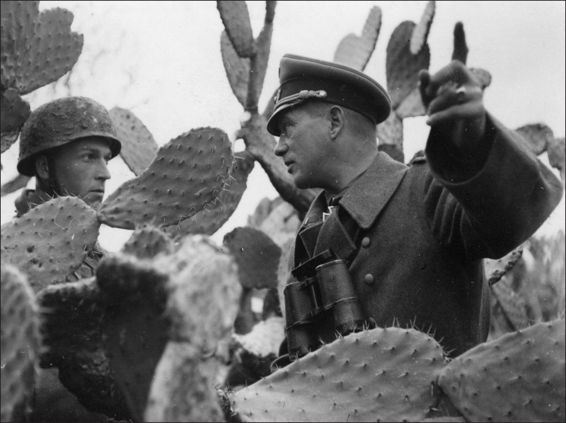
Battalion commander Rudolf Witzig receiving orders from Colonel Friedrich Freiherr von Broich in North Africa. In Tunisia Kampfgruppe Witzig’s battalion was initially subordinated to Division Broich (later redesignated Division Manteuffel) and then to the Barenthin Glider Regiment.
In Tunis, Witzig’s battalion was detached from Koch’s command and subordinated to the newly formed Division von Broich, consisting of a hotch-potch of formations. No sooner had they arrived than Witzig and his men came under attack. ‘We had hardly set foot in Tunisia when we were bombed by British aircraft,’ remembered Rifleman Bohn. ‘Two comrades were killed. These were the first fatalities of our company. The war had started for good! We commandeered a large number of private vehicles and drove off in the direction of Sedjenane and Djebel Abiod.’42 Within a short period of time, Bohn, Feigl and Wenzel would find themselves in good company as German reinforcements continued to pour into Tunis and Bizerta. By the end of November the Axis order of battle in North Africa included the two battalions of the 5th Parachute Regiment, three companies of Witzig’s 11th Parachute Engineer Battalion, and two-and-a-half battalions of the Barenthin Luftwaffe Rifle Regiment, commanded by Colonel Walter Barenthin. Manned by air force personnel, the regiment was chiefly composed of the staff and students of the Parachute School at Wittstock and the Glider School at Posen. As a result, it was frequently referred to as the Barenthin Glider Regiment. Other reinforcements included Marsch Battaillonen (Personnel Replacement Transfer Battalions) 17, 18, 20, and 21, and miscellaneous artillery and anti-aircraft units.43 Although ‘march battalions’ were organized strictly speaking for the transfer of personnel from the replacement area to the theatre of operations, the German situation in North Africa was so desperate that many of these units would be thrown into combat without sending the men to the field units for which they were intended.44 Nehring reported that some of his march battalions were armed only with their personal weapons and lacked any anti-armour capability.45
Mobile and armoured units included two reconnaissance companies, detached from the 190th and 501st Panzer Battalions, and two companies of the 7th Panzer Regiment of the 10th Panzer Division. The only complete German formation still due to arrive was the 10th Panzer Division. German forces consisted of ten battalions, averaging 400 men each, supported by 130 tanks and 28 field artillery pieces.46 In addition, on 12 November the Italians had started to send over the Superga Division, including four infantry battalions, commanded by General Lorenzelli. This move was still going on during December. They also sent the 10th Bersaglieri and two battalions of the San Marco Regiment of Marines, which were subordinated to Nehring on 2 December.47 This gave the Italians a total of five battalions of unknown strength.48 German and Italian combat troops were supported by reconnaissance, engineers and signal troops of undetermined strength. Some of these German units had originally been intended for Rommel’s army. The march battalions, for example, had been destined to be reinforcement drafts, but were instead sent directly to Tunisia and put into the line, where they fought as infantry battalions. By 17 November the British estimated the enemy strength at around 500–1,000 combat personnel in the Tunis area and another 4,000 at Bizerta, with an unidentified number of tanks at each location. In addition, a large number of combat and support aircraft had been flown in. By the end of the month, the Axis forces in Tunisia, exclusive of support elements, would total approximately 15,000 fighting troops backed by 130 tanks, 60 artillery pieces and 30 anti-tank guns.49
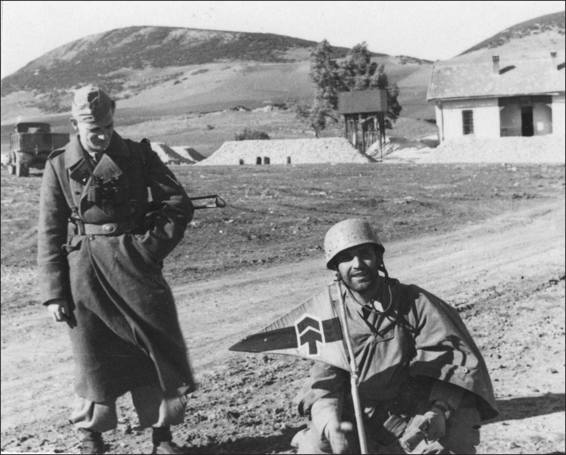
Witzig outside his headquarters in Jefna with one of his airborne engineers. Note the soldier is wearing the distinctive German airborne helmet, while Witzig is wearing a soft garrison cap. Several of Witzig’s soldiers told the author that Witzig never wore a helmet in North Africa – only his cap.
Despite the flow of German troops into North Africa, they remained heavily outnumbered by the Allies. A newly arrived British battalion, for example, had an authorized strength of 1,000 men, and many in fact fielded over 800, while a German battalion typically had only 400. Similarly, a British brigade had three battalions of approximately 2,400 men, while a German infantry division with nine battalions had only 3,600. A British infantry division normally had three brigades, while a British armoured division had three armoured regiments of battalion size and a motorized infantry brigade. In comparison, a German armoured division had only one armoured regiment and six infantry battalions, totalling some 2,400 men. ‘If the strength of a British battalion dipped below 350 men, it was disengaged from the front and filled up,’ wrote General von Arnim, while that same figure was the average strength of a German battalion and this number decreased for as long as the Germans fought in Tunisia.50 Yet despite their superiority on land, sea and in the air, the Allies had failed to exploit it in a timely manner due to their inexperience and caution, a mistake which would cost them dearly and seriously delay their inevitable victory.
If, like many, Rudolf Witzig had imagined North Africa as a dry country, he was in for a rude awakening. Winter was the wet season and the extent of the rains and their effects on the roads, on crosscountry movement and on the airfields was as much of an unpleasant surprise to the Germans as it was to the British. In the northern zone, in which Witzig’s troops and their colleagues faced the British First Army, the rains began early in December and would continue until April, with March the wettest month. Rain, mist and ‘a particularly glutinous mud’ formed the background to Allied and Axis operations during the North African campaign. Furthermore, both sides had to contend with a large, austere and extremely difficult theatre of operations. Northern Tunisia is a country of high mountains, narrow plains between the ranges, and few roads, with a limited scope for armoured action. In the south it becomes much more open and desertlike, but rocky hills occur everywhere. The distance between Algiers and Tunis is about 900 km and at first only two main roads and an inefficient railway were all that were available to the Allies and Axis alike in the extremely mountainous country. Both armies were completely dependent on what they brought with them in terms of transport, ammunition, fuel and supplies. ‘Nothing whatsoever was available locally,’ reported General Anderson, the British commander. ‘Indeed, we had to supply the railway with coal, and our [French] Allies, out of our none-too-plentiful stocks, with rations, petrol and other supplies.’ The Germans were forced to do the same with the Italians in order to keep them in the fight. The term ‘front’ was deceptive and, when defending, each side could only cover the main passes through the mountains with small forces of up to a brigade group. Gaps between these defended areas varied from 15 to 30 km as the crow flies, and these spaces were inadequately patrolled by both sides. General Anderson could have been speaking for the Axis as well, when he said of the Allies: ‘Always the need was for more infantry.’51
The fighting in Northern Tunisia can be divided into three main phases. The first phase was a race for Tunis and Bizerta between the Allied and Axis forces. ‘We just failed to win this race, after some bitter fighting in bad weather, which gave us our first experience of Tunisian mud,’ reported Anderson. ‘This phase ended after Christmas 1942.’ The second phase lasted from 28 December 1942 to 27 March 1943. During this time both sides attempted to build up their forces and to hold or seize ground important for future operations, while struggling to improve their lines of communications. ‘We were mainly on the defensive, suffered from an acute shortage of infantry, and were often very hard pressed in the mountainous country.’ Finally, the third phase lasted from the Allied counter-attack at Djebel Abiod on 28 March through the final destruction of the Axis forces in Africa on 13 May 1943.52
Nehring initially expected the British to advance against Bizerta and Tunis along the two principal roads and believed they would try to capture Bizerta early. He decided to counter this move by attacking first. For this purpose, Witzig’s battalion, reinforced with tanks, armoured cars and artillery and redesignated Kampfgruppe Witzig, was sent from Mateur towards Tabarka on 16 November with orders to drive the enemy back to Bône. The battalion was replaced in Mateur and Bizerta by Kampfgruppe Stolz. During the next few days the Axis occupied Sousse, Sfax, and Gabès, and raided Gafsa. In the meantime, the Tunis bridgehead continued to take shape. Gradually, all units in the Bizerta bridgehead coalesced to form the Von Broich Division, to which Witzig’s 11th Parachute Engineer Battalion had been attached.
The Germans advanced along four separate axes towards Djebel Abiod, Béja, and Medjez el Bab as part of Operation Wild Sow. Witzig commanded the north-westernmost column. ‘Hardly had we arrived [in North Africa] than the battalion received orders to march immediately after it was motorized,’ he recorded.53 Kampfgruppe Witzig had been motorized on short notice with requisitioned vehicles; its own motor park, having been left behind in Germany, was scheduled to arrive by sea. It had also been reinforced and now consisted of the 11th Parachute Engineer Battalion’s 1st and 4th Companies (the 3rd Company having remained behind on the approach to Mateur), a battery of 105-mm guns, 16 light tanks, six 20-mm anti-aircraft guns, and 6 Italian armoured cars with 47-mm guns, totalling almost 600 personnel.54 There was heavier armour too. While not mentioned in Witzig’s official report, Matthias Scheurer, who served under Witzig in North Africa, remembers that Witzig was also reinforced with four Panzer IVs55 and in his postwar history of the battalion, Witzig mentions that he was reinforced with a company of Panzer IVs.56 ‘On 16 November the small combat team marched in the early afternoon, first, past the far superior French garrison at Ferryville, which reacted passively, and then past Mateur, approximately 35 km south-west of Bizerta,’ recorded Witzig. ‘We were enthusiastically received by the Arab and Italian settlers.’57 As the Germans began their advance, an Italian settler brought Witzig his beautiful white sports car and handed him the keys, remarking: ‘I will not need it now. If all goes well, you can give it back. If not, it’s lost anyway!’ ‘We used it until April 1943,’ remembered Witzig.
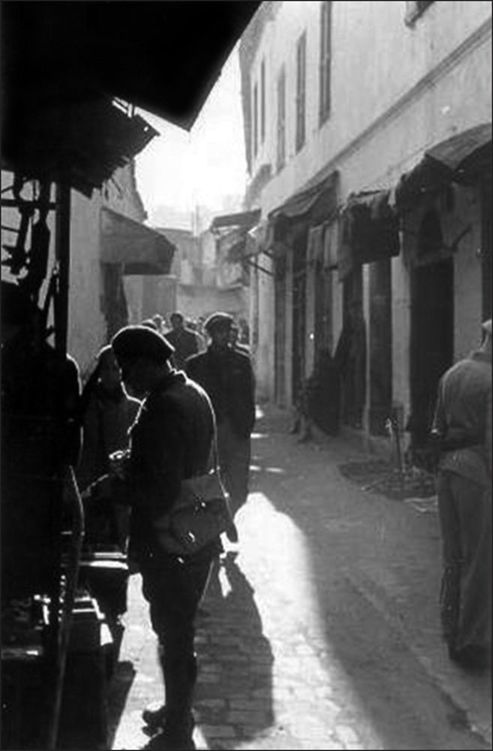
A street scene in Tunis. Both armies were dependent on what they brought with them; few supplies could be be obtained locally.
The British had earlier attempted to beat the Germans to Mateur, but had been thrown back and were now dug in at Djebel Abiod. At 1500 hours on 16 November they spotted a column of German tanks and armoured cars approaching. ‘They were by no means fully deployed, believing that Djebel Abiod was unoccupied,’ recorded General Anthony Farrar-Hockley, historian of the British campaign in North Africa. ‘Behind the tanks in transports was a detachment of parachute infantry.’ The British opened fire at 200 metres, knocking out the two leading vehicles. Then a dog fight ensued around the village ‘the powerful 75-mm gun of the Mark IV being particularly deadly in a long-range sniping at the British 2- and 6-pounder anti-tank guns’.58 Heavy British artillery fire pounded Witzig’s column, which deployed swiftly and then responded for the next three hours with accurate mortar and machine-gun fire, accompanied by effective shelling from the tank guns. Witzig and his men had been taken by surprise. ‘Almost no reconnaissance!’ recorded Helmut Wenzel angrily in his diary afterwards:
Our tanks engaged the target while we lay in a ditch. Our 88mm Flak was outstanding! It fired from the open road until it received a direct hit and the crew were killed or wounded . . . The British were well camouflaged in a village, while we were in the open. Finally we occupied a small hill beside the road and a few Arab huts.59
Their superior position and unyielding small-arms and artillery fire decided the matter in favour of the British, despite the presence of the Luftwaffe overhead, which contributed little to support Witzig. ‘Due to the lack of infantry, a further advance was not possible,’ Witzig later reported.60 At dusk, the Germans and Italians retired, having suffered some twenty casualties and eight tanks knocked out. ‘Losses were heavy,’ reported General Anderson.61 The British suffered the loss of five field guns, most of their anti-tank guns, and a large number of carriers and other vehicles destroyed or damaged.62 The following day Wenzel recorded the loss of two men from the 1st Company, including Pionier Schumacher, who was ‘so heavily wounded by artillery fragments that he died’.63 Within a short period of time the Germans would learn to respect the British artillery. Fast, accurate, unrelenting, and plentiful, it would make their lives in Tunisia miserable. Witzig’s positions at Djebel Abiod mark the westernmost points which German forces would reach in the entire Tunisian campaign.
The battle continued at intervals during the next two days, with both sides receiving reinforcements but neither being able to gain the upper hand. ‘The Kampfgruppe was forced to switch to the defence, between high ground occupied by the enemy, which succeeded without the loss of heavy weapons or motor vehicles due to the quality of leadership,’ Witzig reported. ‘Despite unbelievably unfavourable positions (with no covered approaches, no covered artillery positions, no favourable terrain of attack or attack zone for our tanks), the Kampfgruppe held its ground until 25 November 1942, some 50 kilometres forward of friendly lines and with no other German or Italian units on its flanks.’64 On 21 and 22 November Lieutenant Hünichen’s 1st Company launched successful night combat patrols. A reinforcement of 300 Italian paratroopers on 22 November did not improve Witzig’s situation substantially. These were probably the surviving elements of the Italian Air Force’s 1st Folgore Parachute Division, formed in September 1941 and deployed to North Africa in July 1942. There, the division served alongside Rommel’s Afrika Korps until November 1942, when it was largely destroyed during the battle of El Alamein and reduced to the strength of one small battalion.65 It was probably these survivors that were sent to reinforce Witzig’s battalion and it is no surprise that his Fallschirmjäger formed such a poor opinion of their Italian counterparts. According to Matthias Scheurer, the Germans found them poorly-armed, ill-equipped, and weakly trained and called them, derisively, ‘Die Spaghetti Kameraden’.66 By the time the initial series of battles was over, Witzig’s command had suffered 83 casualties, including 1 officer and 17 NCOs. The high percentage of killed, wounded, and missing among the leadership cadre was the result of the German belief in leading from the front.67
On 25 November the Allies attacked to drive back the Germans and Italians, capture Tunis, and reduce Bizerta. Witzig’s reinforced 3rd Company in Mateur, acting as the division reserve, successfully repulsed an American tank attack 17 km south of the city. This was the closest Witzig would ever come to U.S. soldiers. That same day, the British 36th Infantry Brigade attacked in Witzig’s sector, only to find their bird had flown the coop. Witzig’s orders to hold a position as far forward as possible had been changed, as the concentration of German forces around Bizerta had been completed. As a result, the 11th Parachute Engineer Battalion and its attachments had withdrawn in two stages to Djefna, some 20 km west of Mateur, during the two previous nights, unnoticed by the British, who had been reinforced. To assist in covering their withdrawal, a night attack was launched by one of the platoons of Witzig’s 1st Company, under the command of the company commander, Lieutenant Hünichen. Its mission was to determine the strength of the British and whether or not Abiod could be taken without heavy losses. The attack proceeded well, supported by artillery, and was executed with minimal losses. It determined, however, that Abiod could be taken, but not held without additional infantry reinforcements. As a result, Abiod remained in British hands. Instead, Witzig ordered an attack on the railway station at Nefza, which was located 2 km forward of the German front lines in order to delay the Allied advance as long as possible. Well supported by artillery, the attack was conducted by the 4th Company, led by Sergeant Schürmann. According to Witzig’s report, the station remained in German hands for the complete period needed to withdraw.
The British, estimated by Witzig at two to three battalions, two batteries of artillery, and a number of tracked vehicles, advanced cautiously for the next two days, slowed by numerous mines and booby traps, all expertly laid by the parachute engineers, before stumbling upon their opponent just west of Djefna. The Fallschirmjäger, supported by a battery of Italian anti-tank guns and reinforced by the 8th Company of the Barenthin Glider Regiment,68 were ready for a fight.
‘Posted on top of the hills, we waited for the clash,’ remembered Rifleman Bohn of the 4th Company.69 Witzig had prepared the position with meticulous care, directing the construction of sheltered gun pits and ensuring interlocking fields of fire and excellent camouflage. A German account later called the fortified area ‘a Tunisian Verdun on a minor scale’. Minefields were laid on both sides of the road, while the high ground was protected by wire obstacles and S-mines. Weighing about 4 kg, the anti-personnel ‘S-’ or Schu-mine contained 250–360 steel balls, short lengths of steel rod, or small pieces of scrap steel. Pressure- or remote-activated, the mine was propelled some 1–1.5 metres into the air by a secondary charge before detonating and scattering its load. It was capable of killing those within a 25-metre radius and wounding and maiming up to 100 metres.70 Allied soldiers on all fronts soon learned to fear the S-mine.
Lead elements of the 36th Brigade attacked at dawn on 28 November. By 1200 hours they had advanced some 24 km, reaching their objectives, designated as Green and Bald Hills, on which Witzig’s men were positioned. Witzig, who had been expecting the attack, waited until the two deployed companies of the 8th Battalion, Argyll and Sutherland Highlanders, were well within the kill zone before giving the order to open fire. Anti-tank guns ripped through the first and last carriers, trapping the column on the narrow road, and then dense 20-mm and mortar fire raked the column back and forth along its entire length. Within ten minutes the two British companies had lost almost a dozen tracked carriers and suffered 30 men killed, 50 wounded and another 86 taken prisoner. ‘Eleven light tanks were destroyed, approximately two companies were dispersed,’ Witzig reported without any elaboration. But the British fought back resolutely. ‘It was terrible,’ remembered Rifleman Bohn. ‘The khaki uniforms worn by the soldiers of both sides were mixed in the battlefield. Our small group numbered only 28 men and so was grossly outnumbered by the foe. Fighting petered out about 4 p.m. Both sides had suffered heavy casualties.’71
Bohn was among the German casualties:
I was captured by the British along with two wounded comrades. For us the war was over. In spite of their heavy losses the British treated us with fair play. Two of them tended my wound, expressing surprise on discovering that a “Green Devil” [German paratrooper] could be so young. It seemed to me that the British regarded us as gallant and loyal soldiers, certainly among the bravest they had to contend with.
In February 1943, Bohn was shipped to Britain on a hospital ship and from there, in May, to a prisoner of war camp in the United States. A photo of the young German soldier in captivity shows a handsome and proud young man, glaring defiantly into the camera, wearing a tropical tunic borrowed from a comrade lest the sight of his own, tattered when he was wounded in Tunisia, might distress his parents, for whom the photograph was intended.72
During 29 and 30 November the British continued their assaults, invariably preceded by heavy artillery barrages. Three company-size attacks were repulsed and a two-battalion assault fared little better. ‘The enemy was repulsed after a heavy fight,’ reported Witzig, noting in his history of the battalion that these were the heaviest attacks his unit endured during the entire North African campaign. Three of his officers and a fourth from the 8th Company of the Barenthin Glider Regiment were wounded in the fighting.73 The British then withdrew some 2 km and proceeded to pound the German positions to pieces with generous doses of artillery. ‘Our greatest asset was our preponderance in artillery,’ reported Anderson accurately, ‘and the front seemed at times largely held by artillery fire.’74 Within a short period, Witzig’s command had sustained 100 per cent officer casualties and the number of killed and wounded among his men was so high that he had to merge the 1st Company into the 4th, giving the combination a total strength of one officer and 200 other ranks. The withdrawal of what remained of the 300 Italian paratroopers was more than balanced by the addition of a separate company of 250 German soldiers.75 On 30 November the British 36th Brigade finally withdrew, unable to budge the Germans from Djefna. Witzig and his paratroopers had stopped a British brigade of more than 4,000 men dead in its tracks. ‘For six months, the Djefna position would remain as impregnable in fact as Eben Emael had been in reputation,’ writes Rick Atkinson, a historian of the campaign.76