
Chapter One
In the afternoon of 29 June 1945, Louis Lemarquand, a 14 year old boy from Querqueville in the suburbs of Cherbourg, heard loud noises coming from the airfield near the village. It was a place he had frequented for nearly a year; he knew every corner and every aeroplane, not to mention ‘his’ GIs, who would share their chewing gum with him from time to time. With the war in Europe over and the atmosphere on the base pretty relaxed, Louis headed over to the airfield as soon as he could. Once there, he was astonished to see aeroplanes without any propellers. He asked what they were and was told they were Arados as well as Messerschmitts and other unknown aircraft. The man he spoke to may well have been Flight Lieutenant Roy Brown of the USAAF (United States Army Air Force), who had just landed with his Me 262 ‘Pick II’.
Louis Lemarquand and Roy Brown have each described their individual memories of the last moments of Operation Lusty. Similar to Operation Dick Tracy (mentioned in the introduction), it consisted of capturing the Luftwaffe’s most interesting technological innovations, in order to deconstruct and study them back in America.
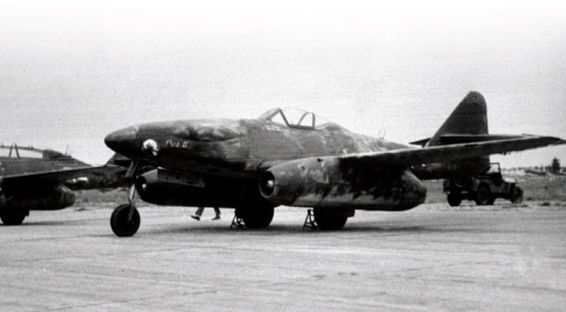
The Messerschmitt Me 262 ‘Pick II’ on the ground at Melun-Villaroche.
Intelligence gathering
Intelligence gathering from both allies and enemies, has always been one of the main springboards of technological progress. For example, when the Americans entered the First World War in 1917, they had virtually no military aircraft; just fifty-five training aircraft in the United States, of which fifty-one were unusable. Major Raynal C. Bolling was therefore charged with collecting intelligence from the Allies and as a result he acquired aircraft, engines and licences from companies such as de Havilland, Sopwith, Nieuport, Breguet, Caproni, Isottas, Rhone and Gnome. The Americans, entering the war in 1917 with only 55 training aircraft on their soil, had 1200 in Europe by 1918. This was increased to 11,760 by November 1918 and afterwards continued to increase at a rate of 13,500 a year. This clearly demonstrated the importance of intelligence gathering that would be seen later in the form of Operation Lusty.
Despite Lindberg’s warnings in 1938, in which he claimed that the German air force was superior to those of Britain, France and Russia combined, history repeated itself and in 1941 the USA did not have sufficient numbers of aircraft, meaning they were unable to protect their ships on the east coast. As a result, they had to ask the British to hunt down enemy submarines using the RAF Lockheed Hudson planes based in Guantanamo.
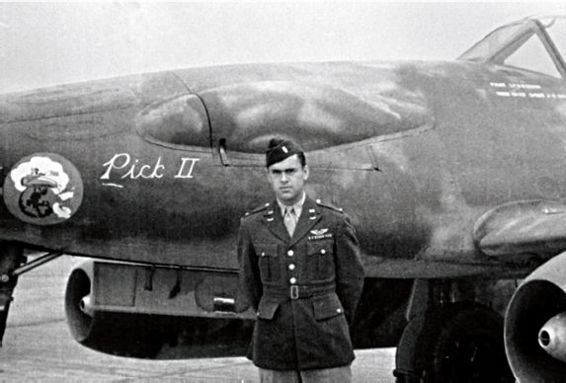
Lieutenant Roy Brown in front of the Messerschmitt Me 262 ‘Pick II’ at Melun-Villaroche.
Air Technical Intelligence (ATI)
The concept of Air Technical Intelligence was born from a meeting between General Arnold and Dr T. von Karman, a professor at the California Institute of Technology. Its aim was to bring together all the technological developments made during the war. Von Karman was an eminent specialist in aerodynamics and during the First World War had built an observational helicopter for the Austro-Hungarian Army, that worked in a similar way to a captive balloon.
In early 1942, at Wright Field near Riverside in Ohio, an organisation was created that would collect and study information on all aircraft wrecks and crashes, as well as looking at all the characteristics of enemy planes. One of the most memorable of these cases was the discovery on 25 June 1942, of a previously unknown aluminium alloy in the wreck of a Nakajima 27 MK-3. The exceptional properties of this alloy would mobilise the specialists working at the Aluminium Company of America and Reynolds Metal Company.
After the Normandy Invasion, some of these specialists, the Crash Intelligence Officers, were sent to work in France. On 10 August 1944, they reportedly took part in the capture of an important radar centre at Perros-Guirec, Brittany. Amongst the group were specialists from Benito, Coastwatcher, Freya Hoarding, Windjammer and Würzburg, who collected all the equipment together and immediately sent it back to Wright Field. In September, the same intelligence officers discovered a V1 flying bomb near Cherbourg and sent it back to Ohio on 8 September.
The Scientific Advisory Group (SAD)
It was not until the liberation of Paris that the American services became independent from the RAF and on 5 September they installed the Air Technical Intelligence Section at Saint Germain-en-Laye. On 11 December 1944, General Arnold created the Scientific Advisory Group and Wright Field established a ‘blacklist’, containing the thirty priority targets the intelligence officers should capture; notably the Me 262 and the Arado 234, the latter of which needed to be seized intact.
In February 1945, an Ar 234 landed in a minefield between the American and German fronts near Selgedorf. The engine carriage and wings were dismantled overnight and shipped to Farnborough via Liege, before the German artillery had a chance to pound the remaining wreckage of the aircraft in to pieces.
On 31 March, an Me 262 was transported to the aerodrome at Frankfurt, where it was dismantled, transferred by road to Rouen and shipped back to the USA, arriving at Wright Field on 29 August. Operation Lusty had begun. If the blacklist remained the primary objective, the Americans’ other preoccupation was the level of technology that had been transferred between Germany and Japan that could benefit the far-eastern country, for example jet aviation, missiles, rockets and, worryingly, nuclear weapons.
The first task the Americans faced was to know precisely what forms of technology had been given to Japan and the centres and factories where these technologies could be developed, in order that they could be destroyed immediately. In particular, they learnt that ten German submarines loaded with Luftwaffe technology (radars, infrared missiles, etc.) had left Kiel in mid-April en route for Japan, and while six were intercepted intact, the other four were already too close to Japan and were not captured.
The V1 against the Japanese
On 17 May 1945, another dismantled Me 262 was found in the holds of Submarine U-234 after it had surrendered and been transported back to the US Naval shipyard at Portsmouth. Although we may never officially know the destination of this curious cargo, it is logical to think that it was on its way to Japan.
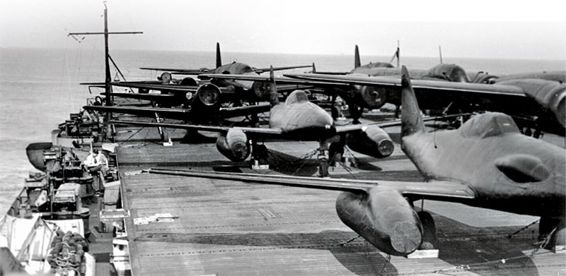
A selection of German technology on the deck of the aircraft carrier HMS Reaper, Cherbourg, July 1945.
The urgency for the Americans to master the German high technology was so great that the arrival of the V1 flying bomb at Wright Field resulted in it being put into production immediately, with Republic Aviation carrying out the first tests from October 1944. Altogether 213 would be built, with the first ones intended to be used to attack Japanese positions.
General Spaatz, at the entreating of Arnold, was at the heart of the success of the SAD. In particular, he secured the help of the ‘long haired scientists’ who arrived in Paris on 1 May 1945 to decipher all the information that had so far been collected on discoveries such as rocket-powered aeroplanes, radio-controlled bombs, wing profiles, etc. During these missions, the forty-seven experts would gather together 16,280 pieces, weighing a total of sixteen tons. Amongst these, 2,398 would be the focus of even further analysis. Of equal interest to the Allied scientists were the applications of cryogenics, optics and at Zeiss in particular, the manufacturing of heavy water.
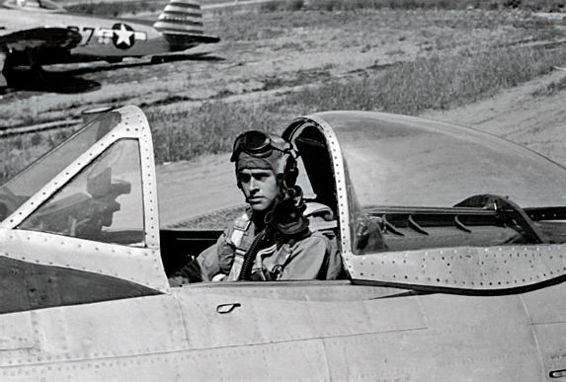
Lieutenant Roy Brown, one of the ten men who made up ‘Watson’s Whizzers’, in his P-47 ‘Pick’.
All of this information eventually found itself being stored in the Air Documents Research Centre in London, which altogether collated some 110,000 tonnes of documents seized in the American, British and even Russian zones during the first three months of the occupation. Included were all the records from the German Patent Centre that had been hidden deep inside a potash mine. At the same time, German scholars, engineers, doctors and technicians were offered employment with the Allies, in order to maintain and work on the technologies that they had previously developed.
Watson’s Whizzers
Whilst Karman set up his scientists in Paris, Colonel H. Watson of the 9th Air Force, a former test pilot at Wright Field and primarily responsible for the maintenance of US aircraft held by the French Air Force, established a new group of pilots; ‘Watson’s Whizzers’, whose role was to take control of the captured German aeroplanes and helicopters. There were two teams; one for the jets (in a way creating the first ‘squadron’ of jet pilots in the USAAF), while the other team was for any aircraft with a piston engine.
Watson’s Whizzers were created in April 1945 at Merseburg, in the German state of Saxony-Anhalt. Watson had considerable powers; General Eisenhower had granted him safe conduct, allowing him to travel not only throughout Germany, but also across the whole of Europe. He was allowed to examine any piece of confiscated documentation and was to have the full support of the armed forces in order to help him achieve his mission.
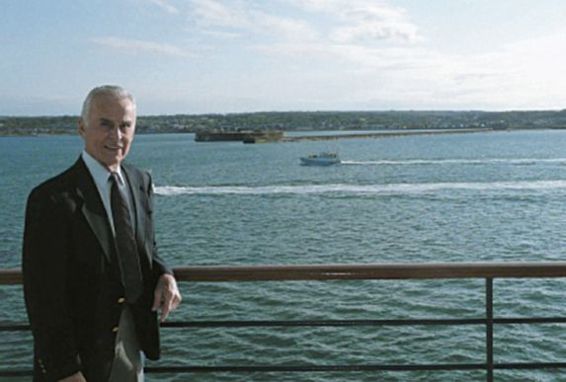
Roy Brown returned to Cherbourg in 2008. He is seen here on the bridge of a boat, off the Querqueville dyke.
On 4 May 1945 the Americans took over the Messerschmitt factory at Lechfield Airbase, south of Augsburg. There, they found fifty Me 262s of all types; those carrying a 50mm cannon, two-seater training vehicles and even ones fitted for reconnaissance and bombing missions. Unfortunately, around thirty of the Messerschmitts were damaged during the attack, and were for the most part repaired on site. Other aeroplanes also arrived at Lechfield Airbase from zones that would soon be occupied by the Russians.
If Watson managed to achieve his set target of ten Me 262s, he still only had two Arado 234s; an aircraft he considered the greatest of the era. He needed two more. More than 200 had been built, and the British, Russians and French had captured almost all of them. This meant he would have to negotiate with the British in order to obtain the additional two he needed.
The majority of the American pilots in Watson’s Whizzers were former P-47 pilots and they arrived at Lechfield ready to begin Operation Lusty. There were six pilots to begin with, then eight and finally ten.
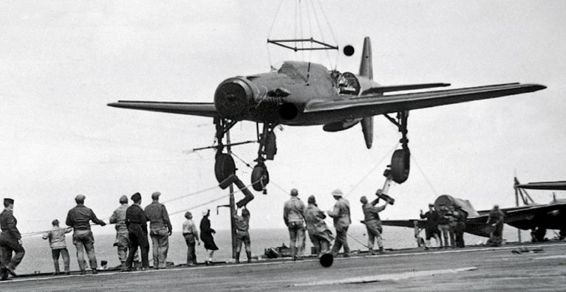
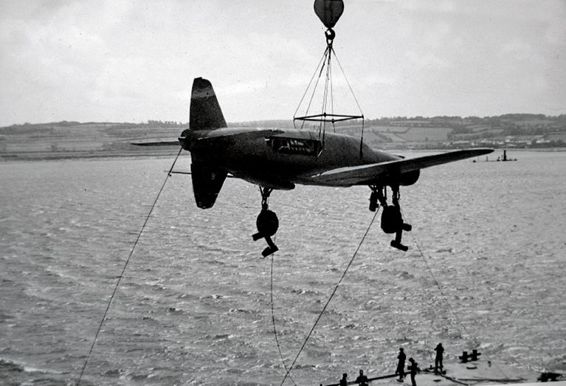
Suspended by the crane, a Dornier Do 335 arrives on the deck of the aircraft carrier HMS Reaper after having been lifted from its transport barge.
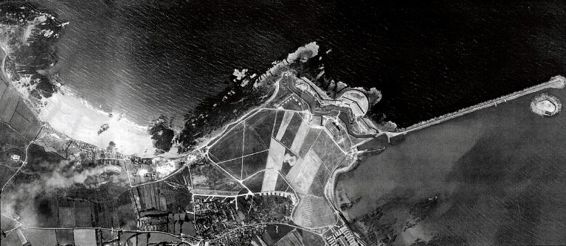
Aerial view comprising of three reconnaissance images taken by the Allies on 22 June 1944, a few days after the liberation of Cherbourg by American troops. Querqueville quay can be seen where the aircraft carrier HMS Reaper will dock twelve months later. (Coll. B.P.)
Amongst them was Lieutenant Roy Brown. The only one of the ten pilots to gain a diploma from MIT, he named his P47 ‘Pick’, after his wife and likewise his Me 262 ‘Pick II’. Indeed, it is thanks to his wife’s name that I was able to find Roy amongst the vast numbers of Browns living in America. Upon returning to Normandy in spring 2008, he was disappointed to be unable to find the missing Querqueville aerodrome.
Operation Lusty was a great secret; not one contemporary war correspondent covered this unknown but crucial undertaking of the Second World War. It is fortunate that Roy Brown owned a camera and, as a consequence, the images he took during the mission have been used to illustrate this book.
At Lechfield, Watson’s Whizzers learnt to work with the German pilots and mechanics in order to fly the machines that had been left behind. The favourable terms offered in return for their surrender were of great interest to many German pilots who landed at American-held airbases. At Munich-Riem airport, on 8 May 1945, Colonel Watson found his own plane to fly; a four-engined Ju 290, similar in size to a B-29.
The machines targeted on the blacklist had practically all been acquired, meaning their departure for the USA could now be organised. Cherbourg was the only Allied port that had an aerodrome close-by, at Querqueville and was consequently given the codename A23. Operation Seahorse got its name from an anagram of Colonel Seashore; the man who would take charge of the Atlantic crossing. The aircraft and helicopters would arrive at Cherbourg after flying over France in stages, with the main relay base situated at Melun-Villaroche (codename A55). An accompanying C-47 would carry the necessary fuel in order to replenish the aircraft along the way.
At Melun, a French test pilot, Colonel Paul Badré, who was also an engineer and resistance fighter, much to the delight of the Americans offered them an Me 262. Other bases along the way were equally sought after, in terms of the space available for the aircraft that would be landing there. Examples include Saint-Dizier, Vilacoublay, Saint-André-de-l’Eure and Caen-Carpiquet. On 27 June, Melun hosted a huge air display of Me 262s, Ar 234s and other machines in front of General Spaatz.
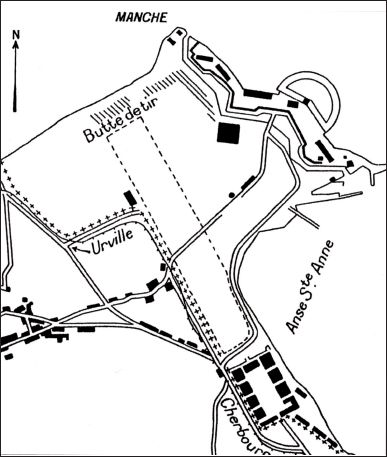
Extract from the Michelin aerial guide dated 1930, this plan shows the location of the Cherbourg-Querqueville aerodrome. The 800m x 150m grassed landing area is on a north-west/south-west axis. Saint-Anne Cove, just to the east can also accommodate the fleet air arm’s sea planes. Equipped with hangars, a two tonne crane and a slip- way to the water, this site had been occupied by the Luftwaffe since July 1940. It was intended for use during Operation Sea Lion, which was eventually foiled by the success of the RAF in what is now called the Battle of Britain.
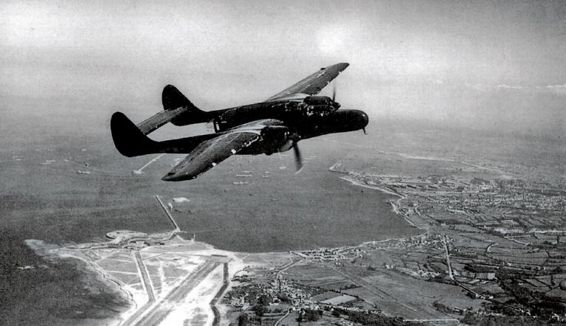
Aerial view of Querqueville aerodrome in July 1944 and a P-61 Black Widow. A tanker can be seen anchored against the sea wall, in the same spot where HMS Reaper would be, one year later.
However, that is not to say that all the journeys to Cherbourg were just ‘joy- flights’. On 30 June for example, an Me 262 got lost in the fog; short on fuel, the pilot had to carry out an emergency landing in Jersey on a small grass runway. Without any means of communication, Cherbourg only learnt of his misadventure two days later, after the story had been relayed through the radio via London. Colonel Seashore sent a C-47 carrying two kerosene cans to Jersey and the Me 262 was able to return safely to Cherbourg. Another Me 262 ‘Happy Hunter II’, carrying a 50mm gun and piloted by Willy Hoffman (a Messerschmitt test pilot), lost an engine near Conches. Willy parachuted out of the aircraft which inevitably crashed to the ground. The recovered gun from the wreckage is still at Wright- Patterson Air Force Base in Ohio.
The Americans had no aircraft carriers in Europe - they were all mobilised in the Pacific - and so had to ask the British for help with transporting the aeroplanes back to the USA. As a result, the British carrier HMS Reaper was commandeered for the occasion. Anchored at Querqueville, where a year earlier, tankers from America had unloaded their precious fuel, all loading and unloading would be carried out at the end of runway A23. Carefully protected and packaged, the aircraft were loaded onto a barge that would then pull alongside HMS Reaper.
Of a total of fifty captured machines, forty-one were on board: four Arado 234s, two Bücker 181s, a Doblhoff jet-helicopter WFF 342, two Dornier 335s, two Flettner 282 helicopters, four Focke-Wulf 190Ds, five Focke-Wulf 190Fs, a Focke- Wulf Ta 152H, a Heinkel 162, three Heinkel 219s, a Junkers 88G, a Junkers 388, three Messerschmitt Bf 109s, a Messerschmitt 108 and ten Messerschmitt 262s.
HMS Reaper left Cherbourg on 20 July. Around ten other aircraft would leave Cherbourg on the Liberty Ship Richard Jordan Gatling and the machinery, test benches, ventilating fans, etc would be carried on other vessels.
His mission accomplished, Watson left Europe on 28 July flying his own Ju 290 aircraft, stopping at the Azores and Bermuda on the way home. The airmen arrived at Patterson Field on 31 July and were greeted as heroes, and the American press reported the arrival of Colonel Watson on board his giant German aircraft in great detail.
Like all the seized machinery, the Ju 290 would be dismantled in order to discover how it had been put together in the first place and so it could reveal all its technical details. It was only discovered later that the aircraft had been booby trapped and set to explode whilst in flight!
In hindsight, one could say that it is due to this capture of the men and equipment of the Luftwaffe that later allowed the US Air Force to make such great technological advancements, resulting in it eventually becoming a world leader in aviation. It is not inaccurate to say that the capture and study of the Arado 234 was a major factor in this technological leap. As we shall see, the role it played at the end of the war could have easily changed the course of history...
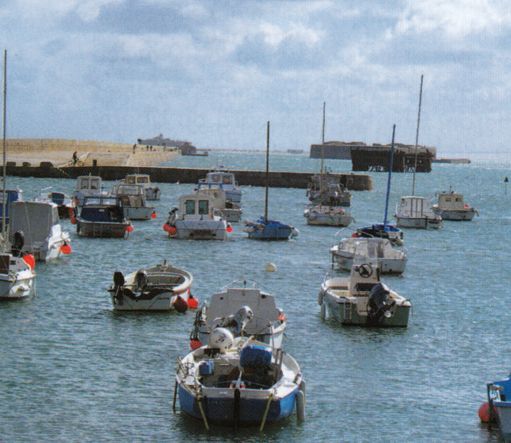
HMS Reaper’s mooring position can still be seen today, on the right and in the middle of the sea wall at Querqueville.
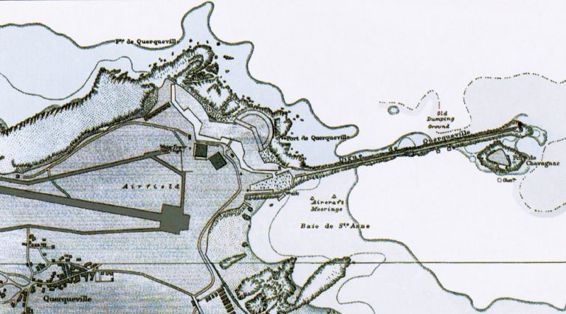
Map of the fort and the tip of Querqueville from the 1960s with the location of the field the Americans constructed on the same site. This field, codenamed A23C (C for cargo as the field was primarily used for refuelling C-47s) had been built by the 850th Aviation Engineer Battalion. This runway, made principally from pierced steel planks, also had disposal areas coated in square mesh netting. 1,400m long, it can be seen that the west-east field had nothing to do with the French field’s grass runway. From 8 August 1944, it was the 877th Airborne Engineer Aviation Battalion who took charge of its maintenance for the American troops. The field would be handed back after the departure of HMS Reaper for the USA. The jetty at Querqueville quay is on the right. (Coll. B.P.)
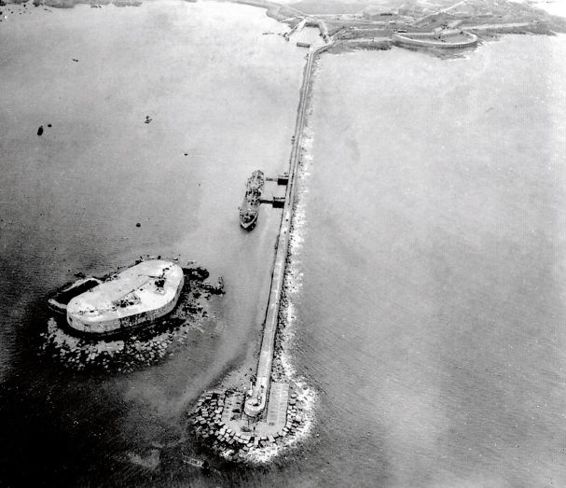
Aerial view of the sea wall at Querqueville in July 1944. Chavagnac fort can be seen, as well as a tanker at anchor, in the same place as the Reaper would be, one year later.
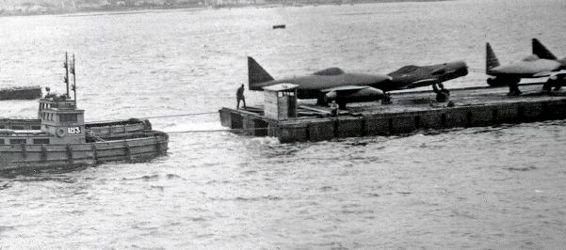
A support barge carrying aircraft approaching the Reaper. On it are Me-262s and a Focke-Wulf I90D-9.
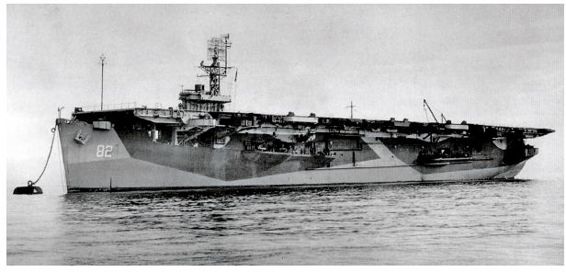
The aircraft carrier HMS Reaper at anchor in England.
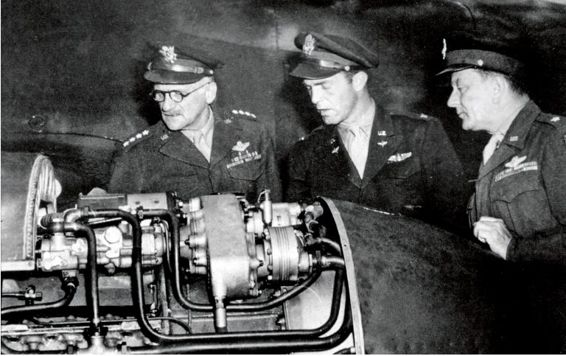
General Spaatz, Colonel Watson and Brigadier General McDonald inspecting a Jumo 004 engine during their meeting at Melun, 25 June 1945.
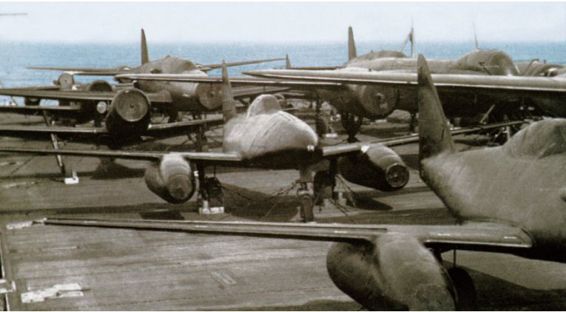
Some of the planes on the ‘Blacklist’, stowed on the deck of HMS Reaper.
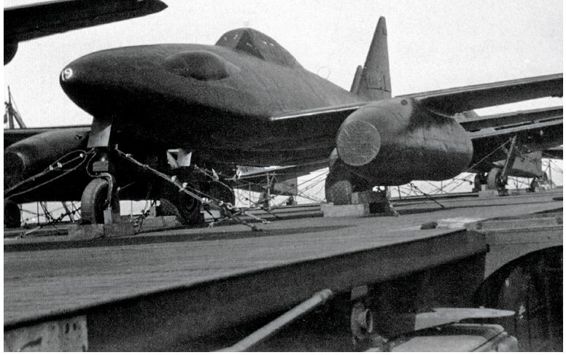
An Me 262 tied down on the deck of HMS Reaper.
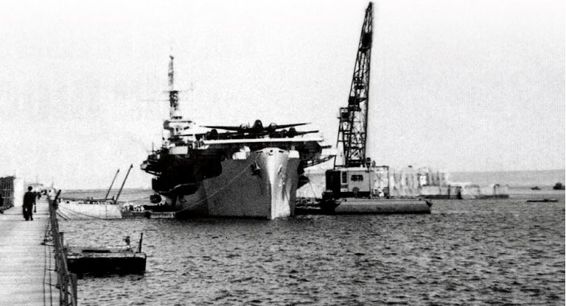
HMS Reaper at anchor alongside Querqueville sea wall. Against the port side, a jib crane installed on a floating barge allowed the aircraft to be transported from the support barges to the deck of the carrier.
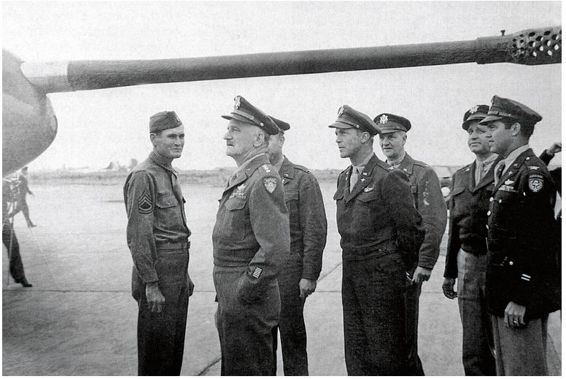
General Spaatz, still at Melun, observes the 50mm gun of ‘Happy Hunter II’. Colonel Watson stands behind him. You can see his insignia showing his position as a pilot in the Army Air Force has kept its silver appendix.
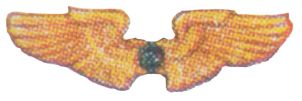
The official insignia of the Army Air Force, as modified by each of the ten pilots of Watson’s group. The two original propeller blades, a symbol of the combustion engine, have been removed. The pilots in Watson’s group, conscious of being part of a new group of aviators, had decided to ‘create’ this new non-regulatory insignia themselves, in order to honour their new position. Only Watson, a career soldier, kept his intact.
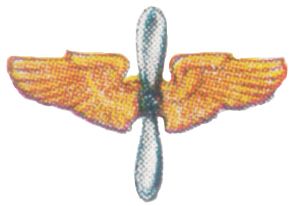
The official insignia of the Army Air Force, with the small vertical silver propellers welded on to the two traditional adorning wings.
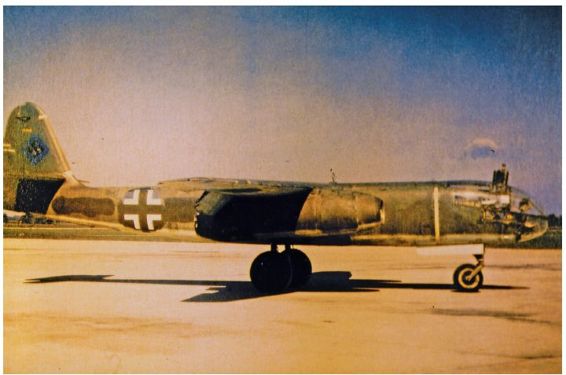
Colour photograph taken at Wright Field before the ‘Americanisation’. (Smithsonian ASM)
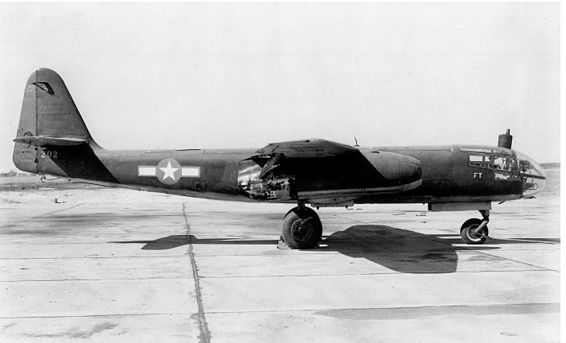
An ‘Americanised’ Arado 234 at Wright Field in September 1945, ready for inspection. (Smithsonian ASM)
Operation ‘Dick Tracy’
Operation ‘Dick Tracy’ was only a small part of what was a vast undertaking of systematic plundering of more than twenty years-worth of Nazi Germany intelligence.
The primary objective was to seize all of the scientists, researchers and engineers who had developed materials, products and machines that had ensured the supremacy of the regime. As well as the men themselves, who had been the focus of Operation Paperclip, also captured were rockets, aeroplanes or helicopters, chemical weapons, magnetic tape, cars, radar submarines and even entire coal liquefaction factories.
Even if the main target was the researchers themselves, the Allies were as equally interested in their work. 3,000 tonnes of various papers (such as these, reports and patents) were seized and their recovery required an enormous logistical operation; it took entire convoys of trucks to transport some 1,500 tonnes of patents discovered in the salt mines at Wintershall, where they had been hidden by the Reichspatentamt (Office of Patents and Trademarks).
Similarly, the Allies also decided to seize the thousands of aerial photographs taken by the Luftwaffe both before and during the war in an operation codenamed ‘Dick Tracy’, after the famous American cartoon. From 1938-1945, these Luftwaffe photographs covered all the European theatres of operation, including ones taken at Juvincourt in September 1939, in what was almost a premonition of what was to come.
For the most part, these photographs were archived at Templehof Airport in Berlin, where they were later seized by the Russians, but there were others kept elsewhere. All the Allies were in competition with each other to acquire them, with those in Berlin eventually ending up in American and British hands. Today, they form part of a collection of more than 1.2m aerial photographs that can be accessed at the College Park National Archives in Washington D.C. Added to this massive collection are the thousands of maps and post-operational reports of reconnaissance missions.
As I can testify from my several visits to the NARA (National Archives and Records Administration), looking through these documents is an extremely rewarding experience. In addition, the military objectives, territorial gains and battle lines are all revealed with striking precision and it was with great joy that I was able to find those relating to the Battle for Normandy, although sadly, too few of them remain.
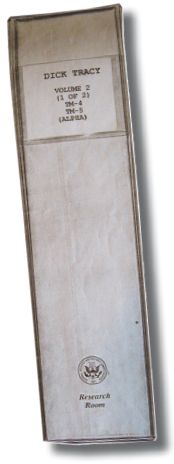
The back of one of the dossiers devoted to Operation Dick Tracy, in the American National Archives (NARA). (DR)
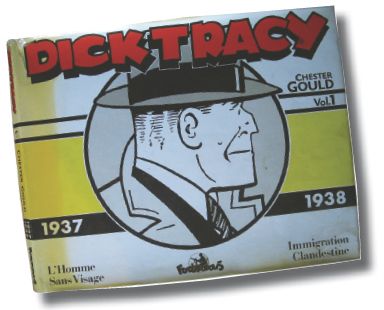
Dust cover of the famous cartoon which gave its name to the operation. (DR)