
Chapter Five
The Germans were the forerunners in the domain of jet aviation since the end of the 1930s, even if they were not the only ones to be interested in this new form of technology; on the other side of the Channel, the British engineer Frank Whittle was also working on similar ideas. On 27 August 1939, the Germans made a ‘jet’ fly for the first time, with the Heinkel He 178 taking the air for a total of eight minutes.

If its design dates from the last few months of the Second World War, the genesis of the Arado Ar 234, the first jet powered bomber to be put into service, actually dates back to 1941.

The world’s first jet aeroplane, the Heinkel 178, carried out its first flight just before war was declared, during the summer of 1939. It remained a prototype and was never put into production. (Heinkel Archives)
In that year, the Reichsluftfahrtministerium (German Air Ministry) asked for the design of a jet-powered reconnaissance aeroplane with a range of 2,150km. The Arado company was the only one to respond, with its E.370 project. The aircraft was a conventional high-winged monoplane, powered by two Junkers Jumo 004 jet engines placed under each wing. Its speed was estimated at 780km/h with a range of 2,000km.
In order to have such a range, considering the enormous fuel consumption levels of the first jet engines, the designers decided to reduce the mass by removing the landing gear, meaning the plane took off on a wheeled trolley and landed on runners once its mission was accomplished. Although the Luftwaffe officials were dissatisfied with its range, they nevertheless gave their approval to the project and asked Arado to provide two prototypes. The airframes were ready well before the end of the year, but the engines were not.
It was only in February 1943 that Junkers delivered the first Jumo 004s. However these initial engines were extremely unreliable, meaning Arado had to wait until the spring, until flight-worthy engines were delivered. The first Ar 234A0 flew for the first time on 15 June 1943 and was joined by three others in September. Eight were produced in total, of which two, the sixth (Ar 234V6) and eighth (Ar 234V8), were powered by four BMW 003 engines.

Features of the reconnaissance and bomber Arado 234. (ASM Washington)

The Arado’s specification sheet. (Smithsonian Archives ASM)
In July, the promising performance of the plane led the Reichsluftfahrtministerium to ask Arado to develop a Schnellbomber (fast bomber), named Ar 234B. As the fuselage was primarily taken up by fuel tanks, the bombs had to be carried on external pylons. As this meant its speed was consequently reduced to 660km/p, it now had to be equipped with a suitable defensive system in order to offer it protection. Thus, two 20mm Mauser MG 151 machine guns were fitted at the back, that the pilot aimed using a periscopic mirror.
Later, the majority of pilots would deem this system unusable and consequently got rid of it. The use of rollers was also made impossible by the external weights, leading to the plane being fitted with a three-wheeled undercarriage instead.
First flight on 10 March 1944
The Ar 234V9, the first of the Ar 234Bs, flew on 10 March 1944. Twenty Ar 234B-0s were delivered before June of that year, but the production was very slow as the Arado factories had been seriously damaged during Allied bombing raids, in particular during the ‘Big Week’ between 19 and 25 February 1944.
Arado’s development efforts were then diverted to the Ar 234V8, also fitted with a fixed gear mechanism. The use of BMW 003 engines proved more promising, as although less powerful, they were lighter and had the bigger advantage of not being used by the Messerschmitt Me 262. The use of four of these engines gave birth to the fastest version of the aeroplane, the Arado Ar 234C, whose prototype, the Ar 234V19, flew in October 1944. Other projects were also launched, some providing the use of crescent shaped wings (which would influence the British designers in their ‘Victor’ bombers), and others with arrow shaped wings. Another project, named Deichselschlepp, would have involved the towing of a fuel tank, a 1,400kg glider bomb or a V1 flying bomb.
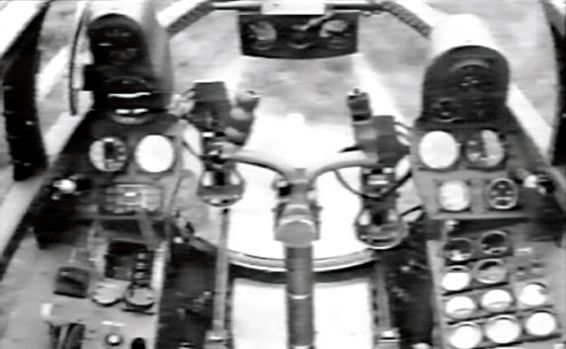
The cockpit of the Arado Ar 234. (DR)
At the beginning of March 1945 however, the work of the designers and engineers was stopped and the Arado factory was methodically destroyed due to the impending threat of the advancing Red Army.
The first combat action the aircraft saw took place when the two V5 and V7 prototypes were sent to France on 25 July 1944. Their objective was to photograph the Allied bridgehead in Normandy, something the ordinary reconnaissance planes were unable to do. Only the V5 could be used, the other aircraft being returned to Germany after experiencing problems with its engine.
Piloted by Erich Sommer, the aircraft first flew over the beaches on 2 August 1944 (see chapter 7). Flying at an altitude of 9,000m and a speed of around 800km/h, the aircraft was not even detected by the Allies. For this mission, two Rb50/30 cameras were mounted on the back of the fuselage, inclined at twelve degrees on either side of the aircraft, allowing photographs to be taken in a 10km band around the trajectory of the aircraft. On the same day, the plane was joined by the other prototype and between them they carried out other similar missions over the following three weeks.
From the first bombing mission to Christmas 1944
In September, the two planes were withdrawn from operations and replaced by the first Ar 234Bs. From October, this aircraft would perform its reconnaissance role, even flying over England in order to determine whether or not a new invasion was being prepared for the Netherland’s coast. It was only on 21 November that a training escort of P-51Bs saw the Luftwaffe’s jet aeroplane for the first time. Realising they’d been seen, the Arados were able to evade the Mustangs, thanks to their quicker speeds and ability to fly at greater altitude.
The first bombing missions were conducted on the night of 25 December 1944, in support of the Ardennes offensive. Nine Arado 234Bs, each armed with a single 500kg bomb, attacked the village of Liege. Several similar missions were completed afterwards, before the weather deteriorated at the beginning of January 1945. The number of planes and the size of the bombs carried, meant that these missions were really more those of a ‘harassment’ rather than a bombing raid in the proper sense.
At this time, the Luftwaffe could only string together seventeen Ar 234Bs, twelve configured for bombing and five for reconnaissance. For those that operated as bombers, the pilots had three methods of attack: flying at low altitude, during which time they would judge themselves when to drop their bombs; bombing in a shallow dive, which started at 5,000m, where they used their periscope to pick out their targets and finally, cruising at high altitude. The latter, although safer, was particularly difficult for the pilots as with only themselves on board, they had to take on the roles of both pilot and bomb aimer. However, they were nevertheless able to rely on the efficient help of the very sophisticated Patin autopilot.
The bombing run was initiated 30km away from its objective. The pilot engaged the autopilot , then pushed the flight control column in order to get to the Lofte 7K bomb aimer, located in the nose of the aeroplane. This viewfinder controlled the autopilot and adjusted the trajectory towards the target, the bombs being dropped automatically thanks to a mechanical calculator.
Although not particularly vulnerable in flight, these operations presented great risks to the Ar 234, because of the strong aerial presence of the Allies. At the beginning of January, when landing at an aerodrome in order to be transferred, eighteen Ar 234s were attacked by Spitfires. Three were destroyed, two others damaged and two German pilots were killed.
Profiting from the improving weather conditions over the following weeks, the Ar 234s would conduct as many missions as possible above the Netherlands and in the defence of Aix-la-Chapelle. One of them would be captured on 24 February, after a P-47 forced it to crash land when its engines failed.
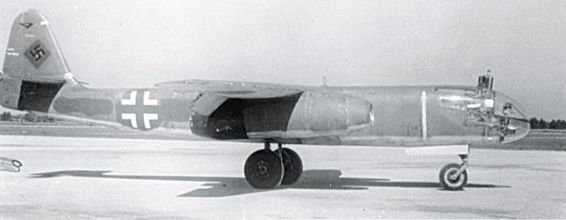
Test run of an Arado 234 equipped with the classic landing gear. (Erich Sommer)
Indeed, even if its pilots found it agreeable to fly, the reliability of the Junkers engines remained a constant problem. A common fault was that the engines would fail following a sudden manoeuvre; the pilot therefore had to expect to be below 4,000m and travelling at 500km/h in order to restore the fuel supply without the risk of catching fire. The problem worsened, when due to fuel shortages, the Germans were forced to use fuel that wasn’t suited for that type of aircraft.
Engine problems to the end
Furthermore, the Ar 234 pilots had to face another major handicap. Although some prototypes had used them, the aircraft did not have an ejector seat, making any evacuation perilous in the case of any emergency. The pilot had to slide through a glass hatch situated on the underside of the cockpit, which while possible on earlier bombers, was practically impossible onboard these jet aircraft. The length of the runway required for takeoff also caused numerous accidents, but the training of pilots on Me 262s and the frequent usage of rockets to assist takeoff, eventually solved the problem.

The first Ar 234s were not fitted with landing gear, but special ‘skates’. Lift off was achieved by using a three wheeled carriage that was detached at the point of take off and used a parachute to brake. Here, the Ar 234 V1 takes off on its third test flight. For the first time, the carriage is dropped at around 150km/h, landing successfully on the ground. (DR)
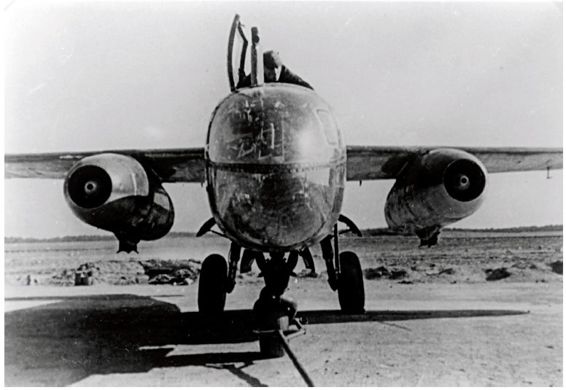
This photograph of the Arado’s nose clearly shows the periscope invented by Erich Sommer that was used to monitor the vapour trails produced by the aircraft. (Erich Sommer)
The taking of Ludendorf bridge at Remagen, would prove to be the greatest occasion for using the Ar 234 as a bomber. On the orders of Hermann Göring, all available aircraft were ordered to try and destroy the bridge. Attacking at low altitude for the majority of the time, they suffered serious losses mainly from the anti-aircraft guns, without succeeding in hitting their target. The bridge would collapse anyway on 17 March, but the bridgehead on the Allied side was still solid and was served by a rapidly built boat-bridge.
Lacking fuel and qualified pilots, the Ar 234s nevertheless continued to be used until the collapse of the Third Reich. Some planes were modified to serve as night fighters, carrying an FuG 218 ‘Neptun’ broadband radar and a pair of MG-151/120 guns mounted on a gondola under the plane. The last Luftwaffe inventory on 10 April 1945 recorded thirty-eight operational planes: twelve bombers, twenty-four reconnaissance planes and two night fighters.
After the defeat of Germany, twelve examples of the Ar 234 were recovered by the British, three by the USAAF and one by the US Navy (see chapter ‘Operation Lusty’). As for the Soviets, it appears that they only seized a single example, mainly due to the fact that the Ar 234 only really saw action on the Western Front.
One of the three planes seized by the USAAF underwent rigorous testing at the Wright Patterson airbase and as the only surviving example remaining, is now conserved at the Smithsonian Institute’s Air and Space Museum in Washington DC.
The different versions of the Ar 234
Ar 234VI, Ar 234V2, Ar 234V3 and Ar 234V4: two Junkers Jumo 004A engines, ‘skates’ for landing
Ar 234V5 and Ar 234V6: two Junkers Jumo 004B engines, ‘skates’ for landing gear. Ar 234V6: four individual BMW 003 engines, ‘skates’ for landing gear Ar 234V8: two sets of two BMW 003 engines, ‘skates’ for landing gear
Ar 234V9: three wheeled takeoff under carriage, two Junkers Jumo 004B engines. The prototype of the B series.
Ar 234B: three wheeled takeoff under carriage, two Junkers Jumo 004B engines. 210 made.
Ar 234C: three wheeled takeoff under carriage, two sets of two BMW 003 engines. Fourteen made.
Ar 234D: draft version of a proposed two-seater reconnaissance and bomber aircraft, with two Heinkel-Hirth HeS 011 engines.
Ar 234P: proposed tandem night fighter.
E.560: A heavier model that adopted an arrow-shaped wing.
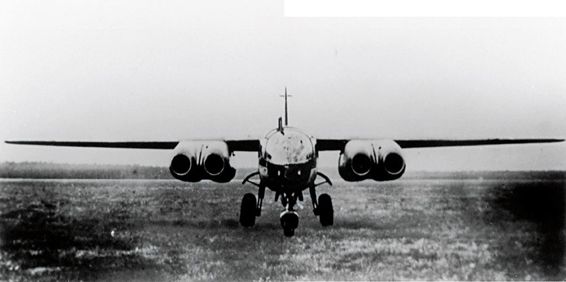
The Arado 234, powered by four engines, on a typical tricycle take off under carriage. (Erich Sommer)
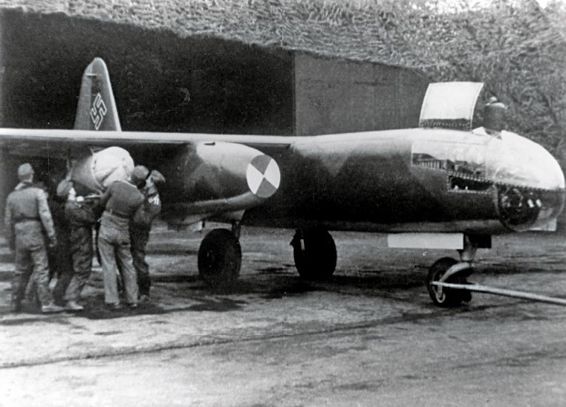
Fitting rocket boosters on an Arado 234 for takeoff. (Erich Sommer)
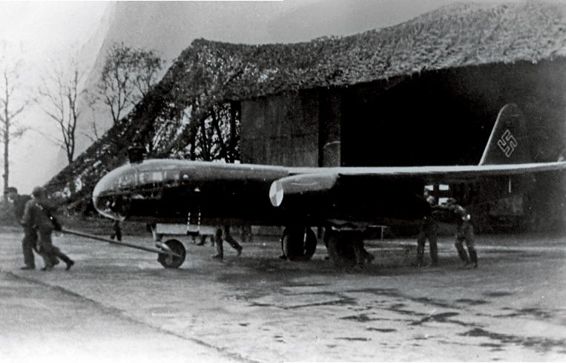
The Arado T9+HH leaving its camouflaged shelter near Rheine at the end of 1944. (Erich Sommer)
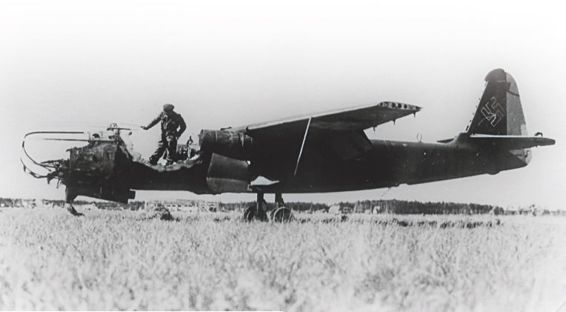
Examining the wreck of a crashed Arado 234. (Erich Sommer)
The famous Junkers Jumo 004 turbo jet engine
The Jumo 004 was the world’s first turbo jet engine to be produced en masse and powered both the Arado 234 and the Me 262.
In 1937, Hans von Ohain, an engineer at Heinkel, demonstrated that it was possible to power an aeroplane with a piston-free engine. At the same time, British engineer Frank Whittle was developing a turbine engine in England.
At Junkers, Anselm Frantz improved Ohain’s design and produced a device with an axial compressor, combustion chamber and turbine. This longer, but narrower jet engine was rapidly adapted to the construction of fighter, reconnaissance and bomber aircraft.
In 1939 the Reichsluftfahrtministerium (RLM) asked Anselm Frantz to develop an engine that he had designed under the number 109.004. After having solved the problems with the blade on the turbine, the first jet engine was turned on and kept going for ten hours at the Junkers factory in December 1941.
On 15 March 1942, an 004 was tested in flight on a Me 110 and on 18 July its first successful flight on board an Me 262 took place. Consequently, the RLM requested another eighty Jumo 004 engines to be produced.
By going into full production, the real shortage of strategic materials became apparent, such as nickel, cadmium and molybdenum. So Junkers turned to Krupp in order to develop an alloy of 12% chrome, 18% manganese and 70% iron: Cromadur. This alloy would help to develop the blades, which were hollowed in order to make the turbine cool down easier.
The development of the motor was finally finished in December 1943. Its rotation speed was 8,700rpm it produced 8.8kN of thrust and weighed 740kg. The Junkers Jumo 004 was started by a small two-stroke Riedel piston engine attached to the shaft and was powered by three kinds of fuel: a synthesis of J2, diesel and aviation fuel. Around 5,980 Jumo 004s and no less than 225,000 blades were produced during the war.
After the war the engine was produced in the USSR, in Czechoslovakia and in France where it powered the SO.6000 Triton, the first French jet aeroplane.
Ironically, this French aircraft, which carried out its first flight in November 1946 using the power of a German engine, was designed right under the very noses of the occupying forces.
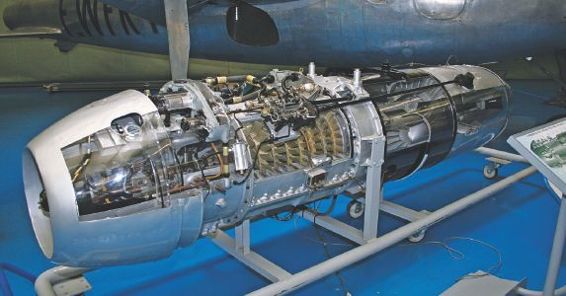
An uncovered Jumo 004 engine at the Musee du Bourget. (Photograph J.C. Augst)
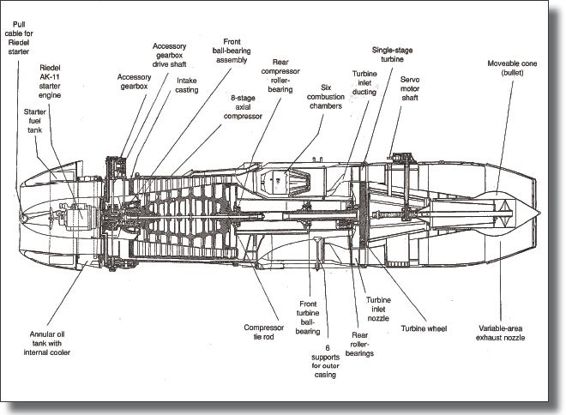
Diagram of a Jumo 004 engine. (Smithsonian Archives ASM)
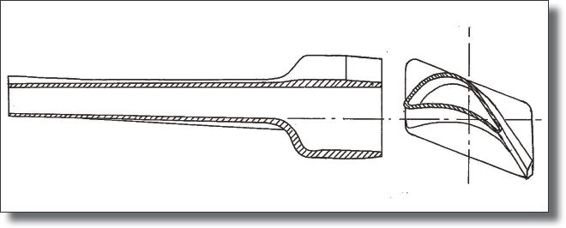
Drawing of a Jumo 004 turbine blade. (Smithsonian Archives ASM)
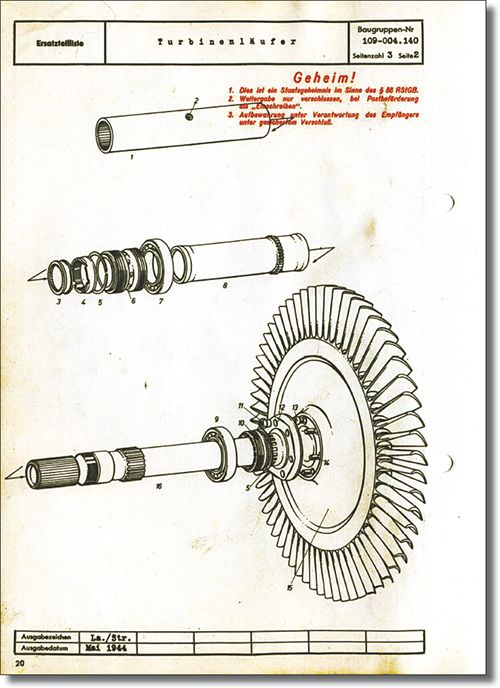
Detail of a turbine on its axis. (Collection of Michaël Fuller)
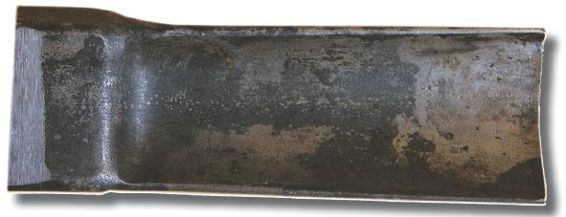
A cromadur Krupp Jumo 004 turbine blade. (Collection of Philippe Bauduin)
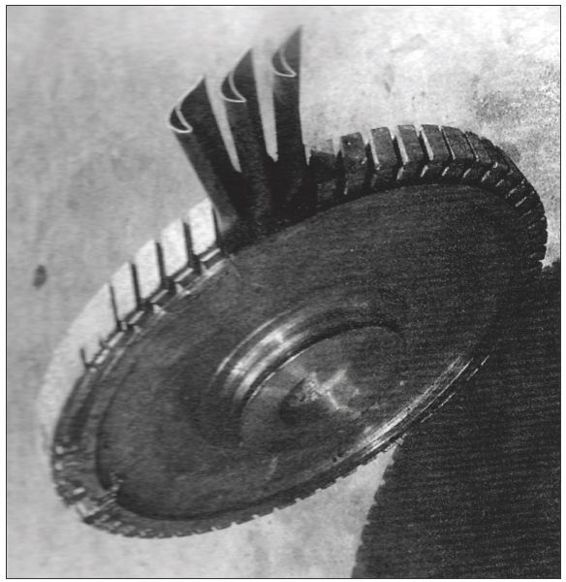
Blades being assembled on a Jumo 004 engine. (Smithsonian Archives ASM)
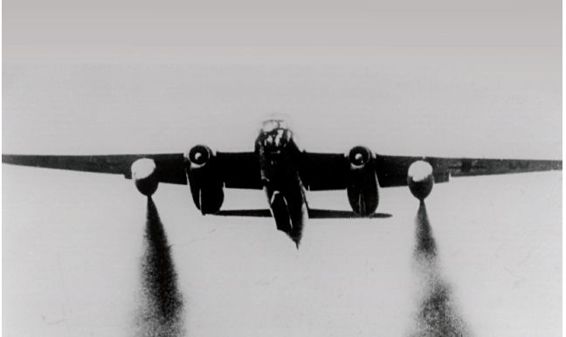
An Arado using its booster rockets to take off. (Erich Sommer)
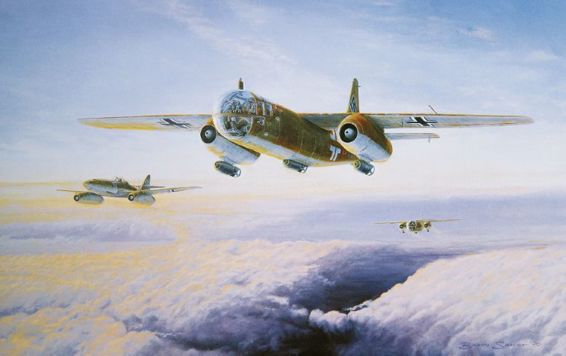
Painting by the Australian artist Barry Spicer showing two Ar 234 bombers escorted by a Messerschmitt Me 262. (DR)
The Arado, the ‘eye’ of the V2
The V2 was one of the V weapons (Vergeltingswaffe) intended to destroy Great Britain. A ballistic rocket, which thanks to its speed and the high altitude it travelled at, was totally invulnerable against any form of destruction or intervention at the time. The Arado, itself untouchable, was considered the ‘eye’ of this weaponry system.
Germany had been developing the V weapons since 1938 and the first one was fired on 3 October 1942 at Peenemünde on the Baltic coast.
The V2 weighed 12.5 tonnes, was 14 metres long, had a range of 320km and could reach a height of 88,000m. Powered by a liquid propellant engine (3.8 tonnes of alcohol and 4.9 tonnes of oxygen), it carried an 800kg explosive charge.
With its internal navigation and lack of any electronic components, it was imperceptible to radio counter-measures. The first V2 rocket was fired on 8 September 1944, with Paris as its target. It got as far as the suburb of Maisons-Alfort.
Until the end of the war, more than 4,000 V2s were produced at the Dora subterranean factory in the centre of Germany, and were responsible for the loss of over 20,000 lives.
London was the V2’s principle target, but the accuracy of the rocket was poor. It’s failures were revealed during Erich Sommer’s mission over the British capital on 9 September 1944, which consequently aroused the anger of the V2 gunners.
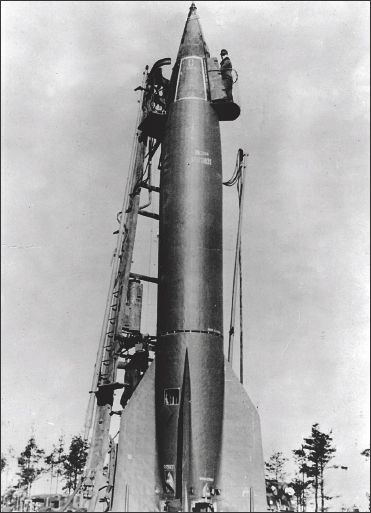
Preparing a V2 for launch. (DR)