
Chapter Six
The site of the Juvincourt aerodrome, which extended over an area of more than 500 hectares, was split in two by the main road from Reims to Laon. Today it is bordered by the A28 motorway and limited by the Juvincourt municipalities, Damary, La Ville-aux-Bois-les Pontavert and Corbeny. Juvincourt has not just entered the history books in recent years. In 57BC, Julius Caesar defeated a combination of Gaul and Belgian forces there. In his writings, the famous Roman general recounts that after the battle, which had caused the deaths of thousands, he had crossed the Miette by standing on the corpses of his enemies.
Located east of the infamous Chemin des Dames, Juvincourt changed hands several times during the First World War. At Berry-au-Bac, the first tank offensive took place in 1917 and a monument now commemorates this battle. An airfield was first located on the plain where it was home to both British and American aerial units. A British cemetery from this period remains close by.
In 1938, the French Air Force established a base with three grass runways on the outskirts of Amifontaine, Guignicourt and Proviseux. An RAF Fairey Battle squadron took over the Proviseux runway in September 1939, followed later by a Hurricane squadron.
In June 1940, Juvincourt was occupied by the Luftwaffe, who would turn it into their largest airbase in France. After their arrival, the Germans created three concrete runways: two 1,600m long, ‘17/35’ and ‘9/27’, the other 1,980m long, named ‘05/23’.
The N44 main road can also be added to these three runways, as it was to be used as such if needed. It is still possible to go on these routes today as they remain in excellent condition. Only runway ‘05/23’, now given over to an automotive supplier, is inaccessible. On the N44, the hotel Relais Sainte-Marie (an old stop off for drivers before the creation of the motorway) is housed in a former Luftwaffe building, flanked by a tower whose use remains a mystery.
As well as the runways, the Juvincourt base was home to labour camps, workshops, concrete shelters covered with earth, ‘caves’ where the planes were housed (around 300) and munitions stocks. Some people even suggest there were underground shelters, which would have been blocked up by the USAAF. From 5 September 1944 to the end of 1945, Juvincourt effectively became an American airbase, codenamed ‘A68’.

Map from the inventory of the former aerodromes drawn up by the DGAC (the Direction Generale de l’Aviation Civile - the French organisation for flights and airports).. The orange area corresponds with the aerial photograph taken by the Luftwaffe in 1939. (DR)
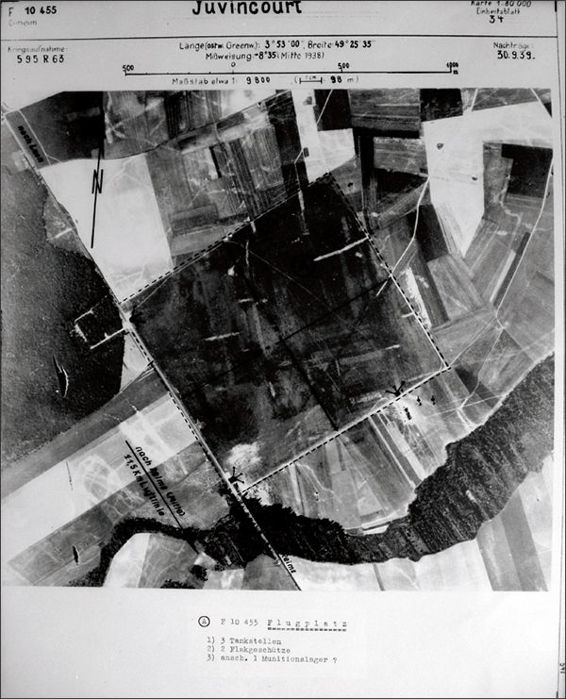
The field at Juvincourt, photographed by the Luftwaffe on 30 September 1939. (NARA)
The Americans move in: September 1944
Throughout the German occupation, Juvincourt had successively been home to the Ju 88As of KG77 in 1941, the Dorniers of KG2 from 1941 to 1942, the Ju 88s of KG54 from June to July 1944, Erich Sommer’s Arado 234 on 25 July 1944, Horst Götz’s Arado on 2 August 1944, Schenck’s Me 262 from 22 to 28 August and the Me 262s of KG51 from 27 to 28 August 1944.
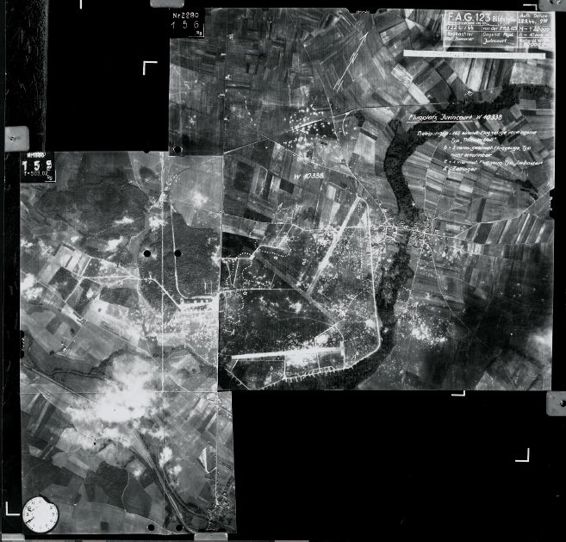
The same field photographed almost five years to the day later, on 28 September 1944, taken by Erich Sommer in his Arado 234. Interesting in more ways than one, this photograph reveals the efforts taken by the Americans to develop the site. You can also notice the bomb damage and that the N44 hardly seems to have been hit at all. Furthermore, the photograph shows the audacity of Erich Sommer, who had complete confidence in the invulnerability of his aircraft. It’s an admirable snub by Sommer, who may have already known the war was lost. (NARA)

The Junkers Ju352 Al ‘T9+AB’ of the Versuchsverband, just landed at Juvincourt. The ground staff unload the Arado 234’s enormous cargo of spare parts and various other equipment, using a special ramp: Trapoklappe. On the right of the photograph is Oberleutnant Erich Sommer, in his black leather jacket and filming apparatus, perhaps an 8mm camera. (Erich Sommer)

In this other photograph of the Junkers Ju352 Al ‘T9+AB’, you can see the Arado’s three-wheeled takeoff trolley. (Erich Sommer)
Götz’s Sonderkommando was composed of two aircraft: the ‘T9+LHV7’ belonging to Götz and Erich Sommer’s ‘T9+MHV5’. The reconnaissance commando’s assessment mission had been decided before the invasion and it is the correlation of these events that is remarkable.
The two aircraft took off from Oranienburg on 25 July 1944. Unfortunately, a fire in the engine forced Götz to turn around and Sommer arrived at Juvincourt in the afternoon, alone. The takeoff equipment, which would have allowed them to carry out the first reconnaissance mission over the Normandy beaches the following day, had unfortunately not arrived. The Luftwaffe hadn’t taken into account the impact of the bombardment on the railways and the actions of the Resistance, which had prevented the convoy carrying the three-wheeled take off equipment from arriving on time.
It was not until the flight of the big Ju 352 on 1 August that the long awaited reconnaissance mission could finally take place. On 2 August, Erich Sommer flew towards Normandy, an Area he knew well, having been stationed at Vannes- Meucon and Beauvais, and having crash landed at Carpiquet. He flew over the landing beaches at 11,000m, making three similar passes at a distance of around twelve km towards the south. The pictures he brought back were exceptional. On the evening of 2 August, Götz set down his Arado at Juvincourt. The two pilots and their equipment, particularly the Enigma machine, stayed at the Chateau de Guignicourt.
During one of his takeoffs, Erich Sommer recalls seeing a man crouched on the ground with a camera. Despite strict instructions for complete radio silence so that their enemies couldn’t learn about their operations, the pilot signalled the presence of the intruder to the base, who immediately hunted him down. It is obvious that the RAF’s Station Y had certainly recorded this alert by Sommer.
It is worth noting here that the agents of the Centurie network, whose boss was Captain Etienne Dromas, commander of B Group of the 2nd Aisne Region, had been watching Juvincourt ever since he had noticed the arrival of the propeller-free aircraft. The photographs arrived in Britain safely, where it was impossible for me to study them; hardly surprising given that these were the actions of Her Majesty’s Secret Service! The missions of the two Arados ran until 26 August. Curiously, the two Arado pilots remember having no contact with the Me 262 pilots at this time, as if their missions were of a special or secret nature.

One of the ‘cells’ still visible on the site. (DR)
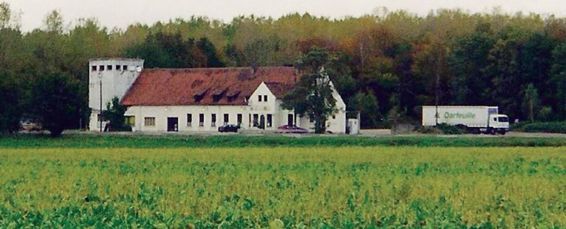
The N44 main road today and the remnants of German installations. (Collection Philippe Bauduin)

The Arado 234 V7 ‘T9+MH’ in the process of being raised before being placed on it’s take off trolley. The major problem with the Arado 234 prototypes lay in the fact that they had to take off on a hard runway and then land on a grass one. Devoid of landing gear wheels and equipped only with a form of ‘skate’, the Arado 234 had to be moved from it’s cell to the runway on it’s take off trolley. Once it landed on the grass, the aircraft remained vulnerable to any aerial attack for at least twenty minutes as the ground crew carried out their manoeuvres. Note on this photograph the jack used to raise the tail of the aircraft. (Erich Sommer)
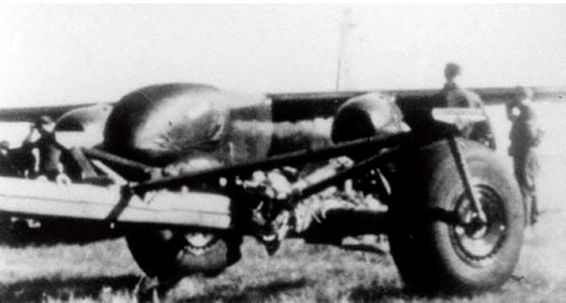
The take off trolley used by the Arado. (Erich Sommer)
Flight logs
Logbook for Arado Ar 234V5 T9+LH.W.Nr.130005

Logbook for Arado Ar 234V7 T9+MH.W.Nr.130007

Characteristics of the Arado Ar 234 and V7
Engines: x2 Jumo 004B-0
Type:Turbo-jet
Units of thrust: 900kgp
Span: I4.20m
Length: I2.56m
Surface area: 26.4m sq m
Mass: 4,75kg (empty) 8,700kg (maximum)
Average speed: around 760km/h - Erich Sommer reached a speed of 950km/h whilst carrying out a dive on 26 June I944. Flight No. 2.
Maximum height: I0,000m
Range: around 800km
Weapons: None
Camera equipment: x2 Rb50/30
Versuchsverband OKL - Sonderkommando Götz
Hauptmann Horst Götz and Oberleutnant Erich Sommer, although assigned to l./Versuchsverband OKL based at Alt Lönnewitz, began their familiarisation with the Arado 234 at the beginning of June 1944. An operational Sonderkommando (special detachment) was created, taking the name of its Commandant , Hauptmann Götz, who himself carried out his first fifteen minute flight on the prototype V5 Arado 234 on 1 June 1944. His assistant, Erich Sommer, undertook his first fifteen minute flight four days later on 5 June in an Arado 234V4. After having carried out several practice flights (more than six hours flight time for Götz and more than seven for Sommer), the Arado 234V5s (codenamed T9+LH) were declared operational, but no order was given for their deployment with Sonderkommando Götz. The reason for the delay seemed inconceivable to the two pilots. Hauptmann Götz remembers bitterly:
‘The Allied invasion was in full swing. I assumed that Kommando Götz was going to move west and I reported our two planes for operation. I also had a Ju 352 for aerial transportation. Nothing happened! Those traitors in the highest command didn’t want to interfere in the invasion. On 17 July, we finally received the authorisation ( but not the order) to fly to Juvincourt and the invasion front line. There was no way of moving any of the technical equipment by road and to do so by train was a very dangerous undertaking at the time. I left our special equipment on two goods trains, but only one arrived at its destination.’1
Sonderkommando Götz finally left its base at Oranienburg, north-west of Berlin on 27 July and headed for Juvincourt near Reims, France. Its mission was to reconnoitre the area at the beachhead, where the Allies had invaded a few weeks before. One of Götz’s five engines broke down during the transfer flight, forcing him to return to Oranienburg, but Sommer’s V7 reached Juvincourt without any problems. Once there, the plane was hoisted onto a low trailer and towed into a hangar The aircraft would stay there until the small three-wheeled takeoff apparatus and other vital equipment had been delivered by rail. Sonderkommando Götz was made up of eighteen Luftwaffe ground staff two aviation experts from Arado and an engineer from Junkers. Erich Sommer remembers his first operational sortie in an Arado 234:
‘As I approached Juvincourt, I saw that our Ju 352 (T9+AB) had landed and that Horst’s V5 was about ready to be towed away. Turning to my final approach, I almost crashed. With the flaps open, the wheels lowered and the engines idling, the aeroplane wanted to bank despite all my efforts to try and force it the other way. I only succeeded by giving it more power and increasing the balance just as I hit the ground. It was scary and I couldn’t explain why it had happened. After that, we avoided the situation in similar flights by taking away the power [of the engines].’
After his successful landing, the mechanics rushed towards the aeroplane to unload the stores of filming devices and position the Arado on its takeoff trolley. It would take a team of twelve interpreters ten days to produce an initial report of the 380 photographs taken during the sortie on 2 August. ‘After the first sortie’ adds Erich Sommer, ‘plenty of senior officers came to Juvincourt wanting to see the plane, but everything had been kept very secret and they weren’t authorised to go near it.’
In the three weeks that followed, the two aeroplanes carried out a total of eight further missions, four for each of the two pilots. The Allied advance soon forced Sonderkommando Götz and its two Arados to leave Juvincourt for Chievres in southern Belgium on 28 August. Erich Sommer arrived safely in his V7, but the V5 flown by Götz was hit by flak flying over Mons. The aircraft’s hydraulic circuits damaged, Hauptmann Götz decided to head to Brandenburg where they could be repaired. Upon learning that the aerodrome was in the middle of being bombed by the Allies, the pilot decided to turn towards Oranienburg. As he crash landed, the windscreen exploded, temporarily blinding him. The two Arados were soon withdrawn from operations and replaced by the first reconnaissance Ar 234B-ls. The unit, still commanded by Hauptmann Götz and officially constituted in September would operate primarily over Britain.
___________
1. J. Richard Smith & Eddie J. Creek with Hans-Georg Dachner Military Aircraft in Detail, Arado Ar 234 A (Ian Allan Publishing, 2006)
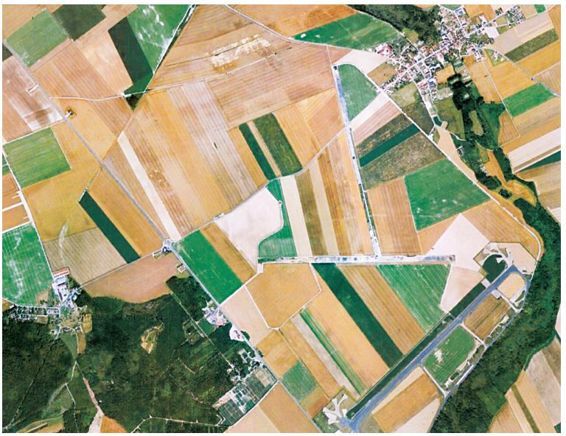
Juvincourt today. You can see the three runways and on either side of the former N44 are the ‘cells’ where the Arados were kept. (Google Maps)
During this time, the runways were in a permanent state of bombardment, and had to be repaired just as quickly. Strangely, the N44, which served as a takeoff strip for the Arados, was never hit and remained operational throughout.
On 16 and 17 June 1944, Hitler came to Margival to encourage his generals to be more combative. It was not his first visit to this part of the Aisne: during the First World War a certain Corporal Hitler had been stationed at Juvincourt.
At the end of the spring of 1944, Hitler would have landed at Metz and arrived at camp W2 by armoured car. He would have hastily left Margival after the unexpected crash landing of a V1 flying bomb close by, and taken a plane to Juvincourt.
Yet the two Arado pilots, arriving at the end of July, do not appear to have heard anyone speak about Hitler’s visit, as they confided in me many years later.
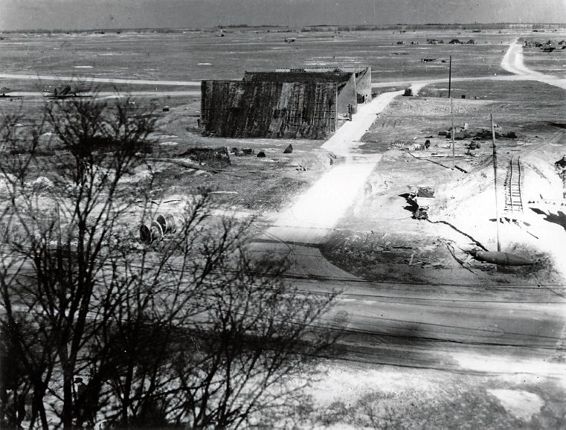
Camouflage and adjustments made at Base A68, Juvincourt, by 410th Bomb Group during the winter of 1944. The N44 main road can be seen in the foreground. (NARA)
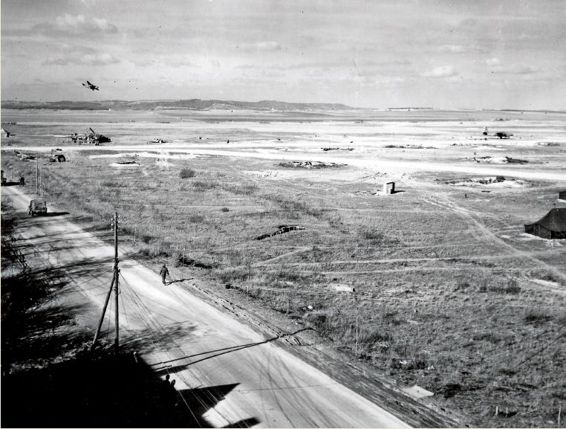

Camouflages and adjustments made at Base A68, Juvincourt, by 410th Bomb Group during the winter of 1944. The N44 main road can be seen in the foreground. (NARA)

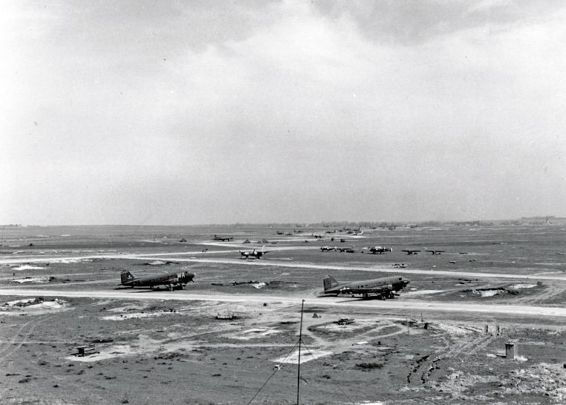
Aircraft belonging to the USAAF stationed at Juvincourt after the Americans had taken the base. (NARA)

The Arado AR 234 flying over the invasion beaches in August 1944. Painting by Barry Spicer. (DR)