
PART THREE
10
‘Executions in consequence of mentioned attempt are made at
isolated places so that nobody—I say nobody—can witness them.’
Viceroy Rodolfo Graziani, 19 March 1937
Although by the end of the first quarter of 1937 the Italians had already slaughtered the clergy of several notable churches and monasteries, there is no question that for them the crowning achievement in the war on the Ethiopian Church would be the destruction of the monastery of Debre Libanos. Graziani knew that the massacre of that community—a strike at the very heart of the Ethiopian Church—would create shock and terror across the land, and might even sound the death knell of the Church as a national institution.
But the timing had to be right. Following the abortive attack on the monastery in February, Graziani did his homework, and bided his time. He would wait until the biggest event of the year, which would attract the greatest number of clergy and pilgrims: 20 May. As inscribed in the Ethiopian Synaxarium, the Lives of the Saints, this is the day in 1370 when the monks of Tekle Haymanot’s original monastery of Debre Asbo moved their Holy Father’s remains from the cave where he died to Elam, a site nestling among trees in the wooded escarpment high above the present church of St Tekle Haymanot.1 Ever since, 20 May has been the best-attended day of the year for the monastery of Debre Libanos. Furthermore, 20 May is also the monthly celebration for St Michael, who is said in the hagiography of St Tekle Haymanot to have rescued the saint’s mother from a terrible fate. Thus, on that day the congregation of the church of St Tekle Haymanot would be supplemented by devotees of St Michael.
Graziani’s choice of this important date would ensure the presence of not only the clergy and monks normally resident at Debre Libanos, numbering around one thousand, but also at least a thousand additional visitors. Indeed, in his proposals for the massacre, General Maletti would in due course inform Graziani that he expected the event of 20 May to attract a total of two to three thousand ‘clergy, servants, mendicants and pilgrims’.2
By early March Graziani had made his decision and selected the date, and on the 7th of that month he made it clear to General Tracchia that the time had come for the destruction of the monastery. A week later, on receiving a report on the monastery by Major Mario Quercia, the viceroy wrote across the top of the first page of the report, ‘Inform General Maletti that he must proceed to the total liquidation of the monastery in May 1937’ (see Appendix III).3 No stone would be left unturned, and every step would be covered by carefully worded reports to Rome. In due course a case would be framed against the monastery to justify the slaughter. But that would come later. Graziani got his secretary to open a new file. There was no mistaking the objective of the project now under way: ‘Liquidation of the monastery of Debre Libanos’.
A Machiavellian Plan
The viceroy planned the operation carefully. If the Debre Libanos community was to be enticed into the monastery and captured, it was essential that this time the military presence should raise no suspicions. Carabinieri would move into Debre Libanos as an apparent gesture of goodwill. They would develop personal relationships with the monks and the priests, and convince them that they were there to support them. When the day scheduled for the massacre arrived, the presence of the military would be accepted as normal, and the community would be enticed into the monastery church. Then the word would be given, and the clergy and congregation of the House of St Tekle Haymanot would be rounded up and shot.
Thus, in March a group of carabinieri established itself in Ras Kassa’s house in the monastery village of Wusha Gedel, and were in due course more or less accepted by the community. They gave food and money to the monks, and established a degree of local influence.4 However, some of the clergy knew that the carabinieri were also seeking informants,5 for Meggabi Welde-Tinsa’e revealed that they were asking questions about Moges Asgedom and Abriha Deboch, and threatened some of the monks with execution if they didn’t talk.6
Nonetheless, Graziani’s strategy was quite effective, and as the appointed day approached, arrangements were made for a celebration of unprecedented proportions. A proclamation was read out by collaborator Gebre-Maryam, the Italians’ new appointee as tsebaté, before a crowd at the monastery, announcing that on 20 May the ichegé (a collaborator appointee) would attend, all members of the Debre Libanos community and their family and friends should be present, and Italian dignitaries would distribute gifts.7 He also announced that anyone who failed to attend would henceforth be barred from the monastery—for devotees of St Tekle Haymanot, an edict almost equivalent to excommunication.
Seeking a Rationale
Meanwhile, Italian Military Intelligence personnel were at work in Addis Ababa suggesting possible links between the monastery and ‘the attempt’,8 as Graziani used to refer to the February attack on the Italian High Command, or what the Ethiopians called Yekatit 12. These were being prepared at the office of the royal military advocate, Major Giuseppe Franceschino, in preparation for an explanatory telegram to be transmitted to Rome after the massacre. The case against the monastery was put together using fragments of circumstantial evidence.9 In case the rationale turned out to be unconvincing, Graziani was reassured by the compliant military advocate, who advised him, ‘We cannot trust anyone, neither the clergy nor the notables. The feelings of rebellion are latent in all of them.’10
If the connection between Yekatit 12 and the Patriots was tenuous, its connection with Debre Libanos was equally speculative, relying as it did on hearsay and anecdotal evidence. Nonetheless, Franceschino drew his conclusions with great confidence: ‘One must with a clear conscience conclude that one cannot speak only of the complicity of the monks of Debre Libanos, but of the much graver hypothesis of their share in the guilt.’11
The report also incriminated the former tsebaté, Tekle-Giyorgis, and Graziani seemed to be content not to demand more convincing evidence. He probably realised that if Franceschino had gone further with a genuine trial, the viceroy’s plan would most likely have failed, since by definition a clandestine conspiracy would have involved few people, providing no basis for mass executions. Thus, terminating the inquiry before too many facts emerged would ensure that the viceroy was unchallenged in claiming that the ‘secret’ plot had involved all the clergy of Debre Libanos. It is not surprising that the suspects were never charged.12
A Faithful General
The district in which the monastery of Debre Libanos stood fell under the military jurisdiction of a commander well known to Graziani and trusted by him: General Pietro Maletti, commander of the north-east sector of Shewa, with headquarters at Debre Birhan.13 Born in 1880, and having attended a prestigious military school, Maletti was enjoying a career as a professional soldier. Like Graziani, he had fought in the First World War, where he was known as a harsh disciplinarian with a ‘punitive’ approach, employing ‘coercion rather than persuasion’. These being qualities sought by his superiors, he was assigned to Libya, where he commanded Eritrean battalions. In 1935 he was transferred to East Africa, and by 1937, having fought under Graziani in the southern front of the invasion of Ethiopia, had become one of the viceroy’s most trusted generals.14
For the first phase of the liquidation of Debre Libanos, Maletti sought a suitable execution site near the monastery. The location needed to be accessible by motor vehicles but invisible to anyone not actually on site, in accordance with Graziani’s assurance to Lessona that ‘executions ordered in consequence of mentioned attempt are made at isolated places and that nobody—I say nobody—can witness them’.15
The general was provided with a knowledgeable local collaborator, who recommended Laga Weldé, a site on the plain near the edge of the gorge where a seasonal stream, or laga, known as the Fincha Wenz, meandered eastwards into the gorge (see Map 11). So long as the locals were kept to the other side of the surrounding hills, there would be no witnesses.16 The execution site was easily accessible from the Addis Ababa–Fiché road, between two hills known as Gobola and Tsebaté.
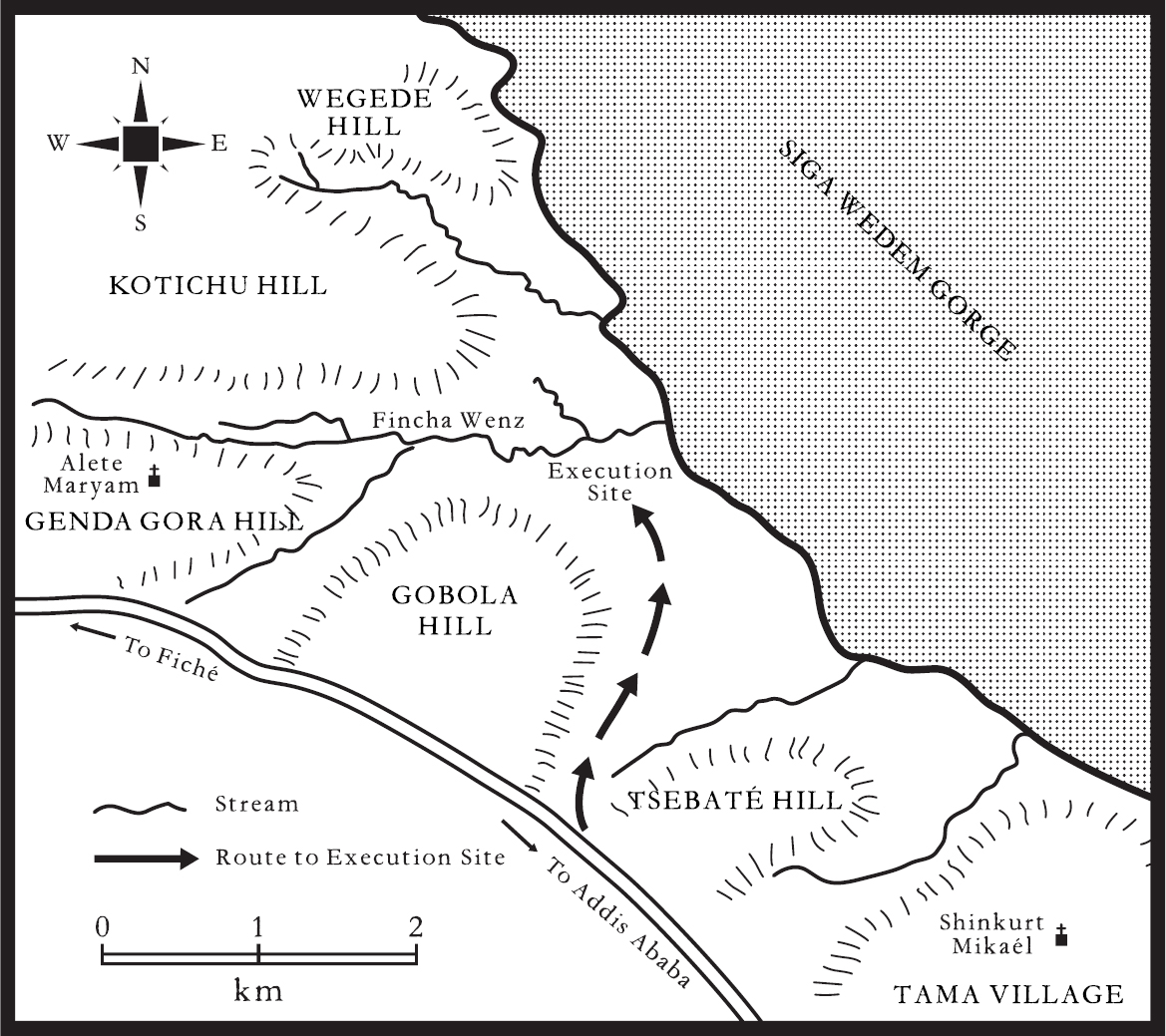
Map 11: The massacre of Debre Libanos: the execution site at Laga Weldé (© Ian Campbell)
A Secret Site
While Maletti was preparing for the executions at Laga Weldé,17 another, more secluded site was being sought for the elimination of people other than Debre Libanos clergy. While Graziani would later issue orders for the execution of the monks and priests of Debre Libanos to be broadcast as a warning to others, it was important that the second set of executions, which would involve under-age victims as well as pilgrims and clergy from other churches, should not be made public.
As in the case of Laga Weldé, local knowledge for the site selection was required, and in this instance Maletti was assisted by the Italian residente. Some seven kilometres from Debre Birhan town, the site lay among the rolling hills of the highland plateau, on the way to where the former Shewan capital of Ankober formed the gateway to the old caravan route across the lowlands to the Red Sea.
In a sparsely populated area known as Ingécha, this second execution site, referred to locally as Borale, was near the Debre Birhan–Ankober road but hidden from it (see Map 12).18 The site lay in a shallow valley of the seasonal Borale River, surrounded by hills crowned with rocky outcrops, while on the lower slopes cattle grazed and crops were grown by a few scattered subsistence-farming families. The execution site was adjacent to the river, which for much of the year was no more than a small stream around which cattle would find dry-season grazing.
Overlooking the site were two homesteads. On one on the northern slopes, a young boy named Letarge lived with his parents, brothers and sisters; on the southern slopes was the homestead of Ato Yirgu and his family.
Borale was less than three kilometres from an Italian military camp at Awsene Amba.19 It was also easily accessible by vehicle from the garrison town of Debre Birhan, but provided the seclusion necessary to fulfil the viceroy’s assurance to Rome regarding secrecy. The requirement was convenient for Graziani, for it facilitated secret executions—secret even from Rome—without the risk that the news would leak out. In any case, since Northern Shewa was aflame with exemplary repression, the burning of dwellings, and the use of poison gas, the massacre at Borale could go virtually unnoticed amidst the carnage.
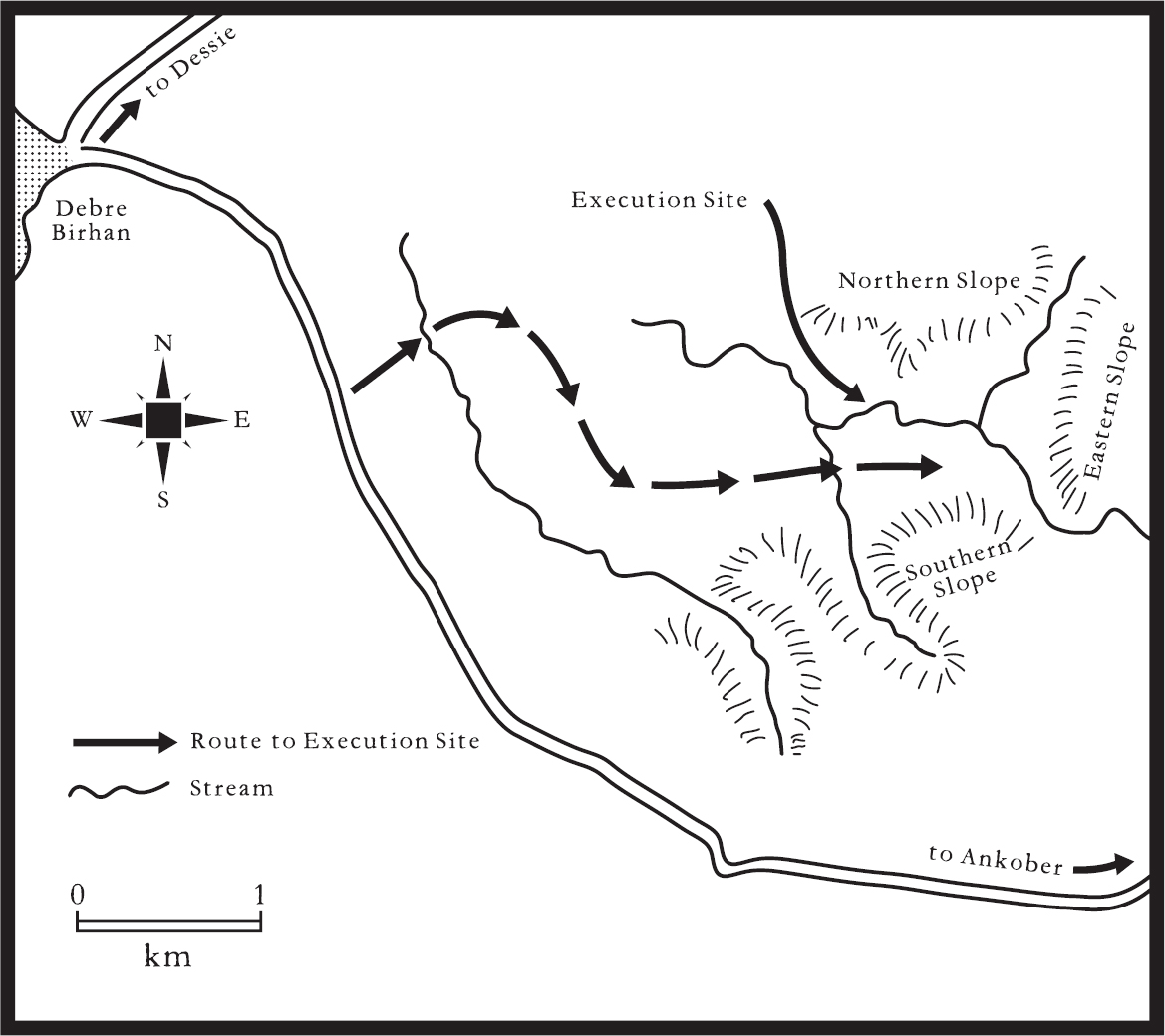
Map 12: The massacre of Debre Libanos: the execution site at Borale, Ingécha (© Ian Campbell)