
16
‘I don’t know what effect these men will have upon the enemy, but,
by God, they terrify me.’
Duke of Wellington
Throughout the Italian occupation, Northern Shewa remained a hotbed of resistance. Indeed, the first guerrilla attacks against the advancing Italians had taken place in this area, in April 1936.1 The rugged landscape was ideal for guerrilla warfare, and being close to Addis Ababa it was the place of origin of many of the early residents of the city. In fact, after the massacre of February 1937 many people fled from Addis Ababa to join the Patriots in Northern Shewa.2 The area also formed part of the Christian highlands, which had produced several members of the ruling classes largely responsible for the 19th-century expansion of the Ethiopian empire to the east, west and south, and was the birthplace of Emperor Menelik. Thus it became a natural focus of resistance to the Italians.
At its eastern perimeter, the Shewan plateau falls away in a steep escarpment towards the sweltering lowlands known as the Afar Depression and the ancient caravan routes to the Red Sea. At the end of a ten-kilometre peninsula of the high plateau stands the old Shewan capital of Ankober, perched far above the rugged countryside below, where in the 1930s the former customs office of Aliyu Amba still stood—a reminder of the times when traders would lead their camel caravans across the Muslim lowlands, pay their taxes, then begin the ascent into the kingdom of Shewa on the temperate plateau above.
The high plateau had long been settled by Christians. However, the eastern border area accommodated both Orthodox Christianity and Islam, as well as some pockets of Catholicism and ancient Judaism. Down in the forests of the valleys there were, and still are, monasteries of mixed Christian–Judaic heritage. Apart from the 16th-century jihad of Ahmed Grañ, which had been driven principally by Ottoman Turks, these religious communities had in recent centuries enjoyed a relatively harmonious coexistence, as was common in Ethiopia. But with the intrusion of the Italians, and their strategy of recruiting Muslim mercenaries, Ankober district with its religiously mixed population was particularly vulnerable to Graziani’s policy of divide and rule. This policy had resulted in the arming of disaffected local groups to make deadly attacks on the emperor and his forces in retreat after the Battle of Maychew.3 During the occupation, the initial challenges to the invading Italians came principally from highland Christian Amhara and some Oromo communities. Against these, the Italians were able to pitch Muslims with antipathy towards Emperor Haile Selassie, who had often ruled them with a heavy hand. Recruited from the nearby lowlands, some could be enticed with various favours, including the building of mosques. Overall, it was religion, rather than ethnicity, that was found by the Italians to be the most effective way to obtain local assistance in their attempts to crush the resistance to the occupation.4
The formation by the Italians of the 45th (Muslim) Colonial Battalion for deployment against Christian civilians has already been discussed, but their masterstroke in this regard was the cultivation of an alliance with the family of the elderly but widely influential Sheikh Sayed Raslan, who was based in the lowlands immediately east of the Shewan plateau. Sayed’s energetic son, Sheikh Mohammed Sultan, became a powerful ally of General Maletti, and the relationship culminated in the creation of the Mohammed Sultan Group of irregulars, who would conduct a bizarre but deadly jihad under Italian command.
The sack of Addis Ababa and the massacre of the clergy of Debre Libanos had not only aroused anger across Ethiopia, it had also triggered the flight of thousands of men into the countryside to join the Patriots. In response, Maletti launched the Mohammed Sultan campaign to directly address the resistance that constituted a growing obstacle to Italian control of the Ethiopian highlands. Heavily armed companies under Lieutenant Colonel Giuseppe Costa, Lieutenant Colonel Quinico and Colonel Arduino Garelli, all under the command of General Maletti, had been battling resistance armies in various parts of Northern Shewa during May and early June 1937,5 resulting in the deaths of not only many resistance fighters, but also numerous defenceless subsistence-farming families living in the vicinity. One Italian source reports that in Ankober district alone, between 5 May and 15 June, the Italians ‘slaughtered and maimed no less than 15,000 innocent civilians’.6
In reality, the Mohammed Sultan irregulars would be focused on continuing this exemplary repression, terrorising the local population into rejecting and disowning the resistance. Based on research among local communities and eyewitnesses, Professor Ahmed Hassen, the leading authority on the history of Northern Shewa, describes how the Italians persuaded the sheikh, assisted by other sheikhs and chiefs, to declare a jihad, or holy war, against non-Muslims.7 The jihad proved to be one of the bloodiest and most destructive confrontations of the entire occupation. Let loose in June, the forces of the sheikh—a coalition of various Muslim groups—were under the command of Italian officers whose active participation in the campaign still remains in the collective memory of the local communities, for it took the slaughter of Christians to a new level of horror.8
Into the Highlands
Ostensibly, the Maletti–Mohammed Sultan alliance sought to track down resistance leaders, but it was actually focused principally on mutilating and killing defenceless non-combatant Christians and looting and burning their churches. At the Italian military headquarters in the newly established garrison town of Debre Sina, the force split into two fronts, each headed by senior Italian officers. One front headed westwards and the other, including Sheikh Mohammed himself, set out along the slopes of the escarpment through Aliyu Amba and across the Kasem River. The western section of the alliance divided into three companies. The Italians led one company north-west into the rugged district of Menz; the second aimed south-west towards the settlements of Sheno and Sendafa; the third separated from the second company at Debre Birhan, to head north-west for Moret and Merhabété (see Map 15).
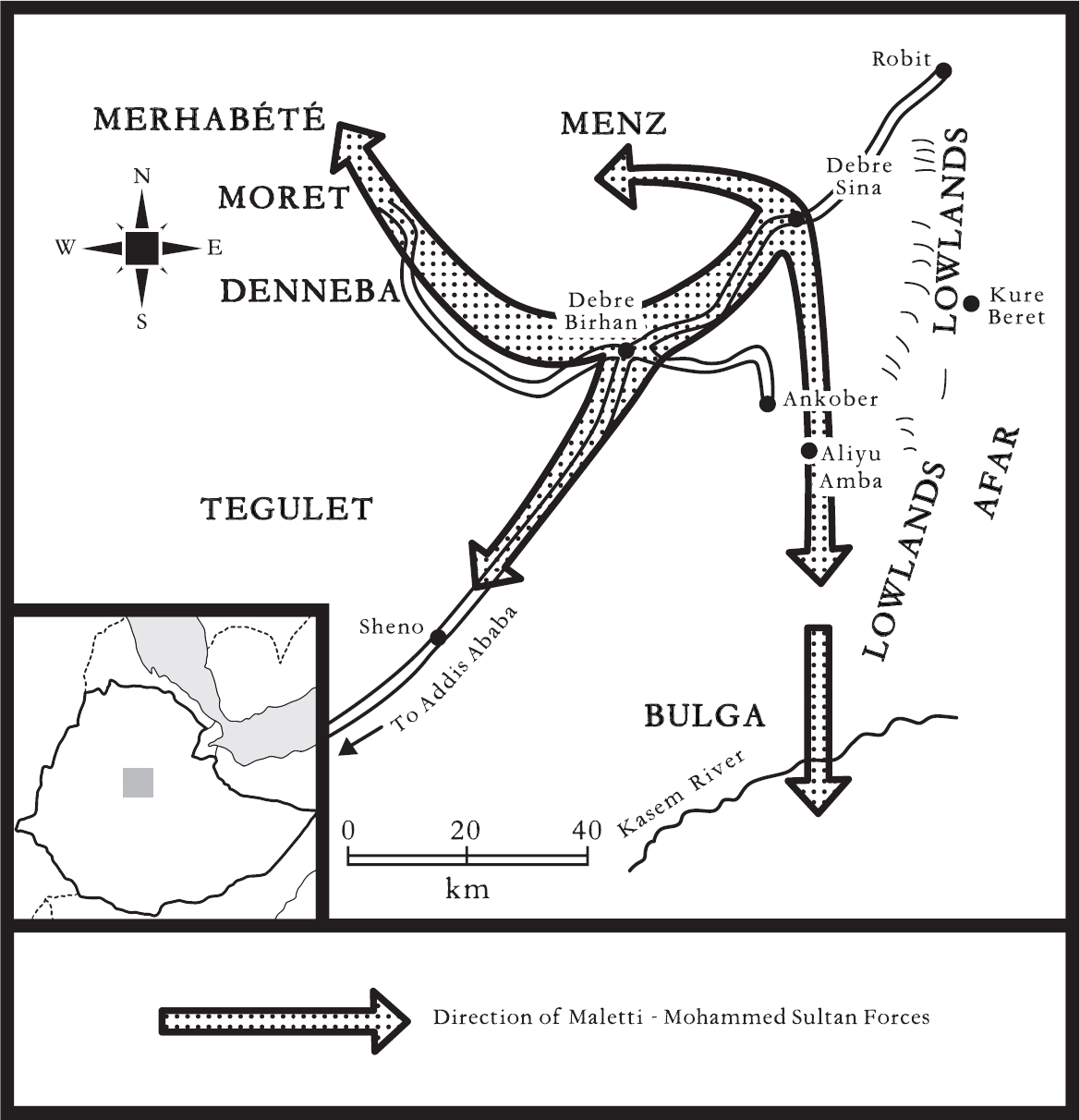
Map 15. Northern Shewa: the jihad of June 1937 (© Ian Campbell)
Following Graziani’s written instructions, ‘When in doubt always eliminate everyone without mercy’, the campaign in Menz–Merhabété, which lasted eight days, quickly gained the Maletti–Mohammed Sultan alliance a reputation for leaving behind them, in the words of an Italian military historian, ‘a trail of blood and violence’, in which ‘they attack the villages, kill all the males over the age of three and emasculate the rest, kidnap the young women and seize the cattle’.9 In each case the marauders maimed and slaughtered the local population, and destroyed their villages, churches and crops.10
The jihadists sent into Menz massacred numerous Christian communities, several of which were totally annihilated and as a result no longer exist. Only their memory lives on; speaking to postgraduate researchers from Addis Ababa University in the 1990s, local elders recalled from their youth some of the villages and churches that had fallen victim to the slaughter, with not a single soul surviving. These included Gedambo St George, Qeya St Gabriel, Gishe Robel, and Molalé Aradma Agancha Kidane Mihret (‘The Covenant of Mercy’).11
Down the Escarpment
The residents of the Ankober–Aliyu Amba area, who were victims of the group led by Mohammed Sultan himself, suffered horrors that elderly informants interviewed in the 1980s and early 1990s still shuddered to remember. The commanders had no compunction in unleashing their jihadists to run wild. As most able-bodied local men had either been killed in the war or joined the resistance, the militia burned entire villages, emasculating elderly men and boys, cutting off women’s breasts, and publicly mutilating and butchering priests and monks, as they rampaged from church to church. Recounting the massacres fifty years later, surviving witnesses recalled their shock and amazement that the senior Italian commanders not only permitted but actually encouraged such excesses.12 The Maletti–Mohammed Sultan irregulars surpassed even the general’s ‘ferocious castrators’ of the 45th Colonial Battalion.13
Maletti’s jihadists also killed members of the local Muslim Argobba community, who were either mistaken for Christians or, having coexisted peacefully for years with their Christian neighbours, were not supporting the campaign.14 However, as Ahmed Hassen observes, these attacks eventually turned some Muslims away from the holy war: ‘The Afar Muslim community took exception to the Italian-backed devastation being classified as a jihad’, asking, after an attack on a local Muslim community: ‘If the Italians sympathise with our religion [Islam] and the war they wage is a jihad, why do they devastate the village of Muslims like that of Mohammed Salih?’15
Father Satan
Realising that the campaign had done nothing to destroy the resistance, General Maletti announced that he was targeting Patriot leader Ayyele Haylé, who had been governor of Ankober under the emperor and who was regarded by Ethiopians as a hero of the Battle of Maychew. Ayyele had moved eastwards to the lowlands of Afar to lead the local resistance.16
Thus, in late June Maletti ordered the Mohammed Sultan Group to march again. However, while fanning out east and south-east of Debre Sina, far from pursuing Ayyele, the jihadists launched yet another reign of terror. Under the general’s command they devastated numerous villages and ravaged the countryside along the escarpment with fire and sword. On this occasion the carnage was so horrific that the sheikh became known locally as Father Satan.
The upshot was that witnesses and survivors of the massacres of Northern Shewa, no longer willing to be sitting targets, decided to join the resistance. At the same time, the jihad began to lose steam. It was, in any case, an obvious travesty, for many of the district’s Muslims had not been at loggerheads with the Christians, and had not agreed with the jihad in the first place, and others, as we have seen, were refusing to support what they no longer considered was a genuine jihad. Consequently, some of the locals banded together, armed themselves, and started fighting back. Eventually they managed to repel the attackers. In the process, in a conflagration known as the Battle of Kuré Wuha, at a settlement on the eastern escarpment named Kuré Beret (see Map 15), they finally managed to kill Sheikh Mohammed Sultan and three of his leading commanders, whereupon his surviving lieutenants fled eastwards, down into the lowlands.17
The Aftermath
With the death of Mohammed Sultan, the jihad of June–July 1937, which had lasted almost four weeks, was over. The campaign had destroyed and looted hundreds of churches, put the clergy to the sword, and slaughtered and maimed countless Christians and even Muslims in the process.18 It also left so many unburied bodies in its wake that they created a public health emergency.19
For the Italians the pogrom achieved virtually nothing, other than to confirm their reputation for cruelty and barbarity against unarmed civilians. In fact, it intensified the resistance, bringing both Christian and Muslim communities that had been its victims into the Patriot movement.
There was never any reckoning of the death toll of the Maletti–Mohammed Sultan jihad. However, given that each of the four military columns, consisting of thousands of rampaging armed men, most likely killed hundreds of victims each day of the campaign, the typical combined daily death toll could have been in excess of a thousand, bringing the total death toll of the campaign into the tens of thousands, in addition to those who survived to suffer their injuries. This assessment is consistent with the view of Ahmed Hassen, who indicated to the present author that the scale and death toll of the Maletti–Mohammed Sultan campaign exceeded even that of the massacre of Addis Ababa, let alone the massacre of Debre Libanos.20
Such estimates are inevitably speculative, for, as Nicolas Virtue observes, throughout Maletti’s 1937 campaign in Northern Shewa, details of the reprisals became barely worthy of mention in the telegrams from column commanders, who sometimes submitted vague reports such as ‘Burned all villages and destroyed all crops’.21 Considering that often no one was counting the victims, even one of Maletti’s reports stating that his colonial troops together with five thousand irregulars had killed or executed 15,078 ‘rebels’ and destroyed 56,865 dwellings must be regarded as only part of the story.22 Indeed, even the official Italian statistics reporting 37,620 ‘rebels’ killed during these campaigns must be regarded as a conservative figure.23
An Appeal to International Christendom
As news of the bloodbath in the Ethiopian highlands trickled across to Europe in mid-1937, Emperor Haile Selassie was outraged. Horrified by what he termed the ‘merciless carnage’, he sent a desperate appeal to the Christian Churches of the world from his exile in Bath, England. Stating that he believed that ‘God’s judgement will eventually visit the weak and the mighty alike, according to what each deserves’, he charged the Italian army with ten ‘barbarities’, including ‘a number of sacrilegious acts … against the religious and spiritual practices of my people [and] of the Ethiopian Church’, such as the massacre of Addis Ababa, which, he noted, had involved the killing of priests and Muslim sheikhs and the denial of Christian burial, ‘the destruction of the ancient Church of the Monastery of Debre Libanos and other churches by deliberately setting them on fire by way of reprisal’, the ‘public execution of Abune (Bishop) Pétros’, and ‘the forcing of unmarried women and young widows in Addis Ababa and other towns into concentration camps and licensed brothels as prostitutes’.
The emperor also drew attention to the looting of the 4th-century monolithic Aksum obelisk—one of Ethiopia’s greatest national treasures—and to the Italian practice of killing prisoners, concluding: ‘I beseech the leaders and members of the international Christian community to denounce the iniquities perpetrated on my people. I also solicit your prayers for the ending of the despicable atrocities being committed on the orders and silent consent of the Italian government.’24
On 27 July the sovereign sent his letter to the Catholic archbishop Arthur Hinsley in Britain, for onward transmission to Pope Pius XI. Hinsley forwarded it to Pacelli. After sitting on the matter for several weeks, the secretary of state challenged the veracity of the emperor’s report, despite the fact that most of atrocities were well known and were documented by the Italian military. Suggesting that the atrocities had not actually taken place, the Holy See decided not to ‘go into the matter’. Once again, the pope, who had prayed to God to ‘bless the land of Ethiopia, its kings and its people’, chose to look the other way.25