

CHAPTER 9
Now we began to roll-long marches and shorter bivouacs. This was the happier type of fighting, the blitzkrieg style. No endless days of sweating out a battle within earshot of the enemy, although we were often less than six hours behind them. It meant more work, and less sleep, but everyone knew he was getting somewhere.
-Al Heintzleman, We'll Never Go Over-Seas
 peration Cobra, which ripped the threadbare German defenses in Normandy, unleashed the kind of fluid campaign tankers dream about, one that even the dirt-grimed infantry tankers could enjoy. The attrition in the bocage had hurt the Germans badly. In all of Normandy between 6 June and 9 July (including the British sector), the Germans lost 2,000 officers and 85,000 men and received only 5,210 replacements. They also lost 150 Mark IVs, 85 Panthers, 15 Tigers, 167 75millimeter assault guns and antitank guns, and almost 30 88-millimeter guns.'
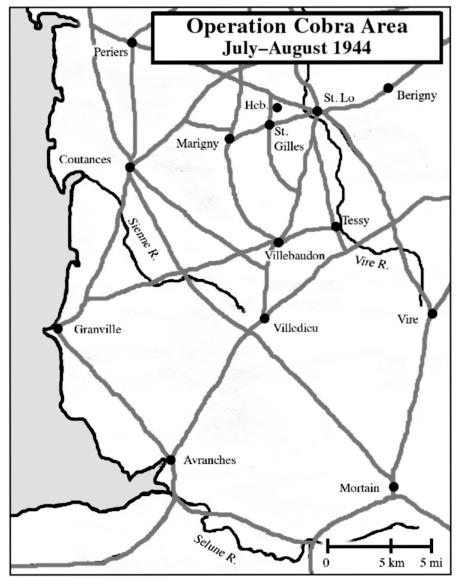
Lt. Gen. Omar Bradley conceived Operation Cobra as a way to end the bloody hedgerow war with a major breakthrough on a narrow front west of St. Lo? J. Lawton Collins's VII Corps was to make the main effort in the American center immediately west of St. Lo, with the 83d and 9th Infantry Divisions on the left, the 30th Infantry Division in the center, and the 29th Infantry Division on the right. Once a penetration had been achieved, the motorized 1st Infantry Division, with Combat Command B from the 3d Armored Division attached, was to exploit four miles southward to Marigny and then turn west ten miles to Coutances on the coast to cut off the German left wing. The rest of the 3d Armored Division, with a 1st Infantry Division rifle battalion attached, was to secure the southern exits from Coutances. The 2d Armored Division, with the motorized 22d Infantry Regiment attached, was to drive through the gap and establish more blocking positions. The XIX and V Corps were to launch smaller attacks to pin the Germans in place along their fronts east of the VII Corps, while the VIII Corps pushed southward down the coast to the west to destroy the German left wing after delaying just long enough for the VII Corps' action to be felt.' To the rear, Lt. Gen. George Patton Jr.'s Third Army bided its time, ready to explode into France.
Cobra experienced an inauspicious false start on 24 July. Bad weather forced commanders to cancel the air operation, but the word did not reach some of the heavy bombers already in flight. American troops had withdrawn 1,200 yards from the bomb zone, but some bombers released their loads early and hit soldiers of the 30th Infantry Division some 2,000 yards north of the Periers-St. Lo highway "nobomb" line. Twenty-five American soldiers were killed and 131 wounded. Cobra was postponed for twenty-four hours.
American forces tried again on 25 July, and once more, the initial signs were inauspicious. Flying north to south over American and then German lines despite the previous day's mishap, 1,500 B-17 and B-24 heavy bombers from the U.S. Eighth Air Force dropped more than 3,300 tons of bombs, while 380 B-26 medium bombers unloaded more than 650 tons of high-explosive and fragmentation bombs. Theoretically the only aircraft attacking in the zone closest to American ground troops, more than 550 fighter-bombers from the IX Tactical Air Command dropped more than 200 tons of bombs and a large amount of napalm.
Roughly 75 of the bombers dropped their loads within American lines due to various errors, killing 111 troops and wounding 490. This time, tankers were under the bombs, too. One officer in the 746th Tank Battalion was seriously wounded. Medics in the 743d Tank Battalion raced among burning fuel trucks to help doughs hit or buried by the bombs, and two battalion tanks were knocked out 4 Lt. Gen. Lesley McNair, the head of the Army Ground Forces and father of the separate tank battalions, was killed while observing the attack. So was the entire command group of the 47th Infantry Regiment except the commander, and many soldiers were in deep shock.
There would be no more delays, however. Assault elements were ordered forward.
The bombing had dealt German units in the assault zone a shocking and crippling blow, although that was not immediately apparent to the tankers. The German commander, Lt. Gen. Fritz Bayerlein, had organized a tank defense in depth and thought his position strong; he had not reckoned on being carpet-bombed. His Panzer Lehr armored division-already badly depleted-and small attached elements from Kampfgruppe Heinz and an airborne regiment were shattered. About one-third of the combat effectives manning the main line of defense and the immediate reserve line were killed or wounded, and the remainder left in a daze. Forced to throw their remaining armor reserves into the line to stop Operation Goodwood, launched by Montgomery in the British sector a week before Cobra, the German command had almost nothing with which to fill the gap. By that evening, Field Marshal Gunther von Kluge, the German theater commander who had recently replaced Gerd von Rundstedt, had to conclude, "As of this moment, the front has ... burst"'
Advancing American troops, however, were surprised to find groups of enemy soldiers fighting stubbornly despite the saturation bombing. In the center, the 30th Infantry Division attacked generally toward St. Gilles. Company B of the 743d Tank Battalion worked with Col. Edwin Sutherland's 119th Infantry on the division's left, which was to capture Hebecrevon and the high ground on which the village was located. While two companies from the 1st Battalion and the entire 3d Battalion attacked the town frontally, the tanks carried the doughs of Company A, 1st Battalion, in a hook around the left and into the village. Resistance against the main attack was fierce, and at 2200 hours, the flanking force, which encountered little trouble, slipped into Hebecrevon. Enemy fire was heavy for a few minutes but then dropped off as the Germans pulled out.'
On the division's right, the 120th Infantry Regiment had orders to punch through the German main line of resistance and capture St. Gilles, after which the 2d Armored Division's Combat Command A was to pass through the regiment. Col. Hammond Birks attacked south down the St. Gilles road in a column of battalionswith the 2d Battalion, which had been heavily bombed, in the lead-and he planned to deploy the following battalion to the left if he ran into firm resistance. Companies and platoons were to use this same scheme of maneuver. Companies A and C of the 743d Tank Battalion and two platoons of light tanks supported the regiment's drive.
At the very first crossroad, the 2d Battalion ran into a strongpoint formed by three Panthers flanked by infantry and machine guns. High-velocity fire knocked out one Sherman and killed a platoon leader in the turret of a second. The 2d Battalion tried to overcome the resistance, but the fighting was bitter, and the battalion's S-3 was killed. Birks sent his 1st Battalion to the left, and when progress there slowed, he sent the 3d Battalion to the right. Birks and Lt. Col. William Duncan, who commanded the 743d Tank Battalion, met behind a hedgerow to figure out what they could do about the strongpoint.
In the meantime, Lt. Ernest Aas of Company A had dismounted from his tank and conducted a stealthy foot reconnaissance of the German position. Aas reported to Birks and Duncan and proposed sending five Shermans across the fields to the left of the road, which was mined, to take out the Panthers that formed the core of the defense. Duncan observed that three of the five Shermans might be knocked out, but it seemed like the only thing to be done.
Aas led his tanks off the road toward the first panzer he had spotted. The gunners destroyed the Panther, and the other two took off westward toward La Picaud- erie. Aas and his tankers cornered one there and destroyed it. "The infantry-tank cooperation was working smoothly," observed Aas. Returning to the main road, the tankers saw the third Panther firing from the west and knocked it out. The way was clear for the 2d Battalion.
During the fight, the light tanks had been unable to play any role, because, in Duncan's view, their 37-millimeter guns were wholly inadequate. One tank commander had engaged one of the Panthers but radioed dolefully, "Good God, I fired three rounds, and they all bounced off!"7
Wayne Robinson's history of the 743d records, "It did not seem like the battle was getting any place in that welter of confusion, with the attack beginning under the ill-starred bombing, with the roads heavily mined, with direct-fire weapons hidden in the hedgerows, with the enemy shells falling constantly, and with the infantry disorganized. It did not seem that anybody was getting anywhere "8 Nevertheless, with the loss of Hebecrevon, the German Seventh Army recorded in its war diary, "The various small penetrations in the area of the Panzer Lehr Division and to the left of it have developed into a breakthrough "9

The 9th Infantry Division, attacking toward Marigny, generally fell short of its initial objectives on 25 July." The 746th Tank Battalion encountered stiff resistance through 29 July as the doughs advanced. Beginning on 1 August, however, the division pushed through to St. Pois, and the 746th Tank Battalion's after-action report recorded, "The operation was characterized by more open hilly terrain with increased visibility and faster movement from high ground to high ground. The operation was one of mopping up heavy centers of resistance and fighting delaying actions accompanied by local counterattacks. Losses were considerably lighter than in the previous period. Employment of tanks with the 9th Infantry Division during this period was generally good"

During the initial phase of the attack, the tankers finally were permitted to exploit the mobility afforded by their Rhino attachments or "Culin hedgerow device." History has linked the name of Sgt. Curtis G. Culin of the 102d Cavalry Reconnaissance Squadron to the device, although other inventors produced their own variants. The contraption (the 3d Armored Group referred to them as "Rube Goldbergs") was made of steel girders from German beach defenses. It amounted to a set of steel teeth protruding from the nose of the tank, and it could be mounted on M4s and M5s. The teeth allowed the vehicle to grip and plow through a hedgerow with hardly any loss of speed." Tankers found that approaching the typical hedgerow in third gear at about fifteen miles per hour usually worked.12 A similar device that looked more like a blade was referred to as the "green dozer." By the time Cobra began, 60 percent of the tanks involved had been fitted with Culin devices.13 The use of the Rhino in combat had been barred until the launch of Cobra in order to maintain tactical surprise."
Generally, the devices allowed tankers to better execute standard hedgerow tactics. The 709th Tank Battalion, attached to the 8th Infantry Division in the VIII Corps' zone, for example, was able to support the infantry by side-slipping German positions and putting enfilading fire on hedgerow defenses.15

The Cobra breakout was a rough execution of theory: The infantry divisions and their supporting tanks created the hole through which the armored divisions could exploit. Collins sent two armored columns driving south into the guts of the disintegrating German defenses on the afternoon of 26 July. On the right, Maj. Gen. Clarence Huebner's 1st Infantry Division (motorized), with the 3d Armored Division's Combat Command B attached, was to pass through the 9th Infantry Division and capture Marigny. Maj. Gen. Edward Brooks's 2d Armored Division, with the 4th Infantry Division's 22d Infantry Regiment attached, was to drive south and east on the left, passing through the 30th Infantry Division to seize St. Gilles." By 27 July, it was clear to American commanders that they had broken open the German defenses."
Combat Command B of the 3d Armored Division formed one spearhead aimed initially at Marigny, and the 18th Infantry Regiment was attached to provide rifle strength. The infantry regiment brought along Company B, 745th Tank Battalion. Almost immediately after crossing the Periers-St. Lo road on 26 July, the 1st Battalion found it could not advance along the roads because they were ripped up by bomb craters. It therefore struck off cross-country, led by tankdozers to cut through the hedgerows and followed by tanks, which fanned out on the far side until the next hedgerow was reached.18
The 1st and 3d Battalions, 16th Infantry, followed Combat Command B's charge. Each battalion mounted a company of infantry on tanks from the 745th Tank Battalion, while the remainder followed on foot. The GIs almost immediately learned the risks inherent in mounting men on tanks when on 27 July eight Company I soldiers were shot off the decks at a strongpoint near Marigny.19

General Patton and his Third Army followed. On 28 July, Bradley temporarily named Patton deputy army group commander and gave him charge of the VIII Corps on Collins's right flank. Patton immediately threw the 4th and 6th Armored Divisions and the already attacking 8th and 79th Infantry Divisions against the Germans, who by now were trying to "advance to the rear" to avoid complete encirclement. This advance passed through Avranches at the base of the Cotentin Peninsula on 1 August. That same day, Patton's Third Army officially became operational.
The doorway to France was ajar. Said Patton, "Those troops know their business. We'll keep right on going, full speed ahead "20 On 2 August, the 749th Tank Battalion, attached to the 79th Infantry Division, pushed forward more than thirtythree miles, and on the seventh, it advanced forty miles.21 Patton's spearhead first cut right into Brittany. The next wave-the XV Corps, composed at this time of the 5th Armored Division and the 83d and 90th Infantry Divisions-hooked eastward toward Paris and Germany.
On the left shoulder of the breakout, the 4th Infantry Division initially had trouble maintaining contact with supporting tanks. Nevertheless, each time resistance brought the advance to a halt, 70th Tank Battalion Shermans eventually showed up and hammered a way through.22 At the end of 25 July, the battalion had advanced only 2,000 yards but despite what it considered stubborn opposition, it had lost no tanks. The next day, the battalion advanced rapidly, and by 2 August, it was at Villedieu-about twenty-five miles from St. L6-an objective the German commanders viewed along with Avranches as the keys to any American success.23 Maj. Gen. Raymond Barton, the commander of the 4th Infantry Division, told his commanders, "We face a defeated enemy, an enemy terribly low in morale, terribly confused. I want you in the next advance to throw caution to the winds... destroying, capturing, or bypassing the enemy, and pressing recklessly on to the objective." His troops did just that.
The breakout ended the bloodiest chapter in the history of the separate tank battalions. Attrition in the bocage had been grim. The 747th Tank Battalion, for example, lost 8 men killed and 34 wounded between 7 and 17 June alone. In late July, the 741st suffered 16 men killed and 64 wounded-more than 10 percent of its strength-in just over two weeks. In June and July, the 743rd lost at least 25 officers and men killed in action and another 116 wounded-nearly 20 percent.

For the separate tank battalions, once clear of the bocage, breaking out offered a rare opportunity to act like armored divisions in slashing maneuver. The main difference was that, whereas the armored-infantry battalions had organic transportation, the tanks carried the infantry to whom they were attached. The infantry divisions "motorized themselves," using not only tanks but mortar carriers, artillery prime movers, fuel and ammunition trucks, and anything else that would roll. The doughs loved it."
After starting slowly because of congested roads, advancing troops broke into open ground, and hastily organized task forces formed spearheads that struck toward distant objectives. Ad hoc by nature, task forces could vary substantially in size. In the 5th Infantry Division, for example, Task Force Thackery, commanded by the division's intelligence officer, consisted of the reconnaissance troop, one infantry company, one light tank platoon from the 735th Tank Battalion, an engineer platoon, and medics. On 7 August, this small band was ordered to race roughly 100 miles to Angers at the base of the Brittany Peninsula to capture the bridge there intact and prevent German movement into or out of the region. Unfortunately, the bridge had been blown.26 At the larger end of the spectrum, Task Force Taylor, activated on 1 September by the 4th Infantry Division to drive for Brussels, consisted of the 22d Infantry Regiment, the entire 747th Tank Battalion, Company C of the 893d Tank Destroyer Battalion, a company of engineers, the 44th Field Artillery Battalion, and the division antitank company.27
As American forces broke free, combat tended to consist of short, often sharp, engagements against delaying forces and strongpoints. This was a new style of warfare for the tankers for which, again, they and the doughs had not trained. Adaptation came easily, however, because an entire village often posed no greater challenge than had a well-defended hedgerow. This account from the after-action report of 741st Tank Battalion is typical:
Company D, with Company A, 1st Battalion, 23d Infantry, [2d Infantry Division,] mounted on the tanks' decks . . . by 0250, 1 August, had reached the village of St. Amand without encountering resistance. By 0430, this company had penetrated still further on, to the railroad station near Les Bessardierre. At this point the advance was halted to await the coming of daylight.
At 0730, the advance was continued, with the infantry still riding the tanks until, at 0900 near the village of Cour de Precuire, a bazooka projectile slammed into the lead tank of the 1st Platoon, and the fight was on. Withdrawing slightly to permit the attack to be organized, the tanks and infantry attacked before noon, facing a concentration of artillery and mortar fire in addition to fire from machine guns and rifles. The attack pressed on steadily, in spite of steady opposition, and at last reached the village of Lovdier, where the action ceased at 2030.
The Near Destruction of the German Seventh Army
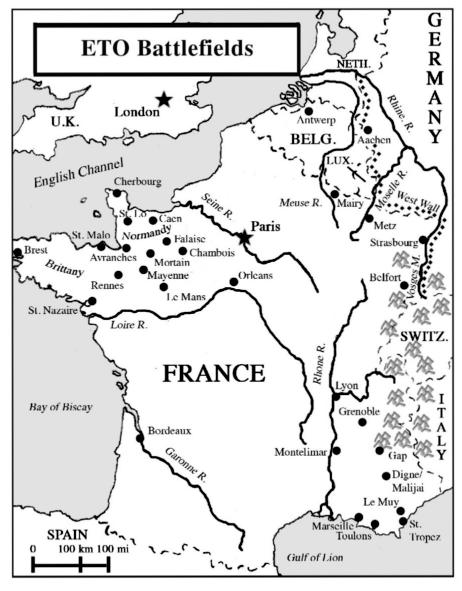
Near Caen on 9 August, the Canadian First Army launched a massive attack southeast toward Falaise, about thirty miles behind and west-northwest of the German line at Mortain, where, on the night of 6 August, the Germans had launched an unsuccessful offensive to pinch shut the hole at Avranches. On 10 August, Patton ordered the XV Corps, which had captured Le Mans seventy miles behind and southeast of the enemy's Mortain line, to attack north across the German rear toward Argentan and Falaise.21 The entire German Seventh Army was in danger of encirclement. As the situation became clear, Hitler finally agreed that the Seventh Army must withdraw.
Punching through desperate German resistance at Alencon on 1 1 August, the French 2d and U.S. 5th Armored Divisions, followed closely by the U.S. 79th and 90th Infantry Divisions, reached Argentan. Patrols reached Falaise only ten miles to the northwest. But on 13 August, Supreme Headquarters Allied Expeditionary Force ordered the 90th Infantry and French 2d Armored Divisions to stop in Argentan and wait for Montgomery's troops, who were pushing south to close the gap; the rest of the XV Corps was ordered to turn east toward Paris. Unfortunately, the Canadian attack stalled halfway to the objective, and Montgomery's troops did not close the trap until 19 August, which allowed perhaps one-third of the German troops to escape.29 The collapse of the Falaise Pocket was nonetheless a disaster for the German army. It left behind 50,000 prisoners, 10,000 dead, as many as 500 tanks and assault guns destroyed or captured, and most of the transportation and artillery of the troops who fled 30
The 90th Infantry Division advanced to Chambois on 18 August to crimp the escape hole out of the Falaise Pocket, and the 712th Tank Battalion fought with the doughs as usual. On 15 August, the 359th Infantry spread out along the line from Le Bourg-St.-Leonard to Le Merlerault, small villages south and east of Chambois. The next day, German artillery shelled Le Bourg-St.-Leonard, which was held by Company A, 1st Battalion, and the tanks of Company As 1st Platoon. German infantry attacks followed, and at 1700 hours, panzers joined the fray. The elements of many different divisions were piling up against the 359th Infantry's holding position, and the Germans briefly captured Le Bourg-St.-Leonard.
The Germans struck with renewed fury on 16 August, as a dozen panzers and parts of two panzergrenadier regiments of the 2d SS Panzer Division Das Reich sought to break free of the pocket. The attack successfully enveloped Le BourgSt.-Leonard, and the 359th Infantry threw a platoon of reserve tanks into the fight, with the 1st Battalion's commander, Maj. Leroy Pond, standing atop the lead tank and the Ammunition and Pioneer Platoon of the 1st Battalion mounted on the decks, which restored the situation and carpeted the field with dead SS stormtroopers. Commented one participant, the only thing that stopped the German thrust was "our tanks and American guts" Nevertheless, the Germans, having no alternative, came on again, and control over the town passed back and forth. By 2300, the Americans held it for good.
From 17 through 21 August, the 359th Infantry stood in the Germans' path like a stone wall. Artillery smashed column after column as they approached Chambois. The watching GIs cheered and cheered. Soldiers from the 90th Division linked up with Polish troops under Canadian command at 1600 hours on 19 August, and the pocket was closed 31
In his oral history of the 712th Tank Battalion, Aaron Elson records tank commander Jim Gifford's recollection of the immense scene of chaos and slaughter as the pincers closed:
[I]t was just daylight, I took my field glasses and went up the hill so I could see out over this valley.... I see all these little sparkles, little sparkles all over the valley, what the hell is that? I looked through the field glasses and I'm telling you, I couldn't believe the sight I saw. It was thousands of bayonets flashing in the early morning sun. These guys, these infantry guys, were walking toward us, now they're about three miles away up that valley, and they're dispersed among hundreds of tanks moving along. Holy shit, I saw this, this was coming toward us, this is it. So I ran down, I got on the radio and I started hollering over the radio what's coming. And it wasn't twenty minutes later a bunch of our P-47 Thunderbolts were flying towards them, at treetop level, those guys were our saviors, they were our angels up there, they were there all the time so we felt secure. They used to run in groups of four, and they came flying in one group after another. They'd go and the next thing there'd be more of them coming, they were knocking the shit out of them, and shells started flying over us, big shells....
Well, these poor bastards out there three miles away, they were catching bloody hell, I'll tell you, they were getting it. We were firing at them from a mile or two away.... Companies A and B were spread out across the valley [with] the 773d [Tank Destroyer] Battalion. . . . And this monolith, whatever you want to call it, was slowly rolling, with all the destruction that was going on, it was coming right along by us-and Jesus, it wasn't stopping-and we were hitting everything. They had hundreds of horses drawing artillery. And instead of turning and coming up the hill toward us, they continued to head toward the gap with our [Companies] A, B, and 773d [Tank Destroyer] Battalion dispersed there, and those two companies were catching hell because the Germans started rolling through them. And when they hit these two companies plus the 773d they started piling up, and the next thing they turned and started to go back and started running into themselves.
By two o'clock in the afternoon, airplanes had been flying over dropping leaflets ... saying surrender, wave the leaflet, you'll be okay. We got orders, they kept coming over the radio, stop firing at two o'clock.... Then at two o'clock it stopped, and they started coming up, out of the gap. Their equipment was burning all over the place, as far as you could see.... I looked down from the tank, and these guys were all dusty, dirty and filthy, and tired. They were a bedraggled army, it was a defeated army. They were just so goddamn glad to just be alive 32
The 90th Division's G-2 estimated that the 712th Tank Battalion had destroyed 50 tanks, 123 self-propelled guns, and 408 other vehicles-numbers that simply are not credible. The G-2 estimated that the 773d Tank Destroyer Battalion had knocked out 104 tanks and 51 self-propelled guns-several times the figure claimed by the battalion itself.
Nevertheless, it had been a killing field for the Germans. One infantry officer commented upon entering Chambois that it was the first time he had seen the proverbial river of blood.33
Getting a Better Tank
With the arrival of the 774th Tank Battalion in August, the first Shermans armed with a 76-millimeter gun reached the pool of separate tank battalions. A few 76millimeter Shermans made it to England in time for D-Day, but commanders were not enthused until stung by the bad experiences of tankers in France, where gun ners learned that their 75-millimeter rounds simply bounced off the front armor of Panther tanks. Initial plans called for one-third of tanks eventually to mount the 76-millimeter gun, but by the end of hostilities, the proportion would climb to more than half.34
Like many equipment upgrades, the appearance of 76-millimeter Shermans in the separate tank battalions varied tremendously. At one extreme, the 774th Tank Battalion entered combat fully equipped with 76-millimeter Shermans, and the 70th Tank Battalion drew 76-millimeter Shermans on 10 August (all of which went to Company A).35 On 19 October 1944, the 737th Tank Battalion received a single tank with a 76-millimeter gun, which it decided to use as an assault gun attached to Headquarters Company and shuttle among the line units as needed.36 The 741st Tank Battalion did not draw its first 76-millimeter Shermans until 1 January 1945,37 and the 743d Tank Battalion received its first five M4Als with 76-millimeter guns on 2 January.38 It was not until February 1945 that the separate tank battalions moved to the top of the list, ahead of armored divisions, for allocation of 76-millimeter tanks arriving in theater.39 In January, the 756th Tank Battalion, for example, had 75-millimeter and 76-millimeter tanks in a ratio of two to one, and by the end of February, the proportions had reversed.40
Although better against armor than the 75 millimeter, the 76-millimeter gun was not the solution for which tankers had hoped. It, too, proved to be generally ineffective against the frontal armor of the Panther and Tiger, except at close ranges, thanks to a botched assessment of the gun's penetration ability by the Ordnance Department during development." The gun's effectiveness improved significantly with the introduction of tungsten-core hyper-velocity armor-piercing (HVAP) rounds, with which the Sherman finally gained the ability to kill Panthers from the front at 300 yards42 Once again, deployment of equipment in the pipeline caused the Sherman to remain weaker than it had to be. HVAP rounds began to reach separate tank battalions by September 1944 at the latest,43 but the new ammunition remained extremely scarce for the entire war. In late March 1945, when the Ninth Army notified the 3d Armored Group that HVAP would henceforth be available as a standard issue, it indicated that one-half round per tube per month could be drawn.'
A drawback to the 76-millimeter gun was that it fired a far less effective highexplosive round than did the 75 millimeter. For infantry -support tanks, this was a major sticking point. At least some infantry commanders seemed to want to keep a preponderance of 75-millimeter guns around. Indeed, Maj. Gen. Alvan Gillem, who became commander of the Armored Force in May 1943, was an infantry officer and believed that no more than one-third of Shermans should have the 76millimeter gun because of its less effective high-explosive round.45
The 76-millimeter gun also produced a muzzle blast so large that crews had trouble tracking the rounds in order to correct their aim. It was not until the M4A3E8 "Easy 8" was delivered in early 1945 that a muzzle brake-a pineappleshaped device on the end of the gun tube with vents that diverted blast force to the sides-corrected the problem.
PARIS AND BEYOND: THE PURSUIT
After the closure of the Falaise Gap, the road race eastward truly began. On 19 August, Eisenhower made another major adjustment to the plan. Instead of stopping at the Seine River for three months in order to build up supplies, open ports, and build airfields, he decided to pursue the retreating Germans relentlessly on a broad front.46 The First and Third Armies were to charge ahead. Eisenhower's decision to advance on a broad front led to months of friction with Montgomery, who wanted to stage a single thrust in the north all the way into Germany and cut off the Ruhr industrial basin.
The official U.S. Army history describes this period almost entirely as a series of movements rather than clashes. Contact with the enemy, whose forces were in disarray, was sporadic. The Germans tried to make a stand in only a few instances, usually at river crossings. Otherwise, American units faced scattered roadblocks or small rearguard actions that rarely lasted even a few hours. Many bridges were captured intact, and the Germans defended few towns and villages." Only the armored division spearheads ran into serious fighting-even then highly localized-once the race began.
For the separate tank battalions, the action was essentially one of rapid pursuit of the enemy, who threw up defenses in the form of mined roadblocks, demolitions, and mobile strongpoints consisting of infantry, tanks, and self-propelled artillery." The 743d Tank Battalion, for example, raced 123 miles on 19 and 20 August.49 At one time, the battalion's point was only eight minutes behind the enemy's rear guard. The retreating column was frequently shelled, and the highway was littered with knocked-out vehicles and abandoned equipment. So fast was the advance that the Germans had no time to lay mines or do more than construct the simplest roadblocks."

Aside from such occasional run-ins with German troops, the race eastward was a triumphant experience for the tankers. Locals mobbed them in every village, eager to greet their liberators with flowers, cheers, wine, and kisses from the girls. For once, fear was far away. Lt. Homer Wilkes recalled that on one occasion, none of the gunners in another 747th platoon were able to hit an escaping Tiger tank in full view because they were all inebriated."
Paris fell on 25 August. Eisenhower had hoped to bypass and surround the city, but the French Resistance launched a rebellion that quickly got into trouble. They called for help. Free French leader Gen. Charles de Gaulle insisted on intervention, and he and the French 2d Armored Division commander, Maj. Gen. Jacque Leclerc, gave every indication that French troops under U.S. First Army command would disobey orders not to take the city. Eisenhower gave in.52 For political reasons, the French 2d Armored Division was officially the first unit to enter Paris; Patton's Third Army had been poised to move earlier, but it had been ordered to stay to the south. Simultaneously, the 4th Infantry Division moved into the French capital, providing the 70th Tank Battalion with the unmatched opportunity to perform two days of "guard" duty in the center of a joyous and momentarily generous Parisian public. The tankers enjoyed the time-a great deal.53
The 741st Tank Battalion also got to Paris, and Capt. James Thornton and his men had great expectations when the word went around. "Paris was on everyone's lips," recalled Sgt. Bill Merk. "Paris, the ambition of any vacationer, playboy, or fashion expert !"54 The tankers reached the city at 1015 on 29 August, where they formed up to participate in a parade through the city center. Along with doughs of the 28th Infantry Division, they rolled four tanks abreast down the Champs Elysee-and straight out the other end of Paris. They had orders to attack at 0730 the next day.55
Meanwhile, the 70th Tank Battalion sadly left the City of Light and was fully recommitted to battle on 27 August, a day during which it lost seven Shermans, one of its highest loss rates of the war. Perhaps hangovers played a role."

On 8 September, the 712th Tank Battalion was in bivouac around Mairy, a village near Landres and not far from Metz, when it experienced the only real tank battle in the separate tank battalion annals during the race across northern France. At 0200 hours, about thirty-five Panthers and Mark IVs belonging to the 106th Panzer Brigade, accompanied by half-tracks bearing panzergrenadiers, stumbled into the bivouac area. George Bussel, whose Company A platoon was guarding the division's artillery position, watched in amazement as the column appeared out of the dark and the commander in the first German panzer leaned over the turret to read the sign pointing toward the 90th Infantry Division artillery command post. The Germans were on their way to Briey and had taken a wrong turn, though a bright moon lit the night. Four or five panzers, accompanied by about ten halftracks, had approached the command post, while the rest of the column halted.
Lt. Lester O'Riley, commanding Company A, reported the German incursion to the battalion command post but said he was not opening fire because he was unsure of the enemy's strength and his tanks were poorly positioned. Nevertheless, shortly thereafter, Lt. Harry Bell's section of three Shermans fired on the Germans, who immediately replied. At least one Sherman exploded in flames (some accounts say two were knocked out), as did two Panthers.
The panzergrenadiers dismounted and attacked the American position, while the crew of the destroyed Sherman joined the artillerymen in a small-arms defense of the command post. When the Germans mounted a second attack at 0345 under cover of panzer cannon fire, Pvt. George Briggs climbed atop the crippled Sherman and fired the antiaircraft machine gun at the Germans. After an exchange of grenades around the artillery message center, the Germans drew off.
A confused fight flared until daybreak, during which time the division command post evacuated its nearby bivouac and ordered two rifle battalions into action. A platoon of Company C tanks moved into the division command post area, where two were hit and burned.
After daybreak, the German column ran into the 1st Battalion, 358th Infantry, which was responding to the summons to engage the enemy. The battalion had been told there were 100 German tanks, and because all the enemy vehicles were camouflaged with brush, the GIs at first thought that number to be true. The battalion commander called for all the artillery he could get, no matter how close it fell to his own positions. While shells ripped the German column, a heroic bazooka man worked his way to the head of the column and disabled the lead vehicle, which blocked the Germans on a sunken road. Three panzers and thirtyone half-tracks were destroyed in the trap.
At 1000 hours, two Panthers broke past the American tanks and headed for the tank battalion's command post. Guns from many directions turned on the panzers and knocked them out. Captured crewmen said that by this time they were trying to break out, not in.
About noon, three more panzers advanced on the glade where the Service Company was repairing tanks. As men scattered, maintenance officer Forrest Dixon and another man clambered into one of the Shermans. Doubting that the sights and main gun were aligned, Dixon waited until the lead German tank was only fifty yards away. The enemy's turret began to turn in his direction, so Dixon let him have it and called for help over the radio. The shell hit a bogie on the Panther, and it skewed to the left. Two other Shermans pumped 75-millimeter shells into its flank, and the German commander waved a white handkerchief and dismounted from his now burning panzer with his two surviving crewmates. Meanwhile, a towed tank destroyer crew that happened along unlimbered the gun with the help of some GIs and dispatched the other two panzers, though the tankers were firing on one of them, too, and also claimed the kill.
By the time the fighting finally died down, the 712th Tank Battalion and 90th Division had knocked out thirty German tanks and fifty-four half-tracks and had captured ten tanks, at least fifty half-tracks, and 764 enemy soldiers. The 712th Tank Battalion's own losses that day were a handful of men and four Shermans.17

The rapid advance across France took a tremendous toll on the equipment of the tank battalions despite the Sherman's remarkable durability. On 10 September, for example, the 749th Tank Battalion, advancing with the 8th Infantry Division, could muster only a composite platoon of five operational Shermans; all its other tanks were out of action for maintenance reasons. The battalion that day dispatched thirty trucks to Utah Beach or Cherbourg to find tank tracks, engines, and other needed spares. On 12 September, one of the battalion's five tanks hit a mine and a second broke down.58 The First Army reacted to the shortage of tanks throughout armored formations by adopting a provisional table of organization and equipment that reduced the size of armored divisions and the separate tank battalions-in the latter case to fifty medium tanks.59
But while steel suffered, for a change human flesh did not to any great degree, except perhaps for those portions that sat in bouncing tank seats for hundreds of miles. During the entire race across France after 20 August, for example, the 743rd Tank Battalion lost only one man killed and two wounded.60 The 741st Tank Battalion had only one man lightly wounded in the first two weeks of September.
The race across northern France ended by mid-September because of supply problems and successful German efforts to rally the shards of the Seventh Army along the German frontier, boosted by fortress battalions and other scanty reserves from inside the Reich. Patton's advance elements reached Metz on 1 September,b' but Eisenhower's decision in August to throw most of the available logistic support behind Monty's advance along the coast starved the Third Army of fuel and other necessities, and the tanks ground to a halt. Patton improvised a bit by using captured German fuel.
Farther north in the First Army's zone, American columns had similar supply problems. By early September, the 743d Tank Battalion, whose tanks were the first to enter Belgium and the Netherlands, was rationing tank fuel and sending supply trucks far to the rear in search of more; on 12 September, the point halted because it had no more gas.62 The 702d Tank Battalion noted in mid-September that the distance to its various supply points ranged from 100 to 500 miles.63 That any fuel at all was reaching the advance elements was due to the tireless efforts of the famous Red Ball Express, which moved gasoline forward in five-gallon jerry cans on quartermaster trucks. By September, however, the Red Ball was approaching the point at which it burned more gas to reach the front than the trucks could carry.64
In any event, First Army elements reached prepared defensive positions in the Netherlands and the Siegfried Line along the German border by 11 September. There they slowed or stopped in the face of re-emergent German resistance."
OPERATION DRAGOON: THE OTHER SHOE DROPS
On 15 August, the U.S. Seventh Army's VI Corps, drawn from the Italian campaign, landed on the southern coast of France. German forces in southern France under Army Group G, almost stripped of effective armored units and many of the best infantry divisions to help hold the line in Normandy, already confronted an untenable position as Patton raced across their rear toward the German border.
American forces faced generally light opposition from several infantry divisions belonging to the German Nineteenth Army as they came ashore near St. Tropez.bb The three infantry divisions of the VI Corps-the 3d, the 36th, and the 45th-made up the invasion force, which was to be followed by four French divisions. Three tank battalions-the 191st, 753d, and 756th-were each equipped with the rough equivalent of one company of DD Shermans for the invasion. On D-Day, all three of the 191st Tank Battalion's DD platoons puttered to shore safely, although an entire platoon was immobilized by mines on Blue Beach after landing. Three DDs were total losses, and the platoon drew standard replacement tanks. In the 753d Tank Battalion, Company As DDs were floated 4,000 yards offshore, and only one was lost temporarily when its screen was pierced by an antitank round, flooding the engine as the tank neared the beach.67
The 756th Tank Battalion lost two DDs from Company A when they hit underwater objects and their canvas tore. The commander of a third tank was killed by friendly fire as he perched atop the turret. All of Company B's DDs reached the beach, although one drowned out when the wake from a passing small vessel swamped the vehicle, which had dropped its screen to fire with the water halfway up the hull.68
Lt. Col. Glenn Rogers, the commander of the 756th Tank Battalion, opined that the DD tank's screen was far to vulnerable to enemy fire and that because the commander had to remain fully exposed, he was likely to be a casualty if resistance was fierce. "I believe that a different type of tank should be used in the assault waves-probably the `amphtank' used in the Pacific.""
Lessons learned in Italy about the need for effective tank-infantry communications gave the Dragoon tankers a leg up. Each company commander's tank in the 191st Tank Battalion went ashore with an infantry SCR-300 radio installed in an armored box behind the turret. A shortage of such radios, however, prevented their use in platoon leaders' tanks. Meanwhile, the battalion gave the infantry regiments to which it was attached SCR-509 radios as a backup. The records of the 753d and 756th Tank Battalions provide no evidence that they adopted the same system.
The lesson of lasting partnership had also taken root. Maj. Gen. John "Iron Mike" O'Daniel, commanding the 3d Infantry Division, had put into practice the sentiments he had expressed to the War Department observer back in Italy. He had "claimed" the 756th Tank Battalion as his own. He required the tankers to wear the 3d Division patch on the shoulder opposite their armored force patch. David Redle recalled, "When we started with the 3rd [Division] in southern France, we had basic cooperation. As time went on, tankers had more and more concern about helping the infantry, and the infantry really developed a concern for our tanks' well being. 1170

On 17 August, Hitler instructed Army Group G to disengage from the enemy except for units occupying Marseille and Toulon and to withdraw northward to link up with the southern wing of Army Group B, which was reeling back before the Overlord forces. An initial order to withdraw elements not committed to the battle reached Army Group G on 17 August, and instructions for a total withdrawal arrived the next day. The 11th Panzer Division was to protect the Rhone Valley and serve as rearguard for the Nineteenth Army."
The Seventh Army's plan called for an advance westward with two corps abreast to capture the major ports of Toulon and Marseille. But Maj. Gen. Lucian Truscott, the commander of the VI Corps, had his eye on a spot 100 miles to the north where high ground east of the Rhone River created a bottleneck near the town of Montelimar through which the Nineteenth Army would have to pass. Truscott expected the Germans to concentrate their forces to stop the Seventh Army's push westward, and he saw an opening to send a strike force toward Grenoble and from there to the high ground just upstream from Montelimar. No plan had foreseen such early exploitation, but Truscott had.72
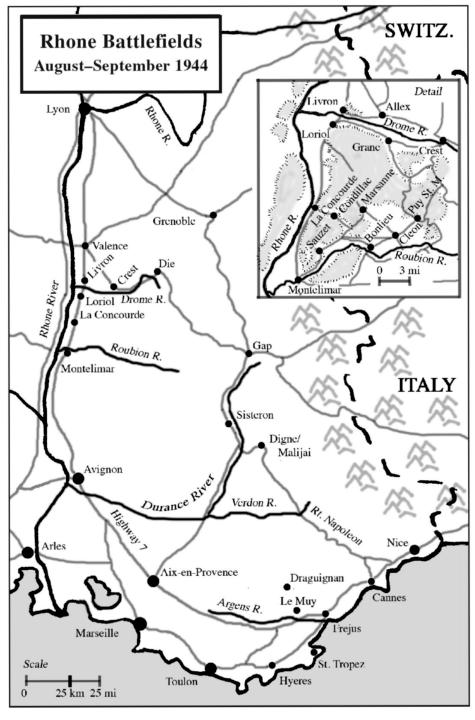
Even before the landings, Truscott-denied an American armored division for the invasion-had decided to improvise a combat command, and on 1 August, he created a provisional armored group led by his assistant corps commander, Brig. Gen. Frederic Butler. This formation, generally referred to as Butler Task Force, consisted of the 2d Battalion, 143d Infantry Regiment; the 117th Cavalry Reconnaissance Squadron; the 753d Tank Battalion (reduced to two companies of medium tanks), under the command of Lt. Col. Joseph Felber; Company C, 636th Tank Destroyer Battalion; an armored field artillery battalion; and assorted other units. In strength, Butler Task Force closely approximated an American combat command, which was usually built around a battalion each of tanks and armored infantry. The command would form at Le Muy on order once the VI Corps was established ashore. Butler and his hastily gathered staff set to work planning for various contingencies, including an advance up the Route Napoleon toward Grenoble to block roads east of the Rhone River near Montelimar.73
Task Force Butler charged north toward Grenoble on 18 August. When the cavalry's light reconnaissance tanks and armored cars encountered too much German resistance to handle in Malijai and Digne the next day, a company of medium tanks and infantry lumbered up to provide the weight necessary to overcome the problems. The lead elements reached the town of Gap on 20 August, just as Truscott ordered Butler to move seventy miles westward through rough terrain to cut the highway along the Rhone.
Lt. Col. Joseph Felber, commanding the main column of armor and infantry, received orders at 0600 hours on 21 August to pass through Die and then, operating behind a reconnaissance screen, take the high ground overlooking the Rhone approximately three miles south of Livron. The lead reconnaissance elementsTroop B, 117th Cavalry Reconnaissance Squadron-reached the high ground by mid-afternoon.
Meanwhile, Felber Force rolled toward its objective over steep and winding roads, dropping elements here and there along the route to secure key junctions, and closed on Condillac at about 2145. After examining the terrain, Felber concluded he lacked the manpower to hold all of the high ground and decided to occupy hill masses to the north and south of the road running from Condillac down to La Concourde, where it intersected Highway 7 near the Rhone a few miles north of Montelimar. Felber had only a rifle company (less one squad), a heavy weapons company, a few antitank guns, a company of fourteen medium tanks, a handful of tank destroyers, an armored field artillery battalion (less one battery), and a company of noncombat engineers. Felber deployed his limited resources on the high ground and at a few strategic roadblocks, positioning four tank destroyers to command the Rhone road by fire. M7 Priests clanked into firing positions while forward observers made themselves comfortable, peering down on the German Nineteenth Army snaking northward below them. Felber obtained Butler's permission to outpost several more hills with Troop B of the 117th Cavalry Reconnaissance Squadron and met with the local Resistance commander, who supplied 200 men to assist in manning outposts and roadblocks.
By 2300 hours, Felber Force was in position.74 The tankers and their comrades from the cavalry, infantry, and artillery had beaten most of the Nineteenth Army to the pass.

The sky gradually lightened enough on the morning of 22 August that the tank and tank destroyer gunners of Felber Force could see through their sights, and the men were delighted to observe a target-rich environment of German vehicles below them crawling past hulks destroyed by shelling during the night. Gunners gleefully added so much new wreckage that it temporarily blocked the highway.75 There were many smaller paths parallel to the highway, however, so that German movement never ceased entirely.
Slowly, additional formations swelled the ranks of Butler Task Force-the missing armored field artillery battery, plus another column including six more tank destroyers. But as Butler later observed, "the Germans were building up against me faster than were our own forces building up "76
Artillery, tanks, tank destroyers, armored cars, and even the infantry's 57millimeter antitank guns rained death on Highway 7 during the long daylight hours. The 59th Armored Field Artillery Battalion smashed several trains, which blocked the rail line on the east bank of the river. Two trains carried munitions and put on a display of amazing pyrotechnics as they burned.
Butler's main concern that day turned out not to be the Rhone highway, but rather German efforts to advance along the north bank of the Roubion River and thence northeastward across his rear, which Felber now protected with a small reserve force. Five Panthers supported by panzergrenadiers smashed a roadblock at Cleon and rolled toward Puy St. Martin, where Felber had his command post. Felber had only a few tank destroyers at hand, which engaged the Germans, but the Shermans and tank destroyers on the road from Gap-which were to form the core of his reserve-had not yet arrived. A cub artillery plane was dispatched to drop a message of dire need to the column. Butler described what happened next: "[O]ur rescue column arrived for a movie finish. The German tanks that had crossed the Roubion were destroyed, the infantry were driven back, and on the south bank several fires burned merrily where our guns had found trucks and light vehicles. It was a good honest fight. The reserves had arrived in the nick of time."
The arrival of Panthers and panzergrenadiers was a sure sign that the 11th Panzer Division was joining the battle. Receiving word that infantry was on the way from the 36th Division, Butler assured Felber that he would soon have help for his overextended reserve. But after the day's combat, Butler Task Force was down to twenty-five rounds of artillery ammunition per tube-half Butler's desired minimum. Fire ceased until supplies arrived after dark."
When the tired GIs from the 141st Infantry finally arrived late that day, Fel- ber's tanks and Company C, 636th Tank Destroyer Battalion, were attached to the regiment to provide general support.78 The stage was set for the battle of Monte- limar.79
Butler Task Force was dissolved at 0900 on 23 August, and at 1530, Felber turned command of his sector over to the 141st Infantry.80 The tankers thereafter shuttled about supporting the doughboys where needed.
Although the 36th Infantry Division never completely blocked the escape route up the Rhone, by the time the 3d Infantry Division and 756th Tank Battalion pushed up Highway 7 to Montelimar in the wake of the retreating enemy, the Americans had badly hurt the Germans. Army Group G would report on 22 September that 209,000 men had left southern and southwestern France and that only 130,000 of them had escaped.81 The Nineteenth Army had lost 1,316 of its 1,480 guns.82

The "Champagne Campaign," as critics called it, cost the U.S. Seventh Army 2,733 men killed, wounded, or captured to reach Lyon on 2 September. Casualties in the tank battalions were correspondingly modest despite an assault landing and 500mile advance. The 756th Tank Battalion, for example, lost twenty-five men killed and thirty-seven wounded between 15 August and 15 September. During August, the 191st Tank Battalion had lost twenty-four tanks and fifty-four men killed, wounded, or missing.83
On 20 September, the VI Corps set out to force the Moselle River but found that the Germans were no longer running. They now held the VI Corps, dangling at the end of a long supply line, before the Belfort Gap in the Vosges Mountains west of the German border.84 The 756th Tank Battalion reported in September, "Enemy defended approaches to Belfort Gap.... As enemy moved back into the hills, he began using considerable numbers of antitank mines. Enemy used few tanks, but employed considerable numbers of antitank and SP [self-propelled] guns. Enemy resistance stiffened as the terrain grew more favorable for defense, and artillery fire increased in intensity."85
Weather and terrain aided the Germans. The 191st Tank Battalion's afteraction report recorded in October, "Continued rainfall rendered the surrounding territory unfit for cross-country maneuver. In addition, much of the action took place in densely wooded areas, where the employment of tanks was extremely dangerous "86 It was just like being back in Italy.

The tankers had tangled with the Mark V Panthers of the 11th Panzer Division nearly all the way up the Rhone Valley, the first time they had encountered the deadly panzer in any numbers. The experience was sobering, as it had been for tankers in Normandy. Maj. Welborn Dolvin, the commanding officer of the 191st Tank Battalion, summarized the tanker's point of view in August 1944 after his outfit had been in action in France for only two weeks: "The Sherman tank, equipped with the 75mm gun, is no match for ... the German Mark IV, V, or VI. On numerous occasions, hits were obtained on German tanks with no noticeable results. On the other hand, German high-velocity tank guns never failed to penetrate the Sherman tank. This situation has a tremendous effect on the morale of the tank crews. This was evidenced by reluctance of crews to fire on German tanks, feeling that it would do no good and would result in their being promptly knocked out."S7
On 1 September, the 191st Tank Battalion expressed concern that long road marches and shortages of spares were forcing the battalion to continue using wornout tank tracks.88 By the second week of September, fuel shortages were hampering the advance.89 The 753d Tank Battalion also reported near-critical shortages of tracks, support rollers, bogie wheels, and tank engines during September. On 6 September, the battalion's commander warned the commanding general of the 36th Infantry Division that his tanks would not be operational after two more days of movement unless parts could be obtained. At mid-month, Company C had only three tanks that would run.90 But the problem was supply, not the tank. The 756th Tank Battalion concluded, "The M4 tank has proved itself very reliable mechanically. Our tanks traveled some 1,200 miles between 15 August and 15 October, with relatively few mechanical failures.""
As German resistance toughened, the 753d Tank Battalion was hit in September by another shortage that soon would trouble tank battalions farther north: qualified replacement personnel. Since the Dragoon landing through September, the battalion had lost sixteen tank commanders and seventeen drivers; these positions required crucial skills, and the battalion had shifted its surviving veterans to fill them after heavy losses in Italy during May and June. In September, the battalion had to "deadline" operational tanks because of crew shortages. 2 According to the 756th Tank Battalion, "Replacements continue to be poorly trained. Approximately fifty percent of replacements have to be trained for their jobs after being received. 1193