

CHAPTER 10
"The reality of war was grimly present once more.... [T]he Germans showed a frantic-and fanatical-determination to throw up some semblance of a line.... By 12 September, the First Army's sustained drive had been stopped. The war settled down to a foot-soldier's walk again. Ahead was some of the bitterest fighting of the war."
-Wayne Robinson, Move Out, Verify
 the officially recognized U.S. Army campaigns in northern and southern France, characterized by rapid movement, ended on 14 September 1944; on 15 September, the Rhineland Campaign began, a slugfest that dragged on, by official count, until 21 March of the next year.
The First Army's three corps butted up against the Siegfried Line between 13 and 19 September. Gen. William Simpson's Ninth Army, shifted from Brittany, took over control of the northernmost part of this sector on 22 October. In the Third Army's zone, Patton's troops had just breached the Moselle River line by 14 September but faced a shortage of most supplies and an order to go onto the defensive as of 25 September. Patton nevertheless was determined to knock through the fortifications around Metz that stood between him and the Siegfried Line. ` On Patton's right flank, Seventh Army troops were stuck in the rough, forested terrain of the Vosges Mountains.
From north to south, the separate tank battalions faced broadly similar challenges in the next phase of the conflict. Tanks were committed against preparedand often fortified-German positions where, lacking room for maneuver and heavy punch, they were at their least effective. Infantry and tankers had no training to deal with this and found themselves enrolled in another school of hard knocks.
The weather was horrible, which magnified most other problems. The fall and winter of 1944 produced weather of near-record severity, first in the form of mud-producing rain and then snow and unusually harsh temperatures.2
Instead of fighting a hedgerow-by-hedgerow battle, the doughs and tankers found themselves embroiled in a fortification-by-fortification, strongpoint-bystrongpoint struggle. Having experienced-and mastered-the first type of warfare, they quickly adapted to the new circumstances. Moreover, a more tightly integrated and effective combined-arms team was emerging in units that had spent time together in battle; the team integrated infantry, tanks, artillery, tank destroyers, and airpower into a package that could bore through the defenses. For example, with ever-greater frequency, after-action reports show tanks and tank destroyers working together (a great rarity in Normandy). More battalions began to put officers in artillery planes from which they could spot German tanks, guns, and other elements and coordinate action on the ground.' And a tank battalion could now expect to have its commanding officer at the front and officers equipped with tank radios at the infantry's battalion, regiment, and division headquarters. The worst experiences occurred in circumstances, such as the dense Hiirtgen Forest, where the entire package could not come into play simultaneously.
The U.S. Army's official history goes too far, however, in describing the infantry-tank-artillery teams at this time as "close-knit families, into which had been adopted the fighter-bomber," that possessed an "almost reflexive knowledge of how to fight this kind of war."4 American troops were frequently shot up by their own planes.' Disconnects between infantry and tanks continued to occur, and infantry commanders still sometimes made bad calls on the use of tanks.
Units had to work at keeping the team functioning because there was no reflexive knowledge. The main change from Normandy days was that both infantry and tankers better understood that they had to work out solutions together in order to survive and win.
THE SIEGFRIED LINE
The West Wall, construction of which began in 1936, ran nearly 400 miles from north of Aachen along the German frontier to the Swiss border. The Germans had neglected the defenses after 1940, so Hitler now worked furiously to put together a scratch force of 135,000 men to partially rebuild and man the line as the Allies approached the border. The strongest portion faced Patton along the Saar River between the Moselle and the Rhine. The second most formidable section was a double band of defenses protecting the Aachen Gap, with the city of Aachen lying between the two. Immediately behind the West Wall in this sector was the Roer River, which gave the Germans a backstop that they could flood from three dams farther south near Schmidt.'
Pillboxes in the West Wall typically had reinforced concrete walls and roofs three to eight feet thick and were generally twenty to thirty feet wide, forty to fifty feet deep, and twenty to twenty-five feet high, with at least half the structure underground. In some areas, rows of dragon's teeth-reinforced concrete pyramids-acted as antitank obstacles. In other areas, defenses relied on natural features-rivers, lakes, forests, defiles, and so on-to provide passive antitank protection.7
The woods that covered most of the Siegfried Line could work to the advantage of the tankers. Maj. William Campbell, who fought with the 745th Tank Battalion in the Aachen area, observed that the trees dramatically reduced the fields of fire available to German antitank gunners, and tanks could often safely work their way as close as fifty yards to the fortifications they were to bombard.'
LEARNING TO TACKLE THE WEST WALL
On 11 September, the First Army authorized the V Corps on the right and the VII Corps on the left to conduct a "reconnaissance in force" with the aim of breaching the Siegfried Line before the Germans could fully prepare their defenses. The V Corps' operation committed three divisions, the 28th and 4th Infantry and 5th Armored, which were spread out over a wide front and feeling the effects of the long advance across France. They faced rough terrain in the Schnee Eifel, a thickly forested highland. The VII Corps threw the 1st Infantry and 3d Armored Divisions, paralleled by the 9th Infantry Division, against Aachen from the south in anticipation of an eventual pincer move from the north by the 30th Infantry Division.9
Another unwelcome learning experience began. American tankers had never trained to assault fortifications before actually seeing them. The tankers discovered that their cannons were unable to knock out most bunkers. Even the 105millimeter howitzers on the assault guns proved unable to destroy the pillboxes." After trying, they soon realized that their main contribution was to keep the defenders down by firing at embrasures and using tankdozers to cover up the doors and embrasures of captured pillboxes. Here was another puzzle to be solved along with the doughs, the tank destroyers, and the artillery. Air support would prove practically worthless.

In the 28th Infantry Division's sector from 14 to 16 September, the attack painfully poked a pencil-like hole through the West Wall at the cost of 1,500 casualties-losses so high that they precluded exploitation." Tanks had a great deal of trouble maneuvering off the roads because of the torrential rains that had fallen.12
The attached 741st Tank Battalion participated in one of the first assaults on the West Wall. On 14 September at 0930 hours, Capt. James Thornton ordered two platoons of Company B into motion to support the 2d Battalion of the 109th Infantry. His goal, the high ground southeast of Harsfelt, lay 1,500 yards ahead. Thornton deployed one platoon on each side of the road ahead, knowing that it was sure to be mined. Heavy fire from pillboxes and two sturdy houses swept the area. His crews advanced methodically, taking each strongpoint under fire. Then came an unexpected setback: an antitank ditch barred the way. Thornton radioed for one of the tankdozers to fill in a space wide enough for his Shermans to cross. This was soon accomplished. Thornton, looking around, realized that the enemy fire had become so heavy that the infantry had gone to ground. He ordered the Company B tankers to press ahead alone. Soon the high ground was his, and the infantry was able to join the Shermans on the objective.
At 1600 hours, Thornton's radio crackled to life. Regiment wanted him to lead a platoon of tanks to support his 3rd Platoon in the neighboring battalion's sector, where his boys had already lost two Shermans. Thornton quickly decided that the quickest route lay through the German defenses, so he set off to shoot his way past. His gamble cost him two tanks and three men, but Thornton made it. The ranking infantry officer ordered Thornton to lead an attack over the next hill. Thornton took the point and ordered his tanks to advance once again. The Shermans crested the rise. Suddenly, Thornton's tank rocked under a massive blow, followed by two more in quick succession. Fragments of the antitank shells and armor ricocheted like angry hornets inside the tank. Thornton was blown from the turret and badly injured. An infantry captain-an old friend and classmate from The Citadel-saw Thornton, pulled him away from the burning tank, and left two men to protect him. The Germans counterattacked, however, and that was the last Thornton was seen alive.13 Only one crewman, the gunner, would make it back to American lines.

Not too far away, 2d Lt. Joseph Dew, commanding the 1st Platoon of Company C, 741st Tank Battalion, led his Shermans toward the staggered rows of dragon's teeth. The bocage fighting had claimed every one of the company's platoon leaders; Dew-a tall, straightforward man-was one of the replacements. Dew recorded his first major engagement in an after-action report:
On 14 September, [we] moved into position at 0840 hours southeast of Grosskampenberg. The 1st Platoon moved up on the right side of the road to the edge of the dragon's teeth and placed direct AP [armorpiercing] and HE [high-explosive] fire on two pillboxes at four hundred yards. We then placed a few HE on a small clump of trees just over the dragon's teeth and then placed fire on three pillboxes to the left front at ranges from 700 to 1,200 yards.
We waited until 0915 for the engineers to come up and blow a way through the dragon's teeth, and when they failed to arrive my tank pulled within a few feet of the concrete pillars and fired AP point-blank at them. About 0925 my tank went through and the rest of my platoon followed. We moved up to the pillboxes and fired AP and HE at them, point-blank. Then we moved ahead and over the hill. There were two pillboxes on our right at about two o'clock, and we fired on them. I heard AP whistle around the tank and then saw an antitank gun directly ahead of us by a building about eight hundred yards away. We blew that one up and swung towards the town. We saw another antitank gun by the comer of the building and blew the corner off the building firing at it, but I'm sure we didn't hit the gun for I saw it pull back. Then Captain Young called me and said an antitank gun had knocked out one of my tanks behind me, so we pulled back to get him. The gun that got the tank was in the woods to the right and we put three rounds of HE at it at four hundred yards and blew it up. We covered the wounded until they were dragged behind the pillbox where they were temporarily safe. One of my tanks pulled back across the dragon's teeth to get a round out of his 75mm gun, and my tank sat by one pillbox and the other tank of [my] platoon sat by the other one. We waited until 1230 for the infantry to come up and take the pillbox, because they were full of Heinies. But the infantry didn't come and it finally got so hot with AP that Captain Young pulled us out of there.
The following account from the 3d Armored Group's after-action report for September captures the nature of the battle and the attempts on both sides to adapt to it:
On 15 September this headquarters with two tank battalions, the 741st and 747th, was attached to the 28th Infantry Division and on 17 September, with the support of the 110th Infantry and Division engineers, was designated as Task Force M and given the mission of widening the gap forced in the Siegfried Line between Heckhuscheid and Groskampen- berg, Germany; the 108th Field Artillery Battalion provided artillery support. Due to the reduced strength of the infantry at this time the bulk of the force was to be composed of tanks, with one infantry company (at very reduced strength) in support of each tank battalion. Each of the tank battalions had an average of thirty-five medium tanks. Each was formed into composite companies. To these assault companies in each battalion were attached the tankdozers, and all available assault guns were placed in support in direct-fire position.
The general plan of attack was for the tanks to assault a position and, as soon as the fire superiority had been gained, the infantry would move out and occupy the position until a tankdozer had covered the embrasures and entrances to the pillbox. An artillery observer from the 108th Field Artillery Battalion accompanied the group commander and group S-3 to the forward OP [observation post] in the Siegfried Line in order to direct supporting artillery fire; it had been found that direct radio communication between the forward OP and fire control headquarters was unreliable, so one of the three SCR-508s at the group CP [command post] acted as a relay station....
The enemy had all the advantages that go with a well-planned defensive line: terrain favorable to the defenders, direct observation, thick concrete pillboxes, and underground telephone communications. The mutual support provided by enemy pillboxes was particularly effective against the attacking troops. Yet, notwithstanding the many important disadvantages it faced, Task Force M made progress, and reduced the enemy line pillbox by pillbox.
The first day's operation, on 19 September, resulted in the capture of twenty-nine enemy pillboxes. Very heavy accurate enemy mortar and artillery concentrations were received by the attacking units throughout the day; it was evident that the enemy had direct observation and excellent communications between pillboxes. The captured pillboxes were either blown up by engineer demolition squads or locked and covered up with dirt by tankdozers to prevent the enemy from reoccupying them should he reinfiltrate the position.
On 20 September, twelve enemy pillboxes were captured and rendered unusable; heavy enemy mortar and artillery fire again caused trouble. On 21 September, Company I, 110th Infantry Regiment, replaced Company L; during the day's operations ten pillboxes were captured, under extremely heavy mortar and artillery concentrations, which pinned down the attacking infantry time after time. Dive-bombers supported Task Force M on 22 September, but poor visibility caused the results to be unsatisfactory; the first strike missed the pillbox targets by at least one thousand yards, and two near-hits on the second strike did not damage the pillboxes at all. Although hindered by antitank mines and the usual heavy, accurate enemy mortar and artillery fire, the task force succeeded in capturing and sealing five pillboxes.
In four days of operation this task force covered forty-nine pillboxes, sixteen of which were either unoccupied or previously taken and located in the area held by the infantry, and the remainder of which were captured by the task force and destroyed by the engineers. The bulk of these were captured during the first two days of combat for, as objectives were limited, the enemy grasped our method of operations and stationed men armed with bazookas in foxholes in the vicinity and on top of pillboxes.
Bunker-busting was dangerous work. During the fighting between 23 and 25 September, the 747th Tank Battalion lost probably ten men killed (crew members in tanks that burned were often listed as missing in action because they left no remains) and four wounded. After losing only one man during the last two weeks of the race across France, the 741st Tank Battalion suffered the loss of eighteen men killed and twenty men wounded during the first two weeks on the Siegfried Line.

South of the 28th Infantry Division's sector, the 4th Infantry and 5th Armored Divisions rolled through the West Wall in areas that were either weakly held or undefended by German units that were, in some cases, just arriving at the front. Both thrusts pulled up, however, because the rough and forested terrain and the villages behind the fortifications offered nearly as good a position to the gradually jelling German resistance and and because the still-critical logistic situation com pelled the First Army and the V Corps to call a halt. On 22 September, the V Corps went over to the defensive. The relative inactivity that followed lasted until mid-December."
A HOT IDEA
The U.S. Army had put some thought into equipment that might make tanks more effective against the fortified line that loomed ahead. Presumably inspired by the British Crocodile flamethrower tanks mounted on the Churchill chassis, the army decided to install flamethrowers in tanks already in combat. It had first investigated the idea during the Normandy fighting, but delays put the concept on hold.'5 In fact, U.S. Headquarters in the European theater had received four Crocodilestyle Shermans built for it by the British in early 1944; eventually, these were deployed by the 739th Tank Battalion (Special, Mine Exploder [MX]), but the project had been dropped by August.16
The E4-5 equipment selected for use by most outfits put a nozzle in the place of the hull machine gun, and the storage tanks containing compressed air and fifty gallons of the fuel sat behind the bow gunner, who operated the weapon." This system was capable of using crankcase oil mixed with gasoline, Naphthaline mixed with gasoline, or British fuel.18 The E4-5 had first been used in combat by marine corps tanks on Guam in July.19
On orders from Maj. Gen. J. Lawton Collins of the V Corps, the 3d Armored Group recommended on 4 September that the 70th Tank Battalion serve as the test bed for the new flamethrowers.21 The battalion received its first four units on 11 September, and the hardware spread gradually through other outfits.21
Tankers were divided over the utility of the American-style flamethrowers, which an after-action report of the 743d Tank Battalion described as "calculated to make the enemy burn with more than embarrassment." One tanker who fielded the hardware in the 70th Tank Battalion recalls having used it to good effect against pillboxes." The after-action report for the 741st Tank Battalion, however, records for 18-19 September, "A flamethrower tank was used on one pillbox, but flamethrower had to approach within twenty yards of the box, and even then the flame was very unsatisfactory." Tankers in the 747th Tank Battalion realized that the flamethrower and the German bazooka had similar ranges, which made them loath to use the gear in battle against strongpoints. Another drawback of the system was that the equipment eliminated the ammunition rack behind the assistant driver.13
The army finally conceded that there was virtually no evidence that the E4-5 had made a contribution in battle that could not have been achieved with the bow machine gun or a white phosphorous round.24 Nevertheless, battalions continued to be issued flamethrowers for months.
THE AUTUMN STALEMATE
October marked the beginning of a bitter war of attrition that would characterize the fighting in Europe until mid-December. Lt. Gen. Omar Bradley focused on two priorities: pushing the First Army forward near Aachen, Germany, with the goal of reaching the Rhine River at Cologne; and using the Third Army to reduce the fortifications at Metz, France.'
Painful Aachen
Aachen would be the first major German city to fall to the Allies as well as a superb demonstration of the fact that one could, in fact, use tanks effectively in urban warfare. The First Army's VII Corps attacked from the south, while its XIX Corps formed the other jaw of a pincer to the north. Once the two corps had encircled Aachen, the 1st Infantry Division was to storm the city.
To the north, in the XIX Corps' sector, the attack to break through the Siegfried Line and envelope Aachen kicked off on 2 October, spearheaded by the 30th Infantry Division and the attached 743d Tank Battalion. The 2d Armored Division stood by as the exploitation force.21 The doughs moved forward and easily penetrated the fortifications. The tanks, however, sank into mud just across the narrow Wurm River, which they crossed using a culvert-type hasty bridge designed by the battalion's own Captain Miller and the engineers, and it was not until nightfall that the Shermans were able to close with the infantry. By 7 October, the division had carved out a bridgehead beyond the West Wall that was four and a half miles deep and six miles wide 27
The good news ended there, and the struggle around Aachen became the bloodiest experienced by the 743d Tank Battalion after the battle of the hedgerows in Normandy. German resistance became ferocious as reinforcements arrived. Nine more days of heavy fighting were necessary before a 30th Infantry Division patrol hooked up with 1st Infantry Division troops on Ravel Hill, completing the encirclement of Aachen.28 During October, the 743d Tank Battalion lost twenty of its Shermans, one light tank, and one assault gun while destroying three Tigers, eleven Panthers, five Mark IVs, twenty antitank guns, two armored cars, and two heavy artillery pieces. The battalion suffered thirteen officers and sixty-two enlisted men wounded in action, twenty enlisted men killed in action, and seven enlisted men missing in action during the period-nearly all from the medium tank companies.29
In the VII Corps' zone, the 3d Armored Division attacked in the center, with the 1st Infantry Division (with the 745th Tank Battalion attached) on the left oriented to envelop Aachen from the south and the 9th Infantry Division (with the 746th Tank Battalion attached) on the right. Seeking to regain momentum, the 1st Infantry Division launched its drive to close the ring around Aachen on 8 October. Hitler ordered the defenders-about 4,000 men backed by assault guns-to hold the historic city, the seat of Charlemagne's First Reich, at all costs.
Once the 1st and 30th Infantry Divisions closed the ring around Aachen, subduing the city fell to Col. John Seitz's 26th Infantry Regiment, which had only two battalions available for the job. The assault force was substantially outnumbered in terms of men, but it enjoyed a huge advantage in armor, artillery, and air support. The regiment attacked from east to west through the city.
Lt. Col. Derrill Daniel's 2d Battalion of the 26th Infantry-backed by tank destroyers from Company A of the 634th Tank Destroyer Battalion and tanks from the 745th Tank Battalion-had the dubious honor of clearing the south and center of Aachen. While dug in on the outskirts prior to the assault, Daniel had used the tanks as "snipers" against machine-gun nests and the tank destroyers to blow up buildings suspected of harboring observation posts 30 But now he had to take the buildings.
Daniel's battalion had been conducting limited attacks for days to clear structures along the outskirts before moving into the city itself. Initially, Daniel assigned a mixed force of three or more Shermans and two tank destroyers to support each infantry company. The armor's job was to blast ahead of the infantry, drive the enemy into cellars, and generally "scare the hell out of them" Tanks and tank destroyers had prearranged infantry protection, but small-arms fire forced the doughs to move cautiously, dashing from door to door and hole to hole.
Meanwhile, Lt. Col. John Corley's 3d Battalion cleared a factory district on the east side of the city, and Shermans and MIOs played backup. When the doughs came under fire, a tank or tank destroyer returned fire until the riflemen moved in and cleared the building with grenades.
The two battalions launched their attack on the city proper on 13 October. Companies F and G from the 2d Battalion each had three Shermans and one M10 attached, while Company H had three tanks and two tank destroyers. The armor had difficulty negotiating embankments along the main rail line that cut across the 2d Battalion's front. Several successfully slid down a ten-foot bank, while others went under the tracks near the Aachen-Rothe Erde train station only fifteen yards from the main underpass, where the men could see German demolitions installed 31
Daniel soon developed a more frugal tactical approach for the urban fighting: one or two tanks or tank destroyers went into action beside each infantry platoon. The armor would keep each successive building under fire until the riflemen moved in to assault it. The crews normally fired high-explosive rounds on fusedelay through doors, windows, or thin walls to explode inside. They usually shot with no target visible, just in case a foe lurked there. Each armored vehicle expended an average of fifty rounds of high explosive daily.
The GIs would then advance about 100 yards ahead of the armored vehicle to protect it from panzerfaust attack, searching buildings on both sides of the street for enemy troops. When the riflemen spotted an antitank gun, they gave the tank commander precise details so he could pull swiftly into position and dispatch it. Four doughboys were assigned to each tank commander to provide close-in support and act as runners to keep the tankers informed as to the infantry's position.
At each intersection, the armor fired on all four corners before the infantry crossed the street. The presence of tanks gave the GIs greater confidence, as they knew that cannon and machine-gun fire were available in only seconds if the Germans opened up on them.
Only when a building was cleared and the doughs were safe from the muzzle blast would the tank or tank destroyer fire on its next target. The process quickly produced tremendous teamwork. Meanwhile, light artillery crept two or three blocks ahead of the advancing troops, while heavy artillery dropped beyond that .32
Daniel established checkpoints at intersections and in larger buildings so that adjacent units could keep track of one another and stay in line. Each company was assigned an area, and each platoon usually was given a single street to clear. At cross streets, platoons worked about halfway down each block until they made contact with their neighbor.33
George Mucha, a BBC correspondent following Daniel's men, reported:
The Americans were advancing methodically from street to street. Ahead of us, a few yards ahead, a Sherman tank sprayed the buildings with machine-gun fire.
Suddenly it stopped. There was a German machine-gun nest. We squeezed against the wall until the tank had dealt with this by firing its gun at point-blank range into the house. The street was shaking with the thunder of reports. Above our heads mortar bombs were whining through the air. It was raining.... Every ten yards a new house had to be searched from top to bottom for snipers; doors broken in, grenades thrown into suspect rooms 34
Because some structures, including many apartment buildings, were proving impervious to fire from tanks and tank destroyers, the 3d Battalion requested the help of a self-propelled 155-millimeter gun. Division artillery agreed to send one forward. The first test of the 155-millimeter rifle was most successful; one shot leveled a structure that had shrugged off tank and tank destroyer rounds. An enthusiastic Colonel Seitz decided to obtain another gun for the 2d Battalion.
The Germans finally surrendered on 21 October. Corley's troops had reached the German command post and were using a 155-millimeter gun against the outer walls. Col. Gerhard Wilck, the garrison commander, surrendered at 1205 hours, commenting, "When the Americans start using 155s as sniper weapons, it is time to give up. "35
BLOODY HURTGEN
On the VII Corps' right, the 9th Infantry Division was the first of several American divisions to sink into the evil horror of the Hurtgen Forest, which commanders concluded had to be cleared in order to protect the flank of the anticipated advance to the Rhine 36 Using tanks in thick forest proved to be much more difficult than deploying them in city streets. The attached 746th Tank Battalion recorded in its after-action report, "Operations during the period up to 27 October were in very rugged terrain, consisting of hilly, heavily wooded ground, principally the Rotgen and Hurtgen Forests, not suited to normal tank operation. Offensive activities consisted of closely coordinated tank-infantry teams employed against concrete and field fortifications within the forests in the Siegfried Line. Replacements in personnel were green and due to the tactical situation had to be put into tanks without the benefit of prior orientation in the unit."37
The informal history of the 70th Tank Battalion, which followed the 746th into gloomy evergreen woods, offers a pithier description:
No soldier who was there will ever forget Hurtgen Forest-it was simply hell. The 70th moved into the Hurtgen in mid-November. The air was damp and bitter cold, especially inside of a moving tank. Snow covered most of the ground but underneath was soft, slippery mud that hampered a tank's every move. There was danger everywhere: danger of bogging down, danger of ambush in the dense woods, and danger of moving along the mined roads. Enemy artillery and mortar fire was almost incessant. Great tall trees were stripped and chewed to shreds by the continuous pounding of artillery from both sides. Every time a shell burst among the trees, the explosion sent a deafening roar echoing throughout the forest. Tanks entering the thick woods were road-bound and extremely vulnerable to mines and bazooka fire. Oftentimes infantrymen were not available to lead them through, so tankers had to advance alone, sweating it out every inch of the way.
The 70th fought twenty-four separate engagements with the enemy in the Hurtgen death trap from 16 November to 12 December 1944. The tanks were used both offensively and defensively, depending on the situation, which at the time was most unpredictable. The Jerries counterattacked every night in an attempt to regain the ground they had lost during the day.... The entire Hurtgen fighting cost the 70th a total of ninety battle casualties and twenty-four tanks (twelve of which were later repaired)."
Bradley, who ultimately bears some responsibility for the fact that the battle took place at all, years later conceded, "What followed ... was some of the most brutal and difficult fighting of the war. The battle ... was sheer butchery on both sides. "39
Indeed, the fighting was bitter for the doughs and tankers. During the period from 6 to 25 October, the 9th Infantry Division suffered 4,500 casualties for the gain of a mere 3,000 yards. The 746th Tank Battalion, meanwhile, lost ten Shermans, one M4A3E2 Jumbo assault tank, and one light tank while claiming two Mark IVs, four Panthers, two Tigers, eleven antitank guns, sixteen large bazookas and rocket guns, fifty pillboxes with machine guns, thirty-five pillboxes without machine guns, and 134 machine guns in open emplacements.4° The following entry from the 746th's S3 journal gives some flavor for a typical day in action during the period:
October 12: Battalion, less service and combat elements, in position northeast of Zweifall.... Assault Gun Platoon of three two-gun sections attached to each of three regimental combat teams in close support with indirect-fire missions. Mortar Platoon attached to 298th Engineer Battal ion in support of roadblocks between the 60th and 39th Infantry combat teams. Mortars wearing out and replacements difficult to secure. One mortar (81mm) unserviceable after 750 rounds. Division is reducing allotment of mortar ammunition. Company A, attached to 47th Infantry Combat Team, continues to hold its position in the Schevenhutte area, continuing to absorb mortar and artillery concentrations. At 0615 1st Platoon, Company A, moved from 47th sector to 39th sector with Company C for contemplated attack with Company C on Vossenock [Vossenack]. Company B, attached to 60th Infantry Combat Team, supported attack to southwest on Vossenock. First Platoon reduced to three tanks, of which one is inoperative mechanically, in a very sensitive position at [map coordinates]. Supply and maintenance of this platoon very difficult. Lieutenant Hayden returned from hospital and took over his platoon at 1000. Was again evacuated at 1400. After procuring some personnel replacements (one sergeant and two crewmen), the two tanks of the platoon and two [tank destroyers] plus one platoon infantry assaulted from the flank the three pillboxes closely opposing them. One pillbox taken and the position improved somewhat.
Second Platoon held up by mined tank blocking the road. Retriever from company headquarters cleared road at 1500. By that time tanks had found way around. Crewmen from one tank of this platoon that was isolated from rest of the tanks fought off the enemy by dismounted [Thompson submachine gun] action. Machine guns of tank could not be brought to bear because vehicle had been mined. By 1630 other three tanks of platoon had joined it. Third Platoon of three tanks with Company I, 60th Infantry, at [map coordinates] were cut off for most of the day by counterattack. Two tanks of this platoon lost previously to mines. Company B drew four new thirty-nine-ton tanks (Ford engines and heavier armor) [Jumbos]. Personnel losses in Company B heavy due to both casualties and illness. One officer and five enlisted men evacuated. Company C plus one platoon Company A in position preparatory to launch massed tank attack on Vossenock. Before this could be accomplished, the 39th Regimental Combat Team's positions one thousand yards north of Germeter were strongly counterattacked by two companies of infantry reinforced with observed fire from SP [self-propelled] artillery and mortars. Communication lines to the platoons attached to battalions of 39th severed. Lieutenant Heinemann, [seriously wounded in action] and evacuated. One platoon leader left in Company C at close of period. Third Battalion of 39th, with tank platoon, had withdrawn from positions north of Vossenock and east of Germeter to positions north of Germeter. One platoon tanks plus one infantry company secured Germeter. Two tanks in Company C lost. Company D, attached to 9th Infantry Division Reconnaissance Troop, maintained one platoon at division CP [command post] as guard. This platoon alerted at approximately 0930 for possible use against counterattack in 39th sector. Use did not materialize. One platoon dismounted on the left flank of the 39th Combat Team in a defensive position was overrun by the attacking enemy. Later reassembled and reestablished its lines. One platoon remained in support of roadblocks in 298th Engineer sector. Weather fair to good, visibility fair to good. Light air activity on both sides.
More Equipment Improvements
The M4A3E2 Jumbos referred to in this report were among the first to arrive in the separate tank battalions. In March 1944-even before the hard lessons of Normandy-Army Ordnance ordered a limited production run of M4A3E2 assault tanks, nicknamed Jumbos. The Jumbo carried nearly six inches of armor up front (the lower hull was somewhat thicker than the upper hull) and, combining armor and the gun mantlet, thirteen inches of protection on the turret front." The extra armor reduced the top speed slightly to twenty-two miles per hour. The records of the separate tank battalions demonstrate a certain futility in this armor race; although the Jumbos clearly took more punishment than stock Shermans, they nevertheless regularly fell prey to guns of 75-millimeter and higher, bazookas, and mines.
The 746th Tank Battalion drew fifteen Jumbos in October, and the 743d received five. In November, the 70th, 735th, and 737th Tank Battalions received various but smaller quantities. In December, the 774th obtained five.42
Mines were a serious problem for tanks everywhere along the front. In November, the army gave a hard look at special mine-exploding tanks, which had been used on a limited scale since Normandy. The British Crab flail tank (which detonated mines with chains attached to a spinning drum mounted on the front of the vehicle) was found to be far superior to the roller-style detonators T1E1 and T1E3 in American production. Beginning that month, the army placed orders with British authorities for growing numbers of the Crabs. The 738th and 739th MX Tank Battalions each had a company of mine-clearing Shermans, initially including both flail and roller style. The roller style units were abandoned for good, at least in the 739th, in February 1945.43
In late October, a large-scale program to install AN/VRC-3 radio sets (the tank version of the SCR-300) in infantry -support tanks finally kicked off.44 In November, the 3d Armored Group recorded that "higher headquarters" had decided that twentyeight tanks in each battalion should be fitted with the sets, but that they were in short supply.45 The records of the 743d Tank Battalion, for example, indicate that sets were installed in the tanks of the company commanders and the platoon commanders and sergeants, and the 709th Tank Battalion had nineteen AN/VRC-3 radios installed that same month, a number that suggests a similar policy.46
The army judged that these radios achieved "relatively efficient" radio contact between tanks and infantry.47 Some battalions viewed the radio link as a godsend. The 781st Tank Battalion, for example, recorded that "There are two SCR-300 radios in each platoon of tanks, and the importance of making SCR-300s available to any infantry unit, no matter how small, that has a mission with tanks, cannot be overestimated."48 Other tank officers saw the improved communications as a mixed blessing, because infantry officers could issue orders directly to individual tanks, thereby undermining control by the battalion's command structure.49
Chaos at Kommerscheidt
One fight in the Hurtgen demonstrated that even a tank-tank destroyer-infantryartillery-tactical aircraft team in which all elements did their part could not win in the face of command folly. The First Army's commander, Courtney Hodges, ordered the 28th Infantry Division to replace the battered 9th Division on 26 October and push eastward through the Hurtgen Forest toward Schmidt. Thus began an ill-conceived operation that would end in the mauling of the division, particularly its 112th Infantry Regiment and the supporting 707th Tank Battalion. From the German perspective, an attack in the direction of Schmidt could mean nothing but an effort to seize the Roer River dams on which the defenders depended to block an assault across the river downstream. American success would also menace plans underway for a counteroffensive in the Ardennes. American commanders, however, were thinking primarily in terms of flank protection and did not commit the resources that would be necessary to handle the likely German response to a threat to the dams.
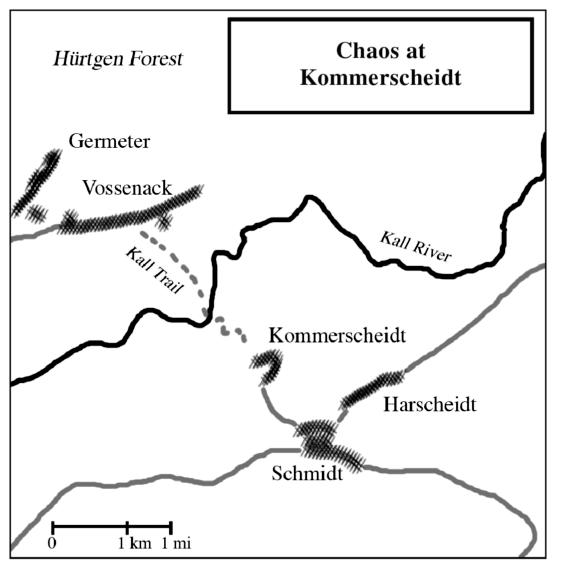
The division attacked in bad weather on 2 November, and the 112th Infantry's 2d Battalion, supported by Company C, 707th Tank Battalion, seized the first objective, Vossenack, with little difficulty. This was the tankers' baptism of fire, and cooperation with the seasoned GIs went remarkably well. The infantry battalions on the north and south flanks, however, became embroiled in confused and bloody fighting in the thick forest and made little progress. On 3 November, the 3d Battalion of the 112th Infantry pushed up the Kall Trail-little more than a cart track across the Kall River gorge-and thence over rough, forested terrain to high ground. At the far end, the doughs first reached the village of Kommerscheidt and then Schmidt just beyond, meeting little resistance. The 1st Battalion moved into Kommerscheidt on its heels.
One hour before dawn on 4 November, the M4A 1 s from 1st Platoon, Company A, commanded by Lt. Raymond Fleig, warmed up their engines and made ready to attempt the Kall Trail to reach the doughs. Fleig's tank entered the trail and immediately struck a mine. Using a winch, Fleig and his men carefully maneuvered the second tank past the blockage. Taking command of the point Sherman while his men performed the same maneuver with the remaining three Shermans, Fleig pressed on, his left track chewing the edge of the trail above a sharp drop into the forest.
The Germans counterattacked the Americans in Schmidt with the 1055th Infantry Regiment, 89th Infantry Division, which happened to be passing through the vicinity of Schmidt when American forces took the town. Twenty to thirty tanks of the 116th Panzer Division supported the regiment. The Germans quickly recaptured Schmidt and headed for Kommerscheidt.
When Fleig pulled into town at about 0900 hours, he could hear panzer fire from the direction of Schmidt. The infantry commander told him, "Get out there and stop those tanks!" About 1100 hours, ten panzers and 100 infantrymen attacked toward Kommerscheidt. Just as Fleig's M4A1 reached the eastern edge of Kommerscheidt, the lieutenant spotted a Mark IV seeking concealment in an orchard. "Gunner, tank, shot, 300, fire!" ordered Fleig. The cannon roared, and a 75-millimeter round struck the panzer. "Target, shot, fire!" This time, the Mark IV burst into flames, and two crewmen bailed out and ran for safety as .30-caliber rounds chased them.
Fleig moved his tank back and forth along the edge of town and fired at several Panthers. Even at a range of only 800 yards, his rounds glanced off the thick German armor. Fleig hoped more of his tanks would arrive soon.
Meanwhile, near the bottom of the gorge on the Kall Trail, the last 1st Platoon Sherman became stuck in mud and threw a track. After a heart-pounding journey over the precarious trail, two Shermans joined Fleig in Kommerscheidt about noon. To the rear, more tanks entered the path after daylight only to experience similar difficulties, made all the worse by the two crippled Shermans and the damage caused to the surface by each passing tank. Three more would slide off the path entirely.
At about 1400, five panzers and infantry attacked from the direction of Harscheidt. Fleig had positioned his tanks in defilade, and his gunners picked off three of the panzers.
Fleig spotted a Panther overrunning the infantry's positions in an orchard and ordered his driver in that direction. He told his gunner to fire the round already in the main gun, which unfortunately was high explosive and failed to harm the panzer. The Shermans had been firing high explosive over the heads of the infantrymen who first entered Kommerscheidt. "This was our baptism of fire," recalled Fleig, "and we didn't know we should have had a mix [in the ready rack]" A second round of high explosive frightened the German crew into bailing out, but once they realized there had been no harm done, they scrambled back aboard.
Unfortunately, all of the remaining armor-piercing rounds were in the hull sponson racks, and Heig had to turn his turret away from the target in order for the crew to pass the ammo up. As he did so, the Panther's high-velocity 75-millimeter gun roared, but the first shot missed. Working feverishly, the American loader slammed an armor-piercing round into the chamber as the gunner spun the turret back into line. The gunner fired. His first shot cut the barrel of the Panther's main gun. Fleig pumped three more rounds into the side of the Mark V, which caught fire.
An infantryman, meanwhile, destroyed a fifth panzer with a bazooka. Close air support arrived, and a P-47 knocked out a panzer the pilot spotted near Schmidt. Artillery and mortar fire crashed into the German ranks. The Germans pulled back at 1600 hours.
On 5 November, the Germans struck shortly after dawn through a freezing rain with eight tanks and two self-propelled guns followed by infantry. The 707th Tank Battalion's assault guns to the rear combined with field artillery and stopped the German infantry. Fleig and his men knocked out one of the panzers, and the Germans pulled back again, but their tanks took up positions on high ground near Schmidt and began firing into Kommerscheidt from long range.
Six more Shermans and nine M10s from the 893d Tank Destroyer Battalion that had finally made it across the trail joined Heig during the day. Fleig personally coordinated the tanks' actions with the tank destroyer commander, Lt. Leonard Turney, when the Germans struck again.
Under the German pounding and a foray by a dozen panzers early on 6 November, two-thirds of the tanks and tank destroyers were knocked out by midday. A plan cooked up by Fleig and Turney to draw panzer fire with the tanks so the tank destroyers could spot and kill them came to naught when Turney was badly wounded and the Germans found the range of both the American tanks and destroyers. The exhausted doughs huddled miserably in their foxholes and in ruined buildings. Lt. Col. Richard Ripple, who commanded the 707th Tank Battalion, also appeared with some 200 infantrymen, all that could get up the trail from a task force formed by Cota for the unachievable end of recapturing Schmidt.
The Germans attacked again during the afternoon on 6 November. Sgt. Tony Kudiak recalled, "There were five tanks and two self-propelled guns this time. They came in, and this time, German infantry came in fast with them. They seemed to come right through our artillery concentrations. Along about dusk, about seven P-47s came over and started strafing the German infantry and tried to hit a [Panther] tank out in the field in front of us. I went back to get one of our tanks to fire on it, and it fired seven rounds. They bounced off"
By 6 November, moreover, German infantry bypassed Kommerscheidt to interdict the nearly undefended trail. To the rear, American troops near Vossenack, pounded by artillery, panicked and broke.
On 7 November, striking out of a cold winter rain, eighteen German tanks and infantry overran Kommerscheidt. Fleig's and another tank engaged in a shootout that claimed three panzers, but an armor-piercing round penetrated the sponson of Fleig's Sherman, killed the driver and bow gunner, and set the tank on fire. The survivors leapt to the ground and climbed into the other M4A1. Elsewhere in town, panzers destroyed two more Shermans. American infantry began to bolt for the trail. Sergeant Kudiak recalled, "We saw quite a few men taking off over the hill to the rear on our left.... I looked around the corner of the barn and could see a German tank firing into the battalion CP [command post]."
Facing an untenable situation, the surviving tanks and tank destroyers withdrew toward the wood line as well, but two of the Shermans threw tracks and had to be abandoned. That afternoon, Maj. Gen. Norman Cota, commanding the 28th Infantry Division, ordered his troops to withdraw behind the Kall. The crew of the last Sherman destroyed its vehicle and walked back with the doughs.
The 707th Tank Battalion's losses amounted to seven men killed, twenty wounded, and thirty-seven missing. Lieutenant Fleig survived the debacle. By 8 November, the battalion had only nine operational tanks. An inspector from the 3d Armored Group who visited the front that same day recommended to the V Corps that the battalion be given time to rest and reorganize. The tankers withdrew with the 28th Infantry Division to the Ardennes on 20 November for intensive rehabilitation in a peaceful sector of the front.51
MUD AND FORTS
Being forced to hunker down did not sit well with Patton, so he ordered part of the Third Army back onto the offensive in late September. The XX Corpsincluding the 5th, 83d, and 90th Infantry Divisions, with the 735th, 774th, and the 712th Tank Battalions, respectively jumped off first on the north flank. The 83d Infantry Division pushed northeast on the road to Trier. The 90th Infantry Division passed easily through the Maginot Line, where the 712th Battalion tankers used the fortifications to practice for the imminent attack on the West Wall.51
The most dramatic action, and most egregious display of how not to use infantry-support tanks, was the 5th Infantry Division's attack on the first of the Metz fortifications, Fort Driant, beginning on 27 September. The main works stood on a hill 360 meters tall and consisted of four casemates with reinforced concrete walls seven feet thick and a central fort shaped like a pentagon. All the elements were connected by tunnels. Each casemate mounted a three-gun battery of either 100- or 150-millimeter guns, and the southern side received additional cover from a detached fort mounting three 100-millimeter gun turrets. The central fort was surrounded by a dry moat running up to thirty feet deep. Barbed wire surrounded the fortification and wove among its individual elements. The gun turrets, as it turned out, could shrug off repeated hits by American 8-inch guns.52
The first battalion-size infantry attack received artillery, air, and tank destroyer support, all of which proved ineffective against the walls. The infantry became pinned down by small-arms, machine-gun, and mortar fire, and the effort was called off after about four hours.53
After the failure of the first operation, the 735th Tank Battalion (which would develop a specialty in attacking forts) was brought into the fight as part of a carefully constructed assault plan. For the special operation, on 30 September, the battalion assembled a composite company consisting of its eleven tanks with 76-millimeter guns, four 105-millimeter assault guns, and a single 75-millimeter Sherman for an artillery observer. They trained in the use of the explosive "snake," designed to blow a path through barbed wire much like the bangalore torpedo, and the use of concrete-piercing ammunition. (This would be the only tactical use of the snake on record in the European theater of operations.54) From 5 to 8 October, tanks tried to work in the confined space of the complex with the doughboys, subject to repeated close assaults by German infantry. Their snakes and guns made absolutely no difference to the outcome, which was failure.
On 9 October, American commanders decided that the attack-which thus far had cost 21 officers and 485 men killed, wounded, or missing in action-was too costly to continue. This decision ushered in a period of relative quiet in most of the Third Army's zone.55 In some areas, however, October saw limited-objective advances against heavy German resistance marked by counterattacks so frequent that at times it was debatable who was on the offensive.56 The 90th Infantry Division spent nearly an entire month taking the town of Maizieres-les-Metz; the army's official history records that men of the 712th Tank Battalion played little role in the battle, but battalion veterans remember tough street fighting.57 During one sixteen-day "break" in offensive operations, moreover, tanks of the 737th Tank Battalion fired approximately 14,000 75-millimeter rounds in indirect-fire missions from static positions. By the end of the month, Patton's troops had breached the Moselle River line to a depth of a dozen miles.58

Almost stymied since September, Patton-with Bradley's blessing-resolved to launch a major offensive by 6 November that he hoped would quickly cross the Saar River, breach the West Wall, and reach the Rhine. Patton's plan was to capture the Saar-Moselle triangle and Trier, the major stronghold. Success would turn the flank of the Siegfried Line in the Third Army's sector and open the route to the Rhine at Koblenz, fifty miles distant.59 Incessant rain during the days before the attack, however, forced delays and turned the entire front into a quagmire. Every bridge on the Moselle save one was knocked out by floodwaters, and move ment across fields for even tracked vehicles became virtually impossible. Patton would not be dissuaded and ordered his troops ahead on 8 November.
The Germans, judging that no one in his right mind would attack under such conditions, were initially caught by surprise. They quickly recovered, fell back on prepared positions, and turned the conditions to their advantage on the defensive. The Third Army clawed forward only fifteen miles in eight days. The XII Corps battered its way across the Saar and finally came close to the Siegfried Line in early December when it captured Sarreguemines. The XX Corps took on Metz and its ring of thirty-five forts; Metz had not been taken by assault since the year 451.60
In the XII Corps' zone, the 737th Tank Battalion (attached to the 35th Division) fought through prepared enemy defenses, extensive mine fields, unfavorable weather, mud-soaked terrain, and moderate-to-heavy resistance. The battalion lost eighteen tanks, including two of the new Jumbos, in the first half of the month.61 On a typical day, Company As commander reported that his men had "moved from Laneuville to Fonteny starting with fifteen tanks-two stuck in mud, then two were hit by [antitank] guns and burned, one broke down in Fonteny, and one was hit by [antitank] fire, breaking the sprocket. Enemy tanks in Fonteny held north portion of town and [Company A] rallied at 1800, remaining all night under artillery with no doughs-only three tanks remain in shape to move.... The infantry knocked out a German tank with a bazooka. Now I have seen every- thing."62 Tanks from the 737th Battalion were the first in the corps to enter Germany in early December.63
The 26th Infantry Division attacked with support from the newly committed 761st "Black Panthers" Tank Battalion, the first African-American armored unit to see combat. The battalion also recorded rough going through rain, mud, cold, and driving sleet. Upon the battalion's arrival in France in October, Patton had told the outfit, "Men, you're the first Negro tankers to ever fight in the American Army. I would never have asked for you if you weren't good. I have nothing but the best in my Army. I don't care what color you are as long as you go up there and kill those kraut sons of bitches. Everyone has their eyes on you and is expecting great things from you. Most of all, your race is looking forward to you. Don't let them down and damn you, don't let me down!"6a
Most of the battalion was allocated to two task forces. The larger, Task Force A, consisted of Companies B and C and a platoon of Company A; a company of the 602d Tank Destroyer Battalion; a squad of engineers; and Company K of the 101st Infantry Regiment. Company C and two platoons of Company A supported the opening attacks by the 101st and 104th Infantry Regiments, and Moyenvic fell on 8 November, which opened the road toward Morville. The next morning, Task Force A rolled out, with the infantry riding the tanks. As the column approached Morville, artillery crashed around it. The infantry dismounted, and the tanks went into partial defilade and fired into the buildings some 600 yards away. Then Company B's tanks rolled forward across open ground, with the infantry sheltering behind the armor and exchanging shots with enemy gunmen in the buildings.
The infantry fanned out once inside Morville, while a Sherman led an advance up the main road until struck by a bazooka. The commander bailed out and fell dead in a rattle of machine-gun fire. The infantry went after the shooters, and by 1500, the town was secure.
Disaster struck Company C as it attacked toward high ground overlooking Morville, and the 761st Tank Battalion wrote its own chapter in the old story of suffering its heaviest losses in the first days of battle: twenty-seven of the thirtyfour men who died in the war did so in November, fifteen of them on the eighth and ninth. Company C fell into a trap set by the 11th Panzer Division at an antitank ditch northeast of Morville, and seven tanks were destroyed."

The XX Corps' attack on Metz, meanwhile, involved four parts: a wide envelopment to the north by the 90th Infantry and 10th Armored Divisions, a close-in envelopment from the south by the 5th Infantry Division, a containing action west of the Moselle by the 95th Infantry Division, and a final assault on both sides of the river.66
Despite grave difficulties of getting tanks across the flooded Moselle River (the first Shermans of the 712th Tank Battalion followed the infantry across after a two-day delay), the 90th Infantry Division advanced steadily through the muck and fortifications. The only stiff challenge came in the form of an infantry-armor counterattack by the 25th Panzergrenadier Division at Distroff on 15 November. American troops had to call friendly artillery down on their own positions, because German infantry penetrated so deeply. Losses were heavy on both sides.67
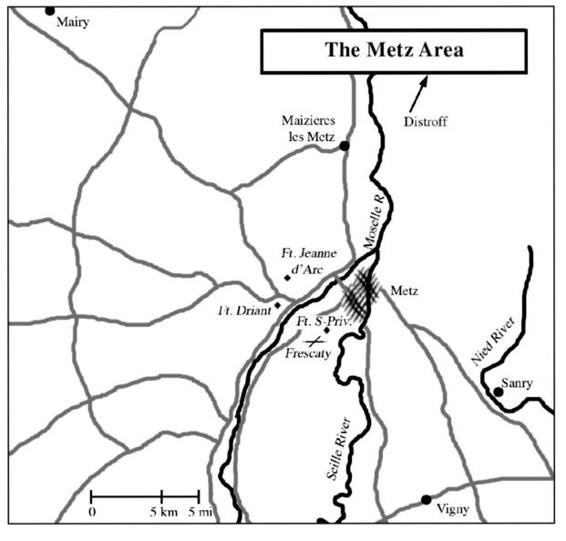
The 5th Infantry Division slugged its way through strongpoint after strongpoint. The infantry crossed the Seille River early on 9 November, but the torrent prevented engineers from finishing a Bailey bridge capable of holding tanks until early the next day. That day, Companies A, C, and D of the 735th Tank Battalion supported the 2d Infantry's attack toward Vigny. The soggy ground was just firm enough to allow the medium tanks to operate across fields and stick with the infantry, although a platoon of light tanks bogged down. One platoon of medium tanks conducted evacuation and supply runs because wheeled vehicles could not move through the muck.
The 6th Armored Division's Combat Command B entered the bridgehead during the morning, passed through the 2d Infantry, and attacked toward the Nied River. The 2d Battalion's infantry mounted their supporting tanks and followed, while the other two battalions secured the flanks. The 2d Infantry and Combat Command B repeated this tactic the following day; when the combat command reached Aube, two infantry companies mounted on 735th Battalion tanks peeled off to the left and right to seize the high ground flanking the town.
The 5th Division and Combat Command B then crossed the Nied River at Sanry, and the Germans began a fighting withdrawal from the outer ring of fortifications. The Americans found the forts themselves abandoned but had to assault town after town. Company C tankers, who were using several M4A3E2 Jumbos for the first time, and doughs of the 11th Infantry Regiment spent two days beginning on 13 November clearing the airfield at Frescaty. In a single engagement against a German counterattack at Sanry sur Nied, three Company B tanks expended 27,000 rounds of .30-caliber ammunition.
Patrols reached the city limits of Metz on 17 November, and the 5th Division worked its way into the city against scattered resistance. On the eighteenth, a bazooka round hit one of the Jumbos, penetrated four inches of armor, and bounced off.68
Hostilities formally ceased in Metz on 22 November, although several forts continued to hold out. The official U.S. Army history asserts that because the XX Corps' commander, Maj. Gen. Walton Walker, had forbidden direct assaults on the forts and because artillery shells had to be conserved to support a projected drive on the Saar River, the isolated forts were left to "wither on the vine."69 In fact, tanks of the 735th Tank Battalion were employed in a new approach to fort-busting.
On 24 November, the battalion received an initial allocation of 600 rounds of French-made 75-millimeter white-phosphorous shells to fire at the fortifications. On 25 November, tank crews that lobbed two hundred shells into Fort de SaintPrivat reported no appreciable results. Forts Jeanne d'Arc and Driant received similar treatment over the following days; the battalion poured hundreds of rounds daily into the German garrisons. Initial skepticism among the tankers gradually gave way as the results of sustained white-phosphorous bombardment became apparent. Fort de Saint-Privat surrendered on 29 November, with more than 10 percent of the troops suffering from burns. Artillery observers reported on 30 November that they could hear German troops inside Fort Driant screaming.70 Fort Jeanne d'Arc was the last to capitulate, which it did on 13 December.

Alarmed by the threat that the Third Army posed to the planned Ardennes offensive, the Germans moved several divisions in to reinforce the front. Moreover, German forces fell back into one of the most extensively fortified parts of the West Wall. Patton's planned dash ground to a halt. The 90th Infantry Division, for example, had barely crossed the Saar and succeeded in clearing the steel town of Dillingen after bloody house-to-house fighting when the Third Army had to turn north to deal with the Bulge.
FIRST TO THE RHINE
At the extreme south of the front, the 6th Army Group (which had been activated on 15 September under Gen. Jacob Devers to exercise control over the U.S. Seventh and French First Armies) made the most significant Allied gains in November. On 13 November, Lt. Gen. Alexander Patch's Seventh Army launched an offensive through the Vosges Mountains toward Strasbourg. Spearheaded by the French 2d Armored Division, Seventh Army forces liberated Strasbourg on the Rhine on 23 November.
To the south, the First French Army struck on 14 November and rolled through the Belfort Gap to the Upper Rhine. By mid-December, the army group occupied positions from south of Bitche through Wissembourg to the Rhine and thence south along the river to the Swiss border. The Germans retained only one sector west of the Rhine, which became known as the Colmar Pocket." Hitler insisted that the pocket be held and gave Heinrich Himmler command.72
MORE NEW EQUIPMENT
In early December, ordnance began to equip some tanks in select battalionsincluding the 702d, 712th, 743d, 753d, and 781st-with turret-mounted multiple rocket launchers intended to provide high-volume area-saturation fire.73 The fairly common T34 Calliope model consisted of a sixty-tube 4.5-inch rocket launcher mounted on a frame above the turret. Typically, about one company per battalion was outfitted with the launchers. The crew controlled elevation by using the main gun, which was connected to the launcher above by an extension. Much to the annoyance of the crews, initial models prevented firing of the main gun unless the aiming arm was removed.74 Captured German soldiers reported that they found the rocket fire worse than artillery and extremely demoralizing. 75 But more than one tank battalion objected to the loss of tanks in their primary role, the vulnerability of the launchers to damage, and the additional supply and maintenance headaches. Several battalions, with the backing of infantry commanders, dumped the launchers after only weeks of use.76
The tank battalions saw the first army effort to improve mobility during the winter of 1944, when grouser kits, also known as "duck bills," became available. The duck bills were attached to the edge of the tracks, making them wider and thus better distributing the tank's weight. This expedient proved only somewhat successful, however, because the grousers were prone to snap off or bend.