

CHAPTER 12
"We spent February licking our wounds. There were new men to be trained, battle lessons to be passed on, and new tanks to be processed. We all knew what we were getting ready for. The Germans had thrown their Sunday punch, now we were going to throw ours."
-Up From Marseille, 781st Tank Battalion
 ate January found American commanders once again contemplating plans to 'breach the West Wall and capture the Roer River dams. This time, however, Lt. Gen. Omar Bradley decided to work around the Hurtgen Forest. The advance during late January and early February was limited far more by deep snow, icy or collapsing roads, and freezing temperatures than it was by patchwork-albeit sometimes spirited-German resistance.
On 1 February, Eisenhower ordered Bradley to throttle back the effort, because he wanted to shift the emphasis northward to the Ninth Army in support of Montgomery. The British field marshal's 21st Army Group launched Operation Veritable on 8 February. The Germans had sabotaged the Roer River dams before they were captured by the Americans on the ninth, and the flooding of the Roer River delayed the Ninth Army's Operation Grenade-supported by the First Army's VII Corps-until 23 February. For that crossing, the 739th Tank Battalion supplied twenty-seven tank drivers to operate LVTs, which ferried personnel and equipment across the Roer River during the assault. The swift current forced the battalion to discontinue use of the LVTs. The Germans had fought the British and Canadians hard, but their defenses gave way under the twin pounding, and the Ninth Army's XIX Corps reached the Rhine on 2 March.
One day earlier, the remainder of the First Army launched Operation Lumberjack, and on the seventh, the 9th Armored Division captured the Ludendorff railroad bridge across the Rhine at Remagen intact. Patton's Third and Patch's Seventh Armies struck in mid-March, and by the twenty-first, the Allies had destroyed most of the German Army west of the Rhine and held the near bank from Switzerland almost to the sea.'
Once resistance broke down, the race to the Rhine was another welcome period of low casualties for most separate tank battalions in the north. The 741st Tank Battalion, for example, lost seven men killed and eighteen wounded during all of March. The 743d Battalion suffered only seventeen casualties of all types for the month.2
About this time, some tank battalions hit upon a new method to improve armor protection by pouring concrete on the front plates of their Shermans. The 750th Tank Battalion, for example, had to use jackhammers at the end of hostilities to remove six inches of reinforced concrete it had added during combat.' Experiments conducted by the 709th Tank Battalion in February 1945 indicated that poured concrete did not stop bazookas from penetrating the armor plate but that it did reduce the splash of molten steel inside the tank caused by the warhead to "negligible" proportions.4 Based on combat experience, tankers in the 753d Tank Battalion concluded that antitank rounds that hit concrete-reinforced armor had a reduced chance of killing the crew, even if they knocked the tank out of action.'
The 12th Army Group had concluded that the M5A1 light tank was not useful in combat. In February, it recommended to Eisenhower that medium tanks replace light tanks in all standard tank battalions and in light tank battalions.'
CROSSING THE RHINE: A THREE-TURRET-RING CIRCUS
The Rhine River was supposed to pose a major defensive obstacle to the Allies, but four separate operations easily forced the river during March. Eisenhower had agreed that Monty would make the big push across the Rhine in the north. Things did not work out that way.
As noted above, on 7 March, the First Army's 9th Armored Division had captured the Ludendorff railroad bridge at Remagen. The 746th Tank Battalion crossed the Remagen bridge on 8 March-the first separate tank battalion to cross the river.
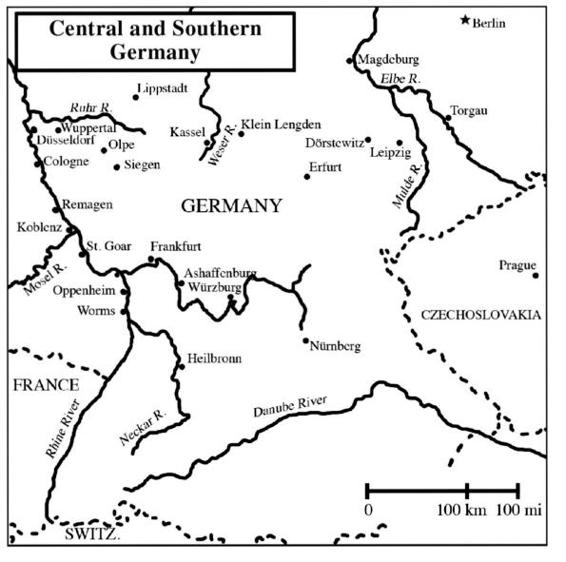
On 22 March, Patton beat Monty to the punch and slipped across the Rhine at Oppenheim, a small barge harbor halfway between Mainz and Worms. The 5th Infantry Division crossed at the cost of only eight killed and twenty wounded, and the 737th Tank Battalion joined the doughs on 23 March. Within thirty-six hours, the bridgehead was five miles deep and seven miles wide. The 90th Infantry and 4th Armored Divisions crossed unmolested and headed east. By 28 March, tanks of Company C, 737th Tank Battalion, had crossed the Main River and entered Frankfurt 7
When news of this stroke reached Hitler, he called for immediate countermeasures, but German commanders had nothing with which to respond. The only "reserve" was an assortment of five panzers under repair at a tank depot 100 miles away. The bottom of the barrel had been scraped.'
On 23 March, Montgomery finally launched his operatic assault, complete with massive air strikes, airborne assaults by two divisions, and well-organized media coverage. He had slowly amassed twenty-five divisions and a quartermillion tons of ammunition and other supplies on the west bank of the Rhine. Opposing him in the thirty-five-mile stretch of river that he planned to cross were only five exhausted German divisions. The Ninth Army, which furnished half the assaulting infantry, lost only forty men killed during the crossing. Still, nervous about the Germans despite the near total absence of serious resistance, Monty would authorize no general advance eastward until he had moved twenty divisions and 1,500 tanks into the bridgehead.9
But first the bridgehead had to be enlarged. The 743d Tank Battalion had crossed the Rhine with the 30th Infantry Division as part of the assault wave, and it ran into a last-gasp German effort to staunch the wound as the 116th Panzer Division shifted into the tankers' path from the Canadian front. Several days of renewed limited-objective fighting against stiff resistance ensued. But the German effort was futile, because two American armored divisions were crossing the river behind the infantry. On 29 March, having again opened the door, the doughs and tankers settled down as the big armor passed through the lines and swept over the defenders.10
On 26 March, the Seventh Army forced the Rhine near Worms. One assault division, the 3d Infantry, had a tough time, but the second, the 45th Infantry, faced only modest resistance. The lead elements of the 756th Tank Battalion crossed the river at 1615 hours, mostly on pontoon rafts, to support the 3d Infantry Division doughs. Within three days, four more divisions, including two armored, had crossed-and more would follow."

The Rhine assault featured an almost circus-like use of the good and not-sogood special capabilities that had been foisted on some of the separate tank battalions-almost as if higher command decided it needed to use the whole panoply to justify the cost.
DD tanks had proven themselves already, and Monty had a veritable naval task force of them ready: sixty-six British and seventeen American. The use of the 70th, 741st, and 743d Tank Battalions, which had used DD tanks in the Normandy landings, was considered. The losses among the tank crews had been so high since Normandy, however, that those outfits would have required as much training as those that had never used the equipment. Company C of the 736th Tank Battalion was instead trained and fitted out with DD tanks and attached to the 743d Battalion for the actual crossing, during which the tankers faced virtually no resistance. Prior to the Seventh Army's crossing, Company C of the 756th Tank Battalionthe only medium tank company in the battalion that had not used DD tanks in Operation Dragoon-had received hurried training on DD Shermans. The DD tanks participated in the crossing in support of the 3d Infantry Division. Launching at daylight, three successfully made the crossing in the 7th Infantry Regiment's sector, but three sank, and one was destroyed by artillery; in the 30th Infantry Regiment's sector, six made it, and one sank.' Technically, Patton in late March also used DD tanks that were supplied to the 748th Tank Battalion. Eight of the fiftyone DD Shermans actually entered the Rhine, but one sank. Most of the rest were so badly damaged by road march that they could no longer maintain buoyancy. The river crossing was not an assault crossing, however; the battalion was merely moving up to support the 65th and 89th Infantry Divisions.
The 747th Tank Battalion was issued LVTs, and between 24 and 26 March, it made 1,112 round trips across the Rhine in support of the Ninth Army. The Water Buffaloes carried elements of the 30th and 79th Infantry Divisions, including infantry, artillery, antitank guns, and ammunition. Two LVTs were damaged by artillery fire.13 For Homer Wilkes and the rest of the battalion (except, briefly, for Company B and the assault guns), the Rhine crossing was the last action under fire of the war.
The Ninth Army reequipped Company B of the 739th Tank Battalion (Mineexploder) with CDL tanks to illuminate bridging sites beginning 23 March. The First Army had been using a handful of CDL tanks from the 738th Tank Battalion (Mine-exploder) for the same purpose at the Remagen bridgehead since 9 March and deployed additional CDL tanks on the twenty-first and twenty-third. The Third Army also used three platoons of CDL tanks from the 748th Tank Battalion at St. Goar, Bad Salsig, and Mainz.14
POCKETING THE RUHR
The envelopment and capture of the Ruhr industrial basin, which lies on both banks of the river of that name, was the last large-scale battle facing American troops in Europe. The Ninth Army-still under Monty's command until 4 April, when it was returned to Bradley's 12th Army Group-raced around the north, while the First Army, in concert with the Third, looped around the south. The encirclement was mainly a story of the 2d Armored Division, which spearheaded the northern sweep, and the 3d Armored Division to the south. The infantry divisions and attached tank battalions played only a supporting role.
On 1 April, American forces linked at Lippstadt. The defenders in the Ruhr Pocket held out for eighteen days, but when the fighting was over, 325,000 Germans had surrendered. Field Marshal Walter Model chose to kill himself rather than give up.15
Mopping up the Ruhr Pocket was no cakewalk, although some areas fell almost without a shot.L6 The 8th Infantry Division, in a typical example, was ordered to cut the pocket in half by driving north through Olpe to Wuppertal, but without tank support. Pushing out of Siegen in the last days of March, the doughs were thrown back with heavy losses. On 8 April, the 740th Tank Battalion was sent to support the frustrated infantry. The tanks spearheaded the renewed attack, with infantrymen mounted on the rear decks. Their orders were to race ahead, with the doughs dismounting only to clear roadblocks; these usually comprised a log barricade defended by two or three bazooka teams, one or two machine guns, and two or more antitank guns. Unfortunately, if the Germans chose to fight, the first indication that a roadblock lay ahead was usually the destruction of the lead tank. In a growing number of cases, however, the dispirited defenders surrendered when the tanks rolled up."
The 3d Platoon of Company C, 740th Tank Battalion, was under new management. Charlie Loopey had taken over the platoon when Lieutenant Powers had received his "million-dollar wound" after the Roer River crossing and received a battlefield commission to second lieutenant. On 9 April, Loopey and his men supported the 2d Battalion, 121st Infantry Regiment, in its advance through Rahrbach just east of Olpe. As Loopey approached the village of Welschen Ennestt, two enormous seventy-ton Jagdtiger tank killers mounting 128-millimeter guns came out of the forest ahead. Either could have obliterated Loopey's Sherman with a single round, and he stood no chance of penetrating the thick frontal armor of the German vehicles at any range. Fortunately, the Jagdtigers were evidently trying to escape because they turned the other direction and headed north. No one will ever know why the escape hatches on both were open. The escape hatch was a circular hole in the back of the superstructure normally covered by an armored door and was about two feet in diameter. Loopey's gunner put a couple of rounds of high-explosive through these holes on both vehicles and knocked them out, killing their crews.18
The doughs pushed forward relentlessly; the American infantry regiments were able to leapfrog one another, but once more, the tankers went into the line every day. The 740th Tank Battalion again experienced considerable friction with infantry commanders.19 Nevertheless, American forces were in Olpe by 11 April.
On 12 April, only four days before the 740th Tank Battalion would experience hostile fire for the last time, Lieutenant Loopey's platoon jumped off at 0800 hours from Hombert. In Oberbrugge, some twenty miles east of Wuppertal, the tankers spotted a roadblock but also noticed a bypass that appeared to lead around the obstruction. Easing forward, Loopey realized that the Germans had set a bazooka ambush on the bypass, and he opened fire. The ambushers dispersed, and the tanks pressed ahead and swung back to take the roadblock from the rear. They found a target-rich environment and destroyed one self-propelled flak gun, one half-track, and many wheeled vehicles. Per standard practice, Loopey had his head protruding out of his hatch. A shell struck the turret, showering Loopey's face and neck with fragments. He was evacuated at about 1130 hours. The war was over for him, too. But the military machine clanked on: Staff Sergeant Fleming assumed command of the 3d Platoon.
On 14 April, the 8th Infantry Division linked with the 79th Infantry Division, which had pushed southward from the Ninth Army at Wetter on the Ruhr River. Lieutenant Colonel Rubel recorded: "The battle of the Ruhr Pocket was over. In many ways it had been a steeplechase, and from the infantry's standpoint, it was an easy operation. From the tanker's standpoint, it was a hundred miles of spearheading, and a grueling, exhausting battle. We had lost as many tanks here as we had lost in the Battle of the Ardennes. We hoped that the war would soon be over."20
On 18 April, Rubel received orders putting his battalion on occupation duty in Dusseldorf. Rubel himself took on the duties of lord mayor of the city. The colonel delivering the orders chuckled and added, "The last Lord Mayor of Dusseldorf was killed a few days ago, you know. Don't let it become a habit."`
RACE TO THE FINISH LINE
The tankers of the separate battalions were now among the most savvy graduates of the school of war. They knew how to storm cities and deal with small groups of defenders in villages or at crossroads. They could slog through fortifications and run like the cavalry of old. By and large, they had worked out effective teamwork strategies with the infantry, tank destroyers, and artillery, even if still a bit ambivalent about their friends in the fighter-bombers above them. They had learned to beat better tanks and worked out a series of pragmatic technical solutions to problems ranging from communication to moving on ice.
They had to do it only a little while longer before they could return to their lives and families.
Cornelius Ryan captured the essence of the final push: "The race was on. Never in the history of warfare had so many men moved so fast. The speed of the Anglo-American offensive was contagious, and all along the front the drive was taking on the proportions of a giant contest."22 So fast, indeed, that between 24 and 30 April, the 737th Tank Battalion moved 520 miles.23 A detailed accounting of the actions of each battalion during this period would be a dull recitation of long lists of towns passed through, sometimes involving a firelight but often not.
The Ninth Army pounded in the direction of Berlin all the way to the Elbe River. Just to the south, the First Army advanced to the Mulde River. Patton's Third Army drove toward Czechoslovakia, and the Seventh Army pushed through Bavaria toward the rumored Nazi National Redoubt in the Bavarian Alps and Austria."
The tankers rolled past columns of German POWs heading for the rear, often with no supervision. Increasingly, displaced persons and released Allied POWs also appeared.
Spearheads
There were not enough armored divisions to sweep everywhere, and some infantry divisions with their attached tank battalions joined the spearheads. Doughs piled onto the tanks. In some cases, artillery observers rode with the forward elements. Tank battalions attached to the infantry divisions in the following wave spent their days scooping up wandering German soldiers and clearing out the scattered towns and villages where German forces refused to give up.
The 736th Tank Battalion (attached to the 83d Infantry Division) was one of the units leading the charge. Their column became engaged in an intense rivalry with the 2d Armored Division to see who could move farther faster. The doughs requisitioned every vehicle they came across-even one German Me 109 fighter plane, on which they painted "83d Inf. Div." across the underside-and soon became known as the "Rag-Tag Circus." The two divisions reluctantly conceded a tie at the Weser River. Then they pelted on. The 2d Armored reached the Elbe River late on 11 April and slipped armored infantry across; doughs of the 83d Division reached the east bank of the river on the thirteenth. The 736th Battalion's tanks crossed the Elbe on the twentieth, but Eisenhower had already decided that his troops would press no closer to Berlin.21 This would be the farthest penetration for a separate tank battalion in Germany.
The 702d Tank Battalion, dashing through central Germany with the 80th Infantry Division, described in its after-action report the conditions tankers of most units encountered much of the time:
Throughout the month of April, enemy attempts at resistance were marked by their continued feebleness. At only two periods was there any show of strength, and by late in the month our assault had lost its character, and the only proper description for operations engaged in by the battalion was "road march."
The cities of Kassel and Erfurt were the focal points of resistance, and in the defense of the former, tanks were used in limited numbers. Flak units were the manpower basis for this defense. But these fanatical sacrifice operations served to no value, for the miscellaneous grab-bag units crumbled before our organized assaults after only a token-plus resistance....
The attitude of the German soldier was one of complete abandonment to his fate. He found his fate lay only in two directions, death or the PW camp, and with a little physical persuasion, generally chose the latter. PW figures grew astronomically, and interrogation degenerated into a simple counting of those who passed through the tills of the PW cage. The German people were completely confused and confusing. Many of them went out of their way to be hospitable to the conquering American, and overt acts by the civilians against our military forces were rare.26
Not all German forces had abandoned the fight. Advancing columns frequently encountered small units that fought briefly, claiming a few more American lives, before giving up, running, or dying. The SS were a particular problem. American troops had a simple rule: if a town showed white flags and offered no resistance, they rolled through. If American troops came under fire, they smashed the community. Indeed, any sympathy for the civilian populace declined as advancing forces began liberating the concentration camps. The 70th Tank Battalion's informal history recorded that "[t]he tanks swept across open fields from village to village, blasting relentlessly at every sign of resistance. Any town or city that tried to delay the advance soon became a raging inferno. The German landscape was dotted with burning villages. More white flags began to appear."27
Lieutenant Dew in the 741st Tank Battalion was fighting a series of these small but deadly engagements as his battalion advanced with the 2d Infantry Division through central Germany. On 8 April, after crossing the Weser, his tankers had to destroy 20-millimeter antiaircraft guns that were firing on the column near Klein Lengden. They suppressed small-arms fire in a few small villages during the next several days. On the thirteenth, the column again encountered antiaircraft fire at DOrstewitz. The division was nearing Leipzig, and it was running into flak batteries disposed to defend synthetic rubber and gasoline plants in Shkopau and Leuna. Dew decided to rush the town and outflank the gun positions, and he ordered his platoon forward. As the Shermans swung into the village, an unseen enemy soldier fired a bazooka. The round easily punctured Dew's tank, wounding the lieutenant and killing his driver. The battalion would experience its final hostile fire only five days later. It seemed so senseless to lose a man at this stage. Dew would return to duty on 5 May after the battalion had fired its last shot.28
Now and again, the fights were big and dismaying. For example, after crossing the Rhine, the 100th Infantry Division and the 781st Tank Battalion advanced rapidly until reaching the west bank of the Neckar River in the vicinity of Heilbronn on 3 April. The doughs crossed the river in assault boats the next day to find themselves battling a remarkably effective defense made up of Wehrmacht, Volksturm, Hitler Youth, and S S-so effective that the Germans counterattacked and almost threw the doughs back into the Neckar. Accurate artillery fire disrupted every American attempt to erect a bridge and get the tanks across. Higher headquarters frantically arranged for the delivery of ten DD Shermans to the 781st Tank Battalion, and crews were given a day of training. The tanks entered the water but were unable to climb the other side, and three sank. Finally, on 8 April, two platoons made the trip across a temporary bridge that was immediately knocked out by enemy artillery. On 12 April, American doughs and tanks pushed the German artillery out of range of the bridging sites, and on the next day, Heilbronn fell.29
On 17 April, the 756th Tank Battalion rolled into the Nazi citadel of Nurnberg, and with the doughs of the 3d Infantry Division, for three days, it fought street to street against determined resistance in the form of antitank, bazooka, and small-arms fire. The 191st Tank Battalion and 45th Infantry Division pushed in from the south. SS and mountain troops, backed by thirty-five tanks brought from the Grafenwoehr Proving Grounds, defended the city. German snipers with panz- erfausts picked off tanks from the rooftops, and it became standard practice for the tanks to blast any building that even looked as if it might hide such a sniper. On 22 April, with victory finally at hand, the 756th Tank Battalion patrolled the streets of the city in a show of strength 30
THE UNDER-BELLY FINALLY GOES SOFT
The Fifth Army in Italy had spent nearly five months with almost no forward movement, but it had used that time wisely. Replacements joined the battlethinned ranks, new vehicles replaced those worn out, and ammunition reserves piled up. Equipment on the Italian front finally began to catch up with that being used in the European theater. M4A3s with 76-millimeter guns reached the 760th Tank Battalion in October and the 751st Tank Battalion by November 1944, and both outfits allocated five to each medium tank company. Seventeen M24s arrived at the 751st Tank Battalion in March 1945, but the following month, the battalion had to turn those over to the 1st Armored Division, getting in exchange worn-out M5 and M5A1 tanks.31 The 752d and 757th Tank Battalions similarly drew M24s only to have them taken away.32
The 752d and 757th Tank Battalions finally received M4A3 105-millimeter assault guns to replace their M7 Priests in December 1944. The first M4A3s with 76-millimeter guns arrived at the 752d and 757th Tank Battalions by February 1945, and the 757th Battalion had enough to fully equip Company A in March, while the 752d Battalion re-armored all three medium tank companies. "The boys were strictly in favor of the new high-velocity weapon," the 752d Tank Battalion recorded. (The battalion later re-issued M4s to one platoon in each company to take the lead crossing minefields, with the surplus M4A3s to be available as replacements; there is no record of what the crews issued M4s thought of that.) While swapping the new tanks for the old M4s, the crews experienced some exciting times on the icy mountain trails, because many of the tanks had been dug in without moving for four months, but installing grousers helped.
Back in August, the 760th Tank Battalion had received T27 4.5-inch rocket launcher kits to be installed on four medium tanks but had not used them. The 752d Tank Battalion was issued launchers for about four tanks during December and 7.2-inch T40 launchers-a point-blank weapon that rendered the main gun unusable until the launcher was jettisoned-for about the same number of tanks. The II Corps had viewed the 4.5-inch launchers as impractical and, in December, told the Fifth Army that it did not want them. Nevertheless, the 752d Tank Battalion put its 4.5-inch launchers into sustained use in March, firing 1,300 rockets over twelve days. The battalion also drew one Scorpion mine-clearing flail tank.33
By 1 April, the Fifth Army's rehabilitation was complete.
On 12 April, the crews of the 751st Tank Battalion pulled into positions behind the doughs of the 10th Mountain Division. The 755th Tank Battalion likewise moved forty Shermans into prepared positions, from which they were to support the 91st Infantry division. The 752d Tank Battalion deployed its rocket and medium tanks where they would do the most good for the 34th Division's GIs. Other battalions made ready, too.

In March, meanwhile, the 755th Tank Battalion had reequipped with LVTs and reorganized into three squadrons. After practicing on the waters of Lake Trasimene, the outfit moved to the Ravenna area and joined the Eighth Army. In one of the opening moves of the final offensive in Italy, on 11 April, the battalion ferried two battalions of the British 56th Infantry Division across flooded terrain south of Lake Comacchio to flank the German line. The next day, the battalion conducted a similar attack with troops from the 24th Guards Brigade, which succeeded despite determined German resistance. Of some interest, when most of the battalion reequipped with tanks after the operation, an entire company received British Fireflies, Shermans armed with the deadly 17-pounder main gun 34

At dawn on 14 April 1945, the Fifth Army attacked all along its line. To the east, the British Eighth Army had launched five days before, and diversionary attacks by the IV Corps near the western coast had started even earlier. At first, the going was tough. "The attack was proceeding slowly," recorded the 752d Tank Battalion, because of "heavily mined terrain and fanatic resistance by infantry and tanks" In the battalion's sector, the terrain proved too rough for the Scorpion mine-clearing tank to work effectively, and mines and antitank fire claimed several Shermans during the first few days 35
After cracking through the initial crust of resistance, American forces swept into the Po River Valley and crossed the river itself within ten days. By 21 April, Shermans and light tanks from the 752d Tank Battalion were churning down the road into Bologna, accompanied by tank destroyers and with a battalion of 34th Infantry Division GIs perched on the back decks. Bologna fell by 0730 that morning. Reattached to the 88th Infantry Division, the battalion reached the Po River on 23 April; Company A was credited with capturing 3,070 prisoners and destroying 1,800 vehicles that day.36
Company C of the 755th Tank Battalion was still equipped as an amphibian unit and transported troops from the 34th, 85th, and 91st Infantry Divisions across the Po River in LVT(4)s on 24 Apri137 Drivers from the 752d Tank Battalion operated additional LVT(4)s that carried 88th Infantry Division GIs across the river. Most tank battalions had to wait a day or two to be ferried across or for the engineers to build pontoon bridges. There was resistance here and there north of the river, but German troops began to surrender en masse.38
The integration of tank destroyers and tanks was nearly complete by now, as illustrated by the model adopted by the 10th Mountain Division. The 701st Tank Destroyer Battalion was attached to the division along with the 751st Tank Battalion. Initially, the armor attached to each regiment was split into two forces under the commands of the tank and tank destroyer company commander. Each medium tank company attached a platoon of Shermans armed with 75-millimeter guns to the tank destroyer company and received, in exchange, a platoon of M10s. The mixed companies combined the armor-piercing firepower of the 3-inch guns and the better high-explosive and automatic-weapons capabilities of the Sherman.
On the other hand, fragmentation reared its ugly head again. For days on end, two tank companies at a time were attached to the 85th Infantry Division and operated beyond the battalion's control.
In late April, the 10th Mountain Division formulated a system that allowed it to advance around the clock. It rotated its three regiments every eight hours and two reorganized armored task forces every twelve hours.
Rather than combine tanks and tank destroyers at the regiment-armored company level, it organized the armor at the division-armored battalion level. Force Madden fell under the control of the 751st Tank Battalion's commanding officer, Lt. Col. C. J. Madden, and included Company A and the tank destroyers of Company B, 701st Tank Destroyer Battalion. Headquarters of the 701st Tank Destroyer Battalion controled Force Redding, which included Companies B, C, and D of the 751st Tank Battalion. Furthermore, each tank destroyer company swapped one platoon with its correspondingly lettered tank company. Company A of the tank battalion, for example, had two tank platoons and one tank destroyer platoon, while the ratio was reversed in the tank destroyer company. The units also exchanged radios and aligned crystals to ensure perfect communications.
One mixed company supported each of the six assault infantry battalions. The tank destroyers provided a base of fire while the tanks advanced in direct support of the doughs. Despite the installation of SCR-300 radios in many infantry-support tanks in northwestern Europe, the armor and infantry components in the 10th Mountain Division still could not communicate by radio at the tactical level .31
The 752d Tank Battalion, operating with the 88th Infantry Division, found that the tank-tank destroyer-infantry team made such rapid progress that the main threat turned out to be German forces appearing from the "rear" and trying to escape. The team reached the outskirts of Verona on 25 April and spent the night fending off attacks by German formations trying to get through town toward the north. Still, stiff fights in a few places such as Vicenza on the twenty-eighth cost the battalion more tanks and men.40
By the end of the war in Italy, American tankers had won the respect of the enemy. Senior German officers judged that the tankers had learned to exploit their mobility and the terrain and were impressed with the climbing ability of American tanks. By contrast, they concluded that German tank engines and tracks were not up to the demands of fighting in difficult terrain, especially mountains. They also praised the skillful use of fire and movement, excellent tank-artillery teamwork, and flexibility in fighting under fire. On the other hand, they believed that American armor rarely exploited tactical opportunities."
Resting Arms
The war had effectively ended for a growing number of the tank battalions in the European theater. As early as 8 April, the 747th Tank Battalion started militarygovernment duties around Wulfen. After two days of street combat in Magdeburg, the fighting was over for the D-Day veterans of the 743d Tank Battalion on 19 April. The 735th Tank Battalion halted at the advance limiting line by the twentieth and saw no further action. Another D-Day outfit, the 745th Tank Battalion, wrapped up fighting in the Harz Mountains on the twenty-second.
On 16 April, the strategic-bombing campaign was suspended for want of targets in Germany. On 25 April, the First Army linked with Soviet troops at Tor- gau.42 On the thirtieth, Hitler shot himself in the FUhrerbunker in Berlin. When word reached German troops in the field, resistance virtually ceased."
Nevertheless, other American battalions continued to push forward through Germany and into Austria and Czechoslovakia. On 4 May, tankers of the 781st Battalion and doughs of the 103d Infantry Division traversed the Brenner Pass and linked up with the U.S. Fifth Army eight miles inside Italy.44
In Italy, the Germans had surrendered, effective on 2 May. Tankers in Company C, 752d Tank Battalion, learned of the armistice from German soldiers who approached to surrender. Official word arrived at 1900 hours that evening.45
German formations north of the Alps continued to surrender en masse, and it was clear that the end was near. On 6 May, Capt. David Redle of the 756th Tank Battalion was driving along in a jeep on the autobahn toward Salzburg when about ten vehicles approached from the opposite direction with their headlights on. Each car had multiple stars on the front, and Redle could see that there were both American and German generals inside. "We knew it was over," recalled Redle.46
German representatives signed documents of capitulation in the early hours of 7 May. To the world, Dwight Eisenhower declared simply, "The mission of this Allied Force was fulfilled at 0241, local time, May 7, 1945."
At midnight on 8 May, the war in Europe was over for everyone. On 9 May, the 774th Tank Battalion recorded simply in its after-action report, "The entire battalion gathered for memorial services, paying tribute to the memory of our departed comrades" About that same day, the 756th Tank Battalion-which had been in direct combat for 420 days in North Africa, Italy, and the European theater-took a group picture of the men who had joined the outfit back at Fort Lewis, Washington, in 1941. Only forty-two men remained 47