

CHAPTER 13
"In small-island jungle-type warfare, the relation of tanks and infantry should be comparable to that of Siamese twins."
-Lt. Col. W. M. Rodgers, 710th Tank Battalion
 "hile vast amphibious operations were taking place at Saipan and Normandy in June 1944, separate tank battalions were just reaching the southwest and central Pacific in growing numbers. Like a boxer hitting with his left and then his right, the Southwest Pacific forces under MacArthur drove toward Formosa, while the Pacific Ocean forces under Nimitz carved a path directly toward the Japanese home islands.
NEW GUINEA: HELL IN THE HEAT
The New Guinea operation was the first stepping stone to MacArthur's planned reconquest of Leyte in the Philippines. "The campaign on New Guinea," observed a U.S. Army history, "is all but forgotten except by those who served there." The island had everything a soldier might hate: heat, torrential rains, thick jungle, disease, and a tenacious enemy. Australian and American forces had never been ejected from the island, and by mid-1944, they had reclaimed considerable ground from the Japanese invaders.'
The 44th Tank Battalion was the first separate battalion to arrive in the southwest Pacific and the first to join Lt. Gen. Walter Krueger's Sixth Army, which by June 1944 had pushed up the New Guinea coast to the offshore island of Biak, some 900 nautical miles southeast of Mindanao in the Philippines.'
The 44th had become a separate tank battalion when the 12th Armored Division released it upon its arrival at its port of embarkation in Vancouver in March 1944. The battalion had arrived at Milne Bay, Dutch New Guinea, on 21 April 1944, having adopted the unit slogan "Wolf Pack" after learning the signature wolf call used by the Dutch crew that carried them across the Pacific.
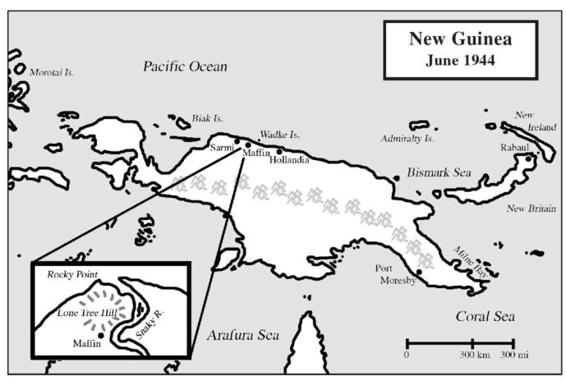
During the last week of May, the battalion sent a composite tank crew to fight on Biak with the 603d Tank Company to gain battle experience. On the twentyeighth, the 603d Tank Company fought the first tank battle in the Southwest Pacific when a platoon of Shermans chased off some Japanese light tanks. The next day, the American Shermans destroyed seven of the flimsy Japanese tanks.
On 3 June, Company C parted from the battalion-after strenuous objections from the company's officers-and shipped to New Guinea-first to Hollandia and then to join the 6th Infantry Division in the Wadke Island-Sanmi area on the northwest coat. The 6th Division had landed on New Guinea in mid-June to relieve the 41st Infantry Division, which had been supported by only a single platoon of the 603d Tank Company. Company C's tanks deployed along the "No Name River" with the GIs, and the tankers settled in for a nervous first night. Shortly after midnight, a jumpy sergeant opened fire on an imagined Japanese gun, which set off a storm of shooting that punctured the drums in the company's fuel depot.
Serious business followed. The 1st and 20th Infantry Regiments attacked vigorously westward on 20 June to capture an objective known as Lone Tree Hill, which overlooks the north coast between the Snaky River and the Maffin Airfield and which was defended by elements of the Japanese 36th Infantry Division, who had beaten off an attempt in May by the 41st Division to take the heights. An LST transported two tank platoons across the Tor River, one of which was attached to the 1st Infantry and the other the 20th Infantry. The next day, the 3d Platoon worked with the 1st Infantry Regiment's 3d Battalion, destroying Japanese pillboxes, while the 1st Platoon knocked a path through the jungle for the 20th Infantry's 3d Battalion toward Lone Tree Hill. The 1st Platoon tanks were held up by the Snaky River just east of Lone Tree Hill until engineers arrived to fill in the cut, and then the Shermans plowed through to the far side ahead of the infantry.
Here the tanks encountered fierce resistance, and the five tanks opened fire on the green-clad flanks of Lone Tree Hill to cover the infantry. The company's history recorded the outfit's baptism of fire: "The tanks destroyed all active pillboxes, machine guns, plus numerous Japs. Carl Fisher as bow gunner in Death Dealer, Sgt. [Paul] Elkins's tank, sighted a Jap leaving his foxhole to seek better security behind a tree. Halfway to the tree, tracers from Fisher's gun finally caught up with the Jap, almost tearing him in half." One tank threw a track, and sniper and mortar fire was so heavy that the crew had to remove the firing mechanism of the gun and abandon the Sherman.
The 3d Battalion was unable to form a perimeter and pulled back across the Snaky River for the night. The next day, the 3d Battalion, followed by the 1st Battalion, seized positions on Lone Tree Hill. The 3d Platoon tankers were sent alone into enemy territory, an action that amounted to a raid, after which the tanks returned.
The Japanese began a series of vicious counterattacks that succeeded in cutting off the 3d Battalion, and the 20th Infantry Regiment's GIs became embroiled in the toughest fight of their lives-bereft of tank support because no suitable route to the top of the hill was available. On 24 June, the 1st Infantry Regiment's 3d Battalion joined the 20th Infantry with orders to conduct a flanking amphibious operation around Rocky Point, which extended into Maffin Bay from Lone Tree Hill, to force the withdrawal of the enemy to the west.
The 6th Cavalry Reconnaissance Troop, which had been equipped with amtanks and amtracs, ferried Companies I and K to a beach below a cliff honeycombed with caves hiding Japanese guns, where the doughboys were pinned down with heavy losses. The 3d Platoon tankers received a call for help. The tanks were ferried by boat to the beach, where they offloaded but could not advance beyond the sand because of an embankment. The company's history recorded, "The only alternative was to line the tanks on the beach facing into the jungle. From this position, they fired into the jungle with 75s and machine guns.... The tanks stayed on the beach with the infantry all that night. We could not open the hatches because of mortar fire, and the tanks became so warm inside that the men could hardly stand it. Several got sick from the heat, and each crew drank over five gallons of water each" The next day, other infantry elements reached the trapped men; the fight around Lone Tree Hill had cost 700 casualties 3
The physical misery experienced by these tankers in conditions of high heat and humidity was to prove common in the Pacific theater. A postwar study of ten armored battalions by the Pacific Warfare Board concluded that carbon-monoxide buildup from gun fumes played a major role in making crewmen sick, which was a particular problem when the turret was buttoned up. Malaise, nausea, and vomiting were common, and almost every unit reported cases of men passing out in combat. The most common firing pattern contributed by rapidly building up fumes: gunners typically fired five to ten bursts as quickly as possible-one minute or less-as targets were spotted, and firing forty rounds in ten to fifteen minutes was common.4
Company C next supported the drive toward Maffin Airfield, just beyond Hill 265. The company history recorded an example of how decisive tanks could be against the often lightly armed Japanese:
[Hill 265] was a large hill covered by dense jungle and high grass. The grass made perfect camouflage for enemy machine guns and snipers. Dug in on this hill, the Japanese commanded every approach and were effectively supported with artillery and mortars. There were no enemy guns large enough to be dangerous to our tanks, so we moved forward spraying the grass with machine guns. At the foot of the hill, we turned our guns upward and raked the hilltop with 75mm and machine-gun fire. This was too much for the Japs, and they beat a hasty retreat. The infantry quickly took up the chase....
After weeks of combat, the company was moved to Maffin Bay for rest and relaxation. Four Australian officers appeared to study the use of medium tanks in the jungle and learn about the company, especially discipline and morale. "Our discipline was poor," noted the company's history, "but morale was quite high" Morale jumped higher when the crews received their first beer since leaving the States.5
SUPPORTING THE MARINES ON GUAM
In the Pacific Ocean Area, the 3d Marine Division and 1st Marine Provisional Brigade landed on Guam on 21 July while the 77th Infantry Division and 706th Tank Battalion waited on transports in the floating reserve. Beginning on D+3, the reserve debarked into a sea of mud created by constant downpours. The tankers first saw action on 28 July, when a platoon of light tanks from Company D and two mediums from the battalion headquarters were sent to support the 4th and 22d Marine Regiments on Orote Peninsula on the southwest corner of the island.
The light tanks destroyed four pillboxes, numerous dugouts, and accounted for approximately 250 Japanese dead, while the medium tanks destroyed a pillbox and an artillery piece. The next day, the tanks supported the marines during the capture of the airstrip on the peninsula. Late in the day, the army tankers were combined with four marine medium tanks and some M 10 tank destroyers and carried a detachment of infantry to the end of the peninsula.
"The tank crews were very enthusiastic about their successes," recorded the battalion history, "and the Marines had shown their appreciation to these men by loading them down with souvenirs of all sorts." A memo from the Marines to the 77th Infantry Division G-3 said, "[The tanks] worked most of the day in the fire fight and were exceptionally outstanding.... It is requested that the outstanding actions and aggressiveness of this Army tank platoon be brought to the attention of higher Army authority."
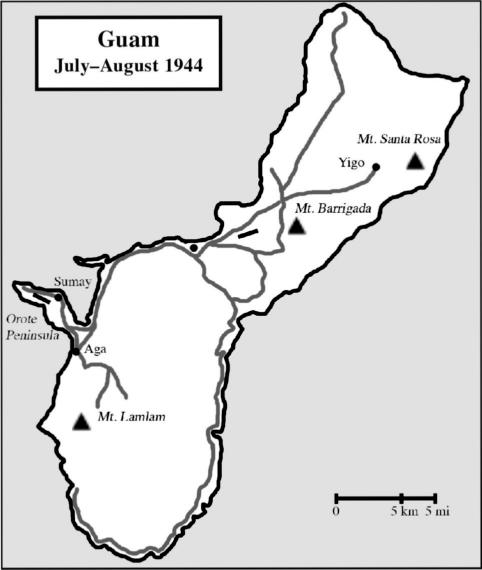
Meanwhile, the 77th Infantry Division put the light tanks to use on reconnaissance missions that bore no relationship to doctrine. On 2 August, Capt. Leonard Seger led his company on a mission two miles behind enemy lines. The tankers could get away with it because the Japanese had few antitank weapons, and the M5AIs simply drove through rifle and machine-gun fire.
Company A's 2d Platoon went into battle on 3 August supporting the 3d Battalion, 307th Infantry, which attacked north of the Barrigada Road. The tankers accounted for several machine-gun nests and an ammunition dump. The 3d Platoon joined the 3d Battalion the next day, and the tanks were used to trailblaze routes through thick jungle during the assault on Mount Barrigada on the northern end of Guam, which proved successful enough that the infantry employed other tank platoons that way over the coming days.
On 4 August, a section of the 1st Platoon plowed through two Japanese roadblocks to establish contact with the marines to the flank. The tankers had been told that the marines would use colored smoke to identify themselves, but tankers saw no smoke, and a friendly-fire incident erupted in which five marines were wounded. They had never been told about the colored smoke plan.
On 7 August, Lt. Col. Charles Stokes, commanding the 706th Tank Battalion, directed the tanks from Companies C and D and the headquarters section against a Japanese strongpoint near Yigo in one of the largest tank attacks to take place in the Pacific theater. The tankers were to move ahead of the 307th Infantry and seize the high ground 200 yards north of Yigo. After an artillery barrage and attacks by dive-bombers, the tankers moved out with the light tanks in the lead in a column of wedges, followed by two platoons of medium tanks. Three Company A tanks and an M 10 provided covering fire.
The tanks advanced at noon, destroying Japanese machine-gun nests. After covering 400 yards, Capt. Leonard Seger, commanding Company D, noted a flash under one of the tanks and radioed Stokes that there might be mines or antitank guns. Stokes ordered the medium tanks forward.
The Japanese had set up ambushes in the thick jungle growth using machine guns, two tanks, and one antitank gun. Gunners opened fire and quickly knocked out two M5A1s and two Shermans with flank shots. Sgt. Joe Divin, who commanded one of the burning Shermans, was badly wounded in the leg and doubted he could lift himself out of the turret hatch so his crewmates could escape. He tried to traverse the turret to move the gun, which was blocking the driver's hatch, but the mechanism was broken. Divin tied a tourniquet to his leg and through a superhuman effort pulled himself from the turret, clearing the escape route. Outside the armor, Divin fell prey to machine-gun bullets.
Light tanks and mediums returned fire and destroyed the Japanese tanks and the antitank gun. Over the course of one hour, the 706th Battalion crushed the last organized Japanese resistance on the island. Four tanks advanced to the objective and held it until the infantry arrived to relieve them. Mopping up operations continued, but the battle for Guam was officially declared over on 10 August.6
ANGAUR AND PELELIU ISLANDS
Fleet operations in the Central Pacific in early September revealed that Japanese strength was far weaker than expected, and commanders decided to move more directly than they had intended into the Philippines. MacArthur and Nimitz nevertheless believed that they could not bypass the Palau Islands, because they judged they would need air bases there to protect lines of communications to the western Pacific.7 The two first objectives would be two islands that lay cheek-byjowl: Angaur, which fell to elements of the army's 81st Infantry Division, and Peleliu, which went to the 1st Marine Division.
On 17 September, Company D of the 776th Amphibian Tank Battalion formed up at the line of departure off Angaur with amtracs of the 726th Amphibian Tractor Battalion. The fleet and air arm had been pounding the island since dawn, and the crewmen wondered whether any of the Japanese could possibly have survived. Like the rest of the battalion, which was headed for Leyte in the Philippines, the company was equipped with eleven 75-millimeter LVT(A)(4)s and seven 37millimeter LVT(A)(1)s. The battalion also had two LVT-M4s, which were outfitted for maintenance crews, and a jeep.
The tankers had trained thoroughly with the 81st Infantry Division back in Hawaii, including practice operating with the GIs off the beach as land tanks. Half the company was attached to the 322d Infantry and the rest to the 321st Infantry.
Angaur ran three miles north to south and only two east to west. Phosphate mines, which produced fertilizer for Japan, had torn a quarter of the island into a rugged moonscape. The 1st Battalion of the 59th Infantry Regiment, 14th Division, occupied the isle.
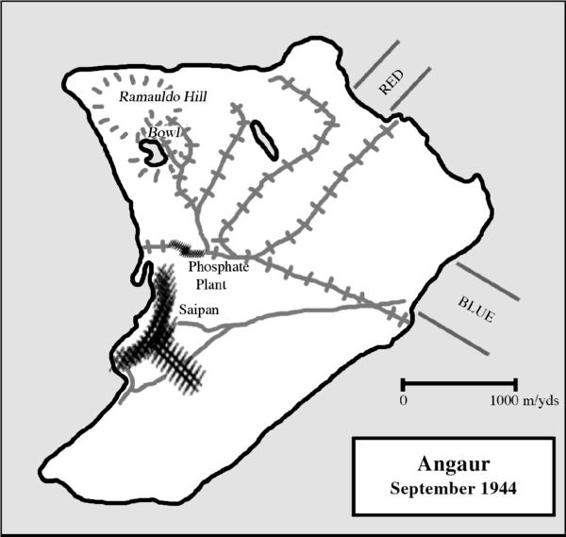
The invasion force headed for shore at about 0815 hours, with the amtanks arrayed on the flanks of the first two waves. Resistance at the beach was surprisingly light, consisting only of small-arms and mortar fire. The amtracs deposited their loads of infantry without a single loss. The amtanks on Blue Beach worked inland with the infantry as planned and stuck with them until noon on D+1. A natural barrier trapped the tanks on Red Beach, where one officer was killed, and by the time engineers had built a road, land tanks from the 710th Tank Battalion had arrived.
The company went into division reserve on D+1 and reported to division artillery for a new mission: indirect supporting fire. This was a concept pioneered by the battalion to take advantage of the 75-millimeter howitzers on the LVT(A)(4)s after initial landings, as the number of tanks in the battalion was equal to the total number of division-level artillery in an infantry division. The battalion had trained at indirect fire and knew how to work with the infantry's firecontrol centers. In this case, no missions were tasked, but the concept would soon play out elsewhere.'
For the 710th Tank Battalion, in the words of its commanding officer, Lt. Col. W. M. Rodgers, "tanks of the 710th were used under adverse conditions of terrain and weather during a period of groping and `cut and try' developments in so far as the use of armor in the Pacific was concerned" Tank operations were on the scale of platoons or sections supporting infantry companies. Fortunately, the battalion and infantry had trained extensively together, each tank company with the regiment beside which it was going to fight, and techniques developed on Oahu worked well. Rodgers described the battle for the island as "hard, slow, bitter fighting."
The battalion's after-action report for 18 September offers a representative vignette:
Because of the extremely heavy jungle growth, it was necessary for the tanks to shoot into the jungle with .30-caliber machine guns and 75mm guns, blasting the foliage away to afford visibility. The infantry followed the tanks [by] from twenty-five to fifty yards.... In firing into the jungle growth... each tank took an area and searched it; while enemy troops were seldom seen, upon moving forward many dead Japanese were found in the areas fired upon, and in no case had the enemy succeeded in getting close to the tanks with any kind of demolition or antitank mines .9
Rodgers observed that because most actions involved two or three tanks, it was hard to construct a history of the fight on Angaur. Cpl. Edward Luzinas, a gunner in a platoon leader's M4A3 in Company C, left one account of his platoon's attempt to support an infantry attack on 21 September into the Lake Salome bowl below Ramauldo Hill, the dominating terrain feature on the northwest corner of the island, where the Japanese had built their key strongpoint. The "Angaur Bowl," as it became known to the 81st Division, was surrounded by cliffs cut by a single rail line for a narrow-gauge mine train. Inside the gap, an embankment of diggings bore the rail line down to the lake.
Heavy Japanese fire stopped the GIs the first time they tried to follow the tanks through the gap, but after liberal doses of friendly artillery and mortar fire, the advance resumed. Intelligence had told the tankers that the Japanese lacked guns that could hurt their tanks, but as the M4A3s crunched through the cut, they found the way blocked by a self-propelled gun that had been knocked out by something. After failing to remove the wreck kinetically (shells, satchel charges), the tankers towed the gun out of the way, the tanks set off down the embankment.
Something hit Luzinas's tank, which was in the lead, and paint chips flew around the turret. The Japanese gun did not, in fact, penetrate the armor, but shells worked over the suspension and tracks on the three tanks stretched out down the embankment. The infantry was stymied.
Luzinas spotted the gun in a cave through his periscope as it fired, emitting a cloud of yellow, brown, and gray smoke. He sprayed the entrance with .30-caliber fire. The tank commander asked him what he was doing and, after Luzinas explained, told him to knock the gun out. Eight high-explosive rounds did the trick.
The infantry moved in, but it was now so close to sundown that the commander did not want to risk being cut off in the bowl by a counterattack after dark, and he ordered a withdrawal. That meant the tanks had to back up the embankment, and steering a tank backwards was no easy task on a flat road.
The two tanks to the rear tried, and each tipped over the side, carrying chunks of the ramp with them. Japanese fire chased the crewmen as they ran for safety, and one man was wounded.
A fourth tank was in the cut, but Luzinas's commander had little faith in relying on directions from there to maneuver. There was, however, the infantry phone on the back of the tank. The loader volunteered to go and slipped out the escape hatch in the belly of the tank. Sheltering as best he could, he directed the driver safely and slowly back up the long embankment to the cut. When a sniper opened up from a palm tree to the rear, the loader pointed Luzinas to the target, and after searching fire from the coax, the shooting stopped.
They didn't teach that at Fort Knox.
The next morning, the crew discovered that the Japanese gun had badly damaged the suspension, and only one connector was holding the track together. Luzinas pondered religious thoughts.10

The 710th Tank Battalion relied mainly on liaison personnel with SCR-536 and SCR-509 radios to talk to the infantry. The battalion had put field telephones on the backs of its tanks, but it found that GIs under fire did not replace the handsets, and they were torn off when the tanks moved. The battalion replaced its 105millimeter howitzers with M10 tank destroyers for the operation, judging the 3-inch gun to have greater penetrating power at longer range.
The battalion had to sit out the last phase of the battle for Angaur from 7 to 22 October because the terrain on the northern tip of the island was too rough for tanks. Company A and other battalion elements moved to Peleliu on 22 September with the 321st Infantry to assist the marines in their bitter fight against the 14th Japanese Division.
For the 710th Tank Battalion, the fighting on Peleliu again featured operations by tank sections with small groups of infantry and lasted until 27 November." Rather than jungle warfare, the tankers fought with the GIs over iron-hard, sunbaked coral rock. Missions generally involved blasting cave entrances and firing slits with the 75-millimeter guns at ranges so short that a commander sticking out of his hatch could be wounded by debris. Ammunition expenditures were high-at times, 100 rounds per day. Eighteen battalion tanks fell prey to mines.12
Company B and other elements of the 726th Amphibian Tractor Battalion also shifted to Peleliu on 23 September, where they were attached to the marines' 8th Amphibian Tractor Group to support the 1st Marine Division. Most of the crews engaged in the usual tasks of hauling supplies to the beach and then inland and evacuating the wounded on the way back. The marines mounted heavy flamethrowers in four battalion vehicles, and the amtracs actually spearheaded attacks against several objectives and participated in the final drive through Death Valley, across the China Wall, and into Hell's Pocket.13 Nevertheless, the LVTs proved to be too fragile for work over rough coral terrain, and the vehicles spent nearly a third of the time under repair for damage such as broken tracks."