

CHAPTER 15
"The enemy appears to be making a last-ditch stand, and several times cases of Hari-Kari were observed."
-S-3 Periodic Report, 763d Tank Battalion, 19 June 1945
 he directive for American forces in the Pacific Ocean Area to capture the Ryukyu Islands, of which Okinawa is the largest, dated to 3 October 1944. MacArthur's forces were first to secure Leyte and Luzon in the Philippines, while Adm. Chester Nimitz's forces occupied Iwo Jima. After the capture of the Ryukyus, which constituted Japan's innermost ring of defenses, the final step was to be the invasion of the Japanese Home Islands!
The 77th Infantry Division was instructed to capture the Kerama Islands west of Okinawa a week before the main landings on L-Day to provide the fleet with protected anchorage to support its sustained naval bombardment of Okinawa and with 155-millimeter batteries with firing positions to support the assault wave.' On 15 February, the division had established the Provisional Armored Group (Amphibious) to control the operations of the 708th Amphibian Tank and the 715th and 773d Amphibian Tractor Battalions in the upcoming operations.3
Beginning on 26 March, the 708th Amphibian Tank Battalion, generally assigning one platoon per rifle company, led a series of small-scale assaults around the Kerama Islands by the 305th Infantry Regiment. This battalion still philosophically viewed amtanks as tanks and not just as mobile artillery, which was evident in the fact that it mounted .30-caliber machine guns in the side hatches of its LVT(A)(4)s to deal with Japanese infantry. The tanks supported the GIs inland from the beaches where the terrain allowed and knocked out pillboxes, shelled caves, destroyed suicide boats, and engaged enemy infantry. Opposition was light, and only five tankers were wounded.'
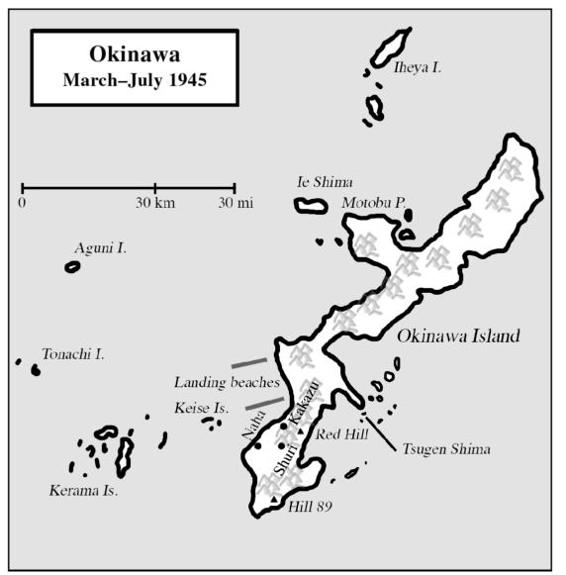

Okinawa is some sixty miles long and ranges from two to eighteen miles wide. The northern two-thirds are mountainous and cloaked in pine forests. The southern third is covered by rolling hills studded with villages and limestone ridges containing many natural caves. It is excellent defensive country, and an estimated 66,000 Japanese troops were thought to be on the island to exploit that terrain. This estimate was low.
Two army and two marine infantry divisions under the Tenth Army, reinforced by amphibian tank and tractor battalions-about 116,000 men in all-made the initial landings on 1 April after weeks of preparatory destruction by air and naval assets. The invasion beaches were located on the west coast roughly a third of the way up the island. The III Amphibious Corps landed on the left, with its 1st and 6th Marine Divisions, and XXIV Corps on the right, with the 7th Infantry Division just to the north of the 96th Infantry Division. The vast American force charged ashore amidst an earth-shaking bombardment only to find that there were almost no Japanese troops there to resist them.
The 776th Amphibian Tank Battalion was attached to the 7th Infantry Division and led the assault wave. Its orders indicated that as soon as its amtanks reached shore, they were to establish contact with forward observers and shift to artillery missions. This was the culmination of the doctrine the battalion had been creating since Angaur. With the agreement of the 7th Division, the battalion had gotten rid of most of its LVT(A)(1)s, and its platoons now consisted of four LVT(A)(4)s-the size of a field artillery battery. During the landings, battalion amtanks fired 41,297 rounds in support of infantry operations.'
Company B of the 711th Tank Battalion had been equipped with T6 pontoon flotation devices, which turned a Sherman into an ungainly raft, and launched from LCMs 500 yards from the beach as part of the 7th Infantry Division's assault wave. All tanks reached the sand west of Kadena, and LCMs brought Company A in shortly thereafter. The remainder of the battalion landed later in the day.'
The eighty-eight LVT(4)s and five LVT(2)s of the 536th Amphibian Tractor Battalion carried the 32d Infantry's assault troops to the beach without incident. The LVT(2)s had been allocated as command vehicles for the infantry battalion and amtrac company commanders.7
The 780th Amphibian Tank Battalion, again attached to the 96th Infantry Division, landed abreast of the 776th Battalion, as it had at Leyte. The battalion's orders were essentially the same as in the Philippines: to lay down intense fire during the landing, work through the seawall, support initial infantry operations as land tanks; then reinforce division artillery. The battalion had judged that its training and equipment for indirect fire had been inadequate on Leyte, and it had taken care of these deficiencies while preparing for Okinawa. There was no opposition at the water's edge, as things turned out, and the amtanks easily moved inland and supported the infantry with direct fire.'
The 763d Tank Battalion joined the 96th Division just behind the infantry assault waves, and unlike on Leyte, the tankers saw country that they could handle. The only tank lost during the landing was one that tipped into a shell hole on a reef, and Japanese fire claimed a second Sherman during the initial advance off the beach. The battalion was well equipped to work with the GIs: tanks carried both SCR-300 radios and sound-powered telephones on the back.9
The Tenth Army quickly cut the island in two. The men in the 711th Tank Battalion had the luxury of easing into combat during the push across the island, knocking out the occasional strongpoint and losing not a single tank.10
The first signs of serious resistance emerged only after the 96th Infantry Division, on 2 and 3 April, wheeled to advance southward into the rolling hills abreast of the 7th Infantry Division, while the marines turned to clear the north. The Japanese had concentrated their forces, some 100,000 strong, in the southern third of the island and were waiting in their caves and bunkers for the Americans to come to them."
In the 96th Division's zone, the 763d Tank Battalion reported increasing resistance on 2 April, though mines initially posed the main threat to the tanks. Working with the infantry, the tanks' 75-millimeter fire destroyed Japanese pillboxes and roadblocks. On 4 April, the 383d Infantry used Company C to spearhead its advance, and the tankers ran into 75-millimeter antitank fire that struck two Shermans and disabled one of them. This was an ominous sign that the Okinawa fight was going to be different than the one the battalion had experienced on Leyte.
The next day, the 763d Tank Battalion recorded in its after-action report, "Strong Japanese fortifications encountered along entire front. Beach, terra cotta, and improvised minefields were extensive. Tank traps, well constructed, were placed on all avenues of approach. 47mm antitank fire was accurate, and guns well placed and concealed. The enemy had excellent observation, and accurate and intense artillery fire was directed at our tanks" Tank losses were heavy from mines and antitank guns, and by 9 April, only forty-three of the fifty-four medium tanks were still in action.' 2
In the 7th Division's zone, the 711th Tank Battalion's Company A experienced its first heavy artillery bombardment during the night of 3 April, and several attempts by suicide squads to reach the tanks with satchel charges were repulsed. Still, the 7th Infantry Division's advance continued, and the division used the tanks to perform reconnaissance in force missions up to two miles ahead of the closest infantry support.
The tankers paid the price for this operating philosophy on 7 April. The 2d Platoon, Company C, was sent ahead of the 2d Battalion, 184th Infantry, down a road that wound past Red Hill. Heavy machine-gun and mortar fire prevented the infantry from following, so on division order, all of Company C and a platoon of light tanks were instructed to take up positions atop Red Hill and neutralize the valley beyond by fire.
The terrain canalized movement, and trouble began when the tenth tank in the column struck an aerial-bomb mine and blocked the rest from passing. While the tankers set to work clearing the minefield with 75-millimeter fire, the 3d Platoon and the light tanks continued up the hill. Soon the lead tank was blown up by another mine, and a suicide squad rushed in and knocked out a light tank with a satchel charge. Only two medium and several light tanks made it to the top of Red Hill.
The Japanese, who had been waiting on the reverse slope, laid down an artillery concentration and counterattacked. Two more light tanks were knocked out. The tankers atop the hill fired all weapons and resorted to grenades and small arms as the Japanese closed in while the wounded crews were evacuated. The Americans retreated.
The 3d Platoon, Company C, then moved down a route west of Red Hill to a point some three miles ahead of the infantry. The Japanese offered no resistance until suicide squads infiltrated between the first and second sections, but the tankers spotted the enemy and drove them off. The platoon pulled back, showered with mortar and artillery fire that the Japanese had withheld while drawing the tanks into their trap.
Meanwhile, Lt. Joseph Gallagher, commanding Company C, sent another light tank platoon followed by an M8 assault gun and a platoon of Shermans up a narrow road with cave-studded hills on both sides. The lead tanks fired their bow machine guns to blow up any mines in the path (this had actually worked once), while the next ones in line sprayed the hillsides and caves. Artillery fell among the light tanks, shaking up two of the crews. Then the lead M5 struck a mine that knocked off the right track. The road was blocked.
The second tank in line moved forward to provide cover. The men in the following vehicles watched Japanese infantry appear and swarm over the advancing M5, but because of obstructing terrain, they could not fire at the enemy soldiers. The Japanese placed a satchel charge that disabled the moving tank and wounded the driver. The watching crewmen to the rear could just make out Japanese troops putting flaming rags on the turret of the second tank. Ignoring the burning rags above, the bow gunner killed a Japanese soldier trying to place a satchel charge on the first tank. Little did he know that an alert crewman in the M8 assault gun who had apparently dismounted with his Tommy gun was just then blowing away a Japanese soldier trying to put a bomb on the bow gunner's vehicle.
The men from the stricken tanks bailed out and scrambled onto the decks of the remaining two, and the platoon pulled back, as did the medium tanks. The exposed men traded shots with Japanese snipers during their escape.
Japanese documents captured near Red Hill made it clear that the 711th Tank Battalion had run into a well-planned antitank defense. Artillery was to separate the infantry from the tanks, making them vulnerable to close assault." The 7th Infantry Division's willingness to push tanks far ahead of the infantry just made things easier for the Japanese.
The next several days were a continuing nightmare for the tankers. During one Japanese counterattack, another tank was destroyed by a satchel charge, and two crewmen were bayoneted while trying to escape. The infantry still pushed the tanks out 600 yards ahead of the riflemen, and direct fire from artillery damaged five tanks, while mines knocked out four more. On 10 April, tanks from Company C, 713th Tank Battalion (Armored Flamethrower), joined each assault company. Only punishing rains that made vehicular movement impossible finally gave the men a break."
THE BATTLE BEGINS IN EARNEST
Six army and marine corps separate tank battalions fought on Okinawa, which allowed each infantry division to have one attached at all times. The extremely rugged terrain prevented the use of armor en masse, and typically, a platoon or two of tanks was committed with each rifle battalion. This was a higher density of armor than had been the case on Luzon-indeed, it was on par with Europe-and on Okinawa, platoons were rarely broken down into sections as they had been in the Philippines.'5
Each army division in the line also normally had one company of flamethrower tanks available for use. The 713th Tank Battalion (Armored Flamethrower) was equipped with Shermans in which the main gun was replaced by a navy flame weapon that fired through the old gun barrel. Normally, the battalion's companies were attached to standard tank battalions (or at times split between two battalions), and in combat, two or three flame tanks operated with a standard tank platoon. When the battalion had converted from a standard to a flamethrower battalion in Hawaii back in January, no doctrine for its use had existed, so the battalion staff had written one.
The E12-7R1 flamethrower was supplied by a 280-gallon fuel tank. A threequarter-inch nozzle discharged burning fuel at a rate of 4.4 gallons per second to a range of 155 yards. The modified tank required a crew of only four as no loader was needed. The flamethrower proved extremely effective against bunkers and caves and could clear an entire hillside with a full fuel load.16
Moreover, flamethrowers in the bow gunner's position had been mounted in all army separate tank battalions on the basis of two per platoon before the landings. As in Europe, crews found the range to be inadequate and the equipment dangerous when tanks were hit by antitank fire."
The Japanese expected to face overwhelming American superiority in tanks and anticipated facing large-scale operations involving up to 300 tanks at a time. Japanese planners drew on lessons learned, especially in the Marianas, Palaus, and Philippines and on Iwo Jima, and spent more time planning and building antitank defenses than they had on any other island in the Pacific. Countermeasures included mines, artillery and 47-millimeter guns, artificial and natural obstacles, construction of concealed positions, and use of close-assault attack groups. Before the landings, the close-assault squads were at the center of Japanese thinking. But as the campaign progressed and the enemy realized that tank-infantry cooperation made the tactic extremely difficult to execute, emphasis shifted to the use of mines."
Catastrophe at Kakazu
"The nature of the Japanese defense of Okinawa was first revealed in the heavy fighting of 8-11 April when the Kakazu Ridge position held against a furious American onslaught," recorded the Tenth Army. 19 This obstinate Japanese position was to serve as a harbinger of the costly fight American tankers and GIs were going to face on Okinawa, and it would raise baffling questions about how cooperation between infantry and armor could break down so thoroughly so late in the war.
The package of outfits assigned to overcome the Japanese should have been perfect. The 193d Tank Battalion, which arrived on Okinawa on 8 April, had undergone intensive tank-infantry training with the 27th Infantry Division. The battalion fielded twenty-eight AN/VRC-3 radios to communicate with the infantry's tactical net, and the tanks commanded by the platoon leader and platoon sergeant had been wired with sound-powered telephones.
The 193d Tank Battalion had also modified its tanks to boost survivability. A device called a "back-scratcher" had been installed on sixteen tanks and assault guns. This consisted of four electrically detonated antipersonnel mines mounted around the turret that the crew could trigger to ward off close assaults by infantry. Extra armor plate had been welded over each sponson on the medium tanks.20
Yet, though the battalion had been one of the first to reach the Pacific and had been the first battalion to see action in the central Pacific, it was in some ways an untried outfit. The four-day battle on Makin had been one of low intensity against an enemy who lacked much in the way of antitank defenses. The 27th Infantry Division, which had come ashore on 9 April, nevertheless had plenty of experience, including the meat grinder of Saipan. Its planners should have known better.
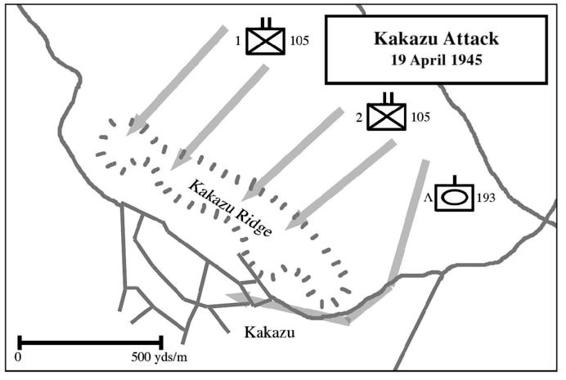
Whatever the reasons, the plan formulated for the battalion's first action on Okinawa on 19 April completely separated the tanks from the infantry they were to support, with disastrous consequences. Company A of the 193d Tank Battalion and the 1st Platoon of Company B, 713th Tank Battalion (Armored Flamethrower)the latter in its first action-were detailed to support the 105th Infantry Regiment's attack against the stubborn Japanese defenses along Kakazu Ridge and take the eponymous town on the far side. A bypass had been constructed that would allow tanks to cross a gorge before the ridge, swing by the ridge to its east, and enter town behind the Japanese line. Meanwhile, the 1st and 2d Battalions were to attack directly toward Kakazu and link up there with the tanks.
The tanks were split into two groups. Two Company A platoons and a section of flamethrowers were to push off first, simultaneously with the 1st Battalion. The second group consisted of the third medium tank platoon, the second section of flamethrowers, and all six of the battalion's assault guns working as a six-gun platoon. These tanks were to provide fire support to the first group and then push off at the same time as the 2d Battalion .21
The plan was too clever by half, but prisoner interrogations later revealed that it just happened that the Japanese had anticipated such an attack and again designed a defense aimed at separating the tanks from the infantry. The Japanese 272d Independent Infantry Battalion positioned guns, mortars, and machine guns to cover the likely avenues of advance for the infantry, and ten-man squads hid to engage them from ambush. Suicide squads and 47-millimeter antitank guns secured the routes useable by tanks.22
The 193d Tank Battalion's after-action report describes the events of 19 April:
The crossing of the first tank elements began at 0730 as scheduled and was executed with difficulty due to the steep slope of the bypass. One tank slipped off the [dirt] fill and overturned. One tank and one flamethrower hit one-homed mines ... and were disabled. As the first tanks entered [map coordinates], they were taken under fire by a 47mm antitank gun from the left flank. Two flamethrowers and three tanks were hit by this gun before it was spotted and destroyed by the assault gun platoon.
[The Japanese account of the action indicated that suicide squads attacked under cover of smoke at this time and immobilized six tanks, pried open the hatches, and killed the crews with grenades. An inspection of the site revealed that several crews had actually gotten under their tanks and fired small arms until their ammunition ran out. Sixteen tankers died in this area.13]
[The surviving tanks made their way into the village, which they shelled and flamed into an inferno.] From approximately 0830, when the movement of all tanks across [the gorge] was completed, to 1200, the remaining tanks, assault guns, and flamethrowers remained around the town of Kakazu, moving to various firing positions and firing on enemy installations and personnel [along the ridge]. During this time, five tanks, one flamethrower, and two assault guns were disabled by mines of various types that were buried indiscriminately over the entire area. One assault gun stuck in a bog, and the crew was later forced to abandon it. . . . [Note: A Tenth Army analysis indicated that a suicide squad destroyed one tank with a box mine. ]
The 1st Battalion, 105th Infantry, never reached the top of Kakazu Ridge and subsequently shifted to the [flank] and advanced around the west of Kakazu Ridge. The tank platoon leader of the 1st Platoon, Company A, was in a position [to see] several infantrymen appear over the hill, but an artillery concentration began falling and the infantrymen either became casualties or withdrew. No infantrymen physically contacted those tanks. The platoon was at times in SCR-300 radio contact with elements of the 1st Battalion, but no physical contact was made.25
The 2d Battalion had likewise fallen back under artillery and mortar fire. Tank communication with the 2d Battalion was a mess anyway because the Tat- ter's commander had been killed shortly after the attack began, and then an artillery round had destroyed the tank battalion's liaison radio and wounded one of the operators.
At 1330, the 193d Tank Battalion's operations officer convinced the regimental commanding officer to permit the tanks to withdraw. Because so many command tanks had been knocked out, nobody was certain that everyone had gotten the message, so the S-3 set out in his Sherman to make sure. All tanks were pulling back, but by the time that was clear, the S-3's tank had hit a mine behind Japanese lines and had to be abandoned.21 The grand total of twenty-two knocked-out tanks was the greatest loss suffered in a single engagement on Okinawa and in the Pacific theater.21
Only two days later, on 21 April, Lt. Col. John Behrns, the 193d Tank Battalion's commander, attempted to lead a column consisting of one platoon of medium tanks from Company C, a platoon of light tanks, and a section from the 713th Armored Flamethrower Battalion past a blown bridge to support Company K, 105th Infantry. Under heavy sniper fire, Behrns dismounted with seven men and used hand tools carve out a suitable bypass. At 1530 hours, Behrns climbed back into the command tank and moved out. About 100 yards beyond the bypass, an antitank round pierced the left side armor of Behrns's tank, followed in quick succession by half a dozen more. Every man in the tank except one was wounded or dead, and the mortally wounded Behrns just managed to climb from the turret and reach the ground before he died.
The platoon leader from Company C took over and moved forward until he reached another blown bridge. Three 47-millimeter shells struck his tank, but this time, the crews in the following tanks spotted the gun and destroyed it. Nevertheless, further advance was impossible, and the infantry commander released the tanks .21

The 193d Tank Battalion's experience was echoed elsewhere. According to the 763d Tank Battalion's after-action report,
From 9 to 19 April, stalemate due to mud and shifting zone of action. The attack on "Tombstone" and "Sawtooth" ridges was spearheaded by Companies A and C, with assault and flamethrower tanks attached. This being an enemy strong point, enemy resistance was the strongest yet encountered. Heavy concentrations of artillery and mortar fire were encountered. Minefields and antitank fire made tank progress slow and costly. The enemy attempted to separate the infantry from the tanks, and then satchelcharge them by suicide attempts. His attempts were unsuccessful due to good mutual tank support. Tanks were instrumental in marking up sizeable gains for the infantry.
During this period, Company B was attached to the 921st Field Artillery Battalion, where it reprised its role on Leyte as an artillery battalion. The battlefield was so lethal that Company D's light tanks were held in reserve. By the time the 96th Division pulled back for rest and rehabilitation on 30 April, the battalion had lost eighteen medium tanks-or roughly a third of its strength-as well as a light tank and an assault gun.29
Cave Warfare
Evidence accumulated during mid-April beyond Kakazu that the Japanese held a "tight, coast-to-coast, dug-in, fortified defense line in depth," recorded the Tenth Army. The failure of attacks against the Shari Line on 19 April ended American hopes that the weight of three infantry divisions and massed artillery could produce a quick victory in southern Okinawa. Maj. Gen. Andrew Bruce, commanding the 77th Infantry Division, proposed conducting an amphibious envelopment of the Japanese line similar to the Ormoc operation on Leyte, but the Tenth Army rejected the idea, saying it lacked sufficient supplies of ammunition for such a venture. The approach was to be brute force 30
For the tankers, this meant that much of the fighting on Okinawa involved routing the enemy out of caves-a twist on medieval tales of knights and dragons because this time, the flame-spewing armored beasts were on the outside.
Col. Grant Schlieker, who spoke to Army Ground Forces Headquarters on his return from Okinawa, characterized the development and improvement of cave warfare as the most outstanding feature of the enemy's tactics on the island. The Japanese had adopted cave warfare as a response to overwhelming American firepower on other islands, but on Okinawa, they for the first time consistently covered the approaches to caves with interlocking fields of fire from nearby caves and open emplacements. Machine guns were well camouflaged and far enough away that they were difficult to detect. Mortars provided effective supporting fire from defilade, and artillery often chimed in from distances longer than the Japanese had used before. Infantry in a cave almost always fought to the last man.
The usually well-camouflaged caves were natural but augmented by human construction. Connecting tunnels ran among many of them, and a cave might have two or three exits. Some were large enough to house heavy artillery; one 150millimeter piece nicknamed "Pistol Pete" fired every night but was so well hidden that it was not spotted until L+45. Mines usually protected caves that housed 47millimeter antitank guns, and the caves had been selected for good fields of fire against the flanks of tanks canalized by ditches or natural obstacles. The Japanese had responded to American use of flamethrowers by installing ventilations shafts, steel or wooden doors, wet mats, and asbestos curtains.
The infantryman typically was the first one to know that a cave lay ahead, because he came under fire. The first step was to spot the opening and any supporting field positions. The doughboy then turned the job over to the artillery, mortars, or aircrews dropping napalm to destroy the camouflage. If practicable, a colored smoke round would be fired into the entrance to reveal adjacent openings. The easy fix was to shell the area above the opening to jar loose enough earth to cover the entrance.
The hard solution was the tank-infantry team. Schlieker described the team play:
Neutralization is normally effected by a small infantry group and a tank or armored flamethrower. The tank boys lay [their] direct-fire weapon on the cave mouth as the infantry team works close. Hostile fire from the cave is immediately returned by the tank, while fire from adjacent positions receives retaliatory fire from the members of the infantry group who cover the advance of their comrades armed with flamethrowers and demolition charges.... When it is possible to approach the cave with an armored flamethrower, a few short blasts from its flame gun cause the enemy to make a hurried retreat [or be] destroyed by the fire or lack of oxygen caused by the flame 31
On 29 April, for example, Company C, 713th Tank Battalion, which was attached to the 96th Infantry Division and the 763d Tank Battalion, committed only eight tanks to support attacks on caves yet was credited by the infantry with killing 90 percent of the 290 Japanese dead counted that day32
Tankers learned that there was an up side to Japanese fire discipline that kept antitank gunners from shooting their 47s until an American tank had come within a few hundred yards. The guns were usually easy to spot, and the close range meant that return fire usually dispatched the gun with a speed that surprised the Japanese. Meanwhile, the simple solution of putting a few GIs in front of a tank to look for suicide squads left the Japanese without an obvious solution, according to captured reports. The gradual destruction of Japanese artillery-which tended to fire at tanks-made the American countermeasure ever less dangerous to the doughboys involved.33

By this time, production was underway back in the States of a rugged waterproofed phone, the External Interphone Station RC-298, to permit the tank crews and infantry to communicate. It had taken the army a year and a half to regularize this critical tactical tool from the first ad hoc field experiments .34
THE SMALL ISLANDS
While the land tankers sweated through the first weeks of fighting on Okinawa, the last amphibian tank operations of the war were underway just off shore. On 10 April, the 780th Amphibian Tank Battalion's Company B supported elements of the 27th Infantry Division that seized Tsugen Shima off the east coast of Okinawa. Before the amphibians left the line of departure, an artillery round struck one of the LVT(A)(4)s and wounded four crewmen. Mortar and small-arms fire greeted the invading force, but a high bank just off the beach allowed the infantry to dismount safely from their LVTs. Once ashore, the amtanks supported the GIs with direct fire against machine-gun emplacements and one coastal gun. Amtracs from the 728th Amphibian Tractor Battalion's Company B, meanwhile, formed a skirmish line and advanced with the infantry they had carried ashore through small-arms fire to capture the village of Tsugen. The operation was more costly for the amtank battalion than had been the main landing on Okinawa: two men were killed and eighteen wounded. Company D and another 27th Infantry Division assault force captured Tori Shima on 10 May.35
The III Amphibious Corps had made such rapid progress securing northern Okinawa that Tenth Army decided to occupy le Shima, which stands to the west off Okinawa's Motobu Peninsula, earlier than planned, mainly to make use of the three landing strips there to support operations in southern Okinawa. The 77th Infantry Division got the word to conduct landings on 16 April.
le Shima is five miles long and two miles wide and is surrounded by a coral reef, which meant that amphibians would be needed. The island itself is covered by tall grass and scrub, with scattered cultivated plots. The Japanese had thoroughly fortified the island with pillboxes, cave positions, and trenches, which were defended by 2,000 men. The Japanese had cut antitank trenches across the airstrips and mined the area thoroughly.
The 77th Infantry Division decided to land on the southwest corner of the island, the farthest point from the town of le and the nearby "pinnacle" promontory, which formed the heart of the Japanese defenses. The 306th Infantry was to land on the left over Green Beach and overrun a nearby airfield, and the 305th Infantry on the right on Red Beaches 1 and 2. Systematic bombardment of the island began on 13 April .36
Company C of the 708th Amphibian Tank Battalion supported the 1st and 3d Battalions at Green Beach. The 1st and 3d Platoons formed the first wave. Crossing the line of departure, the tankers found the beach obscured by the dust raised during the bombardment, but the LVT(A)(4)s opened timed fire over the coast with their 75-millimeter howitzers at 500 yards from shore. The tanks crawled over the coral reef and reached the sand. Both platoons had drifted too far left, and the 3d Platoon maneuvered to its proper landing site before making shore. There the company commander ordered the tanks to stop. The beach was laced with mines constructed from powerful aerial bombs. The 3d Platoon's leader ordered his tank to advance gingerly toward an exit through the bluff, but several large-caliber shells struck around the tank, and shrapnel punched through the side armor and severely wounded one man.
The infantry in their LVTs soon reached shore, and engineers started clearing the mines and improving the beach exits. The amtanks from the 2d Platoon arrived with the second wave. After forty-five minutes, the amtanks moved inland, with each tank commander walking in front of his tank to guide the driver around remaining mines.
Upon reaching the GIs, the tank-infantry team pushed off to capture the airfield. In the 3d Platoon, the tankers found it was still necessary for the commanders to lead their tanks because of the mines around the airstrips. The 1st Platoon on the left came under fire from a 47-millimeter gun but could not destroy it because friendly infantry were in the area. These GIs pointed the gun out to the 3d Platoon, and after the amtanks put several 75-millimeter rounds on the emplacement, the infantry overran the gun. "Many pillboxes were found on this flat terrain," recorded the 3d Platoon, "but the fields of fire were very good, and the pillboxes on open terrain were difficult to conceal and quite easy to destroy with our tank 75mms."37 The 306th Infantry secured the airfield and by evening had covered two-thirds of the length of the island.

Companies A and B of the 708th Amphibian Tank Battalion formed the 305th Infantry's assault wave at Red Beaches 1 and 2. Company A encountered no mines on the beach and pushed up a bluff to a 300-yard stretch of level ground before the next bluff. This ground was heavily mined, and the Japanese covered it with small-arms and machine-gun fire. The amtanks neutralized the machine-gun nests and then gingerly worked their way across the small plain and up the next bluff with the infantry. The 3d Platoon moved eastward while the rest of the company shelled caves in the next bluff to the front.
The 3d Platoon outpaced the infantry and encountered heavy machine-gun fire, which the tankers suppressed. Spotting Japanese infantry in tall grass 700 yards away, the platoon hit them with 75-millimeter fire. At this point, the infantry caught up, and the team pushed on, only to be held up again after 200 yards by fire from strongpoints on a nearby ridge. While reducing these positions with the GIs, the tankers encountered Japanese infantry attacking with magnetic mines, but no tanks were lost.
The 1st Platoon, meanwhile, blasted strong points manned by infantry along the top of the second bluff. The company commander's tank struck a mine, and he and a crewman were wounded when they bailed out under fire. The crippled tank blocked the only route across a steep ravine and stopped further progress by the armor.
During the day, Company B was completely stymied by mines and able to contribute only by firing indirectly. The company learned just how deadly the aerial-bomb mines were when the left track of an amtank triggered one. The left section of the final drive, the left track, the hatches over the driver and assistant driver, and sections of armored plate were torn away, and the tank itself was flipped into the air and landed on its turret. Within minutes, it was a blazing inferno. The only survivors were the turret crew, who were thrown from the tank; the driver, who miraculously was blown clear; and a scarf gunner, who got out of a hatch before the vehicle erupted into flames.
On 17 April, Companies A and B conducted assaults with the 307th Infantry on Red Beaches 3 and 4 on the southeast corner of the island but were unable to move off the beaches because of extremely dense minefields. Meanwhile, Company C spent the next two days fighting with the infantry as land tanks. On W+2, Company C tanks spotted and destroyed Japanese mortar positions on the pinnacle but lost a platoon leader shot while engaging a machine-gun nest that had stopped the infantry.38
Land tanks arrived when, beginning on 18 April, the majority of the 706th Tank Battalion came ashore. The heavier armor provided the decisive edge to the infantry, and in the course of four days, the tankers destroyed pillboxes, fortified caves, gun positions, and Japanese infantry. Land mines destroyed three medium tanks, and suicide squads with satchel charges took out two more.
"`Sherman's march to the sea' was the phrase someone used in describing the final [Company C] action on 22 April," recorded the 706th Tank Battalion's history. "Stretching almost three-quarters the width of the island, the company, supporting the 2d Battalion, 307th Infantry, moved in line formation across the eastern third of the island and reached the sea. Resistance was not very heavy, [and] all tanks completed the mission .... 1139
THE TANK CRUNCH
By the end of May, the four army separate tank battalions and the 713th Tank Battalion (Armored Flamethrower) had lost 221 tanks, of which 94 tanks (43 percent) had been totally destroyed. Gunfire had claimed 111, mines 64, and satchel charges 25 of the destroyed or damaged tanks. The 221 tank casualties amounted to 57 percent of the 338 tanks of all kinds that were available and included 12 flamethrower tanks.4° The 193d Tank Battalion, which had suffered the highest losses in its twelve days of combat, calculated that it had had 18 tanks disabled by gunfire and artillery, 14 by mines, and 2 by hand-thrown charges. All but 3 medium tanks and 2 assault guns were salvageable, however. Two officers and eighteen men were killed in action, and total casualties amounted to seven officers and fifty-six men.41
Tank commanders protested that these losses were too high, but Lt. Gen. John Hodge, the XXIV Corps' commander, had no sympathy. Tanks were made to attack, and up until Okinawa, few outfits had had to face heavy, sustained fighting in the Pacific. Hodge thought that tank losses were proportionate to those of other arms.42
The army had not anticipated the high levels of tank attrition that the Japanese were inflicting, and it literally had no reserve stocks available. An order was sent to Oahu for thirteen medium tanks that were stored on Saipan, but they would not arrive until 10 June, when the campaign was virtually over. An additional requisition of sixty-five medium tanks and twenty-five tank recovery vehicles could not be filled until 15 July.43
After the bloody April fighting around Kakazu, the Tenth Army pulled the 193d Tank Battalion from the line on 1 May. The next day, the Tenth Army ordered it to turn over all of its serviceable medium tanks to the 706th, 711th, and 763d Tank Battalions as replacements. From that point on, battalion personnel conducted motor and foot patrols, conducted airfield security, and swept areas for Japanese stragglers. In late June, several detachments were sent to garrison small offshore islands."

The 706th Tank Battalion had just arrived at the front on the main island on 30 April with the 77th Infantry Division, and it went into action the next day. Companies A and B, supporting the 307th and 306th Infantry Regiments, respectively, got a quick jolt of Okinawa's reality. Japanese 47-millimeter guns knocked out two Company A tanks, and one Company B tank was lost behind Japanese lines to unrecorded causes. The targets were again pillboxes, caves, and other fortifications. One platoon of flamethrowers from the 713th Tank Battalion worked with each line company of mediums. That dreary pattern repeated day after day for three weeks. Every few days, another tank or two fell victim to antitank guns, artillery, or mines.
On 21 May, the 1st Platoon of Company A destroyed six Japanese medium tanks while supporting the 307th Infantry. Heavy rainfall began, and by 23 May, the tanks were unable to maneuver through the muck and were largely taken out of the battle except for occasional fire missions. On 2 June, the battalion pulled back to a rest area, and its part in the battle was over .41
The 711th Tank Battalion remained engaged in heavy action throughout May. The battalion appears to have developed something of a specialty in using its tankdozers with the lead tanks and flamethrower to create routes to firing positions best suited to help the infantry.
When the 763d Tank Battalion returned to the line with the 96th Division on 10 May after a ten-day rest, its after-action report recorded, "Action during this period was characterized by huge numbers of Japs being destroyed by tanks, after being flushed out of caves by flamethrowers." Cave warfare was dangerous for the attackers, too; between 10 and 22 May, the battalion lost fourteen mediums to guns, mines, and satchel charges 46
Finally, on 14 June, the men could sense the end was near. The battalion's history recorded:
For the remainder of the operation, the tanks had a field day.... Tanks pushed out in front and took targets under fire as they were designated from regimental OPs, by company commanders, and from battalion CPs. ... Caves were sealed by tank gun fire; rocky crags, wooded areas, and towns were burned by flame-throwing tanks, which forced the Japanese out into the open to be destroyed by 75mm and machine-gun fire. Some heavy weapons were encountered, but only slight damage was inflicted on our tanks.... As the last strong point, Hill 89, was approached, the resistance was practically broken.... [T]he Japs started to surrender in large groups.47
In three months on Okinawa, the 711th Tank Battalion had lost thirty men killed and eighty-six wounded, twenty-two tanks permanently destroyed (ten by satchel charges), and forty-two tanks damaged but repaired.48 The 763d Tank Battalion over the same period had lost twenty-seven medium, one light, and two assault gun tanks destroyed 49

With no amphibian armored missions to perform, outfits were directed to other tasks. As early as 20 April, the 536th Amphibian Tractor Battalion had been assigned to coordinate defense against amphibious, airborne, and ground attacks in the XXIV Corps' service area .51 In mid-June, the 20th Armored Group dismounted the 780th Amphibian Tank and 773d Amphibian Tractor Battalions to defend the Minutago area against infiltration. Each platoon, in addition to personal weapons, carried one .50- and four .30-caliber machine guns. In mid-August, the 780th Amphibian Tank Battalion was put in XXIV Corps reserve, with one company mounted and the rest on foot to fight as infantry.51

The Japanese commanding general, Lt. Gen. Mitsuru Ushijima, and his chief of staff committed suicide on 22 June, but scattered resistance lasted another week and claimed more than 700 additional American casualties. The campaign formally ended on 2 July. In the bloodiest battle yet against Japan, 12,520 Americans had lost their lives or gone missing, while another 36,361 had been wounded. Approximately 110,000 Japanese personnel had died, and only 7,400 had surrendered.
During the battle for Okinawa, 153 Tenth Army tanks were destroyed and many more damaged. According to the U.S. Army's Center of Military History, the overall loss rate among armored vehicles (army and marines) was about 60 percent, although this figure almost certainly does not include amphibian outfits, where attrition was much lower.51
But the tankers had made a vital, if costly, contribution. Colonel Yahara, a senior staff officer of the Japanese 32d Army captured in the last days of the campaign, stated that the most important single factor in deciding the battle on Okinawa was American superiority in tanks. The men in those tanks had generally fought as they had throughout the Pacific war-in platoons, working closely with the infantry. The largest concentration of tanks in a single attack took place in the final days of fighting, when twenty tanks were used on a 1,000-yard front.53
RELIEF AS MUCH AS TRIUMPH
The suicidal Japanese resistance on Okinawa seemed to foreshadow an even more costly fight for the Home Islands, and more armor arrived in the Pacific to prepare for that struggle. This included the 28th, 779th, and 785th Tank Battalions and the 720th Amphibian Tractor Battalion. Other outfits, including the 795th Amphibian Tank Battalion and 764th Amphibian Tractor Battalion, were in the pipeline back in California. In Europe, several veteran units, including the 737th, 738th, 739th, and 747th Tank Battalions converted to amphibian tractor battalions and shipped westward toward the Pacific theater.
Operations against the Home Islands were going to require all the amphibian strength available, plus tank support for an unprecedented number of infantry divisions for the Pacific theater. MacArthur's plans foresaw putting three corps ashore simultaneously on Kyushu on 1 November. The initial landing force for Honshu, circa March 1946, was to consist of ten infantry divisions, three marine divisions, and two armored divisions.54 Planners in Washington, looking at losses suffered so far in the Pacific, expected the number of Americans killed to total at least 500,000, plus many times that in wounded. The army minted so many Purple Heart medals for the operation that they were still being handed out in 1995.55
The tankers doubtless were as relieved as anybody else when, on 14 August, the White House announced that Japan had capitulated after the horrifying twin blows of the atomic bombs dropped on Hiroshima and Nagasaki and a Soviet declaration of war. Now, instead of invading the Home Islands, the boys could go home.