

CHAPTER 14
"Our first impression of the Philippines was that it was a paradise after being in New Guinea so long. The terrain looked suitable for tank operations, and that was what we had longed for."
-Company C History, 44th Tank Battalion
 ,hysical conditions and relatively advanced economic development made the Philippines the most European-like of the island battlegrounds in the Pacific theater, Luzon more so than Leyte, Mindanao, or the lesser islands. Not surprisingly, tank combat there most closely resembled that experienced in Europe. Just as the Allied armies were grinding to a stop in the European theater and Italy, armored men in the Pacific were about to stage their biggest operation yet.
LEYTE: RETURN TO THE PHILIPPINES
American planners wanted to capture Leyte, in the heart of the Philippine islands, to obtain an air and logistical base to support planned operations on Luzon, Formosa, and the coast of China. Leyte offered coastal plains suitable for building airfields that would guarantee air supremacy over Luzon. The Leyte invasion would be the largest yet in the Pacific and require the help of ground, air, and naval assets from the Pacific Ocean Area.
Lieutenant General Krueger's Sixth Army, which was to go ashore along Leyte's east coast, consisted of the X and XXIV Corps and had 174,000 troops available for the initial assault phase. Intelligence reports suggested that the Japanese 16th Division had 22,000 men on the island, more than half of them combat troops. The X Corps was to land on the army's right in the Palo area, with the 24th Infantry Division (less one regiment) on its left and the 1st Cavalry Division, fighting as an infantry division with four regiments, on its right. The XXIV Corps was to land fifteen miles to the south in the Dulag area, with its 7th Infantry Division on its left and 96th Infantry Division on the right. Japanese combat strength was concentrated in this area. The 32d and 77th Infantry Divisions were available in floating reserve. The two corps were to secure the coastal plain, advance by separate routes to the Ormoc Valley on the west side of the island, and link up.'
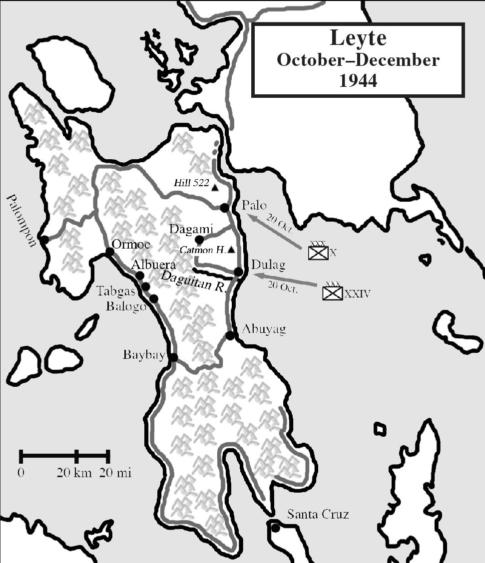
The XXIV Corps landing force had been scheduled to take Yap as the second phase of the landings conducted on Angaur and Peleliu on 15 September. In light of the absence of effective Japanese air opposition, the High Command decided to abandon the Yap operation and divert the entire landing force, which included half of the available assault shipping in the Pacific Fleet, to the Leyte operation. Plans for Yap had evolved to deal with landing areas protected by a coral reef, so LVTs rather than landing craft were allocated to carry the troops to shore. Leyte offered long, smooth beaches suitable for even LSTs. It was too late to change plans, so the XXIV Corps would conduct a Pacific Ocean Area-style assault, though following waves were to land by boat.' This turned out to be fortuitous in the 96th Division's zone.
In terms of armor, there was a remarkable disparity between the corps of the two operating areas arising out of the different campaigns they had waged to date. The XXIV Corps was to attack with two amphibian tank battalions, the X Corps with none. The two XXIV Corps divisions had a complete land tank battalion each, whereas the X Corps divisions shared the equivalent of one battalion.
The XXIV Corps' Tankers Fulfill a Promise
On A-Day, 20 October 1944, the U.S. Navy provided a two-hour preliminary bombardment beginning at 0600 hours, which Task Force 79, off the XXIV Corps' beaches, reported "was increased and maintained at a spectacular intensity during the last half hour" The landings occurred on a broad front, with two regiments abreast in each assault division.'
The bulk of the 776th Amphibian Tank Battalion represented the first combat unit to carry out MacArthur's pledge to return to the Philippines. Attached to the 7th Infantry Division, the battalion had three line companies, each with three platoons made up of three LVT(A)(4)s and two LVT(A)(1)s. The company headquarters had two LVT(A)(4)s, which normally operated attached to a platoon during fire missions, as did three LVT(A)(4)s in the battalion's headquarters and service company. Four new LVT(4) amtracs rounded out the battalion amphibians, and a 2.5-ton boom truck, 10-ton wrecker, and two jeeps waited on LSTs for use ashore.'
Mortar fire greeted the 776th Amphibian Tank Battalion's LVTs as they churned toward the beach, but there were no hits, and the amtanks clawed their way onto the sand at about 1000 hours, with Companies A, B, and C arrayed from left to right. The tanks pushed inland about 250 yards through small-arms and mortar fire, took up firing positions, and waited for the doughboys to arrive. The infantry-bearing amtracs from the 536th Amphibian Tractor Battalion followed, with the only casualties occurring in one LVT from an air burst that killed three GIs and wounded ten. As planned, the 32d and 184th Infantry Regiments landed abreast behind the amphibian tanks.
The amtank crews had been assigned a fairly complex variety of missions. The battalion had been the first amphibian outfit to undergo comprehensive training in the field artillery role, which had taken place back in Hawaii. The 1st Platoon of Company A immediately deployed into battery formation, and by 1130 hours, the guns were paralleled and a forward observer was in communication, although the 57th Field Artillery Battalion did not order the first fire mission until 1800. The 2d Platoon was to enter the Daguitan River and move upstream to secure the Dao Bridge, but the current proved too swift. The amtanks tried to reach the bridge overland, but they ran into Japanese infantry and a swamp that blocked further progress, and the platoon received orders to pull back and fire under the control of the 49th Field Artillery Battalion.
The 3d Platoon entered the village of Dulag, where it encountered retreating Japanese infantry and cut them down. The platoon fired indirectly out to 2,000 yards and helped the infantry by destroying two pillboxes. An LVT(A)(1), commanded by the battalion's S-3 and specially equipped with a Canadian-made Ronson flamethrower, arrived too late to do any good in Dulag.
Company B suffered the battalion's only fatality of the day when a 40millimeter round judged to be friendly fire-struck the company commander's LVT and killed one crewman. The 3d Platoon engaged Japanese infantry with machine guns and 37-millimeter canister, and one scarf gunner killed an enemy soldier who charged an amtank with a grenade. The company quickly lashed into the infantry's fire-control system and fired barrages to support troops attacking the Dulag airstrip.
Company C's 3d Platoon was assigned to move up the small Calbasag River, which reached the sea north of Dulag, to secure a bridge, but it, too, was thwarted, in this case by mud and felled logs. Most of the amtanks engaged Japanese infantry in a trench system with point-blank machine-gun, 37-millimeter, and 75millimeter fire. One tank commander was wounded during the action, but by afternoon, the company had cleared its area and prepared to fire artillery missions.
Maj. Gen. A. V. Arthur, commanding the 7th Infantry Division, would say of the battalion's support, "The spearheading of the assault troops of the division was outstanding. The fire preceding the landing was timely, and the tank action and later fire support contributed largely to our initial success "'

The first 767th Tank Battalion Shermans, from Company A, landed at 1015 in the second wave on Beach Violet 2, in the 32d Infantry's zone, just behind the amphibian tanks in the first wave. The 2d Platoon operated independently at first and destroyed targets of opportunity. Five hundred yards from the water, a concealed Japanese 75-millimeter gun put a round through the side of Number 18 tank and wounded three crewmen. Number 17 survived a hit from the same gun. The Japanese weapon was concealed in one of several pillboxes that each contained an antitank gun and machine guns. The remaining tanks laid suppressing fire on the pillboxes while the infantry from Company K, 32d Infantry, closed from the flanks until they were close enough to knock the pillboxes out with grenades.
The 1st Platoon of Company B was unable to establish contact with the infantry at all, so its tanks entered the village of Dulag and destroyed such opposition as they found. Company D's M5s-nine of them mounted with Ronson flamethrowersfollowed. Only the 3d Platoon on Yellow Beach 2 was able to coordinate its actions with the infantry. Clearly, some problems that had surfaced on Kwajalein between the tankers and 7th Infantry Division doughboys had not been fixed.
By noon, the 2d Platoon of Company B had moved rapidly off the beach, still without the infantry. An antitank gun destroyed the two tanks in the second section and struck tank number 15 five times before the gunner could destroy the Japanese. This likely would not have happened had the infantry been available to advance on the gun or to place indirect fire on it. Not too long thereafter, three Company A tanks were hit by antitank fire, but the rounds only set waterproofing alight. By about 1300 hours, the 32d and 184th Infantry Regiments had regained some control over the tanks, and some coordination of effort emerged.'

The 780th Amphibian Tank Battalion, which was experiencing its first action attached to the green 96th Infantry Division, at first had a similar experience to that of the 776th Battalion. All companies approached the beach in shallow platoon wedges, the LVT(A)(1)s arrayed to the flanks of the LVT(A)(4)s. Tanks opened fire 300 yards from the beach, and they continued shooting after crossing the sand until infantry arrived and blocked the fields of fire. Companies A and B were delayed by antitank obstacles, trees, and stumps but soon found routes inland and advanced to support the 382d Infantry. Plans for the amtanks to stop roughly 500 yards from the water went out the window because the ground was too swampy for land tanks to move up. The amtracs of the 788th Amphibian Tractor Battalion in the first three waves landed without a loss and offloaded the infantry 500 yards inland as foreseen-the army was now using the marine corps' approach-but the following three waves came under intense mortar fire from elements of the Japanese 9th Infantry Regiment, and the GIs dismounted just past the beach.
Amtanks from Companies C and D supported the 1st Battalion, 383d Infantry, in crossing the small Liberanan River, which enters the sea north of Dulag. One platoon secured the division's right flank by swimming down the river and taking up positions on sandbars near the mouth. Most of the amtracs, meanwhile, were able to negotiate the swamp, and they accompanied the infantry until no longer needed.'
The 96th Infantry Division had split the attached 763d Tank Battalion for the assault, with the battalion-minus Companies C and D-supporting the 382d Infantry Regiment and C and D supporting the 383d Infantry. The three medium tank companies had arrived offshore loaded into LCTs in the bays of three LSDs, while Company D's light tanks were in the holds of transports. The medium tanks landed behind the infantry in the seventh wave at 1044 hours and moved smartly 1,000 yards inland, where drivers all along the beach pulled back on their brake levers. Ahead stretched a swamp, and invasion planners had provided no clue about how tanks were supposed to cross this morass. This problem remained unresolved three days later.'
As a consequence, on A+1, the 780th Amphibian Tank Battalion withdrew and tied into the field artillery, but the next day, most companies were sent forward again to fight as land tanks. Mud proved a greater hindrance than the enemy, and at one point, all of Company B became bogged in a swamp. Tankers constructed bridges from coconut logs and snaked their way through the muck. During the initial approach to Catmon Hill, which dominated the beaches, the entire battalion operated in line, which probably was the only time an amtank battalion maneuvered en masse on land during the war. The tankers remained beside the infantry until A+5 and by then had reached a line some 6,000 yards from the surf. From 1 November, the battalion provided security in the landing area, often sending out small foot patrols.'
Apparently, the 96th Infantry Division was becoming a great believer in using tanks as artillery; on 24 October, the 763d Tank Battalion organized Company B into a "tank artillery battalion" to reinforce division artillery, a role the company played for the duration of the Leyte campaign. The division organized Company C into a second artillery battalion on 20 November, plus eight Company A tanks (two batteries) from 20 November until 10 December.
The division's enthusiasm for employing tanks in this fashion derived in part from the fact that on the few occasions early in the campaign when medium tanks had tried to support the infantry, weak bridges and swampy terrain stopped the tanks before the objectives had been reached. The light tanks of Dog Company were able to help the infantry much more often, including during fighting at Catmon Hill on 28 October, near Dagami from 5 to 10 November, and on nearby Mt. Lobi in early December. The company fielded five diesel-engine M3 light tanks with flamethrowers mounted in the turrets in place of M5 tanks, but their effectiveness is not recorded.10
The X Corps Goes in Unarmored
The 24th Infantry Division had the misfortune to go ashore on a stretch of coast that the Japanese had prepared to defend, and it faced the toughest battle of the landings, in part because it had almost no armor support. A wide and deep antitank ditch ran the length of the beach, and camouflaged pillboxes with cleared fields of fire overlooked the sand. Swamps and muddy rice paddies lay just beyond the beach. Overlooking the coast was Hill 522, which the Japanese 33d Infantry Regiment had honeycombed with tunnels, trenches, and pillboxes."
Three medium tanks from the 603d Tank Company were loaded on a landing ship, medium, to debark at H+25 to support the 19th Infantry, and a like number was to land with the 34th Infantry. The rest of the company was aboard LSTs and scheduled to reach the beach at H+60.12
Elements of Companies A and B, 727th Amphibian Tractor Battalion, carried some of the GIs to the beach, with the remainder of the battalion ready to serve as needed.13 Other assault elements rode to the sand in landing craft. The Japanese allowed the first five waves to reach shore and then opened up with mortars and 75-millimeter guns on the sixth wave and sank four landing craft. Four LSTs also were hit, and one caught fire. Two LSTs reached the beach and became stuck; the others withdrew, taking most of the tanks and artillery with them.
The doughboys already on land were finding that the preliminary bombardment had not been entirely effective. Without tank support, the GIs had to conduct close assaults on the pillboxes using bazookas, hand grenades, rifles, and BARs. After more than two hours of fighting, the infantry managed to overcome most of the beach defenses about noon. By then, the first medium tanks were available and led the 3d Battalion, 34th Infantry, into the attack at 1230 hours through waist-deep muck to a tree line 150 yards distant. Other elements of the 19th and 34th Infantry Regiments also pressed inland, overcoming strongpoint after strongpoint. Attacks and counterattacks raged on the slopes of Hill 522 into the night."
Lt. Merritt Corbin, who commanded some of the amtracs, recalled, "[That morning] the skies opened and it poured heavy rains. The rice paddies, river, the swamp were flooded. When the LSTs arrived at the beach, no wheeled vehicle could move on the beach because of the wet sand. We spent all days towing wheeled vehicles on the beach "15
The amtracs ferried troops, supplies, and casualties for the 19th and 34th Infantry Regiments, but already the infantry could see other uses for the LVTs. The commanding officer of the 34th Infantry commandeered one amtrac for his command-and-reconnaissance vehicle the day after the landing, and several were allocated to carry wire crews.
The 24th Division fought its way westward against stiff resistance. With only a single tank company available to the division, the 34th Infantry employed Cpl. Rade Allen's amtrac to attack a pillbox on A+2. Allen directed his vehicle out of defilade and down Highway 1, and the machine guns raked native houses, ditches, and Japanese machine-gun nests. The tractor had advanced 500 yards on its own when a Japanese soldier charged and slid a mine under one track, which disabled the LVT. Allen and one crewman were wounded, but they stuck to the machine guns until rescued by another amtrac.
The infantry viewed the mission as a great success. Allen and his crew were credited with killing sixty enemy troops, allowing GIs who had been pinned down for twenty-four hours to advance onto the objective and recover casualties who had been lying in the line of fire. Tractors were used subsequently in several other attacks and as reconnaissance vehicles."

The 1st Cavalry Division hit the beach on A-Day in a mix of LVTs from Company A, 826th Amphibian Tractor Battalion, and landing craft, and it encountered almost no resistance at the waterline. The official U.S. Army history asserts that amtanks led the assault, but division records, including the complete field order for the operation, do not indicate that this was the case. The cavalrymen moved inland, soon accompanied by medium tanks from the 44th Tank Battalion. "Landings made on schedule," recorded the battalion journal, "without notable event as pertains to tanks." The tankers were without their Company C, which was fighting with the 6th Infantry Division on distant New Guinea. The remaining companies were attached to the line regiments, and in nearly all cases, complained the battalion's commander, orders concerning employment of battalion elements from higher headquarters were oral and reached the battalion headquarters only after the action had taken place.
The cavalry division was assigned the mission of clearing the mountainous and jungle-clad northern end of Leyte, while the 24th Division advanced toward the west side of the island. The 1st Cavalry Division just could not figure out a good use for its attached tanks in the mountains. "The tanks were road-bound," noted the 44th Tank Battalion's history, "and the front limited to the width of the road" From 24 October to 30 November, the crews from Companies B and D were used on foot to man outposts. Company A was the only line company continuously employed with the infantry, and on A+15, that company was transferred to the 24th Infantry Division in exchange for the 603d Tank Company, only to wind up with the 32d Infantry Division a short time later."
The Ormoc Operation: Daring Amphibian Maneuver
The Japanese had quickly reinforced their troops on Leyte and added by convoy five more infantry divisions and 10,000 tons of material from late October to early December, mostly through the port of Ormoc. Instead of mopping up, MacArthur was going to have a hard fight for the western part of the island. He committed his own reserve divisions."
By late November, the 7th Infantry Division had clawed its way to the west coast of Leyte, where it faced a grueling fight northward through the hills and along a narrow coastal plain toward Ormoc. Terrain made the movement of land tanks and artillery extremely difficult, but the infantry needed the support of both. Japanese warships operating off the coast made transport by water risky without heavy naval escort. During October and November, the 24th and 32d Infantry Divisions, working with the 727th Amphibian Tractor Battalion, had demonstrated the effectiveness of battalion-size and larger subsidiary amphibious landings as a way to bypass Japanese resistance.
Sitting back at the Leyte beachhead engaged in security duties was an amphibian tank battalion that could function as both armor and artillery, and one visionary officer figured out a way to get that outfit back into the war. Lt. Col. O'Neill Kane, who had just moved from the 776th Amphibian Tank Battalion to take command of the 767th Tank Battalion, was an old cavalryman, as were most of the officers in the 776th Amphibian Tank Battalion, which only three years earlier had been part of the 2d Cavalry Regiment. He conceived of using amphibians in a cavalry role, mainly on unsupported raids deep into the enemy's rear.19 In proposing the operation to the 7th Infantry Division, Kane had suggested, "The amphibian tank battalion has a better than even chance of success in any engagement with enemy surface craft and could give a good account of itself in an engagement, close ashore, with one or two destroyers." He had conducted water marches of up to twenty miles back at Fort Ord in California.
In late November, the 776th Amphibian Tank Battalion contributed, on corps orders, its Company C-minus all LVT[A][1]s-and the LVT(A)(4)s of two of Company B's platoons, which were to become the combat element of a Provisional Amphibian Battalion organized to provide amtank support to the 7th Infantry Division on the west coast of Leyte. The amtank element had three platoons of six LVT(A)(4)s each. The 718th Amphibian Tractor Battalion contributed a provisional company of twenty amtracs. Kane took command.
The provisional battalion was loaded onto landing ships, medium, on 27 November and transported to a spot off Santa Cruz near the southern tip of Leyte. There the LVTs disembarked and traveled under their own power 100 miles to the 7th Infantry Division's zone of action north of Baybay, the longest water march ever conducted to that point by LVTs under their own power. An LCM led, followed by the amtanks in three columns and then the amtracs, with an LCM bringing up the rear to assist with any maintenance problems. "The ever-droning roar of radial engines purring and the sound of tracks churning the water were constant reminders that the battalion was moving onward," recalled Lt. Charles Shock. Upon arrival, the battalion set up a camp and defensive perimeter against enemy waterborne attack.
On 4 December, the 7th Division ordered the battalion to support an attack northward by the 184th Infantry Regiment by enveloping the Japanese line by sea. Kane made an aerial reconnaissance of the area of operations and coordinated planning carefully with the infantry.
Early on 5 December, Company C's LVT(A)(4)s set off. The battalion's after-action report described the action at Balogo:
At 0635 the company, which was in column formation headed north, executed a movement by the right flank and advanced toward the shore in line formation firing howitzers and machine guns. About 200 yards from shore, on radio command of the battalion commander, the company executed a movement by the left flank and continued to move north in column. Turrets were swung to the right, and the shelling of Balogo and Tabgas continued. The company arrived at the mouth of the Tabgas River at 0700 and made an unsupported landing by maneuvering from column to line formation.... As the amtanks landed, Jap infantrymen were observed evacuating beach positions under the company's machine-gun fire. Ravines, reverse slopes of hills 380 and 910, and other likely areas of enemy concentration were taken under howitzer fire with HE and smoke shells.
By 1045, the raid was over-with not a single loss-and the infantry reported that the tankers had helped unhinge the Japanese line 20
The 77th Infantry Division landed on the west coast of Leyte on 7 December in a maneuver designed to deny the Japanese the use of Ormoc's port; attract Japanese reserves, which would hasten the linkup of the X and XXIV Corps; and cut off the Japanese 26th Infantry Division. Company A of the 776th Amphibian Tank Battalion, reinforced by a platoon of Company B, provided the amtank force for the landings by the 305th Infantry in Ormoc Bay, while a provisional amphibious force from the 536th and 718th Amphibian Tractor Battalions carried GIs and supplies.
Ironically, the division's landing disrupted a second amphibian attack by the provisional battalion ordered by the 7th Infantry Division. Company C's amtanks executed the planned attack on Albuera the next day instead and recorded, "At 0650 the amtanks landed in line formation on the north edge of Albuera and shelled the town at point-blank range. Jap infantry was dug in under many of the houses, and most of the structures in the town were burned or damaged by amtank shelling.... The amtanks received hostile mortar and gunfire from the vicinity of the town, but this fire caused no casualties. One enemy gun northeast of town was silenced by a direct hit. By 0745, the mission was accomplished." On the way back south, Kane received orders to pull into shore, where his men directed 7th Division artillery fire.'
The Japanese had been surprised by the 77th Infantry Division's landing, and the division turned north to push up the coast and took Ormoc on 10 December. On the eighth, the Company A amtanks conducted amphibious reconnaissance ahead of the division's advance and, the next day, rolled northward along the beach to protect the flank of the advancing infantry. The crews spotted Japanese roadblocks along the coast road and shelled them to clear the way for the GIs. At 0900 on 10 December, the company was the first American unit to enter Ormoc. The 2d and 3d Platoons moved through the streets blasting snipers hidden in the buildings until the infantry arrived to secure the village. The company then took over beach defense, destroying a Japanese LST on 12 December and firing artillery missions.
The Japanese moved reserves into the area, and the 77th Division experienced in the fight north to the Palompon road what has been described as the bitterest American troops had yet encountered in the Pacific. Ten medium tanks from Company A, 706th Tank Battalion, and all of Company D were moved by landing craft to Ormoc Bay on 20 December to support the infantry. Capt. Leonard Seger led nine light tanks against entrenched Japanese infantry on 21 December, but mortar fire was so intense that three tanks were hit, one of which was destroyed.
The plan to advance a fast armored column to Palompon had to be abandoned because of the lack of bridges along the road, so in order to complete the operation, a special amphibian task force-this time consisting of Company A, 776th Amphibian Tank Battalion; a platoon of Company B, 718th Amphibian Tractor Battalion; Company B, 536th Amphibian Tractor Battalion; a platoon of 706th Tank Battalion light tanks; and the 1st Battalion, 305th Infantry-was created to advance to Palompon by water.22
After intensive briefings, the task force set off on 24 December for an overnight, thirty-eight-mile journey to the objective-the longest march over open sea yet attempted. The LVTs led, carrying the infantry. While the moon was out, the vehicles swam under blackout restrictions and thereafter with only hooded taillights. PT boats guarded the herd like sheepdogs, and LCMs carrying light tanks, equipment, and supplies brought up the rear.
On 25 December, the task force made an amphibious landing north of Palompon. The amtanks shelled the beach during the approach, but the landing was unopposed. Amtanks, M5Als, infantry, and engineers quickly moved inland and secured the port, at which point the amtanks took up artillery duties. During this operation, the amtanks provided the only artillery support available to the GIs other than mortars. With the capture of Palompon, MacArthur declared that organized resistance on Leyte had ended, which was not true.
The amphibians continued to work with the infantry, conducting reconnaissance missions, envelopments, and raids, until mid-January, when the attachment to the 77th Division was terminated. Amphibian operations by the elements attached to the 7th Infantry Division continued until 5 February.23 Meanwhile, the 706th Tank Battalion continued working with the 77th Infantry Division. The light tanks were by far the busiest-and suffered the only losses-probably because the mediums had great difficulty getting around because of destroyed bridges.24
LUZON: THE FIRST REAL TANK COUNTRY
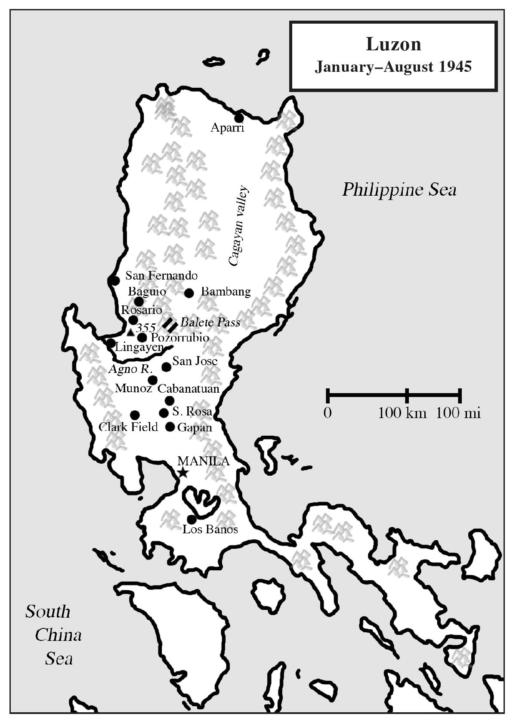
MacArthur intended to invade Luzon right where the Japanese had conducted their main landings in 1941-for the same reason: the Lingayen Gulf provided direct access to the central plains and Manila. He gave the task to Lieutenant General Krueger and his Sixth Army, supported by the air and naval forces of the Southwest Pacific Area.' Once ashore, the Sixth Army's I Corps was to protect the beachhead's left flank while the XIV Corps drove south to Clark Field and then Manila.'
Gen. Tomoyuki Yamashita, the Japanese commander, did not intend to defend the central plains-Manila Bay area with his 260,000 troops because Amer ican superiority in armor and mobility would have its greatest advantage there. He sought only to pin down MacArthur's forces in order to delay Allied progress toward Japan.
The invasion of Luzon began at 0700 on S-Day, 9 January 1945, with a massive naval bombardment. One hour later, the 40th Infantry Division landed at Lingayen on the right wing near the town of that name, with the 37th, 6th, and 43d Infantry Divisions strung out to the left.27 As this was a southwest Pacific endeavor, no amtank battalions were available, but some officers evidently had been persuaded of their utility, because all of the assault divisions except the 43d formed provisional amtank companies for the operation. As usual, amtracs carried the doughboys to a hostile shore: the 658th Amphibian Tractor Battalion carried the 40th Division, the 672d Amphibian Tractor Battalion the 37th Division, the 727th Amphibian Tractor Battalion the 6th Division, and the 826th Amphibian Tractor Battalion the 43d Division. There was no Japanese resistance on shore.

Luzon was not an amphibian story, but one of land tanks. It was to be the most Europe-like of the Pacific campaigns, but even the American side was just a bit different from counterparts in Europe.
The 6th Infantry Division displayed the haphazard nature of armored attachments in the Pacific. Assigned to it were Company C of the 44th Tank Battalion and Company A of the 716th Tank Battalion, plus a detachment of the latter battalion's service company.28 The division, therefore, had half the number of tanks assigned to it that a division in Europe could expect, and the tank companies were completely unfamiliar with one another. Meanwhile, the 716th Tank Battalion was split among the 6th and 43d Infantry Divisions, and the 44th Tank Battalion was shared with the 1st Cavalry Division.
Company C, 44th Tank Battalion, landed at H+40. Old Faithful (with two tank dozers), Snafu, and Bright Eyes were the first three tanks to land in the 6th Division's zone. One dozer suffered a mechanical failure, dropped its blade, and turned to supporting the infantry, but the second filled in a large fishpond to create a causeway for the rest of the tanks to move inland. By 1200 hours, three tanks had reached the company's objective at the Binloc River, and the company was withdrawn into division reserve. The rest of the battalion began landing two days later with the 1st Cavalry Division."

There was little Japanese resistance inland at first, either, and within a few days, the Sixth Army had 175,000 men in a twenty-mile beachhead. While the I Corps protected the left flank, the XIV Corps set off to capture Manila 30
On 11 January, the I Corps pushed eastward into the defenses of the Japanese 23d Infantry Division. The 43d Infantry Division, with the separate 158th Infantry and the 6th Division's 63d Infantry Regiments attached, made the main effort in the direction of Rosario 31
The 716th Tank Battalion landed on S-Day, but other than being shelled, it had seen no action until 15 January, when Company B fought alongside the 43d Infantry Division at Hill 355 near Mount Alava. The Japanese had constructed defensive positions, including log and earth-covered pillboxes, in low, rolling hills and ridges covered with bamboo thickets and scrub, which offered the first good defensive terrain above the Agno River. Artillery pieces were dug in and skillfully hidden.
The 716th Tank Battalion had trained intensively with the infantry, which was the good news. The bad news was that its three medium tank companies had been farmed out to three separate divisions for that training, had landed split between two divisions, and were destined to fight with ten different divisions in the Philippines.
Still, Companies C and D and a platoon of Company B were present when, on 15 January, the battalion supported the 169th Infantry's assault on Hill 355 overlooking Route 3 southwest of Rosario. The Japanese 64th Infantry Regiment held the ground, and the 43d Infantry Division's advance had come to a sudden stop a day earlier in the face of resistance from Japanese troops on a series of hills. The 716th Tank Battalion's assault gun and mortar platoons took positions on a nearby hill to provide fire support. The terrain turned out to be virtually impassable to tanks, and the frustrated men were able to account for only four pillboxes.
Two days later, the battalion went into battle near Pozorrubio, not far from where American and Japanese tanks had first clashed in 1941. This time, the tanks-parceled out by platoons to infantry battalions-crushed Japanese resistance wherever it appeared. Maneuver was rapid, and morale was high. The only tank lost was an assault gun, and tragically, the battalion commander was mortally wounded while helping the crew evacuate.
Things soon turned ugly again, as the battalion on 22 January supported an attack by the 169th Infantry on Hill 355 from a different direction, and a breakdown in cooperation between tankers and infantry was the cause. The battalion's history recorded:
Company B's 2d Platoon attacked Hill 355 from the southwest.... [Lt. Eugene Farley's] tanks overran enemy infantry positions, forcing them into the open and machine-gunning them as they fled. In one instance, a 75mm shell uncovered a trench system. Two tanks astride the trench swept its length with enfilading fire, killing a large number of enemy troops. This climaxed a wild fight in which fanatical Japanese rushed at the tanks with bayonets and hand grenades. In one case, an enemy soldier climbed onto the back deck of a tank with a forked stick and attempted to stuff dry grass into the grillwork to fire the tank's engine. He was shot off the tank by a machine gun....
Sergeant Leo Smith, a tank commander, was killed instantly by a sniper's bullet, which penetrated his skull. Lieutenant Farley fell wounded while attempting to reestablish contact with infantry forces, which was broken during the melee. Toward sunset, the tanks' supply of fuel and ammunition was dangerously low.... The infantry commander refused to release the tanks because of the fluid situation....
Captain [Edward] Stork and Lieutenant Munelly with the 3d Platoon moved out to support the 2d Platoon.... Immediately a fire fight began. Tank guns hurled great quantities of 75mm and machine-gun shells while the enemy fired on the six tanks with hidden antitank guns, mortars, and machine guns. One tank stopped short of the enemy to fix a faulty hatch. Captain Stork's tank was damaged and forced to withdraw. He mounted a second tank to remain in the fight. Sergeant [Clarence] Reese's was the only tank of the remaining four that withdrew undamaged. At great risk to himself, he dismounted under heavy fire to rescue a wounded comrade from a knocked-out tank. After evacuating him, he returned to rescue Captain Stork from death, after Captain Stork had been dazed by a mortar burst and walked toward the enemy firing a pistol.
The Japanese on Hill 355 withstood combined tank-infantry attacks for twelve days, and the 43d Division finally secured the prominence on 29 January. Well-camouflaged antitank guns claimed more Shermans. The action was to prove the most costly the battalion would endure during the entire campaign in the Philippines.
Over the preceding four years, the United States had become a global player in armored warfare, whereas Japanese tank development, which had held the advantage at the start of the war, had stagnated. This became evident almost as soon as the 716th Tank Battalion went into battle. On 17 January, Company C was operating with the 103d Infantry Regiment when it encountered four tanks from the 2d Japanese Tank Division and destroyed all of them. The Japanese may have learned a lesson from this, as when the company again encountered tanks on 19 January at San Manuel, the tankers found that the enemy had dug them in as pillboxes, which deprived them of mobility but offset their thin armor plate 32

Elsewhere in the I Corps' zone, Company A, 716th Tank Battalion, was not far away working with the 6th Infantry Division approaching Rosario during this period. These tankers also destroyed a number of Japanese tanks and tankettes. Company C of the 44th Tank Battalion fought beside the 20th Infantry to clear the Cabaruan Hills, which required cleaning the Japanese from every single hole they occupied. Tanks were used in small numbers to fire at point-blank range into Japanese positions, sometimes in vegetation so thick the crews could see no farther than a few yards. At the end of the fight, the 6th Infantry Division counted 1,432 Japanese killed and 7 captured.33
The 6th Infantry Division had not left its amtracs at the water's edge and was exploiting the capabilities of the 727th Amphibian Tractor Battalion inland. On 19 January, for example, twenty-six Company B tractors conducted an assault crossing of the Agno River with GIs from the 1st and 20th Infantry Regiments. The fol lowing day, the amtracs hauled supplies across the river to the bridgehead and through rice paddies on the far side 34
The Race to Manila
After consolidating its part of the beachhead, the XIV Corps crossed the Agno River unmolested on 15 January. Two days later, MacArthur told Krueger that he wanted the XIV Corps to roll south to capture the Clark Field air base complex with alacrity. The following day, Krueger gave the XIV Corps the green light. The Americans rolled toward Manila, as the Japanese had already largely evacuated the central plain 35
Oral tradition holds that MacArthur was so impressed by a raid conducted on 30 January by the 6th Ranger Battalion at Cabanatuan-resulting in the liberation of 500 prisoners of war-that he ordered the 1st Cavalry Division, which had arrived from Leyte on 27 January, to accomplish a similar rescue of 3,700 American and other Western civilians interned at the University of Santo Tomas in Manila. "Go to Manila! Go over the Japs, go around the Japs, bounce off the Japs, but go to Manila!"36
MacArthur ordered creation of a "flying column" for the mission, and the 1st Cavalry Division organized a mechanized task force under its 1st Cavalry Brigade. The column was broken into three smaller columns or "serials." Marine corps aviation was to support the operation. With the inevitable twists and turns, the men would have to cover about 100 miles to reach the objective. Fortunately, Santo Tomas lay on the north side of Manila, which the Americans would reach first .17
The 44th Tank Battalion-minus Companies A through C-and the 302d Cavalry Reconnaissance Troop formed the spearhead for the flying column, called the Provisional Reconnaissance Squadron. Starting on the night of 31 January, the battalion's commander, Lt. Col. Tom Ross, reached Santa Rosa and pressed on the next day to Gapan. There heavy automatic-weapons fire greeted the column, and Ross was killed. That same day, Company B, working with the 2d Cavalry Brigade, secured the river crossing at Cabanatuan, where heavy street fighting took place, and the tanks proved their worth by destroying the enemy's prepared positions.
The 1st Cavalry Division rolled on, swatting aside resistance here and there, with its flanks protected only by marine corps flyers. On 3 February, tanks from Company B that were operating with the the 1st Brigade's 5th Cavalry Regiment were the first element to enter Manila at about 1830 hours, blasting at all positions suspected of hiding Japanese soldiers. The tanks rolled through streets crisscrossed by sniper bullets and reached the internment camp at Santo Thomas University at about 2100 hours. The Sherman Battlin Basic, followed by Georgia Peach, knocked down the gates. The bold gambit had succeeded .31
Getting into Manila had been easy, but securing the capital proved difficult indeed. Strong Japanese forces, primarily naval, disregarded General Yamashita's plan to hold out in the mountains and fought for possession of the city. On 4 February, Manila was divided into two sectors under the responsibility of the 1st Cavalry Division to the east and the 37th Infantry Division to the west; while the former gathered its strength, its 8th Cavalry Regiment began to push toward the Pasig River that ran roughly east to west through the city's center. The 37th Infantry Division easily secured the river line in its zone the next day, hindered mainly by cheering crowds and burning buildings set alight by the Japanese.
Meanwhile, Company B of the 44th Tank Battalion turned to clear the area northeast of the city center, attached to the 7th Cavalry Regiment. On 7 February, the company was ordered to sweep the eastern suburbs, turn south, and then jog west toward the Pasig River.
In a display of complete incompetence, the division assigned no foot troops to work with the tanks. The tankers ran into strong resistance near the San Juan reservoir, where 5-inch naval and 20-millimeter guns engaged the company, while Japanese infantry closed in with Molotov cocktails and mines. In one platoon, three tanks were destroyed and the other two damaged. The next day, six tanks reached the reservoir but were again set upon by Japanese suicide troops with Molotov cocktails and had to pull back. The infantry finally arrived at 1330 hours, and together, the GIs and tankers secured the reservoir.
The company then moved into the heart of the city, where the other three regiments of the 1st Cavalry Division and the 37th Division's 148th and 129th Infantry Regiments were fighting to clear the area south of the Pasig that the Japanese had converted into a fortress. Company A tankers were already there, working through the streets with the 8th Cavalry Regiment's troopers and blasting bunkers and other positions, sometimes under fire from Japanese naval guns. One tank was lost to a naval depth charge rigged as a landmine; there were 154 such bombs along the road where the tank was destroyed. Some of the tanks were equipped with bow-gun mounted E4-5 flamethrowers, which proved useful against Japanese troops barricaded in buildings. The 1st Cavalry Division reported that the tanks were instrumental in the advance.
The 37th Division's 148th Infantry, meanwhile, put its first troops across the Pasig River on 7 February using assault boats, followed by troops carried by the 672d Amphibian Tractor Battalion, which had accompanied the 37th Infantry Division all the way from Lingayen Gulf. The next day, LVTs carried the 1st Battalion, 129th Infantry, across the river.39

The 1st Cavalry Division crossed the Pasig several days later. On the south bank, tankers, doughs, and troopers became embroiled in urban warfare like that in Cassino and Aachen. One journalist who covered the 44th Tank Battalion's engagements reported:
It was a crazy kind of fighting in Manila south of the Pasig River. A tank commander's fire order to his gunner would not designate a particular building to be shelled, but instead a specific window on a certain floor of a particular structure. Instead of normal 75mm gun ranges, they were firing sometimes at twenty-five to fifty yards. On one occasion, U.S. troops held the lower floors of a tall building, the Nips remaining in the upper stories. In the narrow street alongside, one tank paused just long enough for a Japanese to toss a dynamite charge from the roof. His aim was perfect, and it landed on the helmet of the tank commander, Sgt. Albert Kramer.... Serious injury, of course, resulted....
The reporter noted that this was a result of the 44th Battalion's having to fight with the hatches unbuttoned so the commander could see the battlefield.40
"The fighting was the toughest yet encountered by our troops," recorded the 129th Infantry Regiment. "It was like Bougainville in reverse but instead of attacking log and sand pillboxes, we were up against concrete emplacements thoroughly fortified and prepared and strategically emplaced to offer the best fields of fire" The Japanese had constructed pillboxes in the thick-walled concrete structures at nearly every corner, and the GIs advanced from building to building, clearing each one top to bottom. Artillery and antiaircraft guns were often hidden in doorways or behind second-story windows.
The cavalrymen and tankers had to work out ad hoc tactics that greatly resembled those developed in the first big urban battles in Italy and Germany. "For the tanks as well as the infantry, this was a new type of warfare," recorded the 754th Tank Battalion. "Our tactics were revised and became more flexible to meet the change in conditions. The tanks were used primarily as mobile artillery, firing at strong points at very close range."
The importance of tight control over who was on which street was demonstrated on 11 February, when two tanks from the 754th Battalion-still stuck north of the Pasig because all bridges were down-pounded the 129th Infantry's Company E, an event the regiment termed a "debacle." Massed artillery fire against single buildings increasingly became the tactical fix at first.
The 37th Infantry Division did not even use medium tanks from the 754th Battalion in a direct-fire, close-support role until 14 February, when Shermans and M7 assault guns from the infantry's cannon company pounded the new police station, built of heavily reinforced concrete, to weaken the defenses for an assault by the 129th Infantry Regiment. Thereafter, the division used tanks aggressively to support infantry attacks.
The assault gun platoon from the 711th Tank Battalion was attached to the 37th Division on 17 February to provide even more tactical firepower. By 19 February, the infantry also brought up 155-millimeter howitzers to blast openings in the thickest walls, just as had the 1st Infantry Division in Aachen.4L
Tank company and platoon attachments within the cavalry division, meanwhile, changed frequently, and the 44th Tank Battalion was scattered once again on 13 February, when Company A was sent to the 11th Airborne Division south of Manila.42 The grinding battle in Manila wore on. Many tanks expended between three and four units of fire per day.43 Tanks fell victim to antitank guns, landmines, and satchel charges, and for once, many of them were burning." One was hit on the right sponson by a 120-millimeter dual-purpose gun from only seventy-five yards away. Another was penetrated four times by 47-millimeter fire and then hit by a 120-millimeter high-explosive round. A satchel charge was dropped into the turret of another, and one more was destroyed by a shaped charge placed against the armor.45
The battle for Manila effectively ended on 24 February, when the 37th Infantry Division fully occupied the old walled city of Intramuros, though fighting dragged on for another week.
Lessons Drawn
"On the plains of Luzon," concluded a U.S. Army Forces Far East board report on battle experiences, "our forces for the first time operated in open, firm terrain. The failure of our armor to ride rough-shod over the Japanese defenses may be attributed largely to the Jap's skillful use of antitank weapons to bolster fortified positions.... On Luzon, the Jap has invariably placed his antitank guns well forward and has displayed skill in siting and camouflaging them. His fire discipline has been excellent, in many cases fire being held until U.S. vehicles were within fifty yards."
In and around Manila, Japanese troops had laid well-designed minefields. "Magnetic mines, lunge mines, and satchel charges," the board report continued, "in the hands of suicidal Jap soldiers were a constant threat. These soldiers, working in pairs and usually covered by antitank guns, would conceal themselves along avenues of approach and attack as our tanks passed by. Tank stalking squads were [also] employed but in most cases were unsuccessful and were killed before they could reach our tank."
Tankers in Manila encountered 37-millimeter, 47-millimeter, and 75-millimeter antitank guns and dual-use antiaircraft guns up to 120 millimeters in size, plus the occasional 120-millimeter naval gun. The 47-millimeter gun could penetrate the M4's turret front at short range and its flanks at medium range. The 75-millimeter gun could penetrate the turret from 500 yards and normally destroyed the tank. Every tank hit by the 120-millimeter naval gun was destroyed 46
Tankers and GIs on Luzon learned that the Japanese monitored the return of tanks to a laager to refuel and perform maintenance. The solution was to withdraw tanks before dark and then to disperse them 100 to 200 yards apart and as far from the perimeter as possible. Experience showed that Japanese demolition teams would come after tanks if they were sited at the outer edge."
A Second Rescue Mission
The 672d Amphibian Tractor Battalion, meanwhile, had been attached to the 11th Airborne Division, elements of which had made an amphibious landing sixty miles south of Manila on 31 January. The 511th Parachute Infantry Regiment dropped on 3 February at Tagatay Ridge, and the two forces quickly linked up.
On 18 February, the division headquarters issued orders to the 1st Battalion of the 511th Parachute Infantry to liberate 2,000 civilians from an internment camp at Los Banos, about twenty-five miles south of Manila.
The plan was daring and was executed with only minor glitches. On 21 February, the division's reconnaissance platoon infiltrated the Los Banos area by crossing the Laguna (Lake) de Bay in locally procured boats to make contact with Filipino guerrillas who were to help attack the camp. Division engineers reconnoitered the shore of the lake at the objective to identify places where tracked amphibians would be able to climb the bank. Intelligence collected by guerrillas and from escaped internees revealed that the Japanese garrison gathered without arms at 0700 to perform calisthenics. This fact became a key element to the plan.
At 0500 hours on 23 February, the 672d Amphibian Tractor Battalion's fiftyfour amtracs set off across the lake carrying two companies of parachute infantry. At roughly 0700, as Japanese soldiers exercised in the internment camp, Company B of the 1st Battalion jumped from nine C-47s winging overhead and aimed for a drop zone about 800 yards from the perimeter. To at least one internee, the paratroopers descending under their canopies looked like angels from heaven. Working with the recon platoon and guerrillas, who had taken the stunned garrison under fire as soon as the jump began, Company B stormed and secured the camp. By the time the amphibians arrived, the fight was almost over.
Planners had intended to evacuate some of the internees overland, and the 188th Glider Regiment had attacked toward Los Banos to open a route to safety. The gilder infantry made slower progress than expected, and the 672d Battalion instead ferried the 2,147 internees to safety across the lake in two shuttle runs. By 1500, the tankers had evacuated the last of the civilians and their rescuers. "But for the troopers of the 11th Airborne, the men of the 672d Amphibian Tractor Battalion, and those army C-47 pilots, I would not have survived Los Banos Internment Camp," recalled one internee .41
Pacific Tank Battles
Back in the I Corps' zone, the 44th Tank Battalion's Company C was still attached to the 6th Infantry Division, which on 1 February pushed off with its running mate, the 25th Infantry Division, to capture San Jose. If the Americans could secure the city, they would cut the last land link between the Japanese Shobu battle group-responsible for the defense of northern Luzon-and the Shimbu battle group defending the south. The Japanese planned a holding action at San Jose using the 2d Tank Division and elements of the 10th and 105th Divisions in hopes of shifting more supplies and the 105th Division northward over the route.49
The Japanese 2d Tank Division on Luzon constituted the most formidable armored force faced by the Americans in the Pacific theater. By now, the Japanese clearly had no intention of pitting their undergunned and thinly armored Type 97 medium and Types 95 and 97 light tanks against American M4s, and they used their tanks defensively to stiffen defenses in villages in groups of nine or more vehicles. The tanks were well dug in and camouflaged, though they could be moved to alternate firing positions. The only times that tanks supported infantry attacks were during last-gasp "banzai charges" when it was clear the defense was collapsing."'
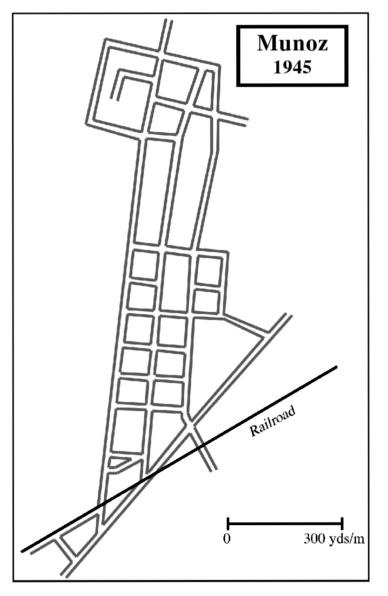
Company C of the 44th Tank Battalion, an attached light tank platoon from the 716th Tank Battalion, and the 6th Infantry Division's doughboys ran into the largest of these strongpoints at Munoz, which lies southwest of San Jose, on 1 February. Some 2,000 Japanese troops defended the village with orders to resist to the last man, including the 6th Tank Regiment (less one company) and elements of the 2d Tank Division's antitank unit armed with 47-millimeter guns.51
To the GIs of Company K, 20th Infantry Regiment, approaching Munoz at 0730 on 31 January, the bomb-shattered buildings that provided excellent camouflage for Japanese emplacements looked just like any other battered town. When the company tried to enter Munoz from the southwest along a rail line, fierce automatic-weapons fire pinned the assault platoons down and kept them immobile the entire day. Other elements of the 3d Battalion moved up to Company K's line, but it was clear that Munoz was going to be a problem. Probes over the next two days confirmed that in spades.52
The 3d Platoon's medium tanks worked with the 20th Infantry Regiment during its fight to take Munoz. Company C's battle report described the situation: Tank operations were limited by flat terrain, boggy ground, and deep water-filled irrigation ditches. The town of Munoz was fortified with antitank guns, 105[-millimeter] artillery pieces, and fifty-seven light and medium tanks, all of which were dug in with a three-feet-thick top of logs and sandbags over them. In addition, numerous alternate positions were available so that the tanks that were in one place one day would be in an alternate position the next.
As a result of constant reconnaissance by the platoon leader, the 3d Platoon was able to move to a somewhat defiladed position on the southwest corner of Munoz, from which point the platoon was able to support the infantry. Movement of tanks was definitely restricted. One false move and a tank was lost. Whenever any armored vehicle attempted to move into the town, it was knocked out by antitank fire. One tank of the 3d Platoon was lost in this manner. Even though limited to almost stationary support, the 3d Platoon gave the infantry considerable support, knocking out six Jap medium tanks, one 105mm artillery piece, four 47mm, and much enemy equipment and personnel.53
The 20th Infantry's attack failed in the face of intense fire, and two more days of slugging appeared to bring the Americans no closer to clearing the village.
The rest of Company C's tanks worked with the 63d Infantry, which bypassed Munoz, reentered the highway on 2 February, and drove on toward San Jose. At the barrio of Abar, the Americans ran into the main defenses before San Jose. The Japanese had emplaced antitank guns and machine guns to cover a water barrier, and tank gunnery that knocked out five 47-millimeter guns was not enough to secure a crossing. The 2d Platoon finally crossed under cover of smoke and then tore up the Japanese defenses, aided by fire from the assault guns, light tanks, and company headquarters, which had enveloped the Japanese line and opened up on the enemy's right flank and rear.54 The 1st Infantry, which also bypassed Munoz, entered San Jose on 4 February almost unopposed.
While the 1st and 63d Infantry Regiments mopped up, the 20th Infantry continued its exhausting fight to capture Munoz. On 3 February, the regiment cracked the first Japanese line running east to west across the south edge of town, which provided a good indication of why the going was so tough. Six medium tanks were dug in forty to eighty yards apart with interlocking fields of fire. Two 47-millimeter antitank guns and two 105-millimeter howitzers were integrated into the line as well. Machine-gun nests and rifle pits covered the tanks and guns.
A very similar Japanese position claimed a Company C tank on 5 February, by which time the 20th Infantry held roughly the southern third of town, as described by infantry officer Capt. Michael Kane, whose Company B was fighting on the east side of Munoz:
Company B located a tank seventy-five yards to the front. Immediately they requested one of our supporting tanks to engage the enemy tank. Our tank came up to ten yards east of the storage building and, after the crew had been oriented as to the location of the enemy tank, they fired a 75mm round at the Jap tank, hitting and destroying it. However, our tank, before it could withdraw, was hit by a 47mm shell from a supporting enemy tank. This enemy tank was about eighty yards north of the Jap tank that had just been destroyed. Our tank burst into flames, but the crew escaped safely.
By 6 February, the 20th Infantry had taken only half the town. That day, withdrawal orders reached the defenders.55
On the morning of 7 February, the Japanese attempted to break out of Munoz. Company C's battle report recorded, "The [American] infantry knocked out eleven tanks ... but the majority of tanks got through "" The company's history added:
About three AM, several men woke up as they heard a tractor coming down the highway. It sounded like an American Caterpillar going full speed. Crouching in the dark, they waited and as the vehicle sped by, they recognized it to be a Japanese medium tank. Immediately the alert was sounded, and everyone was up.... Soon, more vehicles were heard coming, and we could hear the infantry firing at them but not stopping them. Another medium tank led the convoy, followed by a personnel carrier pulling a 105mm artillery piece. Sergeant Elkins' tank, Little Anne, was at the end of the area along the highway covering the direction the Japs were coming from. Corporal [James] Ford jumped into the gunner's seat, Sgt. [Milo] Knowlton into the loader's seat, and T/5 [Charles] Askins stood back of the turret to direct fire. It was impossible to use the gun sights because of the dark. The first tank sped by before the men could fire at it, but when the personnel carrier went by, Askins hollered, "Fire!" and Ford fired. The shell hit dead center on the 105 gun, scattering the Japs that had been sitting on it in all directions. The carrier and gun kept going a few yards down the road, burst into flames, and stopped. Then came another medium tank. Little Anne's gun spoke again and sent an armor-piercing shell clean through the tank.57
The battle report continues,
After blocking the highway by destroying one truck and one medium tank, the company fought it out in the dark with seven other Jap tanks plus Jap foot troops. The company area was first riddled with tank fire from the Japs, and then the foot troops attempted to infiltrate our perimeter. In order to avoid firing into our own infantry troops and to have the advantage of the coming daylight in back of the Jap tanks, it was necessary to move one platoon out to the flank of the Jap tanks and take them under fire [which] enabled the company to eliminate all remaining Jap tanks and personnel.... Upon checking at daylight, 245 Jap bodies were located, eleven tanks and five trucks had been destroyed .51
A physical count revealed the hulks of 48 medium and 4 light tanks in and around Munoz, plus 4 armored cars, 16 47-millimeter antitank guns, and 4 105millimeter howitzers.59 By mid-March, American forces had destroyed 203 medium and 19 light tanks-95 percent of the 2d Tank Division's strengthmostly in the Munoz-San Jose area.60
The fight in Munoz had, in many ways, resembled the 741st Tank Battalion's struggle in Krinkelt-Rocherath during the Battle of the Bulge, with the roles of the Americans and the enemy reversed. Patient tank-infantry teamwork had paid off in Munoz, whereas the impatient SS had thrown themselves into a killing ground in the Ardennes.

In February, the 44th Tank Battalion suffered 106 casualties, including thirteen men killed, and lost nine tanks destroyed plus many damaged. March started out just as difficult: two assault guns were knocked out on 3 March, one by a Japanese soldier with a satchel charge and a second by an antitank gun and infantry throwing white phosphorus.61 The Japanese in and around Manila, in particular, had proved to be as formidable an enemy for the tankers as the Germans had in Europe, without the benefit of a powerful panzer force.
At the end of March, the exhausted men moved to a rest-and-recreation area to enjoy movies, softball, and a swimming pool. By then, an inspection of the 44th Tank Battalion's Company A showed that all of the tank engines needed to be replaced, as well as sixteen sets of tracks. By the time Company C rejoined the battalion in April, the company had been in combat for seventy-seven days straight, which was believed to be a Pacific theater record.62
The Drive into Northern Luzon
Tank operations during the drive into the Cagayan Valley in northern Luzon were probably the most diffuse of any organized corps-scale campaign during the war. Except on the valley floor, the terrain was mountainous and jungle clad, and opportunities for even platoon-size action were rare. In April, for example, the 775th Tank Battalion had its headquarters and Companies C and D attached to the 25th Infantry Division, which was driving through the Balete Pass into the Cagayan Valley to eventually link up with the 11th Airborne Division at Appari; Company B attached to the 37th Infantry Division, which was advancing on Baguio; and Company A attached to the 33d Infantry Division, which also attacking toward Baguio.
Tanks often had to support infantry attacks against Japanese pillboxes and gun positions hidden in literally trackless, sloped jungle. Bulldozers had to create "roads," or the tanks had to smash through the vegetation on their own.63
The 25th Division's 27th Infantry Regiment recorded a representative picture of the setting and the role of the tanks:
Some three thousand yards south of Balete Pass, the gateway to the Cagayan valley, the enemy constructed his main line of resistance. These defenses formed a general east-west series of fortifications extending from a right flank west of Highway 5 to some distance beyond the Old Spanish Trail, which parallels Highway 5 approximately 12,000 yards to the east.
To man this main line of resistance, the enemy had formed a provisional force composed of elements of his main infantry reinforced by various service units collected from all sectors of Luzon. Principal enemy units represented were the 10th, 11th, and 63d Infantry regiments; the 10th Engineer Regiment; the 10th Transportation Regiment; the 8th Railroad Regiment; and artillery from the 10th Division reinforced by independent artillery and heavy mortar units.
The terrain south of Balete Pass was especially suited for defense. Perpendicular to Highway 5, the enemy's defenses were constructed along a series of ridges and principal hill-masses to which there were few natural routes of approach. The central anchor of the main line of resistance was formed on Myoko Mountain, the dominating hill-mass of the entire area south of Balete Pass and north of Putlan....
With the 2d Battalion in the lead, the regiment commenced the advance to the north. Company G was assigned the left sector adjacent to the highway, and Companies E and F were directed toward Myoko. The terrain was characterized by steep slopes covered by dense rain forest, which offered many problems and hardships in both maneuver and supply. The enemy was supported by intense mortar and automatic weapon fire, and his riflemen were well dug-in on commanding ground....
The terrain was not "tank country" Rather than the usual flat or gently rolling ground usually associated with armor, Myoko Mountain offered only the sharp, narrow ridgeline to the northeast. Saddles and knolls were impassable, and bulldozers had to cut paths, often pushing the tanks into position.... When terrain was reached over which the tanks could not move, infantrymen moved ahead to secure the next favorable ground, and the bulldozers followed to improve the ground for further employment of the tanks. Often the path of the tanks was so narrow that a small portion of each track extended over the edge of the ridge.14
Lt. Col. Eben Swift described how his 3d Battalion, 27th Infantry, put just a few 775th Tank Battalion Shermans to work in early April to take a feature nicknamed "the Pimple," the highest point on the main Myoko hill-mass. The Japanese were dug in and supported by 150-millimeter and 90-millimeter guns. Swift obtained an armored bulldozer and cut a trail to the Japanese main line of resist ance, opening the way for two Shermans that advanced protected by infantry against Japanese suicide attacks. Swift described the scene:
The tanks labored forward up the narrow bulldozer road to the crest. The Japs knew that something was in the wind and dropped mortar fire; however, most of it passed harmlessly overhead and exploded in the draw behind the tanks. The first tank reached the end of the road almost at the crest of the knoll but stalled when it reached the lip projecting from the crest.... The tracks started spinning in the soft dirt....
The bulldozer crawled up behind the tank and pushed it over the top as both engines roared and sputtered. The tank maneuvered into position and fired its 75 and machine guns point-blank at the Jap positions on the Pimple. As fast as the Japs crawled out of their foxholes to fire at the tank, our BAR and rifles cut them down. The 75s not only knocked out the enemy's pillboxes, but also blasted away undergrowth and camouflage in front so they could be plainly seen. After the first tank was set, the bulldozer pushed the next tank up. Together, the two tanks and Company B's riflemen methodically plastered the area.
The next day, the battalion kept two Shermans on a nearby hill firing continuously all day long as the riflemen dug the Japanese off the objective. When one ran out of ammunition, it would pull back and the other would take its place. At the end off the day, commented Swift, "We had squeezed the Pimple .1115
The regiment noted regarding its advance, "The psychological effect [of tanks] on the enemy was very strong, and the absence of antitank guns proved that he had not remotely expected or considered that tanks could be employed in this sector.... [T]he support of the medium tanks was invaluable."66
The 775th Tank Battalion concluded at the end of the campaign in northern Luzon, "No one ever conceived that [medium tanks] would or could operate over the rugged terrain which characterized most of the fighting after the enemy was beaten from the central plain into the mountains."

While the 775th Tank Battalion fought its way through northern Luzon, widely scattered elements of the 711th, 716th, and 754th supported the infantry who reclaimed the area east of Manila, the small islands southwest of Luzon, and Mindanao. On some of the smaller islands, no more than a platoon of tanks would be committed to the entire operation.
In terms of duration, the campaign on Luzon most closely approximated the war in Europe. Company C of the 775th Tank Battalion had been in combat for six months and eleven days by the time it was over, and the rest of the battalion had been in combat for nearly five months. Losses, however, were much lighter than in Europe. Only twelve men of the 775th were killed in action, and only four tanks were damaged beyond repair.'
American tanks on Luzon did not cover the kind of distances that tanks in Europe did, but conditions were just as hard on the equipment. By summer 1945, the 754th Tank Battalion was suffering from critical shortages of tracks and spark plugs, and it banned movement of the tanks except in emergencies."