

CHAPTER 3
The "rush-to-battle" idea is wrong. Here we creep up. Each tank should overwatch another tank; each section should overwatch another section; each platoon another platoon.
-Lt. Col. Percy Perkins, 191st Tank Battalion
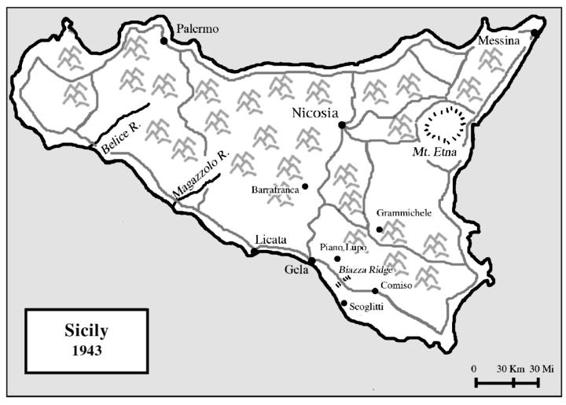
 he Allies decided to follow up the victory in North Africa by invading Sicily in the hope of driving Italy out of the war, which would force the Germans to occupy Italy and pick up Italian military commitments in the Balkans. President Roosevelt also wanted to keep American troops active in the European war during the remainder of 1943. The plan for Operation Husky ultimately called for two corps to land under the British Eighth Army on the southeastern corner of the island. The U.S. Seventh Army's II Corps, under Lt. Gen. Omar Bradley, controlled the 1st and 45th Infantry Divisions and assaulted beaches somewhat farther west around Gela. Lt. Gen. George Patton Jr., who commanded the Seventh Army, retained personal control over the 3d Infantry Division, which landed on the left at Licata.
Two Italian corps defended the island, the XII Corps in the west and the XVI Corps in the east. Field Marshal Albert Kesselring, responsible for German forces in southern Italy-while Field Marshal Erwin Rommel commanded those in the north-had buttressed the Italians with the Hermann Goring Panzer Division assigned to the XII Corps and the 15th Panzergrenadier Division attached to the XVI Corps. At Kesselring's insistence, the two German divisions were positioned close to likely landing areas on the south coast so that they could counterattack quickly to drive invaders back into the sea.'
The Hermann Goring Panzer Division, which had responsibility for the area where the Americans were going to land, would earn a fearsome reputation, but as of early July 1943, the division was green, as few of its soldiers who had fought in Africa had been rescued. It had just organized as a panzer division and had few seasoned tank officers. The division was equipped with about thirty-five Panzer Ills and Panzer IVs, and the Luftwaffe division had attached to it a company of Tiger tanks from the army.'
The Allied landings on 10 July 1943 constituted the largest amphibious assault of the war and put seven divisions ashore in Sicily. In the American zone, Combat Command A of the 2d Armored Division landed at Licata to support the 3d Infantry Division's beachhead on the left of the American assault zone, while the 753d Tank Battalion (Medium) supported the 45th Infantry Division on the right around Scoglitti. Ten of the 753d Battalion's Shermans were to help the 1st Infantry Division in the center around Gela until the 2d's Combat Command B and the 70th Tank Battalion (Light) came ashore. The two combat commands were initially to fill the role normally accorded separate battalions-that is, infantry support.
The invasion fleet was equipped with new models of landing vessels that were designed to speed the delivery of vehicles and men to a hostile shore. The landing ship, tank (LST); landing craft, tank (LCT); landing craft, infantry (LCI); and landing craft, vehicle or personnel (LCVP), saw action for the first time. No longer would tanks have to be hoisted over the sides of transports into landing craft; now they would arrive off the invasion coast aboard their ride to the beach.
The potential revolution of delivering tanks to a spot nearly on the sand did not fully pan out at Sicily, however. False beaches or sandbars off the selected landing areas gave way to fairly deep water before the true shore. As a result, pontoons had to be used between an LST's bow doors and the beach as during the Oran landings-though this time they were prefabricated for speedy installationor a cumbersome LCT relay had to be employed.' Moreover, there were not enough of the new craft to equip the entire force. The 45th Infantry Division arrived combat loaded from the States in traditional fashion. As had inexperienced divisions and fleets similarly equipped during Operation Torch, the landing force suffered high losses in landing craft-up to 50 percent off some transports and 20 percent overall.4 The bulk of the 1st Infantry Division's vehicles arrived aboard transports from North Africa. Only the 3d Infantry Division (code-named Joss Force) received enough landing craft to mount a shore-to-shore operation from North African ports.5
Yet despite the success in landing some light tanks with the assault wave during Torch and the availability of LCTs to Joss Force, for unknown reasons no tanks were assigned to the assault wave in Operation Husky. The assault force commanders imposed a set of rules that applied to all regimental combat teams landing on all beaches, which included several stipulations regarding tanks. The first wave of LCTs was not to hit the beach until H plus ninety minutes (with one exception), and five of those were to carry medium tanks towing antitank guns and followed by the latter's prime movers. All LCTs were to be loaded to permit tanks to fire as they approached the shore. All transports were to be tactically loaded, with no more than one tank company on any given vessel.'
Maj. Gen. Lucian Truscott, commanding the 3d Infantry Division, evidently was the one exception. Truscott assigned the 3d Battalion, 66th Armored Regiment, to land one company of medium tanks by LCT immediately behind the last battalion of each infantry regiment, which would put tanks on the island within sixty minutes of H-Hour. The remainder of Combat Command A was to remain in floating reserve and land on call.'
It is unclear how far behind the 45th Division's assault wave the 753d Tank Battalion landed, but it went ashore with the 157th Infantry. The tank battalion's records for Husky are missing. As of midnight on D-Day, the division's G-3 was unaware of any action involving the tanks, and the tanks' presence is first reflected in 45th Division message traffic about combat operations on D+1.8
Tank destroyers had gotten a bad reputation in North Africa with some senior officers, including Patton. The Seventh Army had assigned no tank destroyer battalions to the Sicily operation, which meant that Patton was relying on tanks to fight tanks in situations of maneuver.

The 753d Tank Battalion was the first separate battalion to use the M4A1 Sherman in combat. The M4A1 was distinguishable from the M4 by the rounded contours of its cast hull, whereas the M4 had a welded and angular hull. The two models were mechanically identical.
The Sherman inherited the chassis, suspension, and power train of the M3, but the gyrostabilized 75-millimeter gun moved to a fully traversing cast turret powered by hydraulic and manual systems. The thirty-four-ton vehicle had a crew of five (commander, gunner, cannoneer/loader, driver, and assistant driver/bow gunner). Tank commanders, who had a simple steel sight on the turret top, could override the gunner's control of the turret rotation, but their switch lacked fine calibration, which meant the gunner usually had to make final adjustments on the target. The turret turned quickly, a trait crews came to value highly because it often meant the Sherman got in the first accurate shot against heavier panzers that had manual traverse systems.
The decision to stick with the 75-millimeter main gun rested on the fact that it fired an excellent high-explosive round-in keeping with the doctrinal assumption that tanks should generally leave fighting other tanks to the tank destroyers-but it nevertheless had plenty of armor-piercing punch for the battlefield of mid-1943. The main gun fired an armor-piercing round at a muzzle velocity of 2,030 feet per second and could penetrate 3.1 inches of face-hardened plate at 1,000 yards, which provided a considerable comfort margin over the two-inch-thick armor on the front of Germany's Mark IV medium tank. A combination gun mount incorporated a .30-caliber coaxial machine gun.
The executive officer of Combat Command B of the 1st Armored Division had told a War Department observer in North Africa flatly, "The M4 tank is the best tank in the theater"9 After an inspection tour in North Africa from December 1942 to January 1943, Lt. Gen. Jacob Devers also asserted, "The M4 medium tank (General Sherman) is the best tank on the battlefield."" A visit by then-Maj. Gen. Omar Bradley to the 1st Armored Division revealed that crews had a more nuanced view. They had learned that most turret penetrations occurred where the armor was thinned down on the inside to accommodate fittings. The plexiglas in the direct vision slits on older tanks could be blown into the driver's face by even a near miss, and many crews had removed it. They thought their gun sights were too weak and should be illuminated for night fighting."

The naval bombardment began only fifteen minutes before the assault boats reached the sand because Patton wanted to achieve tactical surprise.'2 Indeed, even though the Italian coastal defenses had an hour's tactical warning because of airborne drops inland, the 1st and 3d Infantry Divisions rolled ashore against virtually no opposition.
The 45th Division landed three regiments abreast, with destroyers providing the close support against targets on the beach that tanks might otherwise have provided. The tin cans followed the assault troops to within 3,000 yards of the beach, blazing away. "Sometimes," recalled Maj. Ellsworth Cundiff, the S-2 for the 179th Infantry in the division's central zone, "it seemed as if the destroyers themselves were making the assault."
The GIs paid the price for not having tanks sent in with them. Resistance on the beaches in the 45th Division's zone ranged from spirited in the 180th Infantry's area to nothing elsewhere. Once the regiments moved toward their objectives inland, a combat group from the Hermann Goring Panzer Division consisting of Mark IV and Mark VI panzers, infantry, and artillery badly mauled the 180th's 1st Battalion, pushed the regiment back, and created a potentially dangerous gap between it and the 179th Infantry, which was advancing on the Comiso airfield."
At Gela, two Ranger battalions attached to the 1st Infantry Division without any armor support fought off Italian counterattacks backed by tanks. At Piano Lupo crossroads, 82d Airborne Division paratroopers and the first advancing doughboys from the 1st Division's 16th Infantry needed naval gunfire to beat back Italian tanks, and then much of the Hermann Goring Panzer Division."
The following day, Axis forces threw more tank-heavy counterpunches at the American beachhead, and the slow arrival of friendly armor almost had fatal consequences for the 1st Infantry Division. Two tank platoons from Combat Command B had landed late on D-Day but got stuck in soft sand. Four Shermans got loose on D+1 in time to help fend off a large armored attack that nearly overran the 1st Division's beaches.
That same day, two platoons of Company B, 753d Tank Battalion, came to the aid of 82d Airborne Division paratroopers near Piano Lupo, but only after their epic close-range fight against counterattacking Tigers from the Hermann Goring Panzer Division at Biazza Ridge. The tankers supported an evening attack against the Germans and claimed the destruction of a Tiger and a Mark IV, two 88s, and five machine-gun emplacements while losing four Shermans.
Tank support was finally playing a role in the 45th Division's zone, where the 157th Infantry ordered Company C, 753d Tank Battalion, to seize the Comiso airfield and hold it until the arrival of the infantry-an order that reflects no grasp of combined-arms tactics. The tankers moved out, with company commander Capt. George Fowler's Sherman in the lead. After crossing a ridge west of Comiso, Fowler spotted five Italian Renault tanks, which he engaged at only 200 yards; 75-millimeter rounds ripped through the light armor and destroyed all five tanks in short order. The regiment had overrun the airfield by evening.15
The 179th Infantry pushed northward toward Grammichele on 12 July, shoving back delaying forces from the Hermann Goring Panzer Division. The German division had begun a staged withdrawal through three defensive positions. That evening, a sharp counterattack disorganized Company K, but the advance resumed, and the exhausted infantrymen were not allowed to stop and rest until midnight. The next day, German resistance flared at every hill, and counterattacks greeted every success.
Late in the morning, two Sicilians who had once lived in the States reported that there was a concentration of thirty-five panzers and 500 infantry ahead, information that another informant corroborated. Division dispatched Company A, 753d Tank Battalion, to support the advance planned for the next day. In the meantime, the 179th Infantry's 3d Battalion stopped again at midnight on a rolling hill cut by a sunken road. Large olive groves and geranium plants eight feet high covered the hill. Knowing they would be there only a short time, the exhausted doughs dug their slit trenches only a foot deep. Nobody told the company commanders about the enemy force not far ahead. The tanks from Company A arrived and laagered for the night in the battalion's motor park.
On the morning of 14 July, a light fog cloaked the hill. At 0600, the battalion's commanding officer gathered the company commanders to issue his orders for the day's attack. Most of the men were still asleep.
Just then, a Mark III tank appeared out of the fog and overran the security squad, killing two and wounding four men. Two Mark IVs appeared behind it, accompanied by panzergrenadiers on foot. A GI pelted back toward the 3d Battalion, yelling, "Tanks!" The tank company commander, Capt. George Fowler, who was at the officers' call, had his radio with him and immediately ordered his Sherman crews to turn the engines over. Fowler then ran back to his tanks.
As the fog lifted, yet two more panzers with infantry appeared on the next hill, covering the three slowly advancing on the 3d Battalion. The Mark III stopped thirty-five yards from the forward slit trenches.
Mortar crews at that moment dropped a barrage of 60-millimeter rounds on the panzergrenadiers, and "all hell broke loose," recalled the regimental S-2, Maj. Ellsworth Cundiff. The Germans fired all weapons, and the three lead panzers ground forward again. American heavy machine guns opened up on the infantry, but tank fire quickly destroyed one. The panzers shot into individual slit trenches with cannons and machine guns, and German fire scattered the crews of a 57millimeter antitank gun and a self-propelled 75-millimeter gun from Cannon Company. As the tanks rolled over the 3d Platoon of Company K, the riflegrenade man hit the Mark III in the flank and set it on fire.
Now 81-millimeter and 4.2-inch mortar shells dropped around the Germans, who pulled back to an olive grove. Two platoons of Shermans mounted a flanking attack and destroyed three of the retreating panzers. The tanks became separated among the olive trees during the shooting, however, and Fowler crested a rise only to find his Sherman behind two Mark IVs and two Tigers, all of which were driving off with their guns pointed away from the battle.
Fowler's gunner put two rounds into one Tiger's engine and set it alight, and he picked off a Mark IV as his driver backed frantically away from the panzer cannons that were now turning toward the Sherman. Two 88-millimeter shells penetrated the front armor, but the Tiger drove off without finishing off the crew.16
The fight had exhibited none of the niceties of tank-infantry cooperation, but it had amply demonstrated how much better battles went when the army could get tanks to the infantry when they needed them. Indeed, a day earlier, the 180th Infantry had waged a desperate struggle around the Biscati airfield without any tank support at first, relying on bazookas and antitank grenades to disable Italian and German tanks at point-blank range until friendly tanks arrived to join the fight."

After the first few days, tank operations began to take on the vague outlines of what would be the standard practice in Europe. Once the Allied foothold was secure, the reassembled 2d Armored Division went into reserve until it provided the tank muscle to Patton's famous sweep around the western side of the island to Palermo.
The two separate tank battalions, meanwhile, worked through the mountains with the 1st and 45th Infantry Divisions. The 70th Tank Battalion (Light) landed on 13 July and was attached to the 1st Infantry Division, and the tankers barely had time to get oriented before they were thrown into one of the outfit's roughest fights of the war. On 16 July, the tankers joined the 3d Battalion of the 26th Infantry Regiment in its attack on Barrafranca. The day started badly when Companies B and C attacked abreast at the right end of the infantry battalion's line and, forced to use a single road because of rough terrain, ran into a crushing artillery and mortar barrage. The battalion withdrew, at which time sixteen Mark IV medium tanks counterattacked behind an artillery barrage.18 A Mark IV could easily destroy an M5 with a single round.
The battalion's commander, Lt. Col. John Welborn, arrayed two companies of his M5s and the T30 75-millimeter assault guns on high ground above the road the panzers were using, one company to each side. Tanker Carl Rambo explained: "We would run up to the crest of the hill, fire a shot or two, back off, then go to the right or left, run up again, and fire another shot"
The Mark IVs could not elevate their guns far enough to shoot at the light tanks, and the American tankers knocked out five panzers by hitting tracks and thin top armor. Battalion personnel directed artillery fire on the enemy and accounted for an additional four panzers. The battalion's history observed, "That tactic isn't in the books. You don't throw a light tank armed only with a 37mm cannon and a few machine guns up against a heavily armed Mark IV. Especially not at 1,000 yards range. It takes guts plenty. But these tank men knew what the odds are."
The infantry and tankers regrouped and captured Barrafranca late in the afternoon. The 70th Battalion's losses for the day were eight tanks damaged and two destroyed, one man killed, and eleven men wounded.'

The Shermans from Company A, 753d Tank Battalion, were attached to the 70th Battalion for most of the campaign, an acknowledgement that the light tanks alone could not provide effective support to the riflemen. In exchange, the 70th Battalion's own Company C was sent to the 753d Tank Battalion, operating attached to the 45th Infantry Division.20 The practice foreshadowed the army's sweeping reorganization only two months later that largely eliminated light tank battalions in favor of combining medium and light tanks. Still, sometimes the light tank could do more than a medium on narrow mountain roads.
The 1st Infantry Division took another step to increase the 70th Tank Battalion's usefulness on the battlefield when it transformed the outfit into a task force. The 1st Engineer Battalion; Cannon Company, 26th Infantry; Company A, 26th Infantry (motorized in tank battalion trucks); and the 1st Cavalry Reconnaissance Troop were attached on 21 July. Such ad hoc combined-arms operations were repeated occasionally, but generally, the light tanks worked closely with the infantry in the assault, while the attached medium tanks and the battalion's three assault guns provided supporting fire.
The relationship that developed between the 1st Infantry Division troops and the tankers was an early indication that extended education together in the school of hard knocks was essential to fostering effective cooperation in battle. When the 70th Battalion was detached to refit and train on 10 August, Maj. Gen. Terry Allen, who led the 1st Infantry Division, praised the "intimate relationship" that had developed between his division and the battalion." This lesson might have seemed obvious later, but the three-and-a-half weeks that the 1st Division and 70th Tank Battalion had just spent together was the longest period an American separate armored and infantry unit had worked together daily during the war.
Things were not so good everywhere. One infantry captain observed, "The infantry should be given practical training in cooperation with tanks.... I know our regiment didn't have any training with tanks in preparation for combat. At Branieri [sic, unidentified] we just didn't know how to work with the attached tank unit. When our tanks came up to support us after we had broken up the German attack, we did not follow up the tanks properly as they went forward. Had we done so, we could have cleaned out almost a battalion of Germans ""
Sicily was a foretaste of the fighting tankers would face in Italy, as the oftenmountainous terrain canalized movement and gave immense advantages to the defender. Blown bridges stopped the advance as often as did enemy resistance. In praising the 70th Tank Battalion's service during the campaign, Lt. Gen. Omar Bradley, commanding the II Corps, noted, "As long as the terrain permitted, some of your tanks were always well up to the front and played a major part in the advance of the infantry."23
Benito Mussolini was deposed on 26 July, and the Germans took overall command of Axis forces on Sicily several days later. On 5 August, Kesselring, now facing pressure from Patton's drive eastward along the northern coast toward Messina, decided to evacuate Sicily after consultations with Hitler and the German High Command. The withdrawal began the night of 12 August, and patrols from the 3d Infantry Division entered Messina on 16 August, just behind the last Germans slipping away.24
Sicily was the last campaign in Europe in which the infantry more often than not fought without tank support. After parting ways with the 2d Armored Division, the 3d Infantry Division-with but minor exceptions near the end of the campaignhad no tanks attached to it, and the 9th Infantry Division never saw a friendly tank.
ITALY: THE TANKERS' BANE
The Italians had begun making peace overtures after Mussolini's ouster, but they were unwilling to surrender without a substantial Allied force moving to the mainland. For once, Gen. George Marshall backed an operation in the Mediterranean, if it would get Italy out of the war; he foresaw capturing Naples followed by a rapid advance to Rome. Churchill had even bigger aspirations and saw the Italian peninsula as the route to Austria or the Balkans.25
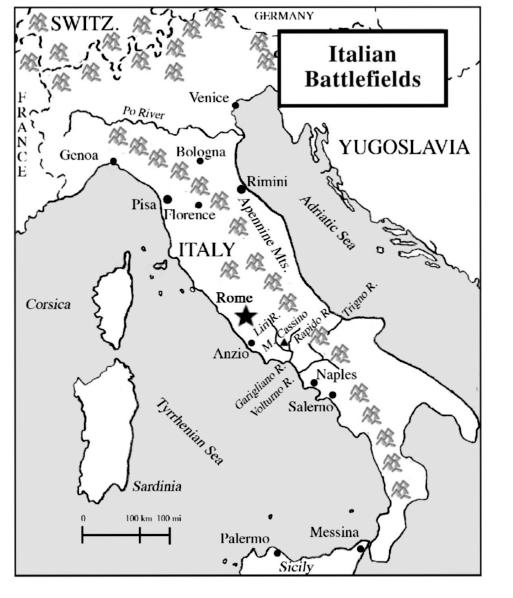
U.S. Fifth Army forces landed at Salerno, Italy, on 9 September 1943 in Operation Avalanche. Allied Forces Headquarters had selected that site rather than a place farther north in part because it was just in range of fighters based in Sicily that could provide air cover.21 The assigned mission was "to seize the port of Naples and secure airfields in the vicinity of Naples with a view toward preparing a firm base for further offensive operations ."21 Six days beforehand, the British Eighth Army had crossed the Straits of Messina from Sicily to the toe of the Italian boot and was advancing with deliberate speed toward a junction with the Salerno beachhead.
Only about twelve hours before the landings, Eisenhower publicly announced the surrender of Italy, which the Allies had secretly negotiated over the preceding weeks. Perhaps these momentous events had created an excessive optimism in American ranks. Maj. Gen. Lucian Truscott recorded in his memoirs that on 5 September, Lt. Gen. Mark Clark, commanding the Fifth Army, told him at a meeting in Algiers that there was not likely to be much opposition and that Truscott should be ready to land with his 3d Infantry Division as far north as Rome.28
The impact of the Italian surrender was not as great as Clark expected, but it did force the German High Command to shift from a strategy of trying to hold Italy to one of delaying defense up the peninsula. German commanders viewed the anticipated invasion of Italy as a training ground for fighting the inevitable Allied landings on the west European coast.29 Still, Field Marshal Gerd von Rundstedt, who commanded German forces in France, groused to interrogators at the end of the war, "[I]t was madness to continue the war in Italy.... After the collapse of Italy, that frightful boot of a country should have been evacuated ... and we should have held a decent front with a few divisions on the Alpine frontier, and they should not have taken away the best divisions from me in the west in order to send them to Italy. 1131
Clark's Fifth Army was a showcase of Anglo-American integration. It included two corps, Maj. Gen. Ernest Dawley's U.S. VI Corps and Lt. Gen. Sir Richard McCreery's British 10 Corps, and, along with the British Eighth Army, was part of the 15th Army Group, commanded by Gen. Sir Harold Alexander. Both corps participated in Avalanche, with the British landing to the north of the Americans. By the time Allied troops set foot on Italy, the capture of Sicily had already effectively cleared the Germans from the Mediterranean, and the theater had become a subsidiary one to the great invasion being planned for France.
Italy was to become arguably the most frustrating of the many theaters in which the tankers fought. In some ways, combat for tank battalions resembled that faced by outfits in the Pacific. The campaign involved two full-blown amphibious landings. The long battle up the peninsula, with the Apennine Mountains running up it like a dragon's spine, required repeated assaults across rivers to establish "beachheads," and much of the action involved rooting defenders out of fortifications that might have seemed familiar to soldiers engaged in "cave warfare" on Peleliu, in the Zambales Mountains on Luzon, or on Okinawa. The battles in which tanks were able to play much of a role stand isolated almost like islands: Salerno, Cassino, the Anzio breakout, the Po valley.
In between, as the official U.S. Army history put it, "The American mechanized forces for the most part fought the terrain rather than the enemy.... [T]he artillery, tank destroyers, and tanks were often a liability rather than an asset"31 While the terrain in Sicily had foreshadowed mountainous Italy, Sicily had been dry, and engineers could easily build bypasses around destroyed bridges; Italy was going to be wet, very wet 32
Decision-making by commanders regarding the use of armor appears to have been unusually bad, starting with a failure to provide adequate armored support to the assault force at Salerno. The 36th Infantry Division, a green outfit fresh from the States, was to conduct the landing. Follow-on troops were to include the 45th Infantry Division, one reinforced regiment of which was in floating reserve; the 3d and 34th Infantry divisions; and the 1st or 2d Armored Division. The 82d Airborne Division stood ready on Sicily if needed. Allied intelligence assessed that the Germans had a panzer division in the vicinity of Salerno and that the landing force could expect to encounter panzers early.33
The first American tanks were not even scheduled to land until the sixth wave-or H-Hour plus 140 minutes. According to the plan, the 751st Tank Battalion (Medium) was to put a single platoon ashore before daybreak with each of the 141st and 142d Infantry Regiments. Company As 1st Platoon, assigned to the 141st Infantry, was to support a "flying column" that was to enter the village of Agropoli. The remaining combat elements of the battalion were to land throughout D-Day. Maj. Gen. Fred Walker, commanding the 36th Division, believed that this timetable would get tanks ashore in time to deal with any armored counterattack, though his total armored strength at first light was to be only ten medium tanks.
The first tank destroyers, roughly two companies of MlOs from the 601st Tank Destroyer Battalion-which according to doctrine were actually supposed to fight tanks-were not to land until 1630, thirteen hours after the first GIs. This was better than the initial plan, which foresaw no tank destroyers arriving until D+2. To cap Salerno's status as the antithesis of amphibious warfare doctrine, Walker decided to forego a preliminary naval bombardment and indeed hoped the shelling of the British beaches would draw off any panzer units in his area.31
Why planners for Operation Avalanche strayed so far from the emerging amphibious doctrine-shell the beach, storm the beach (with armor along to protect the infantry), secure the beach-is a mystery. The assaulting division's commander exercised his judgment regarding the bombardment. Who scheduled the belated arrival of armor is less clear. The Salerno beaches were optimal for landing craft up to the size of LSTs, the exits were suitable for tanks and vehicles, and the only known obstacle was an antitank ditch behind the beach. Other nearby beaches were appropriate for tanks, although some were defended by pillboxes. 5 Fifteen LSTs were available for the landings, and Clark had demanded an increase from the three initially allocated in part to land tanks and tank destroyers 36

The 16th Panzer Division, which defended the landing area, received warning a day before the invasion that an Allied fleet had sailed from Sicily for Salerno, and it was put on alert. At 1600 hours, its status was raised to "ready for battle." Warning orders had also reached other panzer and panzergrenadier divisions south of Rome. As the Fifth Army history records, once the landings began, "German motors began to roar, and column upon column swung out onto the roads of Southern Italy, driving rapidly [toward] the plains of Salerno. 1131
At one minute after midnight on 9 September, riflemen of the 141st and 142d Infantry Regiments clambered down rope nets from troop transports twelve miles off shore into waiting landing craft. Stubby landing craft prows turned toward Italy, and at 0330 hours, the initial wave hit the beach. Miraculously, all was quiet. The rumble and flashes of gun and rocket fire to the north, where two divisions of the British 10 Corps were conducting their assault closer to Naples, told a different story.
As the first squads pushed inland, a loudspeaker called out in English, "Come on in and give up. We have you covered!" Suddenly, German flares popped in the night sky. A furious rain of mortar and machine-gun rounds struck the men now crossing the beach. The infantry assaulted German positions among the dunes, and by dawn, most units were approaching their initial objectives.
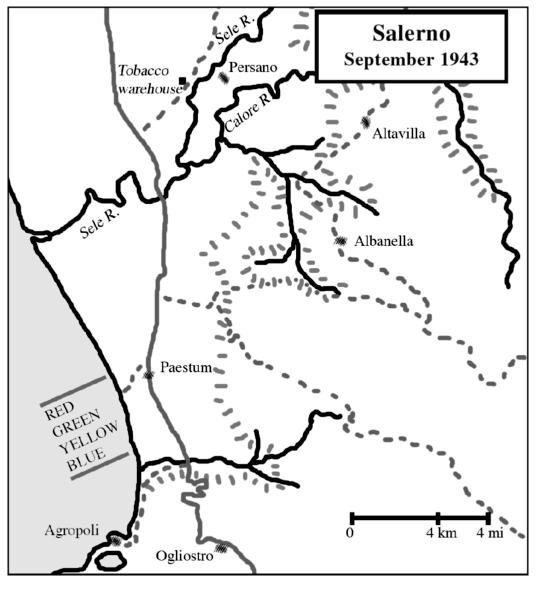
Shortly after daybreak, the first two company-size German tank groups counterattacked. One, striking from the south, overran assault troops of the 142d Infantry and sewed confusion. The second group appeared to the front of the 141st Infantry and kept the men pinned down much of the day. A third tank attack at 1020 hours was stopped only one half mile from Paestum on the sea by field pieces firing over open sights and 37-millimeter guns on weapons carriers manned by the 36th Cavalry Reconnaissance Troop. More panzer attacks followed, and the GIs held them off with bazookas, grenades, and supporting naval gunfire.31
The rate at which American tanks were reaching shore, meanwhile, was falling far short of even modest plans. The landing crafts, mechanized (LCMs), carrying the 1st Platoon, Company A, 751st Tank Battalion, twice tried to reach Blue Beach and failed for reasons that are not clear. One tank finally managed to land at 1500 hours, and the remaining four did not arrive until 1730 across a different beach.
The 2d Platoon beat the designated assault platoon to the beach, but it, too, arrived piecemeal. One tank landed at 0800, followed by a second at 1000, and a third at 1100. A general officer commandeered the second of the tanks to use as his transportation, but the other two went into action with infantry working toward Yellow Beach. The rest of the platoon did not get to Italy until the next day.
The 3d Platoon got its first tank to the beach at 0930, and Sgt. Thomas Glasheen moved smartly inland to support the doughboys. He soon found that the Germans were already counterattacking, and his gunner knocked out two Mark IV Specials (equipped with a long-barreled 75-millimeter gun) and an antitank gun. As Glasheen's tank approached the main highway, a high-velocity round penetrated the turret, killed the gunner, and wounded the rest of the crew.
The platoon's second tank did not arrive until 1330, and the remainder after nightfall. Because of an insufficient number of landing barges, Company B did not start landing until afternoon, followed by Company C and other battalion elements 39
The 191st Tank Battalion was having no better luck. The battalion's intended lead elements, including the command tank, reconnaissance platoon, assault gun platoon, and Company A, had sailed from North Africa aboard LCTs, while the remainder of the outfit followed in two LSTs. The LCTs had arrived at 0330 and been guided through a minefield into Salerno Bay. The LCTs headed for the beach around 0600 hours and immediately drew German artillery fire. Three LCTs were driven back by fire twice before putting two platoons of tanks and the assault guns ashore at 1130, one vessel listing and with wounded on board. Immediately on landing, an unknown general ordered the 3d Platoon to secure some high ground near the beach and prepare to fend off an expected panzer attack.
A shell struck the ramp of a fourth LCT, and then a second round hit a tank, glanced off, and exploded in the pilothouse, where it killed a naval officer and an entire gun crew. The LCT, only 600 yards from shore, turned to head back to sea, and a third round penetrated the side of a tank, killed two men, and set the Sherman alight. With great difficulty, the smoldering tank was pushed off the damaged ramp into the water. This LCT began to take on water and does not appear to have reached the beach. The remaining two reached shore at 1345 and 1540 hours, respectively, each on its third attempt.
The LSTs experienced difficulties, as well. One lowered its pontoon well out to sea at 1030 and headed in. About a mile from shore, it was struck twice by guns located near Paestum, and several men on the pontoon were wounded. Debarkation began at 1505 under intense artillery fire. The second LST failed two times to reach its assigned beach and was sent to another, where the tanks off-loaded at 1530 with nary a friendly GI to be seen. There were some Germans, but they took off when the tanks appeared.
The tankers de-waterproofed their vehicles under artillery fire and strafing from German fighters. The exhaust and intake shrouds on most tanks had to be pulled off by other tanks or hacked free with axes. They had been designed to fit the M10 tank destroyer, but that was what the army had provided.
The battalion rallied, and led by Company C, it drove westward to the Sele River, where the Germans destroyed the bridge as the tanks appeared. The battalion's after-action report records that in the course of the afternoon, it knocked out at least eight Mark IV tanks, four antitank guns, a pillbox, and an unknown number of infantry while losing not a man or vehicle. "It is apparent that the defense of the highway from Paestum to the Sele bridge was not too carefully planned," wrote the recording officer. "The enemy withdrawal was not an orderly one .1140
By day's end, Allied units had reached their D-Day goals, with the exception of most of the 141st Infantry Regiment. The next day, the VI Corps experienced almost no opposition as the 143d Infantry landed, and the 36th Division occupied positions in the hills overlooking the beachhead." Doubtless stung by the preceding day's events, the 36th Infantry Division employed its armored strike force in a most peculiar fashion. Companies B and C of the 751st Tank Battalion were ordered to take up defensive positions on either side of the main highway to defend against any armored attack from the south. The Company C tanks fired artillery missions from their positions near the road .41

On 10 and 11 September, the British 10 Corps faced bitter resistance, and on the night of the tenth, Clark ordered the VI Corps to reinforce the American Rangers operating on the British right 43 On the eleventh, Major General Walker instructed Lt. Col. Louis Hammack to supply a company from his 751st Tank Battalion to join a task force rapidly organized to go. Built around an infantry battalion, the task force sailed that day to join Darby's Rangers-who had been fighting beside the British Commandos since D-Day-at Amalfi Peninsula. Hammack selected Company B.
Hammack did not hear another word about Company B until 16 September, when he learned that his boys had fought beside the Rangers for two days, been attached to British 10 Corps for two more, and then sent to the 141st Infantry Regiment, which at the time was attached to the 45th Infantry Division .14 For a man who had fought his outfit as a battalion in speedy maneuver across the desert at Fondouk, this was a new and probably unsettling experience. He was to find that watching his command be scattered hither and yon was to be his lot in Italy.
Indeed, on 12 September, the 36th Infantry Division ordered the battalionminus Companies B and C-to support the 143d Infantry Regiment east of Paestum. While trying to bypass a heavily mined road by working over a twisting mountain path, the tankers were strafed by American A-36 bombers. Fortunately, the flyboys were not good shots, and only two men were wounded. Mined fields thwarted the maneuver, and the battalion had to repair to defensive positions.45

Meanwhile, the 191st Tank Battalion had been detached in place from the 36th Infantry Division on 10 September, attached to the 45th Infantry Division, and sat on its haunches the entire day. The next day, Company B received orders to cross the Sele, head north, and move cross-country-all without the benefit of supporting infantry. Upon approaching what became know as the tobacco warehouse, the tankers spotted panzers.
Captain May directed his company forward cautiously. As the tanks approached the building, an apparent trap was sprung, and heavy-caliber and small-arms fire swept over the Shermans. Gunners returned fire and knocked out several half-tracks, antitank guns, and machine-gun nests. May pulled back just long enough to deploy his tanks for battle and charged back in. May's tank was hit, and May was wounded, then captured while trying to escape. One platoon commander was missing, and another severely injured. Four men were known to be dead and thirteen missing. Seven tanks were lost, including five that burned.
Infantry officers who viewed the clash declared the attack had been courageous. But this was a hard lesson for a green outfit in how not to use tanks with infantry.46 The problems cut both ways. A War Department observer reported that a tank company commander who was ordered to attack Persano, which consisted of a dozen buildings, objected that the manual said that tanks were not to attack towns. The debate about the attack lasted all afternoon, and finally, it was decided that the tanks would attack under cover of artillery airbursts. That assault never materialized, though the town was shelled."

Momentum on the VI Corps' front shifted abruptly on 12 September with the arrival of the 26th Panzer and 29th Panzergrenadier Divisions, which had rolled north to escape being cut off by the Eighth Army. The first sign of trouble was a counterattack that drove the 36th Division's 1st Battalion, 142d Infantry, off key high ground at Altavilla. Elements of the Hermann Goring Panzer and 15th Panzergrenadier Divisions had appeared in front of the 10 Corps a day earlier .41
On September 12, the 45th Infantry Division's 157th and 179th Infantry Regiments had taken up positions on the VI Corps' left wing, captured Persano, and crossed the Sele River, putting the division in striking distance of the 10 Corps' beachhead. The 36th Division's 2d Battalion, 143d Infantry, shifted leftward on 13 September to man the lengthening line.
That day, the 79th Panzergrenadier Regiment of the 29th Panzergrenadier Division aimed a powerful counterattack at the juncture between the two divisions. A tank-infantry force drove the 157th Infantry back across the Sele at Per- sano and hit the 2d Battalion, 143d Infantry, from the front and rear, smashing the battalion. The attack rolled toward the beach, and only heroic efforts by the 189th and 158th Field Artillery Battalions stopped it from reaching the sand.49
Two companies from the 191st Tank Battalion were attached to the 157th and in the evening supported counterattacks that reclaimed lost ground near the tobacco warehouse and to the south. Operations were again poorly coordinated, and the tankers said that uncertainty about the location of friendly troops had nearly caused needless casualties.
German counterattacks continued on 13 September, and the 45th Infantry Division appears to have made no plan to use its tanks. The only indication of a coherent order reaching the 191st Tank Battalion took place at 1600 hours, when, in response to the first reports of German attacks, the 45th Division operations officer ordered Company C to support the 1st Battalion, 157th Infantry. Evidently acting on his own, Lt. Col. Percy Perkins arrayed his three companies in a wide semicircle to cover three fronts. The mortar and assault gun platoons were deployed behind the tanks. At the time of the action, Companies A and C were at full strength, with seventeen M4A1s each; Company B had ten M4A1s available; the headquarters section had two Shermans, and the assault gun platoon fielded three M8s.
At one point, German troops struck both flanks simultaneously, but the battalion's heavy fire broke up the attack. Tanks shot at targets of opportunity and, when the ammo ran out, backed out one-by-one to resupply from an ad hoc dump set up behind a hedgerow. Gunnery also stopped a German attempt to move down the Sele River and get behind the battalion's line. Fighting continued until 2100 hours; infantry surrounded some of the tanks in Company A, and the nervous crews had no idea whose side they were on.so

As of 14 September, the 751st Tank Battalion had provided the 36th Infantry Division with very little close support. At 0510 that morning, Major General Walker ordered one company to take positions to defend against armored attack from the north. Ten Company A tanks and one from the headquarters section took up their prescribed positions, and a German tank attack developed. Well positioned, the American tanks knocked out eight panzers, five of which burned. The Germans disabled one Sherman in the exchange.51 Meanwhile, Company B was sent to the hard-pressed 45th Division at about 1000 hours .51
The 191st Tank Battalion characterized its situation as desperate on the morning of 14 September, although its initial report to the 45th Division reflected at most the loss of a single Company A Sherman in the preceding twenty-four hours. Its tanks were strewn across the front line and under nearly constant artillery fire. The battalion and Company B of the 751st Tank Battalion screened the withdrawal of the infantry during the morning. Company B of the 191st had lost four more tanks by the time panzers attacked its sector in the afternoon, but fortunately, the tanks were well concealed. Gunners claimed to have destroyed four Mark IVs and one Tiger tank .51
The tankers' efforts were not in vain. "The contributing factor that probably prevented the invasion from being a failure on the 45th Division front," recorded the division's after-action report, "was the defensive employment of artillery and of tanks and tank destroyers. 1154
Field Marshal Albert Kesselring had tried to drive the Fifth Army into the sea and very nearly succeeded, but on 16 September, he ordered a slow fighting withdrawal to the Volturno River line, which he intended to hold until 15 October. Beyond that, his engineers were preparing more fortified belts across the isthmus.55 On 18 September, VI Corps troops found nothing to their immediate front.
The Cooperation Conundrum
The Salerno beachhead had survived, but the fighting had provoked some officers to think hard about whether the army's approach to tank-infantry cooperation was working all that well-in truth, the first time anyone had devoted much attention to the question. Perhaps the near destruction of the beachhead had had one positive effect.
Maj. Gen. W. H. H. Morris Jr., an Army Ground Forces observer, suggested that attaching the 191st and 751st Tank Battalions to the VI Corps instead of to the infantry divisions would have made a great difference during the first desperate days of fighting. The 45th Infantry Division on the left occupied in part the Salerno plain, which was good tank country and was where the G-2 had expected the main German counterattack to come. On the right, the 36th Infantry Division occupied very mountainous terrain, yet it in effect immobilized the 751st Tank Battalion when it could have been used against the German counterstroke in the 45th Division zone.
This same observer put his finger on the way separate tank battalions were going to fight the war, no matter what doctrine said about the use of armor en masse. Morris criticized the allocation of tank companies to each infantry regiment and the further dispersal of platoons to the battalions. Even platoons were dispersed, and individual tanks acted as "mobile pill boxes" or roadblocks. This meant that the tank battalion was never concentrated enough to counterattack the enemy.56
"As a general rule," commented Morris, "I found that the [infantry] commanders to whom [tank] battalions were attached had no conception as to their correct employment. This is borne out by the fact that several field officers and one general officer frankly admitted that they were ignorant of tank tactics and asked the writer to advise them on same" Another observer agreed and noted that an infantry battalion had been sent across flat ground north of Altavilla without any tank support, only to be counterattacked by panzers against which they had no defense, and that heavy casualties were the result.
The problem, again, cut both ways. "There is a great tendency among junior tank officers," Morris noted, "to use tanks in an assault-gun role, that is, to support attacks from the rear rather than in fronts?

The 756th Tank Battalion (Light), which had disembarked at Salerno on 17 September, had an exemplary experience of these problems when attached to the 45th Infantry Division. On 20 September, the battalion was attached to the 180th Infantry Regiment along with Company A, 191st Tank Battalion (Medium), to support an attack on Oliveto Citra. The regiment's plan envisioned a night advance by the 1st Battalion without tank support along the road into Oliveto. At 0500 hours, the medium tank company was to drive down the road into the presumably secured town to support the GIs, followed by the 756th Tank Battalion, less one company. Once in Oliveto, the medium tanks were to be attached to the 756th. Two artillery observers able to control five battalions of guns were also attached for the operation.
Lt. Col. Harry Sweeting, who commanded the 756th Tank Battalion, personally reconnoitered the ground his tanks were expected to cross. Sweeting was to prove himself an extremely aggressive officer who exposed himself frequently to extreme danger. His only contact with the infantry was to be a radio-equipped liaison officer at the regimental command post.
At 0500 hours, the tankers learned that the infantry had not reached the objective but that the tanks were to advance as planned. Sweeting ordered the tanks forward. Soon the medium tank commander reported that he was drawing artillery fire and had stopped. Sweeting went forward to investigate, but the thick morning haze made it difficult to see. As it turned out, the infantry was pinned down along an aqueduct by artillery and automatic-weapons fire. The operation ground to a halt while the regimental commander tried to reorganize his troops.
A new plan was devised by which, under cover of artillery, assault guns, and smoke, a light tank company was to advance, followed by a platoon of medium tanks and the second light tank company. The other mediums were to provide covering fire, and the infantry was to follow the tanks closely. The tanks advanced through artillery fire and were soon in a maze of terraces and buildings, engaging targets of opportunity. Fortunately, two antitank guns discovered later were not manned. Sweeting ordered the remaining mediums forward, and noticing that automatic-weapons fire was coming from structures now behind the tanks, he sent the light tanks back through town, blasting every enemy position. Eventually, enemy fire petered out.
Friendly infantry was nowhere to be seen. The attack had succeeded, but at no point during the day had an actual tank-infantry operation taken place .51
On 23 September, Company A, 191st Tank Battalion, lost two tanks to antitank fire outside Oliveto. The battalion's after-action report complained, "[C]ommunications with front-line infantry would give us information of enemy antitank gun positions without our first blundering into them and drawing their fire.... Many [infantry officers] appear to have little realization of a tank's limitations and capabilities."59
The First Hurdle: The Volturno Line
The German XIV Panzer Corps had orders to fall back on the Volturno River, holding the mountain passes as long as possible to allow time for the destruction of port facilities in Naples. At the Volturno, the corps would form a bow-shaped line pointing south tied into the LXXVI Panzer Corps, which was fighting its own delaying retreat in front of the Eighth Army. Within the Fifth Army, the 10 Corps was to make the main thrust toward Naples, while the VI Corps advanced on its right.
The terrain was so mountainous in the VI Corps' zone that by the last week of September, the 3d Infantry Division was turning to pack animals and human pack trains to supply some of its elements. Nevertheless, there was little German resistance. The British encountered much stiffer delaying actions but captured Naples on 1 October. By 6 October, the Fifth Army had reached the Volturno along most of its length, and here the forward movement stopped.
This was not tank country. As the Fifth Army lamented in its history, "The terrain, together with rainy weather, severely limited the opportunity for varied tactics. Armor, wide envelopments, and swiftly striking spearheads could not be used to speed up the advance." The VI Corps planned to pierce the German line on 13 October, with the 3d Infantry Division making the main effort across a section of the river defended by Kampfgruppe Mauke, part of the Hermann Goring Panzer Division."
Still, tanks could be useful, even if only in small numbers. In preparation for the crossing, the 3d Infantry Division waterproofed a company from each of the 751st Tank and 601st Tank Destroyer Battalions to accompany the GIs from the 7th Infantry Regiment, which was to constitute the division's main effort in the center of the line. The rain-filled Volturno was chest-deep at the crossing site and flowing quickly, but patrols had found a spot at which vehicles would be able to ford the river.
Shortly after midnight, infantrymen from the 1st Battalion crossed the Volturno in rubber boats or by wading with one hand on a guide rope in what fortuitously turned out to be a dead space in the German fields of fire, which was filled with enemy machine-gun fire as soon as the operation was detected. The 2d and 3d Battalions gained the far bank shortly thereafter, and the regiment crossed what would have been a killing field in the daytime to assault their objectives on the high ground ahead.
Day came, and with it increasingly accurate German fire. The waterproofed armor was to have crossed with daylight, but German fire prevented engineers from digging an access route through the bank to the water's edge. Dug-in tank destroyers drove several panzers back into the hills, but at about 1000 hours, a radio intercept indicated that a counterattack by a panzer battalion of the Hermann Goring Panzer Division was imminent. Orders flashed to the 751st Tank Battalion to get Company As waterproofed tanks over to the far bank to support the infantry. Men grabbed picks and shovels and carved out an access route through the riverbank by hand.
The first Sherman reached the infantry at 1100, and by noon, fifteen tanks and three tank destroyers were across. Artillery and tank destroyer fire had already broken up the counterattack, and backed by armor, the 7th Infantry drove forward and gave the Germans no time to reorganize. Although some hard fighting remained, the 7th Infantry had poked an irreparable hole in the Volturno defenses.61
With the Volturno line forced, the Germans fell back slowly and in good order through the mountains to what became known as the Winter Position or Winter Line, which the Germans called the Bernhard Line. German resistance was determined and took advantage of every ridgeline. Demolished bridges slowed the American advance as much as the Germans, and delivery of supplies was difficult. Rains became more frequent, the weather became colder, and the Fifth Army exhausted itself in weeks of steady combat against an elusive enemy.62
There was an odd asymmetry to the forces engaged. For the Americans, each fight to clear a roadblock or a ridge was mainly an infantry action, conducted by an infantry division; American tanks could contribute only occasionally. Within the Fifth Army, the 10 Corps' 7th Armoured Division was the only large armored formation, and it operated on the more tank-friendly coastal plain. The U.S. 1st Armored Division arrived only in November and at first sat largely unused in reserve to exploit any breakout.
The German forces were largely mechanized. The VI Corps faced the Herman Goring Panzer, 26th Panzer, and 3d Panzergrenadier Divisions (the last replaced in November by the 29th Panzergrenadier Division), and the 10 Corps faced the 15th Panzergrenadier Division; all were part of the German XIV Panzer Corps, along with the 94th and 305th Infantry Divisions. One reason may have been that German commanders unanimously expected the Fifth Army to strive for mobile warfare by striking in the center of its line through the Mignano Pass and driving into the Liri Valley past Cassino, where the Fifth Army could make best use of its tanks. The Germans could not understand why the Allies instead sought to advance on a broad front through the mountains. The XIV Panzer Corps' commander, Gen. of Panzer Troops Frido von Senger and Etterlin, viewed the panzer division as completely unsuited to the mountain warfare that unfolded because it lacked the rifle strength to hold much of the front.63 The Germans nevertheless were able to use their tanks effectively in small-scale counterattacks and as artillery.
German Maj. Gen. Martin Schmidt noted from the perspective of the panzer crews:
The German panzer units, in regard to organization, equipment, and training, were intended primarily for action on terrain like that of western, central, and eastern Europe.... It was of decisive significance that the panzer organizations were fighting on the defensive during the whole campaign [in Italy], whereas they were intended for offensive action. Almost all the panzer and panzergrenadier divisions that came to Italy in 1943 had gained their combat experience during campaigns in France and Russia.... In Italy, these divisions had to change their tactics considerably and sometimes paid dearly for their lessons."'
The Second Hurdle: The Winter Line
By the end of the first week of November, the Fifth Army was coming up against the so-called Winter Line, which the Germans had intended to use only as a temporary delaying position until they realized how effective it was. The defenses ran across the peninsula between the Volturno and Garigliano/Rapido Rivers. The Germans held prepared positions that, though generally simple fieldworks protected by mines and barbed wire, combined with the mountainous terrain to pose a daunting challenge. On 15 November, Clark ordered a halt to offensive operations. His exhausted men had to recuperate before they could smash through the Winter Line.65
A skimming of the after-action report for November of the 751st Tank Battalion-which was attached to the 3d Infantry Division at the Mignano Gap, through which ran Highway 6 to Rome-captures the essence of the obstacles to effective use of tanks on this front: "During the afternoon [of 1 November] the 1st Platoon, Company C, moved to [map coordinates] to support 15th Infantry in attack to northwest, but upon [arrival] was stopped by impassable terrain.... Company A was forced by the rains to move to higher ground on 8 November.... Engineers worked continuously constructing tanks routes across wadis and ravines.... Hard rains made it impossible to reach [one] platoon with vehicles, and the platoon was not able to get out of the small valley in which it was located" When the tanks were able to help at all, it was usually direct or indirect firing at distant targets. The battalion was pulled back for rest and refitting on 16 November.66
On 18 November, the II Corps took charge of the 3d and 36th Infantry Divisions in the center of the Fifth Army's line, while the VI Corps retained the 34th and 45th Divisions on the right. More manpower was on the way, as the French Expeditionary Corps was scheduled to arrive with its first two infantry divisions in December.
The Fifth Army's drive to bore through the Winter Line and reach the Liri Valley-the pathway to Rome-fell largely on the shoulders of the American infantry divisions. The VI Corps' 34th Infantry Division launched preliminary attacks on 29 November, and the main offensive, Operation Raincoat, began four days later. Once again, the push was largely an infantry fight through the mountains.67
For tankers, the key event during the offensive was the 36th Infantry Division's fight to take San Pietro from the 29th Panzergrenadier Division, which lasted from 8 to 17 December, as it became another classic lesson in how not to employ tanks. Much of the struggle took place on the cliffs towering above the little village, where American and Italian troops bled profusely while taking the commanding heights. On 15 December, the 143d Infantry Regiment attempted to capture the town itself.
Company A of the 753d Tank Battalion was committed to clear the way for the 2d and 3d Battalions. A single narrow road wound down a slope into San Pietro, lined for much of its length by rock-walled terraces three to seven feet high and covered with olive trees and scrub. Visibility was limited to about twenty-five yards in most places. The road was mined, and rain-soaked ground, streambeds, and gullies made cross-country movement impossible.
The column of Shermans moved out about noon under covering fire from a company each of medium tanks and tank destroyers. Four tanks were knocked out by artillery that opened fire on the exposed column, four tanks struck mines, two threw tracks, and two turned over trying to maneuver onto terraces. Only two tanks made it to the outskirts of San Pietro, where one was destroyed. Only four tanks returned to the assembly area. The infantry attack was no more successful.68

The 191st, 751st, and 756th Tank Battalions were moved out of the line for rest and rehabilitation in December, at which time they reorganized into standard tank battalions. The 751st Tank Battalion replaced its three 75-millimeter M8 assault guns with six 105-millimeter M7 Priest self-propelled howitzers, as the medium tank companies were now allocated one assault gun each.69 The 756th Tank Battalion appears to have adopted the M7 as well. With the guns concentrated, a tank battalion now had the equivalent of an armored field artillery battery at its immediate disposal. Each battalion also organized a light tank company as Company D. During the reorganization, the 191st and 751st Tank Battalions were required to deploy a composite company each to hold defensive positions as infantry attached to the 45th Infantry Division.70

Beyond the Winter Position was Kesselring's next fortified line across the peninsula, the Gustav Line, which he intended to hold indefinitely. Operations against the Winter and Gustav Lines overlapped, and the Fifth Army considered the former to be ended only on 15 January 1944-a six-week slugfest that netted a mere five to seven miles of progress at a cost of nearly 16,000 battle casualties.71