

CHAPTER 2
"Good tankers cannot be pre-selected before combat. Only combat can make the selection."
-Pacific Warfare Board, September 1945
 he geostrategic flow of World War II was a healthy environment in which an American armored force could grow from a pup to a mighty beast. Armor is fundamentally about the attack, and American tankers had to spend less than a year playing defense before the United States and the Allies shifted to the strategic offense. The bad phase unfolded in the Pacific, the only place the Axis was able to engage American ground forces when Uncle Sam first entered the war.
DEFENSE OF THE PHILIPPINES
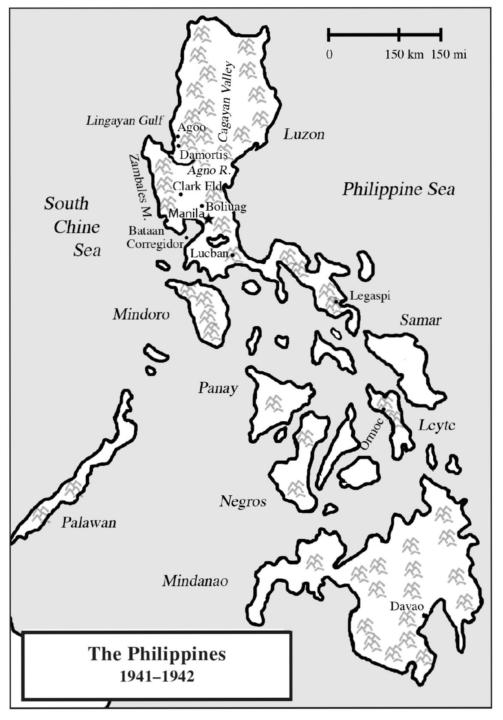
The first separate tank battalions experienced combat within twenty-four hours of the bombing of Pearl Harbor, and in the nation's hour of need, it is perhaps appropriate that the tankers came from the National Guard, called to the colors like their Minutemen forebears. The Guard's tank companies had been tentatively assigned to four tank battalions, the 191st through 194th, in September 1940 and joined those battalions after being federalized in February 1941. At that point, draftees joined the Guardsmen to fill out the ranks. When the shooting started, the only Armored Force battalions abroad were two Guard battalions on Luzon, the largest island in the Philippines.
Rated the best tank battalion in the Army by the training command after being tested at Fort Lewis, Washington, the 194th Tank Battalion drew its men from Guard units around the country. Company C's tankers were Californians, and Company B was filled with Missourians, while Company A hailed from Minnesota. The battalion-minus Company B-received orders for the Philippines and boarded transports in San Francisco on 8 September 1941. The battalion had surrendered its obsolete M2A2 light tanks (armed only with machine guns) and received fifty-four brand new M3 light tanks with a 37-millimeter main gun. Company B, which was redesignated the 602d Separate Tank Company, Light, was dispatched to Alaska.
"All my life I'd dreamed of going to the South Seas," recalled Ken Porwoll, a tanker in Company A who had joined the Guard to look good in his uniform at its annual dance, the biggest social event of the winter in Brainerd, Minnesota. "So now I thought, `Now I'm going to get a free trip.""
The outfit arrived in Manila on 26 September and drove to its new home at Fort Stotsenburg north of Manila. Maj. Ernest Miller tried to ready his troops for battle, but there was a general lack of urgency in higher quarters. The men had never trained on their M3 tanks, but Miller could not do much about that because there was little fuel until 14 November and spare parts took up to thirty days to arrive from depots in nearby Manila. The battalion received no live ammunition until 2 December, and it was able to fire its machine guns and unfamiliar 37millimeter cannons for the first time only in combat. The only maps available for terrain study came from Atlantic Richfield service stations. Even the tank officers were uncertain about the cross-country limitations of their new M3s, which weighed a ton more than the M2A2s they had used during training.
The 192d Tank Battalion-Guardsmen from Wisconsin, Illinois, Ohio, and Kentucky-reached Manila in late November. Before sailing, men over twentynine and married men had been released and replaced by volunteers from the 752d and 753d Tank Battalions. M3 light tanks replaced M2A2s, but the battalion had no time to train on its new mounts. Everyone knew that the idea of one year of federal service was going right out the window.
The newly arrived battalion's Company D was attached to the 194th Tank Battalion to replace Company B so that each outfit had three line companies. The two tank battalions were subordinated to the Provisional Tank Group under Col. R. N. Weaver. Maj. Gen. Douglas MacArthur, who commanded U.S. Forces Far East, exercised direct authority over the tank group, not Maj. Gen. Jonathan Wainwright, who otherwise led ground forces on Luzon. MacArthur told Weaver that he had requested an armored division, but the group never received even the 193d Tank Battalion (Medium) that had been alerted for transfer to the Philippines.2
Japanese plans for war against the United States and its allies called for roughly simultaneous attacks on Hawaii, the Philippines, American-held Guam and Wake Islands, and British-owned Hong Kong and Singapore. The United States had foresworn building new fortifications on its Pacific possessions in the Washington Naval Treaty in 1922, and the Philippine government had taken primary responsibility for defense of the islands when granted commonwealth status in 1935. The American war plan for its forces on the islands, code-named Orange, therefore called only for the defense of Manila Bay and critical adjacent areas. The American garrison of about 31,000 men was to withdraw to the Bataan Peninsula and the fortress island of Corregidor. There were no plans for evacuation or relief, and senior commanders had already concluded that the Philippines would have to be sacrificed if Japan attacked. MacArthur convinced Washington to let him adopt a more aggressive strategy, but that hinged on a build-up that would not be completed until April 1942 3
The men and 108 tanks and 46 half-tracks belonging to the 192d and 194th Tank Battalions were dispersed around Clark Field, north of Manila, when the Japanese bombed the complex on 8 December. The tankers were guarding thirtyfive B-17s and nearly 100 P-40s against paratroopers and saboteurs, blissfully igno rant of the fact that Washington considered them and all the troops around them expendable. The men that morning heard about the attack on Pearl Harbor and knew they were at war. Some of the tankers were just finishing lunch when they heard the sound of engines and spotted bombers far overhead. They thought the planes were reinforcements until bombs exploded among the American aircraft, which were lined up in neat rows to make them easier to protect against sabotage.
Men ran to their machine guns, and soon low-flying fighters strafing the airfield and dive-bombers gave them plenty to shoot at. During the air raid, T/Sgt. Zenon Bardowski of Company B, 192d Tank Battalion, manned a half-trackmounted machine gun on a hill near the end of a runway. A Japanese Zero fighter flew straight down the runway at his half-track, bullets kicking up chips from the surface, but Bardowski stayed in place, blasting away with his machine gun. The fighter burst into flames, passed overhead emitting a trail of smoke, and crashed to the rear. Bardowski had downed the tankers' first enemy aircraft. Private Brooks from the 194th Battalion that day became the first Armored Force soldier to die in combat. The air raids left most of the American air power on Luzon a gutted ruin.4
The Great Retreat
Japanese ground forces from Lt. Gen. Masaharu Homma's 14th Army landed at several points on Luzon on 9, 10, and 12 December, followed on 22 December by the main assault at Lingayen Gulf by a force of 43,000 men.' The American tanks were soon scattered over 150 miles in support four infantry divisions in the North Luzon Force (under Maj. Gen. Jonathan Wainwright) and two in the South Luzon Force (under Brig. Gen. George Parker Jr.). MacArthur had incorporated the Philippine Army's divisions and the Philippine Scouts into his defense forces, but other than the Scouts, most units were ill trained and poorly equipped. In just the first such tale of many, the tankers and infantry had no joint training, and infantry commanders-most of them American-little understood or even recognized the limitations of tanks. Indeed, at Damortis, one infantry officer approached a Japanese tank to speak to the crew, and several days later, American infantrymen fired on friendly tanks.

Being the most "experienced," the 194th Tank Battalion was sent to join the South Luzon Force. Reconnaissance parties contacted the 41st and 51st Divisions on 13 December, and combat elements arrived the next day. The Japanese had landed at distant Legaspi only the day before, and the tankers found they had no immediate missions.
The 192d Tank Battalion received battle orders upon the landing of Japanese forces at Lingayen Gulf north of Manila. The battalion rolled out to join elements of the 11th Philippine Army Division and the 26th Cavalry, Philippine Scouts, near Damortis, but most of the vehicles ran out of fuel en route. A single tank pla toon commanded by Lt. Ben Morin-all that could be fueled for action-rolled north on 21 December to join the 26th Cavalry on orders from Wainwright. Most of the men in the tanks knew each other from Proviso Township High School, classes of 1935 to 1937. The tankers reached Rosario that evening.
The next morning, R. N. Weaver, now a brigadier general commanding the provisional tank group, ordered Morin to attack the Japanese at Agoo, some eight miles farther north. It was believed that the Japanese had not yet brought up artillery or tanks. The tanks departed about 1100 hours and were soon attacked by Japanese planes. Bombs exploded close to the tanks, but they were fragmentation bombs, and the shrapnel merely ricocheted off the armor. Japanese fighters were strafing the cavalry when Morin's platoon arrived, and wounded horses raced around in panic. This was the first view of war for the Guardsmen, and they were mightily upset.
Warned by a cavalryman that he was close to the Japanese, Morin ordered his gunner to fire a test shot from the new 37-millimeter gun, which locked in recoil and remained jammed during the coming engagement. The tankers first came upon Japanese infantry off to the sides of the road. Morin's driver had to maneuver the tank so the sponson-mounted .30 calibers could be brought to bear, and his bow gunner went through several belts of ammunition, despite repeated jams. Morin fired the coaxial machine gun, which was defective and eventually forced him to pull the bolt back by hand for each shot.
About two miles south of Agoo, a shell struck the left side of the hull on Morin's tank and knocked the door in front of the driver loose. The Japanese had indeed brought forward armor, and the first American tank battle of the war was under way. Morin moved his M3 out of the line of fire to fix the door, but a Japanese medium tank rolled from concealment and rammed the American tank, damaging the left front sprocket. When Morin's driver applied power, the tank swung off the road, where several shells hit the right side and rear. One shell set the engine on fire, but a crewman was able to douse the flames with an extinguisher.
The Japanese were using turretless tanks carrying 47-millimeter guns. The American tankers watched in dismay as their 37-millimeter rounds bounced off the sloped Japanese armor, and the platoon started to back to the south. Morin and three of his crewmen were captured, and one man had been killed. The other four tanks were disabled by Japanese fire.
The remainder of the battalion's tanks finally received fuel during the afternoon and deployed to Damortis with orders to cover the retreat of the infantry and cavalry. Cavalry mounts killed by air attacks littered the route forward. The tankers had orders to fight and then "peel off' after the foot troops had passed to the rear.
The situation was so perilous that the 194th Tank Battalion, which had been killing time chasing down flare activity and suspected fifth columnists, was ordered northward on 24 December, without its Company C, to join the 192d Tank Battalion and help stem the tide. By Christmas, two of the 192d Tank Battalion's company commanders had been killed and nine tanks destroyed.'
On Christmas night, the Japanese cut off the 194th's Company A when the infantry line to the tankers' right pulled back without alerting the battalion. The Japanese established a roadblock at Carmen and sighted antitank guns on the road. Lieutenant Burke, who had just taken command, was on the point when the company withdrew toward its next position, and his tank and another fell prey to the ambush. Burke was wounded and taken prisoner. According to one participant, "the balance of Company A made a spectacular dash out, one tank at least going across the whole front, with hostile fire impact and its own return fire making a pyrotechnic spectacle." The infantry blew the bridge across the Agno River after the tanks passed.
Company D-attached from the 192d Tank Battalion-was less fortunate when it reached Moncada at 0800 hours. The infantry had already destroyed the bridges, and reconnaissance uncovered no way to cross because of the steep banks. The commander, Capt. Jack Altman, reluctantly ordered that the tank guns and radios be destroyed, and the men left their tanks and two half-tracks behind them. The Japanese managed to get a handful of the tanks running again and later used them against the Americans on two occasions. After returning to American lines, the crews were used as replacements for losses in other companies.'

On 26 December, MacArthur reactivated Plan Orange and ordered the withdrawal to Bataan, where his forces were to hold out and deny Japan the use of Manila Bay. MacArthur ordered Wainwright's northern force to delay the Japanese advance to cover the withdrawal of the southern force onto the Bataan Peninsula. Wainwright then planned a series of fallback lines that he would hold and relinquish in turn. The hasty withdrawal forced units to abandon most of their supplies, which was to have dire consequences.' These decisions evidently caused the diversion to Hawaii of the 193d Tank Battalion (Medium), still equipped with light tanks, which sailed on 27 December to reinforce the Philippine garrison.'
That same day, Company C of the 194th Tank Battalion joined South Luzon Force elements near Lucena, Paglibo, and Lucban, where they had become engaged. The Japanese 16th Infantry Division had come ashore in southern Luzon two days earlier and was pressing Brigadier General Parker's disorganized forces hard. From the very start, infantry use of the tanks was misguided. The 2d Platoon was ordered to reconnoiter down a trail near Lucban. An infantry major told the platoon commander he could expect to face nothing but small-arms fire, but the tankers instead ran into a roadblock defended by an antitank gun and several hidden field pieces. Antitank fire wrecked the platoon commander's tank and mortally wounded the lieutenant. The commander of the second tank in line pulled around the disabled vehicle and accomplished something called for by tactical doctrine but rarely executed in battle without fatal consequences: he ran over the gun. The four remaining tanks raced forward, but there was no escape other than the track over which they had advanced. The Japanese at the roadblock knocked out the lead tank in line and trapped the others. When the enemy's guns ceased fire, all five tanks were knocked out, and the crews had suffered heavy casualties.10
Company C's tankers learned that machine-gun fire striking the sides of their turrets, which were held together by rivets, could knock the rivets loose and send them flying around inside the tank. They also learned that an effective way to eliminate an enemy soldier in a foxhole was to place one tank track over the hole and pivot the tank on the track to dig into the ground. The men slept upwind of the tanks after such action. The Japanese, meanwhile, attacked the tanks with gasoline. A man would rush the tank and try to climb onto the deck, pour the fuel into the engine vents, and set it alight. Tankers at times had to shoot Japanese off the decks of neighboring tanks to protect them."

The men in the Provisional Tank Group fought with rear guards at many points, playing the role of a cavalry delaying force. Each day, men reconnoitered the next fallback position to make sure it provided adequate fields of fire, and the tanks fell back in leapfrog fashion, generally moving at night to avoid Japanese air attack.12
The American tankers got in their licks, too, even if the overall situation was deteriorating. Early on 30 December, a Japanese bicycle battalion rode into the overnight bivouac of Company A, 192d Tank Battalion, only to be wiped out by the tankers. The next day, Company C had hidden its tanks among the huts of Bal- iuag except for two outposts when Japanese tanks approached. The gunners waited patiently while the Japanese closed to within 1,000 yards before opening fire. The first salvos scored no hits, and the Japanese tanks entered town only to be stalked up and down the streets by the American light tanks, which destroyed eight or nine of the attackers. After this action, Brigadier General Weaver, the tank group commander, judged the M3 superior to the Japanese mediums.13
On 6 January 1942 at Lubao, Capt. Fred Moffit led two 192d Battalion tanks and two half-tracks, and working with four 75-millimeter self-propelled guns and riflemen from the 31st Infantry, they ambushed some 800 Japanese troops attempting to cut the escape route onto Bataan. The bold action inflicted 50 percent casualties on the enemy and kept the road open for a few more critical hours.14
The Siege at Bataan
After suffering heavy losses, the tankers were the last Americans to retreat onto the Bataan Peninsula on 7 January. Just before the final bridge was blown, Maj. Theodore Wickord, commanding the 192d Tank Battalion, crossed it to make certain all the tanks were across. He found one of his platoons lined up along the road, the exhausted crews asleep inside."
The 194th Tank Battalion at this point had lost twenty-six tanks, and the 192d Battalion was down ten. Companies were reorganized to consist of ten tanks, bro ken into three platoons of three tanks each, plus the company commander's vehicle. Tank tracks were worn down to the metal, and engines were far past their 400-hour maintenance. Now that the long moves were over the support troops were able to deal with these problems."

Bataan juts south like a thumb from Luzon, Manila Bay to the east and the South China Sea to the west. The defense plan established two lines that stretched across the peninsula from bay to sea. The main battle position was located at the base of the peninsula, and the rear battle position was located about halfway to the tip. Wainwright's I Philippine Corps held the eastern half and Parker's II Philippine Corps the western."
Plan Orange foresaw 80,000 troops and 26,000 civilians holding out for six months, but the loss of supplies now hit home. Half-rations were introduced, and Weaver recalled that the effects showed up quickly among his tankers, especially in the form of weakened eyesight." "We were so weak," recalled Sgt. Ken Por- woll, "it took three men to do one man's job. 19
A Presidential Unit Citation issued to the provisional tank group summarized its role on the peninsula:
During the period from 6 January to 8 March 1942, after covering the withdrawal of the Luzon Forces into the Bataan Peninsula, this group was charged with the support of the I and II Philippine Corps, the cordon defense of the coasts of Bataan, and the defense of three major landing fields. These measures prevented a projected landing of airborne and paratroop enemy, as well as several abortive thrusts across Manila Bay, any one of which would have meant early disaster in Bataan. Under constant air attack, these units, despite heavy losses in men and material, maintained a magnificent defense and through their ability, courage, and devotion to duty contributed in large measure to the prolonged defense of the Bataan Peninsula.
The Japanese attacked in earnest on 9 January, and by 22 January, they had driven the defenders back to the second line. The tanks were used occasionally to support local attacks, but at times, heavy mining prevented their use. Commanders took steps to remedy the frequent breakdowns in tank-infantry cooperation that emerged during the fighting prior to the withdrawal onto Bataan. The most important step was battalion-by-battalion tank-infantry training to familiarize the infantry with the tanks and their limitations. Articles on coordination were printed in local military publications.
The tankers nevertheless felt that they never received the close infantry support they needed in battle. They found that the infantry did not really want them around except in an emergency because they drew too much artillery fire-a rifleman's lament that was to recur throughout the war. Brigadier General Weaver identified other problems:
Crews suffered accordingly from a lack of rest for extended periods, there being no covering troops-as organic to an armored division. The tanks were mistakenly considered invulnerable, self-sustaining fortresses; capable of going anywhere, surmounting extraordinary obstacles; and performing prodigies such as operations against snipers, flushing enemy out of cane fields, patrolling against infiltration-operations stymied by the inherent blindness of the tank, the noise of its operation, and its considerable dead space, permitting approach to it by enemy with mines, grenades, flamethrowers-particularly in heavy vegetation, and when the tanks were immobilized by blown tracks or bogging.21

From 27 January to 17 February, MacArthur's men fought to destroy Japanese troops who had penetrated the American line only to become lost in the jungle and cut off in what became known as the Battle of the Pockets. The Japanese had dug trenches and foxholes and were nearly impossible to see, much less shoot. From 2 to 4 February, tanks from Companies A and B of the 192d Tank Battalion worked with the infantry in an abortive attempt to wipe out the so-called big (or Toul) pocket. 2d Lt. Kenneth Bloomfield's platoon from Company A attacked with the tank sirens blaring beside riflemen from the 1st Battalion, 45th Infantry, Philippine Scouts, in a coordinated tank-infantry operation. They faced a maze of downed trees hiding snipers and machine-gun nests. The tanks and infantry became separated, the former progressing down a trail to the far side of the pocket with the loss of one M3, but the latter making little progress.
An attack the next day had nearly identical results, again with the loss of a tank. Lt. Willibald Bianchi, an infantryman, was awarded the Medal of Honor for his actions on 3 February while working with the tanks. A tank near Bianchi was having difficulty suppressing its 37-millimeter gun far enough to destroy a machine gun. Already wounded in the hand and chest by bullets, Bianchi climbed onto the deck of an M3 and fired the antiaircraft machine gun at the enemy strongpoint until he was knocked from the tank by a third severe wound.
Although left unmentioned in the army's official history, 2d Lt. John Hay's tanks from Company C also participated in the fight, and the lieutenant is credited with conceiving a nondoctrinal form of tank-infantry cooperation that foreshadowed practice later in the war. The tankers were to support a group of air corps men who had been converted to riflemen but had no infantry training. By now, it was clear how well dug-in the Japanese were. Hay mounted six riflemen on the back of each tank and provided every man with a sack of grenades. When the tanks rolled forward, the Japanese ducked into their foxholes and dugouts to wait for them to pass. The men on the deck then dropped grenades into the holes. Hay was awarded two Silver Stars for his gallantry during the pocket fighting and was one of many tankers to die in Japanese captivity after the fall of Bataan.2L

On 12 March, President Franklin Roosevelt ordered MacArthur to leave Corregidor by submarine for Australia, leaving Wainwright in command. That month, Wainwright estimated that 75 percent of his men were no longer fit for duty. The thinking man could see the end in this, and by the time the Japanese began their final attack on 3 April, the defenders were dispirited, as well as exhausted and malnourished.22
The 192d and 194th Tank battalions still had tanks in action on 7 April, when the Japanese delivered the coup de grace. When told on 8 April that the surrender order would come the next day, Zenon Bardowski, now a sergeant and tank platoon commander, directed his tank to the shore with the plan of going to Corregidor to fight on. Told there was no room on a barge for him and his men, Bardowski cocked his Tommy gun and convinced the other soldier he was wrong.
On 9 April, the men received the radio code message "Crash"-the order to destroy their vehicles and weapons.23 Surrender was a hope-crushing fate. Officers' voices cracked as they delivered the news. Some tankers wondered what the folks at home would think of them, while others considered how terrible their fates might be in captivity.'
With the end of resistance, the remaining tankers joined the Bataan Death March into a miserable and inhumane captivity. Prisoners were forced to march sixty-five miles to Camp O'Donnell near Manila with almost no food or water and under mistreatment by Japanese soldiers. "Anybody who lagged behind on the first day was shot," remembered Sgt. Ken Porwoll. "After the first day, they just bayoneted you. They didn't think you were worth a bullet."'
Some 600 Americans and 5,000 to 10,000 Filipinos died during the march.26 According to a veteran of the 192d Tank Battalion, tankers removed their Armored Force insignia once they saw that the Japanese were picking tankers out and taking them away, never to be seen again. The tankers had done the Japanese a great deal of damage.27

Control of Bataan gave the Japanese firing positions from which to pound the defenses on Corregidor. Nevertheless, the troops on the island, including a handful of men from the 192d and 194th Tank Battalions, held out for another month.
The Japanese began their final attack on 1 May and put troops ashore on 5 May. Sergeant Bardowski's captured tank, manned by Japanese, was the first enemy tank to land on Corregidor. Bardowski, fighting with the 4th Marines, was bayoneted and taken captive when the island fell on 6 May. The intrepid sergeant survived captivity and returned home. Many of his comrades did not. When the war ended and prisoners were liberated, the 192d Tank Battalion's loss became known: 325 of the 593 men who had sailed from San Francisco were dead, most at the hands of their Japanese captors .21
NORTH AFRICAN THEATER OF OPERATIONS
The Western Allies took the strategic offensive against Hitler on the periphery in North Africa because they lacked the wherewithal to challenge him yet at the walls of his so-called Fortress Europe. After a somewhat acrimonious debate, the Americans and British agreed to seize the North African possessions of Vichy France. With luck, the French colonial administration would jump to the Allied camp, and a quick push eastward would threaten the rear of Axis forces under the command of Lt. Gen. Erwin Rommel, who was giving the British a hard time in Egypt.
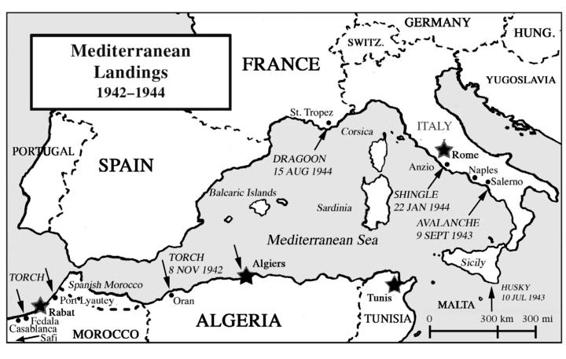
The separate tank battalions had a numerically small but tactically important role in Operation Torch, the Allied landings in North Africa on 8 November 1942. The army intended to use two light tank battalions in the role that amphibian tanks would play in the later stages of the war in the Pacific-to help secure an initial foothold through which following waves of troops and heavier tanks could pass to wage battle inland. It was imperative that troops rapidly clear the beach as they landed, which meant that the infantrymen would need all the firepower they could get to overwhelm initial resistance at the shore. That meant tanks. The aim was to establish a beachhead, which army amphibious doctrine-crafted jointly with the navy-defined as a position organized in depth, with a view to offensive or defensive operations, which protected the beach initially from enemy light artillery fire (range about 10,000 yards) and eventually from medium artillery (range about 15,000 yards).29
Amphibious doctrine as of 1938 specified certain requirements for landings, all subject to the general principles of war, such as the desire for surprise. The beaches had to be good from the landing fleet's point of view and the interior from the land force's perspective. Naval gun and aviation had to control the area of the objective, damage or weaken resistance on the shore, and support ground forces moving inland. The landing force had to have a reasonably secure line of communication. As soon as the action ashore moved from amphibious warfare to land warfare, the army was to relieve the marines. In the eyes of Adm. Richmond "Kelly" Turner, who commanded numerous operations in the Central and South Pacific, the only substantial change to occur in amphibious doctrine during the war was to the last element, because the army threw itself so deeply into amphibious operations 30
The sum total of Allied experience in assaulting a defended shore using tanks was the raid at Dieppe, France, in August 1942. In April of that year, Gen. George Marshall, the army's chief of staff, had sent an American team under Col. Lucian Truscott, a cavalryman who had served with the 1st Armored Division after the creation of the Armored Force in 1940, to London to join the British Combined Operations Command, led by Vice Admiral Lord Louis Mountbatten. The command was responsible for the Commando force and amphibious training. Marshall wanted some American officers to gain battle experience and learn British staff procedures in preparation for what he hoped would be a cross-channel invasion in 1943.
Promoted to brigadier general, Truscott in May and June organized the 1st Ranger Battalion under Maj. William O. Darby to participate in British Commando operations. On 29 June, Truscott and about sixty American officers and men were assigned to Commonwealth units that were to take part in the planned 5,000-man raid on the port of Dieppe. Four days earlier, Mountbatten had also designated a joint "syndicate" of planners to work with American and British planners for Operation Torch; this was soon expanded to four syndicates, including one headed by Truscott that ultimately did much of the planning for Lt. Gen. George S. Patton Jr.
Truscott participated in the Dieppe operation on 19 August, during which a mostly Canadian infantry force, supported by Commandos and the 14th Canadian Tank Battalion equipped with Churchill tanks, assaulted the beach under fire. A light naval bombardment preceded the landings, which also were provided air cover. The affair was viewed by many as bloody failure; 3,400 of the 5,000 men involved were casualties or taken prisoner, and twenty-eight tanks were lost or left behind 31
Then-Maj. Theodore Conway, who worked for Truscott and had participated in planning the Dieppe operation, recalled,
Churchill and [Field Marshal Lord Alanbrooke, Chief of the Imperial General Staff] and ... Truscott all agreed on this point: that we had to learn something about the strength and nature of the German defenses. ... If we were ever going to land on that defended coast, we had to learn how to undertake an operation against defenses.... I think the main lessons came in the area of types of equipment, what do we need to do to waterproof tanks and the like, communications.... Truscott's experience in Dieppe had had a great deal of influence on the North African landings...: 132
Technological limitations in sealift left few options for planners. The infant Allied amphibious force was capable of landing only light tanks aboard available tank lighters, as the medium tanks were too heavy. In the American fleet, the tanks had to be lifted from the holds of transports by cranes and lowered into the lighters waiting alongside 33 The M5s available to the light tank battalions assigned to Western Task Force, which was to invade French Morocco, were waterproofed, with hooded shrouds attached over the air intake and exhaust so the tanks could run through four-to-five-foot-deep water after leaving the lighters 34 Medium tanks had to be offloaded at dockside once the infantry and light tanks had secured port facilities.
David Redle of the 756th Tank Battalion (Light), who had experienced loading many times in training, described the process:
Each time the operation took place at night in blackout conditions. They used the ship boom and a winch. The winch operator watched the man next to the edge of the ship. He had to move the tank down to the waiting Higgins boat. He had to be in synch with the boat moving up and down with the swell. If they were out of synch, the thirteen-ton tank would smash the boat. The tank crew was in the bow of the boat. As soon as the tank was in the boat, they moved away from the ship 35
Casablanca, the prize in French Morocco, was too strongly defended to be taken by frontal assault, so planners selected from among the small ports north and south of Casablanca two just big enough to handle medium tanks unloaded from transport ships-Port Lyautey and Safi. As Safi was 150 miles southwest of Casablanca and Port Lyautey fifty miles to the northeast, infantry and light tanks were to land at Fedala, only eighteen miles northeast of Casablanca, and wait for the medium tanks to arrive .16
Planners adopted another strategy for the landings by Task Force Center at Oran, Algeria, where no ports would be immediately available in the target areas of coast. The 1st Infantry Division was to clear the way for the 1st Armored Division's Combat Command B to land its men and light tanks from Maracaibo transport ships (converted oil tankers).37 The Maracaibos required seven feet of draft, so pontoon bridges were to be constructed-a task requiring three hours-over which vehicles were to drive to shore 38 Once the port of Arzew was captured, the medium tanks, which were too large for the Maracaibos, were to disembark.39
For the easternmost Allied landings around Algiers, the 9th and 34th Infantry Divisions had contributed one regimental combat team each-the 168th and 39th, respectively-to what was a British-majority enterprise.40 One company from the 70th Tank Battalion (Light) was attached to the 39th Infantry for the operation, but no American medium tanks were to participate.
The armored force that was to land in Morocco was the best equipped in the Allied invasion force, despite being farthest from the ultimate objective in Tunisia, because its components deployed from the States and had been able to absorb new equipment until shortly before departure. Where the 70th and 756th Tank battalions had new M5s, the 1st Armored Division, which had shipped out from the United Kingdom, retained M3s. The 2d Armored Division fielded the new M4 Sherman medium tank, as well as the M5 light tank. The 1st Armored Division went into battle with M3 medium tanks.

Fleet Tactical Publication No. 167, the bible of landing operations doctrine published by the U.S. Navy in 1941, had stipulated that the landing area was to be prepared by air and naval bombardment so that troops could seize the shore with confidence. On 7 August, at Guadalcanal, the first American amphibious offensive of the war, three cruisers and four destroyers-nearly all the firepower available for the operation from the overstretched, post-Pearl Harbor Pacific Fleet-had bombarded the invasion beaches for seven minutes before the landing craft reached the sand.4L For political reasons, Operation Torch, the second amphibious offensive, violated this basic tenet of doctrine. Planners hoped the French would not resist vigorously, and there would be no massive bombardment of French soil. Naval units were to fire only when requested to do so by ground forces, at any searchlights, and at any shore batteries that began shooting.42

The 70th Tank Battalion entered Africa with the widely scattered regiments of the 9th Infantry Division. The division was split between the eastern and western task forces, and its 39th Infantry was to land nearly 600 miles east of the 47th and 60th Infantry Regiments. Even within the western task force's zone, the 9th Division was spread out, and its regiments were to land well to the north and south of Casablanca. So, too, were the tankers, parceled out one company to each regiment.
Maj. Gen. Ernest Harmon, commanding general of the 2d Armored Division, directed the sub-task force that was to capture Safi, which included the 47th Infantry Regiment. Company B, 70th Tank Battalion, was attached to the 47th Infantry's assault wave, which was to clear the way for Combat Command B of the 2d Armored Division to disembark medium tanks at the docks in Safi. Combat Command B included M4 Shermans from the 2d Battalion (reinforced) of the 67th Armored Regiment.13
Landing operations commenced shortly after midnight. The limited training and inexperience of the Western Naval Task Force combined with a heavy swell off shore to cause delays in hoisting the light tanks and other gear into lighters. One platoon of Company B's light tanks joined the 1st Battalion Landing Team, which sailed into Safi Harbor to seize control of high ground just outside of town while special landing groups secured the wharves. Only three of the tank lighters managed to reach Green Beach, and all three tanks were immobilized-one by a drowned motor, one by a faulty battery, and one by soft sand-and the riflemen had to advance under fire without their tank support.44 The 1st Platoon's tanks, however, reached shore at 0500 hours with the 47th Reconnaissance Platoon; half the command moved into Safi, seized the telephone and telegraph exchange, and knocked out an antitank gun near the post office.
The 9th Division's 60th Regiment, meanwhile, was to land well northeast of Casablanca. At 0130 hours off Port Lyautey, Company C of the 70th Tank Battalion left the transports with the 60th Infantry Regiment as part of Force Goalpost, the main objective of which was to capture an airfield near the port. Twelve tanks were put ashore-one tank was swamped with the loss of all crewmen-and the Americans easily established a beachhead.
Planners knew that the French regiment defending the airfield could be reinforced by a battalion of forty-five light tanks by late on D-Day and by another half battalion the next day. Brig. Gen. Lucian Truscott, commanding the 60th Infantry, had known he would need tanks of his own, and in addition to Company C, he had a battalion-size landing team from the 2d Armored Division's 66th Armored Regiment assigned. The armor was to guard the south flank, which was effectively Truscott's rear once he was able to drive on the airfield.
The 60th Infantry Regiment was unable to secure all of its D-Day objectives, notably the Kasba, a walled fortress straight out of Beau Geste. A shortage of lighters had allowed only seven M5s from the 66th Armored Regiment to reach the beach. Ominously, French troops appeared from the direction of Rabat before nightfall, supported by Renault light tanks 45

Companies A and C, 756th Tank Battalion (Light), landed with the 3d Infantry Division at Fedala-the main landing for the capture of Casablanca-to be followed by the 1st Battalion, 67th Armored Regiment. Company B had been left at Camp Pickett for lack of shipping space. The command collectively was known as Brushwood Force. Then-Col. Ben Harrell, who functioned as the G-3 of the II Corps and then the 3d Infantry Division during the planning phase, said, "Well, of course this was the first time any of us had done it, and we made our mistakes in our plans and carrying them out.... I made the small boat employment plan, and on paper it looked pretty good, but the thing was too damned complicated.... When we were coming in to land, the whole task force was scattered all over hell .1141
Indeed, the plan called for each battalion landing team to be supported by between forty-three and forty-five personnel landing craft and from five to nine tank lighters." The landing craft were loaded with tank-infantry teams rather than just vehicles. Each had a single M5 tank aboard, plus fifty infantrymen.48 As it turned out, the navy and army commanders agreed that the convoy was too dis arranged for the plan to ever work, and they ordered transports to unload troops into whatever landing craft were available, which meant that most formations arrived on shore incrementally.
The neophyte character of the American amphibious capability became clear to the tankers almost immediately. 2d Lt. John Rutledge, commanding the 2d Platoon of Company A, heard the wave commander and the coxswain talking at the back of the landing craft, and by and by, the coxswain asked Rutledge whether any of his men could read a compass. Fearing he might lose a man to the navy, Rutledge disingenuously replied no. The navy turned the assault wave 180 degrees about and started, the commander imagined, toward the beach. A destroyer loomed out of the dark, and its crew warned that the assault wave was headed toward South America. A turnabout put the landing force in the right spot, but late and in a confused state.49
The landings were a disaster in terms of lost landing craft at the hands of inexperienced crews and drowned infantrymen dragged to the bottom by their heavy loads.50 Only five light tanks reached shore, but fortunately, the French had few tanks of their own in the area.51
Those five tanks-Rutledge and his platoon-rolled off the tank lighters at about 0830 under fire from coastal defense guns on and near Cape Fedala and quickly became engaged just as the army had intended the infantry tanker to be. The tanks drove off the beach, crossed a low hill, and stopped so the crews could remove the waterproofing. Col. William Wilbur, the commander of the 7th Infantry Regiment, drove up. He introduced himself and said there were some guns in Fedala that were shooting up his boys and asked what the tankers were going to do about it. Some readers will be relieved to know that there ensued a brief discussion of doctrine and its relationship to real-world battlefield needs. Rutledge described what happened:
I informed him that our 1st Platoon was supposed to be handling that part of it, and that Armored Force tactics frowned upon taking tanks into towns. He said that we were the only tanks on shore at that time, and that we were the only ones to do the job. He outlined the situation and said, "Lets go get them."
One of my tanks had strayed away after landing. However, the remaining four tanks proceeded toward Fedala. Colonel Wilbur rode on the outside of my tank.... We proceeded into town, where we met Lt. Col. [Roy] Moore, 1st Battalion, 7th Infantry Regiment. Watches were coordinated and arrangements made to meet the infantry battalion in front of the guns in twenty minutes....
At this time, my platoon sergeant's tank "shorted" out. The remaining three tanks proceeded to a point in the formal gardens back of the church there, where we took up defilade positions behind the hedge and opened fire on some guns in the southwest portion of Fedala near the harbor master's house....
Colonel Wilbur and I went forward on foot to some houses just west of Rue de Reims to reconnoiter. While climbing atop a house in order to better observe the situation, we were fired on by an enemy machine gun, the bullets passing between Colonel Wilbur's feet and over my head. We returned to the ground....
Upon arriving at the last row of buildings in front of the guns, I lost track of Colonel Wilbur. I looked over the situation and found the infantry under fire from pillboxes. Two of the three tanks reduced the pillboxes and snipers' positions, while the remaining tank crashed through the barbed wire barricade, thus opening the position to the infantry.12
The French 100-millimeter gun battery surrendered. Wilbur was awarded the Medal of Honor for this and several other acts of bravery during the landing.13
The 7th and 15th Infantry regimental landing groups received orders at 1600 hours to advance on Casablanca. In the 7th Infantry's zone, the light tanks from the battalion landing teams were pulled back into regimental reserve near the command post, and nine more from Company C were shifted there from the 30th Infantry Regiment.51

The importance of having even a few tanks present during an assault landing became apparent in the one place the tanks did not arrive as planned. A lighterborne landing by Company A of the 70th Tank Battalion east of Algiers with the 9th Infantry Division's 39th Infantry Regiment took place belatedly because the ship carrying the company was disabled by a torpedo before it reached the objective." Beach conditions prevented the deployment of antitank guns by the infantry. As a result, when both the 1st and 3d Battalions encountered small numbers of French tanks, they had no weapons to deal with them. The threat of attack by a mere three tanks stopped the 1st Battalion's advance on Algiers. Fortunately, when the 3d Battalion approached its initial objective at an airfield, French tanks there fired a few token rounds and withdrew."

Like everyone else on the American side in Morocco, the tankers were somewhat more organized by D+1. Companies A and C of the 756th Tank Battalion were attached to the 7th Infantry Regiment, which formed the main effort of the 3d Division's advance that day along the coast toward Casablanca.57 They do not appear to have engaged the enemy, however, and one of the few references to their activities was a lament in the report of the 10th Field Artillery Battalion: "Wire was continually being torn up by tanks or by natives cutting out sections for clothes lines."
At 0800 hours, the 70th Tank Battalion's Company C, along with the 9th Division's 60th Infantry Regiment at Port Lyautey, attacked a French armored column five miles south of Mehdia, which itself lies just west of Port Lyautey. Seven light tanks from the 2d Armored Division-no more had been able land overnight because of strong surf-had driven off an earlier attack by French light tanks and infantry, but Truscott realized they needed help and sent Company C to join them. The French were well camouflaged in a cactus patch, and one M5 tank was lost and all crew members seriously wounded. Lieutenant Herbert, commanding Company C's tanks, rallied his men and dispersed the enemy. This was a hard first lesson in the effectiveness of camouflage.
After the French armor drew off, the company headed across country to an assembly area with the 1st Battalion, 60th Infantry, to support the attack on the airfield. The tankers chanced upon two companies of French infantry approaching the 1st Battalion from the rear and pounced. The outmatched French drew off after a sharp exchange of fire but left behind many prisoners.
The next morning, 10 November, the company successfully neutralized machine-gun nests, assault guns, and antitank guns near Port Lyautey. The tanks then moved into defensive positions at the airport outside the city.58

French commanders ended resistance in Algiers late on 8 November and ordered a ceasefire throughout North Africa on 10 November. Days of political disarray and confusion followed, but the French in North Africa had cast their lot with the Allies .51
The first Allied offensive had achieved its initial objectives, but it was already clear that the Americans had much to learn. Patton told observers from Washington that had the landings been opposed by Germans, "we never would have gotten ashore "60 Major General Harmon wrote to a friend in December, "Really, I wonder how we will do against real opposition. I am greatly worried.""
The deployment of light tanks with the assault wave had gone poorly at most locations, and the need to capture docks to off-load medium tanks made the heavier armor unavailable for hours even in the best of circumstances. The fact that the French had been ill equipped with armor in the areas where American tanks had been unable to support the assault infantry had obscured the lesson. At the one place that French armor appeared in force-Port Lyautey-fortune dictated that the handful of 70th Tank Battalion and 2d Armored Division light tanks were just enough to deal with them.
German combat aircraft and a handful of troops began landing at an airfield near Tunis on 9 November, the first of 15,500 reinforcements-including 130 tanks-that arrived by the end of the month. Nine thousand Italian troops also moved in, most having shifted west from Tripoli. British forces, meanwhile, advanced from Algiers by land and by short seaborne and airborne hops. Thanks in part to the Axis incursion, the Allies persuaded the French in North Africa to join their cause formally as combatants on 13 November. On 17 November, a German parachute battalion encountered French holding forces and the British spearhead at Medjez el Bab. The bold German commander bluffed the Allied forces into pulling back.b"
The real war for North Africa was about to begin. Eisenhower noted in his after-action report on Operation Torch that Prime Minister Winston Churchill had anticipated as much during the planning phase, commenting, "Well, if the enemy rushes into Tunisia, where he can probably forestall us if he so determines, where is a better place to kill Germans?"63
On 4 December, Hitler ordered that all Mark VI Tiger tanks that had been shipped to Italy be sent to the newly formed Fifth Panzer Army in Tunisia rather than to the German-Italian Panzer Army fighting Montgomery's Eighth Army.64 American tankers were destined to find out that there was a top league of tank design that their own side had not even considered when designing their machines.
By 10 December, a combination of German resistance and horrifically wet weather had combined to stop the Allied advance toward Tunis. None of the separate tank battalions were involved in this phase of the campaign. One reason for this was probably the inability of the logistic chain to sustain more American tanks than those of the 1st Armored Division at the far end of the rickety, British-run French colonial rail line. For about the first six days of December, Eisenhower reported to the War Department, tank losses amounted to approximately forty, and the accumulated need for replacements at the front equaled a tank battalion. The U.S. Army in North Africa lacked a tank transport unit able to move even a single battalion of medium tanks, a shortfall that would not be remedied until spring 1943.65 A War Department observer reported that as of January 1943, Combat Command B of the 1st Armored Division was still short on vehicles and was cannibalizing those destroyed by enemy fire to obtain spare parts.66 That same month, the 1st Tank Group, which had just arrived at Oran from the United Kingdom with the 751st, 752d, and 755th Tank Battalions, had to surrender fifty-four M3 medium tanks to be rushed to the front as replacements.67
A dowdy band of American tankers nevertheless was about to stake one small claim to the war in Tunisia on behalf of the separate tank battalions.
A Very Separate Tank Company
On 13 December, Company A, 70th Tank Battalion, in Algiers received orders to head to the front, where on 26 December it was attached to the 16th French Infantry Regiment along with Company A, 601st Tank Destroyer Battalion. The first action the next day was something of a debacle, as seven tanks were stranded on the far side of a river and abandoned. Fortunately, the company was able to recover them the following day.
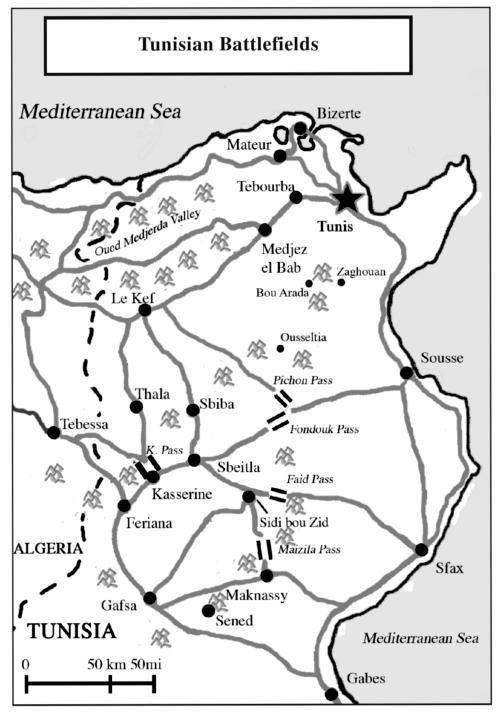
The French XIX Corps, despite a hodge-podge mixing of national units that developed, can be said to have held what became the central stretch of the Allied line, with the British on the left along the coast and, from mid-January 1943, the U.S. II Corps to the right. On 27 December, French forces launched a limited offensive along the Eastern Dorsal mountain chain that ran like a wall before most of the Allied front. Company As tankers had only slightly better luck than in their first engagement when, on 29 December, they attacked 200 Afrika Korps troops supported by mortars and antitank guns near Pichon Pass, Tunisia, under cover of a bombardment by two batteries of French 75s. The tanks achieved a penetration of 3,000 yards, but the inexperienced tankers learned a hard lesson. For reasons no one could reconstruct later, two M5s veered off and headed for a hill where the Germans had hidden an antitank gun. Antitank fire claimed both M5s, as well as the T30 assault gun, which was picked off unnoticed at the back of the column along with its entire crew.
Lt. Franklin Anderson recalled, "We didn't know where [the two tanks] had gone because of our maintaining radio silence. This was ... a mistake, and one we didn't make again. We were new to combat, and I guess were afraid of our radio communications being intercepted. This was our baptism of fire, and we were up against veterans. We learned from our mistakes, but it was a costly lesson."" According to a hand-written manuscript in the battalion's records, probably drafted by company commanding officer Capt. Ralph Lennon, "During this period, our tanks came under heavy air and artillery attack. The Pichon-Ousseltia road was strafed constantly."
Sparring along the French line continued through mid-January, as the Germans sought to reverse local French gains. On 5 January 1943, the Germans attacked the French and Company A at Fondouk with thirty-two medium and light tanks and drove the defenders out. When the Allies fought their way back two days later, the graves of three crewmen from one lost tank were found with a note reading, "Here lie three valorous American panzer soldiers who fell on 29 December 1942"69
The Germans mounted a substantial counterstroke against the southern end of the British zone and against the French on 18 January. Three groups, each backed by panzers including Mark VI Tigers, made little progress against the British but punched a hole in the French line. The next day, reconnaissance revealed that German armor and motorized infantry were entering the Ousseltia Valley.70
Eisenhower had counted on the French being able to fight in the mountains, where German armored strength counted little, and viewed French forces as too ill equipped to fight in the valleys. A program to rearm the French had gained approval from the Joint Chiefs of Staff only two days earlier, but the execution would require months. The British 6th Armored Division sent a squadron of tanks and some artillery to aid the French, and a battalion of the 1st Guards Brigade had already moved into the area."
On 20 January, about fifteen miles northeast of Ousseltia, six M5 tanks from the 70th Tank Battalion's Company A were used as bait to draw German panzers into range of the tank destroyers and some British 6-pounder antitank guns. This was, in fact, a sound tactic according to existing doctrine, but the tankers evidently found the experience so harrowing that the battalion never again risked its tanks as bait for panzers or antitank guns.72
The situation had become sufficiently alarming that Eisenhower's forward command post arranged to put the 1st Armored Division's Combat Command B at the disposal of the French XIX Corps, and the combat command drove into the Ousseltia Valley on 21 January.73
Capt. Ralph Ingersoll was passing through the II Corps' rear headquarters at Tebessa in late February when he encountered a supply-gathering team from the 70th Tank Battalion and received a quick oral history of the company's fight in the Ousseltia valley-and of the arrival of Combat Command B.
The other guest in the mess tent was a second lieutenant with a story.... The lieutenant was about twenty-five, sunburnt and solid.... He was the executive officer of the only American company of light tanks in action in Africa [sic].... It had been attached to the French at the beginning of the campaign.... It got neither mail nor orders; it drew neither pay nor supplies-and it ate French food....
The American light tanks had made ten attacks, and every fourth man in the little company had been decorated by the French government. It was all the Frenchmen could do to show their appreciation. The Americans had been fighting German Mark IVs and, lately, some 60-ton Mark VIs. The solemn, sunburnt lieutenant shook his head between mouthfuls and said:
"It's discouraging. The fellows are awful good shots, but when they make direct hits, the shells just bounce off...."
So the officers at the mess asked the lieutenant what he did about it, anyway.
He said, "Oh, there's always something you can do about it, but it's discouraging. You can hide most of the tanks, and if the Mark IVs will chase the others, you can get in behind and blow up a few trucks before you have to beat it."
And then he cheered up and said brightly, "We got a Mark VI last week."
"How did you do it?" I asked.
"Well," he said, "we tried running like hell when they chased us and dropping antitank mines behind us as we ran. We tried dropping them off in bunches. One of those big bastards ran on three mines all at once and it blew off a tread. Then we sneaked around the other side and kept popping at it until it went up "
The American company had lost about one-fourth of its tanks. The others, we gathered, were kept running by sheer ingenuity and spare parts salvaged from the battlefield.
The month before, the Germans . . . had wedged and chivied and herded the Americans down into [the Ousseltia] valley. There the Americans had a little Arab village to hide in, but the German tanks were all around them now and could sit out of range and blow up the village, house by house.
"And, by God," said the lieutenant, "what do you suppose happened then ... ? It was just like a wild-west movie. Just exactly. There was a road from east to west across one end of the valley, and that afternoon the whole damned 1st Armored Division of the United States Army came up that road.... [W]e didn't know they were coming, and they didn't know we were there, and the Germans didn't know they were coming, either. We would have liked to have gone along with them," he said ruefully, "but after they went by, we had to go back to that French chow." 74
Joined by elements of the 1st Infantry Division, Combat Command B threw the Germans back into the mountains by 29 January, but the Germans retained the passes. The Allies that day decided to pull most French units back from the line to reorganize and reequip.75

On 14 February 1943, the Axis launched a crushing counterattack against the II Corps that came to be known as the Battle of Kasserine. In five days, mainly German forces sent American troops reeling back to the west side of Kasserine Pass and destroyed almost half the tanks possessed by the 1st Armored Division. Only the threat posed to the German rear by Montgomery's Eighth Army forced an end to the Axis rampage .71
The 1st Armored Division, which had fought while broken up into four combat commands scattered across the battlefield, admitted that it had suffered defeat in detail." The battle was the hardest lesson an armored division would suffer in the school of hard knocks, and it provided some of the key lessons that the army drew from North Africa. The separate tank battalions, however, had not gone through that school yet.

Company A continued to fight beside the French in the Ousseltia Valley in March, buttressed by a squadron of British Churchill tanks that had enough armor and firepower to stand up to German panzers. On 26 March, the company carried French infantry into the attack against some high ground near Sidi Bou Rhrib in the Ousseltia Valley, which appears to have been the first use of tank-borne infantry tactics by an American armored unit outside the Pacific.78
Often within the U.S. Army, it seemed that the infantry commanders and tankers spoke different languages. Company A was fighting beside a Frenchspeaking force in which the colonial troops sometimes did not even speak much French. A French-speaking Canadian in the tank company acted as interpreter, and while the Americans found his English difficult to understand, the French doubtless were having similar problems grasping his Canadian French. Everyone did the best he could to understand orders given and comply with them, but it was not easy.
French colonial forces, moreover, like many of their American counterparts, had apparently never trained with tanks, and officers tended to misuse them as forward outposts or pillboxes with no infantry support. Captain Lennon evidently protested these incidents to the point where the French asked that he be relieved.
On 30 March, Capt. Atlee Wampler assumed command. In his first encounter with the French infantry commander, he was ordered to attack at dawn but was not even told from where. A liaison officer led the tanks into position after dark. The tankers emerged from the attack unscathed, but Wampler realized he had to do something. He confronted the French infantry colonel and demanded that henceforth he be included in planning for all operations involving his tanks. After threatening to sack Wampler, too, the Frenchman backed down, and coordination improved markedly.79

All this while, the tank company had been an orphan of the U.S. Army, forced to rely on the French for rations and on long hauls to the American rear for military supplies. In late February, a colonel from the U.S. II Corps headquarters agreed to let the company send its one remaining truck in weekly to pick up supplies.80 On 11 March, the II Corps finally attached Company A for administration and supply. Patton, commanding the corps and a tank man himself, took pity on the company and told his staff to do what it could. The company received its first five replacements for tanks lost in battle on 5 April, and the first personnel replacements arrived five days later. This improvement lasted only until the third week of April, when the II Corps shifted north to the coast to attack toward Bizerte."
The final phase in the battle for Tunisia began in April. The French XIX Corps, however, played a secondary role in Allied plans, and relegated to holding the wall of a Fifth Panzer Army salient, its advances in late April were largely the result of German withdrawals caused by British gains farther north.82
On 6 April, the British 6th Armored Division relieved the American tankers, but they were attached to the British to protect their left flank during the advance. Company A counted the loss of one more M5 to antitank fire and another to a mine. On 22 April, the tankers were sent to rejoin the French four miles southwest of Bou Arada and became part of the Oran Division's Groupement Blinde Francais, commanded by Colonel Le Coulteux de Caumont. The armored group, formed on 13 April, additionally consisted of three French tank squadrons (companies) equipped with 1940-vintage Somua S-35 tanks and British Valentines.83
Here, the company again experienced frequent strafing and bombings. Beginning four days after its attachment, the tankers supported a French offensive that led to the capture of Zaghouan, where the company accepted the surrender of the German garrison.
On 11 May, with the last German resistance in Tunisia collapsing, Company A shared the glory of taking prisoner 7,000 troops from the Hermann Goring Division and 1,500 Italian troops.84 The company finally rejoined the 70th Tank Battalion in late May. The battalion's history recorded, "The first echelon arrived during the afternoon meal, and the men finished quickly and ran to talk with their friends in Company A. `How was it?' everyone wished to know. The answer was written all over their faces. It was good to get back to the battalion."85 In June 1943, the 70th Tank Battalion finally gathered all of its strength in one place for the first time since September 1942.86
An Infantry-Support Battalion in the Desert
In the midst of the Battle of Kasserine, the 751st Tank Battalion (Medium) was sent to the front, departing Algeria on 18 February and moving its vehicles by rail and water. The battalion had arrived at Oran a month earlier, and the other two separate tank battalions in the 1st Tank Group had had to pool equipment to bring the 751st Battalion up to authorized strength .17
On the first day of March, the 751st Tank Battalion moved into bivouac with the 34th Infantry Division in what came to be known as "Stuka Valley" near Rohia, Tunisia.88 Three times a day at chow time, a dozen Stukas would appear overhead and attack the area. The first time this happened, the tankers dove into their M3 medium tanks, which they realized was a mistake. They next day, machine guns on fifty-four mediums blazed away at the aircraft and shot down four. Thereafter, the Luftwaffe avoided the 751st Tank Battalion and went after less dangerous targets.89
In the atmosphere of recent crisis, the battalion was told it would be used defensively or for limited counterattacks. Once the Allies regained the initiative, it would provide close support to the infantry.
Battalion men saw action for the first time on 5 March near Pichon Pass, when Company A covered the withdrawal of a 135th Infantry Regiment task force, during which one man was killed and two wounded and a half-track destroyed. On 30 March, Company C and the mortar and assault gun platoons worked with a company from the 109th Engineer Battalion and some tank destroyers to clear a slope near Fondouk. The mission succeeded, but German fire set two medium tanks on fire. These were sobering first contacts with the enemy.90
As the Allies did retake the initiative, the 34th Infantry Division, attached to British 9 Corps for the operation, sought to capture a strategic gap at Fondouk through the Eastern Dorsal Mountains, which would give the Allies access to the Tunisian coastal plain on the far side and present an opportunity to sever Rommel's supply line. A regiment of the 999th Africa Division, consisting largely of German soldiers who had been court-martialed but allowed to redeem themselves in combat, defended the area. An assault on 27 March by the 135th and 168th Infantry Regiments to capture the high ground south of the gap came to naught.91
On 8 April, the 751st Tank Battalion supported the 34th Infantry Division's 133d and 135th Infantry regiments in a second attack to take the high ground, Djebel El Aouareb, south of the Fondouk Gap. The British 128th Infantry Brigade was to make a simultaneous assault on the heights north of the pass, and the British 6th Armored Division was to enter the gap once both sides were secure. Although the 135th Infantry Regiment had entered the line in the Pichon sector on 14 February, the failed attack on 27-28 March had been its only offensive operation, so while the regiment was not quite green, it was close, and it had not yet worked with tanks. The neighboring 133d Infantry, just to the south, was in similar circumstances.
This operation was not going to be easy, experience aside: the Germans held the high ground in strength, amply supported by artillery and mortars, and apparently unknown to the Americans, they had arrayed machine-gun and antitank positions protected by minefields on the flat area before the slope from which they could unleash grazing fire. The Americans, attacking nearly due east, would have to cross more than three miles of level ground with only occasional cactus patches and hummocks to provide concealment.
The difficulties that inexperienced outfits often encountered became visible fairly quickly. The 135th Infantry Regiment's artillery started a barrage at 0630 on that April morning, and three hours later, division artillery joined the action and pounded the rightmost company of the 3d Battalion, which was to conduct the assault. The regiment was evidently surprised that a promised air strike failed to materialize, although the 9 Corps had informed the 34th Division of the cancellation hours before the start time. At 1130 hours, the 3d Battalion reported that it was making slow progress, and the division headquarters ordered the attack to continue "at all costs" Still, the attack stalled-as did the 133d Infantry's-and Col. Robert Ward, the regimental commanding officer, decided to commit his 2d Battalion next to the 3d Battalion.
Shortly before the new kickoff, Brig. Gen. Benjamin Caffey, the assistant division commander, drove to the 135th Infantry's command post, called the battalion commanders, and told them the objective had to be taken that day. So far, the 751st Tank Battalion had been held in reserve. PFC Francis Sternberg recalled the day's events:
[A]t 0545, our artillery opened up on Fondouk Gap. They shelled the mountain all morning. In a little while, we would get our orders. We checked everything and for the thousandth time wiped the sand out of our guns. All of us were eager to get going. We had grown tired of hiding in the cactus patches for the past two weeks. We were excited, but nobody was scared....
At about 2 o'clock in the afternoon... I heard the battalion commander's voice on our loudspeaker: "Turn `em over and roll out!" That is the tank corps' informal assault order. We grabbed the camouflage net and yanked it off the tank, jumped in, and buttoned up. The driver, Sgt. John Lippert, kicked the motor to life and rolled us up into line formation 92
At 1715 hours, tanks were committed to the attack for the first time, and events suggest that no real effort was made to coordinate operations with the infantry. Lt. Col. Louis Hammack was going to fight his tanks as a battalion-a rare experience for a separate tank battalion commander, as things turned out. The tanks moved out, Companies A and B in the lead with Company C following, all arrayed in wedge formation with Hammack's command tank positioned between the two waves, and they reached the base of the objective, where the tanks fired at suspected targets.93
Sternberg continued his tanker's eye story:
Our ... tanks, one following the other with a distance of 100 yards in between, moved up past the infantry and headed on toward the base of the mountain....
The Germans are coming through the pass in great numbers. I can see their guns spouting fire. Stukas appear overhead, zooming every which way. [Lieutenant Bruce] Foster turned to us.
"Hold your fire, fellows. Wait until they come within range... 11
Our first burst of fire was terrific. The ground shook.... The valley is so full of smoke now it is obscuring our vision. Onward we move. Our big guns are really laying it on, the sounds are deafening....
I can see some of our tanks hit, the crews jumping out and beginning to dig foxholes. Ugly red flames dart through the hatch, then mysteriously flash from the sides until it is a molten mass. Through my peep hole, I can see some of our tanks moving up on the right side of the pass in an attempt to cut off the Jerries....
The tanks reformed into a horseshoe formation as they drew near the base of the mountain. When we were almost there, the Nazis opened up. It came from all sides. They had everything trained on us, including powerful 88s. The first shell tore off one of our tracks, and the tank swerved and came to a stop.94
More shells struck the crippled tank and set it on fire. The gunner fell dead across the breach of his 75-millimeter. Sternberg, already wounded and with his uniform burning, climbed through a hatch that had been blown open. Foster followed, only to be killed by machine-gun fire. The other crewmen made it out, but all the survivors had suffered serious injuries and burns.
Only the infantry on the right wing was able to follow, two other companies being thrown back, and the tankers had to withdraw. During the attack, six tanks struck mines and one was disabled by antitank fire, resulting in five men killed and six wounded. Ward lost contact with all of his infantry battalions after dark, probably because tanks had cut the phone lines.95
The events of 9 April are somewhat confused, and the official U.S. Army history sheds no light on the matter. The tankers supported two attacks that day, and they reached the objective both times, but tank-infantry cooperation was nonexistent where and when it was needed.
At 0640 hours, according to the infantry account, the 1st Battalion, 135th Infantry, clawed its way to the top of its first objective, Hill 254. None of the tanks had been assigned to support this attack, however, and the doughboys were left to their own devices. The Germans counterattacked, and by 1015, the GIs had been forced back off the hill. Soon the 1st Battalion was being shelled and hit by Stukas and reported heavy casualties.
The tank battalion's after-action report indicates that the M3 Lees, meanwhile, attacked at about 0900 out of the 133d Infantry Regiment's zone. Lt. Thomas Rutledge said several days later,
One thing that I have learned: The next time we move up, before we close up on the objective, it is a good thing to look down on the ground in front of the objective, and if you see anything that looks like the enemy or enemy guns, fire away at it with canister. We were so close that with keen observation, even two or three rounds or some machine-gun fire would have downed many machine guns. I believe this would save us a lot of grief afterwards. We know there are lots of mines, but when approaching the objective, we seem to forget those machine guns. So instead of covering the ground in front of the objective with machine-gun fire, we thought only of the objective, which was on the hill."
The tanks reached the base of the hill bereft of infantry support, in great measure because of the German machine-gun nests that the tankers had ignored. Rutledge had also bypassed several antitank guns, and he spotted one thirty yards away. His gunner put a 75-millimeter round into the German position. The tanks could not climb the 200-foot height and pulled back after exchanging fire for some twenty minutes. Two tanks hit mines, and another two collided and were disabled. The intact German machine guns kept the crews that bailed out pinned down until dark.97
According to tanker records, the afternoon attack began at 1215. The 135th Infantry's journal refers vaguely to a "tank battle" being underway during the afternoon. The 34th Infantry Division's soldiers were supposed to follow the tanks but once again could not because of machine-gun fire and mines. The remaining tanks pulled back, and the division did not take the pass until 10 April 98
The 751st Tank Battalion had lost sixteen tanks during its first big fightnearly the strength of one of its companies99 Fortunately, replacement crewmen who arrived were good ones, drawn from the 2d Armored Division, which was sitting idle on occupation duty on the border of Spanish Morocco.100

The 751st Tank Battalion next saw action with the 9th Infantry Division, to which Company A was attached on 4 May, during the II Corps' drive on Bizerte. The 9th Division had not worked with infantry-support tanks since the Torch landings, and it showed. Shortly before noon on 7 May, the tankers along with the 894th Tank Destroyer Battalion were given the mission to reconnoiter some hills to the east and north and "overcome any opposition found therein." Sending armor alone off on such a mission showed no grasp of combined-arms operations.
The 9th Division again ordered the armor to advance alone into Bizerte, which the vehicles entered at about 1550 hours; they were the first Allied troops to enter the town. Maj. Gen. Manton Eddy, the 9th Division's commander, gave an attached French brigade the honor of sending the first foot soldiers into Bizerte, and photographic evidence indicates that the tanks helped the infantry root out a few die-hard defenders. The tanks withdrew that night because they had attracted artillery fire.101
Lessons Learned
The army had drawn some lessons about its tanks, largely from the experience of the 1st Armored Division, which had seen the lion's share of the action in North Africa. Interviewed by a War Department observer, the executive officer of the 1st's Combat Command B, commented in January 1943, "The light tank is excellent for reconnaissance in force, exploitation, wide harassing attacks, and hit-andrun attacks. It is no good for tank-versus-tank combat."102 Maj. Gen. Ernest Harmon, who had taken command of an armored corps controlling the British 6th and U.S. 1st Armored Divisions after Kasserine, had recommended as early as March that all light tanks be removed from the line regiments and given to reconnaissance troops to replace half-tracks and scout cars.103
By August 1943, the Army Ground Forces well understood that a light tank mounting a 75-millimeter gun was needed. It had considered putting one on the M5A1 but concluded that the M24 light tank could be put into production just as quickly and ordered that project expedited."
Harmon also pleaded, "I wish our tanks were diesel operated instead of gas. Practically all of our tanks that are hit catch on fire, which is caused by the highvelocity 75 shell, which is red hot, igniting the leaking gasoline which comes from ruptured tanks when the vehicle is hit. This is a very serious morale factor, and the men want diesels. "105 North Africa had provided one more lesson that was to torment the tankers fighting the Germans throughout the war: a majority of wounds suffered were burns.106 (A British survey of burned Shermans in Italy indicated that most fires were actually caused by main gun ammunition stored in the vehicles. 117 The eventual introduction of wet stowage, which encased the ammunition racks in fluid, dramatically reduced the number of tanks that burned.'08)

The separate tank battalions had seen such limited use that few lessons emerged of direct relevance to the infantry-support tankers. Allied Forces Headquarters, for example, issued a training memorandum that devoted several pages of analysis to the use of an armored division. It concluded that "the outstanding general lesson of the campaign was failure to use the armored division in sufficient strength or concentrated mass."
The memorandum drew only a vague and brief conclusion regarding tankinfantry cooperation, and even that appears to have been based on the employment of the 1st Armored Division's tanks to support infantry divisions:
The campaign has demonstrated that excellent results can be obtained through the use of tanks with the troops of the infantry division, as distinguished from the normal action of the armored infantry. It has been found that their employment should follow the principles of cooperation, teamwork, and coordination required for the infantry-artillery team. Two types of infantry cooperation were effective, as determined by the situation: Preliminary preparation for the breakthrough of the tanks, and close support of the tanks in their own breakthrough. In either case, infantry support has been indispensable to the tank action, especially in consolidating the ground overrun by the tanks.'09