

CHAPTER 5
"Assault landings were awesome. Noise unbelievable. Confusion all around. Fear."
-T/5 Clair Polites, 788th Amphibian Tractor Battalion'
 fter the debacle in the Philippines, Army tankers returned rather late to the war against Japan, after their comrades half a world away had fought across North Africa and Sicily and were just bogging down in the Winter Position in Italy.
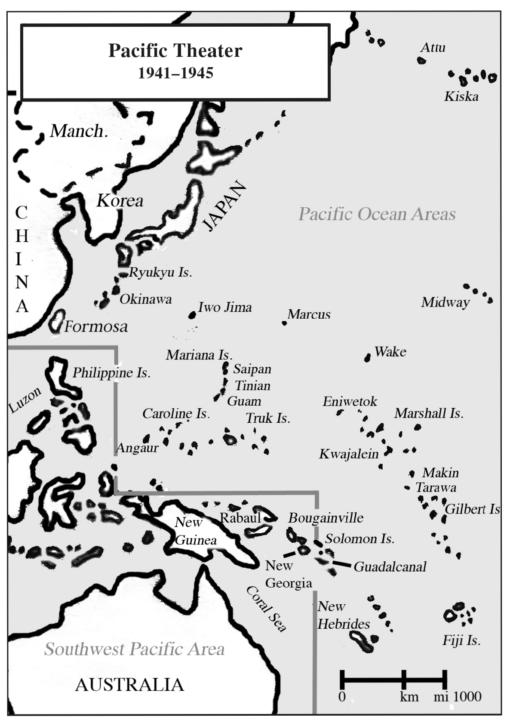
The Pacific was divided into area commands, the two most important being Gen. Douglas MacArthur's Southwest Pacific Area and Admiral Chester Nimitz's Pacific Ocean Area, which included as subtheaters the South, Central, and North Pacific. In both areas, island-hopping campaigns would play out in which naval and air power, rather than large and heavy ground forces, dominated.
Armor operated on a much more limited scale in the Pacific theater than in Europe, but some campaigns fielded as many tanks as were used in North Africa. Twelve tank and amphibian tank battalions fought in the Philippines, and the Ryukyus campaign, including Okinawa, involved nine tank and amphibian tank battalions. Specialized battalions played a substantially larger role than they did in North Africa or Europe, particularly amphibian units.
The Japanese had swept across the Pacific after Pearl Harbor, seemingly unstoppable until checked in the naval engagement in the Coral Sea from 7 to 8 May 1942 and then defeated in the Battle of Midway from 3 to 6 June 1942. It was time to recover the initiative, and the U.S. Joint Chiefs of Staff on 2 July 1942 ordered the reconquest of the Solomon Islands to deny the Japanese the use of the huge naval and air base at Rabaul.
The U.S. Marines took the first step in the South Pacific when they landed at Guadalcanal on 7 August, but stalemate ensued. The army joined the fight in November with the arrival of the lead elements of the Americal Division.' No army tanks were dispatched to the jungle-cloaked island.
The army nevertheless got a few chances to work with U.S. Marine Corps light tanks on Guadalcanal, which was enough to get a taste for the differences from the school solutions taught back in the States. Maj. Gen. O. W. Griswold, who took command of the XIV Corps in April 1943, wrote to General McNair, "We used [the tanks] to advantage on some terrain here. Jap suicide squads went after them with magnetic mines, but our infantry kept them pretty well protected.... Infantry must be trained to support tanks closely in this terrain. It's rather like putting the cart before the horse, from an orthodox viewpoint."3
Griswold was evidently sufficiently unimpressed with the tankers' contribution that he included no army armor in his operations when the XIV Corps moved on to take New Georgia, which was secured in October, nor when it initially deployed to Bougainville in November.
BACK INTO BATTLE: MAKIN ATOLL
In November 1943, Nimitz's island-hopping campaign began with assaults on the Tarawa and Makin Atolls by the marines and army, respectively. The first separate tank battalion to take the war back to the Japanese did so at Makin, and it was fitting that the outfit was the 193d Tank Battalion (Medium), which had been formed from National Guard tank companies, just like the two battalions lost at Bataan. The 193d Tank Battalion, which joined the defenses on Oahu in January 1941, had arrived there with secondhand M3 light tanks, two companies of which had been replaced with M3 Lees. The M3 had not seen service on the far side of the globe for half a year.
For its first operation, the battalion reorganized as a strange hybrid bearing no relationship to any formal table of organization and equipment. The battalion was the first army outfit in the Pacific to receive amphibian tractors, forty-nine of which arrived in October. These appear to have been T33/LVT(1) Alligators, which were unarmored and constructed of sheet metal. The cargo area had room for twenty four men with packs and rifles or 4,500 pounds of cargo. Gun rails ran around the sides and rear, and the vehicle usually had one .30-caliber and one .50-caliber machine gun mounted to the sides. A six-cylinder Hercules WLXC3 gasoline engine powered the LVT(1), and tracks that used blocks with scoop-shaped blades provided the motive force in the water as well as on land. The tankers learned during exercises with the LVTs that concertina barbed wire invariably jammed the bogies and tracks and that rock and coral could easily knock holes in the bottom.
The LVTs were formed into a provisional company for the assault. Company C was still mounted in its M3A1 light tanks, leaving only Company A equipped with medium tanks. LCMs were to carry the tanks to the beach.
Communications at the tactical level between infantry and tanks in Company A consisted of an SCR-509 radio mounted on an infantry mountain pack for use by a liaison officer. The division's reconnaissance troop supplied three more SCR-509s for use by the infantry. The LVTs were equipped with SCR-508s only the night before the landings.'
The Makin operation saw the first use of an amphibious ship that was to haul armored battalions to many Pacific destinations-the landing ship, dock (LSD). In the formula of shore-to-shore operations suggested by Maj. Gen. Lucian Truscott in his account of the Sicily landings, the LSD provided an originating "shore" for smaller craft. Each LSD had a massive dock well accessed by two rear doors into which loaded landing craft could maneuver. Once they were inside the vessel, the well was pumped dry for ocean transit and refilled once the fleet was off the landing area. For example, the USS Belle Grove, LSD-2, could ferry, over a distance of 8,000 miles, three LCTs (Mark V or VI) with five medium tanks apiece, two LCTs (Mark III or IV) with twelve tanks apiece, eighteen LCMs with one tank on each, or forty-one LVTs.s

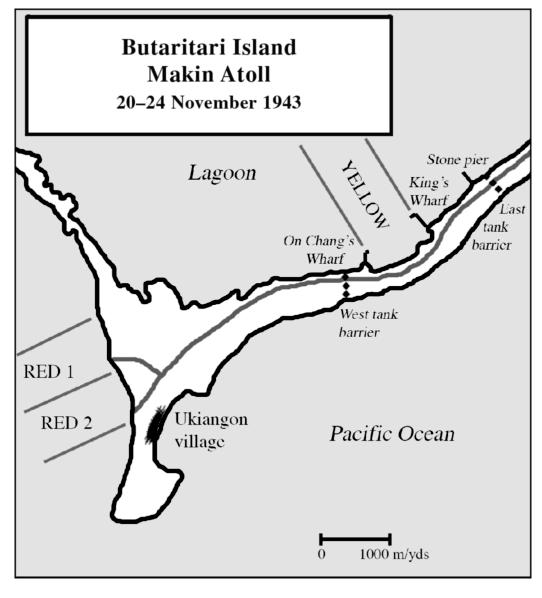
The 27th Infantry Division was bringing an overwhelming force to bear on Makin Atoll. Two regiments were to make the assault. The small Japanese garrison on Butaritari Island-commanded by a lieutenant-possessed no weapons heavier than machine guns and a few antiaircraft guns. Troops had constructed pillboxes and an antitank ditch at each end of their defensive zone.
Upon arrival in the transport area on 20 November 1943, LSTs opened their bow doors, lowered their ramps, and disgorged the 193d Tank Battalion's LVTs carrying detachments from the 105th Infantry, while the 1st and 3d Battalions of the 165th Infantry quickly debarked into small boats in time to make H-Hour at 0830. The critical requirement for the assault wave was the unloading of the light tanks from transports, which was accomplished more rapidly than had been the case during exercises. Once in the LCMs, the tankers turned over their motors, turned on their radios, and tested the turret traverse and gyrostabilizers. The tankers buttoned up except for the commanders, who would watch the beach through field glasses until 100 yards from shore.
The 105th Infantry's assault company in LVTs, followed by the 1st and 3d Battalions in boats, landed at H-Hour on Beaches Red and Red 2 on Butaritari Island's sea side against light opposition and quickly reached their objectives. Red Beach turned out to be a clutter of coral just below the water's surface, and the alligators managed to reach the sand, whereas the landing craft could not. After discharging the infantry, the alligators shuttled cargo from landing craft to the sand. One medium tank landing at Red Beach got stuck in a shell hole; when the crew abandoned the tank, the men came under fire from a Japanese machine gun and returned to it twice as fast. "The Red beaches were just plain stinko profundo," commented Adm. Richmond Turner. The navy learned to have a human reconnoiter every landing beach rather than rely on aerial photos.
The 2d Battalion, 165th Infantry, preceded by a company from the 105th Infantry mounted in LVTs and by medium tanks, at W-Hour, or 1030, stormed Yellow Beach on the lagoon side of the island, where it was hoped they would catch the Japanese fighting the first landing from the rear. The M3 Lees had been waterproofed and equipped with wading stacks that kept sea water away from the engine's air intake and exhaust. The battalion commanding officer, Lt. Col. Harmon Edmonson, reported, "We experienced no difficulty in the water, but after reaching the beach, we were held up by taro pits and shell holes in addition to the coconut trees and a fuel dump that was on fire." Two M3 medium tanks tipped into a pit and had to be abandoned, and another got stuck in a shell hole off shore. Several of the LVTs were "shot full of holes" and had to be welded later by maintenance men.
On Beach Yellow 1, the medium tanks were to destroy known heavy positions, and their 75-millimeter guns did the job. Meanwhile, the infantry advanced rapidly inland, anchored its right flank, and pushed westward to link up with the 1st Battalion. One platoon leader's tank in Company A was knocked out, but in response to orders from the infantry, the remaining four tanks progressed to King's Wharf and shelled the Japanese. By 1700, only a small pocket of resistance remained on the north side of the island, and Company C's light tanks at Red Beach had linked up with Company As mediums at Yellow Beach.
On D+ 1, the 2d Battalion resumed the advance eastward, supported by tanks, until it encountered a heavily fortified position to the south of the lagoon road. The ground was too marshy for the tanks to help, and the Japanese limited the GIs to 600 yards that day.'
Company As tanks were in action along the lagoon, as reported by Cpl. Charles Meyer, who commanded Tank #7:
We proceeded up the road on the lagoon side and came upon a bomb shelter [emitting] enemy gunfire. We blasted the doorways with 75mm. We then came back about 200 yards to Wharf "C" and proceeded to ride out on the wharf, machine-gunning small wooden houses on the left of the pier. We shelled the barricade at the end of the pier with 75mm gun fire. Rode back up to the area of the bomb shelter we had blasted and under direction of foot troops who pointed out enemy positions, mostly pillboxes, proceeded to shell and strafe many of same. The 75mm fire was very effective. Enemy positions in pillboxes were silenced.
Our next mission was to take out a large house.... Shelled house with 75mm and 37mm gunfire. House was left in flames. Tracer ammunition was seen coming from house while it was burning.7
The light tanks from the 1st Platoon of Company C were meanwhile helping the doughboys from the 1st Battalion. The tankers were enthusiastic to learn how easily one could knock a sniper out of a tree with one round of 37-millimeter canister, and five Japanese with light machine guns were dispatched by doing so.
The 3d Battalion relieved the 2d Battalion overnight and attacked the next morning supported by Company A, 193d Tank Battalion. Company A, 165th Infantry, simultaneously mounted LVTs and advanced along the coast to a village 3,000 yards beyond the 3d Battalion's line, where the GIs established a blocking position. Few Japanese were caught by this hammer and anvil, and natives reported that the enemy had left before Company As arrival.
By 0800 hours on D+4, all Japanese resistance had ended. A reconnaissance detachment toured the neighboring islets in an LVT and reported that none were occupied.
The division's commanding general, Maj. Gen. Ralph Smith, reported, "Light and medium tanks were employed continuously throughout the operation and are considered invaluable both for their combat strength and the morale effect on the troops.... The problem of reliable means of communication between the tanks and the close supported infantry is not yet solved. It was extremely difficult to transmit information from outside the tank to the tank crews" Smith blamed, in part, the absence of small-unit infantry training with tanks.'
Capt. Wayne Sikes of the 193d Tank Battalion agreed: "For operations in close terrain, there should be available to the infantry platoon leader or even squad leader a means of communication with the individual tank commander that would enable the infantry leader to point out specific targets and coordinate the forward movement of the smallest unit. "9
The Battle for Bougainville
On 1 October 1943, the 3d Marine Division had landed on the west coast of jungle-cloaked Bougainville in the Solomons. In November, the 37th Infantry Division joined the marines. The 754th Tank Battalion arrived on 6 January 1944, and the Americal Division, with which the tankers had partnered while training on New Caledonia, disembarked a week later. The tank battalion was subordinated to the XIV Corps rather than either of the infantry divisions, and initially, it deployed to secure the perimeter at Empress Augusta Bay as corps reserve.
Soldiers on the scene were going to have to come up with a way to use tanks with the infantry on the fly, largely through trial and error. The XIV Corps' plan ners drew on lessons learned during tank-infantry training conducted on Guadalcanal before the operation and had gathered what information they could on the prior use of tanks to support infantry in the Pacific. They implemented a training program for the tank-infantry-engineer teams the corps intended to use in Bougainville's rain-soaked jungles. "This [combat] experience has been limited both in number of times tanks have been used and in number of tanks used in any one attack," the corps noted in a training memorandum issued on 20 January. "Therefore, the principles enumerated cannot be considered as final."
Some of the concepts taught on Bougainville were old-hat, such as using tanks only on appropriate terrain. Others were novel: "In the jungle, the firepower of the tank assumes far greater importance due to the inherent limitations of maneuver and shock action. Therefore a portion of the tanks must be formed in line in order to exploit maximum firepower." Combat experience had shown that 37-millimeter canister rounds and machine guns could clear jungle growth to reveal pillbox openings. High-explosive rounds and flamethrowers could then be fired through the opening, or failing that, armor-piercing rounds often created a hole big enough for high-explosive fire.
Formations had to be extremely simple to permit any control, and tanks were to be pre-positioned behind the line of departure. Advances had to be short and by bounds with frequent halts for reorganization and reorientation.
The corps mandated that tanks be used en masse, at least one company at a time. This notion doubtless reflected the hand of some unrecorded armored officer, trained in Fort Knox notions of tank warfare, and it was so inapplicable in the jungle that it was among the first to be ditched in practice. Planners said the infantry had to protect the tanks during approach, attack, and withdrawal, and the tanks had to support the doughboys by fire. This insight was the heart of armored warfare in the jungle.
Training emphasized that the infantry and tanks maintain constant communication, but the means were primitive. The armor and the infantry commanders were to establish a radio link at the tank company-infantry battalion level, which was possible only if the tankers loaned a radio to the doughboys. At the tank platoon level, a sound-powered or field telephone was to be run between each tank and the local infantry commander by taping the phone wire to a light cable towed by the tank.
Engineers were crucial to the team to help tanks overcome terrain obstacles, such as by using bulldozers to clear paths or by bridging streams. In cases where mutually supporting pillboxes could be bypassed, small engineer-tank-infantry teams were to destroy them.10

The tankers saw their first action on 30 January with the Americal Division's 132d Infantry, before any of the new training could take place. The operation featured massed use of armor-twenty light tanks-to support the GIs. The regiment's journal indicates that the tanks advanced some 200 yards beyond the perimeter, stopped, and shelled Japanese positions, accounting for eleven pillboxes. A Japanese 90-millimeter gun destroyed one tank, and a second bogged down and was abandoned. At least on one flank, a squad of infantry provided effective cover for a platoon of tanks."
The infantry and tankers had undergone the XIV Corps' training regimen and received their allotment of Sherman tanks by early March, when the Japanese Seventeenth Army launched a desperate and ultimately pointless counterattack to eliminate the XIV Corps' lodgment, which was only 8,000 yards deep. The Japanese confronted a daunting objective, for the American line consisted of fortified pillboxes and firing positions, protected by barbed wire and minefields. The first serious Japanese attacks hit before dawn on 9 March. On the twelfth, elements of the Japanese 45th Infantry Division attacked the 37th Division's 129th Infantry on a narrow front. The American regiment held a stretch of low ground in the center of the division line, where the Japanese established a salient 200 yards deep and 100 yards wide into the 2d Battalion's line. The Japanese drove the GIs out of seven pillboxes, and efforts to retake the ground recovered only two pillboxes.
The next morning, the Japanese attacked again and grabbed another pillbox. At 0945 hours, the 1st Platoon, Company C, 754th Tank Battalion, which consisted of three Shermans and two light tanks, arrived to support a counterattack using the new tactics. Maj. Gen. Oscar Griswold, the XIV Corps' commander, had released the tanks with the stipulation that they be used in an attack rather than defense. The tanks moved out as expected, but the infantry failed to stay close or to designate targets, and the sally broke down. The tanks had difficulty firing at the Japanese, who were hunkered down in ravines with steep slopes. The team tried again at 1315 hours, and again the infantry failed to stick close. Japanese infantry surrounded two tanks for a few nail-biting minutes but were driven off.
The 2d Platoon-also consisting of three medium and two light tanksarrived to relieve the 1st Platoon, and at 1700 hours, the team made its third attempt. This time, the infantry stuck close to the tanks and designated targets by telephone and colored smoke. The tanks approached within fifteen yards of the Japanese positions and hit them with 75-millimeter and machine-gun fire. One 75-millimeter round killed eighteen enemy soldiers sheltering in the roots of a Banyan tree. The combined assault reclaimed the former line with hardly any losses among the doughboys.
On 15 March, the Japanese again penetrated the line in the 2d Battalion's sector and seized a pillbox. A counterattack supported by the 2d Platoon's tanks failed because even infantry NCOs riding in the tanks could not distinguish between the pillboxes held by friend and foe. The tanks fired at visible targets from a distance, but the Japanese had moved in heavy weapons and held firm.
The tank-infantry team tried again at 1635 hours. A corps report related: "Coordination between infantry and tanks was good until several telephones were shot away. Although infantry accompanied the tanks, close-in protection was not continuous, and the enemy succeeding in exploding two mines on the tanks.... At one point, a group of enemy swarmed onto one of the assault tanks; several well-placed charges of canister from the support tanks swept them away without damage to the assault tanks. When the fierce fighting ended at dark, our forces had completely annihilated the enemy." One hundred ninety Japanese dead were counted within the original American line.
The whole cycle repeated itself on 17 March. The XIV Corps reported that in the American counterattack,
ideal coordination between the tank platoon and its supporting infantry platoon was realized. Infantry squad leaders could see the fresh dirt which indicated enemy entrenchments, halted the tanks just short of these, tossed out colored smoke grenades, and gave directions for fire. 75mm and 37mm shells blew the enemy from the ground. Jap machine guns delivered a stream of fire against the tanks but inflicted no damage. Infantry quickly spotted the gun positions, some of which were only fifteen yards off on the flank. These were designated as targets to the tanks and were quickly knocked out. By 0950, our [main line of resistance] was restored, and 200 enemy dead were counted within our wire.12
(The 754th, like most battalions in the Pacific theater, put rubber block or rubber chevron tracks on the tanks. These proved better than steel chevron tracks for gripping mud.13)

On 4 April, after having tested its ideas in combat, the XIV Corps issued a memorandum that concluded that most of its doctrine had proved sound. It had nevertheless refined its model attack formation. The new infantry-tank-engineer team consisted of one "platoon" of tanks (in fact an ad hoc platoon consisting of three medium and three light tanks), a platoon of infantry, and a few attached engineers. Three medium tanks led the assault spread across a frontage of fifty yards. Their mission was to advance slowly, firing cannons and machine guns to drive the enemy to cover and to strip camouflage from pillboxes. A second echelon of two light tanks followed by twenty-five yards, each behind a medium tank on one flank. The light tank could fire the extremely useful canister round, which the medium tank could not. Their mission was to knock out bypassed pillboxes, shoot snipers from treetops, and protect the medium tanks using machine guns and canister fire from attack by foot troops carrying magnetic mines or charges. Two GIs acting as target designators, a telephone orderly from the tank battalion attached to the squad leader and talking to the tank crew through a field telephone, a squad of riflemen and BAR men, and a few engineers with demolitions and flamethrowers walked immediately behind in a wedge formation to avoid canalization in the tracks of the tanks. The designators showed the tankers what to shoot, while the others rooted out enemy infantry and protected the tanks from close infantry assault. The platoon reserve and a third light tank came last. An entire infantry company could be arrayed with three such formations side by side.
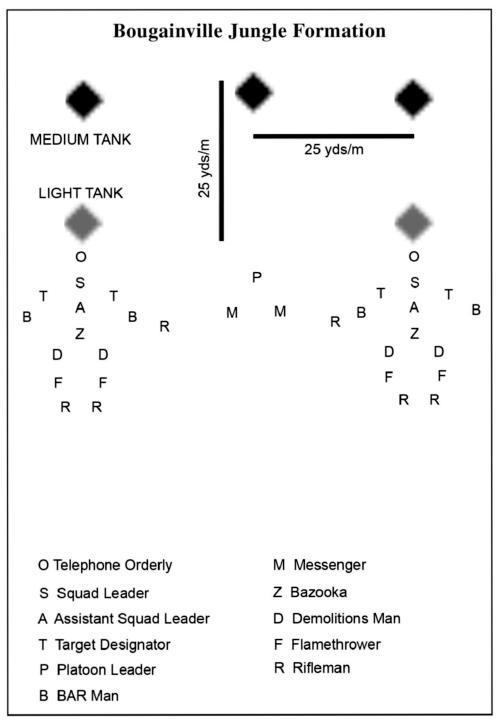
The target designators were an effective invention. "Tanks proved to be almost blind in thick jungle," the corps noted. Tracer fire proved inadequate for designating targets such as well-hidden pillboxes. A red or violet smoke grenade only obscured the target. Trial and error showed that if the grenade's fuse was unscrewed and half the charge removed, the level of smoke was just right. Target designators either tossed the modified grenades by hand or fired rifle grenades at longer ranges.
In a jungle advance, tanks could operate for about three hours before needing reservicing. Typically, the tanks could conduct two such sorties during the day. The pace of jungle combat-tanks advanced in first gear for only twenty-five to seventy-five yards before stopping-was tough on the engines and could result in vapor lock.
Communication plans had fallen short of needs. Only one fix had worked under fire on Bougainville: placing an EE-8 field telephone inside the each tank's turret and running a wire to a handset mounted on the rear of the tank. The soldiers had learned that if the box itself were strapped outside the tank, enemy fire would damage it. The telephone orderly from the tank battalion, armed only with a pistol, could translate the wishes of each infantry squad leader into words the tank crew would understand.14
KWAJALEIN: THE ARMY ADOPTS A WHOLE NEW APPROACH
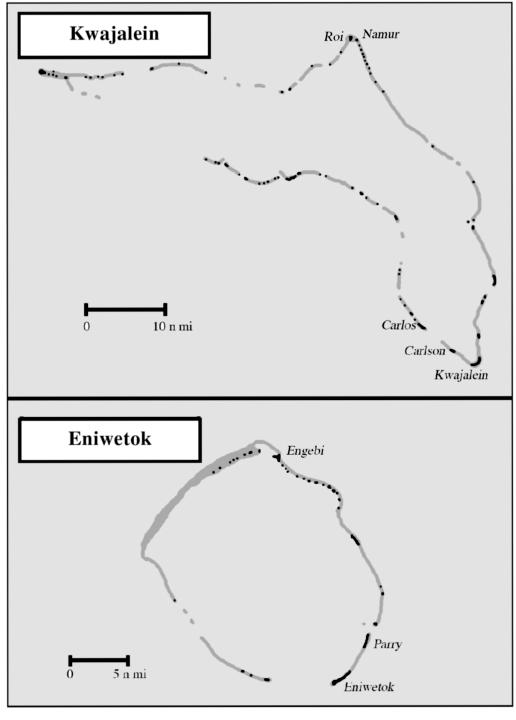
The invasion of the Kwajalein Atoll, the westernmost of the Marshall Islands, marked the debut of the amphibian tank units of the army and the marine corps. The Kwajalein Atoll consisted of flat coral islands connected by underwater reefs and was roughly seventy miles long and thirty miles wide. Two main assault forces-the 4th Marine Division to the north and 7th Infantry Division to the south-arrived the morning of 31 January.
The 708th Amphibian Tank Battalion had joined the 7th Infantry Division in December 1943 to train in the Hawaiian Islands for an amphibious assault somewhere in the Central Pacific. Company D was detached from the battalion and sent to join the 27th Infantry Division.
The 7th Division's plans had not originally called for the use of amphibian tractors, but the lessons learned at Tarawa convinced planners that the infantry would have to ride amtracs to shore. 15 Tarawa, the chief bastion of the Gilbert Islands, lay some 1,000 miles northeast of Guadalcanal. It was the first atoll to be assaulted by American forces when the 2d Marine Division attacked Betio on 20 November 1943 while army elements landed at Makin Atoll. The marines had insisted that they be partially equipped with LVTs for the operation because they were skeptical-rightly so-that landing craft would be able to cross the coral reef offshore. Japanese heavy machine guns, mortars, and artillery claimed about 80 of the 125 unarmored amtracs used to carry the first three waves, and LVT machine gunners suffered disproportionate casualties because they had to expose themselves in order to fire back. As bad as that was, landing craft in later waves hung on the reef, and the marines had to wade up to 800 yards to reach the sand under intense fire, which caused a bloodbath.16
Only seventeen of the battalion's authorized seventy-five LVT(A)(1) amtanks had arrived with the men, but amtracs would become available. The antitank companies of the three infantry regiments were pressed into service to help man them. The resulting 708th Provisional Amphibian Tractor Battalion included one company of LVT(A)(1) amphibian tanks and four provisional amphibian tractor groups. As equipment arrived, each of the groups received fourteen armored LVT(A)(2) amtracs and twenty unarmored LVT(2)s. Each company had two platoons with seventeen vehicles apiece, enough to fill two LSTs. Each platoon was broken into two waves of eight LVTs, with the extra amtrac available for command or air-ground liaison. The armored LVT(A)(2)s were to form the first wave and part of the second.
Training was intensive, as it was clear that not much time remained before the operation. The men practiced landings day and night, first a battalion at a time and then two abreast. The scenarios involved D-Day and D+ 1, which was appropriate because the amphibian armor was to get the troops to shore, after which standard tanks-called "land tanks" by amphibian units-took over. This was the first amphibious assault for both the tankers and the infantry, and they made many mistakes during practice that they were able to correct before the real thing.

Rather than the army, the navy, through its Bureau of Ships, procured amphibian tanks and tractors. The navy designed the vehicles to crawl across coral reefs off Pacific island beaches and then to move out of the water and over the beach without having to stop."
The amtrac was first developed for rescue work in the Everglades and was initially adapted to military use by the U.S. Marine Corps. The nomenclature was changed to landing vehicle, tracked (LVT), to match the navy's designation for landing craft, but the "amtrac" shorthand remained in general use. The LVT(2), LVT(A)(2), and LVT(4) Water Buffalos descended directly from the LVT(1) Alligator first used by the marine corps at Guadalcanal and outfitted the army's amtrac battalions. The LVT(2) was constructed of sheet steel while the LVT(A)(2) was made of armor plate, which increased the weight slightly from 30,900 to 32,000 pounds. Both vehicles had gun rails forward and to the sides and rear, which allowed machine guns to be mounted to fire in any direction, and twin forwardfacing machine guns protected by shields became a common configuration. Thirty fully equipped infantrymen could be ferried to the beach, and they had to exit by clambering over the sides, often under fire. The LVT(4)-by the end of the war the most common model in army use-closely resembled the LVT(2) but had an armored cab and an armored rear ramp that could be lowered with a hand crank to allow the vehicle to carry a jeep, small antitank gun, or field piece and enabled riflemen to debark in greater safety. The LVT(4) had two swinging and two stationary machine-gun mounts.
These models were longer and wider than the Alligator, had an improved and highly flexible suspension system, and used the same seven-cylinder aircraft engine that powered the M3 light tank. The amtrac could reach speeds of about twenty-five miles per hour on land and six miles per hour in the water. It made a stable enough boat, but a large wave or rough surf greater than five feet could swamp or overturn one.18
A crew of three men managed the LVT(2) and LVT(A)(2). The commander/driver, assistant driver, and radio operator sat in the cab. The LVT(4) often had a fourth crewman assigned to operate the rear ramp.
In light of experience on Tarawa, the 708th Provisional Amphibian Tractor Battalion modified its LVTs for the assault. Two .50-caliber machine guns were mounted on the cab rail, and welders fitted them with improvised shields to protect the gunners. Men piled sandbags on top of the vehicles for yet more protection. An additional .30-caliber was mounted on each side, and flamethrowers-all destined to drown out in action despite application of condoms over the nozzleswere installed in five LVTs in ad hoc ball-and-socket arrangements in the bow.19
Amphibian tanks were built on the LVT(2) amtrac chassis and were designed to provide the assault wave with tank gun support on the beach. They had the same drive train as the LVT(2) and reached similar top speeds on both land and water but were more stable at sea because of their greater weight and could likewise bull through up to eight feet of surf.20 Armor ranged from a quarter of an inch on the flanks to half an inch on the front.
The sixteen-ton LVT(A)(1) was basically a covered amtrac with an M5 light tank turret mounted on top. As on the M5, the amtank had a 37-millimeter main gun and a .30-caliber coaxial machine gun, and the roomy vehicle carried 104 shells for the cannon and 6,000 machine-gun rounds. The turret had both hydraulic and manual traverse systems, and twin hatches were provided. Twin hatches on the rear deck had scarf mounts for .30-caliber machine guns. The six-man crew included commander, driver, assistant driver/radio operator, 37-millimeter gunner, and two scarf machine gunners. The vehicle had a radio and intercom system.

The 767th Tank Battalion had also joined the 7th Infantry Division, and the land tankers, too, had drawn lessons from earlier operations. Following the Makin and Tarawa operations, military officers put their heads together to consider the lessons learned regarding troubled communications experienced there between the infantry and supporting tanks. A solution emerged that would be tried at Kwajalein: attaching a TS-7 phone in a metal box to the rear of the tank, through which an infantryman could talk to the commander buttoned up inside. An army combat lessons report indicates that some tanks still used the original Bougainville method of trailing a wire behind the tank to an infantry EE-8 field telephone.
Moreover, every effort was made to ensure that tank units were able to exercise and train with the infantry beside whom they were going to fight. Tankers were advised that, based on experience elsewhere in the Pacific, the infantry would follow them by about thirty yards. Crews also received instruction at jungle training facilities to give them a better appreciation for the difficulties faced by the GIs.
In December 1943, the 767th Tank Battalion had received orders from the 7th Infantry Division to design a flamethrower kit that could be installed in its light tanks in the bow gunner's position. It did so through trial and error and fitted every M3A1 tank in Company D with a flame unit. The battalion, which had been equipped with M7 105-millimeter self-propelled howitzers to use as assault guns, traded those in for M10 tank destroyers mounting 3-inch guns because they had proved so good at destroying fixed emplacements."

On D-Day, 31 January, the provisional amtrac battalion loaded the 2d Battalion, 17th Infantry, aboard Group Able's LVTs and landed on Carlson (Enubuj) Island, where five battalions of artillery were to deploy to support landings the next day on Kwajalein Island. Eight LVT(A)(2)s flanked on each side by a platoon of amtanks headed for shore, which proved to be undefended. The operational plan called for the first wave to hit the beach, unload the infantry, and move 100 yards inland to establish a perimeter defense, into which subsequent waves of infantry and tanks would land. Unbothered by enemy fire, the first wave instead pushed a third of the way across the island and set up a line, where four disembarking land tanks-M3A1 light tanks from Company D, 767th Tank Battalionrelieved the amphibians.
A similar assault group captured nearby Carlos Island (Group Dog and the 1st Battalion, 17th Infantry), which served as an LVT base for the remainder of the operation, while four LVTs carried a hydrographic party to survey the beach on Kwajalein Island's southwest end, where the chosen landing beaches were located. The vehicles drew small-arms fire, but the passengers suffered no casualties." The gunfire signaled that the main island would not be an uncontested walkover.
For the main assault, the provisional battalion loaded two battalions from each of the 32d and 184th Infantry Regiments into the LVTs. The first wave consisted of two infantry battalions, with an amtank platoon arrayed on each flank and the third platoon plus the company headquarters deployed in a wedge formation in the center.21 Medical detachment personnel (two doctors, a dentist, and nineteen enlisted men) were distributed among the groups to handle casualties on the spot except for three enlisted men who remained aboard an LST.
Amphibians started into battle by leaving an LST, and as one report commented, "the difficulty of such movement can be fully appreciated only by an eyewitness. The LST is not a readily maneuverable vessel, and it is peculiarly subject to rolling and pitching. The heavy amphibian tank must be driven off the ramp without damaging ship or tank. Its return is even more complicated"' The fact that the driver could not quickly stop an amphibian in the water-the scoops on the tracks faced only one way, so reversing thrust only slowed the ungainly vessels slightly-helps explain why.' Recovering onto a landing ship involved coasting to an open bow door, catching and securing guide lines tossed from the ship, and backing the amphibian up the ramp.26
As Kwajalein shuddered under the last salvos of a devastating barrage delivered by the navy, artillery on Carlson Island, and heavy bombers flying from Tarawa, the amtanks and amtracs gathered along the line of departure some 3,000 yards from shore. Navy aircraft roared through the sky to give the Japanese a final strafing. At a flag signal from the navy, the lumbering amphibians churned forward like light-blue, lethal sea turtles, and one official observer reported, "LVTs displayed excellent discipline and at no time got out of control as they had in previous operations." LCI(G)s-landing craft loaded with rockets and 40-millimeter guns-led the formation, adding to the mayhem on shore, and then peeled off to the flanks. The amtanks opened fire with cannons and machine guns about 100 yards from shore. Rounds fired by the batteries on Carlson Island were still landing when the amphibians were thirty-five yards from the sand.
The LVT(A)(1)s clawed their way across the beach at 0930 hours, and the scarf gunners concentrated their fire in the treetops to kill any snipers who might be hidden there. Gunners quickly learned that their 37-millimeter cannon was able to knock out coconut palm field works, but one had to blast a hole into a concrete bunker with armor-piercing rounds and then follow up with high explosives.
The amtracs offloaded their infantry, and the armored LVT(A)(2)s moved forward to support the amtanks with fire from their multiple machine guns while the unarmored LVT(2)s turned around to pick up a new load. Even a.25-caliber round could penetrate the LVT(2)'s steel walls. Within minutes, some 1,200 infantrymen were on the ground, having suffered not a single casualty getting there.
On Beach Yellow 2, Lt. Frank Tallman commanded a platoon of LVT(A)(1)s supporting the 184th Infantry; the after-action report recorded:
They received considerable small-arms fire while in the water and also after reaching the shore at the western tip of the 1,200-yard long island. Lieutenant Tallman's tank and two others crossed to the lagoon side of the island, leaving the two remaining tanks of the platoon to move down the seaward side. . . . Tallman took his three tanks to the reef and escorted the infantry as far as a pier about halfway down the island. They received bursts of small-arms fire at intervals during their slow progress, and on one occasion Lieutenant Tallman was wounded slightly when, after raising his head from the turret to talk to an infantryman who had asked for assistance, he was cut on the cheek by a ricocheting bullet.
Tallman was wounded again the next day when, after he breached a pillbox with his 37-millimeter gun at close range, he was burned by a flamethrower that was fired to clear out the occupants.
Capt. John Straub, who commanded the LVTs of Dog Group, described the landings:
While proceeding to shore [on Beach White 2], we drew only scattered rifle fire, and that was ineffective. We landed on the [southwest] end of the island and found no opposition on the beach. The first [LVT] wave moved inland to the right while the later waves landed on the beach and returned to the rendezvous point [out to sea] for more troops. Our tanks helped the infantrymen through the heavy underbrush for a distance of about 150 yards. We found no strongly held positions, and the few Japs encountered were quickly disposed of by fire from our tanks and infantry.
Japanese resistance became more determined as the morning wore on. Rounds from .25-caliber machine guns and occasionally 20-millimeter guns scored the thin armor on even the amtanks, as did shrapnel from artillery fire, but none penetrated. "Many times," the battalion's after-action report records, "individual tanks were assaulted by enemy troops and were saved by the scarf guns. Most of the casualties were among the scarf gunners, who do not have adequate armor protection to their sides and rear." The LVT(A)(2)s proved somewhat more vulnerable, and one had so many holes that it later sank when it reentered the water.27
The 767th Tank Battalion's vehicles disembarked onto the beach beginning roughly fifteen minutes after the assault wave had touched dry ground. Company A's M4A1 medium tanks joined the infantry on the line in direct support at 1205 hours.
The handoff completed, the amtanks were released and reloaded onto LSTs. The amtracs were kept busy shuttling men and supplies until after dark, which resulted in some confusion because crews could not discern their assigned LSTs.28

The U.S. Marine Corps' 1st Armored Amphibian Battalion (amtanks), meanwhile, landed on Roi and Namur Islands with the 4th Marine Division. Seizure of offshore islands on which to place artillery met no opposition on D-Day, and the main assault proceeded simultaneously with that at Kwajalein on 1 February.29 The surf on the beaches was so bad that several tanks overturned, and the outfit lost more men to drowning than to enemy action3° This was not to be an unusual problem. A postwar survey of army amphibian battalions indicated that the leading causes of vehicle losses were rough surf and mechanical deadlining, while losses to enemy action ranged from only 5 to 50 percent, depending on unit 31
A Study in Tank-Infantry Coordination
The 7th Infantry Division had divided the boomerang-shaped Kwajalein roughly down its middle, with the 184th Infantry on the left (lagoon) side and the 32d Infantry on the right (ocean) side. Lt. Col. S. L. A. Marshall organized intensive interviews of participants after the battle to capture the fine details of the action, and his published account of the activities of Company B, 184th Infantry, on 2 February provide insights into the challenges probably experienced throughout the island that day regarding tank-infantry cooperation.
The infantry jumped off at about 0700 hours following an artillery barrage, having waited until the last minute because the M4A1 medium tanks from Company B, 767th Tank Battalion, that were to support the advance had not shown up. Despite pre-landing efforts to match tankers to their infantry partners, these two outfits had never worked together before. Immediately, the GIs encountered Japanese troops occupying bunkers, air-raid shelters, blockhouses, and the ruins of a concrete warehouse. Under building fire, the two assault platoons sought cover, and the outfit broke down into small clumps with little cohesion. Just then, the tanks arrived. The GIs had no way to communicate with them, and the tanks "became part of the scenery" and contributed no help.
After two hours, it became clear that the infantry had reached the core of the island's defenses, and the company regrouped to attack with tanks and satchel charges at 0945. Capt. Charles White, commanding Company B, ordered the tanks to fan out ahead of the infantry and advance slowly, firing all weapons at any target in sight. The infantry was to follow and use satchel charges against surviving emplacements. Marshall recorded:
At first, the tank artillery was used in the least profitable way against the shelters and blockhouses. The fire was put on the entrances. This gave the Japanese the choice of remaining inside or charging directly into the cannon. Some time passed before White realized that if the fire was directed at the walls, the enemy would spill out of the entrances and could be shot down.
Yet it was difficult to get an understanding on even these fundamental problems. The TS-7 telephones on the rear of the tanks were not working, and the tanks remained buttoned up after they got forward. White could get his orders to the tank men only by scrambling up the outside of the tank and hammering on the armor with his rifle until someone looked out. When the fire became too thick, he couldn't do that. So cohesion failed and could only be restored for brief intervals. Such was the chaotic state of the ground and such the nature of the fighting that the infantry frequently could not see their own elements at distances greater than fifteen or twenty yards; the tanks, having even less vision, were not always aware when our men advanced into fresh ground and sometimes fired toward targets in their midst.
Lt. Frank Kaplan was leading his 2d Platoon along the lagoon shore. Three medium tanks approached from behind them and, the crews evidently having not seen the GIs, opened fire over the heads of Kaplan and two other men, who crawled for safety into a nearby shell hole. The muzzle blasts lifted the men clear off the ground, and Kaplan recalled that every round made them feel like "our guts were being turned around inside."
White managed to get everyone stopped and repeated his earlier orders, emphasizing to the tankers that they needed to move at the pace of the riflemen. They got ten yards before one tank's gun jammed, and it pulled back and the others halted. "As invariably happens in atoll fighting," recorded Marshall, "the moment the tanks stopped, enemy sniper fire increased all along the fronts and flank" The remaining tanks expended their ammunition and stayed in place to await resupply. The riflemen clustered in the lee of the tanks and fired every weapon at every debris pile and rise of ground. Japanese resistance broke, and Marshall commented that the mere physical presence of the tanks had given the GIs the confidence to stick it out to the end.
The advance continued, and by now, the infantry and tankers had figured out what worked best. White designated specific targets for the tanks, and the infantry advanced in half-squads behind the armor, clearing each bunker or shelter with grenades and satchel charges 32

Two more days of bitter fighting followed. So much smoke and debris filled the air that at times men ten yards apart could not see one another. Finally, on 4 February, Maj. Gen. Charles Corlett announced to his division that Japanese resistance had ceased on Kwajalein Island as of 1535 hours. American casualties amounted to 142 dead, 845 wounded, and 2 missing. These included 19 men killed and 26 men wounded from the 767th Tank Battalion. An estimated 5,000 Japanese troops had been killed 33
From 3 to 7 February, the 708th Provisional Amphibian Tractor Battalion, the infantry, and elements of the 767th Tank Battalion jumped from islet to islet around the atoll, clearing out a few remaining Japanese. The battalion, less Group Able, reboarded the LSTs and performed maintenance, for on 15 February the vessels set sail for the next destination.
On to Eniwetok
The battalion and the 7th Infantry Division's 106th Infantry Regiment, less a battalion, were now subordinated to Tactical Group 1 of the V Amphibious Corps, which had orders to seize Eniwetok Atoll, located at the northwest corner of the Marshall Islands. The atoll is approximately twenty-one miles in length and seventeen miles across and contains some seventy islets. The original plan for the landings had not included Eniwetok because of uncertainty over what part of available troops would be absorbed by Kwajalein, but tentative plans had been prepared in case Kwajalein fell rapidly. Otherwise, operations at Eniwetok were to begin on 1 May.3a
Intelligence estimates of Japanese strength were rather vague, as there were unconfirmed reports that the 4,000-man First Mobile Seaborne Brigade, an army formation, might be in the area. The estimate given the expeditionary force commander put the number at between 2,900 and 4,000 men, and this was to be the first time in the Central Pacific area that the Americans faced Japanese Army troops rather than naval infantry. The three islands in the atoll had been under continuous bombardment during the Kwajalein operation, and reconnaissance photos showed that most installations had been destroyed. Nevertheless, wellcamouflaged concrete and other defensive works survived.
On D-Day, 17 February, battleships and heavy cruisers commenced shelling Japanese-held islands, lifting fire only to permit attacks by carrier-based aircraft. Minesweepers cleared the channels into the lagoon, and soon shallow-draft vessels from the Southern Group and the entire Northern Group steamed straight into the lagoon. At 1150, six amtanks from the 708th Provisional Amphibian Tractor Battalion carried a marine assault force to Rujiyoru Island, where no Japanese were found. DUKW amphibian trucks carried 75-millimeter and 105-millimeter artillery batteries to shore without interference from the Japanese 35
Two battalions of the 22d Marines landed on Engebi Island the next day, courtesy of 708th Battalion's LVTs. As at Kwajalein, LCI(G)s led the assault wave toward shore and then peeled away to the flanks. The army amtanks advanced in line with the first LVTs, five echeloned on each flank and seven arrayed in an inverted V in the center. Smoke and dust from the bombardment drifted over the water and obscured the view of naval guide officers, and the formation drifted about 300 yards too far to the left. The gunners aboard the amtanks and amtracs unleashed a hail of 37-millimeter, .50-caliber, and .30-caliber rounds into the obscuring cloud when about 500 yards from the beach.
Engebi was a triangle-shaped island some 1,500 yards long, which was about 100 yards too short for the airstrip the Japanese built there, so they had constructed a cement abutment that jutted into the lagoon. The drift leftward caused the left most battalion to arrive at the abutment instead of a beach, and when the marines from Company F clambered up to the flat airstrip, machine guns in concrete pillboxes along the edge laid down a withering fire. Seeing this, the LVT crew maneuvered into dead space under the pillboxes and destroyed them by heaving hand grenades through the apertures.
Meanwhile, the five amtanks on the left wing landed alone on the northern tip of the island. Fire was heavy, but the crews were able to extinguish local resistance on their own.
There was little resistance at the beach. The amtracs were supposed to carry the marines inland 100 yards, where they were to establish a perimeter to protect the arrival of the next wave, but they stopped along the beach, which caused congestion on the sand. Japanese troops in camouflaged foxholes allowed the first wave of riflemen to pass inland and then opened up a sporadic fire from the rear, while fire from small arms and howitzers increased to the front. The marines, supported by a company of medium tanks, nevertheless were able to secure the island by 1600 hours, and most hurriedly reloaded to form the reserve for the next day's landing on Eniwetok.
Army troops from two battalions of the 106th Infantry Regiment formed the assault force for Eniwetok-twice the strength originally planned. Prisoners had indicated that there was a large force on both Eniwetok Island and nearby Parry Island.36
LVTs from the 708th Battalion landed elements of the 5th Amphibious Reconnaissance Company on two small islets on 17 February. The next day, the 1st and 2d Battalions of the 106th Infantry loaded onto the LVTs for the main assault on Eniwetok. The amtank company deployed on the left wing of the landing force, less a platoon and the company headquarters that took up position between the battalion landing teams. The amphibian crews were surprised to encounter a cliff ranging from six to ten feet in height about ten yards from the water's edge, which had not been visible in air reconnaissance photos. All amphibians had to stop until reconnaissance parties found gaps through which they could move and continue their missions. Unlike at Kwajalein, the amphibians were used to provide close support during operations in the island's interior.37
The GIs were able to cut the island across its middle within an hour and deployed to attack both ends, reinforced by a battalion of the 22d Marines that had been in reserve. Captured documents had confirmed the presence of the mobile brigade, and in light of the determined resistance on Eniwetok, commanders decided to commit the remainder of the 22d Marines to capture Parry Island the following day, a landing then postponed until 23 February because of slow progress on Eniwetok.
Indeed, on 20 February, the 3d Battalion, 106th Infantry, was still engaged in full-scale assault operations on the northern part of the island, supported by light tanks from Company C, 766th Tank Battalion. The 1st Battalion, 106th Infantry, and 3d Battalion, 22d Marines, were mopping up on the southern half, backed by Marine medium tanks from the 2d Separate Tank Company. "They moved barely fifteen yards at a time, tanks leading the way," recorded a Yank reporter, "flanked on each side by infantrymen-BAR men spraying every foot, and riflemen throwing grenades into each mound"38 Resistance finally ended late on 21 February, and Parry Island fell after the 22d Marines overcame determined resistance two days later, with transportation again provided by Maj. James Rogers's army amphibians.
In its after-action report, the V Amphibious Corps complimented the 708th Provisional Amphibian Tractor Battalion, which it said played a creditable role in support of all landings 39
Lessons Learned
The 708th Amphibian Tank Battalion, which reverted to its normal organization after operations ended, concluded that the 37-millimeter gun on the LVT(A)(1) had been sufficient to disable light tanks encountered but lacked the punch to reduce pillboxes and other strongholds.
The arrival five days before the Saipan landings of the first sixteen LVT(A)(4)s filled the need. The LVT(A)(4) was similar in design to the LVT(A)(1) but carried the turret from the M8 howitzer motor carriage assault gun mounted farther toward the stem for proper trim (which eliminated the scarf gun positions) and weighed nearly seventeen tons. The open-topped turret had a short-barreled 75-millimeter howitzer and a .50-caliber machine gun mounted to the rear, and the vehicle carried 100 rounds for the main gun and 400 for the machine gun. The vehicle had a crew of six men, including commander, driver, assistant driver-radio operator, gunner, assistant gunner, and ammunition handler. The vehicle had a radio and intercom system.
The 776th Amphibian Tank Battalion's command staff would later argue that while the LVT(A)(1) was an amphibious light tank, the new model was a selfpropelled artillery piece-no longer a tank-and should be used as field artillery in amphibious operations.40 As there was no doctrine distilled in a field manual, different battalions wound up following different paths. While the 708th would eventually use the "A4s" as artillery to some extent, it never stopped thinking of the vehicle as a tank.
Crews that had served in the old tank battalion assault gun section in M8s had helped train other gunners in anticipation of the new model's arrival, and many gunners found the weapon easy to learn after having fired 75-millimeter cannons in their old M3 medium tanks. The battalion realized quickly that the amtank's lack of a coaxial machine gun and scarf guns nevertheless presented a new tactical problem that had to be solved: warding off close infantry attack. The only automatic weapon was the .50-caliber antiaircraft machine gun on the turret rear, and a man had to expose himself to fire it at a ground target. The immediate solution was to assign one LVT(A)(4) to each tank platoon and one to each company headquarters so that the LVT(A)(1)s could provide covering fire with their machine guns.
The battalion constructed a crude but effective course on which to train scarf gunners. Firing took place at ranges of between 50 and 100 yards, which had been typical in combat.
The battalion had learned that amphibian vehicles were much more demanding in terms of maintenance than were land tanks. The thin underbellies were prone to puncture by rocks and coral. The clutch and gears were overtaxed and required constant overhaul. Salt water and sand also played havoc with moving parts. The result was that the outfit had to completely overhaul each LVT every 200 hours and maintain strict first-echelon maintenance in between.41
The commander of the V Amphibious Corps expressed his views on the use of amtanks on Kwajalein, judging that they had provided excellent support to the initial waves of infantry. He warned, however, that they should not be used as tanks on land, but rather as "supplementary fighting vehicles" because of their thin armor. He concluded that the 708th Battalion had demonstrated the durability of the amphibian tractor, and preliminary reports from the marine amphibian units suggested the same.
The navy conceded that it had to work out much better methods for reloading LVTs onto LSTs. Under good sea conditions, two hours were required to get seventeen LVTs back onto a vessel. One idea considered was to install railroad-style turntables in the bow so that vehicles could drive in nose first and then be turned around.42
The land tankers in the 767th Battalion had been pleased with the flamethrowers mounted in the light tanks, which had been used against buildings, debris piles, and, in a few cases, pillboxes. About half had been rendered inoperable by seawater, so the outfit planned to refine the design. The use of M10s had also been deemed a great success. Regarding tank-infantry cooperation, the battalion judged that its crews had been overly cautious in their well-meant efforts to stay with the doughboys. Still, by the end of the battle, the tanks had been engaging targets up to 300 yards in front of the infantry line. Because there were so many obstructions on the ground, the tactic that had gained the greatest favor in battle was for the tanks to pound any possible target in front of the GIs, even if no enemy could be seen, after which the infantry would advance. White-phosphorus rounds had proved extremely effective when fired into emplacements through a breach, inevitably persuading the enemy to exit in haste.43