

CHAPTER 6
"The conquest of Saipan was, among Pacific operations up to that time, the most clear-cut decisive triumph of combined arms of the United States over the Japanese."
-Gen. C. B. Cates, Commandant of the Marine Corps
 he capture of the Marshall Islands had guaranteed the U.S. Fleet protected forward-area anchorages. The conquest of the Mariana's would penetrate the inner perimeter of Japan's defenses and provide bases for B-29 long-range bombers to hit the home islands. The key islands in the Marianas for military purposes were Saipan, Tinian, Rota, and Guam. Saipan hosted two airfields, a naval fueling station, and a seaplane base, and nearby Tinian had two airfields.
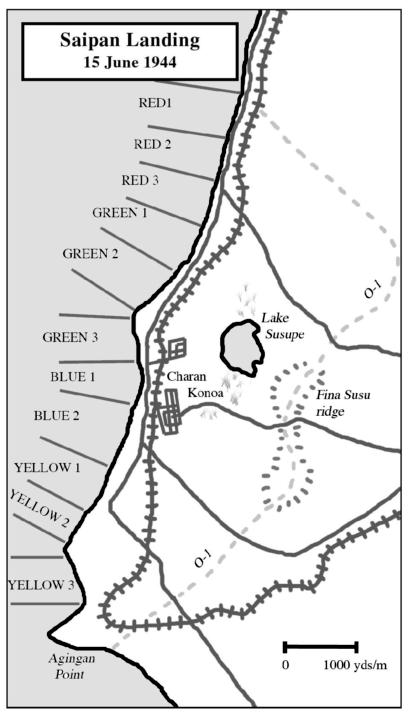
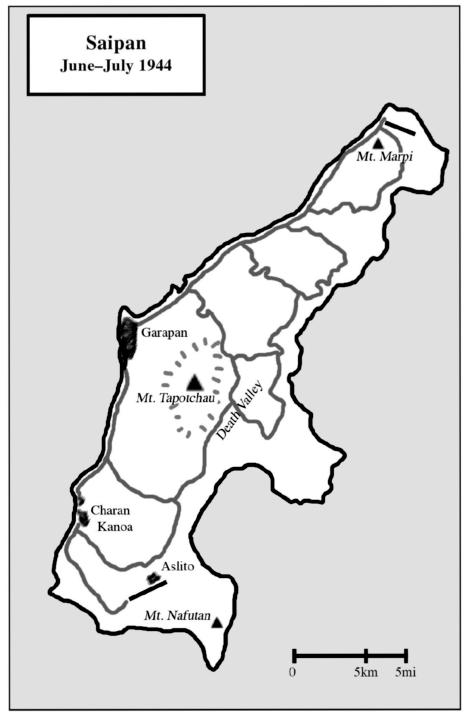
On 15 June 1944, LSTs belonging to the Fifth Fleet's Northern Attack Force and bearing the Northern Troops and Landing Force massed some 6,000 yards off the west side of Saipan, the second largest of the Mariana Islands at fourteen miles long north to south and six miles across at the widest point. Mount Tapotchau dominates the island and gives way to a coastal plain to its west and south. The landing beaches along the southwest corner of the island were protected by a coral reef approximately 500 yards from the sand, so amphibian vehicles once again were a must. The Japanese-built Aslito Airfield, a key objective, was located roughly a mile from the southern coast, and a small half-finished fighter strip lay close to the landing beaches.
Lt. Gen. Yoshitsugu Saito, the commanding general of the Northern Marianas Army Group, had available to defend the island the 43d Division (reinforced), the 47th Mixed Brigade, an infantry battalion, a tank regiment, an antiaircraft regiment, and two regiments of engineers. Total army strength was approximately 22,700 men, supported by about 7,000 naval personnel.'
Elements of the Marine Corps' V Amphibious Corps were to pry those troops off the island. Lt. Russell Gugeler, who gathered oral history of the action from army amphibian crews using the techniques of Lt. Col. S. L. A. Marshall, summed up Operation Forager:
Briefly, the plan called for the landing of two Marine divisions [2d and 4th], attached units, and necessary supplies within a few hours. This plan was dependent upon the amphibious vehicles and their capability of movement on land and in the water. Prior to the landing, the naval and air bombardment would neutralize defensive positions in the landing area. This fire would lift as the amphibious tanks and troop-laden tractors neared the shore and the shock action of a large number of these vehicle should extend the neutralization long enough to allow the first waves to push inland several hundred yards to the initial objective [with the infantry still mounted in LVTs]. This would provide a beachhead sufficiently large for the assault battalions to deploy on the ground and organize for the continuation of the attack. Subsequent waves would debark from the tractors at the beach and mop up resistance that was bypassed by the first waves. This plan to by-pass the beach defenses would also afford defiladed areas inland where troops could debark with greater safety.
The 27th Infantry Division was in Expeditionary Troops reserve and prepared to land on Saipan, Tinian, or Guam; in the event, it was to enter the Saipan beachhead once it was secured.
Four battalions of the 4th Marine Division were to land on the right and four battalions of the 2d Marine Division on the left. The 4th Division had attached to it the 708th Amphibian Tank Battalion, which was to form the first wave and land seventeen amtanks on each of the division's four beaches. The 773d Amphibian Tractor Battalion was to carry the 25th Marines to the two yellow-coded beaches, while Marine amtracs from the 10th Amphibian Tractor Battalion carried the infantry to the two blue-coded beaches. The 534th Amphibian Tractor Battalion (launching from the LSD USS Belle Grove) was also attached to carry marine reconnaissance parties and reserve troops to division beaches and to land artillery reconnaissance parties for both the 4th Marine Division and the 27th Infantry Division. Marine amtanks, meanwhile, were to lead the 2d Division's assault, but the army's 715th Amphibian Tractor Battalion was attached to carry the infantry to the two green-coded beaches in the division's zone.2 The Marine Corps' 2d and 5th Amphibian Tractor battalions provided the remainder of the division's amtracs.
An amphibian tractor battalion had enough LVTs to carry two assault battalions to shore. Normally, each company was attached to and under the operational control of the commander of the infantry battalion to be carried by the company. The amtrac battalion commander and his staff would typically join the staff of the infantry regiment on its control vessel for the operation, which enabled the navy, infantry, and armor to coordinate closely.'
Naval aircraft had been pounding Saipan, Tinian, Rota, and Guam since 11 June, and warships commenced bombardment of Saipan and Tinian two days later. The Japanese certainly knew the Americans were coming.
Army Tankers and the 4th Marine Division
The army's amphibian tankers do not appear to have yet grasped the importance of working and communicating with the infantry that had emerged in land tank formations. The 708th Amphibian Tank Battalion had conducted extensive exercises at Maui with the 4th Marine Division, which it concluded did more harm than good because of the extensive wear on the LVTs. Liaison officers equipped with army SCR-510 radios at the battalion, regiment, and division levels on the marine side were the only communications link between the armor and the infantry.' None of these channels were going to matter during the fierce company and platoon action on the beaches.
By the time of Operation Forager, the 708th Amphibian Tank Battalion was organized into four companies, each consisting of four LVT(A)(4)s and thirteen LVT(A)(1)s. After the experience at Kwajalein, the battalion had scraped together extra armor plate to cover the side pontoons on as many vehicles as possible and added extra armor for the scarf gunners. Maintenance men cut vision slits in the front armor for drivers and their assistants.
The battalion-minus Companies C and D-was attached to the 23d Marines, and the other two companies were attached to the 25th Marines. The battalion was to form the first wave for the entire 4th Marine Division front, with each company leading an LVT-mounted assault battalion. The amtanks were to help the marines seize and secure a phase line designated 0-1 and then assist the infantry as ordered. If the advance inland occurred rapidly and with few casualties, a mechanized attack with marines mounted in their LVTs and supported by the amtanks was to take place before day's end.
On 15 June, the armored force crews aboard the American fleet were awakened between 0145 and 0230 hours and served chow. The men then trooped to the cavernous tank deck to start the engines. Lt. Harry Semmes, a platoon commander in the 708th Amphibian Tank Battalion, recalled, "From past experience it had been found that for morale purposes it was better to have the engines warmed before the infantry loaded on."5
At about 0700, the LSTs dropped anchor, and within minutes amphibian vehicles splashed off the lowered ramps into the ocean. The amtanks and amtracs formed by waves at the line of departure about 5,000 yards off shore while the navy pummeled the landing area with a preparatory bombardment.' LVT commanders sorted themselves out by looking for flags on the platoon commanders' vehicles, and then a small naval craft led each company in a column to the line of departure. The ungainly vessels had difficulty remaining in line, but the wait was not long.
At about 0800 hours, the word reached the amtanks over the radio: "The flag is down. Move out!" The rough line became somewhat more chaotic as drivers proceeded at slightly different speeds, and heavy traffic on the radio net blocked officers' attempts to straighten the line again.7 Fortunately, the sea was calm except for a few spots at the coral reef, where waves would cause some problems. The 773d Amphibian Tractor Battalion's amtracs, augmented by the lead LVT(2)s from Company B (reinforced), 534th Amphibian Tractor Battalion, carrying the first wave of marines, set off behind the amtanks after a three-minute delay, which created a space of about 300 yards between the first and second lines.
Rocket- and gun-firing LCI(G)s preceded the amphibians, giving the beach a final working over and peeling off to the flanks just before the coral reef. When the amtanks reached a line about 600 yards from shore, heavy artillery and mortar fire crashed around the vehicles. Marines crouched in the amtracs not far behind the amtanks, hoping and praying that none of the shells would find them. A moment later, the amtanks opened fire in return, although the gunners could see nothing through the cloud of dirt and debris raised by the naval bombardment. Indeed, fire from 5-inch naval guns continued until the assault wave was 300 yards from the beach.'
"Observation was limited to about fifteen yards," recalled Lieutenant Semmes, who was with Company As amtanks, "and it is a frightening thing to go into something you cannot see, so the tanks stopped momentarily. The beach, however, was receiving a lot of shellfire, and it was urgent that the tanks move inland. The platoon started ahead ten yards at a time, halted, fired a few rounds, and then moved another ten yards "9
Company A landed on Beach Blue 2 in front of the 2d Battalion, 23d Marines, leaving one tank burning in the surf. Many trees had survived the bombardment, and the Japanese had exploited natural obstacles and created numerous tank traps; seven amtanks became stuck while crossing the first 200 yards under small-arms fire. After 600 yards, the remaining tanks ran into a curtain of accurate artillery and mortar fire that demolished three vehicles. The remaining six made it to the 0-1 line and waited for the infantry to arrive, and eventually, a single platoon did so. The tanks spent the remainder of the day shooting at targets on and beyond the ridge from which they were receiving artillery and mortar fire.

Capt. John Straub's Company B amtanks landed nearby on Beach Blue 1 with the 3d Battalion, having lost one vehicle that hung up on the coral reef. The remaining tanks crawled through the village of Charan Konoa under small-arms and artillery fire and then advanced to the Fina Susu ridge by 0930. Amtracs followed, and marines manned the machine guns and exchanged fire with Japanese riflemen who were firing from drainage ditches perpendicular to the road. The tankers say they held the O-1 line the entire day without contact with the infantry, except for brief exchanges with nothing larger than a platoon. The marines assert that they ascended to the crest, where they were pinned down by direct artillery fire, and that the amtank crews failed to follow to provide support. As both accounts are probably substantially true, communication had clearly broken down.
Once the tanks were in place (wherever that was), Straub set off in his amtank to reconnoiter his right flank. According to his interview with Lieutenant Gugeler, about 400 yards south of the company's position, he encountered what he believed to be about thirty enemy infantrymen. The Japanese were armed with rifles but made no attempt to fire at Straub's tank then or while he was turning it around, which he did in order to be in position to move if the force proved to be larger than he then thought. When the tank had reversed its position, Straub halted it and waited while the Japanese walked toward his tank, rifles in their right hands, their left hands aloft. Some carried pieces of white cloth. The soldiers continued to walk toward the tank, but Straub, uncertain of their intentions and in no position to care for that many prisoners, ordered his scarf gunners to kill them. Straub had just started back when he noticed another group of similar size following in the same manner. Straub believed they must have seen the first group killed, but they continued to walk toward his tank and all but one of these were dispatched. During the afternoon, he met other smaller groups that displayed the same strange behavior.
Meanwhile, fire was so heavy on Beach Blue 1 that the 534th Amphibian Tractor Battalion's LVTs-which were bearing elements of the 1st Battalion, 23d Marines, arriving in the second echelon-diverted to Blue 2, which itself was so hot that six amtracs were knocked out with the loss of four men killed and nineteen wounded. The remaining vehicles advanced east of Charan Konoa 1,500 yards inland, unloaded, and returned to the beach to transport casualties.

Company D of the 708th Battalion and the 2d Battalion of the 25th Marines had a relatively easy experience at Beach Yellow 1, where the company lost four vehicles to obstacles and artillery fire before encountering a railroad embankment that stymied the tanks. The amtanks had moved off the beach so briskly that the amtracs of Company B, 773d Amphibian Tractor Battalion, were able to proceed to the railroad. At the rail line, the marines decided to disembark and fight on the ground rather than wait and ride to the 0-1 phase line. One tractor was lost to enemy fire at this point. The amtracs turned around and carried casualties back to the beach.
The 3d Platoon's amtanks on the right of the 2d Battalion's zone finally drove into the neighboring zone, crossed the railroad tracks, and cut back to establish a base of fire. The remainder of the company thereupon crossed the rail line following the same route. Three concealed 75-millimeter guns destroyed two amtanks before the concentrated fire of the 2d Platoon and company headquarters destroyed them. After the survivors were rescued under cover of smoke, five amtanks from the 3d Platoon knocked out several machine-gun nests for marines on the left, who by day's end occupied the ridge in sufficient strength. "I shall always remember the excellent support given to my battalion by the Army LVT(A)s," commented the 2d Battalion's commanding officer, Lt. Col. L. C. Dudson.

At Beach Yellow 2, Company C ran into antitank fire that destroyed Sgt. Harold Gabriel's vehicle at the water's edge. T/5 John Dombrowski was blown into the water, the crewmen in the front of the tank killed, and the other crewmem- hers wounded. The wounded Dombrowski tried three times to get to the badly injured Gabriel, but each time, the Japanese gunner slammed another round into the tank and dislodged Dombrowski, who was finally pulled away by comrades.
The trailing 773d Amphibian Tractor Battalion's amtracs carrying the 1st Battalion, 25th Marines, had closed to within fifty yards of the amtanks by the time the latter reached the beach, and the first wave of amtracs jammed up onto the sand beside them because they stopped for a few moments. Sgt. James McLean's tractor (Company A) halted just behind Gabriel's tank, where it received three direct hits from a mortar that killed thirteen of the twenty-eight men in the vehicle and left only the driver unscathed.
PFC Peter Wilson, who commanded a nearby amtrac, spotted the gun that had knocked out Gabriel's tank and destroyed it with his machine gun. Incoming small-arms fire incapacitated the tractor commanded by Sgt. Steven Spradley, who fired his machine gun until the grips were shot from his hands.
When the tanks moved inland, heavy and accurate small-arms fire picked off several tank commanders, and six amtanks hung on obstacles. The remaining ten traversed nearly a mile of ground to the Fina Susu Ridge, where four tanks crossed the crest and were presented with a splendid target: some of the artillery and mortar positions that were firing at the beach. Direct fire killed some enemy crews and caused others to retreat. The marines who were supposed to follow them in their tractors were back at the beach, however, where they had dismounted and dug in after the amtrac Company A commander-having witnessed the immobilization of many tanks by obstacles-told the marine commander that he could proceed no farther. According to marine accounts, the LVTs left hurriedly after the men had jumped clear, carrying much of their equipmentmachine guns, mortars, ammunition, and radios-back off the beach. Japanese soldiers who were bypassed by the amtanks unleashed a fusillade of frontal and enfilading fire across the sand, and after an hour, the 1st Battalion had gained only twelve yards of beach depth while casualties mounted alarmingly.
Meanwhile, Lt. Dean Coulter's platoon of amtanks moved ahead of Company B's marines, who were to seize the ridge at Agingan Point on the right flank of the beachhead, and reached the objective. Guns in a honeycomb of defenses on the point were laying down flanking fire on the beach, which drove the marines to ground. Coulter had already lost Gabriel's tank, and three more stuck in tank traps, so Coulter was alone when he neared the objective. After drawing heavy artillery fire, he returned and found that two tanks had extricated themselves, and the three amtanks rolled onto the objective by 0945 hours. Heavy naval gunfire from the battleship USS Tennessee, directed by the marines at an imagined counterattack, drove the tankers back, and they joined the marines who were supposed to have reached the ridge. The three running tanks now supported the marines' attempted drive toward the point. The marines had no machine guns, and those on the amtanks were instrumental in scattering the enemy infantry. Nevertheless, resistance was so persistent that the infantry officer on the scene judged it impractical to press all the way to the point.
By 1100, the four tanks on the Fina Susu Ridge were joined by a handful of riflemen. Behind them, most of the marines were pinned down by fire along a line parallel to the beach. At 1330, a heavy barrage drove the infantrymen back, so the amtanks followed them and joined the force trying to reach Aging an Point, which had also obtained infantry reinforcement. The Japanese nonetheless pushed this marine line back 500 yards by evening. Communications by then had broken down even within Company C as most radios failed, some because of saltwater damage and others because the antennae had been shot off.10

Lieutenant Semmes summed up the platoon-level experience on Saipan: "Hitting an enemy-held beach in the leading waves might best be described by a single word, `confusion....' During the move inland, the platoons did little fighting as a unit. Each tank commander would check periodically to see that his tank was in proper position of the platoon, but most firing was done on his own volition or when foot troops called for it."' 1
Progress in the 4th Division's zone had been too slow, and the losses too heavy, for an attack on Aslito Airfield on D-Day. The fallback plan anticipated a ground assault the next day."

The 773d Amphibian Tractor Battalion's amtracs returned to the transfer lines after they unloaded the assault waves and thereafter shuttled men and supplies until late afternoon. The surf at that point increased from eight to seventeen feet, which resulted in eight tractors swamping, including one that turned over and drowned most of the Marines on board. At that point, the battalion suspended operations to reboard the LSTs.
The 534th Amphibian Tractor Battalion's Company A began delivering reserve troops from three 27th Division field artillery battalions and elements of the 14th Marine Artillery Regiment to the 23d and 25th Marine Regiments at about 1000 hours. The tractors did not engage in combat, but artillery fire knocked out several amtracs, and many others hung up on obstructions when they tried to move inland.
The rising surf had played havoc with the marines' efforts to land a battalion of M4A2 tanks during the afternoon, and many drowned out. Nevertheless, several platoons' worth joined the line by the end of the day, including a platoon that arrived during yet another attack on the endangered right flank just in time to turn the tide.13 The marines were going to need tank support the next day, and candidates were scarce.
The majority of amtanks were released to refuel that evening. Only nine amtanks remained on the O-1 line overnight, seven of them with Lieutenant Coulter on the shaky right flank of the beachhead."
Tankers and the 2d Marine Division
In the 2d Marine Division's zone, the amtracs of the 715th Amphibian Tractor Battalion formed part of the first wave. The marines had arrayed thirty-six amtanks from the 2d Armored Amphibian Battalion in platoon-size, inverted-V formations to the flanks of and in between the amtrac companies. The LVTs were to proceed in line across the beach to a tractor control line some 200 yards inland, where the marines would dismount to fight. The amtracs were to provide fire support and, when appropriate, return to the control vessel. The second through fourth waves, following at five-to-eight-minute intervals, were to unload troops on the beach, execute a flank movement to the edge of the beach, and immediately return to sea in column formation to reload without interfering with the next wave.
The plan came unglued quickly. The navy guide boat on the right flank drifted left and forced both amtanks and amtracs to shift until that wing of the formation consisted of three sub-waves, with amtracs in front, which prevented the tanks from firing as they approached the beach. An unexpected northern current also encouraged leftward shift. Marines urged crews to steer right, and crews tried to get the guide boat to steer right, all to no effect. Despite heavy artillery fire that began when the amphibians reached the reef, all but 2 of the 100 tractors made shore. The entire formation had moved leftward, and all elements landed the equivalent of one beach too far over.15
Capt. Richard Adams, who commanded Company B and a dozen attached amtracs from Company C of the 715th Amphibian Tractor Battalion, had a ringside seat from the third wave of the assault force of the 3d Battalion, 8th Marines. The troops, whose amtracs debarked from LSTs 6,000 yards offshore at about 0700, were headed for Beach Green 1, barely visible because of the dust raised by naval fire. The run would take about twenty-five minutes:
As the third wave crossed the line of departure at 0828, the beach seemed strangely quiet and inactive, and nothing seemed to be firing toward the first wave, which was now approximately 1,500 yards from the beach and beginning to cross the coral reef.... When the leading wave was approximately 800 yards from the beach, naval and Marine fighters came in strafing the beach, and this attack continued along the beaches until the leading wave approached within 100 yards of shore....
Then the enemy opened fire. This happened as the first wave hit the beach and the third wave hit the reef at 1,500 yards. Suddenly, the entire reef seemed to be one mass of exploding mortar and big shells. A heavy barrage was laid down between the reef and the beach. Several amtracs took direct hits and went down. Men were blown into the water by direct hits and later [were] picked up by the amtracs returning seaward.
All control that had persisted up to this point ceased. Nothing could be accomplished by radio, and it was almost impossible to see anything, much less make contact with the other waves. Evidently the enemy fire was coming from positions 1,000 to 2,000 yards back of the beach. It was later established that this was true, most of the shelling was coming from caves and along the ridges of Mt. Topatchau, caves that contained artillery pieces on steel tracks that were moved up to the cave entrances, fired, then were pulled back into the caves and sliding steel doors shut.... Also, artillery fire from Tinian, 5,000 yards to the southwest, was falling along the beaches.
To get back to the first wave, as it hit the beach it was discovered that the beach was only about thirty feet in [depth], and that directly to the front the terrain rose steeply to a height of four or five feet. Not only was this too high in most places for the amtracs to negotiate, but trees and thick brush constituted an unsurpassable obstacle in crossing the beach.16
This confronted the amtanks and amtracs on the left wing with a tree-covered bank that blocked passage. The marines disembarked in the water and dug in along the bank, and as subsequent waves arrived, they found themselves squeezed between a growing number of armored amphibians to the rear and the Japanese to the front. Captain Adams observed, "By the time the infantry jumped from the amtracs and got out their equipment, the second wave was upon them, and the massing of vehicles and troops on the beach gave the enemy a target that was hard to miss."
By noon, the landing teams had scrabbled their way only a few hundred yards inland. The division had established a toehold, not a beachhead.
Only two tractors were able to leave the beach; they reached the edge of an airstrip just beyond. One ran into three Japanese tanks, and the driver stalled his vehicle in the excitement. Crew and marines bailed out and ran back to the beachhead. The driver of the second eventually reappeared, disoriented, and no further word was heard of the other men's fate.
Despite confusion and a breakdown in radio communications, the amtracs found ways to get back to the control vessel and thereafter ferried more men and supplies to the beach. All crews had been well briefed on what had to be done in anticipation of radio problems and the Japanese history of concentrating artillery and mortar fire on groups of LVTs, which might then have to split up. The battalion suspended operations at 1830 because of the rising surf. Some LSTs had been converted to hospital ships and could not take the LVTs on board again, and others had closed their doors and refused to re-open them, so much of the battalion spent the night in the water."
Continuing Infantry Close Support
D-Day losses in the 708th Amphibian Tank Battalion amounted to eight amtanks destroyed and six damaged by enemy fire, plus seven put out of action for other reasons. Twelve men were killed and eighty-three men wounded, and five men were listed as missing. Over the next eleven days, losses of men and equipment would nearly double." The three tractor battalions combined on D-Day lost roughly the same number of men as the 708th Battalion, eleven amtracs destroyed by enemy fire, forty-two damaged by fire, and twenty-seven swamped or sunk.19 The marines' 2d Armored Amphibian Battalion had lost three of sixty-eight amtanks in the water and twenty-eight between the beach and the tractor control line.20
The amphibian tank companies refueled and conducted repairs aboard the LSTs on D+ 1. Coulter's amtanks were relieved from the line on the 4th Marine Division's right flank at about noon, and the weary crews returned to the LSTs. Company B, which had refueled overnight, was attached to the 25th Marines but remained in reserve under frequent shellfire.'
Adm. Raymond Spruance, the Fifth Fleet's commander, had learned the previous night that the Japanese fleet was approaching from Philippine waters, and on the morning of D+ 1, he made several decisions that led to the battle commonly called the Great Marianas Turkey Shoot after the large number of Japanese naval aircraft destroyed. One command was to affect the army amphibians and the marines on shore: unloading would continue at Saipan until daylight on 17 June, and then all vessels not critically needed would withdraw to the east of Saipan for safety. As it was clear that a grim fight was in store, the 27th Infantry Division began to land before the transports pulled off. The 165th Infantry debarked at dusk .21
The first army land tanks to come ashore were four light tanks from Company D, 766th Tank Battalion, which were attached to the 165th Infantry. These tanks were landed at 0830 on 17 June. The company was subordinated to the 762d Tank Battalion, which was also preparing to disembark, as a third company. The 762d for this operation consisted of only its headquarters element and Companies B and D and was called the 762d Provisional Tank Battalion. In the event, the medium tank company was carried off with the fleet and did not return for several days.23
On D+2, all companies of the 708th Amphibian Tank Battalion were committed to the drive on Aslito Airfield, which was overrun by the 25th Marines. Companies A and B again worked with the 4th Marine Division on the left, while Company C joined the 165th Infantry (as did several light tanks from Company D, 766th Tank Battalion), which had relieved the right wing of the marine line. Only on the left, where the 24th Marines fought over broken ground toward a ridge designated 0-2, did the tankers of Company A have much trouble. Captain Bonner led five tanks out on a reconnaissance and ran into Japanese fire-possibly from antiaircraft guns east of Aslito that were firing at ground targets-that knocked out his tank and one belonging to one of his lieutenants, and both suffered heavy losses among the crew. Lt. Paul Silberstein led the other three tanks forward to help, but his tank also was struck and the lieutenant wounded. With that, all officers in the company had been killed or disabled, total casualties had reached roughly 50 percent, and a staff sergeant rallied the company's five remaining tanks on the beach .21
On D+3 in the 4th Marine Division's zone, Company D of the 708th Amphibian Tank Battalion was assigned to support attacks by the 23d Marines beyond the O-1 line. During the action, the company commander was killed, and enemy guns knocked out two amtanks. Companies B and C worked with Marine medium tanks, supporting them by fire and followed by the infantry. The 75-millimeter guns on the LVT(A)(4)s proved very effective against all targets and fired highexplosives against artillery positions and small emplacements, and high-explosive antitank rounds against concrete fortifications. The 37-millimeter guns on the LVT(A)(1)s were ineffective against most targets except when the gunner could use canister against exposed infantry. Once again, the scarf guns proved the most useful weapons on the amtanks.
The amphibian battalions first heard about the withdrawal of the transports and LSTs that afternoon. The battalions rushed to get their maintenance men to shore, but when the ships pulled out, the 534th Amphibian Tractor Battalion still had twenty-two LVTs and 182 officers and men aboard. Some did not reappear for three weeks.25
The light tanks from the 762d Provisional Tank Battalion continued to work with the 27th Infantry Division, blasting caves and field positions. The tankers quickly adjusted their ammo loads to carry a minimum of armor-piercing rounds and boost the amount of high explosive and canister. They also learned that unless the ground of a Japanese gun position were physically occupied by the infantry after the tanks had knocked it out, the Japanese would repair the piece over night and open fire the next morning. The medium tanks of Company B went into action on 22 June, the day that most of the 27th Division was ordered into corps reserve and then into position between the 2d and 4th Marine Divisions in the central part of the island.
On 23 June, the light tanks began a six-day fight with the 2d Battalion, 105th Infantry, to clear the Nafutan Valley, a brush-filled area only 200 yards wide sandwiched between steep hills. The brush was so tall that it stood above the tank periscopes, and crewmen could hardly see a thing, which made it nearly impossible to spot and destroy the many machine-gun positions the Japanese has set up throughout the valley. The infantry and tankers adopted the tactic of having the tanks advance twenty-five yards to clear a path, and then the infantry would move forward.
On the first day of the operation, the 105th Infantry sent three light tanks on their own a mile into the valley. The tankers rolled along, firing into caves, houses, brush, and dugouts and returned safely despite attempts by Japanese mortars to disable them. The next day, after the infantry pointed out two dual-purpose guns with tracer fire, several light tanks staged another raid, cutting through the brush to overrun the guns from behind.' It may be that these successful cases of tank action without infantry support contributed to the 105th Infantry's disastrous use of the 193d Tank Battalion later on Okinawa.
More typically, though, the infantry and tanks sought to work together because the doughboys on their own might never have rooted the Japanese out of the island's tangled terrain. A report on the use of army tanks on Saipan said regarding fighting on the Nafutan Peninsula on 25-26 June:
[Lt. John] Phalon's tanks [from Company D, 762d Tank Battalion] ... supported Lieutenant Greenwell's 3d Platoon, Company F. The Japanese positions were in rocks and bad places for tanks to approach. Nevertheless, the infantry credited Phalon's tanks on this day with knocking out six Japanese heavy machine guns, several mortars, a dual-purpose gun, of destroying dumps of various kinds of ammunition and grenades, and of killing more than 100 Japanese soldiers. Their bodies were found later. While all this was happening, not one live Japanese had been seen by the infantry, who were only a short distance away.
The same kind of tank-infantry fighting on Nafutan was resumed the next day. The infantry had been pinned down for several days and had been able to make little or no progress. The tanks were the only means available with which to break up the stubborn enemy resistance in this jungle of coral rock and brush. Phalon's tanks advanced through the brush and cane fields with the infantry following immediately behind them. On one hurry-up call from the infantry, the tanks fired high explosives and canister into a position where the Japanese were in the act of setting up a 75mm pack howitzer and killed twenty-four of them.27
The difficulty of tank-infantry communication loomed large:
Good communication between tank commanders and infantry required that the tank men open their turrets, raise up, and talk with the infantry. This was very dangerous for tank men in enemy territory. The Japanese frequently would allow infantry to pass without firing on them, but the moment a tank man showed himself he was the object of all the enemy fire that could be brought to bear on him. Killing or seriously wounding a tank commander or member of the crew usually meant the tank was immobilized or that it would have to withdraw.28
Five hundred Japanese tried to break through the 105th Infantry's line across the Nafutan Peninsula the night of 26 June. Most died in confused fighting in the dark or were hunted down by patrols the next day.

Medium tanks from Company B, meanwhile, were committed to the fight in Death Valley on 23 June, when the 27th Infantry Division's 106th and 165th Infantry Regiments joined the two marine divisions battling to clear the central part of Saipan. Lt. Dudley Williams's platoon underwent its baptism of fire on 24 June, when a section of three tanks commanded by Williams was attached to Company C, 165th Infantry. The tankers got an immediate lesson in the critical importance of cooperating with the infantry, given Japanese close-assault tactics.
The plan was for the infantry to lead, while the tanks were available nearby on call. The tankers lost sight of the GIs and wound up driving along a narrow road where a light tank had been destroyed a day earlier by Molotov cocktails.
Williams arrived at the spot where the light tank was still burning and stopped, whereupon, in the words of Cpl. Howard Myers, gunner in the third tank, "the entire little knoll to the left seemed to move." Japanese infantry charged Williams's tank, and Myers cut loose with his coaxial machine gun, cutting down men within arm's reach of the Sherman. Myers went through 1,400 rounds of ammunition before the surviving Japanese pulled back.
After one tank broke down and was taken in tow, the tankers went in search of the infantry. They stumbled instead onto a position of the 4th Marine Division. While Williams was speaking to the marines, a shot rang out, and one of the marines dropped like a sack. Williams spotted a Japanese soldier who had crawled underneath his tank and placed two grenades on one track. Williams raced to the deck and asked for the Tommy gun. His gunner suggested grenades would be better, but after two failed to kill the intruder, Williams killed him with a burst of .45caliber slugs.
Almost immediately, new excitement ensued as three Japanese tanks appeared. The two running tanks joined antitank guns in dispensing a broadside that turned all three into piles of junk.
Elsewhere in the valley, the other two platoons were running into high-velocity antitank fire that destroyed or immobilized all but two tanks by nightfall. This had truly been a baptism of fire, and one platoon commander was evacuated as a combat fatigue case. Men were wounded, but the tankers were just lucky enough not to sacrifice any lives to Death Valley that day.
Vicious fighting raged through the valley and onto the slopes of Mt. Tapotchau. Heavy rains drenched the battlefield on 25 June, and the tankers were unable to find the infantry they were supposed to support. Tankers vainly tried to spot Japanese guns emplaced on high ground, and one crew engaged and destroyed two Japanese tanks. Lieutenant Williams's tank engine was penetrated by an antitank round, and over the next several days, other Shermans and light tanks fell prey to direct fire and artillery.
At least some of the medium tanks had field telephones attached to the rear by now. The value became clear on 27 June, when Williams's section was supporting the 3d Battalion, 106th Infantry, on Mount Tapotchau. The riflemen were pinned down, and only 75-millimeter gunfire could knock out the Japanese positions that were causing trouble. Williams directed one of his tanks to a hill from where it could engage the enemy. An infantry major trailed the Sherman, at considerable risk to himself, calling for fire over the telephone. Corporal Myers, in the gunners seat, engaged the strongpoint and destroyed a dug-in tank and machine-gun nest. Job done, the tanks ferried sixteen wounded doughboys to the rear.
At one point, a single platoon of medium tanks operated as a fixed artillery battery under the fire direction of the infantry. This appears to have been the first recorded use of tanks as artillery in the Pacific.
By 30 June, Death Valley was strewn with knocked out tanks, both American and Japanese. Maintenance men stripped the most damaged tanks of parts to keep the rest running, and service company men took casualties while making runs onto the battlefield to reach wrecks. So many tanks were out of action that the 762d Battalion abandoned the platoon structure and formed a pool of "runners," from which as many tanks as a mission required were dispatched.
Many tank men complained that during the inland fighting, they received little if any guidance from the infantry, that they often had to decide their own missions, and that it was hard to distinguish friendly from enemy infantry. The use of SCR536 radios to tie the infantry and tanks together was deemed a consistent failure.
The battle moved out of Death Valley on 1 July. More tough fighting remained, and mines, antitank guns, and suicide squads claimed more American tanks. At the end of twenty-two days of battle, the 762d Tank Battalion had lost seventeen light and five medium tanks destroyed beyond repair. The three tank companies had suffered eighty-eight casualties, including eighteen killed in action. The continued combat utility of light tanks under conditions in the Pacific had been amply demonstrated; the two companies of light tanks had expended 24,000 rounds of high explosive, as compared with 2,204 rounds fired by the mediums, as well as 18,900 rounds of canister.29

The 708th Amphibian Tank Battalion had also conducted close-support missions, losing a trickle of men and equipment, until 26 June, when it was able to pull back to perform maintenance. The tractor battalions, meanwhile, settled into a routine of hauling. In early July, 708th Battalion tanks helped the marines clear caves along the coast by firing into them from the sea. Saipan was declared secure on 10 July.
The battle was not quite over, as Companies C and D were ordered on 23 July to board LSTs for transfer to Tinian, where they were attached to the 23d Marines. On the twenty-fourth, the 773d Amphibian Tractor Battalion, augmented by Companies A and C and a platoon of Company B of the 534th Battalion, carried the 25th Marines to the beach. From 25 to 27 July, amtanks from Company D of the 708th Battalion conducted sorties ashore from the LSTs and provided fire support to the infantry. The battalion was then ordered back to Oahu 3° During the Marianas operation, it had suffered a casualty rate of roughly 31 percent in personnel and lost sixteen tanks destroyed and fourteen badly damaged .31
Lessons Learned
The 708th Amphibian Tank Battalion judged that the use of its amtanks beyond the beachhead had been a mistake because they lacked sufficient armor and mechanical stamina. The battalion therefore proposed that its 75-millimeter howitzers be put to use as artillery once a beach had been secured. The Central Pacific Base Command and the Tenth Army endorsed the idea, and because only one officer in the battalion had training in indirect fire, the outfit turned to other units, including the marine corps, for manuals, education, and equipment. Some officers and men left their tanks to become forward observers as there was a shortage because of the slow arrival of replacements for men lost on Saipan. Those that did arrive had no experience with an amphibian unit and needed extensive training.
The battalion also recommended that LVT(A)(4)s be equipped with scarf guns and the gunners and commanders with bullet-proof vests. It urged that the amtanks be camouflaged for land instead of painted light blue, as the dust raised by bombardment obscured the enemy's view of the vehicles when in the water.
While amtanks left naval control once on the beach, amtracs often spent days shuttling from shore to ship and back. Operations on Saipan had shown that when navy officers delivered orders directly to LVTs, platoon, company, and battalion cohesion broke down. The navy adapted by changing policy so that all orders would go through the amphibian units' officers 32
In its lessons-learned report, the 762d Tank Battalion concluded, "Probably the greatest single obstacle with which the battalion was confronted was the problem of understanding the infantry and making them understand us. Only toward the end of the twenty-three days fighting, and after many mistakes were made, was a relationship achieved between tanks and infantry that approximated harmony and permitted efficient operation."
The tankers argued that one battalion of tanks was too little to support an infantry division and that a regiment would be more appropriate. Specific lessons included removing white stars from everywhere but the top of the turret because they served Japanese gunners so well as aiming points. And tankers wanted some solution to keep Molotov cocktails from setting engines on fire 33

The Saipan operation is far eclipsed in the popular memory by the landings that had taken place in Normandy, France, only nine days earlier, but for the men of the armored force, the Pacific assault was a bigger show. Sixty-eight army amtanks participated in the assault wave at Saipan, as compared with 102 amphibious and 59 wader-equipped tanks at Omaha and Utah Beaches, but to that must be added 200 army-crewed amtracs at Saipan.