

CHAPTER 7
"The British Second Army on the left, the American V Corps in the center, and American VII Corps on the right, together with combined Allied Naval and Air Forces, land simultaneously on the coast of France with the mission of establishing a beachhead on the continent from which further offensive operations can be developed... "[The 741st Tank Battalion] will land on Beach OMAHA-Easy Red and Fox Green in direct support of the 2d and 3d BLTs [Battalion Landing Teams], CT [Combat Team] 16, Companies B and C (DD) landing at H-5, D-Day, and Company A landing at H-Hour D-Day..."
-Field Order #1, 1st Infantry Division
 peration Overlord was to be the symphony of the "Atlantic style" of amphibious operation, developed from the painful learning experiences in North Africa, Sicily, and Italy. Dependence on the infantry to clear landing areas for tanks in Operations Torch, Husky, and Avalanche had weakened the assault waves' ability to handle counterattacks, and commanders determined that the doughs would enjoy close tank support on the Normandy beaches. The Allied armies would shell the beach, storm the beach with infantry and tanks, and secure the beach.
The first separate tank battalions destined to participate in the invasion of France-including the 70th, 743d, and 745th-arrived in the United Kingdom between August and November 1943. Preparation before D-Day included refresher training, exercises with partner infantry divisions, familiarization with landing craft, waterproofing of equipment, and orientation with special equipment built for the invasion. Three battalions selected to go ashore with the first invasion wave in Operation Overlord received special and secret training for a scheme that embodied the purpose of the separate battalions: giving the infantry close-in gun support throughout combat operations. Two companies each of the 70th, 741st, and 743d Tank Battalions were to land minutes before the first infantry, riding special amphibious duplex-drive (DD, also known as "Donald Duck") M4A1 Sherman tanks to shore. The third medium tank company and battalion tankdozers would follow in landing craft.
Developed by the British, the DD conversion to the M4 Sherman series added a collapsible screen and thirty-six inflatable rubber tubes or pillars attached to a boat-shaped platform welded to the hull of the waterproofed tank. When inflated, the tubes raised the screen, which was locked into position by struts. The assembly acted as a flotation device, allowing the tank to displace its own weight in water and giving the vehicle about three feet of freeboard. The tank was driven through the water at seven to eight miles per hour by two eighteen-inch movable screw propellers, which also acted as rudders, attached to the back of the hull and powered through a bevel box off the track idler wheel. Between 15 March and 30 April 1944, the 743d Tank Battalion conducted 1,200 test launches from landing craft at Slapton Sands, losing only three M4A1 tanks and three lives.' The DD-equipped battalions exercised on a restricted beach to maintain secrecy until D-Day, which meant that the men had no opportunity to practice with their infantry partners.2
Maj. Gen. Charles "Cowboy Pete" Corlett, who in April had taken command of the XIX Corps and had led the 7th Infantry Division in its assault on Kwajalein, was appalled that planners were ignoring the lessons of the Pacific War. Why was the first wave of infantry not riding to the beach in armored LVTs? he wanted to know. His observations were brushed off, as if anything learned in the Pacific was "bush league."'
Moreover, training for all battalions focused on getting ashore in France rather than what to do afterward, and crowded conditions in the British Isles precluded any extensive tank-infantry training.4 For example, even though the 70th Tank Battalion exercised in an inland area that somewhat resembled the hedgerow country of Normandy, all training was invasion related; infantry and tanks had no opportunity to work on coordination or tactics in hedgerow country or anywhere else.5 Capt. Charles Kidd of Company M, 116th Infantry, recalled that the 29th Division's three pre-invasion exercises covered concentration, marshalling, embarkation, sea voyage, debarkation, ship-to-shore, and assault on the beach.6 The unit history of the 746th Tank Battalion suggests that maneuvers with the partner 4th Infantry Division routinely ended on the same day of or the day after landing exercises.
Nevertheless, pre-invasion maneuvers gave the army forewarning that the tank-infantry team was going to have trouble once ashore in France, but commanders took no steps to remedy the situation. American forces conducted a series of landing exercises on the beaches of Slapton Sands. One of these, called Beaver, took place on 28 March 1944. Following preparatory fire from all classes of ships of the Royal Navy, Companies B and C of the 746th Tank Battalion hit the beach in the leading wave. The assault troops moved toward objectives several miles inland, and the unit history reported that "the attack was resumed on the second day ashore and terminated in the afternoon. During this phase of the exercise, a new difficulty arose: that of infantry-tank communication. Up to this point the infantry-tank teams had worked with close coordination, due to a prearranged system of smoke signals, but the unexpected situations arising after the successful assault landing created some disruption in contact between infantry and tanks. This was temporarily solved by the use of radio."7 The infantry and tanks, however, did not use interoperable radio equipment; in the above case, one partner physically loaned a radio to the other.
Here again, solutions that had already been found in the Pacific and could have saved lives were unknown on the vast troop carrier that was the British Isles. Tankinfantry tactics worked out in jungles that more closely resembled what men would face in the hedgerows than did terrain assumed by doctrine never reached the ears of men headed for Normandy. Use of the EE-8 field telephone for communications between the doughboy and the tanker had been proved on Bougainville by the spring. Mid-twentieth-century communications technology-and perhaps military bureaucracy-kept this wisdom from soldiers who needed it.
INTO THE MAELSTROM
After delays caused by awful weather, the date was set: D-Day was to be 6 June 1944, with H-Hour at 0630. A massive flotilla off the coast of Normandy readied itself to launch the largest amphibious operation in history (if all air, land, and sea components are taken into account). At 0400 hours, soldiers of the assault wave in the 743d Tank Battalion awoke and prepared equipment and vehicles for landing. At 0430, hot coffee and K rations were issued to all men.' Tankers in the 741st were getting ready, too, and at 0445 turned over their engines.9 In the 70th, men downed their last cup of hot java in the galley at 0530.10
The invasion plan called for elements of one corps to land at each of the two American beaches: the V Corps at Omaha and the VII Corps at Utah. Later, the XIX Corps would become active in the area between the two lead corps, and the 116th Infantry of the XIX Corps' 29th Infantry Division had accordingly been attached to the V Corps for the assault."
Weather conditions at H-Hour were actually somewhat better than predicted, with fifteen-knot winds and eight-mile visibility. Heavy bombers struck coastal defenses on the British beaches and Utah Beach, but low clouds forced bombing on instruments at Omaha, which resulted in most ordnance being dropped to the rear. At 0550, the naval flotilla opened its bombardment of the Omaha and Utah Beach defenses. The battlewagons and cruisers fired until just before the troops hit the sand, at which time rocket gunships and other close-support vessels took up the task.`Z A vast armada of landing craft headed for the coast of France. The German Seventh Army's war diary noted, "Strong seaborne landings of infantry and tank forces beginning at [0615] hours. 1113
THE GOOD NEWS: UTAH BEACH
Utah Beach offered advantages to the Germans, who had 110 emplacements with guns ranging from 75 to 170 millimeters. Immediately behind the beach was a stretch of sand dunes between 150 and 1,000 yards deep, and behind that the terrain had been flooded back to one to two miles, forcing all traffic onto cause- ways.14 These advantages did the Germans no good.
Except for a standard military issue of screw-ups, such as putting troops ashore far away from their assigned landing spots, the Utah Beach assault went as planned. The water was relatively calm when the 70th Tank Battalion's DDs launched 1,500 yards offshore rather than the planned 5,000 yards and puttered to the beach. All but five made it to the sand. Because of the late arrival of the LSTs carrying the DD tanks and the loss of a primary control vessel, Company C's tanks, which were supposed to land after the DDs of Companies A and B, actually hit the beach first, becoming the assault wave. The company lost four tanks on the way in when the LCT they were on was sunk.
Little fighting occurred at the water's edge." Invading troops encountered only light artillery fire, and by 1000 hours, six infantry battalions were ashore.16 While Company C's tanks took over the mission of suppressing defenses laterally to the left and right of the beach, the DD tanks landed and moved quickly inland to link up with paratroopers of the 101st Airborne Division who had jumped the previous night. The relative ease of the landing was reflected in the fact that as of midday, the tanks required no resupply of ammunition. Nevertheless, by day's end, seven medium tanks had been lost. The light tanks of Company D landed late on D-Day and also joined the 101st Airborne Division. Tankers were "unprepared" for the hedgerow terrain they encountered, but initially, they faced little resistance beyond shelling and mines.17

The 746th Tank Battalion crossed Utah Beach late in the morning in the second wave, although the 1st Platoon of Company A had landed more than two hours earlier in support of the 3d Battalion, 22d Infantry, 4th Infantry Division. Company C of the 746th Tank Battalion formed part of Howell Force, the seaborne component of the 82d Airborne Division, which rolled out of its landing craft at about H plus 3 hours. Commanded by Col. Edson Raff, a daring veteran of the North Africa campaign, the force consisted of the 3d Platoon, Troop B, 4th Cavalry Reconnaissance Squadron; ninety riflemen from the 325th Glider Infantry Regiment; and Company C's medium tanks. Together, they were to drive inland to Ste. Mere-Eglise to link up with the 82d Airborne Division and secure the landing zone for the 325th Glider Infantry Regiment, which was scheduled to land at 2100 hours.18 Howell Force failed to overcome the 352d Infantry Division's defenses. The gliders carrying the 325th Glider Infantry swooped in to land as scheduled, and some came down in the German positions. Many others crashed, which resulted in high casualties.
THE BAD NEWS: OMAHA BEACH
Omaha Beach was about 7,000 yards wide and flanked by cliffs, and defensive obstacles covered the sand. Next came a shingle shelf, which presented a problem for vehicles, and then either a seawall or sand dunes. After a flat, somewhat marshy stretch of ground, bluffs honeycombed with German defensive positions rose 170 feet. A mere four draws offered exits from the beach.L9
Off Omaha Beach, winds of ten to eighteen knots caused waves averaging four feet high in the transport area, with occasional waves up to six feet. Breakers were three to four feet.20 The DD rigging provided about three feet of freeboard.
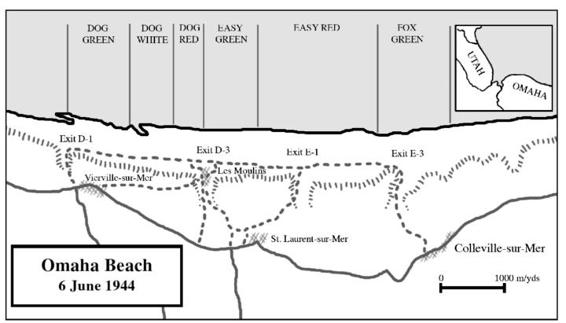
At approximately H minus 60 minutes, LCTs bearing DDs of Companies B and C, 741st Tank Battalion, attached to the 1st Division's 16th Infantry, reached position about 6,000 yards from the regiment's zone at the left end of Omaha Beach. In view of the rough weather forecast for D-Day, the commanding general of Task Force 0 and the admiral commanding Force 0 Naval had agreed that the senior naval commander in each LCT flotilla carrying DD tanks would decide whether to launch them at sea or carry them to the beach; the senior DD tank unit commander was to advise the flotilla commander on the matter.21 Capt. James Thornton Jr., the commander Company B, was able to reach his counterpart from Company C, Capt. Charles Young, by radio. The two discussed the advisability of launching the DD Shermans in the extremely rough seas-much rougher than any they had tackled during preparatory training. Thornton was an extremely brave man; a product of The Citadel and deeply respected by his noncommissioned officers and men, he was always eager to take the lead.22 The officers agreed that the advantage to be gained by launching the tanks justified the risk, and they issued orders for launching at approximately H-50.23
Soon Thornton was standing atop his strange armored boat. His head, more than ten feet above the deck, swung through wild arcs as the LCT pitched and yawed. The bow door opened, and it was action time. Thornton could see the beach four miles away and explosions from the naval bombardment churning the bluffs just beyond. Yellow launch flags went up, and Thornton ordered his driver, who could see nothing over the DD's canvas wall, to ease forward into the choppy water.
The tank following Thornton's off the LCT bow swamped immediately, as did the fourth Sherman to launch. Thornton's DD began to suffer damage after only a few yards; struts snapped and canvas tore, and water eventually flooded the engine compartment. He could see other tanks from his company and Company C suffering similarly alarming problems, but he could do nothing for any of them. After sailing only 1,000 yards, Thornton's tank foundered.' The beach-the object of Thornton's planning, training, speculation, and apprehension for months-still seemed so very far away. The crew scrambled to escape, and Thornton found himself bobbing amid the waves and bustle of assault landing craft headed for shore.
Of the Company B DD tanks launched, only two survived the full distance to Omaha Beach. The rest of Company B and all of Company C sank at distances from 1,000 to 5,000 yards from shore.15 Small craft maneuvered to rescue the freezing tankers, and Thornton and his crew were pulled aboard a small landing craft. The boat pointed its bow back toward the long line of transports. Once aboard ship, tankers gratefully changed into dry clothes. The crews were told that they would be evacuated to England.26
S/Sgt. Turner Sheppard commanded one of the two tanks that reached shore and saw Thornton's tank go down on his way in. When the tracks hit sand, he told his driver to keep moving forward. It was smoothest landing the crew had ever managed. He deflated the screen and only then climbed from the deck into the comparative safety of the turret. To his left, he could see the other surviving DD Sherman commanded by Sergeant Geddes on the sand.
Sheppard's gunner fired at bunkers and pillboxes. Two concrete-piercing rounds slammed into the mouth of a tunnel and produced a satisfying secondary explosion, evidently from the ammunition reserve for a nearby 88-millimeter gun.27
Three other DD tanks aboard one landing craft were carried all the way to the beach after a wave sank the first DD to exit the vessel and smashed the remaining tanks together, which damaged their screens. Sgt. Paul Ragan, the senior tanker on board, convinced the skipper to take the remaining Shermans to the beach.28
"When we drove off the LCT," recalled Ragan, "I couldn't see much in front of me except smoke, but there was a clear spot in it, and through here I could see a pillbox. We fired at least forty rounds of 75 ammo at this. These tanks had landed too far to the right, and they moved left along the beach, weaving past obstacles, skirting a minefield, and firing as they went. Ragan spotted a mortar lobbing shells from behind some drums, and his gunner blew it sky-high. Two of the tanks remained stuck on the beach for seven hours; one pushed ahead to try to knock out a gun but was hit itself and burned .21
The 1st Infantry Division assault had landed in the teeth of a defense mounted by eight battalions of the well-trained German 352d Infantry Division 30 Heavy fire greeted the 16th Infantry's assault wave, and casualties mounted quickly as the men left their landing craft. The loss of all Company C tanks in the water meant that the GIs on Fox Beach had no armored support at all. The handful of Company B tanks and four boat sections of infantry were the only assault troops on Easy Red Beach for the first half hour of the invasion, and at first, some GIs reported later, the tanks drove up and down the beach but did little shooting.
It all depended where you were. PFC Alfred Whitehead II was one of a handful of combat engineers and infantrymen seconded from the 2d Infantry Division to the Special Engineer Task Force for the assault on Easy Red. He recalled, referring to one of the five DD tanks that seemed to him to have appeared from the sea but were already ashore:
I looked around and the picture on the beach was staggering to the imagination. It looked like the end of the world. There were knocked-out German bunkers and pillboxes, cast-off life preservers and lost gas masks, plus piles of all kinds of equipment; wet, waterlogged and ruined. Sherman tanks, halftracks, and other vehicles littered the shoreline, partly submerged and sinking deeper with the rushing tide. More men were still struggling through tremendous forms of twisted steel and shattered concrete, right over broken, lifeless bodies littering the beach-bodies which only a short time before had been living, breathing beings. It was so rough that I thought we had lost the beach three or four times....
For a long time it looked hopeless. The enemy was slaughtering our men with an 88 housed in [a] huge bunker. But just when things looked darkest, one of our Sherman DD amphibious tanks managed to crawl in to the beach and not get knocked-out, probably because there were so many wrecked vehicles the enemy missed spotting it. It moved in close to the bottom of the slope, and I ran over and directed it to that 88. The terrain was such that our tank could creep up close enough to where its gun barrel was just barely sticking its nose over the top of a little rise to fire. I told the tanker that he'd have only a few seconds to move over the rise and shoot, then hit the reverse gears before that 88 could return fire. The first two rounds missed their mark, chipping chunks of concrete outside its massive structure. On the third try the round hit home-right through the bunker's narrow gun slit.
What a relief!"
The tankdozer platoon of four vehicles and all but three tanks from Company A reached shore in the second wave. The tanks blazed away with their 75millimeter guns as they neared the beach, although the odds of hitting anything with aimed fire from a pitching landing craft were remote. Nevertheless, one Sherman on a drifting LCT disabled by German fire had the good fortune to destroy with a single 75-millimeter round the artillery piece that had done the damage. Three Shermans went down with an LCT sunk by enemy fire."
Staff Sergeant Fair commanded one of the Company A tanks in the 741st Tank Battalion that made it to the beach aboard an LCT, along with another Sherman and a tankdozer. Sergeant Fair reported his experience shortly after landing:
[We were] supposed to land at 0630 hours about two hundred yards right of Exit-3, but due to weather conditions and other landing craft we beached at Exit-1 near to 743d Tank Battalion. The ramp was dropped in pretty deep water and we left the craft. I was in No. 1 tank, Sergeant Larsen No. 2 tank, and the dozer No. 3. The water was up over our turret ring. We finally pulled up on the beach but still stayed in the water enough for protection. Our bow gunner and gunner started spraying the trees and hillside with .30 cal. while, not helped by the snipers and shrapnel, we looked for antitank guns and pillboxes. It wasn't long until we spotted one, which no doubt was a machine-gun emplacement. I put my gunner on it, and he fired. His first shots went low, but after the correction was made the next shots entered straight through the opening and put it out of action.
We had to keep moving up with the tide, for it was coming up pretty fast. All of a sudden hell broke loose in front of us; they had made a hit on the boat obstacles on which were Teller mines. We moved to a new position to the left and began firing in the direction we thought it came from. I noticed the tide was closing in on us and we had no exit to escape from in case we had to move, for there was a hill in front of us, a good tank obstacle, and casualties were piling up all around us. I started down the beach to look for our platoon leader, who was Lt. [Gastano] Barcelona. The going was slow, for we had to weave in and out among bodies and sometimes stop till the medics cleared them from our path. On our way down, we accounted for two machine-gun nests that the infantry located for us. We finally located the 1st Platoon, so we got in firing position, as we were firing at gun positions located below Exit-3. Sergeant Larsen's tank was hit by 57mm [sic; not actually used by the defenders] AP between the gun shield and extra armor plate, wounding his gunner. It also smashed the breach mechanism and recoil. Sergeant Larsen got a few powder burns on the face. He gave orders to abandon tank.
About that time, Lieutenant McDonough came moving up the beach. I was sitting crossways in his path, so I pulled up on the bank and got stuck in the pebbles. I heard someone call me and I looked over the side. I saw Private First Class Robinson of Company A, 741st Tank Battalion. He was wounded. I couldn't hear what he was trying to tell me, so I dismounted. He wanted a cigarette and told me to give him morphine. I took him on up where Sergeant Larsen's crew was and gave him morphine and covered him up. Coming back I tried to unhook our trailer [holding extra ammunition] so we could back up. It was in our way all of the time. If I had known what an obstacle it was in the first place, I would have left it on the LCT. I finally got it unhooked and we tried to get off the bank again, resulting in breaking about ten connectors and threw the track. We were out of HE and all the heavy firing was about over with so we dismounted and got behind our tank. All told we fired, Sergeant Larsen and our tank, 450 HE and an uncounted number of .30 cal 33
The LCT bearing Sergeant Holcombe's tankdozer was struck and caught fire but was able to unload its tanks. Holcombe followed a Sherman and a tankdozer in front of him from the burning LCT. They were in water almost up to the Shermans' back decks. Suddenly, the first tank lurched to a halt after being struck by an 88millimeter shell. The men bailed out and clambered aboard Holcombe's tank, which carried them to the sand. By this point, Holcombe had had enough of his first time under fire and ordered his crew to abandon tank. Realizing that their sergeant was in shock, the crew refused. The bow gunner climbed into the turret, took command of the Sherman, and helped load the 75-millimeter gun. Once ashore, the dozer began clearing obstacles and pushing sand into berms to shield the pinned-down infantry. The dozer crew decided to share blankets and food with the wounded and pulled the machine guns out of the tank for the infantry to use while the dozer went about its work .14
Meanwhile, because the command radio had been ruined by seawater, battalion command personnel had to move from tank to tank to direct fire and move vehicles into more advantageous positions. Both technical sergeants and the radio operator in the group were wounded 35
By the time the badly shot-up Company L, 16th Infantry, attacked the German strongpoint assigned to it in a draw through the bluff, two medium tanks were providing covering fire from the beach under the direction of an infantry lieutenant, and the GIs by 0900 captured the objective and moved to the top of the bluff. Likewise, a DD tank appeared at an opportune moment and destroyed several machine guns that were holding up Company F. At about this time, a British destroyer pulled within 400 yards of the sand, and under cover from its broadsides, Company F and the rest of the 3d Battalion were able to reach the crest. We can only imagine the Sherman gunner's reaction to this display of one-upmanship 36
The first tanks crawled off Omaha Beach at about 1700 hours via exit Easy-1, having spent almost twelve hours on that steel-raked sand. Three tanks were knocked out on the road to Colleville-sur-Mer when they tried to exit the beach with the infantry, two of them at the top of the bluff near the 16th Infantry's command post. S/Sgt. Turner Sheppard commanded one of them. At the infantry's request, Sheppard led the way up the road in his DD tank. There was a fortified house at a sharp bend, but the tanks had worked it over fairly well, and Sheppard pulled past it. Suddenly, he spotted an antitank gun in the road about 600 yards away. The German gunners had the drop on him, and their first round penetrated the front armor, killed the bow gunner, and wounded Sheppard. The survivors bailed out. Sheppard was evacuated the next day but returned to the battalion and earned its first battlefield commission.
At 2000 hours, four battalion tanks were still supporting the infantry against machine-gun nests in the vicinity of St. Laurent-sur-Mer. The outfit's remnants laagered in a field two miles from the water and watched a canopy of red tracers slice the air overhead to drive off Luftwaffe raiders. The battalion's first daily tank status report, submitted to the V Corps at 2315 hours on 6 June, indicated that it had three battle-ready medium tanks, two tanks damaged but reparable, and fortyeight tanks reckoned lost 37

In the 116th Regimental Combat Team's zone on the right end of Omaha Beach, the officers in charge of the DD-loaded LCTs decided not to risk the sea conditions, so all thirty-two DDs of the 743d Tank Battalion were carried nearly to the beach 38 The unit's S-3 journal recorded: "Company C landed on Dog White and Easy Green beaches at H minus 6 [minutes]. Upon approaching beach we were met with fire from individual weapons, 155mm, 88mm, and machine guns.... Air support missing." Company B landed simultaneously, and Company As tanks followed the DDs ashore as planned.31 Navy navigation errors deposited some of the tanks on beaches intended for use by the 741st Tank Battalion, which was not such a bad outcome, given the losses suffered by that outfit.40
The infantry arrived after the tanks. Lt. Jack Shea, who landed with the 116th Infantry's regimental headquarters, recalled,
Our particular LCVP did not draw direct fire until we were within 200 yards of the beach.... Moderate small-arms fire was directed at our craft as the ramp was lowered.... The first cover available was the partial screen provided by a DD amphibious tank of Company C, 743d Tank Battalion, which had landed at H minus 6. There were about eighteen of these tanks standing just above the water line of Dog Beach. They were faced toward the mainland at an interval of 70-100 yards, and about twenty-five yards from the breakwater. They were firing at enemy positions to their immediate front. Two tanks, near the Vierville exit, had been hit by enemy fire and were burning.
The tank that screened us was firing to its front right, rather than engaging its previously assigned target-the enemy strong point and gun positions atop the cliff at Point et Raz de la Percee. This was necessary for the tank evidently was seeking to protect itself from the fire of several antitank guns that had survived the air-and-naval pre-landing bombardment....
Both [assistant division commander Brig. Gen Norman] Cota and Col. [Charles] Canham expressed the opinion that the fact that these tanks were not firing at Point Percee permitted those enemy gun positions to profitably employ their fires.41 [Indeed, the German commander of that strongpoint at first judged that the landing had been crushed on the beach; he saw ten burning tanks and infantry hiding behind obstacles, and he noted that his guns were causing heavy losses.42]
The tank battalion's commander, Lt. Col. John Upham, who had put the battalion together, directed operations from an LCT a few hundred yards offshore until he landed ninety minutes after the assault wave. Upham moved from tank to tank, directing fire and movement. Sometime during the morning, a sniper's slug destroyed his right shoulder, but he continued to exercise personal leadership until Green Beach was cleared. Only then did he finally allow medics to evacuate himan action for which he was awarded the Distinguished Service Cross.43
The seawall kept the tanks penned on the beach, where Company A lined up along the promenade under fire; two Shermans burst into flames. The infantry under Cota's leadership reached the top of the bluff by 1000 hours. Cota was concerned that the riflemen had no tank support and turned to a colonel of engineers. "Can you blow up the antitank wall at the exit?"
"We can, sir, just as soon as the infantry clears out those pillboxes around there."
"We just came through there. There's nothing to speak of there. Get to it!" Cota ordered.
Still lacking tanks, Cota spotted two Shermans from the 741st Tank Battalion headquarters section, which had landed at 1530 and climbed up exit Easy-1 to the bluff, parked next to a hedgerow. Cota commandeered one of them from the 1st Infantry Division and sent it to support his men in St. Laurent-sur-Mer. A sergeant from the 115th Infantry, which had come ashore on the heels of the 116th Infantry, took the assistant driver's position to guide the driver into position. The tank had just passed between two farm buildings when a high-velocity round whizzed by. Unable to spot the source, the gunner fired ten 75-millimeter rounds and some machine-gun bullets in the direction of the enemy, and the tank backed away.44
The first Shermans from the 743d Tank Battalion did not exit the beach until about 2200 hours through exit Dog-1 and moved to a bivouac point about 200 yards from Vierville. Approximately eighteen DD tanks from Companies B and C got off the beach, as well as half of Company A. The tankers continued to receive sniper and machine-gun fire until dark. The battalion lost sixteen tanks destroyed or disabled during the day.45 Company A alone had lost eight of sixteen tanks and six dozers; the confusion was such that, at the end of the day, the company commander was not sure how many men had become casualties. Company B had lost seven tanks with three officers and six enlisted men killed in action. Company C was luckier, suffering the loss of only one tank disabled and five men wounded.46

The U.S. Army Center of Military History concluded that, regarding the importance of the tanks on the beach that day, "[t]heir achievement cannot be summed up in statistics; the best testimony in their favor is the casual mention in the records of many units, from all parts of the beach, of emplacements neutralized by the supporting fire of tanks. In an interview shortly after the battle, the commander of the 2d Battalion, 116th Infantry, who saw some of the worst fighting on the beach at Les Moulins, expressed as his opinion that the tanks `saved the day. They shot the hell out of the Germans, and got the hell shot out of them. "47
The importance of the tanks was also underscored by what happened when they could not get to the point of decision to help the doughboys. By noon, the 116th Infantry's 3d Battalion had worked its way into the draw between Les Moulins and St. Laurent-sur-Mer, where it encountered stiff resistance. The battalion commander decided to flank the Germans and advance on St. Laurent. As Company L's attack got underway, the navy shelled the village church, which had a demoralizing effect on the troops. German soldiers in town blasted the advancing GIs with automatic weapons and small-caliber antiaircraft guns. The battalion suffered more casualties than it had getting across the beach and, after one more futile push, pulled back to "button up" for the night.
Capt. Charles Kidd would not forget one key factor: "Tanks were not able to get off the beaches"48 Tanks would have shrugged off machine-gun and 20-millimeter or 37-millimeter antiaircraft fire.

Meanwhile, engineers had cut several roads to the top of the bluffs, and landing schedules were adjusted to take advantage of this. The first tanks of the 745th Tank Battalion landed on Fox Green about 1630 and made it to the high ground by 2000, with the loss of three Shermans to mines 49 Because of the high losses suffered by the 741st Tank Battalion, Maj. Gen. Leonard Gerow, the commanding general of Task Force 0, decided to commit the 745th Tank Battalion to battle immediately.51 (Only one company landed on 6 June, with two more coming ashore on 7 June.51) The arrival of the 745th raised to five the number of separate tank battalions in France by the end of D-Day. The 747th Tank Battalion (in V Corps reserve) would disembark on Omaha at 0700 on 7 June,52 and at the height of the Normandy campaign, twenty-one separate tank battalions were employed.53

The assault on Omaha had succeeded, but ground units there made less progress than planned. The beachhead was one and a half miles deep at its deepest point. At Utah Beach, in contrast, casualties had been low, and the 4th Infantry Division's 8th Infantry Regiment had advanced all the way to its D-Day objectives.54
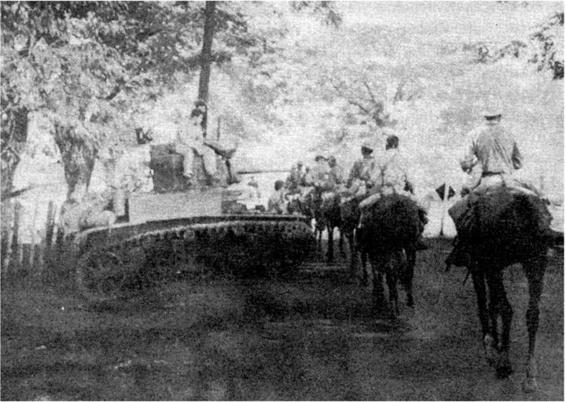
Crewmen of a 192d Tank Battalion M3 light tank watch the 26th Cavalry, Philippine Scouts, pass in December 1941. Both outfits would soon give battle to Japanese invaders. SIGNAL CORPS PHOTO
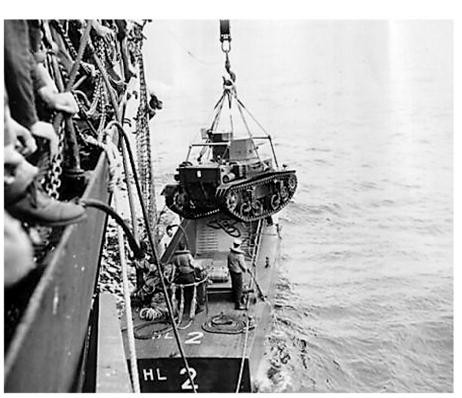
The Army knew before the United States entered the war that it would have to put tanks on hostile shores. Tank lighters, such as this one participating in a 1st Division landing exercise in August 1941, could only carry light tanks, in this case an M2A4, which had to be hoisted from transports. SIGNAL CORPS PHOTO
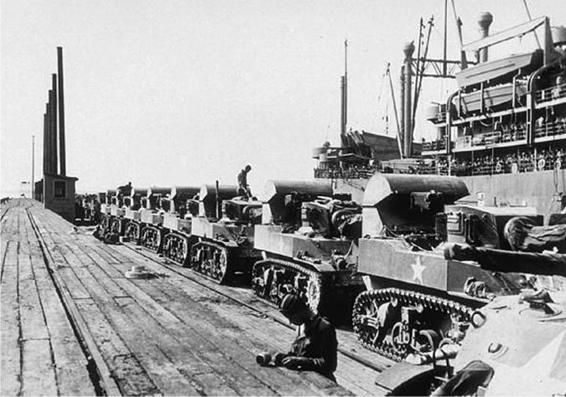
M5 light tanks belonging to the 756th Tank Battalion (Light) await loading for the journey to North Africa for Operation Torch. They are waterproofed and fitted with wading stacks much like those that will be used in amphibious landings for the rest of the war. SIGNAL CORPS PHOTO
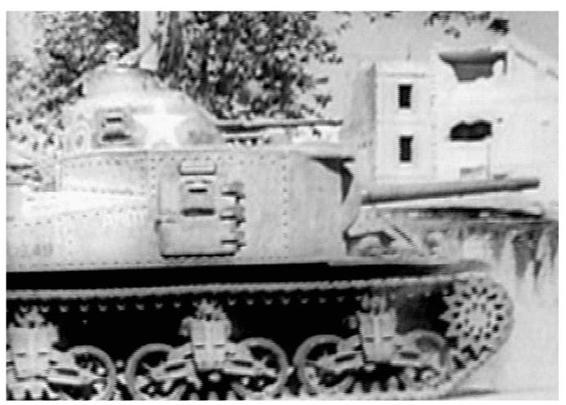
An M3 medium tank belonging to Company A, 751st Tank Battalion (Medium), engages in street fighting in Bizerte, Tunisia, on 8 May 1943. The separate tank battalions saw little action except during the first and last days of the North Africa campaign. SIGNAL CORPS FILM
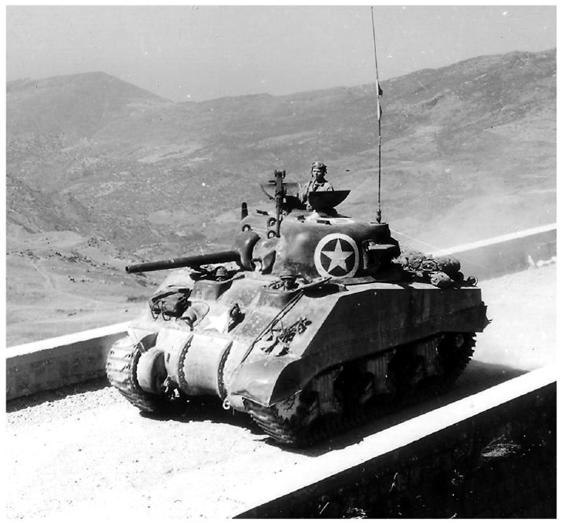
Mountainous terrain such as this near Mistretta, Sicily, in August 1943 greatly limited the use of tanks on the island and the Italian mainland. Usually, German artillery observers had views like this over Allied troops below. SIGNAL CORPS PHOTO
M3 tanks shell the Japanese at King's Wharf, Makin Atoll, on 21 November 1943. These Lees belong to Company A, 193d Tank Battalion. The first tank battalion to go on the offensive against Japan, the outfit equipped one company with M3 mediums, one with M3 light tanks, and one with amtracs. SIGNAL CORPS PHOTO
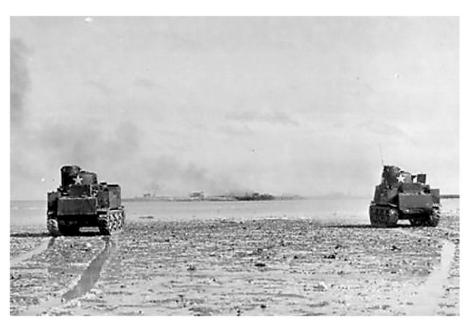
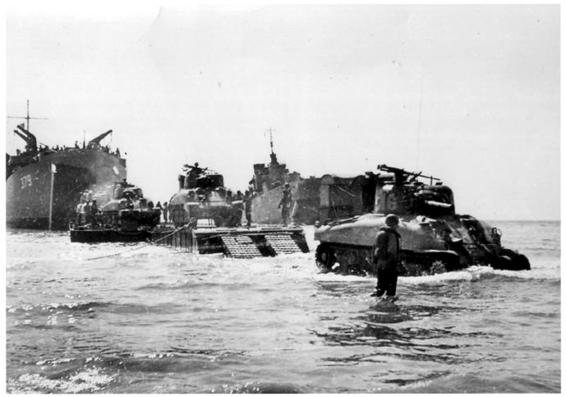
Tanks from the 191st or 751st Tank Battalion debark across a pontoon from an LST at Salerno on 9 September 1943. This method, also used in the Sicily landings, was slow and vulnerable to enemy tire. SIGNAL CORPS PHOTO
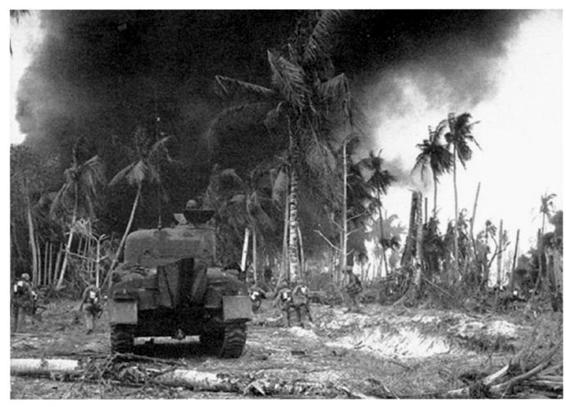
A 767th Tank Battalion Sherman works with 7th Infantry Division doughs on Kwajalein in February 1944. A field phone is mounted on the left-rear fender, one of the first experiments in improving tank-infantry communications. U.S. ARMY PHOTO
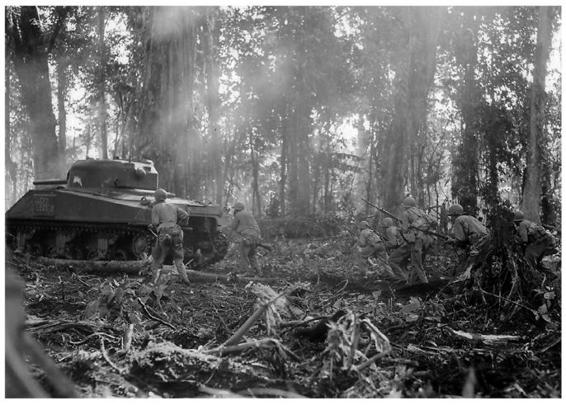
GIs from the 37th Infantry Division on Bougainville advance behind a Sherman belonging to the 754th Tank Battalion on 16 March 1944. They are using a formation developed on the island for jungle warfare, with target designators at the rear corners of the Sherman and riflemen, BAR men, and engineers in a wedge behind. SIGNAL CORPS PHOTO
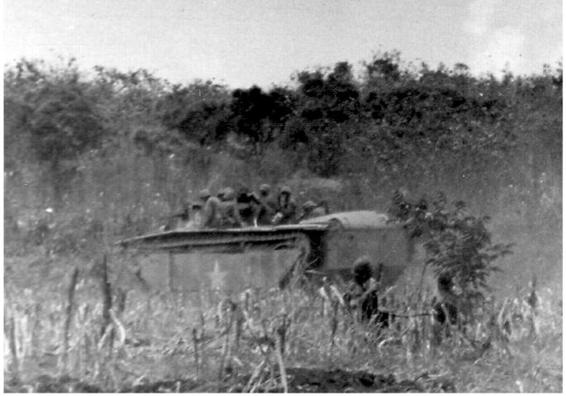
An Army amtrac carries Marines toward what appears to be the 01 phase line on Saipan on 15 June 1944. More armored force men participated in the Saipan landings than in D-Day. MARINE CORPS PHOTO
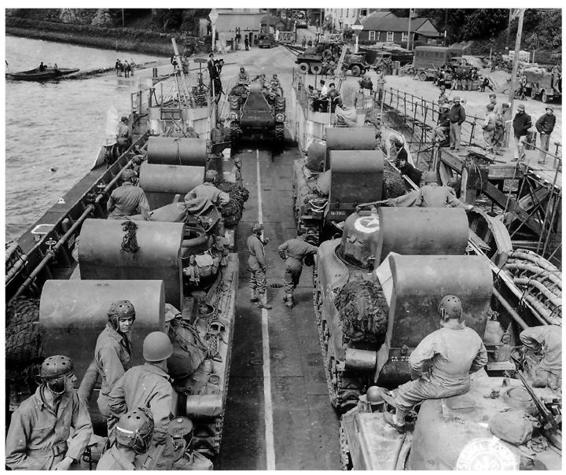
70th Tank Battalion Shermans load onto a landing craft, tank (LCT), in Kingswear, England, on 1 June 1944. These Company C tanks beat the amphibious duplex drive tanks to Utah Beach in Normandy on 6 June, a screw-up that worked out well. SIGNAL CORPS PHOTO
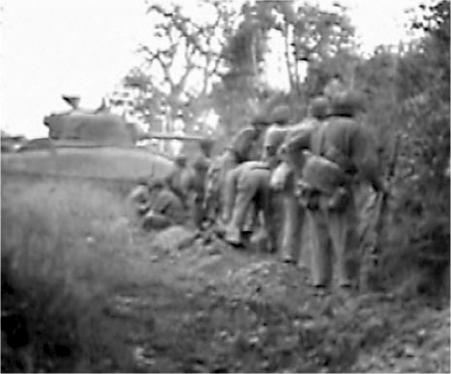
Infantrymen shelter behind a hedgerow while an M4A 1 tank fires at the next one. For both partners, the bocage was a checkerboard hell. SIGNAL CORPS FILM
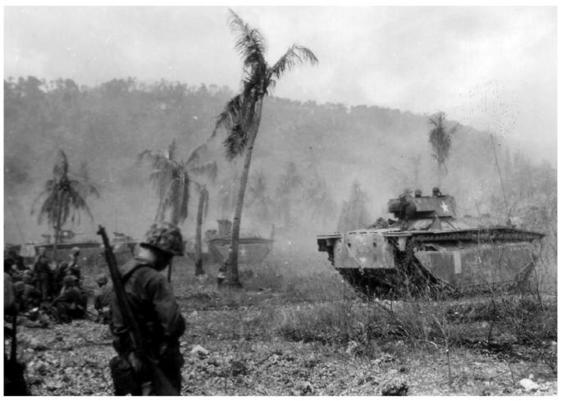
LVT(A)(1) (left) and LVT(A)(4) amtanks belonging to Company D, 708th Amphibian Tank Battalion, line up to attack with the Marines on Saipan in June 1944. MARINE CORPS PHOTO
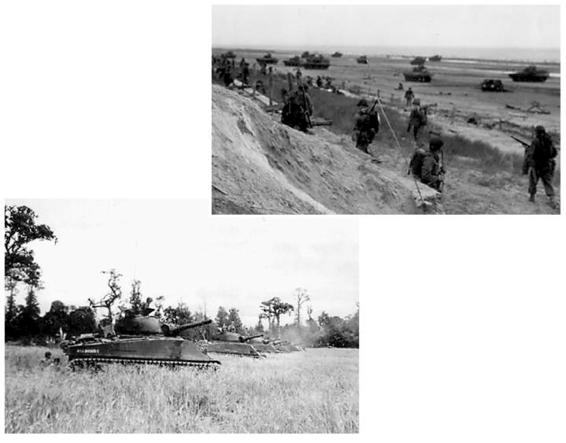
Amphibious duplex-drive M4A 1 s from the 70th Tank Battalion sit on Utah Beach on 6 June 1944. The Allies used DD tanks in Operations Overlord and Dragoon and in the Rhine crossing. SIGNAL CORPS PHOTO
All six M4A3 105-millimeter assault guns from a tank battalion fire in battery in France in mid-July 1944. The 105-millimeter assault gun served in standard tank battalions, though outfits in Italy and the Pacific made do with the M7 self-propelled howitzer until late 1944. SIGNAL CORPS PHOTO
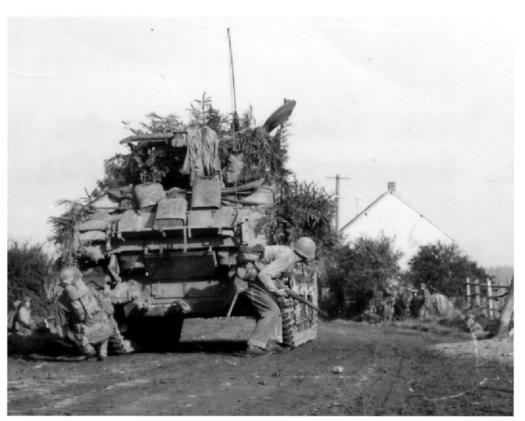
Gis take cover as advancing troops encounter fire at the Siegfried Line near Aachen on 15 September 1944. Supply lines are stretched to the breaking point, and this crew hauls along spare gasoline. SIGNAL CORPS PHOTO
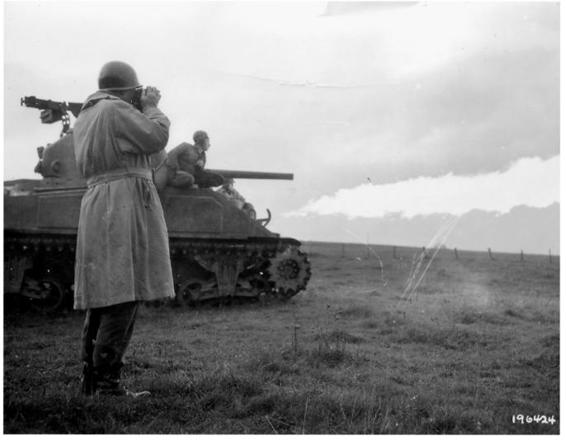
Lieutenant General George Patton Jr. takes a picture of a demonstration of the E4-5 hullmounted flamethrower that began reaching tank battalions in September 1944. The flame unit was also used in the Pacific theater. SIGNAL CORPS PHOTO
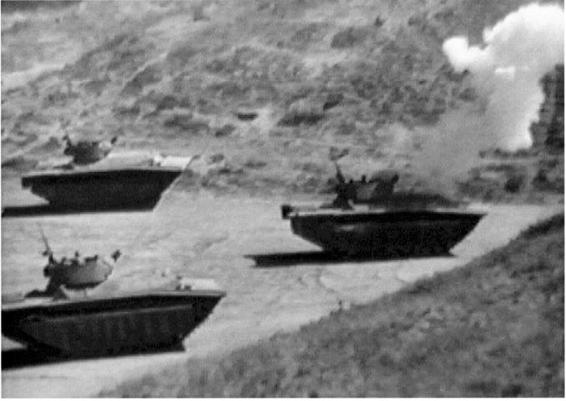
LVT(A)(4)s fire indirectly. From the Leyte landings in October 1944, doctrine increasingly favored using amtanks as artillery after the initial assault, but reality kept pulling them back into combat. SIGNAL CORPS FILM
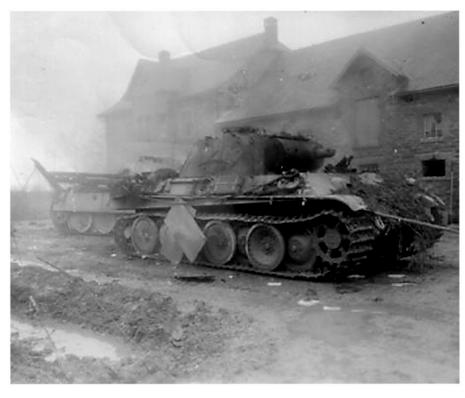
Two 12th SS Panzer Division Panthers knocked out during the fighting in Krinkelt, Belgium, beginning 17 December 1944. SIGNAL CORPS PHOTO
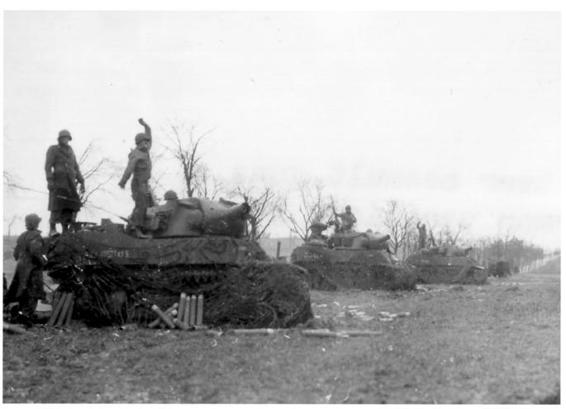
M8 75-millimeter assault guns, which replaced the half-track-based T-30 in 1943, fought with the light tank battalions, briefly with medium battalions in Italy, and with a few standard battalions in the Pacific. These are firing in battery near Hurtgen, Germany, in December 1944. SIGNAL CORPS PHOTO
LVT(4)s of the 658th Amphibian Tractor Battalion carry 40th Division assault troops ashore at Lingayen, Luzon Island, on 9 January 1945. Troops encountered virtually no resistance at the shoreline. SIGNAL CORPS FILM
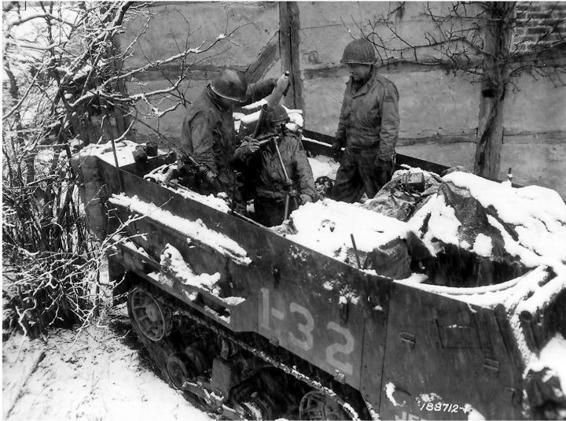
The mortar platoon in light, medium, and standard tank battalions used half-track-mounted 81millimeter mortars such as this M4A 1 mortar carrier, at work in Belgium in early 1945. Some outfits made good use of the platoon, but many did not. SIGNAL CORPS PHOTO
M4A1 Shermans roll through Manila on 23 February 1945. In ten days of street fighting, Company B, 44th Tank Battalion, expended 3,500 rounds of 75-millimeter and 183,000 rounds of .30-caliber ammunition. U.S. NAVY PHOTO
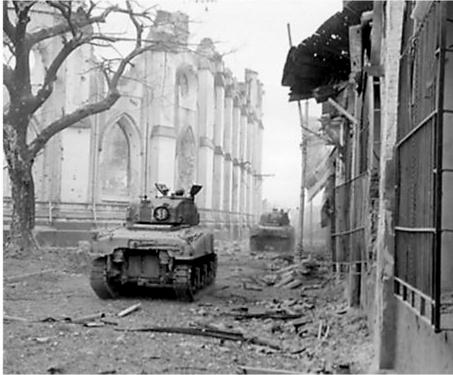
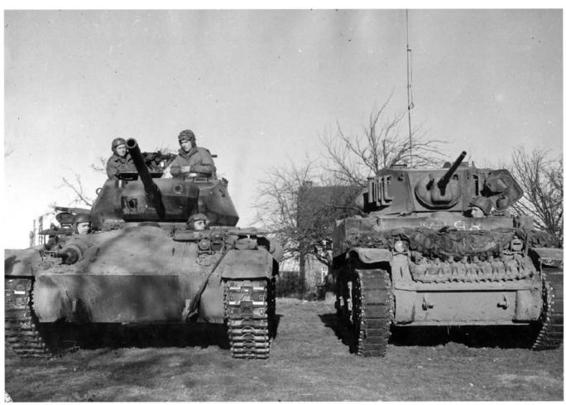
The M24 Chaffee light tank and the M5 that it replaced, both belonging to the 744th Tank Battalion (Light). The 740th Tank Battalion first used two M24s in battle when it found them at a replacement depot during the Battle of the Bulge. SIGNAL CORPS PHOTO
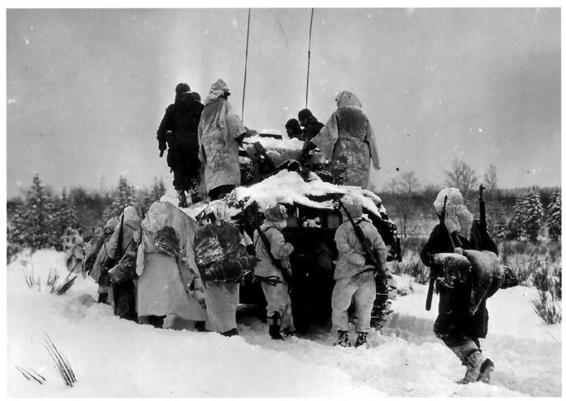
A barely recognizable 740th Tank Battalion Sherman attacks toward Heeresbach, Belgium, on 28 January 1945 with the 82d Airborne Division's 504th Parachute Infantry Regiment. "At a distance of fifty yards it was impossible to tell what kind of a vehicle it was-even if you determined that it actually was a vehicle," said the battalion commander. SIGNAL CORPS PHOTO
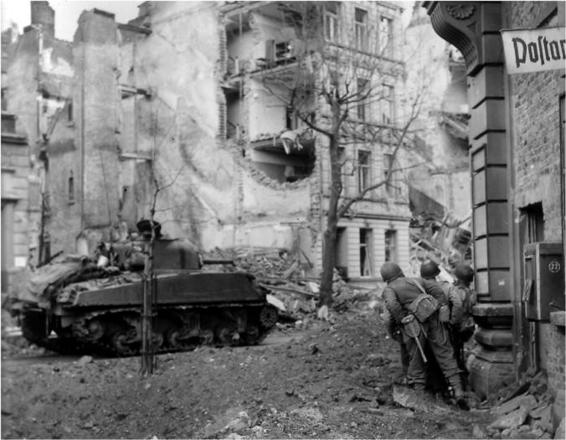
A 750th Tank Battalion Sherman works with 415th Infantry Regiment doughs in Cologne on 6 March 1945. Tankers and GIs time and again disproved early-war doctrine that tanks should not fight in cities. SIGNAL CORPS PHOTO
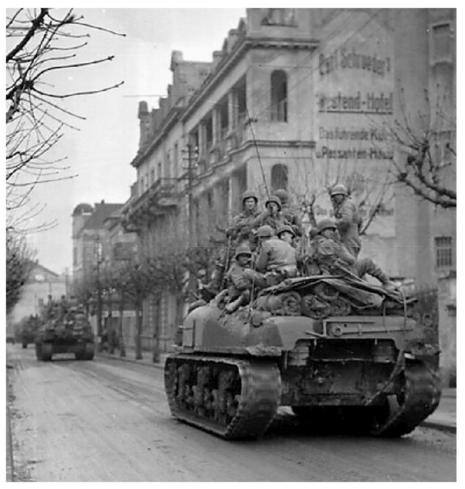
78th Infantry Division doughboys ride Shermans from the 741st Tank Battalion toward the Rhine River on 9 March 1945. SIGNAL CORPS PHOTO
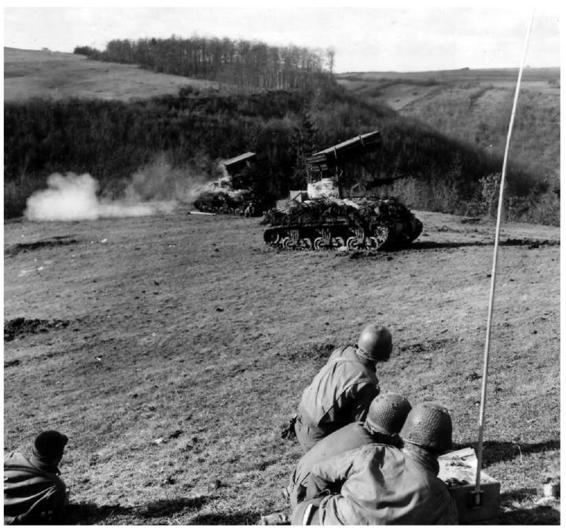
702d Tank Battalion Sherman tanks with new sixty-tube rocket assemblies attached operate near the Siegfried Line with the 80th Infantry Division on 17 March 1945. Launchers were also used in Italy, but not in the Pacific. SIGNAL CORPS PHOTO
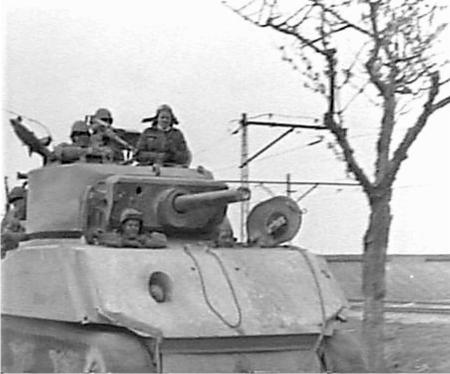
The M4A3E2 Jumbo assault Sherman appeared only in the European theater. The 750th Tank Battalion added a layer of concrete to the Tiger-tankthick front armor on this Jumbo, seen on the road to Halle in April 1945. SIGNAL CORPS FILM
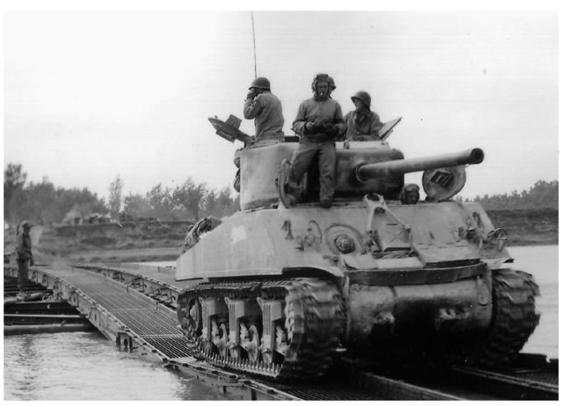
A 757th Tank Battalion M4A3 (76-millimeter) crosses the Po River on 26 April 1945. After soldiering with the oldest tanks in the arsenal into 1944, tankers in Italy caught up with their counterparts in the European theater by early 1945. SIGNAL CORPS PHOTO
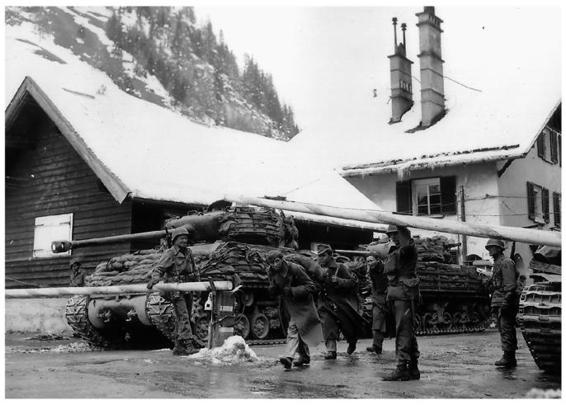
781st Tank Battalion Shermans reach the frontier in Brenner Pass, where the Seventh Army linked up with the Fifth Army, on 4 May 1945. The Easy 8 (left) was the final stage of the Sherman's development, but tankers still resorted to sandbagging for better armor protection. SIGNAL CORPS PHOTO
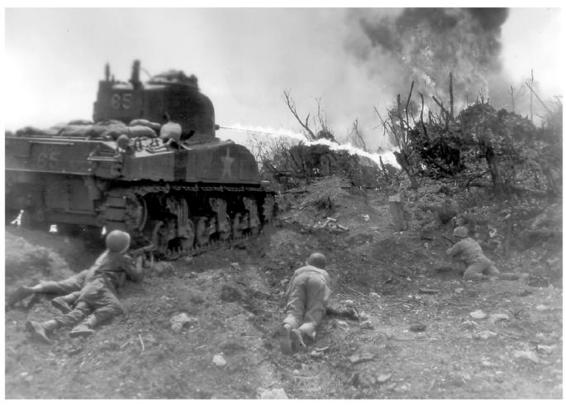
A 713th Tank Battalion flame tank sprays down a Japanese position on Okinawa on 17 May 1945. Flame tanks played a larger role on Okinawa than in any other campaign. SIGNAL CORPS PHOTO
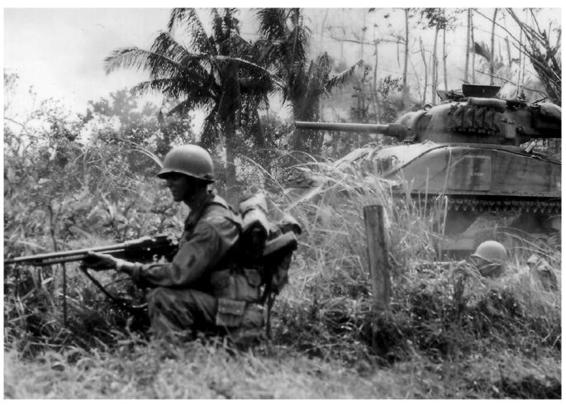
A Sherman from Company B, 775th Tank Battalion, works with 37th Infantry Division doughs on 12 June 1945 in Luzon's Cagayan Valley in the Philippines. The tankers proved they could work in rugged jungle terrain that nobody had ever imagined at the start of the war. SIGNAL CORPS PHOTO