
Chapter Ten
The end of the war in Europe came on 8 May 1945 – VE Day. The World War finally ended on 15 August with the surrender of Japan on VJ Day. For the generation that the war directly affected, the end was met with a mix of emotions. It had been a long war and there had been both triumph and tragedy for many of the people of Kent.
The effects of the Second World War will continue to be felt for many years to come. Today unexploded bombs and munitions continue to surface, and concrete anti-invasion defences still stand as mute reminders of the past. Whilst much redevelopment has occurred since the war, and the effects of intensive farming have changed much of the landscape, it is still possible to see many tangible reminders of the Second World War.
For many people, the war had been an appalling time, a time of fear, deprivation and loss. For some it had provided the ultimate challenge, with bonds of close comradeship forged that would never be forgotten.
Many celebrations were held throughout the county. On 11 May 1945, the Dover and East Kent Express described some of the events that took place in Dover and were typical of events throughout England:
Tuesday May 8th will live for ever in history and in the minds of those who lived through the most terrible war the world has known. The war against Germany had lasted 5 years, 8 months and 5 days, when on Tuesday, Victory in Europe was celebrated. Dover in common with all other cities, towns and villages in this and other Allied countries, gave expression to joy and thanksgiving.
Monday was a day of suspense with rumour following rumour. Every news was listened to from the first in the morning, and each time the announcement was that any hour the Prime Minister was expected to make his statement signalling the end of organised German resistance. Then after a statement at 6.00pm on the B.B.C. that the announcement was not expected until Tuesday, at 7.40pm, the broadcast was broken into to announce VE-Day holiday on Tuesday and Wednesday, with Mr Churchill’s broadcast at 3.00pm on Tuesday.
Dover was awake early on Tuesday morning. Overnight, flags decorated houses and shops, and soon others were being added in haste. The atmosphere grew steadily during the morning until 3 o’clock in the afternoon, when the loud speakers – grim reminders of Dover’s bitter ordeal from German shells – relayed the Prime Ministers declaration: ‘Yesterday at 2.41am at headquarters, General Jodl, the representative of the German High Command and of Grand Admiral Donitz, the designated head of the German State, signed the act of unconditional surrender of all German land, sea and air forces in Europe.’
Winston Churchill’s statement went on to detail how the surrender had taken place and he also included a resume of the war. He went on to conclude:
We may allow ourselves a brief period of rejoicing but let us not forget for a moment the toil and efforts that lie ahead. Japan, with all her treachery and greed, remains unsubdued. The injury she has influenced on Great Britain, the United States and other countries and her detestable cruelties, call for justice and retribution. We must now devote our strength and resources to the completion of our task, both at home and abroad. Advance Britannia. Long live the cause of freedom. God save the King.
At the end of the Prime Minister’s statement, ships in the harbour greeted the declaration by sounding their sirens, creating a deafening noise. In the town, the streets were jammed and good-humouredly the police jostled amongst the crowds, trying to make room for traffic. Buses were decked in flags and from the windows people waved Union Jacks. American jeeps weaved through the crowds with their human cargo, cheering as they went. The crowds danced and sang for hours on end.
Later the King broadcast to the nation:
To-day we give thanks to Almighty God for a great deliverance. Speaking from our Empire’s oldest capital city, war-battered but never for one moment daunted or dismayed – speaking from London, I ask you to join with me in that act of thanksgiving. Germany, the enemy who drove all Europe into war, has finally been overcome.
The King’s speech continued, acknowledging the job still to do in the continuing war against Japan, and also the job now required to repair the ravages of war. He continued:
Let us turn our thoughts on this day of just triumph and sorrow, and then take up our work again, resolved as a people to do nothing unworthy of those who died for us and to make the world such a world as they would have desired, for their children and for ours.
A legacy that all of us should remember today, the debt we owe to those died and the many that went to war and who did not return.
At 0815 on the morning of 6 August 1945, the crew of B-29 44-86292 ‘Enola Gay’, dropped a single atomic bomb which exploded over its target, the city of Hiroshima.
On the 9 May, B-29 44-27297 ‘Bockscar’, dropped a second atomic bomb which exploded above Nagasaki at 11:02 local time.
Six days later the Japanese signed the formal instrument of surrender proclaiming the unconditional surrender to the Allied Powers of the Japanese Imperial General Headquarters and of all Japanese Armed Forces and all Armed Forces.
The war had finally ended.
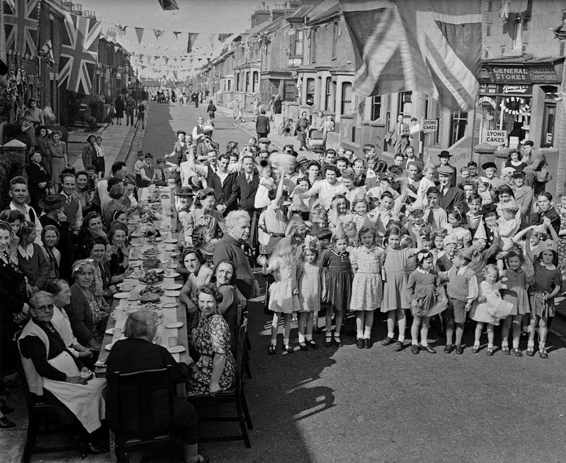
A typical street party taking place on VE day 1945 in Kent. (WanPs-0239)
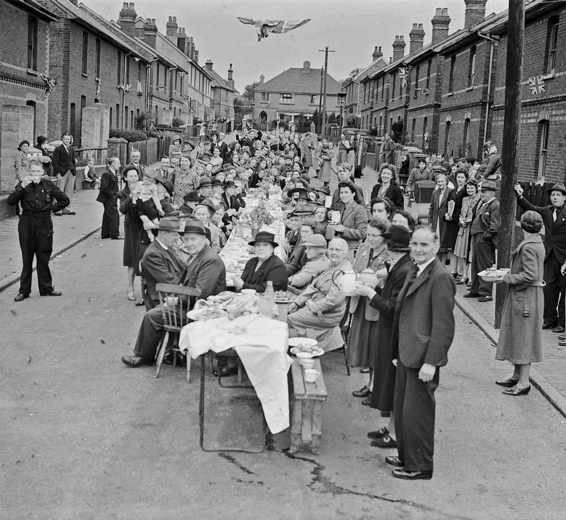
A VE day party at Nursery Road, High Brooms, Royal Tunbridge Wells, 6 June 1945. (WanPs-2237)
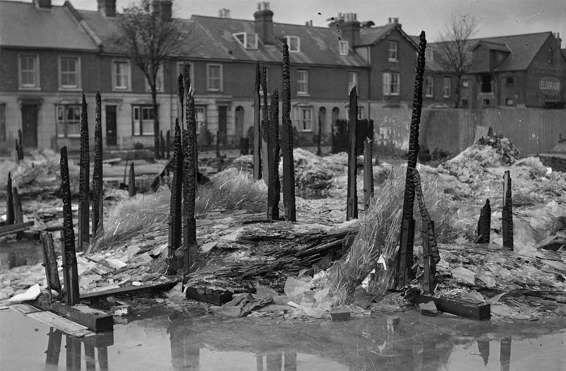
The after effects of the war left much of the county war-damaged. This bomb damage is believed to be at Shoreham. Many bombsites existed well into the 1970s. (WanPs-0332)
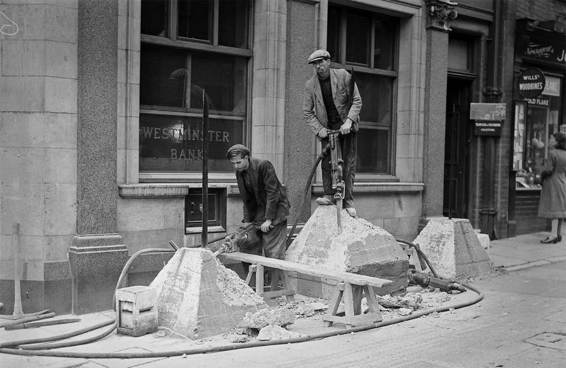
Removing road blocks, Castle Street, Tonbridge, c.1945. (WanPs-0347)
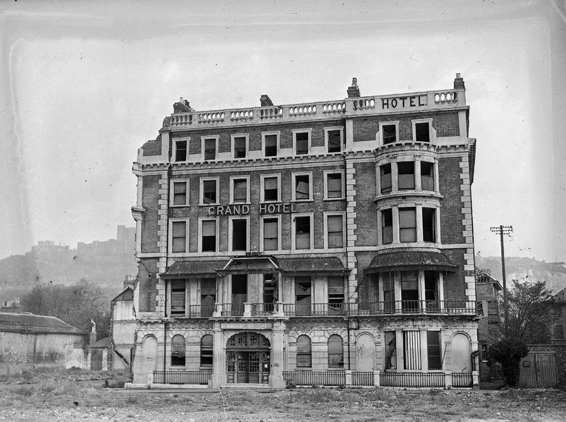
The Grand Hotel Dover was damaged by German bombing on 11 September 1940. Enemy activity on that day consisted of one major attack between 1545 and 1645 hours comprising 250 German aircraft on the Kent Coast. Some thirty aircraft penetrated as far as London. Considerable damage was caused in Dover to houses, shops and Dover Priory railway station, as well as to the Grand Hotel. Seven people were killed, 122 seriously injured and 36 slightly injured as a result of the bombing. Located on the seafront at the end of Camden Crescent, it was finally demolished in 1951 by Frank Luck who paid Dover Corporation £1,000 for the salvage rights. (WanPs-3119)