
Chapter Nine
Kent would play an important part in D-Day. Operations to support the landings were carried out from here; part of the vital Pipeline Under the Ocean (PLUTO) was hosted from Dungeness; support for the Mulberry harbours was provided from the coast of Kent; and part of the vital deception plan intended to fool the Germans that the landing would be carried out in the Calais region, were amongst contributions made to the greater D-Day plans.
The deception plan codenamed Operation Fortitude was intended to draw the Germans’ attention away from the true location of the D-Day landings by simulating large forces poised to land elsewhere. Hitler was convinced that the Allies would land in either Norway or northern France, or both, and consequently kept large forces in those areas to combat this threat. To encourage those beliefs, a deception plan was created and codenamed Fortitude (North) and Fortitude (South) which simulated large military formations in Scotland, North East England, and in the South East of England. The phantom force in the south-east was named the First United States Army Group (FUSAG) and its existence was created by the use of intense radio traffic between imaginary formations, the use of double agents and turned spies sending back false reports, ‘innocent’ news reports and security ‘lapses’ adding weight to reports, the use of dummy landing craft, vehicles and tanks, and the complete denial of the airspace of the South East of England to enemy reconnaissance aircraft.
Amongst the units based in Kent before, during and after D-Day were a number of American units. One of these, the United States Army 643rd Port Company, manned largely by African American troops, arrived in the area to support operations after D-Day, towards the end of the war. Initially based in Wales, the unit’s history provides an insight into the impression made on the soldiers as a result of their stay in Kent:
We loaded our gear and selves into trucks for the Newport Railway Station. The station platform was crowded with our Welsh friends who came to say goodbye. Where we were going was anybody’s guess. Those in the know wouldn’t tell as per usual, ‘Security you know’! We headed west toward London, then sidetracked. All of that afternoon we rode through the lush green meadows of rural Wales and England. About six bells our train skirted a very large body of sky blue water. And then we saw them! Yes! Unmistakably the Great White Chalk Cliffs . . . no mistaking it, this is Dover on the English Channel. We’d always wanted to visit this place and here at last we were! About half an hour later our journey ended at Deal, a very picturesque resort town about seven miles from Dover. After debarkation was completed we stood around awhile doing nothing. Lt Saltzman, who had preceded us in the advance party, showed up after a while and we started on a short walk (it turned out to be four miles) to our new camp. We were impressed by the beautiful homes and quiet dignity of the villages of Deal and Walmer, through which we marched towards our new camp. The neat velvety lawns, which are so typical of all England, were quite in evidence. We thought that this was the most beautiful scenery that we had seen. Dover, Deal and Walmer are located in Kent, one of England’s most beautiful shires or counties. We have just gotten our first glimpse of the Channel since being on terra-firma. It was a fleeting glance past the cylindrical Dover Castle which we passed ‘on the go’. Several British Wrens and ATS girls waved at us. Passing Royal Marines gave the ‘V’ sign. People in the pubs along the route invited us in for a drink during ‘breaks’. Of course we had to refuse, but we promised to join them later. Well at last we were there. We had been warned not to expect the ‘ideal’ camp. Forewarned was forearmed and we had, as per usual, our old reliable pup tents in our field packs. Our new campsite had a few semi-dilapidated buildings which would not accommodate all of the men and so we pitched tents.
Our new camp site is situated on a knoll overlooking ‘Bomb Alley’. The German Bombers used to fly low across here on their bomb run to London. After a supper of rations we bedded down and snoozed until morning. Another day, another hard earned dollar. The doors of our tents were on the west permitting us to look straight across Bomb Alley towards the English Channel about a mile and half away. The chilly Kentish morning air stimulated our appetites and we looked across the way to see what ‘les cousiniers’ were doing. We were surprised to find that they had set up the field ranges. The smell of crisp bacon filled the air and we went all out for chow. We’ve attended orientation where we’ve been informed that we’re the only American Troops on this side of London, some eighty miles distant. We learned that there have never been many Yank troops around and so had to be on our P’s and Q’s.
The men of the 643rd Port Company had been sent to Kent to assist with the salvage of an American Liberty ship, the SS Horace Binney, that had struck a mine and been towed back to England and beached on a sand bar. The work was dirty, disagreeable and not without danger. The holds were littered with waste and filled with cargo and oil. The unit history goes on to further describe their stay in Kent:
Those of us who chose to explore followed our noses down Bomb Alley as straight as the crow flies. We wanted to see what was ‘over that hill’ besides the Channel. We came upon the beautiful little village of Lansdowne. The haze lifted and we could see Calais about twenty miles across the Channel. A fleet of LCTs were moving in that direction from Dover farther up the beach. We noticed that most of the picture-book inns, cottages and pubs were just camouflaged gun positions. Only a few weeks before, the big guns talked back at each other from both sides. Barbed wire and steel obstructions were still on the beach. Part of the beach is still mined and we were particular to stay clear of the area marked. We could see part of the great oil storage tanks submerged in the earth with which the British had intended to transfer the channel literally into a sea of fire in the event of a German attempt at invasion. We collected a few sea shells and hurried back towards camp.
Operations commenced. The job, dirty and difficult, certainly taxed the energy and ingenuity of all concerned. We broke camp and on the morning of July 2, 1945 we entrained at Dover for Cardiff. We said, so long mates’ to the Royal Marines at their barracks in Deal. We shall never forget their hospitality. Of the citizens of nearby Deal, Dover and Walmer, too much cannot be said. We shall simply say that we love them and let that suffice. The lights have now come on all over the world again.
This is the tomorrow when the world is free’. We hope that the bluebirds have taken the cue and are again winging their way over the White Cliffs. They couldn’t have chosen a more hospitable or beautiful locale.
Pipeline Under The Ocean (PLUTO)
Planners knew that the future invasion of Europe would be the largest amphibious landing in history and without adequate and reliable supplies of petrol any advance would at best slow down and at worst grind to a halt. A loss of momentum could jeopardise the whole operation as German forces would have time to regroup and counter-attack. Conventional tankers and ’ship to shore’ pipelines were in danger of cluttering up the beaches, obstructing the movement of men, armaments and materials and, in all circumstances, were subject to disruption by weather and sea conditions, and they were easy targets for the Luftwaffe. The idea of a pipeline under the Channel was an innovative solution.
Work on developing this idea began as early as 1942. Constructing flexible yet pressure-resistant pipes and leak-free couplings was a difficult and slow process. In addition, it was realised that the fuel would need to be stored in the south of England in the preparation stages for the invasion, with the possibility of the storage points becoming targets for the Luftwaffe. Consequently it was decided that an integrated network of pipelines would be needed, bringing the fuel from oil terminals and the like to safer areas of the United Kingdom, mainly Liverpool and Bristol, down to Dungeness and the Isle of Wight and from there over the Channel to Cherbourg and Calais.
In a very short time a continuous flow of fuel was up and running. It is estimated that between August 1944 and May 1945 PLUTO delivered over 172 million gallons to France. As the Allies moved inland, the pipeline was transferred from the Isle of Wight to Dungeness in Kent to shorten the supply route. PLUTO was the world’s first undersea oil pipeline and made a major contribution, not only to the Allied war effort, but also to subsequent pipeline development.
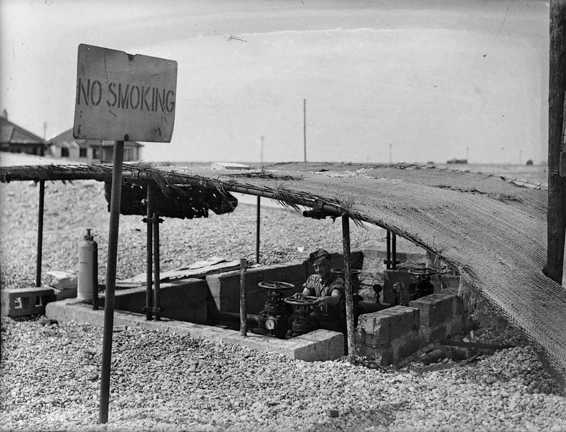
Pipe Line Under The Ocean (PLUTO) control valves Dungeness, c.1945. (WanPs-0001)
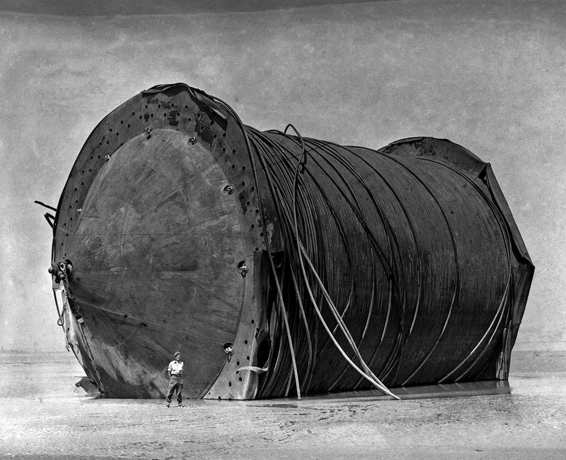
A ‘Conundrum’ aground at Greatstone, c.1945. Following successful trials with a large prototype in early 1944, five of these giant floating pipeline drums, whose name was often shortened to ‘conuns’, were commissioned to a modified design. The new drums, with a 30ft diameter, were fabricated in Scunthorpe, erected in Tilbury Docks and launched into the Thames. Each of the conuns weighed in at 250 tons and had a combined capacity to carry up to seventy nautical miles of 3-inch diameter pipe, codenamed HAMEL pipe, that could be automatically welded together. (WanPs-0005)
American Airmen in Kent
One of the US Army Air Force units based in Kent on the run up to D-Day and after was the 363rd Fighter Group, which was located approximately one mile northeast of Staplehurst, about thirty-eight miles southeast of London. The airfield at Staplehurst had been opened in 1943, and was a prototype Advanced Landing Ground (ALG) type construction, built to the same design as those that were built in and around the Normandy beachhead after D-Day. It was used by squadrons of the Royal Canadian Air Force and the United States Army Air Forces. The Ninth Air Force part of the USAAF utilised several temporary Advanced Landing Grounds along the channel coast prior to D-Day to provide tactical air support for the ground forces landing in Normandy. As such, the ALG at Staplehurst was utilised by the USAAF 363rd Fighter Group who moved there from RAF Rivenhall in Essex on 14 April 1944. Known officially as USAAF Station AAF-413, three squadrons (the 380th Fighter Squadron, the 381st Fighter Squadron, and the 382nd Fighter Squadron) equipped with North American P-51B fighter aircraft flew operations in preparation and then support of the Allied invasion of France. The group escorted bombers and fighter-bombers to targets in France, Germany, and the Low Countries, and strafed and dive-bombed trains, marshalling yards, bridges, vehicles, airfields, troops, gun positions, and other targets on the Continent. The 363rd supported the D-Day invasion of Normandy in June 1944 by escorting troop carriers and gliders and by attacking enemy positions near the front lines, and moved to the Continent at the end of June to take part in the Allied drive to the German border. The Group’s operations resulted in a total of nineteen confirmed victories. However, a similar number of Mustangs were lost, albeit mostly to ground fire. On 30 June, the 363rd was alerted for movement to the Continent, its new base being the airfield at Maupertus (ALG A-15), near Cherbourg. The airfield at Staplehurst closed in September 1944.
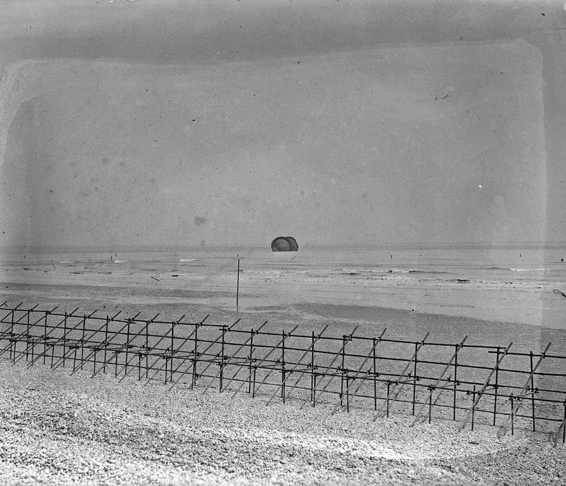
Beach defences with the beached Conundrum at Greatstone in the background. (WanPs-0006)
One of the Group’s operations, made while based at Staplehurst, is graphically described in the first-hand account of one of the pilots Lt Charles F. Stuart Jr, a P-51 pilot with the 381st Fighter Squadron. The event took place on 24 May 1944, returning to England after an escort mission to Berlin:
We were down on the deck, looking for targets of opportunity to strafe (anything that looks like it needs shooting at). If you look at the back of your right hand, your first finger would be a fellow named Shea, the next would be Schmidt, and the third finger would be this new replacement pilot Kennedy, I was on the far right. We had passed over some trees and then all of a sudden there was a German airfield right in front of us. The darn thing was sort of pearshaped. Shea was way over on the left side. He was nearly a quarter of a mile from me, we were spread well out. Schmidt was in there and he kept calling this new pilot (Kennedy) to ‘get off my wing’. The guy was flying right on his wing, close formation, just a few feet off the ground. I mean, it’s suicide to fly like that; you need to spread out so you have a little manoeuvring room. I hit the field at the narrow end – the little end of the pear – and when I saw the thing there was a flak tower right square in my gunsight. They didn’t even see me coming. I recall it had three or four 20mms on it, maybe ten men manning the thing, and they were raring back and shooting like the devil at Schmidt and that wingman out in the middle of the airfield. Shea was a little bit out of their range. I am not sure if they actually hit the new man, or whether he got scared, but he flipped over to the left & into Schmidt. The two of them went across that German airfield in one great big hellish ball of flame. A split second later, I hit my trigger and cleaned that platform out like a bowling ball knocks a strike down the alley. I think I knocked every darn one of them off the platform, but just a hair too late. That was about enough for Shea & I that day. We both revved back on the stick and got up to 15,000 or 20,000 feet. Without a word between us we closed back in, a few yards or so apart, flying abreast. Finally, Shea comes in and says, ‘Did you see what I saw?’ I said ‘Yes, I saw what you saw, too.’ As well as I can remember, we didn’t say anything else until we got back to England.
[Personal account taken from: http://www.warbirdinformationexchange.org/phpBB3/viewtopic.php?p=510886]
During operations from England, the group was credited with forty-one victories but lost forty-three of its own aircraft in the process.
Two memorials have been erected that commemorate the airfield’s part in the Normandy Landings. One is dedicated to the Canadian and American pilots and their ground crews stationed at Chickenden Farm and Spills Hill Farm, Staplehurst. The second, unveiled on 6 June 2010, is dedicated to the American airmen who lost their lives flying from Staplehurst during the period 14 April 1944 to 4 July 1944.
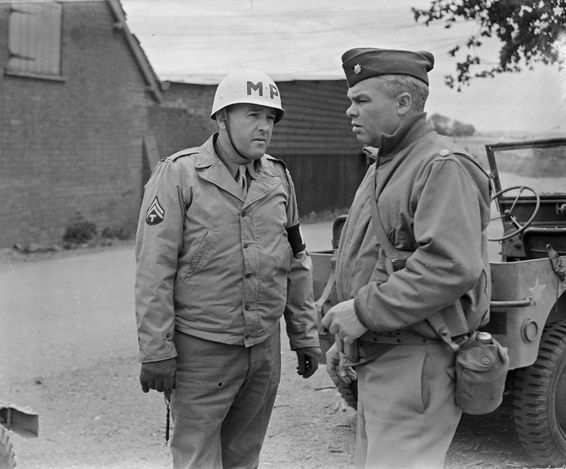
An American military policeman and an American colonel at the 363rd Fighter Group airfield at Chickenden Farm, Staplehurst. (WanPs-2060)
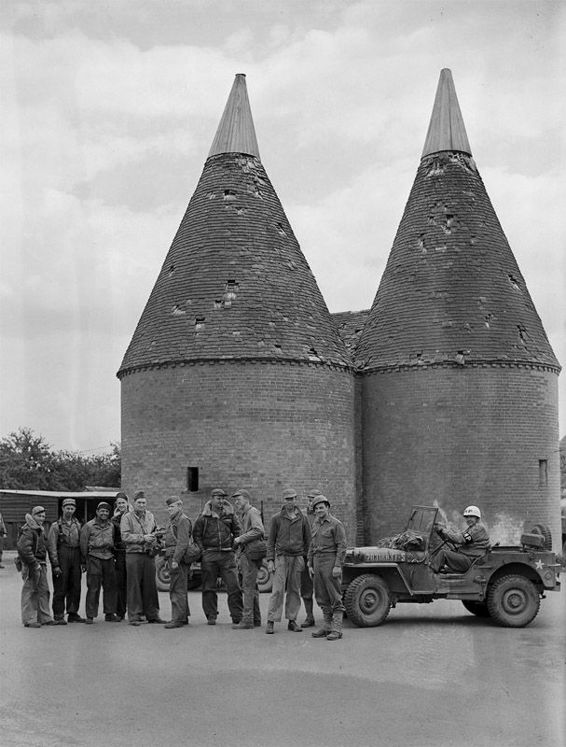
Members of the American 363rd fighter group at the Advanced Landing Ground, Chickenden Farm, Staplehurst. (WanPs-2059)
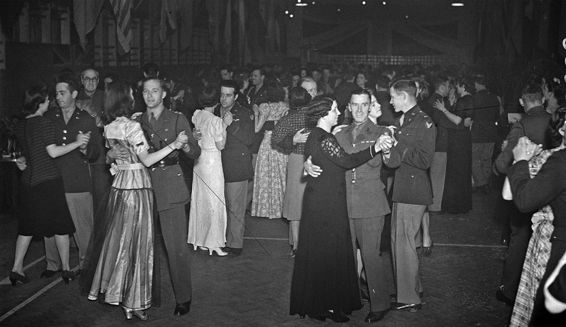
This photograph shows people enjoying a dance for American servicemen held at Maidstone. (WanPs-2378)
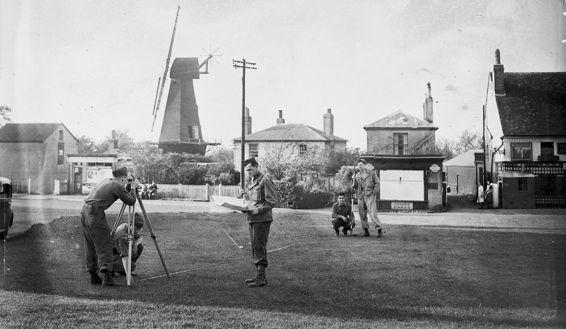
A US army survey unit photographed at Meopham. (WanPs-2246)
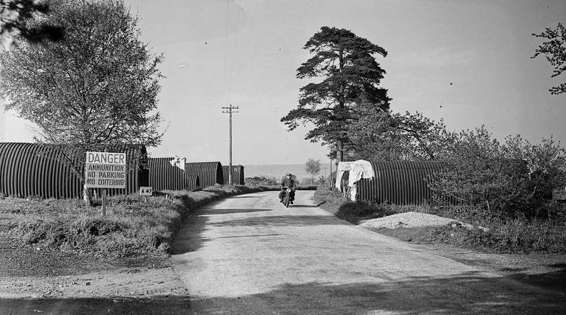
On the run-up to D-Day, the country roads were lined with equipment dumps. This photograph was taken ‘somewhere in Kent’ and shows an ammunition dump located by the roadside. (WanPs-2214)
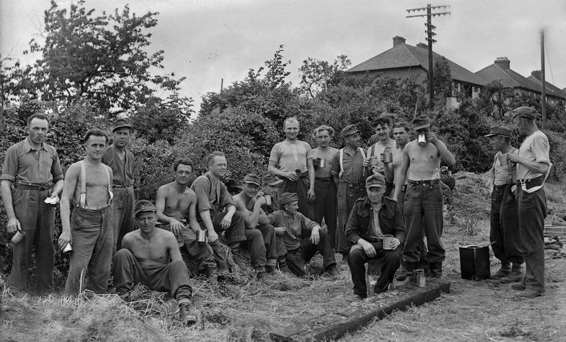
An inevitable consequence of the successful invasion of France was the capture of thousands of German prisoners of war. Many of these POWs were employed in work around the countryside. These prisoners, photographed in Kent, are taking a break from the work they are carrying out. (WanPs-0084)