
Chapter Four
Kent has long had an association with the British Army. The county was for many years represented by two county regiments, the Queen’s Own Royal West Kent Regiment whose formation dates back to 1881, and the Buffs (Royal East Kent Regiment) whose formation dates back 1751. Both regiments have gone through a number of amalgamations and are now part of the Princess of Wales Royal Regiment. The regimental depots of the Royal West Kents and the Buffs were at Maidstone and Canterbury. Another military site long associated with Kent are the firing ranges at Hythe. The Small Arms School Corps, a small corps of the British Army responsible for maintaining the proficiency of the army in the use of small arms, support weapons and range management, were located here for many years until moving to Warminster in Wiltshire in 1969.
The Territorial Army in Kent was represented by The Kent Yeomanry. This was formed in 1920 with the amalgamation of the Royal East Kent (The Duke of Connaught’s Own) Yeomanry (Mounted Rifles) and West Kent Yeomanry (Queen’s Own). In a similar manner to the regular Kent infantry regiments, the Yeomanry has also gone through a number of amalgamations and survives today as C (Kent & Sharpshooters Yeomanry) Sqn, part of The Royal Yeomanry.
During the Second World War, many units of many nationalities representing the Allied Armies were stationed in Kent. Initially they played the part of the County’s defenders, then as the war progressed and the tide turned against the Axis forces, became part of, or supported the Allied Forces fighting in Northern Europe.
One of the Second World War’s most charismatic commanders, Lieutenant-General Sir Brian Horrocks KCB KBE DSO MC, the commander of XXX Corps during its advance through Europe in 1944/45, recalls his experiences in Kent in 1941:
I was delighted when on the 25th of June I was made an acting major-general and ordered to take over command of the 44th (Home Counties) Division. The 44th was an old-established Territorial division, whose three brigades came from Surrey (the Queen’s 131st Bde), Kent (the Buffs and the West Kents 132nd Bde), and Sussex (133rd Bde) and occupied the south-eastern corner of England. I found myself therefore, responsible for what was then regarded as the No. 1 German invasion area, stretching from the Isle of Thanet to Dover and on to Folkestone.
Invasion or not, it was certainly the most exciting part of England at that time. We had a grandstand view not only of the Battle of Britain, with its dog-fights over our heads, but also of the nightly naval war that went on in the Channel.
At this time the man in charge of South Eastern Command was none other than Lieutenant-General Bernard Montgomery, who would go on to become the well-known Field Marshal Montgomery. When ‘Monty’ had taken over South Eastern Command, he had instituted a regime of continuous training and insisted on high levels of physical fitness for both officers and other ranks. He was ruthless in sacking officers he considered would be unfit for command in action. General Horrocks describes his experiences of this after being posted to SE Command:
I had previously experienced Mongomery’s training methods when I had been a brigadier in his 3rd division just after our return from Dunkirk, but even so I was unprepared for his atonishing activity as the GOC-in-C South Eastern Command. It was as though atomic bombs were exploding all over this rural corner of Britain. Before his arrival a distinctly peace-time atmosphere had prevailed. All this changed overnight.
General Montgomery immediately made changes that prevented officers and warrant officers living with their families. He reasoned that in war a soldier could not concentrate on his military training if half his mind was concerned with domestic problems.
The second major change he made was regarding physical fitness. General Horrocks goes on to explain in his autobiography that Monty believed that too many officers spent too much time in their offices and were becoming fat, almost permanently chair-borne and no good for war. Montgomery dictated that, Every officer in command must carry out two cross-country runs weekly, irrespective of age or rank’. Horrocks describes in his memoirs how his senior medical officer protested against this no-exception rule and mentioned a senior administrative staff officer. ‘Colonel X must not run sir. If he does he will probably die.’ Monty replied, ‘Let him die. Much better to die now rather than in the midst of a battle when it might be awkward to find a replacement.’ Colonel X did run and Colonel X didn’t die.
Monty put in place a scheme of constant training exercises of every sort in South Eastern Command. He became highly respected by many that served under him. General Horrocks describes how he was regarded during his tenure as Commander in the South East:
Army Commanders with many thousands of troops under their command tend to become remote god-like characters who few know even by sight. Yet in some extraordinary way Monty’s influence permeated all strata of SE Command, and his knowledge of the personalities under his command was uncanny.
Many soldiers experienced life in Kent during the war. Here is a personal recollection by Corporal Arthur Bridge who was based at Hothfield Camp near Ashford:
For a long period in 1945 I was an 18-year-old Corporal in 9th Btn the Worcestershire Regiment on Hothfield Common. The 9th Worcestershire was situated on the left hand side of the road and on the right hand side was a battalion of the Royal Warwickshires. So you had two battalions, approx 1,200 infantry soldiers, camped there. I say camped, but from a Worcestershire point of view it was a fine posting. The Nissen Huts were in good condition and all paths and in-camp roadways immaculate. There was a very good bath area, a fine Mess Hall and always plenty of hot water. The only drawback was the toilets!!! They consisted of pits, planks and canvas. I suppose they may had [sic] been but I never remember them being emptied. Things must have grown very well there for years after! I remember my time at Hothfield fondly. The countryside was lovely. Ashford in those days was a pleasant market town.
Arthur goes on to describe the importance for the soldiers based at Hothfield Camp of the local station in those days, known as Hothfield Halt:
Quite a few of the stopping trains from Charing Cross called there and to us it was an important station. This was especially so on a Sunday night when we returned from a 24 hour or 48 hour leave. More important it was an open station after a certain time at night. This was important because lots of us on 3 or 4 shillings per day had either no ticket, or ones that had run out far short of Hothfield.
The front of the camp – on the road – was a fine sight with grass well cut and the regimental badge and motto (FIRM) picked out in white stones and flowers. There was also a tall flagpole and the flag was ‘bugled’ up at reveille and lowed [sic] at lights out. We had some very fine buglers and had you lived there then you maybe would have not welcomed it at 6:30 in the morning. I was of course there on 8 May which was VE Day. Most of us were given a 24-hour pass. A lot of us travelled to London (back early hours to the Halt). The rest went into Ashford.
There were significant risks involved in serving on the Home Front as well as overseas. Not only was it possible to be killed by enemy action, the danger of death from accident was also high.
This is graphically illustrated as reported in the East Kent and Dover Express on 19 January 1945 when a live mine exploded killing twenty soldiers and severely injuring others. The Express reports the incident as happening at ‘a camp in Kent’, without giving a specific location, presumably as a result of wartime reporting restrictions, but is believed to have possibly been at Hythe. The explosion occurred inside a Nissen hut during a lesson when an instructor was giving a lecture to a class of thirty-five men, who included those recovering from wounds and undergoing a refresher course. Due to a shortage of dummy mines, the instructor Lance-Sergeant Herbert Fisher was using a live mine. A survivor, Pte Harry Bentley, explained how he had handed the mine to Sergt Fisher who had commenced to move the lever mechanism on the mine when it exploded. Pte Bentley explained that it was a mystery why the mine had detonated as he had in his hand both the cartridge and detonator, so the mine should not have functioned. Early in the inquest proceedings, the coroner had been informed that there was a live mine in the courtroom that had been brought in as evidence! The coroner on finding that a live mine was present at the proceedings, stated then I must ask that it is immediately taken from the room. I wish for no demonstrations with live mines here.’
From the description of the event, it seems likely this mine was a British Mk 1 or Mk 2 anti-personnel fragmentation mine. This type of mine was similar in function to the deadly German S-mine which, when initiated, was launched into the air by a propelling charge and then exploded above ground to maximise injury. A verdict of death by misadventure was recorded. It is almost inconceivable today that a live antipersonnel mine would be used for instructional purposes, let alone be brought into a court inquest. At the time however, such items were commonplace and perhaps it was a case of familiarity breeding a certain amount of contempt which contributed to this tragic accident.
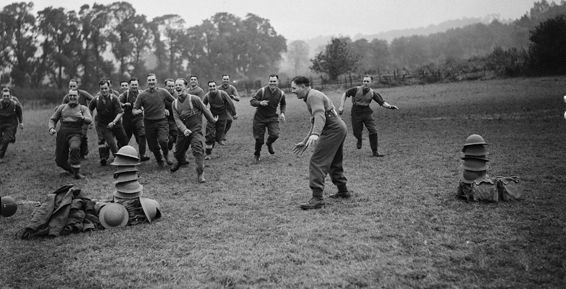
Soldiers of what is believed to be the 46th Light Anti-Aircraft Regiment playing football at an unknown location in Kent, c.1940. (WanPs-0055)
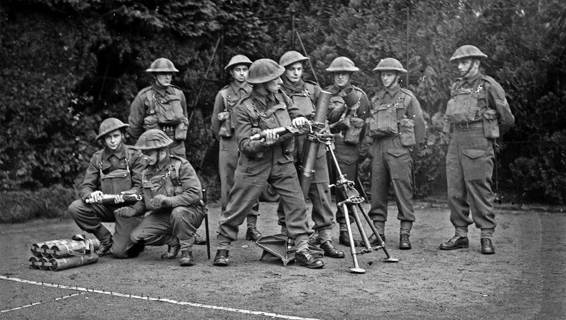
The crew of a 3-inch mortar posing for the camera. The unit these men belong to is unknown. Their helmets feature unusual camouflage painting. The mortar bombs appear to be live mortar bombs – they are fitted with an early No. 150-type percussion fuse. (WanPs-0069)
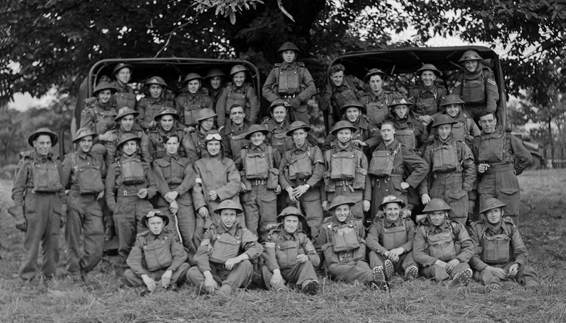
A group of Royal West Kents photographed during Exercise Bumper in 1941. This exercise involved British and Canadian forces around East Anglia and London and surrounding area. It was designed to test the ability of British forces to destroy a German Army after invading Great Britain. (WanPs-0075)
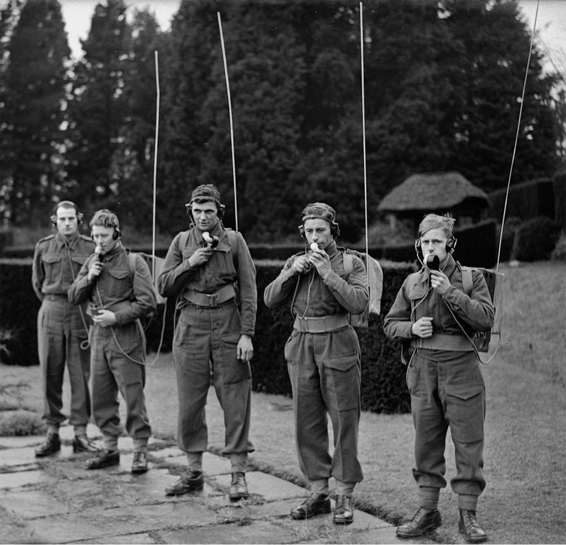
Army radio operators training with portable No. 18 wireless sets. (WanPs-0181)
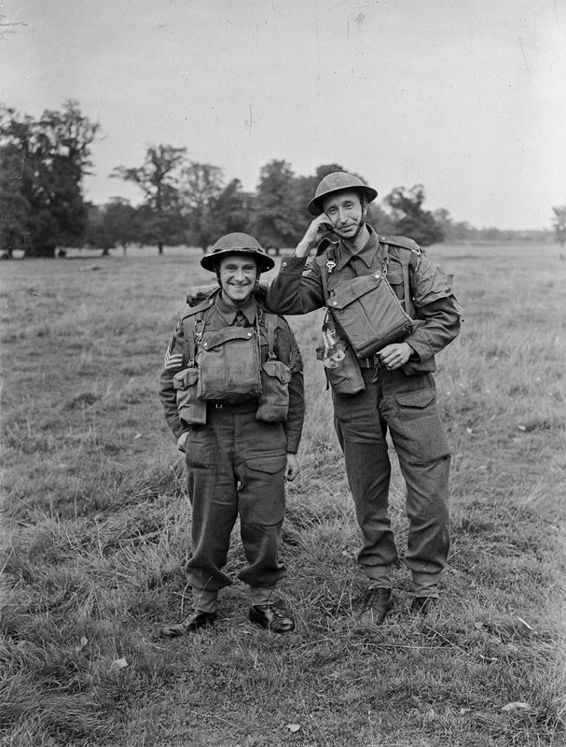
Two British Army NCOs c.1942 of very different heights – no doubt posed by the photographer. Note the gas detector brassard worn by both men on the left arm. The NCO on the right also has his protective anti-gas eye shields tucked into his webbing above his right hand ammunition pouch. (WanPs-0199)
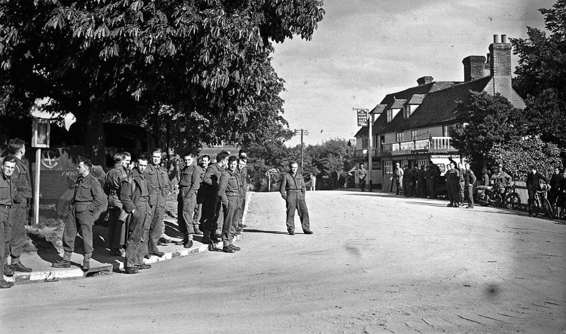
Troops on exercise photographed outside the Gun Hotel, Horsmonden, near Royal Tunbridge Wells. (WanPs-0205)
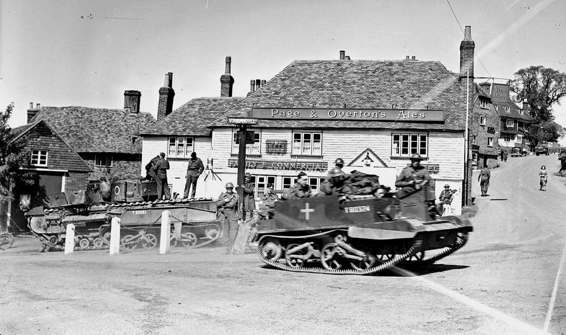
A Universal Carrier passes a Churchill tank, undergoing maintenance or repair, parked in front of the Vine Hotel in Goudhurst. Note the white cross painted on the side of the universal carrier, marking it as a distinct member of one of two exercising forces. (WanPs-0206)
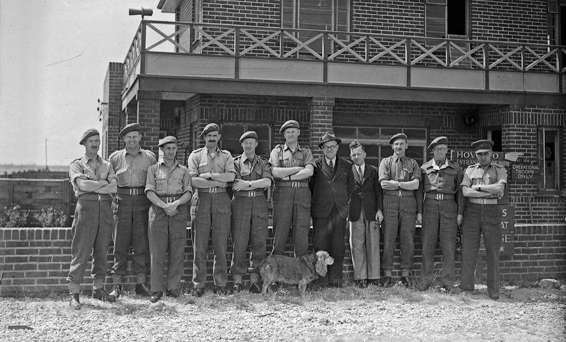
A mixed group of army officers and civilians, photographed in what is believed to be the Lydd area. (WanPs-0308)
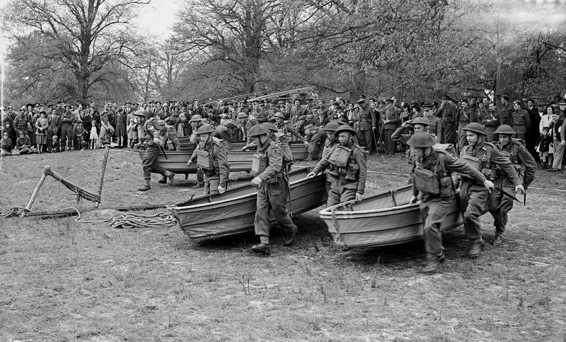
Troops practising or possibly performing a public demonstration with collapsible assault boats. The photograph is taken in Mote Park, Maidstone. (WanPs-0320)
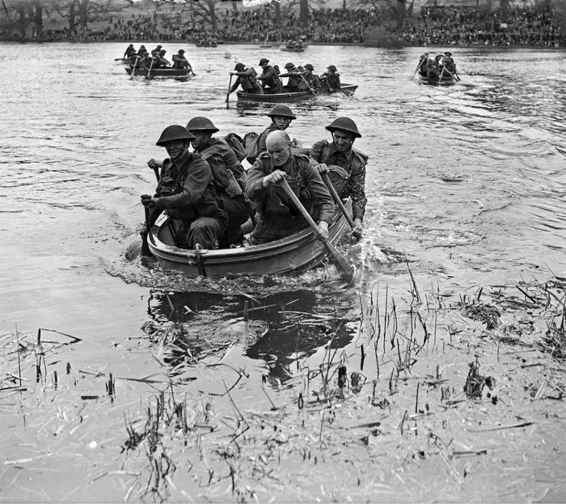
Another photo of the troops exercising in Mote Park, Maidstone. On the banks of the lake can be seen a large audience of spectators. (WanPs-0325)
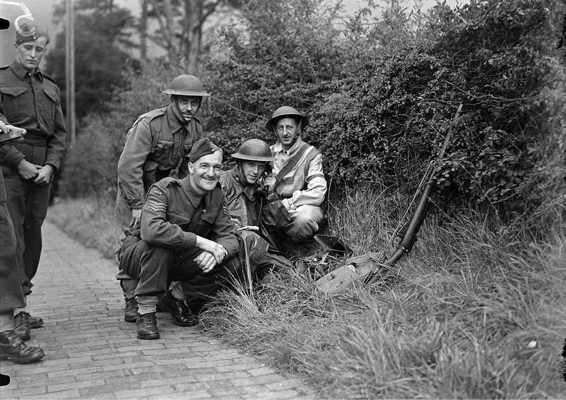
A group of Royal Canadian Corps of Signallers posing for the camera. Note the .303 SMLE rifle resting on the hedge. A signal cable can be seen running behind the soldiers on the hedge. (WanPs-2133)
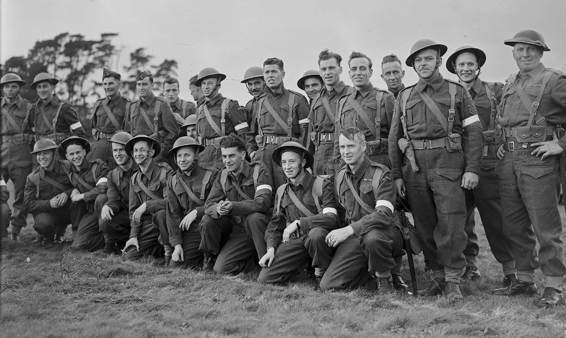
A photograph of a group of soldiers belonging to the Royal Canadian Corps of Signals. Note the sergeant who is armed with a pistol (holstered on his belt). A number of these men are wearing white armbands, reason unknown, but they may well be part of a unit acting as umpires during an exercise. Those not armed with a pistol are also wearing All-Arms pattern ’37 double cartridge carrier ammunition pouches. These were normally issued to non-infantry units, e.g. mortar crews, armed with rifles, who did not need the ammunition carrying capacity of the larger basic pouch. The two tough looking soldiers on the bottom and rear rank on the right of the photograph are both wearing medal ribbons indicating that they served in the First World War. (WanPs-2134)
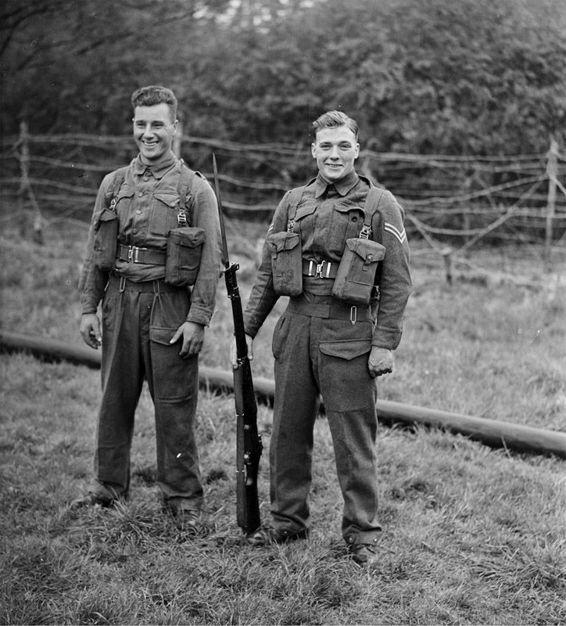
A photograph of two British soldiers, believed to have been taken in the Maidstone area. The corporal on the right is armed with a .303 pattern 1914 (P14) rifle. (WanPs-2146)
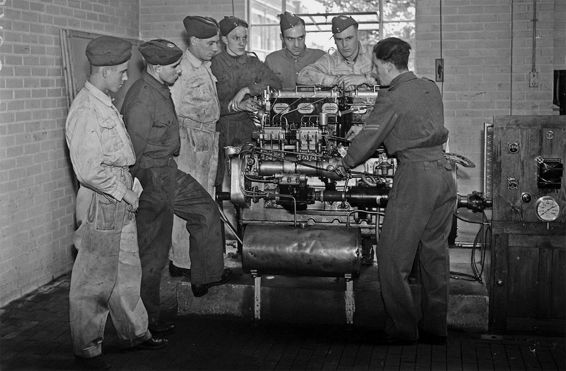
Soldiers (probably Royal Engineers) being instructed by a corporal under instruction on a Gardner diesel engine. (WanPs-2169)
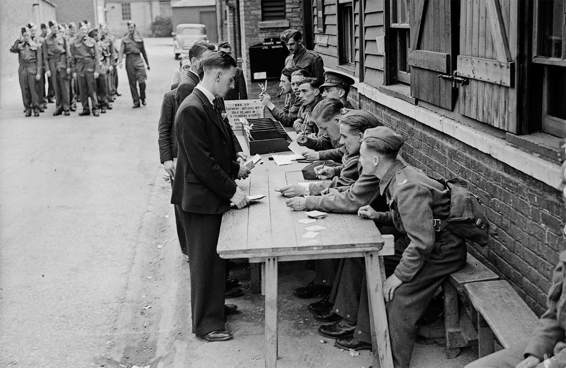
New recruits at a Royal West Kent training depot, c.1940. (WanPs-2327)
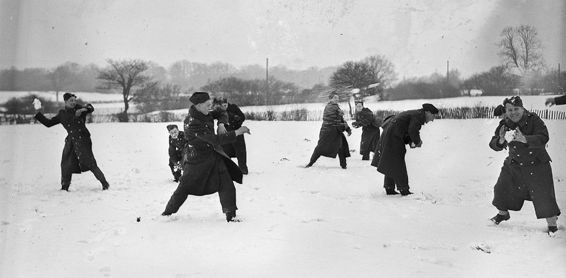
An image showing what might be titled ‘soldiers at play’. Why let a war spoil a good snowball fight! (WanPs-2331)
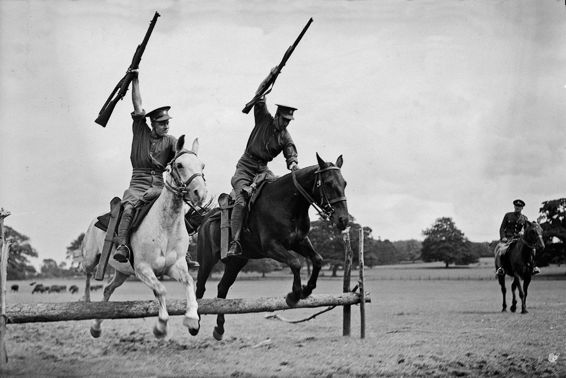
Mounted troops practising. Whilst the identity of the unit these men belong to is unknown, Territorial Yeomanry mounted cavalry regiments between the wars were re-roled as artillery. The two Yeomanry regiments that existed in Kent prior to amalgamation and conversion to an artillery unit were The Queen’s Own West Kent Yeomanry and the The Royal East Kent Yeomanry. (WanPs-2360)
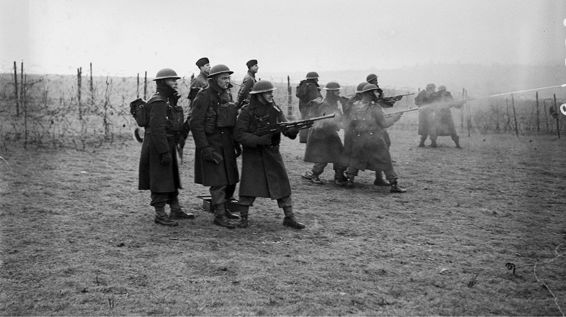
Soldiers live-firing Bren guns from the hip. The soldier in the middle is firing tracer ammunition which can be seen leaving the barrel of the gun, and is firing left handed. (WanPs-2369)
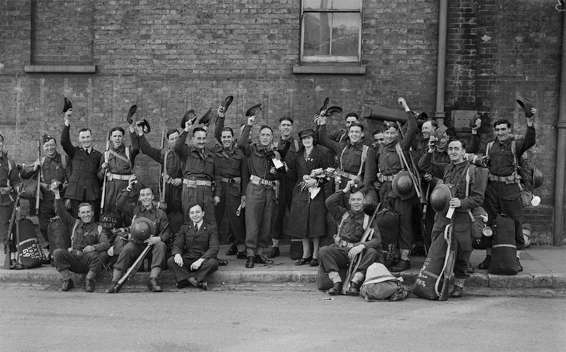
A group of soldiers of the Royal Army Service Corps. Where these men are heading is not known, but one soldier seated at the front right appears to have a tropical topee on the top of his pack. (WanPs-2373)
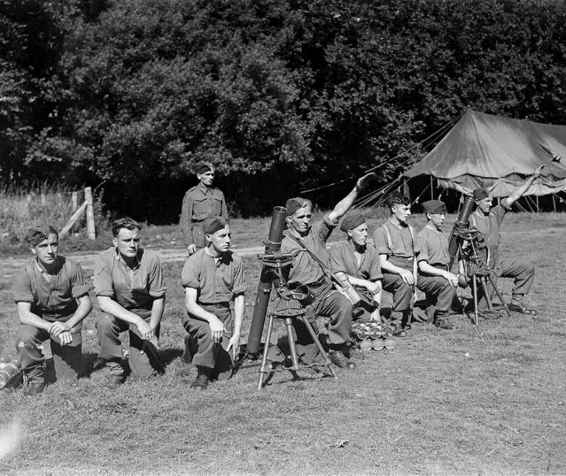
Soldiers in shirtsleeves, practising with a 3-inch mortar. (WanPs-2453)
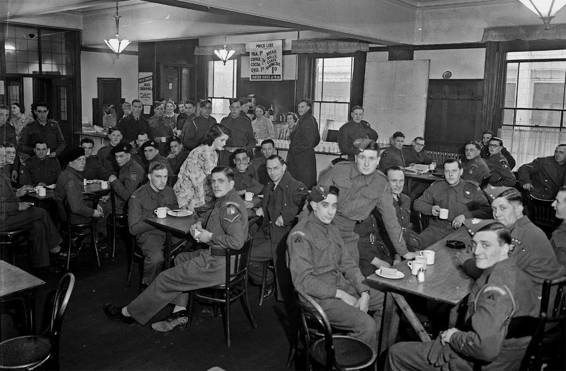
Soldiers photographed enjoying the proverbial cuppa in a Church Canteen at Folkestone. (WanPs-2468)
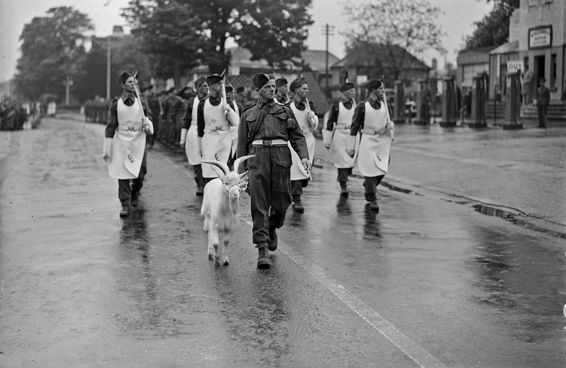
A military parade taking place at an unknown location in Kent with the regimental mascot at the front. The mascot appears to be a Kashmir goat which is associated with Welsh Regiments (The Royal Welsh Fusiliers, The Royal Regiment of Wales, and the Royal Welsh Regiment). It is believed that the men on this parade are those of the Royal Welsh Fusiliers. The 53rd (Welsh) Infantry Division was based in Kent from 1941 to 1943. (WanPs-2474)
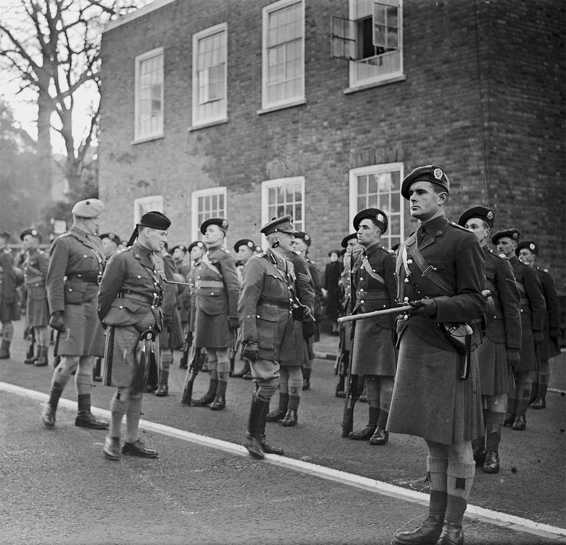
A military parade believed to be at Crescent Road, Tunbridge Wells. The unit being inspected is the 1st Battalion London Scottish. The London Scottish was a London based Territorial unit, part of 168 Brigade, 56 London Division, and known to have been based at Broome Park, near Barham at the end of April 1940. (WanPs-2497)
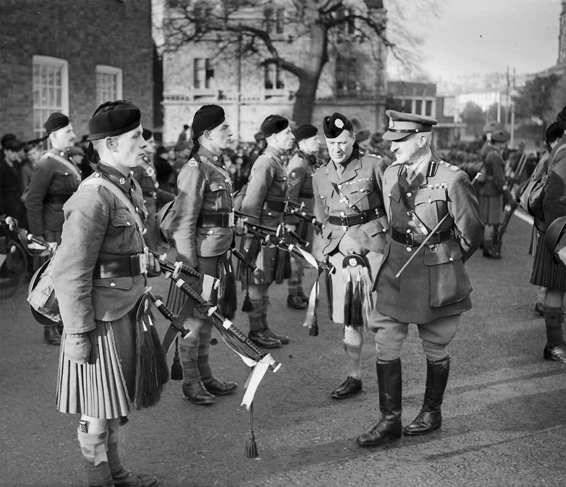
The pipe band of the London Scottish being inspected at Crescent Road (opposite assembly rooms), Tunbridge Wells. (WanPs-0170)