
Chapter Three
Identity Cards
As war approached, preparations were made to enable a national register to be rapidly compiled and identity cards issued. Every man, woman and child had to carry an identity (ID) card at all times and the cards would include the following information:
· Name
· Sex
· Age
· Occupation, profession, trade or employment
· Address
· Marriage status
· Membership of Naval, Military or Air Force Reserves or Auxiliary Forces, or of Civil Defence Services or Reserves.
Approximately 46 million cards were issued. The card had to be produced to a policeman or member of the military on demand, or alternatively within two days at a police station. Posters were created urging people to ‘Carry Your Identity Always – you may be asked for it anytime to prove to the police or military who you are and where you live.’
The Dover Express on Friday 14 June 1940 carried an announcement from the Registrar General ‘to remind the public that the military as well as the police are now empowered to demand the production of National Registration Identity Cards. As these powers may be widely exercised in future by both the military and the police the need is emphasized for all persons over 16 to carry their identity cards about with them.’
Not everybody heeded this advice. In October 1941 Louisa Chubb was summoned to appear at Dover Police Court for failing to produce her identity card on 2 September 1941. She was given a form requiring her to produce the card in two days. This did not happen, so enquiries were made and it was ascertained that she was in fact away hop picking. The identity card was not produced until 15 September. In court she stated that she ‘thought it would be alright if she did not show it’. The police looked upon these cases as very serious matters. Pleading guilty she was fined 10s with 4s costs.
Again in Dover during a weekend in November 1943 a check-up on identity cards at dances and cinemas was carried out by the police. As a result nearly 200 people were found without their identity cards. All were required to produce them at the police station within forty-eight hours. It was emphasised again in the report in the Dover Express, ‘It cannot be too widely known that identity cards should be carried. Much unnecessary work for the police and inconvenience to the people themselves is caused by their action in leaving their identification at home.’
The Identity Card was finally abolished in February 1952.
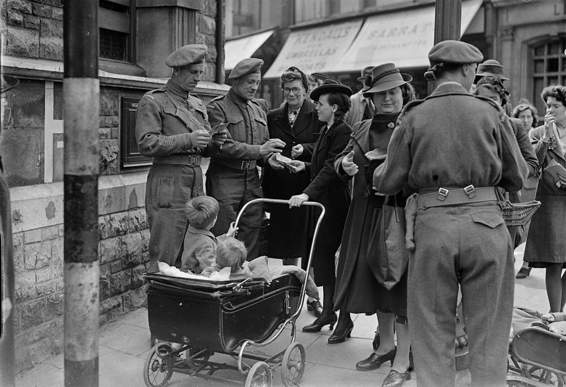
Soldiers from the Leicestershire Regiment carrying out an identity check on the corner of the High Street and Military Road, Chatham, on 23 May 1944. The following information regarding this photo came from Maureen Tierney in July 2009. ‘The lady holding the pram was my mum. Her name was Ellen May Kitney, though everyone knew her as Ethel. The two boys in the pram are my brothers, Reg who has now died, and Jackie, now 67, who lives at Borstal. The lady beside her in the glasses is my auntie Daisy Carey. I was born four years later. My mum was just 24 when that photograph was taken. She was lovely and had long dark hair. My dad bought her the little suit she is wearing. They lived in Skinner Street, Chatham, at the time. My dad, Jack Kitney, was her second husband. He worked at Ambrose’s, the greengrocers off The Delce in Rochester for thirty-six years, and was three months off his 92nd birthday when he died. My mum had lots of jobs, mainly cleaning and fruit picking.’ The soldier on the far left is wearing a cotton .303 ammunition bandoleer across his chest and is sporting four seniority chevrons indicating he has four years army service. (WanPs-0033)
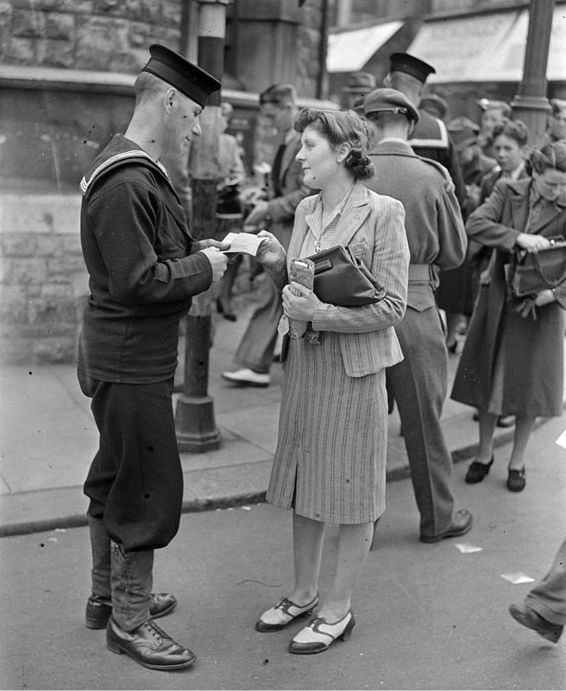
A naval policeman carrying out an identity check on Military Road/High Street Chatham, 23 May 1944. (WanPs-0169)
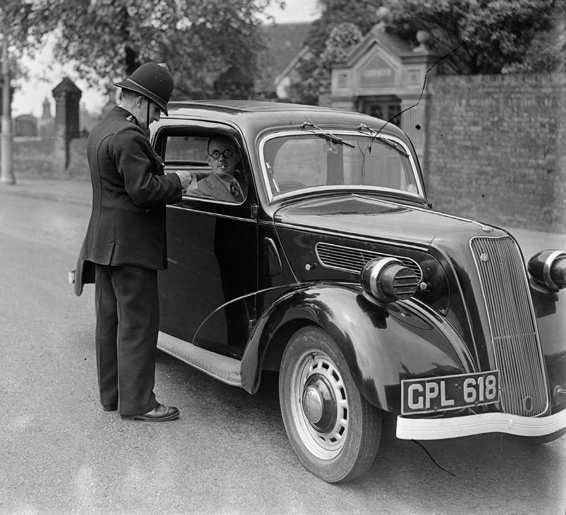
A policeman performing an identity card check on the driver of the Ford Popular saloon car ‘somewhere in Kent’, c.1941. (WanPs-0262)
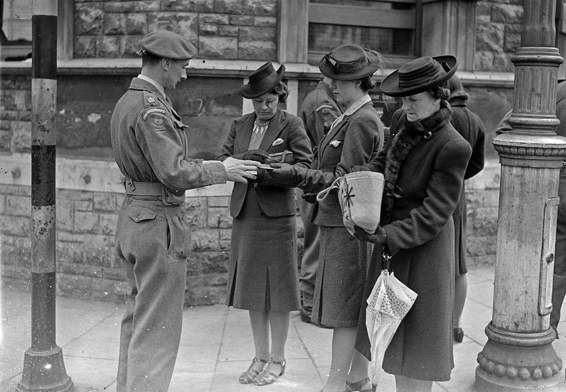
An army major performing an ID check, corner of High Street and Military Road Chatham. (WanPs-0350)
Wings For Victory
In October 1942 the National Savings Committee announced that a Wings for Victory’ week campaign would be held between 5 March and 3 July 1943. This was to be based on previous appeals such as the War Weapons and Warship Weeks. The Wings for Victory’ event was to be built around air power in general and the Royal Air Force in particular. Dover’s Wings for Victory week set a target of raising £30,000, which equated to the cost of a flight of six Spitfire fighters. The week was opened by Air Vice-Marshal Basil Embry DFC AFC ADC. Embry was famous for having evaded the Germans for two months after being shot down. While making his way to Spain he was captured by the Vichy French. He escaped again and eventually arrived in Gibraltar after almost ten weeks on the run. Air Vice-Marshal Embry’s link to Dover was via his father Rev J. Embry who was vicar of St Bartholomew’s church (now demolished and replaced by a block of flats). The Dover Rural District Council total came in at a very successful £41,429.
Nearby Eastry District Council’s Wings for Victory week appeal was also extremely successful, with the magnificent total of £142,308 2s 6d raised against a target of £80,000.
Blood Donors
Many thousands of lives were saved as a direct result of blood transfusion. During the war volunteers came forward readily to give their blood to hospitals for transfusion purposes for bomb casualties and other causes. Blood plasma could be dried and exported to all war fronts. The British public was bombarded with emotive images and appeals, to such an extent that donor responses remained defiantly high in spite of air raids. Glowing recommendations of transfusion enabled the civilian public to feel empowered in the war effort. The romantic appeal of saving the lives of men in the field served as a powerful incentive for donation. Posters were created with an image of a charging British soldier framed by a symbolic blood plasma bottle, with a banner proclaiming ‘If he should fall, is your blood there to save him?’
It was yet another important national service for which the people of Kent during the war volunteered in great numbers.
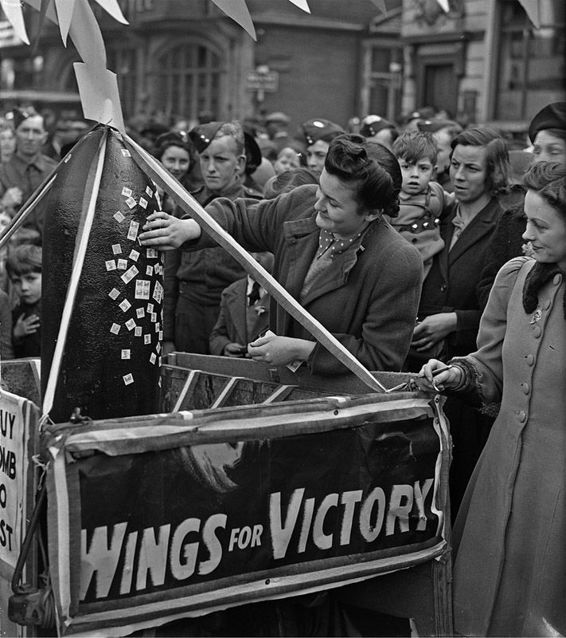
Sticking saving stamps on a bomb for direct delivery by the RAF to Hitler in the Wings for Victory week outside the County Hotel, High Street, Canterbury. Watching on the extreme left is Private S. Butler of the Sturry Home Guard. (WanPs-0031)
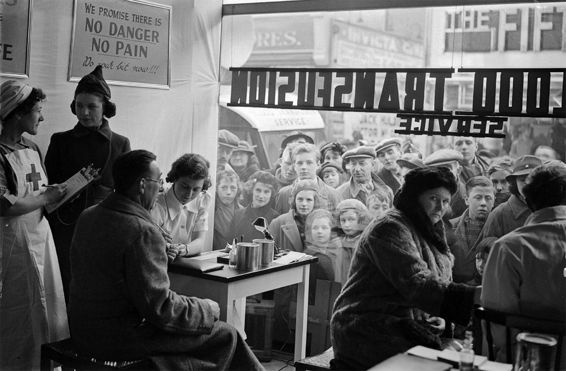
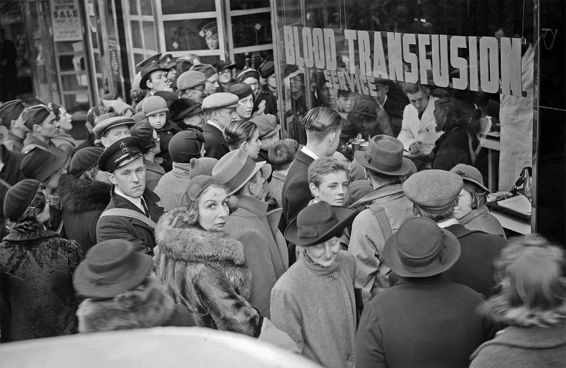
Two photographs of the Blood Transfusion Service donors clinic in High Street, Chatham, c.1941. (WanPs-0185 & 2155)
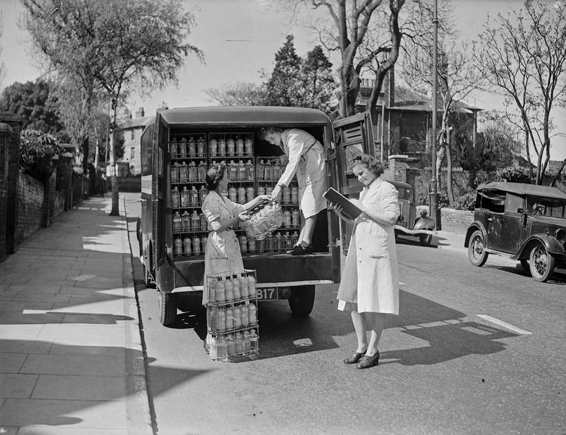
Blood for the Eighth Army. Eight hundred bottles of dried blood given by donors in Kent being packed into a van at Maidstone for shipment to North Africa, April 1943. (WanPs-0269)
Mobile Canteens
During wartime it became the legal responsibility of all employers of 200 or more workers to provide canteen facilities. The rapid de-centralisation of industry created a sudden demand for mass feeding which could not be met by ordinary means. Provision also needed to be made for the victims of air raids whose homes had been destroyed or damaged and who could not feed themselves.
The expansion of the armed forces also resulted in units being stationed in remote villages or away from main centres. These troops needed to be provided with food and sustenance. Organisations such as the Women’s Voluntary Service (WVS), Young Men’s Christian Association (YMCA) and the Navy, Army and Air Force Institutes (NAAFI) provided mobile refreshment wagons.
During the blitz in 1940, these mobile facilities had provided a vital service. In 1941, the Ministry of Food felt that the often ad-hoc arrangements for deploying the available mobile facilities in emergency situations requiring large numbers of people to be fed, needed backing up with more formal arrangements. As such, what was known as the ‘Queens Messengers Convoys’ were created. Each convoy consisted of twelve vehicles, one water tank lorry, two food storage lorries, three mobile canteens and four motorcycles. Apart from the men who drove the heavy lorries and lifted the heavy kitchen equipment from the lorries, the convoys were almost entirely staffed by approximately fifty WVS members. A convoy could feed up to 6,000 people per day.
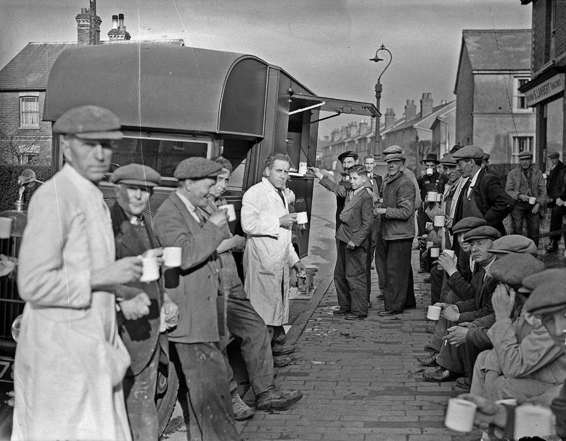
Perhaps one of the more unusual mobile canteens, based in Kent during the war. This vehicle appears to be based on a Rolls Royce vehicle. The photograph is believed to have been taken in Tunbridge Wells. (WanPs-2465)
Many of the vehicles were provided by donations from the British War Relief Society, a US-based humanitarian organisation dealing with the supply of non-military aid such as food, clothes, medical supplies and financial aid to people in Great Britain. In Kent during July 1941 one such vehicle was presented to one of the Queens Messengers Convoys based in Kent. The vehicle was inscribed ‘To the people of Dover, from the people of Dover, Massachusetts, USA’. The vehicle was formally handed over by the head of the British War Relief Society, Mr B. de N. Cruger in London. After being inspected by the United States ambassador’s wife, Mrs Winant, the vehicle was driven to Dover. The local newspaper at the time described the vehicle as being of the ‘latest type to make its appearance in the country, being fully equipped with kitchen utensils, including two thermos urns, bakelite cups and soup plates, cutlery, a sink and a paraffin stove’. Its purpose was declared to be for air-raid use in Kent. These vehicles must have provided a welcome sight during wartime to those either living or stationed in Kent.
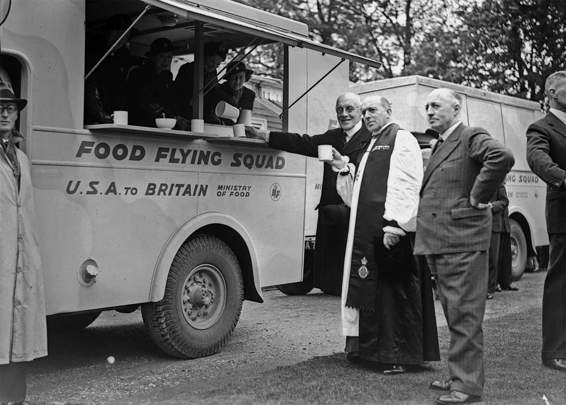
A WVS Queens Messenger convoy ‘food flying squad’ providing some welcome sustenance to what appear to be local dignitaries somewhere in Kent. (WanPs-0258)
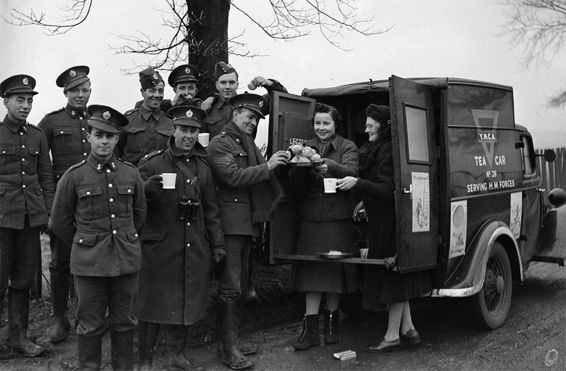
A Royal Engineers anti-aircraft unit at a YMCA tea, car c.1941. By 1943 in Kent, the YMCA was running thirty-eight such mobile canteens. (WanPs-0304)
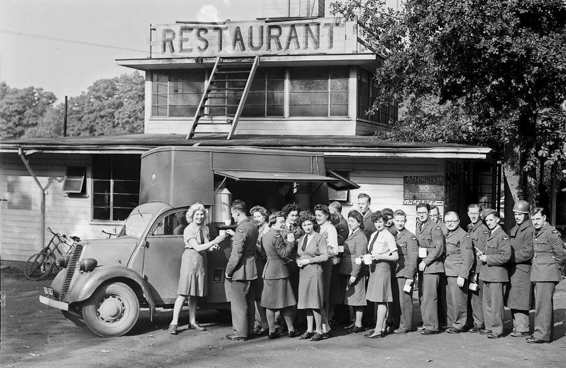
A NAAFI tea wagon photographed at Shorne, near Gravesend providing a welcome cup of tea to the personnel of No. 23 Barrage Balloon Centre at Gravesend Airfield during 1944. This unit was deployed here as part of the Anti-diver Belt (defences against the V1 flying bombs) for the Medway Towns. These defences were made up of balloons drawn at short notice from all over the UK in June 1944. (WanPs-2366)
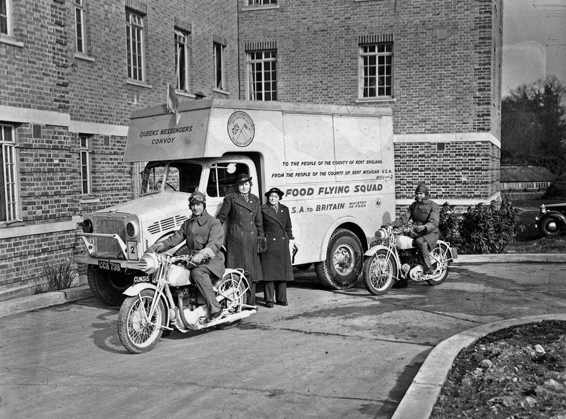
A Bedford OX 30 Food Flying Squad mobile canteen. This vehicle was provided by donations from the people of Kent County, Michigan, USA, which is inscribed on the side of the vehicle. Two of the convoy’s motorcycles and riders are also shown. (WanPs-0337)
Rationing
The first commodity to be controlled after the Second World War began in September 1939 was petrol. On 8 January 1940, bacon, butter and sugar were rationed. This was followed by successive ration schemes for meat, tea, jam, biscuits, breakfast cereals, cheese, eggs, lard, milk and canned and dried fruit.
The Dover and East Kent Express in January 1940 carried an advertisement from the Ministry of Food entitled ‘Reasons for Rationing’. It explained that war had meant the re-planning of food supplies, the reason being that most of our bacon, butter and sugar came from overseas. Four main reasons were given for the need for rationing:
1. The prevention of waste of food – We must not ask our sailors to bring us unnecessary food cargoes at the risk of their lives.
2. Increasing the war effort – Our shipping carries food and armaments in their raw and finished state and other essential raw materials for home consumption and the export trade. To reduce our purchase of food abroad is to release ships for bringing other imports. So we strengthen our war effort.
3. Divides supplies equally – There will be ample supplies for our forty-four and a half million people. But we must divide them fairly, everyone being treated alike. No one must be left out.
4. Prevents uncertainty – Your ration book assures you of your fair share. Rationing means that there will be no uncertainty – and no queues.
During the course of the war, rationing certainly resulted in the prevention of uncertainty. Unfortunately for many people in Kent and elsewhere in the country, the promise about the prevention of queues did not!
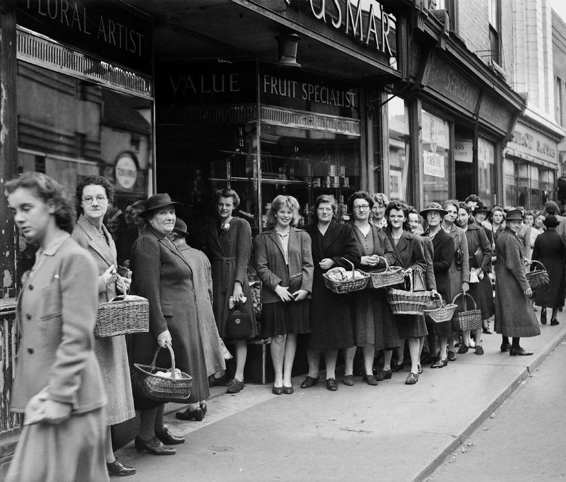
Women queuing outside a fruit shop, Week Street, Maidstone. (WanPs-0295)
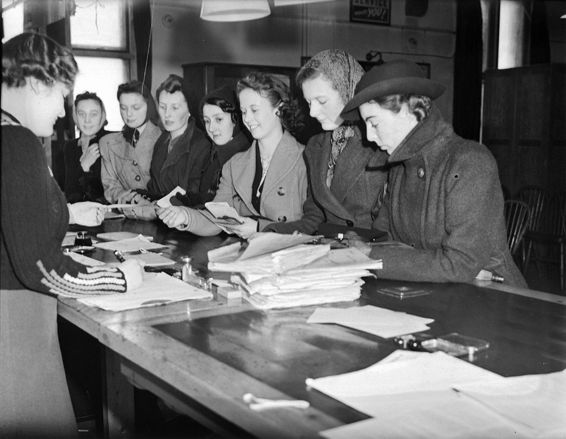
Women collecting ration coupons. (WanPs-0106)