
Chapter Six
With its closeness to occupied Europe, the impact of the war on Kent was dramatic. ‘Hellfire Corner’ – the area nearest to occupied Europe and on the outskirts of London – was the county which directly suffered the greatest impact of the war and German attacks.
Its closeness to London also made it relatively easy for VIPs to visit. As a result, the county received visits to both the civilian population as well as to the armed forces stationed in Kent. Visitors included the Prime Minister Winston Churchill, King George VI and the Queen, The Duke of Kent (although he was killed in an air crash on 25 August 1942) and Princess Marina, Duchess of Kent. All would visit Kent on a number of occasions.
During the war royal visits were not subject to preliminary announcements, for security reasons. Because they visited unannounced, often with the shortest of notice, they were sometimes not greeted by thronging crowds.
Shortly after a devastating cross-Channel bombardment of Dover, it was suggested that the King and Queen visit, to encourage the inhabitants. They drove through the streets viewing the damage and the King suggested that they should call on a home which had been closely affected by the shelling. The mayor agreed and the King, wearing his customary naval uniform, alighted from the car with the Queen by his side. Their rap brought a teenaged girl to open the door. ‘Is your mother home?’ the King enquired, as he and Her Majesty stepped forward. ‘No, she ain’t’, replied the girl, ‘but she said, “if a sailor and a lady calls, you’re to tell ’em they can ’ave the upstairs backroom for 5 shillings for an hour.”’
The King visited East Kent again on 12 April 1940 to inspect military units. He had been forced to cut short another previously owing to a snowstorm. He had promised to visit again and was as good as his word when he returned again soon in April.
As a result of the customary lack of preliminary notice, when the King visited Dover Castle it only became apparent that he was in the area when the royal car was seen to arrive, and the Union Jack flying from the castle keep was replaced by the Royal standard, measuring 20ft × 10ft. Arriving at the castle at 12.25pm, after driving through the town he proceeded to inspect infantry battalions, a signal training battalion, and army classes who were seen at work at various stages of their training. He finished off the visit to the castle by inspecting a contingent of ATS. During the visit the King’s progress was marked by enthusiastic cheers wherever he went.
After visiting the castle the King went on to inspect other units in the area which included an anti-aircraft battery, two more bodies of infantry, and field artillery units going through various phases of training. The King returned to Dover at the end of the visit and returned to London, travelling by special train from Dover Marine Station.
Both the King and Queen paid another visit to Dover and Folkestone in October 1944. The visit started at Dover where they inspected an honour guard formed by the Women’s Royal Naval Service, The Women’s Auxiliary Air Force, The Auxiliary Territorial Service and the National Fire Service. The people of Dover thronged the battered streets and welcomed the royal entourage. Whilst at Dover the King and Queen visited the underground cave shelters in Dover where the people were forced to take shelter during the German bombardments from across the Channel and from the air. From Dover the royal couple travelled to Folkestone where they were given another great welcome at the county cricket ground.
The Prime Minister Winston Churchill visited the county in the autumn of 1942, accompanied by the President of South Africa, Field Marshal Smuts, Mr Henry Morgenthau (Secretary of the US Treasury), and Mr Averell Harriman (President Franklin D. Roosevelt’s special envoy to Europe). Arriving at Dover Priory station the party was greeted by the Mayor, Alderman J.R. Cairns, and senior military officers representing the Navy and the Army.
The announcement of their arrival had been communicated about an hour before to the townspeople by means of the loudspeakers used to give warning of immediate danger from enemy action – a method which enabled considerable numbers of people to congregate along the route from the station to the land at the rear of the police station where General Smuts and the Prime Minister were to inspect representatives of the civil defence services. The couple were cheered along the route as they passed by.
On this visit Churchill chose to dress in a dark coat and peaked hat accompanied with his proverbial cigar and stick. The Prime Minister stated that he was very happy to come down to Dover and to find that after three years of war the defence services were in good spirits. He felt sure that the spirit of Dover, this ancient port famous throughout the world, guardian of the white cliffs, was as high as it had ever been.
The Duke and Duchess of Kent also visited during the war, although the Duke was tragically killed when the Sunderland flying boat in which he was flying whilst heading to Iceland, where the Duke was to meet senior members of the US military, crashed into Eagle’s Rock, near Dunbeath, Caithness. He was the only member of the royal family in recent times to have died on active service.
Prior to his death the Duke had visited Kent in September and December of 1940. On 5 September he visited the Royal Observer Corps post at Dover where its members kept an unbroken watch day and night. He stayed for a considerable time, was keenly interested in everything, and displayed quite a knowledge of observer work. He congratulated the crew on its great help to the Air Force and thanked the Head Observer for the privilege of being allowed to visit the nearest Observer Corps post to the enemy. In December 1940 he again visited Dover, this time to go to an ARP control centre. Afterwards the Duke visited some of the cave shelters and chatted to people who had taken refuge there, as there had actually been an air raid alert during his visit. The Duke also saw some of the considerable damage inflicted on the town.
The formal announcement of his death read: ‘The Air Ministry deeply regrets to announce that Air Commodore His Royal Highness the Duke of Kent was killed on active service yesterday afternoon, when a Sunderland flying boat crashed in the North of Scotland. His Royal Highness, who was attached to the staff of the inspector-general of The Royal Air Force, was proceeding to Iceland on duty. All the crew of the flying boat lost their lives.’ A subsequent message stated that the rear gunner had later been found alive. The Duke had a long association with the county of Kent. He met his future wife to be, Princess Marina, at Dover when she arrived in the county prior to their marriage in November 1934. He was also Colonel-in-Chief of the Royal West Kent Regiment.
On hearing of the tragic news of his death, the Mayor of Dover (Alderman J.R. Cairns) sent the following telegram to the Duchess of Kent: ‘The Corporation and inhabitants of Dover have learned with profound regret of your irreparable loss, and tender their heartfelt and respectful sympathy in your great sorrow.’ The Duchess’s reply to this heartfelt message of sympathy read: ‘Please convey to the town Council and the people of Dover my grateful thanks for their kind message, which has touched me deeply – Marina.’
After the Duke’s death, Princess Marina continued to visit the county in her role as Commandant of the Women’s Royal Naval Service (WRNS).
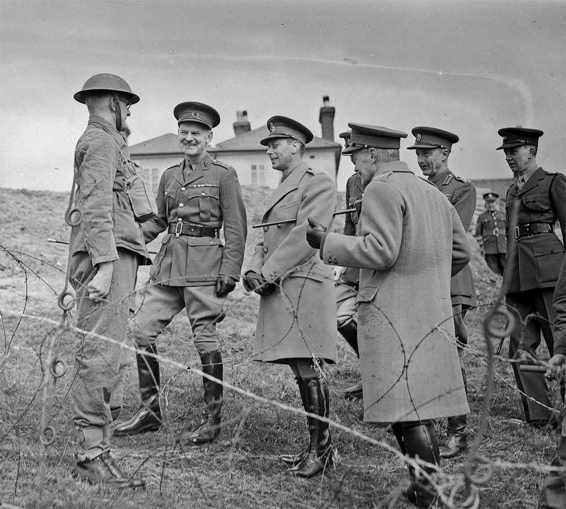
The original caption for this photo read, ‘April 1940, the King and Queen brought cheer to troops when they visited east Kent. The King inspected defence preparations along the coast. Here he is seen at Shorncliffe, Folkestone.’ (WanPs-2160)
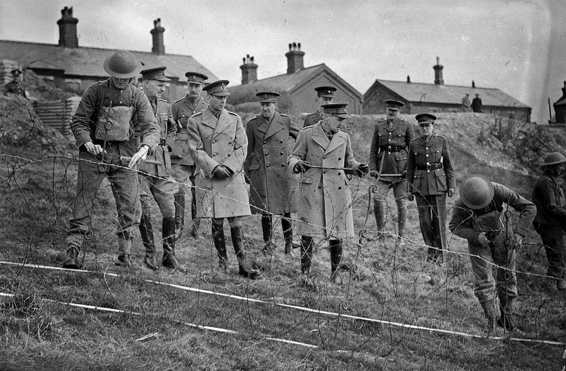
Another photograph showing the King’s visit to Shorncliffe in April 1940. (WanPs-2158)
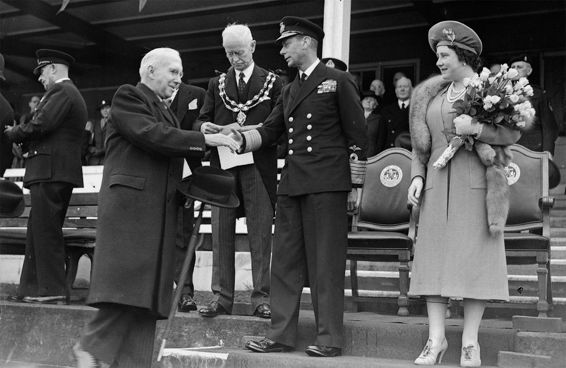
King George VI and Queen Elizabeth during a visit to Kent. This photograph is taken at Folkestone cricket ground in October 1944. (WanPs-0477)
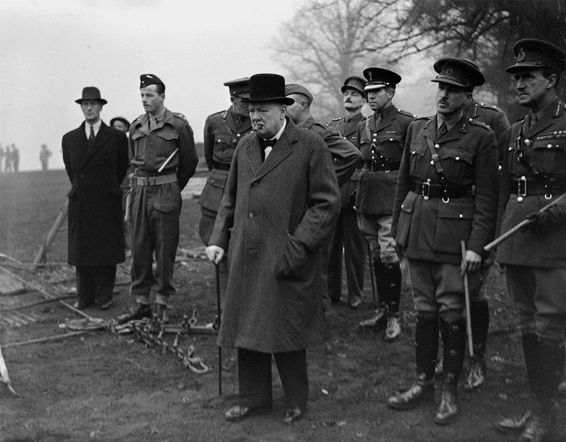
Prime Minister Winston Churchill during a visit to the 53rd (Welsh) Division on 20 November 1942. The photograph is taken at Mote Park, Maidstone. It is a classic study of Winston Churchill with his characteristic Homburg hat, cigar and walking stick. The Commander Home Forces, Lieutenant General Sir Bernard Paget GCB DSO MC, is pictured on the far right. On the far left, Winston Churchill’s personal bodyguard Detective Inspector Walter Henry Thompson can also be seen. It was during this visit that Churchill was shown the new British Infantry Service rifle for the first time, the Lee-Enfield No. 4. (WanPs-0009)
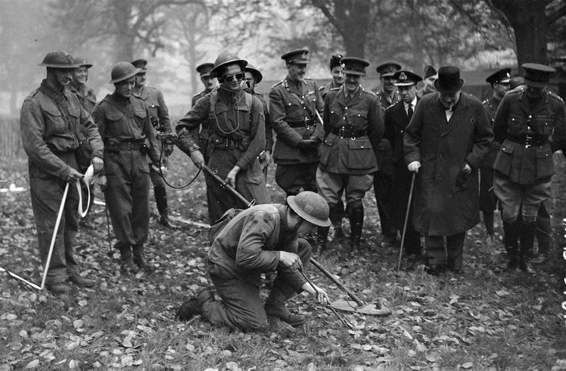
This photograph shows a mine clearing demonstration taking part during the Prime Minister’s visit to the 53rd (Welsh) Division at Mote Park, Maidstone. Churchill and his party of senior officers seem to be enjoying a joke! (WanPs-0194)
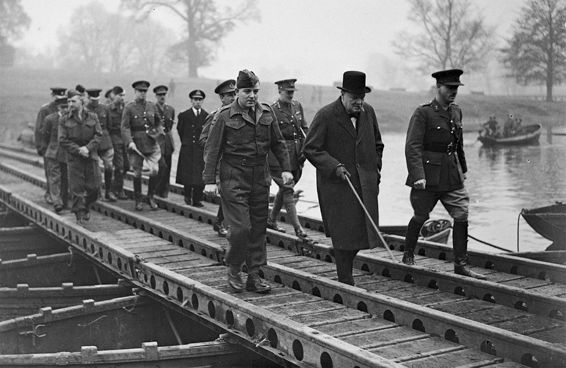
The last of the series of photographs showing Prime Minister Winston Churchill visiting the 53rd (Welsh) Division, Mote Park, Maidstone. The party can be seen here crossing a Folding Boat Equipment (FBE) Bridge. (WanPs-2190)
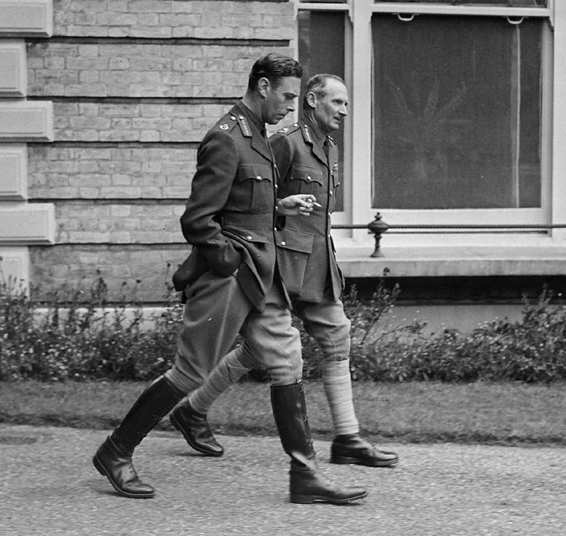
This photograph shows King George VI and Major-General Montgomery at XII Corps HQ at Broadwater Down, Tunbridge Wells on 13 June 1941. Montgomery had taken command of XII Corps in April 1941, and was responsible for the defence of Kent. During this period he instituted a regime of continuous training and insisted on high levels of physical fitness, for both officers and other ranks alike. He became known for being ruthless in sacking officers he considered would be unfit for command in action. (WanPs-1104)
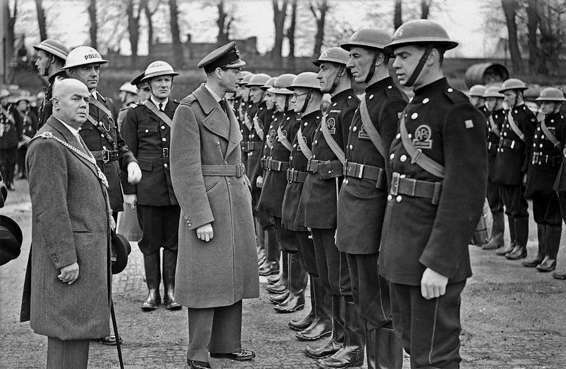
The Duke of Kent with the Mayor of Canterbury, Alderman Charles Lefevre, inspecting the Auxiliary Fire Service at Watling Street car park, Canterbury in May 1941. The Duke of Kent was killed in an air crash in August 1942. (WanPs-2384)
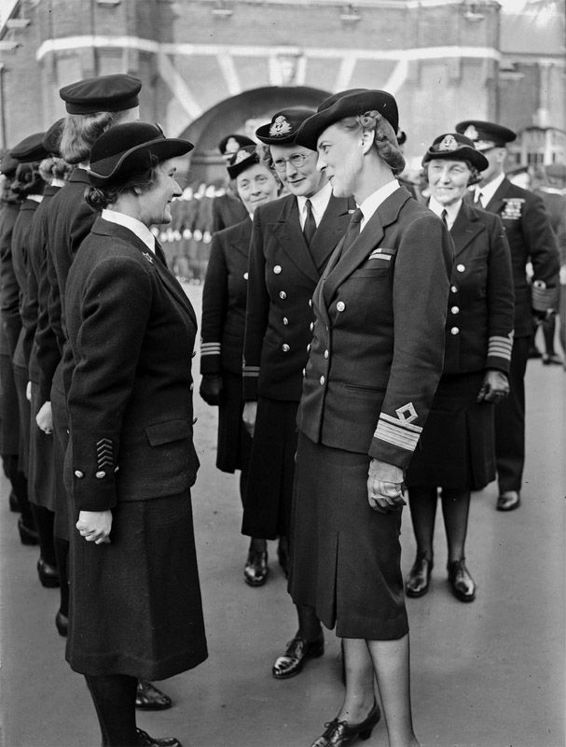
Princess Marina, Duchess of Kent, inspecting The Women’s Royal Naval Service (WRNS) at HMS Pembroke, Chatham. Princess Marina was the Commandant of the Women’s Royal Naval Service. (WanPs-1159)
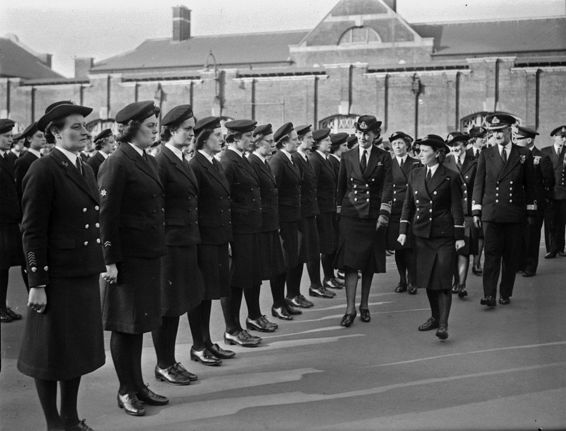
Another photograph showing Princess Marina inspecting The WRNS at Chatham. HMS Pembroke was the Naval Barracks at Chatham, and was located next to Chatham Dockyard. (WanPs-1160)