
Chapter Seven
The Kent coastline is approximately 214 miles long. It incorporates a number of ports and harbours that have been used for commerce and military purposes for thousands of years. In the year 1050 a confederation known as the Cinque Ports was created which involved Hastings, Romney, Hythe, Dover and Sandwich assuming a special arrangement with the King whereby in return for the provision of ships and men for fifteen days free service a year to the Crown the town received privileges.
The Royal Navy has had dockyards in Kent at Chatham and Sheerness since the sixteenth and seventeenth centuries. Chatham Dockyard was established as a Royal dockyard by Elizabeth I in 1567. It became particularly important at this time owing to its strategic position on the River Medway. Its importance as a naval port declined due to the silting of the Medway making navigation difficult. As a result Chatham became a building yard rather than refitting base. In the 1860s the yard had a large building programme and St Mary’s basin was constructed for the steam navy. HMS Pembroke, the Royal Naval Barracks at Chatham opened in 1903. The dockyard and naval base played a major part in supporting the Royal Navy until it was formally closed in 1984. The dockyard is now run as a museum by the Chatham Historic Dockyard Trust.
Sheerness Dockyard is situated at the mouth of the River Medway. The dockyard was founded in 1665, initially for storing and refitting ships. In 1720, a second dry dock was built and it became a ship construction yard. Between 1815 and 1826 it was completely rebuilt, and in 1854 a steam yard was established. It closed in 1957.
The Royal Navy connections with Kent form part of a long and proud naval tradition with the county.
Chatham dockyard became synonymous with the building of submarines, which began in 1907 and continued for over sixty years. The first was the coastal submarine C17 and the last was the Oberon class Okanagan, which was completed in 1968 for the Royal Canadian Navy. A total of fifty-seven submarines of twenty different classes were completed at Chatham.
Not only submarines were built at Chatham. Perhaps the Royal Navy’s most famous ship of all, HMS Victory, was built there. Other ships, such as the cruisers HMS Arethusa and HMS Euryalus, which served during the Second World War, were also built at Chatham.
During the Second World War, the Royal Air Force also operated units at sea based in Kent to provide vital air-sea rescue services.
From 1918 to 1986 the Marine Branch of the Royal Air Force supplied waterborne support, rescue facilities, and services for the Royal Air Force throughout the world. Inaugurated as the Marine Craft Section, just eleven days after the Royal Air Force itself was founded, it initially provided back-up for the flying boats, but it also developed a rescue service which during and after the Second World War became the largest in the world. During the war years alone over 8,000 lives were saved by the crews of the high speed rescue launches who faced enemy action and all weathers to uphold their pledge of ‘The Sea Shall Not Have Them’.
In addition to their routine duties in Air Sea Rescue, RAF marine craft operating from their bases at Sheerness and from the ferry dock at Dover, also participated in major amphibious operations such as the evacuation of Dunkirk in 1940, and Operation Jubilee at Dieppe in 1942.
RAF No. 27 Air-Sea Rescue Marine Craft Unit (ASRMCU) operated from the ferry dock at Dover. Launches of No. 27 ASRMCU came under enemy shell fire many times from German shore batteries while carrying out rescue operations within short distances of the enemy coast. They also frequently crossed dangerous minefields in order to reach ditched aircrews. During 1944, during the V1 blitz, the unit’s launches were fitted with signal rockets, so that when they were operating near the enemy coast and saw flying bombs coming over, they could fire rockets as a warning to patrolling aircraft and to shore-based anti-aircraft batteries. As a result of this work the unit was credited with assisting with the destruction of four flying bombs. It was also credited with two enemy aircraft shot down in self-defence and one ‘probable’ on other operations. Among the many rescues of the unit were British, Allied and enemy airmen, and it also captured one enemy spy picked up from a canoe a few minutes after he had been dropped by an E-Boat. The Air Sea Rescue launches were under RAF Administration but were under naval orders when operating at sea.
An example of their particpation in amphibious operations took place during the Dieppe operation in August 1942. Among the fourteen high-speed RAF launches called out on 19 August 1942 during the Dieppe Raid (Operation Jubilee), in response to no less than forty-seven mayday calls, were the Dover based No. 27 ASRMCU launches HSLs 122, 123, 147 and 186. Two of the boats, HSL 122 and HSL 123 were lost on this operation. An official report submitted after the operation describes the events that took place:
At about 16.35, four miles SE of the position, going north, 123 was attacked by two out of four FW 190s that appeared ahead. LAC Wilkins was wounded and Sergeant Smith slightly wounded. A ‘Help’ signal was sent. The planes did not return and course was maintained. Shortly afterwards the boat was challenged from the shore and the batteries opened fire, the shells falling astern. At 16.50 four FW 190s attacked from the port beam and course was altered towards them and no casualties resulted. A second ‘Help’ signal was sent. Course was altered to NW to try and shake off the planes, which again disappeared, and to contact 122 for mutual aid and support. 122 when sighted, was being bombed by a Heinkel and when closed at 17.15 was found to have been badly damaged by cannon and machine-gun fire, and with only five men left alive. These were being transferred when six or eight FW 190s appeared and attacked from the port beam, four serious casualties being sustained. A signal Urgent Help 182 Dungeness 23’ was sent. The boats then became separated. In view of the fact that not a single British fighter had provided cover or was even sighted from the time the English coast was left, and that we had been informed that none could be expected, it was considered that absolutely no possibility remained of making the twenty-five miles to our coast against the concerted attacks in operation. The boat [122] was therefore abandoned at 17.20. While the survivors were in the water both boats were attacked for about half an hour and set completely on fire ... HSL 177, five to six miles distant, apparently saw smoke and having contacted RML 513 and two Spitfires, proceeded and performed a plucky and skilful rescue at about 18.00, the FW 190s making off on their approach ...’
One of those on board HSL 122 who demonstrated the devotion to duty and contempt for danger so often shown by the crews of RAF air-sea rescue launches, was Leading Aircraftsman Albert Dargue. His actions on the 19 August resulted in the award of a British Empire Medal (the BEM can be awarded for gallantry, but a degree less than that required to earn the George Medal). His award citation reads:
Leading Aircraftman Dargue was Nursing Orderly on a High Speed Launch during the combined operations on 19 August 1942. In spite of wounds, he endeavoured to carry out first-aid to the wounded until he was picked up in a seriously wounded condition. The courage and valuable services rendered by Leading Aircraftman Dargue are typical of the high qualities displayed by the nursing orderlies, who have carried out hazardous operations in High Speed Launches which play an essential part in Air Sea Rescue.
Dargue was plucked from the water by Flight Lieutenant D.R. Don’ Morrison DFC DFM No. 401 (RCAF) Squadron, himself having been picked up by HSL 177 after being downed earlier that day.
Air Commodore Graham Pitchfork’s Shot Down and in the Drink, RAF and Commonwealth Aircrews Saved from the Sea 1939–45 describes the events of Albert Dargue’s rescue:
Morrison noticed a semi-conscious seaman drifting away. He immediately dived into the sea and burning oil to reach the badly injured man, bringing him alongside the launch where he was recovered on board. He was Leading Aircraftman Albert Dargue, the medical orderly of HSL 122, which had been attacked and set on fire by German fighters. Despite being badly hurt himself, Dargue tended the seriously wounded until HSL 123 pulled alongside. Only four men were left alive and Dargue dragged the other three survivors on deck, but just as they were about to be transferred, HSL 123 also came under attack and was severely damaged. As the launch caught fire, the master gave the order to abandon ship. Dargue inflated the Mae Wests of the three injured men and pushed them overboard before he jumped. Exhausted and weak from his wound, he could do little to help himself until Morrison rescued him.’
Once HSL 177 had picked up the fourteen survivors the master headed for New-haven at full speed, where the wounded were quickly evacuated to hospital. Morrison returned to his squadron and was soon back on duty.
Following the Dieppe operation there were a number of gallantry awards for the men of the RAF’s high speed launches, including an MBE to Conway and a BEM to the brave LAC Albert Dargue.
Morrison wrote a detailed report of his experiences but made no mention of his own courageous part. He was loud in his praise for the men who manned the RAF rescue launches and concluded his report: ‘There can be no question as to the bravery of these men of the Air Sea Rescue Service who were often working within sight of the French coast. For myself, I would rather meet a FW 190 head-on in my Spitfire than meet one from a rescue launch.’
Praise indeed from a brave pilot. Don Morrison was again shot down in December 1943. Posted as missing he was feared killed. He had actually been taken prisoner but had been seriously wounded (his left leg was amputated above the knee by German doctors). He was eventually repatriated in November 1943.
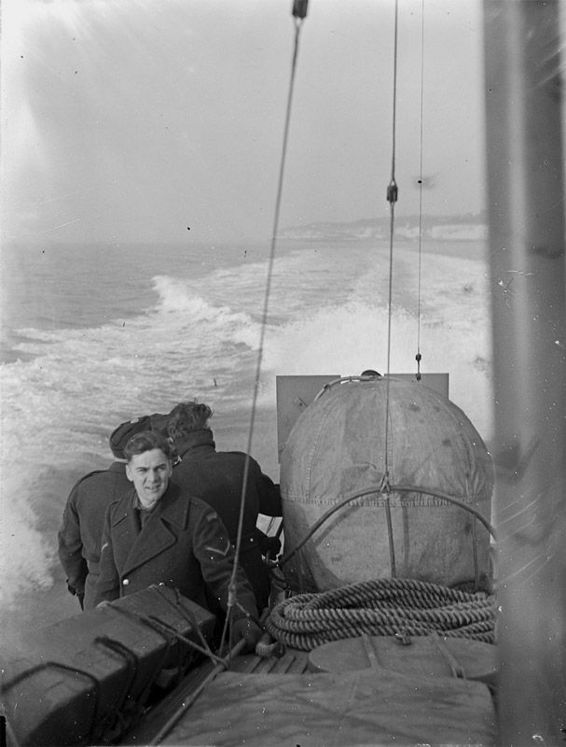
An RAF air-sea rescue launch off the coast of Kent, c.1943. (WanPs-0172)
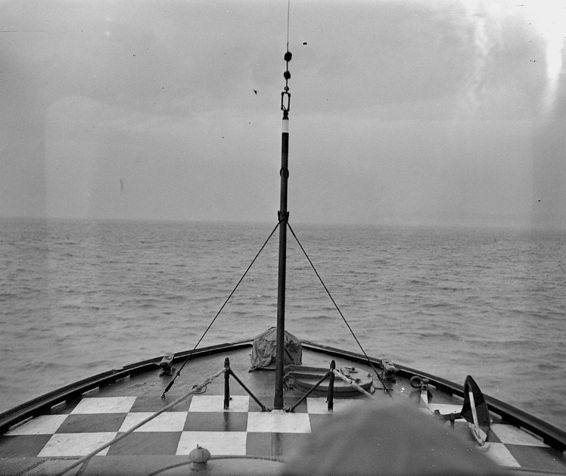
The view looking over the bow of an air-sea rescue launch. The typical red and white chequerboard markings of an ASR launch can be made out in this photograph. Originally the decks and superstructure of ASR launches were painted yellow to make the launches as conspicuous as possible from the air, but the frequency of German air attacks on the launches resulted in the substitution of grey paint. (WanPs-0254)
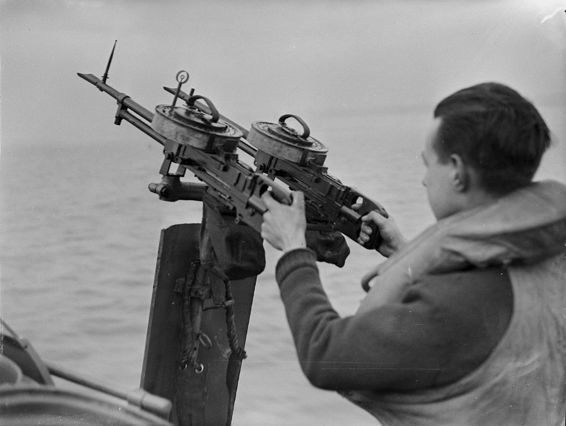
A gunner on RAF air-sea rescue launch manning twin .303 Vickers K machine guns. (WanPs-0287)
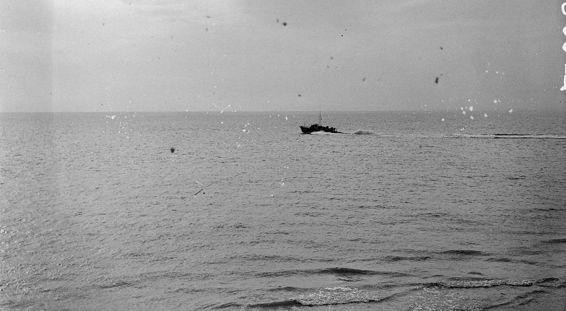
An RAF Air Sea Rescue Launch at sea. The difficulty of spotting downed aircrew is illustrated by this photograph – the sea is a very big place and spotting even a boat the size of an ASR launch can be difficult in the best of sea conditions. (WanPs-0256)
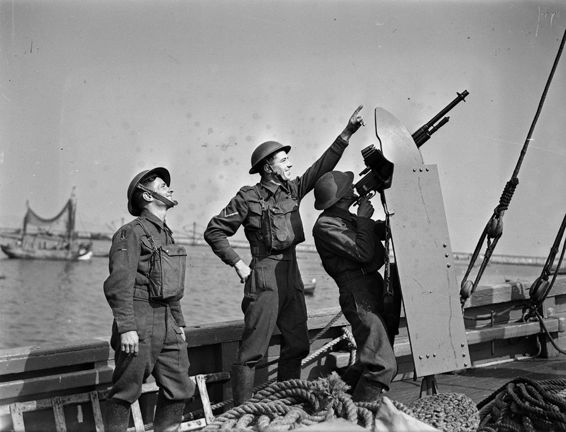
An armed trawler manned by army personnel. The gun is a .303 Hotchkiss machine gun. These First World War vintage machine guns were considered obsolete when the Second World War broke out, but the shortage of weapons forced them to be used as air defence weapons on ships pressed into service. The soldier on the far left is wearing the badge of the 77th Infantry Division. This division was formed from the Devon and Cornwall Division on 1 December 1941. It remained in the United Kingdom throughout the war, was converted into a reserve formation in December 1942, and disbanded in September 1944. (WanPs-0202)
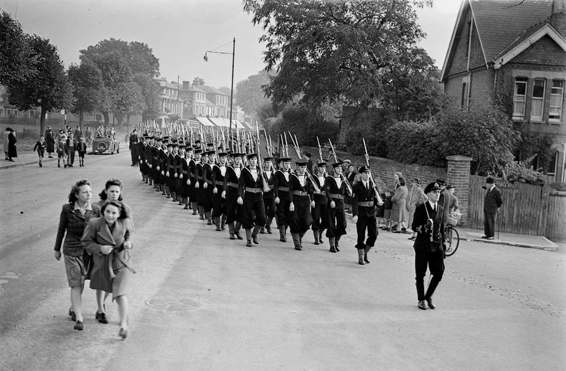
A naval party marching north near Southbourough Common the A26 London Road, Southborough, c.1943. (WanPs-2335)
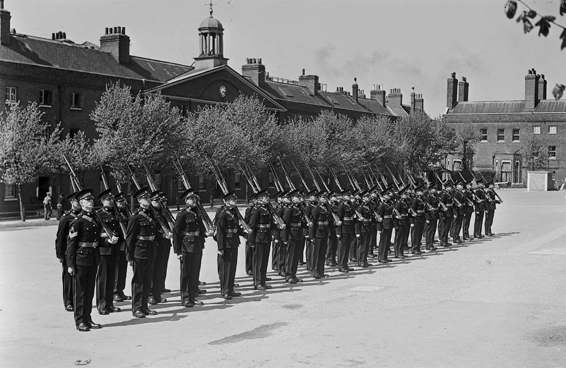
Royal Marines on parade at the Marine Barracks Chatham c.1941. The Royal Marines were based at Chatham for over 200 years. From 1775 until 1950 the Chatham Division of Royal Marines occupied barracks on a site adjacent to the southern end of the Dockyard. The barracks were demolished in the 1950s. (WanPs-2385)
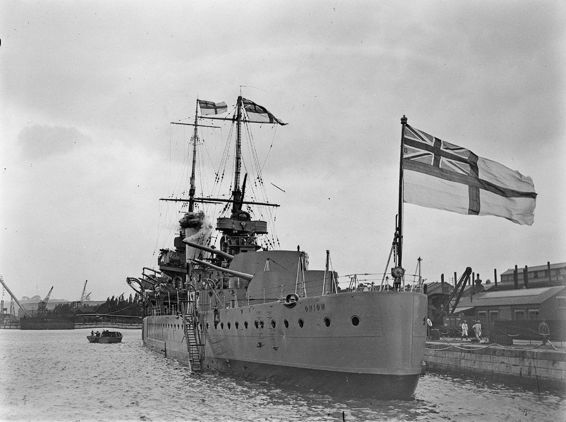
HMS Orion photographed at Chatham Dockyard. Built at Devonport Dockyard, Orion took part in the bombardment of Bardia, and the Battle of Calabria in July 1940. In 1941 Orion took part in the Battle of Cape Matapan and the evacuation of Crete, where she was bombed and badly damaged. Subsequently, after being repaired, she took part in convoy escort duties, the invasion of Sicily, and the Normandy Landings in June 1944. She was scrapped by Arnott Young at Dalmuir, in Scotland in 1949. (WanPs-2838)
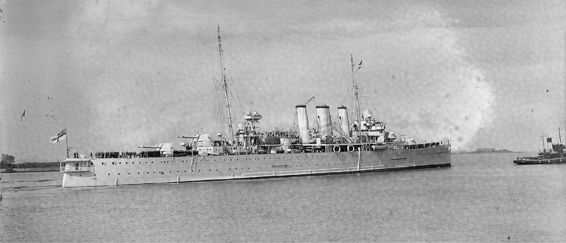
This photograph shows HMS Kent, believed to have been taken after her refit at Chatham in 1938. HMS Kent was a County-class heavy cruiser and was constructed at Chatham. During 1940 she was assigned to troop convoy escort duties in the Indian Ocean, then transferred to the Mediterranean in mid-1940, where she was torpedoed shortly after arriving. The ship was under repair for a year and was then assigned to Home Fleet where she escorted convoys to and from North Russia. In mid-1944 Kent escorted British aircraft carriers as their aircraft made attacks on German shipping and airfields in Norway. This ship, as might be expected, has a close association with the county of Kent. Her badge was the White Horse of Kent on a Field Red and her motto: Invicta – unconquered. (WanPs-2842)
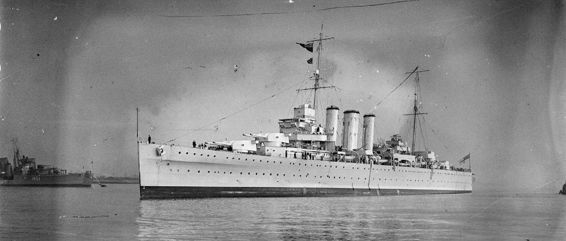
HMS Kent at Chatham, photographed before the war in 1937. (WanPs-2841)
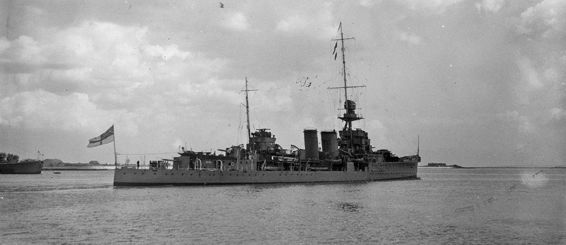
This photograph is another fine study of a Royal Navy Warship, believed to be either HMS Achilles or HMS Orion leaving Chatham Dockyard. (WanPs-2845)
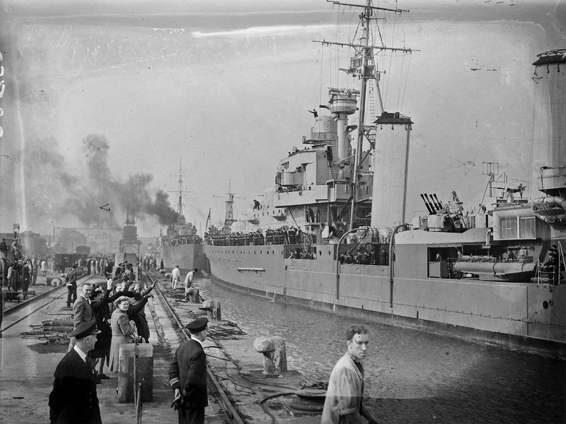
HMS Dido photographed at Chatham Dockyard in 1945. HMS Dido was a Dido class light cruiser. She was built by Cammell Laird at Birkenhead, UK and was launched on 18 July 1939. She was adopted by the civil community of Bolton, Lancashire. Her battle honours are listed: CRETE 1941 – SIRTE 1942 – MEDITERRANEAN 1942–44 – MALTA CONVOYS 1942 – SICILY 1943 – SALERNO 1943 – AEGEAN 1943 – ANZIO 1944 – SOUTH FRANCE 1944 – ARCTIC 1944. She returned to Chatham for a refit in October 1945. On completion in 1947, owing to economic constraints on defence expenditure and manning difficulties, the ship was placed in reserve. She never re-commissioned and was eventually scrapped in 1956 at Barrow-in-Furness. (WanPs-2850)