
The GFP was brought into being on 21 July 1939 following the signing of a new document, Heeres Dienstvorschrift (geheim)150, by Generaloberst Wilhelm Keitel.
The members of this new force were classed as Wehrmachtbeamte and not as professional career soldiers, though regular members of the armed forces could also be temporarily attached to the GFP as required, where they brought a specific skill that was required for the execution of a specific task, whether that skill might be technical, in languages or whatever. As well as suitable personnel from other branches, soldiers from the Feldgendarmerie were also occasionally attached to the GFP.
Organisational Structure
Each Armeeoberkommando had an attached GFP Gruppe, commanded by an official with the rank of Feldpolizeidirektor.
GFP Gruppen were also attached to district commands (Abschnittskommandos) of the Grenzschutz to help protect the security of the borders of the Reich.
Tasks
|
(i) |
To investigate all threats to the state, especially espionage and treasonous activities and to combat sabotage and hostile propaganda. |
|
(ii) |
To collect and evaluate evidence and the results of investigations undertaken. |
|
(iii) |
To supervise the implementation counter-measures for the protection of operational areas and provide support and advice to the military Staffs. |
Performance of such tasks could include general measures for the personal protection of the senior personnel of the Armee staff where this was not otherwise provided; providing support to special courts in cases of espionage; assisting the police authorities in searching premises, especially in areas recently occupied and investigation and prevention of the use and abuse of German uniforms by enemy intelligence services.
In areas just occupied, GFP would become involved in securing all written material and telegrams in various institutions, post offices, railway stations and also securing any mail still in post boxes. Any of such documents might well contain useful intelligence material.
GFP could also be involved in searching recently abandoned military establishments, accommodation barracks etc and the seizure of any documents found in these places for delivery to military intelligence.
Searches would also be made for other means of communication which might potentially be used for espionage or sabotage operations by the enemy, such as courier pigeons, hidden radios transmitters, morse transmitters, printing presses etc.
In operational areas police investigations into matters within their remit were carried out by the GFP, and in such cases they were entitled to require any other military units including the Feldgendarmerie, to provide assistance.
GFP would also be involved in watching for the release of parachutes from aircraft which might contain material for saboteurs and for the release of enemy propaganda leaflets. They would also occasionally monitor establishments such as restaurants and cafes for suspicious persons. They could also monitor churches and other places where the public gathered, listening for subversive or provocative utterings.
Within the Reich, investigations were to be carried out in co-operation with the local civil police authorities. In this case GFP personnel had equal powers to the civilian police authorities. The GFP might also become involved in operations against smuggling, both of contraband and of people.
Although, generally, when operating outside the Reich, GFP officials would be in uniform and when operating within the Reich they would be in civilian clothing, in fact they were authorised to wear whatever civil or military clothing was deemed appropriate for them to carry out their investigations, indicating that they could in fact wear the uniform of other branches of the Wehrmacht if this was authorised, for them to operate ‘under cover’.

A suspect, with Feldgendarmerie escort is interrogated by two GFP officials. On the original print, the distinctive GFP style Waffenfarbe surround around the officer’s collar tabs is visible. (Josef Charita)
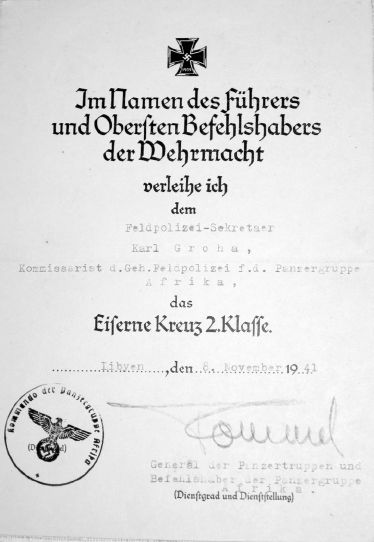
A very rare Award Document for the Iron Cross Second Class to a GFP officer, Feldpolizeisekretär Karl Groha, serving in North Africa, and signed by Rommel. (David Bunch)
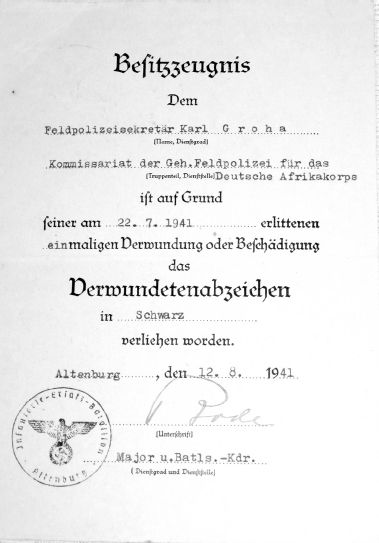
Award Document for the Wound Badge in Black to Groha, also issued for wounds received during his service in North Africa. (David Bunch)
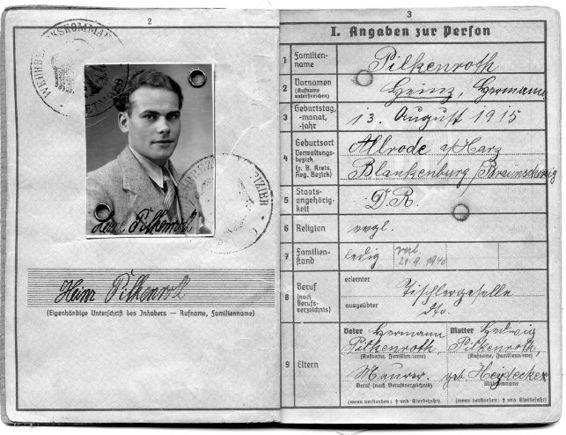
Wehrpass of Heinz Pilkenroth an army soldier who served on temporary attachment to the GFP.
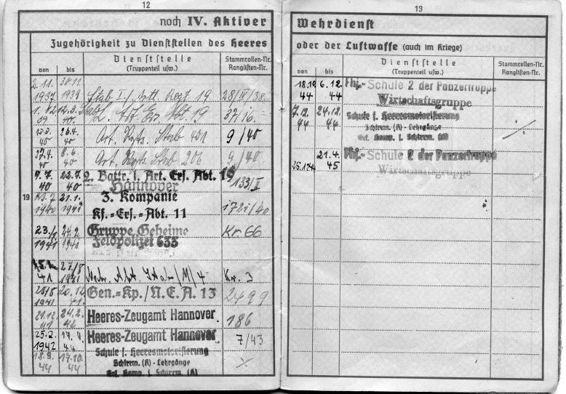
Note the entry in the Pilkenroth Wehrpass showing a brief attachment to Gruppe GFP 633. Such brief assignments, followed by a release to normal duties was Common at NCO level.
Uniforms and Insignia
GFP personnel wore the uniform appropriate to the Heeresbeamte, whose Waffenfarbe was dark green but with light-blue Nebenfarbe or secondary colour as their branch identifier and with a white metal Latin script ‘GFP’ emblem on the shoulder strap. A cuffband bearing the legend Geheime Feldpolizei was also produced but so far no evidence has emerged of this cuffband actually being worn. It is normally made from black rayon with the lettering woven in aluminium thread though hand embroidered versions also exist.
A visor cap also exists which has been attributed to the GFP. In normal Army style, it has a brown rather than dark green band to the cap, with blue-grey Waffenfarbe piping. Once again, no photographic evidence of its wear has yet emerged. Indeed although this type of cap may be contemporary, there is no firm evidence whatsoever to link it to the GFP, and it is most likely that the standard Heeresbeamte visor cap with dark green band and dark green piping was most often worn. Other troops temporarily attached to the GFP wore the uniform of their original branch but also used the metal GFP shoulder strap emblem.
Every member of the GFP, in common with all other military personnel, carried a Soldbuch and an Erkennungsmarke as a form of identification. In terms of their police status however, they also carried a special Ausweis, printed on green paper, and with their photograph in both uniform and civil clothing. This Ausweis carried details of their police powers including confirmation that they were entitled to require other military and civil powers to render assistance when required.
A metal ‘Dienstmarke’ or warrant disc was also carried. Unlike those carried by their civilian equivalents, the GFP disc was circular. On the obverse was shown the Wehrmacht style eagle with wings outspread whilst the reverse had the legend ‘Oberkommando des Heeres’ around the top edge and ‘Geheime /Feldpolizei’ in the centre, over the serial number of the disc.
Amongst the entitlements brought by the possession of the Ausweis and Dienstmarke were the right to pass through military checkpoints, to enter military buildings, to use all military means of communication, to use any armed forces vehicles, to request accommodation and food assuming of course that these were necessary to the performance of his duties, and to free use of all public transport.
Devisenschutzkommando
One of the more unusual, and certainly less well known, of the GFPs functions were the duties it carried out for the Devisenschutzkommando or ‘Currency Protection Command’.
This organisation was formed in the wake of the Westfeldzug, as German forces began their occupation of Denmark, Norway, France and the Low Countries.
Under German occupation, the citizens of these countries were prohibited from owning foreign currency and stocks (including German) and the Devisenschutzkommando assisted by the GFP, had the task of tracking down a seizing such assets in order that they be used to support the German economy.
Responsibility for such activities was passed to the Reichsfinanzverwaltung in 1941.
The following elements of the GFP were employed on these duties:
GFP Gruppe z.b.V. Devisenschutz Kommando Frankreich
GFP Gruppe (Devisenschutz) Kommando Frankreich
GFP Gruppe (Devisenschutz) Aussenstelle Nordfrankreich
GFP Gruppe (Devisenschutz) Kdo. Frankreich Aussenstelle Nancy
GFP Gruppe (Devisenschutz) Aussenstelle Nancy
GFP Gruppe (Devisenschutz) Aussenstelle Ghent
GFP Gruppe (Devisenschutz) Aussenstelle Antwerpen
GFP Gruppe (Devisenschutz) Kommando Belgien
GFP Units
Gruppe Geheime Feldpolizei l
Formed on 26 August 1939 in Wehrkreis II (Rostock). Employed initially in Poland, then in occupied France, Germany, Russia and finally in Italy.
Gruppe Geheime Feldpolizei 2
Formed on 26 August 1939 in Wehrkreis II (Stralsund). Employed primarily in occupied France and the Netherlands. Ultimately absorbed into the Sicherheitsdienst.
Gruppe Geheime Feldpolizei 3
Formed on 25 August 1939 in Wehrkreis VIII (Leobschütz). Employed primarily in occupied France and the Netherlands.
Gruppe Geheime Feldpolizei 7
Formed on 23 August 1939 in Wehrkreis V (Donaueschingen). Employed in occupied France. Ended the war in the Lorient fortress. May have been absorbed into the Sicherheitsdienst.
Gruppe Geheime Feldpolizei 8
Formed on 26 August 1939 in Wehrkreis VI (Soest). Employed in France, Belgium Germany and Denmark.
Gruppe Geheime Feldpolizei 9
Formed on 26 August 1939 in Wehrkreis VI (Aachen). Employed in the Netherlands and ultimately in Croatia.
Gruppe Geheime Feldpolizei 11
Formed in August 1939. Employed in Germany and France. Absorbed into the Sicherheitsdienst in 1942.
Gruppe Geheime Feldpolizei 13
Formed on 26 September 1939 in Wehrkreis VIII (Glogau). Employed in Poland and in the West , ultimately in Silesia.
Gruppe Geheime Feldpolizei 14
Formed on 26 August 1939 in Breslau. Employed in Poland and France. Absorbed into the Sicherheitsdienst in 1942.
Gruppe Geheime Feldpolizei 20
Formed on 26 August 1939 in Wehrkreis XVIII (Salzburg). Employed in Austria.
Gruppe Geheime Feldpolizei 30
Formed on 26 August 1939 in Wehrkreis XVII (Vienna). Employed in Poland , and in France. Absorbed into the Sicherheitsdienst in 1942.
Gruppe Geheime Feldpolizei 131
Formed on 26 August 1939 in East Prussia. Employed in France and the Netherlands.
Gruppe Geheime Feldpolizei 161
Formed on 26 August 1939 in East Prussia. Employed in France.
Gruppe Geheime Feldpolizei 171
Formed on 26 August 1939 in East Prussia. Employed in Denmark and ultimately in Romania.
Gruppe Geheime Feldpolizei 312
Formed on 26 August 1939 in Küstrin. Employed initially in France and ultimately in Hungary.
Gruppe Geheime Feldpolizei 501
Formed on 16 August 1939 in Wehrkreis I (Königsberg). Employed in Poland, France, Northern Russia and Latvia.
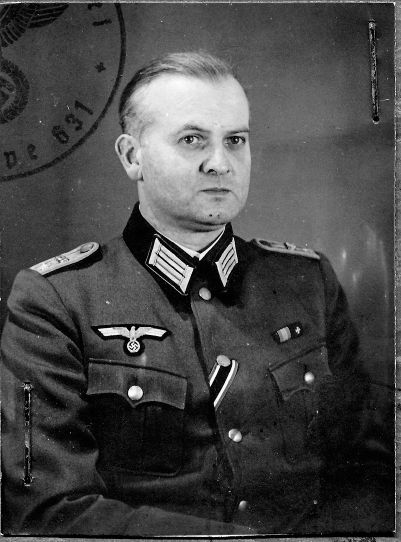
Photograph from the Soldbuch of a GFP officer with the rank of Feldpolizeiinspektor. The distinctive piping around the collar tab can be clearly seen. (Ian Jewison)
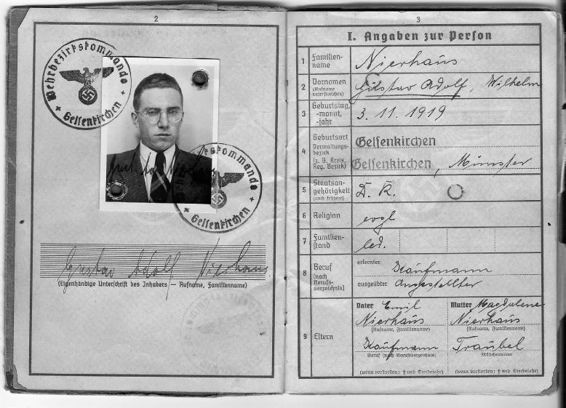
Wehrpass for Unteroffizier Gustav Nierhaus who served with GFP Gruppen 7 and 560. (Kevin Huckfield)
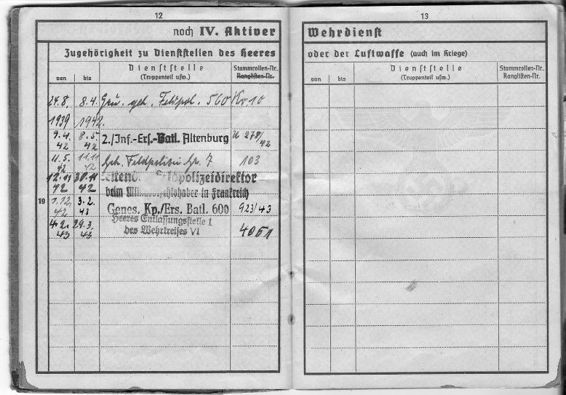
Nierhaus was already serving with the GFP when war broke out and spent the majority of his military career with this organisation. (Kevin Huckfield)
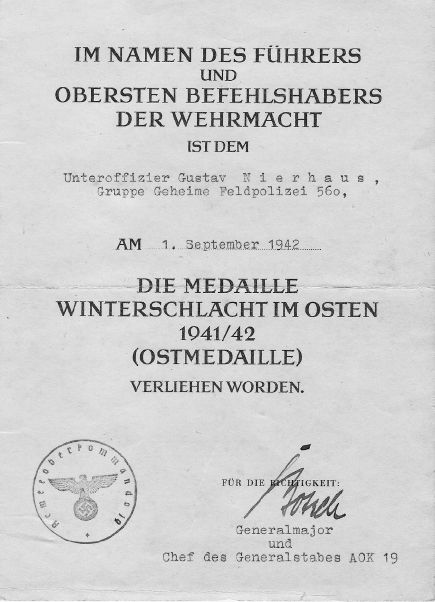
Award Document for the Eastern Front Medal to Gustav Nierhaus. (Kevin Huckfield)
Gruppe Geheime Feldpolizei 510
Formed on 26 August 1939 in Wehrkreis XVII (Vienna). Employed in Poland , the West, the Balkans.
Gruppe Geheime Feldpolizei 520
Formed on 15 August 1939 in Wehrkreis VII (Vienna). Employed in Poland, the West, Russia and Latvia.
Gruppe Geheime Feldpolizei 530
Formed on 2 August 1939 in Wehrkreis III (Berlin). Employed in Poland, Belgium and France.
Gruppe Geheime Feldpolizei 540
Formed on 2 August 1939 in Wehrkreis IV (Dresden). Employed in Poland and in France.
Gruppe Geheime Feldpolizei 550
Formed on 26 August 1939 in Wehrkreis V (Stuttgart). Employed in France and absorbed into the Sicherheitsdienst in 1942.
Gruppe Geheime Feldpolizei 560
Formed on 24 August 1939 in Wehrkreis VI (Münster). Employed in France, Southern Russia and Germany.
Gruppe Geheime Feldpolizei 570
Formed on 26 August 39 in Wehrkreis XI (Nürnberg). Employed in Poland, France, Central Russia and ultimately in East Prussia.
Gruppe Geheime Feldpolizei 580
Formed on 15 August 1939 in Wehrkreis IV (Dresden). Employed in Poland, France, Belgium and Central Russia.
Gruppe Geheime Feldpolizei 581
Formed on 25 August 1939 in Wehrkreis IX (Kassel). Employed on the Western Front.
Gruppe Geheime Feldpolizei 590
Formed on 25 August 1939 in Wehrkreis IX (Kassel). Employed in France.
Gruppe Geheime Feldpolizei 603
Formed on 26 August 1939 in Wehrkreis III (Berlin). Employed in Poland, France and the Netherlands. Absorbed into the Sicherheitsdienst in November 1942.
Gruppe Geheime Feldpolizei 610
Formed on 26 August 1939 in Wehrkreis X (Hamburg). Employed in France, Southern Russia and Italy.
Gruppe Geheime Feldpolizei 611
Formed on 26 August 1939 in Wehrkreis XI (Hannover). Employed in the West and in the Balkans, ultimately in Croatia.
Gruppe Geheime Feldpolizei 612
Formed on 26 August 1939 in Wehrkreis XII (Wiesbaden). Employed in the West, Balkans, Central Russia and West Prussia.
Gruppe Geheime Feldpolizei 621
Formed on 28 February 1940 in Wehrkreis I (Königsberg). Employed in France and Belgium, the Balkans and ultimately in Croatia.
Gruppe Geheime Feldpolizei 625
Formed on 15 February 1940 in Wehrkreis V (Stuttgart). Employed in France.
Gruppe Geheime Feldpolizei 626
Formed in early 1940 in Wehrkreis VI (Münster). Employed in France, Russia and Slovakia.
Gruppe Geheime Feldpolizei 627
Formed on 24 February 1940 in Wehrkreis VII (Munich). Employed in France and absorbed into the Sicherheitsdienst in November 1942.
Gruppe Geheime Feldpolizei 629
Formed February 1940 in Wehrkreis XII (Wiesbaden). Employed in Norway.
Gruppe Geheime Feldpolizei 631
Formed on 21 August 1939 in Wehrkreis III (Berlin). Employed on security duties at OKH headquarters.
Gruppe Geheime Feldpolizei 632
Formed on 17 February 1940 in Wehrkreis XII (Wiesbanden). Employed in France and absorbed into the Sicherheitsdienst in November 1942.
Gruppe Geheime Feldpolizei 633
Formed on 26 February 1940 in Wehrkreis XI (Hannover). Employed in France and absorbed into the Sicherheitsdienst in November 1942.
Gruppe Geheime Feldpolizei 637
Formed on 15 February 1940 in Wehrkreis IV (Dresden). Employed in Belgium and Italy.
Gruppe Geheime Feldpolizei 639
Formed on 10 September 1940 im Wehrkreis V (Stuttgart). Employed with Panzergruppe 2/2 Panzerarmee.
Gruppe Geheime Feldpolizei 640
Formed on 19 September 1940 in Wehrkreis XX (Danzig). Employed in the Balkans and Croatia.
Gruppe Geheime Feldpolizei 644
Formed on 10 September 1940 in Wehrkreis IV (Dresden). Employed In France.
Gruppe Geheime Feldpolizei 647
Formed on 10 September 1940 in Wehrkreis VII (Munich). Employed in France, Southern Russia and Slovakia.
Gruppe Geheime Feldpolizei 648
Formed on 10 September 1940 im Wehrkreis VIII (Breslau). Employed in Belgium, France and ultimately in Bohemia.
Gruppe Geheime Feldpolizei 649
Formed on 9 September 1940 in Wehrkreis IX (Kassel). Employed in France and absorbed into the Sicherheitsdienst in November 1942.
Gruppe Geheime Feldpolizei 701
Formed on 26 April 1941 in Wehrkreis IV (Dresden). Employed in France and absorbed into the Sicherheitsdienst in November 1942
Gruppe Geheime Feldpolizei 702
Formed on 26 April 1941 in Wehrkreis IV (Dresden). Employed with 285 Sicherungs Division in Russia and ultimately with Heeresgruppe Süd in Vienna.
Gruppe Geheime Feldpolizei 703
Formed on 26 April 1941 in Wehrkreis IV (Dresden). Employed in Russia with Pz.Gruppe 3
Gruppe Geheime Feldpolizei 704
Formed on 26 April 1941 in Wehrkreis IV (Dresden). Employed with Pz.Gruppe 4
Gruppe Geheime Feldpolizei 705
Formed on 26 April 1941 in Wehrkreis IV(Dresden). Employed with 281. Sicherungs Division in Russia
Gruppe Geheime Feldpolizei 706
Formed on 26 April 1941 in Wehrkreis IV (Dresden). Employed with 403 Sicherungs Division in Central Russia, later in Southern Russia and ultimately in Silesia.
Gruppe Geheime Feldpolizei 707
Formed on 26 April 1941 in Wehrkreis IV (Dresden). Employed in Central Russia and from early 1945 on the Western Front.
Gruppe Geheime Feldpolizei 708
Formed on 26 April 1941 in Wehrkreis IV. (Dresden). Employed in Southern Russia and ultimately in Hungary and Austria.
Gruppe Geheime Feldpolizei 709
Formed on 26 April 1941 in Wehrkreis IV (Dresden). Employed in central Russia.
Gruppe Geheime Feldpolizei 710
Formed on 26 April 1941 in Wehrkreis IV (Dresden). Employed in Central Russia and from early 1945 on the Western Front.
Gruppe Geheime Feldpolizei 711
Formed on 26 April 1941 im Wehrkreis IV (Dresden). Employed in Southern Russia and absorbed into the Sicherheitsdienst in April 1944.
Gruppe Geheime Feldpolizei 712
Formed on 26 April 1941 in Wehrkreis IV (Dresden). Employed in Belgium and France and absorbed into the Sicherheitsdienst in April 1944.
Gruppe Geheime Feldpolizei 713
Formed on 21 Mayl 1941 in Wehrkreis IV (Dresden). Employed in Northern Russia and ultimately in West Prussia.
Gruppe Geheime Feldpolizei 714
Formed on 21 May 1941 in Wehrkreis IV (Dresden). Employed in Northern Russia and ultimately in West Prussia.
Gruppe Geheime Feldpolizei 715
Formed on 21 May 1941 in Wehrkreis IV (Dresden. Employed in Northern Russia and absorbed into the Sicherheitsdienst in mid 1944.
Gruppe Geheime Feldpolizei 716
Formed on 21 May 1941 in Wehrkreis IV (Dresden). Employed in Central Russia, with the V-Weapon programme in the West and ultimately in the Netherlands.
Gruppe Geheime Feldpolizei 717
Formed on 21 May 1941 in Wehrkreis IV (Dresden). Employed in Central Russia and from 1945 on the Western Front.
Gruppe Geheime Feldpolizei 718
Formed on 21 May 1941 in Wehrkreis IV (Dresden). Employed in Central Russia and absorbed into the Sicherheitsdienst in early 1944.
Gruppe Geheime Feldpolizei 719
Formed on 21 May 1941 in Wehrkreis IV (Dresden). Employed in Southern Russia and from 1945 in Silesia.
Gruppe Geheime Feldpolizei 720
Formed on 21 May 1941 in Wehrkreis IV (Dresden). Employed in Southern Russia and from 1945 in Vienna.
Gruppe Geheime Feldpolizei 721
Formed on 21 May 1941 in Wehrkreis IV (Dresden). Employed in Southern Russia, ultimately in Hungary.
Gruppe Geheime Feldpolizei 722
Formed on 21 May 1941 in Wehrkreis IV (Dresden). Employed in Northern Russia and absorbed into the Sicherheitsdienst in September 1944.
Gruppe Geheime Feldpolizei 723
Formed on 21 May 1941 in Wehrkreis IV (Dresden).; Herbst 1944 (?). Employed in Central Russia and believed disbanded in Autumn 1944.
Gruppe Geheime Feldpolizei 724
Formed on 21 May 1941 in Wehrkreis IV (Dresden). Employed in Central Russia and absorbed into the Sicherheitsdienst in the Autumn of 1944.
Gruppe Geheime Feldpolizei 725
Formed on 21 May 1941 in Wehrkreis IV (Dresden). Employed in Southern Russia and from 1945 in Central Russia.
Gruppe Geheime Feldpolizei 726
Formed on 21 May 1941 in Wehrkreis IV (Dresden). Employed in Southern Russia.
Gruppe Geheime Feldpolizei 727
Formed on 21 June 1941 in Wehrkreis IV (Dresden). Employed in Northern Russia and from 1945 in Latvia.
Gruppe Geheime Feldpolizei 728
Formed on 21 June 1941 in Wehrkreis IV (Dresden). Employed in Northern Russia and Estonia.
Gruppe Geheime Feldpolizei 729
Formed on 21 June 1941 in Wehrkreis IV (Dresden). Employed in Central Russia, Central Russia and East Prussia.
Gruppe Geheime Feldpolizei 730
Formed on 21 June 1941 in Wehrkreis IV (Dresden). Employed in Southern Russia and absorbed into the Sicherheitsdienst in mid 1944.
Gruppe Geheime Feldpolizei 731
Formed on 21 June 1941 im Wehrkreis IV (Dresden). Employed in France and absorbed into the Sicherheitsdienst in November 1942.
Gruppe Geheime Feldpolizei 732
Formed on 21 June 1941 in Wehrkreis IV (Dresden). Employed in France and absorbed into the Sicherheitsdienst in November 1942.
Gruppe Geheime Feldpolizei 733
Formed on 21 June 1941 in Wehrkreis IV (Dresden). Employed in France and absorbed into the Sicherheitsdienst in November 1942.
Gruppe Geheime Feldpolizei 734
Formed on 21 June 1941 in Wehrkreis IV (Dresden). Employed in France and absorbed into the Sicherheitsdienst in November 1942.
Gruppe Geheime Feldpolizei 735
Formed on 21 June 1941 in Wehrkreis IV (Dresden). Employed in France, Lappland and Norway.
Gruppe Geheime Feldpolizei 736
Formed on 21 June 1941 in Wehrkreis IV (Dresden). Employed in France and absorbed into the Sicherheitsdienst in November 1942.
Gruppe Geheime Feldpolizei 737
Formed on 21 June 1941 in Wehrkreis IV (Dresden).
Gruppe Geheime Feldpolizei 738
Formed on 21 June 1941 in Wehrkreis IV (Dresden). Employed in Belgium and France and disbanded in Autumn 1944.
Gruppe Geheime Feldpolizei 739
Formed on 21 June 1941 in Wehrkreis IV (Dresden). Employed in Belgium, France and Southern Russia and absorbed into the Sicherheitsdienst in September 1944.
Gruppe Geheime Feldpolizei 740
Formed on 21 June 1941 in Wehrkreis IV (Dresden). Employed in Belgium, France and Southern Russia and absorbed into the Sicherheitsdienst in September 1944
Gruppe Geheime Feldpolizei 741
Formed on 15.10. 1941 in North Africa to serve the Afrikakorps. Employed in North Africa and Italy.
Gruppe Geheime Feldpolizei 742
Formed in the Winter of 1942/43 in Wehrkreis XXI (Posen) for service with the Luftwaffe.
Gruppe Geheime Feldpolizei 743
Formed in 1943 in Wehrkreis XXI (Posen). Employed on the Western Front.
Gruppe Geheime Feldpolizei 744
Formed in the Winter of 1943/44 im Wehrkreis XXI (Posen) for employment by the Luftwaffe.
Gruppe Geheime Feldpolizei 745
Formed in the Winter of 1943/44 in Wehrkreis XXI (Posen). Employed in Southern Russia.
Gruppe Geheime Feldpolizei 751
Formed on 2 August 1943 in Wehrkreis XXI (Posen). Employed in Italy.
Gruppe Geheime Feldpolizei z.b.V.
Formed in early September 1939 from members of the Reichssicherheitsdienst-Gruppe z.b.V. (Führersicherheit) who had previously been tasked with Hitler’s personal security. It gradually took responsibility for the security of other leading figures both political and military, the latter incuding Reichsmarschall Göring and Grossadmiral Dönitz.
Equipment Levels
GFP Gruppe
2 officers, 14 admin officials, 6 NCOs and 51 enlisted ranks.
66 × pistols.
55 × carbines.
Motor Section
4 NCOs and 27 enlisted men.
13 × pistols.
30 × carbines.
25 × light field cars.
1 × 15 seat Bus.
1 × 3 ton truck.
3 × motorcycles.
2 × motorcycles with sidecars.
It is interesting to note that the weapons allocation suggests that the non-officer ranks were issued a pistol as well as a carbine.
During the second half of the war, the Luftwaffe formed its own GFP branch. Like their army equivalents, they wore the uniform of the Beamter or official, rather than a career soldier. All insignia were that of the normal Luftwaffenbeamter, with the exception of the shoulder straps which bore the GFP letters in gilt, in conjunction with a wine-red Nebenfarbe between the aluminium braid and the green base of the strap.
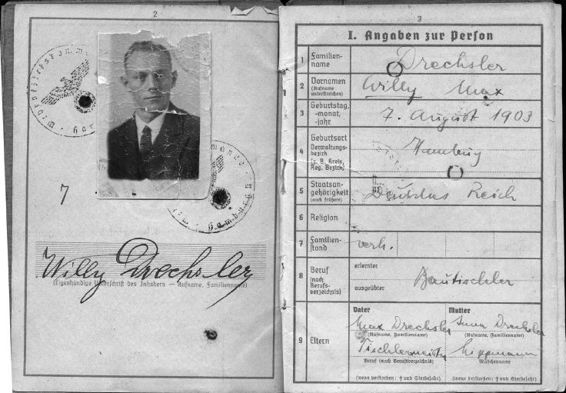
Wehrpass of GFP official Willy Dreschler. Note that the identity photo though it does show Dreschler, is not the original photo from the Wehrpass.
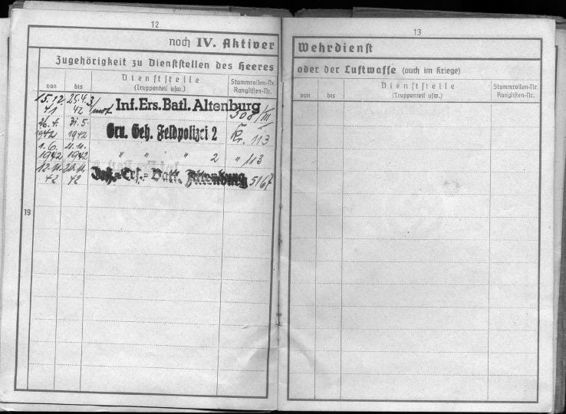
Ehbauer’s Soldbuch shows he served within Wehrkreis XIII, the military district centred on Nuremberg.
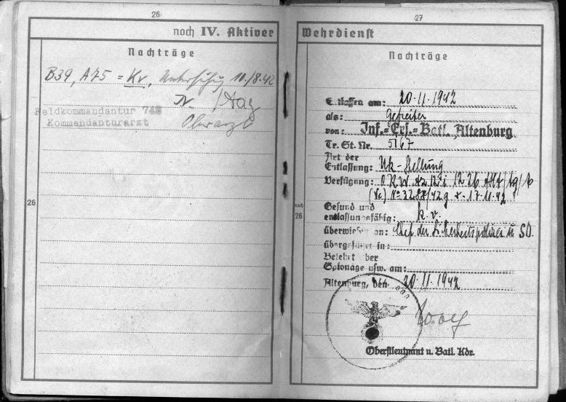
Deschler’s origins are clear from the entry shown here which indicates that when released from his military duties he is returned to the ‘Chef der Sicherheitspolizei u. SD’ (Chief of the Security Police and Security Service). Amt IV (Department IV) of the Sicherheitspolizei was the Gestapo.
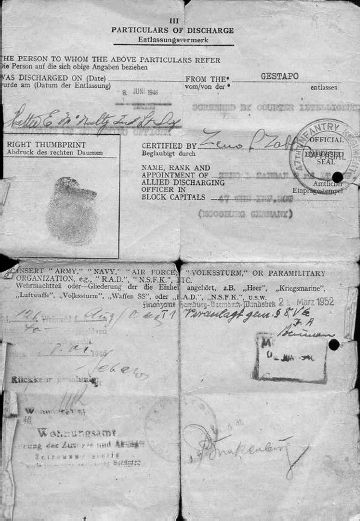
Deschler’s discharge from captivity as a POW confirms he is being discharged from the ‘Gestapo’.