
The Streifendienst
The chaotic military situation which existed in the late part of the Second World War and the need for robust disciplinary elements such as the Feldjäger is well known. More surprising perhaps is the fact that even at the very start of the war, the German military, perceived as being highly organised and disciplined, was facing severe problems with the behaviour of its troops.
With the general mobilisation prior to war, vast numbers of men were called up who had had prior military service in the First World War, and were by 1939 in the older age groups, men of over 40 years of age, many of whom were family men, and who had no wish to be in uniform again. These troops of course were not used as front line combatants, that being the lot of the younger, fitter generation. Used as second or third line elements, these men were often ill-disciplined and had a less than positive attitude. During the so-called ‘Phoney-War’ or Sitzkrieg, some were alleged to have fraternised with the French.
It was not only these older, less reliable troops who caused problems however, even some of the younger troops, including officers, were causing problems including theft, disobedience and drunkenness. Things were serious enough for the Oberbefehlshaber des Heeres, Generaloberst von Brauchitsch, to compare their behaviour to that of the Landsknecht (the often undisciplined German mercenaries of the sixteenth century)
For many of the highest ranking officers in the German military, memories of the breakdown in discipline which preceded the collapse of the German armies in 1918 were still fresh and led to the creation of the Streifendienst in a move intended to reinforce discipline and good behaviour, especially in places where bad behaviour could adversely effect the reputation of the Wehrmacht, i.e. where the public could witness any such behaviour.
On 18 November 1939, the formation of the Heeresstreifendienst was announced in Heeresmitteilungsblatt 41, Nr 526.
The central command for these units lay with the so-called Generäle zbV IV, based at the Oberkommando der Wehrmacht in Berlin. Under the control of this department were included the commanders of the patrol services in the homeland military districts (Heimat Wehrkreise) whose responsibilities included railway station guard units (Bahnhofswache), train guard units (Zugwache) as well as patrol services in garrison areas.
Outside of Germany, i.e. in the operational areas and occupied countries, officers rather awkwardly entitled ‘commanders for monitoring leave’, were established in early 1942. Under their control were patrol groups (initially of the Heer but later for the whole of the Wehrmacht), Wehrmachtpatrol commanders in the senior levels of the armies in the field as well as temporary patrol units organized at a local level for the armies in the field.

A very early and very simple typewritten Ausweis to Unteroffizier Friedrich Nabinger identifying him as a member of the Streifendienst.

The Streifendienst was unusual in not using a gorget or armband as a symbol of authority but rather an aiguilette a simplified version of that worn by adjutants. (Ian Jewison)

A commendation certificate to Nabinger from Generaloberst (later Generalfeldmarschall) Busch in respect of his service with the Streifendienst.
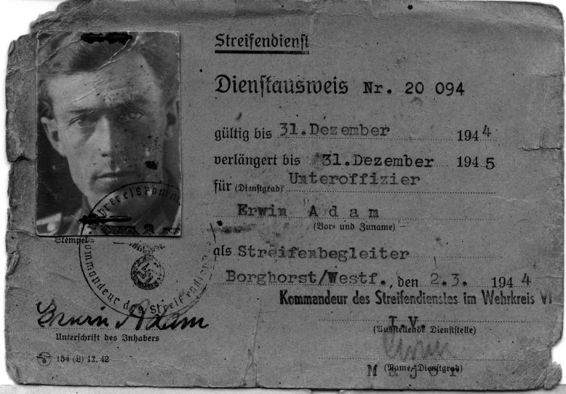
Streifendienst Ausweis to Unteroffizier Erwin Adam. The Ausweis was issued in Wehrkreis VI (Dresden). (Ian Jewison)

The reverse of the Streifendienst Ausweis sets out the responsibilities and authority of the bearer. (Ian Jewison)

Wehrpass to Unteroffizier Ludwig Schober who served with the Heeresstreifendienst.

As we can see, Streifendienst not only operated in Germany and the occupied territories, but anywhere German troops were present, including friendly states. Schober served in the Streifendienst attached to the German Military Attaché in Rome.
Wehrkreis level commands
|
Command |
Location |
|
Kdr. des Streifendienstes im Wehrkreis I: |
Königsberg. |
|
Kdr. des Streifendienstes im Wehrkreis II |
Stettin. |
|
Kdr. des Streifendienstes im Wehrkreis III |
Berlin. |
|
Kdr. des Streifendienstes im Wehrkreis IV: |
Dresden. |
|
Kdr. d. Streifendienstes im Wehrkreis V: |
Stuttgart |
|
Kdr. d. Streifendienstes im Wehrkreis VI |
Münster |
|
Kdr. des Streifendienstes im Wehrkreis VII |
München. |
|
Kdr. des Streifendienstes im Wehrkreis VIII |
Breslau. |
|
Kdr. des Streifendienstes im Wehrkreis IX |
Kassel. |
|
Kdr. des Streifendienstes im Wehrkreis X |
Hamburg |
|
Kdr. des Streifendienstes im Wehrkreis XI |
Hannover. |
|
Kdr. des Streifendienstes im Wehrkreis XII: |
Wiesbaden |
|
Kdr. des Streifendienstes im Wehrkreis XIII |
Nürnberg |
|
Kdr. der Streifendienste im Wehrkreis XVII |
Wien |
|
Kdr. der Streifendienste im Wehrkreis XVIII |
Salzburg |
|
Kdr. des Streifendienstes im Wehrkreis XX |
Danzig |
|
Kdr. des Streifendienstes im Wehrkreis XXI |
Posen |
|
Kdr des Streifendienstes im Generalgouvernement |
|
|
(Formed on 15 August 1941 in Wehrkreis VIII and from 17 September 1943 renamed as ‚Kdr. des Streifendienstes im Wehrkreis Generalgouvernement‘ Disbanded 17 August1944.) |
|
Field Units of the Army and Wehrmacht
All units which were initially formed as Heeres-Streifendienst were redesignated as Wehrmacht-Streifendienst in 1944.
Gruppe Heeresstreifendienst z. b. V. l:
Formed on 9 December 1941 in Wehrkreis VIII, from 29 December 1941 as Gruppe Heeres-Streifendienst beim AOK Norwegen. Reformed 17 February 1942 in Wehrkreis XI 1944/45 with Oberbefehlshaber West, lastly located at Freiburg/Breisgau.
Gruppe Heeresstreifendienst z. b. V. 2:
Formed 17 December 1941 in Wehrkreis XI, 1944 attached to Heeresgruppe A, 1945 attached to Heeresgruppe Mitte.
Gruppe Heeresstreifendienst z. b. V. 3:
Formed l September1942 im Wehrkreis III; 1944/45 in Italy with Oberbefehlshaber Südwest.
Gruppe Heeresstreifendienst z. b. V. 4:
Formed 3 September 1942 in Wehrkreis IV; 1944/45 in Italy.

Soldbuch to Stabsfeldwebel Franz Ehbauer who served in the Streifendienst on the home front.

Entries from the Dreschler Wehrpass showing his service with Gruppe GFP 2.

Wehrpass to Major Julius Messthaler, commander of Wehrmachstreifengruppe z.b.V. 24 a combat infantry veteran before serving with the Streifendienst.

Messthaler’s Wehrpass shows that he served with the Streifendienst on the home front as well as in Russia.
Gruppe Heeresstreifendienst z.b.V. 5:
Formed 5 September 1942 in Wehrkreis XI; 1944 Heeresgruppe A, 1945 Heeresgruppe Mitte (17. Armee) in Oberschlesien.
Gruppe Heeresstreifendienst z. b. V. 6:
Formed April 1943 in Wehrkreis III; 1944/45 in Italy.
Gruppe Heeresstreifendienst z. b. V. 7:
Formed April 1943 in Wehrkreis III (Berlin-Spandau); in 1944 with Heeresgruppe A /Mitte in Silesia.
Gruppe Heeresstreifendienst 8:
Formed March 1943 in Wehrkreis I; 1944 with Oberbefehlshaber West, 1945 on the Oder with Heeresgruppe Weichsel.
Gruppe Heeresstreifendienst 9:
Formed March 1943 in Wehrkreis XIII; 1944 with Heeresgruppe A, 1945 with Heeresgruppe Mitte.
Gruppe Heeresstreifendienst z. b. V. 10:
Formed March 1943 in Wehrkreis IV; 1945 on the western front with Heeresgruppe G, Oberrhein, Saarpfalz.
Gruppe Heeresstreifendienst z. b. V. 11:
Formed March 1943 in Wehrkreis VI; 1944 with Heeresgruppe A in southern Poland. 1945 with Heeresgruppe Mitte in Silesia.
Gruppe Heeresstreifendienst z. b. V. 12:
Formed February 1943 in Wehrkreis III (Berlin-Spandau); 1944 with 4. Armee in East Prussia.
Gruppe Heeresstreifendienst z. b. V. 13:
Formed September 1943 in Wehrkreis VIII; in 1944/45 with Oberbefehlshaber Südost, finally in Cilli/Steiermark.
Gruppe Heeresstreifendienst z. b. V. 14:
Formed September 1943 in Wehrkreis XIII (Bayreuth); November 1943 with Militär Befehlshaber Nordostfrankreich, 1944 with Oberbefehlshaber West, 1945 in Idar-Oberstein.
Gruppe Heeresstreifendienst 15:
Formed Aug. 1943 in Wehrkreis XI; 1944 with Heeresgruppe E in Serbia, 1945 in Croatia.
Wehrmachtsstreifengruppe z.b.V. 16:
Formed March 1944 by renaming ‘Gruppe Wehrmachtsstreifendienst bei Heeresgruppe Süd’; employed with Heeresgruppe A in southern Poland, 1945 in Prague.
Gruppe Wehrmachtsstreifendienst z.b.V. 17:
Formed August 1944 in Wehrkreis III; employed in the west with Heeresgruppe G, In 1945 at St. Wendel/Saar (1.Armee).
Gruppe Wehrmachtsstreifendienst z.b.V. 18:
Formed Aug. 1944 im Wehrkreis IV; employed firstly in the west, by the end of 1944 with Heeresgruppe A in southern Poland, 1945 in Bautzen.
Gruppe Wehrmachtsstreifendienst z.b.V. 19:
Formed August 1944 in Wehrkreis XI; Hannover. Employed initially in Wehrkreis XII, Wiesbaden, then with Heeresgruppe A in southern Poland, and ultimately with Heeresgruppe Mitte in Silesia.
Wehrmachtstreifengruppe z. b. V. 20:
Formed Aug. 1944 from Kommandeur Heeres-Streifendienst beim Befehlshaber Rückwärtigen Heeresgebiet Mitte; action with 3. PzArmee, in East Prussia.
In 1945 with 2. Armee on the Vistula front.
Wehrmachtstreifengruppe z. b. V. 21:
Formed April 1944 in Wehrkreis III (Belzig); action in Hungary.
Wehrmachtstreifengruppe 22:
Formed September 1944 in Slovakia.
Wehrmachtstreifengruppe 23:
Formed October 1944 from Wehrmacht-Streifengruppe 2 bei Heeresgruppe Nord and ultimately served in Kurland.
Wehrmachtstreifengruppe 24:
Formed in October 1944 from Wehrmacht-Streifengruppe Heeresgruppe Süd and ultimately serbed in Slovakia.
Wehrmachtstreifengruppe 25:
Formed Winter 1944/45; ultimately active in East Prussia.
Wehrmachtstreifengruppe z.b.V. 26:
Formed summer 1944 in Hungary from the Kommandeur der Heeresstreifendienstes Ungarn and disbanded at the end of 1944.
Wehrmachtstreifengruppe 27:
Formed November 1944 from Gruppe Heeresstreifendienst beim deutschen Wehrmachtattaché Rom, Employed in Italy.
Wehrmachtstreifengruppe 28:
No information available.
Wehrmachtstreifengruppe z. b. V. 29:
Formed October 1944 from the renamed Gruppe Wehrmachtstreifendienst beim WB Dänemark.
Wehrmachtstreifengruppe 30:
Formed January 1945 active in Bohemia-Moravia.
Wehrmachtstreifengruppe 31:
Formed January 1945 and active with Panzer Armeeoberkommando 6 in Hungary.
Wehrmacht-Streifengruppe 32:
Formed January 1945 and active around Prenzlau with Heeresgruppe Weichsel.
Wehrmacht-Streifengruppe 33:
Formed January 1945. No other details known.
Wehrmacht-Streifengruppe 34:
Formed January 1945. No other details known.
Wehrmacht-Streifengruppe 35:
Formed January 1945 and served with Heeresgruppe B.
Wehrmacht-Streifengruppe 36:
Formed January 1945 and based in Berlin-Hirschgraben.
Wehrmacht-Streifengruppe 37:
Formed February 1945 active around Falkensee.
Wehrmacht-Streifengruppe 38:
Formed February 1945 active in Potsdam.
Wehrmacht-Streifengruppe 39:
Formed February 1945 and active with Heeresgruppe Süd.
Wehrmacht-Streifengruppe 40:
Formed February 1945 and based in Danzig.
Wehrmacht-Streifengruppe 41:
Formed April 1945. No other details known.
Wehrmacht-Streifengruppe 42:
Formed April 1945. No other details known.
Wehrmacht-Streifengruppe 43:
Formed April 1945. No other details known.

Ausweis of Unteroffizier Ernst Schödel as a member of Gruppe Heeresstreifendienst z.b.V. 15

Award document for the West Wall Medal awarded to Nabinger for his service on the defensive fortifications on Germany’s border with France prior to May 1940, whilst serving with the Streifendienst.

Nabinger would later serve as a combat infantryman. This covering letter was to accompany the Wound Badge in Silver and its award document being sent to his wife by his then unit, Infanterie Regiment 118.
Equipment Levels
Gruppe Heeresstreifendenst
HQ
1 officer, 1 NCO and 3 enlisted ranks.
2 × pistols.
3 × carbines.
1 × machine pistol.
1 × automobile.
Officer Patrols
1 officer, 1 NCO and 1 enlisted rank.
1 × pistol.
1 × carbine.
1 × machine pistol.
1 × automobile.
NCO Patrols
2 NCOs and 1 enlisted rank.
1 × pistol.
1 × carbine.
1 × machine pistol.
1 × automobile.
Gruppe Heeresstreifendenst a—Occupied Territories
HQ
2 officers, 3 NCOs and 6 enlisted ranks.
7 × pistols.
4 × carbines.
2 × machine pistols.
1 × heavy field car.
Officer Patrols
9 officers, 9 NCOs and 9 enlisted ranks.
18 × pistols.
9 × carbines.
9 × machine pistols.
6 × medium field cars.
3 × light field cars.
NCO Patrols
6 NCOs and 3 enlisted ranks.
6 × pistols.
3 × carbines.
3 × machine pistols.
1 × medium field car.
1 × heavy field car.
Gruppe Heeresstreifendenst b—Occupied Territories
HQ
2 officers, 3 NCOs and 6 enlisted ranks.
9 × pistols.
6 × carbines.
2 × machine pistols.
1 × heavy field car.
Officer Patrols
12 officers, 12 NCOs and 12 enlisted ranks.
24 × pistols.
12 × carbines.
12 × machine pistols.
8 × medium field cars.
4 × light field cars.
NCO Patrols
12 NCOs and 6 enlisted ranks.
12 × pistols.
6 × carbines.
6 × machine pistols.
4 × medium field cars.
2 × heavy field cars.

1945 Ausweis to Oberfeldwebel Paul Stegmann. Notice that a prefix ‘Wehrmacht’ has been added to the heading after all Heerestreifendienst elements were renamed as Wehrmachtstreifendienst.

Award Document for the War Merit Cross to Obergefreiten Heinrich Gudewill for service in the Streifendienst.
Gruppe Heeresstreifendenst c—Occupied Territories
HQ
2 officers, 3 NCOs and 6 enlisted ranks.
7 × pistols.
4 × carbines.
2 × machine pistols.
1 × heavy field car.
Officer Patrols
3 officers, 4 NCOs and 16 enlisted ranks.
42 × pistols.
21 × carbines.
21 × machine pistols.
16 × medium field cars.
5 × heavy field cars.
NCO Patrols
30 NCOs and 15 enlisted ranks.
30 × pistols.
15 × carbines.
15 × machine pistols.
10 × light field cars.
5 × medium field cars.
Gruppe Heeresstreifendenst zbV—Occupied Territories
HQ
3 officers, 6 NCOs and 18 enlisted ranks.
5 × pistols.
22 × carbines.
4 × medium field cars.
1 × heavy field car.
1 × 3 ton truck.
Officer Patrols
15 officers, 15 NCOs and 15 enlisted ranks.
30 × pistols
15 × carbines.
15 × machine pistols.
15 × medium field cars.
NCO Patrols
20 NCOs and 10 enlisted ranks.
20 × pistols.
10 × carbines.
10 × machine pistols.
10 × medium field car.
Typically, Patrols or Streifen were carried out by groups of three soldiers. Generally this would be one officer, one NCO and one enlisted rank, or by one senior NCO, one junior NCO and one enlisted rank. It is quite clear from studying the above equipment scales that patrol units in occupied areas were far more powerful than those on the home front where miscreant soldiers were unlikely to offer armed resistance!
What is also clear is that Streifendienst patrols were far more heavily armed than those of the Feldgendarmerie or Feldjäger as the issue level of machine pistols shows. The Feldjäger of course were entitled to call upon the Streifendienst to support them so probably did not require a heavier weapons load in their own right.
Bahnhofswache
During the war, at any time vast numbers of military personnel were in transit through all parts of Germany. Almost from the beginning of the war, the Wehrmacht faced difficulties in properly controlling discipline with large troop movements through major rail centres.
Bahnhofswache units were formed in order to maintain order and discipline at railway stations, checking travel papers and movement orders, not only to ensure smooth troop movements, but also to detain those without valid papers, such as deserters etc.
Uniforms and Insignia
As with the Streifendienst, members of the Bahnhofswache did not have a special uniform, or a particular specific colour of Waffenfarbe. Personnel from virtually any branch of the armed services could be temporarily attached to a Bahnhofswache unit. Special insignia however were introduced to identify troops acting as Bahnhofswache personnel. These included:
Armband
A yellow armband with the legend Bahnhofswache machine woven or printed in black Gothic style script.
Gorget
A gorget similar in general style to that worn by the Feldgendarmerie was produced for Bahnhofswache personnel. The neck chain and basic half moon shaped plate were identical to those of the Feldgendarmerie, bit where the Feldgendarmerie gorget featured stippled buttons to the left and right ends of the plate, the Bahnhofswache gorget had Wehrmacht pattern national emblems (the eagle and swastika with folded wings). The scroll had a dark grey painted finish with the legend Bahnhofswache in Gothic characters.

Soldbuch to Feldwebel Karl Schreiter a Luftwaffe member of the Streifendienst. (Ian Jewison)

Schreiter had an interesting career, first in aircrew as an air gunner, then with the elite Fallschirmpanzerkorps Hermann Göring before ending the war in the Streifendienst. See the final entry at the bottom of the right hand page for ‘Wehrmachtstreifenlehrabteilung’. (Ian Jewison)

A Streifendienst unit. Note that all are combat veterans with at least the Iron Cross 2nd Class and most have been wounded in action. (Ian Jewison)

Bahnhofswache checking papers at a major railway station in Germany.

A fine study of an enlisted rank on duty with the Bahnhofswache.

Luftwaffe member of the Bahnhofswache posing with an NCO in the role of Bahnhofs Offizier.
The central motif of the gorget was the number of the wearer’s Abteilung. These numerals, plus the national emblems and the lettering on the scroll, were all finished in luminous paint.
Bahnhofs-Wach u Streifen Abt 101
Active in the northern sector of the Eastern Front and in Latvia.
Bahnhofs-Wach u Streifen Abt 102
Active in the Brandenburg region of Germany.
Bahnhofs-Wach u Streifen Abt 103
Active in the southern sector of the Eastern Front and Czechoslovakia.
Bahnhofs-Wach u Streifen Abt 104
Active in the Ukraine and in Hungary.
Bahnhofs-Wach u Streifen Abt 105
Active in the southern sector of the Eastern Front.
Bahnhofs-Wach u Streifen Abt 106
Active in the southern sector of the Eastern Front.
Bahnhofs-Wach u Streifen Abt 108
Active in the Hamburg area.
Bahnhofs-Wach u Streifen Abt 109
Active in the area along the upper Rhine.
Bahnhofs-Wach u Streifen Abt 110
Active in the Netherlands.
Bahnhofs-Wach-Kompanie Italien
Operated in Italy.
Bahnhofs-Wach u Streifen Abt beim Armeeoberkommando Norwegen
Operated in occupied Norway.
Bahnhofs-Wach u Streifen Abt Nordrussland
Active in the norther sector of the Eastern Front.

Oberfeldwebel of Bahnhofswache on duty. This was not a specific military career but simply a duty to which any soldier could be temporarily assigned.

This Bahnhofswache soldier may look very young, but wears the Wound Badge verifying that he has seen combat.

Bahnhofswache Unteroffizier wearing a pistol—the typical armament for this duty.

A variant of the Bahnhofswache armband being worn, with italic script lettering.

Soldbuch of Hauptmann Erich Marquardt who commanded a Bahnhofswache detachment.

Entry in the Marquardt Soldbuch showing an entry for Bahnhofskommandantur 402.

The Bahnhofswache armband was replaced by the gorget but in this interesting shot the soldier second from right wears both the armband and the gorget.

Another NCO of Bahnhofswache with combat experience as evidenced by the Wound Badge on his pocket.

Combat infantry veteran on duty with the Bahnhofswache.

Bahnhofswache on duty at a rural railway station, in the occupied Eastern territories.

Typical mixed Luftwaffe/Army Bahnhofswache group, some wearing decorations from previous combat duties.
Zugwache
The Zugwache were somewhat analogous to the Bahnhofswache, but whereas the former were responsible for policing railway stations, the latter were responsible for the trains themselves. Each train would have its own designated carriage for the Zugwache, who would ensure the travel papers of those travelling on the train were in order, apprehend any deserters or soldiers without proper paperwork, etc. In addition, the Zugwache would provide an instant armed response to any attacks on trains by partisans etc. when passing through dangerous areas.
Soldiers from any branch could be assigned to service in the Zugwache, and as this service did not have its own specific Waffenfarbe colour, would continue to wear the Waffenfarbe of their parent branch.
Examination of Soldbücher and Wehrpässe of soldiers with Zugwache experience indicate that, as opposed to being a career choice this was often a temporary assignment with soldiers passing from a particular branch of service or unit, experiencing a period of time in a Zugwache unit, and then moving on to a new assignment.
Special Insignia
The Gorget
In order to identify themselves as members of the Zugwache, members of these units wore a gorget when on duty. The gorget was of a similar style to that of the Feldgendarmerie being in typical crescent shape, stamped from thin sheet metal and with a plain undecorated chain. Replacing the buttons found on the Feldgendarmerie gorget were Wehrmacht pattern national emblems, each facing inwards towards the centre of the gorget. In the lower part of the gorget was a dark grey painted scroll bearing the legend ‘Zugwachabteilung’ in Gothic characters. The centre field of the gorget bore three metal numerals representing the Abteilung number.
A variant of the gorget also exists with the word ‘Zugwache’ rather than ‘Zugwachabteilung’ on the scroll. It may be that the change from Zugwache to Zugwachabteilung came when the basic unit formation size was upgraded from Kompanie to Abteilung strength.
At least two sizes of metal numerals have been noted on genuine examples indicating perhaps more than one manufacturer of these gorgets. A further variant has been noted which is identical to the Feldgendarmerie gorget with only the wording on the scroll being altered to ‘Zugwachabteilung’.
Ausweis
To back up the gorget as a sign of their authority, members of the Zugwache also carried a special Ausweis. The example shown here carries the following text:
Er hat die Berechtigung, gegebenfalls die Verpflichtung, allen Angehörigen der Wehrmacht und des Wehrmachtgefolges—mit Ausnahme von Generalen und im Generalsrang stehenden Wehrmachtbeamten in bezug auf seinen Aufgabenkreis Befehle zu erteilen.
Gegenüber Offizieren und Wehrmachtbeamten im Offizierrang haben nur Offizier Befehlsgewalt und Prüfungsrecht.
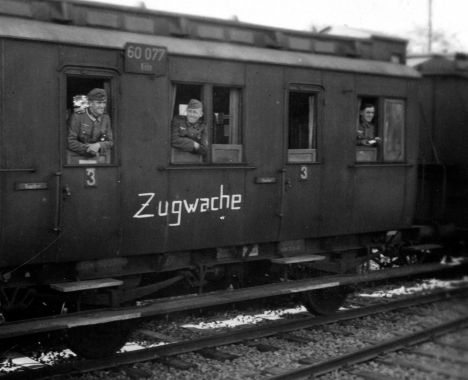
Railway carriage designated for use of the escorting Zugwache troops.

Condolence letter from the unit commander to Fischer’s wife explaining that he was killed in action when the train he was guarding was blown up after running over a mine.

Wehrpass for Stabsfeldwebel Karl Fischer of Zugwachabteilung 513.
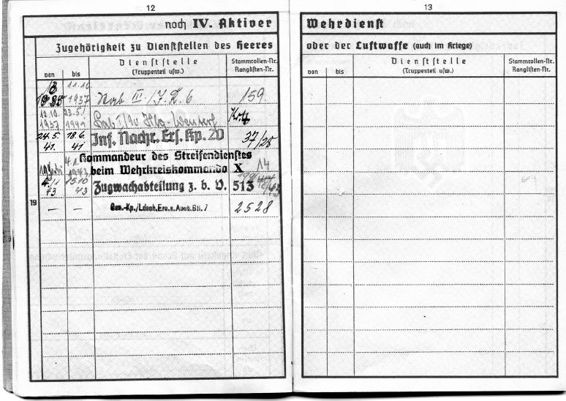
Detail from the Fischer Wehrpass showing the entry for Zugwachabteilung 513.

Zugwache NCO with a comrade from the Reichsarbeitsdienst.
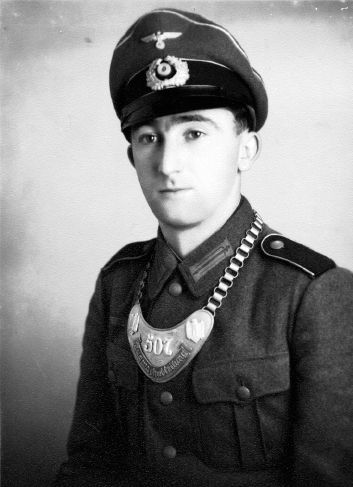
A superb portrait study of an enlisted rank serving with Zugwachabteilung 507.
Alle truppenteile und Dienststellen sowie jeder Wehrmachtangehörige sind verpflichtet, die Transportführer und Zugwachen auf Anforderung mit allen erforderlichen Mitteln zu unterstützen.
In relation to the bearer, this indicates that:
He has authorization, even the obligation, to give orders to all members of the armed forces and armed forces followers—with exception of generals and officials with equivalent general rank—related to the execution of his duties.
Only officers have authority over and rights to check officers and armed forces officials in officer rank.
All military units and agencies as well as each member of the armed forces is obliged to support the Transport leaders and Zugwache by all necessary means whenever required.
Clearly, when operating in the execution of their duties, members of the Zugwache, like their cousins in the Feldgendarmerie, also had wide ranging power and authority. The Ausweis goes on to clarify further details of the Zugwache soldier’s status:
Dem Inhaber dieses Ausweises obliegt die Kontrolle aller Wehrmachtreisenden—einschl. Angehörigen des Wehrmachtgefolges—in den Zügen.
Er hat in Ausübung seines Dienstes die Eigenschaft einer militärischen Wache im Sinne des s111 Abs.2 MstGB.
Er ist berechtigt in und ausser Dienst Pistole zu tragen.
Soweit dienstliche Notwendigkeit vorliegt, ist er bei Flakbeschuss und Luftalarm von luftschutzmässigem Verhalten und vom Aufsuchen von Luftschutzräumen befreit.
The holder of this certificate is responsible for the control of all armed forces passengers—including members of the military retinue—on trains.
He has, in exercising his duties, the capacity of a military guard as defined in Section 2 s111 MstGB.
He is entitled to carry a pistol both on and off duty.
In as far as required by his duties, he is exempt from flak fire alarm and air from air-raid precaution measures and taking cover in air raid shelters.
And finally, an extract from the Military Penal Code reinforces his position and authority, indicating that any action or opposition to the orders of a member of the Zugwache would be treated as if they had been committed against the individual’s own superiors.
Auszug aus MStGB III (H.Dv.275)
Wer eine militärische Wache im Dienste oder in Beziehung auf eine Diensthandlung mit der Begehung eines Verbrechens oder Vergehens bedroht oder wer sich ihr gegenüber einer Beleidigung, eines Ungehorsams, einer Widersetzung oder einer Tätlichkeit schuldig macht, wird ebenso bestraft, als wenn er die Handlung gegen einen Vorgesetzten begangen hätte.
This translates as:
Extract from Military Penal Code Para III ( Heeresdienstvorschrift 275)
Whoever threatens a military guard on duty or in engaged on an official matters with the commission of a crime, or an offense, or who is guilty of an insult, of disobedience, of offering resistance or an assault, is just as punishable as if the action had been committed against a superior.
Order of Battle
Zugwache units were allocated ‘500’ series numbers. The basic unit of the Zugwache was initially the Kompanie. However in 1942, the Company level units were upgraded to battalion strength and each Kompanie, whilst retaining its number, was renamed as an Abteilung.
Zugwach Units
The majority of Zugwache units began their life at Kompanie strength. They were initially classed as ‘special purpose’ units and carried the ‘z.b.V.’ (zur besondere Verwendung) suffix before this was dropped and from May 1942 onwards units were either upgraded to Abteilung or created at this level.
Zugwach-Abt. 502
Formed on 11 May 1942 from Zugwach-Kompanie 502 which had originally been formed on 26 November 1941 in Freiberg in Saxony. It served with Kommandeur des Heeresstreifendienstes für Reiseverkehr West in Paris,
Zugwach-Abt. 503
Formed on 11 May 1942 from Zugwach-Kompanie 503, which had originally been formed on 29 November 1941 in Wehrkreis VI. Ultimately employed in Wehrkreis III.

An interesting shot of a Zugwache soldier from Zugwachabteilung 509 in mountain cap and boots on board a ferry which was transferring a train to Norway.

Soldbuch for Hauptmann Erich Schmidt, a unit commander with the Zugwache.

The Schmidt Soldbuch shows service with Zugwachkompanie/Abteilung 504 and Zugwachabteilung 503.

The Schreier Soldbuch shows a change in the unit designation when it was upgraded from a Leutnant to an Abteilung.

Soldbuch for Oberleutnant Karl Schreier from Zugwachabteilung z.b.V. 502.
Zugwach-Abt. 504
Formed on 4 May 1942 from Zugwach-Kompanie 504, which had originally been formed on 1 December 1941 in Wehrkreis X. Disbanded on 15 November 1944.
Served with Kommandeur der Heeresstreifendienst für Reiseverkehr West.
Zugwach-Abt. 505
Formed on 11 May 1942 from Zugwach-Kompanie z.b.V. 505, which had originally been formed on 1 December 1941 in Wehrkreis XII. It served for some time in Berlin, and with Kommandeur der Heeresstreifendienst für Reiseverkehr West, then ultimately with Heeresgruppe B.
Zugwach-Abt 506
No information, but gorgets to this formation exist.
Zugwach-Abt. 507
Formed on 12 May 1942 from Zugwach-Kompanie 507, which had originally been formed on 8 May 1942 in Wehrkreis XVII. It served with Kommandeur der Heeresstreifendienst für Reiseverkehr West but was ultimately dispersed with Stab/507 being located in Wehrkreis V, 1, 2 and 3. Kompanien with Heeresgruppe Mitte in Silesia and 4. Kompanie in Wehrkreis III.
Zugwach-Abt. 508
Formed on 7 May 1942 from Zugwach-Kompanie 508 originally formed on 1 May 1942 in Aachen in Wehrkreis VI. It served with Kommandeur der Heeresstreifendienst für Reiseverkehr West ultimately being located in Oberkotzau in northern Bavaria.
Zugwach-Abt. 509
Formed on 13 June 1942 in Wehrkreis III. Served under Kommandeur der Heeresstreifendienst für Reiseverkehr Nord and with Armeeoberkommando Norwegen.
Zugwach-Abt. 510
Formed on 14 October 1942 in Wehrkreis I. It served under Kommandeur der Heeresstreifendienst für Reiseverkehr Nordrußland, ultimately being dispersed with 1. Staffel allocated to Heeresgruppe C in Italy and 2. Staffel serving in North Norway.
Zugwach-Abt. z.b.V. 511
Formed on 10 October 1942 in Wehrkreis II, and later renamed as Bahnhofs-Wach- u. Streifen-Abt. 109 during the Winter of 1944–45. It served with Heeresstreifendienst beim Reiseverkehr on the Eastern Front and from August 1944 in Paris.
Zugwach-Abt. 512
Formed on 8 October 1942 in Wehrkreis IX. It served with Streifendienst beim Reiseverkehr, by 1945 in Erfurt.
Zugwach-Abt. 513
Formed on 6 January 1943 in Wehrkreis VII, Munich aus Abgaben der Wehrkreise I, III, IX und X. Served with Streifendienst beim Reiseverkehr Rußland -Nord, and ultimately in the area around Neufahrwasser.
Zugwach-Abt. 514
Formed on 3 January 1943 in Köln, Wehrkreis VI. Operational with Kommandeur der Heeresstreifendienst für Reiseverkehr in central Russia and lastly with Heeresgruppe Nord in East Prussia.
Zugwach-Abt. 515
Formed 1943 in Wehrkreis III. Operational 1943 with General z. b. V. IV in Berlin, later with Kdr. d. Heeresstreifendienst f. Reiseverkehr (Balkan—Marburg/Maribor) and lastly in Wehrkreis XVII (Wien).
Zugwach-Abt. 516
A Staffel from this unit is known to have served in Italy.
Zugwach-Abt. 520
Formed on 26 August 1943 in Wehrkreis III. It served with Kommandeur der Heeresstreifendienst für Reiseverkehr Rußland-Mitte and ultimately with Herresgruppe Nord in East Prussia.

Zugwache relaxing with a glass of Schnapps.

Soldbuch for Hauptmann Reinhard Lange from Zugwachabteilung 503.

The Soldbuch reveals that Lange first served in Dresden before being transferred to Berlin
Equipment Levels
Zugwach Kompanie
Command Unit
1 officer, 7 NCOs and 7 enlisted ranks.
3 × pistols.
12 × carbines.
1 × automobile.
Platoons
22 officers, 22 NCOs and 22 enlisted ranks.
66 × pistols.
A Zugwachkompanie consisted of a command element and 4 platoons, therefore the total Kompanie strength would be 89 officers, 95 NCOs and 95 enlisted ranks .
Zugwachabteilung zbV
Command
3 officers, 1 admin official, 3 NCOs and 6 enlisted ranks.
4 × carbines.
5 × pistols.
Zugwach Staffel
37 officers and 37 NCOs.
74 × pistols.
A Zugwachabteilung consisted of a command group plus 3 Staffeln giving a total manpower count of 114 officers, 1 admin official, 114 NCOs and 6 enlisted ranks.
The Kommandanturen
Each Kommandantur or local military headquarters in the Reich organised its own foot patrols to ensure discipline was maintained by soldiers in public view. Service with such patrols was not a ‘career’ as such but a simple duty to which soldiers serving at the Kommandantur could be assigned. There was no special uniform insignia or Waffenfarbe, but soldiers on patrol duty wore a special gorget bearing a scroll with the legend ‘Kommandantur’ flanked each side by a Wehrmacht eagle. Above the scroll was an Arabic numeral. Photographs of the gorget being worn are extremely rare. From the outbreak of war, Feldgendarmerie were the primary organ for maintaining discipline.

Award Document for the Wound Badge in Black to Obergefreiter Erich Ritz of Zugwachabteilung 507.

Award Document for the Wound Badge in Black to Gefreiter Georg Reidinger of 1 Staffel/Zugwachabteilung 513.
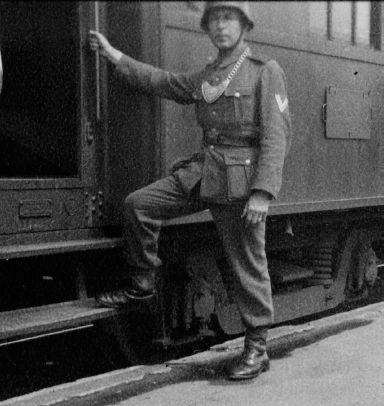
Zugwache Gefreiter about to board the train he is to guard.
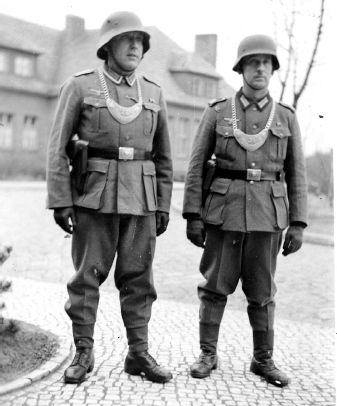
This extremely rare shot shows the Kommandantur gorget being worn by a two- man foot-patrol.