
The end of the Vietnam War necessarily ends this narrative history of American artistic engagement during it. This narrative has contextualized antiwar art-making within a detailed history of the war and tried to give attention to many of the significant artworks. It has identified specific historical occurrences and phenomena that both catalyzed and deterred such engagement. This study has also developed a general typology of American protest, which has been lacking in previous scholarship, and which aims to promote greater understanding of protest in the arts.
As a conclusion to this study, in order to expand the argument for the historical relevance of this work (and this project), I will highlight some examples where the influence of this era of engagement on some subsequent art and artists can be seen. However, because the subsequent history is not the focus of this work, this is not meant as a complete evaluation but rather an overview; a comprehensive evaluation deserves its own book. Important to note as well is the fact that arguing for the subsequent influence of any twentieth-century political work has become particularly significant in recent history in the face of a prevailing and misguided opinion that twentieth-century political art movements were “failures.”
To begin with, while AWC did not form in response to the Vietnam War, nor (it must be said) did the majority of its various activities concern the war, the activities of its various factions has been by far the most influential force on subsequent American antiwar engagement as well as politically and socially engaged production as a whole. Those involved with AWC catalyzed a lineage of various subgroups, offshoots, and initiatives. While most of these aggregations were composed of AWC’s unprecedented body of participants, AWC also established its significance through publications, such as Open Hearing (a transcript of their April 1969 meeting at the School of Visual Arts) and Documents 1 (a collection of letters, press, and ephemera documenting the formation of the coalition and its dialogue with MoMA). These publications were disseminated and inspired those unaffiliated with the coalition to create new political formations. Further, the activities of AWC generated a collective spirit and politicized climate that inspired those not directly connected with the group.
Among the groups formed thanks to the AWC were those that ended up cultivating the agitational, “consciousness-raising,” and identity-oriented feminist art and activism of the late 1960s and early 1970s. These were such groups as Women Artists in Revolution (WAR), which split off from the coalition in 1969 to fight for women’s rights in the art world; the Women’s Interart Center, which evolved from WAR (and was New York’s first women’s alternative space); and the Ad Hoc Women’s Artists’ Committee. The Ad Hoc Committee emerged from AWC in 1970 and was formed specifically to address the low number of women shown in the Whitney annual—now biennial—exhibitions. The group, founded by Faith Ringgold, Poppy Johnson, and Brenda Miller—and soon joined by Lucy Lippard—staged four months of picketing outside the Whitney.1 They urged equal representation in the exhibition, and to make it easier for the museum to find women they submitted a long list of possible candidates. This list became the foundation for the Women’s Art Registry, which is still in existence.2 The group envisioned the registry as a concrete resource to battle bias and ignorance about women’s art. (The registry has since become a model for other minority groups.)3
AWC’s activities and consciousness-raising also contributed to the founding of a plethora of alternative art museums, artist-run spaces, cooperative galleries, and art centers in New York City, such as the Studio Museum in Harlem (1968), El Museo del Barrio (1969), the Bronx Museum for the Arts (1971), the Alternative Museum (1975), 55 Mercer, Artists Space (1972), the Institute for Art and Urban Resources (1971)—which later became PS1—and 112 Workshop/112 Greene Street (1970), which in 1979 became White Columns. These institutions’ focus on articulating the identity of underrepresented groups and countering the power of major museums and commercial galleries had been central to AWC.
In December 1975, veterans of Vietnam-era protest (many of whom had been involved with AWC) formed Artists Meeting for Cultural Change (AMCC). AMCC revived the organizational model of AWC to again focus attention on the continuing lack of minorities in the art world. Their most famous action—and the impetus for the group’s founding—was a protest of the Whitney Museum’s plan to celebrate the U.S. bicentennial with an exhibition of the collection of John D. Rockefeller III. In a letter signed by Benny Andrews (still then involved with the Black Emergency Cultural Coalition), Lucy Lippard (then of the Women’s Slide Registry), and Rudolf Baranik (still of Artists and Writers Protest), AMCC argued that the Rockefeller collection ignored the art of dissent, as well as art by minorities and women. Weekly meetings at Artists Space led to the creation of an anti-catalog for the Whitney exhibition. The catalog featured critical essays and documents intended to counter the viewpoints of what they believed the Whitney was putting forth as “official culture.”4
In 1979, Lippard began the influential archive of materials relating to political art, Political Art Documentation/Distribution (PAD/D), when she stamped an open call for such materials on the announcement card of an exhibition she was curating for Artists Space titled Some British Art from the Left. (Even though by then Lippard had been involved in various other organizations concerned with art and politics and particularly feminist art and politics, PAD/D could not have been formed without Lippard’s previous involvement—and political awakening—in AWC.) Though PAD/D did not have an exhibition space, it was an activist art group. It practiced political art and promoted discourse by mounting socially themed streetworks and staged monthly forums and workshops called Second Sundays (at the major archive of artists’ books, Franklin Furnace). PAD/D also organized exhibitions, such as State of Mind: State of the Union before Reagan’s second presidential inauguration, and published the magazine Upfront. The exhibitions of Group Material, the politically and socially conscious art collective of the 1980s (which included among its members Julie Ault, Tim Rollins, Doug Ashford, and Felix Gonzalez-Torres) could be seen as a more aesthetically inclined outgrowth of PAD/D.5
In 1984, the poster committee that originated in AWC (and had spearheaded the organization of And Babies) decided to create another major poster that would respond with outrage to current political events. During a sound check prior to his weekly address on National Public Radio while running for reelection in 1984, President Ronald Reagan had played a joke on his radio technicians by announcing, “My fellow Americans, I’m pleased to tell you that I’ve signed legislation that will outlaw Russia forever. We begin bombing in five minutes.” While Reagan’s words were not broadcast, they were leaked to the press and led to criticism, especially among those seeking to portray Reagan as a warmonger.6 (Allegedly, the Soviet army was placed on alert for thirty minutes after the statement was leaked.) In response to this situation, APC created a poster that included a graphic depiction of a clock and the abbreviated quotation, “We begin bombing in five minutes.” The poster brought to attention how Reagan’s behavior was incompatible with the seriousness demanded from the presidential office and how it could lead to dire consequences for the entire world.
Apart from AWC, artists’ open calls for protest work during the Vietnam War (which resulted in the Peace Tower and the Collage of Indignation) became the model for organizing later collective endeavors—which were often led by the same people who had been involved in the previous Vietnam-era calls. For example, one of the largest collective aesthetic actions of the 1980s, 1984’s Artists Call Against U.S. Intervention in Central America, was promoted by familiar artists and critics such as Hendricks, Petlin, Lippard, and Oldenburg. The call had been inspired by demonstrations against U.S. intervention that took place in Washington, DC, and originated in January 1984 with Daniel Flores y Ascencio at the Institute for the Arts and Letters of El Salvador, Lucy Lippard, and Doug Ashford. (Julie Ault was also involved, and Coosje van Bruggen was a significant organizer for the group.) The institute asked artists working in various mediums and disciplines “to bring their originality into play to show the connection of vision that exists between our peoples and the people of Central America—to make it known that the people of Central America are not alone and that we actively share their dreams for peace and self-determination.” The statement added that this was the moment for a remobilization within the artists’ community, which had been dormant since its “awakening” during the Vietnam War, and one “must again stand up in protest to avoid another Vietnam.”7 The call led to thirty-one exhibitions, and various murals, film series, lectures, a calendar, and a mail-in project, though it bears mentioning that the call—like so many extra-aesthetic efforts during Vietnam—lacked any clarified “political line” except for its basic and decidedly political premise: “No U.S. Intervention.”8 The proceeds from the call supported “culture and workers . . . which together comprise[d] the endangered culture of Central America.”9 And according to Lucy Lippard, “Aside from raising money and raising consciousness about the increasing militarization of Central America by the Reagan administration, the Call encouraged international solidarity among artists, set up an ongoing national network of socially conscious artists, and provided a model for other cultural and professional groups. . . . [It also] widened the spectrum of artists who learned about the Central American situation and who realized that such issues could be part of their art.”10
The most memorable result from the call was the Claes Oldenburg–designed poster for it that ran in the New York Times. Originally executed in three colors, it featured a large image, created by Oldenburg, of soldiers pulling down a monumental sculpture of a banana with a rope (thus destroying it). The banana referred to how, since the late nineteenth century, the United States has consistently made Central American countries into “banana republics,” so called because Central American countries would be characteristically cultivated by foreigners to farm one agricultural product—often bananas—making them heavily dependent on foreign capital. Alongside Oldenburg’s graphic were hundreds of signatures. A related artists’ call from the period occurred the year previous. Art Against Apartheid, organized by hundreds of artists—among them Leon Golub—placed an open call for work that would raise consciousness about the battle against apartheid laws in South Africa, which had legalized racial segregation since the late 1940s. Art Against Apartheid exhibitions continued to be organized annually for several years into the 1990s until apartheid laws were eliminated.
Though the Guerrilla Art Action Group’s activities persisted into the 1980s, their example of bringing street theater—and thus direct and bold performative actions—into the realm of visual art also proved to be a paradigm for a host of later protest groups.11Among them were Carnival Knowledge, an 1980s art protest group focused on reproductive rights formed by Anne Pitrone in response to the antiabortion campaign of the Moral Majority in the United States. There was also ACT UP, which raised consciousness of the AIDS epidemic; Gran Fury, a spin-off from ACT UP that was also involved with AIDS awareness; and the Guerrilla Girls. At the end of the 1980s, drawing on the example of the New York Art Strike was the organization of the first Day Without Art, which occurred on December 1, 1989. For one day, eight hundred U.S. art and AIDS action groups shut down museums, volunteered at AIDS organizations, and mounted exhibitions to raise awareness of the AIDS crisis. The day continues to be a yearly event.
While collective action was the dominant form of influence during the 1980s of Vietnam-era engagement, over the course of the last decade, throughout American wars in Iraq and Afghanistan, there has been a great lack of collective artistic activities. The historical influence of Vietnam-era engagement has thus been limited to art objects created in the United States as well as in other countries allied with America in its wars, such as the United Kingdom and Israel. While this state of affairs has been attributed to the lack of a draft, which has lessened the urgency of the antiwar movement as a whole and in turn affected the appearance of collective aesthetic or extra-aesthetic activities in the art world, other reasons are more significant. The American and British art markets are now more sympathetic to protest objects in a way they have never been previously. This allows artists not to have to mobilize through media forms (or in this case, non-media forms) outside the gallery or museum system. There is also the often-discussed end of the public sphere and the transference of many of its previous activities into virtual outlets (like Facebook and Twitter) that are in some ways easier to manipulate and definitely less risky for the participants.
Despite the reasons for such a situation, the extent of Vietnam-era and previous antiwar production’s influence on current protest artworks has been substantial. As the art historian Ara Merjian explained in 2008 in Modern Painters, this may have been because of the inability of Americans to truly understand the complexities of the Iraq War. He wrote, “There is something ultimately unrepresentable about the ideology with which and through which this war is being conducted. . . . It is perhaps for this reason that, while the war on terror streams in with an unprecedented instantaneity and simultaneity, so many works of art turn to previous aesthetic (and antiaesthetic) models to make sense of that information.”12
One way that Vietnam-era production’s influence has manifested itself is the fact that a common strategy of protest during the Iraq War was the re-exhibition of historical antiwar works significant to artists during Vietnam, or the subtle alteration of works made during Vietnam by their original authors so that they now refer to the situation in Iraq. For example, Picasso’s and Goya’s antiwar works as well as Leon Golub’s Vietnam-era paintings were all exhibited as antiwar statements during the Iraq War. Picasso’s paintings and prints created at the onset of the Spanish Civil War were a focus of Barcelona and Modernity: Gaudí to Dalí at the Metropolitan Museum of Art. The Peter Blum Gallery in SoHo exhibited eighty of Goya’s Disasters of War etchings, explaining, “Goya’s honest and sober representations of war speak not only of the past, but contain a timeless message that resonates even today.”15 And Golub’s Vietnam and Napalm paintings were shown at Ronald Feldman Gallery during the winter of 2006. Martha Rosler in essence retained the same strategies from her Bringing the War Home: House Beautiful series, but just inserted contemporary imagery in her new series of collages based on the Iraq War, such as Photo Op of 2004. Notably, Rosler’s current series is exhibited in the spaces and publications she initially sought to circumvent. Rosler has commented that the rationale for this was multiple. Among her reasons were that the public for art is much larger than in the 1960s; that people are more than ready to think about alternatives to war and empire; and her belief that the shortest route to the mass media was by exhibiting in the art world.
The Peace Tower was essentially just updated for the Iraq War by its original driving force, Mark di Suvero. For the 2006 Whitney biennial, di Suvero created a joint venture with Rirkrit Tiravanija titled Peace Tower (fig. 65). Installed in the sculpture court in front of the Whitney Museum, the work recreated the original sculptural skeleton of the Artists Tower of Protest. The new tower was covered by hundreds of new panels that commented on the Iraq War by both contemporary artists who had nothing to do with the original tower as well as artists who had been involved with the Vietnam-era antiwar movement (but who had not necessarily contributed to the first tower). Among others, the work of Alice Zimmerman, Spero, Rosenquist, Tom Doyle, Anthe Zacharias, Ethelyn Honig, Petlin, and Haacke was included.
The artist Harrell Fletcher further created an incredibly powerful form of re-exhibition with his work The American War (2005). Fletcher’s work was a collection of photographs the artist took in the War Remnants Museum in Ho Chi Minh City, a memorial museum for what is referred to in Vietnam as the American War. Fletcher’s photographs record all the documentary photographs and texts used in the museum, all of which illustrate—at times quite graphically—the atrocities committed by U.S. forces. Some of Fletcher’s photographs are at odd angles, which he used to avoid flash reflections, and all of them attempt to include some of the background walls (because, he explained, he wanted the viewer to always be aware that the images were taken in Vietnam, at the museum). Fletcher wanted to find a way to bring the museum to a wider U.S. population, and through a multitude of exhibitions around the United States he has done so.
A preponderance of artworks by contemporary artists that spoke out against the Iraq War employed the strategy of contrasting government rhetoric concerning the war with images of direct evidence, a common sight in posters during Vietnam. Peter Kuper’s play off René Magritte’s The Treachery of Images, for example, used Magritte’s iconic illustration of the disjunction between utterance and appearance (“Ceci n’est pas une pipe”) to spin off recent disjunctions between the rhetoric used to describe the Iraq War and theactual human and material toll of it. The majority of the posters shown in exhibitions (or published in their self-titled book) by the Yo! What Happened to Peace? collective also employed this strategy.14
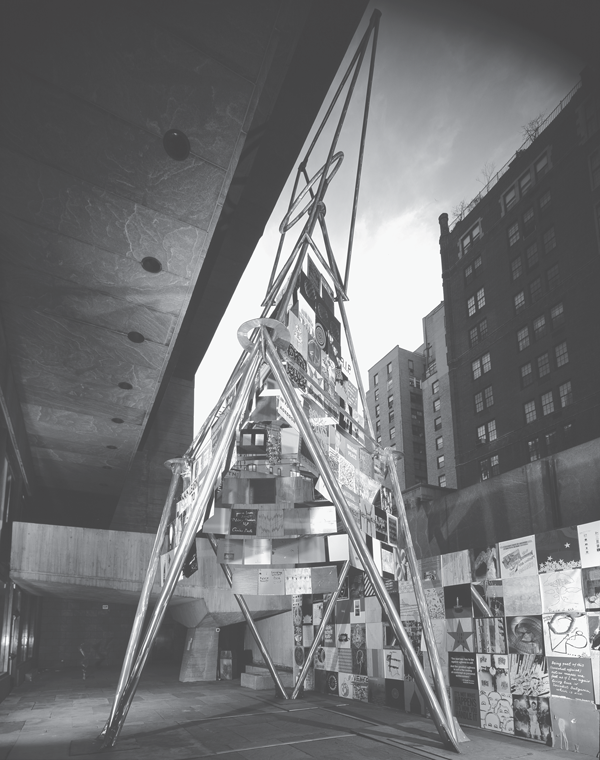
65. Mark di Suvero and Rirkrit Tiravanija, Peace Tower, 2006. Mixed media. © Mark di Suvero. Courtesy Paula Cooper Gallery, New York. Installation view at Whitney Biennial 2006: Day for Night, Whitney Museum of American Art.
One of the most iconic posters included in the Yo! collective’s exhibitions and book took a different approach than Kuper’s work and became an icon of the recent antiwar movement. This was the iRaq series of posters (fig. 66), designed by Forkscrew Graphics and patterned after Apple Computer’s television, print, and web advertisements for its iPod (then a personal listening device and now virtually a handheld personal computer). The iPod ads were ever present in the United States between roughly 2004 and 2008. Unlike the majority of the other works that Yo! featured, the iRaq posters conjure up Violet Ray’s “advertising art” (as well as the work of Adbusters) and subtly alter Apple’s characteristic ads into something quite subversive and multifaceted. The Apple ads featured a single color background (which were most often blue, light green, or yellow) and a black silhouette of one person dancing while wearing his or her iPod. The iPod would be represented by its trademark rectangular shape and white headphones, and would itself be undifferentiated thanks to its representation as a white silhouette, to contrast with the all-black figure. On the left hand side of the ad would be the Apple logo (the white silhouette of the fruit) and the name of the product, “iPod.” The iRaq posters—many of which were wheatpasted in downtown Manhattan and Los Angeles—replaced the Apple logo with a grenade and the word “iPod” with “iRaq.” The posters moreover swapped out the dancing silhouette for figures from the Iraq war front.
The figure most commonly used was sourced from one of the most-reproduced photographs from the war, a leaked image of a detainee from the Abu Ghraib prison. (This image was also used in Richard Serra’s well-known protest posters, which above the figure declared, “STOP BUSH.”) The photograph featured a man whose head is covered with a black hood and whose body is draped with a large black cloth. He stands on a box with his arms raised out parallel to the floor—looking like Jesus on the cross—and electric cables, attached to each hand, run down to the floor and up the wall. The man, whom U.S. soldiers jokingly called “Gilligan,” was ordered to stand on the box. If he fell, they explained to him, he would be electrocuted. (This never happened. There was no electric current running through the wires, and the soldiers, when questioned about the event later, said they were just playing with this man.)
Other Yo! collective posters further referred to Vietnam paradigms. A map work featuring small bombs named after each of the countries the United States has bombed since World War II recalled Fahlström’s maps and Maciunas’s flags. Another poster included Picasso’s peace dove. However, this time the dove functioned both as a symbol of peace and one that pointedly rejected the American military—it defecated on American tanks.
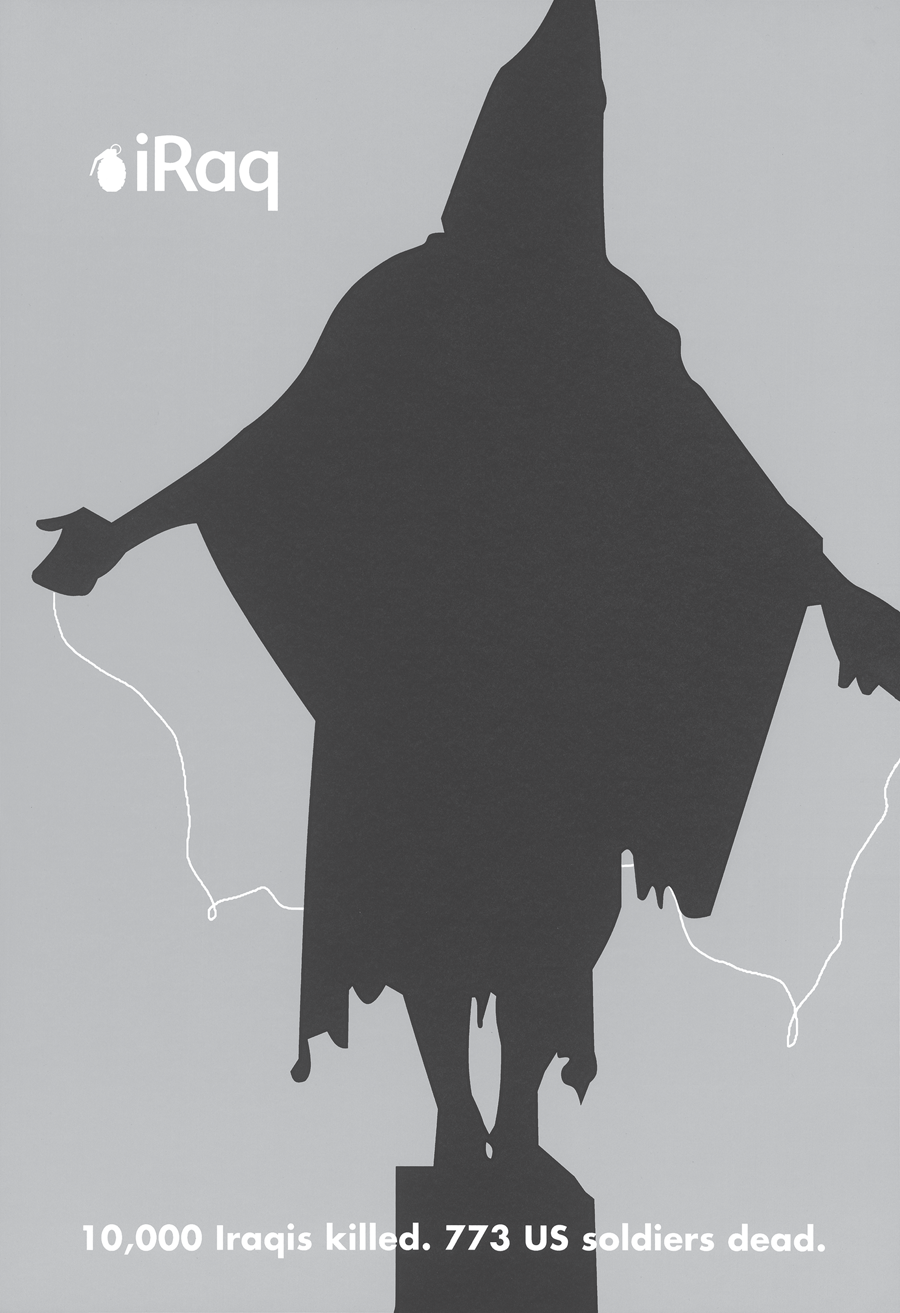
66. Forkscrew Graphics, iRaq (Abu Ghraib Prisoner), 2004. Silkscreen. 86.4 × 59.1 cm (34 × 23-1/4 in.). Courtesy of the Center for the Study of Political Graphics.
An entire 2007 exhibition, Memorial to the Iraq War, at London’s Institute of Contemporary Arts (ICA), was organized around the recognizable strategy from Vietnam of the advance memorial (since at that time the war was not yet over). On the one hand, the exhibition—which asked twenty-five artists from Europe, the United States, and the Middle East to propose memorials—tried to be politically neutral. In this respect, it argued that the exhibition was mounted only to encourage debate about the form of a memorial for the war. At the same time, the show was undoubtedly antiwar. Just mounting an exhibition to memorialize the war focused on the losses the war has caused and was thus extremely provocative. Also, in the museum’s press materials the ICAintroduced the war with a minimal focus on successes and a maximum focus on the war’s death toll. Their press release began as follows:
The American-led invasion and occupation of Iraq began in March 2003 and has resulted in the downfall of the dictator Saddam Hussein and his eventual replacement by the Iraqi National Assembly. To date the Iraq War has also resulted in the deaths of over 3300 soldiers from America, over 140 from Britain and over 120 from the other past and present Coalition countries. At the same time Iraq has slid towards the chaos of civil war and The Lancet estimated that by July 2006 the number of Iraqi deaths—both combatant and civilian—that could be directly or indirectly attributed to the war was over 650,000.
In the exhibition, Collier Schorr’s part-photograph, part-drawing collage of a soldier’s body suggested the body’s disconnection. Nate Lowman’s rusted gas pumps became symbolic of America’s dependence on Middle East oil and stability in the region (and, as such, America’s reasoning for fighting the war). The Israeli artist Yael Davids staged a performance piece titled Choosing One’s Heritage in which participants stood behind a wall and pressed their lips through small holes specifically cut out for them. Visitors to the exhibition could only see lips pushed through the holes, and because those who stood behind the wall were behind foam and pushed their lips through it, nothing could be heard on the other side of the wall. As a result, the viewer saw only actual human lips drying out. Davids’s work was a poignant statement on how little those outside the war front could understand the war’s victims.
This inability to communicate was echoed in 2007’s 9 Scripts from a Nation at War (a ten-part video installation by David Thorne, Katya Sander, Ashley Hunt, Sharon Hayes, and Andrea Geyer), which foregrounded the confining “scripts” or roles a wartime environment presents and the ability of people to embrace or reject them. This theme of constrained communication was also central to Michael Rakowitz’s Return, an ongoing project he started in 2004 that reopened his Iraqi-born grandfather’s American import–export business (Davisons & Co.) in order to send gifts to Iraqis and import goods from Iraq (dates). The project focused directly on the war due to the difficulty of transporting goods. Rakowitz’s project (and specifically the storefront he opened in Brooklyn on Atlantic Avenue) also became a locus for dialogue about the war, which was rare in the art context of the time. (One other exception was Jeremy Deller’s 2008 It Is What It Is, which attempted to engage the art-going public in New York, Chicago, and Los Angeles through dialogue with veterans, journalists, scholars, and Iraqi nationals. Objects were meant to stimulate discussion, most prominently the remains of a car that was destroyed in March 2007 by an explosion on Al-Mutanabbi, a street in Baghdad and a center of cultural life, which killed thirty people.) Rakowitz explained of his project, “The dates suddenly became a surrogate, traveling the same path as Iraqi refu gees. The store became a place where that crisis and its affiliated narrative was being disseminated—hardly the exchange a customer would expect.”15
Davids’s work also directly relates to a larger tendency of this antiwar production: to argue for more complete media coverage of the war. This was not anywhere as much an issue during Vietnam, which was extensively covered by the media, especially after 1968. The U.S. government and media’s heightened control of war imagery after (and as a result of) Vietnam is well-known. Claude Moller’s If Vietnam Were Now/What Would You See? comments on the current lack of coverage. Layered on the iconic image of Nguyen Ngoc Loan executing a VC captive, Moller places a (General Electric–manufactured) television screen that frames only part of the image—that of the general’s head—thus omitting the image’s most important section (in which the captive is being shot and killed). The paintings of Stephen Andrews further attest to this lack of exposure. Based on photography from the war, these works are made so that the images are deliberately hard to see. Andrews transfers the photographs by rubbing crayon onto canvases that have been stretched over window screens. Andrews’s titles attest to this haze of depiction and its resultant generalized information as well. One carries the title Soldiers in the Palace and another jpeg (both 2003).
Thomas Hirschhorn’s 2006 installation Superficial Engagement (which followed his 2003 work on Iraq, Drift Topography) protested the media coverage in a different fashion. Rather than mourn the lack of images available, he tried to solve the problem by locating hundreds of images of dead Iraqis on the Internet and then printing them and putting them in one of his all-over installations (reminiscent of Kurt Schwitters’s Merzbau or the First International Dada Fair) so that the viewer is bombarded by them. An understated approach to the same idea was Steve McQueen’s Queen and Country, a series of postage stamps that featured the faces of soldiers killed in the line of duty in Iraq (figs. 67 and 68).
Apart from Nina Berman’s Marine Wedding series (2006/2008), which cataloged the post-Iraq marriage and life of an awfully disfigured marine, and the Iraqi-born Wafaa Bilal’s Domestic Tension (2007), in which he allowed people on the Internet to shoot him with a paint gun (reflecting on the death of his brother at a U.S. checkpoint, the increasing preponderance of drones, and the general inhumanity of the war), the best-known exposure of direct evidence from the war was Mark Wallinger’s State Britain (fig. 69).State Britain was a meticulous recreation of every detail of the Iraq War protester Brian Haw’s pictures, statements, flags, and donated items, which he had collected and installed on the street outside the Palace of Westminster between June 2001 (when Iraq sanctions began) and May 23, 2006, when his items were removed. The reason for the removal was a law passed in Britain defining an “exclusionary zone” of one kilometer around Parliament where protests would be deemed illegal. Wallinger’s work—which when installed in Tate Britain was provocatively placed just past the one-kilometer barrier that ran through the museum—won the 2007 Turner Prize. On the one hand, Wallinger’s work has been celebrated for its uniqueness. Alain Badiou, for example, has called it model for a “new realism” because it allowed Haw’s action, which existed in what Badiou sees as a void in the democratic system, to exist. Yet on the other hand, the work, like GAAG’s actions during the Vietnam War, continues to take strategies of protest from the street and bring them into the museum. One wonders if future protest against inevitable future wars will build off Wallinger’s example or forge other paths on the basis of something else.
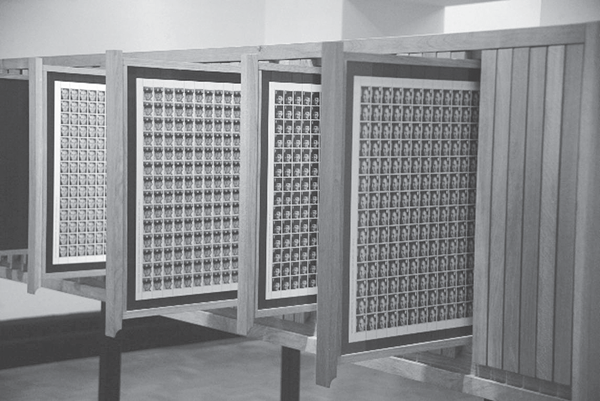
67. Steve McQueen, Queen and Country, 2007. Cabinet with facsimile postage sheets. Co-commission between Manchester International Festival and Imperial War Museum. Installation Manchester Central Library, February 28–July 14, 2007.
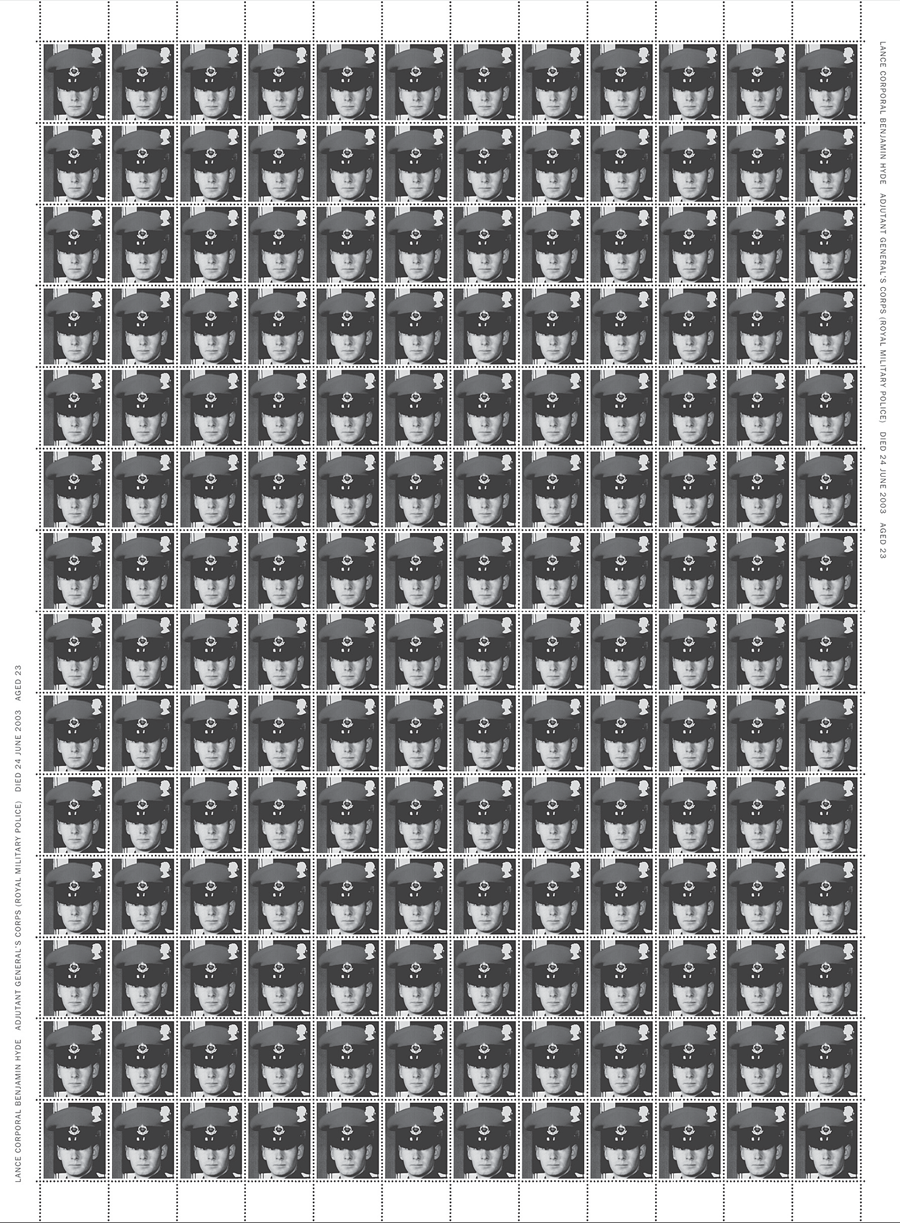
68. Steve McQueen, Queen and Country, 2007. Detail of cabinet with facsimile postage sheets. Image of Lance Corporal Benjamin Hyde is reproduced with the kind permission of the family. Co-commission between Manchester International Festival and Imperial War Museum. Installation Manchester Central Library, February 28–July 14, 2007. Courtesy of Marian Goodman Gallery, New York and Paris.
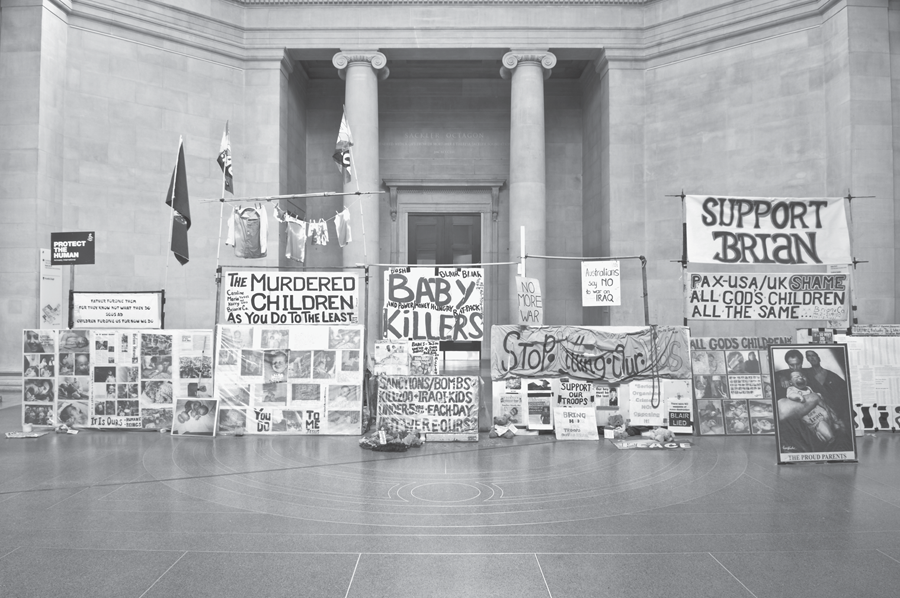
69. Mark Wallinger, State Britain (detail), 2007. Mixed media installation. Approx. 570 cm × 190 cm × 43 m. Installation at Tate Britain, 2007. © Mark Wallinger. Courtesy Anthony Reynolds Gallery, London. Photograph by Dave Morgan.