
8
During 1971, public support of the Vietnam War continued to deteriorate even further. The initial printing of parts of the Pentagon Papers on June 13, 1971, in both the New York Times and the Washington Post was a major factor. The Papers (leaked to the newspapers by former RAND employee and Papers contributor Daniel Ellsberg) were a top-secret chronicle of American decision making during the entire course of the conflict. They demonstrated that the Johnson administration had consistently lied about the state of the war to both the American public and to Congress. When the Papers first appeared, the government won a court order restraining any continued publication of them. Then newspapers other than the Times and the Post published excerpts. For a brief period these efforts were restrained as well. Yet on June 30, 1971, the U.S. Supreme Court ruled that newspapers could continue to print the Papers. The public quickly came to know about them. H. Bruce Franklin has called the disclosure of the Papers “an earthquake that demolished all the official narratives, revealing the shameful swamp of lies on which [the war had] been constructed.”1
Increasing reports of disillusionment among troops further eroded support for the war. Because the U.S. Armed Forces made it virtually impossible for soldiers to demonstrate, write, or petition against the war, this disillusionment surfaced through a number of actions that could interfere with the war: drug use (primarily marijuana and heroin), desertion, the shirking of duties, sabotage, self-inflicted injury, atrocities committed against civilians, or the killing of officers who ordered hazardous missions or who were considered inept, which was called “fragging.” Fragging incidents had a particularly damaging effect on the armed forces, since officers took the threat of them seriously and as a result were less and less willing to compel their soldiers to follow them or their other superiors.
Vietnam Veterans Against the War’s February 1971 organization of the Winter Soldier Investigation in Detroit devastated domestic opinion of the war. As a means of protest, roughly 150 veterans publicly discussed incidents of violence that they or other soldiers had committed in Vietnam. The name “Winter Soldier” was a response to Thomas Paine’s pamphlet of 1776, in which he wrote, “These are times that try men’s souls. The summer soldier and the sunshine patriot will, in this crisis, shrink from the service of their country.” The term winter soldier, as a result, asserted the loyalty of these soldiers who were damaging the reputation of the American armed forces. During the investigation, the media paid little attention, but when Republican senator Mark Hatfield of Oregon introduced the VVAW’s entire testimony into the Congressional Record, the story was covered nationally.
As a follow-up to the Winter Soldier Investigation, VVAW staged Operation Dewey Canyon III from April 19 to 23 at the U.S. Capitol. Dewey Canyon I and II were invasions into Laos that had taken place in 1969 and 1970. During Dewey Canyon III, alongside the group Gold Star Mothers, whose sons were killed in Vietnam, VVAW performed skits, spoke to passersby, illegally camped on the National Mall, tried to turn themselves in as war criminals, and, in the most dramatic part of the “operation,” organized some eight hundred veterans in front of barricades to keep people off the Capitol steps and one by one tossed their Bronze Stars, Silver Stars, Purple Hearts, and campaign ribbons at the Capitol. Millions of Americans watched television coverage of the spectacle. The day before, John Kerry, a highly decorated veteran and one of VVAW’s leaders, spoke in front of Congress. This event launched Kerry’s subsequent political career.2
By the middle of 1972, Nixon pushed for negotiations with the North Vietnamese to progress further. By October it seemed that Kissinger and DRV representatives Xuan Thuy and Le Duc Tho had established a preliminary peace treaty draft.3 Yet the leaders in Saigon, especially President Nguyen Van Thieu and Vice President Nguyen Cao Ky, rejected the Kissinger–Tho proposal, demanding that no concessions be made. In December 1972, Nixon unleashed the most concentrated air assault in the history of the war—what would later be called the “Christmas bombings”—against Hanoi and Haiphong, in order to pressure the peace proceedings to conclude.4 Though the press reacted with outrage to Nixon’s bullying tactics, Americans were generally mute about the attack. American troops had come home in large numbers and this, to some extent, pacified their previous unrest.5 Following the bombings, the United States convinced the Thieu–Ky regime in Saigon that America would not abandon South Vietnam if the latter signed the peace accord. This led to a final draft of a peace treaty on January 23 that ended open hostilities between the United States and the DRV. Nixon proclaimed, “We have finally reached peace with honor,” and signed the agreement in Paris on January 27. Yet with the signing of the accords, the conflict did not end in Vietnam. From March 1973 until the fall of Saigon in April 1975, ARVN forces continued to fight the DRV, trying desperately to save the South from political and military takeover. The end of the war finally came on the morning of April 30, 1975, when communist forces captured the presidential palace in Saigon. In the largest helicopter evacuation on record, the U.S. mission ferried one thousand Americans and six thousand Vietnamese out of the country in the span of eighteen hours.
After the summer of 1970, even with significant numbers of Americans still against the war, the success of Vietnamization and the beginning of serious peace talks with the North Vietnamese essentially dried up the antiwar movement, or channeled its energies toward further radicalism, as practiced by urban terrorists, such as the Weathermen, or toward new causes, such as the feminist movement. For the most part, activism in the art world withered as well. Nevertheless, the post-1970 period did see substantial, although isolated, instances of engagement. In 1971, the New School for Social Research mounted the exhibition American Posters of Protest, 1966–1970, curated by David Kunzle. A second version of the Collage of Indignation was installed. In 1972, the Brooklyn Museum installed Vietnam: A Photographic Essay of the Undeclared War in Southeast Asia. In addition, Leon Golub’s Vietnam series of paintings and Öyvind Fahlström’s map and puzzle works focusing on Vietnam were created between 1970 and 1973.6
On the one hand, the second version of the Collage bore a direct relationship to the first because some of the same people were involved with its manifestation, and because it was another collective protest effort. On the other hand, it had little else in common with the 1967 version. Installed at the New York Cultural Center between April and August 1971, to coincide with an April mass march in Washington and San Francisco, and organized mainly by Lucy Lippard and Ron Wolin (with the assistance of Dore Ashton, Barbara Rose, and Deena Shupe), the work simply featured a collection of peace posters that had been commissioned by the committee.7 The idea was that the posters would be sold to benefit the National Peace Action Coalition and Student Mobilization Committee, and some of the profits would be used to print editions of the posters as further benefit works. Roughly sixty artists contributed individual works. The results were varied. Artists continued to supply verbal rants. Carl Andre contributed an often-quoted line of Lieutenant Calley (“It was no big deal, sir”); Robert Ryman created a misspelled “Pease” on a white ground. Other no longer extant works that Lippard notes were included were created by Joseph Kosuth, Douglas Huebler, Luis Camnitzer, Faith Ring-gold, Rosenquist, Alex Katz, and Susan Hall. Kosuth and Huebler’s presence is another sign of conceptualism’s political engagement. Lippard explains that Kosuth, like several other artists, “made connections to the Nazis via Hitler or Nuremberg,” and Huebler’s poster was a blank page that read, “Existing Everywhere Ahead of the Above Surface Is Every Reason for Peace.”8 Only one poster, by Robert Rauschenberg, was actually published as a result of the second Collage installation.
While Golub’s Vietnam series (figs. 63a, b, and c) followed immediately upon the completion of his Napalm series (figs. 32–34, ch. 4), his creation of the Vietnam paintings marked a significant transformation for his oeuvre. The new works embraced subject matters outside of napalm. Golub’s figures were also rendered more realistically than they had been in the past; specific dress and clarity in faces allowed the viewer to identify immediately, for example, who is American and who is Vietnamese. And his figures were (in general) no longer tightly grouped together but arranged to generate compositional drama. This is particularly true in the case of Vietnam II, which dramatically features a child’s face as the fulcrum of the image. As such, these works—in their grand scale and attempt toward narrative—seem to be Golub’s attempt to create history paintings for the war. Simultaneously, the Vietnam series refrains from supplying specific references or narrative. The series was originally called Assassins, but Golub changed the name years later, fearing it was too “cruel” to the Americans. He commented that the change came about because he realized he couldn’t “blame the GI’s for the guys who were initiating all this. The soldiers weren’t assassins. . . . I became ashamed.”9
After completing the Vietnam works, Golub endured a crisis in the mid-1970s in which he destroyed virtually everything he made. Then he slowly began painting again: first with a series of small, political portraits; and then in the 1980s, taking up ideas he began working with in the Vietnam series, he produced the most recognized paintings of his career. These works focused on mercenaries, torturers, and death squads in U.S.-supported military regimes where human rights violations were being ignored, such as in Argentina, Brazil, Chile, Uruguay, El Salvador, Guatemala, and Honduras.10 In this respect, Vietnam was Golub’s turning point. According to Gerard Marzorati, “Golub’s involvement in the Vietnam protest is significant not only for what impact it may have had on the art-world aspect of the antiwar movement, and, indirectly, as part of this movement, on the government, but also for where it would take his own painting. Would Golub ever have painted [his works of the 1980s] had he not been involved in the antiwar movement? I can’t see how. In the 1960s, Golub for the first time stepped into the history of his own time as an artist.”11
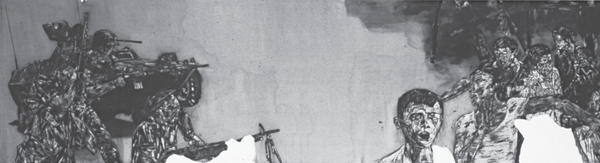
63a. Leon Golub, Vietnam II, 1973. Acrylic on linen. 120 × 480 in. Art © Estate of Leon Golub/Licensed by VAGA, New York. Courtesy Ronald Feldman Fine Arts, New York.
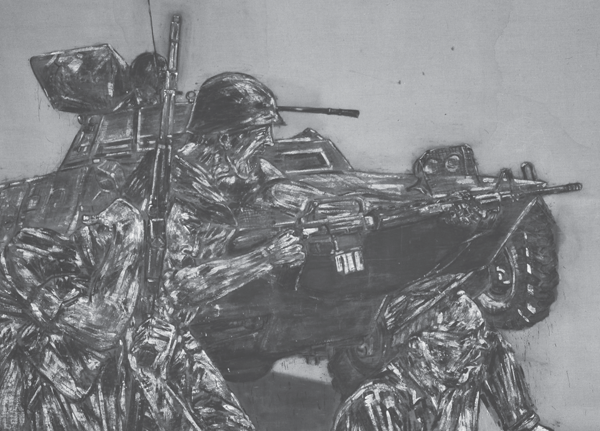
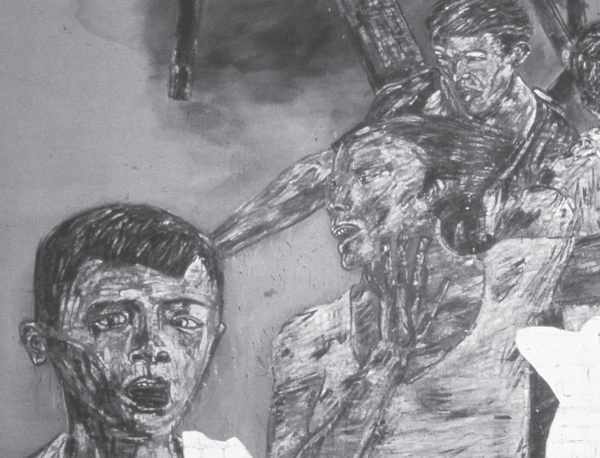
63b & c. Leon Golub, Vietnam II, 1973. Acrylic on linen. 120 × 480 in. Art © Estate of Leon Golub/Licensed by VAGA, New York. Courtesy Ronald Feldman Fine Arts, New York.
Among his many works in a wide variety of media—from paintings to written manifestoes (which were often mislabeled as pop)—Öyvind Fahlström’s maps of the early 1970s condemned American imperialism and, for a time, America’s war in Vietnam.12Fahlström’s maps stemmed from the beginning of the late 1960s when, he explained, “Like many people, I began to understand . . . that words like ‘imperialism,’ ‘capitalism,’ ‘exploitation,’ ‘alienation’ were not mere ideas or political slogans, but stood for terrifying, absurd and inhumane conditions in the world. Living in LBJ’s and Nixon’s America during the Vietnam war—culminating in the Christmas ’72 terror bombings of Hanoi and Haiphong and Watergate—it became impossible not to deal in my work—once I had the stylistic tools—with what was going on around me. Guernica, multiplied a million times.”13
Among the first articulations of Fahlström’s consciousness were his Notes of 1970–1971, sketch-like compilations of texts and figures commenting on politics. One of them detailed Nixon’s dreams; another, the Pentagon. A third was subtitled “Reading Felix Greene’s The Enemy.” The Enemy was a book that sought to give an objective account of imperialism. Gradually Fahlström’s Notes were consolidated in the later Maps. The maps featured puzzles of tightly pressed-together, colored fields that represented particular countries. These countries were sometimes generally in the right place, as in his World Map of 1972 (figs. 64a and b), but they could often be positioned in an entirely fanciful relationship to reality.14 Inside the countries, whose colors consistently represented the same places—according to the artist, blue was the United States, violet was Europe, red to yellow were socialist countries, and green to brown were “Third World”—there were dense texts and little drawings.15 The overall impression of these works is like a mix of painting, game, puppet theater, comics, medieval maps, and Aztec codices.16 While the individual facets of these works can be identified, they feel encyclopedic. One can never seem to grasp at once all of what is presented. This impression is something of which Fahlström was well aware. He said, “If I were only, or mainly, interested in educating my viewers . . . I would create simpler structures, and use other media than handmade art. I see myself as a witness, rather than as an educator.”17
One can identify general themes in the maps: American global conspiracy dominates the world. Capitalist greed leads to exploitation, repression, disease, and environmental depredation. Fahlström also celebrates communist peasants and Third World liberation movements. While the cartoonish quality of Fahlström’s texts—reminiscent of the work of R. Crumb—suggests they were gathered casually, the artist was a scrupulous (but unassuming) researcher. He was a voracious reader in five languages of a variety of sources, including periodicals like Ramparts and the short-lived Scanlan’s Monthly, though he also culled material from books on contemporary history. In sum, Fahlström’s words represent a new kind of antiwar art, a fusion of conceptual information-giving and the allure of the humorous pop cartoon. The result is an endlessly appealing illustration of Fahlström’s politics.
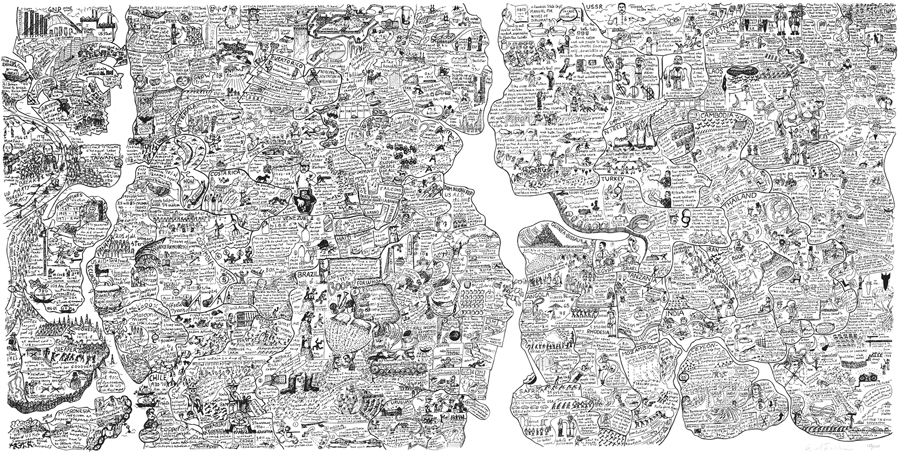
64a. Öyvind Fahlström, Sketch for World Map, 1973. Silkscreen (one color). 55.9 × 106 cm (22 × 41-3/4 in.). Edition: 150. Printer: Styria Studio, New York (Adolf Rischner, master printer). Publisher: Avery, Kenner and Weiner (AKW), New York. © 2011 Sharon Avery-Fahlström.
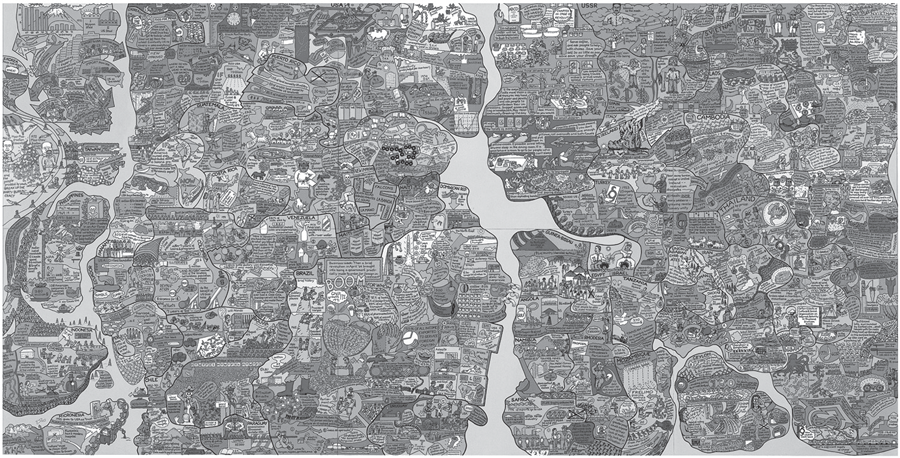
64b. Öyvind Fahlström, World Map, 1972. Acrylic and India ink on vinyl mounted on wood. 91.5 × 183 cm. Private collection. © 2011 Sharon Avery-Fahlström.
Fahlström’s sentiments regarding American involvement in Indochina are best understood through his World Map. Almost the entire right side of the work is devoted to the subject of the Vietnam War through small texts and drawings or diagrams. These texts and images include the number of bombs dropped during the war; Johnson dressed in a colonial-era uniform explaining his refusal to be the first American president to lose a war; a description of the Con Son Tiger cages (a South Vietnamese prison whose horrific conditions were exposed by a U.S. government delegation in 1970); and the statistic that the United States built up the South Vietnamese army to be the fourth largest in the world. There is also a picture of new and improved smart bombs, napalm, and a new “electronic battlefield,” as well as the effects of strategic hamlets, phosphorous bombs, and cluster bombs. Fahlström illustrates a central capability of this new electronic battlefield through five individually numbered drawings. In the first, “planes drop millions ofSYLVANIA, AT&T, HONEYWELL ETC. SENSORS.” In the second, the “sensors pick up signals (acoustic or seismic).” In the following drawings, the signals are relayed “back to base in Thailand,” and an onboard computer directs a bomber to release bombs over an unseen target; and in the last image, the “pilot returns in time for a swim in the pool before lunch.” The top right of the Map highlights North Vietnamese peasants who “take care to plant the rice straight so the U.S. pilots see it and know we are not afraid.”
The year following his completion of World Map, in his Column No. 2 (Picasso 90) of 1973, Fahlström continued to focus on the Vietnam War. Echoing petitions by Angry Arts in 1967, and GAAG and AWC in 1970, Fahlström appealed to Picasso to removeGuernica to protest the Vietnam War. Fahlström’s appeal was presented in the work as an excerpt from a real column and a real letter, which included his own address (121 Second Avenue, New York, NY, 10003) at the top, and read as follows: “Dear Picasso . . . you once beautifully combined protest as an artistic expression and a political gesture. Why don’t you honor the pleas from American & other artists to remove Guernica from the Museum of Modern Art, until the USA completely withdraws from all of S.E. Asia incl.” The manner in which the note is constructed—it includes the crossing out of words as well as punctuation and grammatical errors—points to Fahlström’s dark sense of humor. A particularly entertaining part of World Map, for instance, is worth referring to in this regard. In it, a chapter from an illustrated “Swedish manual for diplomats’ wives” represents the entirety of Europe.18 The chapter, titled “In Case of Revolution,” reads:
Do not go out. Water will be needed especially to flush toilets. Fill the bath tubs. Serve coffee and ask people to help with chores. Save yourself. Do as little as possible. . . . Dismiss those servants you suspect of being troublemakers or that would spread rumors. . . . Retain one person who speaks the dialect. If the siege lasts more than a couple of days, you may hand out paper and pencils and ask people to write down their impressions. Suggest games and knitting or needlework. Play recorded music continually. Break up the day as you would for small children. At night, assign the toilets as evenly as possible among those present. If you don’t have enough pillows, roll overcoats and bath-towels and put them in pillow-cases. If possible, avoid letting anyone sleep in the dining room. It is good to have a room to go to for people who can’t sleep. Try to segregate people with colds or who snore. Coughing and sneezing disturb more than exploding bombs.19
Fahlström conceived his works as “orchestrat[ing] data, so people will—at best—both understand and be outraged” by the facts. But he had reservations about their art value. He wondered if their “facts about economic exploitation or torture techniques” would destroy the balance and make the works “propaganda.” At the same time, however he asked whether Goya’s Disasters of War were propaganda.20
Fahlström’s puzzles, such as Pentagon Puzzle and Pentagon Diptych, occupy a position somewhere between his Notes and his Maps, since they are more cohesive than his Notes but lack text. As in World Map, the Pentagon Puzzle shows how government, military, and business collaborate to make the entire world an American sphere of influence: the CIA is represented as a greedy octopus; a scientist tests gas on mice and then drops it from a helicopter; the world itself is represented as a chained cube, symbolizingNATO and SEATO’s power.21 As Donald Kuspit has written, Fahlström’s puzzles functioned “as a metaphor for consciousness—an accretion of fragments given unity by a common horizon of meaning” that could assert the user’s power over the “impressions” of reality, since the user has to play with them and engage them to make them function. As such, there is hope that one can reconstruct the whole in a new manner. On the other hand, to the extent that one tries to complete the puzzle and fit the parts together in one designated form, “there is no escape from the picture of the world it presents.” Kuspit has observed that in this respect such works speak also of Fahlström’s “own sense of being trapped.”22 Trapped is an apt way to also describe the situation of the United States in Vietnam between 1973 and the end of the war. The country was stuck in the arduous, drawn-out process of trying to leave Vietnam.