
5
January 31, 1968, marked the onset of the North Vietnamese Tet Offensive. So called because it began on Tet, the first day of the Vietnamese calendar and the most important Vietnamese holiday (usually a truce period), “Tet” was a huge series of coordinated attacks by the DRV and the NLF on U.S. and South Vietnamese forces, designed to bring the Americans to the bargaining table.1 During the month of February, eighty-four thousand Vietcong soldiers stormed into more than one hundred cities and towns in the South, from the DMZ to the base of the Ca Mau peninsula. Saigon was a major target. VC took over its radio station, and nineteen commandos occupied the city’s U.S. embassy—long a symbol of America’s unshakeable place in Vietnam—for six and a half hours. The communists also beset the city of Hue in a meticulously planned attack targeting more than two hundred of the city’s “cruel tyrants and reactionary elements,” who they believed were sympathetic to the South Vietnamese regime.2
Another significant focus of the Vietcong during Tet was the U.S combat base at Khe Sanh, a plateau in northwestern Quang Tri Province. Used since 1964 as a springboard for air attacks against communist sanctuaries in Laos and to gather intelligence on the Ho Chi Minh trail, Khe Sanh was besieged by the VC between January 21 and April 8 with what the U.S. estimated was a force of forty thousand. Since the United States believed Khe Sanh to be one of its key strongholds in South Vietnam, it did everything in its power to hold the base. General Westmoreland positioned six thousand extra men on the base and put into effect the bombing mission Operation Niagara, which involved dropping seventy-five thousand tons of explosives on the VC over six weeks—the largest amount of explosives that had ever dropped on a single target in the history of warfare.3
At the conclusion of the offensive, the communists lost roughly twenty times the number of men as their American counterparts and were forced out of nearly all the towns and cities they invaded. Nevertheless, their campaign was a significant (if not the) turning point in the Vietnam War for the United States. Tet emphasized to the Johnson administration that victory in Vietnam would require a much greater commitment of men and resources than the American public, which had been shocked by Tet, was willing to invest. Polls showed that Johnson’s approval ratings were at a new low of 35 percent and that the majority of Americans believed the country had made a mistake committing combat troops to Vietnam.4 Americans could not understand how their country had been so unprepared.5 They were also taken aback by the VC’s power, size, and resilience, as well as its presence in Vietnamese cities at a point when Americans had been repeatedly given optimistic forecasts by the U.S. government.
How news of Tet was transmitted to the American public was crucial to the domestic reaction. Before Tet, Americans were used to seeing the war in a particular way. In the words of Stanley Karnow:
Americans at home had been accustomed to a familiar pattern of images. Columns of troops, disgorged from hovering helicopters, cut through dense jungles or plodded across muddy rice fields toward faraway villages, occasionally stumbling upon mines or booby traps, or drawing fire from hidden guerrillas. Artillery shelled distant targets from lonely bases, and aircraft bombed the vast countryside, billows of flame and smoke rising in their wake. The screen often portrayed human agony in scenes of the wounded and dying on both sides, and the ordeal of civilians trapped by the combat. But mostly it transmitted the grueling reality of the struggle—remote, repetitious, monotonous—punctuated periodically by moments of horror.6
By contrast, Tet occurred openly in the cities and American television crews were able to film the VC up close as they struggled and fought to the death with American soldiers.7 Some of the most shocking photographs from the war were also taken during Tet. Eddie Adams’s horrific photograph of the Saigon chief of police General Nguyen Ngoc Loan executing a VC captive is arguably the most well-known.8
During and after Tet, the major newsmagazines and television stations not only covered the war in unprecedented detail but began for the first time to criticize war policy overtly. Walter Cronkite’s criticisms were the most significant and far-reaching. Amid Tet, Cronkite traveled to Vietnam himself. When he returned to New York, CBS broadcast a half-hour special, Cronkite’s Report from Vietnam, which ended with Cronkite voicing his conclusion about the state of the war directly to the camera:
Who won and who lost in the great Tet Offensive against the cities? I’m not sure. The Vietcong did not win by a knockout, but neither did we. . . . It seems now more certain than ever that the bloody experience in Vietnam is to end in a stalemate. This summer’s almost certain standoff will either end in real give-and-take negotiations or terrible escalation; and for every means we have to escalate, the enemy can match us, and that applies to invasion of the North, the use of nuclear weapons, or the mere commitment of 100 or 200 or 300,000 more American troops to the battle. And with each escalation, the world comes close to the brink of cosmic disaster. . . . On the off chance that military and political analysts are right, in the next months we must test the enemy’s intention in case this is indeed his last big gasp before negotiations. But it is increasingly clear to this reporter that the only rational way out of there will be to negotiate, not as victors but as an honorable people who lived up to their pledge to defend democracy, and did the best they could.9
On the basis of his visit, Cronkite saw no positive outcome—and definitely no victory—for the United States in Vietnam other than compromise and concessions, which needed to be arrived at through negotiations. Up close to the enemy, he found them the equal of American forces. If the United States chose not to negotiate, he warned that disaster was a distinct possibility.
During and after Tet, politicians looking toward the fall presidential election began to speak out and campaign strongly against the war. In Chicago, on February 8, Robert F. Kennedy delivered what the New York Times called “the most sweeping and detailed indictment of the war and of the Administration’s policy yet heard from any leading figure in either party.”10 Kennedy called Johnson’s claims of progress “illusory,” the Saigon regime “enormously corrupt,” and explained, “The history of conflict among nations does not record another such lengthy and consistent chronicle of error. . . . It is time for the truth. It is time to face the reality that a military victory is not in sight and that it probably will never come.”11 In early March, the student-run, decidedly antiwar presidential campaign of Senator Eugene McCarthy gained unexpected support and surprised the nation by winning 42 percent of the popular vote in the New Hampshire primary (to Johnson’s 49 percent). This strong support for McCarthy sped up the sequence of events that would lead to a nationally televised address by Johnson on March 31, 1968. Johnson began the address by making it clear that the United States was looking for a way to end the war. He explained that the nation would not pursue targets above the 20th parallel (thus restricting the United States from 90 percent of North Vietnam), and that he would authorize negotiations when the North Vietnamese were ready.12 Then, suddenly, he announced that he would not seek and would not accept the nomination for the presidency by the Democratic Party.
After Johnson’s startling announcement, Americans were optimistic about the upcoming election, McCarthy and Kennedy as potential Democratic nominees, and the Democratic National Convention (which would take place in Chicago in late August). Then the McCarthy campaign sputtered, Robert Kennedy was assassinated on June 6, and it seemed clear that Vice President Hubert H. Humphrey, whose views more or less reflected Johnson’s, would be the probable Democratic candidate—despite the fact that 80 percent of the primary voters had voted for antiwar candidates. Fueled by this situation and the anger and unrest following the assassination of Martin Luther King Jr. on April 4, the country’s mood regarding the war changed drastically.13 Various groups focused on Chicago as the site of forceful protests. Students for a Democratic Society and the National Mobilization Committee to End the War in Vietnam, for example, saw the DNC as a major forum in which they could voice their anger at, and sense of disenfranchisement from, the powers that be.14 The Youth International Party (i.e., the Yippies), formed by Abbie Hoffman and others, likewise planned a protest against the Democratic Party and the war, their comical “Festival of Life.” In the face of all these mounting plans, Chicago’s Democratic mayor, Richard J. Daley—who had gained a reputation of zero tolerance for demonstrations after enacting a “shoot to kill” order during riots following the April King assassination—made his own preparations. He pledged to keep order. He talked tough. He refused to grant permits. He sealed off the convention site with barbed wire. And he arranged for twelve thousand Chicago police officers, five to six thousand national guardsmen, and a thousand FBI agents to be in Chicago during the convention.15 Moreover, Daley placed six thousand U.S. Army troops on active duty in the suburbs surrounding the city.
Though the protests in Chicago were not as large as Daley anticipated (one hundred thousand protestors were estimated but only about ten thousand showed up), they were violent, due primarily to the provocations of Daley’s police.16 In the words of Todd Gitlin (SDS president in 1963 and 1964, who went on to become one of the most important historians of the 1960s), in crucial instances, Chicago police came down on protestors without much reason, like “avenging thugs. They charged, clubbed, gassed, and mauled—demonstrators, bystanders, and reporters.” When Daley’s cops’ cleared protestors out from Lincoln Park with tear gas and clubs, battles ensued for two days. A short clash between police and protestors outside the Conrad Hilton Hotel was broadcast by TV cameras to eighty-nine million Americans. It was at this moment that protestors famously announced to the cameras that “the whole world is watching,” voicing their belief that their unrest was being witnessed by the entire world and their protest was significant enough to warrant their viewership. Images of the Chicago street clashes also made it inside the halls of the convention center, where they prompted Senator Abraham Ribicoff to condemn what he called the police’s “Gestapo tactics.” This comment in turn provoked Daley to yell (although the TV couldn’t pick up the sound), “Fuck you you Jew son of a bitch you lousy motherfucker go home.”17
In conjunction with the March on the Pentagon, the 1968 DNC protests ended up being one of the primary sites for the radicalization of American protest of the 1960s, marking a significant alteration of strategy from protest to resistance. Moreover, the August engagement at the DNC caused the art world to collectively mobilize for the first time since the beginning of 1968. The chaos of the preceding months combined with the hope injected into the antiwar movement by Johnson’s departure from the presidential race dissuaded earlier engagement. Members of the Chicago art community organized activities. Because of Daley’s actions, they initially proposed an artistic withdrawal from the city. The idea was floated that no art be exhibited in Chicago for two years; some even said ten years would be the more effective form of protest.18 While this boycott never occurred on a group level or for any comparable amount of time (because arguments won out that removing art would actually rob artists of any voice), Claes Oldenburg, who had been injured by the police during the convention, did take the step of canceling his fall one-person exhibition at the Richard Feigen Gallery. He explained in a letter to Feigen, “In Chicago, I, like so many others ran head-on into the model American police state. I was tossed to the ground by six swearing state troopers who kicked me and choked me and called me a Communist.”19
While Feigen was sympathetic, rather than close the gallery (and thus support the idea that no art was the best form of protest) he decided to replace Oldenburg’s show with a one-month statement against Daley, his Richard J. Daley Exhibition, which would demonstrate “the outrage of many left-leaning artists” in response to Daley’s actions in Chicago.20 The artists participating in the Feigen show included Lee Bontecou, Christo, Cply, Sam Francis, Golub, Red Grooms, William Gropper, Ray Johnson, Judd, Jack Levine, Motherwell, Barnett Newman, Kenneth Noland, Oldenburg, Petlin, Larry Rivers, Rosenquist, Seymour Rosofsky, Schneemann, and Spero.21
The majority of works employed strategies comparable to those used for the Peace Tower. To express antiwar sentiment, artists contributed written rants, and small alterations to works done in their characteristic styles. Other artists, such as Francis, Judd, Noland, and Motherwell, chose to contribute benefit work—which was basically unchanged for the event and was there to exhibit the artist’s support for the cause.22 A few artists created memorable political parodies of the mayor.23 Rosenquist created a screen print of Daley’s head on long polyester strips (that looked like the hanging bands of cloth one would see in a car wash), which visitors could engage with—for example, they could break up Daley’s face (fig. 39) with their fist if they so desired.24
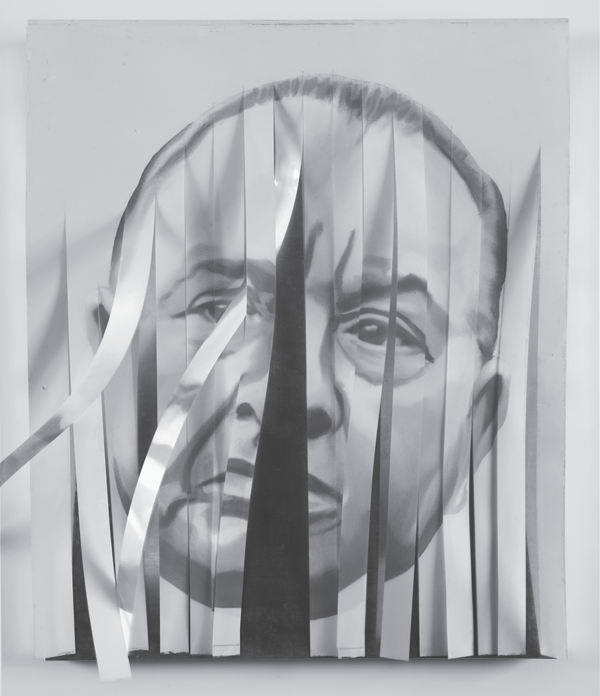
39. James Rosenquist, Daley Portrait, 1968. Oil on slit Mylar, with posterior aluminum panel. 24-1/2 × 20 in. (62.2 × 50.8 cm). Art © James Rosenquist/Licensed by VAGA, New York. Courtesy Acquavella Galleries, New York.
Newman’s Lace Curtain for Mayor Daley was the exhibition’s centerpiece (fig. 40). Divorced from the artist’s usual formalist and quasi-religious production, Lace Curtain was a barbed-wire grid set in a six-by-four-foot heavy steel frame, installed upright and splattered with blood-red paint. The work’s form called to mind barriers used for crowd control on the front of government trucks during the convention. The title was similarly provocative. By substituting a harsh material for a genteel one, Newman signifies brutality. Almost certainly in response to Daley’s anti-Semitic heckling of Ribicoff, Newman likewise associated Daley with the “lace-curtain Irish,” a well-recognized term meaning one who tried to mask their working-class roots or unrefined nature with material goods.25
Due to the provocative works included in the exhibition and the extensive press coverage the exhibition was receiving, supporters of the mayor threatened to close the show down. At one point the gallery was even trashed by vandals. Yet Feigen hired a bodyguard to protect his staff, and halfway through the run of the exhibition, on November 2, 1968—which was on the weekend before the presidential election—other Chicago galleries joined them in solidarity by organizing a one-day series of protest exhibitions, Response to Violence in Our Society. While little documentation of the shows exists, it is known that the Richard Gray Gallery exhibited the collages of William Weege, some of which included images of napalm victims, and the Phillip Freed Gallery of Fine Art showed theArtists and Writers Protest Against the War in Vietnam portfolio (figs. 41 and 42). Organized by Jack Sonenberg and sold originally from April 24 to April 29, 1967, at the Associated American Artists Gallery, the portfolio included prints and poems by artists and writers whose “consciences have been provoked” and have “chosen to express their conscience[s] through the medium of their own work,” wrote Max Kozloff, in the portfolio’s introduction. Kozloff explained, “This is, then, a collective project which is partially an imaginative response to a tragic event of our times, and partially a more indirect acknowledgment of the war’s anguish by the placing of works in this special context. No matter how varied their theme or form, these visual and verbal images are meant to testify to their authors’ deep alarm over a violence which, as they have shown here, has been impossible for them to ignore. It is to such indignation, social as well as aesthetic, that this art has been dedicated.”26 The artists included in the portfolio were Paul Burlin, Charles Cajori, Cply, Allan d’Arcangelo, di Suvero, Golub, Charles Hinman, Louise Nevelson, Petlin, Reinhardt, Sonenberg, George Sugarman, Carol Summers, David Weinrib, and Adja Yunkers. Akin to those in the Feigen exhibition, their works were mostly done using familiar methods of engagement. Dead and injured bodies along with written rants dominated the contributions. There were also abstract benefit works. Yet despite their strategic familiarity, a few things stood out in this show. Summers’s Kill for Peace (fig. 42) was a searing image, a black-and-white photograph of a Vietnamese woman and her two injured children, crossed out in a large red X. Characteristically a symbol of editorial rejection, the X simultaneously referred to the elimination of people.
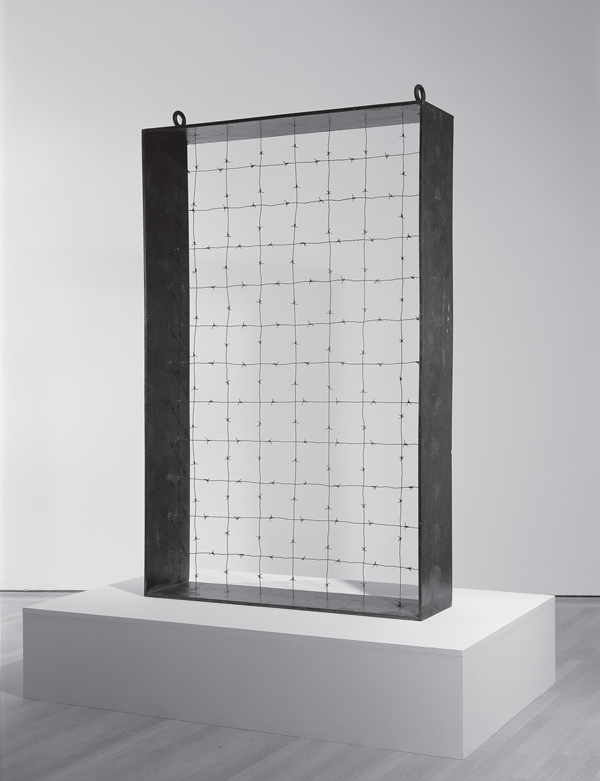
40. Barnett Newman, Lace Curtain for Mayor Daley, 1968. COR-TEN steel, galvanized barbed wire, and enamel paint. 177.8 × 121.9 × 25.4 cm (70 × 48 × 10 in.). The Art Institute of Chicago. Gift of Annalee Newman, 1989. © 2012 The Barnett Newman Foundation/Artists Rights Society (ARS), New York.
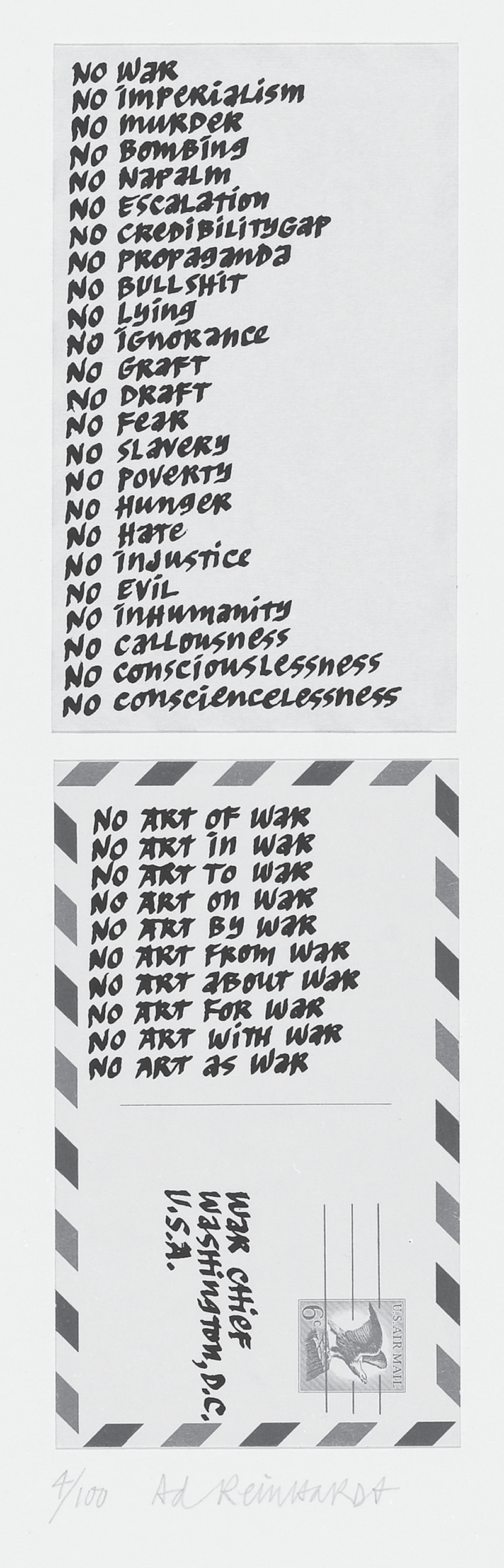
41. Ad Reinhardt, Untitled (Postcard to War Chief), from Artists and Writers Against the War in Vietnam, 1967. Screenprint with collage. Composition: 11-1/4 × 3-1/4 in. (28.6 × 8.3 cm); sheet: 25-3/4 × 20-15/16 in. (65.4 × 53.3 cm). Publisher: Artists and Writers Protest, New York. Printer: Chiron Press, New York. Edition: 100. © 2009 Estate of Ad Reinhardt/Artists Rights Society (ARS), New York. Digital Image © Museum of Modern Art, licensed by SCALA/Art Resource, New York.
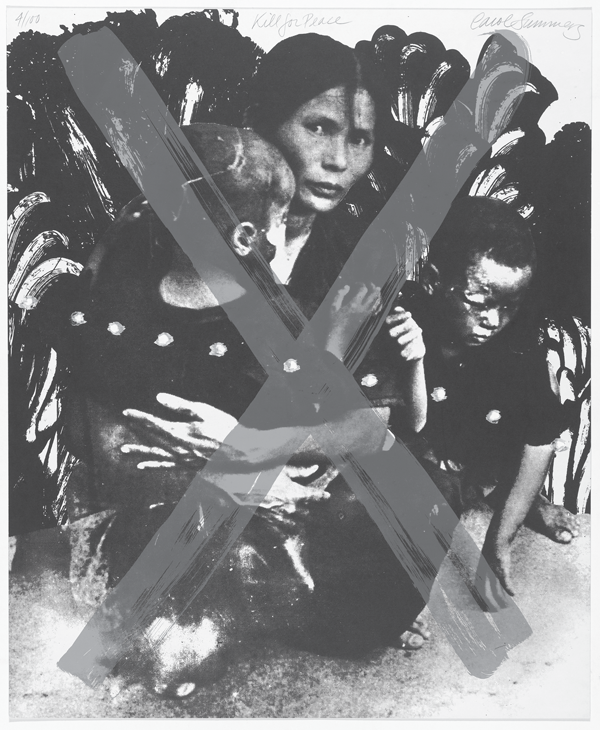
42. Carol Summers, Kill for Peace, from Artists and Writers Against the War in Vietnam, 1967. Screenprint with punched holes. Composition: 23-5/16 × 19-3/16 in. (59.2 × 48.7 cm); sheet: 23-5/16 × 19-3/16 in. (59.2 × 48.7 cm). Publisher: Artists and Writers Protest, New York. Printer: unknown. Edition: 100. Digital Image © Museum of Modern Art/Licensed by SCALA/Art Resource, New York.
The most provocative item in the portfolio was Ad Reinhardt’s silk screen telegram, which protested both the war and art’s relationship with war with two long lists. The first list, on the back of the card, was a catalog of things Reinhardt did not want in the world. It read:
NO WAR
NO IMPERIALISM
NO MURDER
NO BOMBING
NO NAPALM
NO ESCALATION
NO CREDIBILITY GAP
NO PROPOGANDA
NO BULLSHIT
NO LYING
NO IGNORANCE
NO GRAFT
NO DRAFT
NO FEAR
NO SLAVERY
NO POVERTY
NO HUNGER
NO HATE
NO INJUSTICE
NO EVIL
NO INHUMANITY
NO CALLOUSNESS
NO CONSCIOUSLESSNESS
NO CONSCIENCELESSNESS
On the front of the card, next to the address—“War Chief, Washington, D.C., U.S.A.”—where a note would usually be written, Reinhardt included his second list. Shorter than the first, this list explained that art could not be involved in any way, shape, or form with the issue of the war.
NO ART OF WAR
NO ART IN WAR
NO ART TO WAR
NO ART ON WAR
NO ART BY WAR
NO ART FROM WAR
NO ART ABOUT WAR
NO ART FOR WAR
NO ART WITH WAR
NO ART AS WAR.
On the one hand, Reinhardt’s statements reflected his long-standing commitment to an art entirely without reference. His untitled black paintings were obdurately art-as-art and nothing else. Yet simultaneously, Reinhardt created this work, as well as his comics forPM, in the belief that painting should not be the only activity of the modern artist. He asked in 1946, “Do you think that when a painter expresses an opinion of political beliefs he makes even more of a fool of himself than when a politician expresses an opinion on art?” He answered himself with a categorical “NO!”27 Reinhardt’s consistent involvement in antiwar activities (in addition to his various other political activities) from 1965 onward testified to this vehement refusal.
Back in New York in the fall of 1968, distanced from the events of Chicago, artists mobilized for peace. While Johnson had taken the major steps of beginning negotiations in Paris and stopping the bombing of the North, and Humphrey and Richard Nixon (the Republican presidential candidate) had made peace plans a primary part of their respective platforms, artists believed the war could not be concluded fast enough and organized efforts to say so.28 The most intriguing expression of this was the inaugural show of Paula Cooper’s pioneering SoHo gallery, its Benefit for the Student Mobilization Committee to End the War in Vietnam (fig. 43), which ran for just nine days, between October 22 and 31, 1968.29 Cooper’s show, curated by Lucy Lippard, the artist Robert Huot, and the activist Ron Wolin (of Veterans for Peace in Vietnam, and a political organizer with the Socialist Workers Party), was timed to open during the anniversary week of the 1967 March on the Pentagon, which the Student Mobilization Committee had helped organize, and in conjunction with a week of antiwar events in Japan, Great Britain, Canada, and many other countries.
The exhibition touted itself as the first antiwar benefit exhibition of “nonobjective art”—and this was true—though almost all the works included in the exhibition were what would now be labeled more specifically “minimalist” works. Among the artists included in the exhibition were Carl Andre, Jo Baer, Dan Flavin, Donald Judd, Robert Ryman, Robert Mangold, and Sol LeWitt. LeWitt’s contribution to the show was a breakthrough work—his first wall drawing, a major moment in the development from minimalism to conceptualism.30 The press release for the exhibition—which was headed “for peace”—stated:
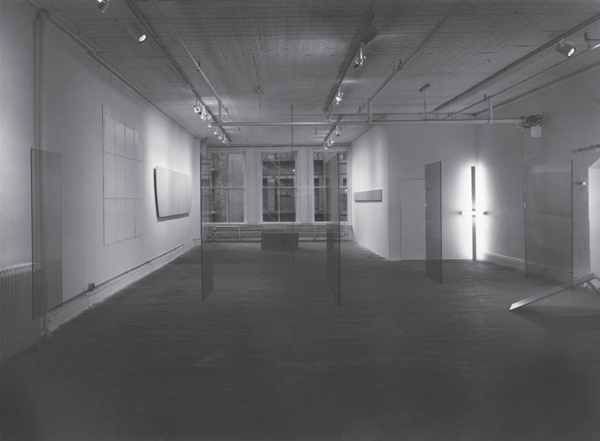
43. Installation view of Benefit for the Student Mobilization Committee to End the War in Vietnam, 1968. Paula Cooper Gallery, 96 Prince Street, New York, October 22–31, 1968. Courtesy Paula Cooper Gallery, New York.
As a rule, non-objective artists in America have been politically inactive since the 1930s. In 1948, Robert Motherwell and Harold Rosenberg went so far as to say that “Political commitment in our time means logically—no art, no literature.” During the 1960s, this attitude has been drastically revised. An increasing number of abstract artists have found it morally necessary to protest the political climate, their art-for-art’s sake position notwithstanding. A specialized exhibition like this one further allows them to put their particular esthetic achievement on the line. By contributing to the peace cause their most important possessions—major examples of their work—these artists have demonstrated their involvement in the strongest possible manner.31
The curators saw the exhibition as a solution for nonobjective artists who were politically active in the antiwar effort but did not engage politics in their work.32 The curators believed the exhibition of these artists’ best works was the strongest way they could protest the war. While the curators left it somewhat ambiguous in the press release whether they believed this was the best way for art to protest, they were more explicit in other forms of media, such as the New York Times. Echoing Stephen Radich’s 1966 remarks, Lippard commented to Grace Glueck that she saw the show as “a kind of protest against the potpourri peace shows with all those burned dolls’ heads. . . . It really looks like an exhibition first and a benefit second.”33 Accordingly, Lippard prioritized minimal expressions of protest over figurative ones, which made sense given her allegiance at the time to minimalism.
Although the run of the Cooper exhibition was extremely short and the ideas proposed in the press release were soon abandoned, the exhibition provoked reaction from the antiwar community. In the New York Free Press, Gregory Battcock questioned—as many did of minimalist artists during the war—how, if an artist was truly against the war, he could fail to engage the war in his work. Battcock also disputed the artists’ dedication to the cause, since they all received the cut they would get for any other gallery exhibition for their participation—and thus had not entirely “contributed” the works. Additionally, Battcock lampooned the central idea of the exhibition: that a cohesive group of important works made the most forceful statement for peace. He explained:
If indeed an exhibition of a cohesive group of important works makes a forceful statement for peace, would not an exhibition of wearing apparel by, let’s say, Cardin, Gernreich, and St. Laurent, presented under similar imprimatur, make an equally forceful statement for peace? Or how about an exhibition of pastels and watercolors offered under the same circumstances by the National Society of Bird Artists? What would be the story if the best wine merchants and importers got together and offered a tasting of their finest vintages to oenophiles and claimed the whole affair is really a protest against the war in Vietnam?34
Surprisingly, at the end of his article, after the criticism and humor, Battcock opened his mind up to the show. He acknowledged that this idea that the highest style is the best form of benefit protest might actually be useful and legitimate.35 Unfortunately, after Cooper’s show, nothing comparable occurred again.
Outside of collective exhibitions and benefits, 1968 saw artists continuing to make individual works that employed strategies used in previous years—though through new material means that allowed for further complexity. Edward Kienholz, for example, created his iconic Portable War Memorial (fig. 44), which, like Dan Flavin’s light work of three years previous, used the strategy of creating an advance memorial or memorial-before-the-fact. However, Kienholz’s sculpture was a life-size mixed media diorama comprising several large-scale elements. These elements collectively countered a memorial’s traditional approbation of a war as well as popular propaganda devices’ historical promotion of “patriotic solidarity.”36 Both are exemplified for American audiences in the Marine Corps War Memorial (opened in 1954), commonly called the Iwo Jima Memorial. The Iwo Jima Memorial features a collective unit of soldiers (their bodies aligned in a valiant crescendo) planting an American flag. The composition was based on the iconic photograph taken by Joe Rosenthal during the World War II siege of Iwo Jima, Japan, which was possibly staged.37 The men stand on a substantial base that reads “Uncommon Valor Was a Common Virtue.”
The left side of Kienholz’s sculpture features revisions of what he described as “the traditional propaganda devices.” There is a reconsideration of the Iwo Jima memorial, in which faceless American soldiers plant a tiny reproduction of the American flag—a far cry from the size of the original—into the umbrella hole of a patio table (which is situated in front of an Uncle Sam I Want You poster). Next to the soldiers sits a giant black chalkboard tombstone that includes an inverted cross with the title of the work written on it; a blank space for indicating which war this memorial is supposed to commemorate; and the names of almost five hundred countries that no longer exist because of war and boundary changes throughout history. Chalk and an eraser hang to aid the addition of future entries. To the right of the chalkboard Kienholz included a section called “Business as Usual.” Two more patio tables (with chairs set around them) have been set up, and behind them is a couple eating ground-up meat products at a diner. Chili and hot dogs are available for customers at this diner, it is explained in huge letters above the couple, and one can also purchase a Coca-Cola in a real machine. On the one hand, the scene represents status quo in the United States: Americans enjoying their hamburgers, hot dogs, and soda. On the other hand, the way the diner is juxtaposed with the chalkboard suggests that ground-up men from the list of extinct countries are the dinner fare. In the background of the work, the sound of Kate Smith singing Irving Berlin’s patriotic anthem “God Bless America” does not grandly boom from speakers but crackles from a strange figure in an upside-down garbage can. At the other side of the tableau, next to the barbecue stand, is a tombstone, blank (like the chalkboard) to prepare for the dead of future wars. Hard to see on it is a two-inch-tall man crucified with burned hands, symbolizing for Kienholz humankind’s “nuclear predictability and responsibility.”38 Kienholz’s work is arguably one of the most important pieces of protest art created during the Vietnam War, yet its presence in a German collection (the Museum Ludwig, Cologne) has limited its exposure.
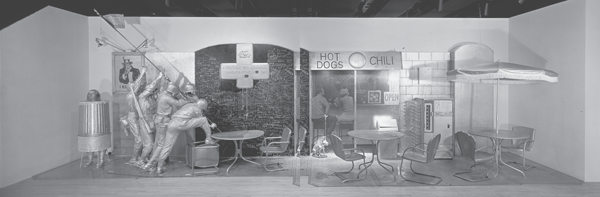
44. Edward Kienholz, The Portable War Memorial, 1968. Mixed media tableau. 114 × 384 × 96 in. (289.6 × 975.4 × 243.8 cm). Museum Ludwig, Cologne. © Kienholz. Courtesy L.A. Louver, Venice, CA.
Kienholz’s 1968 work The Eleventh Hour Final (fig. 45) is also in a German collection, the Hamburger Kunsthalle. The work is a full-scale recreation of a “typical” American living room of the 1960s, complete with wall-to-wall carpeting, wood-paneled walls, a worn-in couch, a wooden coffee table (with a TV Guide on it), and an end table. The focus of the room is a tombstone-shaped TV set (made out of concrete) and its remote control, whose wire winds back across the room from the TV set to the coffee table. Broadcast on the TV are body counts of “THIS WEEKS TOLL” from the war. There is the amount of “AMERICAN DEAD: 217, AMERICAN WOUNDED: 563, ENEMY DEAD: 435, ENEMY WOUNDED: 1291.” Behind these numbers lies a sculptural representation of a Vietnamese child’s head. The head hovers sideways and stares at the viewer from the TV. Shockingly breaking up the quiet of this typical suburban tableau, and supplanting the American concern for American dead and the abstraction of numbers with the image of a Vietnamese child, Kienholz’s work is similar to Rosler’s. He juxtaposes an image from the war with an American domestic environment far removed from the death and destruction taking place in Vietnam, in order to bring the war home. At the same time, he also utilized another strategy: the juxtaposition of an individual victim with a depersonalized body count.
Focusing on individual death within mass death to humanize a war’s victims is familiar to antiwar art. Ernst Friedrich’s book War Against War, published in Berlin after World War I, is one of the most horrifying examples. Friedrich’s book humanized the carnage of the First World War by featuring shocking images of soldiers whose faces and bodies had been virtually destroyed and then grotesquely repaired. The images were juxtaposed with ironic text and images that glorified battle and war and the role of the soldier.
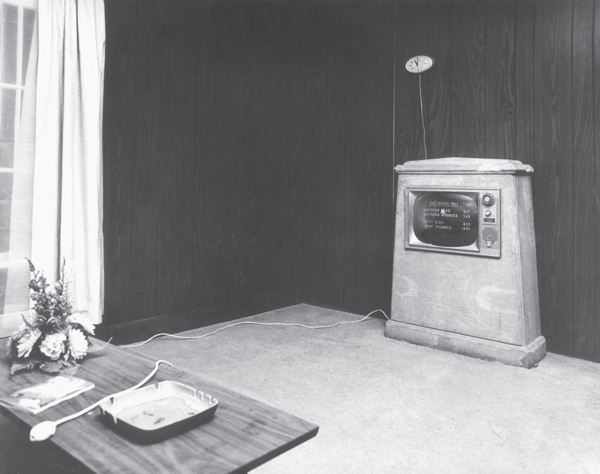
45. Edward Kienholz, The Eleventh Hour Final, 1968. Mixed media assemblage. 120 × 144 × 168 in. (304.8 × 365.8 × 426.7 cm). Private collection. © Kienholz. Courtesy L.A. Louver, Venice, CA.
In relation to Vietnam, there was the very early 1965 example of the comic Blazing Combat (fig. 46).39 Distributed by Warren Publishing, written by Archie Goodwin, and drawn by Frank Frazetta, Wally Wood, John Severin, Alex Toth, Al Williamson, Russ Heath, Reed Crandall, and Gene Colan, Blazing Combat’s stories (many of them set in other American wars, from the Revolutionary War to Korea, in addition to Vietnam), like “Long View” (not pictured), focused on the deaths of Americans and their units in battles featuring senseless mass murder and destruction. (All the while their superiors tell these men they are making heroic sacrifices for their country.) A recurring final scene in each of the stories is a juxtaposition of the armed forces’ textual description of their victory with an up-close image of the protagonist’s dead body, eyes open and mouth agape. Other Combat stories presented the deaths of individual Vietnamese, giving a face and identity to what so often was an unknown enemy. An example from Blazing Combatno. 2 is its concluding story, “Landscape!,” in which an old Vietnamese man, who simply wants to farm his rice and avoid the war, is killed in the chaos of an American ambush.40 Unfortunately, Blazing Combat was little known during the Vietnam War. Its second issue, and particularly “Landscape!” whose general theme was the “futility of war,” was protested by the military, and as a result the comic was banned from sale on military bases. The American Legion also objected to the comic, leading some magazine wholesalers to halt any further sales of it. In the 1960s market for comic books, losing a few wholesalers spelled the end of a comic, since wholesalers held a virtual monopoly on the business.41
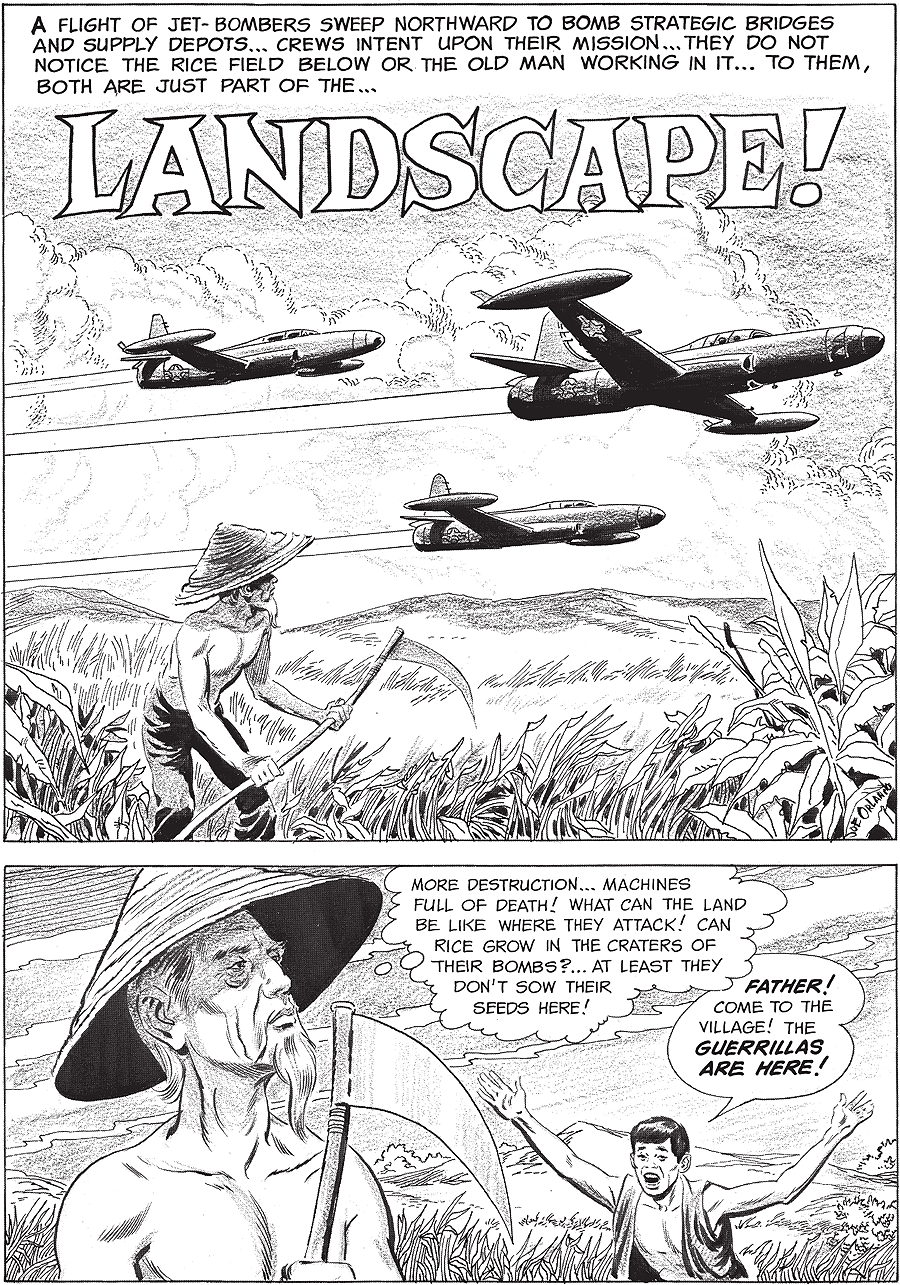
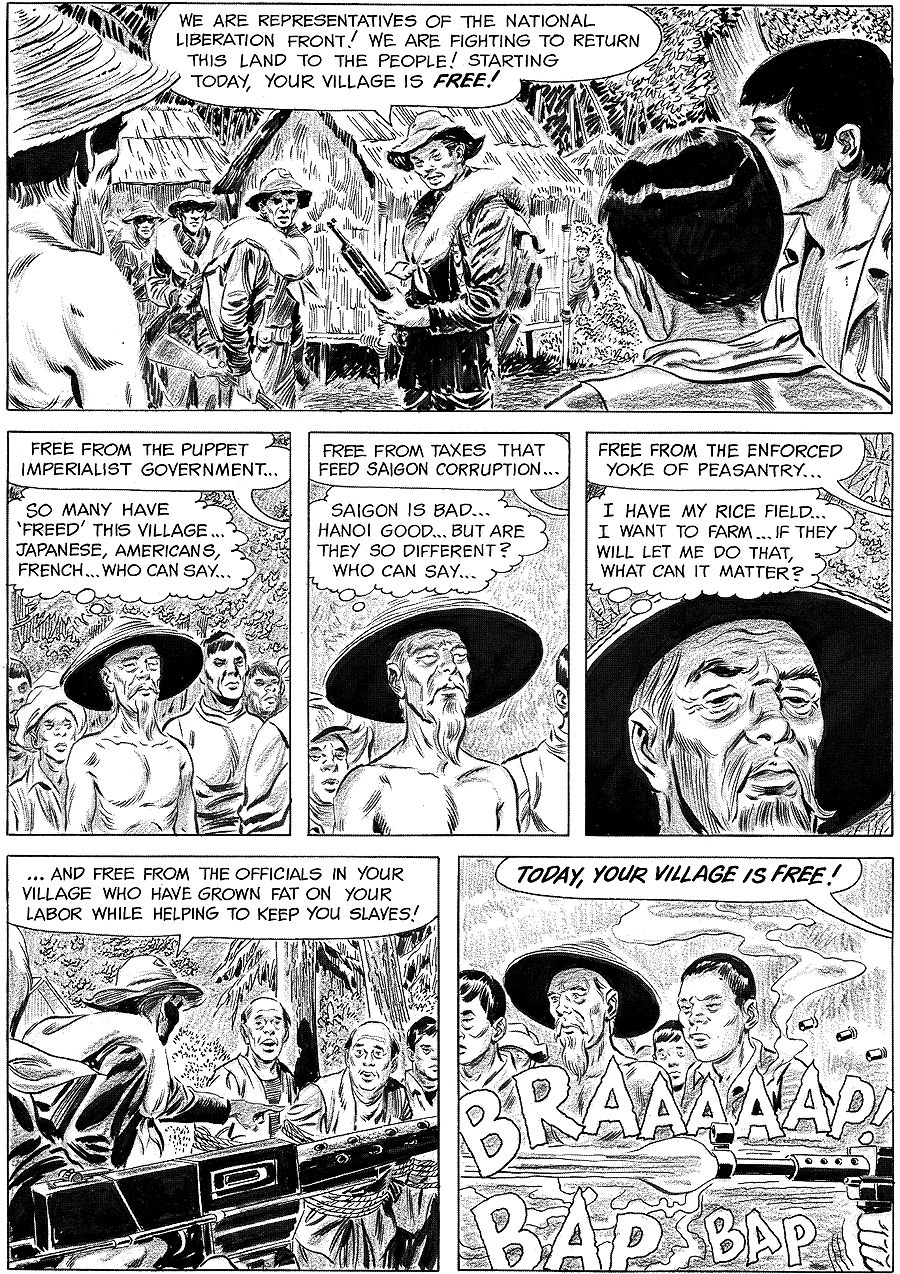
46. First pages from “Landscape!” a story in the comic Blazing Combat, 1965. Reprinted in Archie Goodwin et al., Blazing Combat (Seattle: Fantagraphics Books, 2009), 46–47. Courtesy Fantagraphics Books. © Michael Catron.
As opposed to the previous examples of Friedrich and Blazing Combat, Kienholz’s work opposed the individual to a body count, which during the Vietnam War charted progress on a nightly basis. In later years, other artists followed him in using this approach. To humanize slain American soldiers, Carlos Irizarry collaged photographs of those who had been killed in one week (from Life magazine) into his My Son, the Soldier, Parts I–II (1970). In James Dong’s 1969 Vietnam Scoreboard, an American pilot keeps track of the number of times he hits his target by adding marks to the side of his plane. Yet when one looks closely at the work, the marks do not appear alone, but rather are joined by the silhouette of an Asian family (whose full image can be seen at the left-hand side of the work). While Dong identified this family as Vietnamese war victims, he actually sourced the image from his own Chinese family.
Because of missteps by the Johnson administration during the Tet Offensive, protests during the DNC and the presidential election, and the eventual election of Richard Nixon, the defacement of political figures became a prevalent strategy for antiwar works over the course of 1968. Johnson was a primary target. He was crucified, TNT was shoved up his rear end, his penis was tied up and burned off at the bottom with a match, his body was turned into a bloated yellow worm, and his ignorance was exaggerated by making him speak an insulting parody of an “Asian” language (“Ching Chong”)—and all this appeared in just one work by Peter Saul, Ching Chong (LBJ). Peter Dean depicted Johnson as a cannibal with a ferociously bloody mouth, grinning, seemingly post-meal in #1 Cannibal. Dean’s image recalled Red Grooms’s Patriots’ Parade of the previous year, which also focused on Johnson. In Parade, Johnson leads two veterans and their large American flags—which they wield like baseball bats—along a parade route. Grooms pictures the president as a caricature of himself, with enlarged ears, stepping on children, and taking his hat off to the crowd. Tipped so that the viewer can see into it, the hat is a central aspect of the work. Off of Johnson’s head, upside down, it reveals a black-and-white skull, which recalls the skull contained in the light bulb looming in the back of Otto Dix’s 1920 Skat Players. “Miss Napalm” also leads Johnson’s parade. She is Grooms’s inversion of (and replacement for) the Statue of Liberty. In addition to Johnson, artists abused other political figures. As noted, Mayor Daley earned himself an entire exhibition in Chicago. The smug faces of Richard Nixon and Dean Rusk were juxtaposed with the tortured countenance of a Vietnamese victim of war in Joe Raffaele’s Vietnam Collage.42
As seen with Grooms’s Miss Napalm, artists skewered American political symbols alongside their upending of politicians. Uncle Sam was a popular target. Perhaps the most iconic presentation of him was in End Bad Breath (fig. 48), created by the graphic designer Seymour Chwast. End Bad Breath features a green Uncle Sam opening his mouth to reveal bombers in Vietnam, equating war-making with a disease in the body politic of the country. In other works, Uncle Sam appears badly beaten up, as in Steve Horn and Larry Dunst’s I Want Out (fig. 49), a parody of James Montgomery Flagg’s iconic I Want You poster used to recruit soldiers during both world wars.
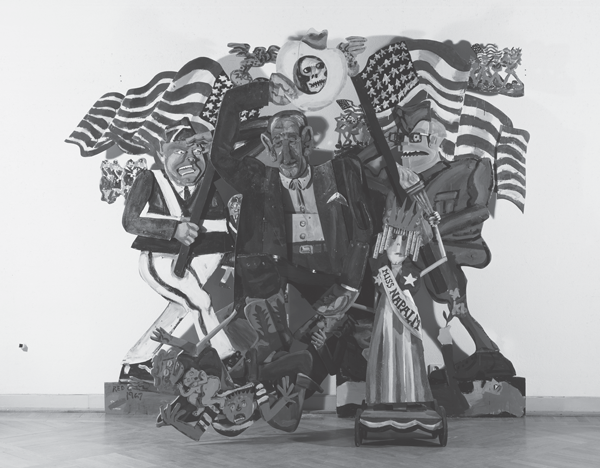
47. Red Grooms, Patriots’ Parade, 1967. Construction, painted wood. 8' × 4" × 11' 40". Collection Moderna Museet, Stockholm, Sweden. © 2012 Red Grooms/Artists Rights Society (ARS), New York.
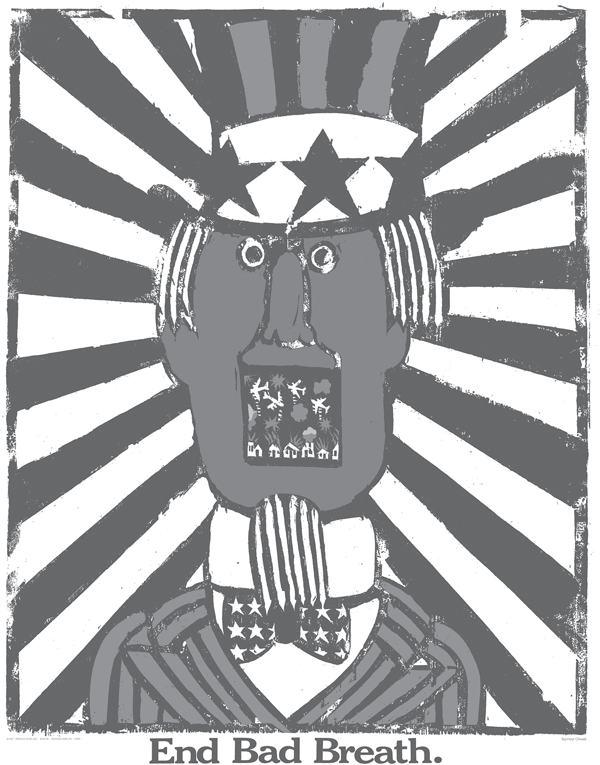
48. Seymour Chwast, End Bad Breath, 1967. Offset lithograph. 24 × 36 in. Courtesy Seymour Chwast.
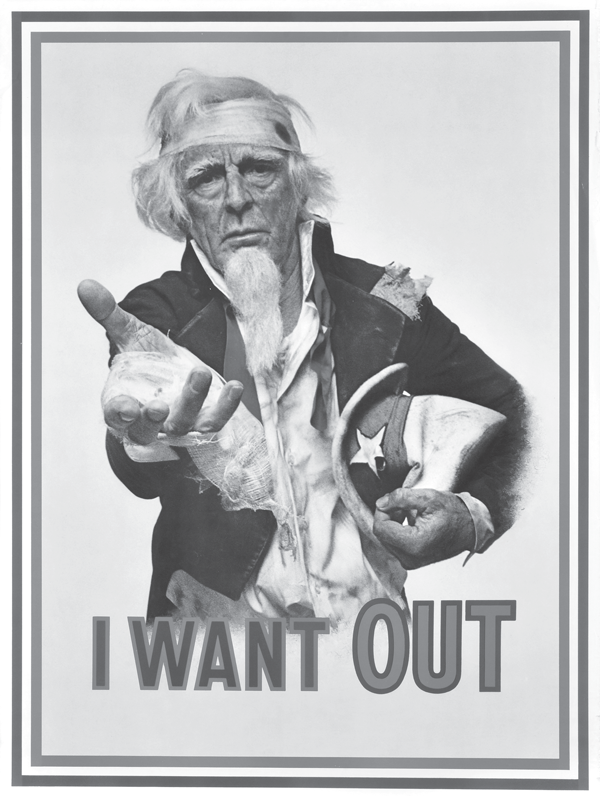
49. Larry Dunst, I Want Out, 1971. Committee to Help Unsell the War. Photographer: Steve Horn. Offset. 101 × 76 cm (39-3/4 × 29-15/16 in.). Courtesy of the Center for the Study of Political Graphics.
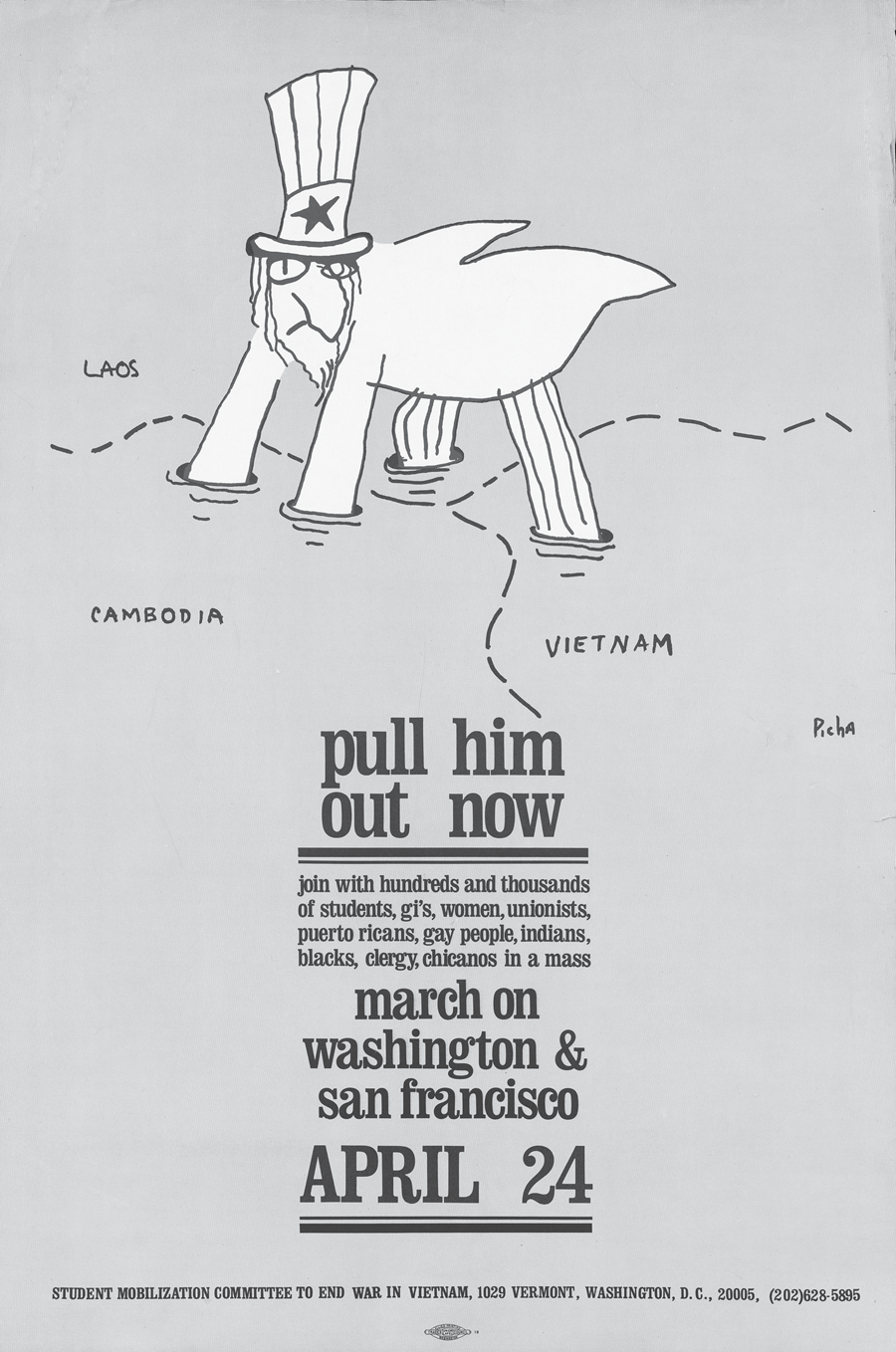
50. Student Mobilization Committee to End the War in Vietnam, Pull Him Out Now, circa 1969. Offset. 68.6 × 45.7 cm (27 × 18 in.). Courtesy of the Center for the Study of Political Graphics.
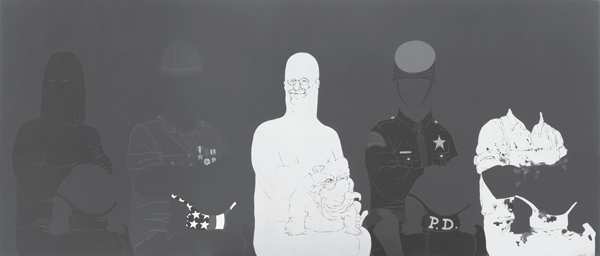
51. May Stevens, Big Daddy Paper Doll, 1970. Acrylic on canvas. 72 × 168 in. (182.9 × 426.7 cm). Brooklyn Museum, Gift of Mr. and Mrs. S. Zachary Swidler, 75.73. © May Stevens.
The quagmire that was the war by 1971 also threatened to devour Uncle Sam. In a poster for student demonstrations that year (fig. 50), Uncle Sam literally is being swallowed up by the ground, sinking into the quicksand of Cambodia and Vietnam. The poster demands, “Pull him out now!”
In her series Big Daddy, which featured the consistent representation of an imposing, bald, overweight, pasty white man—whose overall form suggested a penis—May Stevens insulted another kind of American political figure: the ordinary working-class man who supported the war fully, didn’t criticize the government, and didn’t get into politics. Big Daddy was based on Stevens’s father, who lived in Quincy, Massachusetts—where Stevens grew up—and the series was triggered in part by the threat that her son would be drafted.43 In Stevens words, Big Daddy watched you with “total incomprehension . . . his eyes [were] blank,” just as many of the “hawks” of the United States looked at the “doves” protesting the war.44 An example from Stevens’s series is her Big Daddy Paper Doll (fig. 51). In it, Big Daddy is depicted naked (with a bulldog humorously hiding his penis) in the format of what could be a children’s book.45 Various outfits he can don—including a soldier’s and a butcher’s uniform—surround him. For Stevens, the assumption was that all these positions in society represent forms of the Big Daddy personality.
The distrust of authority present in Stevens’s works reflected the greater political and social upheaval of 1968, and specifically the belief that Vietnam had truly become a quagmire. In response, the U.S. government began 1969 by introducing a way to downscale American involvement.