
6
Soon after his inauguration in January 1969, Richard Nixon announced a plan to end American troop involvement in the war: “Vietnamization.”1 Vietnamization, according to Nixon, would allow American ground troops to be sent home in stages by progressively transferring their duties to ARVN forces, hence the name: the war would go from being Americanized to Vietnamized. The United States would compensate for the departure of U.S. troops with an expansion of the (less troop-heavy) air war over theDRV. In the future, Vietnamization would lead to the departure of all American troops from Vietnam, according to Nixon, leaving the war—or hopefully peace by that point—in the hands of the DRV.
Yet by the fall of 1969, almost eight months after his initial announcement, Nixon had done very little to put Vietnamization into effect. Members of the antiwar movement once again rose up and organized in response. This time their protest was an unprecedented statement, Vietnam Moratorium Day, which took place on October 14, 1969. Millions of Americans in thousands of cities, towns, and villages across the United States demonstrated as part of the Moratorium. It remains the largest public protest in U.S. history. In their seminal, comprehensive history of the antiwar movement, Who Spoke Up? American Protest Against the War in Vietnam, 1963–1975, Nancy Zaroulis and Gerald Sullivan described the scene:
A Whitmanesque alchemy was at work; a gentle spirit of comradely acceptance pervaded gatherings large and small where every shade of dissent was represented. For some, long kept in silent restraint by radical usurpation of the ground they might have taken, it was, at last, a chance to be safely heard. Only a few minor incidents of violence were reported, there were no ugly mob scenes; instead, in town after town, there were silent, reproachful vigils, endless reading of the names of the Americans killed in the war, candlelight processions, church services, and, in some cities, larger meetings where politicians spoke in muted terms. The extremes of citizen opposition to the war came together and whatever radical impulse strayed about the fringes of these gatherings was submerged in a spirit of civic solidarity in common enterprise.2
After 1968, in which protests time and again expressed dissension and new expressions of violence, here was an unprecedented and peaceful consensus calling for an end to the war. The hope was that these resounding numbers and an almost religious piety would convince Nixon and the administration to change its course.
In the wake of this extraordinary expression of dissent, Nixon went on the offensive. On November 3 he delivered a major speech to the American people. He began by explaining that the purpose of the speech was to inform Americans of “the truth” about current American policy in Vietnam, including Vietnamization, in his belief that “the [country’s] deep division about Vietnam” was due to a lack of information. He then explained that Vietnamization, what he called a “long overdue change in American policy,” was working. Air operations, for example, had been reduced by 20 percent. Further, he said that he had “worked out” a plan “in cooperation with the South Vietnamese for the complete withdrawal of all U.S. combat ground forces, and their replacement by South Vietnamese forces on an orderly scheduled timetable.” Then Nixon abruptly switched gears and changed the focus of his speech to the American civilian population. Regarding his plan of action, he asked not for the whole country’s support, but only for support from “the great silent majority” of Americans—by which he meant those not currently speaking out against the war and who inaudibly supported Nixon. With this comment, Nixon converted the address into one of the most divisive ever given by a sitting president. Suddenly, public opinion changed from something to be won over by persuasion to something that could be won through the method of divide and conquer. Nixon made the division between his silent majority and the antiwar movement starker still by inferring that the antiwar movement was not just outside his concerns, but that those involved in it were the real enemy. He said, “North Vietnam cannot defeat or humiliate the United States. Only Americans can do that.”3
While Nixon’s speech was immediately trumpeted as a great success by his administration, which paraded heaps of telegrams from the newly audible “silent majority,” it did not calm the American political waters. Events of the ensuing months made calm seem impossible, especially the revelation a little more than a week after Nixon’s speech of what had taken place more than a year before at the My Lai hamlet in the Song My district of South Vietnam. A report by Seymour Hersh in the Cleveland Plain Dealer(accompanied by Ron Haeberle’s photographs) disclosed that at My Lai, on the morning of March 16, 1968, in the span of a few hours, American soldiers from Charlie Company murdered more than five hundred Vietnamese villagers.4 The deaths stemmed from a search and destroy mission the company had been ordered to undertake. When the soldiers had arrived at My Lai they expected an intense battle, and a good deal of the men in the company wanted one. Many were especially agitated after the Vietcong had killed some members of their unit during the previous weeks. Yet what the company came upon was a quiet village where none of the men and women posed a direct threat, and where it was highly questionable that anyone had links to the Vietcong. Regardless, this did not stop the Americans from carrying out their orders, which were reinforced by those in charge, notably Lieutenant William Calley. According to eyewitnesses that morning, American soldiers committed mass murder. They bayoneted old men, shot women and children in the back, and mowed down with machine guns groups of people they had lined up in front of trenches. After the revelation of the incident, there was enough evidence to convict only Calley, and he received a life sentence. Despite this fact, because of political pressure Nixon commuted Calley’s sentence. Nixon made him serve only three days in jail and then allowed him to be released into house arrest. Three years later Calley was free.
For most antiwar Americans (though in later years similar comparable incidents were revealed) My Lai became the representative incident of war crimes in Vietnam.5 It sparked a great deal of antiwar protest, including efforts by artists, the best-known of which was the And Babies poster, created by the poster committee of the Art Workers’ Coalition.
The Art Workers’ Coalition had its origins in a series of events involving the artist Takis (Vassilakis). One of Takis’s works—Telesculpture of 1960, which was in the collection of the Museum of Modern Art—had been included in MoMA’s winter 1969 exhibition, The Machine as Seen at the End of the Mechanical Age.6 But Telesculpture was not the work Takis had thought would be included in the exhibition. He had been told MoMA would feature a more recent work that he considered more representative of what he was currently making.7 In response to this replacement, Takis decided to protest MoMA. In doing so, he wanted to bring attention not only to his own particular situation but also to how the museum dealt with artists and their works in general. Takis was particularly concerned with how museums exhibited artists’ works without their consent, the idea of “exclusive” museum ownership of a work, and the common practice of taking unauthorized photographs of artists’ works.8
Takis’s protest occurred on January 3, 1969. He entered The Machine as Seen at the End of the Mechanical Age, removed his work, and retreated to the museum’s sculpture garden with the work in his hands. When MoMA staff (including the curator of the exhibition) got wind of his action and approached him to inquire about it, Takis asked the curator if his work could be removed from the exhibition. The curator and the museum said it couldn’t be, after which Takis and a few others began a sit-in at the museum and distributed a handbill to the public. The handbill explained Takis’s aforementioned agenda and the fact that this would “be the first in a series of acts against the stagnant policies of art museums all over the world.”9 Takis’s act led to meetings being scheduled with Bates Lowry, MoMA’s director. In the time between these meetings and Takis’s initial protest, friends and supporters sympathetic to Takis joined his cause. This group included artists who showed with Takis at the Howard Wise Gallery—such as Wen-Ying Tsai, Tom Lloyd, Len Lye, Farman, and Hans Haacke—and artists and critics from other areas of the art world, like Carl Andre, Lippard, John Perreault, Petlin, Rosemarie Castoro, Kozloff, and Willoughby Sharp.
As it became larger and involved more and more people of like mind, the group catalyzed by Takis’s actions eventually decided to refer to itself as the Art Workers’ Coalition (AWC). Julia Bryan-Wilson has recently noted how this name called to mind some significant precedents: namely, the New York Artists Union chapter of the 1930s, and the Art Workers Guild, established in England in 1884 as an outgrowth of William Morris’s Arts and Crafts Movement. The most immediate link, though, was with the Black Emergency Cultural Coalition, formed to protest the 1969 Harlem on My Mind exhibition at the Metropolitan Museum of Art.10 Fluxus and the network of performance artists associated with Judson Memorial Church in Greenwich Village provided other important local precedents for anti-institutional collective artistic activity in New York.11 (Actually, members of both groups, such as Jon Hendricks and Yvonne Rainer, became AWC participants.) AWC kept its organization deliberately loose. Decisions were made based on direct participatory democracy; membership could be determined only by the number of people who appeared at an activity or meeting; and anyone could be a member: critics, museum and gallery personnel, even art audiences.12
With the formal creation of AWC, the group expanded Takis’s protest to include other new demands of the museum. They wanted MoMA to (1) set up a section of the museum that would be dedicated to the exhibition of black artists (and be directed by black artists); (2) extend itself into “Black, Spanish and other communities”; (3) establish a committee of artists who would organize exhibitions; (4) make itself free for everyone; (5) have it pay a rental fee to show artists’ works; (6) hire staff that was specifically trained to handle the installation and maintenance of technological works; and (7) create a section of the museum to show works by artists who did not have gallery representation.13
Over the next few months as they negotiated their demands with Lowry, AWC became the largest political artists’ organization in the United States and buttressed their statements and negotiations with highly visible actions.14 Three hundred AWC participants gathered outside MoMA to protest the museum’s lack of representation of black artists. They held an “Open Hearing” at the School of Visual Arts in which fifty members of the coalition clarified or critiqued AWC’s demands and proposed new issues to an audience of approximately 250 people.15 Beginning in April 1969, AWC participants began protesting against the Vietnam War. The most significant of these antiwar protests took the form of a poster now widely known as And Babies (fig. 52), which was created in November 1969.
And Babies featured two main elements: a photograph reproduced in color and blood-red typewriter-like text printed at the top and bottom of the photograph. The photograph was one of Ron Haeberle’s appalling images of direct evidence of the My Lai Massacre. Because of its publication in Life magazine in December 1969, the picture had already become the primary image of the incident and one of the most iconic of the war. On a dirt road lined with tall grass and a bent-over wire fence, more than twenty women and children lie dead. Some of their bodies are in the middle of the road, some lie off to the sides. Some are clothed; some are not. Within the group of bodies are three dead babies.16
The text used in And Babies, which is the source of the title history has given the work, reads: “Q: And babies?” and at the bottom “A: And babies.” Both the question and answer stemmed from a November 24 interview broadcast on the CBS national newsmagazine program 60 Minutes that reporter Mike Wallace conducted with Paul Meadlo, a soldier who had been involved in the My Lai incident. During the interview, Meadlo admitted to shooting unarmed men, women, children, and babies, alongside his fellow soldiers and at the orders of Lieutenant Calley. Meadlo described how soldiers shot people with their machine guns and pushed them into a ravine; he also recounted gathering others into a ditch and then dropping a grenade on them. He said American soldiers killed about 370 people that day. Nevertheless, Meadlo explained that he felt like what he did was correct in the face of the recent loss of some of his buddies. Today, the Meadlo interview is remembered by 60 Minutes as the most “shocking” of Wallace’s career. It was definitely the most horrific historical discussion of the My Lai events. Notably, while the origin of the text used in And Babies was the Wallace–Meadlo interview, the lettering itself was sourced from the New York Times, which printed the interview the following day.17 The poster dramatically enlarged and turned red the original Times text.18
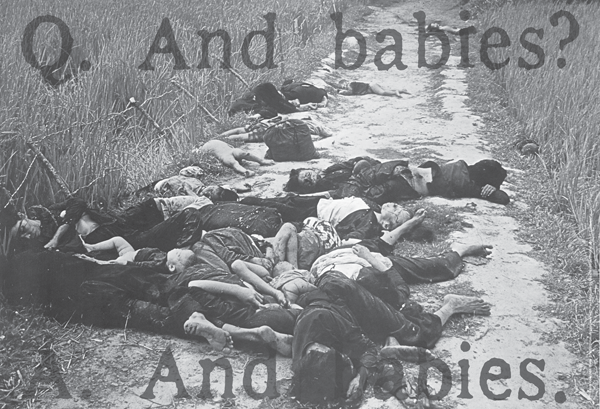
52. Artists’ Poster Committee of Art Workers’ Coalition: Frazier Dougherty, Jon Hendricks, and Irving Petlin, Q. And babies? A. And babies, 1970. Photographer: R. L. Haeberle. Offset. 63.5 × 96.3 cm (25 × 37-15/16 in.). Courtesy of the Center for the Study of Political Graphics.
And Babies was meant to be a kind of collaboration between the AWC and MoMA, a sign of the progress AWC had made in persuading the museum to attend to its concerns and a public statement of the museum’s political engagement. Between November 25 and December 3, the poster committee settled the design and it was agreed that MoMA—which was not involved in the creation of the poster—would take care of the distribution of the work if AWC would pay for it. MoMA additionally agreed to let AWC use its name to secure reproduction rights, a donation of paper, and a printer (the Amalgamated Lithographers Union) for the project. Moreover, the credit line for the poster would list both MoMA and AWC.19 Nonetheless, according to the poster committee, at the last minute, after the color plate had been finished and the printer was waiting only for the credit line to be approved, MoMA backed out. The museum’s abrupt change of heart was allegedly because of the sentiments of William Paley, the president of the museum’s board of trustees, who was also a former president of CBS and the current chairman of its board. Paley had not seen the poster until the final printing days; when he was shown a mock-up of the work, he said the museum could not be associated with such a project. According to Lucy Lippard, he said “in so many words,” “You must be kidding, the museum will not do this.”20
MoMA sent out a press release summarizing the decision and the background of the situation for the public. It explained that there had never been any promise that the museum staff’s executive committee (which had worked with the poster committee and was not in contact with Paley) would be empowered to make the final decision about the poster. Further, it said, “The Museum’s Board and staff are comprised of individuals with diverse points of view who have come together because of their interest in art, and if they are to continue to function effectively in this role, they must confine themselves to questions related to their immediate subject. Mr. Paley said they could not commit the Museum to any position on any matter not directly related to a specific function of the Museum.”21 MoMA’s statement implied a few possible conclusions. It emphasized the immediate and appropriate subject of MoMA was not projects outside its collection and that a specific function of the museum was not to be politically active. If one reads “immediate subject” as art separated from any sociopolitical relationships, MoMA’s words also insinuate the museum’s formalism.
AWC still printed And Babies without MoMA’s participation, in a run of fifty thousand posters, and according to Lucy Lippard, an “an informal network of artists, students and peace workers throughout the world” distributed the posters widely, free of charge.22Such wide distribution led to the poster’s visibility in both “high” and “low” locations. It was put up on the street, hung up in people’s homes, published in Rolling Stone, and, ironically, included in two major MoMA exhibitions: Kynaston McShine’s 1970 seminal museum exhibition of conceptual art, Information, and Betsy Jones’s 1971 The Artist as Adversary. AWC also tried to publish And Babies simultaneously on the cover of all four major American art magazines—Artforum, Arts, Art in America, andArtnews—yet the plan fell through because Art in America would run the poster only if all the other magazines did and Artnews did not want to be involved.23 Importantly, the poster had another life during the 1972 Nixon reelection campaign, when all text on the poster’s image was replaced with “Four More Years?”
In the months following the printing of And Babies, those involved with AWC continued to focus on Vietnam through a unique collective aesthetic endeavor that again centered on My Lai. During the fall Moratorium Against the War in Washington, DC,AWCparticipants teamed up with members of Artists and Writers Protest to fabricate and distribute masks that they had created of Lieutenant William Calley (fig. 53). The masks were black-and-white photographic reproductions of Calley’s face with small holes for the wearer’s eyes, so that one would in essence become Calley by putting it on. The visual effect of a sea of Calley faces approaching the Capitol was haunting. Though the majority of those who wore the masks saw them as continuing to bring awareness to Calley and the horrors of the incident, the action was not so one-sided or direct, and implied other meanings. Some felt the masks implied that everyone had a touch of Calley in them and that everyone shared responsibility for the atrocities committed. Lucy Lippard even explained that at the time, while the masks were interpreted as condemning Calley, some observing the protest thought the masks were worn in support of him.24
Another imaginative antiwar action organized by AWC participants was its Mass Antiwar Mail-In. Again executed in partnership with AWP, this action appealed to artists and writers to send to the groups “a gift, a keepsake, a trophy, a poem, an amulet, or whatever you like (the bulkier the better),” which the group would then collect and forward on to the “WAR CHIEFS OF THE PENTAGON.” AWC and AWP participants ended up with a good deal of material, and on April 2 they gathered what had been sent (to 530 LaGuardia Place, the home of Leon Golub and Nancy Spero), and walked it, in a procession, to the Canal Street Post Office. At the post office, those involved in the action “stood in line . . . and flaunted their packages, which included a papier-mâché bomb,” a “disheveled papier-mâché Statue of Liberty,” and an amusing napalm toilet seat by Golub. The post office staff—to the group’s amazement—accepted everything, as if they were conscious of the symbolism of the action and their role as participants, but no one can confirm what was done with the materials afterward.25
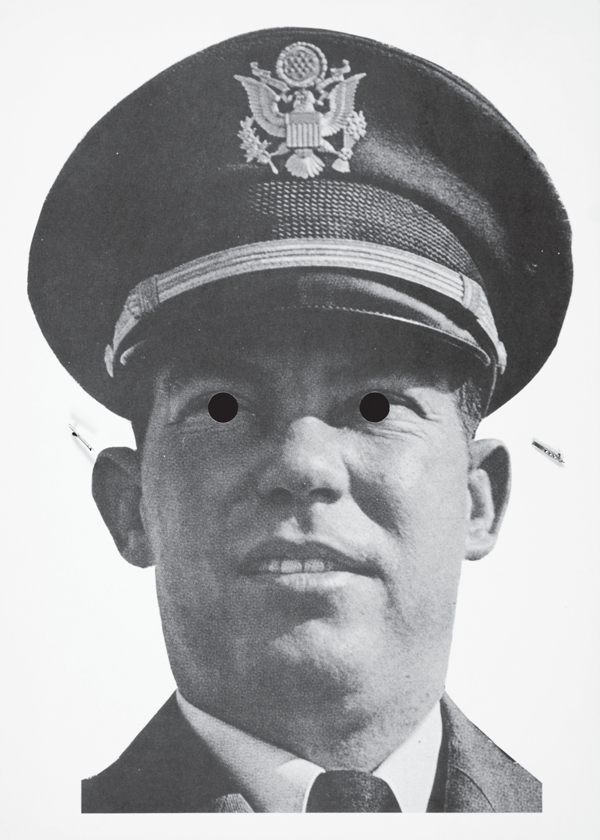
53. Art Workers’ Coalition, Mask of Lieutenant William Calley, 1969. Lithograph. 14 × 10-1/4 in.
On October 15, 1969, two AWC members, Jean Toche and Jon Hendricks—who was involved with Fluxus as well as with Happenings, through his directorship of the Judson Gallery during the mid-1960s—formed the Guerrill a Art Action Group (GAAG), in response to their belief that AWC was not committed or extreme enough to effect political change.26 They saw those involved with AWC as too liberal, too willing to accept the art world status quo and its ability to mediate their dissent, and as too reluctant to sacrifice their identities as artists.27 (A picket at the Guggenheim Museum, in which AWC’s protest collapsed because participants suddenly left for lunch, was the breaking point for Hendricks and Toche.) On the contrary, GAAG explained that there was nothing it “wanted to get into museums,” and it didn’t want to submit to negotiations like other groups of the period.28 For the most part, members said, GAAG would create public performances—which the group saw as politicized “Art Actions”—in appropriated, unrestricted spaces that would bring direct attention to human crises.29 They saw these actions as the most effective means of protest, as Schneemann, Hoffman, and artists involved in Angry Arts Week had in years previous, and as increasing numbers of artists involved in antiwar engagement would in an art environment more and more influenced by performance or object-less works. Dore Ashton commented at the time that the greater employment of performative work was motivated by a sense of exasperation and futility that befell artists in the face of current events.30 The appropriated, unrestricted spaces mentioned by GAAG were often museums, and as a result, GAAG is credited with being one of the first groups to bring 1960s artistic movements such as destruction art, conceptual art, and performance art into public spaces and encouraging others to do the same.31
GAAG’s best-known action was A Call for the Immediate Resignation of All the Rockefellers from the Board of Trustees of the Museum of Modern Art, which occurred on November 18, 1969 (figs. 54–57), and which is better known as Blood Bath. The action used the issue of rape along with the pseudo-direct evidence of blood to draw attention to the war in Vietnam. It began when Hendricks and Toche and two women—Poppy Johnson and Sylvianna (the name filmmaker Sylvia Goldsmith chose to go by), who often participated in GAAG actions—entered MoMA with bags of beef blood taped to their bodies but hidden in their clothes. After one of them threw down one hundred copies of their statement, all the GAAG members started ripping at one another’s clothes, puncturing the bags of blood and crying out gibberish and occasionally “Rape!” (Images of the event can be seen in figs. 54 and 55, the statement is presented in fig. 56, and a communiqué about the event is shown in fig. 57.) The blood exploded from the bags, staining the participants’ clothes, the floor, and the statements. After a few minutes of further clothes-ripping, the artists then dropped to the floor, moaning and groaning, and the action shifted from what they described as “outward aggressive hostility into individual anguish.”32Eventually the noises and movement stopped and all became silent. A crowd, which had gathered around the group at the museum, applauded, as if they watching street theater. Subsequently GAAG members got up from the floor, put their coats on, and left the building. The New York City police came eventually, but long after the artists left. While the final scene of the artists on the floor among their scattered statements suggested the iconic Haeberle image from My Lai, there is no confirmation that this was the artists’ intention. What further discourages this interpretation is the fact that the performance was planned before the revelation of My Lai.
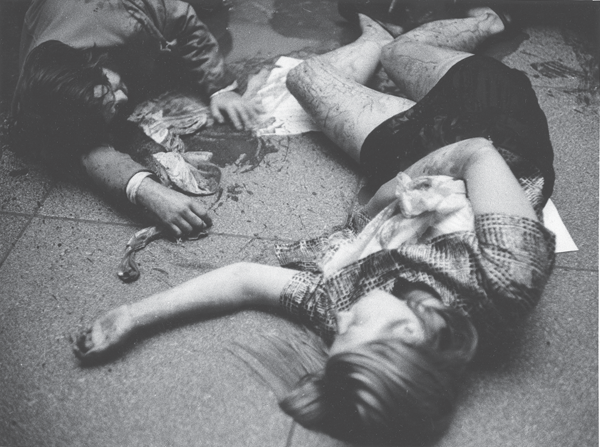
54. Guerrilla Art Action Group, A Call for the Immediate Resignation of All the Rockefellers from the Board of Trustees of the Museum of Modern Art, November 10, 1969. Photograph by Hui Ka Kwong. Courtesy Jon Hendricks.
Though often ignored in historical discussions of the action, GAAG’s statement was an important part of Blood Bath and helps clarify why the action took place at MoMA as well as how GAAG situated itself within the greater antiwar movement. The statement called for the immediate resignation of all Rockefellers from the MoMA board of trustees, because of their use of art as “a means of self-glorification” and “as a form of social acceptability,” and their “use of art as a disguise, a cover for their brutal involvement in all spheres of the war machine.”33 They explained how Standard Oil, in which the Rockefeller family owned a 65 percent stake and which was a “special interest of David Rockefeller,” leased one of its manufacturing plants to United Technology Center for “the specific purpose of manufacturing napalm.” Second, they noted that Rockefeller Brothers owned 20 percent of the McDonnell Aircraft Corporation, “which has been deeply involved in chemical and biological warfare research.” Third, GAAG explained that Chase Manhattan Bank (of which David Rockefeller was chairman of the board), McDonnell Aircraft Corporation, and North American Airlines (“another Rockefeller interest”) were represented on the Defense Industry Advisory Council, which reported directly to the International Logistics Group and the International Security Affairs Division of the Pentagon. Finally, GAAG faulted Rockefeller for the lack of political art at MoMA. The group argued that the family’s “control of the museum’s policies since its founding” allowed them to manipulate artists, evacuate art of social or political protest, and “render art totally irrelevant to the existing social crisis.”34
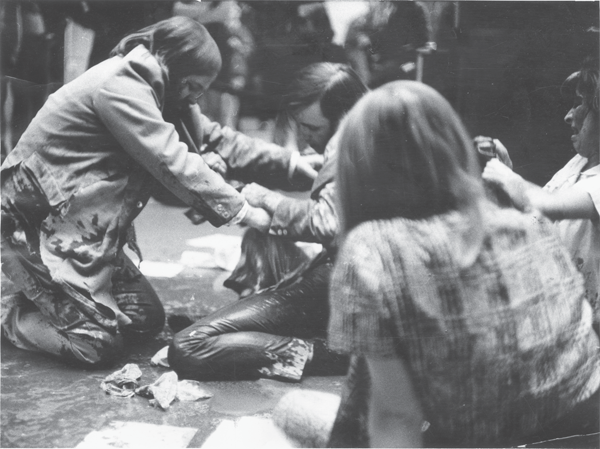
55. Guerrilla Art Action Group, A CALL FOR THE IMMEDIATE RESIGNATION OF ALL THE ROCKEFELLERS FROM THE BOARD OF TRUSTEES OF THE MUSEUM OF MODERN ART, November 10, 1969. Courtesy Jon Hendricks.
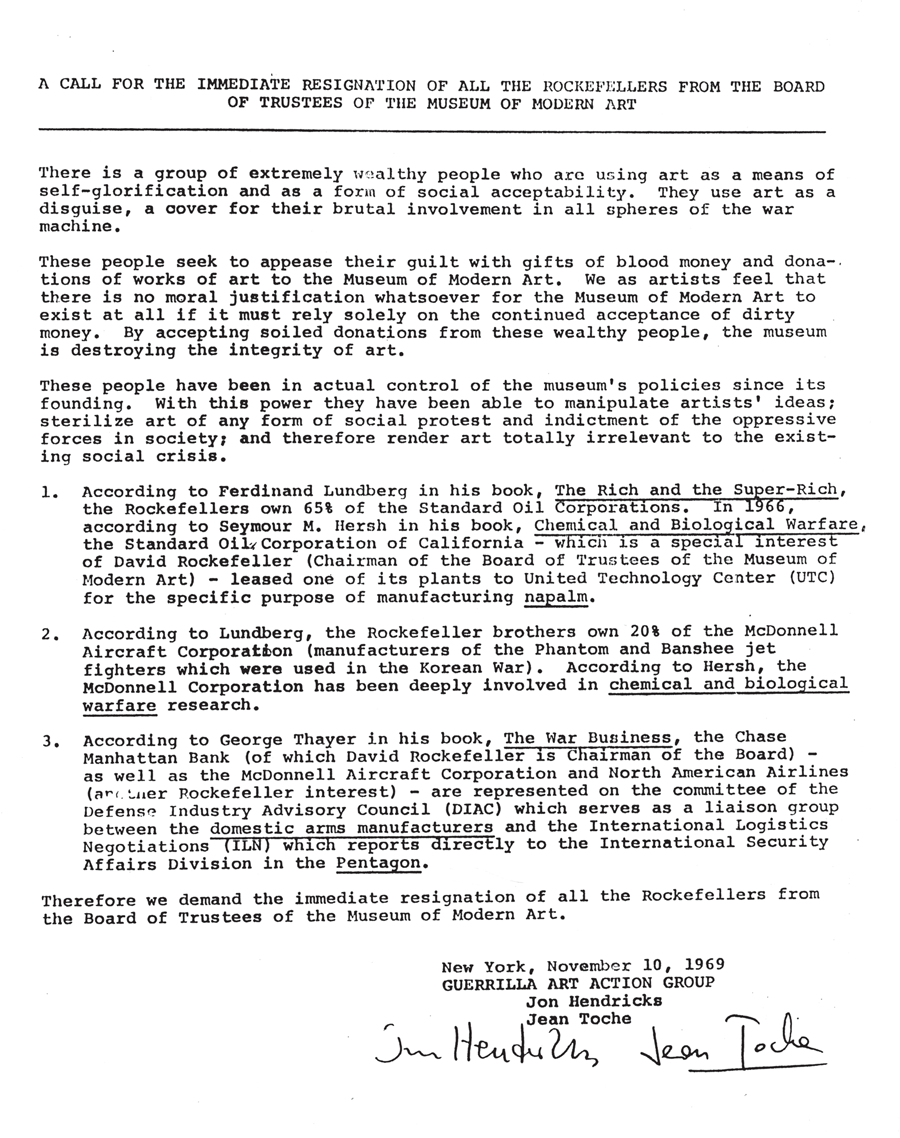
56. Guerrilla Art Action Group, A CALL FOR THE IMMEDIATE RESIGNATION OF ALL THE ROCKEFELLERS FROM THE BOARD OF TRUSTEES OF THE MUSEUM OF MODERN ART, November 10, 1969. Courtesy Jon Hendricks.
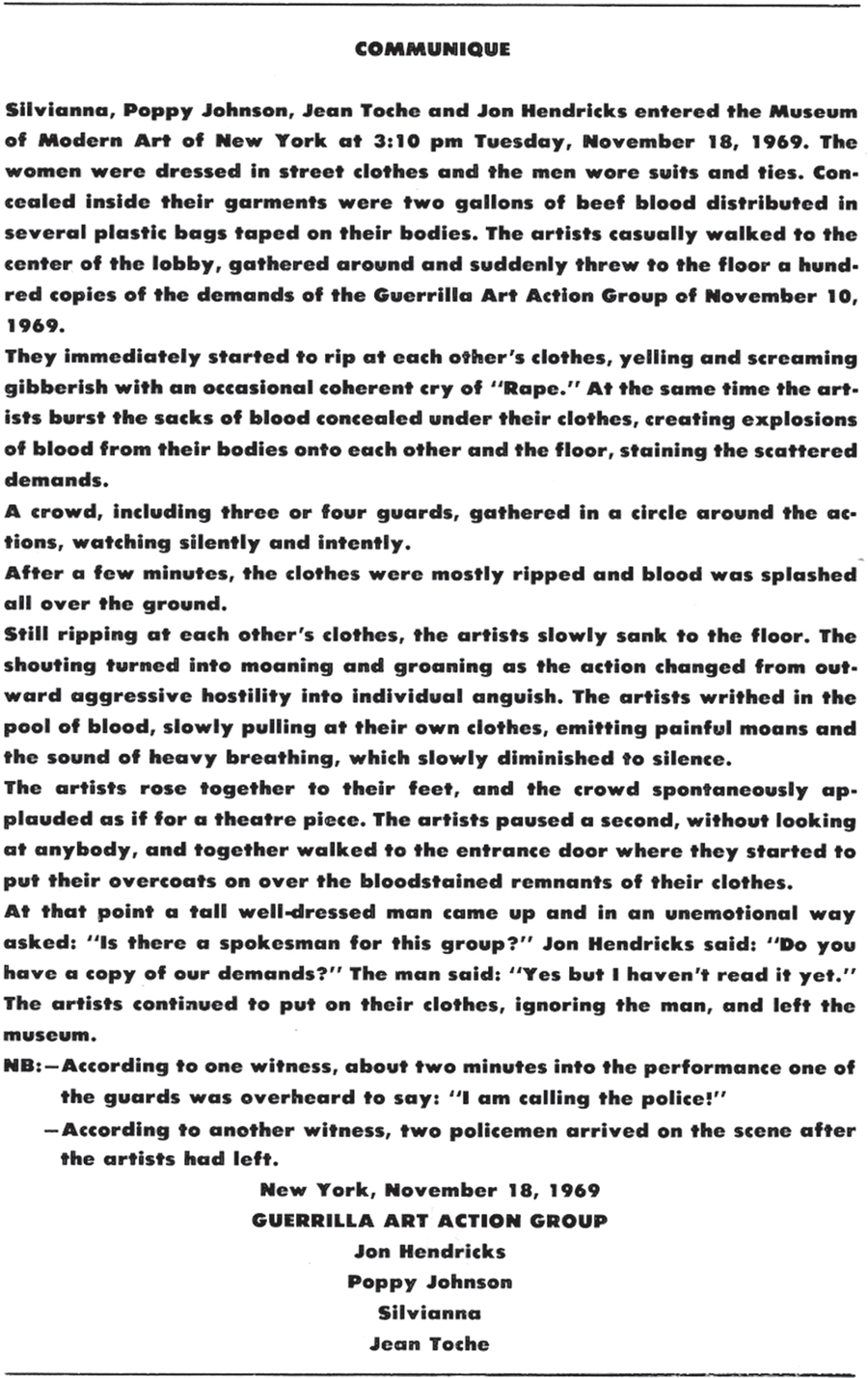
57. Guerrilla Art Action Group, Communiqué, November 18, 1969. Courtesy Jon Hendricks.
Apart from Blood Bath, GAAG mobilized against the war through other actions. In an exploit concurrent with and quite similar to Blood Bath, members walked into the lobby of the Whitney Museum of American Art, dumped red-colored pigment on the floor, and then appeared to—with mops and sponges and a big bucket of water they brought along—in their words, “clean [the] place up,” since “it is a mess from the war.” People associated with GAAG who had been waiting in the museum then joined in to help the entering group. Yet GAAG only spread the “foaming red” mess further around the lobby, making it difficult for people to enter and move around the museum. (Members of the group also kept people away for safety reasons. They warned visitors that the floor was extremely slippery.)
GAAG hoped their action would help call attention to the fact that the Whitney had not closed in honor of the nationwide 1969 Moratorium. A leaflet they handed out arguably expressed this better. GAAG also made its way to a significant audience in the form of the Whitney’s director of public relations, who approached the group about five minutes into the action.35 He asked them what they were doing, and after talking about it briefly, he allowed them to leave without further trouble and without having to clean up their mess.
On January 3 and January 8, 1970, members of GAAG joined with some AWC participants and the Destruction in Art Symposium to stage a protest in front of Guernica at MoMA, which continued to bring attention to My Lai. On the third, the group held a memorial service “for dead babies murdered at Songmy and all Songmys.” The service was led by Stephen Garmey, a chaplain from Columbia University, and it included passages from the Bible, poetry by Denise Levertov, and accounts of American soldiers killing Vietnamese children at My Lai, taken from the December 5 issue of Life. To further indicate the service to the museum-going public, funeral wreaths were placed under Guernica, the And Babies poster was held up, and Joyce Kozloff sat down on the ground (until she was told by the guards to get up), holding her eight-month-old baby, Nikolas, in her arms. On the eighth, the participants (most of them involved with AWC) lay down in front of Guernica for two hours, chanting “Guernica, Guernica, Song My, Murders, Murders,” while others distributed, held up, and wore the And Babies poster on placards. In addition, a flier was distributed resurrecting the 1967 petition to remove Guernica that had been sent to Picasso. The new petition, however, differed from the original. It was addressed to MoMA and stipulated that when the painting was removed, it should be replaced by “posters of the Songmy massacre until the cessation of hostilities in Viet Nam,” or if this was not possible, And Babies posters should cover the wall facing the painting to constantly remind the world of the U.S. level of civilization.36 MoMA ignored the petition. Nonetheless, those behind the petition continued to pursue the matter. They sent it out again to artists, critics, and art historians, asking them to write letters to Picasso; in all, 256 letters were collected.37 Once more, the materials were hand-delivered by Irving Petlin to Michael Leiris in France. But again, no response was received from Picasso. Petlin maintains today that, as in the previous attempt, Picasso’s inner circle kept the material from the artist. For instance, Petlin claims that Barr tapped his phone and sabotaged the petition from early on, contacting Picasso once he knew of the petition and telling him to ignore it.38
Antiwar works featuring depictions of dead American soldiers began appearing in 1969. The fact that such works surfaced so late in the course of artistic antiwar engagement resulted from the consistent appearance of dead Americans on television and in newspapers only after the Tet Offensive, and the fact that images of American war casualties had historically been kept from the American public. (This is still today the situation in the United States.) The depictions of these soldiers were mostly monochromatic and generalized because colorlessness alluded to lifelessness. In general, artists also did not want to create images that might be at all look similar to actual (serving or dead) American soldiers.
Two works in this genre, both of which also continue to engage with the idea of the war memorial, stand out: Duane Hanson’s meticulously detailed War (also called Vietnam Scene) and Edward Kienholz’s The Non-War Memorial (figs. 58 and 59). Hanson’s work, which, like Kienholz’s previous works, is in a German collection and is practically unknown to American audiences, consists of five soldiers, life-size and hyperrealistic like the artist’s more familiar sculptures of overweight and unattractive 1970s and 1980s Americans.39 Hanson arranged the soldiers on a large, dirt-covered tarp with nothing else added, creating a kind of non-space akin to that seen in Golub’s paintings. The tarp and the men are painted entirely “army” green, except for the blood-red injuries of one of the men, who although wounded in the head and the stomach, is the only one of the four who sits up and appears to be alive. The rest of the men lie flat on the ground and have gaping holes in their torsos. Hanson’s work is blunt. While not formally created as a memorial, the size and monochromatic presentation make it appear as one. In so doing, compared with historical memorials like the Iwo Jima memorial, the work deflates war death’s heroism and the spectacular nature of more traditional monuments to remembrance. Hanson’s soldiers are splayed in the dirt, divorced from any kind of illustrative, collective, or individuating context. They are merely trying to hold their bodies and lives together, and no grand rhetoric elevates their presence.
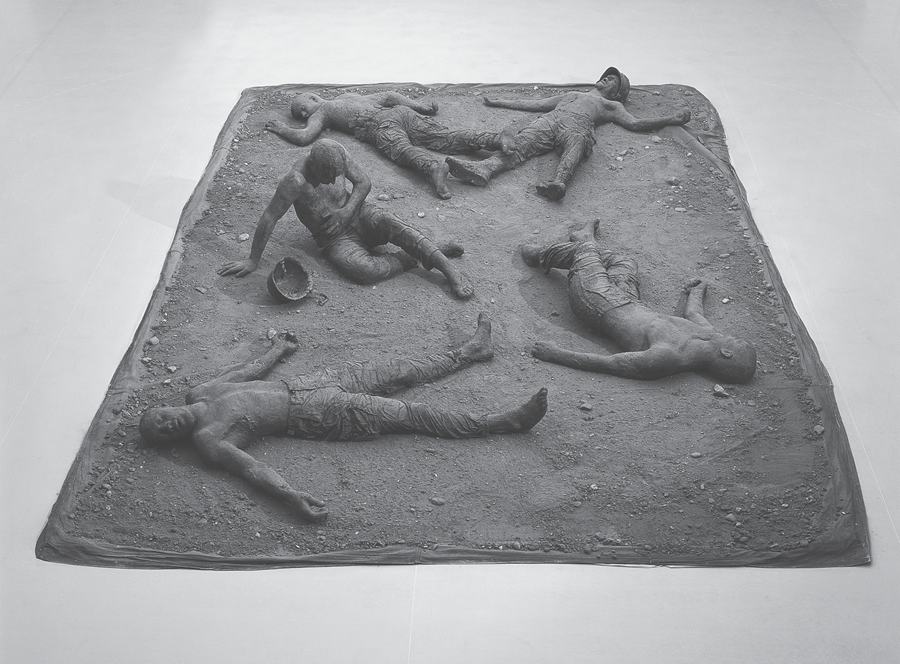
58. Duane Hanson, War (Vietnam Scene), 1969. Installation with five figures, polyester resin and fiberglass, painted, different accessories. Approx. 77 × 550 × 355 cm. Art © Estate of Duane Hanson/Licensed by VAGA. Courtesy Stiftung Wilhelm Lehmbruck Museum, Duisberg. Photographer: Bernd Kirtz.
Kienholz completed his Non-War Memorial in 1970. Though less graphic than Hanson’s work, Kienholz’s piece similarly debunks the characteristic pageantry of war memorials. Planned but never fully executed—in this way it exists as one of Kienholz’s many “concept tableaus”—the Memorial was to have consisted of fifty thousand surplus military uniforms filled with clay slurry. These uniforms would then be then spaced out randomly and laid down across a seventy-five-acre meadow near Clark Fort, Idaho.40According to curator and cofounder of the Ferus Gallery, Walter Hopps—a longtime friend of Kienholz’s—the making of the work was to be a collective endeavor, involving time donated by artists, students, and peace activists.41 Nevertheless, once finished, the work was not intended to endure like a historical memorial, but to biodegrade and disappear. As Hopps explained, “In time, the uniforms would rot, [the] bodies [would] melt away, and wildflowers [would] grow on the site. Eventually the land would revert to alfalfa fields.”42 As a result, the non in the title bore a twofold resonance: it stressed how atypical the work would look in contrast to traditional war memorials—since it was non-vertical and presented tens of thousands of soldiers’ bodies in a field—and highlighted the fact that the memorial would eventually be non or nothing.
Part of the sculpture was The Non-War Memorial Book, printed in an edition of twenty-five, which recorded the elements of the sculpture for posterity. It contained photographs of each of the fifty thousand dirt-filled uniforms, laid out in twenty images per page. As an ephemeral memorial, The Non-War Memorial is a significant statement in the face of war and in the history of war memorials. War memorials are characteristically focused on concretizing memory and occupying the place of missing soldiers. The Non-War Memorial does concretize memory—by always having a written record of the piece—but its elimination of soldiers’ bodies takes away from the traditional memorial’s need to solidify life and assert the ever-present existence of the soldier’s body.
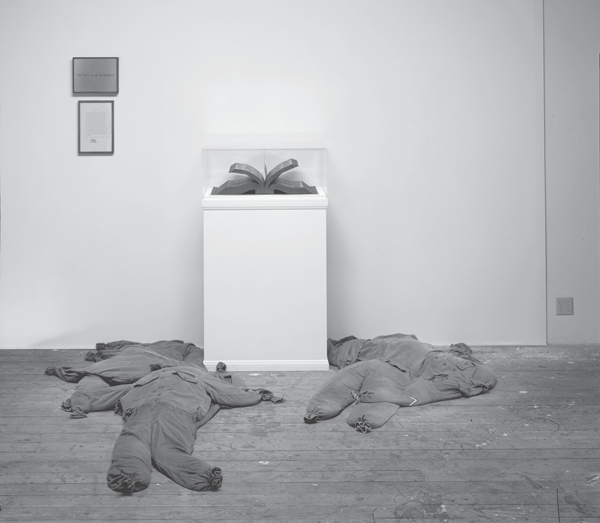
59. Edward Kienholz, The Non-War Memorial, 1970. Mixed media tableau. Dimensions variable. Collection of the artist. © Kienholz. Courtesy LA Louver, Venice, CA.
Dead American soldiers did not have to be represented through bodies, but could also be referred to through other familiar containers or markers of death—such as coffins, body bags, and tombstones. The use of such objects sought—as in Hanson and Kienholz’s works, and like protest works that juxtaposed body counts with images of war victims—to foreground the physicality of American soldiers’ deaths in a society where death had been kept abstract, hidden in numbers or in images broadcast from a faraway land.
In May 1969, for instance, AWC participants and Artists and Writers Protest marched up Sixth Avenue to Columbus Circle carrying a group of body bags, on which they inscribed the totals of American as well as Vietnamese dead.43 Those involved in the march also carried white cloth runners that stretched over a block in length and included names of the dead. Lucy Lippard, who was a part of the action, said that people on the streets were affected; they “threw flowers on the bags; even the police . . . were respectful.”44Tombstones and coffins representing the American dead were present in posters and a few sculptures, such as in Kienholz’s Portable War Memorial and Sam Weiner’s Those Who Fail to Remember the Past Are Condemned to Repeat It of 1970. Weiner’s work featured a group of coffins draped in American flags and installed in a fully mirrored room. The configuration of the mirrors connected the work to previous mirrored rooms by Yayoi Kusama and Lucas Samaras. Their infinite reflections of the coffins also proposed that the deaths would continue ad infinitum. Judging by the events of 1969 it seemed like they would.
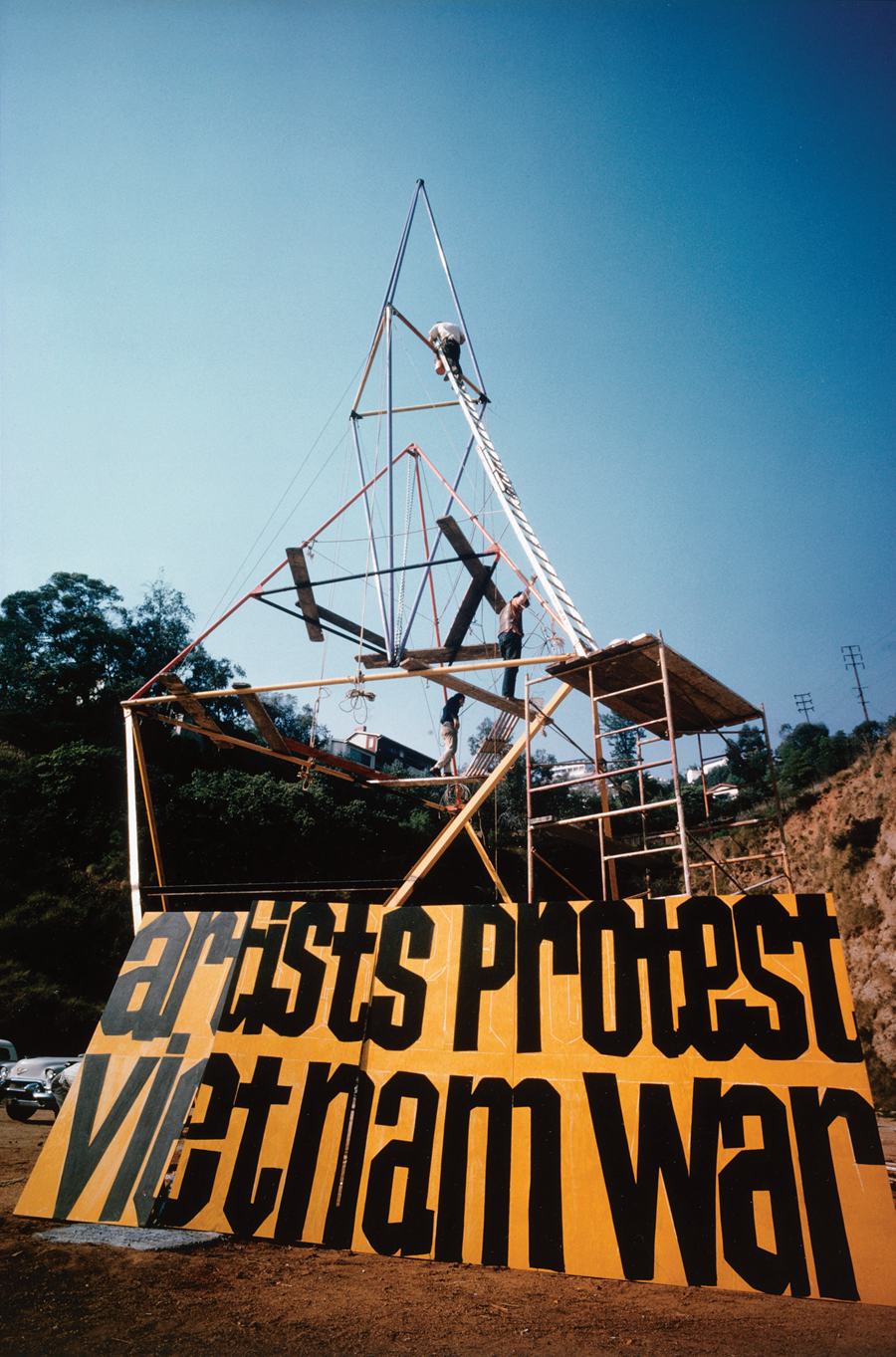
Charles Brittin, Photograph of the Artists’ Protest Committee Artists’ Tower of Protest, Los Angeles, 1966. Silver dye bleach print, chromogenic process. Charles Brittin Archive, Getty Research Institute. Used with permission.
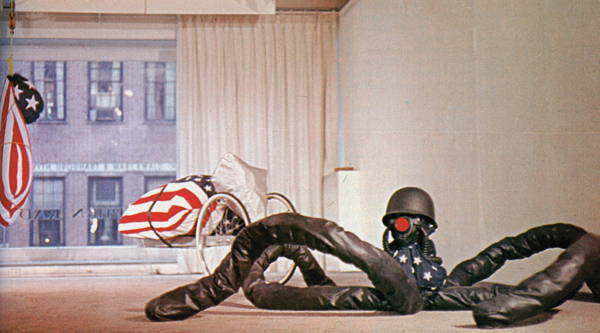
Installation view of Marc Morrel flag works at the Stephen Radich Gallery, December 1966. Courtesy Marc Morrel and Art in America.
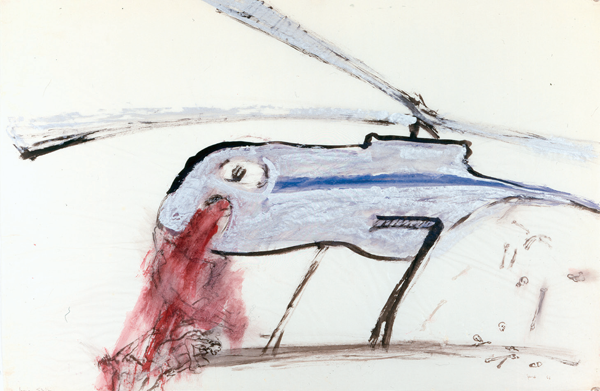
Nancy Spero, Gunship, 1966. Gouache on paper. Framed: 27-1/2 × 39-1/2 in. (69.9 × 100.3 cm). Art © Estate of Nancy Spero/Licensed by VAGA, New York. Courtesy Galerie Lelong, New York.
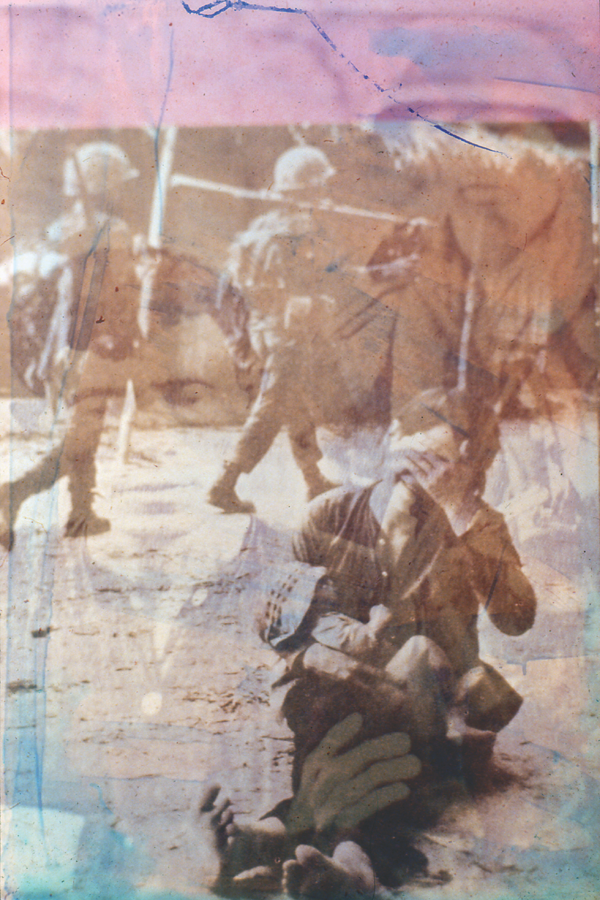
Carolee Schneemann, Viet-Flakes, 1965. Film still from DVD of original toned B&W 16mm film. © Carolee Schneemann.
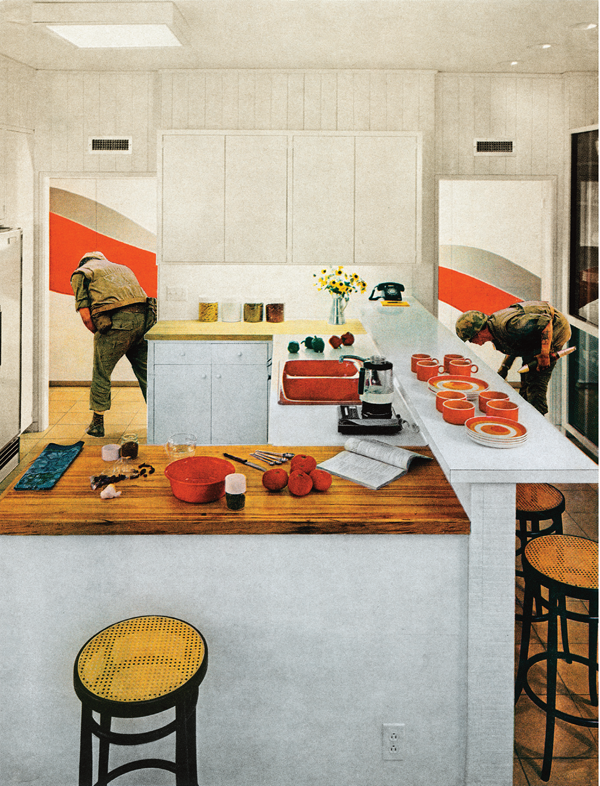
Martha Rosler, Red Stripe Kitchen, from the series Bringing the War Home: House Beautiful, 1967–1972. Photomontage. © Martha Rosler.
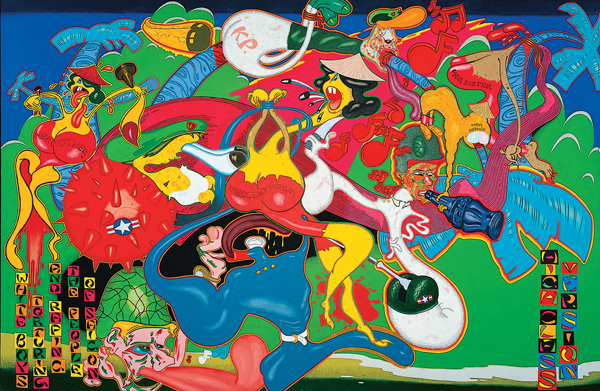
Peter Saul, Saigon, 1967. Enamel, oil, and synthetic polymer on canvas. 92-3/4 × 142 in. (235.6 × 360.7 cm). Whitney Museum of American Art; purchased with funds from the Friends of the Whitney Museum of American Art 69.103. Photograph by Sheldon C. Collins
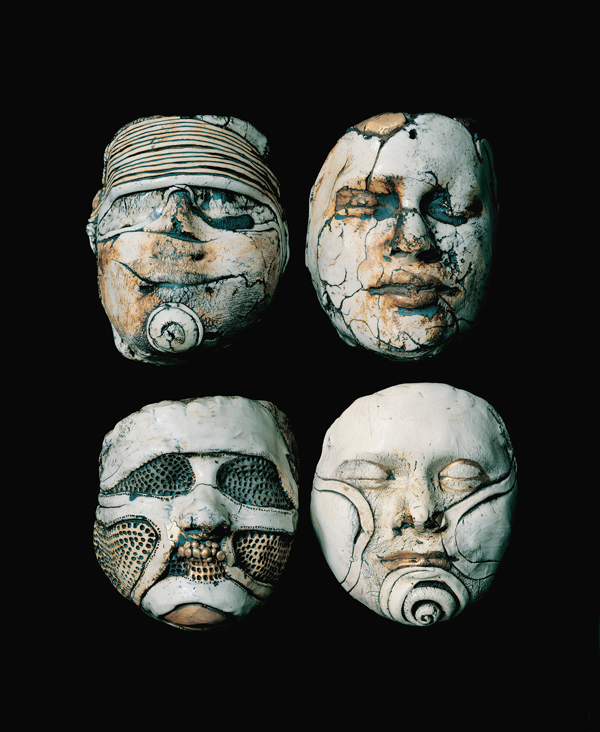
Michele Oka Doner, Death Masks, 1967. Ceramic, four pieces. 6 × 6 × 3 in. each. Collection: Stephanie Freed, Miami Beach. Photo: D. James Dee.
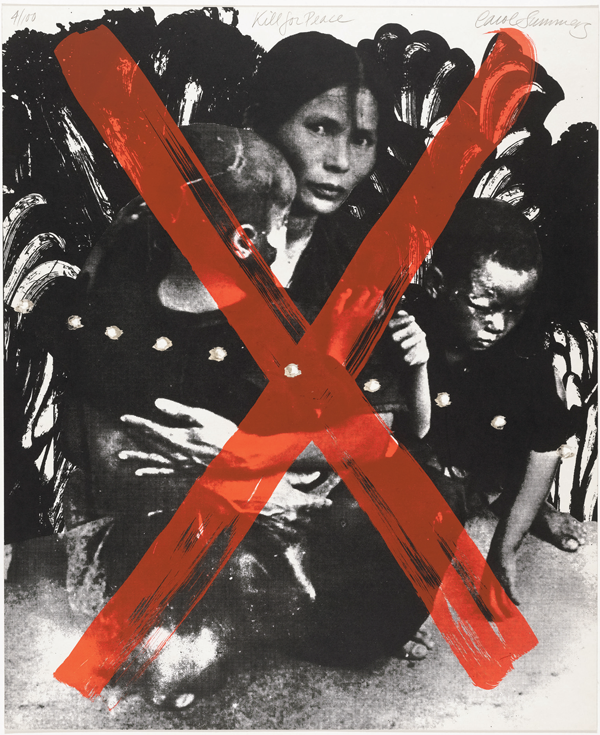
Carol Summers, Kill for Peace, from Artists and Writers Against the War in Vietnam, 1967. Screenprint with punched holes. Composition: 235⁄16 × 193⁄16 in. (59.2 × 48.7 cm); sheet: 235⁄16 × 193⁄16 in. (59.2 × 48.7 cm). Publisher: Artists and Writers Protest, New York. Printer: unknown. Edition: 100. Digital Image © Museum of Modern Art/Licensed bySCALA/Art Resource, New York.

Edward Kienholz, The Portable War Memorial, 1968. Mixed media tableau. 114 × 384 × 96 in. (289.6 × 975.4 × 243.8 cm). Museum Ludwig, Cologne. © Kienholz. Courtesy L.A. Louver, Venice, CA.
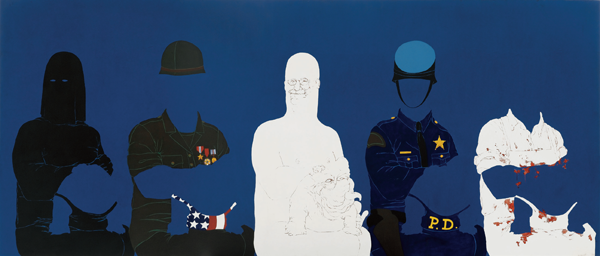
May Stevens, Big Daddy Paper Doll, 1970. Acrylic on canvas. 72 × 168 in. (182.9 × 426.7 cm). Brooklyn Museum, Gift of Mr. and Mrs. S. Zachary Swidler, 75.73. © May Stevens.
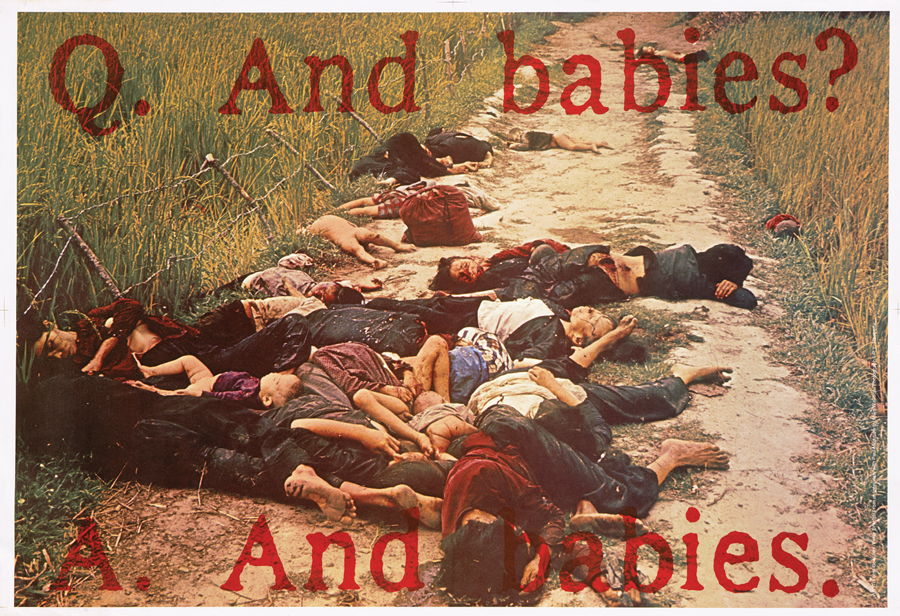
Artists’ Poster Committee of Art Workers’ Coalition: Frazier Dougherty, Jon Hendricks, and Irving Petlin, Q. And babies? A. And babies, 1970. Photographer: R. L. Haeberle. Offset. 63.5 × 96.3 cm (25 × 37-15⁄16 in.). Courtesy of the Center for the Study of Political Graphics.
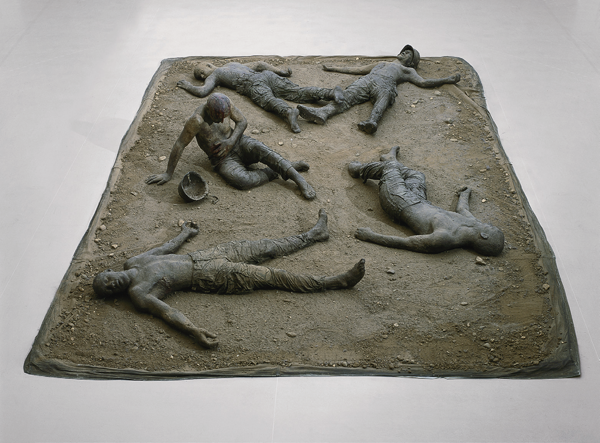
Duane Hanson, War (Vietnam Scene), 1969. Installation with five figures, polyester resin and fiberglass, painted, different accessories. Approx. 77 × 550 × 355 cm. Art © Estate of Duane Hanson/Licensed by VAGA. Courtesy Stiftung Wilhelm Lehmbruck Museum, Duisberg. Photographer: Bernd Kirtz.
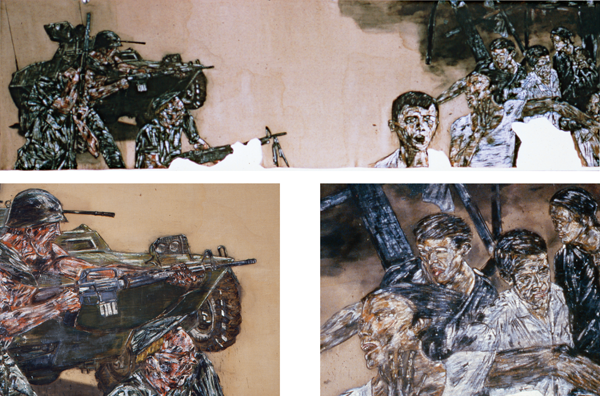
Leon Golub, Vietnam II, 1973. Acrylic on linen. 120 × 480 in. Art © Estate of Leon Golub/Licensed by VAGA, New York. Courtesy Ronald Feldman Fine Arts, New York.
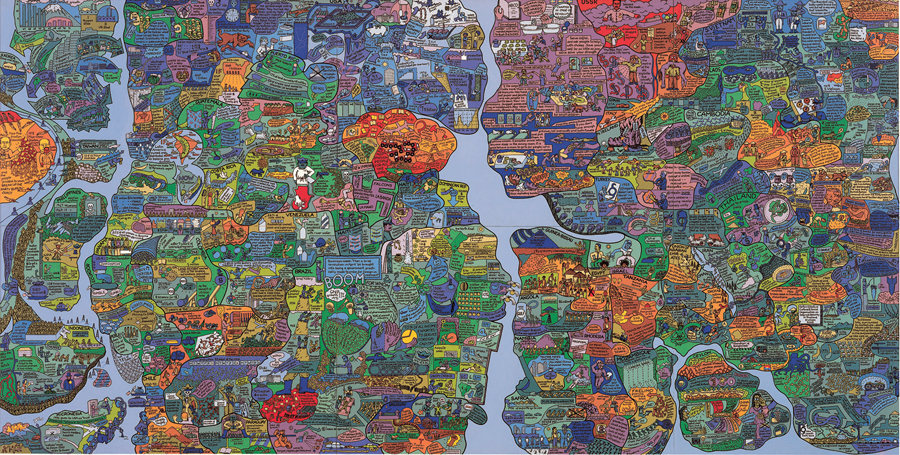
Öyvind Fahlström, World Map, 1972. Acrylic and India ink on vinyl mounted on wood. 91.5 × 183 cm. Private collection. © 2011 Sharon Avery-Fahlström.
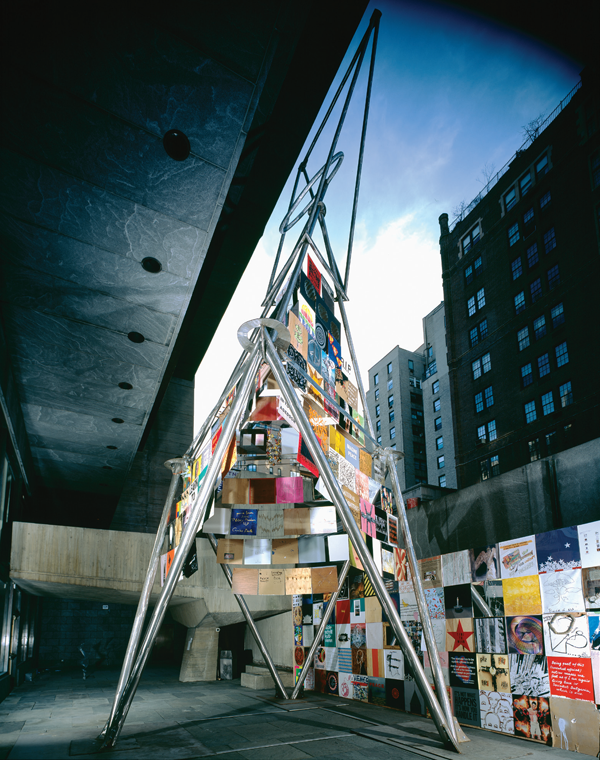
Mark di Suvero and Rirkrit Tiravanija, Peace Tower, 2006. Mixed media. © Mark di Suvero. Courtesy Paula Cooper Gallery, New York. Installation view at Whitney Biennial 2006: Day for Night, Whitney Museum of American Art.
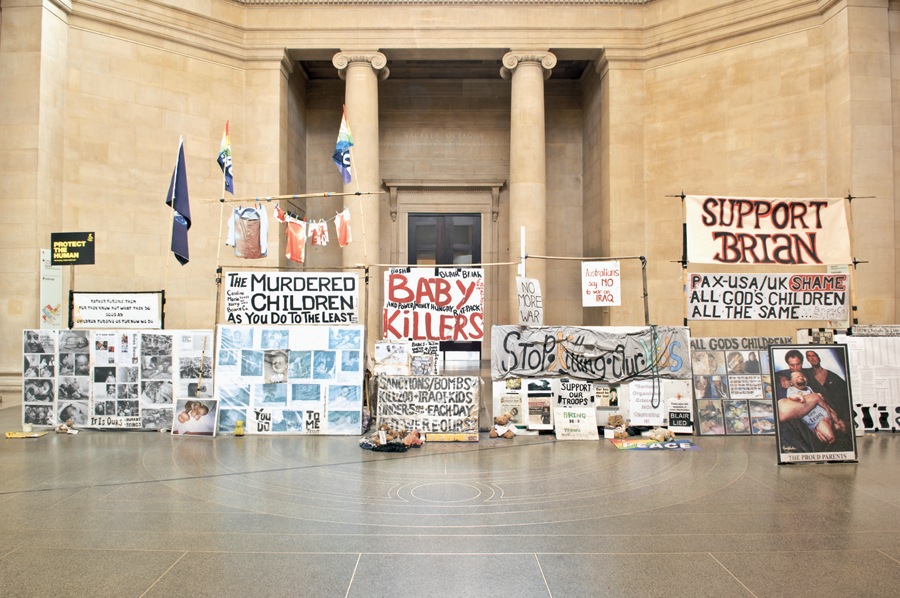
Mark Wallinger, State Britain (detail), 2007. Mixed media installation. Approx. 570 cm × 190 cm × 43 m. Installation at Tate Britain, 2007. © Mark Wallinger. Courtesy Anthony Reynolds Gallery, London. Photograph by Dave Morgan.