
5
A GREAT DEAL HAS BEEN SAID ABOUT TRENCH warfare in bygone eras. Prolonged stabilized battlefronts and sieges are not new and go all the way back to the beginning of mass warfare. Regardless of the war, regardless of the era, trenches hold many things in common for the infantry soldier—not the least of which are the constant danger, the filthy existence so inherent in trench living, and the incredible boredom at times.
One can find many reasons for armies engaging in trench warfare. First, some past situations of trench warfare came about because the armies pitted against each other were relatively equal in strength or determination, or both, and one side was not able to prevail over the other, thus a static or stagnant front emerged in a war of attrition. Examples include the Siege of Vicksburg and the Battle of the Wilderness in the American Civil War and the trench warfare in Europe during the First World War, to mention only a few.
In Korea, the stagnant front line trench warfare during the last two years of the war was seemingly by choice (our choice)—a stalemate determined by political decision or a political commitment not to go further to prevent escalating the war. The stabilized front resulted from our rules of engagement. In other words, we were in a programmed stand off. We were not allowed to go further forward; we were not allowed to retreat backward. We were stuck somewhere around the 38th parallel while the politicians and negotiators tried, seemingly in vain, to bring about peace. In this way, our stagnant trench war was different from past wars. Not better but just different.
The Chinese did not particularly like a stabilized MLR (Main Line of Resistance). Having a static front took away a major element of the Chinese People’s Army’s strategy of military engagement. Earlier in the Korean War, and in their war against Nationalist China to wrest the large country from Chaing Kai Chek’s control, the communist army was a night infiltration force beyond comparison. They traveled at night in force and holed up in the daytime to avoid detection. Their formations and strategies were designed to infiltrate and flank or gain the rear of their enemy where they could do the most damage. They were effective in the early stages of the Korean War to break through American and ROK forces, move to the rear, and set up ambushes against relatively undefended units and personnel. The Chinese were able to trap entire divisions in their ambushes as the American forces disintegrated after their push to the Yalu River had weakened and over extended their fighting units. After the American and ROK forces were able to establish themselves across a broad front and effectively tie-in their flanks the Chinese strategy was less effective and breakthroughs were on a smaller scale. The stabilized war or trench warfare was more in keeping with Western tradition and allowed the superior firepower of the United Nations forces to be employed more effectively.
The infantry soldier was actually told very little about the overall plan of the war in Korea. The lack of general information really mattered very little since it was only what happened in his immediate front, his own small sector of the MLR that counted most. It mattered most whether there was enough ammunition for the task at hand and that rations were reasonably regular.
DEFENSIVE POSITIONS
The essential purpose of the trench works that zigzagged across the roughly 255 miles of Korea was to defend against assaults by the massive Chinese and North Korean armies that tried to capture strategic or desirable pieces of real estate. With fewer men in place it was necessary for the UN forces to defend with superior and effective use of firepower. Each section of the MLR was a citadel of armament—an arms manufacture’s dream.
Fox Company spent a considerable amount of time on Hill 327 of the MLR in positions that overlooked the Yokkokechon Valley and several smaller hills. The Chinese held T-Bone Hill with the exception of a small foothold of the American forces. The American occupied string of positions leading out from 327 to the T-Bone included the outposts Yoke and Uncle. These knolls were platoon-sized circular trenches at the crest that were well covered with sandbags that could resist heavy shelling, a common occurrence.
Typically an infantry company would have an assigned section of the line and would, at any one time, have two platoons of infantry (about eighty or so men)—reinforced with heavy weapons such as mortars and machine guns stretched along the trench line. One platoon would be held in reserve to allow for a counter attack if the lines were breached by an enemy assault. It is easiest to visualize an infantry company’s line defense if you think of two slopes of the hill: the forward slope along which firing positions would be dug in and usually connected by a trench; the reverse slope which was not in direct contact or line of sight of the enemy hills and would contain command and support personnel.
The weaponry was spaced along the trench line in such a way to have overlapping fields of fire. Every thirty yards or so there would be a Browning Automatic Rifle (BAR) or a .30 caliber machine gun—weapons that fired both rapidly and accurately at good range. Interspersed along the MLR were also 57 mm recoilless rifles and an occasional “quad or twin fifty,” a set of two or four heavy machine gun that fired .50 caliber ammunition. These weapons were effective against troop concentrations, machine gun positions, and mortar positions. On some sections of the line tanks would be dug in usually in such a manner as to provide indirect fire but with positions in place to enable them to move up to fire directly at approaching enemy if necessary.
Below the defensive positions and covering the entire front was placed an important line of defense—barbed wire and concertina wire to slow any advancing enemy. Within and/or below the barbed wire GIs would place trip wires attached to flares and mines that might be set off by enemy troops walking in the area.
Also below the trench line and concertina wire, and some distance from the line itself, each platoon would set up a listening post or LP. The job of the LP was to observe the approach of the enemy and warn the line of impending attack. The LP was usually a foxhole disguised and camouflaged so that the enemy would not determine its location. Often, the LP would be made up of four foxholes, in a diamond shaped formation, to provide 360 degrees visibility and protection. The LP would likely be wired for communication by a microphone attached to the platoon Company Command Post (CP) by communication wire. The men serving on LP would be rotated each night so that this sometimes scary duty would be shared. In the event of a major attack, the LP would be “called in” to the company defensive line.
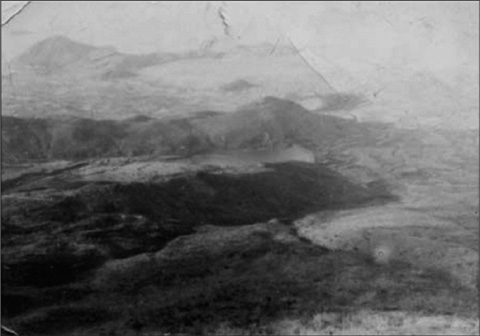
Yoke and Uncle outposts, near T-Bone Hill.
The rear slope or the reverse slope of the hills contained the support troops. Any man in a rifle company, even a cook, was subject to combat duty. On more than one occasion the cooks were issued ammunition and employed in direct combat.
The reverse slope of the hill, usually out of direct firing range but vulnerable to mortar and artillery fire, were the administrative units of the infantry company such as the CP and the chow bunker. The CP usually housed the Company Commander and Exec Officer and the radioman and runners. The reverse slope of the hill also contained an offensive force—mortars. Both 60 mm and 81 mm mortars from the weapons platoon could cover the target area. Further back in the rear was the enormously effective Division Artillery.
****
Many units attempted to provide hot meals to the troops at least once or sometimes twice a day if the position on the MLR allowed. That is, if food could be brought up. At times, we were in places where artillery barrages preempted any effort to provide hot meals.
In some situations there were “chow bunkers” actually on the rear slope of the line. Hot meals were prepared and served to the men in shifts on the line. Even on outposts where the GIs were far out beyond the MLR some hot meals were served (see photo on next page). Being a cook in a line company was not necessarily an easy and safe job. Cooks were in as much danger from artillery shells and other dangers from the skies as anyone else. On one occasion the Navy accidentally bombed our MLR positions; the rockets hit the mess bunker killing a mess sergeant and two others.
The chow bunker held the heart of the company (at least as far as the hungry GI was concerned)—the cooks and the utensils needed to prepare meals. It was fairly typical for an infantry company on the line to provide two hot meals a day—usually breakfast and supper. The GIs would have C-rations for the noon meal. Breakfasts might consist of scrambled eggs or pancakes, or my favorite: ground beef on toast often referred to as “shit on a shingle” or SOS for short. Dinners often consisted of re-constituted mashed potatoes, some variety of beef, pork, or chicken, and a vegetable like canned lima beans—pretty basic cuisine but warm and nourishing. Many GIs would take their mess kits, fill them up at the chow bunker, and dine in the quaint atmosphere of their gun position or foxhole.
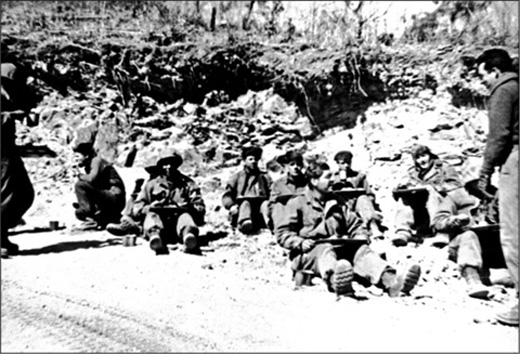
The platoon on Outpost Yoke having a hot meal in a protected area of the hill.
It was not easy to wash one’s mess gear out in the field with warm soapy water, as the technical manuals suggested. Experienced GIs learned that it was important to remove the food particles from their kit and spoon (all we used for eating was a spoon, which was usually carried on one’s belt.) The eating utensils were cleaned with dirt. One would simply take the spoon and plunge it into the ground a couple of times and then wipe off the dirt on one’s pants leg. The mess kit was also cleaned by rubbing dirt on it then brushing off the dirt particles. This way they were ready for the next meal. One learns not to be squeamish about the lack of cleanliness in the infantry!
****
Another important component of some sections of the reverse slope in some companies along MLR was the helipad—a clearing where Air Rescue Operations brought choppers all the way to the front to evacuate wounded. Medical evacuation efforts often would get severely wounded soldiers back to a MASH hospital and into surgery within an hour after they fell from shot or shell. The survival rate of seriously wounded soldiers was much greater during the Korean War than during WWII, largely due to the rapid evacuation provided by Air Rescue Services. A frequent sight in Korea was the little Air Rescue chopper with its twin pods containing stretchers moving to and from the front on their life saving missions.
KOREAN SERVICE WORKERS
Attached to our fighting units, usually stationed far in the rear areas out of artillery range, were the Korean Service Corps (KSC) personnel. These men were Korean civilians, nicknamed “Choggies,” who performed much of the manual labor that allowed the GI to devote most of his attention to the enemy. The KSC workers were really a mixed blessing. On the positive side, they performed much of the backbreaking labor required in maintaining a defensive line along a string of high mountains. They carried enormous loads on their backs using their A-frames. The laborers were mainly farm peasants. The KSC workers could be seen in caravans carrying such things as water cans, food containers, ammunition, and so forth up the steep winding hills. Without them, the war effort would have ground to a halt. They would dig trenches and construct bunkers along with the GIs and repair roadways washed out by spring rains.
There were clear disadvantages in our reliance upon the KSCs for manual labor. Having this unorganized and uncontrolled force of Koreans in our midst, many from the North Korean areas and so close to our vital rear areas, was a harbor for spies. More than a few times it was necessary to pull men from the lines to hunt down renegade or phony KSC workers. Some of the men in the KSC were infiltrators from the North and provided information to the enemy. In some situations, enemy soldiers were mistaken for KSC workers and vice versa. During one battle, two men believed to be KSC workers were instructed to carry one of our wounded men to the rear area. The fellow awakened only to find that they were carrying him toward the Chinese lines. Fortunately, he had a pistol and was able to provide them with new instructions.
The nearness of the KSC camps to our rear areas led to the development of a black market close to the front lines. The Korean black market was a vast enterprise, selling to both civilians and soldiers. The goods for the black market came from a number of sources including unprincipled ROK officers who apparently sold off materials that were supposed to be for the troops. Mac-Donald (1986) reported an incident in which the entire contents of a ship being off loaded in Pusan Harbor was hijacked and sold on the black market. While some GIs appreciated the ready access to black market goods, others bemoaned it as a detriment to an effective war operation. Even so, alcoholic beverages from North America like Canadian Club (CC) were popular with the GIs, especially compared to the Korean alternatives. In Chapter 8, I describe how we outfoxed some black marketers to obtain the prized CC.
LIFE UP FRONT
Darkness on the front lines added a mixed blessing to the routine of trench warfare. First, there was clear safety from not being seen and one could walk about the skyline without too much risk of drawing artillery or sniper fire. However, the night also provided good cover for enemy troop movements so the chances of small arms engagements increased after nightfall.
The front was, at times, a comfortable place. I enjoyed some aspects of being a front line infantryman. There was, occasionally, a feeling of contentment, a feeling that we were doing something important, something that few others could do. I felt that we were helping the South Korean people and at the same time, when things turned out as planned, gained satisfaction out of doing the job well.
Moreover, there was usually no official “harassment” on the front—no field grade, rear echelon, officers to enforce a rigid “spit and shine” code. There was no arbitrary police call to pick up litter and no KP duty as there was in every other duty station. One could generally live a pretty slovenly existence most of the time up front if so inclined, as long as they did not alienate their comrades. It could even at times be peaceful at the front. Sometimes at night there was a dead stillness with only the cold wind and the blackness of the night sky to occupy our thoughts.
The bunkers we slept in, or dove into to escape artillery barrages, and the command posts on the line, were usually only elaborate sections of trench. Although they could be made pretty comfortable they were usually small and cramped sleeping quarters that were simply widened sections of the trench over which a couple of logs or metal poles were laid. Then other metal posts, usually those provided for stretching barbed wire, were laid across the logs and then covered with a piece of canvas such as a shelter half or piece of plastic to hopefully keep out the rain and snow. Then the canvas would be covered with several layers of sandbags (the more bags the more protection from artillery shell fragments) and finally topped with a layer of rocks or logs for additional protection. Usually the area around the bunker was piled with a couple of rows of sandbags to keep out bits of shrapnel and the ever-biting wind and snow.
Later in the war we received some pre-fabricated “bunker kits” that we called Lincoln Log bunkers because the resembled the toy building set in they had pre-cut grooves that fit together. These bunkers were usually sturdy and easy to put together. Once a set of these logs was in place and several layers of sandbags deposited on top the infantryman had a fairly dry and relatively safe hangout.
The American GI usually carried along an air mattress to sleep on, which provided a bit of comfort and some protection from the cold ground. When we were in stable positions for a while it was customary for guys to make bunks out of commo wire. This was a skill that the older guys taught the new men. This was very useful information to have because the bunks worked like hammocks; it sure beat sleeping on the cold ground. There was an art to making a good commo wire bunk. It was easier if the bunker had firm posts holding up the ceiling, as there often were, because there needed to be substantial support to prop up the bunker roof because of the weight of the sandbags. With a couple of strong posts one could simply string communication wire between them, somewhat like the hammocks on the troop ship. Otherwise, the steel posts used for barbed wire also came in handy in constructing the common wire bunks. Blankets were stretched over the door to make the bunker “blacked out.”
We usually were provided small charcoal stoves (sometimes heating oil stoves) that radiated some heat in the bunkers; every couple of days we received a new supply of charcoal to keep them fired. There was usually a chimney cut into the roof to let out the smoke from the fires. Even though the bunkers were pretty drafty, the stoves gave off enough heat to warm up frozen hands and feet a few degrees. One of the greatest inventions of all times, I came to discover, was the little Zippo hand warmer that most of us purchased from the PX rations. A fill of lighter fluid would burn these little marvels for hours, at least to warm up a frozen sleeping bag when off-guard time allowed a nap.
If we were going to be in a set of positions for a while we got a bit fancier with our preparations and even added some decorations—pinups of attractive women from magazines were popular. An interesting decoration that one of our guys, Frank Field, put up can be seen in the skull and crossbones as an ominous warning on the approach to the outpost!
One of our riflemen in one squad was handy at cutting hair using a pair of medic’s scissors. (This fellow was well received as a comrade because the guy that had this duty before him nearly cut off one of our friend’s ears.) Naturally, our new barber’s bunker had to be decorated with a makeshift barber pole and a sign that read “Bear Ass Barber Shop.” Another fellow, from Kentucky, decorated his bunker with a Confederate Flag that someone had given him before he left home. Interestingly, this flag probably caused a bit of a stir in the Chinese Intelligence Corp when a reinforced Chinese patrol attacked our line and overran this part of the hill for a time. When they were driven back, they took the Confederate flag with them, probably assuming that it was the standard for the unit they had over run. The Chinese Army intelligence staff may have had some difficulty in identifying the Army unit they were up against!
The front of our positions beneath the concertina wire that lay stretched across the length of trench and for several yards below were piles of refuse thrown there by several previous contingents of occupants over the past months. The tin cans accumulating under the wire had a useful function in that they served as warning devices. We often tied cans to the wire to rattle if anyone brushed again them. If an enemy soldier crept up to the positions the cans would serve as an audible warning. One great disadvantage of having the refuse piled in front of the positions was that it served as a home for rats.
FILTH BEGETS DISEASE: HEMORRHAGIC FEVER
A frightening disease lurked around the trenches in Korea—an incurable illness in which the victim hemorrhages internally in a manner similar to what hemophiliacs experience. This disease, a type of Ebola virus, is apparently similar to those making the news in recent times with several outbreaks in Asia and Africa. Sudden onset, fever, aching, and bleeding of the internal organs characterize the disease. Hemorrhagic fever was not a hereditary disorder, but one that was transmitted by parasites living on rats. We were informed that many of the Korean trench rats carried these tiny mites and that they would remain on the animal unless it died. When the host rat departed this world and “cooled off,” then the mites would begin to look around for other warm-blooded animals to chew on. The only other animals around the trenches were the unsuspecting GIs. We were unsure as to where this medical information came from but none of us was willing to test out the theory with our own bodies.
This bit of news may well have been started by the rats themselves in order to assure them a longer life given all of the loaded weapons lying around. No infantryman in his right mind would kill a rat and run the risk of its mites then looking around for a new home. Actually, one of the men in our company came down with very suspicious symptoms that matched those of this blood disease. He was evacuated and never returned to the company.
In Korea, rats shared an important place with the infantryman. Both the dog soldier and the rodent seemed, at times, to be at the bottom rung of their respective societies, living in trenches often together, and often competing for the same space or morsel of food. Rats crawled brazenly through the barbed wire to the front of our positions, sought food in our refuse, and took shelter in our bunkers—searching our gear for whatever they might use. Rats were more valuable to us alive than dead it seemed. So our choice was to get along with them or else face the consequences of the fever. As long as the rat was crawling some distance away one felt safe enough to send him or her into eternity. Riflemen would often take practice shots at them; I have known times in which a hand grenade would be lobbed at them. But if the animal was moving in close proximity to the soldier then discretion tended to rule and, grudgingly, the varmint was allowed to pass unharmed. In these times it seemed as though the critter had a knowing smirk on its face.
One night, one of my new squad members, while sitting across the bunker from me, watched a large rat crawling on the planking over my head. He raised his carbine and fired two shots about four feet above my head while yelling, “Duck!” I dived for the floor just as the now dead creature fell against the post that I had been leaning against. Needless to say I was not pleased by his action—because I could just imagine that the mites were looking at me as a potential new home. In my string of expletives afterward I did, however, acknowledge the accuracy of his shot.
One of the most emotionally charged circumstances that I encountered during my stay in Korea occurred one night as I slept. During the night, a slight movement on top of me awakened me and I lay motionless in the low candle lit bunker until I got my bearings. As I lay peering into the dimly lit room, my eyes fixed something unusual on the top of my sleeping bag. I moved slightly and so did it! I began to make out the form of an extremely large bunker rat with its whiskers moving rhythmically up and down a few inches from my face! I felt a moment of terror thinking about those mites and I jumped, as best I could, yelling “AAAGH” in a strange voice that seemed unlike my own. The surprised creature was flung against the sandbag wall. He then scampered out of sight.
Of all of the troublesome memories I had to follow me after the Korean War, this one was the most powerful. After I returned from Korea, I re-experienced that situation two times. At some point during the night I turned over and somehow brushed the sheet against my face. I awakened with the intense feeling of anxiety, as though there was a rat crawling on me. In each instance I awakened with a scream and found myself slapping my head and shoulders in an effort to “brush the rat off of me.” This phobic experience was actually “cured” when I was a graduate student studying experimental psychology. My graduate assistantship required me to take care of the animal lab so I got a great deal of exposure to the rats, certainly a cleaner and nicer bunch of creatures than the Korean trench rat. In addition, I conducted my Masters thesis on rats and had to handle them every day. This exposure served to decondition my aversive reaction to them.
A CRAWLY VISITATION
Human beings can acclimate to a broad range of sanitary conditions if required. The Army has many ways of assuring that the troops keep clean and dispose of waste in an effective manner. But, under combat conditions these measures may get ignored or at least minimized in favor of simply keeping alive. One soon adopts a “two valued orientation to life”—staying out of harm’s way and acquiring food. Everything else gets put on temporary hold at times. One common affliction that seemed to seek out soldiers under these conditions was a pack of little creatures called crabs that appeared to enjoy being around dirty soldiers. The actual dictionary definition of this insect is: “Crab or crab louse is a sucking louse that infests the pubic region of the human body.” The “sucking” designation refers to blood sucking. In the past, lice and crab lice apparently traveled extensively with armies and have been known to carry diseases such as typhus that killed many soldiers. Because we were vaccinated against these major diseases, the crab louse in our Army served as merely a source of irritation
The crab enjoys inhabiting hairy parts of the human body where it apparently finds security and sustenance. They are, in some ways, harmless little fellows in that I have never heard of anyone dying from them. However, I have heard of many guys infected with them wishing they were dead! Crabs crawl about, digging their many legs into government issued flesh (usually at night) when all was quiet. Those infected with these tiny creatures usually spent much of their time scratching, groaning, and cursing.
During this time on the line I too fell victim to those little varmints. I noticed at first only an excessive scratching in vital areas, which soon increased to the requirement of sudden and aggressive digging to alleviate the painful, crawly feelings. The light and sporadic sleep we generally received on line became even more fitful and interrupted as my new guests boarded in for the duration, they hoped.
An oft quoted cure for these creatures was as follows: The cursed GI shaves a strip across the prominent infected area, usually the groin; next they rub their body with some type of strong alcohol which soon gets the little devils drunk; the soldier then carefully watches the shaven strip while holding a sharp instrument such as an ice pick or a bayonet; then as the little guys begin their drunken crawl, the soldier simply plunges the ice pick vigorously into them as they wander out into the open. I don’t know of any soldier who actually attempted this treatment but I do know how it feels to want to do so!
Actually, the Army does have a quite effective treatment for crabs—a powdery substance that the GI pours all over himself. The ensuing night is horrendous because the crabs appear to have one last orgy on the soldiers flesh, but they are usually gone by the next day. We do not know whether the powder kills them off or simply encourages them to find other residence (such as the guy sharing the foxhole with you) but it was usually worth the horrendous sleepless night that accompanies the medicine just to have them gone for a while.
CUT-OFF FROM NEWS BACK HOME
It was usually a welcome relief to be assigned a section of the trench that had a steep hill or preferably a cliff in the front. This made the section easy to defend and one could sleep a bit easier. In early November we were on a portion of the line near Triangle Ridge when Old Joe began to act up a bit. His probes of our positions were ineffective but he overran some positions on our left and effectively cut off our communications and supplies for a few days.
It was during this time that the American presidential elections were held back in the States. The Korean War was the central issue in the 1952 presidential campaign. The war had dragged on for two years with no end in sight with the peace talks being stalled at Panmunjom. President Truman, with the lowest popularity of any president (23%) since such ratings were instituted, decided against running for re-election (Bernstein, 1989). Most of us, though some were unable to vote because of our age, were in favor of Ike Eisenhower rather than Adlai Stevenson. We felt that our fates would be better in Eisenhower’s hands, given his interest in things military. We felt that he would get us out of this mess or else untie our hands and let us win the war militarily. Korean veterans often consider themselves to have been twice forgotten. The first time was during the war, when soldiers at the front often felt that we had been “written-off” by society; the second time came after the war, when society repressed all active memory of it.
November 5th, Election Day, came and went. We had no word on the outcome because we were busy fighting the Chinese. Unfortunately, our first word was that Ike had lost! We were very dejected.
It was a full three days later when we actually found out that Ike had won the election! When we heard the good news about Ike’s election we felt that the war would now be settled one way or the other. All we had to do was wait and trust Ike. He would either get us out or else give us the resources to win the war. But to our chagrin, there was no simple solution to the war and it would be many months before most of us would be able to lay down our arms.
****
At some point during the “Battle for the Hills,” while we were on one of the hills near Triangle Ridge, I turned nineteen. Birthdays were not significant events under these conditions and this day was not marked by any celebrations or even recognition that it was somehow different from yesterday or the day before. We were not receiving mail at that time, so there were no birthday greetings to mark the occasion. Given the fact that I was somewhat younger than the guys in my squad I always tried to minimize discussion and reference to age. I certainly was not going to call attention to it and run the risk of weakening the authority of my stripes. They all thought that I actually was older than I was and I was not going to weaken their confidence in me by acknowledging my real age. My nineteenth birthday was just another day in a far away place.
FREE CIGARETTES: THE DEVELOPMENT OF AN ADDICTION
All through my younger years, even in high school when a lot of my friends were smoking, I never used tobacco of any form. Some kids smoked because they were rebelling against their parents and asserting their independence. I did not need to do this. I was pretty independent of adult rule. I could do what I wanted. Perhaps the major reason that I did not smoke during these years was that I did not want to call attention to myself as being a “bad kid.”
I did not begin smoking during my early days in the Army because of my desire to go into the airborne. I realized I needed all of the stamina I could muster just to pass the physical tests. I didn’t think I could waste my breath on cigarettes because I could see that the heavy smokers had a tougher time making it through the long runs.
But it was very different on the front lines in Korea, and my attitudes began to change about smoking. I started smoking cigarettes for several reasons. The biggest was the abundance of cigarettes no matter where I was. Except for the two or three times when we were cut off and isolated from our company, I received a pack of cigarettes a day, free of charge. Cigarettes, unlike other necessary supplies like warm socks, always seemed to make it to us. At first I gave my packs to my buddies. But life on the front was boring and bleak with no opportunities for enjoyment. The guys that smoked appeared to obtain satisfaction from it and frequently invited me to join them. Friends were always handing me a cigarette saying, “This’ll calm you down.” I observed others using cigarettes as a tension reliever. More than once, someone would say, “I need a cigarette to calm my nerves.” Many of us began to smoke when we developed a “live only for the moment” attitude on the front. Why worry about our future health—we may not have any future! Cigarettes provided us with a momentary pleasure—there was little else to look forward to during those long nights alone.
At the time, I did not question how the cigarettes affected me or understand how addictive they are. Now I know that nicotine addiction shares the same pharmacologic and behavioral processes as cocaine and heroin (President’s Cancer Panel, 2007). Then, I had barely heard about heroin, knew nothing of cocaine, and certainly would not have experimented with such drugs. Soldiers like me did not hear of doctor’s concerns like Ochsner (1954):
How many of our World War II and Korean War veterans will turn up sooner or later at veteran’s hospitals as heart and lung-cancer patients?
We had heard the radio proclamations during World War II that Ochsner (1954) described, but had not made the connection that was why cigarettes were on the front:
I am convinced that hundreds of thousands of non-smokers were inducted into the cigarette habit by the generous cigarette makers who patriotically proclaimed on the air their free gifts of millions of cigarettes to our armed forces.
My buddies and I at the front were part of a longstanding “vital market” for the tobacco companies, made clear in marketing documents released to the public as part of litigation beginning in the 1990s. Military recruits tend to be members of some of the industry’s prime targets: young adults, high school educated, lower income, and minorities (President’s Cancer Panel, 2007). Smoking prevalence in the military (33.8% in 2002) is substantially higher than the civilian rate (20% in 2005), suggesting military service is a risk factor to tobacco use initiation and continued smoking. To many, tobacco use is seen as a “right” and, until recently, free cigarettes (now replaced with low prices at the exchange) a “benefit” (President’s Cancer Panel, 2007). My nicotine addiction acquired on the front lines in Korea was persistent. It took twenty years, and many failed attempts, to free myself from nicotine’s hold.
THANKSGIVING DAY UP FRONT
Traditions are important to Americans whether they are lounging in front of the TV viewing a football game, receiving family guests, or sitting in foxholes watching for Chinese patrols determined to end our stay on earth. Every year, toward the end of November, we have to have our turkey with all the trimmings regardless of where we are. The front line trenches of Korea in 1952 were no exception, and the rear echelon administrators pulled out all the stops to provide us with a hot traditional Thanksgiving dinner even though the food had to be cooked in the rear areas, transported in thermal containers, and hand carried up some rather steep slopes to reach our remote locations. The traditional dinner was then made available to hungry troops who were willing to risk leaving a deep, secure trench in order to partake of the feast. The plan, at least in the case of my squad, worked miraculously. We took our turn making our way back to the company chow bunker and filled up our mess kits until they were running over—even down to the apple pie (no ice cream, though). This was the most rewarding thing that had happened to us in a long while and we felt pretty good that people would go to all the trouble to give us this little touch of home. We thought that this kind of miracle could only happen in the American Army.
FREE AIR MAIL
One of the perks, if you want to call it that, of front line duty was that troops got to mail letters free. We simply had to write our letter, seal it in an envelope, put on an address, and write on the outside “FREE AIRMAIL” where stamps are usually affixed. The main problem that I had with this great opportunity was that I did not really have anyone that I could write to—no wife, no fiancée, not even a girlfriend. I occasionally wrote a letter home to my sister and told her what was happening, but this seemed like too good a deal to waste on an occasional letter. One night, with nothing else to do while all of my buddies were sitting around the bunker writing letters, I decided to write a letter home to a couple of former acquaintances, to my old pal Bob Baker and a young woman acquaintance from high school who happened to live on my old paper route (so I remembered her address). I couldn’t really think of much to say after the greeting so I simply wrote several lines of phony oriental script, just pencil scratches that sort of resembled what Chinese or Korean words might look like. I thought this was a pretty funny joke and had a good time writing the notes, chuckling to myself about what the recipients would think of receiving such a strange piece of mail. I have no idea what they thought of it because I never received replies. So much for free air mail!
TOOTHACHE UP FRONT
As if the steadily increasing cold and constant danger from periodic 76 mm rounds wasn’t enough misery to bear, one morning I woke up with a severe toothache. The tooth had been bothering me off and on for a while, usually when cold air rushed across it or if I drank something cold; but the pain usually lasted only a few sickening moments. This time it was different. The pain seemed to increase with intensity and after a couple of hours it became all but unbearable. The platoon leader, tiring of my grumbling, sent me and a buddy off the hill to the aid station to get the tooth pulled.
We walked back to Battalion Aid station arriving there about two hours later but there was no one available who could tend to the tooth, although a couple of the dental techs there jokingly volunteered to get out their pliers. I was not in good humor and they, noting my grisly appearance and the loaded rifle on my shoulder, thought better of further attempts at humor.
I was evacuated farther back to the rear, this time by jeep. We had not been all the way back to Division Headquarters before and had I not been experiencing the pain the brief trip to the rear might have been a lark. We found a “so called” dentist who solved the problem by pulling the offending tooth (he did not have the facilities to do much else with it). Once the tooth was out we returned to the line; all the way back to company rear by a relay of jeeps. The last leg of the trip was made courtesy of the U. S. mail delivery. It seemed weird but climbing back up the hill to our platoon’s positions I felt the strange sense that I was returning home. I realized at the time that maybe I was finding home in the Army. It felt good.
THE LAND OF THE MORNING CALM
The nickname for Korea, the “Land of the Morning Calm,” was clearly a misnomer much of the time that I was there. There were, however, many times when this historic description of the country applied. Breaking dawn after a quiet night on the front was sometimes accompanied by good feelings. Even though the guns were never really silent for long and the tracers from nighttime harassing fire a constant reminder that the night was not perfect, when dawn broke absent any action in front of your position, it felt fairly peaceful. One could allow one’s imagination to run and collect one’s private thoughts about pleasant past events or people and could dream of better times to come. But as the first true light of dawn began to ooze up the hill, the sight of the concertina wire in front of our foxholes brought the stark reality of the situation into clearer focus. Another day up front was at hand!
MORE ABOUT GUYS IN THE PLATOON
Self reliance is an enviable quality and one that is important for young men to pursue in order to fit into American culture. It is a characteristic that we, as a society prize; our schools profess to teach it; the adults in our lives promote it. In short, it appears to be a major goal with which we, in our youth, must come to terms. In some ways, the military and its organization continues to require these qualities but, in addition, presents a powerful force aimed at reliance on others—a modification of the lone wolf philosophy and development of attitudes that instill teamwork and unit cohesion. Living under harsh conditions in combat and having to perform duties involving more than one person underscore the interdependence of infantry soldiers on each other. Most of us who have experienced the military recognize that friendships are never so close or as absolutely necessary as those formed under combat conditions.
An infantry soldier can consider himself fortunate indeed when he is thrown together with a true soul mate, someone who is steady, reliable, even tempered, and with a good sense of humor to help one get through the terrible times. These are qualities that help one make it through the harsh and boring climate and the hassles of every day duty in the Army. The combat infantry soldier is even more fortunate when his buddy’s qualities are also laced with a good dose of courage and willingness to stick out his neck for the squad. Sullivan was one of those persons who was fun to be around and trustworthy when the chips were down.
Another such person was Pvt. Emmett “Dale” Moss, from Missouri, who was assigned to my squad shortly after we got off Jane Russell Hill and moved to reserve positions. Dale and I became fast and unwavering friends until his death on Pork Chop Hill just before the armistice was signed. The remainder of this book is as much about his experiences as mine, because we were near constant companions throughout these times—good and bad.
When Dale first joined our platoon he was initially a humble and concerned person—he was fearful, as he intimated to me (a nineteen year old with less than two months of combat experience himself), that he would not be able to handle combat situations and hoped that he would not let me down. Nothing could have been further from the truth. I quickly became so reliant on Dale that I asked him to be the BAR (Browning Automatic Rifleman) for the squad, tasked with providing cover for riflemen when they advanced. Moss was not a tall person, measuring only about 5’ 7”. He was somewhat mesomorphic in build and had short cropped sandy hair. When he first joined our outfit, he appeared to be unassuming at first, wanting to do what was asked and almost apologetic that he had not been with us on Russell. As he became more comfortable in the unit, we discovered an “extra” quality about him: usually cheery with funny remarks to lift everyone up when we were having a bad day. He was outgoing and talkative anytime he was awake and his distinctive “Southern style” Missouri twang could be heard above everyone else’s voice, usually cracking everyone up.
Moss would be in the right place at the right time. He had a knack for knowing the right spot to set up automatic weapons to provide the maximum support for a particular patrol action. He was “Mr. Reliable” and always raised his hand to volunteer when we needed someone to pull a bit of dangerous duty. We ran many combat patrols together and I became so dependent upon his strengths that I felt tactically and personally vulnerable if he wasn’t there for some reason.
One of the guys from the second squad that often hung around with our squad was Ray Millsap, originally from Wilderness, Missouri. Anytime there was something heavy to carry or work to be done he, being a rather large man over 6’ 2” and muscular in build, was handy to have around. He always managed to carry the extra ammo or the five-gallon cans of water that needed to go up the hill. He never had to be asked, he always knew what needed to be hauled and saddled up with it. Ray also liked to sing along when it came time for Billy Marshall to get out the fiddle.
Clark Gable was one of the South Korean (ROK) soldiers assigned to our platoon shortly after we got off Jane Russell. Of course, that wasn’t his real name—he received this “American” name because of his unattractive appearance. (I don’t remember his real name because we always called him Clark.) He was a squat and extremely muscular man who had buckteeth that protruded in irregular lines. Clark Gable was a good natured, outgoing, and friendly fellow who was an excellent worker in our platoon. Everyone liked him very much. The first time that I saw Clark Gable (we almost always used both names, as did he) he was standing obtrusively on the top of a ridge line on the front in his white, long underwear, vigorously shaking the contents of a DDT powder can all over his body. Apparently, he like most of us at times in the trenches, had become the victim of parasites. What a marvelous target he must be presenting to the Chinese observers, I thought. I ran up to him and screamed, “Get down! Get off the ridge line, you’ll get yourself shot!”
He did not have the slightest idea what I was saying because he couldn’t speak or understand English. I motioned to him to look and I ran through a pantomime about the likely outcome of his behavior if the enemy saw him. He smiled at me, with teeth sticking out everywhere, pointing in all directions. He smiled, saying in his deep guttural voice, “Kaw mahp SOOM nee dah! Kaw mahp SOOM nee dah!” Which I took to mean some kind of acknowledgment or “thanks!”
Everyone came to love Clark Gable, both the Korean and the American soldiers. Built like a Sherman tank, he was popular when large heavy loads of equipment needed to be carried. He always did so with enthusiasm and pride. Clark Gable finally did learn a few words of English, for example, “Numba hucking ten!” was used for describing anything bad and “Numba hucking one!” to describe something good or to indicate pleasure about something. He, like the other ROK soldiers assigned to American infantry units, considered himself very lucky. The food in American units was much better and more plentiful than in the ROK units, where food was often scarce as a result of misappropriation of funds to purchase rations. In addition, the discipline in American units was much less severe than in the ROK army. The ROK officers had the reputation of being extremely harsh and could shoot or beat a soldier for minor infractions.
One day when we were in the rear in reserve a few of the Korean soldiers were wrestling, an activity in which the Korean men seemed to excel and have great fun in participating. They were laughing and trying to get the Americans engaged in their sport. When they noticed me watching they began to chide me into wrestling Clark Gable, which I quickly declined knowing that Clark would throw me to the ground immediately and twist my lifeless form into some odd, embarrassing shape.
Finally after their persistent banter, I gave in knowing full well the outcome. But, I had one trick up my sleeve that I had seen in a Western movie some years before, and I hoped that Clark Gable had not seen the same movie. We wrestled for a few seconds and he, as one would expect in a class wrestler, headed for the high ground. As he did, I immediately fell backwards on to the ground pulling him over my head; with my knee in his stomach he went flying through the air, landing in the rice paddy below. The crowd around us was in an uproar. He dusted himself off and within thirty seconds had me pinned to the ground, roughly in the shape of a badly misshapen pretzel. Clark Gable was in great spirits with his victory.
Later that evening when the beer rations were tapped and Billy Marshall got out his fiddle, we decided to teach Clark how to sing country western music. Being affable and outgoing he was a willing participant and his horrible singing was considered to be at least on par with my terrible wrestling. We did, however, teach him a few lines of Hank Williams’ song “Your Cheating Heart,” but he simply kept repeating a somewhat hoarse and quite off-key rendition throughout the sing along. “Yo ree chee ting hardt! Yo ree chee ting hardt!” and so on.
HOEDOWN IN THE RICE PADDY
Billy Marshall, originally from Hillsville, Virginia, brought his fiddle with him to Korea. He spent many evenings livening up of the platoon’s mood by playing around the campfire. The music was a great treat for all of us and we kept Billy busy playing late into the night—often by the light of campfire. He played by ear and in our way of thinking it was the greatest music we had ever heard. Most of the tunes Billy knew were country songs that would be popular on the hillbilly radio stations in the Southern United States. But everyone, northerner and southerner alike, city dweller or rural bumpkin, was alive with enthusiasm for the fiddle tunes and would sing along.
Dale “Ziggy” Barnhardt, Carlos Coleman’s ever present sidekick and ammo bearer (see photo on page 239), did not have a lot to say much of the time. He was usually quiet and timid and could often be found sitting by himself playing a harmonica. He was friendly and kind, that is, until death overtook him on Pork Chop like it did so many of our guys. Ziggy joined in some of the songs with his harmonica.
Even some of the Korean soldiers, who generally kept to themselves, began to join in the fun. Private Kon Do Baull, referred to as “Moosemaid” (an American rendering of the Korean name musame, for young girl), was one of the more outgoing ROK soldiers in our platoon. He was so nicknamed because of a somewhat feminine appearing face and so friendly. He particularly enjoyed sitting around with the music playing. A lot of the songs were happy refrains but with an occasional tearjerker thrown in, stimulating melancholia among the singers. The singing was loud if not professional and had the effect of bringing the guys closer together. There was not a man among us that wouldn’t have elected Billy Marshall to the highest post in the land for his efforts with the fiddle.
In late November, we received word that our Division was being replaced on line by another unit and we were scheduled for a long rest. This was a timely announcement because the troops, now thinned in ranks because of casualties and rotations to the States, were not functioning up to the capacity of a first rate combat force. We were informed that we would be pulled off the line for about a month and would be going far back in the rear for a brief tour of duty to assist in guarding prisoners that had been accumulating for over two years. The Buffaloes of the Seventh Division were leaving the front for a time, bound for a place called Koje-do—an island in the Sea of Japan off the Korean coast south of Pusan.