
6
OTHER THAN POTENTIALLY USEFUL BUT TEMPORARY tactical information that captured prisoners can provide they are usually considered to be unwanted by-products of war. Infantrymen generally tend to see them as a sometimes necessary burden to move back to the rear and out of the way as soon as possible. What happens to them when they are evacuated to the rear is of no interest to line soldiers. By the spring of 1952 there were more than 132,000 prisoners-of-war, both Chinese and Korean, who were being held by U. S. forces along the southern coast of Korea. The information about the actual number of POWs on both sides is somewhat confusing. The numbers employed in this chapter come from several sources: Army Historical Series, 1989; Fehrenbach, 1963; and Hastings, 1987. These POWs became a major problem for the governments of South Korea and the United States, which were considerably more preoccupied with the military defense of the country and not prepared for such a large number of prisoners, the available facilities for whom were makeshift and overcrowded.
Some of these prisoners were kept in compounds near the city of Pusan, at the southern tip of the Korean peninsula on the islands of Koje-do (about twenty miles south) and Cheju-do, around ninety-three miles farther south in the sea between Korea and Japan. Not all of the enemy POWs captured in Korea were alike by any means. The Chinese prisoners were largely military personnel who were being held on Cheju-do Island. However, the Koreans, who were being held in camps in Pusan (mostly on Koje-do Island), were the most mixed and the most problematic. The Korean prisoner-of-war compounds were highly volatile holding facilities. The prisoners were mostly military men and women; however, some were civilians. Some were enthusiastic communists while others were strong anti-communists and actually anti-North Korean. This latter group included many South Koreans drafted into the North Korean Army service against their will. In addition to the military prisoners, there were some who were simply civilians who happened to get caught up in the back and forth movement of the armies. There were also some who were actually “free loaders,” that is, people who had no connection to the armies but who managed to get detained in POW camps because of the steady meals that were served.
During the early part of the war, the POWs were held in large, somewhat makeshift compounds, which were essentially temporary, pre-fabricated Quonset huts enclosed by barbed wire. They were largely guarded by MPs, who have been described by some as cruel, and by some men who were essentially rejects from front line units. The administrators of these compounds made no effort to classify and segregate the different factions but simply housed them all together.
The atmosphere of these POW compounds, particularly the North Korean camps, was tense and trouble-filled and the guards were often insufficiently trained in prison management procedures, generally operating under poor supervision. The Korean POWs were problematic from many perspectives. Simply the logistics of having such a large number of people living in crowded, uncomfortable compounds was mind-boggling. Feeding, guarding, and providing medical care for such a large number of people was an enormous job. McDonald (1986) pointed out that there were occasional food shortages that affected morale in the camps around Pusan.
More problematic, however, was the great turmoil in the camps that existed as a result of the political upheaval and agitation by some factions. Some North Korean political/military leaders allowed themselves to become POWs in order to create turmoil in the prison camps and potentially to break out of prison to create havoc behind the American lines. The political dissent among the prisoners, particularly the existence of “youth leagues” and paramilitary communist groups, made for violent confrontations among different factions. For example, in one Korean prison camp, a group of men from one faction held a kangaroo court to try POWs who did not want to return to North Korea if the peace talks ended the hostilities. They executed a large number of people they considered to be traitors.
The prisoners in the more extreme compounds became more aggressive toward their captors. In order to attempt to bring order to the camp, a battalion of the 27th Infantry deployed four companies of troops inside the barbed wire with fixed bayonets. The POWs were apparently not intimidated and attacked with more than 1,500 men carrying makeshift weapons, sticks, and rocks. Initially, the soldiers attempted to stop the mob with concussion grenades, but these had little effect. The soldiers then fired their weapons against the crowd. A total of seventy-seven prisoners were killed and 140 wounded; one American soldier was killed and 140 wounded (Hermes, 1966).
In addition to these logistical problems and political undercurrents the prisoners-of-war became a major bargaining chip in the peace negotiations. This issue itself became a political football that delayed the armistice between the North and South for the last two years of the war. The warring parties could not agree on how to exchange the prisoners. The Chinese and North Korean governments would not give an accurate accounting of the number of prisoners held. There were 11,500 American and other allied prisoners in addition to an unknown number of South Korean prisoners. The North Koreans and Chinese were reluctant to provide information or allow Red Cross supervision of the camps that held the Allied or UN Army prisoners. Regardless of the harshness of the U. N. Camps, those in the North were much more severe; for example, out of 7,140 Americans captured, 2,701 died in captivity. Furthermore, the Chinese and North Korean governments resented the fact that so many of the POWs in American camps did not want to go back to these totalitarian regimes—more than 60,000 prisoners wanted to stay in the South or go to Taiwan.
This prisoner exchange issue held up the armistice negotiations for many months while wave after wave of Chinese and American infantry units assaulted each other along the MLR. In June of 1952, apparently under great instigation from the Kremlin, prison riots broke out on the island of Koje-do where the largest number of North Korean prisoners was kept. The prisoners lured the camp commander, an American general named Francis Dodd, into the camp. He was captured and held prisoner for several days. This provided them the opportunity to make great demands on U. S. negotiators and call international attention to the prisoner issue. In order to free General Dodd, the replacement commander, General Charles Colson, made a number of concessions to the prisoners and admitted some “guilt” about prisoner mistreatment at the camps that proved to be an embarrassment to the American military command.
By this time, General Mark Clark replaced General Ridgeway as the UN commander. MacDonald (1986) pointed out that Clark was a vehement anti-communist who was “convinced that communists only understood force” (p. 160). Clark initiated policies to bring order into the camps by segregating the various elements—placing those not seeking to be repatriated in different quarters and sending the hardcore Koreans to Koje-do and the Chinese POWs to Cheju-do.
General Haydon Boatner was placed in command of the camp at Kojedo. He was determined to restore order and to clean up the compounds. The new POW administration, tired of the problems that the poorly run camps created, established a firmer program of control. Discipline would be implemented by a “shoot to kill policy” (if necessary). For example, the Eighth Army Commander, Van Fleet, pointed out to his men, “I will be much more critical of your using less force than necessary than too much.” (MacDonald, 1986, p. 160). In this effort, front line combat troops were used to restore order.
At this point, the military had the support of the government to reinstate control over the POW camps and a sufficient amount of money and military strength was applied to break up the camps and segregate those POWs who were making trouble. In developing a strong hand, General Boatner had called in the 187th Airborne to assure that the prisoners got the message that the camps were going to be controlled. The U. S. military’s orders in clearing up problems in camps were more clearly oriented toward maintaining discipline and assuring the safety of our own troops than making the experience a positive one for the POWs. The reshuffling and better screening of POWs would go a long way toward establishing order in the camps. In addition, moving the civilian refugee communities back away from the compounds deterred communications between the people in the camps and sympathizers in the refugee camps. In all likelihood, this was how communications between the Soviets and Chinese officials were influencing those in the prison camps.
Although order was restored to the POW camps fairly quickly, the Chinese and Russians employed the incidents at Koje-do, particularly the concession statements made by the American commander, to create great international embarrassment. This was a real public relations victory for the communists in that the Americans were made to look sinister and cruel—analogous to the Nazis just a few short years before. Needless to say, Koje-do was not seen by any self-respecting infantryman as a great place to be stationed after all this turmoil and political fallout.
USE OF FRONT LINE TROOPS TO ASSERT DOMINANCE
In order to maintain stability and reduce the aggression against camp administrators by the North Korean prisoners, General Boatner made the decision to continue to employ combat tested infantry troops to quiet the compounds and prevent the recurrence of riots. Initially the duty at the prison compounds was presented to the infantry troops as well deserved rest because they would be at least out of the range of artillery fire. However, over the nearly four weeks that units were assigned to prison duty, the troops came to dislike the tasks they were involved in such duty as guarding military installations and work details, inspecting (raiding) compounds, and walking guard along the enclosures. Many GIs looked forward to a return to the front after their sojourn to Koje-do or Cheju-do.
As far as this sort of duty goes, American infantrymen were not very well prepared for it and many of them came to prefer front line combat duty to the “softer” duty on Koje-do, particularly because they got more points to count toward their rotation home. Techniques of assuring camp security, crowd control procedures, policies of prisoner treatment under the Geneva Conventions, military law and justice pertaining to human rights, the role of the Red Cross inspectors in maintenance of responsibility, and so forth were not a part of the typical infantryman’s training or experience. In short, most soldiers did not know anything about running or guarding prisoners. Infantry soldiers assigned to guard prisoners were usually given some brief guidance and warnings not to fraternize with the prisoners. Soldiers were especially warned to keep a good distance from them because they could be very dangerous indeed. Guards had been killed or injured by prisoners who appeared to be very effective at smuggling in or manufacturing weapons.
MORE RIOTS IN DECEMBER OF 1952
The 7th Infantry Division was replaced in their positions on the MLR by a “fresh” division and was ordered to Koje-do and Cheju-do to restore order. This duty was considered to be a “prize” because the 7th Division had been engaged in a very difficult war zone for a long time and had served with distinction. Our unit pulled back from the MLR to a reserve position for a few days of rest, a welcome clean up, and refitting with new uniforms and equipment. Preparations were being made to move our Regiment to the southern tip of Korea and new duty for a month.
Along with my new sergeant’s stripes came some different responsibilities that I had not counted on and for which I was generally ill prepared—teaching classes to the troops. The instructional role of the NCO’s duty was new to me but I was assigned the task of providing some lectures and practical training on several topics relevant to our duties.
The first lecture I was assigned to deliver for the new troops, who were streaming in to our company to replace those we had lost, was “How to conduct night patrols.” This was a very practically oriented talk on a subject with which I had, by now, become quite familiar. I simply talked (not in a school bookish fashion) but in a one-on-one manner as if I was going out in the valley with them that night. Because there were no manuals available on the topic, I tried to provide a clear image of what they needed to do to stay alive on combat patrols. This was a topic for which they showed a lot of interest. They were given tips on how to get ready for a patrol, how to dress, what to take, what not to take, how to conduct one’s self in the valley to avoid danger, and so forth. There were also a lot of questions that fleshed out my outline. This “lecture” was actually fun and I thought it provided some useful information to the new men; they wanted to hear specifics about what would be expected of them when the unit returned to the front in a few weeks.
When we were given our orders to prepare to leave for Koje-do, we had a week’s time to prepare the troops for the duties they would be expected to fulfill. The new CO, Lieutenant Brandenberg, called me into his tent and handed me a couple of small Army technical pamphlets. One dealt with bayonet drill and the other with crowd control techniques. He put me in charge of training the company on these procedures. This was not something that I had been exposed to in my training, so in order to get up to speed on the procedures, I had to stay one jump ahead by reading the Army technical tracts and preparing for the topics by walking through the drills in my tent until I had them perfected. I believe it was something like learning dance steps—an activity that I had never attempted before, being somewhat cloddish as a youth. These written materials were actually quite graphic in that their drawings clearly spelled out the maneuvers and tactics.
In getting ourselves ready for Koje-do and our unknown tasks, we were determined that the communist belligerents were not going to take any of our guys prisoner nor were they going to hurt anyone from the 7th Infantry. We considered ourselves a tough bunch of guys, capable of taking care of ourselves. Frontline soldiers usually develop a somewhat cynical and defiant attitude—an unwillingness to take much nonsense from anyone. This attitude can be summarized as “I don’t much care about this crap! What are they going to do to me—send me to Korea?”
TRAVEL TO KOJE-DO: A BIT OF LUCK AT CARDS
Army transportation is seemingly planned by the military to be sluggish, inefficient, and exceedingly boring in order to prepare soldiers to be happy and enthusiastic with the crappy tasks that they have in store for them when they arrive. There are, however, many ways that troops develop to try and foil the Army’s plan to bore them into despair and dint their future enthusiasm by actually having fun during transport. There was a lot of time to pass because the train and ship trip to Koje-do would take three days.
Life on a troop transport, especially one that was as crowded as this one was, definitely met the Army’s criteria of dull, boring, and unpleasant. In order to cope, playing cards became our number one preoccupation. The game of hearts was for those without money; poker and black jack for the rest. I had a few dollars to start the trip and found myself with a bit of luck at the blackjack games along the way. I wound up with several hundred extra bucks and a nice pair of Japanese made 10 x 50 binoculars. This seemed to me to be a good way to start our temporary duty assignment.
The peaceful sleep we were beginning to receive at night was a novel experience for us. It had been some time since most of us had known uninterrupted sleep—sleep without incoming “mail” (as exploding artillery shells were often called) or the chatter of a machine gun jarring us into the stark recognition of war. Front line duty makes light sleepers of everyone. In a few days, the hollow, sunken expressions (often referred to as “thousand-yard stares”) that seem to characterize front line troops had given away to lighter and more pleasant countenances. The grim looks were beginning to fade.
DUTY ON KOJE-DO
Koje-do, a large island located about twenty miles south of Pusan in the Sea of Japan is described in travel brochures as one of the loveliest garden spots in South Korea. Before the war it had been a fishing community; since the end of the Korean War it has become the center of the giant ship building industry in Korea. Historically, the island had always had a nautical theme. It had been the site of a naval base for centuries, and since 1905 until the end of the Second World War the island had been a base for the Japanese Imperial Navy.
Koje-do was relatively untouched by the Korean War that had been raging on the mainland. It experienced little of the bombing and foreign troop movement through it as had the northern parts of South Korea. However, the people in the small civilian communities, refugee camps, or towns located around the island suffered a great deal from various shortages that accompany large-scale wars.
All of our briefings on the kinds of situations we would likely find on Kojedo rang pretty true. As noted by their press coverage some of the prisoners were indeed a very difficult lot to deal with. Although there had been some efforts to break up the most troublesome factions into smaller compound units this was only partly successful. Of several smaller compounds that our men were assigned to guard two of the buildings were particularly difficult. Even the women prisoners were considered unruly and dangerous. Among our charges was one compound of women prisoners. There had been a number of reported incidents in which women had stabbed American guards after having lured them to the fence with an offer of sexual favors. Our guys guarding the women’s compound experienced hostile jeering and taunts on a daily basis. On one occasion, one women in the compound lured a GI close to the wire and threw a batch of feces at him. Such gross activity on their part did not promote much in the way of amorous interest in them from our guys.
Our units were required to supply manpower for several types of guard duty in the management of the compounds on Koje-do. The enlisted men below the rank of corporal were required to pull regular guard duty around the camps in several capacities. This involved walking posts, standing guard tower duty along the barbed wire enclosures, and guarding work details. NCOs did not pull guard detail in the same way as the privates, but managed and supervised guard details, a clear advantage of having made sergeant! Being now a tech sergeant, I was assigned to such duties as Sergeant of the Day, manning guard post phones, and inspecting guards at the various compounds. For this latter duty, the sergeants usually were assigned a jeep driver and they made their rounds several times a shift. Some of these duties required hanging around the Company Command Post during my hours. Being a fairly new NCO I had not gotten accustomed to post type duty and administration details although the officers in the company were pretty supportive of my rough spots. One duty outside the company area that was usually more interesting was the work detail. On these assignments the NCO would be in charge of a squad of armed GIs assigned to guard work details, often about thirty prisoners who would off-load freighters in the harbor, much as we had seen as we entered Koje-do port.
There were some unpleasant duties that GIs did not particularly like. One involved supervising the emptying of the “honeybuckets.” Each morning a prisoner detail would line up with their famous Korean honeybuckets, which were large pots of human waste that accumulated in the compounds over the night. The honeybuckets were usually taken to local farms where the contents were used for fertilizer. Yes, Korean farmers used human excrement to fertilize their crops.
Another distasteful aspect of duty at Koje-do involved having to perform searches of the compounds at night. The idea here was to disrupt and defuse potential riots by eliminating weapons that kept showing up in the barracks. The patrol unit would usually operate somewhat as follows: Two armed men would stand guard by each of the two doors leading into the hootchie or sleeping quarters. Two men would enter the sleeping quarters, armed with their weapons in the ready position. One of the men also carried a high powered portable light that he would shine around the room to watch for any suspicious activity; that is, people not sleeping but engaging in meetings (such as kangaroo courts). This might seem to be an unnecessary show of force; however, it needs to be kept in mind that a number of guards had lost their lives and several officers had lost their careers in these camps so far. We did not want to have such outcomes in our unit. The compound raiding could be stressful at times even though we were always armed when we entered the fenced areas.
One night, because of suspicious activity in one of the compounds, we were ordered to conduct a raid after the prisoners had bedded down for the night. We went into the compound with six men, leaving Bill Estes with a machine gun mounted on a jeep outside the compound to provide support and cover for the raiding party. This night as we approached the barracks door that we planned to raid, one of the prisoners was seen milling around the shadows near the doorway. Suddenly he rushed at me yelling something loudly in Korean. He lunged at my weapon and I reacted quickly by hitting him across the face with the butt of the rifle and bringing the barrel to rest near his head as he fell to the ground. We held him in check while the raiding party entered the barracks—a long Quonset hut with a pathway down the center and elevated floors on either side for sleeping. We yelled (with the assistance of our ROK interpreter) for the men inside to “Move outside! Line up!” Our suspicions that there were problem activities in the compound were being confirmed.
The entire barracks emptied quickly; none of the Koreans seemed to be sleeping prior to our arrival. Once the sleeping billet was emptied, our search team conducted an extensive search of the quarters while the POWs were kept in a formation outside the barracks. The contraband that we discovered in the barracks was incredible. The raid turned up knives, sharpened sticks, scissors, long pieces of chain, ropes, even a partly manufactured hand gun—all implements that might be used in an escape or on assaults against other prisoners or guards.
As we were standing in front of the doorway packing up the contraband, one of the North Korean leaders, a very articulate and well-spoken man, came up to us from the formation and told us that the man who had rushed up to me or “scared” us would like to apologize for his actions. He reportedly was having a nightmare when he rushed at us!
****
In dealing with the prisoners in the camp, our rule was to try to be firm but fair. Never backing down but not making unreasonable demands on them. The Red Cross had surveillance teams posted at the camps to observe activities and oversee the maintenance of order, and to assure that the prisoners were well treated. This overseeing function had apparently increased since the riots in June and the toughening of discipline in the camps. We often felt that the Red Cross was hampering our performance in that we were limited in what we could do to defend ourselves. It was rather frightening going into the compounds and every time we went in we ran the risk of being overpowered and killed.
The situation that occurred in our compound on this evening was one that called for some prompt, aggressive action and an extensive search of the barracks. As required by international rules, Red Cross observers undertook an inquiry the next day into our actions. No violations were brought against our team or me. A Red Cross observer quietly cautioned us against the use of force on the prisoners in the future. We received a very different message—one of congratulations—from our company commander and the compound commander for our prompt and effective action.
Apart from the POW camp on Koje-do, the island itself was incredibly beautiful, with steep granite cliffs plunging into the sea and silent, scenic hills overlooking the beaches stretched below. A jeep ride to some remote parts of the island provided a grand perspective of the island’s unique beauty—and a welcome respite from the front line action and aggravations of the POW camp. Even though we were well behind the Chinese and North Korean front line positions we still carried our weapons. We had been warned that there were likely enemy infiltrators living in the villages in a continuous effort to stir up trouble for the Americans over the prisoner issues that were being bandied about at the Panmunjom peace talks.
FRIVOLITY CAN BE DANGEROUS TOO
Apart from the raids that we were required to conduct into the compounds about every third night, Koje-do could be pleasant. It was particularly good not to have the incoming artillery and the night patrols into the frozen valley to contend with. It was also nice that we were getting three square meals a day and regular PX rations. We saved up our beer privileges for a few days and have ourselves a beer party when our squad and a few other close friends such as Ray Millsap, Bob Huggins, Ziggy Barnhardt, Charlie Otto, Don Zimdahl, and Ron Grasshold were off duty for the night. Several of the men, who had been detailed for a few days to guard a radar installation in the mountains, returned so it was considered to be a very good time for a party.
The night was as dark as anyone of us could remember. Moss and I were running from the PX tent back to our squad area where the friendly gathering was planned. We each were carrying a twenty-four can case of Blatz beer as we jogged quickly along the familiar path toward the squad tent. I was in front with Moss coming just behind me softly singing something about “Ninety-nine bottles of beer...” when I ran head long into one of the guys from the machine gun squad, Zimdahl (aka, Zimmy), who was running swiftly down the path from the other direction to get his mail. We hit head on with an enormous crash! My case of Blatz went flying over Zimdahl and down the incline of a small bank and Zimdahl crashed to the ground with me sprawled on top of him. Zimmy and I lay on the ground moaning, rubbing our heads vigorously while Moss was impatiently wanting to tap into the beer but rather much enjoying the crash scene. I had a headache for two days, not entirely from the beer, and Zimmy had a sore head, one black eye, and the distinct possibility of a broken jaw from the initial impact and the subsequent tumble to the ground. Sometimes it was more dangerous to party than to go out on combat patrols!
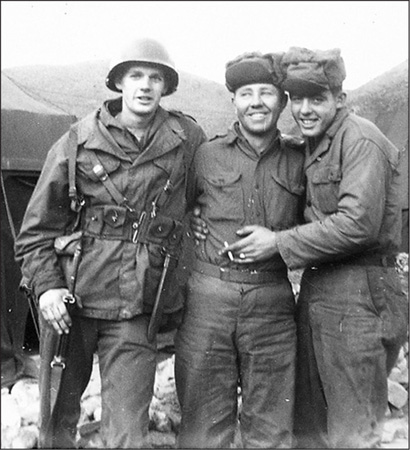
Left to right: The author, Dale Moss, and Ray Millsap on Koje-do Island, December, 1952.
These evening blasts usually provided a lot of fun and more than their share of practical jokes. One evening, a couple of the guys decided to shave one of our Puerto Rican friends, a machine gunner named Munoz, when he passed out from drinking. The shaving was not, however, complete since they only cut off half of his full mustache. When he awakened to discover that half of his pride and joy had been removed he became angry and went looking for the fellows that did the evil deed. Even though Munoz was slight in build he was a tough case and no one was willing to own up to the deed. Later in the war Munoz demonstrated just how tough he could be when the chips were down. However, this time he had to limit his expression of displeasure to verbal complaints against unnamed offenders.
REINFORCEMENTS ARE NOT ALWAYS WELCOME: AN OFFICER WITH WEIRD HABITS
We received a new replacement officer in the company while we were on Koje-do who was assigned as the platoon leader for the third platoon. He was quite a colorful figure though not very popular with the troops because of his picky, unrealistic orders and his ready selfishness. Moreover, the men could see through his phony bravado and were worried about his behavior and what he would be like when our company returned to the front lines. (Overly zealous or reckless officers were very unwelcome on the front.) On the surface, he cut a dashing figure among the officers. He sported two very beautiful and flashy pearl handled revolvers, which gave him somewhat the outward appearance of a younger General Patton. These weapons, as beautiful as they were, were not government issue but rather a gift from someone before he left the States. They were also not very functional in that revolvers are a bit too slow and finicky for effective combat service.
The lieutenant also seemed odd in the way he talked about going into combat, often with a strange look in his eyes. He also had a bad nighttime habit. Late at night, when most people were sleeping, he could be heard playing with his pistols, aiming and clicking them incessantly. He talked a lot about going up to the front and expressed a good bit of bravado about seeing action. He really gave us the willies, and soon became the butt of jokes among the enlisted men.
The lieutenant also placed a great deal of distance between himself and the other officers who appeared to view his actions with a great deal of suspicion. He really had no friends in the unit, a difficult situation to be in given the nature of war and the basic need for men to rely upon others in such times.
A JOURNEY TO A REMOTE VILLAGE
One of the ROK soldiers in our platoon, a pleasant and hard working soldier named Lee, was originally from Koje-do and still had family living on the island. He came to me during our first few days on the island and asked if he might receive a pass to visit his family who lived in the interior. Lieutenant Brandenberg had mentioned in an earlier meeting that it might be possible for some of the men who lived there to get a pass to go home. I arranged the pass with the CO having confidence that Lee would return on time. I was not disappointed; Lee came back in a good mood and was very grateful for his pass.
A few days later Lee came back and said that he would like to have another visit but this time he would like to take me with him to the village as well. I thought about it for a few days and raised the question with our new platoon leader, Lieutenant Feiner. He did not hesitate but agreed to give me a pass because I had been pulling a lot of extra details lately. He cautioned me to be sure and go armed because there had likely been a number of escapes in the past and I needed to take precautions in the event we encountered escaped POWs.
The next afternoon Lee and I started our long walk into the mountains of Koje-do. We carried packs filled with rations, cigarettes, candy, and other supplies from the PX for his family in the village. The trail into the hills was winding and long, through ravines with flowing streams, and up steep inclines that appeared to be less well traveled footpaths. The journey inland made me think of the images conjured up in Hilton’s novel The Lost Horizon, with scenes reminiscent of the mystical, remote, and beautiful Shangri-La.
Getting to the mountain village was no small task. I suppose this is what being remote means. I was enjoying the scenery en route even though we were now in the dead of winter. The air, even in the southern part of Korea, was cold and crisp. The countryside reminded me, in some respects, of my home state of West Virginia with its hills and valleys. We traveled mostly in silence, given Lee’s limited English and my total lack of Korean language skills.
Our trek through the mountains was interrupted with occasional thoughts about possible enemies hiding in brush or crevices in the rocks that we passed along the way. We did not, however, go out of our way to explore these potential hideouts or seek danger. Our goals and mission at the moment were to avoid those unpleasant elements and go inland to a peaceful island hideaway. Though long and tiring, the journey was uninterrupted by any trouble of human making. I could tell that we were near our destination when Lee’s pace quickened and his countenance changed to one of joy and anticipation. We were finally at Shangri-La.
Like the landscape I hiked, the village reminded me of West Virginia and the coal mining towns of my childhood. It was not really a town, but a collection of a few houses nestled into the hills. Most of the people living there were somehow related to each other, but I could not always understand the connection.
The houses were interesting in terms of their efficient construction. They were small homes with one or two rooms and a wooden floor over which a straw mat served as a carpet. For sleeping, blankets were then placed over the straw matting. Each house seemed as though it was built on top of a stone furnace. Actually, the houses were built so that a series of “ondols” or flues under the floor of the house, in the winter, could be fired up and the floor would become quite warm to the touch. I thought that this was an ingenious and highly efficient way to build and heat their homes.
Several friendly women and children came out of one of the houses into the yard to greet us. Lee’s wife, an attractive woman who was holding on to a young boy about four years old, warmly embraced him. They talked for a while, almost oblivious to the tall American standing somewhat awkwardly off to the side. An elderly man, who had been squatting by the side of the road, in a fashion that was common for people in Korea, came over to Lee and made a greeting. Lee appeared to be very subservient to him, not because he was a relative (which he was not) but because of his age. He had passed his sixtieth birthday, called hwangap, an especially important milestone because it completes a traditional zodiac cycle.
Even though none of the villagers spoke English, it was clear that they were happy to meet an American soldier. The villagers were grateful for the presence of the American forces in their country. Lee introduced me to his cousin, Myon-Hee, a widow of an ROK soldier killed only three months after their marriage. She sat next to me at the large family dinner and showed me how to use chopsticks. There were about a dozen of us sitting on the floor. We sat for what seemed like hours—until my back nearly collapsed from sitting in this uncomfortable position. American backs, I became convinced, were not well suited for Korean ceremonial dinners.
The meal consisted of several courses including soup, rice, and many spicy dishes made from meat and vegetables. I was wary of some of the foods served, and not just because of my limited West Virginia tastes. I could hear the warnings from the Army’s “while in Korea” lectures given during our layover in Japan. We were cautioned not to eat raw fruits and vegetables because they might contain germs. Even more troublesome were my memories of the smells from the “honeybuckets” carried by farmers on their A-frames—a most unpleasant reminder that Koreans use human excrement for fertilizer.
It was a balancing act—I didn’t want to offend my new friends, but I needed to protect my stomach. I decided that no germs could possibly live in kimchi, a pungent, spicy relish that was available throughout the meal and a favorite of everyone but this West Virginian. I tried to like this dish, but it was pretty harsh on a palate that had grown very accustomed to C-rations such as canned hamburgers and pork and beans.
I could not make out anything about their conversation during dinner. It was difficult for anyone to explain. We just smiled a lot and acknowledged our good feelings about the company. Although I was totally in the dark about the topics of the evening I enjoyed myself.
My stay in the village was a pleasant break from the war. What I liked most about the two days that I spent there was the friendliness of Lee’s family and friends. I regretted having to leave. This was the most peaceful time that I could remember in Korea.
CHRISTMAS ON KOJE-DO
It seems that everyone we knew in the States thought that GIs in Korea needed to have a fruitcake for the Christmas holidays. Someone in our group seemed to get one every day that mail came. We did our best to polish them off without complaint. One of the most favorite gifts that any of our guys received was the package that Grasshold occasionally received from home, which he always willingly shared with others though his judgment in this benevolent act could have been questioned. He always received several well-packed bottles of Maraschino cherries—not the usual sweet syrupy Maraschino cherries you can buy back home—but bottles in which the syrup had been poured out and replaced with good, tasty brandy. Now those were Maraschino cherries!
It seemed like the number of packages from home had quickened in pace toward the end of December, and we enjoyed them. Even I, with not much in the way of family back home, received a couple of packages at Christmas. My sister Joan had become adept at canning and tried her hand at canning a chicken. It turned out to be quite good, but the chocolate cake that she sent was an even bigger hit. It was a treat to get a cake that was not made of compressed fruit, as everything else seemed to be.
The guys in our squad tent were feeling very friendly at this point and the new men had blended well into our routine. We decided that we would try to bring some Christmas cheer to the platoon. We even put up something that looked like a Christmas tree and there were presents exchanged, mostly makeshift gag gifts.
The cuisine at this time of the year even took a sharp turn for the better. The Army usually did a pretty good job of handling holidays when guys are a long way from home, and Christmas on Koje-do in 1952 was no exception. We got a couple of days off from routine duty and on the Christmas Day, the Army provided a fantastic Christmas dinner, just as good as one could get back home. One of the officers, Lieutenant Barger, came by our tent after dinner and left a little present under our Christmas tree—a bottle of brandy. Billy Marshall and Ziggy, of course, provided music into the evening and a few Christmas carols were slaughtered. Most of us felt, by the end of the evening, that this was one of the most memorable Christmases that we had ever had.
JANUARY AND A RETURN TO THE FRONT
The return to the Korean mainland by troop transport was, as usual, long and boring, but at least highly profitable. It was shortly after payday, and this usually meant that everyone had some money to donate to poker and blackjack games. I had, by that time in my military career, become somewhat of an avid poker player and on this trip had some exceptional draws of the cards—such a streak of good luck comes rarely in life. The great god of poker decided that it was my turn. One of the guys in the card game kept drawing “second best type hands.” These are the worst kind of hands to get because they entice one into the challenge only to lose out after committing one’s fortune. After each frustrating hand of cards that he lost, he muttered, “You dun went and dun it again...Remember, you bastaads! Lucky in kaads, unlucky in war!”
My good fortune, at least in cards, stayed with me throughout my return to the war zone. When I got off the boat and train rides I had over $2,000 in my pocket, nine wrist watches on my arms, and two hand guns—one an Italian Beretta (a derringer sized weapon) and the other a long barrel .45 Colt revolver, what used to be called a “hawg leg” back in the old cowboy shows. This was a good way to begin the new year. I sent the money back home for Joan and the boys to use as they saw fit. Actually, their financial situation had begun to improve substantially by this time and she was working as a telephone operator. She began to save some of the money from the Army allotments that I was sending every month. The poker money was a nice holiday bonus.