
7
OUR RETURN TO THE WINTER-CHILLED FRONT LINES came at a time that our division was seemingly gearing up for greater aggressive activity along its section of the front—near a place called “Spud Hill,” a small potato-like knob adjacent to T-Bone Hill. T-Bone, named after its shape, became the object of a number of military adventures in January 1953. One of the most dramatic operations was known as Operation Smack—a somewhat ill-conceived adventure that received a great deal of media attention and brought substantial criticism for the military staff who engineered the attack against Chinese fortifications on the T-Bone. This military operation became more famous for its public criticism than for its success as a military mission—the newspapers apparently played it up back home as a “show” designed for the generals and news media.
The stated mission of Operation Smack included a number of simultaneous goals: The military objectives of the operation were ostensibly to create an aggressive military action against the Chinese, capture prisoners that might provide important military intelligence to determine what the Chinese plans were, and to better develop the air-ground coordination in a planned assault that would allow the military air wings, the Navy and Air Force, to have greater integration into the war effort. The military leaders also thought this operation might serve as a good bit of publicity if the news media could see an actual military action in operation.
Everything was well planned out in advance to maximize the benefits of the situation. The observers (news reporters and top brass) were housed in a nice safe bunker on the MLR that provided a good vantage point, what in the press was referred to as “heated box seats,” on a high hill that over looked the terrain on which the raid was to occur. The invited guests were also given a printed program (printed in three colors) with a timetable so that they would be able to follow the operation as the various events in the scenario unfolded.
The air arm of Operation Smack, happy to be involved in an unusual combined air-ground action in order to show its flexibility and effectiveness, flew a number of “softening-up” missions against the tiny piece of real estate. Initially, the air strikes against Spud Hill proceeded effectively and in a classic manner. First the Air Force conducted about sixteen night bombing missions with B-26 aircraft dropping 500-pound bombs followed by over 100 daylight sorties against the tiny hill with Thunderjet fighter-bombers. Just before the assault, U. S. Marine F-4 Corsairs attempted to lay smoke in a strategic location to help the ground forces avoid direct detection and subsequent fire. The smoke screen was ineffectively placed and did little good.
Then on January 25, 1953 at 1:00 P.M. in the afternoon, the next phase of the show began with a combined armor and infantry assault on the hill by elements of the 31st Infantry Regiment. Two platoons of infantry accompanied a tank attack across the open valley. The Chinese were apparently not occupying Spud Hill at the time or else were buried very deep in tunnels on the hill and stayed out of harm’s way.
The infantry and tanks came under intensive artillery fire and considerable heavy machine gun fire from strategically located Chinese positions on T-Bone Hill. The enemy fire against the attack force was quite effective at keeping the infantry force pinned down behind the tanks.
In terms of military value, Operation Smack was not successful. No prisoners were taken, no Chinese soldiers were confirmed killed, and the attack wound up getting three American infantrymen killed and sixty-one so severely wounded as to require evacuation. The stated accomplishments included the destruction of a tunnel on the hill that could have been used as a staging area by the Chinese troops. Nothing about this target was, however, ever confirmed.
There was considerable furor from Operation Smack, not from the Chinese army, but from the American press. Military leaders, particularly General Smith, the 7th Division Commander, were singled out and criticized for “staging” a show for the press. There were concerns that this operation was initiated simply in order to gain publicity and was launched without sufficient regard for the lives of the men involved. We do not know what the Chinese thought about the drama centered on Spud Hill. As we were to learn just two days later, however, the Chinese were well aware of our interest in the hill and planned accordingly.
A PATROL TO OBTAIN PRISONERS
Our Battalion Commander was interested in obtaining better information about the area around T-Bone and Spud Hill before our units returned to the sector of the MLR we were slated to occupy. Our company was ordered to provide a reconnaissance/ambush patrol to gain information about the Chinese forces on the day before our units were to return to the line. The Fox Company commander asked for volunteers for the patrol, and several members of our platoon volunteered to participate in the raid. The company officers did not tell us about the failed Spud Hill assault and we knew nothing of the fiasco until several days after we returned from our patrol to the same area and some of our guys received clippings from home about the controversy. We became curious about the timing of our patrol.
Our raid, as initially outlined, seemed simple to conceptualize but as we drew closer to actually implementing those plans it began to seem like a potential suicide mission. We were to crawl up to the Chinese positions on Spud Hill and either club a Chinese soldier over the head or use a concussion grenade to knock him out in order to bring him back to our lines for interrogation.
The plan seemed straightforward in the early planning stages. Our twenty-two-man patrol would, under the cover of darkness, make its way to the base of Spud Hill. At this point on the valley floor, we would set up a covering force to provide support for the raiding team that would actually go up the hill to try and kidnap an enemy soldier. Frank “Vito” Field, Del Kenway, and I volunteered to try to capture the Chinese soldier. We would then return, hopefully with a prisoner in tow (or probably strapped to a stretcher), and rejoin the covering force for the return back to the MLR, which was to follow a different route than we followed on the way out. Vito, Kenway, and I were eager to go on this mission and we never questioned the sanity of it at the time. We were, in part, motivated by the bounty for capturing a prisoner that our Battalion CO had posted which was to be a nice rest leave in Japan. We were confident we would be going on this leave as soon as our patrol returned!
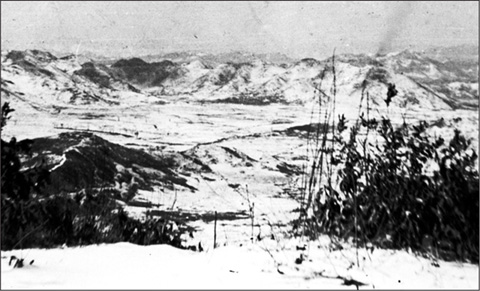
T-Bone Hill in winter, January 1953.
As planned, our patrol returned to the front one day prior to the time when the remainder of the company was scheduled to move into their position on the MLR. Our company was trucked to positions about twenty miles to the rear of the MLR to make preparations for the return. The remainder of the company had to march twenty miles up to the front. We viewed this as a slight consolation for the patrol—we were brought close up to the front by vehicle and did not have to make the long march.
FINAL PREPARATION AND RETURN TO THE FRONT
I went into the company command post to get a final briefing from our platoon leader and the company CO. Three other company officers, including the unpopular and odd lieutenant described in Chapter 6, attended the briefing. As we discussed the plans and the situations that could go array, the stated objective and the patrol’s planned action began to seem pretty crazy to me (and dangerous). There seemed to be a lot of “ifs” tied to this raid. But, I felt committed to carry out my orders. When the company commander asked if I had any other questions or requests, I simply replied that everything was clear and I took my leave.
As I left the tent I passed by the peculiar lieutenant with his flashy pearl handled pistols gleaming at his side. He called me over to where he was standing and stared intently into my eyes. I was quite surprised and amazed by his odd and frozen expression. He appeared tense, saying, inquisitively, “Sergeant, are you really going to take that patrol out in the valley like that?”
A bit taken aback by his question after such a briefing, I confidently asserted, “Yes, we’re on our way!”
He walked away muttering, “Oh my! Oh my!”
That was the last time that I saw him. He became agitated and upset shortly after our patrol left the area. I was later told that shortly after we left, he began to behave more and more bizarrely. When the rest of the company began to get their gear together to make the move back up to the front the lieutenant became extremely frightened and broke down under the pressure. He apparently became actively psychotic. He was crying and moaning and began, at one point, to fire his pistols in the air. Several people had to restrain him. Apparently he was experiencing delusional behavior and was hallucinating, that is, hearing voices. He was evacuated back to Japan for psychiatric treatment. A few years later, as a graduate student in psychology, I realized my observations of this lieutenant’s behaviors fit the symptoms of schizophrenic disorder.
We finished our briefing and lined up to get our evening meal before the rest of the company was to chow-down. Just as we were finishing our meal, we noticed two jeeps pull up into the company area about fifty yards from where we were loading up ammunition and equipment for the patrol. Several women, dressed in Army fatigues, got out of the jeeps, including a strikingly beautiful blonde.
They were USO entertainers touring Korea. Our company was treated to a private performance! We could hear laughing, cheers, and music coming from the other guys. My men and I were preoccupied with getting ready for the patrol, and did not pay much attention to the show. As we were getting on the trucks, one of the men from the USO asked me to hold up our departure. The young blonde actress wanted to say goodbye to us. She had asked what we were doing at the trucks and was told that we were going up to the front on a dangerous mission.
When the show ended, the young woman came over to us and asked who was in charge. Everyone pointed to me and she walked over and asked my name. I was already on edge about the mission, but even more nervous when she focused her attention on me. She stood very close, saying that she wanted to sing a farewell song for us. She sang the “Tennessee Waltz” very softly and I was transfixed. I was taken by her beauty and her voice—singing on a very cold evening just for us. One of the guys from our outfit, who was wounded later and evacuated to Japan, happened to see this actress in a hospital there. She approached him because she recognized the 7th Division patch on his uniform. She asked him what happened to the patrol. I never learned for certain the identity of this kind, thoughtful, and talented woman. I wish I knew who she was.
A NIGHT VISIT TO SPUD HILL
The evening was not totally dark. The moonlit sky reflecting on the snow provided enough visibility to see eight or nine yards away as we made our way through the shadowy world. By about 10:00 P.M. we had crossed the valley and reached the old rice paddy where we planned to set up the fire support base. After we set up the automatic weapon gun teams in place to provide covering fire for our withdrawal, Frank Field, Del Kenway, and I moved forward for the final leg of the raid—the crawl up the hill.
The T-Bone loomed ominously over us as we slowly crawled away from the support team up toward the little potato shaped knoll. We took a long time crawling on our stomachs toward the ugly piece of terrain above us. We crawled about five feet apart, with Field on my left and Kenway on my right, because we did not want to get separated and have to make noise in order to find each other again. We crawled slowly through the night.
After about a half an hour of forward movement, we passed near a large wood and brush pile a few yards from Kenway. As we reached the base of the hill and started up the slight incline, Kenway excitedly got my attention and crawled over to where I was inching my way along. He was very concerned about something. By the time he reached me, Vito had also detected a problem and had crawled over to hear what Del had seen. Del whispered, “I saw several Chinks moving behind us near that woodpile that we passed.”
The Chinese listening post had apparently waited until we had passed their positions and had moved troops in the vicinity of what was to be our withdrawal route. We decided that our situation was getting somewhat difficult and it might be us, rather than a Chinese soldier, who wound up being taken prisoner, so we decided to return to the firebase to further evaluate an impending attack by the Chinese.
Vito whispered, “I think we should return to the firebase and take ‘em on there!”
“I agree,” I said.
For a few minutes there was some jockeying around to return to our fire-base to prevent the Chinese troops from getting into a position to bring us under attack. It had taken us almost forty minutes to crawl to our most forward position; it took less than fifteen minutes for us to make it back to the firebase. A person can certainly walk faster than they can crawl! We met up with the rest of the patrol at about the time that the first burp gun rounds were fired into our circle. Our patrol was set up into a defensive circle perimeter and could make a good stand against a ground attack. It was difficult to determine where the first rounds came from.
Red Chinese flares exploded in the night sky over our heads illuminating the landscape like atmosphere red-tinged lighting in some nightclubs I had seen. At that moment, as we were getting the patrol alerted for an attack, the enemy machine gun emplacements on the T-Bone came alive and quickly got our range and began to fire in our direction. We dived for the ground just as the bullets poured also from the hill above us, “kzing, kzing, kzing!”
The telltale path of machine gun bullets kicked up the frozen earth along the rice paddy wall two feet in front of my head. Our automatic weapons opened up return fire against their positions.
At that instant, one of the men yelled, “I’m hit! I’m hit!”
It was Ray Millsap. A Chinese burp gun bullet from the enemy in the valley had ripped through one of his arms and he lay on the ground, wrenching with great pain. In a matter of seconds, Vito and the medic pulled him on the stretcher that we carried with us while the area was being sprayed with bullets from both the hill and the valley floor. Vito assured Ray that we were going to get him back up the hill safely. Ray was in great pain and losing a lot of blood. The medic, hands shaking, plunged a hypodermic needle with morphine into his arm to help with the pain as he applied a tourniquet to try and stop the flow of blood.
Burp gun fire was coming from an area south of the woodpile and our patrol began to answer them from our defensive circle. We radioed our intentions to return back to the CP and indicated that we would need a medic on our immediate return. The impromptu firefight died away as rapidly as it began, and as the night sky once again became dark as the Chinese flares died out briefly, we began to think about our return trip to the MLR. With Vito leading the way and Moss following the column to engage the Chinese as a rear guard, if needed, the patrol headed back through the cold night.
The trek across the valley floor was a nightmare. Millsap weighed over 225 pounds, but with him and his BAR clips in his vest, the stretcher seemed to weigh a ton; it was a long way back to the MLR. We took turns carrying the stretcher across the frozen earth back toward our lines. Shifts of stretcher-bearers became shorter and shorter as we became more fatigued from carrying the lead weight across the rough terrain.
After we had moved some distance south and away from the rice paddy, the harassing fire from the Chinese machine guns was focusing on our previous location away from our current path of return. Each time a Chinese flare burst in a crimson light across the night sky, we remained motionless to avoid giving away our present position. Fortunately, the Chinese flares had a more limited range and time in the air than American flares so they were not as effective at locating our movements.
We inched our way across the frozen earth, stopping periodically to rest and change stretcher-bearers. At one time when I was taking a turn at carrying, I became so exhausted that I fell to my knees, barely catching Ray and keeping him from rolling off the stretcher—a situation that occurred several times on our return journey. After he nearly fell off the stretcher at one point Millsap awakened and in a drowsy tone of voice asked, “Am I going to make it?” Someone whispered back, “Millsap, you lucky son of a bitch. You’ve got a million dollar wound! You’re going home!”
Ray said, “Damn. Damn.” And then fell back into an unconscious state.
The journey back became more grueling as we left the relatively flat valley floor and started up the slippery hill toward our own lines. All the while we had to remain alert to the possibility that the Chinese force was following or had managed to get ahead of us. We had no idea how much damage our own return fire against the flashes of their weapons had done to their main body—we hoped that we had struck as painful a chord for them as their firing had caused us with the wounding of Ray.
Although extremely exhausted, we considered ourselves fortunate to have made the return with only one casualty. We had managed to make a pretty good accounting of ourselves in the firefight and we had crossed a very wide expanse of the valley on slippery ground with a heavy cargo. We were thankful that Ray survived the tortuous journey back. He lost a lot of blood and was unconscious when we handed him over to the waiting medics on the MLR at the top of the hill. Ray was evacuated to Japan and then back to the United States for a considerable period of rehabilitation. The burp gun bullet had caused extensive damage to his arm. Ray died in 1978 of a coronary.
Unfortunately, dead Chinese on the valley floor would not bring a premium as far as the bounty was concerned. We had to go back without a prisoner—alas, no leave!
A COLD WINTER SET IN
After the raid to the base of T-Bone, we settled into our new positions on the MLR overlooking the ominous and unfriendly hill with the somewhat silly name in the distance. The section of the trench that we occupied already had established bunkers and firing positions. Our positions, however, needed extensive repair and reconstruction to accommodate our platoon’s preferred ways of operating.
It was bitter cold at the front at this time and it was painful to inhale the cold air into our lungs. We never knew what the exact temperature was—no one really wanted to know. Officially, I think the Army kept this information from the GIs to prevent further demoralization, as if knowing the truth would really make much more difference. It was miserable regardless of whether we knew the actual numbers on the Fahrenheit scale! The cold wind blowing through the trench reaffirmed my belief that the little Zippo hand warmer was the greatest invention of all time, at least when we had the opportunity to squirrel ourselves away in our sleeping bags for a rest and a respite from the cold wind for a couple of hours at a time.
In order to protect ourselves from the winter nights, we dressed with as many layers of clothing as possible. We started with those ridiculous, itchy Army “Long Johns” and two pair of fatigue pants and shirts. On top of that we might also wear our field jacket with a wool winter lining and a muffler. This basic outfit was then topped with our Army flak jacket or armored vest to protect against shrapnel. The final outer garment, our cold weather parka, would be put on last with a muffler and then a furry cap under the parka hood. On cold nights we would wear two pairs of gloves. Some guys would cut the trigger fingers off the gloves to make it possible to actually fire one’s weapon.
We were issued a very good winter boot that went by the name of “Mickey Mouse Boots” because of their resemblance to the Disney character’s shoes. These boots were both warm and water proof. When the GI wore two pairs of socks and the Mickey Mouse boots he could be assured of reasonable warmth—except, of course, if water some how got inside, say from crossing open water or deep snow. Then they might develop discomfort; the water inside the boot would not actually freeze but would warm up to body temperature.
With all of this clothing, we walked and looked like overstuffed sofas. All of this warm clothing only worked against the cold, winter Korean wind for a short period of time. On the coldest nights we shortened our outside guard shifts to allow more frequent warm-ups. This amount of clothing was too cumbersome to take out on patrol where one would have to walk several miles in deep snow, so the number of layers had to be reduced to allow the GI to move effectively. On several occasions, for patrols conducted under snow conditions, we were issued white “Outer parkas,” or white garments that camouflaged us in the snow and served to provide some break from the harsh wind.
It was, however, impossible under combat conditions to completely insulate ourselves from the winter conditions. One of the most serious dangers from the cold was the ever-present danger of frostbite. Many of us experienced this nemesis and had a great deal of discomfort from the pain of frozen skin for some time. On the front, we treated mild frostbite simply by warming up the affected body parts. We tolerated the red inflammations on our skin. When frostbite became severe enough that it was considered “limb endangering,” the GI would need to be evacuated to the rear area for treatment. Night patrols were particularly dangerous because we had to remain quite still, often for hours at a time, and the cold would soon make its presence known.
The cold weather was often problematic from the standpoint of any of our equipment that was made of metal; for example, the action of weapons was often sluggish in the cold air. However, one positive aspect of the winter climate (and there weren’t many that I can think of) that should be noted is that the snow, which was generously available at times, when packed around the barrels of machine guns was an excellent coolant if they had to be fired continuously.
AN EXPERIMENT GONE AWRY
The winter of 1952-1953 was severe and the weather itself became as threatening to the infantryman’s safety at times as was the Chinese gunfire. We often had visual images of the Chinese infantrymen sitting with their women in warm caves while we prowled the frozen valley below trying to harass them. Traversing the valley and icy slopes at night could be extremely difficult. One patrol that we took into the valley after a fresh snow found us sliding down the hillside plowing up the snow as we went. Once onto the valley floor we made a very tell tale track that the Chinese would likely to be able to follow, either with their trackers at night or, if we were still there in the daylight, their artillery observers could simply follow the nicely etched boot marks in the snow.
We were all shivering and wet from our frolic in the snow. Vito, serving as point man as usual, had crossed a partially frozen stream over which the ice gave way dropping him into the chilly water underneath. His wet frozen legs caused him to have an extreme shaking reaction that gave us all concern. It was necessary for us to cut short our patrol and get him back to the MLR to restore his circulation and prevent frostbite.
****
The Army, always trying to get more efficiency out of its troops with the latest in technology, developed a new set of underwear that was designed to solve the problem of the Korean winter. They provided us with snug, rubberized, air-tight underwear designed to keep the body warmth inside and cool air outside, thus keeping the GI nice and toasty while the rest of the world froze. This sounded like a wonderful invention so the Army, supposedly after perfecting this product in their laboratories, decided that it needed field testing under combat conditions—one of our patrols.
We were told that this undergarment would allow us to lie around the snow in just our fatigues, without a coat, even if our outer garment got soaking wet. This, of course, sounded just wonderful to us—like the best thing that we could imagine, not to be freezing while we were out on patrol. So we suited up with our new undergarments, without our heavy parkas, wearing only our fatigues and armored nylon vests for protection.
It was a bitter cold evening but all eighteen of us felt warm and secure in our new outfits. The men lined up in the trench and the NCO squad leaders made final equipment checks of each man’s gear and weapon. As it began to get dark, we loaded up our gear and headed down the narrow trail toward the passageway through the barbed wire and between the minefields to the valley floor below.
Before I had walked ten minutes down the line I began to feel very warm, then hot, then extremely tired. I was sweating as though it was summertime. As I marched along in the center of the formation and I began to see a few of the men fall to the ground, exhausted and sweating profusely. I looked to my rear and observed a similar situation. What was happening? Why were the men dropping like flies? We had not even passed through our own positions on this freezing cold night, and we had already lost half of the patrol. Concerned over the mystery, and with the now decreased manpower of the patrol, I passed up the word for the patrol to return to the trench. There was something desperately wrong. The CO, complaining about why the patrol was returning, came running up to me.
“What’s going on Sergeant? Why did you come back?”
I could hardly talk I was so weak. I said, “The men can’t go on for some reason. Everyone is dropping out and can’t go forward.”
We were absolutely exhausted and perspiring much as one might find after vigorous exercise on a hot, humid day. We were all experiencing an affliction that we usually only encountered in mid-summer—heat exhaustion! The CO was angry over the use of our troops as guinea pigs in a quartermaster experiment and told off someone back at Battalion over the comm line.
Those damned rubber suits were not able to “breathe” and were retaining all of the heat to the point that we were experiencing an electrolyte imbalance that, in the summer, we usually counter by swallowing salt tablets and a lot of water. In just a short distance we had lost most of the patrol to a failure in the Army’s research program. Needless to say we were absolutely disappointed about the rubber underwear. Apparently it had been designed for stationary action and not for any vigorous movement, but no one seemed to know that in advance. We sent the rubber suits back with some suggestions as to exactly where in their own posterior anatomy they might stick that junk!
THE PLATOON COMMAND POST
By January I had now moved up in responsibility, and was serving as the Assistant Platoon Sergeant. One of the most important duties of this job during the long cold winter nights, especially if we were in a relatively quiet sector, was to keep the platoon command post (usually a bunker that was large enough for four or five guys to sleep) as a warming hut with a charcoal stove going. We also tried to keep a pot of coffee brewing at all times during the night. Coffee was made according to the following trusted recipe: An ammo container, holding about a gallon of water, was filled about 2/3 and heated to boiling point; then coffee (a bunch) was dumped into the can and boiled until it became black; then the hot black liquid was dipped out as needed until there were only grounds left in the bottom of the can. When more coffee was needed, additional water would be added along with more grounds, all the while keeping the pot on the stove boiling. This pot would be kept going until it became too full of grounds to hold more water then it would be thrown out in front of our positions and a fresh ammo can started with boiling water. Coffee was plentiful, especially after the time that we relieved a platoon of Colombians (the Colombian Battalion was attached to the 7th Division) who moved out of positions that we took over leaving a bunker containing many tins of Colombian coffee. With coffee like we made in our platoon the wintry wind didn’t have a chance to demoralize us.
A RISKY FIELD TEST FOR VIGILANCE
On the front lines it was crucial to have buddies that one could rely upon to hold up their end of the work, particularly when it came to standing duty watch. In the sector of the MLR to which we were assigned in February 1953, it was possible to operate with a half-on/half-off guard situation at night enabling one person to sleep while the other watched the approaches to our positions. This allowed the troops to get a bit of rest and to get warm for a while. Being able to fall asleep immediately was important because the two-to-four hour nap before the next stint of guard duty would end abruptly and one would be up peering over the valley floor in the cold night air while comrades slept.
Trust in one’s companions was critical on the front. Falling asleep on post in a combat situation was a sufficient offense to warrant severe punishment such as a general court martial. But worse, this sort of sleep interruption, say a fragmentation grenade exploding next to one’s head, would certainly ruin one’s day. There had been a disturbing recent report about a tragic incident in one of the other regiments about an entire squad that had fallen asleep; sometime during the night they were visited by a Chinese raiding party that killed them all without anyone knowing what happened.
One of the men in our platoon, a fellow we called “Wally” because someone noted that he looked something like the cartoon character Wally the Walrus, had gotten the reputation of being somewhat of a laggard and we had some suspicions that he was not staying awake on his watches. I decided that I would run the supreme test on him one evening and informed his squad leader of my plan to test Wally’s vigilance. This sort of test is risky and was probably not one of the wisest decisions that I ever made as a sergeant! But, I left the command post and rather stealthily made my way to Wally’s foxhole. I crouched down very quietly in the shadows and observed his posture for a long time. He seemed to be almost like an inanimate object he was so still. I began to creep slowly up to his post, all the while listening for sound of movement from the foxhole. I was attending to the possibility that he might, as required, speak out the password, which in turn required a counter sign, or else he could, as sentry, begin firing at me. As it turned out I had nothing to fear from Wally’s weapon because I soon discovered he was sound asleep. I stood for a time watching him enjoying his pleasant dreams of home then I quietly placed the business end of my M-2 carbine against his cheek and yelled out very loudly, “BANG! AAAAGH!”
Wally shrieked and fell back into his foxhole whimpering. I instructed him to get out of the foxhole and proceeded to give him a “chewing out” that he would not soon forget. I had no intention of turning him over to the company commander for his action, only to scare him into realizing the importance of staying awake. I also informed his squad leader about the results of Wally’s failed test so that he could deal with the lack of vigilance at the squad level and arrange future watches in a way that we would not have to rely upon a weak link.
CLEANING UP AT THE FRONT
After a long period on the front line, troops get to smell pretty ripe. With no means of taking complete baths or changing clothes, personal hygiene became somewhat scarce or not at all. Some soldiers enjoy the front line atmosphere because it is away from the Army’s customary “spit and shine” and, under some conditions, one might become quite accustomed to smelling like a mountain goat for weeks at a time. Most of us usually found that our scheduled visits to the shower point (roughly every week or so) were welcome indeed.
The scheduled shower for line troops normally worked as follows. On arriving at the shower point, the company of men would dismount their vehicles and line up in customary Army style in front of the first of a series of squad tents that had been rigged with makeshift plumbing and water tanks to feed the showers in some of the tents. The water source was several fifty-five-gallon drums lined up along the side of two of the tents. Adjacent to the line of tents was a deep trench with sandbags around it for protection in the event of an artillery barrage or in the unlikely event of an air raid. The tents were arranged like an assembly line in a factory. Soldiers walked through the line of tents participating in the various stages of clean up as they went.
Approximately ten soldiers would enter the sequence of tents en masse after first removing their outerwear and piling it outside. The parkas, flak vests, and field jackets were keepers—they would be retrieved at the end of the process.
When the GIs entered tent # 1 (Disrobing Tent) they took off all of their dirty clothes and piled them in containers along the wall. These dirty clothes would be later cleaned and issued to a future batch of troops. The small bevy of naked soldiers next entered Tent # 2 (Soaping Tent) and stood under the showers (cold of course) and tried to get off the layers of accumulated dirt. Still soapy, and by now shivering, the GIs next walked over to tent # 3 (Rinsing Tent) where the GI soap could be removed, leaving a head-to-toe clean infantryman. After drying off, of course on a government issued brown towel, the next stop was tent # 4 (New Clothes Tent). Actually, the now clean GI would be given recycled clothing from bags of clean fatigue (work) uniforms that had been washed from soldiers who had gone through the same procedures a day or two before. This was truly a communal army! With luck, the clothes that were obtained from the Quartermaster bag would fit; if not, the various articles of clothing would simply be traded around until the recipients came close to having an acceptable outfit.
The shower program was not designed for comfort but efficiency; it was not designed to provide long relaxing baths but simply dirt dissolving experiences that left the soldier a little cleaner than before. Neither was stylish or nice fitting clothing a priority; but no one complained much about a visit to the shower point.
On this particular day in February 1953, the shower point provided some additional entertainment to fun-starved GIs just out of the trenches. About halfway through the soaping routine, I had soap all over my head and upper body and couldn’t see much, but I was startled by a terrible, piercing scream coming from one of the squad leaders at the end of the line of showers, “AACH, you dirty son of a bitch! What are you doing? Stop that!”
One of the Korean soldiers that was new to the company, trying to be helpful to his sergeant (who was busy soaping his head and face), had simply begun to lather up his leader’s genital area for him. The sergeant became so panicked over the extra hands covering his lower body parts that he half ran, half slid through the soapy water across the plank floor and into the next tent. His mad dash through the tent was accompanied by thunderous laughter from several bystanders who witnessed the event with curiosity. Perhaps the situation resulted from a clash of cultures; perhaps it resulted from different personality styles. Whatever the source of misunderstanding, the sergeant, unaccustomed to such assistance in washing his lower body parts, remained a bit miffed at the young Korean man who perhaps simply saw himself as trying to be helpful to his sergeant.
Our good clean fun came to an abrupt end a few minutes later. Just as my little group had finished donning our fresh outfits and stepped outdoors to make room for the next batch of lucky bathers to take their place in the system, we heard the all-too-familiar whistle of incoming artillery rounds. We dived unhaltingly into the safety of the trench near the shower tents as several incoming rounds began to explode about a hundred yards away and seemed to be walking their way toward the tent area. No sooner did we get into the safety of the trench than we were inundated with other bathers piling in on top of us from each of the respective tents; some soapy, some drenching wet, others in different stages of disrobement. In spite of the danger from the shelling, and in spite of the cold weather, there was an evident cascade of harassing shouts and laughter coming from the frozen trench.
OCCASIONAL SHORTAGE OF BASICS UP FRONT
There were occasional shortages at the front, and times in which we were told to conserve ammunition or not fire too many artillery rounds because the 8th Army was running low. In terms of the basics required for existence, at the front we usually had what we needed: clothing that was almost warm enough; rations that almost quelled our hunger pangs (though never fully satisfying the human longing for descent food); and water was usually available, though it sometimes had to be supplemented, for example by melting snow.
Water was occasionally available from natural sources. In one section of the line, for example, when the ice in a close-by mountain stream began to melt, we got plenty of cool and refreshing water that ran down the brook from the north by our rear area on the reverse slope of the hill. We drank freely from this stream (of course, with two of our government issued purification tablets) with a number of people commenting upon how fresh and good it tasted until someone discovered a problem with the creek—a deteriorating corpse was found lying in the stream about a mile up to the north or our positions. Suddenly, we lost our appetite for this cool mountain water. We waited for the KSC choggies (laborers) or our guys to get water cans up to the front.
At times we experienced unusual deficits. On one occasion one of the squad leaders and I were asked to go back to Battalion HQ for a de-briefing of a combat patrol that we had run the night before out into the valley. After we were finished with our description of the patrol’s action and the situation on the Chinese hill as we observed it, Major Noble from Battalion (a very well liked officer) asked us if there was anything he could do for us.
“Do you fellows need anything up there?” he said.
“A sock, sir,” I said, hesitatingly
He seemed puzzled. “A what? What are you saying?”
I said, even more hesitatingly, “A sock sir. I only have one sock to wear and my boot that is rubbing against my bare foot is very uncomfortable.” I explained further: “I try to change the sock each day from one foot to the other but I am experiencing some irritation from the boot. A sock for the other foot would help.”
Surprised at what I had revealed, Major Noble asked if I would have the Battalion Aid medics look at my feet to determine if I had any medical problems then, without saying another word, he went into his tent and brought back a clean pair of his own socks and handed them to me saying, “Sergeant, I am going to see to it that this sort of shortage does not happen again.”
Our supply situation improved significantly...for a while.
ARTILLERY FORWARD OBSERVER TRAINING
A novel experience happened in late February 1953. I was sent back to school for a week for a quick lesson in military science. I was one of five NCOs from our Battalion selected to receive a quick course in artillery observation. We were given a crash course into techniques designed to make us more effective in tracing incoming shells and in zeroing artillery barrages against enemy targets.
We learned, for example, how to perform a diagnostic evaluation of shell craters to determine the likely direction from which the round came. After an incoming shell blasted a crater, we were taught to go immediately (we also were told that we shouldn’t fear because lightening does not strike twice in the same place!) to the hole and make some measurements as to the shape and scatter of the hole and shrapnel, likely type of shell, and the likely azimuth of the shells track toward the earth. This information was not of much use to us on the line but the artillery officers in the Command Headquarters could put these soundings into an informative pattern by getting readings from different locations. They could triangulate and pinpoint the location of the artillery piece from whence the shells came. I found this interesting and it gave us something to think about other than simply hiding from the incoming shells.
More than this sedentary diagnostic assessment of shell craters I was, at the time, more interested in some of the aggressive operations and wanted to learn how we could use the information to direct artillery assaults against enemy positions and troop concentrations. We were also trained in methods used in forward artillery observation. This procedure was straightforward—using rudimentary geometry (which, thanks to Mr. Hill back at Stonewall Jackson High, I understood), direct observation, compass headings, and radio communication with the artillery fire control center we could adjust artillery and produce interesting, effective results. We learned how to make range estimates to targets using our binoculars and then obtain coordinates for establishing an initial target range.
After establishing our range, we called for firing an initial round to zero in or “prove out” our estimated reading and then adjusted the estimate depending upon how far away the first round landed from our estimated coordinates. We then adjusted our coordinate and called for fire to the revised target reading and again observed the results. Once the next adjustment was made we then called for the artillery control center to fire the mission, which was referred to as “fire for effect.”
This course provided some very helpful hints that we would find useful in coming engagements. In the ensuing months, we conducted several patrols for the purpose of firing artillery missions.
A GRUESOME FINDING
The section of the line we had recently moved into presented some interesting terrain problems. I did not like the placement of one of our .30 caliber machine guns because the field of fire was constricted and the gun team was somewhat vulnerable to an attack from behind a small knoll to their right. Reconnoitering the positions, I decided that the machine gun placement would likely be more effective and safer from attack if it were moved about thirty yards down the finger of the hill. We selected a new location which seemed ideal—it had an added benefit of having a large rock that could serve to offer some protection if the emplacement were dug in front and under the rock.
The machine gun crew began to excavate their new firing positions. Only a few inches down they uncovered a previous military emplacement and pulled out a broken M-1 rifle that had been buried there, probably for some months. They continued to dig around the area and then found a U.S. Army steel helmet containing the remnants of a skull, then other human remains, probably of at least two people. As they dug further, the stench from the hole became more unbearable and the ammo bearer who was digging at the time became nauseous, crawled a few feet away, and barfed noisily.
I suggested that the digging be stopped until we could get some body bags from the rear in which we could place the remains. We gave up on our new machine gun emplacement for the time being and waited for the Graves Registration unit to send up the bags. A couple of days later we received them and resumed the very unpleasant chore of retrieving the bodies. It looked as though the bunker containing the people had caved in after a shell had exploded on it. One of the two bodies we recovered was very clearly an American because of the steel helmet and the remnants of a dog tag; the other body was probably an American too, but the identification process was more difficult because of its condition. We threw everything we could find into the bags in hopes that Graves Registration would be able to make positive identifications.
In all probability the soldiers had been killed a year or so before when there had been extensive fighting in this vicinity. We found this operation very distasteful. At times the life of an infantryman in war is indeed terrible. This recovery process was the stuff nightmares are made of, but we were at least consoled by the fact that some families somewhere would have their anxious and frustrating wait for their missing soldier come to an end. It is probably better to know these truths, as horrible as they are, than to live with such painful uncertainty as accompanies the MIA designation. It’s frustrating for veterans like me and family members of the missing to know that almost 8,000 Americans are still unaccounted for.
LUCKY SEVEN AND THE BLINDING OF A MOUNTAIN MAN
We were back in reserve for a few days. The platoon was very thirsty and some of the guys sent out a scouting party to go to the KSC camp down the road to look for some bootleg whisky. They found no Seagrams Seven, the usual liquor available, but the camp bootlegger had six bottles of “Lucky Seven”—a Korean concoction made from distilled rice wine, not generally developed according to the highest bottling standards and probably somewhat short of the standards followed the 1930’s type gangster/bootlegger in theUnited States. The milky, grey product tasted somewhat like moonshine liquor that was familiar to some of the Southern guys (actually resembling a taste that I recalled from my tour in North Carolina) but with somewhat more of a metallic taste. Our troops were certainly warned not to drink this Korean liquor.
I knew right away that I did not like this taste because it made me want to throw-up. Instead of swallowing the potent brew when it was passed my way I simply held my tongue in the neck of the bottle and stopped the flow. This strategy kept me safe from the horrible taste yet made it appear to my buddies as though I was participating in the fun-fest. As the evening progressed several of the guys got pretty sick and trips to the latrine or the bush outside the tent were common.
The evening wore on and the merriment got loud and a bit chaotic with a few fellows dropping out of the action. One of the BAR men, a corporal named Ken, who was a mountain man type of guy from Wyoming, suddenly became sick. A large fellow—6’ 4” and muscular—he leapt up suddenly throwing his bulk against one of the main tent poles. He swayed awkwardly toward the tent flap seeking fresh air, falling en route over a bunk containing a half sleeping GI. He rolled on the floor groaning loudly in agony, “I’m blind! I can’t see!! Oh God!”
He flailed about yelling obscenities for a few moments until some of the group reached him to try to restrain him in order to prevent him from hurting himself or, given his strength, maiming others. As he rolled on the ground of the tent groaning, “Shit, I can’t see!” five of the squad members were able to hold him still for a bit until someone obtained a stretcher to try to remove him to Battalion Aid station to possibly receive some help.
As he was being lowered onto the stretcher, Ken swung his fists wildly, catching the canvas with great force and ripping a large hole near one of the handles. Ken was evacuated to a MASH unit. He never returned to our company and the only word we ever received about him was that he had not yet recovered his sight.
Nothing much was ever said about the incident, officially or otherwise. The next day the formation was silent, though many of the partakers of the merriment appeared to be at death’s door. The unit attempted to restore its equilibrium and shortly afterward we returned to action in the Yokkokchon Valley.
BOOZE UP FRONT: AN ACCIDENTAL GUN SHOT
One other alcohol related incident that bears reporting, one that could have ended tragically, occurred on evening on the MLR, a rather quiet section of the line. Moss located a small, half-pint flask of liquor which he brought up to our positions. He had bought it from the mess sergeant who was known for having such things as alcohol and various exotic weapons for sale from time to time.
This was not enough liquor for anyone to get drunk on but just enough for a few sociable after dinner cocktails. Moss, Vito, and I sat for a while having a few drinks as we chowed down on our favorite C-ration meals. After the bottle was emptied, Vito left to go back to his bunker to go to sleep. Moss and I talked for a while longer about his suggestion that we go out on a two-man patrol over to the T-Bone, capture ourselves “a nice fat Chink,” and win us a bounty to go to Japan. To the question of what weapons we might take with us on such a patrol Moss said,
“Just pistols!”
After a bit, Moss chided me by saying, “Show me your quick draw!”
Accommodating Moss’s request to show him how fast I might draw this weapon from its holster, I quickly reached for the pistol. As I jerked the long .45 caliber Colt from my shoulder holster it discharged prematurely (a bad habit the weapon had) surprising both of us and sending a bullet into a water canteen hanging above and slightly to the right of Moss’s head. After the bullet smashed into the canteen the water began to drip down his left shoulder and arm. Moss, without hesitation and in a soft and calm voice, said, “John, you missed!” (Because of all the unrealistic movie heroics they’d been exposed to, the guys in the platoon often used names like “John” or “John Wayne” to refer to someone who was acting gung ho.)
OBSERVATIONS ABOUT ARMY OFFICERS IN KOREA
Anyone spending time in the infantry, whether as an officer or as an enlisted soldier, becomes aware quickly that the unit runs effectively because of the NCOs—the non-commissioned officers. They are the backbone of the command structure. If the NCOs are ineffective so too will be the unit’s performance. In some respects, the lowest non commissioned officers, the corporals, are the true commanding force in the infantry. They are the ones with the most direct responsibilities for getting the job done.
The Army officers in Korea were a mixed lot. Not all of them were as oriented toward the troops’ wellbeing as were Major Noble, Captain Vaughn, Lt. Brandenberg, Captain King, and Lt. Barger. We always considered ourselves fortunate to have officers who were willing to take personal risks with the rest of us or were fair in what they asked us to do. I, on the other hand, encountered too many officers like “Whispering Smith,” who refused to come out of his foxhole even while we were under attack on Jane Russell Hill (Chapter 3) and the lieutenant with the flashy pearl-handled pistols who had the psychotic breakdown (described earlier in this chapter and Chapter 6).
Often our platoon officers were recent graduates of ROTC or Officer Candidate School who were called “Ninety-day wonders” and “shavetails.” Many were not career military, and had less experience at command than our least experienced corporals. They were placed in charge of men who knew a lot more about staying alive in combat and getting the job done. Adding to the problem, these officers tended to remain in an assignment for very brief periods—from a few weeks to no longer than three months—before being reassigned to the rear. Many never really stayed on the front lines long enough to get to know us or fully understand our operation. Not surprisingly, resentment towards the clearly inept officers was common.
An active rumor mill provided descriptions of hated lieutenants not making it back from an assault on a hill because of a vengeful grenade toss. However, these descriptions were always non-specific and I quickly saw them as tension-relievers, not based on actual events. There were many distasteful jokes about “hit lists” or as bounties on a given officer’s head. A guy might say, “Lt. Jones is an SOB and he had better not be in front of me in the next attack!” Someone else might respond, “That’d be worth $200.00 bucks to me! Do I hear more?” Typically, these jokes were reserved for officers that had acted recklessly and gotten people hurt. “Chickenshit officers” (our technical term for those who liked to hear the sound of their voices ordering us to do unnecessary, irrelevant, or demeaning tasks) were also the butt of these jokes. I never had any reason to suspect that these statements were other than jokes. I witnessed nothing to suggest that they were expressions of intent to do actual harm. In the next chapter, we take a closer look at combat patrols. In any stabilized trench warfare like Korea, patrols are essential.