
Chapter 2
Just then another Lancaster dropped a load of incendiaries, and where, a moment before, there had been a dark patch of the city, a dazzling silver pattern spread itself a rectangle of brilliant lights – hundreds, thousands of them – winking and gleaming and lighting the outlines of the city around them. As though this unloading had been the signal, score after score of fire bombs went down, and all over the dark face of the German capital these great incandescent flower-beds spread themselves. It was a fascinating sight. As I watched and tried to photograph the flares with a cine-camera, I saw the pin-points merging, and the white glare turning to a dull, ugly red as the fires of bricks and mortar and wood spread from the chemical flares.
Broadcaster Richard Dimbleby reporting on the raid on Berlin on 17/18 January 1943 for the BBC.
The sky was steel blue and everywhere below there was the restless crisscross pattern of long white beams. Sergeant Robert S. Raymond, one of a small number of ‘Yanks’ in Bomber Command and his crew, had never seen so many searchlights or so great a barrage, as over the Ruhr before. His second pilot, a new boy on 44 Squadron, who was there to get some experience, was on his first operational flight. The neophyte could not stop shaking but Raymond’s boys, having made a few trips by now, were ‘absolutely steady and normal under fire’. Raymond even found time to study the scene, which to him represented a ‘marvellously beautiful picture’ especially on such a night with a few scattered clouds and the moon in its second quarter.
On the night of 13/14 January, 66 Lancasters raided Essen. Two Oboe Mosquitoes had to return without marking and the sky markers of the third Mossie failed to ignite above the cloud, but the city was bathed in light. German aircraft even dropped decoy flares to try to distract the Lancaster crews. In the bomb bay Raymond’s crew carried a 4,000 pounder and more than 1,000 incendiaries. Down they went, the cookie adding to the great red mushroom explosions of the other 4,000-pounders and the fire bombs stoking up the long strings of incendiaries being laid out in geometrical patterns among the buildings. It was destruction on a colossal scale and terrifying in its concentration and intensity.
Four Lancasters failed to make it back to their bases. Usually Raymond’s Lancaster was among the last to return to Waddington because he and Griffiths, his flight engineer, believed in saving their engines. He was a miser with petrol, Raymond thought quite rightly, and the engineer’s most famous remark was in crossing the Alps when the pilot asked for more power to gain height. Griffiths opened the throttles about half an inch and said, ‘There, that’s all you can have’. His knowledge of the Merlin engines, due to long experience, was amazing for a young man of 19 years. One of the Lancaster’s engines overheated badly at more than half-throttle, so that it was not much help. Griffiths and his pilot talked over the possibilities and procedures in such cases by cutting other crew members off the intercom; otherwise they would have too much to think about. The air temperature was – 30°C and the North Sea was pretty cold at that time of year. But this was the shortest trip they had ever made, a fact, which would have been lost on the ‘new boy’ on the squadron who was still shaking after they landed back at Waddington. Interrogation after the trip was always a pleasant time for Raymond and the crew. It was carried out in the warm, brightly lighted Mess while they were eating. WAAFs moved about serving food. All of Raymond’s own officers were around and usually a number from the Air Ministry looked on. There was much laughter and many enquiries among the crews about incidents en route. There was much kidding if a pilot did not land promptly when it was his turn. The whole scene was a complete contrast to that of half an hour earlier when most of them were stacked on the circuit listening to the others and the WAAF in the control tower, ‘cursing like troopers if any stooge didn’t land on first try’.1
On 16/17 January Berlin was bombed for the first time in 14 months by 190 Lancasters and 11 Halifaxes.2 Air Marshal Sir Arthur Harris, C.-in-C. Bomber Command, sent them on their way with the words: ‘Tonight you are going to the Big City. You will have the opportunity to light a fire in the belly of the enemy that will burn his black heart out.’
This raid marked the first use of purpose-designed Target Indicators (TIs) instead of modified incendiaries, which had previously been used.3 Only one Lancaster was lost but the raid was a disappointment. Thick cloud en route and haze over the target caused problems and the bombing was scattered. The Berlin flak had proved light and ineffective and it was assumed that the greater altitude of the attacking force had surprised the German gunners. Harris repeated the raid on Berlin, sending 170 Lancasters and 17 Halifaxes back to the ‘Big City’ the following night, when the weather was better. Broadcaster Richard Dimbleby reported on the raid for the BBC, flying with Wing Commander Guy Gibson DSO DFC*, the CO of 106 Squadron at Syerston in a 9 hour 15 minute round trip. It was Gibson’s 67th op.4 Next morning British listeners tuning in to the BBC Home Service heard Dimbleby’s broadcast on their wireless sets:
‘The Berlin raid was a big show as heavy bomber operations go: it was also quite a long raid, and the Wing Commander who took me stayed over Berlin for half an hour The flak was hot but it has been hotter. For me it was a pretty hair-raising experience and I was glad when it was over, though I wouldn’t have missed it for the world. But we must all remember that these men do it as a regular routine job. The various crews who were flying last night from the bomber station where I’d been staying had flown on several of the Essen raids. That means that night after night they’ve been out over one of the hottest parts of Germany, returning to eat, drink and sleep before going out again. That’s their life, and I can promise you it’s hard, tiring and dangerous.
‘Four-engined Lancasters, Halifaxes and Stirlings roared out over the North Sea. We flew among them and, turning back from the cockpit to look into the gorgeous sunset, I counted 30 or 40 Lancasters seemingly suspended in the evening sky. They were there wherever you looked – in front, behind, above and below – each a separate monster, each separately navigated, but all bound by a coordinated plan of approach and attack. Up above the clouds, the dusk was short The orange and crimson of sunset died back there where the coast of England lay, and ahead of us the brilliant moon hung with the stars around her; below us, the thick clouds hid the sea. We were climbing steadily, and as it grew dark we put on our oxygen masks when the air grew too rarified for normal breathing.
‘As we approached the enemy coast I saw the German Ack-Ack. It was bursting away from us and much lower. I didn’t see any long streams of it soaring into the air, as the pictures suggest: it burst in little yellow, winking flashes, and you couldn’t hear it above the roar of the engines. Sometimes it closes in on you and the mid- or tail-gunner will call up calmly and report its position to the Captain so that he can dodge it. We dodged it last night, particularly over Berlin: literally jumped over it and nipped round with the Wing Commander sitting up in his seat as cool as a cucumber, pushing and pulling his great bomber about as though it were a toy.
‘We knew well enough when we were approaching Berlin. There was a complete ring of powerful searchlights waving and crossing, though it seemed to me that most of our bombers were over the city. Many of the lights were doused: there was also intense flak. First of all they didn’t seem to be aiming at us. It was bursting away to starboard and away to port in thick, yellow clusters and dark, smoky puffs. As we turned in for our first run across the city it closed right round us. For a moment it seemed impossible that we could miss it, and one burst lifted us in the air as though a giant hand had pushed up the belly of the machine but we flew on.
‘Just then another Lancaster dropped a load of incendiaries and where, a moment before, there had been a dark patch of the city, a dazzling silver pattern spread itself a rectangle of brilliant lights – hundreds, thousands of them – winking and gleaming and lighting the outlines of the city around them. As though this unloading had been the signal, score after score of firebombs went down, and all over the dark face of the German capital these great incandescent flower-beds spread themselves. It was a fascinating sight. As I watched and tried to photograph the flares with a cine-camera, I saw the pin-points merging, and the white glare turning to a dull, ugly red as the fires of bricks and mortar and wood spread from the chemical flares.
‘We flew over the city three times, for more than half an hour, while the guns sought us out and failed to hit us. At last our bomb-aimer sighted his objective below, and for one unpleasant minute we flew steady and straight Then he pressed the button and the biggest bomb of the evening, our 3½-tonner, fell away and down. I didn’t see it burst but I know what a giant bomb does and I couldn’t help wondering whether, anywhere in the area of the devastation, such a man as Hitler, Göring, Himmler or Goebbels might be cowering in a shelter. It was engrossing to realize that the Nazi leaders and their Ministries were only a few thousand feet from us, and that this shimmering mass of flares and bombs and gun-flashes was their stronghold.
‘We turned away from Berlin at last – it seemed we were there for an age – and we came home. We saw no night fighters, to our amazement, nor did any of the flak on the homeward journey come very near us. We came back across the North Sea, exchanged greetings of the day with a little coastwise convoy and came in to England again, nine hours after we had flown out. There were so many machines circling impatiently round our aerodrome that we had to wait up above for an hour and twenty minutes before we could land and it was two o’clock in the morning when the Wing Commander brought us dawn to the flare path and taxied us in.
‘We climbed stiffly out, Johnny from the tail turret, Brian who used to be a policeman from the mid-upper, Hutch, the radio operator, Junior the navigator – by far the youngest of us all. Then the Scots co-pilot, a quiet calm sergeant, and last the short sturdy Wingco who has flown in every major air raid of this war and been a night fighter pilot in between times. They were the crew – six brave, cool and exceedingly skilful men.5 Perhaps I am shooting a line for them but I think somebody ought to. They and their magnificent Lancasters and all the others like them are taking the war right into Germany. They have been attacking and giving their lives in attack since the first day of the war and their squadron went on that show too. Per ardua ad astra is the RAF motto. Perhaps I can translate it ‘Through hardship to the stars’. I understand the hardship now and I’m proud to have seen the stars with them.’6
In February attacks were made on German cities, on French seaports on the Atlantic coast and strikes were resumed against Italy. On 4/5 February Bomber Command returned in force to Turin. A total of 188 aircraft including 77 Lancasters made the trip while four Pathfinder Lancasters attacked the port of La Spezia with new ‘proximity fuzed’ 4,000lb bombs, which exploded between 200 and 600 feet above the ground to widen the effects of the blast. Three PFF Lancasters dropped their bombs successfully and all returned safely. At Turin the flak was reported to be ‘not up to the German standard’ and a Canadian pilot quipped that he ‘saw one night-fighter’ and that ‘he flew through the flak. I guess he knew Italian flak wouldn’t hurt him.’ Three Lancasters failed to return from the bombing of Turin, which caused serious and widespread damage. After a raid on Lorient on the 13/14th when seven aircraft were lost from the 466 dispatched, crews were ‘on’ again the next night to city targets. Some 243 bombers were sent to bomb Cologne once more and 142 Lancasters crossed the Alps again, this time to attack Milan. Their targets were 24 factories, three of them turning out war materials on the number one priority list. Fires could be seen from 100 miles away on the return flight. Only two Lancasters were lost on this raid. One Lancaster crew fought a memorable and gallant action. Sergeant Ivan Henry Hazard’s crew in 101 Squadron had bombed and were on the home run when a Fiat Cr.42CN Caccia Notturna (night fighter)7 made a diving attack on them. The Lancaster caught fire amidships almost immediately, one engine dead and two of the petrol-tanks were holed. Sergeant Leslie Airey the rear-gunner was wounded in the leg but he sat at his gun-button, waiting until the attacker was a bare 50 yards away, and then gave it a burst, which put its engine on fire. The mid-upper gunner, Flight Sergeant George P. Dove DFM who was from Redcar in Yorkshire, likewise remaining at his guns, waited while the flames lapped his turret and at the right moment gave the fighter another burst. This sent it whirling down out of control, flames from its engine spreading over fuselage and tail. Meanwhile the fire in the Lancaster was pronounced out of control and reluctantly Hazard gave the order to prepare to abandon the aircraft.8 However, the intercom system had been wrecked and the rear-gunner with his injured leg could not make a parachute descent so the captain decided to make a crash-landing. But before he could find a spot to land on Sergeant William E. Williams the navigator and Pilot Officer Frederick W. Gates the wireless operator, working like men possessed, got the flames under control. Dove, though burned badly about the face, hauled Airey out of his turret. Flight Sergeant Dove DFM recalled:
‘My window was burned and ammunition began to explode. The smoke was so thick that I could scarcely see the fighter when I got him in my sights. Only one gun was working properly. I scrambled down and picked the rear-gunner out of his turret. But owing to the fire and a hole blown in the bottom of the aircraft by the explosion, I couldn’t carry him forward to the bed, and I had to prop him up near his turret.’
Again Hazard revised his plan, determined to try to make his base on three engines. He got up to 15,000 feet, staggered over the Alps and, with his tanks practically drained dry,9 at length landed at Tangmere. Gates, of Cheam in Surrey, said later:
‘The pilot did a first-class job of work on that trip. He made three vital decisions in quick succession. After we were hit and set alight by the fighter the pilot put the aircraft into a spiral dive and pulled out about 800 feet from the ground. Bullets had hit incendiary bombs that were not released from our aircraft. We heard an explosion and in 15 seconds the fire was burning fiercely.’ 10
On the night of 16/17 February 327 bombers, 131 of them Lancasters, attacked Lorient again, mostly dropping incendiary loads in clear visibility for the loss of one Lancaster. The next main force raid was on 18/19 February when the target for 195 aircraft, 127 of them Lancasters, was Wilhelmshaven. Although the Pathfinders claimed to have marked accurately in clear visibility, most of the bombs fell in open country west of the target. Four Lancasters were lost. As the results were doubtful the bombers were detailed to return to Wilhelmshaven the following night. Crews never liked going to the same target two nights in a row. They always felt that the defences would be more alert and more practised the second time around. It seemed a good effort, though the resultant fires were subdued. The defences waited until they were sure that the target was marked before opening fire. The early Pathfinders had a relatively quiet reception but the second wave, carrying mostly incendiaries, was to start fires to illuminate targets for the 52 Lancasters following up with their 4,000lb ‘blockbuster’ bombs. Once they were sure that the target was identified, the German defences gave them all they had. German gunners were always more accurate and quicker at the beginning of a raid than later on. Crews bombed on Pathfinder Force (PFF) markers with a mixed bomb load. The PFF Force was the elite group in Bomber Command. It had the best crews and the latest and best equipment. Their mission was to mark the target with flares, either ground or air. Then the rest of the force bombed on those flares. This was to improve the bombing accuracy and it did. However, there were still many problems – most of them caused by the constant enemy, the weather. There was 8/10ths cloud and smoke over the target. Intense heavy and light flak was encountered.11 Despite the dreadful weather conditions, three experienced German night fighter crews had been given permission to take-off from Leeuwarden to try and intercept the returning Wilhelmshaven force. Oberleutnant Paul Gildner12 and Unteroffizier Heinz Huhn, his experienced radar operator, were one of them. Huhn recalled in his diary:
‘A thick layer of mist and bad ground visibility prevail. Enemy bombers are reported approaching Wilhelmshaven. We can’t take-off. Still, Gildner wants to get after the bombers, if necessary he will fly the Dornier. The bombers fly back through the boxes in our area. We decide to take-off all the same. There’s a full moon. The Dornier is not fitted with flame dampers, so from the engine exhausts long flames trail back. The radio and radar equipment of the aircraft is completely worn out. I switch off the Lichtenstein and we have to search without it. We immediately get a course to steer for a mission in box Tiger.13 The first Kurier is a Halifax [sic]. Suspecting no attack, its crew must feel quite safe. Gildner attacks, the Kurier starts to burn and at 2105 hours it crashes into the North Sea. Sieg Heil.
‘The reflector sight has broken down and only one cannon still fires. We are guided onto another aircraft. At 2110 hours we obtain visual contact; a Halifax [sic]. A giant pillar of smoke from our first kill rises from the water. An attack, the Kurier trails a long banner of smoke, it explodes and crashes into the sea. Time is 2116 hours. We are vectored onto another aircraft, this time we engage a Boeing [sic]. R/T connection is very bad, as a transmitter on the ground has broken down. I am dripping with sweat, have to switch all the time and tune the radio set. And my helmet fits miserably. Nevertheless, were still in business and remain in visual contact with the enemy bomber. We get into attacking position. Gildner opens fire; only three machine guns are still working. The aircraft is not burning yet. We charge in again and fire another burst, then have to turn away as a second Kurier is flying only 200 metres away from us. So, this one is getting away. We can only claim a damaged. Our own aircraft has been hit by return fire in the propellers. We immediately turn back for home and safely touch down. In the Operations Room we have a big party that same night with champagne and red wine. Jabs has shot down three bombers, all Short Stirlings. Our third probably didn’t make it back home either as it sent off a SOS. In the afternoon of the 20th our lightning visit to Leeuwarden comes to an end and we fly back to Gilze.’14
During the 1943 strategic night bombing offensive the life expectancy of a bomber crew was between eight and eleven operations, whereas each crew member had to complete 30 ‘trips’ before being sent on ‘rest’ at an Operational Training Unit. Flight Sergeant Maurice ‘Frank’ Hemming DFM, a flight engineer in 97 (PFF) Squadron flying Lancasters, recalls:
‘The most frightening ops were those to the Ruhr (Happy Valley to the crews), these targets being heavily defended. The real danger was on the bombing run in, when the pilot had to fly straight and level under the bomb-aimer’s guidance, for what seemed like forever. Our five trips to Berlin – “The Big City” to us – were no picnic due to night fighters. We certainly saw more of our bombers either shot down, or hit by flak and blown up than at other targets.’
February 1943 had been a month of hard operational flying for Bomber Command. Towards the end of the month round-the-clock bombing was inaugurated and the crews of Bomber Command, for their part of the schedule, had begun carrying a new 8,000lb cookie. This was the new era of cascade bombing and thunderbolt attacks. March 1943 came in with a roar, when, on the 1st, crews were briefed for Berlin. Just over 300 aircraft were dispatched and 17 bombers failed to return. The Pathfinders experienced difficulty in producing concentrated marking because individual parts of the extensive built up area of the ‘Big City’ could not be distinguished on the H2S screens. Though the attack was spread over 100 square miles, because larger numbers of aircraft were now being employed and because those aircraft were now carrying a greater average bomb load, the proportion of the force, which did hit Berlin caused more damage than any previous raid to this target.15
After a break of one night the bombers returned to the Reich on the night of 3/4 March with a raid on Hamburg by 417 aircraft, 149 of them Lancasters. The raid was led by 14 H2S equipped Pathfinders but six suffered radar failures including one PFF aircraft whose crew decided to ‘press on regardless’. But the radar operator still managed to pick out distinctive features such as the Alster Lake in the centre of the city and the point where the Elbe narrowed at Hamburg. However, the tide was out and revealed extensive mud-banks, which on H2S screens looked like a river narrowing several miles downstream of the city. It was not the Alster Lake that the H2S operator had seen; it was the Wedel Lake, 13 miles downstream. The marker flares went down over the small town of Wedel where most of the bombing was concentrated, although in Hamburg a proportion of the bombing force did hit the city and the fire brigade had to extinguish 100 fires. Later PR photos revealed that of the 344 crews who had confidently reported bombing Hamburg, only 17 had actually hit the city. To most Hamburgers it seemed that their city had largely escaped, for the time being at least. Prophetically, at a concert in a convent garden a blind woman singer leaning against a harpsichord sang, Die schwere Leidenszeit beginnt nun abermals – ‘The time of suffering now begins once more.’ That time was fast approaching.
On the night of 5/6 March it was Essen’s turn when 442 aircraft, 157 of them Lancasters and Oboe equipped Mosquitoes, began what has gone into history as the starting point of the Battle of the Ruhr. The cascade that night included no less than 150 4,000-pounders and two-thirds of the bombs carried were incendiaries. For most of the way out the route was cloudy but 15 miles from the target the weather cleared although pilots reported valley mists were still seeping in from the river. The eight Oboe Mosquitoes marked the centre of the city perfectly with red TIs and the Pathfinder ‘backers up’ arrived in good order and dropped their green TIs blind on the target. Only if there were no reds visible were the main force to bomb the ‘greens’. These were followed by the first cookies, which wailed down and then erupted with violence and flame and the raid was well under way. The valley mists and industrial haze did not affect the outcome of the raid, which was bombed in three waves with the Lancasters bombing last, the entire weight of the raid being concentrated into a volcanic 45 minutes. Fifty-six aircraft turned back early because of technical problems and other causes. Fourteen aircraft including four Lancasters were shot down and 38 other bombers returned with damage. Damage was modest but a week afterwards the Air Ministry announced that 450 acres of Essen had been designated a devastated area. Of the Krupps’ plant alone, 53 separate large workshops were affected by the bombing. Thirteen of the main buildings in the works were completely demolished or seriously damaged. Over 470 people were killed on the ground and over 3,000 houses were destroyed, while over 2,100 were seriously damaged. The havoc was caused by nearly 1,000 tons of high explosive dropped by crews without them needing to see the target. ‘Essen,’ said the special Air Ministry announcement on 12 March, ‘is now the second most blitzed town in Germany. Only in Cologne is there a greater area of devastation.’
When, on 9/10 March, 264 aircraft including 142 Lancasters set out for Munich the wind caused this raid to be concentrated on the western half of the city rather than in the centre but much damage was caused. Flight Sergeant Ken Brown RCAF’s crew in 44 Squadron at Waddington flew their first operation as a crew after their ‘settling-in period’. A few weeks earlier, on a clear, moonlit night in mid-February the 20 year old Canadian from Moose Jaw, Saskatchewan, and his English navigator Sergeant Dudley Heal, had flown a first operation over enemy territory, each with an experienced crew, to Wilhelmshaven. In 1939 Dudley Heal was an Assistant Preventive Officer in the Waterguard branch of HM Customs and Excise at Southampton Docks. As established civil servants he and his close friend and colleague, Les Twentyman – who had joined the service on the same day – 18 September 1936, were exempt from call up to the Armed Forces. Indeed, if they wanted to enlist they would have to obtain the permission of the Board of Customs first. When the Board announced in March 1940 that after a certain date in May no Customs staff aged 23 or over would be allowed to join the Armed Forces it made their minds up for them. They were both 23! Heal and Twentyman applied forthwith for permission to enlist in the RAF. But in the winter of 1940 – 41 their colleagues in the Waterguard were astonished to see them back at the dock gates once again, this time in RAF uniform with Special Police badges on their arms. Finally, after washing out of pilot training in Canada, Heal was sent to Pensacola in Florida in January 1942 and he came in the first six in the exams and was flown home in late May. At No. 3 Advanced Flying Unit, Bobbington, Shropshire, where eventually he was reunited with the rest of his course from Pensacola in the end of term exams, Heal came top with 93 per cent. His next move was to No. 19 Operational Training Unit, Kinloss where ‘crewing up’ with one or other of the pilots, bomb-aimers, wireless operators and gunners took place as he recalls:
‘Your name Heal?’ asked the pilot, a tall well-built chap.
‘Yes’, I said.
‘Then you’re going to be our navigator,’ he said.
I looked questioningly at him. ‘Who says so?’ I asked.
‘I’ve just been to the Navigation Office’, he said. ‘You were top of your course at AFU so we want you to be our navigator.’
‘I looked at the other two who were obviously in complete agreement with him. I liked the look of all of them and if I considered it at all my reaction would have been that here was someone who was interested in survival, which couldn’t be bad. I agreed to join them without further ado. Ken Brown was a Flight Sergeant and wore a crown over his three stripes while the rest of us were still sergeants. We shook hands; he introduced the bomb-aimer, Stefan “Steve” Oancia and the rear-gunner Grant MacDonald and off we went to the NAAFI for a cup of tea. We then acquired a wireless operator, “Hewie” Hewstone and from that time on, our being together as a crew was everything. Our next move, early in 1943, was to Wigsley in Lincolnshire where we converted firstly to the twin-engined Manchester and then the Lancaster. We acquired two new crew members, Basil Feneron, Flight Engineer and Donald Buntain, mid-upper gunner. Ken had difficulty accepting mine and Basil’s Christian names and ended by calling us “D” and “Buzz” respectively. One memory of Wigsley is of arriving back from a cross-country flight to find the airfield swathed in fog. Rather than try and land somewhere else Ken had Steve drop navigation flares on a dummy run, after which we were able to land on the airfield.’
Navigation presented no problems for Dudley Heal on the operation to Wilhelmshaven but it was ironic that he and his crew should find Waddington swathed in fog and be diverted to Leeming in Yorkshire after returning. The Munich raid was Sergeant Dudley Heal’s first opportunity to use Gee; ‘that marvellous navigational aid’, as he called it.
‘We floated calmly down over Southern England, the Channel and Northern France, checking our position at intervals with Gee. I worked out the change of course for Munich and shortly afterwards took another fix. To my horror we were well south of where we should be (if the fix was correct) and I told Ken so, working out a new course as I did so. This would be a long flight and we could not afford to waste petrol so I aimed directly for Munich, Eventually we began to see the same sort of picture ahead that I’d seen at Wilhelmshaven and I knew we were on the right track. We arrived over Munich 45 minutes after we should have done and had the “flak” and searchlights all to ourselves. There did not appear to be any fighters about. (They were our main worry of course on a moonlit night) and I have always assumed that they had returned to base after the main force had turned for home and it was not considered worthwhile to get them airborne again for one bomber.
‘For the return journey I chose the shortest possible route and we landed back at Waddington long after everybody else, having been airborne for eight hours and fifteen minutes. The following morning the Navigation Leader sent for me. Eyeing my chart from the previous night he said, “According to this you flew over every major city in the German Reich last night.” Restraining the temptation to say, “Yes, that was how it felt to us,” I told him what had happened and we tried to find some explanation for it. I dismissed the thought that I had given Ken the new course to turn on over Northern France and for some reason he hadn’t done so. It seemed just as unlikely to me that I had worked out the new course and had not passed it on to him. Anyway, the Nav Leader arranged to have the aircraft compasses swung, a process carried out on the ground whereby they could he checked for accuracy. No fault was found and the mystery remains to this day.’
At the 6./NJG4 base at St Dizier on the night of 11/12 March Feldwebel Gerhard Rase and his radar operator Unteroffizier Rolf Langhoff and the other German crews went out to their Bf 110 night fighters. Rase and Langhoff were still waiting to achieve their first night Abschuss. On the other hand, their Staffelkapitän, Oberleutnant Hans Autenrieth, was almost into double figures. NJG 4’s Bf 110 crews had been quite successful on the night of 9/10 March when they destroyed six Viermots over France. Three of them were Lancasters and Oberfeldwebel Reinhard Kollak destroyed two of these. Rase was no doubt anxious to emulate Kollak and his Staffelkapitän and the other high-scoring pilots in the Gruppe. There would be plenty of opportunities because over 300 Lancasters, Halifaxes and Stirlings were given Stuttgart as their target on 11/12 March. The main force would be led by a dozen PFF Lancasters, equipped with H2S and 16 ‘backers-up’ whose task was to maintain landmark illumination in passing, along the route, Châlons-sur-Marne-Bischmiller-Stuttgart-Baden-Baden, and return.
At Wyton, one of the ‘backers-up’ in 83 Squadron was Acting Squadron Leader Norman A. J. Mackie DFC, a very experienced pilot who had begun his first tour with 83 Squadron at Scampton in May 1941. He flew 23 ops on Hampdens before converting to the Manchester and he finally completed his tour of 200 hours in March 1942. After a ‘rest’ instructing at 29 OTU in November Mackie rejoined his squadron at Wyton, which had re-equipped with Lancasters and had become one of the original five PFF squadrons. F-Freddie had been allocated to his crew when it arrived new on the squadron in November 1942. They had made 13 out of their 19 trips on this Lancaster and they ‘loved it dearly’. However, F-Freddie was in for inspection on 11 March and since Squadron Leader John Hurry was on leave, Mackie was given his aircraft. Sergeant Ken Chipchase, aged 21, was the youngest of the crew and was the rear-gunner. At age 30, Flight Sergeant Alexander ‘Jock’ Lynch DFM, the mid-upper gunner, was the oldest member of the crew. Lynch had been awarded the DFM for downing two night fighters on his first tour with 144 Squadron. Flight Sergeant W. E. Barrett DFM was the bomb-aimer. Pre-war, he had visited Germany where he had acquired a Nazi dagger with the inscription Blut und Gott, which he always carried in his flying boot when going on ops. Flight Sergeant L. E. J. ‘Lew’ Humber the W/Op always wore a forbidding pair of black gloves, which he said, brought him luck. The navigator was Flight Lieutenant A. M. ‘Joe’ Ogilvie DFC. The flight engineer this night was Sergeant R. Henderson, a new pilot on the squadron who was going on the trip instead of the regular flight engineer, Flight Sergeant Geoff Seaton, ‘to get the feel of ops’. The CO, Wing Commander Gillman, conducted the briefing at Wyton at 14.30 hours. Zero hour was 22.45. The route appeared straightforward and the met forecast very reasonable and the crews were not at all unhappy with the target because, generally speaking, anything in southern Germany was preferable to the Ruhr, Hamburg or the ‘Big City’.
After main briefing crews had their usual general ‘crew chat’ before dispersing either to the sections for a further specialist briefing or back to the Mess to rest up before their ops’ meal of egg and bacon. Take-off was scheduled for about 20.00 hours and since Norman Mackie always liked to have plenty of time to dress and so on, he wandered down to ‘A’ Flight in good time. There followed the inevitable chat and wisecracks and then they were aboard the lorry for dispersal.
During the aircraft check Lew Humber discovered that his helmet headset was faulty and he had to make a mad dash to the engineer officer’s van and he scrambled aboard the aircraft just in time. The ladder was quickly stowed, door closed and Mackie taxied out, the very last Lancaster, as the rest of the squadron were now well on their climb away from base.
As they proceeded to the target they could see small bursts of flak in different areas and the occasional searchlight, but nothing was near enough to cause any concern. The target lay only 40 miles from Baden-Baden and the usual searchlights and flak peppering the bombers ahead could be seen. The heavy flak was inaccurate and slight to moderate in intensity, with some light flak hosing up periodically a little way below. The raid was not successful. The first use by the Germans of dummy target indicators was reported, though the Pathfinders claimed to have marked Stuttgart accurately, but the main force was late arriving and most of the bombing fell in open country. Only the south-western suburbs of Vaihingen and Kaltental were hit.
After bombing, Mackie’s crew set course for Baden-Baden where, with other PFF aircraft, they were to deposit their incendiaries to provide route-markers as a navigational aid to aircraft of the main force and so prevent them from straying over Karlsruhe or Strasbourg. Numerous searchlights were exposed at Karlsruhe and adjacent areas with some intermittent flak, which indicated that some aircraft had already wandered off track and were possibly being harried by night fighters. Norman Mackie could not help thinking it was rather cruel to set fire to an ineffectual little spa town like Baden-Baden but as Jock Lynch remarked: ‘They would at least have some bloody water to put the fires out!’
Leaving Baden-Baden behind they set course for Châlons-sur-Marne about 180 miles distant at just below 17,000 feet. The crew’s thoughts, as usual after leaving the target safely, were that another op was now thankfully under their belts. About eight minutes to run before reaching their turning point at Châlons-sur-Marne one of the Merlin engines was running a little rough with the revs tending to fluctuate from time to time. Suddenly, the Lancaster gave a violent shudder as cannon shells thudded into the starboard wing from below, shaving the canopy, as they whipped by in a reddish stream. The starboard engine burst into flames. Almost instinctively, before Jock Lynch yelled, ‘Fighter – fighter, corkscrew starboard – corkscrew starboard’ as he opened fire and the tracer ripped into the metal, Norman Mackie was diving to starboard but not quick enough to avoid being hit. Also, on seeing the starboard inner engine had caught fire he yelled at the flight engineer to take extinguishing action. At the same time Mackie realized that his dive to starboard was far too steep and, on trying to lift the wing up and roll into the corkscrew climb, the ailerons did not appear to be responding. Unfortunately, the flight engineer had mistakenly pulled back the starboard outer throttle and not the starboard inner as he should have done and was about to feather the good engine. Mackie knocked his hands away and powered the starboard outer engine to full boost and revs and quickly dealt with the starboard inner himself. All the cowlings had disappeared from the starboard inner engine, which was now enveloped in flames and belching smoke back in the slipstream across the wing. Although feathering had stopped the engine, the prop continued to slowly rotate and the controls felt very spongy. However, the wing had now started to come up and Mackie attempted to continue a corkscrew as best he could. He dived to about 11,000 feet and hoped that the change of altitude might lose the Bf 110, which was being flown by Gerhard Rase.
The Feldwebel, and Oberfeldwebel Kollak, began a second attack from the starboard quarter and Rase poured tracer into and around the Lancaster. Jock Lynch yelled ‘corkscrew-corkscrew; I see the bastard’ and the whole aircraft vibrated as he fired his guns. Mackie was now attempting to throw the Lancaster around using the throttles and flying controls as best he could, but the bomber continued to lose height, which he was powerless to arrest. Tongues of flame were licking around No. 1 tank, which still had a fair quantity of fuel and there was a horrible acrid smell wafting about in the aircraft. By the time the Lancaster was down to about 4,000 feet the whole aircraft started to vibrate badly and with the fire spreading along the starboard wing and licking around the cockpit Mackie ordered the crew to bale out. Before he left he knew that his altitude was about 2,500 feet and so he did not waste time before pulling the rip-cord.
Feldwebel Gerhard Rase and Unteroffizier Rolf Langhoff returned to St Dizier no doubt elated at gaining their first victory. The remains of the Lancaster they had shot down were damaged but recognizable and were sought out and photographed by Rase and his Staffelkapitän, Oberleutnant Hans Autenrieth, a few days later. None of the crew could be found at the site of the crash, so they assumed that they had baled out and subsequently escaped capture. Possibly, however, the dead crew members had been recovered and buried by the recovery team from the local Luftwaffe airfield sector. Operational units were never tasked with these duties as it was the policy to keep flying personnel away from the crash sites until any victims had been recovered and taken away, to spare the crews from the sight of the often gruesome scenes at these crash sites. In fact, Barrett and Humber had been taken prisoner. Lynch and Chipchase were killed and laid to rest in Sogny-en-l’Angle. Henderson and Ogilvie avoided being captured and they returned to the UK on 6 June 1943. Henderson was awarded the DFM on 23 July 1943. As captain of Lancaster JB424, he and his crew were killed in action during a Berlin raid exactly four months later.
Norman Mackie was captured by a Wehrmacht patrol on the second night after baling out and he was imprisoned alone in a room adjoining their control post with his flying boots removed. However, he forced a boarded-up window and escaped without raising the alarm. With the help of various French Resistance groups, he reached Switzerland in early April. At first he was imprisoned in the Prison de St. Antoine, Geneva but he was later released and classed as an internee. During the second half of 1943 he worked for the British Air Attaché before making a clandestine departure from Switzerland on 6 December 1943. He and his fellow escaper made it to Spain on 20 December. A short spell of imprisonment followed in Figueras but eventually Mackie was released and he reached England via Gibraltar on 17 January 1944. On return to the UK he briefly served as a Lancaster flying instructor at PFF NTU before he was appointed as Squadron Leader Flight Commander to form 571 Squadron in 8 Group on 23 April 1944. He went on to complete another 40 ops, being awarded the DSO before he was finally rested in December 1944.16
Meanwhile, on the night of 16/17 April Langhoff died in air combat over Châlons-sur-Marne. Rase survived the war with four Abschusse to his credit. On 11/12 March he and eight other crews in NJG4 claimed nine Viermots destroyed, plus two ‘probables’. In all, 11 Bomber Command aircraft failed to return from the Stuttgart raid and two more crashed on return in England.
Beginning on 27/28 March, Berlin was attacked for two nights in succession. The first raid by 396 aircraft was a failure. The Pathfinders marked two areas but they were short of their aiming points by five miles. Consequently, none of the bombs came within five miles of the target area in the centre of the city. Nine aircraft were lost. When, on the night of 29/30 March, 329 aircraft of Bomber Command raided Berlin again17 one of the aircraft was a 49 Squadron Lancaster18 piloted by 26 year old Flying Officer George F. Mabee RCAF. He and his crew were flying their first operation since joining ‘A’ Flight at Fiskerton on 10 March. They were shot down by Leutnant Hans Krause and his crew in I./NJG 3 at Wunstorf near Hanover. Krause recalled:
‘As on every night, a weather briefing took place in the crew room on 30 March at 18.00. According to the meteorologists, no operations could have taken place at all due to the miserable weather conditions; not because we could not have flown, as all-weather flyers we were able always to do that but because the enemy would not have been able to make out any target. The ceiling, as we were able to see for ourselves, was at about 500 metres, the tops at 7,000 metres and in between compact cloud. There was no enemy activity at first, only later were isolated targets reported over the North Sea and the Baltic, heading east. We knew that they would turn south at Stralsund or Greifswald and attack Berlin. Generally, bombs dropped through cloud always struck something but the air raid warning alone would disrupt traffic and production more than one would generally assume. Towards 02.00 the returning flights began, scattered over the entire area of northern Germany. One of these returning enemy bombers set course for Hanover to set off an air raid warning and thus came into our area. Cockpit readiness had already been ordered; then take-off was ordered. At around 02.35 our Bf 110 thundered along the runway and into the pitch-dark night. Because of the risk of getting in each other’s way in the clouds, the remaining aircraft stayed on the ground for possible operations later. I climbed in serpentines at two-three metres/second upward and it took an age before I came out of the clouds at 7,000 metres. But then we found the sky star-spangled and clear with a full moon making the cloud below appear like snow and visible afar. It felt like a bit of space opening up before our eyes.
‘With the airfield below us, we flew a little to the east. The visibility was so good as to seem like daylight. After climbing another 400 metres we were able to observe an area of several kilometres around us. And then we saw him, the enemy bomber. He crept along looking like a fat beetle crawling over a ground-glass screen illuminated from below. We watched him for a while from a safe distance above and to his left. It was an Avro Lancaster. He flew on a westerly course and only a few metres above the bright layer of cloud, into which he would certainly disappear at any sign of danger. Otto Zinn, my radio operator, transmitted all the data to ground control and then ordered radio silence. We intended to attack shortly. The rear-gunner had his quadruple machine guns pointing aft and so we could assume that we had not yet been made out by him. With the moon behind us, I then dived at him like a falcon on his prey and commenced firing at about 200 metres, aiming at the port wing which caught fire at once. He did not have a chance. He dived into the cloud and into the void below, leaving a ghostly reddish glow behind him. We followed but in an orderly descent of about five metres/second.
‘We were unable to observe the actual crash but certainly its bright glow, clearly visible even through the cloud, contrasting the dark of the night. We came out of the cloud at about 500 metres and were able to see the burning wreckage. The force of the impact had scattered burning pieces over several hundred metres. To our surprise the crash site was only about ten kilometres to the north-west of our airfield. We landed at 04.35 and drove to the crash site. The glow, visible from afar, gave us the direction. We were surprised to find so many people there already at such an early hour. Because of the still exploding ammunition and signal cartridges we parked the car at a safe distance in a country lane beside a flak colonel and his adjutant. Their conversation indicated that their flak battery stationed nearby would claim this Abschuss in order to paint another white ring on their gun barrels. But we had not seen a single burst of flak during our entire sortie. During our conversation the colonel thought he had the better argument. We left, certain that the decision would be made at a higher level.
‘While looking at the burning wreckage, we heard calls for help, faint at first but then louder, from the bushes 150 metres away. Otto and I looked at each other in amazement. Perhaps a local farmer had paid for his curiosity with a splinter from an exploding cartridge? Whatever, help was needed and so Otto and I went along a furrow towards the coppice. To our surprise we soon made out the rear fuselage of the Lancaster which had remained hidden in the dark. The fuselage had become entangled in the dense branches of the trees. Then we saw a member of the British crew lying on a soft bed of leaves and moss. He had gone clean through the fuselage and was in a pitiful state. His legs and arms must have been broken in several places as they were at strange angles to his body. His face and hands were covered in blood. A faint “help” again came from his lips and also a call for “water” but even the lightest touch caused him to cry out with pain. We were convinced that our British aviator comrade would soon breathe his last but we decided, in spite of his screams of pain, to release him. We pulled and pushed, seeking cover in the furrows, as far as the track through the field. He lost consciousness. Without the terrible screams of pain, the rescue operation became easier. Further helping hands were able to lay him on an available farm cart, then, out of the blue, our ambulance appeared and we knew that our patient was in good hands with the local military medical officer Dr Wesendorf.
‘I sent the usual operations report to the Gruppe at Vechta for further transmission to the commanding officer. Dawn was breaking before I was able to retire for a well-earned rest. It was almost midday when the telephone rang. Our medical officer asked me to go to see him at the sick-quarters. Expecting the worst, he led me to the sickroom. But I was pleasurably surprised to find a man [the Lancaster rear-gunner, Sergeant G. A. Jones] very much alive in the bed. Having been briefed by the medical officer, he knew who I was and we shook hands with a smile as is proper amongst flying comrades. The doctor had cleaned the patient’s body of blood and abrasions, then set the broken limbs and put them in splints. A bullet had been removed from his buttocks which, in a macabre sort of way confirmed the Abschuss through night fighter and not flak. He was taken to hospital the following day where the doctor expected him to have a good chance of recovery. Having exchanged home addresses, we parted with best wishes for the future. Unfortunately the address got lost in the turmoil of the war. He was the wireless operator, came from the Midlands and was 21 years old.’19
Altogether, 11 Lancasters failed to return from the Berlin raid. At Wickenby anxious eyes scanned the horizon for the return of Sergeant F. W. Pinkerton’s 12 Squadron Lancaster. Pinkerton arrived over the target five minutes ahead of time before the flares had gone down. A Master held the Lancaster searchlight, which suddenly exposed the aircraft. Then a very large cone, estimated to be about 40 searchlights, picked it up. The aircraft at this time was at 19,000 feet. Flak began coming up about one minute after the aircraft had been coned and Pinkerton believed that they were hit, probably in the wings. He then jettisoned his bombs, lost height in his attempt to get out of the searchlights and finally escaped from them at about 3,000 feet. The four engines were running well and there was no damage evident in the aircraft, but the Lancaster would not climb above 15,000ft. Pinkerton found he could not get the rear-gunner on the intercom and sent the W/Op Sergeant F. Morton to investigate. After a quarter of an hour Morton returned saying that the rear-gunner’s microphone was u/s. The flight engineer gave the W/Op his helmet to take to the rear-gunner. After another quarter of an hour the flight engineer complained of lack of oxygen (they were at 15,000 feet) and about 10 minutes later became unconscious. They now ran into more searchlights and flak, possibly at Bremen. Pinkerton altered course to 191 degrees in order to escape from this defended area. He also lost height to 3,000 feet to try and get the flight engineer round. The navigator and mid-upper gunner went back to look for Morton and found him dead with a broken neck near the step. Forty minutes after leaving the area, believed to be Bremen, Pinkerton discovered he was still on course 191 degrees and at once changed course to due west. After a while both starboard engines cut due to lack of petrol, but the navigator turned on other tanks and they started up. About two hours after leaving Berlin the starboard inner engine failed, not due to lack of petrol, and the propeller was feathered. The flight engineer now calculated that they had petrol for one hour’s flying. After a time they crossed a flak belt, which they believed to be at the Dutch coast. The flight engineer now calculated that they had only 20 gallons left and just afterwards the starboard outer engine cut for lack of petrol. They were still at 3,000 feet. Pinkerton gave the order to bale out and he landed three kilometres from Rotterdam. He managed to evade capture and later returned to England. Four of the crew survived to be taken prisoner but Sergeant G. C. W. Warren’s parachute failed to deploy and he was killed. When they baled out they had been flying for seven to eight hours. Pinkerton believed that he should have had petrol for about ten hours and he thought that the flak hit over Berlin must have caused him to lose some petrol.
A few nights later, on 2/3 April, another Dominion pilot, Warrant Officer Warren L. ‘Pluto’ Wilson, an Australian from New South Wales, and his crew in 467 Squadron RAAF at RAF Bottesford, flew their first operation when the targets this night were the strongly defended U-boat pens at St Nazaire and Lorient. His flight engineer was 18 year old Sergeant Charles A. Cawthorne, who had joined the RAF as a boy apprentice before volunteering for aircrew duties. Cawthorne recalls:20
‘The Station Commander was a very experienced bomber pilot, Wing Commander Cosme L. Gomm DFC and the Squadron Commander was Squadron Leader David A. Green. Both men were keen to show the rest of 5 Group what an Aussie squadron could do and to this end were keen to build one of the highest totals of operational sorties within the Group.21 The Squadron flew their first operational Gardening (minelaying) sorties on 2/3 January. These were quickly followed by an Oboe trial bombing operation against Essen in the Ruhr Valley. As we approached the target at St Nazaire, Harry Crumplin the navigator was persuaded to come forward into the cockpit to see the target area ahead all lit up with searchlights, TIs and the irregular flashes from exploding bombs and flak. He took one look, muttered, “Bloody Hell” and quickly disappeared behind the black curtain around his crew position. In complete contrast to this experience, less than 24 hours after facing the flak of St Nazaire, I accompanied our wireless operator, David Booth, to his wedding in Manchester. Our tour of operations progressed very satisfactorily and we soon found ourselves involved in what was referred to in the newspapers as The Battle of the Ruhr. Despite Bomber Command sustaining heavy casualties during this period, our crew remained relatively unscathed but nevertheless we were alarmed to find that every time we went on leave, another crew become a squadron casualty whilst using our aircraft.’
Essen, the home of Krupps, was bombed by 317 aircraft on 3/4 April and over 600 buildings were destroyed. Fourteen Halifaxes and nine Lancasters failed to return,22 a ‘chop rate’ of 6 per cent. The next night, 4/5 April, the largest number of aircraft operated so far, 577, went to Kiel. It was a cloudy Sunday night with sky marking to bomb on; not much flak and no sign of fighters but the results were disappointing. Marking was difficult due to the cloud and strong winds and little damage was done to the major port and naval base. Twelve aircraft – just 2 per cent – were lost. After Essen one bomber pilot noticed that ‘everybody said’ that it was a ‘piece of cake’. Nineteen bombers were lost on the Duisburg raid of 8/9 April from a force of 392 aircraft. The following night another eight Lancasters failed to return from a force of 104 Lancasters and five Mosquitoes that went to Duisburg.23 Leutnant Oskar Köstler24 and Unteroffizier Heinz Huhn were ordered off from Bergen in a Bf 110G-4 25 for a patrol in Himmelbett box ‘Herring’. Huhn recorded his experiences in his diary:
‘Almost cloudless, moon, take-off at 21.50. To begin with flying on radio beacon. After an hour at last contact with Lichtenstein at 2.2 kilometres. Köstler: “I have him at 200 metres distance”. Sitting below him. Halifax or Lancaster at forty metres. I have to call out the speed. At last! Attack! The cannons start firing. Suddenly a blow from ahead, bright as day, boiling hot. What was that? Have we been hit? No, Tommy’s exploding. Splinters rain onto our machine. We are burning. In front of me flames, a bright flood. We are going down. Heat is beating into my face. Leutnant Köstler is silent. I reach for the cockpit roof jettison lever. Helmet is singed, have to close eyes. At last the handle! Roof flies away. I rise up and shove myself off. Get away. Machine going down, burning. I somersault, cannot find the rip-cord. At last, a jerk, I float. Around me burning parts. I find that I am over water. Unlock parachute safety catch. I believe to be carried further out to sea, so I pull the parachute lines. Parachute collapses, falls. Icy cold, hands freezing. I notice that I’m drifting towards land. How high might I be? Attack was at 5,500 metres, jumped at 5,000? I reach for the signal pistol but it is not secured and my hands are almost rigidly stiff.
‘Am over land . . . pain, hang uncomfortably in the ’chute. Hands are stiff and without feeling. I had lost my boots during the jump. Bright patch below me. A lake? Would I drown in a puddle after all this? But I’m still very high. Swinging violently. At last the earth is coming up towards me. Woods, trees. Splintering, I am hanging between two trees. Helpless. No strength left and my hands frozen stiff. Parachute straps cutting into my flesh. Must wait until my hands have warmed. Pain. At last feeling returns to my fingers. I swing myself towards a tree trunk, am about four-five metres above ground. I grip the trunk. Release straps! Won’t work. Lock frozen? With a final effort I clamber a little higher. Fortunately there is a branch which gives support, otherwise no strength left and fall down. Not to break my neck now, after all this! A little higher. Straps loosening at last. Chest straps are free but leg straps still pulling me upwards. A little higher still. At last the leg straps are released too. Climb, slide, fall down the trunk. Moss at the bottom. Dinghy off. I feel faint. Struggle up. Limbs unharmed. Signal pistol and torch still there. Have three red cartridges left. Must not use them senselessly.
‘Start walking through the forest. Fall down again, get up, stumble, lose signal pistol, search for it and find it again. Move on. Feet cold, socks wet through the damp ground. Face burning, skin singed. Find a track, then past a meadow, finally a good road. Tread on sharp metal fragments of the Tommy lying around on the road everywhere. March on, pass a lone building. Fire one red. See no telephone wire in the bright light, so carry on. After an hour a railway crossing. Change direction and follow the rails. Painful for the feet due to sharp stones. Half an hour’s laborious tramping along the rails. No signal cabin. Suddenly a noise behind me: a train. Load the last red cartridge. A shot in front of the engine. Brakes squeal. Train stops. Flash SOS. Freight train. Have to identify myself, get aboard. Face burning, eyebrows crusted over. Try to phone from next station. No connection. Continue on train to Harderwijk. Get out there. At the unit there I hear: Leutnant Köstler dead. Call Bergen: they think I’m a ghost as I had been reported dead. Karl Vinke had shot down three this night. Then into sick quarters. Eat, ointment on the forehead, sleep. In the morning I was taken to the crash site. Had spoken during the night with Hauptmann Ruppel and made my report. At crash site. Bits from the Tommy strewn around for miles. Pieces of bodies everywhere. At the crash site of our machine also bits everywhere. Must have exploded in the air. Leutnant Köstler with open parachute dead beside the wreckage. The body whole, only the bloody head is put into the coffin. Then a car arrives from Leeuwarden to fetch the coffin. I go with it.’26
Sergeant Charlie ‘Jock’ Baird, a 19 year old Scot from Edinburgh, mid-upper gunner in 20 year old Warrant Officer Den Rudge’s crew in 103 Squadron at Elsham Wolds, Lincolnshire, began his tour on 10/11 April.27 He recalls: ‘Being an all NCO crew bonded us all the more as we slept, ate, imbibed and flew together. Our pilot, an English lad, turned out to be a top grade pilot. Our second trip, to La Spezia in northern Italy on 13/14 April, lasted 9 hours 45 minutes.’ Altogether, 208 Lancasters and three Halifaxes flew the 700 miles to the port and bombed the San Vito Arsenal, the shipyards and the submarine base area, causing heavy damage. Flying Officer V. A. Wilson, the captain of the last Lancaster to leave the port, saw the dockyards burning furiously: ‘I could see below me the interiors of the buildings looking quite black but with the walls white-hot. And there were wide areas as red as the inside of a furnace.’ There was not much flak and the searchlights, in the words of one pilot, ‘waved hopelessly, like grass in the wind’. ‘In fact,’ Wilson continues, ‘the only dangerous moment we had was when we were over the Alps. I was looking at the white caps of the mountains and the dark valleys when suddenly everything seemed to blur. I looked at my instrument panel and I could see only a luminous haze. I realized that I was passing out and made a quick check of the oxygen supply. Somehow or other we had developed a bad leak and there was no oxygen left. Clouds then came between the ground and us. I asked the navigator if it was safe to go lower. In a rather weak voice he said he didn’t think it was. But by that time there was nothing else to do, as I knew I should become unconscious at any moment, so I put the nose down and hoped for the best. We lost 5,000 feet and then found we were just clear of the mountains and over France. We began to feel less ‘muggy’ and came home the rest of the way in good spirits.’ Four Lancasters were lost and three more, which were either damaged or in mechanical difficulties, flew on to land at Allied airfields in North Africa.28
Den Rudge’s crew in 103 Squadron started their third trip on 16/17 April and it had his crew wondering about their choice of going into action as ‘Jock’ Baird recalls:
‘This trip was to the Skoda arms works at Pilsen in Czechoslovakia and we were warned to be extra careful passing Saarbrücken. We were well and truly coned by about 25 searchlights and we took a bit of a hammering before eluding them. On arrival at Pilsen a blue master searchlight caught us and was soon joined by many more. We copped an awful beating and the port outer petrol tank was holed in the process. I reported it as smoke but it was petrol. I alerted the skipper and our engineer did a quick transfer of fuel. This all happened rather quickly but it made my hair stand on end. We finally broke clear and headed for home where we found 74 small holes and one shell had gone clean through the wing, fracturing the port outer petrol tank. We were more than fortunate several times during this trip but it went a long way to cementing us together as a crew. W4845 never flew on ops again having been badly damaged this night. It was a 9 hour 50 minute trip and 54 aircraft were lost29
‘Our tour of ops carried on through the battle of the Ruhr and we did 20 ops to that hotbed. Most evenings we were routed out over or between the Friesian Islands, Texel, Terschelling etc. and then into the German fighter belt. We had about eight encounters with fighters but I had keen eyesight and always picked them up quickly and we evaded them. My skipper was very much alert and he never lost even a split second when I gave him instructions on evasive action; a great guy. We were a very alert crew and spoke only when absolutely necessary. No idle chatting and our turrets kept moving from take-off to landing. This was a great comfort to our skipper. We finished our tour on 23/24 August to Berlin, when 58 aircraft went missing. Sadly we all had to part and go as instructors. Our skipper was awarded the DFC and navigator the DFM. Well earned; they were two fine men.’
On 20/21 April 339 aircraft, including 194 Lancasters, visited Stettin, an 8½ hour round trip over 600 miles from England and well outside the range of Oboe. It turned out as probably the most successful raid during the Battle of the Ruhr though Bomber Command still lost between 6 – 7 per cent,30 which many old sweats saw as ‘the going rate for the job’. No more main force operations were flown until the night of 26/27 April when the target was Duisburg again and 561 aircraft, including 215 Lancasters, 135 Wellingtons and 119 Halifaxes, were dispatched. Seventeen aircraft were lost, 10 of them to night fighters over the Netherlands. More than 30 tons of bombs a minute for a space of three-quarters of an hour rained down on the important inland port, the largest in Europe, which handled about 75 per cent of all the cargo passing along the Rhine. For two nights following, large numbers of aircraft carried out minelaying off the Biscay and Brittany ports and in the Friesian Islands and off Heligoland. The second of these Gardening operations, during which 593 mines were laid, cost 22 aircraft with 155 of their crews missing. It was the highest loss of the war on minelaying, an unprecedented loss rate of 10 per cent for what supposedly were ‘easy’ operations. Low cloud over the German and Danish coast forced the minelayers to fly low in order to establish their positions before laying their mines and the losses resulted from light German flak. Minelayers were given a really hot time while they were within range of coastal batteries and night fighters too had special instructions to go in and engage them.
A Lancaster minelayer was just leaving the Danish coast when a night fighter swept in to attack from astern. The German’s fire was accurate and raked the bomber from nose to tail. The rear and mid-upper gunners were both wounded. Getting the shot-up Lanc back to Britain over 300 miles of open sea was no mean feat. Those of the crew who were able to work were struggling hard every minute of the way against the aircraft’s tendency to slide down into the water. ‘We heard the rear-gunner cry out,’ the pilot related after landing, ‘and the wireless operator went to see what had happened. On the way he found that the mid-upper gunner had been wounded and was lying on the floor of the aircraft. His seat had been shot away from under him. When the wireless operator got to the rear-turret he found that the doors were jammed and he had to break them down with an axe. Then with the help of the bomb-aimer he pulled the gunner out of the turret. They wrapped the two gunners in blankets and gave them orange juice and some morphia. Meanwhile, I was trying to get the aircraft under control. When the fighter hit us the Lancaster went into a flat spin. The port aileron had been shot away and we dived down nearly 9,000 feet before I could get the Lancaster under control. The flight engineer then came to my help and by heaving on the control column together we managed to right the aircraft. It was pretty exhausting work and we took it in turns to hang on to it. The flight engineer had to keep a check on the petrol-gauges, as two of the tanks had been holed and he was afraid that we might be running short of petrol. We found that we also had to keep the starboard rudder pushed hard forward. It was too much of a strain for me to hold it, so the bomb-aimer pushed it forward with a bar against a support and held it there.’ It seemed a veritable miracle that the pilot, flying thousands of feet above the North Sea at night in an aircraft with its radio aerial shot away, its tail-wheel punctured, both turrets riddled like sieves, two fuel-tanks holed, fuselage shot up and port aileron missing, should have got home. But he did.
Bomber Command crews wondered if ‘there were going to be any easy targets left?’ On the last night of April, over 300 bombers headed for Essen again and dropped more bombs on its already devastated environs to take the figure to 10,000 tons which, at that time, was the heaviest weight of bombs dropped on any town in the world. Twelve aircraft failed to return. Night fighters inflicted half the losses. The world’s press took notice of the performance of Bomber Command and the New York Times commented in its leader: ‘Germany is apparently reaching the point where she cannot cope, materially or physically, with the effects of bombing. Her enemies did not wait to pummel her cities until the population was strained by years of war and the armies were scraping the bottom of the barrel for men and material. They waited because they were unable to hit sooner. But if Allied strategy had been dictated not by necessity but by a plan to reserve its full striking power until German force was spent, the results would be very much like what there are now.’
On 2 May Flight Sergeant Eddie Wheeler was delighted and excited when he and his crew were posted to 97 ‘Straits Settlement’ Squadron in 8 Pathfinder Group at Bourn near Cambridge. The squadron was equipped with Lancaster IIIs and was commanded by Wing Commander R. C. Alabaster DFC, a superb navigator. Wheeler recalls:
‘Apart from being an efficient CO, he was an absolute gentleman and was most caring for the crews under his command. Our living quarters at Bourn were pretty Spartan but we enjoyed the atmosphere of life on the squadron. Two days after arriving, we were called for our first operational briefing and the adrenaline started flowing again. We had during that morning undergone fighter affiliation with Thunderbolts based at Debden and we were amazed at the manoeuvrability of the Lancaster and with the fire power of the rear, mid-upper and front turrets we considered that we could face an adversary with greater confidence than ever before. We filed into briefing at 17.00 hours and saw that our target was Dortmund. We drew a gasp when we saw our bomb load totalled 12,000lbs, comprising a 4,000lb cookie, four 1,000lb and eight 500lb GP bombs. The all-up weight with our considerable fuel load was staggering and we wondered how we were going to get airborne on the comparatively short runway. At 21.30 hours we were aboard Lanc ED862 doing our pre-flight checks and then the four engines burst into life. The sense of power as 20 aircraft taxied in line from dispersal points to the take-off runway was frightening. When one thought of 240,000lbs of explosive power, line astern and in close proximity it needed only one aircraft to spark off a major disaster. At 22.10 hours the brakes were released and with all available power we surged down the runway. It seemed we would never lift off before we ran out of runway. At long last we were up – just! It appeared as if we were brushing the treetops and ascent was painfully slow but sure. “Hitch” [Flying Officer H. Hitchcock, navigator] called out a course to steer to reach our coastal rendezvous with the main force. I tuned the radio to the Group frequency ready to receive the Command half hourly broadcasts which, in code, would transmit any relevant information as to target alterations, recalls etc. It was vitally important to listen to and log these transmissions as we were committed to radio silence except in the direst emergency. The German listening posts would pick up transmissions from the aircraft immediately and we would give them ample opportunity to have a “reception” party waiting for us.
‘Over the sea, the gunners tested their guns after making a careful search for other friendly aircraft. This procedure had to be terminated after a time in view of the danger when forces became so concentrated. The gunners were always apprehensive at the thought that their guns would freeze up after flying at 20,000 plus feet. One normally had only a split second to act if attacked by an enemy fighter. The warmth of the cabin and the constant droning of the four engines had the effect of introducing drowsiness. To keep myself alert in between broadcasts I took a walk, positioned myself in the astrodome and peered into the blackness of the night – sometimes to see the red-hot exhausts of nearby aircraft or the tell tale vapour trails. Crossing the enemy coast brought the inevitable deep lines of searchlights and accompanying flak – that had not changed after two and a half years – I remembered it well! We got to the target and the Ruhr was solidly defended. It was a new experience for Peter [Pilot Officer H. P. Burbridge, bomb-aimer] as he took his position in front of his bombsight. After an initial “Bloody hell” he directed Johnny [Flight Lieutenant Johnnie Sauvage, pilot] on to the aiming point with his directions of “Left, left, steady” and it seemed an interminable period before he said “Bombs gone.” The uplift after release of our full load was very dramatic. After the photo of our bomb plot was taken, Johnny said: “Let’s get the hell out of here,” and promptly threw the Lanc around the sky to escape the accurate anti-aircraft fire. As I stood in the astrodome, the sight below was incredible. It seemed a sea of fire and I could imagine the hell being experienced by those poor unfortunates down there.
‘The return flight was uneventful until we switched on our IFF equipment, which identified us as a “friendly” to UK defences. Listening in to the broadcast it was evident that the weather was deteriorating. A landing at base was considered out of the question and we were directed to divert to High Ercall. A landing at a strange aerodrome after six hours of tension was not good for morale – we just wanted to get back to our beds and relax. Not so, we had to wait our turn for debriefing, then to follow the Duty Officer to find available sleeping accommodation here, there and everywhere. But at least we had survived the first trip of our second tour safely. It was Bill’s [Flight Sergeant William Waller, flight engineer] and Peter’s first operation and I don’t think they could sleep at all. They had both done their jobs competently and we were confident that they would prove to be valuable crew members. We flew back to Bourn the next day and found that there was a stand-down from ops, so we all went into Cambridge to celebrate – which we did, in fine style.’31
Squadron Leader Kenneth Holstead Burns, an American from Oregon, flew one of 97 Squadron’s bombers to Dortmund but lost the use of one engine on the outward flight. To continue offered the prospect of having to jink from night fighters and flak with a lagging aircraft that might at any moment become completely unmanageable. Burns continued, got to the target, bombed it and returned to base, the dead engine still giving no sign of life. A few nights afterwards he flew to attack a target in Czechoslovakia and, when all of 200 miles distant from his target, ran into a thick curtain of flak. His aircraft was hit, and the air-speed indicator rendered unserviceable. Burns again went on, knowing he would have to come back over territory where gunners would be waiting for him. He again bombed his target ‘vigorously’ and got home. His actions earned him the award of a bar to his DFC.
Flight Sergeant Eddie Wheeler waited a week before being briefed for the attack on Duisburg-Ruhrort on 12/ 13 May when more than 1,500 tons of high explosives and incendiaries, more than was dropped on Cologne in the thousand-bomber raid, was dropped. Whereas the Cologne raid had taken 98 minutes, concentration at Duisburg-Ruhrort was so controlled that delivery was made in half that time. Zero hour was fixed for 02.00. The first flares and bombs went down dead on time. The last aircraft was winging home 45 minutes later.
‘The flight was in bright moon with no cloud and excellent visibility. The target was clearly identified visually, which was a rarity. Our total bomb load of 11,000lbs went down at 2 a.m. and the glow of the fires was seen from 40 miles away. As usual, the flak was intense and accurate but we came away unscathed and landed at base without incident at 04.06 hours.’32
Then, on 13/14 May, 442 aircraft were sent to bomb Bochum, a smaller town than Dortmund lying at the eastern side of the central Ruhr but highly industrialized and an important transport centre for the entire region. On this attack and others made elsewhere during the night, Bomber Command broke the record it had set up only 24 hours earlier for the largest tonnage of bombs carried in a single night. Another 156 Lancasters and 12 Halifaxes set off on a long haul to bomb the Skoda armaments factory at Pilsen in Czechoslovakia. Eddie Wheeler was one who was awakened at 11.00 with news that ‘ops’ were on again that night and an earlier briefing than normal gave the hint of a longer target.
‘Bill Waller our flight engineer had to withdraw with a real stinker of a cold. Flying at 20,000 feet on oxygen would do him no good at all. His deputy had to be Sergeant Ken Fairlie. When we saw that the target was Pilsen in Czechoslovakia, we wished that we all had bad colds! We took off at 21.40 hours and we were not due back at base until approximately 05.00 next morning. In the bomb bays we carried a 4,000lb cookie and six 500lb GP bombs, not inconsiderable for the distance involved. It was bright moonlight again, visibility very good, but considerable ground haze. With such conditions, the gunners and lookouts had to be right on their mettle, we must have been so clearly visible to marauding fighters. A cluster of five red TIs went down as we did our bombing run at 13,000 feet and Peter saw our bombs going through the centre of the cluster A vague glow was seen through the haze as we turned for home. Seven and a-half-hours after take off we saw the welcome sight of Cambridge and landed safely at Bourn at 05.10 hours. By the time we had been de-briefed and devoured our eggs and bacon breakfast it was 09.00 and tired as we were, it was difficult to get a satisfactory sleep. Up again to lunch, we were delighted to learn that we were not required for “ops” and many “cat-naps” were taken in the Mess before embarking on another affray in Cambridge.’
The raids on Pilsen and Bochum cost 33 bombers. One of the Lancasters lost was ED667 of 57 Squadron piloted by Pilot Officer J. B. Haye, a Dutchman. He took off from Scampton at 11.37 hours to attack Pilsen, carrying one 4,000lb HC bomb and five 1,000lb bombs. After leaving England the engine temperatures were a little high and the aircraft was climbing badly with the result that the Dutch coast was crossed at 17,000 feet instead of 20,000 feet as intended. Apart from running a little warm, the engines appeared to he functioning perfectly. Just after turning into the second leg of the track and about five miles before crossing the coast of the Dutch mainland, Haye noticed a white flare shot up behind the Lancaster, to about the height at which it was flying. Flight Sergeant W. J. McCoombes RCAF the rear-gunner reported this. It was a very dark night with no cloud and after crossing the Friesian Islands Haye, as was his normal custom, flew on a weaving course of about 15 to 20 degrees each side of his track. But two or three minutes after midnight, just before crossing the German border, he flew straight and level to check his DR compass. When he had been flying straight and level for about two minutes Haye suddenly saw white tracer passing the nose of the aircraft from dead astern, about 30 degrees below level, and heard shells hitting the aircraft. He believed that the enemy aircraft, which was being flown by Hauptmann Herbert Lütje, Staffelkapitän 8./NJG 1, might have been following the Lancaster unseen all the way from the point at which the white light was seen. As soon as the bomber was hit Haye pulled back the stick to make a starboard peel-off, but almost immediately he felt the rudder bar suddenly go completely free and the rudder became unserviceable. He accordingly side-slipped out of the peel-off down to about 16,000 feet and then noticed that the aircraft was on fire and flames were coming from the underside of the fuselage and the bottom of the mainplanes below the inboard fuel tanks.
Lütje had fired only one burst and was not seen at all by any of the crew. Haye told the bomb-aimer to jettison the bombs at once and this he did but the fire continued just as fiercely as before. He then ordered the crew to abandon the aircraft. During this time the aircraft became very nose-heavy and Haye had to keep turning back the elevators. The aileron control alone remained unaffected. The intercom also gradually became unserviceable. The flight engineer handed Haye his parachute and he saw the bomber and flight engineer go past him and bale out. The navigator shouted something in the Dutchman’s ear but he was unable to catch what he said and, as the aircraft was becoming more and more out of control, Haye waved to the navigator to get out at once. The navigator and W/Op then baled out. Meanwhile Haye had to keep turning back the elevator control and he noticed the mid-upper gunner standing behind him without his parachute. He shouted to him to get his parachute and get out. But by this time he had turned back the elevators as far as possible and the Lancaster suddenly went into a steep dive and the stick was useless. The fire had spread rapidly and the inside of the bomber was filling with smoke and flames. It was also blazing up round the engines, which, however, continued to run satisfactorily. The IAS was then 250 and rising and about two minutes after the Lancaster had been hit Haye was forced to abandon the aircraft, which was then at about 10,000 feet. Lütje claimed six victories this night, three Pilsen-bound Lancasters and three Halifaxes.33
Unteroffizier Karl-Georg Pfeiffer of 10./NJG 1 was another of the successful night fighter pilots this night. He recalls:
‘We headed for night-fighting area Löwe (between Leeuwarden and Groningen). Very soon the Jägerleitoffizier (JLO, or GCI-controller) announced a Kurier flying over the Zuider Zee in a north-easterly direction. At last an incoming aircraft, which had not yet dropped his bombs. Ground control directed us to the target and Unteroffizier Willi Knappe my Bordfunker soon had it on his Lichtenstein radar. As we got closer, we noticed that the Britisher34 was constantly altering his course. Obviously an old hand who knew that he was passing through the German night fighter belt. I placed myself exactly beneath him and tried to follow his regular weaving movements. That was no simple matter. At long last we were weaving in unison like dancers to music and the time had come when I had to pull up. My neck was almost stiff through constantly staring upward. I pulled up quickly and was no more than 25 metres below and behind his tail. Then I remembered that I had not armed the cannon. Down quickly and away. He had not noticed us and I was able with shaking hands to repair my lapse. Now the manoeuvre had to be done all over again. I followed his movements, climbed a little, pulled up and fired! I intended to make certain by cutting through the fuselage from front to rear, when I realized that he would still have all his bombs on board. On firing I gave a little left rudder and the projectiles did not strike the fuselage but the port wing with the two engines, which caught fire at once. That was enough. Now away to the side and down I went. As I turned I noticed that the bomb doors were open and the whole load went down, narrowly missing my Me 110. We saw the Lancaster burning brightly. One could already see through the skeleton of the fuselage and still it continued to fly. Did the crew manage to bale out? They certainly had sufficient time. Suddenly the aircraft exploded and the burning parts fell into the North Sea. We landed at about 04.37 hours after a half-hour flight and were glad that the night with its terrors was over. Once again all had gone well.’35
Flight Sergeant Ken Brown’s crew in 44 Squadron meanwhile had flown to Essen, Duisburg and Berlin among other targets in that month of March. They were then completely taken aback to be told, early in April, that they were being posted forthwith to Scampton, a few miles north of Lincoln, and the base for 57 Squadron, to join a new squadron that was being formed. No other information was forthcoming, as Dudley Heal recalls:
‘We were not told why we had been chosen. We were on our way within 24 hours. We found we were only one of twenty crews, which would arrive within the next few days to join Squadron “X”.’
Notes
1
A Yank in Bomber Command, Robert S. Raymond, Pacifica Press, 1998.
2
The Stirlings were withdrawn from an original plan so that only the higher-flying heavies would participate and most of the force came from 5 Group.
3
There were eventually several types of TI from 250lb to the ‘Pink Pansy’ model weighing 2,300lb, which made use of a 4,000lb-bomb casing. It got its name from the red pyrotechnic added to the basic marker mixture of benzol, rubber and phosphorus. There were also TIs of good ballistic form arranged to eject coloured roman candles either in the air or on impact with or without explosives. A 250lb TI lit up a radius of 100 yards.
4
The award of the DSO had been made in November 1942 and a bar would follow in March 1943.
5
Gibson’s crew consisted of Flying Officer ‘Junior’ Ruskell, Sub/ Lieutenant Muttrie, Flight Lieutenant Oliver; Pilot Officer E. G. ‘Bob’ Hutchison, WOp/AG; Flying Officer Wickens and McGregor. R5611 went MIA on 14 May 1943. Gibson, who led the famous Ruhr dams raid in May 1943, was KIA in a Mosquito of 627 Squadron on 19/20 September 1944. Hutchison, who flew as Gibson’s WOp/Ag on the Dams raid, was KIA on 15/16 September 1943 on the Dortmund-Ems canal raid.
6
Nineteen Lancasters and three Halifaxes were lost on the night of 17/18 January. The routes taken by the bombers to and from Berlin were the same as those followed on the previous night and German night fighters were able to find the bomber stream. On both raids the Pathfinders were unable to mark the centre of Berlin and bombing was inaccurate. The experiments with the Lancaster-Halifax force using TIs against the big city now ceased until H2S became available. Thirty-five major attacks were made on Berlin and other German towns during the Battle of Berlin between mid-1943 and March 1944; 20,224 sorties, 9,111 of which were to the big city. From these sorties (14,652 by Lancasters), 1,047 aircraft failed to return and 1,682 received varying degrees of damage. Air Marshal Sir Arthur Harris said later: ‘We can wreck Berlin from end to end if the USAAF will come in on it. It will cost between 400 – 500 aircraft. It will cost Germany the war.’
7
The CR.42CN was a night fighter version of the CR.42 Falco biplane fighter-bomber with exhaust flame dampers, radio and small underwing searchlights.
8
Pilot Officer Moffatt, the bomb-aimer, baled out.
9
After leaving his position to help with the fires, Sergeant James Fortune Bain, the engineer, returned to find the starboard tank holed and leaking. He turned on the balance cocks and manipulated the petrol system throughout the return flight with the greatest skill and on landing only 15 gallons of petrol were found still in the port inner tank. In Action With the Enemy; The Holders of the Conspicuous Gallantry Medal (Flying) by Alan W. Cooper, William Kimber, 1986.
10
A report on their Lancaster by the A. V. Roe Company stated, ‘It was the severest fire damage ever seen to one of our aircraft and the Skipper has to be praised on his skill in getting it back’. Sergeants Bain, Airey and Williams were all recommended on 16 February for awards of the Conspicuous Gallantry Medal (CGM), Pilot Officer Gates the DSO, while Hazard and Dove were recommended for the Victoria Cross. These two latter recommendations went as far as the AOC of No. 1 Group, Bomber Command, who approved them but upon reaching the C.-in-C., were changed, on 11 March to immediate awards of the CGM. All five CGMs and the DSO to Gates were gazetted on 23 March. On returning after special leave Hazard was assigned a new Lancaster and on 20 March he took it up for an air test. He made a low pass over Hornsea beach but on pulling up at the end of his run, the tail wheel struck a concrete pill box on the beach. The impact caused the Lancaster to break up. All ten men including Hazard, Bain and Williams, were killed instantly. Cooper, op. cit. Pilot Officer Gates DSO died when the Lancaster in which he was flying, crashed when returning from Dortmund on 5 May 1943.
11
The Pathfinder marking caused the main force – 338 aircraft were dispatched – to bomb north of Wilhelmshaven. Later, it was discovered that the Pathfinders had been issued with out-of-date maps, which did not show up-to-date town developments.
12
Gildner, a Silesian by birth, had volunteered for the Wehrmacht in 1934 as an infantry officer but had transferred to the Luftwaffe and he became a Zerstörer pilot, joining Nachtjagd in July 1940. As the third Nachtjagd pilot Gildner had been awarded the Ritterkreuz on 9 July 1941 after his 14th Abschuss. After the death in combat of Reinhold Knacke on 3/4 February he had been given command of 1./NJG 1. Gildner’s score stood at 38 Abschüsse, two in the Battle of France and 36 at night.
13
Himmelbett box on Terschelling.
14
Both ‘Halifaxes’ which Gildner claimed were Lancasters, of 156 and 467 RAAF Squadrons, both crashing into the North Sea, 20 and 15 km north of Vlieland respectively. The ‘Boeing’ was a Stirling, probably BK627 of 90 Squadron. (Altogether, 12 bombers failed to return and four of them were Lancasters). On 24/25 February Gildner, whose score stood at 44 victories, was killed when his Bf 110G-4 crashed on final approach to Gilze-Rijen following an engine fire. Heinz Huhn managed to bale out at low level.
15
Much damage was caused to the south and west of Berlin, 22 acres of workshops were burnt out at the railway repair works at Templehof and 20 factories were badly damaged and 875 buildings were destroyed. Some bombs hit the Telefunken works at which an H2S set taken from a Stirling shot down near Rotterdam was being reassembled. The set was completely destroyed in the bombing but a Halifax of 35 Squadron with an almost intact H2S set, crashed in Holland on this night and the Germans were able to resume their research into H2S immediately. The Bomber Command War Diaries by Martin Middlebrook and Chris Everitt (Midland, 1985).
16
Night Airwar: Personal Recollections of the conflict over Europe, 1939 – 45 by Theo Boiten (Crowood, 1999).
17
One hundred and sixty-two Lancasters, 103 Halifaxes and 64 Stirlings – 21 aircraft, including 11 Lancasters, failed to return.
18
Lancaster III ED469, which had taken off from Fiskerton at 21.45 hours.
19
Jones was repatriated in 1944. The Lancaster, Krause’s 3rd victory, crashed in flames at Eilvese near Wunstorf. The other six crew perished. Hauptmann Hans Krause, who was decorated with the coveted Ritterkreuz on 7 February 1945 after his 28th victory and at the same time appointed Kommandeur, I./NJG 4 at Vechta.
20
Thundering Through the Clear Air: No. 61 (Lincoln Imp) Squadron At War by Derek Brammer (Tucann Books 1997).
21
Cosme Gomm was born in 1913 in Curitiba, an industrial town in Parana State, Brazil. Flying Whitleys, his first tour of 33 sorties ended in April 1941, the month when his DFC was gazetted. On completion of his tour Gomm was posted to 604 Squadron equipped with Beaufighter Is for night fighting and commanded by John Cunningham. Cosme Gomm flew 19 operational patrols and gained two, and one shared, victories. On 7 November 1942, his 29th birthday, Gomm arrived at Scampton with orders to form 467 Squadron RAAF. The new squadron moved to Bottesford just over two weeks later. His second bomber tour began on 16/17 January 1943 with a raid on Berlin. On 11 June 1943 Wing Commander Gomm’s DSO was gazetted. See Flying For Freedom: Life and Death in Bomber Command by Tony Redding (Cerebus, 2005).
22
Oberleutnant von Bonin, Staffelkapitän 6./NJG 1 downed Lancaster ED694 of 9 Squadron at Stevensbeek. I./NJG 1 destroyed a Lancaster and four Halifaxes, three of them by Gruppen Kommandeur Major Werner Streib. Hauptmann Herbert Lütje, Staffelkapitän 8./NJG 1 claimed Lancaster ED334 of 83 Squadron at Winterswijk and a Halifax. Leutnant August Geiger and Unteroffizier Emil Henzelmann both of III./NJG 1 destroyed an unidentified Lancaster and a Halifax.
23
IV./NJG 1 destroyed five Lancasters, three of these credited to Oberfeldwebel Heinz Vinke. ED554 of 207 Squadron went down at Jisp; ED566 of 9 Squadron went down in the North Sea. Oberfeldwebel Vinke claimed ED724 of 103 Squadron destroyed over the North Sea west of Alkmaar. ED502 of 9 Squadron came down at Snelrewaard near Utrecht. ED724 of 103 Squadron, flown by Flight Lieutenant K. G. Bickers, which Oberfeldwebel Vinke claimed destroyed in the vicinity of Alkmaar limped back to England with Sergeant R. H. Howell (rear-gunner) dead. Attempting to land near Bodney airfield, the bomber was wrecked. Major Werner Streib of I./NJG 1 claimed Lancaster ED806 of 9 Squadron at Nistelrode. Oberst Werner Streib achieved 67 Abschüsse (including 30 Viermots) in 150 sorties with NJG 1 plus 1 as Zerstörer in I./ZG 1. He was awarded the Ritterkreuz with Eichenlaub and Schwerter.
24
Köstler and original Bordfunker Unteroffizier Völler were one of the newly-trained crews posted to 10./NJG 1 in summer 1942. They claimed their first victory on 1/2 March 1943. Völler had fallen ill early in April and was replaced by Huhn, whose two previous pilots were KIA.
25
G9 + CX (Werke Nummer (Serial) 4811).
26
There were no survivors from Flight Sergeant J. D. Steele RCAF and his 101 Squadron crew when Lancaster III ED618 exploded at 22.43 hours. Leutnant Oskar Köstler and Unteroffizier Heinz Huhn’s BF 110 crashed a few km further north, at Elburg.
27
When a force of 502 Lancasters, Halifaxes, Stirlings and Wellingtons raided Frankfurt.
28
On the night of 14/15 April Bomber Command attacked Stuttgart with 462 bombers. 23 a/c failed to return including eight Stirlings. Again NJG 4 was successful, 12 of its crews scoring 17 confirmed victories.
29
There were 197 Lancs and 130 Halifaxes ‘on’ this night. Thirty-six Lancasters and Halifaxes were lost on the Pilsen raid and 18 aircraft on Mannheim – 11 per cent of the force. These were the highest loss to date.. Pilsen should have been a ‘piece of cake’: a long flight into southern Europe well away from the heavy defences. Unfortunately it was a night of bright moonlight and the fighters got into the bomber stream early. From then on it was a fight for survival with mainly luck deciding who was caught. It was soon learned that the raid did not affect the Skoda armaments factory. The major damage was to a lunatic asylum seven miles away. All in all it was ‘a terrible waste of crews’.
30
Twenty aircraft (13 Lancasters and 7 Halifaxes) failed to return from Stettin and eight Stirlings failed to return from Rostock.
31
Thirty-one aircraft or 5.2 per cent of the bombing force were lost. Another seven bombers crashed in England in bad weather. Lancaster III ED862 and Pilot Officer D. J. Marks DFM were lost without trace on 30 July 1943.
32
Five hundred and seventy-two aircraft attacked Duisburg. Twenty-four of these losses are attributed to night fighters of NJG 1. Thirty-four aircraft or 5.9 per cent of the force failed to return.
33
Lancaster ED667 of 57 Squadron went down at Albergen. Haye evadaed capture with the help of his Dutch compatriots and four of the crew were captured and taken prisoner. Two of the crew were killed in the night fighter attack. Ten minutes after shooting down ED667 Lütje claimed R5611 of 106 Squadron at Rossum/Weerselo. Lancaster W4305 of 44 Squadron went down between Bevergern and Hörstel. His six victories took Lütje’s tally to 28. He was awarded the Ritterkreuz two weeks later and appointed Kommandeur of IV./NJG 6 in Rumania. Lütje ended the war as Kommodore of NJG 6 with 50 kills. In all the Bochum raid cost 24 aircraft and Pilsen, nine.
34
Lancaster W4110 of 44 Squadron.
35
It was Pfeiffer’s 4th Abschuss and he was awarded the EK I (Eisernes Kreuz I or Iron Cross 1st Class) which a Bordfunker received after the 6th.
Chapter 4 (cont.): Bellicose and Beyond
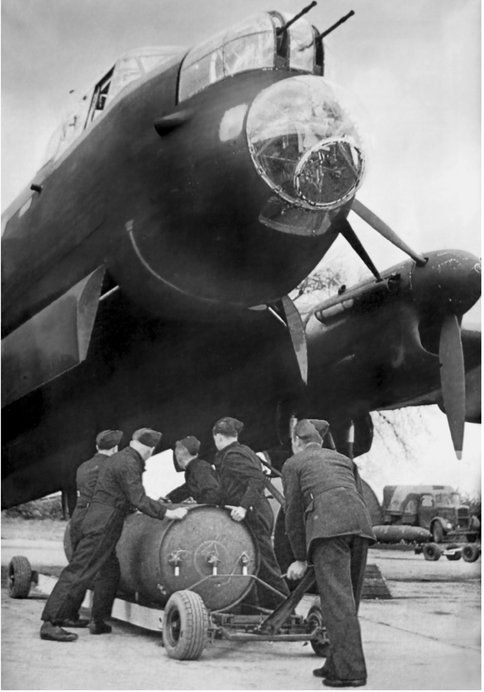
Ground crew load a ‘Cookie’ into the Lancaster’s bomb bay. The 4,000lb bomb never became widely used by Bomber Command partly because only one could be carried by Lancaster aircraft and none by Halifaxes.
The crew of Lancaster III ED831 Y-Yoke in 9 Squadron board their aircraft at Bardney, Lincolnshire, before taking off for the ten-hour round trip to the Zeppelin works at Friedrichshafen on 20 June 1943, one of the longest they would be expected to make. Skippered by Squadron Leader A. M. Hobbs DFC RNZAF, they are Sergeant L. W. Sanderson, navigator, Sergeant K. Mott, bomb aimer, Sergeant C. P. King, flight engineer, Sergeant E. C. Bishop, WOp, Sergeant W. C. Rowlands, mid upper gunner and Flight Sergeant F. Slater, rear gunner. Six nights later on 25/26 June Hobbs and his crew were one of thirteen Lancaster crews that failed to return from an operation to Gelsenkirchen when Y-Yoke was shot down into the Ijsselmeer on the homeward trip by a nightfighter. All the crew in this photo plus Flying Officer J. H. Sams, who was a graduate from Oxford University and who had reported from 1660 HCU that day, perished.
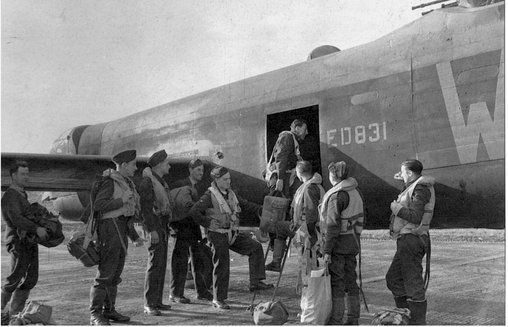
Chapter 5: Hamburg and Hydra Come Hell or High Water
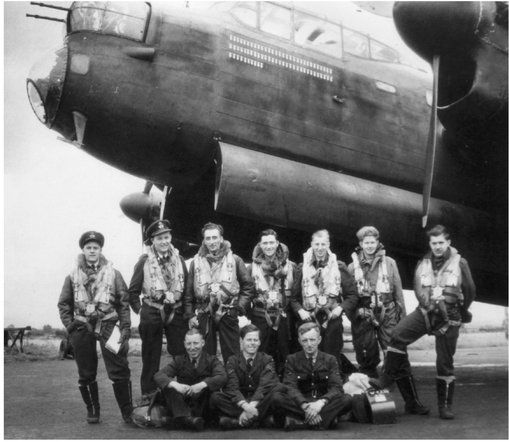
Pilot Officer W. H. Eager’s crew of Lancaster B.I W4236 QR-K K-Kitty in 61 Squadron at Syerston on 30 July 1943. L – R: Flight Lieutenant Hewish, radio operator from Heston; Pilot Officer Eager, who was from Winnipeg; Sergeant Stone, WOp from Pontypridd; Sergeant Vanner, rear gunner from Romford; Sergeant Petts, navigator from Ripley; Sergeant Sharrard, mid-upper gunner from Toronto; and Sergeant Lawrence, flight engineer from Barnsley. On 9/10 August 1943 this Lancaster (and a Halifax II) was shot down on the trip to Mannheim by Leutnant Norbert Pietrek of II./NJG 4. Three of Sergeant J. C. Whitley’s crew on the Lancaster, which crashed at Marbehan, Luxembourg were KIA.
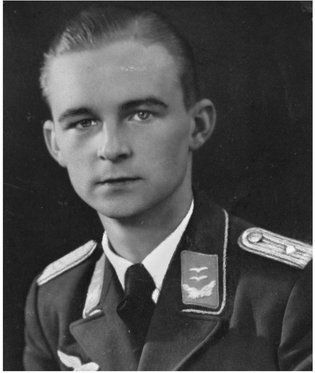
Leutnant Norbert Pietrek, a Bf 110 pilot who was awarded the EKII (Iron Cross 2nd Class). Pietrek received head injuries he received when he belly-landed his Bf 110 at Kitzingen on 27/28 August 1943 and he suffered further head injuries when he crashed near Dinant on 1 October. He never flew operationally again and in October 1945 he began most of the next ten years in captivity in the Soviet Union. (Norbert Pietrek)
The need for more destructive power in one missile resulted in the 12,000lb bomb, made by bolting together three 4,000lb sections and adding a tail unit. Such bombs were first used on 15/16 September in the disastrous attempt by 617 Squadron to breach the Dortmund-Ems Canal. Modifications necessary to enable Lancasters to carry this weapon were first effected on 617’s aircraft and included the removal of the nose and mid-upper turrets to reduce weight. The new weapon in this photograph is displayed before a 617 Lancaster at Scampton. The marking ‘51/40/9’ on the bomb refers to the explosive filling, which could be Armatex, RDX/TNT or Torpex 2. (IWM)
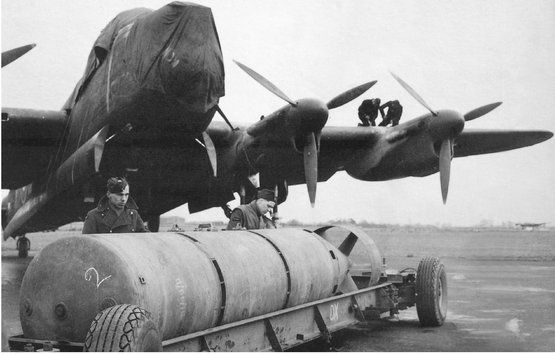
In August 1943 Woodford had three Lancaster assembly lines, two for Chadderton manufactured components and a third for aircraft built by Metrovick at Trafford Park, Manchester Bay One shown here contains Chadderton-built Lancasters. III JB276 (left) was lost with Warrant Officer J.T.C. Rhodes and his crew on 103 Squadron on 23 October 1943. Rhodes and five of the crew were KIA and two were taken prisoner. A. V. Roe produced the major components at Chadderton with assembly and flight testing being undertaken at Woodford 20 miles away. (Avro)
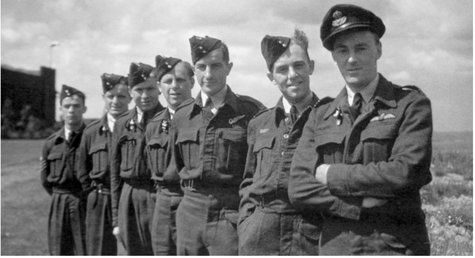
Flight Lieutenant Harold Wilson’s crew of 617 Squadron who were KIA on 15/16 September 1943 in the disastrous attempt by 617 Squadron to breach the Dortmund-Ems Canal. In May Wilson’s crew had been due to fly the Dams raid but owing to illness they were scrubbed from the battle order at the last minute.
On 16/17 September 1943 eight Lancasters of 617 Squadron and four from 619 Squadron set out to bomb the Anthéor viaduct near Cannes on the coastal railway line leading to Italy. The Lancaster crews found the viaduct in the moonlight without trouble but their bombs missed the target. American bombers finally destroyed the viaduct.
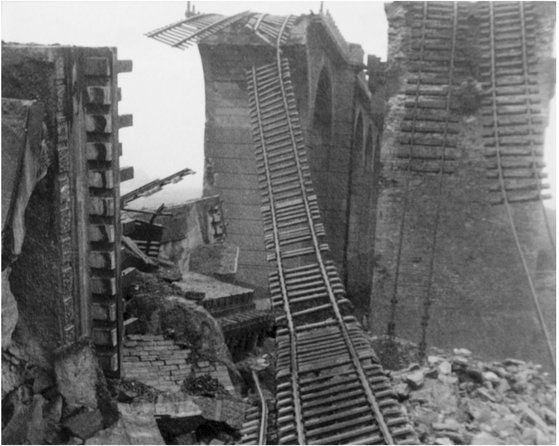
In the daylight reconnaissance twelve hours after the Peenemünde attack on 17/18 August 1943 photographs revealed twenty-seven buildings in the northern manufacturing area destroyed and forty huts in the living and sleeping quarters completely flattened. The foreign labour camp to the south suffered worst of all and 500 – 600 foreign workers, mostly Polish, were killed. The whole target area was covered in craters. The raid is adjudged to have set back the V-2 experimental programme by at least two months and to have reduced the scale of the eventual rocket attack on Britain. (Australian National Archives)
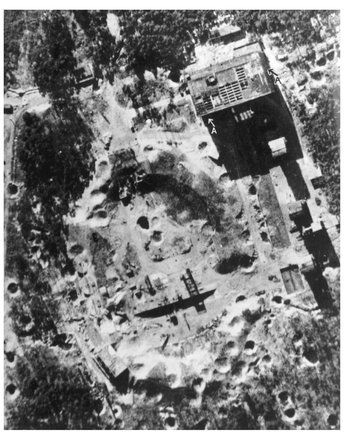
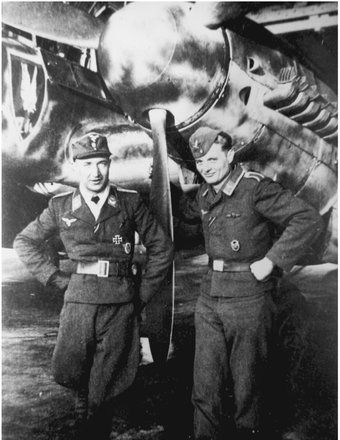
Feldwebel Otto Fries and his Bordfunker Unteroffizier Fred Staffa of 5./NJG 1 at St Trond in front of their Bf 110G. On 11 August 1943 they shot down Lancaster III JA716 of 97 Squadron at Hanzinelle, SE of Charleroi at 0257 hours for their first kill. Flight Lieutenant W. I. Covington DFC and his crew baled out and five men were taken prisoner. The skipper and his rear gunner, Sergeant J. McKnight, evaded capture. Freis and Staffa were credited with ten victories at night between August 1943 and April 1944, plus two unconfirmed Abschüsse in daylight. Flying the He 219 they added another six victory claims to take their final tally to fourteen confirmed and four unconfirmed Abschüsse. (Otto H. Fries)
On 3/4 October 1943 Kassel was attacked by 547 aircraft, 204 of them Lancasters. Twenty-four aircraft including four Lancasters were lost and the city’s eastern and western suburbs were devastated. Some 569 aircraft, 322 of them Lancasters, returned to the city on the night of 22/23 October and caused widespread destruction. Forty-three aircraft, including eighteen Lancasters, were lost.
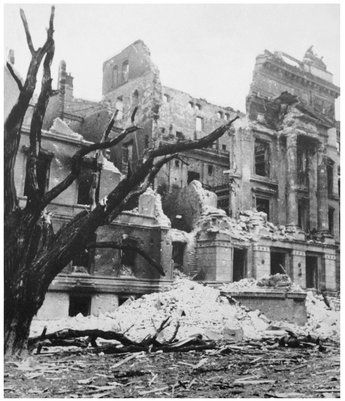
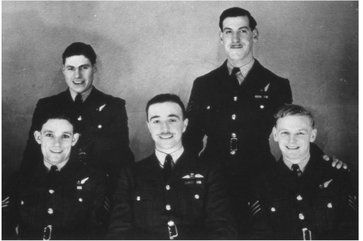
Five of the crew of Lancaster III LM360 O-Oboe of 61 Squadron, 5 Group at Syerston, near Nottingham, who flew the operation to Düsseldorf on 3/4 November 1943. Despite the damage to the aircraft and being badly wounded, Reid and his crew managed to nurse O-Oboe back to England where they bellied in at the 44th Bomb Group Liberator base at Shipdham, Norfolk. Back row, L – R: Flight Sergeant Les Rolton, bomb-aimer; Flight Sergeant Frank Emerson, rear gunner Front row: Flight Sergeant Jim ‘Taffy’ Norris, flight engineer; Flight Lieutenant Bill Reid, pilot; Flight Sergeant C. Baldwin, gunner. Pilot Officer John Jeffreys RAAF, navigator was killed and WOp Flight Sergeant I. J. Mann died the next day from his wounds. (Bill Reid Collection)
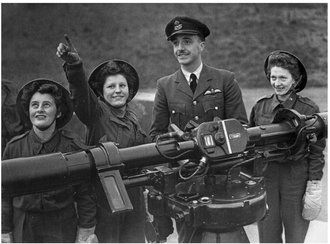
Bill Reid VC during a visit to an anti aircraft battery. Reid and Les Rolton joined 617 Squadron after recovering from their ordeal. On 31 July 1943 Reid became a PoW and Rolton was killed when their Lancaster was brought down over France by a 1,000lb bomb dropped by an aircraft overhead during the bombing of both ends of a railway tunnel at Rilly-La-Montage, which was being used as a flying-bomb store.
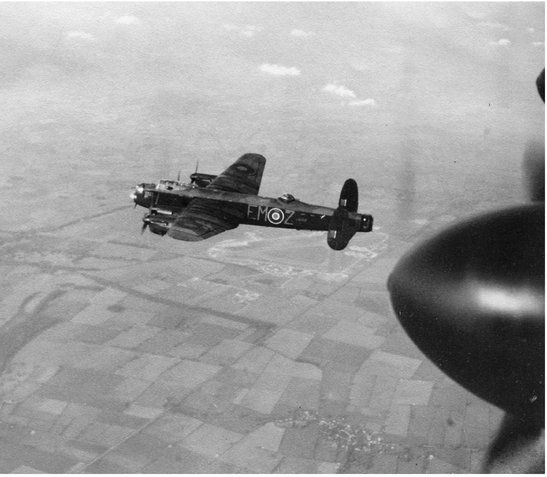
Lancaster III LM326 EM-Z ‘Z-Zebra’ of 207 Squadron on a local flight over countryside east of Grantham and Barkston Heath airfield. 207 Squadron suffered the highest percentage losses in 5 Group and in Nissen-hut rumour was a ‘chop’ squadron. LM326/EM-Z lasted four months before failing to return from the Hanover raid of 18/19 October 1943 with Flight Sergeant Geoff Taylor RAAF and crew who were shot down by Hauptmann Friedrich Karl ‘Nose’ Müller, a Wilde Sau pilot of Stab JG 300. All seven crew were taken prisoner. (IWM)
Debriefing a 1660 HCU crew at Swinderby on 23 November 1943 following the raid on Berlin. Twenty-six aircraft, eleven of them Lancasters, were lost. 1660 HCU had been formed from the Conversion Flights of 61, 97 and 106 Squadrons in October 1942. During the bombing offensive twenty-four OTUs (Operational Training Units) and eight HCUs (twelve of them equipped or partly equipped with Lancasters at one time or another) sent crews on operations flown mainly by mixed crews of pupils and instructors. Additionally, there were four Lancaster Finishing Schools.
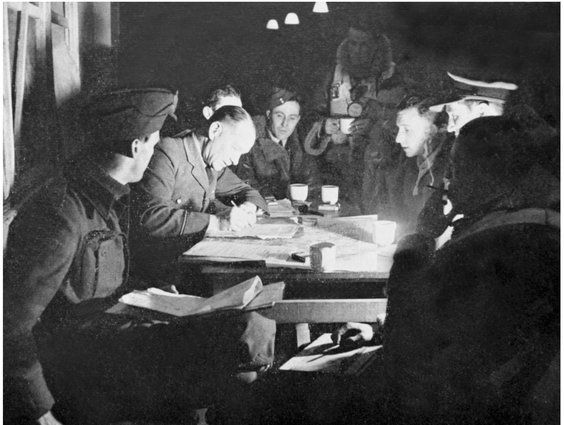
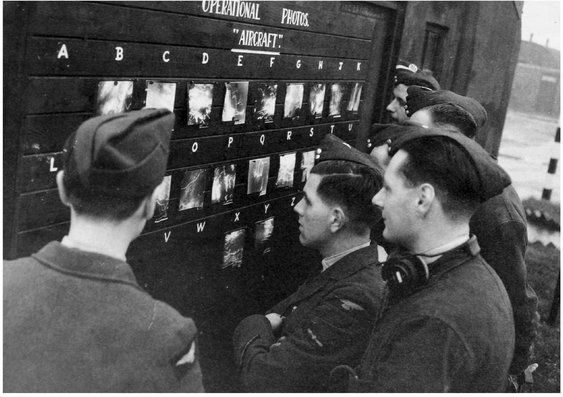
Station personnel at Fiskerton look at the night flash photographs displayed at the technical site following the 22/23 November Berlin raid. (IWM)
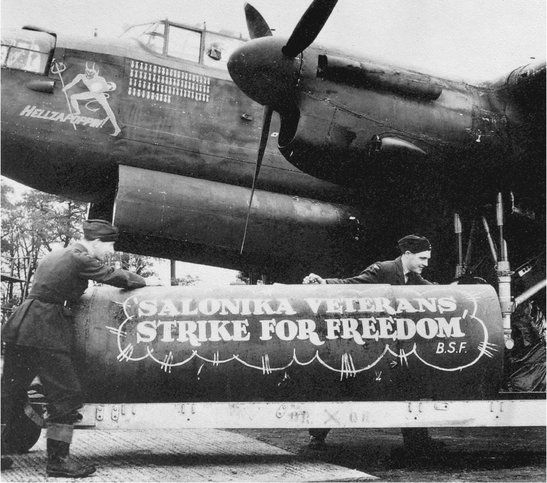
Public subscription to the cost of specific items of war equipment was given official encouragement by most combatant nations. The First World War veterans of the Salonika Reunion Association in Britain bought a 4,000lb ‘Cookie’ for delivery to a German target. It is here seen at Syerston before loading in Lancaster I W4198 QR-H Hellzapoppin! of 61 Squadron, which has seventy-one ops on the nose. This aircraft and Pilot Officer A. J. D. Eaves and crew were lost on the aircraft’s 75th operation on 26/27 November 1943.
Lancaster II D5723 EQ-B of 408 Squadron, which failed to return with Wing Commander A. C. Mair DFC RCAF and crew from the raid on Berlin on 26/27 November 1943. All the crew were killed.
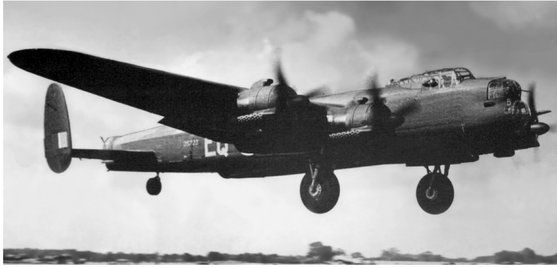
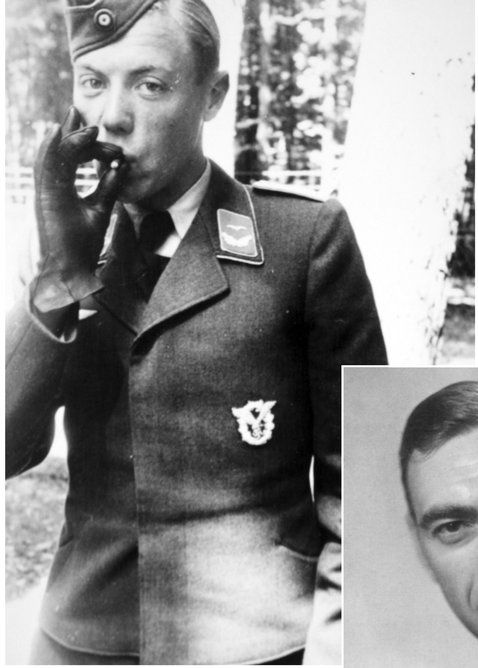
Hauptmann Peter Spoden was one of the leading Tame Boar pilots who made his first operational flight in a Bf 110 in the Battle of Hamburg 27/28 July 1943. His first victory came on the night of the Peenemünde raid 17/18 August 1943 when he shot down Lancaster III JA897 of 44 Squadron flown by Sergeant W. J. Drew (KIA with five of his crew – only Sergeant W. Sparks, bomb aimer, survived). In August 1943 Spoden was hospitalized, his Bordfunker survived and his flight mechanic was killed when they were shot down. Late in November 1943 he shot down a Lancaster. Spoden finished the war with twenty-four night and one day victories. He was awarded the Deutsches Kreuz. Post war Spoden was a senior Lufthansa pilot. (Peter Spoden)
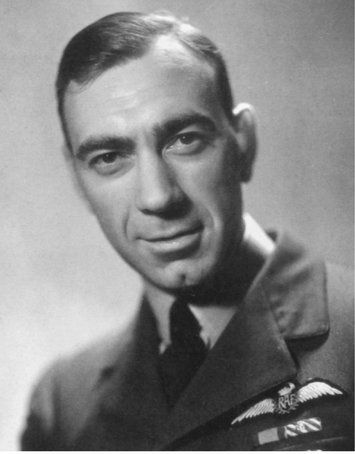
Wing Commander Ray Hilton DSO DFC* who returned to command 83 Squadron for his third tour in November 1943. He was killed on the Berlin raid on 23/24 November. Hilton had flown at least sixty-four ops.
Chapter 6: To the Big City
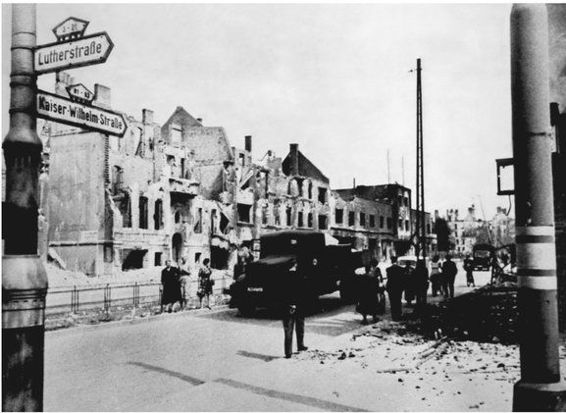
Berlin devastated by bombing.
In the USA on 3 December 1943 radio listeners tuned in to hear their favourite foreign correspondent Edward R. Murrow, head of CBS European Bureau in London, begin his broadcast, This is London. Murrow, who had become well known in America for his broadcasts during the Blitz when the USA was still neutral, proceeded to regale his listeners with a gripping account of his experience over Berlin in a Lancaster the night before. (CBS)
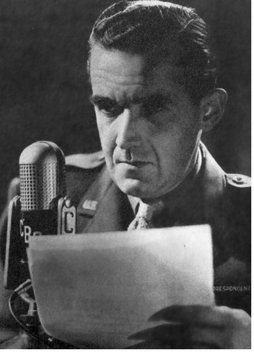
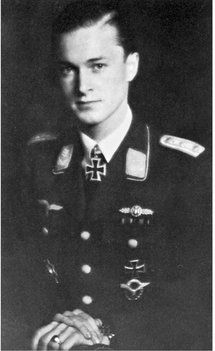
A brilliant pilot of aristocratic descent, Major Heinrich Prinz Zu Sayn-Wittgenstein served with distinction, first as a bomber pilot in France, Britain and Russia. In August 1941 he transferred to Nachtjagd and rapidly became a legend. In seven months in 1942 he achieved twenty-two victories, receiving the Ritterkreuz in October of that year. Over the next twelve months he added forty more victories. Award of the Oak Leaves for fifty-four victories followed at the end of August 1943. On 1/2 January 1944 Wittgenstein shot down Flight Lieutenant Leo B. Patkin RAAF (KIA) and his crew of 467 Squadron RAAF for his 71st Abschuss. At the time of his death in combat on 21/22 January 1944 Wittgenstein had eighty-three Nachtjagd victories (including twenty-three on the Eastern Front) in 170 sorties. And he had been awarded the Ritterkreuz with Eichenlaub and Schwerter.
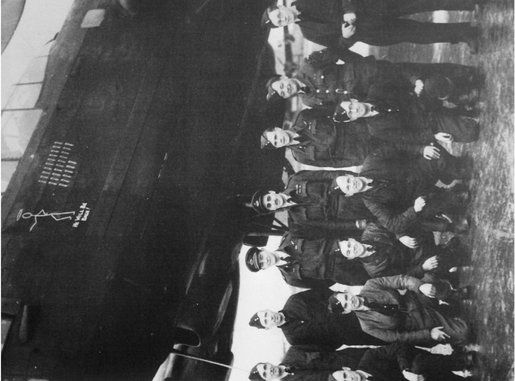
Maurice Chick and his crew in 83 Squadron beside Lancaster III JA967 The Saint He Will Be Back. This aircraft and Flight Lieutenant H. R. Hyde’s crew were lost on 29 January 1944 when they were involved in a outbound collison with a 463 Squadron RAAF Lancaster and crashed on the Danish Island of Als. There were no survivors from either crew. Hyde had previously had a miraculous escape when his Lancaster (JA686) exploded at dispersal at Wyton on the night of 26/27 November 1943 after an electrical fault ignited the photo flash. One of his crew died and two others who were injured, died a few hours later. A WAAF and four airmen were killed on the ground.
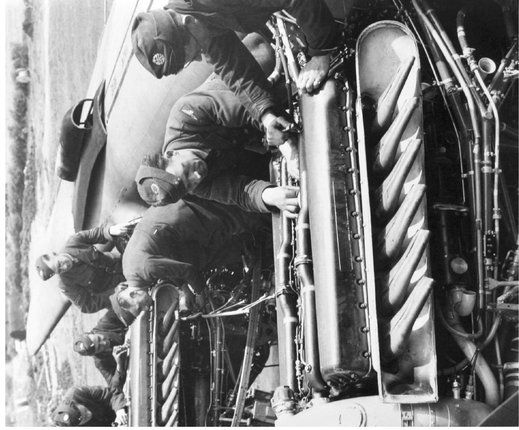
Servicing Merlin engines on the Lancaster.
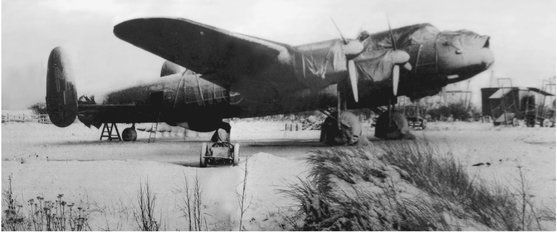
Lancaster VN-M of 50 Squadron at Skellingthorpe in the winter of 1943 – 44. The squadron was stationed at the Lincolnshire airfield from October 1942 and flew t most Lancaster operations in 5 Group.
The sad remains of a Lancaster crew.
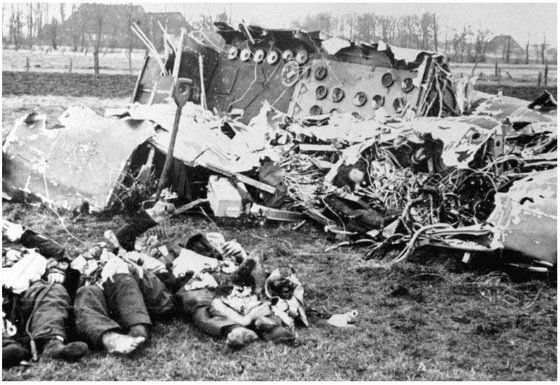
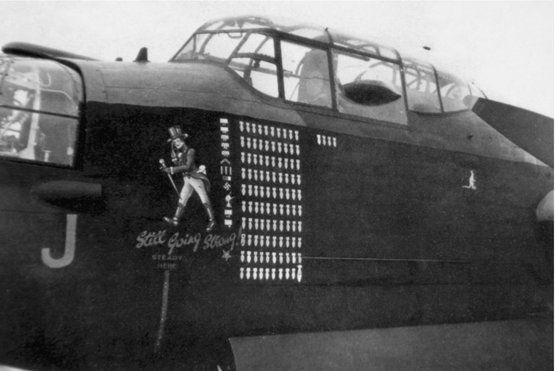
W4964 Still Going Strong! of 9 Squadron flew 106 ops between April 1943 and October 1944.
Lancaster III LM446/PG-H of 619 Squadron a few days after it was taken on charge at Coningsby on 31 January 1944. This Lancaster was one of five that failed to return from the attack by fifty-six Lancasters and eight Mosquitoes of 5 Group on the Gnôme-Rhône aero-engine factory and another factory nearby at Gennevilliers, France on 9/10 May 1944. Seven of Pilot Officer J. M. Aitken RNZAF’s crew were killed and one was taken prisoner.
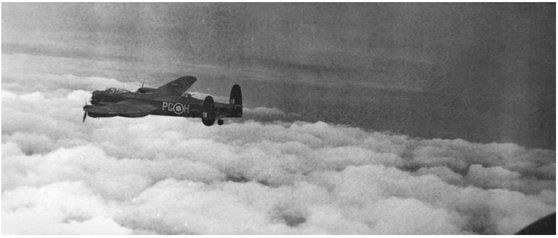
Chapter 7: Berlin or Bust
Pilot Officer Howard Farmiloe, aged twenty-two, of 61 Squadron was one of the most junior commissioned officers in the RAF to be awarded the DSO during the war. On the last raid of the battle of Berlin on 24/25 March 1944 Farmiloe flew ME596 H-Hellzapoppin back against all the odds. He suffered an engine failure outward bound over the North Sea and on the bomb run the second engine on the same wing failed, but he bombed the target from 18,500 feet before setting a course for home, making an emergency landing at Little Snoring in Norfolk at 0215 hours. Farmiloe was awarded an immediate DSO, his bomb-aimer and wireless operator each received a DFM and Flying Officer S. Halliwell, navigator, a bar to his DFC. ME596 was lost with Pilot Officer G. McL Taylor RAAF and crew on the raid on Rüsselsheim 12/13 August 1944. Taylor and five of his crew were killed. The other member of the crew was taken prisoner. (Howard Farmiloe)
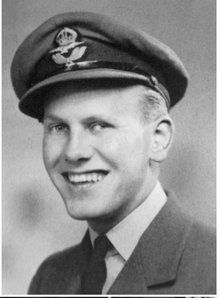
Flying Officer P. Ingleby of 619 Squadron at his navigator’s table on 14 February 1944. Ingleby was killed later in the war.
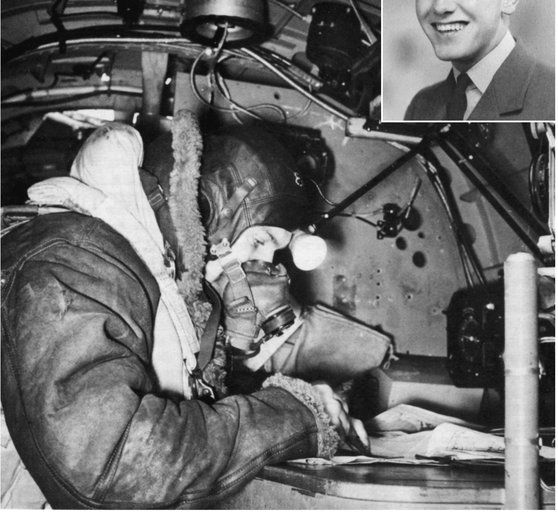
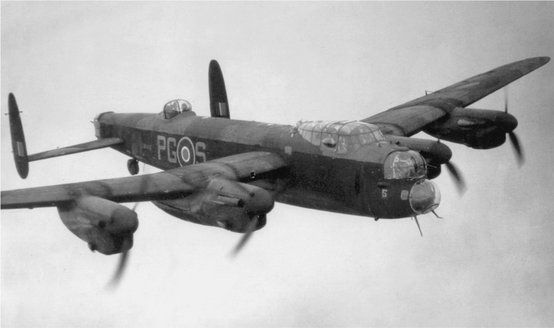
Lancaster III LM418 of 619 Squadron on 14 February 1944. This aircraft was wrecked a month later on 30/31 March on return from Nuremberg. Sergeant J. Parker took off from Coningsby at 2213 hours and on return, crash-landed at Woodbridge. No one was hurt but the Lancaster was consumed by fire. Parker and his crew were killed on the operation to Kiel on 23/24 July 1944.
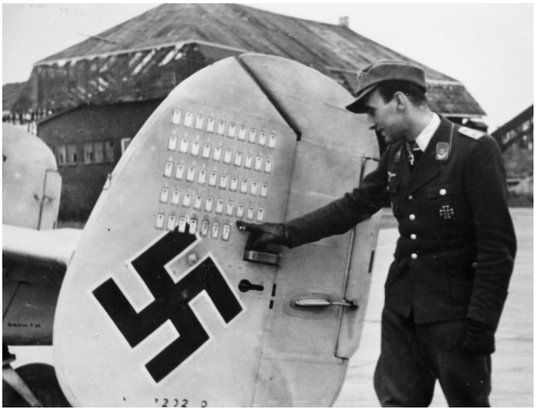
Oberleutnant Heinz-Wolfgang Schnaufer, Staffelkapitän, 12./NJG 1 at Leeuwarden points out his 47th Abschuss – he scored his 45th – 47th victories on 15/16 February 1944 during a Bomber Command raid on Berlin when forty-three aircraft were lost. The 47th victory was Lancaster B.I W4272 of 622 Squadron, which he shot down into the Ijsselmeer 1km south of Medemblik at 2333 hours. Flight Lieutenant T. L. Griffiths RAAF and his crew were killed. (Hans Bredewold via Ab A. Jansen)