Chapter 3
In the early hours of this morning a force of Lancasters of Bomber Command led by Wing Commander G. P Gibson DSO* DFC* attacked with mines the dams of the Ruhr Basin. Eight of the Lancasters are missing . . .
BBC Home Service 17 May 1943
Flying Officer Joseph Charles ‘Big Joe’ McCarthy DFC RCAF, a burly 23 year old, 6 feet 3 inch Irish-American from New York City, had just beaten the odds by completing his first tour with 97 Squadron at Woodhall Spa, on 11 March 1943. A few days later he received a telephone call from Guy Gibson. The 24 year old Wing Commander told him, ‘I’m forming a new squadron. I can’t tell you much about it except to say that we may only be doing one trip. I’d like you and your crew to join us.’ It was on 17 March that ‘Squadron X’ was formed, at Scampton in Lincolnshire. McCarthy, who was fascinated by all things aeronautical was a favourite of his fellow pilots and was known on the squadrons as ‘the big blond American’. On his uniform he wore dual shoulder flashes ‘USA’ and ‘Canada’. Born in St James, Long Island, on 31 August 1919, Joe McCarthy was raised in Brooklyn. His family had a summer home on Long Island where one of his summer jobs was as a lifeguard at Coney Island, the money helping to pay for private flying lessons at Roosevelt Field where, in 1927, Charles Lindbergh had taken off on his epic solo New York to Paris flight. In 1940 – 1941 McCarthy tried three times to join the US Army Air Corps but he never heard back from them! One of his neighbourhood lifelong friends was Donald Joseph Curtin who suggested that they enlist in the Royal Canadian Air Force. Because of the war, Curtin had been laid off from his job as a cruise director with the Holland America Steamship Company. McCarthy and Curtin boarded a bus and headed north for Ontario. They crossed the St Lawrence River by ferry and the Canadian Customs helped them get a connecting bus to Ottawa. They spent the night at the YMCA and the following morning, 5 May 1941; they proceeded to the recruiting office. However, they were told to return in six weeks. The two Yanks told the officials that they did not have the money to come back so if the RCAF wanted them they had better decide that day! The Warrant Officer in charge took a second look at the two American volunteers, changed his mind and had them sign enlistment papers.
Pilot Officer Curtin went on to fly Lancasters at Syerston with 106 Squadron and he was awarded the DFC after his first sortie in July 1942 and a further award of a bar to his DFC was approved in January 1943. During the period Curtin was with 106 Squadron Guy Gibson was his commanding officer. It was during a visit to see Curtin at Syerston that McCarthy first met Gibson. He remembered him as one of those men to whom leadership came as naturally as breathing; autocratic and impatient at times, yet commanding instant respect. It was a foregone certainly that Curtin would have been invited to join Squadron X if he and his crew had not been lost in a Lancaster over Nuremberg on the night of 25/26 February. Don and his crew were buried in the War Graves Cemetery in Dumbach, Germany.
All but one of Joe McCarthy’s crew of six eventually decided to follow their aircraft captain to Squadron X. Sergeant George L. ‘Johnny’ Johnson his bomb-aimer, almost did not make it as he was due to get married on 3 April and his bride to be had warned him that if he was not there on that date then he ‘needn’t bother to come at all’. McCarthy with his customary directness told Gibson that they had finished their tour and were entitled to leave. They got four days’ leave and Johnson made it to the church on time.
From 97 Squadron there also came other pilots like Flight Lieutenant David J. H. Maltby DFC and Flight Lieutenant J. L. ‘Les’ Munro RNZAF. Maltby, born at Baldslow near Hastings in May 1920, had trained as a mining engineer before the war and he had joined the RAFVR in 1940, winning the DFC with 106 Squadron on Hampdens. He had flown a total of 28 ops on Hampdens on 106 Squadron, and Manchesters and Lancasters on 97 Squadron. Maltby’s new crew, all sergeants, arrived at Woodhall Spa on 18 March prior to beginning his second tour. They were posted to 617 Squadron a week later. Three of them had yet to fly on operations; Bill Hatton, the flight engineer, had flown two ops, and John Fort, the bomb-aimer, had flown just one while at OTU. On 7 May Victor Hill, who had flown 22 ops on Lancasters, including the raid on the Schneider works at Le Cruseot, joined Maltby’s crew as the replacement front gunner.1 Maltby has been described as ‘large and thoughtful, a fine pilot.’ Like many pilots he was superstitious, always taking his oil and grease stained field service or ‘fore and aft’ hat on every op and even on parade. Les Munro on the other hand has been described as, ‘a most charming fellow with an excellent operational record’. He too had discussed with his crew the question of whether they should volunteer or not. Pilot Officer Warner Ottley DFC, born in 1923 in Battersea and growing up in Herne Bay, had joined the RAF in 1941 and trained in England and Canada before serving with 83 and 207 Squadrons. Flight Lieutenant Robert N. G. Barlow DFC RAAF, 32, originally from St Kilda, Victoria, who had joined the RAAF in 1941, arrived from 61 Squadron at Syerston. Sergeant Cyril T. Anderson and 22 year old Flight Sergeant William Clifford Townsend DFM were from 49 Squadron. Bill Townsend had joined the Army in 1941 but soon transferred to the RAF. At Bottesford in Leicestershire Sergeant Frank Heavery DFM’s crew in 467 Squadron RAAF were given the choice by their CO, Wing Commander Cosme L. Gomm DFC, who asked if they wanted to transfer to the special duties squadron being formed at Scampton. Heavery, who had flown a dozen ops with the Empire Squadron, said that he would like to talk it over with the rest of his crew.2Heavery polled his six crew members about moving to Scampton and put it to the vote. Two of the crew were in favour but three of the crew said that they preferred to stay with 467 Squadron. Heavery held the casting vote and he decided that they would stay as they were. Selected in their place were Vernon W. Byers RCAF who, at 32, was older than most Lancaster captains, and his crew. Born in Star City, Saskatchewan he had joined the RCAF in 1941, training in Manitoba before coming to England and joining 467 Squadron RAAF in February 1943. Recently commissioned, he had flown three ops since he and his crew had joined the Australian squadron seven weeks earlier.
Scampton’s station commander was 31 year old Group Captain J. N. H. ‘Charlie’ Whitworth DSO DFC who was born in Buenos Aires, and he would work closely with Gibson. ‘He would always give a few words of encouragement and wish us well’, recalls 22 year old Pilot Officer Edmund Basil ‘Chan’ Chandler, a recently commissioned rear-gunner in 49 Squadron at Fiskerton who had completed 38 ops on Hampdens in 1941. Chan had earned his nickname because his first gunnery leader did not want any ‘bloody Basils here’ and because he had a grin like Charlie Chan. He had been involved in several crash-landings and one Channel ditching, on which he and the crew were adrift for eight perilous days. Walking back to Coningsby from Woodhall Spa one August night in 1942, Wing Commander Guy Gibson knocked him down with his car and broke the rear-gunner’s leg in four places. (On another occasion, when Gibson had been stopped by a police motorcyclist for driving his small Wholesale Ten Saloon at 93 mph and asked if he knew why he had stopped him, Gibson had replied, ‘Was I really going that fast officer? My mind must have been miles away.’)3 Instead of getting a bed at Coningsby, Chandler finished up in RAF Hospital Rauceby for seven months. The ‘break’ may have saved Chandler’s life. Three operations later and after rehabilitation at Loughborough, Chandler returned to ops in March 1943. In April, during a hectic period flying three raids in five days, including a long trip in full moonlight to the Skoda armament works in Pilsen on the 16th, Chandler was told to go to Scampton to see Gibson. After hanging about all day without getting to see him Chandler returned to Fiskerton and told his CO that as far as he was concerned ‘617 could get lost’.4
Many of the crews who arrived at Scampton aerodrome on 30 March had completed fewer than 10 operations and some, as previously noted, had not yet flown one. Dudley Heal, Ken Brown’s navigator, had flown seven. Steve Oancia the bomb-aimer mentioned the fact that he ‘did not recall volunteering for this transfer’. Basil Feneron had also protested. In Flight Lieutenant Dave J. Shannon DFC RAAF’s crew in 106 Squadron only the navigator had agreed to go with his skipper to Scampton after they were posted to the Pathfinders. Shannon was a 21 year old from South Australia who did not look ‘any more than sixteen, so he was growing a large moustache to look older’. He had joined the RAFVR in 1940 and trained in England before serving under Gibson on 106 Squadron, completing 36 operations. Flight Sergeant Len J. Sumpter, who became Shannon’s bomb-aimer, was a former Grenadier guardsman. ‘Tougher than a prize fighter’ he had completed 13 operations since volunteering for air crew. From Gibson’s old squadron too came Flight Lieutenant John Vere ‘Hoppy’ Hopgood DFC* and Flight Sergeant Lewis J. Burpee DFM RCAF, 25, from Ottawa, Ontario who had a pregnant wife waiting at home.5 Hopgood, 21, who came from Seaford in Sussex, has been described as ‘English, fair and good looking except for a long front tooth that stuck out at an angle’. It was he who had taken Gibson up to familiarize him with the Lancaster.
Of the 133 men who would crew the Lancasters on the secret operation, only 20 of them were decorated. Gibson selected many of these including McCarthy, Hopgood, Burpee and Shannon, personally. He chose Squadron Leader Henry Melvin ‘Dinghy’ Young DFC* who came from 57 Squadron at Scampton, as his ‘A’ Flight Commander. Young, whose father was a solicitor and a second lieutenant in the Queen’s Royal West Surrey Regiment and his mother, Fannie Forrester Young, formerly Rowan, an American from a socially prominent Los Angeles family, was born in Belgravia, London on 20 May 1915. Educated in England and in California and Connecticut, he attended Trinity College, Oxford where he studied law and was an Oxford rowing Blue. The first of his ditchings, which earned him his nickname, was in a Whitley in October 1940, when he spent 22 hours in a dinghy in the Atlantic before being rescued, and the second was in November following a raid on Turin. In May 1941 he was awarded the DFC for his service with 102 Squadron and a bar followed in September 1942 when he completed a tour with 104 Squadron.6 The following summer he married his 33 year old American fiancée.7 Young has been described as, ‘a large, calm man’ and ‘a very efficient organizer’. ‘His favourite trick was to swallow a pint of beer without drawing breath.’ By mid 1943 he had completed 65 ops.
From 57 Squadron also, came (reluctantly) Pilot Officer Geoff Rice, a 23 year old Mancunian, Sergeant Lovell, and Flight Lieutenant Bill Astell DFC born in Derbyshire in 1920 and who had joined the RAFVR in 1939.8 The ‘B’ Flight Commander was 21 year old Squadron Leader Henry Eric Maudslay DFC who came from 50 Squadron. Originally from the Cotswold village of Broadway in Worcestershire, he was an accomplished middle-distance runner and former Captain of Boats at Eton. He was well-liked and was considered a ‘real gentleman’ and ‘quiet, kind, purposeful – nothing was too much trouble’.9
Gibson rang 1654 Heavy Conversion Unit to speak to ‘Mick’ Martin. He had met the Australian with a ‘wild glint in his eyes and a monstrous moustache that ended raggedly out by his ears’ at Buckingham Palace when Gibson received his DSO and Martin the first of his DFCs. Harold Brownlow Morgan Martin, born at Edgecliff, New South Wales on 27 February 1918 had been pronounced unfit to fly because of asthma but he worked his passage to England, where he joined the RAF in 1940. Martin was commissioned in 1941. He then served with 455 Squadron RAAF, was transferred to 50 Squadron, with whom he flew a further 23 operations and was then taken off operational flying and awarded the DFC. He was probably the RAF’s greatest exponent of low-level bombing. Martin arrived at Scampton on Wednesday 31 March.
At Skellingthorpe, another Australian pilot in 50 Squadron and the crew of N-Nan were told that they were being posted to Scampton. Twenty year old Pilot Officer Les Knight DSO RAAF was a trainee accountant from a small outback town. His crew was composed of a rich mix of RAF and Dominion airmen. Sergeant Ray Grayston, a Surrey-born apprentice engineer when he was called up in December 1939, was the flight engineer. He says:
‘The two gunners, Sergeant Frederick “Doc” Sutherland and Sergeant Harry O’Brien were Canadians. The wireless operator, Flight Sergeant Bob Kellow was another Australian. Flying Officers Harold Hobday, navigator and Edward “Johnny” Johnson, bomb-aimer, were English. I had serviced Lancasters before volunteering to join 50 Squadron as a flight engineer in 1942. When the other lads found out, they told me I must be crazy. We were losing about 50 aircraft a night at that time. You certainly felt a bit jelly-like in the legs for the first few ops, but once you got over that, you would have volunteered to go every night. It was amazing really; you just got hyped up on it. As you saw the target area ahead, glowing on fire and with all the flak flying up, you wondered how the hell you were going to get through it. That’s when you began to think, “My God . . .” Over the Ruhr in particular, they put up a box barrage, just firing the guns, endlessly, endlessly, hoping to hit something. At first you’d imagine that it would be impossible to fly through this tenor and get out the other side. But when you did, it gave you exhilaration on the back end of the journey. So you thought, well, I want to keep doing that. And at the start of the next op, you never once considered that you were going to die. No, you never reckoned on that. I think that for most people, who flew on operations, the excitement became a sort of drug. I rode high-speed motorbikes before I joined the RAF and it was thrilling. Flying ops was that sort of atmosphere. You never knew when you could be shot, so it was wise to have somebody to take over in an emergency. Even though I was the flight engineer Les would let me fly the plane to get used to the controls. I did quite a few hours flying. Les Knight was remarkably quiet. He didn’t smoke or drink, didn’t go out with women, couldn’t drive a car or even ride a bike. But he could fly a Lancaster! He was a brilliant pilot, even in the worst predicaments. I never heard him issue a harsh word, apart from telling us to shut up because we were all talking at the same time on the radiotelegraphy. As a crew, we were close but we didn’t live in each other’s pockets. On the ground we didn’t socialize at all.’
‘Then came the morning’ recalls Dudley Heal, ‘when we were all called to the Briefing Room. Our new CO, Wing Commander Gibson DSO* DFC* called us to order to tell us that the squadron had been formed to attack a particular target, the identity of which could not be revealed to anyone until briefing for the operation took place. Security would be at maximum and anyone caught talking about the squadron outside Scampton would be severely disciplined. We would be training for an unidentified period by night and at low level. With that we were dismissed.
‘During the next six weeks there were few days when we were not flying. At first it was just low level, say 200 feet above the ground. As time wore on more and more flying was over water, the sea, rivers, or canals by day and then gradually by night. Tinted screens were affixed to the Perspex around the cockpit in the daytime to simulate night flying. We practised flying over Derwent Water and attacking the dam with a newly designed bombsight that looked just like a dam, strangely enough. Of course, we all laughed at the idea that we might be going to attack a dam – we all knew that Tirpitz was the target. Spotlights were fitted to the underside of the aircraft, which converged to a point on the water when the aircraft was at the required height. [617 Squadron flew a series of low-level training flights all over Britain where they practised over lakes like the Derwent near Sheffield and the reservoirs at Uppingham (Eyebrook) near Corby and Abberton near Colchester and Bala Lake in Wales.] All this time 57 Squadron were steadily plugging over Germany at night and no doubt suffering the same percentage of casualties as the rest of Bomber Command. I don’t think they thought much of 617 (as we now were). While we were doing all this low-level flying, one incident comes to mind. We were flying along a canal and Steve called out, “Bridge ahead”. Ken, of course, could see it and there was some discussion as to the size and height of it, ending with Ken saying, “Let’s find out”, whereupon he put the nose down and flew under it! I still remember those feelings as we were momentarily enclosed on four sides. I did not enter that in my log.’
Ray Grayston continues.
‘You’d never get a licence to fly that low anywhere in any air force under any conditions. It was forbidden. Locals on the ground who had us flying at rooftop over their homes obviously hated it, but we thoroughly enjoyed it. Gibson was a straight talking, no bullshit sort of bloke. He wouldn’t ask you to do anything he had not first done himself. Because we had been flying so intensively we were scruffy, with un-pressed suits and tarnished buttons and when the CO saw us, all hell was let loose. He read us the riot act and told us to parade for a punishment march. Gibson told him, “In that case, I’ll be leading them”. That shut him up! Gibson made it clear we were there to do a job, not to play silly buggers. But the other two squadrons on the base took an intense dislike to us because we were allowed to violate all the rules of flying. [Up until the day of the operation crews were kept in the dark about its real purpose. But their imaginations raced when Barnes Wallis’ bouncing bombs were delivered to Scampton]. Rather than spheres, the mines were cylindrical and were made to spin in reverse before being dropped, so that they would skim over the tops of torpedo booms. They were massive great things that made us wonder how the hell we were supposed to fly with them. We knew the operation was something out of the ordinary, but there was no mention of dams or bouncing bombs. The only test run, using dummy concrete mines, took place off Reculver, Kent with mixed results. The Lanc didn’t like the thing hanging underneath it, stuck right out in the slipstream. It interfered too much with the aerodynamics. So on our run with a dummy mine, we thought we were flying at 30 to 50 feet but were actually below that and the splash badly damaged our machine. The tail-plane and back end looked like a sardine can where the water had hit it.10 It was so simple you could make it with a pencil and a piece of string, but it worked a treat.’
‘On 13 May,’ recalls Dudley Heal, ‘the first of the bombs for our operation arrived. It looked like an outside garden roller and would be slung beneath the aircraft, the bomb doors having been removed and replaced by special fittings. Security at Scampton reached a high point over the next 48 hours. There was no chance of a trip into Lincoln. In the early afternoon of 15 May the Tannoy came to life: “All pilots, navigators and bomb-aimers of 617 Squadron report to the briefing-room immediately.” The great moment had arrived and we were to spend the next four or five hours learning all about the Ruhr dams, listening to Wing Commander Gibson and to Barnes Wallis, inventor of the bomb we would use. We studied models of the dams as well as the route we were to follow. Every known concentration of anti-aircraft fire would be noted as well as every possible landmark. No effort was spared to equip us for this op. We were dismissed, with the injunction that we were to tell nobody, not even our crew-mates, what the targets were. Preparations continued on l6th and then all the aircrew were called for briefing. We learned that we would form part of the third, reserve wave to take off, would set course for the Möhne Dam but be ready to receive fresh orders en route.
Gibson ended his briefing by saying: ‘Well chaps if you don’t do it tonight you will be going back tomorrow night to finish it off.’
Ray Grayston continues:
‘On Sunday 16 May I had breakfast and saw the officers go off to their briefing. We had been quarantined for six weeks, having no contact with civilians, no access to telephones and being unable to write letters. I’d been married for less than a year, but I couldn’t tell my wife what I was up to. So speculation was rife. Some of us thought the targets were submarine and torpedo boat pens. It was a great surprise when we found out where we were going. [The 19 Lancasters were to fly across the North Sea at 150 feet, then across occupied Holland at 100 feet and into Germany at ‘nought feet’.] We had to hug the ground so the Germans couldn’t vector us with their radar otherwise they would have picked us off like flies.’
A little after 09.00 Gibson ‘hatless and hurrying with a red file marked “Most Secret” under his arm, crashed into Flight Lieutenant Harry Humphries, the adjutant’s office, with instructions for a flying programme. Harry’s first thought was that Gibson meant another training sortie. He said, “No – that is yes to the rest of the station”. Seeing Humphries’ bemused look Gibson added, “We are going to war at last but I don’t want the world to know about it so do not mention the words Battle Order. Just make out a night flying programme.” Humphries arranged buses to take the crews out to the waiting Lancasters, checked the estimated return times to ensure that meals were prepared and made himself available to collect cash, wills and letters to next-of-kin. He had “a hell of a job” persuading the WAAF Mess sergeant to give the crews eggs and bacon. They were entitled to it because they were on an operation. The trouble was that because of the secrecy the instructions didn’t carry the words “Battle Order”. I argued and cajoled but was getting nowhere until I eventually told her that the flying programme was a bit different to usual. “Why didn’t you say so in the first place” she said.’11
At Syerston Gibson had rescued Humphries from the drudgery of a committee or adjustment officer responsible for cataloguing and collecting the personal effects of aircrew missing in action. Having been briefed about what his job as 617 Squadron Adjutant would entail, Gibson had cryptically remarked: ‘This squadron will either make history or it will be completely wiped out.’ From their first encounter Harry Humphries came to see Gibson as a born leader. ‘He had enormous willpower and strength of character and was one of those rare men who are completely without fear. He never thought anything about what might happen to him. And to be a leader you have to be a bit cocky, or at least have that inner self-belief and that’s what he had. The aircrews loved him. They would go anywhere with him. When he took a briefing they hung on his every word and when it came to flying he knew what he was talking about. But it’s fair to say that he didn’t have much time for non-flying officers. I was lucky. I always got on well with him but he could be very forthright and he didn’t stand fools gladly. During the practice sorties, he fined crews who’d flown too low and come back with leaves and branches in their props. Gibson and men such as McCarthy, Munro, Martin, Shannon, Ken Brown and Bill Townsend were a “special breed”. They behaved as though they were fearless. I don’t know how they did it. I know I certainly couldn’t have done what they were doing.’
At about 15.00 on that balmy, sunny Sunday afternoon, the teleprinters at Scampton chattered out the orders from Group: ‘Code name for 5 Group Operation Order B.976 is Chastise . . . Zero Hour: 22.48.’
Evening came and Harry Humphries, still none the wiser about the nature of the operation, found the officers’ Mess invaded by high-ranking officers and ‘serious looking civilians’ and so retired to his office. ‘Then at last the activity commenced in earnest. The aircrews began to turn up, on bicycles, in battered little cars and on foot. I began to check. Yes, all the buses were ready. The flying rations were OK. The coffee was available and, in the distance, the Lancasters stood silent, ominous looking, waiting to be unleashed at the enemy.’ Walking among them Humphries found some lying on the grass surrounded by Mae Wests, parachute harnesses and other items of equipment. He found Maudslay deep in conversation with his crew while ‘Dinghy’ Young was tidying his room. Another pilot was sprawled in a chair reading a magazine. Before take-off the crews went through a variety of rituals. Several played cards, rolled dice or dozed; many wrote letters home and Doug Webb, Townsend’s front gunner took a bath, ‘determined to die clean’. Gibson arrived by car and was seen smiling as he chatted to the men he was about to lead into action. ‘If he was worried’ wrote Harry Humphries ‘he certainly didn’t show it.’ Shortly before the buses arrived I asked him if there were any last tasks to be done. He said, ‘I don’t think there is anything at the moment’ before correcting himself. ‘Yes there is. Plenty of beer in the mess when we return. We’ll be having a party . . . I hope.’ Not long after Humphries watched as the Lancasters began lumbering towards their take-off points. They reminded him of ducks, waddling down the runway before launching themselves skywards. After that there was nothing to do but to wait and hope and pray. I went to the mess where I got talking with a WAAF Intelligence Officer who was attached to the squadron. She said something like “isn’t it so exciting? No squadron’s ever done anything like this” to which I had to admit that I still had no idea what the target was!’12
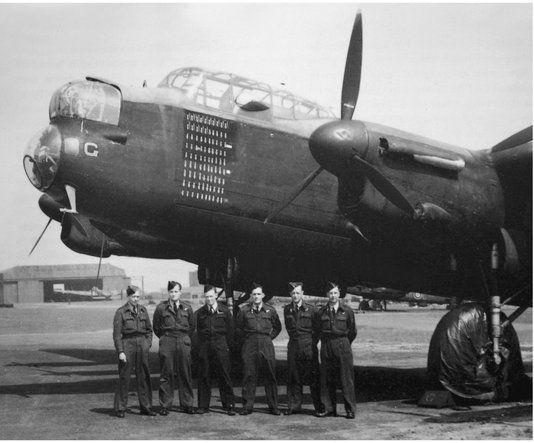
As the crews went out to their waiting Lancasters, Basil Feneron, Brown’s flight engineer, pretended to lift the Upkeep bomb attached to the underside of the Lancaster. Warrant Officer Abram A. Garshowitz RCAF, Astell’s Canadian wireless operator, chalked on their Upkeep, ‘Never has so much been expected of so few’. Superstitious as ever, David Maltby carried his old oil and grease stained ‘fore and aft’ hat to the aircraft. Mick Martin as usual carried his small toy koala bear. As a former Boy Scout, Gibson always wore their badge on his right wrist as a lucky charm. He was in a little pain from gout in his feet, probably brought on by the build up to the operation during which he would wear the Luftwaffe fighter pilot’s inflatable lifejacket he had acquired early in the war over the top of his sleeveless shirt. The German life preserver was less bulky than the RAF issue Mae West. A good omen was that Gibson’s Lancaster was coded ‘AJ-G’, which matched his father’s initials and whose birthday it was on this momentous day. Three years earlier, almost to the day, Guy Gibson’s Hampden had hit a balloon cable on a raid on Hamburg. ‘Hoppy’ Hopgood reportedly said to Shannon just before take off, ‘I think this is going to be a tough one and I don’t think I’m coming back, Dave.’ Hopgood is also reported to have said to Gibson in the time honoured service tradition, ‘Hey Gibbo. If you don’t come back, can I have your egg tomorrow?’ Gibson’s young wife Eve had once asked her husband if he was frightened of dying. He had thought for a moment before saying calmly, ‘no not really. All my friends are somewhere up there waiting for me. When the time comes I shall be quite pleased to see them.’ On another occasion driving back to their hotel in Wales on a beautiful evening with the sun just disappearing behind Snowdon, Gibson pulled to the side of the road, turned to Eve and said very seriously, ‘Eve, if anything should happen to me, I want you to promise me two things. First you will have a bloody good party and second, you will marry again as soon as possible . . . I would hate to think of you alone.’13
Joe McCarthy, commander of the second wave of five Lancasters assigned to attack the Sorpe dam, climbed into Q-Queenie. A bouncing bomb attack would be ineffective against this target because an earthen wall surrounded the dam’s concrete core so McCarthy’s crew would have to make a conventional bomb drop. However, Q-Queenie was found to be unserviceable. They rushed over to a spare aircraft, T-Tommy, only to find the card giving them precise compass deviations vital for accurately flying the carefully charted route was not in the cockpit. The chances of flying the Lancaster at low level (between 75 and 120-feet) through the myriad of flak emplacements and around night fighter bases, which lay between them and their target, were zero without it. Joe McCarthy climbed down from the cockpit for the second time that evening and with his Irish temper near to boiling point, headed for the hangar where he ran into Flight Sergeant G. E. ‘Chiefy’ Powell, 617’s Senior NCO. After a very short, expletive-filled, one-sided conversation, Powell took off on the double to the squadron’s instrument section. Unsure of what exactly he was looking for, he managed somehow to locate the route card! McCarthy finally got airborne 20 minutes behind his section.
The Lancasters took off in three waves. The first nine aircraft were to target the Möhne and then carry on to the Eder dam followed by other targets as directed by wireless from 5 Group Headquarters. The second wave of five was to act as a diversionary force and to attack the Sorpe and the final five were detailed as back-up aircraft with alternative targets at Achwelm, Ennerpe and Dieml dams if they were not needed in the main attacks. The first wave would fly in three sections of three aircraft about 10 minutes apart. After crossing the north-west coast of the Wash about five miles north-east of Boston, their route was across Norfolk past East Dereham and Wymondham near Norwich to Bungay in Suffolk and on to Southwold before heading out across the North Sea to Holland and on to the Möhne. The second wave would fly a different route to confuse enemy defences, to the Sorpe dam. This route was slightly further, via the Friesian Islands, so the second wave actually took off first. The third wave of five Lancasters was to set off later and act as a mobile reserve to be used against such dams as were still unbroken. Flight Sergeant Ken Brown’s crew were in one of the last five Lancasters (F-Freddie) as Dudley Heal recalls:
‘Soon after 21.00 hours we watched the first wave of nine aircraft take off in formations of three. This was most unusual for bombers. They lumbered over the grass (Scampton had no runways) with their bombs slung beneath the aircraft, and gathered speed slowly to clear the perimeter fence with little to spare. We silently wished them “God-speed”. The second wave had taken off a little earlier as they would follow a different route, rather longer, to distract the defences. We now had something like two hours to wait. I think most of us wrote a letter, just in case, collected our equipment and went down to dispersal to get organized in the aircraft and to chat to our ground crew. They had spent so many hours making sure that all was done that could he done to ensure that everything would work perfectly. We expressed our appreciation for their efforts. It was twenty past midnight when we, in our turn, lumbered across the airfield and climbed slowly into the air, as did the other members of the third wave. We set course according to the expected wind and headed for the coast. We would be in touch with base and had code words with which to signal to base the result of any attack we made. We flew as low as possible over the North Sea, 100 feet and less, to avoid attracting the attention of the enemy radar. At the Dutch coast we were a little off track so I made some adjustments. Steve kept me informed of any landmarks and I realized after a while that we had this tendency to drift off to starboard, so from then on I added or subtracted five degrees whenever the planned route called for a change of course. I was lucky that I had three pairs of eyes up front to report anything of interest to me – and other matters such as the loss of one Lancaster over Holland and another near the notorious Hamm marshalling yards. I was glad that we also had two pairs of eyes, which could see behind, should fighters appear. Our mid-upper gunner incidentally, was off sick and Dave Allatson, from a reserve crew, took his place. Both he and Grant, the rear-gunner, used their guns to good effect during this “op”.’
‘N for Nan took off at 21.59 into a clear sky,’ continues Ray Grayston. ‘There was no chit-chat. When you’re bombed up and you’re going out on a raid you’re on the alert from the time you take-off until you get back, if you get back. On this mission, the height we were flying at made us even more watchful. We were all on the lookout the whole time for churches, pylons, hills, and tall trees. It was hair-raising stuff. We were flying in threes and were only half a wingspan apart. We couldn’t use the radio, so we had to keep in sight of each other to be able to communicate by lights.14 There was a lot of flak; though most of it went into the sky above where the Germans expected us to be. We also lost one out of our three on the way in. B for Baker piloted by Bill Astell DFC was on our starboard side one minute and the next moment he’d gone. Just like that, gone. I believe he flew into an obstruction. Now that’s how close you were to sudden death. Whatever the hell he hit ripped the mine off his machine and killed them all.’ 15
The remaining Lancasters swung up the Rhine and arrived over the Ruhr and the first target, the Möhne dam. As Gibson flew over a hill he saw the lake and then the dam itself. In the moonlight it looked ‘squat and heavy and unconquerable ... grey and solid as though it were part of the countryside itself and just as unmoveable. We’d never practised anything like it.’
Forty-seven year old auxiliary policeman Wilhelm Strotkamp was on duty guarding the 6,000-kilowatt powerhouse below the Möhne dam. Towards midnight, while doing his rounds, he heard air-raid sirens in the distance. At first he took little notice, as air-raid warnings were not uncommon in the Ruhr in 1943. Then he realized that something was wrong; the RAF did not normally venture over the Ruhr on nights with a full moon but there was one tonight and the water in the lake was at its highest. Fear showed in the eyes of Wilhelm Strotkamp and his fear was soon confirmed when he heard the Lancasters’ engines, not droning past overhead, but swarming around the distant end of the lake; and one was getting nearer. He finished his round of the powerhouse as fast as he could, opened the entrance to the turbine room and shouted a warning to the engineer on duty. At that moment the gun on one of the towers opened fire and Strotkamp ran for cover in a cavity in the dam’s wall. Then the guns on both towers began non-stop firing. The noise of aircraft engines was now very loud and one thundered right over him, just missing the dam’s parapet so that the whole valley appeared to vibrate to the roar of its engines. It was Gibson’s Lancaster. A huge explosion tore at Strotkamp’s lungs and masses of water spilled over the top of the dam. Drenched to the skin, he began to run as he had never run before until he reached the north side of the valley, hundreds of yards away. He stopped breathless behind a tree half way up the slope and turned to gaze as though hypnotized at the enormous dam wall. The dam was still intact.16
Ray Grayston continues: ‘When we saw the location, we thought it was near impossible. The Germans were so certain no aircraft could attack it that they had not defended it with anti-aircraft batteries, which was the good news. The bad news was that the dam wall was at the head of a narrow, crooked reservoir in a steep, wooded valley with a sharp hill at either end and a peninsula jutting out in the middle. We would have to fly over a castle 1,000 feet above the reservoir, drop down like a stone, fly above the water at no more than 60 feet, hop over the peninsula, drop down again and release our mine. Then climb like fury to miss the hill at the far end.’
Gibson went in and sent his mine bouncing three times towards the concrete wall but it sank and exploded sending up a column of water. When the lake settled he saw that the dam had not been breached. The Upkeep mine had probably stopped and sunk just short of the dam, possibly having hit and broken the anti-torpedo nets thus clearing the way for the following mines. Flight Lieutenant Mick Martin DFC RAAF in P-Popsie watched the whole process. ‘The Wing Commander’s load was placed just right and a spout of water went up 300 feet into the air.’
The next two Lancasters missed. Brilliantly-coloured flak from guns in the sluice towers and lower dam wall hit M-Mother flown by Flight Lieutenant ‘Hoppy’ Hopgood.17 Tracers hit both port engines, the loss of the inner engine cutting off hydraulic power to the rear turret. ‘Feather Number 2’ ordered Hopgood. In the rear turret Pilot Officer Tony Burcher DFM RAAF who was from New South Wales, could hear the navigator telling Hopgood to come down lower and lower. Suddenly there was a whump and sparks and flames streamed past the Australian’s turret. ‘Christ, we’re on fire,’ shouted the flight engineer. One shell exploded in the cockpit and over the intercom the crew heard Sergeant Charles Brennan the flight engineer gasp, ‘Bloody Hell!’ He had been hit in the face and blood was streaming from the wound. Hopgood shouted grimly to his engineer, ‘don’t worry, hold your handkerchief against it.’ Then Hopgood checked the crew one by one; there was no reply from his front gunner, Pilot Officer George H. F. G. Gregory DFM. ‘He must have bought it,’ he thought. Flight Sergeant Jim Fraser DFM RCAF, the bomb-aimer, released the mine a fraction of a second too late. Bouncing across the lake it leaped over the low parapet and exploded with a vivid yellow flash on the roof of the powerhouse on the other side of the dam.
Hopgood clung grimly to the controls, well aware that he could not gain more height for the crew to bale out. He banked the doomed Lancaster round to the right, away from the valley and said to his crew, ‘For Christ’s sake get out’.
Fraser immediately grasped his parachute and pulled the escape hatch open. Realizing that he had little chance of survival if he baled out normally, he pulled the D-ring and when his parachute unfolded, he grabbed the silk under his arm and left the aircraft head first. The parachute opened fully just at the moment Fraser hit the ground near Ostonnen and walked away without a scratch and, as he was leaving the field, he was arrested by a local policeman and taken away into captivity.
Burcher desperately tried to swing his turret to the fore and aft position but the hydraulics were powered by a pump on the port inner engine, now a mass of flames. The turret could not be actuated hydraulically. ‘I’m trapped!’ Burcher thought. Then he cranked his disabled turret round by hand before scrambling into the rear of the aircraft to retrieve his parachute but what use was a ‘chute at nought feet? Just as he was putting his parachute on he saw Sergeant John Minchin, the 27 year old wireless operator from Bedford, struggling to clamber over the notorious main spar. Minchin, who had already signalled the other aircraft that they were badly hit by firing a red Very flare, managed to get the rear hatch open. Minchin’s face was contorted with pain, his right leg shot away. Burcher could have baled out and left him but he grabbed Minchin’s parachute, fastened it on the dying man and shoved him out of the rear door pulling his ripcord as he went but could see no chute opening. Burcher then pulled his own D-ring and plugged his intercom into the socket next to the rear hatch and gasped, ‘Rear-gunner baling out now!’ He just managed to hear Hopgood scream, ‘For Christ’s sake, get out of here’ before he was blown out with the billowing white silk in his arms as the Lancaster exploded. The Australian was found lying in a field, alive, but with a badly injured back after he hit the tail fin. Minchin did not survive the descent and Hopgood and the three other crew were killed when the Lancaster exploded and crashed about three miles beyond a village near the dam where it burst into flames and glowed fiercely throughout the rest of the attack. Almost all the crews saw the crash and there was a long silence on the radiotelephone, which had been freely used before.
Next it was the turn of the Australian with the ‘wild glint in his eyes and a monstrous moustache that ended raggedly out by his ears’. Mick Martin recalled: ‘There was still no sign of a breach. I went in and we caused a huge explosion up against the dam.’ But still the dam held. The mine had probably hit the water slightly off level and thus did not bounce straight and it had veered off to the left and exploded near the southern shore of the lake. Gibson flew just ahead of Martin and to his right to distract the German defences and told his own gunners to fire back. P-Popsie was hit but not badly damaged. The fourth and fifth hits on the dam by Dinghy Young and David Maltby finally breached the dam at 00.56 hours. Martin, who flew alongside Young to draw some of the flak, adds: ‘The dam at last broke. I saw the first jet very clear in the moonlight. I should say that the breach was about fifty yards wide.’18
Gibson, who was now flying on the far side of the dam to distract the gunners, recalled: ‘Nearly all the flak had now stopped and the other boys came down from the hills to have a closer look to see what had been done. There was no doubt about it at all. The Möhne dam had been breached and the gunners on top of the dam, except for one man, had all run for their lives towards the safety of solid ground. This remaining gunner was a brave man but one of the boys quickly extinguished his flak with a burst of well-aimed tracer. Now all was quiet, except for the roar of the water, which steamed and hissed its way from its 150 feet head. Then we began to shout and scream and act like madmen over the R/T, for this was a tremendous sight, a sight, which probably no man will ever see again. Quickly I told Hutch to tap out the message, “Nigger” to my station and when this was handed to the Air Officer Commanding there was (I heard afterwards) great excitement in the operations room. The scientist jumped up and danced around the room.
‘Then I looked again at the dam and at the water, while all around me the boys were doing the same. It was the most amazing sight. The whole valley was beginning to fill with fog from the steam of the gushing water. Down in the foggy valley we saw cars speeding along the roads in front of this great wave of water, which was chasing them and going faster than they could ever hope to go. I saw their headlights burning and I saw water overtake them, wave by wave and then the colour of the headlights underneath the water changing from light blue to green, from green to dark purple, until there was no longer anything except the water bouncing down in great waves. The floods raced on, carrying with them as they went – viaducts, railways, bridges and everything that stood in their path. Three miles beyond the dam the remains of Hoppy’s aircraft were still burning gently, a dull red glow on the ground. Hoppy had been avenged.’19
Gibson, Maudslay, Shannon and Knight flew on to the Dam Busters’ next target, the Eder Dam, the largest masonry dam in Germany at 1,310 feet wide, 138 feet high, 119 feet thick at the base and 20 feet thick at the top. The Eder Dam was not defended by guns but, as Shannon said, ‘The Eder was a bugger of a job’ lying in very difficult terrain along a valley and very hard to find. Shannon only found the dam after Gibson fired a Very light over it. Gibson called Astell but there was no reply and then ordered Shannon to make his attack in L-Love. Shannon tried three times to get a ‘spot on’ approach but was never satisfied. To get out of the valley after crossing the dam wall he had to put on full throttle and make a steep climbing turn to avoid a vast rock face. He described his exit with a 9,000lb bomb revolving at 500 rpm as ‘bloody hairy’. Then Gibson told him to take a ‘breather’ and Z for Zebra piloted by Squadron Leader Henry E. Maudslay DFC went in. He made two runs without releasing his mine and then Shannon made two more unsuccessful attempts before launching his weapon. Ray Grayston recalls:
‘It was way off centre. Then Maudslay made his run and it was a disaster. His mine bounced over the dam wall and exploded in the valley below. Gibson called him up to ask him if he was all right and all he said was, “I think so” and those were the last words we heard from him. We think he flew on for a while before crashing or being shot down.20 So then it was us; the last of the main wave of nine aircraft. I suppose we were lucky really. We did one dummy run and got it pretty well right. So we circled and came in again at about 800 feet. As flight engineer, I was responsible for the air speed. I’d tumbled to the fact that if I chopped my engines right back and let them idle then she would glide down to 60 feet. That’s what I did – with my fingers crossed that they’d open up again. At 60 feet I slammed the throttles forward and they did. The machine took a few moments to level off and seconds later we released the mine. Immediately afterwards we went into a blistering climb, with engines hammering up through the emergency gauge to get enough power to get out the other end. As we banked, we looked back and, by God, we’d been spot on, absolutely spot on. A huge column of water had been thrown up to about 1,000 feet. We had hit bang in the middle of the dam and had blown a hole straight through it. The bottom came out, then the top fell away and that was it. There was great excitement among the crew about our success. We were all on a high for a few minutes.
Gibson described the breach, ‘as if a gigantic hand had pushed a hole through cardboard’. Banking below him, Les Knight reported a ‘torrent of water causing a tidal wave almost 30 feet high’. The crew of N-Nan watched in awe as car headlights in the path of the water turned from bright white to murky green to nothing. Melvin Young’s nickname ‘Dinghy’ was transmitted back to 5 Group Headquarters to be received with yet more celebration.
The Lancasters flown by Flight Sergeant Ken Brown and Flight Lieutenant Joe McCarthy headed for the 226 feet high Sorpe dam. Dudley Heal says:
‘Some time before we were due to reach the Möhne dam, ‘Hewie’ reported that both it and the Eder had been breached and we were to aim for the Sorpe. We changed course, much encouraged by this news. Barnes Wallis’ bomb was designed to be released by an aircraft heading over water towards a dam, the bomb then bouncing over water (like a pebble skimmed over the sea from the shore), hitting the dam and sinking to 20 feet, when it was set to explode. It had been realized quite late in the day that this was effective if the dam was built of concrete but no good for an earth dam, as the Sorpe was. Our instructions, therefore, were to fly over and along the line of the dam at 60 feet, releasing the bomb as near the centre of the dam as we could.’
Arriving over the valley, McCarthy initiated a diving attack on the dam nestled at the bottom of two steep hills. Coming over the top of one hill, using full flaps to keep the speed of his 30-ton Lancaster under control, McCarthy dived down the slope toward the 765-yard long dam. To escape he had to apply full power to his four Packard-built Rolls-Royce Merlins and climb at a steep angle up the side of the second hill. And if that wasn’t difficult enough, a thick mist was filling the valley as he arrived. The blinding moonlight turned the mist into a writhing phosphorescent pall, which made it extremely difficult to judge the bomber’s height above the lake. On the third attempt to locate the target, McCarthy almost flew T-Tommy into the water. It was not until the tenth run that bomb-aimer, Sergeant George ‘Johnny’ Johnson, was satisfied and released the bomb from a height of just 90 feet. The weapon exploded squarely on top of the parapet, damaging and crumbling for more than 50-yards the crown of the earthen wall.
Shortly thereafter Flight Sergeant Ken Brown attacked the dam. His trip was quite eventful. Even before he reached the Sorpe his gunners shot up three trains en route. They were fired on by flak and hit in the fuselage but suffered no serious damage to the aircraft. Dudley Heal recalls:
‘We found the Sorpe dam with no trouble and could see it quite clearly at the northern end of the Sorpe River. The ground rose steeply on each side, heavily wooded, with a church steeple on our line of approach, all, except the river and dam swathed in mist. The only good point appeared to be that there were no defences. After two or three abortive runs, Ken decided to try the Wigsley “gambit” of dropping flares along the approach route. We could see that the top of the dam was already damaged.21 Eventually avoiding the steeple, dropping the bomb at 60 feet and pulling up sharply over the wooded hill we saw our bomb go off, causing an enormous water spout and an extension of the damage already done.22 After a good look at it we set course for base, Hewie transmitting “Goner”, indicating that we had attacked but not breached the dam. Our homeward track took us near the Möhne dam and we stared in awe at the breach through which the Möhne river was rushing down the valley. After that the journey back was uneventful until we approached the Dutch coast and could see the sea ahead. Then, without warning we were caught and held by searchlights and blasted by gunfire. Even in my curtained compartment I was blinded by those searchlights so how Ken and Basil coped I shall never know, Ken even put the nose down although we were already flying as low as seemed possible and we flew on. Then we were over the sea and I could see shells whizzing over our heads and hitting the water. The searchlights lost their effect and Ken handed over the controls to Basil, while he and I examined the holes in the fuselage. The starboard side of the aircraft at just above head height was riddled. I think there is little doubt that had we remained at the same height, or even attempted to climb, it would have been disastrous. (We learned later that Squadron Leader Young had gone down earlier at this same spot.)23 Back at Scampton we were the last aircraft but one to touch down. Flight Sergeant Townsend landed about half-an-hour later, having attacked the Ennerpe Dam but, like us, failed to breach it.’24
The ‘last resort’ targets, the Lister (Schweim) and Dieml dams were not attacked. However, the damage inflicted in the first two attacks proved the operation’s success. The surge of water from the Möhne and Eder dams knocked out power stations and damaged factories and cut water, gas and electricity supplies. As many as 1,300 civilians, including about 500 Ukrainian women slave labourers died. Eight Lancasters were lost, 53 men were killed and three were captured.
A member of the Hitler Youth found Tony Burcher, who had been blown out of his burning Lancaster over the Möhne dam. The Australian rear-gunner was taken to a police station and locked up in a cell. Lying on a hard wooden bed in agony from his broken back, his immediate problem was to slake his thirst. He called the Obergefreiter guarding his cell door and shouted, ‘I want a drink of water!’
The Obergefreiter grunted, ‘You want wasser?’
Burcher groaned, ‘Yes, wasser – please’.
The Obergefreiter left, only to return with his Feldwebel who looked at the dishevelled and badly injured figure. He went out and returned with a Hauptmann. ‘So, you want a drink of water, do you? You English [sic] bastard. Thanks to you and your comrades, there is no drinking water any more!’
A broad grin creased Burcher’s face. So the others had done it after all.25
Ray Grayston. ‘Gibson called up and said simply, “OK fellas, that’s your job done. No hanging about, you know. Make your way home.” That was easier said than done, of course, because the Germans had woken up to what we’d done and they were out to get us. And they did get a few.’26
At Scampton Harry Humphries heard on the radio G-George, Gibson’s aircraft, asking permission to land. Among the first aircrew the adjutant saw was an excited David Maltby. He called it a ‘terrific show, absolutely terrific. Never seen anything like it in my life.’ Then quite bluntly, ‘Hoppy’s bought it. Shot down over the target and I am afraid that we have lost several others too. Some didn’t even get there and I am sure Dinghy Young got into trouble and maybe Henry Maudslay’ he told Humphries. ‘We pranged it though, Adj; Oh boy did we prang it! Water, water everywhere. “Gibby” was everywhere. How the hell the Jerry gunners missed him I don’t know . . .’ More crews arrived back and a celebratory party was getting under way in the Mess as Humphries made his way to the control tower. There the grim reality sank in. ‘I looked at the blackboard and thought, “Bloody hell”, eight aircraft missing with all their crews’. Of course I’d experienced losses before but not on this scale. To think that 53 men, some of whom you’d been with in the Mess only a few hours before, were gone was a blow. When I saw Gibson in the Mess he said, ‘It’s a bad show Humph, but I think it’s probably been worthwhile – or at least I hope so.’ Humphries felt like a ‘wet dishcloth. It affected me deeply. It was draining and depressing. But you had to get on with it. People would want to know about their loved ones. I just collapsed like a pricked balloon but at the same time made sure that the first milestone in the history of 617 Squadron was duly recorded.’27
The results of the operation were radioed to 5 Group Operations Room at Grantham where Air Chief Marshal Arthur ‘Bomber’ Harris, Barnes Wallis and others were waiting for news. On hearing the code word, Wallis, who until then had been morose, punched the air with both fists. Harris turned to him and said: ‘Wallis, I didn’t believe a word you said when you first came to see me. But now you could sell me a pink elephant!’ The euphoria became more muted when news of the losses came in. Of the 133 men who flew on the raid, 56 failed to return.
N-Nan did make it back, though not without incident. Ray Grayston says:
‘We were picked up by searchlights and machine guns and it was so bad that we thought, “This is it”. We were so low that the searchlights were beaming straight into the cockpit and blinding Les, who couldn’t see a thing. But luckily our Brownings were loaded with 100 per cent tracer bullets, and when “Doc” Sutherland opened up from the front turret, it was like two streams of liquid lightning. Then Harry O’Brien in the rear turret opened up with four Brownings. With all these streams of lightning flying at them, the Germans panicked and ran away from their guns. So we got away with it. If they had stood by their guns, we’d have been shot down for sure. We landed back at Scampton at 04.20 in the morning and went straight into debriefing. All the nobs and senior officers, as well as Barnes Wallis, were there waiting to talk to the pilots, but they didn’t have much to say to us. The senior officers didn’t mix with the fry. We got egg and chips in our Mess, with rum and coffee. But all we really wanted to do was get into our sacks and go to sleep for a few hours. We had been in the air for almost six-and-a-half hours. The senior officers celebrated for weeks as they visited various messes around the country. Les Knight acted as taxi pilot most of the time because he didn’t drink.’
Dudley Heal adds:
‘The importance with which the powers-that-be regarded this operation is demonstrated by the fact that Air Chief Marshal Harris, Head of Bomber Command, attended the debriefing of the returning crews, as did Barnes Wallis and the Station Commander, Group Captain Whitworth. I don’t think any of us went to bed that night. We were all given a week’s leave now and it was during that week that IT happened. Halfway through the week I was sitting at the tea table with my parents and my brother, Les, (my other brother, Don, being at sea) when the doorbell rang. Being nearest, I got up and answered it. It was a telegram for me from Scampton. Back in the living room I held it up and said, “I hope that isn’t a recall from leave.” I opened it, everybody watching me apprehensively and read it aloud – it said, “Heartiest congratulations on award of the Distinguished Flying Medal. Wingco.” We were all speechless. Then my father, who was Secretary of the British Legion Club in Gosport, said, “We’re all going down to the Club tonight” – which we did. Back at Scampton after the leave I found that Steve had also received the DFM while Ken had been awarded the CGM (Conspicuous Gallantry Medal). Basically, awards had been given to pilots, navigators and bomb-aimers who had reached and attacked their targets accurately, whether or not they had been breached. Where other members of the crews, gunners for example, had distinguished themselves in some way they could also have been decorated. The matter of rank was always a problem in this connection. Commissioned pilots had received the DSO, a most prestigious decoration, as Ken knew. Non-commissioned pilots received the CGM, which few people had heard of at the time – similarly, if I had been commissioned I would have received the DFC. I think Ken was, as a Canadian, miffed about this class distinction although he did realize that he had received one of the rarest “gongs” of all. For my part I could not have been more thrilled if I had been awarded the Victoria Cross.
‘The raid received maximum publicity. Scampton was honoured by a visit from Their Majesties the King and Queen and the decorations were presented by the Queen, (the King being in Africa), at a Special Investiture, 22/6/43 – to quote from RAF records.’
In the message he sent to the crews, congratulating them on their brilliant work, Air Chief Marshal Harris said: ‘Please convey to all concerned my warmest congratulations on the brilliantly successful execution of last night’s operations. To the air-crews I would say that their keenness and thoroughness in training and their skill and determination in pressing home their attacks will forever be an inspiration to the Royal Air Force. In this memorable operation they have won a major victory in the Battle of the Ruhr, the effects of which will last until the Boche is swept away in the flood of final disaster.’
Congratulations came from the War Cabinet. They were addressed to Sir Arthur Harris by the Secretary of State for Air, who wrote: ‘The War Cabinet has instructed me to convey to you and to all who shared in the preparation and execution [of] Sunday night’s operations – particularly to Wing Commander Gibson and his squadron – their congratulations on the great success achieved. This attack, pressed home in the face strong resistance, is a testimony alike to the tactical resource and energy of those who planned it, to the gallantry and determination of the aircrews and to the excellence British design and workmanship. The War Cabinet has noted with satisfaction the damage done to German war power.’
It was, as Wallis said, ‘the most amazing feat the RAF ever had or ever could perform’. The massive Möhne, Eder and Sorpe dams served the industrial Ruhr Basin and more than a dozen hydroelectric power plants relied on their waters. So did foundries, steel works, chemical plants and other factories fuelling Germany’s war effort. Winston Churchill had authorized the operation and he used it as a coup to seek greater support from the USA. At the time, most of President Roosevelt’s advisers were committed to targeting Japan first. The ‘Dam Busters’ proved that the war in Europe was being prosecuted dramatically well. Two days after the operation, Churchill was given a standing ovation at the Trident Conference with Roosevelt in Washington. Gibson, who already had two DSOs and two DFCs was awarded the VC for leading the ‘Dam Busters’ and many of the officers got DFCs and DSOs.28 Ray Grayston adds: ‘The officers got their invitations to Buckingham Palace. We thought we’d get something sooner or later, but it never happened.’
‘That over’, continues Dudley Heal, ‘617 settled down to work again – not, as most of us expected, to the hammering of German cities and industries but to specialized targets which needed accurate bombing by a small force. In August 617 moved to Coningsby, nearby, where there were hard runways which Scampton lacked. Late in August it was noted that massive concrete structures were springing up in Northern France. They were, of course, sites for the launching of V-1 and V-2 weapons, which would require accurate bombing with the biggest possible bombs. They would be 617 targets for the foreseeable future. 617, meanwhile, had moved again, this time to Woodhall Spa, near Coningsby, where we would be the only squadron. Accommodation was temporary at first and the nearby Petwood Hotel, taken over by the RAF, was our billet. In the hurly-hurly of removal we found beds where we could and the first night I shared a room with members of another crew, the captain being Flight Lieutenant [T. V. ‘Tom’] O’Shaughnessy. The next day [20 January 1944] they went off for some low level flying and bombing practice, ending up by flying into a rise in the ground off the beach. That night I shared a room with six empty beds.29
‘It was in February 1944 that Ken began to have problems with his hearing and was occasionally unable to make out what was being said over the intercom. He reported to the MO, as a result of which, Ken was grounded for the time being for medical reports. We were given the choice of flying with another pilot or of being ‘rested’. This was difficult off the cuff. We had not yet completed the required 30 ops but we had been with 617 for nearly a year, not forgetting our time with 44 Squadron and with Coastal Command, altogether 16 months under operational conditions. Added to this was the reluctance to change pilots – I said I would prefer to be rested. The other members of the crew felt as I did. It was not long before our postings came through, mine being to Bruntingthorpe, near Rugby. I said “Au Revoir” to the other members of the crew rather than “goodbye”. The normal rest period was six months. It was now February 1944, and the war seemed likely to continue indefinitely.
‘At Bruntingthorpe I would be teaching Gee to would-be navigators under classroom conditions. This left the evenings free, an unusual luxury, and after a while I began to spend some of those evenings, with two or three fellow teachers, cycling to a village called, I swear, Willoughby Waterless, where we would play darts in the only pub, making friends with the locals. Occasionally we would cycle back to camp with a bag containing half a dozen eggs slung over the handlebars. These, with our names pencilled on them were handed in to the Officers’ Mess kitchen and eventually served up for our breakfast. I was now a Flying Officer, playing darts instead of helping the war effort. When I was approached by one of the pilots at Bruntingthorpe later in 1944 and asked if I would go back on ‘ops’ with him I did not hesitate for long. I had to smile when he said he would be joining a special squadron. The new squadron was 214 in 100 Group (Radio CounterMeasures). I agreed to join Flight Lieutenant “Johnny” Wynne DFC and soon we had a complete crew of ten and joined 214 Squadron early in 1945.’
Twenty-two veterans of the Dams raid were killed on ops. Guy Gibson was sent to America as an air attaché but he begged the Air Ministry to allow him to return to operations. At Woodhall Spa Gibson persuaded the CO of 627 Squadron to let him fly a Mosquito, against his better judgement, for the operation to Rheydt on the night of 19/20 September 1944 when he was to act as controller for the raid. It would appear that Gibson did not exactly endear himself to some of 627 Squadron’s members but then 617 Squadron has always engendered fierce rivalries. Squadron Leader Frank W. Boyle DFC* RAAF, a 627 Squadron navigator, encountered Gibson a few times at Woodhall. He reported that, ‘he seemed a lost soul, particularly on the last occasion when he dropped in at the Mess. He was upset by the award of Cheshire’s VC (and I would understand that after his own VC for the Dam Busters raid), but he reckoned too forcibly and bluntly that, on the basis of Cheshire’s citation, he would get a bar to his VC.’ Fellow 627 Squadron navigator Wallace ‘Johnno’ Gaunt DFC recalled that, ‘Guy Gibson was a brave man and did a good job leading the Dam Busters but he came back from the USA too full of his own importance. He walked into our mess one night and everybody was talking, playing liar-dice, drinking, etc., so he called out, “Don’t you know who I am?” He got very annoyed, as he had expected everyone to stand up and cheer him. In the end he was de-bagged and put outside. A week or so later he did not return.’30
While returning over Walcheren after the op to Rheydt, both engines of Gibson’s Mosquito cut (according to Anton de Bruyn, a night watchman at the local sugar factory in Steenbergen, who witnessed the incident) and the aircraft crashed, killing him and his navigator 23 year old Squadron Leader James Brown Warwick DFC, an Irishman and veteran of two tours. Steenbergen is a small rural town in the southern Dutch province of North Brabant.
On the Van der Riet farm in the West Graaf Hendrik Polder, the family was asleep. It was about midnight when they all awoke, startled by a terrible noise, followed by a dreadful bang. Leaping from their beds, they rushed to a window overlooking the fields in front of the farm, from which direction the noise seemed to have come and some way off they could see a reddish glow and a tongue of flame. It was difficult to estimate the distance due to a layer of ground fog over the pasture. They assumed that it had been a bomb and after gazing for a while, recovering from the shock and seeing the flames die down, they returned to bed. Next morning Mr Van der Riet went out to start his daily work. He crossed to a shed to collect his tools and to his horror he found a human body slumped against the wall. Upon closer inspection he could see that it was in fact just a limbless trunk with the head hanging loosely. Utterly shocked, he rushed back to inform his wife and sons of his discovery and they too were filled with horror. Van der Riet decided to notify the Chief of Police of Steenbergen, Mr Van der Kassteele who, in turn informed the German Ortskommandant who immediately ordered the farm and crash site sealed off. After a lengthy search two Dutch Auxiliary policemen, Tiny Van Mechelen and Chris Stoffelen and another helper, eventually found two legs and two arms and realized that a second flyer had been in the aircraft when they came across part of a third foot. As the limbs were being placed in a basket, Tiny Van Mechelen noticed a gold ring on one of the fingers. To prevent the Germans from taking it, he tried to remove it but the hand was too swollen, so with his penknife he sliced off the finger and removed the ring, which he slipped into his pocket. Upon returning to the field, they found a piece of skull, a severed hand and a leather portfolio. Upon closer examination of the ring later, they could clearly see the name ‘Warwick’. J. B. Warwick and ‘an unknown soldier’ were buried in Steenbergen cemetery. In February 1945 the name of Guy Gibson was added to the wooden cross and in the spring of that year the inscription was altered to ‘Wing Commander Guy Gibson VC DSO DFC and 156612 Squadron Leader J. B. Warwick DFC 19-9-44’.31
The most likely theory for the accident is that the fuel transfer cocks were not operated in the correct sequence and the engines ran out of fuel.32
Notes
1
Sergeant Austin Williams, the original front gunner, was sent to the Air Crew Refresher Course in Brighton for disciplinary reasons and when he returned at the end of May he was assigned to the crew of Pilot Officer William G. Divall who did not fly the Dams raid because of sickness among the crew. (Divall’s crew and one other pulled out at the last minute which made selection for the Dams raid easier as there were only 19 serviceable Lancaster specials and 19 crews able to fly). Williams was KIA on 15/16 September 1943 along with the rest of Divall’s crew on the Dortmund-Ems Canal raid. The Dambuster Who Cracked the Dam: The Story of Melvin ‘Dinghy’ Young by Arthur G. Thorning (Pen & Sword, 2008)
2
Flying For Freedom: Life and Death in Bomber Command by Tony Redding (Cerebus 2005).
3
We Will Remember Them: Guy Gibson and the Dam Busters by Jan van den Driesschen with Eve Gibson (Erskine Press 2004).
4
On 13 May it was back to Pilsen for another try at the Skoda works and during the evening, three days later, two vics of 617 Squadron Lancasters went over at low level. When he got back to the Mess Chandler was told that Scampton had been phoning up for him as Dinghy Young’s gunner had gone sick. See Tail Gunner: 98 Raids in World War II by Chan Chandler DFC*, USSR Medal of Valour (Airlife 1999).
5
Burpee received his commission shortly after joining 617.
6
Thorning, op. cit.
7
Priscilla Lawson, a graduate of Brearley School, New York and Bryn Mawr College. Thorning, op. cit.
8
By 24 April the number of crews was reduced to 21 and Lovell’s returned to 57 Squadron and were replaced by that of Sergeant William G. Divall, 21, from Thornton Heath, Surrey. Flight Sergeant Lanchester and crew had opted to leave 617 Squadron, as Guy Gibson wanted to replace the navigator. The Dambusters by John Sweetman, David Coward and Gary Johnstone (Time Warner 2003)
9
Thorning, op. cit.
10
To achieve the right altitude, two Aldis lamps fitted to the fuselage were played on to the water until they met in a figure of eight at precisely 60 feet. Judging the distance from the target proved equally simple, by making use of the twin towers, which flanked both the Möhne and Eder dams. A triangular wooden ‘sight’ was made with a peephole at the apex and nails at the other two ends. The bomb-aimer would peer through the peephole and when the nails lined up with the towers, release his mine.
11
Living With Heroes: The Dam Busters by Harry Humphries (The Erskine Press, 2003)
12
ibid.
13
Van den Driesschen and Gibson, op. cit.
14
Pilot Officer Geoff Rice flew so low that his Lancaster hit the sea before crossing the enemy coast and he lost its bomb. Rice aborted and flew back on two engines. W-William flown by Flight Lieutenant Les Munro RNZAF was damaged by flak over Vlieland on the Dutch coast and was also forced to abort. Harry Humphries, op. cit. said, ‘first back was Les Munro. His intercom had been shot up. He arrived back with his bomb still aboard to the consternation of his ground crew. Then came Geoff Rice. After that someone had the bright idea of tuning in the radio to pick up the returning aircraft.’
15
Astell’s navigator seems to have mistaken their position near Roosendaal. Astell changed track to a southern direction but after a while returned to his original course. This manoeuvre caused them to fall half a mile behind Young and Maltby. They were never seen again. See van den Driesschen and Gibson, op. cit. Astell’s Lancaster was fired on by flak guns at Dorsten and was probably hit by shells after delaying when the others turned at a pinpoint. Two lines of tracer came up and Astell’s gunners returned fire but B-Baker hit high-tension cables and crashed in flames near Marbeck, 3 miles SSE of Borken, Germany. There were no survivors.
16
Van den Driesschen and Gibson, op. cit.
17
There were six 20mm guns positioned on the Möhne dam, two of which were put out of action by bomb blast. One gun on the dam wall and the three near Günne continued throughout the remainder of the attack, putting up sporadic resistance against other aircraft even after the dam had been breached. A week later 23 year old Unteroffizier Karl Schütte who commanded the flak detachment and who helped man the 20mm gun on the North Tower, was decorated with the Iron Cross (Second Class). During the fourth attack, the North Tower gun failed after a premature explosion in the barrel. Helmuth Euler recalled that: ‘We bashed away with all our strength trying to clear the jam with a hammer and a metal spike but it was no good. When it came to the fifth attack we did what we’d so often done in training – let loose with our carbines. There was just one flak gun on the road still firing at the aircraft – now they had it all their own way. There was a muffled explosion and when the spray had cleared a bit I had a quick look over the parapet down at the dam wall and shouted, “The wall’s had it”. The gunners didn’t want to believe it at first but the breach got visibly bigger.’ See The Dams Raid Through the Lens by Helmuth Euler (After the Battle, 2001), Barnes Wallis’ Bombs: Tallboy, Dambuster & Grand Slam by Stephen Flower (Tempus, 2002) and Dambuster – A Life of Guy Gibson VC by Susan Ottaway (Pen & Sword, 1994).
18
When Maltby attacked he saw the small breach in the centre made by Young’s Lancaster and noticed that there was crumbling along the crown so he turned slightly to port but remained straight and level, and their mine was released. It bounced four times and struck the wall and, according to the quote in the Daily Mail, 18 May 1943, ‘sent up water and mud to a height of 1,000 feet. The spout of water was silhouetted against the moon. It rose with tremendous speed and then gently fell back. You could see the shock wave at the base of the jet.’ Six minutes after Maltby’s attack, the breach was confirmed. In the end Young’s breach in the centre and Maltby’s to the left were joined together by the force of the escaping water to make a single breach 76 metres wide. See Breaking The Dams: The Story of Dambuster David Maltby & His Crew by Charles Foster (Pen & Sword, 2008)
19
Enemy Coast Ahead by Wing Commander Guy Gibson VC DSO* DFC*.
20
He did. Badly damaged over the Möhne by the detonation of his own Upkeep weapon, Maudslay crashed near the German border between the Dutch village of Netterden and the German hamlet, Klein Netterden, 1-miles east of Emmerich, Germany. There were no survivors.
21
Brown made eight runs on the Sorpe but he was still not happy about dropping his mine. On the ninth he dropped incendiaries on the banks of the lake to try to identify the Sorpe dam through the swirling mist. On the eleventh run they saw the dam and Brown’s mine was released. The mine exploded on impact, as it was dropped while flying across the dam and not dropped towards it in the planned method, without it bouncing off the surface of the water. The explosion caused a crumbling of 300 feet the crest of the dam wall.
22
The Germans, unsure of the dam’s integrity, were forced to drain off over 50 per cent of the reservoir’s capacity until the structure could be inspected and repaired.
23
Young’s Lancaster was hit by flak at Castricum-aan-Zee, Holland and crashed into the sea with the loss of all the crew.
24
Townsend was ordered to attack the Ennerpe Dam on the Schelme River. He made three runs on the dam before his bomb-aimer, Sergeant Charles Franklin DFM, was satisfied. Their bomb was released, bounced once, and exploded 30 seconds after release. On leaving the target much opposition was encountered but, by great determination on his part, plus the navigational skill of Pilot Officer Cecil Howard from Western Australia, O-Orange made it safely back, landing at 06.15. Most of the latter part of the homeward trip was flown in broad daylight.
25
Van den Driesschen and Gibson, op. cit.
26
Pilot Officer W. H. T. Ottley’s Lancaster was hit by flak near Hamm as they started to change their route when told to proceed to the Lister dam. Ablaze and with the outer port engine dead, Sergeant Fred Tees, the rear-gunner with 21 operations to his credit, heard Ottley say apologetically, ‘Sorry boys. I’m afraid we’ve bought it.’ Their Lancaster crashed just outside the town of Heesen, north-east of Dortmund and blew up. The impact separated the tail of the aircraft from the fuselage and threw Tees out of his rear turret. Severely burned and barely conscious he was found by a local farmer who took him to a flak battery nearby. In hospital doctors found several shell splinters in his back. He was later incarcerated in Stalag Luft V near the Lithuanian border. See van den Driesschen and Gibson, op. cit. The Lancasters piloted by Byers, Burpee and Barlow, who hit high-tension cables on the outward flight at Haldern, 2½-miles ENE of Rees, were also lost. Barlow’s Upkeep mine did not explode and next morning, assuming that it was a ‘fuel tank’ the Mayor of Haldern posed proudly beside the enormous weapon. He nearly passed out when told that the ‘fuel tank’ was in fact a heavy bomb! Two political prisoners were then forced to defuse the ignition, whereupon the mine was transported to Berlin for examination by German experts. Van den Driesschen and Gibson, op. cit. Pilot Officer V. W. Byers must have realized that he was off track when crossing Texel in the Frisian Islands, not Vlieland as was briefed. While climbing to get a coastal pinpoint, his Lancaster was hit by flak and the aircraft disappeared into the Waddenzee. Only Flight Sergeant James McDowell RCAF, the rear-gunner, was washed ashore and the Germans in Harlingen later buried him. Pilot Officer L. J. Burpee also climbed briefly after crossing the Dutch coast, to find a landmark and was hit almost at once by flak defending Gilze-Rijen airfield. Out of control the Lancaster crashed onto a barracks block on the airfield and exploded.
27
Humphries, op. cit.
28
Brown was awarded the CGM. Joe McCarthy, David Maltby, Mick Martin, Dave Shannon and Les Knight were awarded the DSO.
29
O’Shaughnessy could not find his gunners so he took off from Scampton at 19.30 hours without them in ED 918 AJ-F (the Lancaster flown on the Dam Buster’s raid by Flight Sergeant Brown). He crashed 35 minutes later on the beach at Snettisham in Norfolk when he hit the sea, diving from 600 to 60 feet using spotlights to gauge the height of the dive. O’Shaughnessy and Flying Officer A. D. Holding were killed. The W/Op and the bomb-aimer were badly injured.
30
See At First Sight; A Factual and anecdotal account of No.627 Squadron RAF, researched and compiled by Alan B. Webb, 1991.
31
Van den Driesschen and Gibson, op. cit.
32
Many crews in 627 Squadron at the time have an opinion about why Gibson crashed. John Watt, a 627 Squadron Mosquito navigator, says, ‘Between the two seats and to the rear of the pilot’s there was a box on which was mounted two fuel transfer cocks (FTCs). Normally the two outer petrol tanks were run dry before the engine fuel supply was switched to the main tanks for the rest of the flight. When each outer tank was nearly empty a red warning light would come on and the appropriate FTC had to be operated immediately. Being tucked away behind his seat, it was not easy for the pilot to move these FTCs so the job was done by the navigator, who had to grope for the levers in the dark while hampered by a bulky flying suit, Mae West lifejacket, parachute harness and oxygen mask. I remember that we were pointing east at around 20,000 feet somewhere in the region of Lübeck – a very unfriendly area in 1944(!) when Johnny informed me that the port outer tank was nearly dry. When the red warning light came on I fumbled for the lever and turned it over to the main tank. Shortly afterwards the starboard light came on and that engine supply was similarly transferred to the main tank. Unfortunately the starboard light did not go out, but the port warning light appeared again. Both engines then decided that they could not operate efficiently without petrol and gave up trying! After pushing the nose down to gain airspeed to avoid falling out of the sky, Johnny’s language made me realize that I had switched the starboard engine back on to the empty outer tank while the port engine quietly ran out of essential fuel. Having very smartly returned the two FTCs to the correct setting we were fortunate to have the engines pick up again without the possible problem of an airlock in the fuel system.’ It was the opinion of many in 627 Squadron at the time that this is precisely what happened to Guy Gibson and his navigator, but unfortunately they were not quite so experienced on Mosquitoes. See Webb, op. cit.
Chapter 7 (cont.): Berlin or Bust
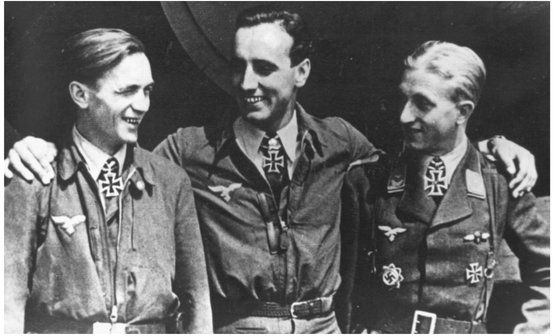
The most successful nightfighter crew ever. L – R: Oberfeldwebel Wilhelm Gänsler, bordschütze (gunner), Oberleutnant Heinz-Wolfgang Schnaufer and Leutnant Fritz Rumpelhardt, Bordfunker (radar operator). By August 1943 Schnaufer’s score had reached twenty-three and by mid-December he had scored forty victories. In 1944 he scored sixty-four victories, a feat unequalled by any other night-fighter pilot. In 1945 he scored fifteen victories, including nine in a single twenty-four-hour period on 21 February, to reach a final score of 121. Schnaufer shared 100 victories with Fritz Rumpelhardt, twelve victories with Leutnant Baro and eight with Erich Handke. Wilhelm Gänsler shared in ninety-eight of Schnaufer’s victories. (Ab A. Jansen)
On 21/22 February 1944 Oberfeldwebel Günther Bahr of 1./NJG 6 flying Bf 110 2Z+IH with Feldwebel Rehmer as Bordfunker and Unteroffizier Riediger as Bordschütze shot down seven Lancasters of the Worms force in quick succession 2034 – 2050 hours, all on their bombing run to the target with their bomb loads still on board. Bahr survived the war having scored thirty-five night and two day victories. He was also awarded the Ritterkreuz. (Günther Bahr)
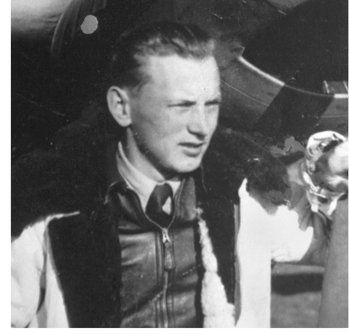
On 24/25 February 1944 209 Tame Boars destroyed thirty-one Lancasters and Halifaxes of a 734 strong force raiding Schweinfurt. Hauptmann ‘Hugo’ Eckart-Wilhelm von Bonin, Ritterkreuzträger and Kommandeur of II./NJG 1, seen here with his regular Bordfunker Oberfeldwebel Johrden destroyed two Viermots for his 28th and 29th kills. His 28th Abschuss was Lancaster III JB721 of 156 Squadron flown by Flight Lieutenant J. A. Day DFC, which crashed at Briey, NE of Metz at 2136 hours. Day and one other of the crew were PoW while five men died. Day fractured a leg and he was later repatriated. von Bonin was decorated with the coveted Ritterkreuz on 5 February 1944 and he ended the war with thirty-two victories. Two of his brothers, also serving in the Luftwaffe, were killed on the Eastern Front and his father, Oberst Bogislav von Bonin, was captured by the Russians in March 1945 and never seen again. (Hans Grohmann)
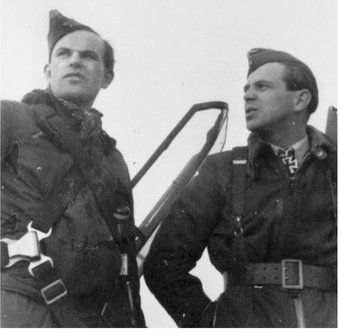
The 101 Squadron aircraft equipped with ABC were distinguishable by their large masts above the fuselage as here on Lancaster B.I ME590/SR-C. On 26 February 1944 Flight Sergeant R. Dixon piloted the aircraft back from Augsburg, where at 20,000 feet his aircraft was hit by flak, which fractured hydraulic lines and they were attacked by an Me 110, whose fire perforated the elevators before the Lancaster could evade. Dixon crash-landed at home base, Ludford Magna. The crash wrecked part of the FIDO (Fog Investigation and Dispersal Operation) pipe-work in the process. Burning petrol and allied fuels, this apparatus successfully cleared fog from runways and was responsible for the safe landing of many bombers, particularly in the winter of 1944 – 45 when fifteen airfields were then equipped with FIDO. 101 Squadron’s aircraft normally carried a bomb load for the briefed target but were spread throughout the bomber stream. ME590 was repaired, converted from Mk I to Mk III and pensioned off to a Conversion Unit.
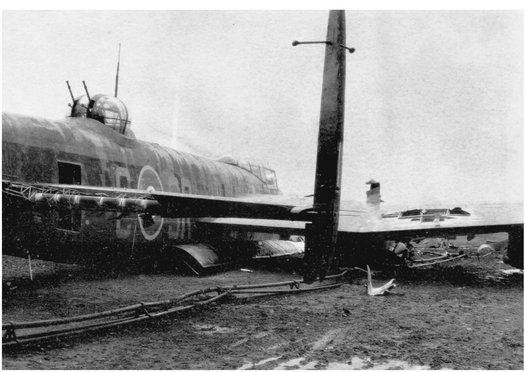
Warrant Officer A. F. ‘Red’ Browne DFM, rear gunner in Flight Lieutenant Ron Walker’s crew in 57 Squadron. He is wearing a bright yellow Taylor Suit, which had in-built buoyancy and electrical heating to help prevent gunners from freezing in their uninsulated and unheated turrets.
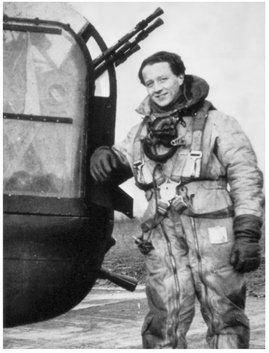
Pilot Officer Freddie Watts of 630 Squadron at the controls of Lancaster III ND554 LE-C Conquering Cleo at East Kirkby on 25 March 1944. Watts and his crew completed eleven operations from January to March 1944 and after the 30/31 March Nuremberg raid they were asked to go to the Pathfinders but they did not want to drop flares so they went to 617 Squadron at Woodhall Spa for Special Duties. They did not want to lose Conquering Cleo so they took the aircraft with them and Watts and crew flew four ops in Conquering Cleo with 617 Squadron before it was returned to 630 Squadron in mid-June 1944. The crew completed their tour on 29 October in LM695/N, bombing the battleship Tirpitz in Tromsø Fiord with a 14,000lb Tallboy on their 37th trip. ND554 and Flying Officer R. B. Knight RNZAF and crew were lost without trace on the 8/9 February 1945 raid on Pölitz. (Dennis Cooper)
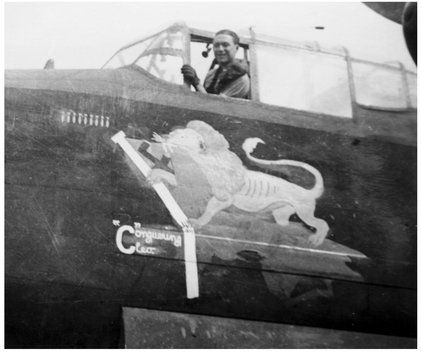
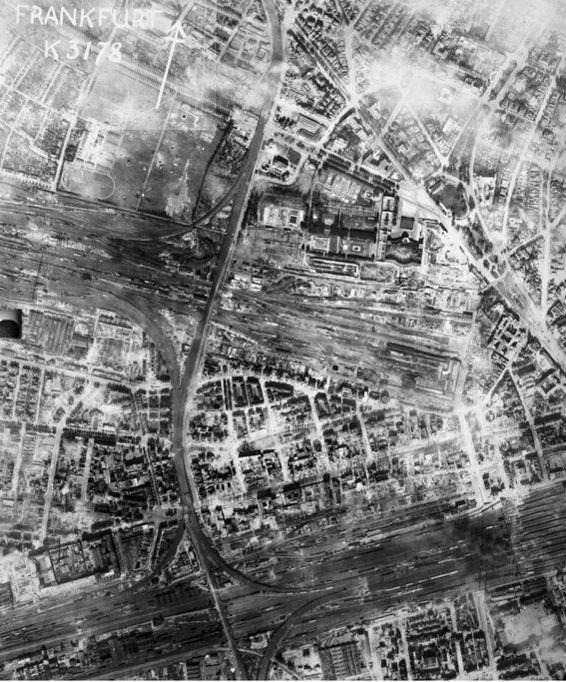
On 18/19 March 1944 846 aircraft including 620 Lancasters set out to bomb Frankfurt. Twenty-two aircraft, ten of them Lancasters, were lost. Four nights later on 22/23 March, the city was bombed again, this time by 816 aircraft, 620 of them Lancasters. Thirty-three aircraft were lost, twenty-six of them Lancasters. This raid was more severe than four nights earlier and 948 people were killed and 120,000 bombed out.
On 20/21 December 1943 Oberleutnant Martin ‘Tino’ Becker of Stab I./NJG 6 was credited with the destruction of a Lancaster and two Halifax bombers. He scored his first victory on 23/24 September when he destroyed a Lancaster (possibly DV174 of 460 Squadron RAAF) near Speyer during a raid on Mannheim. He would fly in all weathers and in the weeks following he scored a further five Abschüsse against RAF Viermots before the year was out. On 19/20 February 1944 Becker reached double figures and on the night of 22/23 March he claimed six Lancasters and Halifaxes shot down. On the Nürnburg raid on the night of 30/31 March Becker shot down Lancaster III ND466 of 156 Squadron flown by Flying Officer J. V. Scrivener RCAF (PoW). Four of the crew were killed. Becker ended the war with fifty-eight night kills (all four-engined bombers) and the Ritterkreuz and Eichenlaub. (Karl-Ludwig Johanssen)
On the night of 14/15 March 1944 eighteen Lancasters were lost and 100 Group lost two Mosquitoes and a Fortress III during radio countermeasure duties in support of the Main Force. Hauptmann Martin ‘Tino’ Becker of Stab IV./NJG 6 and his Funker Unteroffizier Karl-Ludwig Johanssen (pictured) in a Ju 88G-6 claimed nine of these aircraft, the highest score by a German night-fighter crew in any single night. Becker shot down six Lancasters before expending his last ammunition and Johanssen, manning the twin rear facing machine guns, then destroyed two Lancasters and a Fortress III. Johanssen’s three victims counted towards the grand total of his pilot so the B-17 was Becker’s 57th official victory. Johanssen is pictured receiving the Ritterkreuz two days later. (Karl-Ludwig Johanssen)
Flying Officer P. J. Richards is ‘chaired’ by his crew of C-Charlie after finishing his tour on their return to Metheringham from the Frankfurt raid of 22/23 March 1944. (IWM)
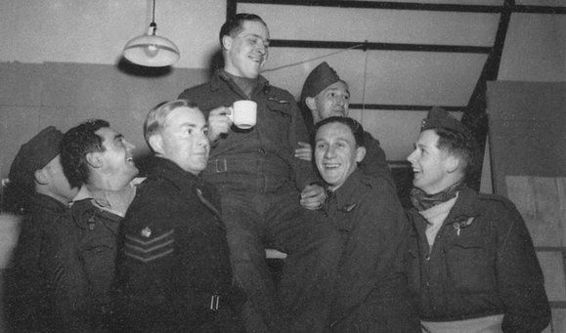
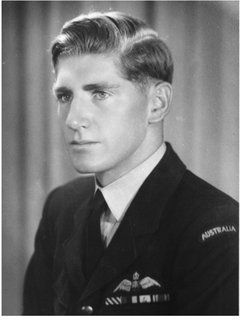
Flight Lieutenant Frank Dengate DFC RAAF of 15 Squadron. (Dengate)
The crew of K-King in 15 Squadron 1944 in front of E-Easy at Mildenhall. L – R: Doug Davis, rear gunner; Frank Watson, wireless operator; Frank Dengate RAAF, pilot; Fred Coney, mid-upper gunner; Joe Ell RCAF, bomb aimer; Bobby Kitchin, flight engineer and a replacement navigator. (Fred Coney)
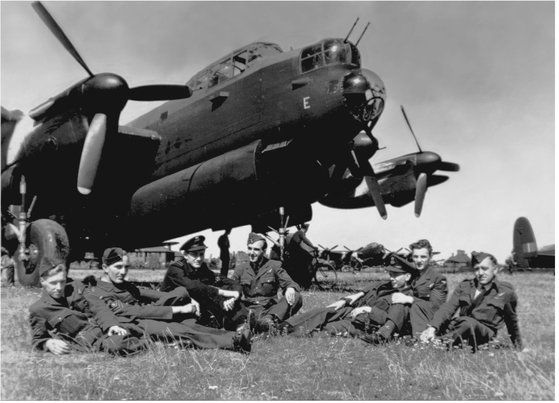
Chapter 8: ‘There’s a War on Tonight’
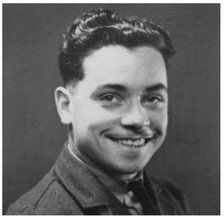
Sergeant Derek ‘Pat’ Patfield, bomb aimer in Denny Freeman’s crew in 61 Squadron at Skellingthorpe in spring 1944. (Patfield)
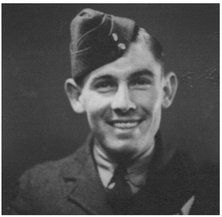
Sergeant Leslie ‘Jimmy’ Chapman, wireless operator in Denny Freeman’s cre in 61 Squadron who was awarded the Conspicuous Gallantry Medal for his actions on the Nurmenburg raid 30/31 March 1944. (Patfield)
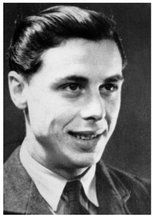
Pilot Officer Desmond ‘Denny’ Freeman RAFVR (21), pilot of Q-Queenie of 61 Squadron at Skellingthorpe in spring 1944. Freeman was KIA on 24 September 1944. (Patfield)
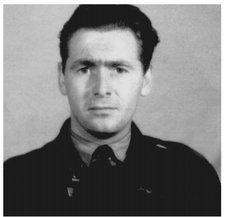
Flight Sergeant Bill Smith the rear gunner in Denny Freeman’s crew. Smith was KIA on 8 July 1944. (Patfield)
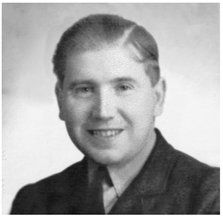
Sergeant Frank Devonshire the flight engineer, in Denny Freeman’s crew. As a result of the Nurmenburg raid 30/31 March 1944 the crew of Q-Queenie never flew as a crew again. Devonshire, badly injured, was invalided out of the service and ‘Tommy’ Thomas never flew again either. (Patfield)
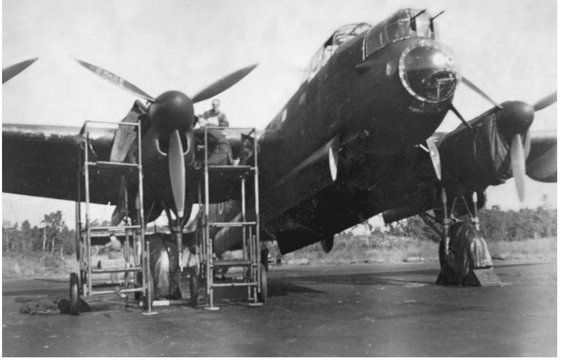
Lancaster B.I R5856 QR-Q Q-Queenie of 61 Squadron at Skellingthorpe in spring 1944. This Lancaster was lost on 8 July 1944 on the operation to St Leu-d‘Esserent. (‘Pat’ Patfield)
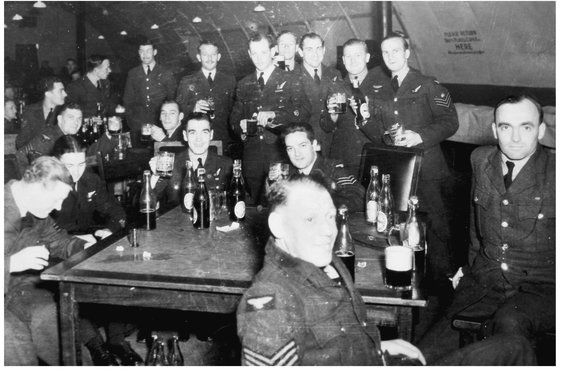
Relaxing between ops. 617 Squadron ‘Dambuster’ aircrew in the sergeants mess at Woodhall Spa, Lincolnshire probably in the spring of 1944. (Dennis Cooper)
A B-17 Flying Fortress crew in the 96th Bomb Group at Snetterton Heath, Norfolk with a Lancaster crew of 622 Squadron at RAF Mildenhall in spring 1944. Note the unpainted ‘Window’ chute beneath the nose of F for Freddie. (IWM)
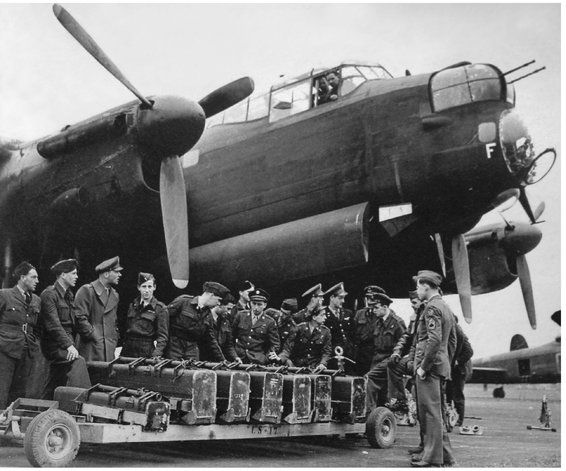
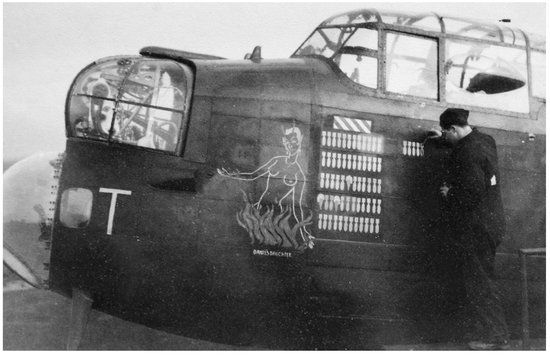
Lancaster III ED731 AS-T2 Dante’s Daughter of 166 Squadron, on which an American pilot completed a tour of operations, gets a ‘65th raid completed’ symbol from ground crew member LAC F. Turner at Kirmington. This Lancaster began its operational service with 103 Squadron in March 1943 and was passed to 166 in September that year. It completed more than seventy sorties before being lost with Flying Officer T. L. Teasdale RCAF and crew on 24/25 March 1944 in the last major RAF Bomber Command raid of the war on Berlin, when seventy-two ‘heavies’ were lost. Teasdale and five of his crew were killed. One survived to be taken prisoner. The ‘scoreboard’ acknowledges a DFC awarded to the pilot. The ice-cream symbols are for raids on Italian targets. (IWM)
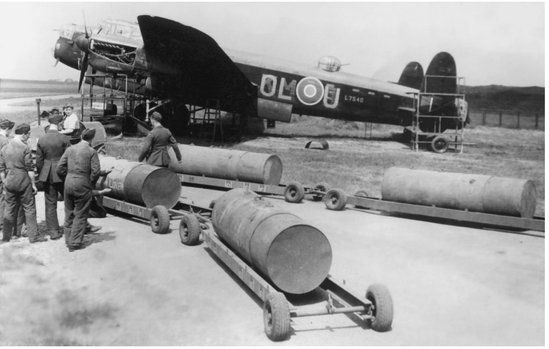
Lancaster B.I L7540 seen here in 83 Squadron markings (the letters OL-U freshly painted over the old 44 Squadron codes on which squadron it served from January 1942) awaiting 4,000lb HC bombs. L7540 finished its career with 5 Lancaster Finishing School in 5 Group at Syerston and was SOC in April 1944.
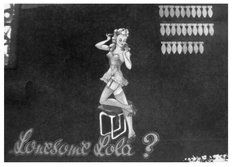
Lancaster B.I LL845 Lonesome Lola? of 9 Squadron, which flew ninety-seven ops between March 1944 and August 1945 before going to 15 MU.
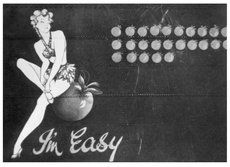
(Centre) Lancaster I’m Easy of 9 Squadron.
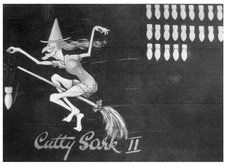
Lancaster Cutty Sark II of 9 Squadron.
Wing Commanders W. L. Brill (right) and A. W. Doubleday, two farmers from Wagga in New South Wales, whose war careers marched almost in step, typifying many famous Australian air partnerships. After volunteering for the RAAF they were called up together in 1940 and thereafter their promotions were simultaneous. When they became wing commanders Brill commanded 463 Squadron RAAF and Doubleday 61 Squadron RAF. Each was awarded the DFC and DSO. Brill added a Bar to his DFC later. Both were original members of 460 Squadron RAAF.
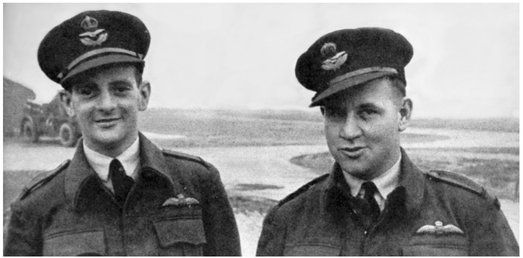
Chapter 9: Night Fighter Nights
The Himmelbett Räume and the Nachtjäger were orchestrated by Jägerleitoffiziers (JLOs or GCI-controllers) in ‘Battle Opera Houses’.
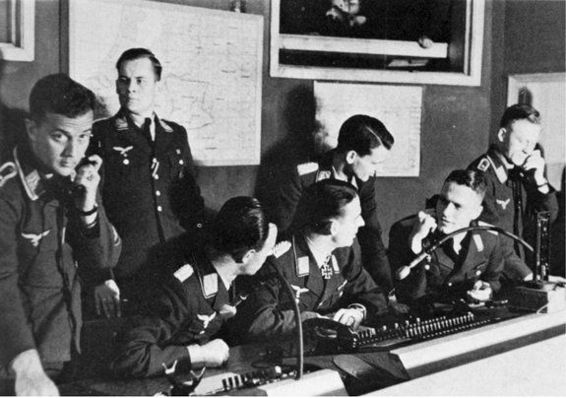
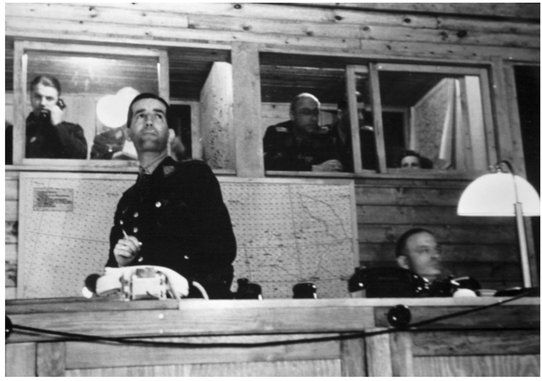
With the change from close-controlled Himmelbett to broadcast-controlled Wild and Tame Boar night-fighting in the summer of 1943, the night air battles over the Third Reich were directed from five huge Divisiongefechtsstände (Divisional Battle Command posts) in Holland, France and Germany. The central HQ during the Battle of Berlin was the Battle Room of Luftflotte Reich in Berlin-Wannsee (pictured). Generalmajor Andreas Nielsen Chief of Staff of Luftflotte Reich and the officer in overall control (right) and Oberst Wolf Falck, since late 1943 ‘Ia Flieg’, Senior Operations Officer responsible for the deployment of operational Nachtjagd units (left) keep a close eye on the development of a Bomber Command raid during the Battle of Berlin. Note the brightly painted telephone in front of Falck, which was his ‘Hot line’ with Göring.
(Falck)
Though the JLOs were far removed from the actual battles, high tiered rows of Leuchtspukers or ‘Light Spitter girls’ projected information onto a hugh screen for them and operators moved the plots on the Seeburg plotting tables.
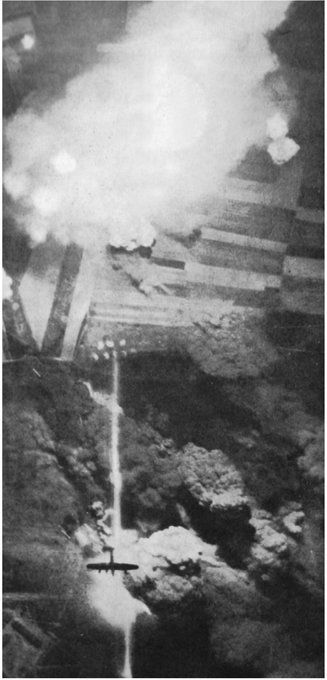
This unusual night photograph was taken during a bomber attack on the tank and lorry depot at Mailly-le-Camp, southeast of Rheims on the night of 3/4 May 1944. The photograph shows a Lancaster flying just above the rising mushrooms of smoke. Forty-two Lancasters were lost. (‘Pat’ Patfield)
Pilot Officer R. R. Reed of 61 Squadron did a remarkable job of piloting and was awarded a well-deserved DSO for bringing back Lancaster B.I ME703/UL-S2 from the costly raid on Mailly-le-Camp. Enemy fire shattered the rear turret, killing the gunner and damaging the elevators and rudders along with the oxygen and electrical systems. Because of the electrical failures the radiator flaps were inoperative, causing engine overheating. The rear turret wreckage made control so difficult that Reed had to have help from both the flight engineer and bomb-aimer in order to keep pressure on the control column and rudder pedals. (IWM)
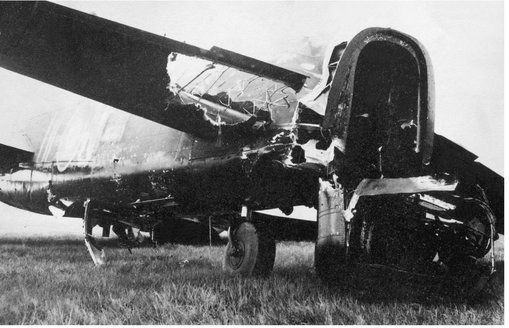
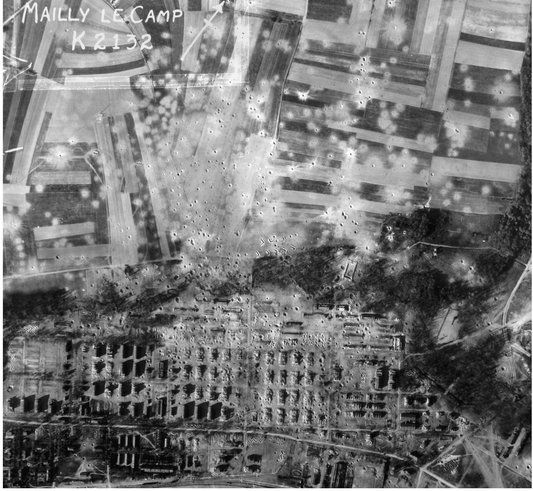
Photo-reconnaissance picture of Mailly-le-Camp after the raid by 346 Lancasters and fourteen Mosquitoes of 1 and 5 Groups on the night of 3/4 May 1944. (via ‘Pat’ Patfield)
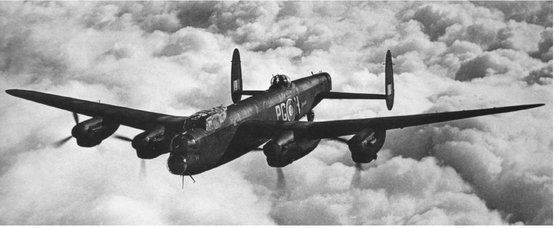
Lancaster III LM446 PG-H of 619 Squadron, which was one of five Lancasters that failed to return to Dunholme Lodge from the raid on the Gnôme-Rhône aero-engine factory and another factory nearby at Gennevilliers, France on 9/10 May 1944. Seven of Pilot Officer J. M. Aitken RNZAF’s crew were killed and one was taken prisoner.
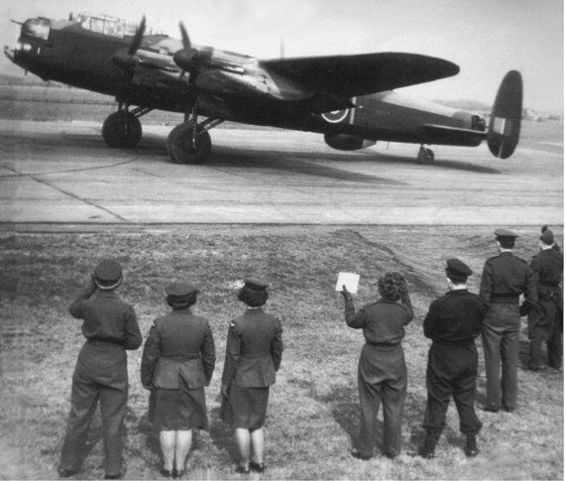
A 61 Squadron Lancaster fitted with the H2S airborne radar transmitter taxies out for take off at Skellingthorpe and is waved off by WAAFs and RAF men.
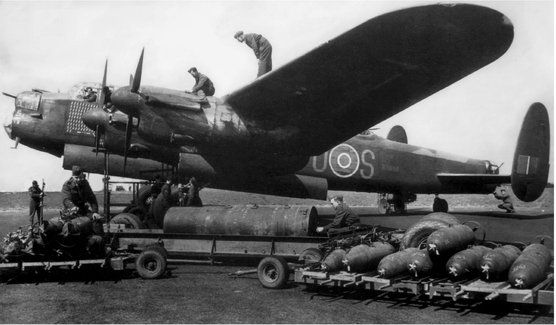
Lancaster B.I R5868 S-Sugar of 467 Squadron RAAF is prepared for the 99th op on 10 May 1944 when the target that night was the marshalling yards at Lille. This famous Lancaster had flown sixty-eight operations with 83 Squadron at Scampton and Wyton, as Q-Queenie July 1942-August 1943 before joining 467 Squadron RAAF at Bottesford in September. Sugar returned safely from the raid on Lille but the Squadron lost three Lancasters, the heaviest loss it had suffered.
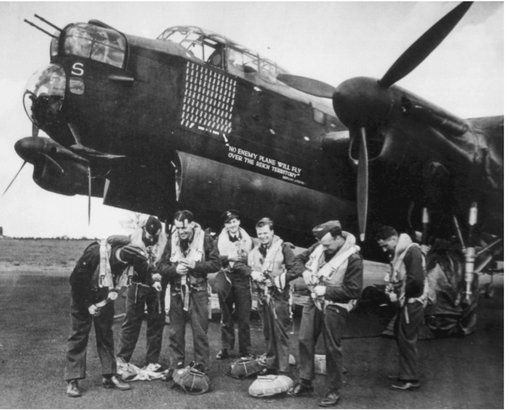
Pilot Officer (later Squadron Leader) T. N. Scholefield RAAF and his crew get kitted up in front of Lancaster B.I R5868 S-Sugar of 467 Squadron RAAF, which has ninety-nine ops recorded on the nose. The Göring quotation ‘NO ENEMY PLANE WILL FLY OVER THE REICH TERRITORY’ was added by LAC Willoughby one of the engine fitters around the time that Sugar had completed eighty-eight ops. Scholefield, who was from Cryon, New South Wales and his crew, flew Sugar on four ops, including the 100th on 11/12 May 1944 when the target was Bourg Leopold in Belgium.
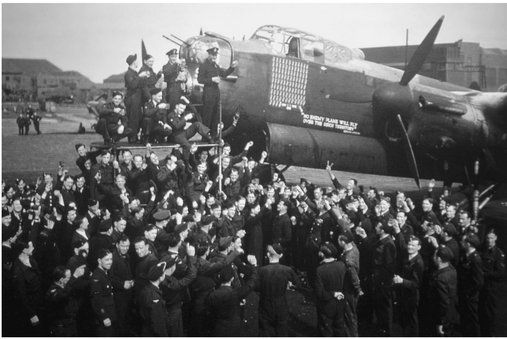
Lancaster B.I R5868 S-Sugar of 467 Squadron RAAF after its sortie on 11/12 May 1944 to Bourg Leopold in Belgium. Sugar was one of those that had not completed its bombing run when he order ‘stop bombing’ was given and on withdrawing from the target area was attacked by two Ju 88 nightfighters. Sugar was at 16,000 feet when first attacked but was down to 9,000 feet by the time the attacks were over. The ‘Cookie’ was jettisoned in the North Sea and a return to Waddington was made without further incident. The rear gunner, Flight Sergeant K. E. Stewart of Sydney described the incident in an interview with waiting newspaper reporters. ‘They came in alternately attacking first one side and then the other. At times they were firing at us from a range of only 200 yards. The mid-upper gunner and I opened fire and we feel sure that we damaged one. Altogether we were attacked seven times in seven minutes. It was really the grand co-operation between all the crew, which enabled us to get away. “Old Sugar” went beautifully. She is a grand old bus.’
On 19/20 May 1944 118 Lancasters and four Mosquitoes of 1 and 8 Groups carried out a particularly accurate attack on the railway yards at Orléans. One Lancaster was lost. After further raids by Bomber Command, on 4/5 July 282 Lancasters and five Mosquitoes of 1, 6 and 8 Groups accurately bombed Orléans and Villeneuve. Fourteen Lancasters were lost, eleven from the Villeneuve attack and three from the Orléans raid.
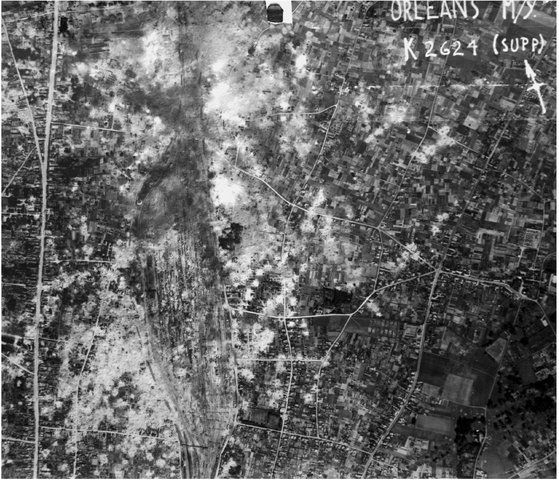
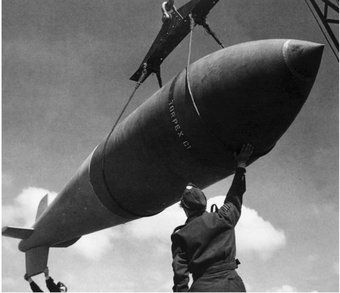
A Tallboy being hoisted aloft. By the end of the war 854 of these fearsome weapons, which were filled with approximately 5,760lbs of Torpex D high explosiv had been dropped on a variety of targets ranging from shipping, U-boat and E-boat pens to viaducts, canals and V-weapon sites.
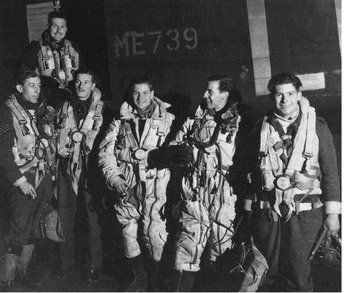
Flying Officer C. Rodgers and crew of Lancaster B.I ME739/LE-D D-Dog of 630 Squadron after landing at East Kirkby at 0126 hours on 19 April 1944. T Juvisy raid was the first operational sortie for the aircraft. It would serve the squadron well for twelve months, being lost with Flying Officer A. V. Cameron RAAF a crew on the Leipzig operation of 10/11 April 1945, exactly a year after its delivery to the squadron. Cameron and three of the crew were taken prisoner and two eva Sergeant J. R. Dicken also baled out but his parachute was on fire and he was killed. (IWM)
460 Squadron RAAF was a three-flight squadron with an establishment of thirty aircraft. For virtually the whole time it was equipped with Lancasters and it claimed to have dropped more bombs on the Reich than any other squadron in Bomber Command. The squadron flew more Lancaster sorties than any other squadron, suffering the highest losses in 1 Group. Lancaster B.I W4783 AR-G was from its original complement received in 1942 and after completion of the 90th trip on 20/21 April, when it was flown by Flying Officer J. A. Critchley’s crew, (pictured) 1944 the veteran ‘Lanc’ was presented to the Australian War Museum. Although 460 was an Australian squadron, many air crewmembers were British – in this crew the flight engineer and the two air gunners. A Binbrook C-type hangar can be seen in the background. (IWM)