
Chapter 5
It is so densely built that one fire alone would be enough to destroy the whole city . . . fires everywhere, with countless incendiary bombs of an entirely new type. Thousands of fires . . . will unite in one huge blaze over the whole area. High explosives don’t work, but we can do it with incendiaries; What will their firemen be able to do once it’s really burning?
Albert Speer describing Hitler at a dinner in the Reich Chancellery in 1940 imagining the total destruction of the capital of the British Empire.
Operation Gomorrah, the first of four raids on Hamburg, a city of nearly 2 million people, began on the night of 24/25 July. Bundles of ‘Window’ were carried in the 791 aircraft1 that set out across the North Sea loaded with high capacity bombs and incendiaries. By blowing off roofs and shattering windows and doors, the blast bombs would create the powerful draught needed to spread the fires from countless incendiaries to devastate an area about 10 times the area of the City of London. Since Hamburg was far beyond the range of Oboe, 74 of the aircraft were equipped with H2S. These were to help the Pathfinders mark and keep the city marked, the plan being that 20 H2S aircraft would open the attack by releasing yellow TIs and strings of flares solely on their radar. These would be followed by eight visual markers, which were to identify the target in the glow of the flares and put down red TIs. Finally, the 53 backers-up positioned throughout the bomber stream were to aim their green TIs at the red TIs just beyond the centre of the green TIs to alleviate ‘creep back’. The bombers of the main force were to bomb the reds if they were visible, or failing that, the centre of the greens. They were to ignore the yellow TIs.
In the first 15 minutes of the raid the green TIs followed each other accurately into the area around the aiming point. Led by the H2S PFF aircraft, 728 bombers rained down 2,284 tons of HE and incendiaries in 50 minutes on the dockyards and city districts. However, less than half of the force bombed within three miles of the centre of Hamburg and there was a marked ‘creep back’, which continued until the end of the attack, by which time a six mile long carpet of burning incendiaries extended back from the aiming point. Hamburg was such a large city that it made little difference in the final outcome. Severe damage was caused to the central and north-western districts, particularly in Altona, Euimsbüttel and Hohenluft. The roof of the Rathaus was set afire and the Nikolaikirche, the Central Police Station and the long distance telephone exchange in the wealthy district of Rotherbaum were among other known city landmarks to be hit. Four ‘blockbuster’ blast bombs, 16 other HE bombs and many incendiaries destroyed the famous Hagenbeck Zoo where 140 animals were killed or they had to be shot.2 In one of the 97 Squadron Lancasters that took off from Bourn at 22.00 hours with 8,000lb of bombs plus target indicators, sat Warrant Officer Eddie Wheeler, the WOp/AG. He noted that there was very little cloud but hazy visibility. At 17,000 feet they ran into the inevitable heavy flak and released their load at 01.05 hours. Two minutes later there was the most violent explosion near the aiming point followed by a glow lasting for 40 seconds. Later all the squadron crews at debriefing confirmed this. ‘Window’s’ effect was noticeable because searchlights wandered all over the sky and the flak was haphazard. The German fighter pilots and their Bordfunkers too were blind.’
Many large fires and a pall of smoke were visible as they turned away for the journey back across the dreaded North Sea. Six hours after take off they touched down at Bourn at 04.00. Wheeler thought ‘that’s another satisfactory night’s work over’. Only 12 bombers,3 just 1.5 per cent of the force, were lost. Without ‘Window’ losses could well have amounted to around the 6 per cent mark, which had characterized previous raids on this target. ‘Window’ neutralized the Würzburg GCI and GL radars and short range AI, and completely destroyed the basis of GCI interception. Controlled anti-aircraft fire was almost completely disrupted at night and fixed box barrages only remained possible. The new British tactics also combined the use of PFF, the massed bomber stream and new target finding equipment (H2S). This combination resulted in total chaos to the German night fighter defence system, which was unable to obtain a true picture of the air situation or control the night fighters in the air.
In an attempt to achieve a ‘good raid’ on a major target while ‘Window’ remained effective, over 700 bombers were dispatched to bomb Essen on the night of 25/26 July. Included in the force were 294 Lancasters. Severe damage was caused to the industrial areas in the eastern parts of the city. The Krupps Works suffered its most damaging raid of the war and 51 other industrial buildings were damaged with another 83 heavily damaged.4
In the next raid on Hamburg, early in the morning of 27 July, 787 aircraft including 353 Lancasters, dropped 550 – 600 bomb loads of high explosive and incendiary bombs on the densely populated residential area east of the Elbe. This area comprised the districts of Hammerbrook, Hamm-Nord and Hamm-Süd, Billwerder Ausschlag and parts of St Georg, Eilbek, Barmbek and Wandshek. A now familiar sequence of events occurred. First all the doors and windows were torn from their frames and smashed by high explosive bombs and then lightweight incendiary mixtures ignited the attic floors of the buildings. At the same time firebombs weighing up to 15 kilograms fell into the lower storeys. Within a few minutes huge fires were burning all over the target area, which covered 20 square kilometres, and they merged so rapidly that only a quarter of an hour after the first bombs had dropped the whole airspace was a sea of flames as far as the eye could see. Five minutes later a firestorm of an intensity that no one would ever before have thought possible arose.5 The fire, now rising 2,000 metres into the sky, snatched oxygen to itself so violently that the air currents reached hurricane force resonating like mighty organs with all their stops pulled out at once. The fire burned like this for three hours. At its height the storm lifted gables and roofs from buildings, flung rafters and entire advertising hoardings through the air, tore trees from the ground and drove human beings before it like living torches. Behind collapsing façades the flames shot up as high as houses, rolled like a tidal wave through the streets at a speed of over 150kph, spun across open squares, in strange rhythms like rolling cylinders of fire. The water in some of the canals was ablaze. The glass in the tramcar windows melted; stocks of sugar boiled in the bakery cellars. Those who had fled from their air-raid shelters sank, with grotesque contortions, in the thick bubbles thrown up by the melting asphalt. No one knows for certain how many lost their lives that night, or how many went mad before they died. When day broke, the summer dawn could not penetrate the leaden gloom above the city. The smoke had risen to a height of 8,000 metres, where it spread like a vast, anvil-shaped cumulo-nimbus cloud. A wavering heat, which the bomber pilots said they had felt through the sides of their planes, continued to rise from the smoking, glowing mounds of stone. Residential districts with a street length of 200 kilometres in all were utterly destroyed. Horribly disfigured corpses lay everywhere. Bluish little phosphorus flames still flickered around many of them; others had been roasted brown or purple and reduced to a third of their normal size. They lay doubled up in pools of their own melted fat, which had sometimes already congealed. In the next few days, the central death zone was declared a no-go area. When punishment labour gangs and camp inmates could begin clearing it in August, after the rubble had cooled down, they found people still sitting at tables or up against walls where they had been overcome by monoxide gas. Elsewhere, clumps of flesh and bone or whole heaps of bodies had cooked in the water gushing from bursting boilers. Other victims had been so badly charred and reduced to ashes by the heat, which had risen to 1,000 degrees or more, that the remains of families consisting of several people could be carried away in a single laundry basket.6
Over four nights 3,000 bombers dropped 10,000 tons of HE and incendiary bombs to totally devastate half of Hamburg and kill an estimated 42,000 of its inhabitants.7 After the fourth raid on 2/3 August by 740 aircraft, 900,000 inhabitants had lost their homes and had fled the city. The exodus of severely confused survivors, some clad only in pyjamas, started going ‘no one knew where’ until 1¼ million refugees were dispersed all over the Reich, as far as its outer borders. On 20 August Friedrich Reck saw a group of 40 to 50 such refugees trying to force their way into a train at a station in Upper Bavaria. As they did so a cardboard suitcase ‘fell on the platform, burst open and spilled its contents. Toys, a manicure case, singed underwear and last of all, the roasted corpse of a child, shrunk like a mummy, which its half-deranged mother has been carrying about with her, the relic of a past that was still intact a few days ago.’ An American bomber navigator, who flew a US 8th Air Force daylight mission after the RAF raids on Hamburg noted that every section of the huge city was on fire. An ugly pall of smoke was blowing to the south-west. ‘It looked the way that one might imagine Hell to be.’ Paralyzed by ‘Window’ Nachtjagd and the Flakwaffe were unable to offer any significant resistance. Albert Speer, Minister of War Production, warned Hitler that Germany would have to surrender after another six of these bombing raids.
Since Hamburg and the introduction of ‘Window’, casualty figures had got significantly lower8 and in August when Johnny Moss, and his crew of J-Johnny in 49 Squadron, returned from leave, their spirits were high. Len Bradfield, the bomb-aimer recalled that when they first began flying ops in March 1943, losses were averaging 5 per cent a night but the crew believed that they were special and that they would survive. ‘We were sorry other crews didn’t make it back’ he recalls, ‘but we accepted that this was the way things were. We didn’t think it could happen to us. We were an above average crew and expected to go to Pathfinders after our tour. It came as a sharp jolt when the crew we had trained with failed to return from the raid on Mannheim on 9/10 August. Next day, however, was beautiful. The NFT9 went well. When we saw the fuel and bomb loading we decided it would be a longish operation. After the flying supper we went to briefing. The target was Nürnburg [Nuremberg] with the MAN diesel factory at Fürth being the aiming point. As it was in southern Germany the route was over lightly defended territory as much as possible. Climbing to a height of 21,000ft on track, we crossed the enemy coast at Le Treport and then flew on over France, directly to Nürnburg. “Window” was dropped at intervals on entering German airspace north of Trier. There was about 8/10ths cloud with tops at 14,000ft, which meant we would be silhouetted from above by the bright moonlight. We knew we were in trouble and we generally weaved to give a maximum sky search. All of a sudden near Wolfstein (south of Bad Kreuznach and NNW of Mannheim, where we could see the glow from our bombing the night before) a night fighter attacked us. Terry Woods, the mid-upper gunner, spotted the incoming attack and shouted, “Bandit 5 o’clock high!”
‘I abandoned scrabbling about on the floor dropping “window” and stood at my guns (being 6 feet 1 inch I could work the turret better standing than sitting). Cannon and tracer fire hit our port wing and port outer engine, setting both on fire. Terry returned fire, followed by Ronnie Musson in the rear turret before he was put out of action because of the loss of the port outer, which produced hydraulic power for his turret. As our attacker broke away over the nose I got in a burst of 30 rounds from the front guns. Johnny started taking violent evasive action to blow out the fire. Sammy Small, the WOp/AG, was standing in the astrodome coordinating the defences as we had practised. Almost at once Ron Musson, the rear-gunner called out a second attack. It began at 6 o’clock level, dead aft. All hell was let loose. Shells were exploding “crunk”, “crunk”, “crunk” against the armoured doors and the 4,000lb cookie in the bomb bay. There was a smell of cordite and fire broke out in the bomb bay and main-plane. I dropped down to the bomb-aimer’s compartment and could see the fire raging. I told Johnny and he gave the order to jettison. I did. The attack was still in progress. The night fighter was holding off at 600 yards, blazing away. He didn’t close. The fire persisted and Johnny gave the order to bale out – “Abracadabra, Jump, Jump!”
‘From beginning to end it had lasted perhaps 1 – 2 seconds but it seemed like slow motion. The order was acknowledged, except for the rear-gunner. I got my parachute on and pulled up, twisted and dropped the front escape hatch in order to bale out. Ernie Roden, flight engineer and David Jones, navigator were coming down the bomb-aimer’s bay. I dived out and fell clear and delayed opening my chute until I was below the cloud. I could still see red and yellow tracer flying by. It is possible that Ernie and David were hit when they baled out. As I broke cloud I could see several small fires, which reinforces the idea that the B-Baker exploded. On the ground I chucked my lucky woolly gollywog away. It was nothing personal (I had carried him on all my 18 ops) but I thought it had failed me. He hadn’t because later, when I was captured, when I asked about my crew I was told, Fünf Tot (five dead). Johnny Moss was the only other survivor, probably blown clear when the Lancaster exploded. A Luftwaffe NCO told me three 4-engined bombers had been brought down in a 10-km circle by his unit. At Dulag Luft interrogation centre I thought about the attack and concluded that a professional, a real “tradesman” had shot us down.’10
Since early August Bomber Command flew five raids on Italian targets with Genoa, Milan and Turin being bombed by the 4-engined heavies. Milan was subjected to a series of three attacks within the space of a few days. On Sunday, 15 August, 199 Lancasters were bombed up for the fourth in the series of raids on the city. Bombing was claimed as, ‘particularly concentrated’. Seven Lancasters were lost; some running into accurate flak around Chartres but mostly the victims fell to night fighters. One of them was Y-Yankee flown by Wing Commander Cosme Gomm DSO DFC, which was shot down over Normandy by a night fighter. The Lancaster exploded near the village of Beaumont scattering debris over two square miles. The only the survivor was 20 year old Sergeant James Lee, the flight engineer and youngest crewmember on board who, badly burned, had the luck to parachute down onto a hayrick and was taken prisoner. When the Lancasters of 467 Squadron RAAF landed back at Bottesford and entered debriefing, the news was broken to a distraught Section Officer Paula Fisher, a WAAF in the Intelligence Section who had formed a relationship with the highly regarded pilot.11
On the night of 16/17 August, as a handful of Lancasters joined other aircraft in another raid on Turin, some Lancasters carried out one of the most dangerous minelaying missions of the war when they blocked the Stettin ship canal, the vital waterway supplying the Russian front. One force of bombers was detailed to attack the port of Stettin while the other force, which was to be detached from the main bomber stream at the last minute, went down to a few hundred feet to lay their mines. Flak ships and batteries defended the canal throughout its entire length of more than 30 miles, and on the night of the attack every gun was in action during the 20 minute operation. Guard ships and motor craft patrolling the canal fired almost every type of AA weapon at the Lancasters flying close above them. But the bombers kept on their steady course up the channel, reached Stettin and laid their mines as hundreds of high explosive and incendiary bombs rained down on the port from the other force. It was an intricate as well as a dangerous operation. To make sure of putting the mines into so small an area an application of Pathfinder technique was used. Three Lancasters went even lower than the main force to lay floating flares in the target area, while others, flying higher, dropped more flares to light up the whole canal. These flares, and searchlights constantly sweeping the water, made the night as bright as day.
Squadron Leader H. B. Locke DFC RAAF flew No. 3 of the marking Lancasters, with four other Australians in the crew. He was detailed to place a precision marker at the northern entrance to the channel, and to drop mines as far north in the channel as possible. He identified the channel before the flares went down by doing a preliminary run. The horizontal beams of searchlights ringed the bay and the flak ships lining the channel came to life as he made his run-in, putting both markers and mines in exactly the allotted area. A flak ship mounting cannon, machine guns and searchlights engaged his aircraft a second after Locke’s mines went down. He put his bomber into an evading dive while his gunners blazed away at the enemy positions, and pulled out at water level. By then both gun turrets and all the hydraulic system of the aircraft were useless. There was a bad petrol leak but through superb calculations by the navigator, Squadron Leader H. Makepeace, Locke found a gap on the coast and by flying below trees, was able to dodge the searchlights of successive defensive positions. Despite the lack of almost all navigational aids, dead reckoning by the navigator brought the Lancaster back to England, where Locke made a successful landing at base. He was awarded the DSO.
By early August ‘Pluto’ Wilson’s crew had completed 24 operational sorties and the crew were known as one of the old sweats on 467 Squadron RAAF. Together with other experienced crews, they were taken off routine bombing trips and became engaged in special low level time and distance bombing practice over the Wainfleet bombing range near Skegness. ‘At first we thought it strange that it was the most experienced crews who were degraded in this way’ recalls, Charles Cawthorne.12 ‘But as the results were being scrutinized by senior staff from Group Headquarters, headed by the AOC, Air Vice-Marshal Cochrane, we soon realized that there was some hidden purpose behind this special training. A few days later the AOC visited Bottesford and told the selected aircrews that they must do better and reduce the number of bombing errors. At this stage we had no idea what was going on but there were rumours circulating around the camp that we might be going to attack the German dams again or maybe the Dortmund-Ems Canal. On 17 August all speculation ended when we were detailed to attend the pre-operation briefing and it immediately became apparent that something very special had been planned. Security around the operations block was unusually severe with RAF Police in far greater numbers than usual.
‘There was a great buzz of speculation amongst the crews as we entered the large briefing room. The assembled crews were brought to attention as the station’s senior officers entered the room accompanied by a very senior officer from Group Headquarters. The curtain over the map of western Europe was pulled back to reveal red route marker tapes leading to a small target called Peenemünde on the German Baltic coast sited between Rostock and Stettin. I wondered what all the fuss was about because we had never heard of this little place called Peenemünde and the Squadron had attacked both Rostock and Stettin quite recently. The briefing was opened with a statement from the visiting officer from Group. He said, “Peenemünde is a German military research establishment whose scientists are working on new Radio Detection Finding (RDF) equipment as a countermeasure against our night bombers and therefore is a very important target that has to be destroyed at all costs. That is why the operation has been planned to take place in full moon flying conditions and must be carried out at low level. It is imperative that this target is destroyed and I must warn you that if you are unsuccessful tonight, then the Squadron will have to return tomorrow night and on successive nights until complete destruction is achieved.” (It was only later when the V-2 rockets started to fall on London in September 1944, that we in Bomber Command and the general public learned the true purpose of this raid i.e. the destruction of the secret V-2 rocket research and production facility.) The Squadron Commander then said it was to be a precision attack on three main target areas. The first and second waves would attack on Pathfinder TIs but 5 Group squadrons were to bomb last in the third wave and would use the new time-and-distance bombing method as the target would probably be obscured by smoke from the first and second wave attacks.13
‘The objective for the third wave aircraft was the Experimental Works which consisted of over 70 small buildings. (This complex contained vital development data and equipment and the accommodation block, which housed the V-2 Project Director, General Dornberger and his Deputy, Werner von Braun. We did not learn this until much later.) The crews were then informed that a master bomber, Group Captain John Searby of 83 Pathfinder Squadron would control all phases of the raid by circling the target area. If necessary he would give instructions over the VHF radio to the Pathfinders should the TIs need repositioning or to stop main force creep-back developing. As we listened to the briefing it became clear that this operation was a formidable task but we were determined to succeed as none of us fancied our chances of survival if we had to return again the next night.
‘At 21.30 hours our Aussie skipper turned our heavily laden Lanc onto the main runway and once the aircraft was lined up he slowly opened the throttles while I watched the needles swing round in the boost and rev gauges. At the same time my left hand followed the skipper’s right as he pushed forward the throttle levers. As the aircraft gained speed the navigator called out the indicated air speed (IAS) over the intercom. With full rudder control and all four engines pulling, the skipper called for me to take over the throttle levers and push them through the gate for maximum power. Moments later with gauges showing 3,000-rpm +14lb/sq.in boost, the aircraft reached a speed of 100 knots IAS and took off into a cloudless summer evening sky. With a positive rate of climb established the skipper called for the undercarriage to be raised and engines set to a climbing power of 2,850-rpm with +9lb/sq.in boost. This was quickly followed by a series of flap adjustments and once the airframe was clean, our Lancaster F-Freddie climbed away at 155 knots to join the third wave of the bomber stream off the north Lincolnshire coast. To see scores of heavy bombers assembling in bright moonlight over the North Sea was quite an exhilarating experience. Usually we carried out ops on dark moonless nights and the only indication other aircraft were around was when we ran through prop wash turbulence or occasionally we saw the red glow from aircraft engine exhausts.
‘At 23.35 hours we crossed the Danish coast twelve miles north of the island of Sylt and from our operational height of 18,000 feet I could clearly see small villages and farm houses in the brightly lit countryside. Forty minutes later we were flying over the Baltic and the moonlight presented an eerie picture as numerous islands were clearly outlined against the sea. At this juncture we were flying south-east at 8,000 feet some twenty miles off shore, midway between Rostock and Stettin. In the nose of the aircraft our Aussie bomb-aimer, Swill Campbell, was busy map reading and called over the intercom that we were approaching the headland of Arkona on the northeastern tip of the island of Rugen. We were now only 40 miles from the target and the skipper turned south to follow the coastline that led directly to Peenemünde. Approaching the target we could see the raid ahead progressing as the first and second wave aircraft bombed the red and green TIs laid down by the Pathfinders. From our position at the rear of the bomber stream there appeared to be little enemy opposition with only moderate light flak and few searchlights. Over our VHF radio set we heard the calm voice of Group Captain Searby assuring the third wave crews the raid was progressing in a satisfactory way and to standby for further orders.
‘A few minutes later at 00.42 hours the master bomber ordered the Lancasters of 5 Group to commence their timed bombing runs from the designated starting point at the southern tip of the island. At this point during every bombing raid, aircraft became particularly vulnerable to flak or night fighter attack and on this occasion the seven mile bombing run seemed endless as we frantically searched the crowded sky for the enemy and to avoid a collision with a friendly aircraft. At last, our bomb-aimer announced “Bombs gone” and the aircraft wobbled as it was relieved of its heavy load. The skipper held the same course until the aiming point photograph had been taken and then much to the relief of everyone on board mined back over the sea to start our journey home. As we left the immediate target area, we felt elated that our outward flight had been uneventful and we had made a successful bombing run. But as we commenced our return journey we became aware of increased enemy activity in our vicinity as burning aircraft began to fall out of the sky at an alarming rate. It seemed as if a huge armada of enemy night fighters, who were taking full advantage of the bright moonlight conditions, was attacking the third wave of the bomber stream. (Later, we found out that the German night fighters had been successfully lured away from the Peenemünde area by a diversionary raid on Berlin. However, once the German fighter controllers realized that this was not the main target, the night fighters were ordered to pursue the bombers over Peenemünde.)
‘The skipper called over the intercom for everyone to be extra vigilant but without warning we felt our aircraft judder, as it was riddled with both machine gun and 20mm cannon fire. Standing beside the pilot, I clearly recall seeing tracer bullet trails looping high over our port wing and hearing the terrifying noise of the enemy’s ammunition hitting our aircraft. George Oliver, our mid-upper gunner, made an immediate response to the attack and our rugged Australian skipper put the aircraft into a violent dive to port in the hope of escaping further attention from the fighter. However, after losing several thousand feet of altitude he announced he was having great difficulty in getting the aircraft out of the dive. Without further ado I leaned over to assist by grasping the control column with both hands and together we pulled it back until the aircraft responded and we were flying straight and level again. On recovery, I checked the engine gauges and fuel control panel and looking aft saw what looked like the whole of the rear fuselage on fire with thick black acrid smoke billowing forward. Out of the smoke climbing over the main spar came George the mid-upper gunner and David the wireless operator soon joined him. Both had their chutes clipped on ready to jump out of the front emergency exit. I reported the fire to the skipper and expected him to give the order to abandon aircraft, but to my amazement he coolly said, “Well go and put the bloody thing out then”. If it had not been for those cool calculated words, we would have all finished our ops tour there and then.
‘Armed with fire extinguishers, George and I went aft over the main spar to tackle the blaze and there David quickly joined us. We found the ammunition lines to the rear turret ablaze with one round setting fire to the next with alarming speed. The fuselage was full of thick smoke which made our progress difficult and soon it was realized the dead man’s handle, a device for rotating the rear turret in the event of hydraulic failure, had received a direct hit. The turret’s hydraulic oil supply had been sprayed around the floor not only adding fuel to the fire but also making it difficult to stand in our rubber flying boots. When all extinguishers had been emptied, we resorted to smothering the blaze with our gloved hands and eventually we succeeded in putting the fire out.
‘It was then that we realized the rear-gunner, Paddy Barry, was wounded and trapped in his turret. With the aid of the aircraft axe, George, the mid-upper gunner managed to open the back doors of the rear turret and I assisted in manoeuvring Paddy over the tail-plane and up to the rest bed near the main spar. Despite Paddy’s precarious state, we had to leave him and return to our crew positions to report on the fire damage sustained from the night fighter attack and take stock of the battle that was taking place all around us in the bomber stream. From the flight engineer’s panel I calculated that we were losing a considerable amount of fuel and after reporting this to the skipper and navigator it was decided we would divert to an airfield in neutral Sweden. At this juncture Swill, the bomb-aimer, and I were told by the skipper to make Paddy as comfortable as possible. By the light of a masked torch, we realized he had sustained a serious injury to his left foot from an exploding cannon shell. I attempted to inject morphine to ease his pain but could not get through his protective clothing. In desperation, I started to cut away his flying boot, which was torn and saturated with blood. In the semi-darkness of the fuselage it was difficult to see any detail and what I thought to be a large piece of boot was in fact a piece of skin which I immediately replaced and bound the wound with a shell bandage. I then returned to my seat in the cockpit and after rechecking the fuel gauges I realized the self-sealing fuel tanks had been effective and the loss of fuel had been stemmed. Following a hurried crew conference, it was decided we had sufficient fuel to attempt the return journey over the North Sea to England.
‘The skipper then announced he was still having trouble controlling the aircraft which continuously wanted to climb and it was necessary for him to stand on the rudder pedals and wedge his back against the seat with fully extended arms to prevent the aircraft climbing. In an endeavour to relieve the physical effort of the situation the skipper and I removed our Mae West’s and after inflating them jammed them both between the control column and the pilot’s seat. We did not realize that the problem was caused by the loss of our elevator trim tabs, which had been shot away during the night fighter attack. By the time we crossed the enemy coast the skipper was completely exhausted and it became necessary for me to fly the aircraft over the relatively safe area of the North Sea. With great difficulty we changed seats and, by the grace of God, nothing untoward happened during the sea crossing. Approaching the Lincolnshire coast the skipper took over again and David Booth, the wireless operator, called our base for a priority landing due to our seriously wounded gunner and the precarious state of the aircraft. Bottesford responded to our request and the skipper ordered all crewmembers to their crash positions for an emergency landing. I had to remain in my normal crew position to assist the skipper with the handling of the aircraft. On final approach, I was fully prepared to select full flap, which was the normal procedure. But the skipper quickly reminded me that only a couple of weeks before an Aussie pilot on the Squadron called Tillotson had suffered a complete fracture of the rear fuselage on his aircraft following full flap selection after suffering serious battle damage to the rear fuselage. His aircraft’s tail fell off with disastrous results. I didn’t require any further warning and my hand kept a respectful distance away from the flap lever. In the early morning light after nearly seven hours in the air we glided over the threshold of the runway and touched down at 04.20 hours. With engines spluttering we taxied off the runway and came to a stop on the grass, where we were immediately attended by the fire and ambulance staff who carefully extricated Paddy, our injured gunner. It was now quite light and on evacuating the aircraft through the rear door, I was amazed to see the extent of the damage we had sustained. Internally the skin of the rear fuselage was charred and black from the intense fire and shafts of light pointed to where machine gun bullets and cannon shells had entered and exited the aircraft. Externally, the wings, rear fuselage, tail plane and both rudders were all severely perforated by machine gun and cannon fire. Overall F-Freddie was in an appalling state, but miraculously all four engines were undamaged and had functioned perfectly throughout the flight to bring us home.’14
Initial reports that morning indicated that the raid had been a complete success, achieved through the element of surprise and the sheer audacity of operating under a full moon and clear skies. Ground controllers were fooled into thinking the bombers were headed for Stettin and a further ‘spoof’ by Mosquitoes aiming for Berlin drew more fighters away from the Peenemünde force. Out of the total of 606 aircraft assigned, 44 bombers and one Mosquito were lost in the wild mêlée over the target and 32 suffered damage. Two night fighter crews flying Bf 110s fitted with a new and deadly weapons system called Schräge Musik destroyed six of the bombers.15 In the daylight reconnaissance 12 hours after the attack, photographs revealed 27 buildings in the northern manufacturing area destroyed and 40 huts in the living and sleeping quarters completely flattened. The foreign labour camp to the south suffered worst of all. The whole target area was covered in craters. It was inconceivable that the site could ever operate again and at least we had gained valuable time against V-1 and V-2 attacks on London and our impending second front assault forces. This raid probably gave crews their most satisfaction against all other targets attacked.
Within days of this episode, ‘Pluto’ Wilson’s crew and others in Bomber Command were on operations again. On 22/23 August the target for 462 aircraft, 257 of them Lancasters, was the I.G. Farben factory at Leverkusen. The night following Berlin was the target for 710 aircraft, including 335 Lancasters, when Bomber Command suffered its greatest loss of aircraft in one night in the war so far. Seventeen Mosquitoes were used to mark various points on the route to the capital to help keep the main force on the correct track. A master bomber, Wing Commander J. E. ‘Johnny’ Fauquier the CO of 405 Squadron RCAF, was used. For Warrant Officer Eddie Wheeler, WOp/AG in 97 Squadron at Bourn in Cambridgeshire, it was his first trip to the ‘big one’:
‘It meant a long trip over heavily defended enemy territory and the Berlin defences were savage in the protection of the great city which, the Nazis had sworn would never be subjected to air bombardment. What a long way I had come since those dark days in 1940 when there appeared to be no salvation from the gloom and here we were attacking the German capital in strength and talking more and more of an invasion of Europe. This was to be my 57th operation; could I survive to see that 60th operation? It did seem to be inviting the inevitable with each further raid. So many crews had not even reached double figures and with so many more aircraft involved, losses mounted so that the likelihood of aircrews surviving twelve raids was still minimal. For this trip, we had an additional crewmember – a Flight Sergeant Penny who came as second pilot for the experience. Apart from the heavy flak and searchlight activity, the flight was uneventful, far less frightening than any trip to the Ruhr and after bombing from 18,000 feet we were back at base in six hours 35 minutes.’
The raid was only partially successful. The Pathfinders were not able to identify the city centre by H2S and they marked an area in the southern outskirts of the capital. The main force arrived late and approached from the wrong direction so that most of the 1,700 tons of bombs that were dropped in the space of 50 minutes fell in open country with 25 villages reporting bombs falling on them. Even so, over 2,600 individual buildings in Berlin were destroyed or seriously damaged and two residential areas well south of the city centre were badly hit with a large loss of life, many of whom had not taken shelter when the bombs began falling. Thirty-one bombers fell victim to fighters in the target area with another seven crashing on the way home as a result of fighter attacks over Berlin. The gunner of a 103 Squadron Lancaster claimed that six Bf 109 Wilde Sau fighters that approached in pairs attacked them. The badly riddled bomber made it back to Elsham Wolds but 62 aircraft were lost. The Halifax squadrons came off worse, losing 25 of their number while 20 Lancasters and 17 Stirlings were also lost.16 A Ju 88 night fighter attacked an hour’s flying time from the target a Lancaster of 207 Squadron flown by Pilot Officer J. McIntosh, a veteran of the earlier Berlin raids. The rear-gunner, Sergeant R. Middleton from Leeds and the Junkers’ gunner exchanged fire. A red glow appeared in the cockpit of the enemy night fighter and it disappeared below but the starboard fuel tank of the Lancaster, then more than half full, had taken hits and was set on fire. McIntosh jettisoned the bombs and turned for home. Three times he dived in an effort to blow the flames out but each time the flames spurted when the bomber levelled out. Luckily all four engines were still working and McIntosh gave them full throttle to cut time to the coast. The flight engineer unsuccessfully hacked at the fuselage to try to make a hole to get an extinguisher into the flames. As the coast of England came into view the port inner engine stopped and an emergency landing was made at the first airfield they saw. With the port wing framework red-hot the Lancaster landed and the station fire fighting personnel soon had the fire out. Another five minutes flying and the metal would have been completely burned through.
Group Captain Hughie Edwards VC DSO DFC, the first Australian air VC, who had taken command of RAF Binbrook on 18 February 1943, flew with the Australian heavies from his station, which took part in the big attack on Berlin. Twenty year old Pilot Officer Roberts C. Dunstan, the Australian one-legged air gunner, was in the rear turret of Edward’s aircraft. Dunstan was already an ‘old soldier’. When he was 17 he had joined the Australian Imperial Forces, as an engineer, advancing his age a little to enlist. He went into battle with the 6th Division and, on 15 January 1941, he was hit in the right knee by a shell fragment. His right leg was amputated after five operations and he was sent back to Australia, reaching Melbourne the day Russia entered the war against Germany. After seven months in hospital he was discharged with an artificial leg. He returned to school – a returned soldier at 19 – and prepared to take a course in law at the university. Then he began to think about flying, and urged the authorities to let him join the RAAF despite his disability. He was accepted in June 1942. He went to England as a sergeant on 18 November 1942 and at the end of May 1943 joined 460 Squadron. His first operation was an attack on Düsseldorf on 11 June and he finished his tour with an attack on the same target on 3 November. He used to take his crutches with him in the air and when he had to go aft would crawl there on one leg. Dunstan was commissioned in August 1943. During an attack on Kassel in the following October, a fighter attacked his aircraft and a shell smashed through Dunstan’s turret and tore his sleeve. The turret itself was so badly damaged that the crew had to cut away the wreckage before they could get Dunstan out. At the end of his tour he won the DSO, the only Australian air gunner to win this award. He was a gunnery instructor when the war ended.17
Nine thousand Australians flew on Bomber Command operations, along with 20,000 Canadians and 3,000 New Zealanders who took part in the ‘Empire Air Training Scheme’. Flight Sergeant Mick Christensen’s crew in 460 Squadron RAAF at Binbrook was fairly typical of those in Bomber Command. Pilot Officer R. H. ‘Chad’ Chadwick recalls:
‘Although we were in a Royal Australian Air Force squadron, the pilot was the only Australian in the crew. I was the only officer and the remainder, all sergeants. The skipper was a tall, strongly built Australian, with very much the look of a Viking and a natural leader. This made no difference. We seven were firm friends with tremendous mutual trust and respect and rank or position had no part in our approach to the job. This was highly desirable, of course, in the making of an efficient bomber crew. As an officer, I felt lucky to have one or two privileges that the others did not get and to make up for this I tried to do a few extra chores around the aircraft, before or after a trip. We all felt ourselves lucky to be on this particular squadron as we found that Australians were a wonderful race with whom to go to war. They had little time for anyone who pulled rank or position and basic discipline was good, but it was a discipline coming from natural leaders with a team keen to get on with the job. As RAF chaps found; an Aussie could call a man “a Pommy bastard” and make it sound an absolute term of endearment! On the other hand, any officer who started to put on airs and graces – very few did – merited the derogatory description “He’s gone Pommy”.’
Dominion airmen were among the most stalwart and direct members of the whole bunch. ‘It was forbidden to have brothers in the same squadron’ recalled one Lancaster flight sergeant gunner at Spilsby ‘but the Aussies always found ways of ignoring the rules. We had two pairs of New Zealand brothers on our strength. We’d just returned from a raid one day and I was walking behind an Aussie when the CO came across and put his hand on his shoulder. “I’m sorry Dave,” he said, “but your brother’s plane has bought it. There are witnesses who saw it explode in the air. I’m afraid that there were no survivors.”
“That’s all right Sir,” Dave said. “I’ll have his egg and bacon.”’18
On the night of 27/28 August, 674 heavy bombers were sent to attack Nuremberg. Warrant Officer Eddie Wheeler recalls:
‘We were back with another 7,000lbs of “goodies” that were placed on workshops and marshalling yards with the aid of H2S. On the return searchlights coned us and the heavy flak suddenly stopped, indicating that fighter activity could be expected. Jacky in the mid-upper turret spotted a fighter attacking from the starboard quarter and gave Johnny instructions to “corkscrew” and he and Geoff in the rear turret gave a burst of fire which made N for Nan shudder and the smell of cordite in the cabin was pungent. I was sitting at my radio listening to the Group broadcast and as I looked up I saw that there was a clean hole through the crystal monitor about 18 inches above and to the right of my head. A cannon shell had pierced it and gone straight out through the front of the aircraft. I was rigid, not daring to move an inch. The contact was brief and the fighter sheered off – much to our relief. One of the crews, captained by Flight Lieutenant C. B. Robertson, did not return from this operation.’19
On 30/31 August 660 heavies targeted the cities of Mönchengladbach and Rheydt. Approximately half of the built-up area in each town was destroyed for the loss of 25 aircraft, 22 of which were shot down by the by Zahme Sau. The very next night 622 bombers assembled in a giant stream and headed for the ‘Big City’ once more.
Warrant Officer Eddie Wheeler, WOp/AG in 97 Squadron, recalls: ‘Our hearts dropped again when we saw that the target was Berlin again. It seemed that the targets were becoming so much harder these days and I gained the impression that time was running out for me and the odds were increasing. I was becoming more nervous than ever before and was looking forward to finishing my tour of ops. Although we had a satisfactory trip we were upset to hear that Wing Commander Burns had been shot down. It was established subsequently that all except two of the crew had been taken prisoner of war.20 The raids on Berlin were becoming monotonous when we found ourselves in flight again on 3 September against the “Big City”. The seven and a half-hour return trip was carried out without too much trouble. There was no moon; no cloud and good visibility and our bombs released from 19,000 feet were seen to burst in a built up area. The flak as usual was intense and accurate but we escaped damage. From the frequency of raids on the Capital City, it was only too evident that the “Battle of Berlin” had started in earnest and we were repaying ten-fold the attacks on London in 1940/41. All our crews returned from this operation, one having to return early after two hours when Sergeant Miller’s mid-upper gunner Sergeant Williams was rendered unconscious at 20,000 feet after his electrically heated suit and oxygen supply failed.’
On this night the radio-listening world went by proxy to Berlin with F-Freddie of 207 Squadron navigated by Warrant Officer H. F. Connely DFM RAAF from Brisbane, who was on his 50th sortie. The crew took Wynford Vaughan-Thomas, a BBC Home Service commentator, and an engineer, Mr. Reginald Pidsley, with them. Scottie, the flight engineer, was a cinema projectionist in Glasgow before the war. Sparky was bomb-aimer and the mid-upper gunner was in advertising while the rear-gunner was a Sussex farmer. On the first of the thousand raids, to Cologne, in May 1942 a Lancaster navigated by Connely took the only record of the great attack. He and his fellow airmen had remained over the city for 50 minutes, cruising around at about 4,000 feet getting photographs of the great fires. Vaughan-Thomas had to manage with a minimum of facts. They flew over the North Sea with the white breakers on the coastline below them. Nearing Germany with an audible tremor in his voice he said, ‘Now, right before us lies darkness and Germany’. Later after describing the crew, the skipper remaining anonymous, he said, ‘We are now well out over the sea and looking out all the time towards the enemy coast’. He spoke of ‘a wall of searchlights, in hundreds, in cones and behind that wall is a pool of fiercer light, glowing red and green and blue and over that pool myriads of flares hanging in the sky. That’s the city itself . . . Its going to be quite soundless, the roar of our aircraft is drowning everything else. We are running straight into the most gigantic display of soundless fireworks in the world and here we go to drop our bombs on Berlin.’
During the run-up to Berlin, the recording disc froze so hard that the release of the bomb broke it. In the broadcast the air bomber’s recorded voice was heard saying, ‘bombs away,’ then counting . . . ‘three, four, five, six’ after a few seconds’ gap. In that tiny interval Pidsley had slipped the broken disc off and put another on.
A Naxos-equipped Bf 109 night fighter of II./JG 300 came in just after the bomb doors opened, but the mid-upper and rear-gunners had shot it down almost before the rest of the crew were aware of its presence. The wireless operator called: ‘He’s down; he’s down!’ and Connely, rising from his navigator’s table, looked back and saw the Messerschmitt float down the sky, a burning mass. The encounter had no effect on the bombing run, and the crew brought back a target photograph showing the Siemens works. Most of the bombing by over 300 Lancasters fell short and the part of the bombing, which did reach the capital’s built-up area fell in residential parts of Charlottenburg and Moabit and in the industrial area called Siemensstadt. ‘Not too much nattering,’ the skipper told them. ‘By God that looks like a bloody good show,’ said one of the crew. ‘Best I’ve ever seen,’ added another. And then after some time, a third voice, rather quieter, speaking with something like awe; ‘Look at that fire! Oh boy!’ Connely sang ‘Annie Laurie’ on the way back (as listeners to the famous broadcast heard) ‘because he felt so happy’. He did not know he was being recorded.
A total of 22 Lancasters were lost, including two aircraft in 106 Squadron. While the bomb doors of Squadron Leader D. W. S. Howroyd’s Lancaster were still open, a Bf 110 attacked without warning from directly astern. There was one definite hit by a cannon shell and the rear-gunner reported that he was severely wounded. Although the pilot carried out the appropriate combat manoeuvres during this and subsequent attacks, three further shells hits were experienced. All of the turrets were damaged; the fuselage hit at the forend of the bomb bays and near the IFF position and the bomb-aimer fatally wounded. Nevertheless, the mid-upper gunner continued to reply effectively to the attacks and his claim to have destroyed the fighter was corroborated by the wireless operator in the astro hatch. As the intercom was severed during the combat the pilot was only aware that the attacks had suddenly ceased. Howroyd continues:
‘I had my course already set on the DR compass and flew it for some way. In actual fact, this course was probably 060 degrees, as I did not realize that my DR compass was out of action. We were then at about 10,000 feet so I started to climb and tried to find out the state of my crew The bomb-aimer, Flying Officer T. W. A. Saxby was either dead or dying. The mid-upper gunner had passed out, owing to damaged oxygen supply and I was under the impression that he was dead. I knew that the rear-gunner, Sergeant L. G. A. McKenzie was badly injured. There was no intercom, or call lights and as we were by that time flying at over 20,000 feet it was difficult to make contact by word of mouth. After about half-an-hour, when I had time to check my DR compass against the P4, I found that the former was out of action and remained stationary on changing course. Then, steering by P4 compass and Sperry gyro, we presently made landfall on the south-east coast of Sweden. At the time we did not recognize it and subsequently mistook Lake Vattern for the Kattegat – we were by then up to 27,000 feet, having no means of defence other than height. Our course was 255 degrees until we obtained a fix 70 miles west of Denmark and changed course to 260 degrees. We then knew we had to ditch but hoped to get within 80 miles of the English coast. All this time the wireless operator was trying to get fixes. The flight engineer was acting as my runner and helping the navigator with the wounded. The former had previously said that he was all right but we found out later that he too was wounded. I discovered that my straps had been shot away and the flight engineer managed to fix me up some makeshift ones from oxygen extension tubes. At 04.50 hours he went aft, after I had given him three minutes warning of ditching. That was five hours after leaving Berlin.
‘Ditching the aircraft presented no troubles, although only 10 degrees of flap could be obtained ... I went back and got the pigeon, wireless and other equipment, which might be of use. As soon as it was light and a rather large predatory looking bird had left the area, I launched the pigeon. McKenzie went into a coma and died at about 06.00 hours. At about 09.00 hours I was keeping watch while the crew were asleep and saw two specks on the horizon, which came straight towards us at about 500 feet. They resolved into Hudsons, who dropped smoke-floats and circled us. Emergency rations were dropped and at about 11.00 hours an airborne lifeboat was dropped. At 16.00 hours two Naval Motor Launches appeared and we were taken aboard.’21
A 460 Squadron Lancaster piloted by Flying Officer F. H. Randall RAAF was another of the aircraft that failed to return. The flight was uneventful until the approach for bombing the target was made at a height of about 19,000 feet when one or two searchlights held the Lancaster. The Australian pilot immediately put the aircraft into a turn and dive, attaining a speed of about 300 mph IAS, but the Lancaster was soon afterwards coned and fired on by heavy flak. Hits by fragments were registered several times during this time. When the aircraft was coned Randall turned on all the cabin lights and found that this was of great assistance in seeing his instruments. He then made an approximate bombing run on the flares and ordered the bomb-aimer to jettison the bombs. As the searchlights appeared to be thinnest to the north it was decided to leave the target area that way, continuous weaving and a gentle dive were carried out as evasive action against predicted flak as the aircraft was still coned.
After diving to about 14,000 feet, the Lancaster was in such a position that the searchlights were pointing nearly vertically; suddenly the flak stopped and fighters came in to attack. It is believed that there were three fighters – two Ju 88s and a Bf 109. The first attack came from dead astern and level, but although the tracer passed close to the Lancaster, Randall believes that no hits were made on it. The second attack came from about 45 degrees on the port quarter and slightly above and in this attack the port engine was hit and set on fire. Randall cut off the petrol and feathered the propeller and the flight engineer operated the fire extinguisher with the result that the fire went out shortly afterwards. Randall was about to trim the aircraft for three-engined flying after feathering the port outer propeller but found that this was not necessary. There must, therefore, have been some unusual drag on the starboard side and Randall thinks that the starboard undercarriage must have dropped, since the warning light showed red about five minutes later. In addition it was not possible to close the bomb doors.
There were several more attacks and at one stage there were probably two fighters attacking simultaneously from the port and starboard quarters, as there were two streams of tracers intersecting in front of the aircraft. During the second or third attack the mid-upper turret was hit and badly damaged so that it was useless. The gunner whose microphone had been blown off his face, got out of his turret and went aft to the rear turret where he found that the rear-gunner had got out of his turret as his guns were unserviceable due to the barrels being buckled by cannon fire.
Finally, the starboard engine was hit and set on fire and the searchlights then doused and the fighters broke off their attack. The drill, as was used for the port outer engine, extinguished the fire. The mid-upper gunner told Randall later that at this time there was a fire above . . . the bomb doors and a considerable quantity of smoke in the fuselage. After feathering the two outer engines, the inboard engines were running at 2850 +9 but it was not possible to maintain height and the control of the aircraft was poor. Randall tried to trim the aircraft but was unable to do so and the aircraft continued diving rapidly. Shortly after telling the crew to stand by to abandon the aircraft, Randall noticed a sudden torrent of wind blowing up from the nose and going out through his Perspex canopy, which had been damaged ... The aircraft, which was at about 7,000 feet, was still losing height and Randall told the flight engineer to get 3000 +2 on the two remaining engines. However, as even then the aircraft continued to lose height, the flight engineer pulled the cut-out when they were down to 5,000 feet and got 3000 +14 from the engines. Randall’s idea was to get as far away from the target as possible before it was necessary to bale out.
The port centre and starboard inner petrol tanks were badly holed in the engagement because, on leaving the target, there were only 600 gallons left whereas on arrival there had been 1,200 gallons. After pulling the cut-out, the loss of height was checked and, after jettisoning the bomb carriers, it was possible to climb slowly to 6,000 feet. When it became apparent that the aircraft might be able to remain airborne for some little time it was decided to set course for Sweden . . . It was necessary to fly at an IAS of 105 – 110 mph to maintain height and to keep straight full port aileron and full weight on port rudder applied. The elevator control was forcing the control column back, so that considerable force was required to push it forward and keep the aircraft level, as the trimmer was useless. Moreover, the aircraft kept shuddering.22 The crew though that they were over Sweden and three of them baled out but they were in fact over Denmark and two landed safely and were taken prisoner. Flight Sergeant N. J. Conway RAAF was killed. By the time the rest of the crew were able to evacuate the aircraft they were being fired at by Swedish AA fire and the Lancaster crashed at Laröd near Helsingborg.23
On 5/6 September a force of 605 aircraft, 299 of them Lancasters, was dispatched to bomb the eastern side of Mannheim and then into Ludwigshafen on the western bank of the Rhine. Sergeant Leslie Cromarty of 61 Squadron, manned the rear turret of the Lancaster flown by Flying Officer Bernard C. Fitch this night:
‘This was our first operation with the main force and it was a complete disaster from beginning to end. We were so excited when we heard we were flying that night and playing around in our dormitory Johnny Kershaw the WOp/AG swung a broom round his head and hit Harold Pronger, our mid-upper gunner in the eye. He had to go to the MO, who dressed it and advised him not to fly. There was no way that Harold was going to miss the trip. Then the WOp/AG left some of his notes in the Ops room and we had to wait on the tarmac for the WAAF driver to go and fetch them. Next, Flying Officer ‘Ginger’ Lyons accidentally opened his ’chute and we had another wait while someone brought another. By this time we were half an hour late taking off. We learned later that we should not have taken off so late but Flying Control thought we were a training flight and not part of the main force.
‘We flew without incident until we were still some distance from the enemy coast. To my surprise I saw an aircraft approaching from the starboard quarter high. I identified it as a Fw 190. It came in very fast and we began corkscrewing. The Fw opened fire and I thought he had put his lights on. Then I realized it was his cannon. I opened fire at 200 yards with a long burst. Suddenly the Focke-Wulf reared up and began climbing. He was almost out of sight when he seemed to hang on his nose for a few seconds and then the nose slowly began to drop and he began diving. His speed built up and I thought he was attacking again. I could not fire because he was still out of range. I had to wait until he pulled out of his dive and attacked again. Instead, the Focke-Wulf continued to dive, gathering speed all the time. I lost sight of him for a while. Then I saw a flash and a great white ring on the sea. There was no smoke or fire, just a white ring growing bigger. I did not feel elated or pleased. I realized that I had just killed someone. I switched off my intercom and had a bit of a weep.
‘Our aircraft was damaged in the attack and we had trouble with the starboard outer engine so we headed back. Big sparks flew past my turret and when I leaned forward I could see the engine beginning to burn. We crossed the English coast and tried to feather the engine. The Skipper called “Mayday” and we got an immediate response when there was a bright flash from the engine and the Skipper ordered us to bale out. I had the choice of either leaving via my turret doors, or climbing out to the rear exit. I chose the latter in case anyone needed help. When I reached the rear door the mid-upper gunner was already there and the navigator, Flying Officer Jennings, was coming down the fuselage. I sat on the step and he signalled me to go. I tucked my head into my knees and rolled out, just missing the tail. I landed in a field full of cows and went to a house for assistance but the only occupant was a woman. From an upstairs window she told me that her ‘phone was disconnected. I walked to the road and flagged down a van. It was a RAF vehicle and the officer took me to the Police Station at Newark, which was only a couple of miles away. I contacted base and learned that my Skipper had successfully landed the aircraft by himself. I was the first to report in and return. The others arrived unhurt some hours later. We were given a 48-hour pass. So-called “Survivors” Leave.’24
Over 400 aircraft, 257 of them Lancasters, attacked Munich the following night. The Pathfinders discovered that the city was mostly covered by cloud and neither their ground markers nor their sky-markers were very effective. Most of the main force crews could do little else than bomb on a timed run from Lake Ammersee 21 miles south-west of the target. All got their bombs away during a 30 minute bombing period but the bombing was mostly scattered over the southern and western parts of Munich. Nineteen bombers including three Lancasters were lost. One Lancaster pilot on 100 Squadron passed out at 23,500 feet from lack of oxygen and the bomber plunged down. The navigator and flight engineer wrestled for control in the up-ended Lancaster and succeeded in pulling it out at 18,000 feet. At this lower altitude the pilot recovered and took over control. It was then that the bomb-aimer was found to be missing and it was not known whether he baled out or was thrown out. After landing at Waltham it was found that, in the terrific strain of the pull out, cowlings had been wrenched from the outer engines, the astrodome cracked, a canopy panel was missing and the aileron fabric had torn but the structure had held.
It was exactly four months after the famous Ruhr Dam’s raid when, on the night of 15/16 September, 617 Squadron, which had moved to Coningsby with its tarmac runway on 30 August, was tasked to carry out a raid on the banks of the Dortmund-Ems Canal at Ladbergen near Greven, just south of the junction with the Mittelland Canal. Here there was a raised section where aqueducts carry the canal over a river. This time the delayed-fuse mines were the new 12,000lb light-case bomb (not the 12,000lb Tallboy earthquake bomb developed later), which had been made in three sections bolted together with a six-finned tail unit on the end. It was so big that it needed special bomb trolleys to move it from the store and it took 35 minutes to be winched into the bomb bay of each Lancaster. The first attempt the night before by eight Lancasters, had been aborted.25Squadron Leader David J. H. Maltby DSO DFC and crew, all of whom had flown on the Dam’s raid, were lost on the way home eight miles north-east of Cromer when their Lancaster cart wheeled into the North Sea.26 With little sleep, eight of the crews were ordered back into the air the very next night to try again with the 12,000lb light-case bombs. Ray Grayston, the recently commissioned flight engineer on N-Nan captained by Pilot Officer Les Knight DSO RAAF, says, ‘We didn’t think it was a very good idea and we were right’. The attack on the Dortmund-Ems Canal on 15/16 September was led by Squadron Leader George Holden DSO DFC* MID in S-Sugar. That morning the new CO had broken the news of Maltby’s death to his wife Nina, who lived near the airfield with their two month old son. ‘Too stunned to cry she had told the CO that it was not unexpected. He had been waking up in the night lately shouting something about the bomb not coming off.’27
S-Sugar’s crew included Flying Officer ‘Spam’ Spafford as bomb-aimer and three other men who had flown with Gibson in the attack on the Möhne dam.28 Among the other Dam Busters, Flight Lieutenant Mick Martin DSO DFC, who had returned from leave and had demanded to take Maltby’s place, piloted P-Popsie the No. 2 Lancaster in the first formation. Flight Lieutenant Dave Shannon DSO DFC, who was due to marry his fiancée, Ann Fowler, a dark, slim Section Officer in the WAAF at Scampton, in a week and was supposed to have left for London to make the arrangements, piloted L-Love, No. 2 in the second formation. Maltby was to have been his best man. For the flight to Ladbergen Les Knight and N-Nan were No. 3 in the first formation. A fourth Dam Buster crew was captained by Flying Officer Geoff Rice who had aborted the famous raid after hitting the sea on the outward flight, ripping off the Upkeep mine and tearing a hole in the bomb bay, flying back on two engines.
In the control tower at Coningsby Joe McCarthy, now a squadron leader with a DSO for the Dam’s raid and a bar to his DFC added at the beginning of his third tour, watched as the eight Lancasters took off and headed east for the Dortmund-Ems Canal at around midnight. Outwardly McCarthy had a personality that matched his physique. His colourful American expletives were freely lavished on all who crossed his path. This was in marked contrast to the more austere profanity of the British pilots. Also watching was a ‘languid’ WAAF who said, as the Lancasters merged with the darkness, ‘My God, I only hope they get there tonight! The trouble the AOC’s gone to over this ...’ McCarthy turned on her and snarled, ‘The hell with you and all the AOCs. What about the seven lives in every kite!’ The building vibrated as the door slammed behind him.29Near the end of the war, Joe McCarthy adapted to the British way, being seen with a pipe, a walking stick and a dog on a lead. ‘If I’m going to be an officer and a gentleman, I’m going to have a crack at looking the part,’ he said.
A wall of heavy fog lay along the frontier of Germany and Belgium as the aircraft flew in at rooftop level. It had moved in from the east ‘without warning, almost without precedent’. Grayston said:
‘The new CO took us across the Dutch coast and over an industrial area with no shortage of anti-aircraft batteries. Bang, bang, bang and all of his fuel tanks were hit. There was a mile of burning fuel flying out behind him and we were panicking to get out of the way before his mine went off. We just made it clear of him as he dropped out of the sky.’
S-Sugar half-turned, dived and rolled to earth. It exploded on the ground in successive bursts as the oil tanks, then the bombs, exploded. Some of the experts said later that Flight Lieutenant Ralf A. P. Allsebrook DSO DFC, the deputy controller, should have called off the operation when the fog had moved in but they pressed on. Allsebrook, an alumnus of Trinity College, Oxford 30 is believed to have bombed eventually but where his bomb went is not known. They never found the wreckage of his Lancaster either. Flight Lieutenant Harold S. Wilson, 28 years old, who came from Tottenham in north London, was heard briefly over the R/T saying something about going in to attack. The 12,000lb bomb was still aboard when his Lancaster hit the ground about 200 yards beyond the canal and it made a crater 200 feet across.31 Pilot Officer William Divall was heard briefly over the R/T but that was the last anyone ever heard from him. Wilson and Divall had been prevented from flying the Dam’s raid in May because of sickness in their crews.
Mick Martin took charge, with Knight’s Lancaster on his starboard side and another on the port. The formation turned to avoid an airfield whose flare path could be seen below and eventually the three bombers went around north of Rheims. Martin believed that Knight’s Lancaster must have been hit at this stage, because suddenly he found himself with only one accompanying Lancaster. A few minutes later, Knight’s calm voice was heard on the radiotelephone: ‘I have lost two engines. May I have permission to jettison sir?’ At this time Knight must have been only about 50 feet above the ground, in an aircraft faltering to its fate with only two engines functioning and nearly six tons of high explosive on board. It was an example of iron discipline that he should pause to ask permission to drop his bomb.
Martin replied: ‘OK, jettison. Good luck!’ and he heard the leader of the other formation, invisible in the darkness echo his ‘Good luck!’ Three or four minute’s later Knight’s voice was heard again: ‘I have successfully jettisoned and am endeavouring to return to base.’ The other pilots came in on the radiotelephone with their individual ‘good luck’ calls. From high above, from one of the escorting Mosquitoes, came too, the good wishes of Flight Lieutenant Charles Scherf, later to become an outstanding intruder pilot. That was the last the bomber men heard of Knight. Ray Grayston recalled:
‘At the target area, there was fog and we couldn’t even see the ground. We circled at low level and saw a couple of guys fly into the deck. Then we did too. We clipped the top of a wood, had two engines ripped off and had part of a tree sticking out of the starboard wing. We knew we weren’t going to last long. Les Knight tried to get us back up to a height where we had a chance of survival if we jumped. He got it to 1,500 feet and ordered us to bale out. But the aircraft was keeling over and Les needed me to help him struggle with the controls. Everyone grabbed their parachutes and dived out . . . and that left just Les and me. He had his leg stretched out rigid on the rudder bar and he couldn’t move because if he let go, the machine was going to just fall over. So Les said, “OK, I’ll do what I can. Away you go.” I jumped out at about 800 feet and the chute opened. The Lanc flew straight into a tree, caught fire and Les was killed.’32
The bomber men began looking for the target. Martin was then eight to ten miles north of it. Shannon was, at that stage, three or four miles from it, also searching. Martin spent 84 minutes and Shannon 45 minutes in the fog at low level over this heavily defended area in search of their target, and both bombed at last after they had carefully identified it. The only surviving aircraft at this stage were the Lancasters piloted by Martin, Shannon and Flying Officer Geoff Rice, who tried for an hour to find the canal. Martin spent an hour and a half plunging at 150 feet in the fog around the canal trying to find a good enough sight on the few spots where the high earth bank was vulnerable. Finally, on the 13th run Flight Lieutenant R. C. ‘Bob’ Hay DFC* his South Australian bomb-aimer and the Squadron Bombing Leader since 617 Squadron’s formation, got a glimpse of water in the swirling fog and they at last dropped the bomb. A little later they hurtled back across the canal and saw the water boiling where the bomb had exploded, a few feet from the bank, just a few feet too far, because the bank was still there. It was 70 minutes before Shannon got a quick sight of the high banks of the canal. He wheeled the Lancaster along the water and his bomb-aimer called, ‘Bomb Gone!’ There was an 11 second delay on the fuse so they only dimly saw the explosion.33 These three alone returned to Scampton.34
Mick Martin was made up to squadron leader and given temporary command of the Squadron. When asked if he thought that the Dam Busters needed a rest to ‘fill up’ with new crews and train them, he said, ‘No. Let’s do another one right away and get the taste out of our mouths.’ Martin got his way and the night following the Dortmund-Ems debacle, eight Lancasters of 617 Squadron and four from 619 Squadron set out to bomb the Anthéor viaduct near Cannes on the coastal railway line leading to Italy. Another 340 aircraft, including 43 Lancasters, were to attack the important railway yards at Modane in a steep valley on the French Alpine border on the main rail route to Italy, but the marking of the target was not successful and the bombing was not accurate. The visit to the French Riviera did not go well either. The Lancaster crews found the viaduct in the moonlight without trouble 15 miles west of Cannes and saw the 90-foot stone arches curving back across the beach at the foot of a ravine. The plan was to dive to 300 feet and drop 1,000lb bombs with delayed fuses into the stone but the bombs missed by inches, the bombs going through the arches and exploding on the ground. The Dam Busters would later return to the viaduct with even bigger bombs but this first raid simply alerted the Germans to the vulnerability of the structure and soon after the flak batteries moved in. One Lancaster of 619 Squadron was lost when it came down in the sea off Portugal while trying to reach Gibraltar. The Dam Busters now began retraining as a specialist high-altitude bombing squadron to drop bombs on suitable enemy targets. Crews believed, wrongly as it turned out, that their immediate target might be the Tirpitz, which was not bombed by 617 until almost exactly a year later.
On 23/24 September Ron Clark and the crew of Phantom of the Ruhr came closest to disaster on their last trip, when 627 bombers set out to destroy the northern part of Mannheim. They took off in the Phantom with the first wave arriving over the target on time. The weather was clear with the glow of the Rhine clearly visible. Commencing the bombing run at 21,000 feet the Phantom was immediately caught by the master searchlight and quickly coned by up to 80 more. Clark put the bomber into a steep dive but the searchlights stayed with them and a flak shell hit the aircraft. One shell damaged the starboard elevator. Another shell, which went through the bomb bay and out through the top of the fuselage without exploding, narrowly missed ‘Lish’ Easby at his wireless. The shell severed the starboard aileron control causing the aircraft to go out of control. With the control column jammed hard over Clark and ‘Ben’ Bennett struggled to regain control as they plummeted earthwards. Sergeant Geoff Green was immobilized in his rear turret by the G-forces imposed by the gyrating aircraft and blinded by searchlights. He joked later that at least he had enough light to finish his crossword puzzle and when Lish yelled, ‘corkscrew’ from the astrodome, the rear-gunner thought it was drinks all round at last!
Clark and Bennett finally succeeded in recovering the aircraft at 13,000 feet but, still held in searchlights, were attacked by a night fighter from astern, damaging the port wing trailing edge and flap. Another shell hit the starboard tail plane. Having just regained control, Clark could see streams of tracer flashing in front of him and knew that despite limited control and considerable damage to his aircraft he had no choice but to throw Phantom into another steep dive. He successfully avoided the fighter and recovered the aircraft again, this time at only 4,000 feet but was still followed by the searchlights that now appeared to be almost horizontal in their pursuit of the aircraft. The crew managed to clear the target area and jettison their bombs, but Phantom was vibrating violently with the port wing and the tail plane ‘flapping up and down’. Despite operating under the most extreme conditions Ben Bennett determined that the severe vibration was due to the starboard aileron trim tab still being connected. Armed with a penknife he delved into the control pedestal and somehow found the right trimming wires, cut them and the vibration stopped. Clark flew the crippled bomber home and landed at Waltham without flaps and only partial aileron control. For their actions that night, saving their aircraft and crew, Ron Clark and Ben Bennett received the DFC and DFM respectively. In the hangar the tail fin from a 30lb incendiary bomb was found in the air intake of one of the engines, indicating that bombs from above had also hit the aircraft. Severe damage was found to the tail and rudder and at least 300 shrapnel holes counted in the aircraft. Phantom had survived but it would be out of commission until early November.35
Bomber Command continued the offensive against German cities with four raids on Hanover in September--October. On 27/28 September Hanover was the target for 678 aircraft although of these only 612 dropped their bombs, but scattered them in open country. RAF crews were not yet expert with the new H2S navigational radar, which showed up an expanse of water very well but the Steinhuder See, a large lake, which was used as a way point, had been almost completely covered with boards and nets. Millions of strips of ‘Window’ were dropped but losses were high.36On 29/30 September 352 aircraft raided Bochum, losing nine bombers. A Lancaster of 83 Squadron flown by Flying Officer C. P. McDonald RCAF had taken off from Wyton at a little after 18.20 that evening when it went into a dive from which recovery took the combined efforts of the pilot, with his feet on the instrument panel, and the navigator and flight engineer. The Lancaster was still nose heavy so it was headed for home. Once back over England in the area of Swaffham in Norfolk McDonald ordered the crew to bale out. To keep the Lancaster steady for his own exit he jammed a bag between the control column and the instrument panel. The bomber then flew on an approximately straight course for 80 miles before striking the ground. Most of this crew had been interned in Sweden after raiding Stettin in April 1943.37
When a bombing force of 294 Lancasters set out for Munich on the night of 2/3 October38 Warrant Officer Eddie Wheeler DFC WOp/AG in 97 Squadron had no prior knowledge that this would be his crew’s final operation together.
‘Perhaps it was just as well as we might have been even more nervous in our anxiety to survive. As it was the trip was largely uneventful except that we coaxed Hitch, our navigator to leave his seat and take up position in the astrodome to see what was going on over the target area. His remarks over the intercom brought smiles to our faces when he said, “Christ! Does this sort of thing go on every night?” Seeing the mass of fires in the target area he considered it was “sheer bloody murder”. Ginger too was on this raid and he was to be involved in five further operations against Berlin. Our crew was stood down for a few days after this until Johnny called us together and said, “Well lads, do we want to go on, or for some of us at least, shall we call it a day?” For Johnny, Hitch, Jackie Blair and myself, we had done our quota and would ask to be relieved of further operational duty. Bill (flight engineer), Peter (air bomber) and Geoff (rear-gunner) had no option but to continue. Peter anxiously cleaned his pipe, Bill kept shuffling his feet and Geoff nervously fingered his lanyard whilst the rest of us tried to reach a decision. If we old-stagers decided to finish, then Bill, Peter and Geoff would be assigned to a new crew to finish their first tour. Whilst they were hopeful that the crew would not split up, they recognized that we had done our fair share of ops over a long period and in similar circumstances they would say, “enough is enough”. Johnny posed the question to us again and there seemed a reluctance to reply. Finally, I said that the last half dozen trips had been a nightmare for me and I had been getting progressively more nervous, so I was going to call it a day. Hitch said he agreed with me and so it was decided to tell the CO, Wing Commander Alabaster, we had made up our minds. Naturally, the other three lads were disappointed but they thanked us for the happy times we had enjoyed at Bourn and we wished them all the luck that was going.’
After several frustrating delays converting from the Halifax, 408 Squadron RCAF became operational with Lancasters on the night of 7/8 October when the target was Stuttgart. Some 343 Lancasters were dispatched, with a further 16 Lancasters carrying out a diversionary raid without loss on the Zeppelin factory at Friedrichshafen. Sixteen of the aircraft in the new Canadian Lancaster Squadron took off from Linton-on-Ouse and 14 returned. One of 408 Squadron’s Lancasters flown by Flight Sergeant J. D. Harvey RCAF got into difficulties over Hutton-le-Hole, Yorkshire, 18 miles east of Thirsk and had to be abandoned by the crew. The Lancaster crashed at Manor Farm, Spaunton, where a 51 year old farmer, George Strickland, was killed when the 4,000lb cookie exploded. Altogether, four Lancasters were lost this night when the German night fighter controller was confused by the Mosquito diversion on Munich and only a few night fighters intercepted the main force attack.39
New arrivals on 61 Squadron at RAF Syerston in October 1943 included Sergeant C. J. ‘Jeff’ Gray and his crew who had very little idea of what lay ahead. They were full of youthful exuberance and confident that they came with a good report from their instructors at the Operational Conversion Unit. Why else would they have cut short the final cross country stages and packed them off to a squadron? Gray recalled:40
‘Our new Commanding Officer seemed unimpressed with us. Shortage of Lancaster aircraft at the OCU might be nearer the mark for your early arrival was his comment, followed by the statement that he would not allow us to commence flying operations until we had made good our shortfall in flying time in Lancasters. However, he would find us an easy target with which to start our operational tour. This promise, was not, as it turned out, a simple one to discharge in the winter of 1943 while serving in a front line squadron of Bomber Command. A few days later a distressing experience awaited us. The whole station was ordered on parade to witness some poor wretch being stripped of his flight engineer’s brevet, his sergeant’s stripes and finally the brass buttons on his jacket. It seems he had had enough and decided to go home. He made no attempt to run away, he simply went home. The Military Police brought him back to be disgraced in front of comrades. Suddenly a drum started to beat and the sergeant was read a charge of desertion. Throughout this display of cruel humiliation the drum kept beating, then the bareheaded prisoner was marched quickly off the parade ground under escort to start his punishment.41 If we had been under any illusions as to the realities of the course on which we were now embarked, we were thus shortly disabused.’
As Jeff Gray and his crew waited for an ‘easy’ target there were plenty of difficult and dangerous ones on the battle order throughout October such as Bremen, Hanover, Leipzig and Kassel, although Berlin was noticeably absent since the costly raids in August. Had they felt obliged, the old sweats would have told them that there was no such thing as an ‘easy’ target. The operation to Hanover on the night of 18/19 October saw 360 Lancasters set out and 18 lost. Over the target a Lancaster of 166 Squadron flown by Warrant Officer J. F. Thomas steadied up for the run-in, with the bomb doors already open. For minutes there was a fusillade of flak and the mid-upper gunner, Sergeant A. V. Collins, was wounded. After a lull a twin-engined night fighter closed in, firing short bursts, which set the port inner engine on fire and started a fire in the fuselage. Collins, with pieces of flak embedded in his back, stamped the flames in the fuselage out, although this meant leaving his oxygen supply post. Thomas managed to elude the night fighter in a series of evasive moves but over the French coast, at a lower height, the Lancaster was a target for light flak and the bomber was hit again. Over the English coast the port outer engine stopped but Thomas managed to land safely at Kirmington on two engines. (On 2 November Thomas was awarded the DFC and Collins the DFM for their actions on the Hanover raid. Thomas and his crew were shot down on 26/27 November when five of them survived to be taken prisoner and two, including Collins, who tried to assist the rear-gunner, were killed.)
Another Lancaster returned from Hanover on one engine when Wing Commander P. Burnett DFC the CO of 9 Squadron and his veteran crew landed the badly shot up bomber at Bardney after a tussle with a Ju 88 night fighter when nearing home. Sixty cannon shells hit the Lancaster, the majority of which passed straight through but several hit the trimming controls, the airscrew pitch controls and the hydraulic control pipes. Only one engine remained steady, the revolutions of which could not be altered owing to control damage. Of the other three engines, two stopped altogether and the propeller of the third raced like a Catherine Wheel, shedding sparks. Burnett nursed the stricken Lancaster to Bardney, but landing was prevented when another Lancaster crashed on the main runway and only a subsidiary runway, across wind, was available. The undercarriage responded to the emergency system and a landing was effected without mishap. Within four days the Lancaster was reported serviceable, but three new engines and two new turrets had to be installed as well as the replacement of piping and minor components.
One of the Lancasters that failed to return from Hanover was Z-Zebra of 207 Squadron, which was piloted by Flight Sergeant Geoff Taylor RAAF and his crew, who had taken off from Spilsby at 17.16 hours. Hauptmann Friedrich Karl Müller, a Wilde Sau pilot of Stab JG 300, an ex-bomber pilot and pre-war Lufthansa captain, intercepted them. Müller who was nicknamed Felix or Nasen (nose, on account of his aristocratic proboscis) shot Z-Zebra down near Reinerbeck for his 19th victory. Taylor describes the loss of his aircraft:
‘As the dark horizon of Germany rapidly climbs higher round you, and Z-Zebra drops bumping into low cloud, rage grips you again this time at the thought of six men, six friends they are, riding with you and waiting for you to do something, hoping for the act of wizardry that will pull the rabbit out of the fire. Or is it the hat? You can’t think which. There’s Billy, married, by a few months. You never did meet his wife. Don; due to be married in a fortnight. Joe, long since married and content. The rest of the boys, like yourself, with light-hearted dates for tomorrow night. A bloody fine skipper you turned out to be. Thoughts like these loom rapidly into your consciousness to vanish as quickly, pursued by wishful-thinking calculations of fuel and range. Like a stab in the back, the starboard inner engine suddenly screams and spews flame. Don reaches for the feathering and fire buttons. He might just as well have sat back and sung the Lord’s Prayer. Faithfully he plays out the little game he was taught but, in the language of the times, you have had it. Aching with the sheer muscular effort of holding up the plunging port wing, you feel the elevators tighten as the nose goes down with a lurch. Too tired to think, you hear your voice giving the queer little order they taught you one drowsy summer day at the operational training unit in pastoral Oxfordshire; the absurd jingle you had never really thought you would ever use: “Abracadabra, jump, jump. Abracadabra, jump, jump”.’42
One pilot who refused to jump and would not be pushed was Warrant Officer J. White of 630 Squadron stationed at East Kirkby. His Lancaster came under attack from a night fighter on the night of 20/21 October when the target for 358 Lancasters was Leipzig. The main force bombing was very scattered, the weather was later described as ‘appalling’ and sixteen aircraft were lost. White’s rear-gunner was mortally wounded in the night fighter attack, which also caused crippling damage to the aircraft. With the hydraulics shot through White commenced his attack and then limped home to land at an unfamiliar airfield. When asked if he wanted an emergency landing, when circling with a flaming engine, he replied that a few more minutes waiting for clearance would not matter, as he had already been alight for hours! When he did land he stayed with the fire crew until the flames were extinguished. White was awarded the DFM on 31 December for bringing his badly damaged Lancaster home from Leipzig. He and his crew were shot down on the Berlin raid on 24/25 March 1944 and White died at the controls of his bomber while his crew all baled out and were taken prisoner.
Death was part of the scene and men felt a sense of sorrow when a certain crew had not returned. When, on 22/23 October, 569 aircraft, 322 of them Lancasters, attacked Kassel, 43 aircraft were lost. Eighteen of these were Lancasters. The disruption caused and the destruction in the city was on a grand scale with over 4,300 dwellings, containing almost 28,000 people, destroyed and over 6,700 more damaged. Upwards of 120,000 Germans had to leave their homes. By the end of November the number of dead recovered from Kassel was almost 5,600 people of which, more than 1,800 were unidentifiable. Amid the carnage on the ground one Lancaster returned with a rear-gunner dead in his turret having been killed by fire from the mid-upper turret of another as he traversed his turret to follow the course of a night fighter. This singularly distressing incident could have been avoided if the interrupter gear in the MUG turret had not been destroyed by enemy action.
At Syerston meanwhile, Jeff Gray and his crew still awaited the ‘easy’ target that had been promised but then from Bomber Command Headquarters came the call for maximum effort from all bomber stations and Gray’s crew found themselves briefed, with the others, for Berlin. ‘So much for the CO’s easy target’, Gray remembers. ‘As we waited inside the aircraft for the time to start engines, I noticed with growing anxiety, the gathering fog shrouding the dispersal. On this still unfamiliar airfield, my first concern had to be finding the way out of the dispersal to the main runway. Then, much to my relief a white Very light went up from the control tower signifying recall. The operation was scrubbed. We handed back the flying rations including the much prized chocolate bar. It was then that I noticed we were the only ones to do so, one small lesson learnt. We returned to our programme of cross-country flights. There was one consolation in all this. Syerston was only a few miles from Nottingham, famed throughout the RAF for its pretty girls, the fairest of the fair. Between the training flights and the ‘promised’ easy target, hopefully there would be other delights. Finally, Geoff Ward, my navigator and I were rostered separately for our supernumerary flights. It was the custom to treat the navigator and pilot of sprog crews to a trip with an experienced crew. The target was Düsseldorf, the date 3 November.43 My experienced crew were about mid-tour. To my surprise they spent a lot of time weaving about. This seemed particularly hazardous in the dark within a stream of bombers although I had heard there were those who favoured such a technique. As we approached the target the weaving continued. I could only guess that the defenders had resorted to a box barrage, each anti-aircraft shell bursting to leave a puff of black smoke, which hung suspended in the night sky, the gaps between growing ever smaller. They showed up clearly in the glow of incendiary fires from below. At any moment I expected the pilot to straighten up in preparation for the bombing run but no, with the bomb-aimer complaining, the weaving continued. Then, more extraordinary still, we broke away, turning left across the bomber stream, then back the way we had come for a second approach. I must say I was most impressed by the cool and steely behaviour of the whole crew throughout this manoeuvre although I could not quite suppress the thought that it might have been better if they had got it right the first rime round. Geoff Ward, being a somewhat phlegmatic Yorkshireman, found nothing remarkable to report from his trip. But one member of 61 Squadron most certainly did.’44
Acting Flight Lieutenant William ‘Bill’ Reid RAFVR and his crew of O-Oboe of 61 Squadron crossed the North Sea without incident. Reid, the son of a Scottish blacksmith and not quite 22 years old was on his 10th op. He had enlisted for training as aircrew in 1941 and trained as a pilot in the United States. Reid had been posted to 61 Squadron at Syerston near Nottingham on 6 September 1943. As they crossed the Dutch coast Reid’s windscreen was suddenly shattered by fire from a twin-engined night fighter. Flight Sergeant Frank Emerson45 in the rear turret was unable to open fire immediately because his hands were frozen owing to a failure in the heating circuit, and he could not operate his microphone for the same reason. The rear turret was badly damaged; the communications system and the compasses were put out of action, and the elevator trimming tabs of the Lancaster were damaged. The bomber became difficult to control. Emerson was unaware of the damage that the night fighter had caused to the rest of the aircraft, but it had registered hits in the cockpit area of O-Oboe, leaving Reid nursing wounds to the head, shoulders and hands. He said later: ‘I just saw a blinding flash and felt as if my head had been blown off. My shoulder was a bit stiff and it felt as if someone had hit me with a hammer. Blood was pouring down my face and I could feel the taste of it in my mouth. It soon froze up because of the intense cold.’
Reid asked, ‘Everybody OK?’ Miraculously, the rest of the crew were unscathed and, on receiving answers, he said, ‘Resuming course.’ He didn’t say he was hit, but ‘the wind was lashing through the broken windscreen and pieces of the Perspex had cut my face’. Despite his wounds and damage to the aircraft, Reid was determined to carry on to Düsseldorf. ‘There were other bombers behind us and if we had turned we might have been a danger to them,’ he said. Flight Sergeant L. G. ‘Les’ Rolton the bomb-aimer added later: ‘We gave all the oxygen to the pilot, who was navigating by the stars.’ Soon afterwards, however, O-Oboe was pounced on again, this time by a Fw 190 Wilde Sau. The Lancaster was raked from nose to tail with cannon fire. Emerson put up a brave resistance, returning fire with his only serviceable machine gun but the damaged state of his turret made accurate aiming impossible. Flight Sergeant Cyril Baldwin climbed out of his mid-upper turret, which had been hit, to see for himself the extent of the damage to the aircraft. He found 22 year old WOp/AG Flight Sergeant J. J. Mann, a Liverpudlian, lying full length over the body of Pilot Officer John Jeffreys RAAF, Reid’s 30 year old navigator from Perth, Western Australia, who was dead with a bullet through his skull. The oxygen system aboard the aircraft had been put out of action. Baldwin helped the badly wounded wireless operator into his seat and put an oxygen tube from a portable supply into his mouth. Reid had also been hit once again. Though wounded in the forearm, Flight Sergeant Jim W. ‘Taffy’ Norris, flight engineer, supplied him with oxygen from another portable supply and Reid was able to carry on.
En route the bombers encountered heavy flak with searchlights over Holland and night fighters shot down six bombers. A total of 525 aircraft reached Düsseldorf, where the anti-aircraft guns opened up with a vengeance, reaching 15 – 16,000 feet, occasionally aimed at aircraft held by searchlight cones above this level. Eighty night fighters were reported over the city, as many as 55 of these being twin-engined. The fighters damaged 14 returning bombers while three enemy fighters were claimed destroyed. The ‘heavies’ opened their attack with three red TIs dropped in salvo by an Oboe Mosquito. The serviceability of Oboe on this night was very poor with the result that only five bundles of sky-markers and three of TIs were dropped. Seventy-two main force aircraft carried H2S for navigational purposes and 55 reached the target with their sets in order. There was little cloud and, in the light of a half moon, an accurate ground-marking attack was delivered. Decoy fires at Macherscheid, five miles from Düsseldorf, were started but the main force dropped their HE on the aiming point in the extreme north-east of the city but, with the usual undershooting, the RAF attack spread rapidly south-south-westwards. Most of the 2,000 tons of bombs dropped fell within the built-up area.46
Bill Reid flew the course to and from the target by the Pole Star and the moon. He was growing weak from loss of blood, and the emergency oxygen supply had given out. With the windscreen shattered, the cold was intense, and he occasionally lapsed into semiconsciousness. Rolton recalled: ‘The Lancaster went into a dive and I saw the engineer pull the pilot off the stick and level the aircraft. That was the first I knew of anyone being wounded. I went back and helped the engineer to control the aircraft. The pilot several times regained consciousness. As one of the elevators had been shot away, the aircraft tended to go into a dive and both of us had to hold the stick.’ Bill Reid confirms:
‘Considering that I was in the pilot’s seat with my left foot jammed on the rudder because of the effect of the elevator damage and having my hands clasped in front of the stick to hold it back – because of the fact that it acted nose heavy – I did have some effect on the plane’s reaction. Les Rolton helped by pushing back on the stick from in front and sighting a beacon flashing, signifying land and asking for the wireless operator’s ‘flimsy’ so that we could find out where we were.’
Norris and Rolton braved heavy anti-aircraft fire over the Dutch coast and, clinging to the stick all the way across the North Sea, kept the Lancaster in the air. Bill Reid continues: ‘I do remember Jim shaking me and pointing to the fuel gauges and then downwards, meaning that it was time we landed as we were running out of fuel. I also saw the searchlights to the north of us, for which I headed and it was en route to them that the layout of Shipdham airfield 47 in Norfolk appeared below us.’ Reid resumed control, and made ready to land. Ground mist partially obscured the runway lights and Reid was also much troubled by blood from his head wound getting into his eyes. With the hydraulics shot out, he had no brakes for landing, and the legs of the damaged undercarriage collapsed when the load came on, but he got O-Oboe down safely. The Lancaster skidded to a halt on its belly as ambulances and crash wagons raced over to the unexpected arrival to help get everybody out of the plane. Reid was given a blood transfusion and spent four days at the Norfolk & Norwich Hospital, before being transferred to a military hospital. It was while convalescing that he was told he had been awarded the Victoria Cross.48
Jeff Gray adds: ‘During this era, the senior officers of 61 Squadron were much given to the press on regardless, stiff upper lip school of thought. So much so, that the Squadron records at the Public Records Office make no mention of Jock’s VC, only a pencil entry added years later draws attention to his courage and determination. After recovering from his injuries Jock was poached by 617 Squadron (The Dam Busters) where his Scottish tenacity was appreciated.’49
Sergeant Gray and his crew spent a week at Syerston until their CO’s long awaited easy trip finally came on the night of 10/11 November, when 61 Squadron were part of a force briefed to bomb the entrance to the railway tunnel at Modane in the French Alps, through which ran the main rail link into Italy. Gray recalls:
‘As a Sprog crew we didn’t have a regular aircraft of our own so we had been given QR-M Mickey the Moocher for this operation.50 After getting the green light from the control caravan we turned onto the main runway. As we moved forward I felt at last we were an operational crew. Unfortunately my inexperience almost caused a disastrous ground loop. I wasn’t used to the slow acceleration of a fully loaded Lancaster and I opened up the engines too soon before I had full rudder control. Slowly, but inexorably, we began to swing to port. It was decision time. I slammed the throttles shut and we ground to a halt. The crew was a little shaken up but otherwise OK so I decided the best thing to do was to try again. We quickly turned left off the runway, over the grass and passed very close to the control tower and rejoined the queue of aircraft for a second attempt. With McCulloch my flight engineer complaining about the engine coolant temperature going off the clock, we took another green light from the caravan and this time, making no mistakes, we lumbered off into the night. The weather over France was perfect and, by following the railway track, the undefended target was easy to find. However the Pathfinder marking was slightly beyond the target but because of the usual raid creep-back, 200 Lancaster crews brought back photographs to show that their bombs fell within one mile of the aiming point. This raid resulted in the railway yard and tunnel being severely damaged, thus preventing war materials getting through to the German army in Italy. Ron Jones our bomb-aimer said our run up to the target was perfect and he felt our bombing result would be good. After such an almost disastrous start to the operation everyone wanted to prove our worth to the Squadron CO. As it turned out Ron was right and a week later Air Vice-Marshal Cochrane sent us his congratulations along with an aiming point photograph. We decided to keep quiet about our bombing success at Modane when talking to our peers and if ever I inclined to immodesty, my crew quickly reminded me of the row of ashen faces on the control tower balcony as our Lancaster hurtled passed.
Meanwhile, on 3 November Bomber Harris had picked up the cudgel aimed at Berlin again, noting Churchill saying that, ‘We can wreck Berlin from end to end if the USAAF will come in on it. It will cost us 400 – 500 aircraft. It will cost Germany the war.’ A fortnight later raids on Berlin were resumed, the first of 16 such attacks known as the ‘Third Battle of Berlin’, going ahead on the night of the 18/19 November when an all-Lancaster force, 440 strong, was sent to pound the German capital. The ‘Big City’ was covered with a blanket of 10/10ths cloud and both marking and bombing were carried out blindly. Six special Lancasters carried the new H2S Mark III navigational device, which worked on a wavelength of 3cm instead of 10cm, and only one set broke down. Fighters were not very active and there was no evidence that they achieved any success, as only nine Lancasters were lost but a further 90 aircraft were damaged by flak.
On the night of the 22nd/23rd 764 aircraft, 469 of them Lancasters, returned to the Reich capital when, because of the dry weather conditions, several ‘firestorm’ areas were reported and a smoke cloud rose to 19,000 feet. The following night 383 aircraft, mostly Lancasters, bombed the German capital again. The city was cloud covered again and the Pathfinders carried out sky marking though many crews simply aimed their bombs through the cloud at the glow of 11 major fires still burning from the night before. These two raids cost Bomber Command 46 aircraft; all except 15 of them were Lancasters.
The night of the 26/27th was the fourth and last of the great November attacks on the Big City and another ‘maximum effort’. At Elsham Wolds 103 Squadron managed 30 Lancasters on the battle order. At Wyton preparations were severely hampered when a Lancaster of 83 Squadron blew up just before 17.00 while an armourer crew were working on it. An electrical failure caused the photoflash to explode and the fuel tanks and bombs exploded. One of Flight Lieutenant H. R. Hyde’s crew died and two others who were injured, died a few hours later. Corporal M. W. McDowell a WAAF and four airmen were killed on the ground. Some 376 Lancasters and seven Mosquitoes delivered the attack from a cloudless sky. However, primary blind-markers were scattered short of the target and all but one of the secondary markers had become u/s. The raid itself went well because the German controllers thought that the bombers were heading for Frankfurt and only realized late on that the target was in fact Berlin. The weather was clear over the capital where flak was the main danger and the Pathfinders marked an area about seven miles north-west of the city centre. Thirty-eight war industry factories were destroyed and many more damaged while houses, public buildings and the Berlin Zoo, like the Hagenbeck in Hamburg before it, suffered under the weight of the bombs. Incendiary bombs and canisters of phosphorus set fire to 15 of the zoo buildings. The antelope house and the enclosure for the beasts of prey, the administration building and the director’s villa were entirely destroyed, while the monkey house and the quarantine building, the main restaurant and the elephants’ Indian temple were left in ruins or badly damaged. A third of the animals died. There were still 2,000 left, although many had been evacuated. Deer and monkeys escaped, birds flew away through the broken glass roofs. There were rumours that lions on the loose were prowling around the nearby Kaiser Wilhelm Memorial Church, but they lay charred and suffocated in their cages. The ornamental three-storey aquarium building and the 30 metre crocodile hall were also destroyed, along with the artificial jungle. The great reptiles, writhing in pain, lay beneath chunks of concrete, earth, broken glass, fallen palms and tree trunks, in water a foot deep, or crawled down the visitors’ staircase, while the firelight of the dying city of Berlin shone red through a gate, knocked off its hinges in the background. Over the next few days the elephants who had perished in the ruins of their sleeping quarters had to be cut up where they lay by men crawling around inside the rib-cages of the huge pachyderms and burrowing through mountains of entrails. The crocodile tails, cooked in large pans, tasted like fat chicken. Bear hams and bear sausage were regarded as delicacies.51
The scattered condition of the bomber stream over the Big City meant that the Lancasters became easy pickings for the night fighters off track on the return flight and 28 Lancasters were lost. Flak was intense and nine of the losses occurred over Berlin, two of these to fighters. Nine aircraft were shot down on the outbound route, 40 were damaged by flak and 11 damaged by fighters. There were three collisions. Fourteen Lancasters crashed on their return to England and were wrecked beyond repair. The airfields were congested and Flight Lieutenant W. E. D. Bell of 619 Squadron could not obtain permission to land at Woodhall Spa although his fuel was dangerously low. When down to the last few gallons he ordered his crew to bale out, pointed the Lancaster out to sea and abandoned the bomber over the Humber Estuary. All the crew landed safely and the Lancaster was found next morning on the Four Holme Sands. A badly shot up Lancaster of 166 Squadron at Kirmington flown by Flight Sergeant Fennell put down safely at an airfield in the south of England with several wounded on board. En route to the target the Lancaster was intercepted by a fighter over Belgium. The Canadian rear-gunner was wounded in the groin and Sergeant C. Cushing, the mid-upper gunner, was hit above the eye by flying metal when a cannon shell exploded against his turret. The Lancaster’s starboard propellers were holed and the navigational instruments, including the compass, were damaged. Fennell decided to drop his bombs on a target of opportunity, a German airfield, and return home steering westward by the North Star. But no sooner had the aircraft risen with the release of the bombs than a Fw 190 Wilde Sauattacked and fired from behind. A cannon shell exploded between the flight engineer and the navigator. As the cockpit filled with smoke, the nose suddenly dropped and the Lancaster dived. Fennell ordered the crew to bale out. Wrestling with the controls at 350-mph IAS he believed that the aircraft was doomed. Knowing some of his crew members to be wounded he remained at his post, miraculously regained control and cancelled the order to abandon. Fennell then found that both Flight Sergeant D. B. Harvey, his Australian wireless operator, and Sergeant J. Smythe, the Irish navigator, had head wounds. The rear-gunner, in spite of his painful wound, kept up instructions to Fennell to ‘corkscrew’, as the Fw 190 continued making persistent attacks on the battered Lancaster. Locating their position without instruments proved difficult and Fennell came down warily to 3,000 feet, where the crew sighted the lights of an airfield. Descending further to 2,000 feet to try to effect recognition, they were met with intensive fire from light flak. They struck out towards the west and came down thankfully at an airfield in the south of England.52
During November and December seven big raids were made on Berlin. Meanwhile, the whole of 61 Squadron moved from Syerston to its new home at RAF Skellingthorpe. Jeff Gray’s crew packed their few possessions, waved goodbye to Nottingham and climbed aboard Lancaster QR-G-George for the short hop across to Skellingthorpe. “‘Never mind”, they said, “in Lincoln there are lots of pubs with lots of beer and the girls are just as pretty as the lace making girls of Nottingham”. All of which was probably true, but they forgot to mention that Lincoln was surrounded by at least ten other bomber stations and swamped by young men in blue. Soon the long dark winter nights came upon us, the moon faded and Berlin, “The Big City”, awaited our coming.’53
Notes
1
Three hundred and forty-seven Lancasters, 246 Halifaxes, 125 Stirlings and 73 Wellingtons.
2
The definitive account of the Hamburg raids is contained in The Battle of Hamburg: Allied Bomber Forces Against A German City in 1943 by Martin Middlebrook (Penguin, 1980).
3
Four Halifaxes, four Lancasters, three Stirlings and a Wellington.
4
Twenty-six bombers or 3.7 per cent of the force, failed to return of which, 19 were destroyed by night fighters – 15 of these to crews of NJG 1 and NJG 3 manning the Himmelbett boxes in Holland and over the Dutch-German border. Wilde Sau single-engined night fighters that engaged the bomber stream over the blazing city of Essen claimed the four remaining a/c losses.
5
The firestorm was previously exceeded in history only by the fire at Tokyo following the earthquake of 1923.
6
On The Natural History of Destruction by W. G. Sebald.
7
On 27/28 July Nachtjäger claimed 16 bombers, including four by single-engined Wilde Sau. During the third raid on Hamburg on 29/30 July the Nachtjagd was credited with 34 kills, equally divided between single-engined Wilde Sau and twin-engined crews that were allowed to leave the confines of their Himmelbett boxes for the first time. On 2/3 August the Nachtjagd shot down 19 of the 30 bombers that failed to return from Hamburg.
8
During the first six attacks in which ‘Window’ had been used – two on the Ruhr and four on Hamburg – Bomber Command flew more than 4,000 sorties. From this total, 124 aircraft, just over 3 per cent of the total, failed to return. On average, British losses during the Hamburg raids were no more than 2.8 per cent, whereas in the previous 12 months, losses had risen from 3.7 to 4.3 per cent.
9
In ED625 B-Baker the flight commander’s aircraft which was fitted with Monica tail warning apparatus.
10
B-Baker was one of six Lancasters lost when it was shot down by Major Heinrich Wohlers Kommandeur I./NJG 6 flying a Bf 110 who claimed a ‘Halifax’ at Spessbach, NW of Landstuhl to take his score to 18. (Dave Jones died when he landed in a vineyard and was impaled in the throat. Len Bradfield was incarcerated in POW camp and, in March 1945, he attempted escape during the forced march through Germany. He hid in a sugar beet field for three nights but both his feet were badly frostbitten and his toes had to be removed later by a Polish surgeon). On 10/11 August, 653 heavies caused widespread destruction in Nuremberg. Seven Halifaxes and three Stirlings also failed to return, making a total of 16 aircraft lost overall, or 2.4 per cent. Twelve of the losses are attributed to Nachtjagd. I./NJG 6 claimed four victories; Hauptmann Wohlers scoring a triple kill. Oberleutnant Heinz-Wolfgang Schnaufer, StII/NJG 1 claimed a Lancaster at Hahnlein and Oberleutnant H. J. Birkenstock, St.I/NJG 6 a Lancaster near Alsenborn. On 12/13 August 321 Lancasters and 183 Halifaxes visited Milan, while 152 aircraft went to Turin. Milan was considered a successful raid and two Halifaxes and one Lancaster were lost. Turin was hit by 152 aircraft and two bombers failed to return.
11
Paula Fisher was told to ‘pull her self together’ and subsequently was posted from Bottesford. See Flying For Freedom: Life and Death in Bomber Command by Tony Redding (Cerebus 2005).
12
Thundering Through the Clear Air: No. 61 (Lincoln Imp) Squadron At War by Derek Brammer (Tucann Books, 1997).
13
Altogether, 596 heavies of Bomber Command were taking part.
14
‘After debriefing, we went for our post-op egg and bacon breakfast. Before retiring to our billets for a well-earned rest we visited sick quarters to see Paddy before he was transferred to the local hospital. He later became one of plastic surgeon Archibald McKindoe’s wartime guinea pigs and was ultimately fully restored to health despite a much-damaged ankle. Two days later we were all delighted to hear that our skipper had gained the immediate award of the DFC and George Oliver the mid-upper gunner, who was confirmed as having shot down the attacking Me 109 before vacating his turret, was awarded the Conspicuous Gallantry Medal. All the remaining crewmembers received the appropriate DFC or DFM decoration at the end of the tour. Following two raids on Berlin the Squadron Commander awarded our crew Tour Complete status on 9 September 1943. We were in fact the first crew to survive a tour of bombing operations with 467 Squadron RAAF since it was formed at RAF Scampton in November 1942. After an end of tour leave, I was then posted with my skipper to 1668 HCU at RAF Balderton and later carried out staff engineer duties with 1660 HCU at RAF Swinderby. This was followed by ground instructor duties at the Lancaster Holding Unit at RAF Scampton.’
15
Schräge Musik (‘Jazz’, ‘slanting’ or ‘Oblique Music’) was invented by an armourer, Paul Mahle of II./NJG 5 and comprised two 20/30mm MG FF MK 108 cannon mounted behind the rear cockpit bulkhead of the Bf 110 and Ju 88 night fighters, arranged to fire forwards and upwards at an angle of between 70 and 80 degrees. These fighters did not need to attack von unten, hinten (‘underneath, behind’). They could attack from the blind spot underneath the bomber with cannon raked at 15 degrees, fired by the pilot using a Revi C/12D reflector sight. Nachtjagd also successfully employed Zahme Sau (Tame Boar) freelance or Pursuit Night Fighting tactics for the first time since switching its twin-engined night fighting crews away from the fixed Himmelbett system. Oberst Victor von Lossberg of the Luftwaffe’s Staff College in Berlin had developed Zahme Sau. It was a method used whereby the ground network, by giving a running commentary, directed its night fighters to where the ‘window concentration was at its most dense. The tactics of Zahme Sau took full advantage of the new RAF methods. Night fighters directed by ground control, and the ‘Y’ navigational control system, were fed into the bomber stream by tracking H2S transmissions as early as possible, preferably on a reciprocal course. The slipstream of the bombers provided a useful indication that they were there. Night fighters operated for the most part individually but a few enterprising officers led their Gruppen personally in close formation into the bomber stream, with telling effect (Geschlosser Gruppeneinsatz). Night fighter crews hunted on their own using SN-2 AI radar whose longer wavelength, unlike early Lichtenstein AI, could not be jammed by ‘Window’, Naxos 7 (FuG 350) a device which homed onto the H2S navigation radar and Flensburg (FuG 227/1) which homed onto the Monica tail warning device widely used on Bomber Command heavies.
16
Lancaster losses were 5.4 per cent compared with a corresponding 8.8 per cent and 12.9 per cent for Halifaxes and Stirlings respectively. Lancaster-The Story Of A Famous Bomber by Bruce Robertson (Harleyford Publications Ltd, 1964). The losses were 8.7 per cent of the force dispatched.
17
By the end of the year Edwards had taken up an appointment in Air Command Far East Asia and held the rank of SASO (Senior Air Staff Officer) until the end of 1945. He remained in the post-war RAF and was awarded the OBE in 1947. In 1958 he was promoted to Air Commodore and finally retired from the service in 1963. He returned to Australia, was knighted and in 1974 became Governor of West Australia.
18
Not Just Another Milk Run; The Mailly-le-Camp Bomber Raid by Molly Burkett & Geoff Gilbert (Barny Books, 2004). On 57 Squadron in 1943 were the Singer twins – A. M. and P. L. – both pilot officers with DFCs.
19
Twin-engined Nachtjagd crews operating in Zahme Sau fashion claimed 12 of the 33 bombers shot down. Total claims were 28 kills this night.
20
Wing Commander K. H. Burns DFC lost a hand.
21
Bomber Command Quarterly Review No. 6.
22
Report K56, Bomber Command ORS.
23
The loss of 22 Lancasters was nearly 7.0 per cent of the force. The Berlin raid was only moderately effective. The part of the bombing which did reach the built up area fell in residential areas of Charlottenburg and Moabit and in the industrial area called Siemensstadt. Three heavy bombing raids in 10 days by RAF Bomber Command on Berlin had resulted in the loss of 137 aircraft and great loss of life to Berliners in the Siemensstadt and Mariendorf districts, and also to Lichterfelde. It was but a prelude to the Battle of Berlin, which would open with all ferocity in November. On the 3/4 September raid, 20 out of 316 Lancasters were lost.
24
The raids were succesful with severe destruction to both targets. Thirty-four aircraft – 13 Halifaxes, 13 Lancasters and 8 Stirlings (5.6 per cent of the force) – were lost while German losses were four Wilde Sau and three twin-engined aircraft. The He 219A-0 flown by Oberleutnant Heinz Strüning, Staffelkapitän 3./NJG 1 and his Bordfunker, Oberfeldwebel Willi Bleier, was damaged by return fire. A bullet severed the control cable from the fuel tank selector lever and, during the flight back to Venlo, Strüning was unable to switch to Tank 1. The He 219’s engines quit one after the other and Strüning and Bleier decided to abandon the aircraft. However, the ejector seats refused to fire and so both men climbed out. Strüning hit the antenna mast and tail surfaces of his Uhu and suffered bruised ribs and contusions. Bleier probably also hit the machine and he was found dead the next day with an unopened parachute. Bleier had participated in the destruction of 40 RAF bombers. On 24/25 December 1944 Strüning, Staffelkapitän 9./NJG 1 was shot down by a Mosquito. Strüning was killed after he hit the tail unit of his Bf 110G-4 while baling out. His total number of victories was 56 Nachtjagd Abschüsse in 250 sorties. He had been decorated with the Ritterkreuz mit Eichenlaub.
25
While over the North Sea a weather reconnaissance Mosquito reported that there was fog in the target area and the Lancasters were recalled. (The Bomber Command War Diaries by Martin Middlebrook and Chris Everitt). Six Mosquitoes from 418 and 605 Squadrons, which had arrived at Scampton on 5 September, were to have dealt with the searchlights, flak and any fighter opposition along the route or at the target.
26
See Breaking the Dams: The Story of Dambuster David Maltby & His Crew by Charles Foster (Pen & Sword, 2008), The body of David Maltby, who was 21 years old, was picked up by an RAF ASR launch of 24 ASR at Gorleston and taken ashore. He was buried later at Wickhambreux near Canterbury in Kent where he had been married.
27
The Dam Busters by Paul Brickhill (Evans Bros, London 1951).
28
Flight Lieutenants T. H. ‘Terry’ Taerum DFC, and R. E. G. Hutchison DFC* and Pilot Officer G. A. Deering DFC.
29
Brickhill, op. cit. The plan for Operation Garlic, as it was called, was drawn up in great detail by Air Commodore H. V. Satterly, the Senior Air Staff Officer at 5 Group; the same officer who had drawn up the final orders for the Dam’s raid.
30
Born in 1920, he went up to Oxford in 1939 but left in 1940 to join the RAF. The Dambuster Who Cracked the Dam: The Story of Melvin ‘Dinghy’ Young by Arthur G. Thorning (Pen & Sword, 2008).
31
Wilson’s crew were due to fly the Dam’s raid but owing to illness they were scrubbed from the battle order at the last minute.
32
Ray Grayston roamed the Dutch countryside for a couple of days and was given sanctuary in a village until a search party of German troops sent him on the run again. He was captured and ended the war in the infamous Stalag Luft III. ‘But being an officer gave me better conditions so I’ve got Guy Gibson to thank for that. Of the other crewmembers of N for Nan, Harry O’Brien was captured, “Doc” Sutherland, Bob Kellow, Harold Hobday and “Johnny” Johnson split up and individually trekked across occupied Europe to Gibraltar. In December 1943 they burst into the Officers’ Mess at Woodhall Spa wearing French berets.’
33
Brickhill, op. cit.
34
Mick Martin and Dave Shannon were awarded bars to their DFCs and Rice the DFC. Knight was later ‘mentioned in dispatches’. Pilot Officer Rice and his crew, all of whom flew the Dam’s raid, were shot down on the operation to the John Cockerill steel works at Liège on 20/21 December 1943. The Lancaster was believed to have been hit by flak at 14,000 feet while returning to Coningsby and the aircraft broke up over Merbes-le-Chateau (Hainaut) 22 km SW of Charleroi. Rice was thrown clear as the Lancaster exploded in mid-air killing the rest of his crew. Despite a broken wrist, Rice managed to evade capture for six months until April 1944 by which time the Belgian Resistance had moved him to Brussels. In January 1944 Martin was awarded a bar to his DSO. On 12/13 February 1944 in an attack by 10 Lancasters of 617 Squadron with 12,000lb blockbusters on the Anthéor Viaduct, when running in to attack at under 200 feet through heavy fire, Martin’s Lancaster was hit repeatedly. Bob Hay was killed and the engineer wounded. The bomb release was destroyed and the controls badly damaged. Tammy Simpson and Toby Foxlee’s brilliant work with the guns enabled the bomber to get clear of the defences and Martin succeeded in flying the crippled Lanc back through severe electrical storms to Elmas Field at Cagliari in Sardinia, where he made an excellent landing in difficult circumstances. (Foxlee and Simpson were awarded the DFC.) The sides of the valley were very steep and the viaduct was defended by guns which damaged both Martin’s and Cheshire’s low level aircraft. Martin was awarded a second bar to his DFC in November 1944 after he had completed two tours on heavy bombers and one as a Mosquito Intruder pilot. By the end of the war he was the only Australian airman to have won five British awards in the conflict. He was granted a permanent commission in 1945 and commanded 2nd TAF and RAF Germany from 1967 to 1970, retiring from the RAF in 1974 as Air Marshal Sir Harold Martin KCB DSO* DFC** AFC. He died on 3 November 1988.
35
Ron Clark and his crew flew a further five ops with 100 Squadron before being posted with ‘C’ Flight to form the nucleus of the new 625 Squadron at Kelstern. They flew one more op before being screened, split up and posted. All of them survived the war with the exception of the navigator, Jim Siddell, who was killed over Holland in a Mosquito in 1944. The Phantom was transferred to the newly formed 550 Squadron on 25 November and re-coded BQ B-Baker.
36
Thirty-three victories for five a/c lost were claimed by 207 twin-engined Zahme Sau. Thirty-eight RAF heavies were lost. Seven victories were credited to III./NJG 1. Hauptmann August Geiger achieved a triple victory destroying two Halifaxes and a Lancaster over the Ijsselmeer.
37
A total of 178 victories were credited to Nachtjagd for September. The arm was now in a downwards spiral that was not halted until the end of the year when the Zahme Sau force had been fully built up and trained to counter the strategic night bombing offensive effectively.
38
Night fighters shot down eight Lancasters.
39
During October 149 RAF bombers were destroyed by Nachtjagd. On the Kassel raid of 3/4 October Nachtjagd claimed 17 heavies shot down from a force of 547 aircraft and for nine Zahme Sau losses. Hauptmann Rudolf Sigmund, Kommandeur, III./NJG 3, KIA either by flak or by return fire SW of Göttingen. He had 27 victories. On 4/5 October when 406 aircraft attacked Frankfurt for the loss of 11 bombers it is highly likely that these were due to Nachtjäger as the Zahme and Wilde Sau claimed 12 victories. The raid by 343 Lancasters against Stuttgart on 7/8 October resulted in claims by Nachtjagd for only two kills but on the Bremen and Hanover raids of 8/9 October Nachtjagd claimed 37 of the 623 bombers. Four large-scale Zahme Sau operations were mounted by 1 Jagdkorps during October. On the 18/19th when Hanover was raided by 360 Lancasters, 190 twin-engined aircraft claimed 14 victories. On the 20/21st I JD scrambled 220 aircraft, which claimed 11 Lancasters destroyed from 358 sent to raid Leipzig for nine own losses. On 22/23 October, while 36 heavies bombed Frankfurt as a diversion, Kassel was subjected to an exceptionally accurate and concentrated raid by 569 Lancasters and Halifaxes, which created a firestorm destroying 63 per cent of all Kassel’s living accomodation. The 194 Zahme Sau dispatched made 40 kills for the loss of only six fighters. Altogether, the RAF lost 43 aircraft. Hauptmann Manfred Meurer of Stab I./NJG 1 claimed Lancaster W4357 of 61 Squadron that crashed at Bühne-Haarbrück, north of Kassel. Oberleutnant Werner Husemann of 7./NJG 1 got a Lancaster, DS778 of 408 Squadron NW of Minden while Leutnant Otto Fries of 5./NJG 1 destroyed Lancaster EE175 EM-R of 207 Squadron. Squadron Leader McDowell RCAF and his crew KIA. The Lancaster crashed at Nettersheim.
40
Brammer, op. cit.
41
‘Lacking in Moral Fibre’, as it was euphemistically called, which next to the unknown was the greatest fear to be found. The layman has the harsher but more accurate word for it – cowardice. LMF was bad for morale and was kept out of the press. LMF cases remained a very low percentage of total numbers of Bomber Command. Throughout the war, 4,059 cases were considered – 746 officers and 3,313 NCOs. The ‘charges’ against most were dismissed and only 2,726 (389 officers, 2,337 NCOs) were actually classified as LMF; a total less than 0.4 per cent of all the aircrews of Bomber Command. The NCOs’ total was higher, because there were more of them than officers.
42
Piece of Cake by Geoff Taylor (George Mann, 1956). Taylor, Sergeant’s Don J. Duff, A. G. McLeod, C. R. Smith RCAF, A. R. Burton, W. Worthington and Flight Sergeant W. J. McCarthy RAAF were taken prisoner. Müller, who received the Ritterkreuz in July 1944, destroyed 29 Viermots and a Mosquito in just 52 sorties, making him the most successful Wilde Sau pilot of all.
43
After a lapse of almost five months the city was the target of 577 bombers on the night of 3/4 November. AM Sir Arthur Harris was in the midst of a campaign of area bombing German cities at night using Lancasters and Halifaxes, while B-24 Liberators and B-17 Flying Fortresses of the US 8th and 12th Air Forces stoked the fires by day. The Düsseldorf operation included a special force of Lancasters equipped with G-H, who were to test this precision device for the first time on a considerable scale in a raid on the Mannesmann steelworks. Fifty-two Lancasters, including 20 blind-markers and 10 Mosquitoes were detailed to carry out a feint attack on Cologne 10 minutes before the start of the main raid on Düsseldorf. Thirteen Oboe-equipped Mosquitoes were detailed to hit Rheinhausen, two more, equipped with G-H, went to Dortmund and 23 Stirlings and Lancasters were detailed to lay mines off the Friesians. Weather could affect the overall success or failure of an operation. A belt of layer cloud extended from the Dutch coast to 90 miles west of Düsseldorf. Contrails extended at all heights above 15,000 feet. The wind at 20,000 feet was 25 mph and 28 mph at 28,000 feet.
44
Brammer, op. cit.
45
Emerson had flown a first tour on 61 Squadron in Gordon Oldham’s crew.
46
The G-H trial attack by 38 Lancaster IIs on the Mannesmann Rohrenwerke was successfully carried out at the same time as the main operation. Fifteen aircraft attacked the steel works according to plan but 126 found their sets unserviceable and bombed the city, five returned early and two were lost. Photographic evidence gathered later showed that the accuracy was such that 50 per cent of their bombs had fallen within half a mile of the works.
47
A US 8th AF 2nd Bomb Division base occupied by B-24 Liberators of the 44th Bomb Group.
48
Mann, wounded by shrapnel, died in hospital on Thursday morning. Taffy Norris, who had shrapnel wounds in the shoulder and left arm, did not reveal that he was wounded until he was getting out of the aircraft. He received the CGM. Joe Emerson was awarded the DFM. Baldwin went on to complete his tour. Reid went back on ops in January 1944, this time with 617 Dam Busters Squadron. With him went Les Rolton. On 31 July during a raid on Rilly La Montagne near Rheims, an RAF bomber put paid to the rest of his tour when an a/c overhead released its bombs and a 1,000 pounder hurtled through Reid’s Lancaster. Five crew, including Rolton were killed in action. Reid and his WOp/AG, Flying Officer David Luker were thrown clear when the nose of the plane broke off as it spun down. They spent ten months in Stalag Luft III Sagan and Stalag Luft IV Bellaria.
49
Brammer, op. cit. Night fighters destroyed all of the 18 heavies that failed to return. Three German fighters were claimed destroyed and 37 were damaged. On the night of 4/5 November the RAF carried out mining of the western Baltic, with a Mosquito spoof towards the Ruhr. German radar picked up 50 to 60 RAF aircraft between Cap Griz Nez and the Westerschelde River at 23,000 to 30,000 feet. Their further course was south-east into the southern Ruhr area. As their speed at first was only about 250 mph they were taken to be four-engined bombers but later, taking headwinds into consideration, the defences identified them as Mosquitoes and several night fighters that were ordered off were recalled. Meanwhile, 30 to 50 aircraft at heights between 3,300 feet and 5,000 feet flying at 200 mph, were picked up by German radar approaching the northern part of west Jutland. Night fighters engaged 16 bombers and shot down four without loss. On 8 November 100 Group (Special Duties, later Bomber Support) was created to consolidate the various squadrons and units using the secret ELINT and RCM in the war against the German night fighter air and defence system. In tandem with this electronic wizardry, 100 Group also accepted ‘spoofing’ as a large part of its offensive armoury and it also controlled squadrons of Mosquitoes engaged purely on Intruder missions over Germany. It would need to hone and refine all of these techniques if it were to be of any value against the German night fighter defences. Early in November about 50 German night fighters were equipped with the improved SN-2 radar, which was relatively immune to ‘Window’ but only 12 night fighters and crews were operational, mainly because of the delay in training suitable operators.
50
EE176’s nose had received a Walt Disney cartoon of Mickey Mouse, pulling a bomb-trolley on which sat a bomb.
51
Mit Faltern begann’s – Mein Leben mit Tieren in Breslau, München und Berlin [It Began with Butterflies – My Life with Animals in Breslau, Munich and Berlin] by Katharina Heinroth (Munich, 1979) and Tiere – Mein Abenteuer. Erlebnisse in Wildnis und Zoo [Animals – My Adventure. Experiences in the Wild and at the Zoo] by Lutz Heck (Vienna, 1952).
52
The raids of 22/23, 23/24 and 26/27 November resulted in the deaths of 4,330 Berliners of whom the bodies of 574 were never recovered. (The Bomber Command War Diaries by Martin Middlebrook and Chris Everitt).
53
At the end of his tour of operations, Jeff Gray was awarded the DFM. From 18/19 November 1943 to 24/25 March 1944 Berlin was subjected to 16 major raids, which have gone into history as the Battle of Berlin. During the 18/19 November raid, only nine out of 440 Lancaster were lost. An effective Zahme Sau operation was mounted against a second force of 395 aircraft simultaneously raiding Ludwigshafen-on-Rhine, a handful of crews shooting down the majority of the 23 aircraft that failed to return. On 22/23 November an estimated four out of 764 bombers raiding Berlin were lost to the Nachtjagd, which largely remained grounded due to adverse weather conditions. The next night, 383 bombers again raided the Big City. Twelve Zahme Sau crews shot down 13 of the 20 bombers that were lost. On the night of 25/26 November 262 Halifaxes and Lancasters attacked Frankfurt for the loss of 12 bombers. A raid by 450 bombers on Berlin and 178 on Stuttgart on the night of 26/27 November was met with difficult weather conditions in the target area. Thirty-four bombers failed to return.
Chapter 11 (cont.): ‘Round the Clock’
On 16 November 1944 in support of a US Army offensive, 1,880 RAF Bomber Command ‘heavies’ attacked the supposedly fortified towns of Duren, Julich and Heinsburg ahead of the advance.
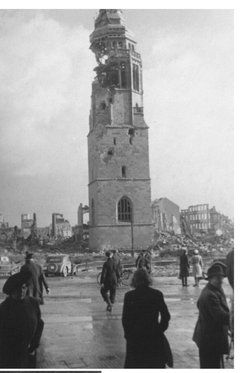

Lancaster B.I PD228 G1-A of 622 Squadron, flown by Squadron Leader R. G. Allen and crew 8,500 feet over Heinsburg on 16 November 1944. (IWM)
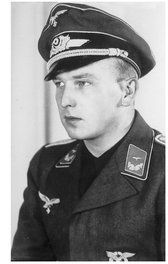
Leutnant Gustav Mohr a Wild Boar Bf 109 pilot claimed five night Abschüsse serving with 2./NJG 1 from 1 September to December 1944. Whilst shooting dow his 5th victim (a Lancaster on 12/13 December 1944) he was injured by return fire and was forced to bale out of his Bf 109G-6, which effectively ended his career i the Nachtjagd. (Steve Hall via John Foreman).
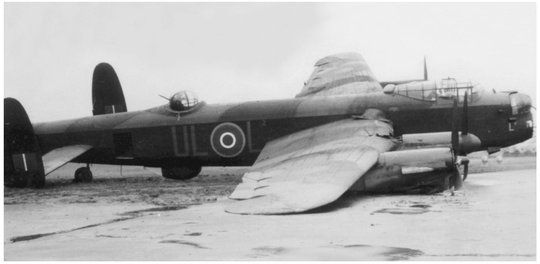
Lancaster III ND521 UL-L2 of 576 Squadron after a starboard undercarriage collapse on 18 November 1944. The aircraft was soon repaired and continued operations with 57 Squadron.
Ground crew installing a propeller unit on SE-L of 431 ‘Iroquois’ Squadron at Croft. Halifaxes were replaced by Canadian-built Lancasters on the squadron on 10 October 1944.
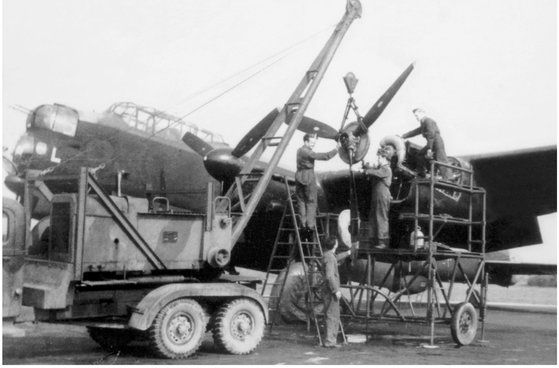
Wing Commander C. H. Baigent DFC*, a twenty-one-year-old New Zealander, was the youngest squadron commander in Bomber Command when he took over 75 New Zealand Squadron early in January 1945. (IWM)
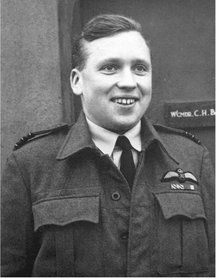
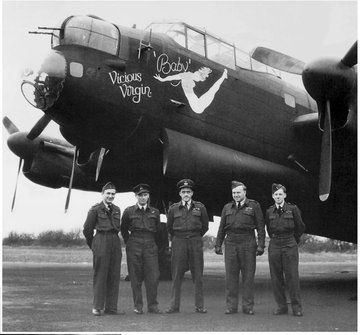
Flying Officer Bob Purves (left) usual pilot of P4-V Vicious Virgin/Baby, ‘B’ Flight, 153 Squadron, Squadron Leader McLaughlin and Wing Commander F. S. Powley DFC AFC, the CO. Powley was a Canadian from Kelowna in British Columbia who had joined the pre-war regular air force on a short service commision in 1936. On the night of 4/5 April 1945 he and Squadron Leader Gee’s usual crew of RA544 P4-U perished on a mine laying sortie in the Kattegat. Powley and Flight Lieutenant A. J. Winder’s crew were each victims of Major Werner Husemann a thirty-two Abschüsse ace of I./NJG 3.

The Mittelland Canal after a raid by 138 Lancasters on 21/22 November 1944, which completely demolished the aqueduct over the River Glane and breached the embankments on both sides and left 30 miles of canal, dry. On 1/2 January 1945 152 Lancasters and five Mosquitoes of 5 Group carried out an accurate attack on the Gravenhorst section of the canal. Half a mile of banks were pitted with bomb craters and some parts were breached. No aircraft were lost.
The ground crew of Lancaster III ND458 ‘Able Mabel’ of 100 Squadron who had serviced the aircraft since arrival on the squadron congratulate Canadian pilot Flight Lieutenant John ‘Jack’ D. Playford DFC RCAF who flew the aircraft on twenty-six ops including its 100th on 1 February 1945. Sergeant W. Hearn, who was from West Wickham, shakes hands with Playford while Corporal R. T. Withey, from Henley and LACs J. E. Robinson, from Solihull, J. Hales, Tottenham, and J. Cowls, Penzance, look on. Able Mabel which has 119 ops on the bomb log was destined to complete 134 ops, the 127th and last operational raid being 25 April to Berchtesgaden, an Exodus trip on 27 April and six Manna sorties. ND644 HW-N ‘N-Nan’ completed 112 sorties on the squadron before it was lost on 16/17 March 1945.

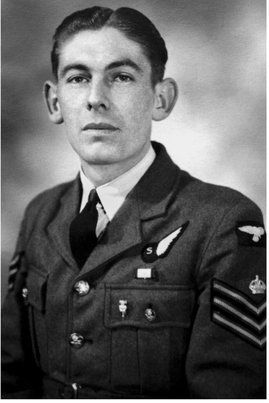
Flight Sergeant Jimmy Chapman CGM of 61 Squadron who was killed when his Lancaster crashed on take off from Skellingthorpe on 1 February 1945. (Derek Patfield)
Flight Sergeant Arthur ‘Dep’ Sherriff DFM (35) air gunner, of 61 Squadron who was killed when his Lancaster crashed on take off from Skellingthorpe on 1 February 1945.

Chapter 12: All Clap Hands for the Walking Dead
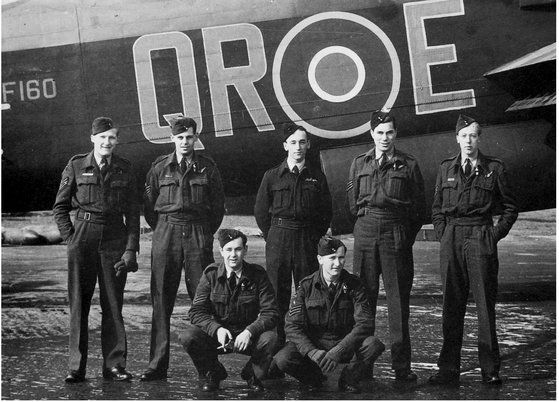
Lancaster B.I RF160 QR-E pictured here with Flying Officer Ray Lushey and crew was delivered to 61 Squadron at Skellingthorpe in March 1945.

Wing Commander David M. Balme DSO DFC who took command of 227 Squadron in March 1945. Balme had flown a tour with 207 Squadron whom he joined as a Flying Officer in March 1943, reaching the rank of Squadron Leader ten months later. After the war he became a professor.

Lancaster B.I PD336 WP-P of 90 Squadron, blows up after taking a direct hit at 23,000 feet over Wesel on 19 February 1945 killing the CO, Wing Commander P. F. Dunham DFC, Flying Officer T. Metcalfe RCAF, Flying Officer H. F. J. Carlton, Sergeant L. A. Page, Sergeant J. E. Bozeat, Pilot Officer F. A. Creswell and Sergeant J. E. Bennett. PD336 came down in the Rhine near Xanten and the bodies of the crew were recovered at nearby Bislicker. Dunham had only recently taken command of 90 Squadron following the death on 2/3 February of Wing Commander W. G. Bannister who died when his Lancaster I HK610 was involved in a mid-air collision with PD336 which was flown by Flying officer C. W. R. Harries, 33 minutes after take off from Tuddenham at the start of the operation to Wiesbaden. Bannister was a pre-war athlete who had represented Great Britain in the 1936 Olympic Games in Berlin. HK610 crashed at Hengrave near Bury St Edmunds. (IWM)
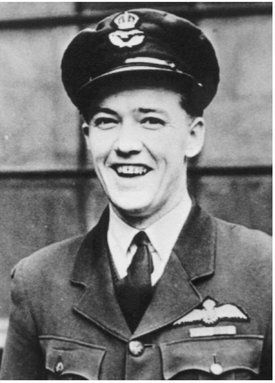
Wing Commander W. A. ‘Bill’ Forbes, CO of 463 Squadron RAAF from June 1944 until his death in action on 21/22 February 1945 when he and his crew were one of nine Lancasters that failed to return from the operation to the Mittelland Canal. Forbes and two of his crew were killed and five were taken prisoner. Four other Lancasters crashed in France and Holland.
Flight Sergeant F. Wadge DFM and his crew of J-Jig in 100 Squadron who returned from Stuttgart on 20/21 February 1945 with about six feet of the port wing sliced off after a collision with a German night fighter. Four nights later, on 24/25 February on the operation to Schweinfurt, everyone in this photo except the wounded member of the crew, were killed. Wadge took off from Waltham (Grimsby) in Lancaster III ND593 HW-B at 1830 hours but at 211 hours they returned overhead their base due to the pilot being taken ill. They were advised to jettison part of their fuel load but at 2145 hours a radio message indicated that they were in trouble and an order to jettison the bombs was transmitted to the crew. Wadge turned the Lancaster out to sea and disappaeared without trace.

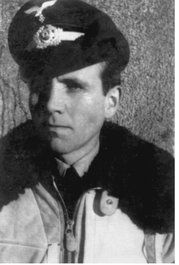
Feldwebel Helmut Bunje, Flugzeugführer, 4./NJG 6 who shot down three Lancasters on the night of 23/24 February 1945 on the Pforzheim raid. Bunje survived the war and he scored twelve Abschüsse in 4./NJG 6. (Helmut Bunje)

Lancaster B.I NG358 LS-H of 15 Squadron in 1945. The two yellow bars on the fins show that this aircraft is a G-H leader and the bulge beneath the fuelage go contains the scanner for the H2S airborne radar transmitter. The clover shaped marking in front of the mid-upper turret is a gas detection panel designed to change colour in the presence of toxic gas. (IWM)
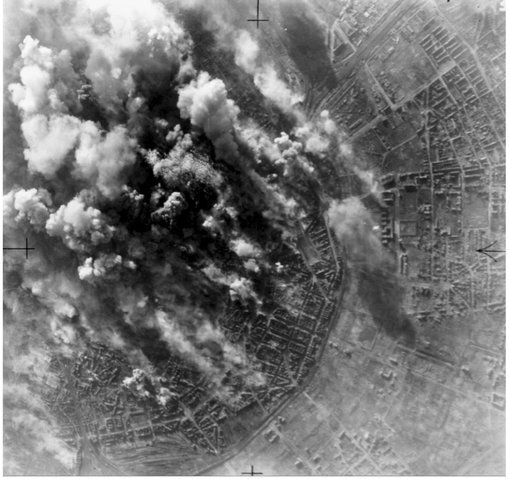
Cologne under attack on 2 March 1945 when two raids were mounted against the city, the first by 703 aircraft including 376 Lancasters and the second by 155 Lancasters of 3 Group. In the second raid however, only fifteen Lancasters bombed because the G-H station in England was not functioning correctly. The main raid was highly destructive with the Pathfinders marking in clear weather conditions. Between 11 May 1940 and 31 May 1942 RAF heavy bombers attacked Cologne on no less than 144 occasions. The 2 March 1945 raid was the last on Cologne, which was captured by American troops four days later. Only the blackened 13th century Gothic cathedral (its towers were not built until the 19th century) is recognizable. (via ‘Pat’ Patfield)
Lancaster III PA995/BQ:V The Vulture Strikes was the third Lancaster of 550 Squadron to complete 100 raids, reaching the century on 5/6 March 1945 with Flying Officer George Blackler DFC and crew. Blackler finished his own tour on this night when the target was Chemnitz. All those in the squadron associated with this aircraft posed for a commemorative picture although the bomb log only has ninety-eight bombs. Included are the CO, Wing Commander J. C. MacWatters DFC, two WAAFs, the padre and the inevitable dog mascot. George Blackler, who flew Victor on twenty-seven ops, is in the cockpit. The Vulture Strikes was one of three squadron Lancasters that failed to return from the next operation, when Flying Officer C. J. Jones RCAF and crew were lost on the operation to Dessau on 7/8 March. Jones and two fellow Canadian crewmen died. (IWM)
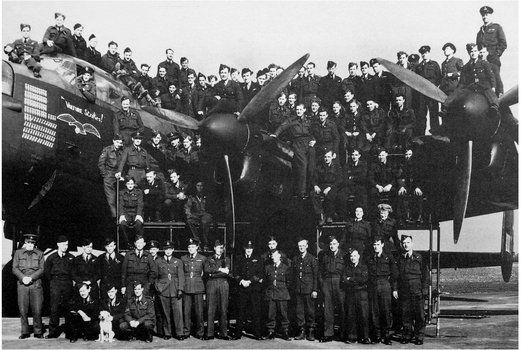
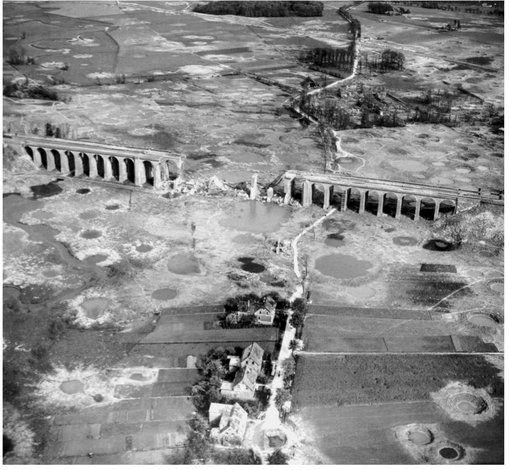
On 14 March 1945 thirty-two Lancasters and one Mosquito of 5 Group with four Oboe Mosquitoes of 8 Group attacked the Bielefeld and Arnsberg railway viaducts in Germany. Twenty-eight Lancasters dropped 12,000lb ‘Tallboy’ bombs and the 617 Squadron Lancaster of Squadron Leader C. C. Calder dropped the first 22,000lb ‘Grand Slam’ bomb, at Bielefeld. The Arnsberg viaduct, 9 Squadron’s target, was later found to be undamaged but near misses at Bielefeld created an earthquake effect which caused 100 yards of the viaduct to collapse, as this photo by a Lockheed F-5 Lightning of the US 8th Air Force shows.
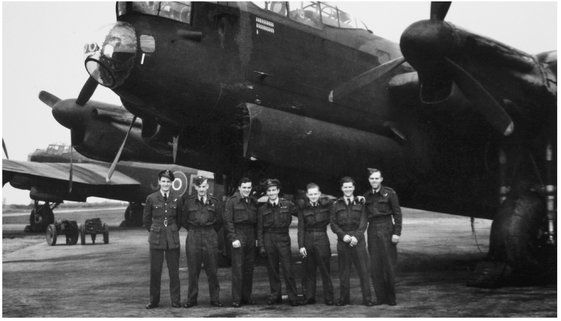
Flying Officer Les Sutton and his crew of Lancaster K-King of 514 Squadron at Waterbeach. L – R: John Britain, Alf McBurrugh, engineer; WOp; Bob Tores, rear gunner; Les Sutton, pilot; Shorty Evers, mid-upper gunner; Joe Speare, bomb aimer; Ray Hilchey, navigator. (Les Sutton)
Flying Officer Les Sutton and crew of 514 Squadron perched on top of Lancaster K-King at Waterbeach. L – R: Shorty Evers, mid-upper gunner; Alf McBurrugh, engineer; Ray Hilchey, navigator; Joe Speare, bomb aimer; Bob Tores, rear gunner; John Britain, WOp; Les Sutton, pilot. (Les Sutton)

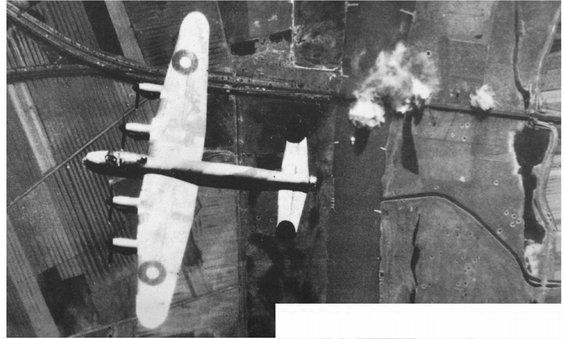
On 21 March 1945 the Arbergen railway bridge over the River Weser was attacked by twenty Lancasters of 617 Squadron who dropped ‘Ten Ton Bombs’ on the structure and damaged two piers of the bridge. One Lancaster was lost. In the photograph is Lancaster Mk.I Special PB996/YZ-C minus nose or dorsal turret, flown by Squadron Leader C. C. Calder.

Lancaster X KB832 WL-F of 434 ‘Bluenose’ Squadron RCAF blows up shortly after take off from Croft on 22 March 1945 for the daylight operation to Hildesheim. Flying Officer Horace Payne RCAF took off at 1055 hours but the Lancaster was caught by a sudden blast of wind, which took the bomber onto the grass. Payne tried to bring the aircraft back onto the runway but he over corrected and he then closed the throttles but he was unable to avoid racing across the airfield. A tyre burst and a collision occurred involving Lancaster X KB811 SE-T of 431 ‘Iroquois’ Squadron RCAF before KB832 came to a halt near East Vince Moor farm. A fire started in the port engine and this spread rapidly. The crew managed to get clear and a general evacuation order was broadcast. At 1127 hours the bomb load exploded and the force of the blast removed the roof of the farmhouse and set fire to hay and nearby buildings. Incredibly, no one was injured but it was late afternoon before the airfield was declared fit for use. (George Kercher)
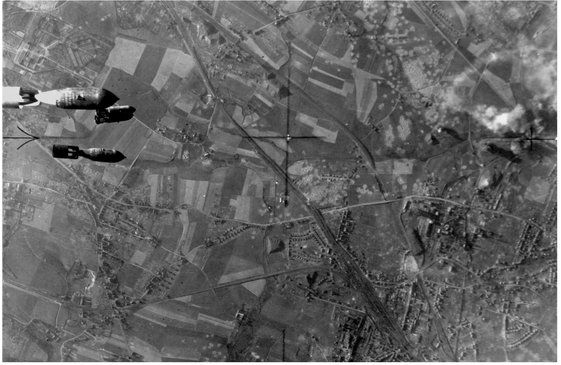
Dortmund (Harpenerweg) oil plant from 19,000 feet on 24 March 1945 when 173 Lancasters and twelve Mosquitoes of 1, 6 and 8 Groups attacked this plant and the Mathias Stinnes plant at Bottrop. Three Lancasters were lost on the Dortmund raid.

A 22,000lb ‘Grand Slam’ loaded on Lancaster B.1 Special PD113/YZ-T of 617 Squadron at Woodhall Spa prior to the raid by twenty Lancasters on the U-boat shelter at the Valentin submarine works at Farge on the River Weser north of Bremen on 27 March 1945. The crew are Flying Officer E. W. Weaver, air bomber; Flying Officer R. P. Barry, rear gunner; Flight Lieutenant J. L. Sayer DFC, pilot; Flying Officer V. L. Johnson, flight engineer and Flying Officer F. E. Wittmer, navigator. The U-boat shelter was a huge stucture with a reinforced concerete roof 23 feet thick and was almost ready for use when 617 Squadron dropped twelve of the 22,000lb bombs, two of which penetrated the roof, bringing down thousands of tons of concretre rubble and rendering the shelter unusable. No aircraft were lost in the attack on Farge or on the raid on an oil-storage depot by ninety-five Lancasters of 5 Group. Lancasters dropped a total of forty-one ‘Grand Slam’ bombs operationally. (IWM)
Heligoland pictured from 17,000 feet on 18 April 1945 when 969 aircraft, 617 of them Lancasters, attacked the naval base, the airfield and the town on this small island. The bombing was accurate and the target areas were turned almost into crater-pitted moonscapes.

Lancasters en route over the Alps to Berchtesgaden on 25 April 1945. Hitler’s home, referred to as the ‘Chalet’ by the RAF, was the target for 359 Lancaster heavy bombers and fourteen Oboe Mosquito and twenty-four Lancaster marker aircraft. Included in the mighty force were thirty-three Lancasters of 9 Squadron and 617 the ‘Dam Busters’, each carrying a 12,000lb Tallboy bomb.
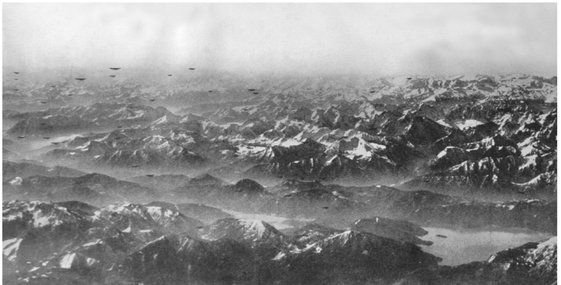

Berchtesgaden from 18,000 feet on 25 April 1945. Those who bombed the ‘Chalet’ mostly missed. A mountain peak between the Oboe ground station and the aircraft had blocked out the bomb release signal. Since Oboe signals went line of sight and did not follow the curvature of the earth, the further the target, the higher one needed to be and the Oboe Mosquitoes flew at 36,000 feet because of the Alps. Crews heard the first two dots of the release signal and then nothing more. They were unable to drop and brought the markers back.
The empty ruins of Hamburg in May 1945. Altogether, Lancasters dropped 608,612 tons of bombs in 156,000 sorties in the Second World War. (IWM)
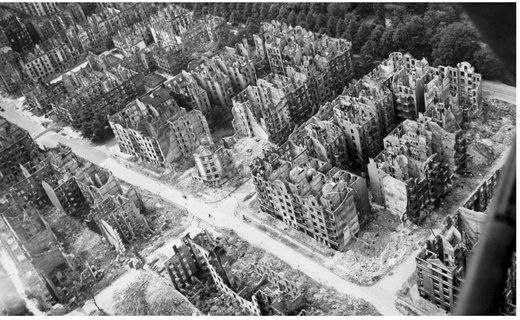

The crew of ‘V for Victory’ found their aircraft appropriately lettered for VE-Day in May 1945. They are reading the surrender news on an airfield near Rheims. L – R: Flight Lieutenant M. F. Colvin (RAF), Flight Sergeant G. C. Prunster, of Geraldton, Western Australia; Flight Lieutenant R. W. Markham, of Melbourne; Flight Sergeant G. R. Goodard, of Perth; Flight Lieutenant R. G. Bligh, of Sydney, and Sergeant A. N. Maxwell (RAF).
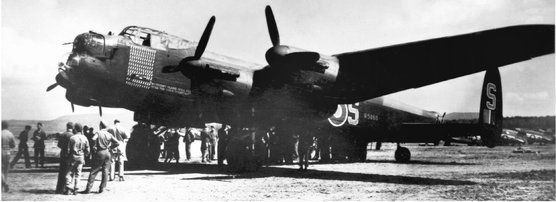
Lancaster B.I R5868 S-Sugar of 467 Squadron RAAF at Kitzingen airfield, Germany on 7 May 1945 for the repatriation of British ex-PoWs during Operation Exodus. S-Sugar which completed her 137th and final operational bombing sortie on 23 April 1945 to Flensburg, is now on permanent display at the RAF Museum, Hendon, London. Lancaster III ED888 PM-M M for Mother completed the most number of trips of any Lancaster – 140 in 103 and 576 Squadrons (the latter as PM-M Mike Squared) and 103 Squadron again, May 1943 to December 1944 – in Bomber Command. (IWM)
Former PoWs wait to board Lancaster I ME455 LS-O of 15 Squadron for the flight home during Operation Exodus. Mildenhall’s Lancasters, each carrying twenty-four PoWs ferried them home from Juvincourt near Rheims to Westcott and Wing between 10 May and 30 June 1945. (via Harry Holmes)


Ex-British PoWs file past Lancaster III PB935 F2-Z of 635 Squadron at Lübeck on 11 May 1945 during Operation Exodus. In the distance is a Gloster Meteor jet fighter. (IWM)
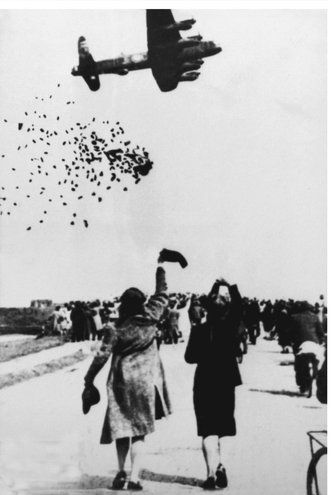
During Operation Manna 29 April to 7 May 1945 Lancasters flew 2,835 food sorties and PFF Mosquitoes made 124 sorties to ‘mark’ the dropping zones and Bomber Command delivered 6,672 tons of food to the starving Dutch people. (IWM)