Chapter 4
Everybody said how much easier the ‘Eyetie’ trips would be after the Ruhr but of course we had to negotiate the Swiss Alps in each direction. Whilst passing through the Alps the Swiss, no doubt wishing to make a point of their neutrality, opened up with their AA fire, which although far from accurate was strange since it came down toward us instead of upwards! Visibility was good and the Alps was an awesome sight.
Warrant Officer Eddie Wheeler
Raids on Ruhr targets continued with Dortmund, the fourth heavy Bomber Command raid of May 1943, on the night of the 23rd/24th. Of 829 aircraft dispatched, 38 bombers failed to return. More than 2,000 tons of bombs, the biggest bomb load ever dropped anywhere in a single night, fell on the luckless city and the great weight fell in less than an hour between 01.00 and 02.00. Bombers all but jockeyed one another for position on the bombing run. Sergeant Ray Foster, rear-gunner in a Lancaster, was startled to see the starboard wing of another Lancaster flash by in front of his own tail-plane. The tip of one bomber’s wing passed between the trailing edge of another bomber’s main-plane and the leading edge of its tail-plane. ‘I could have shaken hands with the bomb-aimer in the other Lancaster,’ said Foster. Flight Lieutenant H. C. Lee of Felixstowe, piloting another Lancaster, made his attack late in the raid. But before then he had circled round the target for nearly an hour, awaiting his ‘turn’. He was startled just as much as Sergeant Foster: ‘As I made my attack a Stirling came streaking out only fifty feet above us and we were bumped by its slipstream. By this time it was difficult to believe that it was a real town below; the place was so covered with fires and smoke.’ The next morning came more accolades and another promise from the Commander-in-Chief, addressed to all crews in Bomber Command: ‘In 1939 Goering promised that not a single enemy bomb would reach the Ruhr. Congratulations on having delivered the first 100,000 tons on Germany to refute him. The next 100,000, if he waits for them, will be even bigger and better bombs, delivered more accurately and in much shorter time.’
On the night of the 25/26 May 759 bombers were dispatched to bomb Düsseldorf. Twenty-seven bombers1 were lost – 21 of which, were victims of night fighters. The raid was a failure due to the difficulty of marking in bad weather. By contrast, the raid on Wuppertal three nights later was the outstanding success of the Battle of the Ruhr. A large fire area developed in the narrow streets at the old centre of the extended, oblong shaped town, which had a population of almost 360,000. Wuppertal had been formed in 1920 by the union of the adjacent towns of Elberfeld and Barmen in the Upper Wupper Valley. The Barmen half of the town was the target for the 719 aircraft dispatched on that Saturday night which was moonless and 292 of them were Lancasters. Sixty-two aircraft turned back early but the remainder, aided by blind-marking systems, devastated about 1,000 acres of Barmen’s built up area. Nearly 4,000 dwellings were destroyed, and 71 industrial and 1,800 domestic buildings were seriously damaged. Thirty-three bombers, seven of them Lancasters, were lost.2
Early in June Sergeant (later Warrant Officer) Ronald J. Clark and his all NCO crew were posted to 100 Squadron at RAF Waltham (Grimsby) having ‘crewed up’ in the time-honoured fashion at 1656 HCU (Heavy Conversion Unit) at Lindholme. Jim Siddell, the navigator, was a strong-minded Yorkshireman and the only married man in the crew. Harold ‘Ben’ Bennett, the flight engineer, was a Lancastrian from Preston and a Halton ‘brat’ who had joined the crew at Lindholme. Lishman ‘Lish’ Y. Easby, the wireless operator was from the North Riding and a former civil servant. Les ‘Trigger’ R. Simpson, a Londoner, was the 29 year old mid-upper gunner. His fellow Londoner was Doug Wheeler, the bomb-aimer. W. G. ‘Geoff’ Green from King’s Lynn was the rear-gunner. The crew were allocated A-Apple in which to make six or seven training flights and once they realized that EE139 which, in early July, became R-Roger, was theirs a more personal name would have to be thought of. For the present they had other things to think about. The Battle of the Ruhr was in full flow and when the crew’s names were posted at the bottom of the battle order for the first time on 11 June, the ‘target for tonight’ for them and 782 other crews was the heavily defended city of Düsseldorf. They safely negotiated ‘Happy Valley’s’ flak and fighter defences between Cologne and Düsseldorf and bombed the rail yards and factories, returning shaken but uninjured to Waltham. That night the Squadron lost two aircraft and 13 men died with one surviving to become a POW.3 During the month nine crews were lost, one third of the squadron strength. By mid-June only two crews survived from those that had reformed 100 Squadron at Waltham just a few months earlier. The chances of Ron Clark’s crew surviving a tour of 30 operations did not appear likely. They discussed an identity for R-Roger. Inspiration was found from the film Phantom of the Opera, which was then showing in cinemas. Ron Clark felt that the grand operatic Teutonic sagas of the British and the Germans performed nightly over the Fatherland should have been accompanied by the music of Siegfried. Sergeant Harold ‘Ben’ Bennett, the flight engineer suggested painting a ghoulish hooded skeleton figure casting bombs out of the night sky. The ex-Halton apprentice might have been influenced by feelings of revenge from his time as a ground engineer in Fighter Command when he had suffered frequent bomb attacks. The name Phantom of the Ruhr and the skeletal figure were adopted, though afterwards Ron Clark felt that ‘something a little less ghoulish would have been more appropriate’. In front of the Phantom motif was the mustard-coloured circular gas detection patch, which appeared on aircraft of No. 1 Group Bomber Command.
On 12/13 June the German defences destroyed 14 Lancasters and 10 Halifaxes from the 503 aircraft raiding Bochum. A-Apple’s second op resulted in the Lanc being hit by flak over the target, which caused damage to the rear turret but again Clark’s crew returned safely.4 Two nights later, on 14/15 June, the crew was forced to abort the operation to Oberhausen after 2 hours 38 minutes when the R/T failed. They jettisoned their bombs over the North Sea and the sortie was not counted. The target was cloud-covered but once again the Oboe sky marking was accurate. Seventeen Lancasters, from the 197 dispatched, failed to return.5 Minnie the Moocher6 in 15 Squadron at Wickenby was attacked 30 miles from the target by three or four night fighters as Sergeant A. H. Moores, the pilot who was from Bromley in Kent, recalls:
‘Sergeant J. D. Cushing my bomb-aimer, whose home was at Ealing, told me that there were two Junkers 88s below. The next thing I heard was the rear-gunner open up with a four-second burst. I think it was then that he was hit, because I heard nothing more and the intercom was cut off. Sergeant Norcliffe the wireless operator, a Halifax man, thought that we were on fire and in looking for the flames knocked off his oxygen tube. He was so dazed that he said to me, “Me, you, the pilot of this aircraft?” We all believed that there must be a fire owing to the overpowering reek of cordite – actually it came from an enemy shell – and I was expecting our 4,000-pound bomb to go off at any moment. But I was determined not to jettison the bomb after the distance we had flown. So we carried on to the target and when our full load had gone down I heaved a sigh of relief I was amazed to find that the aircraft could still fly true and level. I turned for home. We hit the coast right where we wanted to. When our badly damaged Lancaster touched down at base we found that the rear-gunner had been killed by a cannon-shell. It had smashed one side of the rear-turret. There were holes as big as coconuts in the fuselage and both starboard propellers had been hit. Luckily they had continued to function.’
Fourteen Lancasters were lost from a force of 212 heavies that raided Cologne on 16/17 June.7 One of the 202 Lancasters which took part was flown by Wing Commander Peter Johnson, commanding 49 Squadron at Fiskerton. As a single-satellite station, Fiskerton did not warrant a group captain as station commander, so Johnson was also station commander. His rear-gunner was Pilot Officer ‘Chan’ Chandler, who had recently missed a date with certain death had he flown the Dams raid. Cologne was Chandler’s 54th operation of the war and it was part of a spell in ‘Happy Valley’ following a visit to Dortmund and two to Düsseldorf with Johnson as his pilot. They had carried a maximum load of incendiaries to Dortmund and it was ‘a sea of flame’ when they left. Large areas were devastated, 2,000 buildings were destroyed and the Hoesch steelworks was put out of action. The 25 May raid on Düsseldorf was not so successful. There was heavy cloud over the target and the Germans had dummy markers and fires. The raid on 11 June had been more successful with 130 acres destroyed in the centre of the city and 140,000 people bombed out. It was another ‘sea of flame’ when they left. Johnson’s Lancaster was hit and all the Perspex was shot out of the front. Johnson ‘nearly froze to death’ on the way home. On the Cologne trip the target was cloud-covered and marked by 16 heavy bombers of the Pathfinder Force (PFF) using H2S. Chan Chandler recalls the operation in vivid detail:8
‘One of the perks of being a tail end Charlie and flying backwards was the marvellous sunsets. Flying to the east the cabin crew were flying into the dark, but in the back, taking off at dusk or even an hour or two after dark, as we went up into the sky so the horizon extended and one could see a second sunset. In Lancs we flew much higher than Hampdens and from the air the colours were often indescribably beautiful. As we climbed eastwards the sunset would slowly fade to be replaced by a purple line with black darkness below and light above. It gave the most eerie sensation; it felt as if you were going to fly clear over the edge of the world like a lost soul flying out into space, never to return . . .
“Five miles to target, skipper.”
“I see it, seems as though they’ve got a good fire going.”
“Well, maybe we’ll stoke it up a bit.”
‘Obviously we were arriving well into the raid – at the start the streets would be outlined by incendiaries, showing the grid pattern of the town as if all the street lamps were on; then as the high explosives began to shatter the buildings, the fires would take hold, grow and coalesce into one gigantic fire.
“Turn on to target, steer 010.”
“Roger, turning – steering 010.”
‘Up front they could see the blazing town laid out before them and the markers going down on the aiming point. In the tail I was still relentlessly searching the darkness, turret and guns maintaining their never-ending right, up, down, left, up, down. Now we were over the town, covered by a pall of smoke from the bombs and fires through which glowed the fires and the flashes from the bombs. The whole town seemed to be one obscene boiling mass beneath us. Left, right, left. The search now concentrated on the darkness above for the least trace of a flash of light that could be a fighter bearing down out of the darkness on to us, his prey, silhouetted by the fires below. Still, he wasn’t likely to follow us down with all this flak about. We were flying through a cloud of black and brown smoke puffs.
“Bomb doors open.”
‘I felt the altitude alter and the pilot’s correction as the big doors came down into the slipstream. Men, women, children, babies, cats, dogs, rats, mice; nothing would live down there. All would be literally boiled alive and then incinerated, the ashes covered by the falling buildings.
“Bombs gone” – the gentle thump as the bomb doors closed.
“Right – let’s get the hell out of it.” The skipper put the nose down to crack on some speed.
“Carry on steering 010 for about twenty minutes to turning point, skip.”
“Roger, steering 010.”
‘Not far to the right of us a kite suddenly exploded into a ball of flame in mid-air.
“Some poor bastard’s just bought it – looks like a night fighter – keep your eyes peeled, Chan.”
“Wilco, skip.”
“Turning point in one minute on to 355. Next turn approximately forty-five minutes.”
“Roger.”
“Corkscrew starboard – GO GO GO!”
‘The giant Lanc lurched and dived, turned and climbed.
“OK skip, I think we’ve lost him – Ju 88 just hurtling past. Back on to 355.”
‘The minutes tick away, each bringing us a little closer to the coast and safety.
“Turning point in one minute – Turn port on to 290”
“Wilco, steering 290”
“Enemy coast ahead about five miles”
“Thanks bomb-aimer, let me know when we cross”
“Wilco -Crossing enemy coast – now”
“Thank you.”
‘Everyone breathes a sigh of relief as the comparative safety of the North Sea is reached. Still we have all four engines going – should be a doddle unless there are any intruders about.
‘Down at the “lonely end” I unclasp my oxygen mask and light a cigarette, the smoke rasping on my dry throat. I pick up my Thermos and have a mouthful of cold coffee and curse at the taste. I relax a bit and enjoy my cigarette, but still with one hand directing the turret in its endless search up, down, right, left, up, down. Too many have been chopped thinking they were safe once they had crossed the enemy coast on the way home, only to find the fighters had chased them anything up to thirty miles out to sea.
‘ “Coast coming up” – another great sigh of relief all over the kite. Whatever happens now, we are home.
‘At last we reach the drome, get in the circuit, and eventually it is our turn to land.
‘ “Wheels down.” Everyone holds their breath. Are they going to? You can feel the part sound, part vibration as the undercart comes down; the sound and shiver of vibration runs down the kite as one side locks in. Two or three heart-stopping seconds later, clunk! and the other side locks in.
‘Into the funnel – runway lights ahead – she goes down. The screech as the tyres touch the tarmac hits your ears, then the deceleration as the brakes come on. The tail drum and the tail wheel hammers and yammers until she slows down to taxiing speed. Round the peri-track to dispersal and brakes on, engines off for the first time in eight or nine hours.
‘Those four bloody Merlins have shut up. You’d have been in a poor bloody funny state without ’em wouldn’t you? Stop bitching and get out of there. Too tired – I’ll sleep here. Oh fuck – there’s bloody debriefing isn’t there? Almost too tired to open the turret doors. Crawl across the spar into the fuselage; legs won’t work, have to crawl to the door and stick my feet out backwards. Jimmy the W/Op guides them on to the ladder and helps me down and then gives Mike a hand. A flight van rolls up. We all fall into it and it takes us off to debriefing. One more for the log-book – how many more will we manage, I wonder?’
His next op was on 20/21 June as mid-upper gunner flying with Flight Lieutenant Tommy Taylor. Codenamed Operation Bellicose, 56 Lancaster bomber crews and four Pathfinders of 97 Squadron were briefed to make a precision attack on the Zeppelin works at Friedrichshafen on the shores of Lake Constance (the Bodensee) near the Swiss border. Zeppelins were no longer being built or housed at the factory, bombed by Royal Naval Air Service Avro 504s in November 1914, but was now turning out Würzburg radar, which was used to locate RAF bombers approaching the night fighter zones on the continent. There was also a factory nearby making diesel engines for U-boats. Due to the target’s distance from England it would have been extremely dangerous to try a daylight raid and because of the short nights in the summer it would not have been possible to attack and return under the cover of darkness. It was therefore decided to fly on to Allied bases at Blida and Maison Blanche in North Africa to confuse the German night fighter defences in France then, after rearming and refuelling, to attack Spezia on the return trip. It thus became the first ‘shuttle trip’. ‘As the natives of those parts had rather nasty habits, which included collecting essential bits of one’s anatomy’ recalls Chan Chandler, ‘the Air Ministry thoughtfully provided us with pieces of folded cardboard printed in both English and Arabic to entice them away from their usual practices with the promise of baksheesh, so long as they returned their aircrew ‘virgo intacta’. The Air Ministry had obviously taken great trouble to prepare these ‘goolie chits’, as the aircrew called them, but had either overlooked, or at any rate forgotten, to tell us that none of these blighters could read!’9
At Syerston, a pre-war permanent station on the Fosse Way with two Lancaster squadrons, 61 and 106, the bombers began taking off at around 21.45 hours. Pilot Officer Ward Parsons RCAF from Cayuga in QR-L and four other Lancasters of 61 Squadron headed south over East Anglia at the start of a five-hour flight across France and southern Germany to the target area. By this time the Canadian’s crew had 25 ops under their belts and they were considered by the ‘sprog’ crews to be ‘Gen Men’ and one of the most experienced crews on the Squadron. Being posted to 61 Squadron suited Sergeant ‘Nobby’ Clark, Parsons’ WOp/AG, fine because the main feature of the squadron badge was the Lincoln Imp and, as he was from Thorney and went to school in Lincoln, it had seemed a good omen. So far the omens had been good and as a result of their experience, Parsons’ crew, with four other seasoned crews, had been temporarily taken off ops to carry out a series of flying exercises prior to taking part in the special operation.10
The raid was also the first to employ a master bomber, Group Captain Leonard Slee DSO DFC to control the main force in the target area sending instruction by radiotelephone over the target. This was introduced following Guy Gibson’s successful use of VHF on the Dams’ raid a month earlier. The Channel was crossed at maximum height and gradually the Lancasters came down to between 2,000 – 3,000 feet and then higher again when they crossed the Rhine. Aboard Slee’s aircraft was Major Johnny Mullock MC the 5 Group flak liaison officer who had flown with Guy Gibson to Italy and who had participated in raids over the Ruhr to observe the German defences first hand.11 Mullock was to recall:
‘Approaching the French coast at 19,000 feet we encountered heavy cloud and electric storms up to 24,000 feet. We therefore decided to come down below the front and lost height to 5,000 feet. We were suddenly engaged by the defences of Caen or the outer defences of Le Havre – owing to technical difficulties with navigation instruments we were uncertain of our exact position. Four 4-gun heavy flak positions engaged us for about four minutes. During the time we altered course by about 30 degrees every eight seconds, alternatively losing and gaining height by 1,000 feet. The flak bursts were mainly 300 – 500 feet behind and about the same distance above us. It was noticed that the rate of fire of the guns was extremely high! We flew on below cloud at 2,500 – 3,000 feet across France and encountered no further opposition.
‘About 45 minutes from the target area by which time we had increased our height to 6,000 feet, we had to feather our port inner engine, which had been emitting sparks. And so we continued on three engines until we sighted Lake Constance. As the port inner engine is essential for the Mk.XIV bombsight it was unfeathered and allowed to windmill but shortly after, the engine caught fire. We were unable to feather it or extinguish the fire, which grew in intensity. We jettisoned our bombs and the order to prepare to abandon the aircraft was given, first diving across the lake into Switzerland and subsequently turning the aircraft towards Germany. We were about to bale out, expecting the petrol tanks to explode, when the engine seized up and the fire went out. By this time we were at 4,000 feet but were able to maintain height.’
Slee meanwhile, had handed over control to his deputy, Wing Commander Cosme L. Gomm DSO DFC of 467 Squadron flying Y-Yankee. The weather at the target was clear, with Lake Constance and surrounding area bathed in bright moonlight, which enabled the Pathfinders to place their markers very close to the target. Circling Friedrichshafen the crews awaited instructions from the deputy leader. Both attacking elements had been briefed to bomb visually from a height of between 5,000 – 10,000 feet. There were approximately 16 – 20 heavy flak guns and 18 – 20 light flak guns and about 25 searchlights, all within a radius of about six to eight miles of the target. They were more active than expected so Gomm ordered the bombers to climb to the safer height of 15,000 feet before attacking. The first wave of bombers dropped their bombs on the Target Indicators laid down by the Pathfinders and the second wave was briefed to make a time and distance run from a prominent point on the shore of the lake to the estimated position of the factory. Aboard Ward Parson’s Lancaster, Sergeant Frank Poole, the bomb-aimer from Weston-super-Mare, got his bombs away on the target. Stronger winds at the higher altitudes caused problems but around 10 per cent of the bombs hit the relatively small target. After the Lancasters had completed their bombing runs they flew south over the French Alps and Mediterranean to North Africa for a landing at either Maison Blanche or Blida airfields. Slee’s Lancaster stayed over Lake Constance for 13 minutes and the crew had an excellent view of the attack, as Major Mullock recalls:
‘Several aircraft were coned but not for any length of time. Leaving the target area, we continued to fly over the Alps. By skirting the peaks we eventually crossed, gradually gaining height to above about 14,000 feet. The 600-mile flight over the Mediterranean was slow, as we were limited to 140 mph to prevent overheating. Eventually we sighted the Algerian coast and landed safely at Maison Blanche at 07.52 hours, after a flight of ten hours and thirteen minutes.’
Chan Chandler adds:
‘On arrival the force circled, waiting for the markers to be dropped by the PFF. Inevitably, some over flew Swiss air space. The Swiss had all their lights on, which was a very pleasant sight, but of course had to demonstrate their neutrality by firing at us. However, we noticed that their flak was bursting well below us. Story has it that some wag flashed down on the Aldis lamp, “You are firing very low” and the Swiss flashed back, “Thank you, we know”.
‘Soon after the start of the raid the target was obscured by smoke from the bomb blasts. The third special feature of this raid now came into operation. The PFF were called in to drop flares along the shoreline of the lake so that the bombers could identify a prominent landmark. Then, knowing the distance and the bearing from the landmark to the target, they could make a timed run and drop their bombs in the right place. As the target was heavily defended all the aircraft remained circling to distract the flak from those on the bombing run, and then, on instruction from the master bomber, all headed for Maison Blanche near Algiers. Luckily we got to the landing strip without going down in the desert, so we did not have to put the “goolie chits” to the test. However, I have since wondered how many aircrew’s bits it took before word filtered back to the caravans that these bits of card could be worth money.’12
Before leaving Syerston crews had been briefed that weather conditions at the Algerian airfields in the early morning would not present any problems. ‘However’ recalls Nobby Clark, ‘when we arrived over Maison Blanche at about 1,200 feet we could only get fleeting glimpses of the runway as banks of low mist drifted across the airfield. There were already a number of aircraft in the circuit and pilots were continually calling the tower for permission to land, as fuel was getting short after ten hours in the air. Instead of calling each aircraft down in turn, all we got back from the American controller was, “Ship on the approach now, come on in, the runway’s right below you”. This confusion resulted in everyone attempting to get down at the same time. Even after landing the danger from collision was not over. As we slowed down at the end of the runway, Danny Towse our rear-gunner from Kilham, Bridlington, shouted over the intercom, “For God’s sake Skip get off the ******* runway quick, there’s another kite coming up fast behind”, or words to that effect! Maison Blanche was a primitive desert airstrip and while there we all lived under canvas. However to ease the boredom we did managed to squeeze in a visit to the city of Algiers. Quite a change from our usual night out in Newark.’13
The new bombing procedures tried during Operation Bellicose were deemed successful. In addition, when reconnaissance photographs were examined they showed that 10 per cent of the bombs hit the target factory and many of the near misses destroyed other industrial premises. By flying on to North Africa after the raid the bomber force confused the German night fighters that were waiting for them to return directly to England. As a result there were no Lancaster losses during either part of this operation. On 23 June 52 of the Lancasters that had bombed Friedrichshafen were bombed up and the aircrews were briefed to attack the oil depot at the northern Italian port of La Spezia. After completing the operation the crews were instructed to return to their home bases in England. Eight of the aircraft that bombed Friedrichshafen remained in North Africa for maintenance. Sergeant Nobby Clark continues:
‘We took off in QR-L at 20.05 hours and after a one and a half hour flight over the Mediterranean we arrived off the Italian coast just south of the target area. In the distance the skipper saw a target indicator cascading down over the target and quickly turned on our bombing run. Our debrief entry in the Squadron log for this attack records the following: “Pilot Officer Parsons saw one green marker and after identifying the bay visually, bombed 500 yards north of an oil fire from 11,250 feet at 2133 hours. Once clear of the target area we headed northwest over the Maritime Alps and five hours later, after an uneventful flight over France, landed safely back at RAF Syerston at 0437 hours.”
‘My crew’s last two ops were both to Gelsenkirchen, the first on 25 June and the second on 9 July. The latter was my 30th and last sortie of my operational tour and was destined to end in tragic circumstances. Shortly after we had bombed the target, we ran into heavy flak and the only fragment of shrapnel that penetrated the fuselage hit our navigator, Sergeant Bob Dyson and he died shortly afterwards. We headed west for home and by using radio aids and a bit of rough navigation by the second bomb-aimer, whom we had on board for his introduction to ops, our skipper got us safely back to RAF Manston in Kent. We returned to our base at Syerston on 11 July. Two days later the Squadron Commander informed us that it had been decided our tour of operations had been completed and we would shortly be posted as Instructors for training new aircrew.’14
In England meanwhile, the Lancaster crews had been kept busy during a week of sustained operations. They had only one day of rest then two nights in succession to the Ruhr area, Krefeld to the west of the Rhine on 21/22 June15 and the twin towns of Mülheim and Oberhausen near Düsseldorf on 22/23 June.16 On 25/26 June when 473 bombers attacked Gelsenkirchen and Bochum, 31 aircraft including 13 Lancasters were lost. Sergeant J. S. ‘Johnny’ Johnston was the flight engineer in Z-Zebra17 in 103 Squadron at RAF Elsham Wolds flown by Flight Sergeant Alan E. Egan RAAF, which was shot down at Bechtrup north of Lüdinghausen.
‘Somebody shouted, “There’s a yellow marker”. Course we all looked away. Next minute I saw this great big wing above my head (as flight engineer I was standing up). We were hit just like as if it was a three-ton truck. BANG! We held together for a minute. Then she screamed right across the port wing, hit the propellers and we went out of control. Both engines burst into flames. I got thrown to the floor and banged my head. I got up, or tried to. I could see Alan trying to get her straight. Then she dipped her nose and I went straight down into the nose with all the junk that was on the floor and landed on top of the bomb-aimer. All of a sudden, the nose broke off. I just saw it start to crack. The bomb-aimer and I fell out. I was surrounded by bits of cowlings and pieces of metal all floating around me. I thought I was going up instead of the bits of metal going down. All the planes were coming in like little mosquitoes – line upon line of them. A yellow light from the fires that were just starting lighted up Gelsenkirchen. It was like a watery sunset. Bombs were going down like big golden darts in the yellow light. It was horrifying.
‘I was captured and told to climb into the back of a truck. Up I got and in the darkness I could just see some boxes. I put my hand out and felt a flying boot. I thought, ‘Gee, that’s all right, I want a pair of flying boots’. I put it on and felt around for the other one. All of a sudden I realized that they were soaking wet. I felt horrible because I thought it was blood. Then it hit me. I was sitting on top of coffins. I counted them. There were five on the top layer and six on the bottom. Afterwards I found out that four of them were members of my crew and seven of others.18
‘At the first stop on the train to my POW camp with two Luftwaffe guards there was a Red Cross train just opposite and I saw little children with bandages round their eyes and their hands on one another’s shoulders. A nurse in front and one behind were leading them to the train. This was the first time that I realized what war was really like. It was easy when you were dropping bombs up there. I turned to one of my guards, a good German and asked, “Where’s this?” He said, “Mülheim” (which was still smouldering from a raid the previous Tuesday). I kept silent. I had been on that one too.’19
Cologne was subjected to three consecutive heavy raids in late June and early July. Warrant Officer Eddie Wheeler, WOp/AG in 97 Squadron, recalls the raid on 28/29 June when 608 heavies were dispatched:
‘After six days we resumed marking operations, this time against poor old Cologne again. We were allocated another N for Nan. With no cloud and excellent visibility we bombed from 20,000 feet releasing our markers and 10,000-lb bomb load, which resulted in a huge explosion. Landing at 03.40 hours we decided on another thrash to Cambridge that evening. I had now completed my fiftieth operational sortie, which was as good a reason as any to celebrate.’20
A follow-up raid on Cologne by 653 bombers including 293 Lancasters went ahead on 3/4 July when single-engined Wilde Sau (Wild Boar) fighter pilots of the Nachtjagd Versuchs Kommando (Night Fighting Experimental Command) were employed for the first time. The freelancing single-engined night fighting tactics were hastily introduced under the command of Ritterkreuzträger Oberst Hans-Joachim ‘Hajo’ Herrmann. The former bomber pilot reasoned that his fighter pilots could identify bombers over a German city using the light of the massed searchlights and Pathfinder flares and the flames of the burning target below. Then they could shoot them down. Geschwader Herrmann was equipped with Fw 190s and Bf 109s thrown into the fray in Wilde Sau operations, a primitive form of night fighting in which the pilots tried to intercept and destroy the bombers in the glare of fires burning below and with the aid of searchlight beams played on the cloud base, forming a Mattschheibe or ‘ground glass screen’ against which the bombers showed up in silhouette. The first Wilde Sau operation over Cologne on 3/4 July met with instant success and 12 of the 30 aircraft that were lost were claimed shot down over the target by the freelancing single-engined night fighters.21
There were other losses too. That night 26 Lancasters of 460 Squadron RAAF were drawn up at Binbrook, Lincolnshire, for the attack on Cologne. The aircrews and most of the ground crews were at their evening meal when, suddenly, at 18.00 hours, an alarm came. Through an electrical short circuit the entire bomb load of one Lancaster had been released and had fallen to the ground, where the incendiary part of the load was burning fiercely beneath the aircraft. Up went the 4lb incendiary clusters with the 500lb HEs roasting in the centre of the inferno. Two shocked maintenance crewmembers inside the bomber at the time leapt out and tried to roll the 4,000lb bomb away from the mass of burning incendiaries. They saw it was hopeless and ran for safety. They had covered 400 yards when the 4,000lb cookie and the 500lb bombs exploded, scattering the incendiaries among other aircraft. The two airmen were blown to the ground, but escaped with shock. Then the Lancaster next to the first burst into flames and two minutes later its load, which included another 4,000lb bomb and three 1,000lb bombs, exploded, wrecking the bomber, throwing still more incendiaries among the aircraft and setting fire to starter trolleys.
With several airmen, Wing Commander C. E. Martin DFC the squadron CO manned the station fire tender and extinguished as many of the incendiary bombs as possible. Then someone saw smoke pouring from another bomber a little distance away. Martin climbed inside the aircraft with Flight Sergeant A. E. Kan of Victoria, the latter still shell-shocked from the original explosion and they tried to fight the flames with hand extinguishers. When the flames were partly under control another airman climbed into the bomber and disconnected the electrical leads to prevent more bombs from being dropped to the ground. By this time the fire was intense enough to cause the magnesium contents of the fuselage construction to flare up. Almost suffocated, the men had to leap out. Martin climbed on top of the burning, fully loaded bomber and stood there directing the operations until the flames were out. In the meantime the armament officer had checked the delay mechanism of the 1,000lb bombs scattered by the explosions, and other airmen and members of the RAF Regiment attached to the station put out the remaining incendiaries. The flight commanders posted guards around the dangerous bombs still lying around the fragment-strewn field. In half an hour the danger was past, and the ground crews began getting as many aircraft as possible ready for the night’s operation. In spite of damaged runways and shrapnel-torn bombers, 17 aircraft roared off the patched-up airfield that night, and all returned safely some hours later after a successful attack on Cologne.22
On 8/9 July when Cologne was raided again, seven out of 282 Lancasters were lost.23 The next main force raid was directed to Gelsenkirchen on 9/10 July when seven Halifaxes and five Lancasters went missing from a force of 418 aircraft. At this time 101 Squadron was the only one of its kind to combine Airborne Cigar (ABC) electronic countermeasure duties24 with regular bombing operations, which meant that the squadron flew on almost every major bombing raid until the end of the war. Consequently, 101 Squadron lost 113 Lancasters on 308 raids, plus another 33 destroyed in crashes in the UK. Flight Lieutenant William Alexander ‘Scrym’ Scrymgeour-Wedderburn’s crew was the only one to survive a tour on 101 during 1943. Sergeant Les King, W/Op in the crew, recalls one particularly memorable sortie in N-Nan, the crew’s 15th, on the night of 12/13 July when 295 Lancasters were dispatched on an 11 hour round trip to Turin, a distance of 1,350 miles there and back:
‘It was our first experience to Italy and we experienced very severe weather over the Alpine range. The electrical storms in the Mont Blanc area caused problems like flying blind hoping our altitude was sufficient to clear the highest peaks and St Elmo’s Fire was noticeable on the propeller tips and astrodome and when I wound in our trailing aerial it was like a Catherine Wheel firework. We developed engine trouble in an inboard engine when the magneto supercharger failed so we had to feather the propeller but we proceeded to the target and bombed accordingly at the required height of 16,000 feet. The problem now was knowing we would be unable to climb over the Alps but in an emergency we could follow our briefing instructions and proceed to Blida in North Africa. Sergeant Robert Craddock our rear-gunner became concerned, as he was due to become father and his wife certainly would be distraught if we went missing even if later we returned safely. Bill Wedderburn made a decision to get back to base by asking Flight Sergeant Roy Sidwell, the navigator, for a course to fly westwards over southern France, skirting the Pyrenees and reaching the Bay of Biscay to go down to sea level. (Being July daylight would be early so we would be sitting ducks on a more direct route home across France). Eventually we skirted Brittany and reached the coastline of Cornwall. I had made more than one attempt to contact base to notify them of our situation but our signal was too weak at sea level. (I found out later that Gibraltar received my signal and being a powerful station had passed on my attempted message). We thought we would land at St Eval in Cornwall and refuel but our skipper consulted the flight engineer regarding fuel remaining and decided to make base at Ludford Magna. After being airborne 11¼ hours we landed with only enough fuel remaining for five more minutes when all three engines would have cut out.’25
Warrant Officer Eddie Wheeler the Wop/AG on N-Nan in 97 Squadron adds:
‘Everybody said how much easier the “Eyetie” trips would be after the Ruhr but of course we had to negotiate the Swiss Alps in each direction. Whilst passing through the Alps the Swiss, no doubt wishing to make a point of their neutrality, opened up with their AA fire, which although far from accurate was strange since it came down toward us instead of upwards! Visibility was good and the Alps were an awesome sight. Over Turin we came down to 13,000 feet as the flak was haphazard and didn’t present the problems we had come to be used to over Germany. With no cloud and clear visibility the target was defined and we took our time to ensure accuracy of bombing. Bomb-aimer Peter Burbridge’s words were, “Piece of cake”! Thirteen Lancasters including one flown by South African Wing Commander John Dering Nettleton VC, CO of 44 (Rhodesia) Squadron were lost.26 An unidentified night fighter shot Nettleton’s aircraft down over the Channel on the return. Safely back at RAF Waltham an ice-cream cornet representing a raid on an Italian target was painted underneath Ron Clark’s cockpit window alongside the yellow bombs and one red bomb, which signified a trip to the “Big City”. Ron and his crew would be responsible for two of the four cornets on Phantom of the Ruhr’s bomb log.
An area bombing raid on Aachen on 13/14 July resulted in bombs being released by 374 aircraft, mainly Halifaxes, which devastated large parts of the city, reducing almost 3,000 individual buildings, containing almost 17,000 flats/apartments to rubble and killing or injuring over 1,000 people for the loss of 20 aircraft.27 Aachen reported that that raid was a Terrorangriff of the most severe scale . . .’
Two nights later 617 Squadron carried out its first operation since the Dam’s raid in May. Guy Gibson had been told that he had done enough operations and was not allowed to fly again. Squadron Leader George Holden DSO DFC* MID had taken command of the ‘Dam Busters’ in July. Holden, who as CO of 102 Squadron, had flown Halifaxes on raids over the Alps to Italy, has been described as, ‘slight and youthful with fair wavy hair but a brusque manner. Before the war he had worn a bowler and carried a rolled umbrella but was a very tough young man. He had felt very sick once but kept flying on ops, for over a week till he nearly collapsed after landing one night and went to the doctor who said he thought he’d had pleurisy but seemed to be nearly all right now.’ It had been decided to keep the Dam Busters in being as an ‘old lags’ squadron (Harris’ affectionate and respectful name for experienced men who only wanted to fly ops) and to use it for independent precision raids on small targets. These would be carried out using the Stabilizing Automatic Bomb Sight (SABS), which had been invented at Farnborough in 1941 and incorporated a bulky gyro. In perfect conditions SABS could aim a bomb very accurately but a bomber using it had to run perfectly straight and level up to the target for 10 miles. Harris said this would result in too many bomber losses but the argument was that SABS could be used economically by a small force operating at a fraction under 20,000 feet over a well marked target. At 5 Group the Air Officer Commanding (AOC), Air Vice-Marshal The Honourable Sir Ralph A. Cochrane KBE CB AFC intended that 617 be trained to use SABS and deliver Barnes Wallis’ new 10-ton bombs coming off the drawing board.28
In the meantime the targets on the night of 15/16 July were two power and transformer stations in northern Italy. The intention was to disrupt the supply of electricity to the railways carrying German troops and supplies to the battle front in Sicily using 12 Lancasters of 617 Squadron and a dozen more from 5 Group. Because of the distance which was beyond the round trip range of the Lancaster, landfall would be made at Blida airfield, 30 miles from Algiers in North Africa. Six of the Dam Busters were led by Holden to Aquata Scrivia near Genoa and the other six to San Pola d’Enza near Bologna were led by Dams’ veteran Squadron Leader David J. H. Maltby DSO DFC. The raids were not successful. No flares or markers were carried and the targets were partially hidden by haze. Maltby reported that he had bombed on target and had seen blue flashes. However one bomb and some of the incendiaries ‘hung up’ but they had successfully dropped these on the Genoa-Spezia railway line.29 There was little opposition and two Lancasters of the supporting force were lost.
The 9 Squadron Lancaster flown by Flying Officer M. R. Head RNZAF had taken off from Bardney at 22.15 hours. There was a full moon and visibility was fairly good throughout the flight. After crossing the French coast the New Zealander flew low on a moderate weaving course. Over France a large number of AI radar indications were received, some of them lasting for several minutes. Frequent Monica indications were also received during a large part of the flight. At first Head took corkscrew action on receiving the indications but, as this had no apparent effect and no other aircraft were sighted, he came to the conclusion that the instrument was unserviceable. They flew on to the rendezvous point at the southern end of Lake Garda where R/T communication was established with the leader of the formation. A further five minutes were spent awaiting the arrival of another aircraft but this failed to turn up so the remaining five set course together for the target. Crews had been briefed to make a time and distance run from the southern tip of Lake Garda to a point on the main line west of Reggio where it ran parallel to the main road.
Head’s crew were unable to make an accurate first run and turned to make a second attempt: A few seconds later the New Zealander glanced ahead and saw another Lancaster approximately on the same level, at 1,800 feet. The other aircraft was a Lancaster of 50 Squadron piloted by Flight Lieutenant C. H. J. Hunt, which had taken off from Skellingthorpe. It was only about 100 yards off when first seen and there appeared to be no time to avoid a collision by making a turn. Head therefore pulled the control column hard back in the hope that he would pass over the other Lancaster. Hunt apparently sighted Head’s Lancaster at the same time and began to turn to port, but almost immediately a collision occurred. As far as Head could judge the starboard wing tip of the other Lancaster hit his port wing about midway along. He believed that the top of the fuselage of the other aircraft struck the underside of the fuselage, possibly its mid-upper turret. His own mid-upper gunner reported a large hole in the fuselage but did not specify its exact position and he also heard someone say that there was a lot of blood near Sergeant E. W. Edwards, the navigator’s position. Hunt’s Lancaster was seen to crash and burst into flames near Traversetolo 20 kilometres from Parma. There were no survivors. Head at once noticed that the spinner of his port inner propeller had come off and he immediately feathered this engine. The trimming controls of both the rudder elevators were unserviceable and in order to fly straight and level it was necessary to keep the control column pressed right forward and the rudder hard over to starboard. After a short interval he noticed that the port outer engine was only revolving slowly and that the temperature had dropped right down. He feathered this engine also. The rear-gunner reported that he was jammed in his turret and Head therefore decided that he would have to make a crash-landing. He tried to jettison the bomb load but the bomb doors would not open. The bomb-aimer therefore went aft and released them manually. Most of the load fell clear through the hole made by collision, but the bombs could not be released. Meanwhile Edwards had also gone aft and had managed to free the rear-gunner. The decision was taken to try to reach the coast and ditch but the Lancaster continued to lose height and eventually Head ordered the crew to bale out. They all left the aircraft safely except for Edwards, whose parachute caught on the aircraft and he was killed when the Lancaster crashed at Mirandola (Bologna) 30 kilometres from Modena. The other members of the crew were taken prisoner.30
All the Dam Busters landed safely at Blida. Les Munro’s Lancaster was damaged by shrapnel from his own bomb casing, damage was caused to the bomb-aimer’s panel and his starboard tyre burst, although he managed to land safely. After landing Flight Lieutenant Joe McCarthy DSO DFC threw his parachute down disgustedly and said, ‘If we’d only carried flares we could’ve seen what we were doing.’
In North Africa bad weather grounded the Lancasters for 10 days and they finally flew home on Saturday, 24 July via Leghorn (Livorno) where bombs were dropped through the persistent haze into the harbour below. The bombing was uneventful, carried out on a time-and-distance run from Corsica. Back at Scampton the crews unloaded the Lancasters. In spite of everything they could hardly regard it as a fruitless trip, as they struggled to the Mess with crates of figs, dates and oranges, bottles of red wine and Benedictine. Flight Lieutenant Mick Martin DSO DFC jumped out of P-Popsie wearing a fez!
The Battle of the Ruhr was fought over 99 nights and 55 days – 5/6 March – 23/24 July 1943 – and 24,355 heavy bomber sorties were flown.31 At the start of the Battle of the Ruhr Bomber Harris had been able to call upon almost 600 heavies for main force operations and at the pinnacle of the battle, near the end of May, more than 800 aircraft took part. Innovations such as Pathfinders to find and mark targets with their TIs and wizardry such as Oboe, which enabled crews to find them, were instrumental in the mounting levels of death and destruction. Little it seemed could be done to assuage the bomber losses which, by the end of the campaign, had reached high proportions. During the Battle of the Ruhr Sergeant James W. Boynton was a ‘tail end Charlie’ or rear-gunner with 156 Squadron. He flew a Pathfinder tour of ops with Flight Lieutenant R. E. Young and crew from RAF Warboys near Huntingdon. For 10 of those operations they flew in N-Nan.32
‘At Warboys,’ recalls Boynton,33 ‘it was usually about 11 o’clock in the morning that word got around the station that ops were on for the following night. Aircrew looked for their names on the Ops Battle Order that was posted in the Squadron office. Some names appeared on the list despite having been on ops the previous night and not landing back at base until six or seven that morning. These crews had to be awakened by the billet orderlies at mid-day in order for them to prepare for the coming operation. After a mid-day lunch, our crew would meet in the aircrew locker room, draw our chutes and then board the crew bus, which took us out to our aircraft’s dispersal. Once the ground crew had completed the aircraft’s daily inspections and dealt with any problems reported from the previous operation, we took her up on a night flying test (NFT). This usually lasted about an hour and consisted of each crewmember checking over all his operational equipment and making sure everything was working correctly.
‘The skipper would fly out over the north Norfolk coast to the coastal inlet called the Wash. After checking the area for shipping, we would drop a flame float target into the sea and fire off a few hundred rounds to make sure the eight Browning .303 machine guns were working properly. It also provided good gunnery practice. After returning to base and taxiing the aircraft to its dispersal, the petrol bowser would arrive and the ground crew would begin to fill the aircraft’s petrol tanks and the armourers set about loading the correct Target Indicators (TIs) and bomb load aboard the aircraft for the coming operation. If we had had a rough week doing a few ops on the trot, the Medical Officer (MO) would issue us with wakey-wakey pills to keep us awake and alert during the long flight. However, we never took them until the very last moment because sometimes the op was scrubbed just before take-off due to dodgy weather en route, which meant another sleepless night if we had taken a pill too early.
‘During the early months of 1943, operational briefings were usually held at 16.00 hours. The actual take-off times depended upon the distance to the target, weather and the rise and setting of the moon. After specialist briefings all the aircrews came together in the Squadron briefing room. At the far end of the room a large map of Western Europe was displayed, with thick red tapes, the route to and from the target. When everyone was settled, the Station Commander arrived and various officers gave us the gen on the night’s operation. The Flying Control officer gave us times of take-off in aircraft order. Next the Intelligence Officer described the route out and home, the time to open the attack with our marker flares and where they were to be placed in the target area. Sometimes we would be briefed to drop markers en route to keep the main force on the correct path away from heavy flak. Bitter experience had shown that anyone wandering off track 15 or 20 miles would almost certainly become a sitting duck for both fighters and flak. The Squadron Commander then briefed us on where the most flak and fighters were likely to be encountered, lastly the Met man would give us his weather forecast en route, over the target and for our return in the early hours. Unfortunately he usually got it wrong somewhere along the way, resulting in some of the experienced crews taking the Mickey out of him by shouting out “Was your seaweed wet or dry today?” such banter helped to relieved the tension. All the pilots and navigators would set their watches on the time check, the Station Commander would wish us luck and the briefing was over. This was followed by a pre-op meal and then we would all try and relax until about an hour and half before take-off when the whole crew would meet up again in the locker room. There we collected all our flying gear including our chutes, Mae West, helmets, flying boots, silk under gloves and gauntlets. In addition, because of the intense cold experienced in Lancaster rear turrets, gunners were issued with special electrically heated clothing, which included an overall, gloves and slippers that fitted inside flying boots. All of which offered some welcome comfort and protection against the extremely low temperatures encountered above 10,000 feet. However, on hot summer nights I never got fully dressed in my flying gear until the aircraft had climbed to a cooler altitude. If I had dressed up in my full flying kit on the ground my perspiration would have frozen on me once airborne. After kitting out we went by crew bus out to the aircraft, which was by then bombed up, and ready to go.
‘On take-off there was always a small crowd of officers, WAAFs and airmen to wave us off. While on the take-off run I always turned the rear turret facing the port beam with the turret back doors open just in case of a ground loop crash. In many such accidents the rear-gunner often came off the best as the aircraft’s main beam area took most of the impact. At around 6,000 feet I left the turret, got fully dressed and then climbed back in to settle down to concentrate on the task ahead. Later, when I started to feel cold I’d plug my electrically heated suit into the aircraft’s power supply. We had climbed to our operational height of 20,000 feet by the time we reached the coast and, sometimes on a clear starlit night, I would watch the Norfolk shoreline rapidly fade into the distance and wonder if we would ever see it again. Over the North Sea our skipper always flew straight and level until the bomb-aimer sighted the enemy coast. After that it was weaving all the way to the target. In our opinion to fly straight and level over enemy territory was just plain suicide for a slow heavily laden bomber. At our first crew meeting, the skipper said he believed the only way to survive a tour of forty Pathfinder operations was to have a well disciplined and highly trained crew and a big slice of all the luck going. After completing a few operations we realized that we would encounter more heavy flak areas the deeper we penetrated German air space. So the procedure we adopted to counter the predicted flak batteries, was to fly in an irregular pattern by descending 500 – 600 feet and then climbing slowly back and also weaving from left to right of the set course. The whole crew, apart from the navigator, were on fighter and friendly aircraft collision watch. The gun turrets on our aircraft never stopped moving from side to side for the duration of the operation. This constant movement and scanning the sky made our aircraft a hard target for both German night fighters and ground defences.
‘Once over enemy territory many aircraft would be seen going down in flames on the way to the target. Those I actually saw crash on the ground I reported to the navigator giving him their approximate position, he then plotted them on his chart. On some deep penetration operations over Germany I saw a dozen or more aircraft go down behind and many more burning on the ground. One of the most hated anti-bomber defences employed by the Germans was parachute flares dropped by high flying Ju 88 night fighters. These flares would burst just below the bomber stream and illuminate the whole area thus presenting many bombers as silhouetted targets for the night fighters waiting above. These flares burned so brightly that it was like driving down a well-lit road at night and temporarily blinded anyone who was close by. In such circumstances there was nothing the skipper could do apart from weave more violently than usual and try to fly out of range. The same applied when we got ourselves coned in searchlights. Most large city targets, such as Berlin had a radar-controlled master beam, which was blue in colour. If it locked onto an aircraft, another ten to fifteen searchlight beams quickly latched onto the victim who became a sitting duck for the heavy flak batteries. Experienced bomber crews found the only way to escape the master beam was to dive away from the expected flak barrage coming up from below. The last 20 miles to the target had to be flown straight and level in order to make sure target indicators and bombs were placed accurately on the target aiming point. This was a really dodgy period and we were lucky if something or other did not hit us. Many aircraft were lost at this point, some in collisions and others hit by bombs from above. Stirling and Halifax bombers could only reach about 17,000 feet so they got the lot, the small flak as well as the heavy, plus more attention from the night fighters. Whilst over the target area, I would often see the fighters attacking bombers silhouetted against the fires on the ground. However, once away from the brightly-lit area, identifying a fighter was not easy against a black sky. The German night fighter always had the advantage over the bombers and a very few were shot down by bomber crews.
‘It was always a great relief when the bomb-aimer said, “Bombs gone”. The aircraft would rear up and wobble as the weight of the bombs left the aircraft, then we knew all we had to do was go home but that could be nearly as bad as getting there. The route home would be more or less straight apart from trying to avoid any known well-defended areas. On some nights if conditions were right the skipper would climb to 27,000 feet then put the nose down and really belt for home. The only snag being that by flying so high the temperature outside was sometimes as low as 60 below freezing. This froze the anti-freeze in the pipes that fired the guns in the rear turret making them useless until they thawed out at a lower altitude. However, the mid-upper guns were electrically fired so were not affected. Once we had crossed the enemy coast and were well out over the North Sea the skipper would bring us down to 10,000 feet, below oxygen-using height. Everything would then start to warm up and we could relax a little more. Tommy Evans the bomb-aimer would come to the rear turret and bring me a flask of coffee and although smoking was banned while flying, many of us broke that rule. After all the operational stress we had suffered over the past few hours, that mug of coffee and a Woodbine went down really well. I personally always carried a good supply of baccy and a well-filled petrol lighter, just in case we were shot down and managed to get on the run for a while. On odd occasions a message would come from base that Bandits (enemy fighters) were suspected of being in the area. That meant no relaxation until we were actually back over base. We would then be given a height at which to circle the airfield and a landing number. When our turn came Air Traffic Control radioed permission to land and once down the skipper taxied the aircraft around the perimeter track to our dispersal and we were welcomed back by our ground crew before being picked up by the crew bus and taken to the locker room.
‘After handing in our flying gear we then went along to the debriefing room were a WAAF officer served us with a mug of coffee well laced with rum and the Padre would hand sandwiches around. Then we would sit around a table with an intelligence officer and debriefing would begin. “Did you have any difficulty finding the target? At what time were the TIs placed on the aiming point? How heavy was the flak? Did you encounter any fighters? Did you see any aircraft shot down? How far from the target could the fires be seen?” and many such questions until he had all the information we could give. Next we collected our personal belongings, including a brown envelope containing our wills and last letters home. These had been deposited and locked away in the Squadron office, for safe keeping before take-off. After that we went to the Mess for an aircrew breakfast, before seeking out our billet in a state of utter exhaustion. Hopefully we could get a good morning’s sleep before being called once again to go to war.’
When, during the long summer heat wave on 24 July 1943, bomber crews learned that in a few hours time they would be striking Hamburg’s port area on the wide Elbe River; no one was unduly troubled. The city was amongst the most heavily defended in the Reich but it did not present too many difficulties in that most of the flight was over the sea and therefore crews would escape the attentions of the flak that was experienced during overland trips to places like the Ruhr. Their greatest salvation though had already come eight days earlier at a meeting of the War Cabinet when Mr Churchill had finally authorized the use of ‘Window’. Although devised in 1942, a decision had been taken not to use ‘Window’ for fear that the Luftwaffe would retaliate by using it in a new Blitz on Britain. ‘Window’ was strips of black paper with aluminium foil stuck to one side and cut to a length (30cm by 1.5cm), equivalent to half the wavelength of the Würzburg ground and Lichtenstein airborne interception radar. When dropped by aircraft in bundles of 1,000 at a time at one-minute intervals, ‘Window’ reflected the radar waves and ‘snowed’ the tubes, which made a city like Hamburg, protected by 54 heavy flak and 22 searchlight batteries, virtually defenceless. The aim of Operation Gomorrah, as it was codenamed, was to destroy Hamburg and reduce the city as completely as possible to ashes.
Notes
1
3.6 per cent of the force dispatched.
2
A complete account of the raid on Wuppertal on 29/30 May 1943 can be found in Battle Over the Reich by Alfred Price (Ian Allan Ltd, 1973)
3
The Pathfinder marking plan for the 11/12 June raid on Düsseldorf went extremely well until an Oboe Mosquito inadvertently released its load of TIs 14 miles north-east of the city, which caused part of the main force to drop their bombs on open country. Even so, in the city itself damage was extensive and 130 acres were claimed destroyed. Forty-three aircraft failed to return, 29 of which were shot down by Nachtjäger. Five of the losses (4 Halifaxes and Lancaster DS647 of 115 Squadron near Kiel) can probably be attributed to to Major Werner Streib Gruppenkommandeur of I./NJG 1 who, with Unteroffizier Helmut Fischer as his Funker, was flying the first fully operational test sortie in a He 219A-0R2 Uhu. The night’s victories took his score to 54. Streib exhausted all his amunition and approached Venlo with fuel running low and several instruments u/s. On approach his canopy misted over and he was forced to fly on instruments. Streib lowered the electrically-operated flaps to the landing position and then lowered the undercarriage. The flaps did not lock down and they returned to the normal position. The He 219 hit the runway and disentegrated but remarkably, Streib and Fischer escaped almost uninjured. In June Nachtjagd claimed a record 223 victories.
4
Nachtjagd was credited with 27 confirmed kills, 21 Abschüsse being credited to NJG 1. Hauptmann Egmont Prinz zur Lippe Weissenfeld III./NJG 1 Kommandeur destroyed two Halifaxes. Oberleutnant Geiger claimed Lancaster III ED584 of 49 Squadron at Luttenberg near Raalte with the loss of Sergeant J. Hutchison and his crew.
5
Seven Lancasters were shot down by I./NJG 1 during the Oberhausen raid of 14/15 June when the Himmelbett Nachtjagd claimed 13 main force aircraft destroyed.
6
Aircraft lettered ‘M’ were usually known as M-Mike or M-Mother. This Lancaster got its name from Cab Calloway’s popular slow blues song, of the same name.
7
Three Lancasters, ED840 of 156 Squadron, ED553 of 100 Squadron and ED785 of 49 Squadron, were shot down by Unteroffizier Rudolf Frank of 2./NJG 3 to take his score to 12 kills.
8
Tail Gunner: 98 Raids in World War II by Chan Chandler DFC* USSR Medal of Valour (Airlife 1999).
9
ibid.
10
Thundering Through the Clear Air: No. 61 (Lincoln Imp) Squadron At War by Derek Brammer (Tucann Books, 1997).
11
Mullock had flown with Slee to Berlin on 28 March 1943, as Chan Chandler was to recall: ‘. . . He wanted to see some flak. We found some for him – or rather it found us. We lost an engine and got a tank holed, plus a u/s compass. So Slee had quite an exciting last trip with 49, but we were to meet up with him again over Switzerland.’ (Chandler, op. cit.)
12
ibid.
13
Brammer, op.cit.
14
ibid.
15
When over 700 bombers – 262 of them Lancasters – attacked Krefeld on the night of 21/22 June the raid took place in good visibility and the Pathfinders carried out an almost perfect marking operation. Ground-markers dropped by the dozen Oboe Mosquitoes were well backed up by the Pathfinder heavies and 619 aircraft were reckoned to have bombed these markers, dropping more than 2,300 tons of bombs. More than three-quarters of the bombers achieved bombing photographs within three miles of the centre of the city. A large fire ensued, took hold and burned out of control for several hours and 47 per cent of the built up area was laid waste. About 72,000 people lost their homes; the largest figure so far in the war. The Bomber Command War Diaries by Martin Middlebrook and Chris Everitt.
16
Wuppertal was the target for 630 aircraft on 24/25 June when Elberfeld, the other half of the town, unharmed on 29/30 May, was bombed. On 21/22 June 705 aircraft including 262 Lancasters took part and 44 aircraft, nine of them Lancasters, failed to return. The night following, 557 aircraft went to Mülheim where the Pathfinders had to mark the target through a thin layer of stratus cloud. The marking proved very accurate and large fires raged throughout the city destroying over 1,100 houses and damaging over 12,600 dwellings. The post-war British Bombing Survey Unit estimated that this single raid destroyed 64 per cent of the town of Mülheim. The raid cost 35 bombers or 6.3 per cent of the force. (Middlebrook and Everitt, op. cit.). Oberleutnant Gerhard Raht of 4./NJG 3 claimed Lancaster III ED595 of 7 Squadron E of Rilland, Zeeland. Wing Commander R. G. Barrell DSO DFC* KIA when his parachute failed to deploy after he baled out. Hauptmann Werner Hoffmann, Staffelkapitän 4./NJG 5 destroyed a Lancaster (probably ED858 of 156 Squadron at Erkelenz) and a Wellington at Dessel/Antwerp.
17
Lancaster I ED528 PM-Z.
18
Egan and the air bomber Flight Sergeant W. Miller RAAF survived and they too became POWs. Flight Sergeant S. B. Elliott RAAF, navigator; Sergeant J. Brown, W/Op; Sergeant H. A. Horrell, mid-upper-gunner and Sergeant C. A. Britton were KIA.
19
ED528 was shot down at Bechtrup north of Lüdinghausen. Sixteen of the bombers lost on the Wuppertal raid were shot down by the NJG 1 including three Lancasters of 100, 101 and 103 Squadrons by Oberfeldwebel Karl-Heinz Scherfling. Oberleutnant August Geiger of III./NJG 1 achieved a triple victory in 43 minutes downing a Stirling, a Halifax and a Lancaster, possibly ED831 of 9 Squadron into the Ijsselmeer off Edam. Bomber Command lost 275 bombers shot down in June 1943.
20
The target turned out to be cloud-covered so sky-marking system was used. This was seven minutes late in starting and proceeded only intermittently. Despite all of this, the main force of nearly 600 bombers devastated Cologne in the most destructive raid on the city in the entire war. Thousands of buildings were destroyed, over 4,300 people were killed and about 10,000 inhabitants were injured while 230,000 people were forced to leave their damaged dwellings. Twenty-five bombers failed to return. Eight were claimed destroyed by I./NJG 1 and 12 by II./NJG 1 over eastern Belgium. Leutnant Heinz-Wolfgang Schnaufer of the Gruppen Stab destroyed Lancaster LM323 of 97 Squadron and two Halifaxes. A follow up raid took place on 3/4 July when 653 bombers aimed their bombs at industrial targets on the east bank of the Rhine. Pathfinder ground marking by the Mosquito Oboe aircraft and the backers-up was accurate and much devastation was caused.
21
The Wilde Saus had to share these victories with the local flak defences, who also claimed 12 successes. Twenty-one crews of II./NJG 1 at St Trond returned with claims for 14 Abschüsse. During July 1943-early March 1944 Wilde Sau Geschwader claimed 330 bombers destroyed at night. Of the record 290 Nachtjagd victories achieved in August 1943 only 48 were by the traditional Himmelbett method while the remaining 80 per cent were credited to the Wilde Sau units and to twin-engined crews operating in Wilde Sau fashion. Nachtjagd lost 61 aircraft in action that same month. Mainly they were flown by green and inexperienced crews.
22
Among subsequent awards was a DSO for Wing Commander Martin. He had been awarded the DFC in February 1942 after taking part in 30 bombing raids. These raids included a solo attack on Berlin in 1941 when, on the outward journey, he failed to receive a general recall signal, penetrated alone into the centre of the city, bombed, and successfully landed in thick fog on his return to England.
23
Despite being hampered by thick layers of cloud, 24 II./NJG 1 crews in the Himmelbett boxes in eastern Belgium destroyed three Lancasters and claimed another seven Feindberührungen (encounters with the enemy).
24
Airborne Cigar (ABC) was a device consisting of six scanning receivers and three transmitters designed to cover the VHF band of the standard German R/T sets and to jam 30 – 33 MHz (Ottokar) and later 38 – 42 MHz (Benito. R/T and Beam). ABC emitted a warbling note, which German crewmen christened Dudelsack or bagpipes. The British successive transmission of 6 – 8 jamming tones on the Nachtjagd R/T frequencies sounded like a child’s cheap music box and it was very nerve-wracking to German night fighter ears. Seelenbohrer or ‘soul borer’ was the night fighter’s nickname of the British use of ‘Tinsel‘, whereby a German-speaking crew member blotted out German R/T transmissions with engine noise. ‘Tinsel’ sounded like a very unpleasant drilling noise.
25
Scrymgeour-Wedderburn and his crew flew two tours before the end of the war.
26
Nettleton had been awarded the Victoria Cross for his leadership on the low level daylight raid on the Maschinenfabrik Augsburg-Nürnberg Aktiengesellschaft (MAN) diesel engine factory at Augsburg on 17 April 1942.
27
NJG 1 and NJG 4 were credited with 18 kills. Lancaster II DS690 of 115 Squadron flown by Squadron Leader The Hon. R. A. G. Baird, the son of Viscount and Viscountess Stonehaven, was shot down by Hauptmann August Geiger, temporarily of I./NJG 4 and it crashed at La Cornette. Baird and five of his crew were KIA. Sergeant J. E. C. Odendaal, a southern Rhodesian, survived and was taken prisoner.
28
Born on 24 February 1895, the third son of Baron Cochrane of Cults in Fifeshire, Cochrane was educated at the Royal Naval Colleges at Osborne and Dartmouth before entering the Royal Navy in 1912, transferring to the RAF in 1918. He became the first Chief of the Air Staff of the Royal New Zealand Air Force in 1936. In 1942 Cochrane became AOC 3 Group Bomber Command and with the sacking by Air Chief Marshal Harris of AVM Alec Coryton in February 1943, he assumed command of 5 Group. Cochrane had been a flight commander on 45 Squadron commanded by Harris in Mesopotamia in 1922 – 24 when the unit flew Vickers Vernons and Victorias on troop carrying duties. (Cochrane retired from the RAF as Vice-Chief of the Air Staff in 1952 and died in 1977 aged 82.)
29
Breaking The Dams: The Story of Dambuster David Maltby & His Crew by Charles Foster (Pen & Sword, 2008)
30
Eighteen Lancasters of 5 Group attempted raids on two more transformer stations in northern Italy on 16/17 July. Seven aircraft bombed the Cislago station accurately but the second target was not located and an alternative target was bombed instead. One Lancaster was lost.
31
The main Battle of the Ruhr lasted for four months during which 43 major raids were carried out. Two thirds of these were against the Ruhr and the rest were to other areas including Stettin on the Baltic, Munich in Bavaria, Pilsen in Czechoslovakia and Turin in Italy. Approximately 57,034 tons of bombs were dropped at a cost of 1,038 aircraft (4.3 per cent).
32
In early August the Squadron started to receive aircraft fitted with H2S and so Nan was transferred to 61 Squadron after surviving 25 hazardous Pathfinder operations. Little did the crew know that Nan was a lucky aircraft and would go on to complete a further 105 ops over the following year.
33
Brammer, op. cit.
Chapter 10: Dawn of D-Day
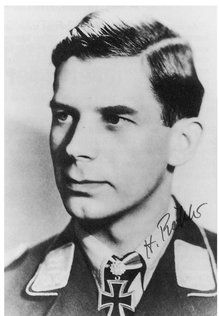
Oberleutnant Heinz Rökker, Staffelkapitän, 1./NJG 2. On the night of 22/23 March 1944, flying a Ju 88R-2, he destroyed two Lancasters and a Halifax to take his tally to 17. On the night of 6/7 June 1944 Rökker claimed five Lancasters in the area around Caen. On the night of 7/8 August 1944 Rökker claimed three Lancasters NE of Le Havre for his 38th – 40th victories. Rökker survived the war with sixty-three Nachtjagd victories (including fifty-five Viermots and one Mosquito), plus one in daylight in 161 sorties. He was awarded the Ritterkreuz with Eichenlaub. He was the 8th highest scoring Luftwaffe night fighter pilot of the war. (Heinz Rökker)
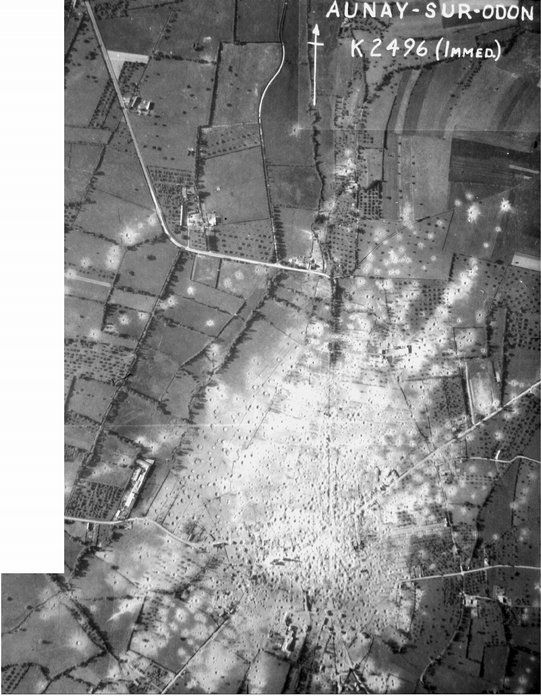
On 14/15 June 1944 337 aircraft including 223 Lancasters of 4, 5 and 8 Groups attacked German troop and vehicle positions at Aunay-Sur-Odon and Évrecy near Caen. These raids were prepared and executed in great haste, in response to an army report giving details of the presence of major German units. The weather was clear and both targets were successfully bombed. At Aunay the marking was shared by 5 and 8 Groups and was particularly accurate. No aircraft were lost.
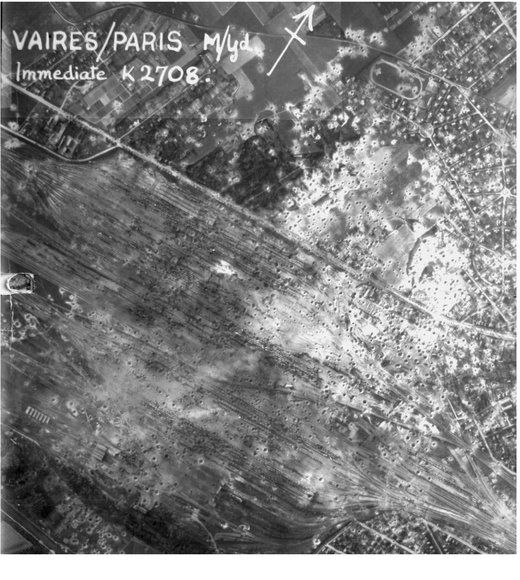
On 27/28 June 1944 214 Lancasters and nine Mosquitoes of 1, 5 and 8 Groups attacked Vaires and Vitry railway yards. The 8 Group raid on the important railway yards at Vaires on the outskirts of Paris was particularly accurate. Four Lancasters were lost – two from each raid. On 12 July 153 Lancasters and six Mosquitoes of 1, 3 and 8 Groups visited the yards again. The target area was covered by cloud and the Master Bomber ordered the attack to be abandoned after two Mosquitoes had marked and twelve Lancasters had bombed.
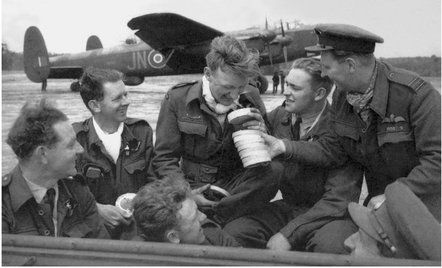
During a daylight bombing of enemy forces at Villers-Bocage on 30 June 1944, 75 Squadron Lancaster ND917 was hit by flak splinters, one striking flight engineer Sergeant P. McDevitt in the knee and causing excessive bleeding. The pilot Squadron Leader N. Williamson, seeing that McDevitt was losing blood rapidly, elected to land on one of the Advanced Landing Grounds on the Normandy beachhead where medical attention could be sought. This was the first RAF heavy’ to make use of one of these small strips. This photograph, taken next day, shows Williamson presenting bomb-aimer Flying Officer G. Couth with Camembert cheese produced in the district to mark his 23rd birthday. Other members of the crew are Flying Officer Watts, navigator, Sergeant J. Russell, rear gunner; Sergeant R. Jones, mid-upper gunner and Sergeant S. Cooke, wireless operator. ND9I7 was one of four Lancasters lost during a daylight raid on Solingen on 4 November 1944. (IWM)
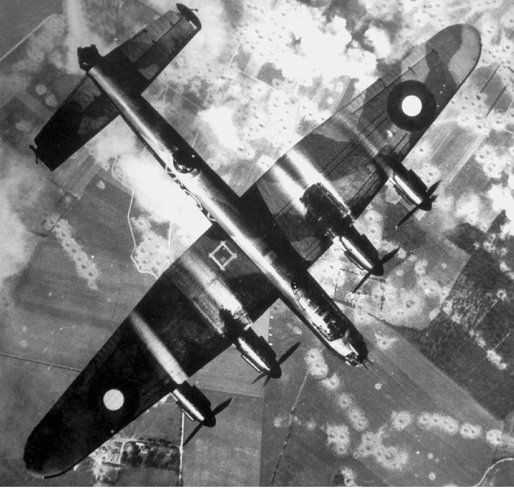
Canadian built Lancaster X KB745 VR-V of 419 ‘Moose’ Squadron RCAF flown by Flying Officer Rokeby photographed over Normandy in the summer of 1944 by 1st Lieutenant Joseph H. Hartshorn DFC, an American pilot on the squadron who flew thirty-four ops. The exhaust gases from the leaded petrol caused the grey streaks on the wing. KB745 and Flying Officer G. R. Duncan RCAF and crew flew into a hillside at Goldscleugh near Rothbury, Scotland setting course for Norway and an attack on the U-Boat pens at Bergen on 4 October 1944. All the crew died.
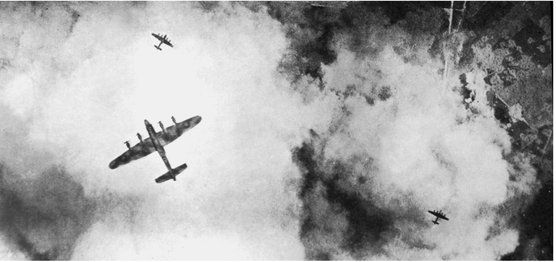
Lancasters flying above the huge clouds of smoke from fires during the daylight attack on flying bomb sites in the Pas de Calais area on 2 July 1944. Three sites were attacked by 374 Lancasters and ten Mosquitoes of 1, 3 and 8 Groups and though cloud affected all of the raids good concentrations of bombs were thought to have been dropped at all targets. No aircraft were lost.
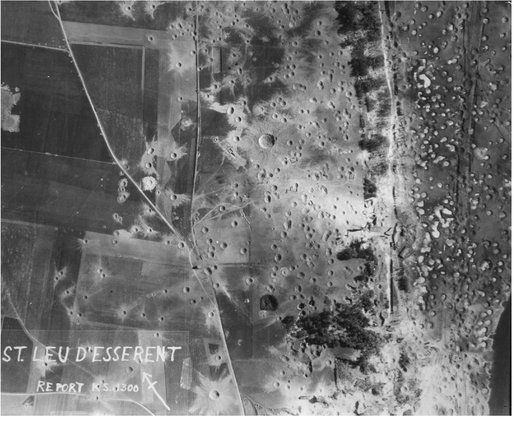
On 4 July 1944 seventeen Lancasters, one Mosquito and one Mustang of 617 Squadron attacked the flying bomb store in a large cave (formerly used for growing mushrooms) at St-Leu-d’ Esserent, north of Paris and bombed the site accurately and without loss. On the night of 4/5 July 231 Lancasters and fifteen Mosquitoes mostly from 5 Group but with some Pathfinder aircraft, continued the attack with 1,000lb bombs in order to cut all communications to the store. The bombing was accurate but thirteen Lancasters were lost when enemy fighters attacked them. On 7/8 July St-Leu-d’Esserent was attacked again, by 208 Lancasters and thirteen Mosquitoes, mainly from 5 Group but with some Pathfinders. The bombing as accurately directed on to the mouths of the tunnels and on to the approach roads, thus blocking access to the flying bombs stored there. Night fighters intercepted the bombers and shot down twenty-nine Lancasters and two Mosquitoes. 106 Squadron from Metheringham, lost five of its sixteen Lancasters on the raid and 630 Squadron from East Kirkby, lost its CO, Wing Commander W. I. Deas, who was flying his 69th operation. Finally, on 5 August 742 aircraft including 257 Lancasters attacked the St-Leu-d’Esserent and Forêt de Nieppe storage sites. (via ‘Pat’ Patfield)
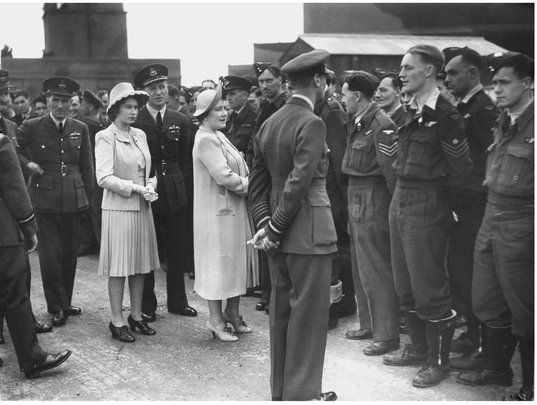
A Royal visit to Mildenhall on 5 July 1944 when crews in 15 and 622 Squadrons operated from the station. (via Fred Coney)
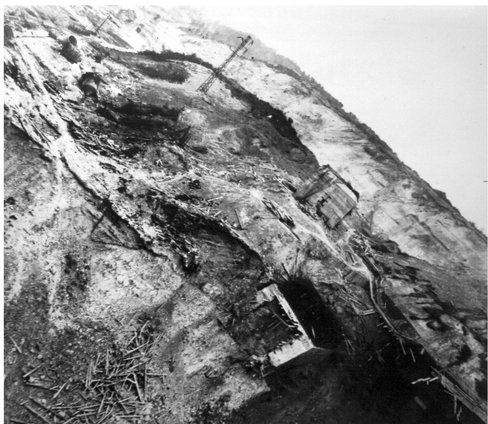
A low level photograph taken after the attack on the V-2 rocket site under construction at Wizernes in Northern France on 17 July 1944 by sixteen Lancasters of 617 Squadron with a Mosquito and a Mustang as marker aircraft. The ‘Dambusters’ aimed 12,000lb Tallboy earthquake bombs with 11-second delay on the huge concrete dome, 20-feet thick, which lay on the edge of a chalk quarry protecting rocket stores and launching tunnels that led out of the face of the quarry pointing towards London. One Tallboy that apparently burst at the side of the dome exploded beneath it, knocking it askew. Another caused part of the chalk cliff to collapse, undermining the dome, with part of the resulting landslide also blocking four tunnel entrances, including the two that were intended for the erected V-2s. Though the construction was not hit, the surrounding area was so badly ‘churned up’ that it was unapproachable and the bunker jeopardized from underneath. The site was abandoned and the V-2s were pulled back to The Hague in Holland where, in September the Germans began firing them from mobile launchers. (IWM)
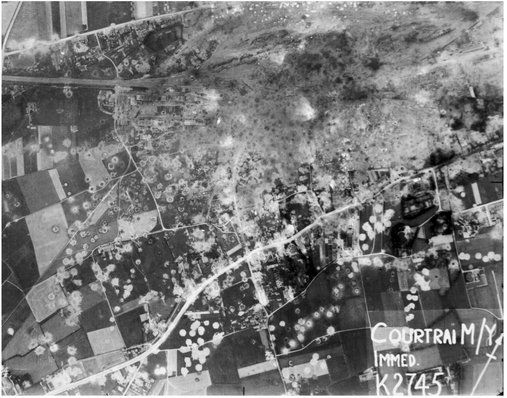
On 20/21 July 1944 302 Lancasters and fifteen Mosquitoes of 1, 5 and 8 Groups attacked the railway yards and a ‘triangle’ rail junction at Courtrai in Belgium. Both targets were devastated as this photo shows. Nine Lancasters were lost. (via ‘Pat’ Patfield)
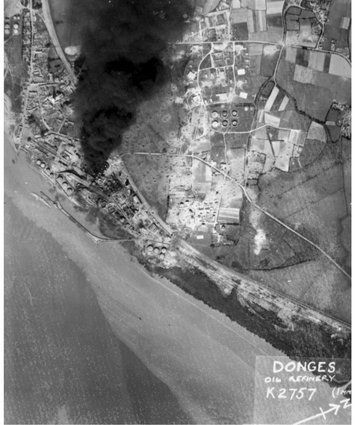
On 23/24 July 1944 100 Halifaxes of 6 Group along with fourteen Lancasters and five Mosquitoes of 8 Group attacked an oil refinery and storage depot at Donges near the mouth of the River Loire. The target was severely damaged and a tanker was hit and capsized. (via ‘Pat’ Patfield)
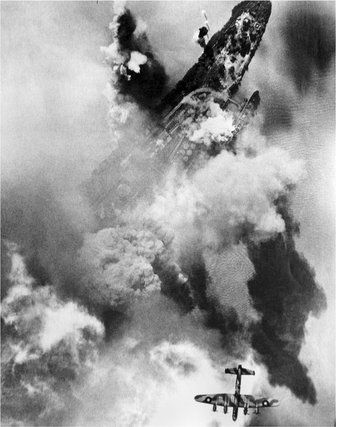
A Lancaster flying over the oil storage depot of Bec-d‘Ambes near Bordeaux on 4 August 1944 when 288 Lancasters of 1, 3 and 8 Groups attacked Bec-d’Ambes and Pauillac in clear conditions and without loss.
Lancaster II LL734/JL-O of 514 Squadron flown by Flying Officer C. B. Sandland on the aircraft’s 33rd sortie during the attack on the V-1 site at Les Catelliers on 27 July 1944. Twelve Lancasters of 514 Squadron dropped eighteen 500-pounders on Oboe marking. Five V-1 sites were attacked this day by seventy-one aircraft, thirty-six of them Lancasters. All targets were cloud-covered and most of the bombing was ‘confused and scattered’. LL734 was later transferred to 1668 HCU and was wrecked on 23 January 1945.
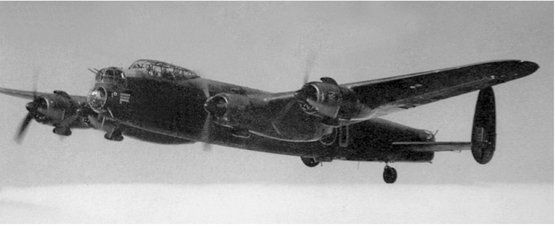
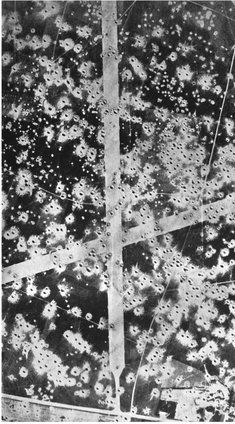
Reconnaissance picture of Le Culot airfield after an attack by Bomber Command on 15 August 1944, a day on which 1,004 aircraft including 599 Lancasters attacked nine German night-fighter airfields in France, Belgium, Holland and Germany in preparation for a renewed night offensive following the breakout from Normandy. Three Lancasters were lost on the raids.
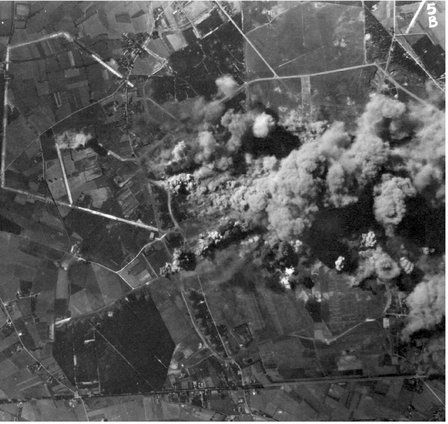
Volkel airfield in Holland on 15 August 1944, the second photo of which is taken from 15,000 feet. Visibilty was perfect as more than 1,000 aircraft attacked nine airfields in Holland and Belgium and all raids were considered successful. (via ‘Pat’ Patfield)
Lancaster III ED860 N-Nan of 61 Squadron with her air and ground crews. N-Nan completed its 100th op on 27/28 June 1944 when Flying Officer B. S. Turner flew the aircraft on the operation to the Vitry railway yards.
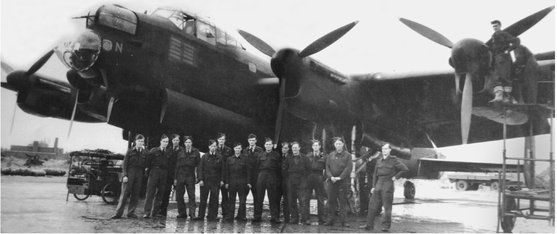
Chapter 11: ‘Round the Clock’
Canadian Flying Officer Jack F. Hamilton, mid-upper gunner in the crew of Lancaster JO-J ‘Jumpin’ Jive’ of 463 Squadron RAAF. The trip to Königsberg on the night of 29/30 August 1944 was his 21st trip (and longest at almost eleven hours) in a tour of thirty-three trips from 6 June to 17 October 1944. Hamilton had started out as a tail gunner at OTU but as he was six feet tall and too big for the gun turret, he had problems with the gun sights, so he had to switch to the mid-upper position. (Jack Hamilton)
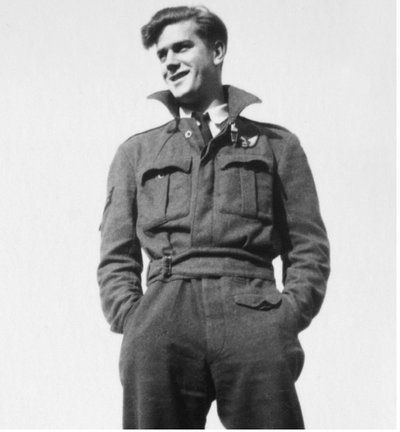
Lancaster III ED588 VN-G G-George of 50 Squadron, which was lost with Flying Officer A. H. ‘Tony’ Carver and crew on the operation to Königsberg on 29/30 August 1944. All but one of the crew were killed. This aircraft, which was originally assigned to 97 Squadron in early 1943, completed 128 operational sorties.
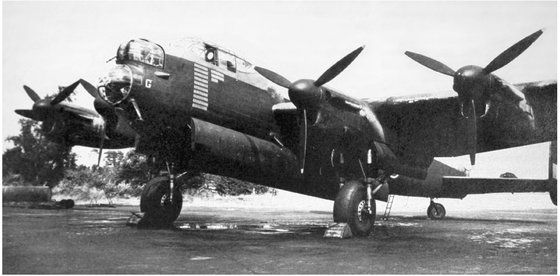
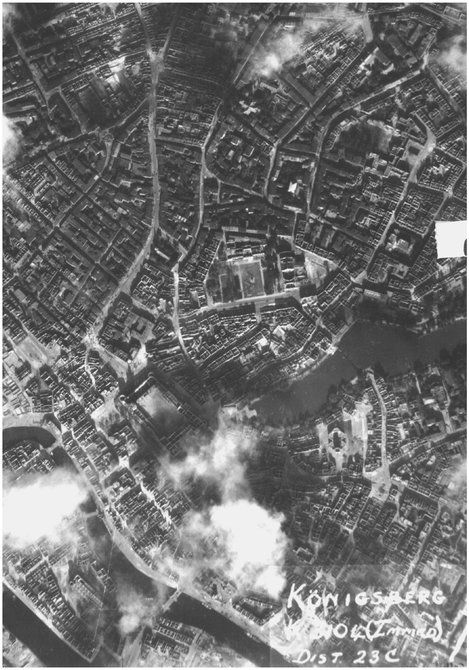
The raid on Königsberg on the night of 29/30 August 1944 by 189 Lancasters of 5 Group was one of their most successful attacks of the war. Only 480 tons of bombs could be carried because of the range of the target but severe damage was caused around the four separate aiming points chosen. This success was achieved despite a 20-minute delay in opening the attack because of the presence of low cloud; the bombing force waited patiently, using up precious fuel, until the marker aircraft found a break in the clouds and the Master Bomber, Wing Commander J. Woodroffe, allowed the attack to start. Bomber Command estimated that 41 per cent of all the housing and 20 per cent of all the industry in Königsberg were destroyed. There was heavy fighter opposition over the target and fifteen Lancasters were lost.
A Tallboy spin-stabilised, deep penetration bomb on its Type H special transporter at Bardney on 9 September 1944. If dropped from the optimum height of 18,000 feet the Tallboy took 37 seconds to reach the ground where it impacted at 750mph and penetrated 25 feet into the surface before exploding.
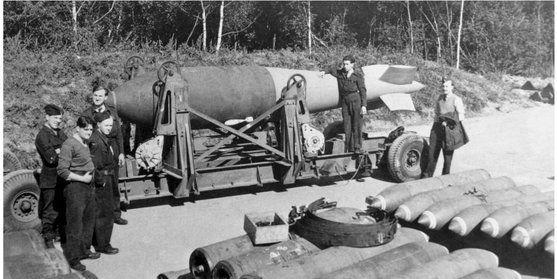
Flying from a temporary Russian base, twenty-eight Lancasters of 9 and 617 Squadrons attacked the battleship Tirpitz (indicated by the arrow) in Kaa Fjord, north Norway on 15 September 1944. The smokescreen failed to prevent some accurate bombing and the battleship was hit by one of thirteen Tallboys dropped. This and other damage rendered the ship unserviceable for sea action and never went to sea again, being used instead as a floating gun battery. Unfortunately, this was not realised by Allied Intelligence.
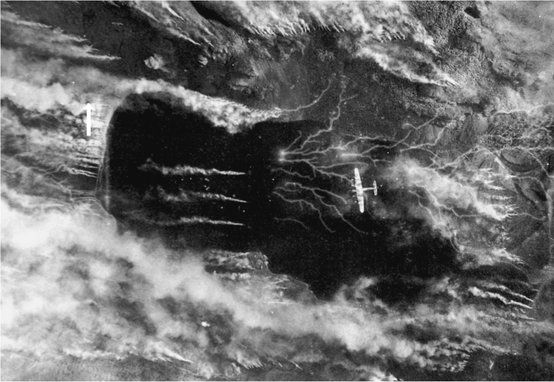
Vote For Joe of 463 Squadron RAAF at Waddington in 1944 with fifty-nine ops denoted by Russian stars. Lancaster III ED611 Uncle Joe, which had a picture of Stalin and operations also denoted by stars, flew 115 ops with the squadron. (Jack F. Hamilton)
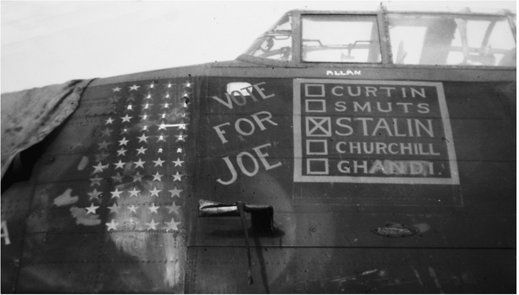
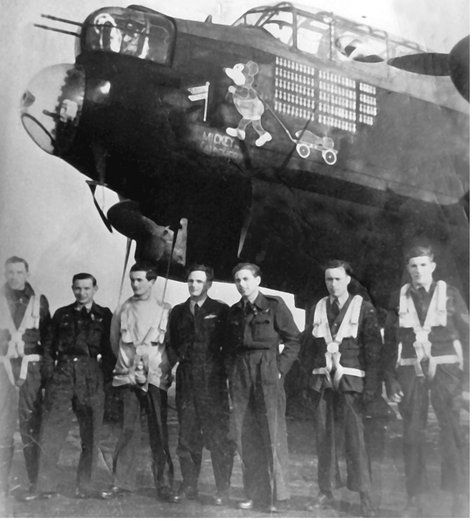
Lancaster III EE176 QR-M MICKEY THE MOOCHER of 61 Squadron at Skellingthorpe in 1944. L – R: Jim Leith, flight engineer; Den Cluett, rear gunner; Pete Smith, bomb aimer; Flying Officer Frank Mouritz RAAF, pilot; Arthur Bass, mid-upper gunner; Laurie Cooper, navigator; Dave Blomfield, WOp. Aircraft lettered ‘M’ were usually known as M-Mike or M-Mother. (Frank Mouritz)
RAF ground technicians work to repair the damaged wing of a Halifax at Woodbridge. In the background is Lancaster II LL624/JI-B of 514 Squadron, which after it was badly battle-damaged for the fourth time on 28 September 1944 it was SOC. (IWM)
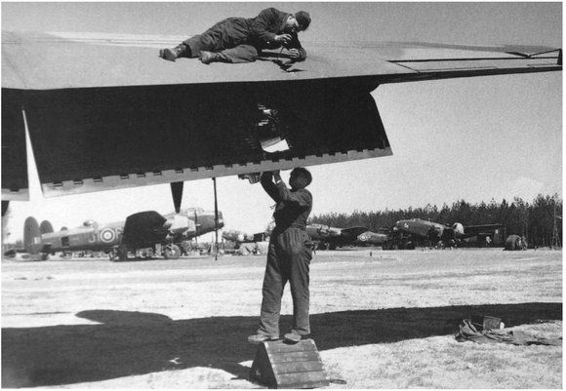
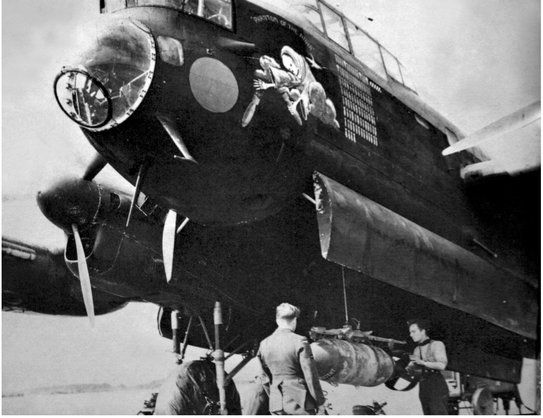
Lancaster III EE139 ‘B-Baker’ of 550 Squadron, better known as PHANTOM OF THE RUHR at North Killingholme with Flying Officer Joe C. Hutcheson’s crew just before its 100th op on 5 September 1944 on a daylight raid against Le Havre, France. (Note the mustard-coloured circular gas detection panel, which appeared on aircraft of 1 Group Bomber Command and the four ice-cream cones in the first two rows of the bomb log denoting raids on Italian targets in 1943.) EE136 began it career in 100 Squadron at Waltham near Grimsby in May 1943 and flew at least twenty-nine sorties with this unit until in November 1943 it joined 550 Squadron. During 11/12 June 1943 to 21 November 1944 PHANTOM OF THE RUHR completed 121 trips, surviving five night-fighter attacks and returning with severe flak scars on five occasions.The name and the ghoulish figure were the creation of Sergeant Harold ‘Ben’ Bennett, the aircraft’s first flight engineer who had been a ground engineer in Fighter Command in the early part of the war. (Len Browning)
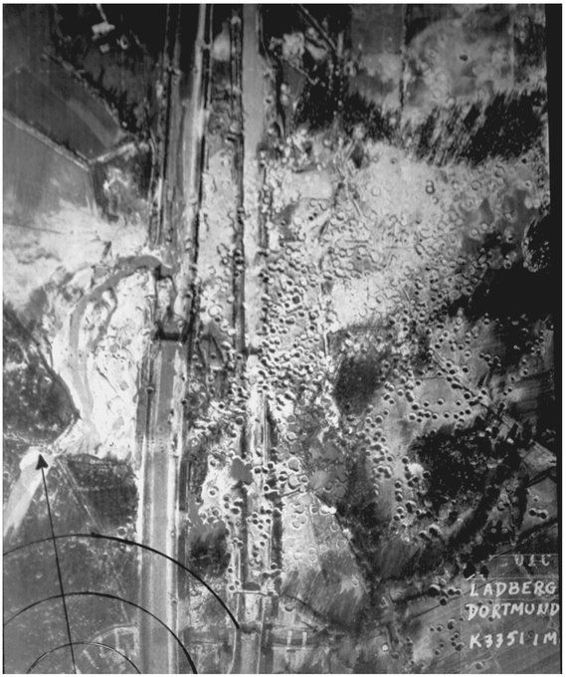
An empty Dortmund-Ems Canal at Ladberg after the ‘Tallboy’ attack on the night of 23/24 September 1944.
‘Window’ cascades from Lancaster B.I NG126/SR-B of 101 Squadron piloted by Warrant Officer R. B. Tibbs en route to Duisburg during Operation Hurricane on 14/15 October 1944. The Airborne Cigar (ABC) aerials are prominent above the fuselage. Few photographs of these special aircraft exist owing to the censor’s work, but this still came from a motion film taken by the Bomber Command Film Unit and eliminating the masts was not possible. The aircraft carried special radios and a German-speaking operator and Luftwaffe ground and airborne radio transmissions were intercepted and misleading instructions passed on to German fighters. On 14 October 957 RAF heavies dropped 3,574 tons of high explosive and 820 tons of incendiaries and that night 1,005 more bombers dropped 4,040 tons of high explosive and 500 tons of incendiaries on the city. In all 101 Squadron flew 2,477 ABC sorties in the Second World War. (IWM)
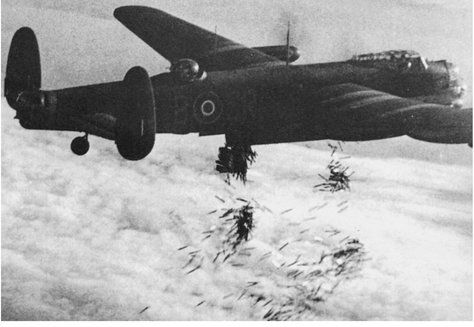
On 21 October seventy-five Lancasters of 3 Group carried out a daylight attack on a German coastal battery at Flushing on the Dutch Island of Walcheren. Bombing was very accurate and one Lancaster failed to return.
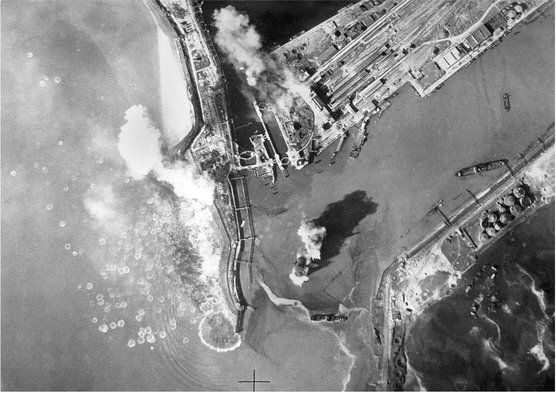
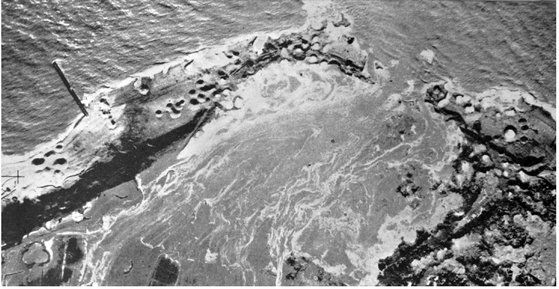
‘Sinking’ an island. Bomber Command sent many heavy bombs down on the built-up walls of the Dutch Island of Zoutelande (Walcheren) at the mouth of the River Scheldt. On 29 October 1944 358 aircraft – 194 Lancasters, 128 Halifaxes and thirty-six Mosquitoes – of four Groups attacked eleven different German ground positions in good visibility for the loss of one Lancaster. This picture shows the sea rushing in over part of the fortifications the Germans had established on the island. Many of the bomb craters on the arms of the sea wall on each side of the breach touch one another, so precise and so concentrated was the bombing.
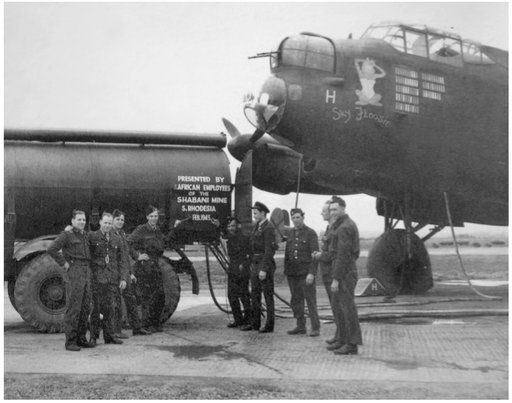
44 (Rhodesia) Squadron took Lancaster III LM625/KM-H Sky Floosie on charge in June 1944. The employees of Shabani Mines in Southern Rhodesia contributed £1,255 and this was used for a petrol bowser. On hand for the photograph were twenty-one-year-old Flying Officer Plenderleith who had thirty-four ops to his credit, nineteen-year-old Flight Sergeant Van Niekerk, who had flown twenty-six ops and Corporal Simpson, a fitter; all these men coming from Shabani. Sky Floosie has seventy-eight bombing ops on the noise, the bombs in white denoting daylight raids. In mid-1945 LM625 was transferred to 75 Squadron and after a spell with 39 MU was scrapped in October 1945.
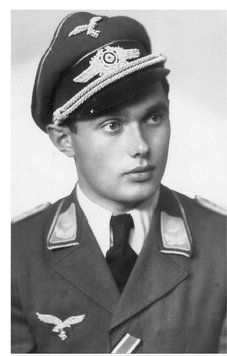
Leutnant Horst Rüdiger Blume claimed one victory in 1943 and two more in 1944, a Viermot on 12/13 August and a Lancaster on 4/5 November before he was killed in a crash south of Lübbecke during a non-operational flight ten days later on 14 November 1944. (Steve Hall via John Foreman)
A 4,000lb ‘Cookie’ and other bombs hurtle down on Gelsenkirchen from 17,000 feet on 6 November 1944 when 738 aircraft, 324 of them Lancasters, carried out a daylight raid on the town. The aiming point was the Nordstern synthetic-oil plant. The attack was not well concentrated but 514 aircraft were able to bomb the approximate position of the oil plant before smoke obscured the ground and 187 aircraft then bombed the general town area. Three Lancasters and two Halifaxes were lost. (via ‘Pat’ Patfield)