
Chapter 2
(FlaK and ground forces 1941–1942)
For the invasion of Russia, code-named Barbarossa, the German army assembled some three million men, divided into 105 infantry divisions and 32 Panzer divisions. There were 3,332 tanks, over 7,000 artillery pieces, 60,000 motor vehicles and 625,000 horses. This massive force was distributed into three German Army Groups: North, Centre and South. Army Group North was commanded by General Wilhelm Ritter von Leeb, who had assembled his forces in East Prussia on the Lithuanian border. His forces provided the main spearhead for the advance on Leningrad.
The main objective of Barbarossa was for the German forces to crush the Soviet war machine and paralyse infrastructure of the country; and to swiftly advance and capture Leningrad, Moscow and the Ukraine using tried and tested Blitzkrieg tactics. Almost immediately both the motorized infantry and Panzer divisions supported by various artillery and Flak units soon sliced through the bewildered Russian forces on every front. The infantry and Panzer divisions were so successful that they surrounded gigantic pockets of the Red Army. Groups of up to fifteen Russian divisions at a time were trapped and slowly and systematically annihilated.
On the northern front, Leeb’s Army Group North was advancing at tremendous speed. With half a million men at Leeb’s disposal, comprising almost 30 divisions, six of them armoured and motorized with 1,500 Panzers and 12,000 heavy weapons including a multitude of heavy and light Flak units, plus an air fleet of nearly 1,000 aircraft, he was determined to strike along the Baltic coast and destroy the Red Army.
On the central Front, was Army Group Centre, which was the strongest Army Group. During the initial phase of the invasion it made a series of heavy penetrating drives through the Russian heartlands, bulldozing through the marshy ground to the main Russian defences. Within days of its first attacks across the frontier both the infantry and Panzer divisions had destroyed bewildered Russian formations, which led to a string of victories along its entire front.
In the south, the story was the same as Army Group South pushed forward at breakneck speed towards the Ukraine.
For the Flak units that supported the main drive, it was a momentous advance. The Germans boasted a variety of anti-tank weapons at their disposal. These weapons included anti-tank guns, anti-tank mines and anti-tank rifles. Although the PaK35/36 was to later prove ineffective against the new Soviet T-34 and kV-tanks, it could still destroy lighter armoured vehicles. other weapons such as the 5cm Pak38 and 7.5cm Pak 40 were used throughout the campaign though the former’s effectiveness against the T-34 and kV 1 was only marginal, even with the rarer AP 40 ammunition.
During the summer months of 1941 German forces were exhilarated by their string of victories as they mercilessly pushed forward leaving a trail of devastation in their wake. Across the whole of the front tanks advanced further, and the guns of the infantry divisions lengthened their range. For the troops it seemed that Blitzkrieg had once again been decisive on the battlefield and there was an aura of invincibility among the men. Yet much of the German army was unmechanized. There were some 500,000 horses used to move guns and supplies. Although this type of transportation did not cause the German commanders initial concern, by the time the army arrived at the higher Donets River in october 1941 the weather began to change. Cold driving rain fell on the Army Groups’, front and within hours the Russian countryside had been turned into a quagmire with roads and fields becoming virtually impassable. Many of the roads leading East had become boggy swamps. Although tanks and other tracked vehicles managed to push through the mire at slow pace, horse-drawn wagons, trucks and other wheeled vehicles became hopelessly stuck in deep boggy mud. To make matters worse during November the German supply lines became increasingly overstretched: their vehicles were breaking down, and casualty returns were mounting. Stiff resistance also began to hinder progress.
By December mounting casualties were causing much concern. Hitler had planned to partially demobilize his forces following the successful drive through Russia. However, now, in the depths of one of the coldest Russian winters in recorded history he began to worry about reinforcements. Almost immediately he ordered new divisions to be raised and scoured Europe to look for foreign forces to help bolster his badly depleted force. All services in the German Wehrmacht were also called upon to assist in making good the dreadful losses. one branch which was deemed more suited for this ground role was the Luftwaffe.
During early 1942 new Luftwaffe replacements were finally assembled in East Prussia, and after initial basic infantry (but not paratroop) training conducted by Fallschirmjäger instructors, they were hurriedly formed into battalions and regiments and then transported to Russia. In total seven Luftwaffe field regiments were organized in January and February 1942. Each regiment had a strength of four battalions and each battalion had three light companies and one heavy company. The heavy company comprised of four 8.8cm Flak guns, which were now being incorporated in a dual purpose role, and twelve 2cm Flak guns.
On the battlefield these Luftwaffe replacements fought relatively well, supporting army and Waffen SS troops both in offensive and defensive roles. The 8.8cm Flak gun scored considerable success in its dual role and managed to halt a number of attacking enemy formations, allowing army and Waffen SS forces to successfully break through in some areas. Although the Luftwaffe bravely defended seriously threatened lines, it was ill-equipped and lacked proper winter clothing. Along with the army and Waffen-SS, it carried on regardless until the spring thaw finally arrived. By then the German soldier had slowly adapted to the Russian climate and terrain, and was seen wearing a host of new summer and winter camouflage uniforms and newly designed steel helmets and field caps. Even the Panzer uniforms were being replaced. But despite the drastic measures implemented in the design of better uniforms and equipment in order to sustain the German soldier on the battlefield, nothing could mask the fact that they were up against an enemy who was numerically superior and who fiercely contested every foot of ground to the death. In addition, the terrain heavily influenced the conduct of military operations, as the German soldier marched across seemingly unending expanses of flat terrain, invariably encountering bitter opposition somewhere along the way.
By the summer of 1942 the average Luftwaffe field battalion still lacked proper artillery and Flak needed to sustain itself with any degree of success on the battlefield. The weapons used by the Luftwaffe ground soldier varied, but the standard equipment was the 7.92mm kar98k carbine. This accurate but slow-firing (it had only a 5-round magazine and the bolt movement was awkward for rapid fire) bolt-action rifle was of Mauser design. This rifle remained the most common weapon used by the German army throughout the war. Another weapon used by the Luftwaffe soldier, but not to the same extent as the kar98k, was the 9mm MP38 or MP40 machine pistol. This submachine gun was undoubtedly one of the most effective weapons ever produced for the German war machine. The Luftwaffe also continued to use its own Flak in the form of the 8.8cm, 3.7cm and 2cm Flak guns. A number of motorized vehicles, although not many, were given to the Luftwaffe comprising a number of Sd.kfz.251, Sd.kfz.10 and Sd.kfz.7 halftracks.

In a field on a very warm summer’s day on the Eastern Front, the crew of an 8.8cm FlaK gun prepares to fire. Note, although the crew are shirtless they are still wearing their helmets for protection.

A convoy crosses a pontoon bridge during the early stages of Barbarossa during the summer of 1941. Note the vehicle towing a 2cm FlaK 38 gun. The letter ‘G’ painted on the rear of the vehicle denotes that it belongs to Guderian’s Panzergruppe 2.

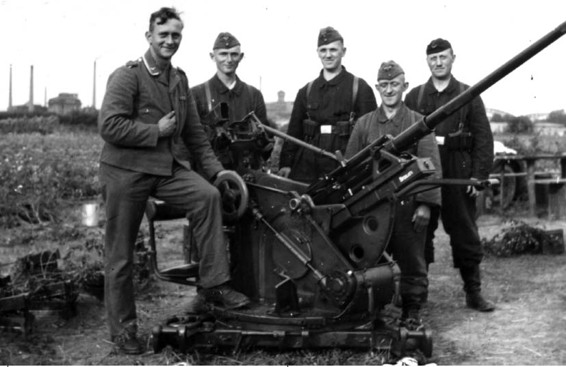


Four photographs showing 2cm FlaK 30 guns in various positions whilst operating on the Eastern Front in 1941. The Luftwaffe had adopted these guns in 1935, and they were primarily used during the early par t of the war for guarding troops, rail lines, bridges and other areas against enemy attack.

A 2cm FlaK 38 crew during operations somewhere on the Eastern Front. Note the gun shield has victory markings painted in white. These were known as kill markings and German military units painted them on most of their guns or vehicles that had destroyed enemy aircraft, vehicles, or other targets.

A photograph showing a FlaK crew with their 2cm FlaK 30. The gun was mounted on a simple three-legged platform upon which the gun revolved, and a two-wheeled trailer to move it.


Two photographs showing the 2cm FlaK 38 mounted on Sd.Kfz.10/4 1-ton halftracks during operations on the Eastern Front. The weapon could engage both air and ground targets. With the vehicle’s folding sides down the gun was very adaptable and could traverse 360 degrees. However, note the use of horse-drawn transport in the background, revealing the patchy nature of German military resources.

An interesting photograph showing a ceremony of Luftwaffe personnel swearing their personal oath of loyalty to the regime.. The weapon mounted on a tripod is a Czech ZB1926, known as the MG26(t), which was based on the 7.92mm Mauser.

An 8.8cm FlaK gun in its fully-elevated position is poised for action against enemy aircraft. The barrel of the gun has victory markings painted in white. These were known as barrel kill rings. Note the letter ‘D’ for ‘Dora’ painted in white on the side of the gun denoting its position in the battery.


Three photographs showing various halftracks operating on the Eastern Front. Mounted on these Sd.Kfz.10/4 1-ton halftracks are the 2cm FlaK 38 guns, which during 1941-1942 were one of the most widely used FlaK weapons in the Luftwaffe arsenal to counter both enemy aerial and ground targets.


Two photographs showing the mighty 8.8cm FlaK 36 guns on their Sonderanhänger 202 trailers. Although the gun could be fired from its trailer most, however, were fired while dismounted. A well trained crew could dismount a gun and be prepared to fire in twenty seconds. It could take them roughly one minute to remount the gun to its trailer.

The crew of a 2cm FlaK 38 mounted on a Sd.Kfz.10/4 1-ton halftrack preparing their weapon for action against an enemy target. Throughout the war Luftwaffe FlaK had two main missions: defending positions and supporting forces in the field.


Two photographs showing the 2cm Flakvierling 38 quadruple mount. This gun could unleash a barrage of fire and was able to discharge 1800 rounds per minute from all four of its barrels. This formidable weapon had two operators, one who fired the top left and bottom right guns while the other fired the top right and bottom left guns. The loader could quickly change the magazines while the other continued to fire.

A 2cm FlaK 30 gun during winter operations on the Eastern Front either during late 1941 or early 1942. FlaK was divided into three categories based on calibre: light – 12.7mm to 2cm; medium – 3.7 to 5cm; heavy – 8cm and larger.

A crewman using an optical range finder to correct fire for the FlaK battery. Should rounds fall short or over the target, his task was to advise the FlaK aimer on the corrections needed for the battery to hit the target.


Three photographs showing the 2cm FlaK 30 gun. By the time Barbarossa arrived FlaK units were being used extensively across the entire front. By the winter of 1941 the Luftwaffe was becoming primarily a ground force constantly supporting both army and Waffen-SS divisions in the field.

An 8.8cm FlaK 36 gun in action firing during winter operations on the Eastern Front in 1942. The casual poses of the crew suggest that the gun is being used to conduct leisurely artillery fire at a distant target, rather than against aircraft. To help stem the serious losses sustained by the air offensive, thousands of FlaK guns were rushed into service and made widely available to all branches of the armed services.
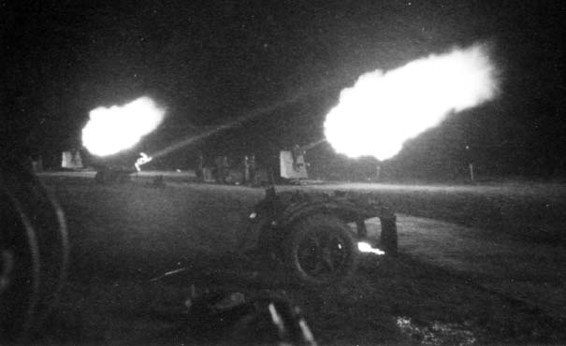
Here a battery of 8.8cm FlaK 18 guns open fire at night. The low elevation of the guns suggests that fire is being directed at ground targets, rather than against aircraft at night. The low elevation of the guns suggests that fire is being directed at ground targets, rather than against aircraft. As early as 1939 the Luftwaffe had been in charge of anti-aircraft defences instead of the army.

A 2cm FlaK 30 crew defending a position against aerial attack somewhere on the Eastern Front. By 1942 there was a huge FlaK strength to counter the growing might of the Soviet air force, but even the might of the Luftwaffe were unable to completely repulse the constant enemy attacks.


Three photographs showing the mighty 8.8cm FlaK gun in a number of air defence roles in Russia. By the time Germany attacked the Soviet Union there were some 1,500,000 personnel manning Germany’s FlaK defences including 500,000 non Luftwaffe men. In 1941 the bulk of FlaK defences comprised Luftwaffe units defending the skies against enemy aircraft that were attempting to destroy troop concentrations and other key defensive positions.

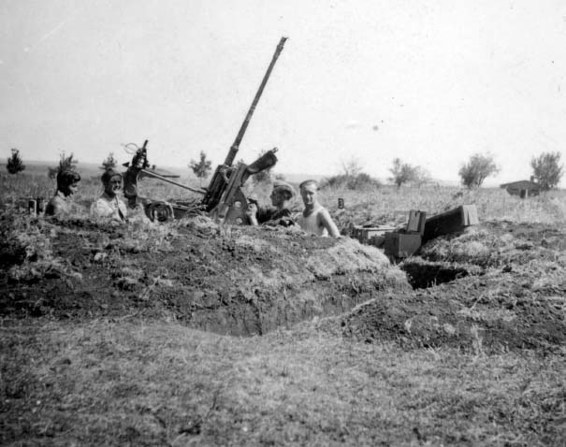
Two photographs showing well positioned and well dug-in Luftwaffe FlaK crews. During the first half of the war the Luftwaffe widely used the 2cm FlaK 30 on all parts of the front.

Army and Luftwaffe ground forces engage an enemy target. The weapon they are using is a 3.7cm FlaK 36 gun mounted on its two-wheeled carriage used by the Luftwaffe, army and Waffen-SS.

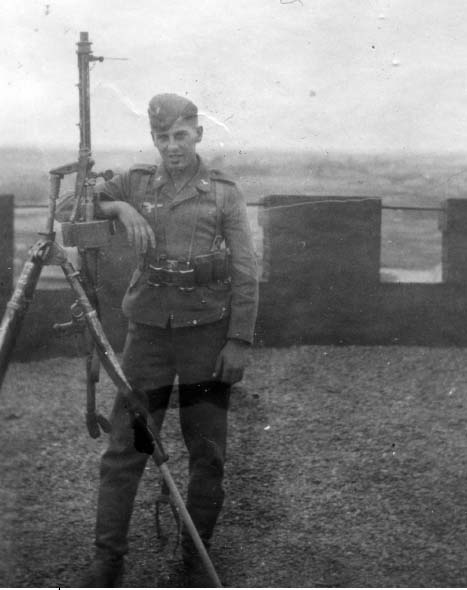

Three photographs showing the standard Luftwaffe machine gun, the 7.92mm MG15, mounted for ground use. Note the double ammunition drum that was capable of holding 150 rounds. Whilst these machine guns were specifically used against low flying enemy aerial attack, they were also used extensively against ground targets.

In a field is a MG34 machine gun squad. The MG34 is mounted on a sustained-fire tripod mount. In every infantry battalion there were eight to twelve MG34 heavy machine guns on sustained-fire tripod mounts. In 1941 and 1942, these were regarded as more than enough to guard the flanks against attacking infantry.
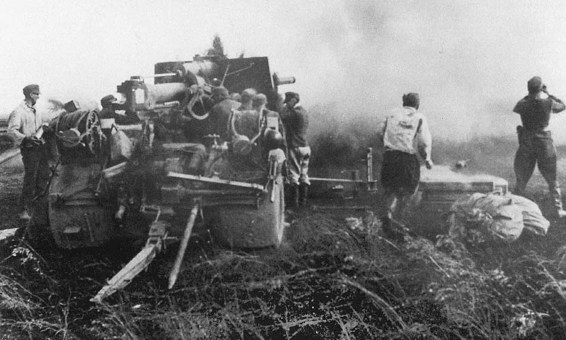

Two photographs showing a FlaK crew during the battle of Stalingrad in the summer of 1942. The 8.8cm FlaK gun was widely used as an anti-tank gun as it possessed a genuine anti-tank capability. On the battlefield it proved a very versatile weapon and continued being used in a dual role until the end of the war. The 8.8cm FlaK gun was used extensively during the crossing of the Don River and along the banks of the Volga where many were carefully positioned to attack enemy shipping and aircraft.