
Chapter 3
(FlaK & Field divisions 1942–1944)
By the beginning of the summer offensive in May 1942, not all the army divisions were fully equipped and ready for combat. Some of the older units for instance did not even have replacements for the losses sustained during the winter offensive of 1941 and were not ready for any type of full-scale operation. Worn out and depleted divisions were therefore relegated to Army Group North or Army Group Centre where they were hastily redeployed for a series of defensive actions instead. The best-equipped divisions were moved south to Army Group South for operations in the Caucasus.
Hitler, who was now in full command of the Wehrmacht, was determined to smash the Red Army once and for all in Russia. However, operations against the Red Army were hampered by stiff resistance and the great distances over which the Axis forces had to fight. For the Germans these obstacles led to further high losses along the entire Russian front. As autumn fast approached further losses were suffered and shortages in manpower were once again dire. In order to bolster the army, Hitler once again went to the Luftwaffe with immediate orders to transfer personnel to support the German army. The commander of the Luftwaffe, Hermann Göring, put forward an alternative plan; to raise his own infantry formations under the command of Luftwaffe officers. The plan was approved, and the divisions were raised from 200,000–250,000 Luftwaffe ground, support and other surplus personnel. They were initially organized into two Jäger regiments each of three battalions, along with an artillery battalion and other support units. These units, however, were substantially smaller than equivalent standard army divisions, but Göring had stipulated that the intended plan was to restrict the Luftwaffe to defensive only in quieter sectors.
For the next several months the Luftwaffe field divisions were directly under Luftwaffe command, but continued supporting the army’s drive to the east, mainly in a defensive rather than an offensive role. other Luftwaffe Flak units supported the main drive. They were of vital importance in their defensive role during the preparation and conduct of infantry or Panzer attacks. When a Panzer or other formation broke through enemy lines, artillery and Flak designated for support followed routinely. The mission of the Flak unit was to neutralize the enemy both on the ground and in the air. In a ground role engaging enemy tanks was of utmost importance. Laying HE fire on suspected enemy observation posts in the sector to be attacked was also initiated. The main task of a Flak gunner was the destruction of advancing enemy formations and any enemy defensive positions. Against air targets the Flak gunner was tasked to minimize the threat from aerial attack as much as possible. However, by the end of 1942 the threat from both ground and aerial attack had almost doubled from the previous year and there was an increased awareness of adapting and producing more Flak guns to meet the mounting peril. This included increasing Flak gun numbers and mounting them on halftracks. By the end of 1942 many various Flak guns were mounted on the back of artillery tractors, with the most common being the 3.7cm Flak gun on an Sd.kfz.7 halftrack. opel Blitz trucks and other vehicles were also modified to carry Flak guns. Quadruple Flak guns were also supplied to units in increased numbers, and the Flak 8.8cm continued to be manufactured at a very fast rate in order to counter the on-going threat from ground and aerial attacks.
By the beginning of 1943 Luftwaffe field divisions were already deployed in various sectors of the Eastern Front and were heavily embroiled in fierce fighting.
Throughout the first half of 1943 the Germans more or less maintained the strategic initiative on the Eastern Front. However, by July 1943 when the Germans unleashed their long-expected summer offensive codenamed ‘operation Zitadelle’, the war in the East changed forever. Within two weeks of the attack, the Red Army had repulsed the German forces with considerable losses. In August, just weeks after the German failure at kursk the Red Army counterattacked towards orel and kharkov and launched a massive attack against Army Group Centre. For nearly three months the Russians fought a series of battles against Army Group Centre and managed to recapture Smolensk and the rail junction at Nevel, forcing back the Germans on a broad front. However, the Russian attack soon faltered in the Vitebsk-orsha-Mogilev area where almost impregnable lines of defences had been erected by the Germans.
Elsewhere on the Eastern Front further Red Army assaults were made against army, Waffen-SS and Luftwaffe units, causing severe losses. The high casualty rates and poor performance of the Luftwaffe field divisions caused further problems. Many of the field divisions had simply been thrown into battle with little or no training whatsoever. Many of the units were totally unprepared for fighting the Red Army and often did not have the proper clothing to fight in the extreme winter conditions. In spite these setbacks both Flak and field divisions endured the harsh conditions of the Eastern Front.
During the first months of 1944 the Germans continued to face repeated heavy attacks, but the Red Army found the mass of well dug-in defences almost too difficult to break. By the spring of 1944 the Soviet command had drawn up plans for a massive concentration of forces along the entire frontline in central Russia. The new Soviet summer offensive was to be called ‘operation Bagration’ and its objective was to annihilate Army Group Centre once and for all.
On the morning of 22 June, the third anniversary of the German invasion, ‘operation Bagration’ was launched by the Red Army against Army Group Centre. The three German armies opposing Bagration had thirty-seven divisions, weakly supported by armour, against 166 Soviet divisions, supported by 2,700 tanks and 1,300 assault guns. At the end of the first week of Bagration the three German armies had lost between them nearly 200,000 men and 900 tanks; 9th Army and the 3rd Panzer Army were almost annihilated. The remnants of the shattered armies retreated westwards in order to regroup and refit what was left of the Panzer units and build new defensive lines. Any plans to regain the initiative on the Eastern Front had now gone forever.
In spite of the success of operation Bagration and the complete collapse of Army Group Centre the Red Army still did not equal the Germans in tactical ability on the battlefield. Although Soviet armament production saw some 29,000 tanks and assault guns being produced in 1944, the Panzerwaffe still possessed a slight advantage in the quality but not the quantity of their heavier armoured vehicles. Tanks like the Panther, the Tiger and the new king Tiger were undoubtedly formidable fighting machines whose arrival at the front was a welcome relief to the already hard-pressed Panzerwaffe. Nonetheless the slow and limited production of the new second generation of tanks did nothing to alleviate the overall predicament that was increasingly manifesting itself along the entire Eastern Front. As too few armoured vehicles were delivered, their units were too thinly stretched to make any significant impression against the growing tank strength of the Red Army. What followed during the last weeks of July was a frantic attempt by the Germans to stem the Soviet drive into Poland. Army Group North Ukraine tried its best to maintain its slender hold on the River Bug, whilst remnants of Army Group Centre attempted with all available resources to create a solid front line on the kaunas, Bialystok-Brest axis, and assemble what was left of its forces on both of its flanks.
Over the coming months, army, Waffen-SS, and Luftwaffe forces tried their best to contain their formidable foe, and in many areas that is exactly what they did. However, on 14 January, Zhukov’s 1st Belorrussian Front began its long-expected drive along the Warsaw-Berlin axis, striking out from the Vistula south of Warsaw. The city was quickly encircled and fell three days later. The frozen ground ensured rapid movement for the Russian tank crews, but in some areas these massive advances were halted for a time by the skilful deployment and performance of the Luftwaffe Flak crews. Determinedly they held out in small groups supported by Panzers, until they were annihilated or forced to fall back. What forces were available to try and stem the Red Army’s advance to the frontiers of the Reich were pulled together into a new army group, ‘Army Group Vistula’. Army Group Vistula was positioned behind the threatened front and consisted mainly of Volkssturm units and militia groups whose personnel were either too young or too old to serve in the regular armed forces. Along this weak front, a number of volunteer SS units and ad hoc Luftwaffe field and Panzer formations bolstered the understrength and under-trained forces, but they too had little with which to impede the Russian onslaught. By early February 1945 German forces in the East had been driven back to the River oder, the last bastion of defence before Berlin.
Along certain parts of the front a number of German divisions were grossly undermanned and did not have the ammunition or the strength to stem an enemy advance. A report noted that each division had to hold a frontage of approximately 20 miles. For every one mile of front some regiments had one artillery piece, one heavy machine gun, two light machine guns and about 150 men. For every two and a half miles of front they had, in addition, one anti-tank gun. Every four miles they had one Panzer, and on every six miles, one battalion. They were confronted by an enemy force made up of three tank armies consisting of thousands of tanks.
The Germans no longer had the manpower, war plant or transportation to accomplish a proper build-up of forces to defend its positions. Commanders could do little to compensate for the deficiencies, and in many sectors of the front they did not have any coherent planning in the event of a Soviet breakthrough.
When the Russians successfully attacked across the river oder in mid-April 1945, the hotchpotch force of what was left of the German armed forces fought on in desperation as the Soviet thrust carved its way across the river, capturing the town of küstrin, and heading towards the Nazi capital.
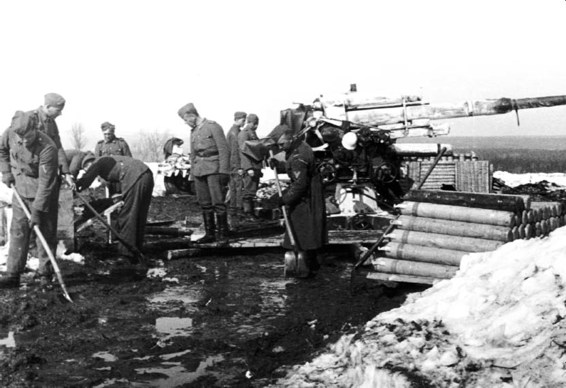
Somewhere on the Eastern Front a Luftwaffe 8.8cm FlaK 36 gun emplacement during the early winter of 1942. As the Soviet air force gradually grew in size and began inflicting ever-greater casualties on German positions, so the need for more 8.8cm FlaK guns to try and counter the growing threat increased.
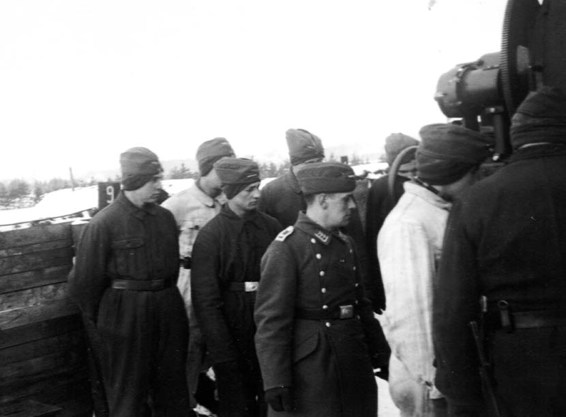
An 8.8cm FlaK gun firing range. Of all the FlaK guns that were introduced into service the best-known and most reliable weapons were the 8.8cm Flugabwehrkanone 18, 36 und 37 or 8.8cm FlaK 18, 36 and 37. All three versions were extensively used during the war by the Luftwaffe, Wehrmacht and later the Waffen-SS. These three services also used another new 8.8cm FlaK gun. It was known as the 8.8cm Flugabwehrkanone 41 or 8.8cm FlaK 41 (Eisenerz) and was built specifically for a dual role and thus possessed an even more formidable anti-tank capability. Its longer 74-calibre barrel gave it an increased muzzle velocity and better penetration. In service it proved robust, and continued in production until the end of the war. However, while powerful and effective, the gun suffered from jamming/case ejection problems even when brass cartridge cases were supplied – a luxury Germany could ill-afford. Some were used post-war by the Czechoslovakian forces into the 1960s.

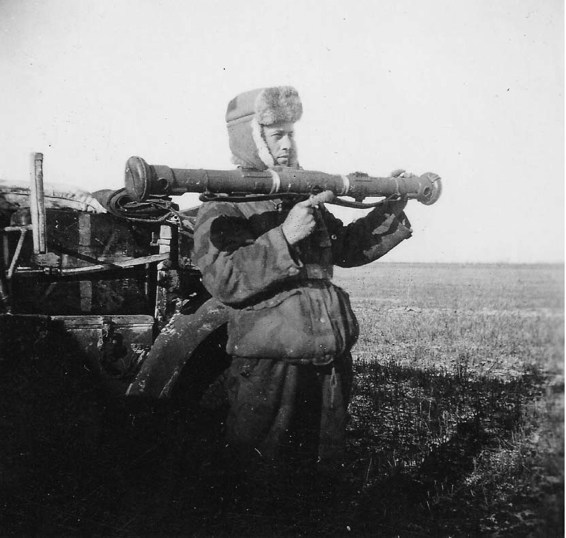
A Luftwaffe soldier attached to an unidentified Luftwaffe field division in the winter of 1942. He wears the standard army M1935 steel helmet and an animal skin greatcoat. These skin coats varied greatly in size and quality, but were primarily designed to be worn in extremely cold climates. The deployment of the first Luftwaffe field soldiers on the Eastern Front was to replace the huge losses sustained by the other services in Russia.
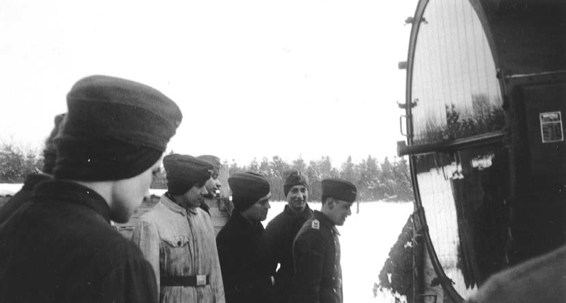
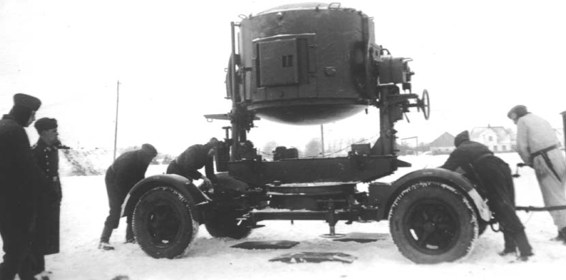
Two photographs taken during the winter of 1942 showing crewmen putting a 150cm searchlight into operation. The crewman on the right can be seen putting wooden blocks into place in order to secure the searchlight trailer in place. These massive searchlights were very effective at pinpointing enemy aircraft in order for FlaK guns, notably the 8.8cm, could open fire.
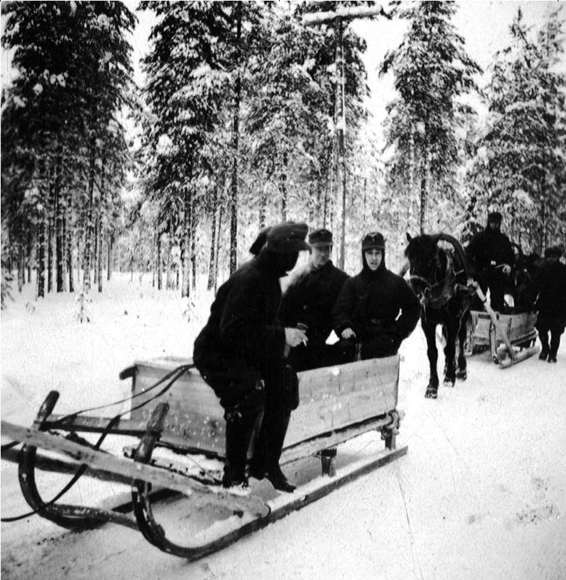
A rare photograph showing Luftwaffe field division troops in the Leningrad sector in 1942 using a sled as a form of transportation through the snow. It was around Leningrad that the first ad hoc formation was employed under the command of Major General Eugen Meindl.
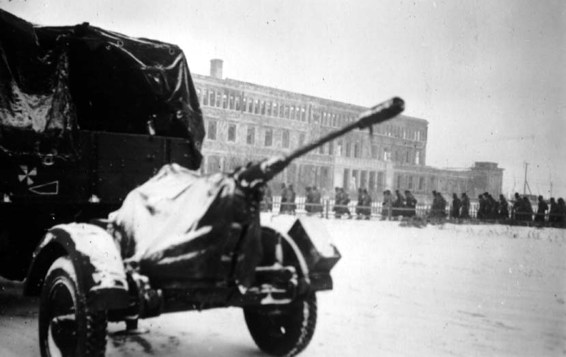
An interesting image showing a 2cm FlaK 30 being towed outside the ruined suburbs of a town during winter operations in 1942. The first field divisions deployed for action in Russia had only limited supplies of ammunition, weaponry and winter clothing. There was also a lack of well trained troops.

FlaK gunners at a barracks maintain their 2cm FlaK 30. Note the two young FlaK helpers watching the crew for tips. During the second half of the war there was a gradual increase in the number of young male and female FlaK helpers employed in various roles to man FlaK defences against Allied aircraft and advancing ground forces.
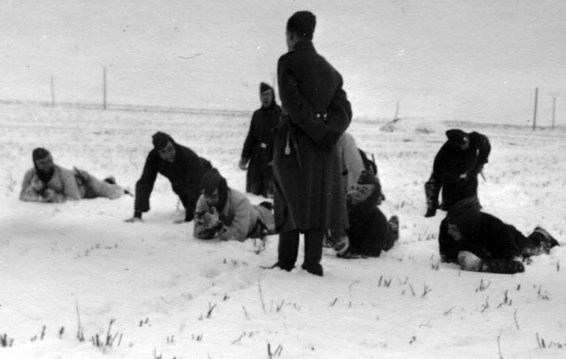
Being put through training in the snow in Russia are new Luftwaffe field troops. The bulk of these Luftwaffe personnel were rushed through their training and were often compelled to fight for long periods against well seasoned and skilful enemy soldiers. As a result there was a high casualty rate.
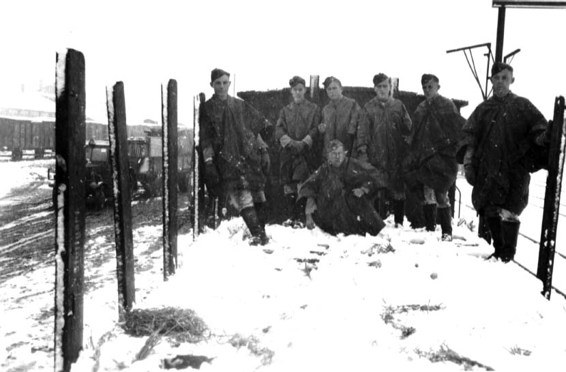
Luftwaffe field personnel pose for the camera onboard a flatbed railway car. Note the troops are wearing the special waterproof triangle camouflage cape or Zeltbahn. As with their army counterparts, each soldier wore this as part of his personal equipment. The Zeltbahn could be worn, as in this photo, as a poncho over the field equipment, and it could also be worn buttoned up under the equipment as a form of camouflage.
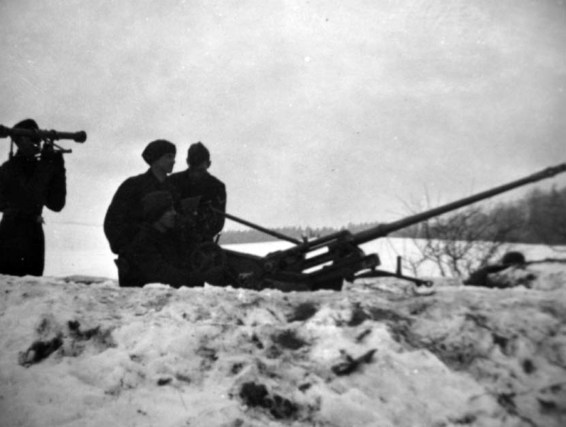
During winter fighting a Luftwaffe crew mans a position with their 2cm FlaK 30 gun. The gunner and loader can be seen whilst the third crewman scans the sky with his optical range finder. Although these light anti-aircraft guns were used extensively to deal with the regenerated threat of the Soviet Air Force, the recurring appearance of heavier enemy armour compelled many FlaK crews to divert their attention from the air and support their own infantry and armour on the ground.
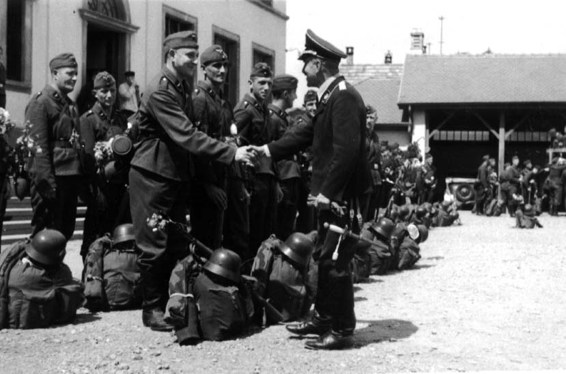
Preparing for the front line in Russia, new field division airmen are greeted by an officer wearing his ceremonial dagger. Flower posies and oak-leaf sprigs are in the men’s hands and gun barrels.

Luftwaffe PaK crews clean their PaK35/36 guns prior to operations during the summer of 1942. This particular weapon was the standard anti-tank gun of the German soldier during the early part of the war. A number of them were issued to Luftwaffe field divisions in 1942. The gun weighed only 432kg (952.5Ib) and had a sloping splinter shield. The gun fired an uncapped APHE round round at a muzzle velocity of 762m/s (2500ft/s) to a maximum range of 4025m (13200ft). An inert sub-calibre AP40 (APCR) round was also available in limited amounts, firing at 1030 m/s (3379ft/s) to give slightly better penetration below 500m.
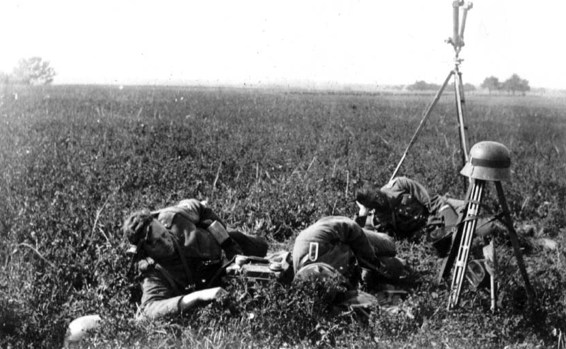
An artillery observation post and a group of Luftwaffe personnel can be seen relaxing in a field next to their 6×30 Sf.14Z Scherefernrohr or scissors binoculars. Each artillery or FlaK battery had an observation post among the frontline positions.
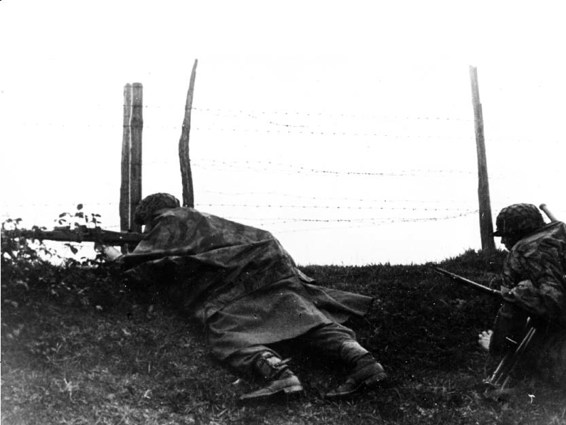
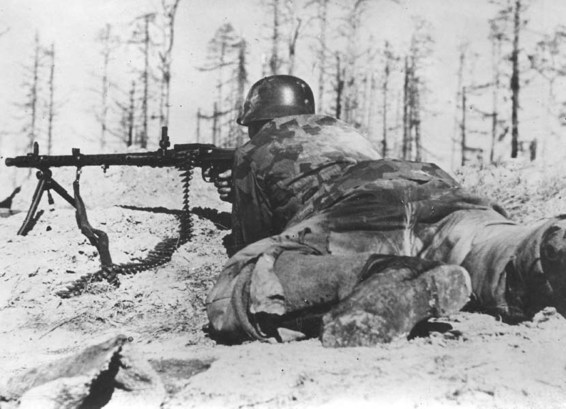
Two images showing Luftwaffe field division troops, probably part of the famous Division Göring. The upper photo shows the later, more rugged and more easily-produced, MG42 while the image on the right shows the earlier, more finely-crafted but slower-firing MG34 being used on bipods in what was termed a ‘light role’.
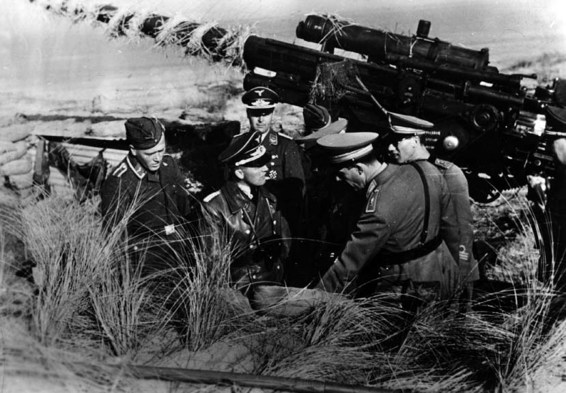
Luftwaffe and allied Axis officers observe a newly positioned 8.8cm FlaK gun during offensive operations in the East in the summer of 1942. The gun’s high velocity and flat trajectory made it very accurate and effective in both an anti-aircraft and anti-tank role.

Here an army 2cm FlaK 30 gun mounted on a Sd.Kfz.10/4 1-ton halftrack being supported by a Luftwaffe field division in 1942. By this period of the war the Germans had begun deploying both the 2cm and 3.7cm FlaK gun in a more mobile role by using a number of tracked and commercial vehicles to carry them into battle.
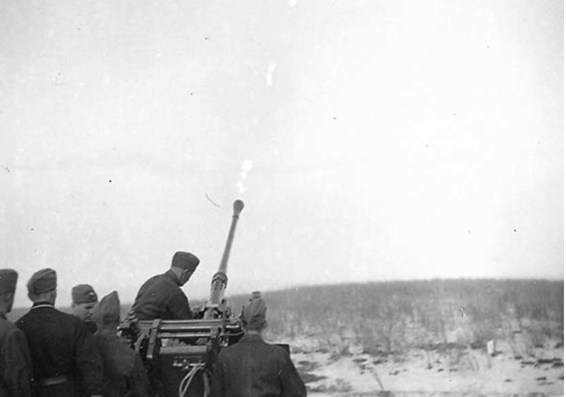
Once the gun was levelled on four adjustable feet, the gun layer could then climb into the seat and the gun was ready for action. Mounted on its cruciform platform the 3.7cm FlaK 18 gun is trained across a field somewhere on the Eastern Front in 1942. The weapons fire rate was more than capable of dealing with attacking enemy troop concentrations.
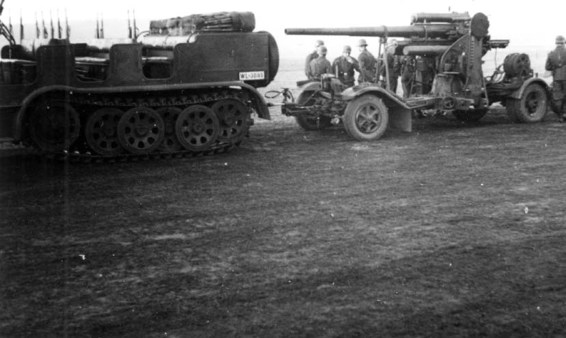
An 8.8cm Luftwaffe FlaK 18 gun mounted on its limber being towed in 1942. Normally the ‘88’ was served by a 10-man crew plus a halftrack driver, who was considered part of the crew.
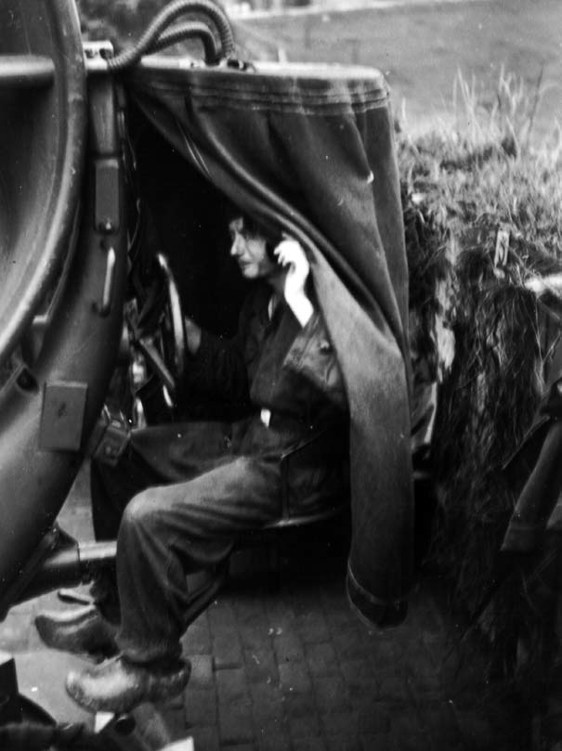
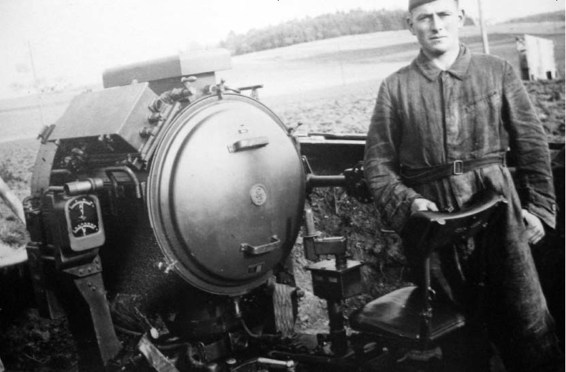

Three photographs showing Luftwaffe search lights in a number of roles on the Eastern Front. The searchlights were used in order to detect both ground and aerial targets and allow FlaK crews to aim their weapons more accurately at the target.
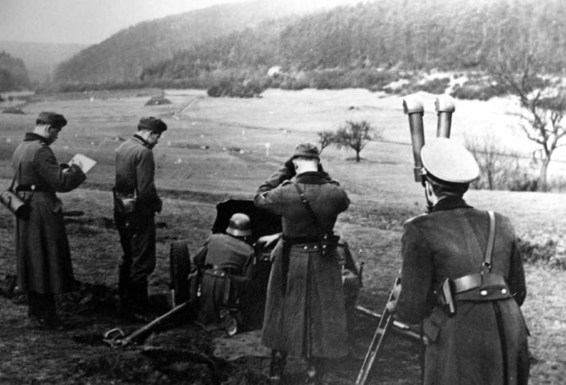
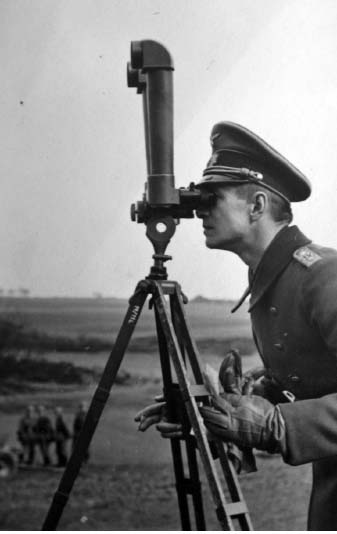

Three photographs showing artillery battery observation posts in action. Here the observer can be seen peering through his scissors binoculars across the terrain. The first two photos suggest that a training exercise is being performed, given the lack of concealment and the pristine uniforms. The gun is a 3.7cm PaK 36 anti-tank gun. Acquiring targets across such terrain was often relatively straightforward. Observation posts were normally located close to the infantry they supported, and it was essential that they were well dug-in and well concealed to ensure survival. Each artillery battery had an observation post among the frontline positions.
A crewman is seen using an optical range finder to correct fire for the battery. Should rounds fall short or over the target, his task was to advise the aimer on the corrections needed for the battery to hit the target.
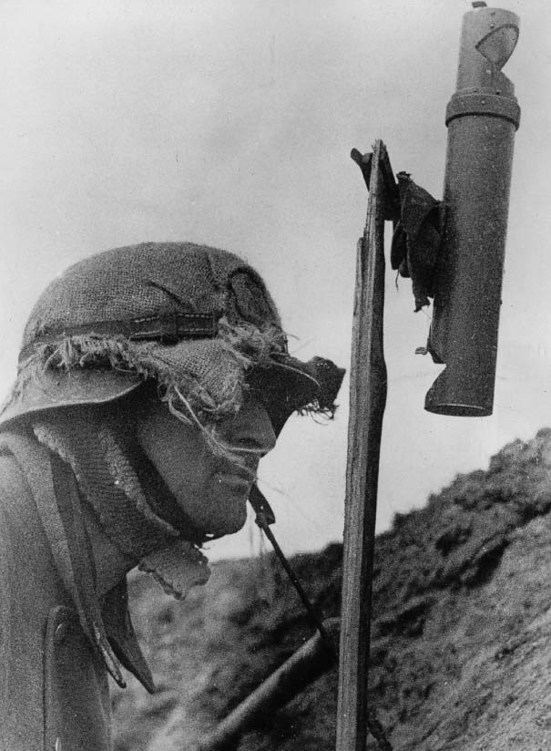
Here a soldier peers across the front line in his trench during operations in Russia in 1943. He uses an optic view finder to locate the enemy’s position and relay information back to his command station.

The FlaK crew can be seen with their 2cm FlaK 30 mounted on top of a 6x4 3-ton Type 33 G1 Henschel or Magirus Deutz diesel truck. The 2cm FlaK 30 can be identified by the shape of its shield and the distinctive shape of the muzzle brake. The weapon was more than capable of dealing with enemy troop concentrations.
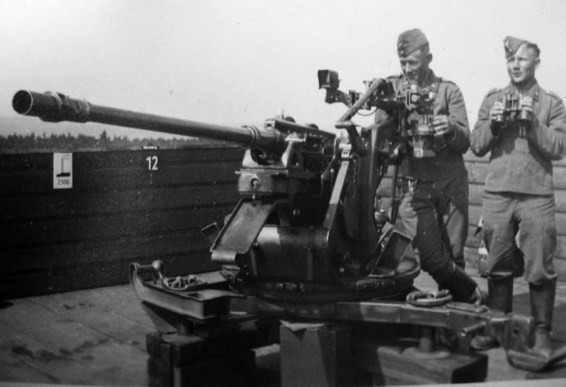
A 2cm FlaK 30 crew preparing for a fire mission against an enemy target. The projectiles used by this weapon were usually airburst shells, though APHE and inert sub-calibre APCR rounds were also issued for use against armoured targets. The airburst shells were favoured for their anti-personnel capabilities. The explosive force of a 2cm H.E. shell was small, about the same as a hand grenade.

A 2cm FlaK 30 gunner stands near his weapon during a lull in the fighting. The number of guns assigned to light FlaK batteries varied during the war, but was typically twelve 2cm and/or 3.7cm guns in four platoons.
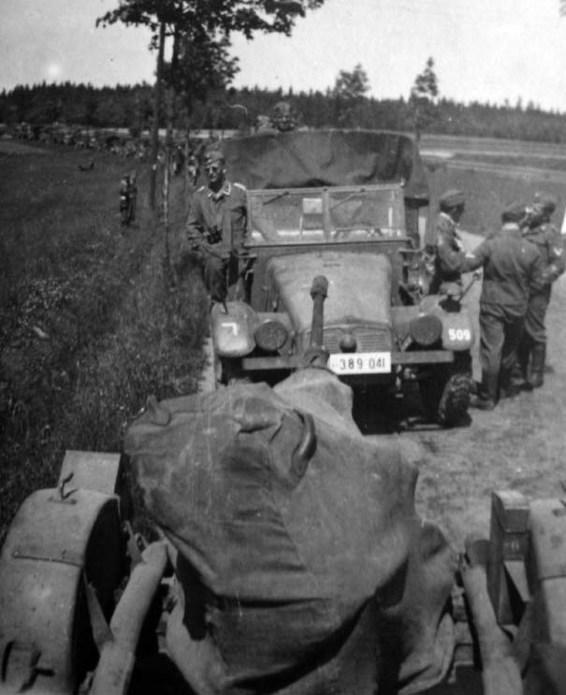
Luftwaffe ground troops have halted with their column somewhere on the Eastern Front. The gun in the foreground is a 2cm FlaK 30. In Russia there was an immense casualty rate owing to the field division’s poor performance. Army commanders complained bitterly that the Luftwaffe units were a waste of personnel and equipment.

A 2cm FlaK 30 gunner in a defensive role protects a coastal line more than likely somewhere along the northern shores of Russia. The projectiles used by this weapon were airburst shells.

Luftwaffe ground troops with their commanding officer survey the wreckage of a downed aircraft. By 1943 the Soviet Air Force had become an immense problem to the German war machine and constantly hindered movement. Thousands of FlaK guns had been issued to the army, Waffen-SS and Luftwaffe to help stem this growing problem. Unfortunately, it did not prevent the constant air strikes, but helped to temporarily stop heavy bombings in some areas of the front.


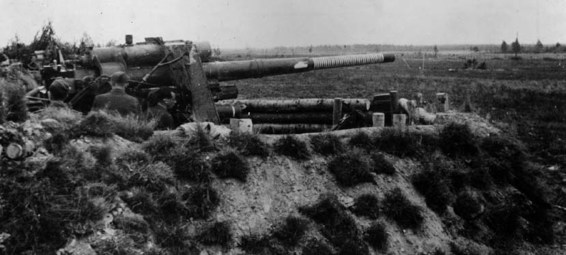
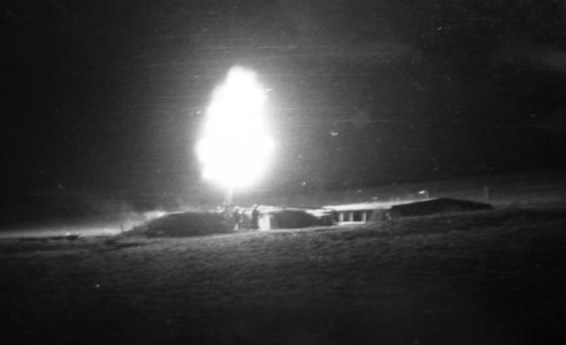
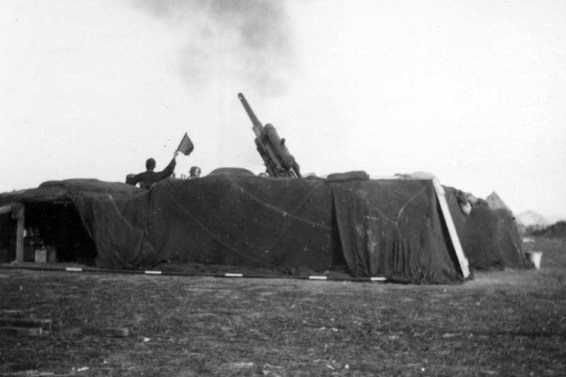


Six photographs showing the mighty 8.8cm FlaK gun in a number of roles on the Eastern Front between 1942 and 1943. The ‘88’ was arguably the most effective anti-aircraft and anti-tank gun used in the Russian campaign. Where the terrain was often flat and open it allowed the long-range performance of the gun to be fully exploited. These guns were positioned all over the front lines for an air-defence role and were lethal weapons to enemy aircraft. However, as the Soviet Air Force increased in size and inflicted ever-greater casualties on German positions, so the need for more 8.8cm FlaK guns to counter the threat grew. As the Allied bombing campaign intensified thousands of 8.8cm FlaK guns were manned all over the Reich in order to mitigate the damage inflicted, not only on its economy, but against the civilian population as well. In the photo below, the tally of destroyed enemy tanks has been painted on the barrel in the usual fashion.

A 2cm FlaK 30 crew in action against aerial attack during the summer of 1943. The number of guns assigned to light FlaK batteries varied through the war, but was typically twelve 2cm and/or 3.7cm guns in four platoons.

A FlaK crew loading a shell into their 8.8cm FlaK 36 gun during intensive fighting on the Eastern Front during the summer months of 1943. Note the gun’s limber positioned nearby. The limber were normally positioned like this in order for the crews to rapidly limber-up and re-position the gun.

During the winter of late 1943, a crew member can be seen with his 2cm Flakvierling 38 quadruple self-propelled FlaK gun. The gun is mounted on the back of what looks like an Sd.Kfz.10/4, which was widely used with a variety of smaller-calibre FlaK guns.

This photograph was taken in southern Russia in the summer of 1943. It shows a quadruple barrelled self-propelled Flakvierling 38 gun. This gun could unleash a hail of fire and was able to discharge 1800 rounds per minute from all four of its barrels.