
Chapter 4
(FlaK and field divisions 1944–1945)
Although German Flak and field commanders were fully aware of the fruitless attempts by its forces to establish a cohesive defensive line, the troops followed orders implicitly in a number of areas to halt the Soviet drive. Again and again these Luftwaffe units fought stoically to the death. Between June and September 1944 the Germans had sustained some one million casualties. To make good their losses many of the exhausted and under-manned divisions consisted of hastily-conscripted old men and low-grade troops. The method of recruitment generally did not produce very good results. Not only were the number of recruits simply insufficient, but even the enlistment of volunteers into the German army was beginning to break down. In the Luftwaffe, too many of the replacement troops could not be properly trained and as a result losses soared. Lack of fuel, insufficient spare parts, low ammunition stocks and shortages of weapons, coupled with the lack of trained crews, all played a major part in reducing the effectiveness of the Luftwaffe Flak and field divisions in the final year of the war.
Yet despite this deficiency in men and equipment the Germans did manage to slow down the Russian drive in the East, if only temporarily. on the central sector of the Eastern Front the remnants of the once vaunted Army Group Centre had steadily withdrawn across the Polish border westwards in July 1944. The Polish capital, Warsaw, was soon under threat and by August 1944 heavy fighting raged around the city. Although the Germans stiffened the defence line east of the city it did not prevent heavy combat occurring around the suburbs of Praga. It was here in these suburbs nearly five years earlier that German infantry and Panzers were victoriously fighting against Polish forces during the invasion of Poland. Now they were fighting for their lives against hardened, well-equipped and vengeful Russian troops. By 14 September Praga was finally captured by the Russians, and Red Army forces sent their infantry and armour across the river and held considerable stretches of the riverfront. Undeterred by the Soviets, the Panzerwaffe tenaciously held the ground west of the capital and fought for every foot. A mass of infantry, mixed with the remnants of naval and Luftwaffe groups, supported the motorized columns, as they fought against huge numbers of Russian tanks. Many of the German armoured vehicles were festooned with camouflage, and wherever possible moved under the cover of trees, or the cover of night to avoid being attacked by the Red Army Air Force, which had almost total control of the air on the Eastern Front.
By September 1944 the whole position in Poland was on the point of disintegration. Action in Poland had been a gruelling battle of attrition for those German units that had managed to escape from the slaughter. Fortunately for the surviving German forces, the Soviet offensive had now run out of momentum. The Red Army’s troops were too exhausted, and their armoured vehicles were in great need of maintenance and repair. It seemed the Germans were spared from being driven out of Poland for the time being.
The lull in Poland was not mirrored elsewhere on the Eastern Front. In mid-July 1944, another massive offensive was launched by the Soviet Ukrainian Fronts. on 20 August, the 2nd Ukrainian Front broke through powerful German defences supported by heavy armour, and the Red Army reached the Bulgarian border on 1 September. Within a week, Soviet troops reached the Yugoslav frontier. on 8 September, Bulgaria and Romania then declared war on Germany. Two weeks later on 23 September, Soviet forces arrived on the Hungarian border and immediately raced through the country for the Danube, finally reaching the river to the south of Budapest.
Elsewhere on the Eastern Front the war situation for the Luftwaffe Flak and field divisions was dire. The Soviets possessed too many tanks, anti-tank guns and aircraft for the Luftwaffe and it remained incapable of causing any serious losses or delay. Little in the way of reinforcements reached them, and those that were left holding a defensive position had already been forced into various ad hoc units, known as kampfgruppen in German (battle groups) that were simply thrown together with a handful of vehicles, Flak guns and troops. Most of these hastily formed formations were short-lived. The majority were either completely destroyed in the fighting or had received such a mauling in battle they were reorganized into a different ad hoc formation under a new commander.
For the Luftwaffe fighting for survival on the Eastern Front with shortages of every kind was affecting most of the old and experienced divisions. Despite fervent efforts to maintain, let alone increase, the combat strength of the Luftwaffe field divisions, the bulk of the units were too exhausted to affect the situation. As a result the Russians continued pushing forward whilst German forces retreated through Poland to East Prussia. Along the Baltic coast too, Soviet forces advanced – crushing those German units which were all that remained of the once mighty Army Group North.
During the first cold months of 1945 the situation on the front lines deteriorated even further. When the Russians successfully attacked across the oder in mid-April 1945, the hotchpotch force of what was left of the German armed forces fought back in desperation as the Soviet thrust carved its way across the river, capturing the town of küstrin, and moving on towards the Nazi capital.
As the Russians pushed along the Berlin highway army, Waffen-SS and Luftwaffe units were given the task of scraping together enough men and weapons to defend the weakened front line. Although these German formations fought bitterly to defend the capital from the advancing Red Army, by 24 April the Russians systematically completed the great encirclement around Berlin. The struggle to defend Berlin was doomed, but even during the battle a mixed bag of Luftwaffe units together with army and Waffen-SS troops fought on ceaselessly trying to delay the death of the German forces.
During the last days of the war most of the remaining Luftwaffe units continued to fight until circumstances forced them to abandon or destroy their equipment and surrender. Although the Luftwaffe field units saw extensive action, their success was limited and localized, and did nothing to frustrate enemy operations.
Nobody could deny that the men of the Luftwaffe, in their brief existence, had won a reputation for daring and professionalism in combat, especially the elite Hermann Göring Division. Throughout the titanic struggles into which they had been thrown during the war in Russia, they provided the army and Waffen-SS with valuable support, despite their lack of training and weapons. Although Luftwaffe strength never exceeded that of the German army its units fought with courage and zeal to the very end.

Luftwaffe personnel pose for the camera in a snow-covered dugout during winter operations in early 1944. By this period of the war the Luftwaffe divisions were suffering from low self-esteem. Many troops had simply been thrown into combat with little training or proper leadership.
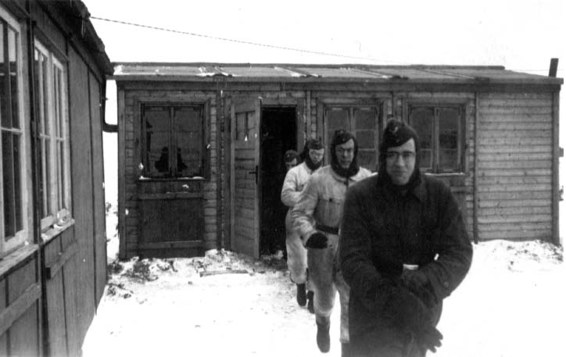
Troops of an unidentified Luftwaffe field division exit a wooden building to begin their daily duties during winter operations in 1944. The state of the Luftwaffe units in the field varied considerably, and in some equipment was very poor.
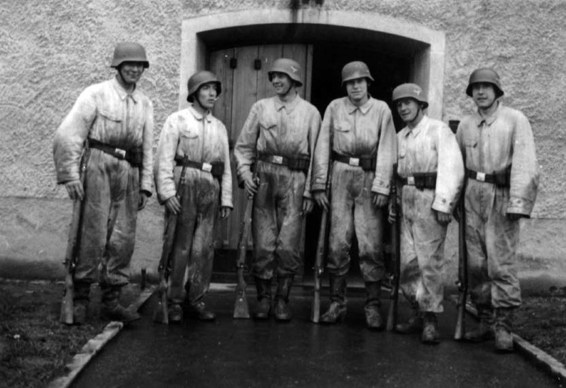
Newly recruited and clearly very young and cold Luftwaffe personnel pose for the camera armed with the standard issue Wehrmacht bolt-action rifle, the Karabiner 98k. In November 1943 the army took over responsibility for the Luftwaffe field divisions. It quickly attempted to make drastic improvements in order to both prevent further massive losses and bolster their equipment and manpower so that they could support the army and Waffen-SS on the front.
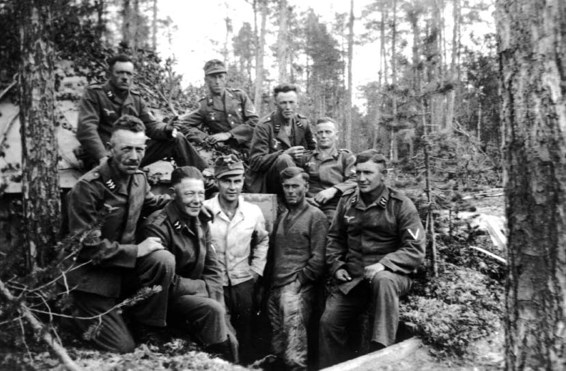
Luftwaffe field division troops in a forest area probably somewhere in northern Russia in 1944. The new field divisions had three Jäger regiments of two battalions, each battalion having a headquarters company, three rifle companies, and one heavy weapons company.

A Luftwaffe 2cm FlaK 30 position in southern Russia. Although these light anti-aircraft guns were used extensively to deal with the threat of the Soviet Air Force, the recurring appearance of large amounts of enemy armour compelled many FlaK crews to divert their attention from the air and support their own infantry and armour on the ground. But these light weapons were of little use against heavier Soviet armour.

A Luftwaffe commanding officer moves along a formation of personnel prior to their departure to the front lines. By mid 1944 Luftwaffe commanders noted that in a number of their units, troop morale had improved in spite the massive losses sustained on all fronts.

A 2cm FlaK 30 gun mounted on the back of a Sd.Kfz.10/4 1-ton halftrack during summer operations in 1944. The sides of the vehicle are folded down. The sides allowed extra space on board the halftrack for the crew to easily manoeuvre. Note the Sd.Ah.51 trailer containing ammunition. This gun was used extensively on the Eastern Front and had a maximum rate of fire of 120 rounds per minute, with a horizontal range of 4800 metres.

A typical 2cm FlaK 30 defensive position somewhere in Russia in the summer of 1944. This weapon was usually served by six men (thus four single 2cm FlaK guns would need a total of 24 men), and had a cyclic rate of fire of 280 rounds per minute. These lighter calibre guns were much respected by Allied aircrews and were also devastating against light vehicles, as well as soldiers caught out in the open. These guns also armed a variety of vehicles on self-propelled mounts.
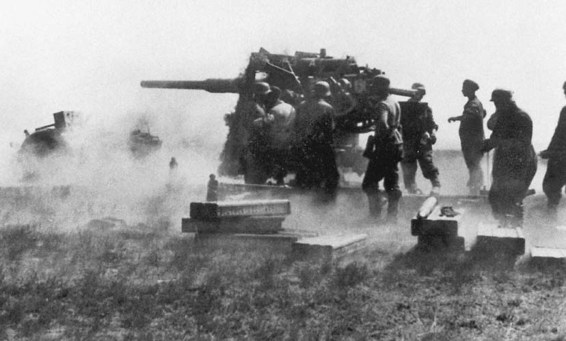
An 8.8cm Luftwaffe FlaK 36 crew in the thick of action during the summer of 1944. By the look of the guns elevation the ‘88’ has been used against a ground target. Note the used ammunition shells and limber unit standing close by.
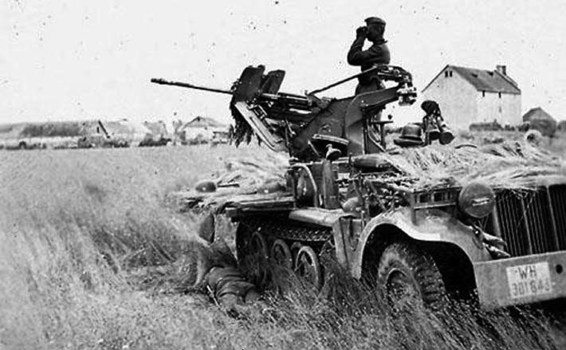
A 2cm FlaK 30 gun mounted on the back of an army Sd.Kfz.10/4 1-ton half track in a field with one of the crew members scouring the terrain for enemy activity. Note foliage has been applied to parts of the vehicle in order to break up the distinctive shape of the vehicle from the air.
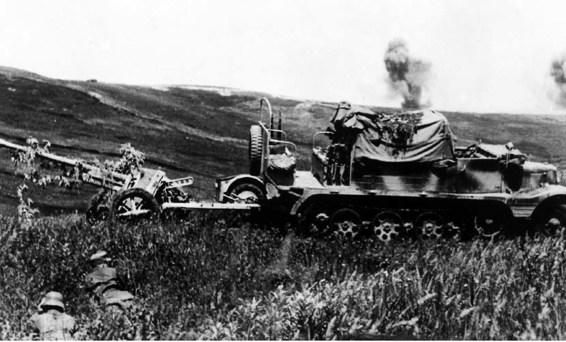
An interesting photograph showing a halftrack towing a 5cm PaK38. The PaK 38 was the first antitank weapon to be produced as a full sized artillery piece, rather than the much smaller-calibre, two-man wheeled ant-tank weapons, and a number of Luftwaffe field divisions were issued with them during the latter half of the war.
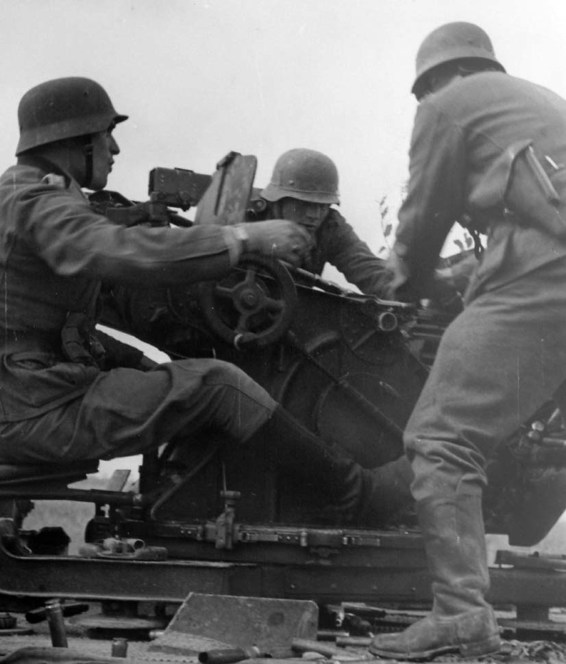


Three photographs showing 2cm FlaK 30 crews somewhere on the Eastern Front. As the Soviet Air Force started to inflict heavy casualties by 1944, the Luftwaffe, army and Waffen-SS divisions were well equipped with FlaK guns. This gun had a practical rate of fire of 120 rounds-per-minute, with a maximum horizontal range of 4800 metres, and thus was particularly effective against both ground and aerial targets. Thousands of these guns were used in the defence of Poland and the Baltic States in a desperate attempt to help delay the Russian onslaught. However, like so much of the German armour employed in the East, they were too few or too widely-dispersed to make any significant impact on the main Soviet operations which were already capturing or encircling many of the key towns and cities.


Four photographs taken of Luftwaffe grenadiers and officers of what was known generally as the Hermann Göring Korps. The Korps is obviously undertaking training, probably in Poland in the summer of 1944.

Two Luftwaffe personnel on a motorcycle advance along a dusty road somewhere in Poland in the summer of 1944. Note the vehicle’s licence plate with the prefix ‘WL’, which means it is attached to the Luftwaffe. Both field troopers are armed with the standard army bolt-action rifle, the Kar 98k.

Troops of the famous Hermann Göring division during winter action on the Eastern Front in 1944. These field soldiers were regarded as elite troops and fought a number of fierce battles in Poland and East Prussia scoring considerable successes and stemming the Russian drive.

A white-washed 2cm FlaK 30 and crew wearing full winter camouflage smocks in a defensive position against ground targets. The end of 1944 found the German army still fighting on foreign soil trying desperately to gain the initiative and halt the Red Army’s relentless drive onto the German frontier.

A fixed 2cm FlaK 38 gun position protecting an area against aerial attack. The projectiles used for this weapon were airburst shells. The airburst shell was favoured for its anti-personnel capabilities against troops within cover.

A 2cm FlaK 30 gun crew with their weapon on its trailer being prepared for action in the snow. By this period of the war, mechanized formations such as the Hermann Göring Panzer-Korps were well equipped with FlaK guns. There were motorized FlaK battalions, with divisions also being furnished with additional anti-aircraft platoons and companies in the Panzergrenadier, Panzer and artillery regiments. This gun, in spite of its small size, was a formidable weapon and more than capable of combating both low flying aircraft and ground targets.

A whitewashed older-pattern Sd.Kfz.250/9 reconnaissance half track mounting a 2cm FlaK 38 gun advances across snow covered terrain during defensive actions on the Eastern Front during late 1944. By this period of the war the Luftwaffe was pushed to its limits trying to defend many sectors of the receding front. As a result losses were very high.

A gunner with his 2cm FlaK 38 mounted on a Sd.Kfz.10/4 1-ton half track. These deadly guns were much respected by Russian airmen and were also particularly devastating against light vehicles, as well as troops caught in the open. The weapon also armed a variety of vehicles on self-propelled mounts where they could be moved from one part of the defensive line to another quickly and efficiently.

An 8.8cm FlaK 36 crew has halted on a road. The gun was often easy to spot at long-distances, due to its high profile. Therefore the crew has whitewashed the weapon, to blend it into the winter surroundings. The gun fired a 9.4kg projectile, and its high velocity and flat trajectory made it a very accurate and effective weapon in both an anti-tank and anti-aircraft role.
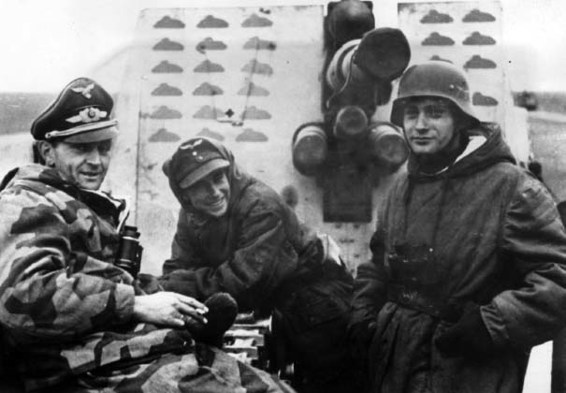
An 8.8cm FlaK 36 gun crew poses for the camera during a lull in the fighting during the early winter of 1945. Note the guns splinter shield boasting a vast array of painted tanks denoting kills. Although the war was now drawing to a terrible end for the Germans, the 8.8cm FlaK gun still continued to do sterling service right to the end.
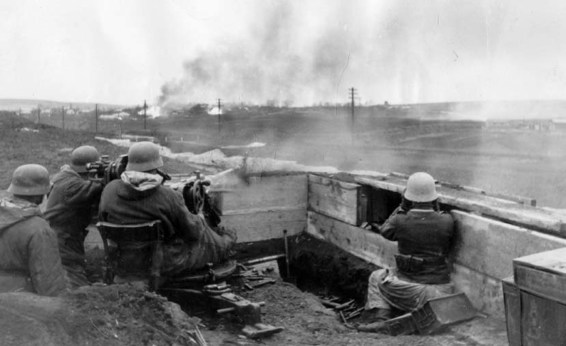
From a fixed position on a hill top a 2cm FlaK crew open fire against an enemy target during defensive actions in Germany during the last weeks of the war. The troops were now courageously fighting from one collapsing front to another.

A well camouflaged 8.8cm FlaK 36 gun is being moved into position on its limber prior to defensive action during the last months of the war. Although the Luftwaffe field divisions were slowly being driven further west by overwhelming enemy superiority they were still fighting with fanatical determination on the battlefield.

A quadruple mounted 2cm Flakvierling 38 gun on top of a FlaK tower in the suburbs of Berlin in 1945. Each of these guns had a practical rate of fire of 180 to 220 rounds-per-minute, with a maximum horizontal range of 4800 metres, which was particularly effective against both ground and aerial targets. A number of these mounted guns were used in the defence of East Germany in a desperate attempt to delay the Russian onslaught. However, like so much of the German armour employed in the East, they were too few or widely-dispersed to make any significant impact on the main Soviet operations which were already capturing or encircling many of the key towns and cities.