
Junkers Ju 86
The twin-engined Ju 86 monoplane was developed both as a medium bomber and as a high-speed civilian airliner capable of carrying ten passengers, and examples of the latter were operated by both Luft Hansa and Swissair before the war. Full production of the bomber version commenced in April 1936 and took part in the Spanish Civil War the following year, and in the 1939 invasion of Poland, but proved inferior to the Heinkel He 111s. After further improvements it was more successful in a high-altitude bomber and photo-reconnaissance role. Some were also used as transport aircraft for VIPs.
Junkers Ju 52
The workhorse of the Luftwaffe’s transportation capability was the ubiquitous Ju 52. This triple-engined aircraft, instantly recognisable from its corrugated metal skin and the heavy cowling of its radial engines, served in every theatre of Germany’s war. Nicknamed ‘Tante Ju’ (Aunty Junkers) or ‘Iron Annie’, it first flew in October 1930 and went on to serve with twelve civilian air carriers. In its original configuration it had only a single engine in the nose, but after seven underpowered prototypes had been built all subsequent Ju 52s had the three engines. In 1934 Junkers were instructed to produce an interim bomber version until the newer purpose-built bombers entered service. It also saw action in the Spanish Civil War, and in its bomber role took part in the bombing of Guernica, and also later of Warsaw, but for the remainder of the war served primarily as a transport for personnel, equipment and for the dropping of paratroopers.
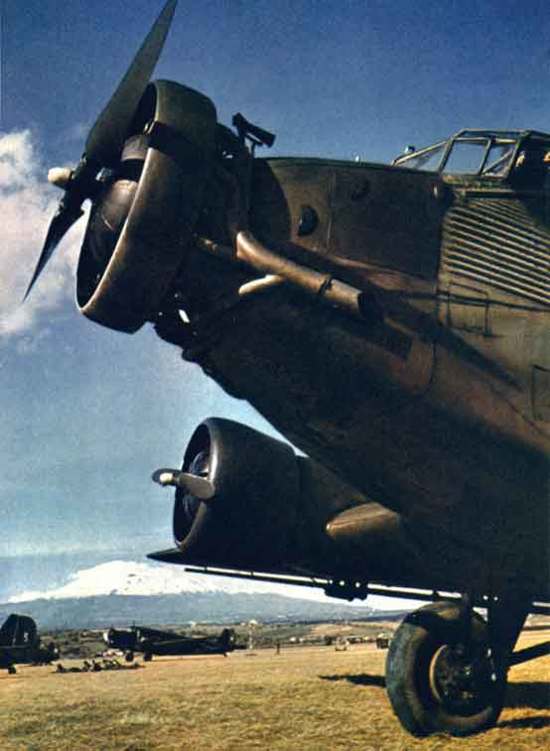
The distinctive nose-mounted radial engine of the triple-engined Ju 52, photographed in Sicily.

Ju 52s carrying Fallschirmjäger, paratroopers, over the Netherlands. In May 1940 the Ju 52 was involved in the first large-scale airdrop as part of the Battle of the Hague, but they suffered heavy losses, either through poor airfield conditions or unexpectedly effective anti-aircraft defences.

The Ju 52’s durability was legendary. This photograph shows an aircraft engine being unloaded from the side access door. The Ju 52 had a payload of around 1,845kg. Its corrugated duralumin metal skin strengthened the entire structure, including its spacious rectangular fuselage, a technique pioneered by Junkers during the First World War. Note the exposed gunner’s position on the top of the fuselage.
Gotha Go 244
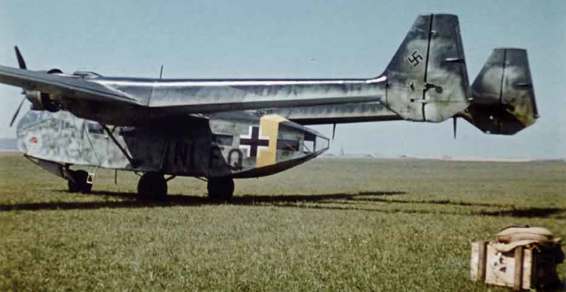
The Go 244 was a powered version of the Go 242 transport glider. It had an unusual extended twin-boom design to accommodate two 700hp Gnome/Rhône engines, with high mounted wings above a fuselage pod. This could carry up to twenty-three fully kitted troops or a small military vehicle, such as a Kübelwagen. It was only in use for a short period as it proved vulnerable to enemy air and anti-aircraft action. (US DoD)

Ju 52 on an airstrip in wintery conditions.