
The Problem in Context
‘One of the greatest victories ever in that part of the world,’ in the estimation of a sixteenth-century chronicler, was won off the Malabar coast on 18 March 1506. A Portuguese squadron of nine ships, which triumphed over the fleet of the Zamorin of Calicut, allegedly 250-sail strong, helped to establish a pattern which was already becoming discernible in European encounters with distant enemies. European naval superiority enabled expeditions to operate successfully, far from home, against adversaries better endowed in every other kind of resource.
This was not only true at sea. The critical moment of the conquest of Mexico was the capture of a lake-bound city 7,350 feet above sea level, with the aid of brigantines built and launched on the shores of the lake. A little later, even more conspicuously, the conquest of Siberia—the largest and most enduring of the empires acquired by European arms in the sixteenth century—was of an enormous hinterland with little access to the sea; but it was very largely a conquest of rivers, which were the highways of communication in the region. Russian superiority in river warfare was as decisive in Siberia as was Portuguese naval supremacy in the Indian Ocean or that of the Spanish in lake-borne warfare in Mexico.
We know little of the medieval background from which these world-beating traditions of naval warfare emerged or of the maritime culture in Europe which bred them. Medieval chroniclers were almost always landlubbers, whose descriptions of sea fights were conventional and ill informed. Artists who depicted battle scenes were rarely interested in realism. Official records give little more than clues about the structure and equipment of ships. Treatises of tactics, which are in good supply to historians of land warfare, are virtually non-existent for the seas. Marine archaeology has only recently begun to yield additional information. In recent years, moreover, naval history has been out of fashion, except as a small department of maritime history—partly as a reaction against the obsession of earlier generations, who took ‘the influence of sea power on history’ as an article of credal authority. The material in this chapter must therefore be more tentative than much in the rest of this book.
The Framework of Nature
During the age of sail, the outcome of fighting at sea depended on nature. Weather, currents, rocks, shoals, winds, and seasonal severities were the extra enemies with which both sides in any encounter had to contend. Europe has two sharply differentiated types of maritime environment, which bred their own technical and, to a lesser extent, strategic and tactical practices in the middle ages.
The Mediterranean, together with the Black Sea, is a tideless and, by general standards, placid body of water with broadly predictable winds and currents. Since it lies entirely within narrow latitudes, it has a fairly consistent climate, except in the northernmost bays of the Black Sea, which freeze in winter. Atlantic-side and Baltic Europe, by contrast, is lashed by a more powerful, capricious and changeable ocean which stretches over a wide climatic band. Climatic conditions had inescapable strategic implications. To some extent, these corresponded to universal rules of naval warfare under sail. In attack, the ‘weather gauge’ is usually decisive: in other words it is of critical advantage to make one’s attack with a following wind. Havens are easiest to defend if they lie to windward. Since westerlies prevail over most of the coasts of Europe, and right across the Mediterranean, these facts give some communities a natural historic advantage. Most of the great ports of Atlantic-side Europe are on lee shores but England has a uniquely long windward coast well furnished with natural harbours; only Sweden, Scotland, and Denmark share this advantage, albeit to a lesser extent. In Mediterranean conflicts, thanks to the winds, relatively westerly powers tended to have an advantage. The racing current, moreover, which powers eastward through the Strait of Gibraltar, flows anti-clockwise along the southern shore of the sea. In consequence, in the great ideological conflict of the middle ages—between Islam, which generally occupied most of the southern and eastern shores, and Christendom in the north and west—the balance of advantage lay on the Christian side. In seaborne warfare, speed of access to critical stations is vital; the return voyage is relatively unimportant for an expedition whose aim is to seize or relieve a point on land.
The Technological Process
Naval historians like to stress the cost of naval war and the magnitude of the logistical effort it demands, but in our period it was relatively economical, compared with expenditure on knights, seige works, and fortifications. For most of the period, few fighting ships were purpose-built at public expense and the opportunities of recouping costs by seizing plunder and prizes were considerable. Only very gradually did naval expenditure overtake the costs of land warfare, as warships became more specialized and land forces less so. The full effects of this change were not felt until after our period was over. Nevertheless, the cheapness of naval warfare was a function of its scale. The occasional great campaigns, in which vast quantities of shipping were taken out of the regular economy and exposed to immolation in hazardous battles, could represent a terrible, if short-lived, strain.
Weapons apart, navigation was the most important aspect of technology for battle fleets, which often took those aboard outside familiar waters. Haven-finding was essential for keeping fleets at sea; precise navigation was essential for getting them to the right place. Most of the technical aids of the period seem hopelessly inadequate to these tasks and it is not surprising that experienced navigators, in regions they knew at first-hand, kept close to the coasts and navigated between landmarks. Advice from a treatise of about 1190 represents an early stage of the reception in Europe of the navigator’s most rudimentary tool: when the moon and stars are enveloped in darkness, Guyot de Provins explained, all the sailor need do is place, inside a straw floating in a basin of water, a pin well rubbed ‘with an ugly brown stone that draws iron to itself’. The compass was made serviceable in the thirteenth century by being balanced on a point, so that it could rotate freely against a fixed scale, usually divided between thirty-two compass-points. Other tools for navigators were gradually and imperfectly absorbed in the course of the middle ages, but their reception tended to be delayed and their impact diminished by the natural conservatism of a traditional craft.
Mariners’ astrolabes, for instance, which enabled navigators to calculate their latitude from the height of the sun or the Pole Star above the horizon, were already available by the start of our period. Few ships, however, were carrying astrolabes even by the period’s end. Tables for determining latitude according to the hours of sunlight were easier to use but demanded more accurate timekeeping than most mariners could manage with the sole means at their disposal: sandclocks turned by ships’ boys. The so-called ‘sun compass’—a small gnomon for casting a shadow on a wooden board—might have been useful for determining one’s latitude relative to one’s starting-point; but we lack evidence that navigators carried it in our period.
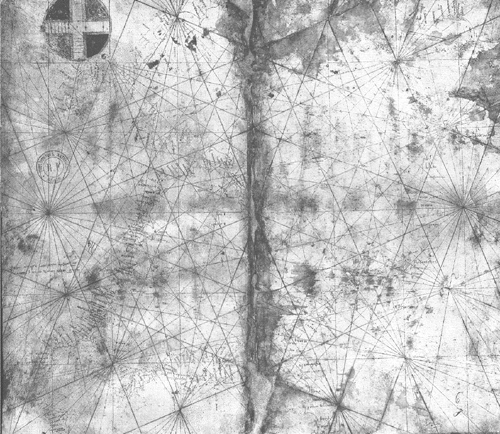
Warfare took navigators from the Atlantic and Mediterranean into each other’s spheres, where they had to contend with the dangers of unknown coasts and narrows (and, in northern waters, tides). This created a demand for sailing directions, which survive in original form for the Mediterranean from the early thirteenth century. They soon began to be cast in the form of charts, criss-crossed with compass bearings, which were probably less useful for practical navigators than written directions in which detailed pilotage information could be included.
In view of the dearth of useful technical aids it is hard to resist the impression that navigators relied on the sheer accumulation of practical craftsmanship and lore to guide them in unknown waters. From the thirteenth century onwards, compilers of navigational manuals distilled vicarious experience into sailing directions which could genuinely assist a navigator without much prior local knowledge. ‘Portolan charts’ began to present similar information in graphic form at about the same period. The earliest clear reference is to the chart which accompanied St Louis on his crusade to Tunis in 1270.
At the start of our period, there were marked technical differences between Mediterranean and Atlantic Europe in shipbuilding. In both areas, the shipwright’s was a numinous craft, sanctified by the sacred images in which ships were associated in the pictorial imaginations of the time: the ark of salvation, the storm-tossed barque, and the ship of fools. Much of our knowledge of medieval shipyards comes from pictures of Noah. Underlain by this conceptual continuity were differences in technique which arose from differences in the environment. Atlantic and northern shipwrights built for heavier seas. Durability was their main criterion. They characteristically built up their hulls plank by plank, laying planks to overlap along their entire length and fitting them together with nails. The Mediterranean tradition preferred to work frame-first: planks were nailed to the frame and laid edge-to-edge. The latter method was more economical. It demanded less wood in all and far fewer nails; once the frame was built, most of the rest of the work could be entrusted to less specialized labour. In partial consequence, frame-first construction gradually spread all over Europe until by the end of our period it was the normal method everywhere. For warships, however, Atlantic-side shipyards generally remained willing to invest in the robust effect of overlapping planks, even though, from the early fifteenth century, these were invariably attached to skeleton frames.
Warships—in the sense of ships designed for battle—were relatively rare. Warfare demanded more troop transports and supply vessels than floating battle-stations and, in any case, merchant ships could be adapted for fighting whenever the need arose. In times of conflict, therefore, shipping of every kind was impressed: availability was more important than suitability. Navies were scraped together by means of ship-levying powers on maritime communities, which compounded for taxes with ships; or they were bought or hired—crews and all—on the international market.
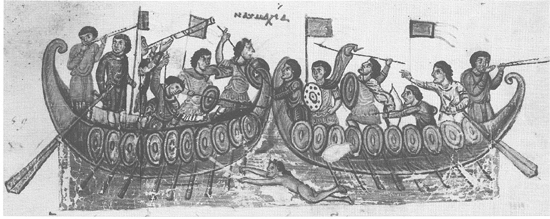
Until late-medieval developments in rigging improved ships’ manoeuvrability under sail, oared vessels were essential for warfare in normal weather conditions. Byzantine dromons were rowed in battle from the lower deck, as shown in this late eleventh-century illustration, with the upper deck cleared for action, apart from the tiller at the stern.
Maritime states usually had some warships permanently at their disposal, for even in time of peace coasts had to be patrolled and customs duties enforced. Purpose-built warships also existed in private hands, commissioned by individuals with piracy in mind, and could be appropriated by the state in wartime. From 1104, the Venetian state maintained the famous arsenal—over 30 hectares of shipyards by the sixteenth century. From 1284 the rulers of the Arago-Catalan state had their own yard, specializing in war galleys, at Barcelona, where the eight parallel aisles built for Pere III in 1378 can still be seen. From 1294 to 1418 the French crown had its Clos des Galées in Rouen, which employed, at its height, sixty-four carpenters and twenty-three caulkers, along with oar-makers, sawyers, sail-makers, stitchers, rope-walkers, lightermen, and warehousemen. Philip the Good, Duke of Burgundy from 1419 to 1467, whose wars and crusading projects created exceptional demand for shipping, founded a shipyard of his own in Bruges, staffed by Portuguese technicians. England had no royal shipyard, but Henry V maintained purpose-built ships of his own as well as borrowing them from others: an ex-pirate vessel, the Craccher, was for instance loaned by John Hawley of Dartmouth. Such loans were not acts of generosity: Henry V was one of the few monarchs of the European middle ages who were serious about curtailing their own subjects’ piracy.
At the start of our period, warships, whether on the Atlantic-side or Mediterranean-side of Europe, were almost invariably driven by oars. Rigging was light by modern standards and only oars could provide the manoeuvrability demanded in battle, or keep a vessel safe in the locations, often close to the shore, where battles commonly took place.
Gradually, however, oars were replaced by sails, especially on the Atlantic seaboard. With additional masts and more sails of differing size and shapes, ships could be controlled almost as well as by oars, while frame-first construction permitted rudders to be fitted to stern-posts rising from the keel: formerly, ships were steered by tillers dangled from the starboard towards the stern. These improvements in manoeuvrability, which were introduced gradually from the twelfth century onwards, freed ships from the economic and logistic burden of vast crews of oarsmen. Oar-power dominated Baltic warfare until 1210, when the crusading order of Sword-brothers switched to sail-driven cogs, which helped them extend their control along the whole coast of Livonia. King John of England had forty-five galleys in 1204 and built twenty more between 1209 and 1212. Edward I’s order for a battle fleet in 1294 was for twenty galleys of 120 oars each. A hundred years later, however, only small oared craft formed part of England’s navy, in which the fighting vanguard was entirely sail-driven. French shipbuilding changed faster. The French at Sluys in 1340 had 170 sailing ships as well as the royal galleys: many of them were certainly intended for the fray.
To a lesser extent, the oar-less craft played a growing role in Mediterranean warfare, too. The Florentine chronicler, Giovanni Villani, with characteristic exaggeration, dated the start of this innovation to 1304 when pirates from Gascony invaded the Mediterranean with ships so impressive that ‘henceforth Genoese, Venetians and Catalans began to use cogs. . . . This was a great change for our navy.’ In the fifteenth century, the Venetian state commissioned large sailing warships specifically for operations against corsair galleys.
Once free of oar-power, ships could be built higher, with corresponding advantages in battle for hurlers of missiles and intimidators of the foe: the tactics favoured throughout the period made height a critical source of advantage. To hoist tubs full of archers to the masthead was an old Byzantine trick, which Venetian galley-masters adopted. Rickety superstructures, which came to be known as ‘castles’, cluttered the prows of ships; shipwrights strained to add height even at the risk of making vessels top-heavy. The clearest demonstration of the advantages of height is in the record of sailing-ships in combat with galleys: countless engagements demonstrated that it was virtually impossible for oar-driven craft to capture tall vessels, even with huge advantages in numbers—like those of the reputed 150 Turkish boats that swarmed ineffectively round four Christian sailing ships in the Bosphorus during the siege of Constantinople of 1453, or the score of Genoese craft that hopelessly hounded the big Venetian merchantman, theRocafortis,across the Aegean in 1264.
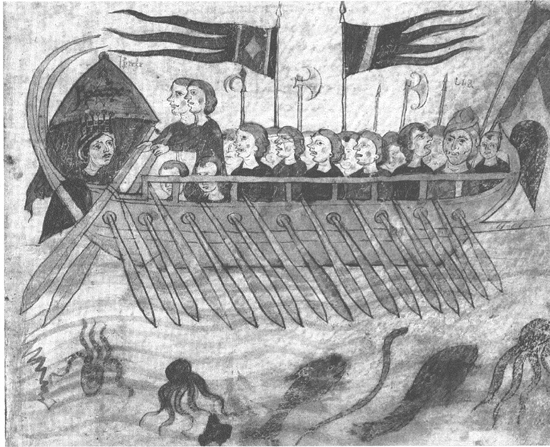
In an early thirteenth-century Sicilian manuscript, a galley cleaves a monster-haunted sea. Although no sails are up, the vessel is not about to engage, though a ram is fixed to the prow. Most of the personnel shown are professional oarsmen, of whom there were two teams, signified by the two banks of oars; on engagement, up to a third of them would double as fighting men. The presence of warriors is evident from the upraised halberds and lances. The vessel is steered by two tillers to enhance manoeuvrability.
In the Mediterranean, galleys tended to get faster. The Catalan galleys of the late thirteenth century, at the time of the conquest of Sicily, had between 100 and 150 oars; by the mid-fourteenth century, complements of between 170 and 200 oars were not unusual, while the dimensions of the vessels had not grown significantly. Light galleys pursued and pinned down the foe while more heavily armed vessels followed to decide the action. The oarsmen had to be heavily armoured, with cuirasse, collar, helmet, and shield. Despite their place in the popular imagination, ‘galley slaves’ or prisoners condemned to the oar were never numerous and were rarely relied on in war. Oarsmen were professionals who doubled as fighters; once battle was joined, speed could be sacrificed in favour of battle strength and up to a third of the oarsmen could become fighters.
The Tactical Pattern
Deliberately to sink an enemy ship would have appeared shockingly wasteful. The use of divers to hole enemy ships below the waterline was known and recommended by theorists but seems to have been rarely practised. For the object of battle was to capture the enemy’s vessels. At Sluys, as many as 190 French ships were said to have been captured; none sank—though so many lives were lost that the chronicler Froissart reckoned the king saved 200,000 florins in wages. Vessels might, of course, be lost in battle through uncontrollable fire, or irremediably holed by excessive zeal in ramming, or scuttled after capture if unseaworthy or if the victors could not man them.
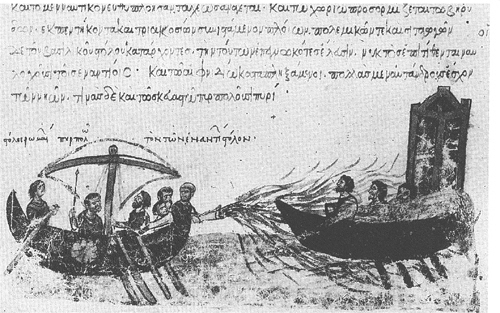
Ships fought at close quarters with short-range missiles, then grappled or rammed for boarding. The first objectives of an encounter were blinding with lime, battering with stones, and burning with ‘Greek fire’—a lost recipe of medieval technology, inextinguishable in water. A digest of naval tactics from ancient treatises, compiled for Philip IV of France, recommended opening the engagement by flinging pots of pitch, sulphur, resin, and oil onto the enemy’s decks to assist combustion. It was a blast of lime, borne on the wind, that overpowered the crew of the ship carrying the siege train of Prince Louis of France to England in February 1217. Protection against lime and stones was supplied chiefly by stringing nets above the defenders; flame-throwers could be resisted, it was said, by felt soaked in vinegar or urine and spread across the decks. In a defensive role, or to force ships out of harbour, fire ships might be used, as they were—to great effect—by Castilian galleys at La Rochelle in June 1372, when blazing boats were towed into the midst of the English fleet.
‘Greek fire’ was ignited by a substance, combustible in water, of which the recipe is lost. Together with short-range missiles and blasts of blinding lime and fire-bombs, it was used prior to boarding, to distract the enemy crew and cripple rather than destroy the ship. Normally, a hand-held siphon with a bronze tube at the prow was used to project it.
As the ships closed, crossbowmen were the decisive arm. According to the chauvinistic Catalan chronicler of the fourteenth century, Ramon Muntaner, ‘The Catalans learn about it with their mother’s milk and the other people in the world do not. Therefore the Catalans are the sovereign crossbowmen of the world. . . . Like the stone thrown by a war machine, nothing fails them.’ Catalan proficiency in archery was supported by special tactics. When Pere II’s fleet confronted that of Charles of Anjou off Malta in September 1283, the Catalans were ordered by message ‘passed from ship to ship’ to withstand the enemy missiles with their shields and not to respond except with archery. The outcome, according to the chronicle tradition, was that 4,500 French were taken prisoner.
At close quarters, Philip IV’s digest recommended a range of devices: ripping the enemy’s sails with arrows specially fitted with long points, spraying his decks with slippery soap, cutting his ropes with scythes, ramming with a heavy beam, fortified with iron tips and swung from the height of the mainmast, and, ‘if he is weaker than you, grappling.’ Ramming or grappling was the prelude to an even closer-fought fight with missiles followed by boarding.
As far as is known from a few surviving inventories, the weapons carried on board ships reflected more or less this range of tactics. When inventoried in 1416, Henry V’s biggest ship had seven breech-loading guns, twenty bows, over 100 spears, 60 sail-ripping darts, crane-lines for winching weaponry between fighting decks, and grapnels with chains twelve fathoms long. It must not be supposed that the inventory was complete as most equipment was surely not stowed aboard, but it is probably a representative selection. Artillery detonated by gunpowder came into use during the period, but only as a supplement to existing weaponry, within the framework of traditional tactics. Numbers of guns increased massively in the fifteenth century, though it is not clear that they grew in effectiveness or influenced tactics much. Overwhelmingly, they were short-range, small-calibre, swivel-mounted breechloaders; anti-personnel weapons, not ship-smashers.
The Conceptual Imperatives
There is something Homeric about the pattern of war these tactics represent: ships duelled with each other in single combat; their fighting crews closed in a mêlée that might be determined by individual prowess. The way wars were fought depended on how they were conceived in the adversaries’ minds and, at least as much as land warfare—more, perhaps, as time went on—the naval warfare of our period was shaped by the great aristocratic ethos of the high and late middle ages: the ‘cult’ of chivalry, which warriors’ deeds were meant to express. There is no need to dwell on the perennial objectives of war, for greed, power-lust, and various religious or moral pretexts for bloodshed are always with us. What was peculiar to the warfare of Latin Christendom was that it was animated by belief in the ennobling effect of great ‘deeds’ of adventure. As chivalry infused seafaring, it made naval service attractive for more than the hope of prize money. The sea became a field fit for kings.
A chivalric treatise of the mid-fifteenth century tells us that the French aristocracy eschewed the sea as an ignoble medium—but the writer was responding to a debate which had already been won by spokesmen for the sea. Almost from the emergence of the genre, the sea was seen in chivalric literature as a suitable environment for deeds of knightly endeavour. In the thirteenth century, one of the great spokesmen of the chivalric ethos in the Iberian peninsula was Jaume I, King of Aragon and Count of Barcelona. When he described his conquest of Majorca in 1229, he revealed that he saw maritime war as a means of chivalric adventure par excellence. There was ‘more honour’ in conquering a single kingdom ‘in the midst of the sea, where God has been pleased to put it’ than threeon dry land.
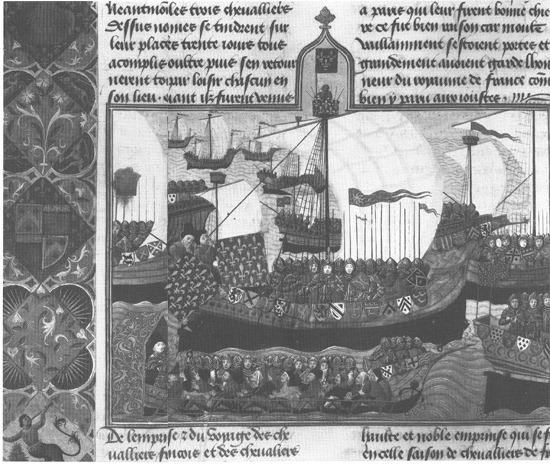
The chivalric representation of naval warfare is strong in this illumination of the Duke of Bourbon’s departure on crusade to Barbary in 1390: the ships are as gaily caparisoned as any war-steed, with pennants, scutcheons, heralds’ horns, and helmed knights.
A metaphor quickly established itself, which was to be a commonplace for the rest of the middle ages: the ship, in the words of King Alfonso X of Castile, was ‘the horse of them that fight by sea’. St Louis planned to create the Order of the Ship for participants in his Tunis crusade. The Order of the Dragon, instituted by the Count of Foix in the early fifteenth century, honoured members who fought at sea with emerald insignia. By the time of Columbus, the Portuguese poet, Gil Vicente, could liken a ship at once to a warhorse and a lovely woman without incongruity, for all three were almost equipollent images in the chivalric tradition. Anyone who contemplates late medieval pictures of fighting ships, caparisoned with pennants as gaily as any warhorse, can grasp how, in the imagination of the time, the sea could be a knightly battlefield and the waves ridden like jennets.
No text better illustrates the influence of this tradition on the conduct of war than the chronicle of the deeds of Count Pero Niño, written by his standard-bearer in the second quarter of the fifteenth century. A treatise of chivalry, as well as an account of campaigns, El victorial celebrates a knight never vanquished in joust or war or love, whose greatest battles were fought at sea; and ‘to win a battle is the greatest good and the greatest glory of life.’ When the author discourses on the mutability of life, his interlocutors are Fortune and the Wind, whose ‘mother’ is the sea ‘and therein is my chief office’. This helps to explain an important advantage of a maritime milieu for the teller of chivalric tales: it is on the sea, with its rapid cycles of storm and calm, that the wheel of fortune revolves most briskly.
At one level, sea warfare was an extension of land warfare. Set-piece battles were rare and usually occurred in the context of the activities on which naval strategy was commonly bent: the transport of armies and the blockade of ports. Inevitably, however, campaigns of this sort suggested strictly maritime strategies. It became conceivable to fight for the control or even the monopolization of sea-lanes and the extension of what might be called a territorial attitude over the sea: seizure of rights of jurisdiction over disputes arising on it and exploitation of its trade for tolls. At the level of grand strategy, some of the aims of naval warfare declared in medieval sources seem stunningly ambitious. English monarchs called themselves ‘roys des mers’ and aspired to the ‘sovereignty of the sea’. An influential political poem of 1437, the Libelle of Englische Polycye, anticipated some of the language of the ages of Drake and Nelson, stressing the imperatives of maritime defence for an island-kingdom. Similar language was sometimes used in the Mediterranean, such as Muntaner’s dictum, ‘It is important that he who would conquer Sardinia rule the sea.’
Late medieval warfare in the Mediterranean was therefore increasingly influenced by strictly maritime considerations: instead of being used as an adjunct to land wars, mainly to transport armies and assist in seiges, ships were deployed to control commercial access to ports and sea lanes. The ideal of naval strategy was represented by the claim of the chronicler, Bernat Desclot, that in the early fourteenth century ‘no fish could go swimming without the King of Aragon’s leave.’ In practice, no such monopoly was ever established anywhere but major powers, such as England, Venice, Genoa, the Hanseatic League, and the House of Barcelona, achieved preponderance, at various times, on particular routes and coasts. This way of conceiving grand strategy was carried by early modern invaders from Western Europe across the oceans of the world, to the consternation and, perhaps, the confusion of indigenous powers.
The Siren of Piracy
Even at its most commonplace, the grand strategy of maritime ‘lordship’ never displaced the small wars of mutually predatory shipping. Pirate operations could be extensive—more so than official campaigns, especially in the piracy ‘black spots’ found in narrows and channels, such as the Strait of Otranto, the Skaggerak, or the Straits of Dover, where for centuries the men of the Cinque Ports terrorized other people’s shipping, and the Sicilian Channel, which ships are obliged to use if they want to avoid the whirlpool of the Strait of Messina ‘between Scylla and Charybdis’.
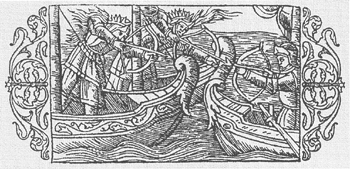
Seasonal constraints on shipping help to explain the long, grinding nature of Baltic wars: the progress of the northern crusades was set back, year by year, as what was won by way of sea on summer cruises was lost on land in winter to ski-soldiery and guerrilla warfare. In a wood-cut from the greatest history of the north—a labour of love by the sixteenth-century Catholic exile, Olaus Magnus—’pirate maidens’ defend the Finnish harbour of Hangö.
At certain levels, piracy is hard to distinguish from other kinds of warfare. Savari de Mauléon fought on crusade against Albigensians and Saracens before setting up as a sea-predator: Philip Augustus offered him great lordships for his services. Eustace the Monk, a nobleman from Artois and escapee from the monastic life of St Wulmer, was invaluable in support of Prince Louis’s invasion of England in 1216 while terrorizing the Channel from his base on Sark. He grew rich enough to invest his son with jewelled armour and renowned enough to be hailed by the chronicler, William the Breton, as ‘a knight most accomplished by land and sea’. Guillaume Coulon, who wrecked a fleet off Lisbon in 1476 when Columbus was on board, was reviled as a murderer by his Venetian and other victims but in France was honoured as an admiral and knight of the Order of Saint-Michel. States routinely authorized acts of piracy against enemy shipping in wartime.
Strictly understood, however, piracy is only a limited form of war. It depends on the trades it feeds off and therefore seeks to interrupt or exploit them, not block them altogether. Control of trade was part of statecraft, for trade yielded tolls; but, as in other periods, opinion in the middle ages was divided on the question of whether war was a cost-effective way of garnering commerce. The association of trading ports known as the Hanse, which played a major role in the trade of the north from the late twelfth century, was capable of organizing war fleets when necessary: generally, however, its policy-makers, who were merchants themselves with vocations geared to peace, relied on economic warfare—embargoes, preferential tariffs, subsidies. Violence was a gambler’s option: if it worked, it could be practised at a profit.
The Courses of War
The Atlantic Side
Our period can be said to have opened in a sea-power vacuum, vacated by vanished hegemonies—those of the Norse in the Atlantic zone and of Muslim powers and the Byzantine empire in the Mediterranean. New powers emerged only slowly. In the French case, the chronicle tradition represents what must have been a gradual process as a sudden experience, analogous to a religious conversion. On a morning in 1213, King Philip Augustus woke up with a vision of the possible conquest of England. He ‘ordered the ports throughout the country to collect all their ships together, with their crews, and to build new ones in great plenty.’ Formerly, French kings’ rule had been almost restricted to a landlocked domain. Now—especially in the reign of Philip Augustus—France seemed to drive for the sea in every direction, and was transformed with relative suddenness into a Mediterranean and Atlantic power. Normandy was conquered by 1214, La Rochelle in 1224. The Albigensian Crusade provided a pretext and framework for the incorporation of the south, with its Mediterranean ports, into what we think of as France by 1229.
France’s main maritime rival for the rest of the middle ages was already a naval power: the dominions of the English crown straddled the Irish Sea and the English Channel. A permanent navy was maintained at least from early in the reign of King John—perhaps from that of his predecessor, Richard I, who had shown some flair as a naval commander in the Mediterranean on the Third Crusade and in river-war along the Seine. After the failure of the efforts of Louis of France, doomed by the defeat of Eustace the Monk off Sandwich in 1217, no French invasion of England materialized, though a threat in 1264 flung the country into something like a panic. Sea-power was used only for transporting English expeditions across the Channel or for exchanges of raids and acts of piracy, until 1337, when Edward Ill’s claim to the throne of France raised the stakes and made control of the Channel vital for both crowns in what promised to be a prolonged war on French soil.
At first it seemed unlikely that the issue at sea could be decisively resolved. French naval forces appeared strong enough, in numerical terms, to impede English cross-channel communications; indeed, the French struck the first blow of the war in the spring of 1338, when some of their ships raided Portsmouth and the Isle of Wight. Although Edward was able to land an army in Flanders shortly afterwards, it would evidently be hard for him to keep it supplied or reinforced without substantial help from Continental allies. Re-crossing the Channel in June 1340, after a brief return to England, he encountered a French fleet of daunting proportions at anchor off Sluys. According to one account, the outcome of the battle of Sluys was the result of the refusal of the French to escape when the tide and wind were against them. ‘Honi soit qui s’en ira d’içi,’ replied the treasurer of the fleet when discretion was proposed by one of the Genoese technicians advising him. The English adopted the usual tactics of inferior forces: using the weather gauge to stand off from the enemy within bowshot-range until his forces were depleted by slaughter. Like so many famous English victories on land in the Hundred Years War, Sluys was a triumph of long-range archery. The English gained command of the Channel—the freedom to transport armies unopposed. Edward Ill’s new coinage showed him enthroned on board ship. The victories of Crécy and Poitiers were, in a strict sense, part of the consequences. The English advantage was confirmed in 1347, when the capture of Calais gave English shipping a privileged position in the narrowest part of the Channel—an advantage maintained until the 1550s.
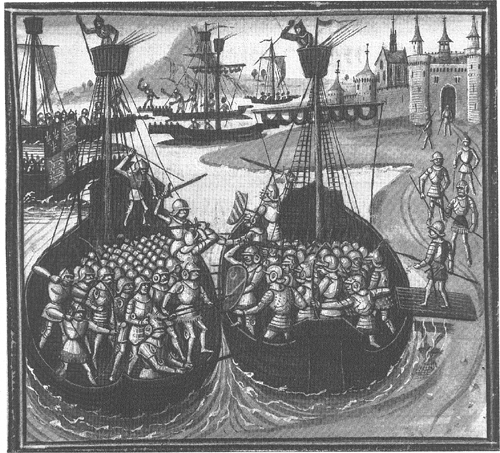
The Battle of Sluys in 1340 is depicted by the illuminator as an engagement hand-to-hand, in the chivalric tradition, with the broad-beamed fighting hulks in the role of chargers. In reality, it was like so many English land victories of the Hundred Years’ War—a triumph of long-range archery.
The most promising French response was the intrusion of Castilian ships into the Channel from 1350: they were expert in the guerrilla warfare of the sea, but their attempts to wrest control of the straits were never fully successful. Thanks to the permanent advantage which possession of the English shore conferred by virtue of wind and weather in the Channel and the North Sea, the French never succeeded in reversing English naval dominance for long. The most they could achieve were successful raids, effected by their own ships or those of their Castilian allies, at, for example, Winchelsea (1360), Portsmouth (1369), Gravesend (1380), and a string of ports from Rye to Portsmouth (1377). By taking a wide berth out into the North Sea, the French could send fleets to Scotland in support of Scots military actions, but the prevailing winds made direct attacks on the east coast of England highly unlikely to succeed. If any doubt lingered over the balance of advantage in the northern seas, it was dispelled by events of 1416, when the English were able to relieve the blockade of Harfleur and ensure control of access to the Seine by defeating a Genoese galley fleet. The French shipyard at Rouen was dismantled. England’s military power waned in the fifteenth century and her vulnerability to invasion was demonstrated by the landing of the future Henry VII in 1485; but her naval supremacy in home waters would not again be challenged by a foreign state until the cruise of the Spanish Armada in 1588.
The Mediterranean
The trajectory of naval warfare in the Mediterranean had some similarities with that in the north: a power vacuum at the start of our period, in which new contenders arose and disputed mastery of the sea. By c.1100 the naval war against Islam had already been won by Christians. Westerners were masters of Corsica, Sardinia, Sicily, southern Italy, and the coasts of Palestine and Syria. The difficulty of dominating the Mediterranean from its eastern end had also affected Byzantine sea power. Byzantium was already in the process of being reduced to minor importance as a naval power by comparison with some rivals further west.
The Egyptian Fatimid fleet, which had once been a formidable force is almost unmentioned in the records after the first decade of the 1100s: it continued to exist, and could put up to seventy galleys at sea in the mid-twelfth century, but it became confined to a largely defensive role. By 1110, the crusaders held almost all the Levantine ports; thereafter, the operation of Egyptian galleys against Christian shipping was practically limited to home coasts: they had virtually no friendly ports to the north in which to water. Turkish naval power, which would be invincible by the end of our period, had hardly been foreshadowed. In the 1090s Syrian collaborators provided free-lance Seljuk war-chiefs with ships that briefly seized Lesbos and Chios and even threatened Constantinople; but the crusades forced the Seljuks back; the coasts were not recovered for Islam for another hundred years or so. The crusader states depended on long and apparently vulnerable communications by sea along lanes that led back to the central and western Mediterranean. Yet they were hardly jeopardized by seaborne counter-attack. Saladin created a navy of sixty galleys almost from nothing in the 1170s, but he used it conservatively and with patchy success until it was captured almost in its entirety by the fleet of the Third Crusade at Acre in 1191.
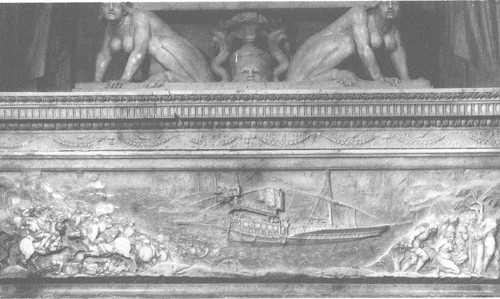
Guarded by Amazons, Ramon de Cardona’s tomb in Bellpuig commemorates one of the most successful exponents of amphibian warfare in the early sixteenth century and illustrates the use of galleys as troop transports. The shallow-draughted vessels are close inshore and the task force is landed in boats. Cardona’s use of seaborne expeditions contributed decisively to Spanish campaigns of conquest in Italy. On his tomb, however, an episode from a North African campaign against Muslim enemies is suitably depicted, while the Muslims’ captives cower in a corner of the composition.
The Christian reconquest of the Mediterranean had been effected, in part, by collaboration among Christian powers. Venetian, Pisan, Genoese, and Byzantine ships acted together to establish and supply the crusader states of the Levant in their early years. Successful allies, however, usually fall out. Relative security from credal enemies left the victors free to fight among themselves. The twelfth century was an era of open competition in the Mediterranean for the control of trade, by means which included violence, between powers in uneasy equipoise. In the twelfth century, Sicily was perhaps the strongest of them. It maintained the only permanent navy west of the twenty-second meridian, but the extinction of its Norman dynasty in 1194 marked the end of its potential for maritime empire. Pisa was a major naval power of the twelfth and thirteenth centuries: its war against Amalfi in 1135–7 effectively dashed all prospect of that port emerging as an imperial metropolis; and the contribution of its ships, with those of Genoa, was decisive in the destruction of the Norman Kingdom of Sicily; but Pisa made a poor choice of allies in thirteenth-century wars and, after a series of setbacks which left it isolated, at the battle of Meloria in 1284 it suffered a blow at Genoese hands from which its navy never recovered. So many prisoners were taken that ‘to see Pisans’, it was said, ‘you must go to Genoa.’
Three rivals stood the course of these wars: the Genoese and Venetian republics and the House of Barcelona. At different times and in overlapping areas of the Mediterranean, all three established seaborne ‘empires’—zones of preponderance or control over favoured routes and coasts. The possibilities were demonstrated in 1204, when Constantinople fell to a mixed host of Westerners and Venice carved a maritime empire out of the spoils. The Republic became mistress of ‘one quarter and one half of a quarter’ of Byzantine territory. At first, Genoa responded with energetic corsair warfare, which had effectively failed when the peace settlement of 1218 nominally restored to Genoese merchants the right to live and trade in Constantinople. In practice, however, they remained victims of the Venetian hegemony until 1261, when Byzantine irredentists recaptured Constantinople and the uneasy parity of the Genoese and Venetian traders was restored.
Genoa acquired an empire of its own—albeit one much less tightly centralized than that of Venice: it comprised, at first, an autonomous merchant-quarter in Constantinople and scattered settlements along the northern shore of the Black Sea, ruled by a representative of the Genoese government. By Byzantine grants of 1267 and 1304, the alum-producing island of Chios became the fief of a Genoese family. Around the middle of the fourteenth century its status was transformed by the intrusion of direct rule from Genoa. The Aegean was effectively divided between Genoese and Venetian spheres. Venice dominated the route to Constantinople via the Dalmatian coast and the Ionian islands, whereas Genoa controlled an alternative route by way of Chios and the eastern shore.
Eastern Mediterranean rivalry between Genoa and Venice was paralleled in some ways in the western rivalry between Genoa and the dominions of the House of Barcelona. Catalans were relative latecomers to the arena. They enjoyed privileged natural access to the entire strategic springboard of the western Mediterranean—the island bases, the Maghribi ports; but while the islands were in the unfriendly hands of Muslim emirs, they were trapped by the anti-clockwise flow of the coastal currents. But by 1229 the power of the count-kings of Barcelona and Aragon and the wealth of their merchant-subjects had developed to the point where they could raise enough ships and a large enough host to attempt conquest. By representing the venture as a holy war, Jaume I was able to induce the landlubber aristocracy of Aragon to take part in the campaign. Once Majorca was in his hands, Ibiza and Formentera fell with relative ease. The island-empire was extended in the 1280s and 1290s, when Minorca and Sicily were conquered. In the 1320s an aggressive imperial policy reduced parts of Sardinia to precarious obedience.
Meanwhile, vassals of members of the House of Barcelona made conquests even further east, in Jarbah, Qarqanah, and parts of mainland Greece. The impression of a growing maritime empire, reaching out towards the east—perhaps to the Holy Land, perhaps to the spice trade, perhaps both—was re-inforced by the propaganda of count-kings who represented themselves as crusaders. The easterly vassal-states were, however, only nominally Catalan in character and, for most of the time, tenuously linked by juridical ties with the other dominions of the House of Barcelona. Catalan naval operations in the eastern Mediterranean were made in alliance with Venice or Genoa and were generally determined by western Mediterranean strategic considerations. If the island-conquests of the House of Barcelona stretched eastward, towards the lands of saints and spices, they also strewed the way south, towards the Maghrib, the land of gold. They were strategic points d’ap-pui of economic warfare across the African trade routes of other trading states. From 1271 onwards, at intervals over a period of about a century, the naval strength of the count-kings was used in part to exact a series of favourable commercial treaties governing access to the major ports from Ceuta to Tunis.
Of the well integrated Catalan world, the easternmost part, from the 1280s, was Sicily. For the count-king Pere II its conquest was a chivalresque adventure in dynastic self-aggrandisement; for his merchant-subjects, it was the key to a well-stocked granary, a way-station to the eastern Mediterranean and, above all, a screen for the lucrative Barbary trade, which terminated in Maghribi ports. Normally ruled by a cadet-line of the House of Barcelona, the island was vaunted as ‘the head and protectress of all the Catalans’, a vital part of the outworks of Catalonia’s medieval trade. Had Sardinia become fully part of the Catalan system the western Mediterranean would have been a ‘Catalan lake’. But indigenous resistance, prolonged for over a century, forced repeated concessions to Genoa and Pisa. The Catalans paid heavily for what was, in effect, a political and commercial condominium. By a cheaper policy—without acquiring sovereign conquests further afield than Corsica—Genoa ended with a greater share of western Mediterranean trade than her Catalan rivals.
Thus, between them, Venice, Genoa, and a Spanish state established a sort of armed equilibrium—a surface tension which covered the Mediterranean. It was broken at the end of our period by the irruption of a new maritime power. The Turkish vocation for the sea did not spring suddenly and fully armed into existence. From the early fourteenth century, pirate-nests on the Levantine shores of the Mediterranean were run by Turkish chieftains, some of whom allegedly had fleets of hundreds of vessels at their command. The greater the extent of coastline conquered by their land forces, as Ottoman imperialism stole west, the greater the opportunities for Turkish-operated corsairs to stay at sea, with access to watering-stations and supplies from on shore. Throughout the fourteenth century, however, these were unambitious enterprises, limited to small ships and hit-and-run tactics.
From the 1390s, the Ottoman sultan Bayezid I began to build up a permanent fleet of his own, but without embracing a radically different strategy from the independent operators who preceded him. Set-piece battles usually occurred in spite of Turkish intentions and resulted in Turkish defeats. As late as 1466, a Venetian merchant in Constantinople claimed that for a successful engagement Turkish ships needed to outnumber Venetians by four or five to one. By that date, however, Ottoman investment in naval strength was probably higher than that of any Christian state. The far-seeing sultans, Mehmed I and Bayezid II, realized that the momentum of their conquests by land had to be supported—if it were to continue—by power at sea. After the long generations of experiment without success in set-piece battles, Bayezid’s navy humiliated that of Venice in the war of 1499–1503. Never, since Romans reluctantly took to the sea against Carthage, had a naval vocation been so successfully embraced by so unlikely a power. The balance of naval strength between Christendom and Islam, as it had lasted for four hundred years, was reversed, at least in the eastern Mediterranean, and a new era can properly be said to have begun.
Retrospect and Prospect
In the long run, sea power in the European middle ages was more influenced by the outcome of conflicts on land than the other way round. Coastal strongholds could be established by naval forces but control of hostile hinterlands could not be permanently sustained by the same means. The Third Crusade recaptured the Levantine coast but could not re-take Jerusalem or restore the crusader states. Venetian sea-power delivered Constantinople into Latin hands in 1204; but the Latin Empire lasted only until 1261 and Byzantium’s permanent losses were all in or beyond the Aegean. St Louis captured Damietta by sea in 1249 but had to relinquish it after a defeat on land the following year.
To some extent, the fate of the English ‘empire’ in France illustrates the same principles: only its maritime fringe was held for long; and the Channel Islands were never lost to French sovereignty; but the ultimate fate of the rest was determined by campaigns on land, where the English were at a long-term disadvantage.
Thus the great events of European history—the making and unmaking of states, the expansion and limitation of Christendom—happened, to some extent, in spite of the sea. For world history, however, Europe’s medieval naval apprenticeship had grave implications. When European warfare was exported into the world arena of the early modern period, and met aggressive and dynamic imperial states in other parts of the world, it was carried by ships onto the home grounds of distant enemies and could deploy the resources of a long, rich, and varied maritime experience. In competition for world resources, European maritime powers had the advantage of an unbeatably long reach.