
IN A sense the problem facing the non-combatant in time of war may be said to be one of relationships. In the second century AD, the poet Juvenal introduced into literature the theme of the relationship between the soldier and those (the togati) whom, in modern parlance, we call non-combatants. From the last of his Satires we learn that it was a very one-sided affair, the odds being heavily stacked in favour of the soldier, the unfair advantage of whose calling was held up to critical scrutiny. The reluctance of the non-combatant to use force against a soldier, or to complain of ill-treatment suffered at his hands, as well as the great advantages enjoyed by the soldier when cases came before the courts, were all emphasized. Juvenal was claiming that a soldier’s power made any challenge to what he might do most unlikely. He was also making it clear that legal practices (such as placing cases involving soldiers at the head of the queue, whereas others normally waited a long time for justice) emphasized the difference between soldier and non-combatant in Roman society.
The well-defined position of the Roman soldier made it relatively easy to see who, in that age, was what we would call a civilian. The use of the word in English is modern (the OED citing the first known use of the term ‘civilian’ in this sense as dating from 1766) while in French the word ‘civil’, used as a noun, dates from the early nineteenth century. Did the middle ages have any comparable idea of who the non-combatant was? Did he have any sort of status, moral or legal? Although there was no word to describe his position within the law, it is clear from early on that the person who, because of age, gender, or occupation, did not normally bear arms belonged to that category of persons who might be regarded as non-combatant. Furthermore, it is clear that at certain times in the middle ages the position of such persons caused great concern.
From the very early middle ages the non-combatant (the inermis, or unarmed person), one of the majority of any population who did not bear arms in time of conflict, was already deeply involved in violence. He and his property, movable and immovable, were targets of attack by both Christians and non-Christians alike. In the century or so which followed the death of Charlemagne and the breakdown of the Carolingian order, unruly knights—among others—used their military power to disturb and destroy the livelihoods of persons who lived off the land. On the many frontiers of the Christian world, populations might experience attack from those whose style of making war was the raid aimed at the seizure of booty and plunder, both human and material, or at the harrying of the countryside and the destruction of the sources of production, sometimes prior to permanent settlement. The Magyar invasions and early Viking attacks, as well as the advances made by the Moors into the Iberian peninsula in the ninth century, all brought fear and terror to those caught up in them. The displacement of populations, the loss of material goods, captivity for those taken away for what might be lifelong slavery, were the fate of many in different parts of Europe at this period.
Border and frontier societies were particularly vulnerable, the raid being the characteristic form of war waged by and on those who lived on them. Dangerous as were attacks from outside, tenth-century Frankish society was even more anxious about the self-inflicted wounds, mainly in the form of attacks by lay magnates and the gangs whom they protected, upon the lands of the Church, and the effects which such lawless activity was having upon contemporary society in general. A dialogue, De statu sanctae ecclesiae,written about 920, demanded that spiritual penalties be imposed against those who attacked sacrilegiously the sources of the Church’s wealth. What would develop into the ‘Peace of God’ (Pax Dei) movement would prove to be broader in scope. In 857 Charles the Bald had already taken steps to protect not only church lands and the clergy, but nuns, widows, orphans, and the poor (pauperes) from acts of violence. A century or more later, in a world in which public authority was in steep decline, and crop failure and floods were seen as marks of divine disapproval, the Church would assume responsibility for trying to restore peace to society. The feud which led to local conflict, a characteristic of these societies, had to be brought to an end. It could only be achieved by arousing public opinion and getting things done.
In this respect a meeting between the bishop of Le Puy and his people, held in 975, had more than symbolic importance. On this occasion the bishop sought the peoples’ advice on what to do; and he won the important support of his noble kinsmen in his attempt to impose an oath upon men that they would respect the property of the Church and of the pauperes. In 989 a local ecclesiastical council meeting at Charroux, near Poitiers, ordered strong penalties against those who had attacked churches or unarmed clerks, or who robbed peasants and pauperes of their animals. Over the next half a century or so a series of local councils in Francia issued similar decrees against those violating the peace of people who could not adequately protect themselves.
None can doubt the importance of the ‘Peace of God’ movement as evidence of a growing consciousness that certain categories of persons should be placed beyond the the realm of violence (whether that violence resulted from internal disorder or from external attack). Yet, powerful as excommunication or interdict might be, neither resolved the problem of seemingly endemic disorder. Further steps were called for. Having banned acts of violence against certain groups (the clergy, pilgrims, merchants, and the ubiquitouspauperes), the Church went further. At Toulouges, in 1027, a new approach was announced. The product of a widely perceived need to restore order to society, the ‘Truce of God’, or Treuga Dei as it was called, was an attempt to restrict the lawful exercise of arms to certain days of the week and to certain times of the year. Fighting on Sundays (the Lord’s day) would be prohibited; so would it be on Thursdays (when the Lord had instituted the Eucharist), on Fridays (when He had died), and on Saturdays (when He had lain in the tomb). Legitimate fighting was thus limited to the three days Monday, Tuesday, and Wednesday. Furthermore, it would be banned during the weeks of Advent and Lent, and on a number of major feasts. With such restrictions increasingly in place, it is hardly surprising that an ecclesiastical council held at Narbonne in 1054 should have decreed the next (logical) step, that no Christian should kill another, ‘for whoever kills a Christian undoubtedly sheds the blood of Christ’. Using its own law which, by the eleventh century, was receiving increasingly wide recognition, the Church had taken the matter of establishing peace in society as far as it could.
Encouraged and aided by the Church, it now became the turn of secular authority to set its seal upon the peace movement. In a real sense, the Crusade was an attempt to release the restless energies of the nobility, and to harness them against the enemies of Christ rather than against fellow Christians. Equally significant was the way the secular power (in Normandy, for instance) acted first with the bishops, and then more and more on its own, to impose the order associated with the duke’s peace. Elsewhere, too, in Sicily and southern Italy, in Catalonia and in France, it was the secular authority which, increasingly, gave its protection to the Church, its personnel, and the non-military lay classes, or, as in Germany, which encouraged the development of Landfrieden, or peace regulations for a region, to further the spread of peace movements at a local level.
The twin and complementary movements of the ‘Peace’ and ‘Truce’ of God had produced ideas and principles concerning the establishment and safeguarding of social peace which would be incorporated into the acta of provincial ecclesiastical councils and then into the universal canon law of the Church. These texts demonstrate that, in the late tenth century, the Church of the former Carolingian world had become acutely aware of the need to grant special protection to the security of ecclesiastics, their lands and their tenants, often among the most economically productive, whose lives and welfare were threatened by unruly plunderers, mainly laity, from within society itself. The movement was influenced both by a desire to preserve social peace and the recognition of the need to maintain levels of food production at a time of not infrequent famines and plagues. In the way that it sought to protect merchants, too, the ‘Peace’ reflected the perceived economic and social needs of the day.
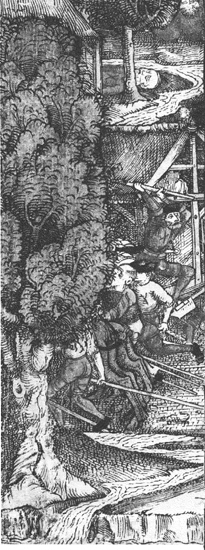
It is useful to see how far the twelfth century judged signs of change of attitude towards the non-combatant. The evidence of Orderic Vitalis, monk of Evreux, in Normandy, a well-informed commentator on the developments of the world about him, is that of a man who lived in an area where the principles of the ‘Peace’ and ‘Truce’ of God had been formally accepted by both Church and the secular authority. From him we learn that, locally, the principles of the ‘Peace of God’, expressed in the decisions of the council of Rouen in 1096, were not being put fully into effect. Equally significant was the way in which he recounted incidents which enabled him to express moral judgements in favour of the poor and the weak. Robert of Rhuddlan, he recalled, had harrassed the Welsh for many years; ‘some he slaughtered on the spot like cattle, others he kept for years in fetters, or forced into a harsh or unlawful slavery’. ‘It is not right that Christians should so oppress their brothers who have been reborn in the faith of Christ by holy baptism.’ Another story, concerning the vision of the priest, Walchelin, confirms that people generally feared soldiers (because of their propensity to violence) rather than seeing them as their protectors, and Orderic depicted them carrying much plunder. The day of the lawless brigand who could act without impediment, whose activities were dreaded by ‘unarmed and well-disposed and simple people’, was to be condemned. On the other hand, he was full of praise for Richard II of Laigle who had shown mercy to a number of peasants whom he found huddled around a wooden cross, but whom he spared although ‘he might have extorted a great price if he had been so irreverent as to capture them’.
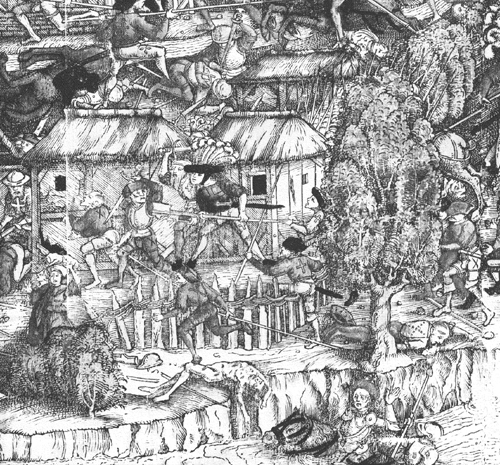
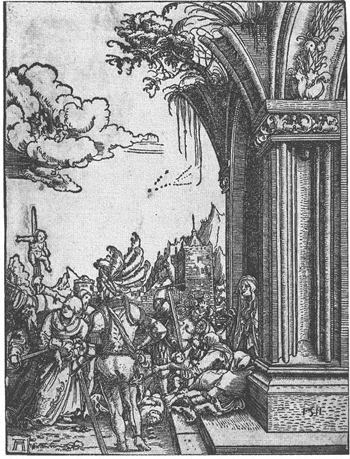
Although the women in the centre of this woodcut are not under direct attack, they represent those whose lives were gravely disturbed by war. The contrast between their vulnerability and the strength and violence of soldiers pursuing a defeated enemy underlines the growing awareness of the dangers to which both non-participating civilians and their property were subject in wartime.
The measures taken to protect the non-combatant in the eleventh and twelfth centuries had had some effect and had evidently won some support. The thirteenth century was to bring yet further developments. With the age of nation-states about to dawn, the defence of rights or territories would now form the bases of many wars, while armies, making use of new arms and techniques, would seek more systematically to further their rulers’ aims and ambitions. With an increase in inter-state war, many more would be seeking any protection which might be accorded them. The search for how best to protect the non-combatant, far from over, for these reasons took on a new dimension and a new intensity.
That search would involve the philosopher, the theologian, and the lawyer. Long ago, in the early fifth century, St Augustine, though he stressed that ultimate peace was the only proper objective of war, had held that in a war deemed to be ‘just’ all might be legitimately killed. The fact that all might not be equally involved (and therefore culpable) in war was an irrelevance, and the distinction between the soldier (who fought) and the non-combatant (who did not) had not been seen as significant. By 1140, however, Gratian, when compiling his Decretum or compendium of the Church’s law, would follow the canon law which had evolved during the age of the ‘Peace of God’ by exempting clerics, monks, pilgrims, women, and the unarmed pauperes from the violence of conflict; which brought him perceptibly closer to some kind of non-combatant immunity. Yet a century or so later, while one Dominican friar, Vincent of Beauvais, thought that those who refused counsel or aid to their rulers in time of war should be exempt from its consequences, another, the great Thomas Aquinas, never set out a clear doctrine of immunity for non-combatants.
If there was progress, it came not through clearer definitions of combatant or non-combatant, but through the new ‘just war’ theory developed in the thirteenth century, by Aquinas in particular. The problem was essentially how best to create conditions for orderly war. These conditions could be of two kinds. The first centred on the answer to be given to the question when and in what circumstances was it legitimate to wage war? Lawyers and philosophers insisted that, in order to be seen to be just, war would have to be officially declared, something which could be done only by a properly constituted secular authority. The formal and public declaration of a state of hostilities was seen as significant. It sought to outlaw private war by making it illegal, and therefore ‘unjust’. It also made it easier to insist that spoil should be taken only as an act of war (’in actu belli’), thus helping to control indiscriminate attacks upon the private property of the non-combatant.
More significant was the consequential problem which Aquinas faced, namely how was a just war to be fought, and what constraints should be imposed upon those who took part in it? It was clearly accepted that, however justifiable a war might be, unreasonable violence discredited not only a particular enterprise but the entire ‘just war’ theory as well. The means used, therefore, must reflect the participants’ proper intention when going to war, war which Augustine much earlier had stressed must be fought only as a means to peace.
This would pose the problem of proportionality, best expressed in the question ‘Is a sledge hammer really needed to crack a nut?’ It is clear that, by the mid-thirteenth century, the problem of how to deal with war’s excesses (which could be of many kinds) was being answered at least implicitly in the teachings of Aquinas. Proportionality implied the use of only as much force as was needed to achieve a particular end. It also implied, albeit tentatively, that those not equipped to fight or those who offered no resistance should not be treated in the same way as an armed soldier might be. This implied a recognition of certain categories of persons who, whether because of their nature or their evident inability to offer resistance, should have at least a minimum of respect shown to them. Such ideas were to be incorporated into Aquinas’s thinking on proportionality; in time of conflict, all who did not actively oppose force with force enjoyed certain rights, in particular the right to life and, although this is less clear, the right to the preservation of property and means of livelihood. Society was now beginning to admit that those who took no active part in war, and did not resist the soldier with force, had a right, in natural law, to protection and to life.
It was what would later be known as the Hundred Years War which was to witness important developments in the story being traced here. This conflict had certain particular characteristics having a bearing on our subject. The scale of the war, measured in terms of both space and time, was to prove greater than anything known to earlier European history. It also involved whole societies in ways no previous war had done. This was the ‘great war’ of the middle ages, one whose effects upon society were to be considerable and, at times, terrible, too.
Why was this so? Its battles, although well known by name, were by no means the war’s most significant moments. For long periods military events could be best described in terms of raids which were far more characteristic of the war than formal battles ever were. Battles involved soldiers fighting soldiers. Raids (or chevauchées as they were termed) were an entirely different matter, often being carried out by men who, not always assured of pay, often served on the understanding that responsibility for seeking the means of survival in enemy country lay with them. On the Anglo-Scottish border, for instance, it was not the Scottish custom to pay soldiers, who were expected to reap their rewards through their own enterprise and initiative. The activities of the reivers in that area are well known. Since they were particularly adept at setting fire to property, the advice given to Englishmen, when raids were threatened, was to remove the thatches of their houses in order to secure the main part of the building which, built chiefly of stone, could not be set on fire so quickly. The reivers also indulged in pillage, in cattle rustling, and in taking human prisoners. The survival to this day in the Anglo-Scottish Borders of fortified towers or ‘bastles’ is evidence of the dangers facing the civilian population in such regions which were, at the best of times, far from peaceful. Such military activity was common to many frontier societies in Europe and elsewhere. The tactics used in the north were frequently practised by the English in France, while at times the French and their allies, notably the Castilians who provided the ships, landed on the southern coastline of England, terrifying the inhabitants of the maritime shires. This was a war of intimidation in which armed soldiers, who might number a few hundred or a few thousand men, swept across an area of countryside, often content to bypass well-defended places which offered resistance, more anxious to keep on the move (in order to avoid confrontation with an enemy army), destroying farms, barns and their contents, mills, and fish ponds, ransoming whole communities, and picking up booty to be placed in wagons specially brought for the purpose.
Why were things done in this way, and with what objectives? The tactic was scarcely a new one. It was, as it had always been, a form of psychological war intended to create maximum fear and insecurity among populations. When church bells rang in the mountainous country of central southern France, their message was not always that of summoning the faithful to prayer: they could just as well be calling them to seek the inadequate protection provided by their villages or churches, many of which had crenelated towers built on to them in the course of the fourteenth century. Shepherds and their flocks on mountain pastures (the direct descendants of those referred to in the decree of the council of Narbonne promulgated in 1054) were an easy target for groups of marauding soldiers who either killed or led away the sheep. In agricultural regions harvests, including vineyards, were regularly destroyed by soldiers who brought to nought efforts to produce food and provide a living for farmers and their families, not to mention the local communities which depended on them. Such acts of seemingly wanton destruction and the lack of confidence in the future which they all too readily induced led to entirely predictable results. Many recent studies have shown how large estates in normally rich agricultural areas contracted in time of war, the uncertainty regarding the future deterring work on outlying land which, before long, became unproductive wasteland. The tares or zizania of Matthew’s gospel, a favourite image of contemporary preachers who warned against dangerous doctrinal tendencies, were also a reality of the agricultural scene. These quickly took hold of uncultivated land which required much patient clearing before it could once again become productive.
Was all this merely wanton destruction for destruction’s sake? It must be recognized that the good of the non-combatant and his property in wartime was increasingly linked to his developing participatory role in war, to the strategies adopted by the leaders of states at war and, to a certain extent, to the effects of new weaponry now becoming available. It is clear, for instance, that the role of the non-combatant in war could not always be totally distinguished from that of the soldier. The payment of small subsidies towards the costs of war, sometimes in place of personal service, was already common in some parts of Europe by the eleventh century. Over time, the contribution of the non-combatant population was to grow, particularly from the thirteenth century onwards. Certain taxes were imposed with the specific intention of securing the defence of the whole community. In most regions the clergy were expected to contribute; and they gave their blessing to war by urging their congregations to pray for victory, and by organizing public processions to seek divine approval in war. All such activities were manifestations of different sections of communities contributing to war in different ways. Likewise, the approval of taxation in assemblies, local and national, was increasingly regarded as an entire community giving agreement, through its representatives, to the levying of financial support in time of war.
In brief, then, as wars were gradually transformed into conflicts between whole and increasingly self-conscious communities, so it became increasingly difficult to argue that even the seemingly innocent activity of the farmer who tilled the land to grow cereal products, or bred cattle or sheep, should be immune from war. Some of his produce could be used to feed armies (and their horses); other parts of the same produce (skins or wool) was a possible source of taxation (hence of public wealth) out of which armies could be paid. Even goose feathers had a military use! Our knowledge, in recent years greatly enhanced by research, of how wars were organized and paid for, demonstrates that war was becoming more and more a societal enterprise, and that even the majority who did not fight in person played an increasingly important role in providing armies with their needs. Where did the non-combatant’s role end and that of the soldier begin? The line of demarcation was not at all clear.
It might then be argued—as it was—that while the person of the non-combatant should be respected unless he offered armed resistance, his property (the basis of a community’s wealth which would be used to advantage in time of war) constituted a legitimate target. In certain societies (as seen above) sources of wealth and livelihood (cattle, for instance) were traditional targets of the armed raid. By the fourteenth century, the English were launching chevauchées across the sea into France, raids sometimes involving armies of over 10,000 men, which had the aim of laying waste the enemy’s land, destroying his means of production, securing booty for the raiders and undermining the authority of the French king who would then be seen as too weak to fulfil his royal function of providing protection for his people. The construction of walls around many French towns during the second and third quarters of the fourteenth century was a recognition that French society was actively engaged in providing refuges for those living on theplat pays, or surrounding countryside, when hostile forces were in the area. The term ‘refugee’ was to enter the language rather later, but the concept was a much older one.
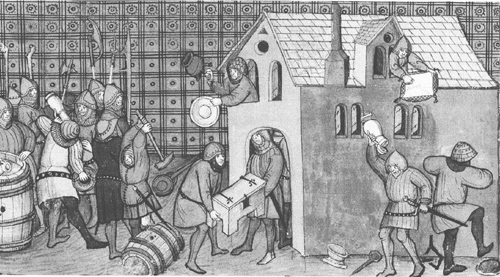
The greater realism of late medieval art encouraged depictions of scenes such as the looting of this fine dwelling. All forms of property, treasure, wine, vessels, and plate were at the mercy of greedy and loutish soldiers, intent upon the theft of what they could take away and the destruction of what they could not.
If military and political aims developed, as they did at least partly in response to developments in weaponry (such as the greater effectiveness of the cannon), the non-combatant might suffer even more. In the fifteenth century, English kings abandoned the raid in favour of a policy of direct conquest. No conquest could be effected unless all fortified towns and castles were brought under the control of the invader. Ironically, the defences built in the fourteenth century to protect communities against raids now had the opposite effect of attracting armies equipped with cannon ready to besiege and take them. Thanks to developments in technology, a siege undertaken with determination was now, more than ever, likely to be brought to a successful conclusion. Such sieges, however, could witness terrible, indiscriminate, and prolonged suffering on the part of the non-combatant population. The siege of Rouen, pressed by Henry V between July 1418 and January 1419, was the siege of a well-fortified city to which thousands, fleeing before the English army, had come in search of refuge. The accounts of it describe the sufferings of those inside the walls: the old and infirm expelled into the city’s ditches in mid-winter to preserve the dwindling stocks of food for the garrison and the younger non-combatants; the effects of starvation upon men, women, and, in particular, the very young. The writing is often emotional and sympathetic (even when it is written by an English soldier) to the plight of the innocent.
It is clear that the civilian was no longer the accidental victim of war but was now becoming one of the chief targets of those who were waging a ‘just’ war with royal or princely authority. The reasons are not difficult to understand. That the non-combatant was an easy target is obvious enough. The evidence of inquisitions or pleadings made before the courts regarding the often deliberately caused destruction of war is reflected vividly in the chronicle evidence. Yet the vulnerability of the non-combatant was not the only reason why soldiers sought him out. It should be recalled that it was from the general population that the enemy’s fighting power of the future would be drawn. Likewise, it was from the economic activity of the non-combatant population, whether that of the manufacturer of goods in a town, that of the farmer who tilled the land or of the fisherman who trawled the sea, that taxes for war, in this age an increasingly important consideration, would be raised. If the non-combatant’s means of production or livelihood were diminished or destroyed, then his crucial financial contribution to the escalating costs of war would suffer the same fate. Such evidence serves as a reminder that it was the non-combatant who, in more than one sense, paid for the war. Indeed, he often paid twice. Destroy the basis of individual wealth, destroy the basis of taxation. Destroy taxation, destroy the ability of an entire society to secure its own defence. Men were not ignorant of the adverse effects of the destruction of a country’s economic base upon its ability and willingness to resist an enemy. In such circumstances, might it not be thought that war waged against the non-combatant was both a legitimate and an effective means of securing victory?
In 1435, at a crucial moment of the Hundred Years War with the conflict turning in favour of the French, a leading English captain, Sir John Fastolf, presented his king with a memorandum suggesting how best to exploit this trend. Sieges, he argued, were a waste of time, men, and money; rather would it be better to teach the enemy a sharp lesson and show him who still had the power and will to be master. In pursuit of this aim, Fastolf advocated the despatch of two small forces, with the intention of ‘brennyng and distruynge alle the lande as thei pas, bothe hous, corne, veignes, and alle treis that beren fruyte for mannys sustenaunce, and alle bestaile that may not be dryven, to be distroiede.’ Harsh as this might seem, Fastolf was explicitly advocating a form of war aimed at the destruction of the enemy’s natural resources, although there is no mention of creating human victims in a direct way. Indeed, aware that such a proposal might shock some on his own side, he emphasized that ‘this cruelle werre [was] withoute any noote of tirannye’ since his king, ‘as a goode Cristen prince’, had offered ‘that alle menne of Holy Chirch, and also the comyns and labourers of the reaume of Fraunce, duelling or being oute of forteresse shuld duelle in seuerte pesible’, and that the war should be conducted only ‘betwixt men of werre and men of werre’. The French, Fastolf claimed in his attempt to wrong-foot the enemy, had refused such an offer, ‘and be concluded to make theire werre cruelle and sharpe, without sparing of any parsone’.
Fastolf was writing for a royal council on which his fellow soldiers had influence. How might such action be regarded by contemporaries who did not share this background? We should remember that this was an age which accepted, with fatalism, the reality of divine intervention in human affairs. God decided how things should happen. The best which men could do was to pray that He would avert disaster and calamities by His divine power: ‘a fame, morte et peste, libera nos, Domine’ (‘From hunger, death and the plague, Lord, deliver us’) was the popular litany of the time. The influence of man’s sinfulness and its effects were deeply ingrained upon the contemporary mind. It is of little surprise, therefore, that war and its evil results were often regarded as a divine visitation which God permitted to happen to a people who had sinned. It was not uncommon for the enemy to be regarded as the human instrument of God’s will, the flail of God (‘flagellum Dei) punishing His people as a parent punishes a child who has done wrong. Could man, indeed should man resist the will of God? Was it not better to accept disaster in a spirit of penitence as a person accepts punishment, and then to be in a position to begin afresh, having paid the price of weakness and sin?
Not all, however, saw it that way. Many regarded an attack upon a non-combatant as a sign of weak government. Such a challenge demanded a response. Yet, what form should it take? To the question why not reform society in order to avert God’s anger, it could be replied that Christ himself had said that it was better to wait for the tares to grow than to try to pull them up while they were small, for fear of uprooting the good plants with the bad. Many, therefore, should resign themselves to suffer. It was the justification for such inaction which led men to ask, with increasing frequency and bitterness, how long such a state of affairs could be allowed to continue. Taking into consideration the physical and moral sufferings increasingly experienced by society in time of war, it is hardly surprising that there should develop sympathy for those who were helpless before the power and aggressiveness of the soldier, anger that such things should be allowed to happen. And, all the while, there grew increasingly vocal demands that something be done to bring about a remedy.
What we are witnessing here is a change in the perception of the civilian’s position in wartime, and, above all, what should be done to assist him in his dilemma. The principle of proportionality, so often breached, was now beginning to find increasingly widespread support. More implicit than ever in the many forms of description of what were known as ‘excesses’ (exces), such as petitions to the king describing acts carried out by soldiers against defenceless civilians for which some redress was sought, was the recognition that the victims had a right to expect something better, namely protection from such acts. The sentiment of late fourteenth-century texts, increasingly condemnatory of unjustified violence, was that of righteous indignation, protest, and criticism levelled against both those guilty of such acts and against the failure of the system (the king and the law in particular) which allowed them to happen. The chroniclers are an excellent source of such opinion, commenting openly upon the undisciplined behaviour of the soldier, all too often guilty of taking the law into his own hand, more concerned with filling his own pocket than with serving the king and society, as the developing view of the soldier’s role in that society held he should. Writing in the 1360s, the Carmelite friar, Jean de Venette, had harsh words for the unruly soldiery and much sympathy for those who suffered the physical hardships of war which the French crown was too weak to prevent. In the next century, we have the evidence of the anonymous Parisian who chronicled events in France’s war-torn capital, seeing developments through the eye of the non-combatant who was powerless to help bring about the end of the many conflicts from which the country had long suffered. The result was that
the men who used to have the land tilled, each dwelling in his own place with his wife and his household in peace and safety, merchants and merchant-women, clergy, monks, nuns, people of all walks of life, have been turned out of their homes, thrust forth as if they were animals, so that now these must beg who used to give, others must serve who used to be served, some in despair turn thief and murderer, decent girls and women through rape or otherwise are come to shame, by necessity made wanton.
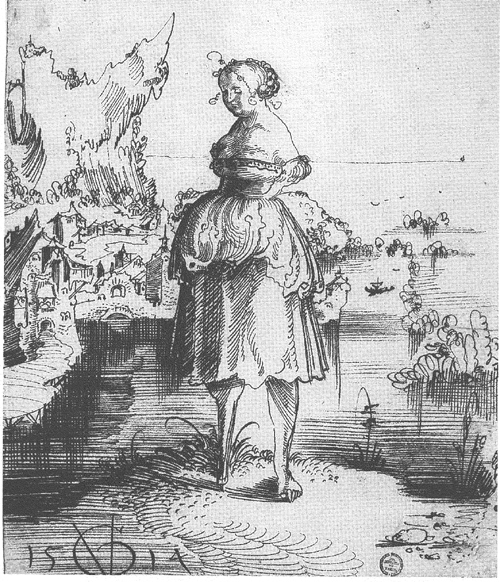
Here the artist contrasts the peaceful background scene with the young woman who has experienced the loss of both arms, one leg, and other disfigurements to her body. She may well be a woman of the camp, but her terrible injuries help to recall how easily the non-combatant could become the victim of war.
In France, the chroniclers were soon followed by the social commentators in condemnation of the lack of control exercised over the soldier and his activities (in particular if he was already being paid), their vigorous language being accompanied by demands that the civilian be left in peace and tranquility.
Such expressions are a reflection of something new, a growing awareness of society as one body, and an increasing concern for that part of it which, it seemed, was suffering more than the rest from the moral and physical effects of war. Why, it was asked, was the non-combatant the war’s great victim? Greed (as expressed in the line ‘Radix malorum est cupiditas’—‘The desire for possessions is the root of all evils’) was often accused of being the cause of the trouble: the opportunity of making a quick profit on campaign was widely seen as helping to make the recruiter’s task easier. It is significant that, in the memorandum alluded to above, Fastolf, himself one of war’s great beneficiaries, should have argued ‘that none of the chieftains shuld in no wise raunsone, appatise [hold to collective ransom] … no contre nor place that thei passe thoroughe for no singuler lucre nor profite of them silfe’. With the growing recognition that effective control of troops required good leaders and strong discipline, the qualities associated with good leadership and firm discipline became regular themes in much of the literature written around 1400. In contemporary eyes, it was on discipline that the security of the civilian was largely founded. But discipline was not simply a matter of personal control of soldiers by their leaders. In turn, it depended upon such factors as the ability to pay troops well and, above all, regularly. Thus the fate of the civilian was increasingly regarded as hanging upon the resolution of other problems. It could not be isolated and dealt with on its own.
What could the law contribute? As Juvenal in antiquity had suggested, precious little. The law of arms (the jus armorum), although founded on wide military practice, was formulated for the needs of the soldier. Nor, in spite of the ambitions of those who wished to see its authority extended, could the secular law achieve much, particularly if the authority which exercised it was weak. The last, perhaps the only resort was the canon law which, in the tenth and eleventh centuries, had been used to protect clergy, nuns, women, and ecclesiastical property. Now, four centuries later, men turned once more to that code which came nearest to providing the non-combatant with some explicit form of legal protection. In about 1389 Honoré Bouvet, a monk trained in canon law who was prior of a Benedictine monastery in southern France, wrote his L’Arbre des Batailles or Tree of Battles. Among other things, Bouvet discussed the prevalence of violence by armed soldiers against defenceless non-combatants. Both his analysis of the problem and the solutions proposed are of interest to us. The evils of war, Bouvet argued, stemmed not from war itself, but from wrongful use and practices. Since wrong practices could be put right, it followed that something could be done for the non-combatant. This marked a change of attitude: here was a man asserting that, through the observance of canon law, the excesses of war might be prevented and the doctrine of proportionality observed. The old fatalism was dwindling. Once again, the Church and its universal law would protect the person of the non-combatant. Others too, princes and commanders who bore military responsibility, must do likewise. The common good of the community demanded that the place of the non-combatant be recognized. Let us note what Bouvet actually wrote:
If, on both sides, war is decided upon and begun by the councils of the two kings, the soldiery may take spoils from the kingdom at will and make war freely; and if sometimes the humble and innocent suffer harm and lose their goods, it cannot be otherwise… Valiant men and wise, however, who follow arms should take pains, so far as they can, not to bear hard on simple and innocent folk, but only on those who make and continue war, and flee peace.
Here, then, was what looked like an important distinction. Bouvet appeared to be arguing that, in time of war, while physical possessions were liable to being looted and plundered, the individual non-combatant, provided that he did not make war and acted peacefully (that is, he did not resist), should be unmolested. Furthermore, those involved in peaceful occupations, students travelling to university or their parents going to visit them there (recall the immunity granted centuries earlier to the merchant or the pilgrim on the road) should be left to travel unmolested. Bouvet then took the example of the ploughman and his horse or oxen. Since theirs was the essentially peaceful occupation of producing food they, too, should be left untouched. Or so he argued. Yet even he realized that, in time of conflict, people must expect to suffer physical and moral consequences of war. In his anxiety to protect the rural worker, was Bouvet reluctant to admit that, in a changing society, the ploughman was now contributing to the national good and the national economy and, consequently, to the national war effort, in a way in which his predecessor of four centuries earlier had perhaps not done? Was he being realistic and up-to-date enough in his pronouncements, sufficiently tuned-in to the reality of the world outside his monastery? What should be the protection accorded to the productive non-combatant in time of war? By the late fourteenth century, men were beginning to appreciate that here was a question which needed to be faced. But answer, as yet, there came none.
Nevertheless, the increasingly difficult plight of defenceless non-combatants was attracting more and more sympathetic comment. Many of France’s best writers of the period, Eustache Deschamps, Guillaume de Machaut, Christine de Pisan among them, wrote to bemoan the lack of respect shown to the civilian by the soldiery and officialdom. When, about 1416, the Norman, Alain Chartier, wrote about the effect of war upon society, he did so by describing the reactions of four women to the fate of their husbands at the recent battle of Agincourt. One was dead; another a prisoner; the third was missing; and the last had fled the field of battle. The text of Le Livre des Quatre Dames is a close and subtle analysis of the reactions of these women to the fate of their menfolk. From it we learn a great deal about the effects of war upon ordinary non-combatants, in this case women, who became the victims of war not through anything done to them personally, but because their husbands suffered the consequences of taking up arms and going off to war. We learn, too, of the author’s sympathy for the plight in which such persons found themselves. Chartier showed himself keenly aware of the mental anguish caused by war. In so doing he added a whole dimension to the more prosaic image of physical suffering which chroniclers conveyed in their works. Even at this distance of time, his story is a moving one.
The works of the poets, the analyses of social commentators, the books of advice to kings all present important evidence of the growth of public awareness of the non-combatant’s experience in wartime. Even the artists added their silent commentaries on war’s effects upon the non-combatant population. Illuminated manuscripts vividly depict soldiers looting or sacking what are clearly non-military targets, or sieges of prosperous-looking towns or cities whose capture will yield a rich financial harvest and lead to the death of those who have resisted. Telling, too, are the depictions of another scene from Matthew’s gospel, the massacre of the innocents, many of which survive. In such paintings as that by Giotto in the Franciscan convent at Assisi, the picture of mothers trying to save their babies from their attackers underlined, in visual form, the commonly-felt hostility of society to the soldier, horror at the unprovoked death of innocent children, and the common reaction to the terrifying experience of the women concerned. It is not surprising that the feast of Childermas was a very popular one at the end of the middle ages.
To try to deal, in the space of a short chapter, with a complex subject which merits much more is not to do it justice. A contribution of this kind can only point out where the possibilities lie. Over several centuries, the middle ages slowly developed a clearer idea of who the non-combatant was. The concept of him and her evolved because the non-combatant was directly concerned in two major developments: one, the emergence of an ordered world ruled by law; the other, the growth of a society in which war was constantly increasing in significance, not least in the way that it became an activity from which few could escape. A society was coming into existence in which the soldier and the non-combatant, the active and the passive, lived in uneasy conceptual relationship. The non-combatant’s position, particularly in wartime, was both a moral and a legal issue. Ultimately lawyers would try to resolve it through international law, itself the heir of the position claimed by canon law centuries earlier. In the meantime, although the law was not always effective in preventing violence against the non-combatant, there were always those who were touched by the innocence of war’s non-combatant victims. One of the first episodes of the Hundred Years War was the destruction, largely through fire, of an area near and around Cambrai, the local population suffering terrible effects. It was in response to this tragedy that Pope Benedict XII ordered 6,000 gold florins to be sent for the relief of its victims. At its destination, the money was distributed through the practical services of churchmen, care being taken to ensure that it came into the hands of those in greatest need, the genuine victims of the war, rather than the poor of every day. Such an act has a very modern ring about it. It enables us to say one thing. If it did not prevent atrocities of this kind from happening again, the charity dispensed by the papacy showed that a humanitarian conscience, reflecting the threat which war constantly presented to the non-combatant population, existed somewhere in Christendom and, in reflection of that conscience, was ready to act when need demanded.
Normally beneath the surface, but appearing above it with increasing frequency, there existed a growing sense of hostility to the apparently senseless effects which the violence of war caused to the petit peuple, such a sentiment sometimes being expressed as ideas which were, in essence, pacifist. By the end of the fifteenth century strong opposition to this violence, sometimes likened to a people suffering the torment of crucifixion, was being expressed by highly critical social commentators. What did peace mean if the ordinary man continued to suffer at the hands of the soldier? Leaders were needed to redeem their people from the torment which too many of them were experiencing. In their different media artists denounced the atrocities of the ill-disciplined soldiery. War might appear sweet to those who had never been involved (Dulce bellum inexpertis, as wrote Erasmus in the early sixteenth century), but those who had experienced it at first hand knew otherwise. The voice of the great humanist was but one in a rising chorus of protest which denounced war, its effects and, in particular, the sufferings of those for whom life was already hard enough without adding the need to defend themselves against men who took advantage of their vulnerability to attack them and deprive them of their livelihoods.
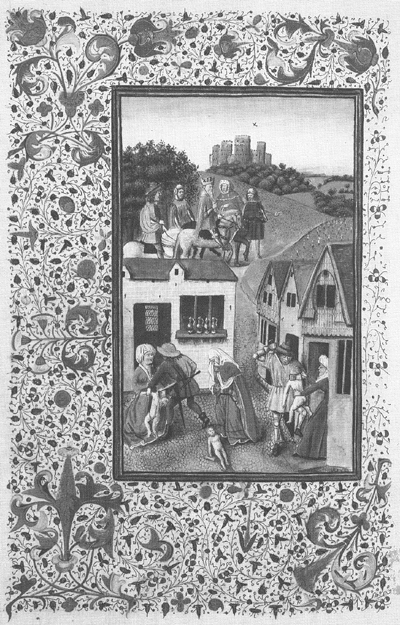
Facing: along with the oft-depicted ‘Flight into Egypt’, the ‘Massacre of the Innocents’ by soldiers, even those [as here] in the service of a king, underlined what could happen when quiet village life was brutally disturbed by armed men with little respect for humanity.
Above: a Landsknecht supervises attacks upon women and the massacre of their babies, one of whom has been impaled upon a sword in what was commonly regarded as Turkish practice. The back view of the soldier prevents us from seeing precisely what emotion, if any, the scene is causing him, but his firm, authoritative stance speaks volumes to the beholder.