
THE Vikings are almost as elusive to us today as they were to their contemporaries. We pursue them through historical records at our peril. There is a fundamental imbalance between Scandinavian and non-Scandinavian sources—in broad terms between what was buried in the ground and what was written down. The art of warfare is usually presented and understood from the perspective of its practitioners. Viking values are represented, often enigmatically, in skaldic poetry and runic inscriptions. A limited number of defensive sites have been identified in the homelands and abroad, some with urban connotations. Most eloquently of all, Scandinavian sources speak to us voicelessly through the remains of their dead, in the shape of skeletons of humans and domestic animals, and of weapons, ships, and other equipment. But the great bulk of the written record comes from the Vikings’ opponents, who were naturally hostile and hardly objective. Danes and Norwegians feature prominently in annals and chronicles composed by English, Frankish, and Irish clerics and monks; Swedes are mentioned occasionally by Arabic and Greek observers. Few of these writers are likely to have witnessed at first hand the battles and sieges that they describe, although they may have looked captured and collaborating Vikings directly in the eye. Asser, the Welsh cleric and bishop of Sherborne, claims in his biography of King Alfred to have been shown both the solitary thorn-tree round which Danes and English had clashed at Ashdown in 870 and the fort at Countisbury where a Viking force had been confronted in 878. The preponderance of non-Scandinavian written accounts has lent to Vikings a somewhat distant, other-worldly character, which at the same time is part of their enduring appeal. This other-worldlyquality has been reinforced by over-reliance on much later texts, principally Scandinavian and non-Scandinavian chronicles and sagas.
The word ‘Viking’ (Old Norse víkingr) has always been problematic. In the early Viking Age it seems to have denoted an inhabitant of Víken—the coastal district round Oslofjord and Skagerrak in southern Norway. Vikings in that sense may have been trading across the North Sea well before c.790. But in the course of time the word came to mean ‘sea pirate’ and this remains its normal usage in all languages. Like most medieval warriors, Vikings were fighters by vocation rather than by profession, in that they did not constitute standing armies. Nevertheless they clearly had an esprit de corps of a well-developed nature, for which the best evidence emanates not from the field of battle but from the realm of religion. In the ninth century and the first half of the tenth, Western European sources depict Vikings as Gentiles, heathens, or pagans, that is as non-Christians. Scandinavian paganism of the Viking Age deserves to be taken seriously. During the Saxon wars, Germanic neighbours of the Danes had demonstrated a courageous attachment to their paganism in the face of brutal Carolingian aggression and many Scandinavians may have had a similar attitude. A polytheistic religious system offered to warriors, and to those who composed skaldic verses in their honour, a specialized, high-status god of war, Odin. Animal sacrifices to him were probably made each spring for success on military campaigns. Valhalla (Valh ll) as a paradise for fallen comrades must have acted as a spur to bravery on the battlefield. The psychological comfort to be derived from this concept is impossible to gauge, but we may reasonably assume that its power was at least equal to that of Heaven or Paradise for Christians. Just as the cult of Thor, controller of elemental forces, may account in part for the almost reckless adventurousness displayed by Vikings as seafarers, so may the cult of Odin have underpinned their equally renowned reputation as doughty fighters.
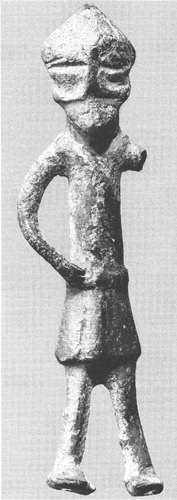
Odin, here represented by a bronze figurine from Linby in Skåne (once in Denmark, now in Sweden), was the Scandinavian god of war and of a select band of dead warriors who were attended by valkyries. Blind in one eye, Odin’s attributes were complex and convoluted. Cunning, demonic, pitiless and violent, he brings us close to the Viking mentality.
The hierarchy of pagan gods was matched by that of their human adherents and inventors. At its apex, as in much of Europe at this time, were men who were called, or liked to call themselves, king (cununc). As in the lands of their victims, so in the homelands multiple kingship was the norm. This custom, coupled with widespread recognition of the claims of sons born outside wedlock, resulted in political instability at home and abroad. Everywhere kings were war-leaders, often young and dying young, like the five killed at Brunanburh (the still unidentified site in England) in 937. Some Scandinavian war- leaders were royal exiles: a clear example is Gudurm, a nephew of Horic I of Denmark, who according to the Annals of Fulda was driven out and lived a piratical existence. Another is his contemporary Roric, who had lived among the Saxons before gathering a force of Danes and embarking on a career of piracy. In this context we should always remember that east Frankish kings, whether Carolingian or Saxon, were neighbours of Danish kings, separated only by the ‘Danish march’ south of the defensive boundary known as the Danevirke (the ‘Danish work’ [of fortification]). Thus in 873 envoys of King Sigifrid sought peace on account of border disputes between the Danes and the Saxons, in order that merchants might trade in safety. Being on the same social level, Scandinavian kings were able to make marriage alliances with their Western counterparts: Godefrid and the Carolingian Gisela in 883 are a case in point. And, of course, Vikings forged military alliances with their Christian rivals whenever it suited both sides, as in 862 when the joint Scandinavian kings of Dublin plundered Meath in association with Aed Finnliath, king of the Northern Uí Néill.
In early medieval Scandinavia, as elsewhere in Europe, royal families arose out of a wider aristocratic milieu in which non-royal warlords were numerous. One of the first Viking commanders whose name we know, sxulfr, is described in the Annals of Ulsterastoísech ‘chief’, ‘leader’ at the time of his death in 837. In Old Norse he would have been a jarl, the ancestor of English ‘earl’. Scandinavian kings and jarls sometimes acted in conjunction with one another; alternatively they could be rivals, as in 893 when Dublin Vikings divided their loyalty between a former king’s son and a jarl. In large Viking armies there were probably several chieftains to every king: during the fighting in Wessex over the winter of 870–1, nine Danish jarls and one king died according to theAnglo-Saxon Chronicle. Below the level of jarl there were lesser leaders called holds (Old English holdas) in Anglo-Saxon sources. This military hierarchy is illustrated by the list of aristocratic casualties at the battle of Tettenhall in 910, which includes two kings, two jarls, and at least five holds. All are named by the English annalists; at this social level people tended to be acquainted with the main war-leaders. At a further stage in the Edwardian conquest of eastern England, a surviving jarl and an unstated number of holdssubmitted to the West Saxon king. That they ‘sought to have him as their lord and protector’ was a source of satisfaction; there was nothing incongruous about it. Accordingly Scandinavian armies operating abroad were normally under royal or aristocratic command and Vikings should not be thought of as an undisciplined rabble. Their leaders, on the contrary, sought fame as well as fortune and would have wished their deeds to be commemorated in skaldic verses and in runic inscriptions.
The size of Viking armies has been much debated, for we have only their opponents’ word for it. Kings presumably commanded larger forces than jarls, while some of the Danish armies seeking to conquer England in the late Viking Age were of a quite different order from Norwegian raiding parties in the early Viking Age. It is usual, and wise, to adopt a cautious approach to the credibility of figures given in Western annals and chronicles. Irish annalists are notably restrained in their estimates of casualties on the Scandinavian side. When in 837 the men of Brega, north of Dublin, ‘routed’ a plundering warband, a total of six score Vikings are reported to have been killed. In 917, this time in Munster, only about a hundred men fell between the two sides, despite the fact that the fighting lasted for several hours. The main exception to this restraint comes in 848 when, in four battles in different parts of Ireland, 240, 500, 700, and 1,200 Viking dead are claimed—successes that were duly noted in the Annals of St-Bertin.Contemporary Irish sources are less oppositional than their English and Frankish counterparts, perhaps because it was relatively common for Irishmen to fight side by side with Scandinavian allies. The post-Viking Age propaganda tract Cogad Gaedel re Gallaib(The War of the Irish with the Foreigners) is completely out of step in this regard. The probability is that most Viking armies numbered hundreds rather than thousands: a ‘large force’ (Old Irish sluagh mór) of Vikings defeated along with their Southern Uí Néill and Leinster allies in 868 is defined realistically as ‘300 or more’. Much smaller armies could easily have struck terror into civilian populations and could have occasioned widespread destruction and misery. The argument that Viking armies were essentially small does not deny this fundamental reality.
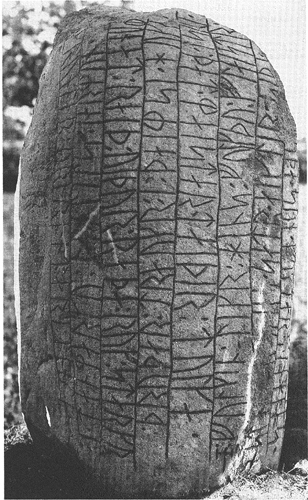
Rune-stone raised c.1000 in memory of a Viking chieftain named Sibbe, at Karlevi on the Swedish island of Öland. Such monuments were public and were intended to be permanent memorials to a warrior’s reputation. The inscription includes an authentic stanza of skaldic verse composed in a technically elaborate metre—itself a subtle form of flattery.
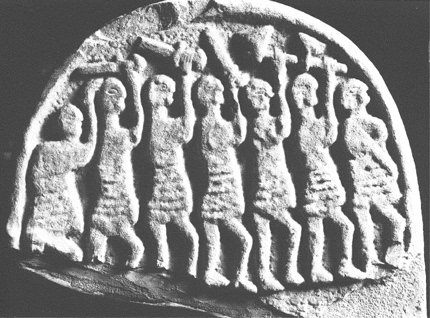
Gravestone from Lindisfarne, Northumbria, depicting a Viking war-band in action. The island monastery was attacked in the summer of 793, probably by raiders from western Norway. The theme of this gravestone is the Day of Judgement and the warriors wielding axes and swords symbolize divine punishment—a typical early medieval reaction to earthly trials and tribulations.
In the second half of the ninth century a Danish ‘great army’ was at large in England and in Francia, both countries rich in potential for financial and political gain. Referred to in Old English as micel here and in Latin as magnus exercitus, this force was clearly regarded as being out of the ordinary. Led by several kings and numerous jarls it did not arrive all at once, but at intervals starting in East Anglia in 865. Successful in Northumbria and in East Anglia, though not in Wessex, the great army was reinforced in the spring of 871 and again in 878 after another defeat by the West Saxons. A year later this new great army crossed over to Francia, where its mixed fortunes are summarized in the Anglo-Saxon Chronicle. This was the army that conducted the sustained yet unsuccessful siege of Paris in 885–6 and which, following another defeat in 891, returned to England as ‘the great Danish army, which we have spoken about before’. By no means a single cohesive force, it had broken up into two parts in England in 874 and again in 876, and in Francia in 884. Finally, at Bridgnorth on the River Severn in the summer of 896, the great army dispersed, into East Anglia, Northumbria, and the Seine region of France. There is no possibility of ascertaining the size of this army at any stage in its chequered history and the same is true of those latter-day great armies, even if they are not so called, which were brought over to England from Scandinavia by King Sven Forkbeard and others in the early eleventh century. The most spectacular great army, however, was commanded in 1066 by a mere duke—William of Normandy, descendant of the Scandinavian Rollo—and several counts, as we see them portrayed on the Bayeux Tapestry. There the fleet has all the appearance of a Viking one, to the extent of transporting horses across the English Channel as a Danish forerunner had done in 892. Instead of a kingdom in England, the objective was the kingdom of England, and of course the Anglo-Danish opposition was famously defeated.
The question of how Viking armies, great and small, were recruited and organized is fraught with difficulty, for lack of contemporary evidence. There is a danger of reading back into the Viking Age the more formalized institutional arrangements of high medieval Scandinavia. In northern Europe state formation was hesitant, held back to some degree by intense dynastic rivalry that caused parts of one country to be taken over by another. From the Viking Age itself, the best evidence for effective state formation assumes the form of five administrative sites in Danish territory: Aggersborg and Fyrkat in Jutland, Nonnebakken on Fyn, Trelleborg on Sjælland, and another Trelleborg in Skåne. Built with military precision, though not primarily for military purposes, these centres may represent a revival of Danish political fortunes under the Jelling kings. Even so, there is no justification for the view that methods of military recruitment were more advanced in late Viking Age Scandinavia. Essentially warriors were recruited and maintained by informal, highly personalized means. They joined with, and fought for, leaders whose military prowess might guarantee material and political gain. Attacks on monasteries would yield a quick profit in terms of provisions and loot, whereas long-drawn-out campaigns motivated by political aspirations created severe logistical problems, the most immediate of which was an adequate and constant food supply. In 1006 Danish forces were provided with food ‘throughout England’, whilst in 1013 both Sven Forkbeard and Thorkell the Tall demanded food for the coming winter. On the field of battle, Viking loyalties were represented practically and symbolically by their leaders’ standards: in 865 Count Robert of Angers slew over 500 Vikings and sent their standards and weapons to King Charles the Bald; thirteen years later the West Saxons captured Ubbe’s raven banner, a symbol of the cult of the war god Odin.
Archaeologically the Viking period in Scandinavia constitutes part of the late Iron Age, which is another reason why we should not presuppose the existence of higher levels of political and social organization than are likely to have been the case. The paganism of this prehistoric culture has left us a precious resource in the shape of thousands of weapons accompanying male burials. In addition Gotlandic memorial stones provide valuable indications, despite their relative crudity as images. There can be little doubt that the supreme weapon of war was the sword. Viking swords were used as slashing instruments, like machetes, as is shown by the mutilated bones found in some graves. Their double-edged blades, usually between 70 and 80 centimetres long, were light and flexible. Swordsmanship required great agility to avoid enemy blows and to inflict injury or death. Superior weapons were pattern-welded from a bundle of thin rods of iron which, when hammered into shape and fitted with steel cutting edges, were immensely strong. Despite the prohibitions of Frankish rulers, blades were imported into Scandinavia from the Rhineland and some of these are inscribed with the name Ulfberht—presumably a highly skilled craftsmen who enjoyed a reputation akin to that of Antonio Stradivari in an entirely different context. Imported blades may have been finished off in Scandinavian workshops, as is suggested by the extensive deposits of slag over much of the site at Hedeby (German Haithabu) in southern Jutland. There is a certain irony in the Danish peace offering sent with messengers to Louis the German in 873: it was a sword with a golden hilt. Sword hilts as classified by Jan Petersen in 1920 still constitute the basis of a complicated dating system, to which scholars have clung as tenaciously as the Dublin Norsemen held on to the sword of Carlus, a war trophy last heard of in 1029.
There were two main types of spear—a lighter one for throwing like a javelin at the start of a pitched battle, and a heavier one for thrusting at the enemy in the subsequent fighting at close quarters. Many spearheads recovered from graves and from settlement sites are plain and unadorned, but others are decorated on the socket by grooves inlaid with silver, copper, or brass, or some combination of these metals, producing a glittering effect. The heavier type was sometimes fitted with wings to prevent over-penetration in the body of the victim; it has been suggested that these, too, were Carolingian imports to judge by the phrase vigra vestrænna ‘western war-lances’ in a comparatively early poem Haraldskvæ i. Axes were used by Vikings in fighting, though their presence in graves might simply reflect their utility as general-purpose tools in a culture that relied extensively on heavy timber. Not many axes uncovered as grave-goods are decorated, but a notable exception is the famous ceremonial weapon from Mammen in Jutland. The grave in which it was found has been dated dendrochronologically to 970–971, in the reign of Harald Bluetooth. During the eleventh century a long-handled, broad-bladed battleaxe was developed and was employed with devastating effect against Norman cavalry at Hastings by Harold Godwinesson’s Anglo-Danish household troops (huscarlas). Evidence of bows and arrows has come from pagan graves, but again their utility in hunting might account for their presence. The lack of grave-goods from Christian opponents of Vikings makes it virtually impossible to compare the quality of Scandinavian and non-Scandinavian weaponry. At the beginning of the Viking Age the Irish had shorter swords, but once native kings reacted to greater Viking pressure after 837 they scored many victories over the foreigners, perhaps with the aid of weapons captured in earlier engagements.
A selection of Viking offensive and defensive equipment from Norway, including the Gjermundbu helmet. The sword, spear, and axe were standard offensive weapons, while the metal helmet and round shield were for bodily protection. Unlike the other items displayed here, metal helmets are rare finds and may have been owned mainly by kings and chieftains.
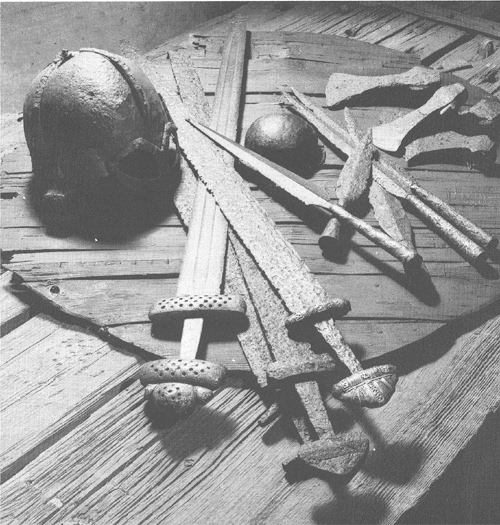
Defensive equipment used by Vikings included circular shields about a metre across. Normally only the metal boss survives, but lime-wood appears to have been favoured. This might be covered with leather and fitted with a metal rim. Shields were painted in bright colours and devices on them form the subject of some of the earliest skaldic verses. They were comparatively fragile, too, and their loss in battle is symbolized in the Gokstad ship-burial in southern Norway by the provision of two shields for each crew member. From a Frankish source we have the fascinating detail that shield-sellers and other traders following in the path of the imperial army in 876 were obstructing a narrow escape route. A hoisted shield was a (deceptive) sign of surrender on the part of Danes entrapped in a stronghold six years later. Contrary to popular conception, a typical Viking helmet may have been made of leather, similar to those depicted on Gotlandic memorial stones which are conical in shape and provided with a nose-guard. Viking helmets were certainly hornless, like the best preserved Scandinavian specimen found at Gjermundbu in southern Norway. Leather may also have been the usual form of body protection, perhaps reinforced with bone plaques and worn over an inner garment. At the battle of Stamford Bridge, east of York, in 1066 the heroic Norwegian defending the bridge single-handedly is said to have been stabbed to death under his corselet. Mail shirts seem to have been rare and the preserve of men of high status, while the bear-coats associated with frenzied and indomitable berserkers (berserkir) are a feature of later literary sources rather than contemporary historical ones. Protective gear, even when not made of metal, may have contributed to mass drownings of Vikings who found themselves on the losing side. This phenomenon is recorded, for example, in 891 at the River Dyle in the Low Countries and in 947 at the River Boyne in eastern Ireland.
Scandinavian warfare conducted outside the homelands must have been influenced in terms of strategy and tactics by those of their opponents. There was no uniform, Viking method of warfare. Scandinavians and their Celtic, Germanic, and Slavic antagonists were possessed of a comparable range of offensive and defensive personal equipment and normally fought land battles on foot. Western European written sources offer a few pointers in the direction of pre-battle manoeuvres and formations. The most important strategy in this context was to avoid pitched battles whenever possible. Vikings were perceived to be vulnerable in open country, as the Anglo-Saxon Chronicle observes, especially when their whereabouts was known, depriving them of the element of surprise. In 876 the Danish great army slipped past the West Saxons on its way from Cambridge to Wareham and subsequently ‘stole away’ from Wareham by night. Similarly Guthrum’s part of the same army arrived at Chippenham in January 878 ‘by stealth’. Four years later, in another winter manoeuvre, Danish Vikings were able to follow tracks left in the snow by departing Franks. On occasion it proved necessary to disencumber themselves before undertaking military operations, as when in 893 and again in 895 the Danes placed their womenfolk (many of them probably English by birth), ships, and other property in East Anglia for safety. Horse-mounted scouts were no doubt used extensively by armies in general, including Viking ones, but they are rarely indicated in our texts. Whenever a pitched battle could not be avoided, it was essential of course to choose one’s ground to advantage and to appear resolute. If we are to believe the annalists recording events in 1003, Sven Forkbeard’s army was able to look that of Ealdorman Ælfric in the eye, and to cause the English war-leader to feign illness and his men to disperse.
Great set-piece battles of the Viking Age, such as Brunanburh (937), Clontarf (1014), and Hastings (1066), were probably preceded by quite elaborate marshalling of troops. At Ashdown the Danes formed themselves into two divisions, one led by two kings and the other by all the jarls. According to a description of the second battle of Corbridge in the Annals of Ulster, there were four batallions of Vikings, all under different leaders. One of these commanded by Ragnall, the king of Waterford, lay in wait out of sight and its assault on the Scottish rear won the day. The shouted negotiations that preceded the poetic account of the battle of Maldon may or may not reflect historical actuality, but at least the precise site of this heroic episode has been identified with a fair degree of certainty. An element of surprise would have been decisive on many an occasion. Guthrum’s defeat at Edington in May 878 was brought about in this way. From the Danes’ perspective, King Alfred’s mounted force crossing over the north-western angle of Salisbury Plain at first light would have been invisible until it came charging down the steep scarp of Edington Hill. After what may have been a relatively brief military encounter, the Danes retreated northwards to their fortified encampment at Chippenham, where they surrendered a fortnight later. Similarly Harald Haardrada’s Norwegians were taken by surprise at Stamford Bridge. Contrary to their popular reputation, Viking armies were frequently beaten. An analysis of battles against the Irish in which Dublin Norsemen participated, down to and including the epic contest at Clontarf, places them on the losing side far more often than not. One obvious reason for this is that they were outnumbered and, in hand-to-hand fighting, numbers count. Irish annalists describe the losers’ fate in matter-of-fact language: in 926, for example, 200 Vikings were beheaded; in 948 the survivors of another major defeat were taken prisoner and no doubt sold into slavery. Lurid Viking methods of dispatching vanquished warlords, especially blood-eagling, belong to the realm of imaginative literature.
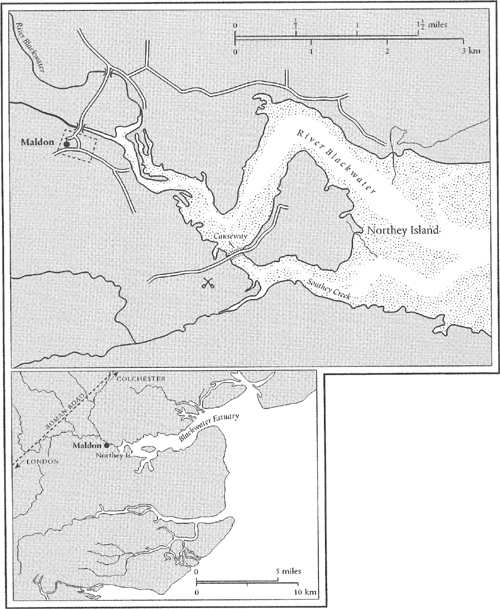
THE PRESUMED SITE OF THE BATTLE OF MALDON, ESSEX, FOUGHT IN 991.
The commonest types of warfare in which Vikings engaged assumed the low-level forms of raiding and skirmishing. Many of these casual encounters with local forces and even local populations occurred as Vikings sought food and human captives. The detailed account in the Annals of Fulda for 873 of a raid by an inveterate Viking called Rudolf implies that the tactic was to kill the menfolk in the Ostergau of Frisia and then to take possession of their women, children, and property. In 917 Danes based at Leicester and Northampton made a night-time raid southwards, capturing men and cattle. When monasteries were targeted by Vikings some of their victims were undoubtedly monks, but others were probably members of local defence forces. Irish monasteries were repositories not only of ecclesiastical treasures but also of the wealth of laymen, who would have tried to protect it. Christian armies were sometimes led by abbots and bishops with relatively small forces at their command. In 882 Bishop Wala of Metz made a rash attack on Danish Vikings and brought upon himself both death and posthumous censureship by Archbishop Hincmar of Reims for having taken up arms. Nonetheless in the following year Liubert, the archbishop of Mainz, also with a small force, killed a number of Vikings and recovered their plunder. In northern France in 859 we hear about a sworn association of ‘common people’ who fought bravely against Danish Vikings, whilst in 894 a raiding party returning from the siege of Exeter was put to flight by the townspeople of Chichester. Low-level warfare was probably the norm in the vicinity of the greater Russian rivers used as trade routes, where Swedish Vikings (Varangians) conducted regular forays in order to gather tribute in the form of furs, honey, skins, and wax, and of course slaves, for sale in southern markets.
In the vastness of Russia, ships remained the only feasible means of longdistance transportation; so essential were they that ingenious methods were devised for hauling them over watersheds and around the Dnepr rapids. But in the narrower confines and more open landscapes of Western Europe, horses were used extensively by Viking armies. The Danish great army spent the winter of 865–6 in East Anglia equipping itself with horses; after its defeat by the Franks at Saucourt-en-Vimeu in August 881 it did the same; and in 892 it crossed over the English Channel from Boulogne ‘horses and all’. The section of the army that returned to England in late 884 was subsequently deprived of its Frankish horses by King Alfred’s relieving force. In an earlier phase of the Alfredian wars, Guthrum’s Danes had outridden the West Saxons on their journey from Wareham to Exeter. A great deal of Viking raiding conducted overland depended on horses for mobility as well as convenience. In 866 about 400 Vikings, allied with Bretons, came up the Loire with their horses and then attacked and sacked the town of Le Mans. A detail from the Annals of Ulster illustrates in a precise way the power of the horse: on 26 February 943 Dublin Vikings defeated and killed the energetic northern king, Muirchertach of the Leather Cloaks, whose chief church at Armagh 56 kilometres away was plundered by them on the very next day. Not surprisingly that most exploitative of late Viking Age commanders, Sven Forkbeard, was provided with food and horses by the cowed and war-weary English in 1013. Having left ships and hostages with his son Cnut, Sven rode with the main part of his army around southern England, taking more hostages, with the result that by the time he ‘turned northward to his ships... all the nation regarded him as full king’. Æthelred II’s kingdom had been conquered on horseback over half a century before the battle of Hastings!
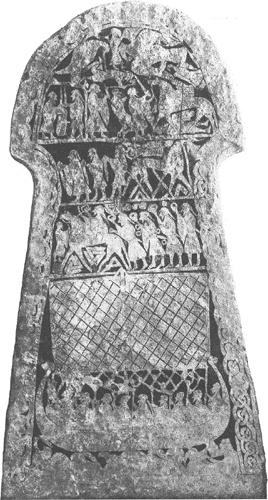
Memorial stone from Lärbro, on the Baltic island of Gotland, showing the prominence given to horses in the Viking homelands. Other signs of an attachment to these animals are collars, stirrups, and spurs, sometimes manufactured at least in part from precious metals, as well as skeletons of horses interred with their former owners inside chamber-graves and in or alongside ship-burials.
England was won by Danes by different military tactics from those used by Normans, their Frenchified descendants. Nevertheless the Bayeux Tapestry shows Norman cavalrymen holding spears aloft like javelins, as well as under arm in couched-lance style. Horses were often at or near the scene of military actions involving Vikings. At the siege of Buttington, situated where Offa’s Dyke meets the Severn near Welshpool, the encircled Danes were forced by lack of food to eat most of their horses. After Edmund Ironside’s victory at Otford in Kent in 1016, Danish warriors retreated on horseback to the island of Sheppey; their horses had presumably been stationed somewhere near the field of battle. Raiding parties would have been horse-mounted for the most part, like that conducted in Brega in the year 1000 by the Dublin Norsemen and their Leinster allies in advance of the main army of their new overlord, Brian Bórama; in the event most of them were killed by Mael Sechnaill’s men. A few years earlier, in 994, Olaf Tryggvason and Sven Forkbeard had ravaged coastal districts of south-eastern England and ‘finally they seized horses and rode as widely as they wished and continued to do indescribable damage’. After their defeat at Saucourt, Danish Vikings indulged in a Cromwellian touch: in the course of extensive pillaging, including the royal palace at Aachen, they stabled their horses in the king’s chapel. On another occasion they turned the advantages of having a steed against its aristocratic rider: according to the Annals of St-Vaast and Regino of Prüm, the east Frankish margrave Henry rode headlong into a pit excavated in advance and was there killed. The same ruse finds a literary echo towards the end of Orkneyinga Saga, where Sven Asleifarson is entrapped in a Dublin street.
In populated areas outside the homelands Scandinavians were vulnerable, whether operating as raiders, traders, or settlers, or some combination of these activities. Just like their victims, Vikings needed protection and security. To start with, their most precious possessions were the ships by which they arrived. Naval encampments designed to protect these were such a novel and distinctive phenomenon in mid-ninth-century Ireland that a descriptive word was coined from two Latin components. A longphort(plurallongphuirt) is expressive of ship defence and among the first recorded examples were those at Annagassan (Co. Louth) and Dublin. Naval bases of this kind had the immediate effect of extending the range of inland forays in 841—about 120 and 90 kilometres, respectively. Natural islands were ideal as lairs for fleets, since elaborate defences would not have been required. Some of these were relatively large and situated off the coast: good examples are Noirmoutier in western France and Sheppey and Thanet in south-eastern England. Other island bases were smaller and upriver or, in Ireland, in big lakes and inlets such as Lough Neagh and Strangford Lough. Provided they had adequate supplies, Vikings could feel tolerably safe. In 863 a party of Danes withstood a two-pronged siege for several weeks on an island in the Rhine, despite the fact that it was winter-time, before retreating. Adrevald of Fleury gives us the clearest written account of such a base, on an island in the Loire near his great monastery. Here Vikings secured their ships, erected huts to live in, and kept prisoners in chains, and from here they ventured on plundering forays aboard ship and on horseback. Major naval bases attracted the covetous eyes of other Vikings: in 851 Norwegian Dublin was ransacked and burnt by DanishVikings; ten years later a substantial ship-borne force attacked the Danish fort on the island of Oissel in the Seine upstream from Rouen.
To identify and to investigate archaeologically relatively short-lived encampments, and thus to describe their design, has not been easy. The standard Viking practice was probably to excavate a ditch and to build a bank inside it, as at Repton; indeed the Danish fort under construction at Louvain at the time of the Frankish assault in 891 was surrounded by a ditch ‘after their fashion’. According to Asser, the winter camp at Reading had gates and extensive use was presumably made of timber for such purposes. The site at Jeufosse selected by Danes in the winter of 856–7 is praised by a Western annalist for its excellence as a base-camp. At Nijmegen in 880–1 they did even better, taking over the king’s palace and building fortifications that proved to be too strong for the royal army. On the other hand, a year or so later, having barricaded themselves in a large farmstead at Avaux in the Low Countries, predatory Vikings decided to decamp by moonlight, but were subsequently defeated on their way back to their ships. Winter camps had to be stocked with provisions, a necessity that exposed the aggressors themselves to attack. The Fulda annalist tells us explicitly that the Frankish tactic at Asselt on the Meuse in 887 was to ambush unsuspecting Vikings outside their stronghold. Two years earlier a war-band took control of Hesbaye and its hinterland, gathering crops of various kinds and assembling a workforce of male and female slaves, only to find itself besieged, deprived of its supplies, and forced to make an overnight escape. Similarly an English army obliged the Danes to abandon Chester towards the end of 893 by seizing cattle and by burning corn or feeding it to their horses.
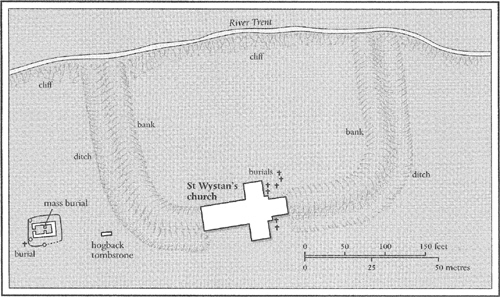
PLAN OF THE DANISH WINTER CAMP AT REPTON, DERBYSHIRE, BUILT IN 873.
Vikings are rarely recorded besieging mere forts: at the unidentified site of Wigingamere in south-eastern England a large Danish army attacked ‘long into the day’ in the critical year of 917, but gave up when it met with stiff resistance. Quite the opposite occurred at defended towns that were full of loot, for Vikings were capable of mounting and maintaining prolonged sieges. An early example is Bordeaux, beginning in 847. In the following year the besiegers were beaten off by Charles the Bald’s forces, but subsequently, possibly by means of a night attack, the Vikings broke through the defences and ravaged and burnt the town. Their persistence had been rewarded. Danes made elaborate preparations for a siege of London in 1016, digging a large ditch parallel to the southern bank of the Thames and dragging their ships upstream of the bridge. The town on the northern bank was then surrounded by another ditch, with the result that no one could get in or out. Time and again towns in Western Europe were targeted. Their usual fate was to be subjected to plundering and burning, like Bonn and Cologne in 881; occasionally they were captured and taken over for lengthy periods, as happened to York in 866 and London five years later. Viking siege techniques were probably similar to those of their contemporaries: exotic strategems, such as Harald Haardrada’s supposed use of small birds fitted with burning shavings of fir tied to their backs, whereby to set fire to a Sicilian town, belong firmly to a saga writer’s imagination. In due course Vikings built defences for their own urban creations, as at Birka and Hedeby in the homelands, or at Dublin in Ireland. The two Scandinavian ones were abandoned during the Viking Age itself and their mid-tenth-century ramparts can be traced in their entirety. At Dublin, on the other hand, the fortifications have been only partially revealed by archaeological excavations, notably at Wood Quay. There the sequence consisted essentially of earthen banks, reinforced by timber, dated c.950 and c.1000, culminating in a stone wall of c.1100.
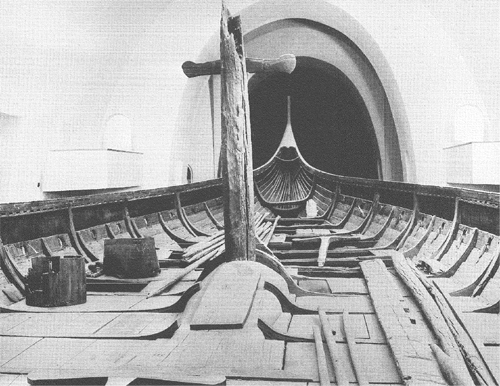
The Gokstad ship viewed from the helmsman’s position. With a beam of 5.3 metres this vessel is surprisingly spacious amidships. There were no fixed benches and the crewmen probably sat on their sea-chests when they took to the oars. Either singly or lashed together with ropes, ships like this would have formed fighting platforms for Vikings and their opponents.
Viking attacks of all kinds were heavily dependent for their success on Scandinavian mastery of shipbuilding and navigation. Ships conveyed not only warriors and sometimes horses, but also that element of surprise which has always been decisive in military history. The bewildering mobility of Vikings that so struck contemporaries owed much to their ships. That mobility was demonstrated spectacularly in 859–60, when Danes sailed through the Straits of Gibraltar and up the Rhône as far north as Valence, before retreating to an island base and then setting off for Italy where they attacked Pisa and other towns. In 1005, as the Anglo-Saxon Chronicle ruefully remarks, the Danish fleet left England for home, yet ‘let little time elapse before it came back’. Scandinavians in the Viking Age deployed many types of ship, as the extensive vocabulary in Old Norse implies, but the classic warship of the first half of the period is probably still best represented by the one discovered at Gokstad, in southern Norway, in 1880. With its sixteen pairs of oars it would have had a crew of about 35 men. This ship was built in the last years of the ninth century, at precisely the time when King Alfred was experimenting with ‘longships’ that were roughly twice as big as those of the Danes and equipped with 60 or more oars. These details from a Norwegian ship-burial and from an English text are in perfect accord. Later ships were probably bigger, like that which Earl Godwin gave to King Harthacnut in 1040 and which was manned by 80 warriors. In an incident off the north-east coast of Ireland in 986 the crewmen of three Danish ships were captured; 140 of them were executed and the rest were sold into slavery, implying a complement for each ship of at least 60 and possibly more. Ships of both types were deployed on the open sea and along the greater rivers: in 844, for example, Vikings sailed up the Garonne as far as Toulouse. In more confined spaces their crews took to the oars, as on the Lympne in Kent in 892 and on the Lea north of London two years later.
By the twelfth century there was an obligation on the inhabitants of coastal districts in the Scandinavian homelands to build and man ships for both defensive and offensive purposes. This obligation, known as leidang (lei∂angr), is probably to be interpreted as an expression of growing royal power, along with other developments such as the foundation of bishoprics, the protection of townspeople, and the minting of coins. The antiquity of this system of naval military service is highly uncertain, again for lack of contemporary evidence. Warships were sophisticated in their construction and required carefully selected timber that had to be transported, materials such as rivets, ropes, and sail-cloth, and skilled craftsmen. In one English reference we have a precise indication of the average cost of building a warship—£345 5s. In terms of late Anglo-Saxon notional prices, this was the equivalent of over 4,000 cows. Since a typical Norwegian farmer may have had only a dozen or so, Scandinavian warlords would have disposed of considerable tributary resources in order to assemble a fleet of any size. Social mechanisms of military obligation must be presumed to have lain in the realm of customary dues, which were incurred by the war-band itself when fleets operated abroad. This we can deduce from allusions to ship repairs and even ship construction in Western European sources. In June 866, for example, a group of Vikings moved from their island base near the monastery of St-Denis and sailed down the Seine until they reached a suitable place for both purposes, as well as to take delivery of tribute from the local Frankish population. Four years earlier Weland’s warriors had chosen Jumièges on the same river in order to repair their ships and to await the spring equinox, before making for the open sea.
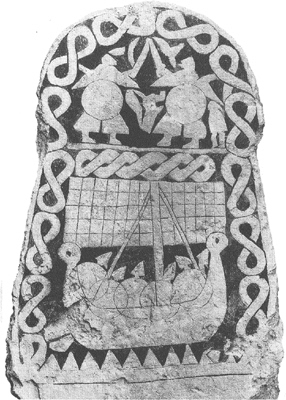
Memorial stone from Smiss, Gotland, showing a ship full of Viking warriors. Though crudely represented, visible features of the vessel include ornamented stem- and stern-posts, the steering oar to starboard, the mast and supporting stays, and the interwoven sail-cloth. The crewmen wear conical helmets and carry shields. The upper panel depicts two men in single combat.
There has been much debate among scholars about the size of Viking fleets. Contemporary written records offer two types of figure. One is small, precise, and usually associated with circumstantial details. Thus a mere six crews inflicted severe damage on the Isle of Wight in 896, while seven ravaged Southampton and killed or captured most of the inhabitants in 980. The other type of figure is much bigger and normally a round number, suggestive of an estimate. The more conservative of these figures are perfectly credible: the Norwegian fleet that menaced eastern Ireland in 837 in two equal halves clearly heralded a change of policy and the 67 shiploads of warriors who sacked Nantes six years later may have been part of it. Large fleets needed correspondingly large resources: a Danish one based on the Isle of Wight in 998 was exploiting Hampshire and Sussex for its food supply. Sea battles may be distinguished in the same way. Most were probably small-scale skirmishes of the kind that we hear about in Alfred’s reign, as in 882 when the opposition consisted of four ships’ crews, two of which were killed and the others captured. Land-based chroniclers have little to say about major naval battles fought among the Scandinavians themselves. In 852 a Norwegian fleet of 160 ships was attacked by Danish Vikings off the Irish coast over the space of three days and nights, whilst in 914 a ‘naval battle’ (bellum navale) was fought between the rival grandsons of former kings of Dublin. Two large-scale naval battles in Scandinavia had important political consequences for Norway: at Hafrsfjord, near Stavanger, Harald Finehair defeated a coalition of rival warlords c.870, and at Svold, in the Baltic Sea, Olaf Tryggvason lost his life in a contest with his Danish contemporary, Sven Forkbeard, in the year 1000.
Of greater importance than the role of the Viking ship as a mobile platform for conventional fighting was its utility as a mode of conveyance. As we are informed in 1003, ‘Sven went back to the sea, where he knew his ships were’. Armies campaigning among hostile populations depended on their ships as a means of departure as much as they did for their arrival. Their opponents would naturally endeavour to deny them access: only those raiders who could swim out to their waiting ships were able to escape from English pursuers in north Devon and Somerset in 914. In 855 and again in 865 Vikings based on the Loire tried to reach Poitiers about 75 kilometres away on foot, on the first occasion unsuccessfully. The Anglo-Saxon Chronicle cites the distance that loot and provisions were carried back to the coast in 1006—over 50 miles—the Danes taunting the inhabitants of Winchester as they marched past their gate. On big Continental waterways the progress of a Viking fleet could serve as an advance warning to the local people, as in 853 when relics and treasures were removed to safety from Tours. Such predictions were less possible further away from the main rivers: six years later the townspeople of Noyon were subjected to a night-time attack by Vikings based on the Seine, at least 85 kilometres to the south-west, and the bishop and other noblemen were taken captive. Fleets sometimes lent support to land-based forces by co-ordinating their movements: this happened along the south coast of England late in 876 as the Danish great army proceeded overland from Wareham to Exeter, though a substantial number of these ships were lost in a storm off Swanage. But the essential role of the ship was to facilitate raiding and profit-taking. The Fulda annalist wrote sorrowfully in 854 about Vikings ‘who for twenty years continuously had cruelly afflicted with fire and slaughter and pillage those places on the borders of Francia which were accessible by ship’.
That military activity shaded off imperceptibly into economic activity was characteristic of the Viking Age. The classic early nineteenth-century view of warfare enunciated by Carl von Clausewitz is that it amounts to a continuation of political intercourse with the admixture of different means; in the case of the Vikings we might see warfare as often as not as a form of economic intercourse. In the autumn of 865, for example, Vikings took over the great monastery north of Paris at St-Denis and spent about twenty days stripping it of movable wealth, carrying booty to their ships each day before returning to base-camp not far away. A similar operation by Dublin Vikings at Clonmacnoise on the Shannon in 936 required only a two-night stopover. In cases such as these, there was no overt political agenda; the motive was easy profit and most of the loot from Britain and Ireland that has been discovered in western Norway in particular must have originated in this way, the beneficiaries including womenfolk whose grave-goods betray the piratical inclinations of their menfolk. Stolen goods could find a ready market elsewhere, as when Danish raiders in Kent in 1048 subsequently made for Flanders where they sold what they had stolen and then went back home. One plundering tactic, therefore, was simply for Viking raiders to turn up, in the words of the Annals of St-Bertin, ‘with their usual surprise attack’. For Christian communities major church festivals were a time of danger: in 929 Kildare was raided from Dublin on St Brigid’s Day, when the place would have been full of pilgrims; in 986 Iona was attacked by Danes on Christmas night, when the community was preoccupied with its devotions. Another tactic was more complex—to threaten destructive violence with a view to exacting tribute. Vikings engaged in this process in the west Frankish kingdom in 866 had come equipped not only with weapons, but also with their own balance-scales for weighing the 4,000 pounds of silver.
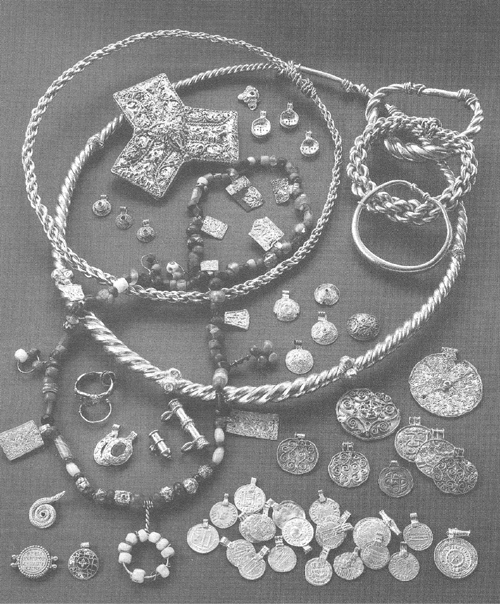
Mixed hoard of gold, silver, and beads from Hon in south-eastern Norway. Among the gold objects are a large trefoil-shaped mount from Francia and a finger-ring from England. Carolingian coins were fitted with attachments to make them adaptable for necklaces, suggesting that Viking Age womenfolk may have encouraged their menfolk to engage in piracy.
The profits of Viking warfare assumed several different forms. Most basic were food and drink, for such provisions enabled warriors to continue to pursue their warlike activities. In 864, for instance, Rodulf Haraldsson and his men received as tribute not only cash, but also flour, livestock, wine, and cider. In Ireland cattle on the hoof were the standard tribute among the native population and Vikings took advantage of this tradition as early as 798. Norwegians, on the other hand, were accustomed to exploiting their own seas for large creatures, which accounts for ‘a great slaughter of porpoises’ by them off the east coast of Ireland in 828. A second form of profit was human beings. High-status people would be ransomed whenever possible; low-status people and others for whom payment was not forthcoming would be retained or sold as slaves. A spectacular ransom was paid in 858 for Abbot Louis of St-Denis and his brother, Gauzlin: 686 pounds of gold and 3,250 pounds of silver. The upcountry bishop of Archenfield, on the Anglo-Welsh border, was delivered at a cost of £40 donated by the West Saxon king in 914. The alternative was death, as in the case of Archbishop Ælfheah of Canterbury who was brutally murdered in 1012 when payment of the Danes’ demand for £3,000 was not forthcoming. A third form of profit was land on which to settle. The entry in the Anglo-Saxon Chronicle for 896 may imply that Vikings might purchase property, but land must often have been obtained by force of arms. Large-scale political takeovers would have facilitated the acquisition of farmland, as in Northumbria (866–7), East Anglia (869–70), and Mercia (873–4), all of which were to receive Danish settlers in due course. Even earlier, land-taking had occurred in the Scottish Isles and the kingdom of Dublin had been established c.853. Accordingly food and drink, bullion and cash, land and labour were among the considerable profits of Viking warfare.
In effect Vikings were competing among themselves, and with the natives of the countries in which they raided, traded, and settled, for wealth. Amid all the aristocratic and dynastic competition of the Viking Age, the greatest prize was the kingdom of England, which was won initially by the West Saxons in 910–27, by the Danes in 1013–16, and by the Normans in 1066–71. A final Danish challenge failed to materialize in 1085–6. Behind the aggression, brutality, and destructiveness, there was calculating rationality. From our own distant perspective, filtered through external sources for the most part, it has become fashionable to portray Vikings as catalysts of economic and political change. By dishoarding monastic treasuries, wealth was released for more productive purposes, even though some of it was simply rehoarded in Scandinavia. There is an element of truth in this argument, but any temptation to glamorize Vikings should be resisted. Vikings divested of bear-coats, horned helmets, a predilection for blood-eagling, and devilishly ingenious siege tactics are Vikings demythologized, yet they become all the more credible as brave and resourceful fighters. As such they were celebrated by contemporary skalds and their deeds were further elaborated to the point of fictionalization by later generations of saga writers. With that in mind, the modern Icelandic author, Halldor Laxness, published a subtly satirical novel entitled Gerpla in 1956; two years afterwards this appeared in English as The Happy Warriors. According to the book’s own publicity, ‘the inescapable conclusion is that the legendary heroes were not larger than life after all; they were what would nowadays be called misfits, and a nuisance to everyone’. More than that, their historical antecedents brought untold misery, injury, and death to tens of thousands of men, women, and children. But warfare was not a Viking monopoly; Vikings were a Scandinavian manifestation of a universal scourge.