
The Rise of the Empire of the Franks
In the eyes of Muslims and Greeks eleventh-century Western Europeans (whom the Muslims called Franks and whom the Greeks sometimes called Franks and sometimes Celts) were loud-mouthed and crude barbarians whose only skills lay in fighting and in the manufacture of arms. During the later eleventh and twelfth centuries these barbarians enjoyed a period of unusually sustained military success and expansion. A great historian Ibn-al-Athir, looking back from his vantage point in early thirteenth-century Mosul, described it as the ‘rise of the empire of the Franks’. For Ibn-al-Athir two key dates were 1085, the capture of Toledo, and 1091, the completion of the Norman conquest of Sicily. Had he been writing in Edinburgh instead of Mosul, he might have started with 1066, the year of Hastings when, in the words of the Bayeux Tapestry, ‘both Franks and English fell in battle’. Underlying the rise of the empire of the ‘Franks’ were demographic growth and economic expansion—developments which put more resources and money into the hands of the ruling elites of Western Europe. Since they were warrior elites, they chose to spend more on war: on arms, armour, horses, ships, and fortifications. The scale of military operations increased. Even more than before, Western aristocratic society became an aggressive society where knights and their followers, archers and crossbowmen, pushed back the frontiers of their dominions, east against the Slavs and towards Jerusalem, south into Greek and Muslim South Italy and Spain, north and west into England, Wales, and Ireland, building castles wherever they went. By the mid-twelfth century an author such as the German Helmold of Bosau could envisage expansion as being planned on a Europe-wide scale. According to him, those organizing the great crusade of 1147 decided that one army should go to the Orient, a second to Spain, and a third against the pagan Slavs.
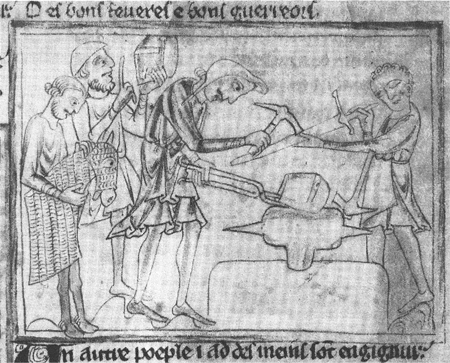
This English manuscript illustrates the quantity of iron—for tools as well as for weapons and armour—consumed by the arms industry. As shown here, from the twelfth century onwards rich societies manufactured coats of mail even for warhorses.
The Lure of Gold
In some cases—for example the twelfth-century campaigns against Celts and Slavs—this expansion was underpinned by an industrial and technological advantage possessed by the English and German aggressors, their capacity to produce arms and armour superior both in quantity and quality to those available to the people who were trying, in vain, to hold on to the lands of their fathers. But neither of the dramatic eleventh-century events highlighted by Ibn-al-Athir can be explained in terms of an imbalance of military technology. Indeed Spain and South Italy were highly developed, urbanized, and very wealthy societies—in all of ‘Western’ Europe (geographically speaking) they were the only two regions where gold coin continued to be used. This, of course, was why mercenaries and adventurers, men such as Roger de Tosny and Harald Sigurdson, made for these theatres of war. In the 1020s Roger de Tosny fought for Barcelona against its Muslim neighbours; then went back to Normandy—where he was known as ‘Roger the Spaniard’—and used his wealth to found the abbey of Conches c.1035. Harald Sigurdson went to Constantinople, saw service with the Greeks in Sicily and then returned home to Norway with such ‘an immense hoard of money and gold and treasure’ that he was able to become king in 1047. As Harald Haardrada, ‘the thunderbolt of the North’ he invaded England in 1066. All he won was the proverbial six foot of English soil, but the other invader, Duke William of Normandy, conquered a land that his chaplain called ‘a treasure-house of Araby’, so abundant was it in gold and precious metals. But if it is easy to explain why those who ‘sought wealth by soldiering’ in the eleventh century were attracted to South Italy, Spain, and England, it is not so easy to explain why the invaders, fighting against defenders with resources at least as great, should have won the upper hand.
Eleventh-Century Spain
Eleventh-century al-Andalus remained a wealthy, urbanized, and culturally sophisticated society, extending over the greater part—and the more fertile part—of the landmass of modern Spain, but after the death of Abd al-Malik in 1008 the Ummayad Caliphate of Córdoba fell apart into 30 or so warring city-states, the ‘party’ or taifa states. For its manpower the Cordoban war-machine had come to rely heavily on ‘imports’: Slavs and Berbers. The former were boys captured in war in North East Europe, castrated and then transported to Cordoba where they were trained as slave-soldiers, the Mamluks of al-Andalus. When developments along the Slav-German frontier led to the drying up of this source of slaves, the taifa kings were unable to find an alternative supply and as rulers of small states they were conscious of the risks of relying on large numbers of Berber tribesmen from nearby North Africa. Their consequential lack of fighting men meant that they became increasingly vulnerable to military pressure from the Christian north. Where once the Muslims had regularly raided the Christians, the boot was now well and truly on the other foot.
Christian rulers exploited their military dominance to consolidate their power and enhance their status. The counts of Barcelona began to mint their own gold coin; Castile became a kingdom in 1035; the lords of Aragon became kings in 1076; Portugal became a kingdom after 1140. Their strategy was to use military pressure, raiding, ravaging, and looting, to extract tribute (parias). According to the memoirs which Abd Allah, emir of Granada, wrote in the 1090s, Alfonso VI of Leon-Castile (1065–1109) ‘spoke to me softly saying “I will not subject you to anything more than the payment of tribute”—which he fixed at 10,000 mitqals a year—“but if you do not pay up in good time you will receive a visit from my ambassador and you will find his stay rather expensive.” I accepted his terms for I knew that paying 10,000 a year for protection was better than the devastation of the land.’ Alfonso VI’s father, Fernando I (1035–65), had been the first great exponent of this protection racket, at one time collecting the rich parias of Zaragoza, Toledo, Badajoz, and Seville. They had made him rich enough to endow Cluny in 1055 with an annual gift of 1,000 pieces of gold—more than this great abbey’s entire income from land; in 1077 Alfonso VI was to double his father’s gift.
Inevitably there was rivalry between the Christian states for control of these rich pickings. In these circumstances Muslims might sometimes fight for Christians and vice versa, as when the Cid took service with the emir of Zaragoza. Nonetheless the existence of the religious frontier between Christian and Muslim meant that war between them was thought of as normal, indeed admirable. But for decades, despite having the upper hand, and with rare exceptions such as the capture of Coimbra in 1064, the Christians deliberately refrained from territorial expansion. According to Abd Allah, they knew that they lacked the human resources which would have enabled them to retain, colonize, and profit from any territory they conquered. Their intention, he believed, was ‘to set the Muslim princes against each other and continually take money from them’. It would have been foolish to kill the goose that laid the golden egg.
But the Toledan goose became so weakened that in the 1080s, almost inexorably, Alfonso VI was drawn into taking it over. Excited by the capture of this great city, the old capital of Visigothic Spain and a strategic centre from which roads radiated out in all directions, Alfonso and his allies pressed forward. In 1094 a second major Muslim centre fell when the Cid captured Valencia. But the tide of war had already turned. Shattered by the fall of Toledo, the taifa rulers had been reluctantly driven to turn for help to a powerful fellow Muslim, even though they regarded him as much a crude barbarian as the Christians. This was Yusuf ibn Tashufin, Almoravid emir of a wide North African empire. The strongly religious outlook of the Almoravids, their disapproval of what they regarded as the decadent softness of taifa society, their abolition of non-Koranic taxes, and their promise to put an end to the threat of Christian raids—a promise backed up by the dispatch of African military resources (including camels)—all combined to make them irresistible in post-1085 al-Andalus. From the moment of their arrival in Spain they were to enjoy over thirty years of virtually unbroken success. Yusuf defeated Alfonso VI in battle at Sagrajas in 1086; Alfonso’s only son met his death in battle at their hands at Uclés in 1108. Angered by the failure of the taifa kings to help him when he besieged Toledo itself in 1090, Yusuf turned against them. Their Christian protectors failed to protect and one by one they were added to the Almoravid empire. Even in the north-east where the kings of Aragon with French help had some success in pushing down the Ebro, taking Huesca in 1096 and Barbastro in 1100, Almoravid expansion continued apace. They recaptured Valencia in 1102, took over Zaragoza (1106) and recaptured Majorca and Ibiza. By 1117 all the former taifa states had been eliminated; the political map of Spain completely redrawn. Roughly speaking Christians held the upper hand until 1085; then Muslims until c.1118. The way the tide of war turned, first c.1010 then after 1085, suggests that it was political rather than military factors which were decisive. As in the history of the crusades, the key variable was the degree of fragmentation in the Muslim world.
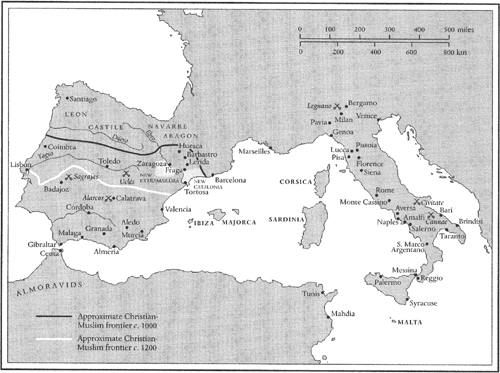
THE WESTERN MEDITERRANEAN, FROM SPAIN TO ITALY, C. 1000–C. 1200
The Normans in the South
From c.1000 a motley crew of mercenaries from France and northern Italy as well as from Normandy drifted into South Italy where they took service with either the Byzantine government or any one of a number of rival Lombard rulers. Late eleventh-century authors, who knew the end of the story and were usually writing for Norman patrons, give the impression that such was Norman bravery, cunning, and ruthlessness, and by so much did they outclass their enemies in the arts of war, that once they had found their way there they were bound to end up as masters of Greek South Italy and Muslim Sicily. According to William of Apulia, ‘the people of Gaul are more powerful than any other people in force of arms’. Twentieth-century authors sometimes agree, suggesting that in the charge of their mounted knights the Normans possessed a military arm that swept all before it. It is not a view which stands up to analysis.
Their normal technique was to seize a castle and use it as a base from which to terrorize the surrounding district into submission, as Robert of Hauteville, known as Guiscard, ‘the Weasel’, did from San Marco Argentano in Calabria. According to Amatus of Montecassino, another Norman, Richard of Aversa, ‘carried off everything he could and gave it away, keeping little… in this way the land about was plundered and the number of his knights multiplied’. Decades of this kind of brigandage made the Normans thoroughly unpopular and Pope Leo IX organized a coalition of Byzantines and Lombards against them. This forced the various Norman bands to unite their forces and they managed to bring the pope’s army, which included a contingent of Swabian troops, to battle at Civitate on 17 June 1053, before it was joined by the Greeks. At Civitate, it has been said, ‘the old world of Germanic infantry tactics went down before the new chivalry of heavy cavalry.’ But according to William of Apulia’s Deeds of Robert Guiscard,once the pope’s Lombards had ridden away in flight, the 700 Swabian foot soldiers who remained put up a prolonged and stout resistance against several thousand Normans. If anything Civitate demonstrates the strength in battle of infantry even when hugely outnumbered. Leo IX was taken prisoner and forced to recognize the Norman acquisitions. But the few lordships they had obtained by this date were hardly impressive. As yet, apart perhaps from Humphrey of Hauteville’s Melfi, they controlled none of the major centres.
Only after 1059 did the Normans make spectacular gains, and for this there were two principal reasons. The first was the growing pressure of the Seljuk Turks on Anatolia. As late as 1038 Constantinople had shown real interest in the West, sending an expedition under its foremost general, George Maniaces, to recover Sicily. He captured Messina and Syracuse, but was recalled in disgrace in 1040—the fate of many ‘too successful’ Byzantine generals from Belisarius onwards. What mattered was that 1038–40 was the last time that Constantinople felt able to give so high a priority to its most western provinces, indeed it was increasingly reluctant to provide the governors of Apulia and Calabria with resources adequate to maintain the regional status quo. In 1058–9 there occurred the first serious breaches in Byzantine defences in Anatolia, and soon afterwards the Normans made their first major inroads. In 1060 Guiscard, recently given the title ‘duke of Apulia and Calabria, future duke of Sicily’ by Pope Nicholas II, occupied Reggio, Brindisi,and Taranto. Next year Robert’s younger brother Roger crossed the Straits and seized Messina—the first step into the politically disunited society of Muslim Sicily. On the whole the two brothers cooperated well, and from 1060 until their deaths, Robert’s in 1085 and Roger’s in 1101, they dominated the region. This was the second principal reason for Norman success after 1059: the continuity of leadership provided by two extraordinarily able—and long-lived—conquistadores. The Cid’s exploits as a warlord made him a Spanish hero; Guiscard was to achieve international fame as, in the words of his epitaph, ‘the terror of the world’. Something of the impression he made can be gleaned from the character sketch composed by the Greek princess, Anna Comnena: ‘that Norman braggart Robert, notorious for his power-lust, of obscure origin, overbearing, thoroughly villainous, a brave fighter and very cunning, wonderfully built, and utterly determined.’
In 1068 the braggart began a siege and naval blockade of Bari, the main stronghold of imperial Byzantine power in South Italy, at a time when the soldier-emperor Romanos Diogenes was increasingly preoccupied with the eastern campaign that was to end with his defeat and capture at Mantzikert. After a three-year blockade, Bari surrendered in 1071. Immediately Robert and Roger turned their attention to Palermo, the metropolis of Muslim Sicily. It surrendered in January 1072. Only after the fall of these two great cities was there an air of inevitability about the Norman conquest of the south. Amalfi was taken in 1073, Salerno in 1077, Syracuse in 1085, the last fortresses in Sicily and Malta in 1091. The critical battles which sealed the fates of both Bari and Palermo were not won by the much vaunted Norman cavalry, they were not even land battles, but naval battles, fought when fleets tried, in vain, to break the blockades. Given the length of the coastlines of South Italy and Sicily in relation to landmass, it is not surprising that sea power should have been critical.
In the Mediterranean
The Muslim loss of Sicily and Malta completed the ruin of their once impressive chain of possessions along the trunk routes of the Mediterranean. In this the Pisans and the Genoese had played a major role, even occasionally acting in concert (see Chapter 11, pp. 249). In a series of raids, beginning in 1015, they wrested control of Corsica and Sardinia from the Muslims. They launched raids on North African ports such as Mahdia (1087). In the Mediterranean the principal warship was the oared galley, single-masted and lateen-rigged. Given their limited water-storage capacity, galleys had a restricted range and they tended to hug land, since lack of freeboard meant they were easily swamped. But they were capable of high speed over short distances, and more manoeuvrable than sailing ships in estuaries and coastal waters. Hence they were ideally suited to coastal raids and attacks on ports. Although Muslim ships were of the same types as Christian, geography favoured the latter. They had the advantage of prevailing weather and current patterns, more suitable harbours on the northern shores, and of the fact that the major Mediterranean islands were nearer the northern shore (see Chapter 11, p. 231). After 1091 the Muslims retained only the Balearics and the ports of western Andalusia.
On the Northern Frontiers
The more powerful northern rulers, such as the kings of Germany and England, liked to think of their poorer neighbours as tributary peoples. They were encouraged in this belief by the way exiles turned to them for help. In Britain, for example, the sons of Duncan of Scotland appealed for help against Macbeth in 1054, and Edgar the Scot turned to William Rufus against Donald Ban in 1097. The numerous succession disputes within the Hungarian, Bohemian, Polish, Abodrite, and Danish ruling dynasties presented German kings with many opportunities for military intervention—and they sometimes took them. But conquest was ruled out by the logistical problems involved in maintaining armies for long periods in relatively thinly populated countries. (One index of eleventh-century England’s prosperity is the fact that it was conquered twice.) Elsewhere only a loose overlordship was feasible, and dependent rulers tended to become independent-and stop paying tribute-as soon as they sat reasonably securely on their thrones. The kings of Germany (throughout this period) and the kings of England (especially after 1066) had many other more pressing concerns and tended to leave the business of enforcement of their superiority to marcher lords-in Germany, to the Saxon and Bavarian aristocracy. So these frontiers long remained war-zones between fairly evenly-matched powers. Beyond these frontiers successful warrior-kings often pursued overlordships of their own, such as that obtained by Gruffudd ap Llywelyn of Gwynedd over the other Welsh kings from 1055 to 1063, or in Ireland the ‘high-kingships’ won by Diarmait mac Maíl na mBó of Leinster (1042–72) or Muirchertach O’Brien of Munster (1086–1114). The vast expanses of Eastern Europe enabled Polish kings such as Boleslav II and Boleslav III to strike out from their centres at Gniezno, Poznan, and Cracow, in the direction of Pomerania and the Baltic fishing grounds, or even as far east as Kiev, in the construction of overlordships which were on a much grander scale, but just as ephemeral.
Wars in the North
Overlordship meant tribute and tribute meant raiding. Everywhere from taifa Spain to the far North where the Norse raided Laps to enforce a tribute of reindeer, the basic form of war was the raid, the chevauchée (see also Chapter 5, p. 98). In urbanized societies such as Spain and Italy the raid was not enough; ultimately wars were decided by sieges and blockades. By contrast in societies such as those in the Celtic, Scandinavian, and Slav worlds, where towns and markets were few and where wealth was dispersed widely through the countryside, the raid was virtually the only form of war. Here, in pillage economies, plunder and tribute were central to the circulation of wealth. Kings and other war-leaders mounted raids on their neighbours either to seize slaves and livestock or by burning and destroying to enforce the payment of tribute, probably itself paid in livestock. (Obviously the sea-kings who used oared warships built in the northern tradition (see Chapter 11, p. 234), clinker-built and square-rigged, for their raids did not go in for cattle-rustling, but concentrated on slaves and precious metals.) On land the job of most of those who rode with a raiding party was to round up the prey; there was no need for them to be heavily armed. When the going got tough they scattered and left the fighting to the well-armed few, the nobles. Farmers, their families, and their livestock were escorted to a place of refuge as soon as an alarm was given, but often the slow-moving convoy would be caught and a running fight would develop between the fightingmen. Even if raiders achieved initial surprise, they would not want to kill their prey by over-driving, so in this case too a running fight between their well-armed rear-guard and the defenders determined to recover their own was almost inevitable. In some of these battles casualties among the nobles could be very high.
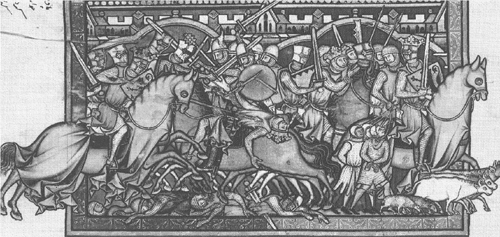
A passage from a twelfth-century epic, the Chanson des Lorrains, provides an apt commentary on this scene from the Maciejowski Bible: ‘a surge of fear sweeps over the countryside. Everywhere you can see helmets glinting in the sun, pennons waving in the breeze, the plain covered with horsemen. Money, cattle, mules and sheep are all seized.’ Here the mail armour of the prisoners shows they can afford ransoms.
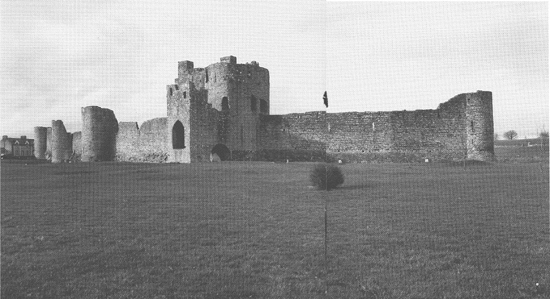
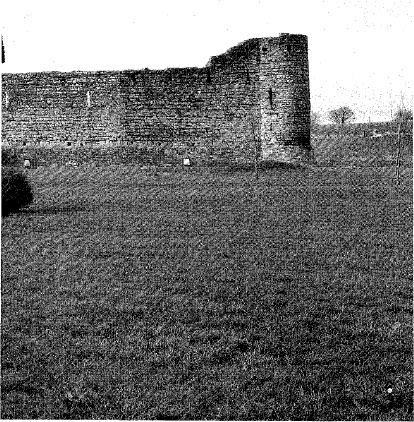
Trim Castle. Although its curtain walls were added in the thirteenth century, dendro-chronological dating shows that the keep was built for Hugh de Lacy (d.1186), lord of Meath and Henry II’s governor of Ireland. At a time when no Irish king was building in stone on anything like this scale, it symbolized the power and ambition of an English aristocrat suspected of wanting to be king of Ireland.
Castles and Wars in the West
From the time of the early eleventh-century building boom observed by Ralph Glaber, by far the most important aspect of the increased investment in war in Western Europe was the money spent on fortification (see further, Chapter 8, pp. 170–3). In the military architecture of the time, though with more evident purpose, there was that same striving after height visible in contemporary church architecture. It was characterized by towers which ‘soared to the sky’, tower-houses in towns and towers perched on artificial mounds (mottes) in the countryside. Compared with other forms of fortification the castle was tall and small. Too small to admit more than a small proportion of the local population, it protected them only indirectly, depending on the capacity of the garrison to harass invading forces and inhibit ravaging. But castles were instruments of power and independent-minded lords found them highly desirable. Raymond III of Rouergue built a castle on the rock at Conques to impose the yoke of his lordship, as he himself (according to The Miracles of St Foy, c.1020) put it, on those who did not want to accept it. Rights to tax, justice, and all profits of local lordship readily fell into the hands of castellans. The problem for princes was to retain the loyalty of castellans. In about 1030 the Poitevin lord Hugh of Lusignan composed an account of his disputes with Duke William of Aquitaine. This narrative, the Conventum, suggests that in Western Europe small-scale wars were a normal continuation of local politics by other means. Castles wereboth the main bones of contention between them, and the focal points around which the campaigns revolved. Even in principalities such as Flanders and Normandy where the rulers on the whole contained the castellans, this was far from being a stable situation. According to William of Jumièges, when the boy William became duke of Normandy in 1035, the province was reduced to chaos as ‘many Normans hatched plots and rebellions once they felt secure behind newly built earthworks and fortifications’. A century later Suger’s Life of Louis VI suggests that even the king of France was troubled by lords who defied him from behind their castle walls.
There were many other causes of wars. Virtually everywhere from Scotland to Spain and from Brittany to Bohemia succession to royal or ducal office was only decided after a power-struggle, often a war, between brothers or cousins. Intermarriage between the ruling dynasties meant that wars of succession quite often reached the level of wars between states (indeed this remained the case well beyond the middle ages). Occasionally such dynastic wars resulted in conquests as dramatic as the Norman Conquest of England or the Hohenstaufen (German) conquest of Sicily. In urbanized Italy cities fought to control food supply and trade routes. War was the common experience not just of the peoples who lived on the frontiers of Europe, but in almost every part of Europe—though England was often an exception.
Conquest and Control of Territory: England
Where the control of territory was disputed, pitched battles could be decisive, especially in those regions where castle building had not yet proliferated. The stories of the Norman Conquest of England and of the Saxon war in Germany offer illuminating illustrations. They point up two crucial issues in medieval warfare: the relative importance of cavalry and infantry, and the impact of new techniques of fortification.
Between Cnut’s conquest in 1015–16 and the overwhelming events of 1066 England’s unusually centralized government kept the peace to the economic benefit of its people. Towns were managed by royal officers, and there were very few castles. The kings kept a permanent fleet of hired Danish ships and men at London until 1051; from Edward the Confessor’s reign Kentish ports provided naval patrols in the Narrow Seas. Great magnates such as Earl Godwin and his sons used fleets, not castles, to pursue their political ends—as when they reasserted their dominance over Edward in 1052. In 1063 Harold burned Gruffudd ap Llywelyn’s ships as they lay at Rhuddlan, and then took his own fleet from Bristol round Wales to put an abrupt end to Llywelyn’s power. But in these years, except on the Scottish and Welsh borders, the English had very little direct experience of war.
In 1066 Harold stationed his fleet at the Isle of Wight with every reasonable expectation of being able to deal with William’s expeditionary force, but the Norman duke delayed sailing until the English fleet returned to London for reprovisioning. However William’s fleet was blown off course and ended up at St-Valéry-sur-Somme. When he eventually sailed from there, Harold was in Yorkshire meeting Haardrada at the Battle of Stamford Bridge and so William was able to establish a beachhead virtually unimpeded. On 14 October 1066 William outmanouevred Harold, though whether this was enough to win the battle of Hastings can never be determined with any certainty; Harold was still able to draw up his troops in a strong defensive position. It is possible that William’s army, recruited from all over northern France, possessed a decisive advantage in its missile-delivery systems—either a technological edge in the shape of the crossbow, seemingly a weapon unknown to the English, or perhaps simply an advantage in the number of archers present. The contemporary French author of The Song of Hastings wrote of ‘the French, versed in strategems, skilled in warfare’ and of the English as ‘a people ignorant of war’. This too may have been significant in deciding the outcome—since the success of the French cavalry’s feigned flight suggests practice on one side and inexperience on the other.
In the critical weeks after Hastings such was the disarray within the English leadership that none of the fortified towns which might have resisted William—Dover, Canterbury, Wallingford, and above all Winchester and London—did so. Not until early 1068 did an English city, Exeter, show what English fortifications might have achieved. Although Exeter surrendered after an eighteen-day siege, it did so only after inflicting heavy losses on William’s army and inducing him to offer favourable terms. William, of course, was keenly aware of the strategic problem posed by the towns. Hence his systematic policy of building castles in the major towns. He was equally aware of the strategic problem of the north—hence the ‘Harrying of the North’, probably the most systematic burning and destroying in medieval history. But one type of problem at least William had not had to face, he was not confronted by a landscape of castles as he would have been in France, as indeed he had been when conquering Maine in the early 1060s. In William’s camp there were men who believed that, no matter how brave its soldiers, a land without castles was virtually indefensible. William set about remedying the situation from the moment he disembarked late in September 1066 and constructed the castles of Pevensey and Hastings. His men followed suit. As many as 500 castles may have been built by the end of his reign (1087).
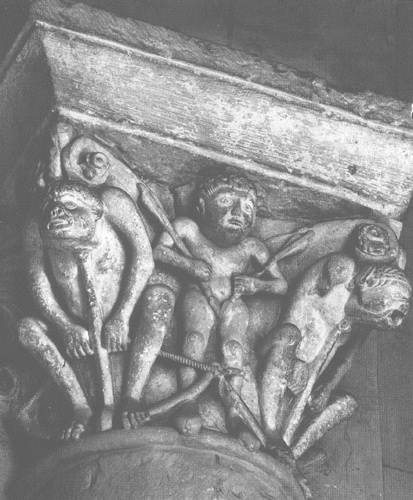
Widely regarded as a diabolical weapon, the crossbow carved on this late eleventh-century capital from the cathedral of St Sernin, Toulouse, is shown being spanned. Spanning, even by a demon, took time. The crossbow’s rate of fire was much slower than that of the ‘ordinary’ bow, but not even the well-armoured knight was safe from its penetrative power. Both bow and crossbow were banned by the Lateran Council of 1139; the ban had no effect.
Conquest and Control of Territory: The Battles for Saxony
The battles for England in 1066 have been endlessly fought over by historians. Less well-known are the battles between the Saxons and the Salian (i.e. Frankish) Kings of Germany, Henry IV and Henry V—even though they were the action highlights of the most important war in Germany before the Thirty Years War. The war was fought in three phases, 1073–80,1085–9, and 1112–15. Each phase was precipitated by the king moving into Saxony in order to exert, as he saw it, traditional royal authority there. Each phase ended with the king driven out by the Saxons who saw him as a tyrant trying to overturn their cherished liberties—in part by building too many castles such as the Harzburg, near the great Salian palace of Goslar, in a previously fairly castle-free zone. In all three phases battles mattered. In the second phase Henry IV was defeated at Pleichfeld in August 1086 by dismounted enemies who fought on foot around their standard. The third phase was settled when Henry V was defeated by Lothar of Supplingenburg, duke of the Saxons, at the battle of Welfesholz in February 1115. But it is the first phase which is best known, thanks in large part to The Book of the Saxon War, a vivid narrative written by Bruno of Merseburg, a clerk who was himself deeply involved in the events he describes. Few descriptions of eleventh-century warfare are as penetrating as Bruno’s. Although the revolt began with the Saxon siege of Harzburg in 1073–4, Bruno’s war does not revolve around sieges but around what he calls the first, second, third, and fourth battles.
The first battle occurred on the Unstrut on 9 June 1075. According to Bruno, Henry IV attacked the Saxons while they were still expecting negotiation, and despite the desperate confusion, exacerbated by dust, in which contingents on both sides took to flight, the advantage he stole then was sufficient to win the day. He followed this up by ravaging Saxony more ruthlessly than any heathen, until in July logistical difficulties forced him to withdraw. When he mustered a second army of invasion in October, after the harvest, the Saxons surrendered. It was in the aftermath of this triumph that Henry took the fateful step of pronouncing the deposition of Pope Gregory VII, an overconfident move that led to the great quarrel between ‘Empire and Papacy’ and to the election of the Swabian duke Rudolf of Rheinfelden as a rival king in March 1077.
Bruno’s second battle took place at Mellrichstadt on 7 August 1078 when Henry successfully forestalled a conjuction between the Saxon and Swabian forces. No sooner had battle been joined than many Saxons fled. The runaways were set upon and robbed by the people of the district. Among those to suffer this humiliation was the bishop of Merseburg who gave Bruno an account of his misfortunes (and that more than once, Bruno remarks). However in another part of the field, Otto of Nordheim’s Saxons drove Henry’s troops far in the direction of Würzburg. As Otto’s men returned, exhausted, they could see another force in occupation of the field of battle, and when their scouts failed to report back, they concluded it was the enemy—though it was in fact another Saxon contingent. They returned home victorious, believing they had lost. Henry quickly exploited the confusion about the outcome of Mellrichstadt, attracting men to his banner by announcing that Saxon losses had been so heavy that their land now lay defenceless. When his assembled troops learned the truth, he led them on a ravaging expedition against Rudolf’s Swabian lands instead.
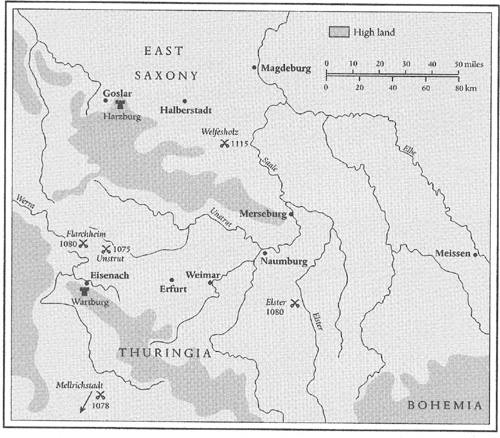
THE SAXON WARS OF HENRY IV AND V, 1073–1115
Bruno’s third battle was fought at Flarchheim on 27 January 1080. Again Henry invaded Saxony and again he surprised his enemies, outmanoeuvring them and taking them in the rear. However Otto and Rudolf managed to regroup and fought back so fiercely that Henry himself fled. When he halted to rest his weary troops near the Wartburg, the castle garrison made a sudden sally and successfully plundered the immense treasures of the royal camp.
The fourth battle took place on 15 October 1080 when Henry, to avenge this humiliation, launched his second invasion of the year—he was, wrote Bruno, ‘tireless in war’. Bruno’s account of a campaign that came uncomfortably close to Merseburg is particularly detailed. When Henry’s scouts reported that Rudolf and Otto had mustered a large army against him near Eisenach, he ordered the bulk of his troops to march in the direction of Erfurt, while his swiftest cavalry made for the Goslar district where they were to burn settlements and then rejoin the main army as fast as possible. The strategem worked. The Saxons reacted to the news from Goslar by rushing there, and then, when they realized they had been deceived, by rushing back in an attempt to defend Erfurt. Even though in their haste they left many troops, both horse and foot, behind at Goslar, they were too late. Henry sacked Erfurt and moved on to ravage the countryside around Naumburg. However the Saxons were moving much faster, even through hilly country, than Henry’s ravaging and plundering army, and they were able to get back in time to defend Naumburg itself. On 14 October Henry camped on the banks of the Elster. Why did he halt there? Bruno confessed he was at a loss to know whether the Salian king was following a battle-seeking strategy—despite having lost his last two battles—or whether he was now waiting for reinforcements from Meissen and Bohemia before marching in overwhelming force via Merseburg and Magdeburg to ravage the whole of Saxony. Whatever his intentions, next morning Henry offered battle. Although the Saxons were tired by their pursuit, they decided to attack. Since most of their foot soldiers had been left behind, the infantry needed strengthening and many of the cavalry were ordered to dismount. As they advanced their clerics chanted the 82nd Psalm. Henry himself fled as soon as hand-to-hand fighting began, but his men did not; they drove some of the Saxons into flight. Rudolf of Rheinfelden was seriously—and, it transpired, fatally—wounded. In the Salian camp, men were already beginning to celebrate victory when to their astonishment they saw the Saxon foot led by Otto of Nordheim advancing against them. The camp fell before their determined assault. Then—and for Bruno this was the critical moment—Otto prevented his men from succumbing to the temptation of looting the king’s treasures; he made them turn instead to challenge the large detachment of Henry’s army which was still in possession of the field of battle and thought it had won. Once again Otto led the foot in a victorious attack—allegedly against superior numbers. Only then were the Saxons allowed to enjoy the rich spoils of Henry’s camp. Bruno ended his narrative with the proud report that when Henry tried to organize another campaign, his men told him they would rather go round the whole world than ever again try to invade Saxony.
Bruno’s war was decided not by capturing strongpoints but by winning battles. None of his four battles was a clash between besieging and relieving armies—the characteristic scenario for battle in a well-fortified zone. His war was fought in East Saxony and Thuringia, a region which, though disturbed by the throes of encastellation, was still much less urbanized and encastellated, i.e. much less ‘modern’, than, say, the Rhineland. Like England in 1015–16 and 1066, this was a theatre of war in which contestants were more willing to risk battle than they would be in a densely fortified country. Bruno represented Henry IV’s supporters, many of whom came from the prosperous Rhineland, as men who looked down on the Saxons, seeing them as backwoodsmen, ‘rustics without military expertise, short on both horses and knightly skills’. Few authors have bettered his descriptions of the terror and sheer confusion of battle, but he was also clear that with intelligent leadership—he described Otto of Nordheim as ‘prudent in war’—disciplined infantry could beat well-equipped cavalry.
Cavalry and Archery in Battle
As the battles for Saxony as well as the battles at Civitate and Hastings demonstrate, eleventh-century knights were far from being the masters of the battle-field. It is, however, sometimes suggested that by the twelfth century they had discovered how to use a couched lance, and that this new technique then enabled them to drive all before them. True, the couched lance, having behind it the weight and power of the moving horse and rider, could penetrate a hauberk and was an ideal weapon in the joust, the head-on confrontation of knight against knight which marked the beginning of many a clash between bodies of cavalry both in tournament and real battle. But there is no evidence that the couched lance was new and the technique was in any case useless against infantry (for a slightly different view, see Chapter 9, p. 188). The likelihood is that couching the lance was one of a number of options which had long been available to horsemen. The Normans in the Bayeux Tapestry are shown throwing or jabbing down with their lances not because they had not yet learned the ‘new’ technique, but because they were attacking infantry in close formation. Cavalry operating alone had no chance against well-disciplined infantry. Horses are too sensible to impale themselves on a hedge of spears. Only when the formation had been disrupted was it possible to drive home a charge. The risky tactic of feigned flight might occasionally work, but missile weapons offered by far the most effective way of disrupting infantry, particularly if, drawn up in defensive formation, they presented an immobile target.
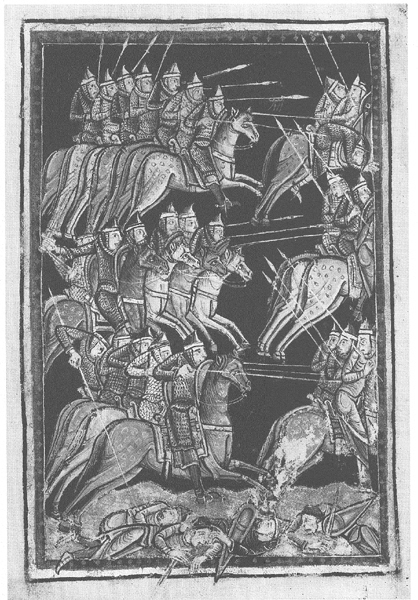
A scene from a Life of St Edmund c.1135. The battle is already over and knights, couching their lances, pursue a demoralized enemy. The couched lance was for use against cavalry; other methods worked better against infantry, whether they stood and fought or whether, as here, they were being finished off.
When Anna Comnena wrote that ‘a mounted Celt is irresistible’, she drew attention not to a particular technique of lance management, but to the fact that the knight’s shield and armour made him virtually invulnerable to arrows. This is why one of the standard Latin words for a knight was loricatus—the man wearing a metal hauberk. When Anna elaborated the circumstances in which the knight was irresistible and moved from the poetic ‘he would bore his way through the walls of Babylon’ to the realistic, she wrote, ‘inspired by passion they are irresistible, their leaders as well as their rank and file charging into the midst of the enemy line with abandon—so long as the opposition everywhere gives ground’. Historians have too often missed that last crucial proviso. Cavalry were devastatingly effective when it came to finishing off and pursuing troops who were already beaten; of least use when the outcome of a battle still hung in the balance.
Castle Warfare
As castles proliferated, so the nature of warfare changed. Twelfth-century battles remained frightening and risky, for even though fewer commanders were killed in them than in the eleventh, the political consequences of being taken prisoner (as Robert Curthose was at Tinchebrai in 1106 and Stephen was at Lincoln in 1141) were catastrophic. On the other hand, battles from which the losing commander escaped still left the victor with the problem of capturing strongholds, and the more densely fortified the region, the greater the problem. Wars could be won without battles. Roger II of Sicily avoided battle but defeated the military alliance ranged against him and took over the mainland territories after the death of Guiscard’s grandson, Duke William of Apulia, in 1127. Geoffrey of Anjou conquered Normandy (1136–44) and Henry VI conquered Sicily (1195), both without battle. Apart from a river-battle for Château-Gaillard, there were no battles when Philip Augustus drove King John out of Anjou, Normandy, and much of Poitou in 1203–4. Not surprisingly commanders became increasingly reluctant to risk battle. Only when very confident would they offer it, and in those circumstances their opponent was almost certain to avoid it—as Philip Augustus fled from Richard I at Fréteval (1194) and Gisors (1198), preferring to suffer the humiliation and losses incurred in flight rather than risk potential disaster. Thus battles became rarer, and when they did occur, it was generally in the context of a siege, as at Lincoln in 1141 or at Carcano in 1160.
Even more than before wars revolved around the winning or losing of strongholds. But they, of course, were hard to take, and became even more so as increasingly they were built or rebuilt in stone. Stone walls could sometimes be undermined or breached. With the development of siege towers and better artillery the technology available to the besieger (if he could afford it) continued to improve (see further, Chapter 8, pp. 171–4). But even if the walls had been breached casualties in a direct assault were so high that it was very rare that troops would risk it—despite the incentive of the right to unrestricted plunder which they would then be allowed by the custom of war. The best chance was surprise, as when King David of Scotland attacked Wark in 1138, at dawn on a mid-winter morning. An alternative was intimidation. For example in 1113 Henry V threatened to hang his prisoner, Mouzon’s lord, if Mouzon were not handed over. In 1146 Roger of Berkeley was ‘hanged’ three times outside the walls of his own castle, before being returned half-dead to prison. On neither occasion did the threat work. In the new climate of chivalry (see p. 83) it was unlikely that such threats would be carried out—and defenders guessed as much.
Since direct attacks were so problematic, the usual tactic was a more indirect one, an attack on the castle’s economic base. In the late twelfth-century metrical Chronicle composed by Jordan Fantosme, the author put some advice on how to make war into the mouth of Count Philip of Flanders, one of the most respected commanders of the time. Speaking to King Louis VII, he envisages William king of Scots invading England as Louis’s ally:
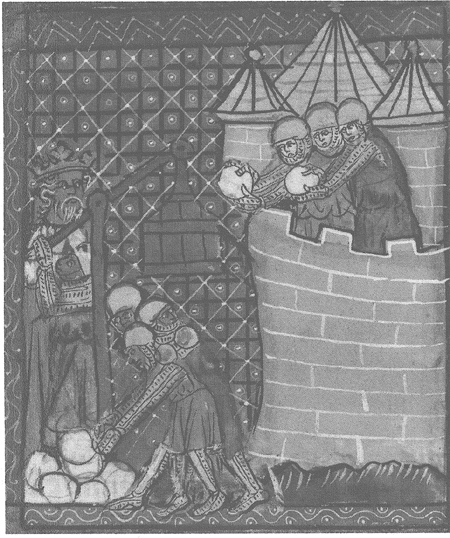
The counterweight trebuchet—the most advanced piece of siege artillery in the world of c.1200. The sling in which the projectiles were placed added to the velocity with which they were flung into the air in a high arc.
Let him aid you in war, swiftly and without delay
Destroy your foes and lay waste their country,
By fire and burning let all be set alight
That nothing be left for them, either in wood or meadow
Of which in the morning they could have a meal;
Then with his united force let him besiege their castles,
Thus should war be begun: such is my advice.
First lay waste the land.
Precisely because castles were so hard to take, even campaigns targeted against them began with ravaging, and many campaigns did not get beyond these destructive—and profitable—preliminaries.
If a siege was eventually laid, then some of the besieging forces would garrison counter-castles or entrench themselves in siege-works, but others would remain highly mobile. In a closely pressed siege, the attackers would want a rapid response force ready to take swift advantage of any opening created by a sortie by the defenders. When William of Normandy blockaded Domfront, he ‘went out riding by day and night, or lay hidden under cover to see whether attacks could be launched against those who were trying to bring in supplies and messages, or who were trying to ambush his foragers’. Lightly armed foragers and ravagers needed to be escorted by heavily armed patrols. The Abodrite prince Niklot was killed in 1160, ambushed by Saxon knights as he attacked their foragers. When the Cid laid siege to Valencia in July 1093, one of his tactics was to launch hit and run raids on its suburbs, fields, and gardens. Warfare, in other words, remained a war of movement both in the preliminaries to siege and during siege. In this kind of warfare, rather than in battle, cavalry was in its element.
After a tough winter, food shortages brought Valencia’s defenders to agree terms of surrender in June 1094. This was how William took Domfront. It was the usual pattern. The offer of generous terms might persuade defenders to surrender earlier rather than later. David of Scotland eventually won Wark in 1138 by agreeing not only to let the garrison go free but also to provide them with horses to replace the ones which hunger had forced them to eat. Other besiegers in other circumstances took a tougher line. Conrad III intended to imprison the defenders of Weinsberg (to which he laid siege in 1141) and would only agree to let their women go with whatever they could carry. They carried out their men.
Once taken, a strongpoint could then become a base from which further destructive raids could be launched. William of Poitiers’ summary of how William the Bastard conquered Maine illustrates the combination of ravaging, taking strongholds, and further ravaging. ‘He sowed terror in the land by his frequent and lengthy invasions; he devastated vineyards, fields and estates; he seized neighbouring strongpoints and where advisable put garrisons in them; in short he incessantly inflicted innumerable calamities upon the land.’ According to Otto of Freising, Frederick of Staufen, the duke of Swabia, advanced ‘down the Rhine building first one castle in a suitable site and subjecting all the surrounding country to his power, and then moving on and building another, in this way gradually subjecting to his will the entire country from Basle to Mainz, the richest part of the realm. It was said of him that he always hauled a castle with him at the tail of his horse.’ Richard I’s base for the recovery of the Norman Vexin from Philip Augustus was the new castle, Château-Gaillard, which in 1196–7 he built at Andeli only five miles from the French king’s fortress at Gaillon. Aggressive commanders sometimes seized castles situated deep in enemy territory and used them as bases from which to disrupt agriculture and trade. For example, after conquering Toledo in 1085, Alfonso VI placed a garrison in Aledo—far to the south of his effective rule—and managed to keep it there, a thorn in Muslim flesh, until 1092.
Italy
No society was more encastellated than Italy, the richest part of Europe. Phenomenal economic growth went hand in hand with acute political fragmentation. By 1200 there were as many as two hundred independent city-states, the communes. In this fiercely competitive society the threat of armed violence was never far away. Rich families built castles in the countryside and tower-houses in town. Benjamin of Tudela said of Genoa, which he visited in the 1160s, that ‘each householder has a tower in his house and at times of strife they fight each other from the tops of the towers’. At Pisa, he alleged, there were 10,000 such houses. City governments tried to set legal limits to the height of towers. Aggrieved neighbours took more direct action, bringing up their own siege artillery.
As the urban population grew so walls had to be extended time and again, sometimes enclosing an area three or four times greater than the Roman walls had done. In the early twelfth-century Liber Pergaminus— the earliest surviving literary work in praise of a commune—among Bergamo’s other excellent qualities were its formidable walls and its military strength. As each city tried to extend the area from which it could require deliveries of grain and on which it could levy taxes and military service, so it came into conflict with its neighbours. By the mid-eleventh century Pavia and Milan were at each other’s throats—a rivalry which was to last for centuries. Florence was generally at odds with Lucca, Pistoia, and Siena. Gradually both smaller towns and rural aristocrats succumbed to the power and lure of the greater towns. By the mid-twelfth century a German historian, Otto bishop of Freising, noted with astonishment that ‘practically the whole land is divided between the cities’.
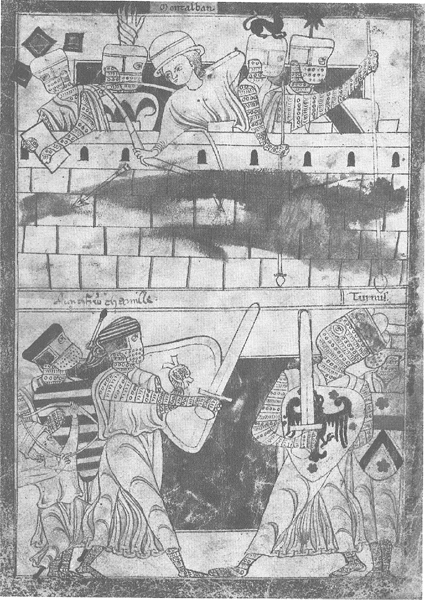
A German illustration of a siege in Italy showing men of high rank (note the shields with heraldic designs) in the thick of the fighting. In England in 1144 Geoffrey de Mandeville was fatally wounded at the siege of Burwell by an arrow in the face, but the great helms shown here—fashionable from the late twelfth century onwards—gave better protection against missiles than had earlier forms of helmet.
In the eleventh and twelfth centuries the German kings found it hard to exercise the authority in Italy which their Ottonian predecessors had enjoyed. The famous carroccio of Milan is first mentioned in 1039 in the context of a campaign against the ‘imperialists’. Frederick Barbarossa made a huge effort to revive imperial power in Italy. Barbarossa himself, in a letter written in 1157, described his first campaign in 1155. ‘Because this land had become arrogant and rebellious, we entered Lombardy in force and destroyed almost all its strongholds [castella]’. In the next few sentences Frederick used the verb ‘destroy’ five more times. He exaggerated his success, but he had clearly found a lot to destroy. So it was in all his Italian campaigns. Being defeated in battle at Legnano at the hands of Milanese forces in 1176 was simply the final straw. What had worn him down was the fact that in a protracted war, and despite his shrewd exploitation of inter-city rivalries, he found the wealth, fortifications, and military resources of a coalition of cities led by Milan too much for him. What he destroyed they rebuilt. In the end (1177) he had to give up. In this period few dynastic rulers could match the military achievements of the ‘businessmen’ of Milan, Genoa, Pisa, and Venice.
Chivalry and Tournaments
Where local wars were endemic and the dominance of the castle led to protracted campaigns with sieges usually ending in negotiated surrender, it made sense for a convention to develop whereby the wealthy (i.e. those with negotiable assets) would be taken prisoner rather than—as so often before—be killed or mutilated. For the elite such a convention offered both financial gain (ransom) and an insurance policy against the day when they were on the losing side. The new knightly code of values—chivalry—did not benefit ‘ordinary’ soldiers. For example when Henry II captured Stephen’s castle of Crowmarsh in 1153 he spared the knights but executed 60 archers—another indication of their effectiveness. At the same time knights found a new arena where they could both hone their military skills and meet socially to share ideas and values. From the 1120s onwards effective body armour was sufficiently widely available to permit the development of a realistic game of group combat—the tournament.
Colonial Wars
Demographic and economic developments had a dramatic effect on the equilibrium of raid and reprisal which in the eleventh century had so often characterized war on the northern frontiers. In the twelfth century the quest to maintain overlordship was replaced in many regions by a policy of conquest accompanied by settlement and economic development. An early sign came in 1092 when William Rufus took Carlisle from the Scots, built a castle and then, in the words of the Anglo-Saxon Chronicle, ‘sent many farmers there with wives and livestock to live there and cultivate the land’. In Henry I’s reign many colonists moved from England into South Wales, founding the earliest towns in Wales. The king even planted a colony of Flemings in Dyfed where ‘they occupied the whole cantref called Rhos and drove away all the [native] inhabitants’. The anonymous author of the Gesta Stephani wrote that by 1135 the intruders had ‘added Wales to their dominion and fortified it with numberless castles, imposed law and order on the people and made the land so productive . . . that it might easily have been thought a second England’. From 1169 onwards English soldiers and settlers moved into Ireland, building castles, towns, villages, mills, and bridges, pushing the native Irish back into the least fertile parts, bogs and uplands. Both Welsh and Irish lost territory partly because they were politically disunited—the invasion of Ireland began, for example, when the exiled King Diarmait of Leinster begged for help against Ruaidri Ua Conchobair of Connacht—but partly also because the English iron industry hugely outproduced them in terms of armour and fire-power (arrow heads and crossbow bolts).
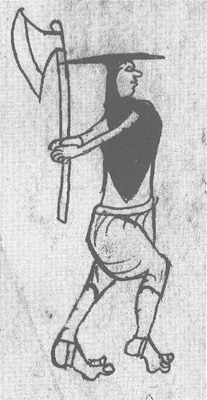
Irishmen, wrote Gerald of Wales in 1188, always carry an axe and are all too ready to use it. This thirteenth-century English representation of a barefoot Irish axeman reflects the view, widely held from the twelfth century onwards, that the Irish, like the Scots and Welsh, went ‘naked’ into battle. Their lack of armour left them so vulnerable to archery that they rarely got close enough to use the dreaded axe.
A similar process underpinned by the same economic and technological superiority occurred to the north-east of Germany, in Brandenburg and along the Baltic coast towards Mecklenburg. In the 1140s Count Adolf of Holstein drove many Slavs out of Wagria and sent messengers as far afield as Flanders, Holland, Frisia, and Westphalia to recruit new settlers. In Helmold of Bosau’s words ‘an innumerable multitude of different peoples came at his call, and bringing their families and possessions arrived in the land which he had promised them.’ Towns such as Lübeck were developed and by 1172 it seemed to Helmold that ‘all the country of the Slavs between the Elbe and the Baltic reaching from the River Eider as far east as Schwerin, once a dangerous wasteland, was now made into one great colony of Saxons, in which cities, villages and churches multiplied’. In the 1170s and 1180s the initiative lay with Danish fleets rather than with German knights. They destroyed Wendish sea-power, and by the 1190s were raiding the Estonian and Livonian coasts. In 1200 Riga was established as a trading centre and a base for further expansion. In the winning of the Baltic, Danes and Germans exploited the technological superiority given them by the cog, the new ship of the northern waters. In battle against traditional longships, the cog’s high freeboard gave it the advantage, maximized when the stability of its deep, heavy hull was used to build fighting castles fore and aft, and even a topcastle at the masthead—the quest for height in marine architecture (see Chapter 11, p. 236).
In the West population growth meant the end of labour-shortage and the end of slavery. In consequence from the twelfth century onwards when English and German armies invaded Celtic and Slav lands they no longer went hunting for human cattle. Celts and Slavs, however, living in more thinly populated regions still used slave labour and consequently, when they raided, they continued to target not just property but also the ‘civilian population’, especially women. This practice Westerners now condemned as barbarous. English and German awareness of the material and technological edge which they enjoyed over the Celts and Slavs whose lands they were occupying took on a moral dimension; this created an attitude of cultural superiority which was to have long-lasting consequences.
Twelfth-Century
Colonization and settlement played an increasingly important role in another theatre of war: Spain. Despite all their successes between 1086 and 1117, the Almoravids failed to recapture Toledo. Although it became an increasingly exposed frontier bastion, it held out. In part this may have been because the kings of Castile held the inner lines of communication, but it was also because with some success they pursued a policy of offering legal and tax privileges to settlers brave enough to settle in the hitherto underpopulated sheep- and cattle-raising country which was Toledo’s hinterland.
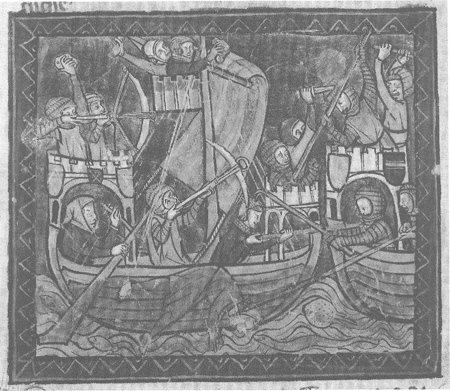
Castles at sea, fore and aft, and at the masthead, are shown in this picture of fighting at sea from a French version of Vegetius’ military handbook. Crossbows too are prominently displayed. When Anna Comnena commented on what she called these ‘diabolical machines’ of the Franks, noting their great range and penetrative power, it was in the context of a naval engagement.
At the same time more strenuous efforts were made to get help from across the Pyrenees—often from knights already familiar with the pilgrim road to Santiago, the camino francés (French road). According to al-Maqqari, in 1117 Alfonso I ‘the Battler’ of Aragon ‘sent messengers to the lands of France summoning all the Christian nations there to help him. Rallying to his call, they came to his standards like swarms of locusts or ants.’ Next year he captured Zaragoza—the first serious setback to be suffered by the Almoravids. In 1125 ‘the Battler’ led a great raid as far as Malaga and returned with, allegedly, no less than 10,000 Andalusian Christian families whom he settled in the Ebro Valley. His death in 1134 might have been the signal for a Muslim revival, but in its African bases the Almoravid regime found itself increasingly hamstrung by the opposition of a new and more fundamentalist sect, the Almohads. Under this pressure the Almoravid empire began to break up. In effect a second wave of taifa kingdoms swept across Spain—no less than 14 emerging between 1144 and 1146. With the return of Muslim political fragmentation, Christian rulers surged forward on all fronts. In 1147 Alfonso VII of Castile organized the grand coalition (contingents from Navarre, Aragon, and the Midi, fleets from Barcelona, Genoa, and Pisa) which captured Almeria, the main Muslim port for trade with Africa and the Eastern Mediterranean. In the same year Alfonso I of Portugal took Lisbon with help from English and Flemish crusaders. Ramon-Berenguer IV, count-king of Barcelona and Aragon, won Tortosa after long siege in 1148, then Lerida and Fraga in 1149. By 1151 Alfonso VII and Ramon-Berenguer had the confidence to plan a partition of all Spain between them.
But exactly as in the exuberant years after the capture of Toledo this confidence was misplaced—and for the same reason. Christian success precipitated decisive military intervention from North Africa. The Almohads arrived in 1148, swiftly winning control of Muslim city-states (only the kingdom of Murcia and Valencia ruled by an adventurer known to Christians as King Lobo, retaining its independence for long). The Almohads recovered Almeria in 1157 and three years later founded Gibraltar to give them a secure bridgehead in Spain. The Christians remained on the defensive, again relying on their capacity to attract settlers to hold on to newly-won lands such as the New Extremadura and New Catalonia. Just as in the crusader states the Military Orders (see further,Chapter 5, p. 95) were called upon to retain control of exposed regions, so a similar need here led to the foundation of the Orders of Calatrava (1164) and Santiago (1170). But the Almohads clearly held the upper hand whenever their caliph himself was free to campaign in Spain, as in 1171–6 and 1195–7. In the early 1170s King Lobo was overthrown. In 1195 Caliph Ya’qub won a great victory over Alfonso VIII of Castile at the battle of Alarcos. With Christian Spain in disarray as old rivalries led the kings of Leon and Navarre to ally with the Almohads, rumours spread through Europe that 600,000 Africans were about to march across the Pyrenees. In fact the threat which Almoravid fleets operating from Majorca posed to the African coast and Almoravid success in fomenting revolt in Tunisia led Ya’qub to grant Castile a truce in 1197. For the moment the mainland Christian states were saved. But with the conquest of Majorca in 1203 the Almohad advance resumed. Although the Christians now held roughly twice as much territory in Spain as in 1000 and crucially had held on to some of their greatest gains—notably Toledo, Zaragoza, and Lisbon—in 1200 it was by no means certain that they would not go the way of Valencia and Almeria. Where ‘the empire of the Franks’ confronted the Muslim world, in Spain as in the crusader states, the century ended with signs that it might be tottering (but see Chapter 6, pp. 117–18).
The Lure of Land and Loot
Everywhere else, however, the frontiers continued to be pushed back. In Ireland the English crossed the Shannon and began to take over the kingdom of Connacht. A new military order founded c.1202 at Riga by a German bishop, the Brothers of the Knighthood of Christ in Livonia, brought an intensely religious drive to the penetration of the Baltic lands. More than earlier German soldiers and settlers had done, the Sword-brothers—as they were commonly known—insisted that pagans, especially Livs and Prussians, must be converted to Christianity. But most dramatic of all was expansion at the expense of fellow Christians. The Fourth Crusade’s capture of Constantinople (1204) by an army originally intended for Egypt, amounted, at least according to Geoffrey de Villehardouin, one of the crusade’s leaders, to ‘the conquest of the greatest, most powerful and most strongly fortified city in the world’. In what he called ‘the grandest enterprise ever’ a decisive role was played by the Venetians, first in financing the crusade and building a fleet, and then in using it to strike at the very heart of a rich and ancient empire in crisis. ‘Geoffrey de Villehardouin here declares that, to his knowledge, so much loot has never been gained in any city since the creation of the world.’