
IN THE year 1300, the royal clerk Pierre Dubois composed an insightful work of military theory, the Doctrine of Successful Expeditions and Shortened Wars, for his monarch, King Philip the Fair. The central theme of the essay was that a new approach to military strategy had to be developed, because the two most common methods of using armed force against rebels or other enemies, battle and siege, had ceased to be effective. Siege warfare did not get the job done, because the castles and fortified cities which dominated the landscape of medieval Europe were too strong to be taken by assault; they could be captured by a regular siege, but this was excessively costly in time and money. ‘A castle can hardly be taken within a year,’ explained Dubois, ‘and even if it does fall, it means more expenses for the king’s purse and for his subjects than the conquest is worth.’ The problem with battle, on the other hand, was that the royal army of France had become so overwhelmingly powerful that no one would dare stand up to it in open combat. An enemy faced by the advance of the Capetian host would simply retreat into his fortresses, and rely on their strength to make up for his relative lack of men-at-arms; then the king would be back to the problems of siege warfare. Dubois’s resolution of this dilemma was an intelligent one, which would find much application in the practice of fourteenth-century warfare: if enemy armies hid behind stone walls, and fortresses were too strong to capture efficiently, then the solution was to direct one’s efforts against softer targets, namely the villages of the countryside and the crops in the fields. By invading just before the harvest, the French could destroy the grain, vines, fruit trees, and other elements of the agricultural economy of their enemies, who would thereby be brought promptly to heel. Dubois thus set out the basic strategic problems which the strong superiority of the defensive in thirteenth- and fourteenth-century siege warfare posed for offensive strategy, and also highlighted the most effective method by which an army superior in the field could employ its strength against an enemy anxious to avoid the test of open battle. He was, however, dramatically wrong about one thing: as all of France was soon to learn, the royal host was not so invincible as he thought. This lesson was delivered by teachers most unexpected-the weavers, shopkeepers, and artisans of Flanders.
By the beginning of the period covered in this chapter, the ferocious Flemish mercenaries who plagued England in the twelfth century had long since faded from the scene. The infantry troops of fourteenth-century Bruges, Ghent, and Ypres were quite different from their predecessors. Organized largely along guild lines into regular, uniformed militias, they were surprisingly well equipped, typically protected by mail haubergeons, steel helmets, gauntlets, shields, and often even coats of plates, and armed with bows, crossbows, pikes, or goedendags. These unique weapons (the name means ‘hello’ or ‘good day’) consisted of a thick, heavy wooden staff four to five feet in length, tipped with a lethal steel spike. Many of the militiamen thus armed had seen repeated service during the last decade of the previous century, thanks to the frequent conflicts between Flanders, Hainault, and Holland, and deserve to be considered veterans.
Their experiences in those campaigns, however, did not include anything like what they had to face on the hot summer afternoon of 11 July 1302. In that year the cities of Flanders, with the exception of Ghent, were in rebellion against the King of France, who had therefore dispatched an army of 2,500 men-at-arms and 8,000 infantry to break their siege of Courtrai castle, rescue the beleaguered French garrison, and suppress the revolt. King Philip probably did not anticipate that this task would involve a battle, for the Capetian army was incomparably superior to the Flemings in men-at-arms, and heavy cavalry was the acknowledged arbiter of battlefield victory or defeat. Yet, when the French troopers approached the encircled town, their enemies did not flee before them or retire behind protective fortifications. Instead, they withdrew to a carefully selected position on marshy ground outside the city, a spot where streams and ditches posed an obstacle to any attacker and protected their flanks, then drew up in battle formations with the River Lys at their backs and stood ready to greet their adversaries.
The communal infantry were ordered in four divisions, with three in line and a fourth in reserve positioned to block a sally by the besieged garrison. The soldiers were packed into a dense array, about eight deep, grouped by region and craft so that each man knew his comrades well, a factor understood to enhance morale and cohesion. Their goedendags, supplemented by longer pikes in the foremost row, made a bristling hedge of wood and steel in front of them. Broad rectangular banners marked the positions of the various guilds-here a hammer, there a mason’s trowel, over there a ship. Farther forward towards the French, archers and crossbowmen were dispersed.
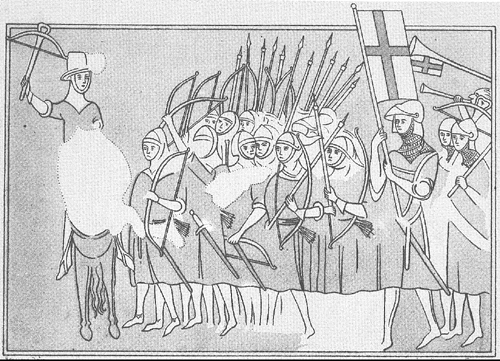
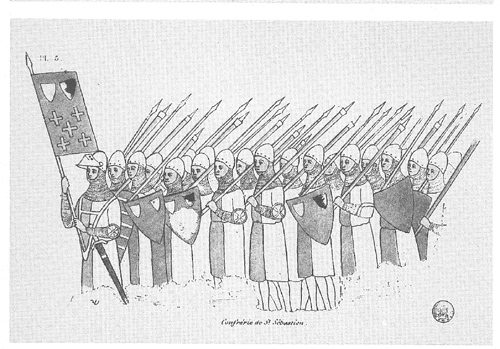
The army of Ghent, c.1346. The men with shortbows and goedendags in the upper panel are the ‘White Hoods’. Behind them march members of the guild of St George, armed with cross-bows. The guildsmen depicted in the lower panel are typical of the Flemish soldiers (or other urban militiamen) of the fourteenth century.
The resolute appearance of the militiamen was enough to give pause to some of their enemies. In a council of war, one French leader suggested breaking up the Flemish formation with crossbow fire; another advised simply letting the townsmen stay where they were until they were exhausted by standing, fully armed, in the hot sun. The majority, however, saw the situation as an unexpected opportunity to gain a decisive victory of just the sort of which Dubois had lamented the rarity. They insisted on a quick attack, lest the Flemings change their minds. So, early in the afternoon, the crossbowmen of the Capetian host advanced to engage their opposite numbers with long-range missile fire. They had largely succeeded in driving the Flemish skirmishers back behind the shelter of the heavy infantry when Robert of Artois, the French commander, ordered his cavalry forward.
Aside from their lances and swords and the great helms which covered their entire faces, the French men-at-arms were not equipped very differently from the men who awaited them on foot. There were, however, two critically important distinctions between the forces about to come to blows. First, the men-at-arms, whether knights or esquires, were nobles, members of the second order, the bellatores, whose primary raison d’être (according to medieval political theory) was making war. Second, they were mounted on large, powerful warhorses, protected by ‘trappers’ of thick-quilted cloth, or even by mail, and painstakingly trained to charge straight forward even into a seemingly solid line of men or other horses. The stallions, like the proud men atop them, had come to assume that infantry would not stand against them, that the wall of flesh and bone which stood facing them would dissolve before they smashed into it. Then, once they had broken into the enemy formation, the men-at-arms would be riding high above a milling mass of panicky shopkeepers and artisans, who would benefit from their numbers no more than a dozen sheep beset by four wolves.
The same images would doubtless have run through the minds of many of the militiamen. Yet these were not raw levies with no experience of war, and they knew that, with a river at their backs, they could not save themselves by flight. They had nothing to gain by breaking their formation, and everything to lose, for everyone knew that an unwavering array was the key to victory. So they stood steady in their tightly formed ranks: they stood and watched the chivalry of the most powerful nation in Europe form into line, banners and pennons unfurled, trumpets blaring, steel flashing. It is difficult to imagine the sound of 2,500 heavy horses trotting forward all at once, but surely the thunder of their hooves, blended into a cacophonous din with the war-cries of the riders—Montjoye! St Denis!—must have struck the motionless infantrymen with an almost physical impact.
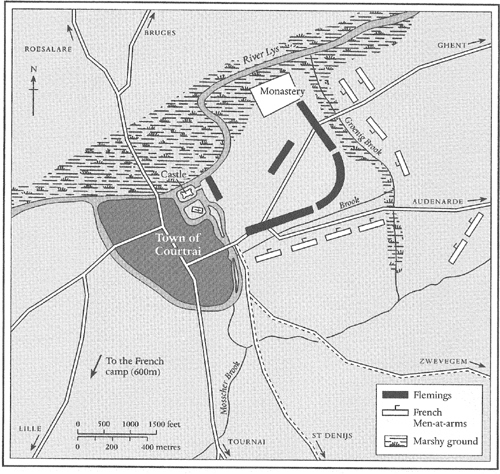
PLAN OF BATTLE OF COURTRAI, 1302
Some of the knights and esquires may also have had to struggle with fear as they rode forward, locked into their places in the French line, like the men-at-arms described in the fourteenth-century The Vows of the Heron:
When we are in taverns, drinking strong wines, at our sides the ladies we desire, looking on, with their smooth throats… their grey eyes shining back with smiling beauty, Nature calls on us to have desiring hearts, to struggle, awaiting [their] thanks at the end. Then we could conquer… Oliver and Roland. But when we are in the field, on our galloping chargers, our shields ‘round our necks and lances lowered… and our enemies are approaching us, then we would rather be deep in some cavern.
More, however, probably experienced emotions more like those described by Jean de Bueil in the fifteenth century:
It is a joyous thing, war… You love your comrade so much in war… A great sweet feeling of loyalty and of pity fills your heart on seeing your friend so valiantly exposing his body… And then you are prepared to go and live or die with him, and for love not to abandon him. And out of that, there arises such a delectation, that he who has not experienced it is not fit to say what delight is. Do you think that a man who does that fears death? Not at all, for he feels so strengthened, so elated, that he does not know where he is. Truly he is afraid of nothing.
Caught up both emotionally and physically in the onrush of their line, the French cavalrymen jumped the brooks in front of them at speed, then roared forward. Some stumbled and went down, for the ground was very muddy and criss-crossed with irrigation ditches and trench-traps dug by the Flemings. The horsemen drew nearer and nearer to a collision, accelerating to a gallop from about fifty yards out. When they saw that the line of infantry did not break, did not waver, some of the men-at-arms must have lost their nerve at the last minute, and tried to turn aside before impaling themselves and their horses. Formed as they were into a tight line, however, this would only have produced chaos, for turning aside meant running into their comrades next to them, and perhaps being struck by the second line coming up behind them. Others, confident to the last or simply beyond caring, pressed on until their mounts hit the pikes which the militiamen held with their butts firmly grounded in the earth. Some of the Flemings went down, pierced by a knight’s lance or trampled under a destrier’s metal-shod hooves, but with eight-deep files the fallen could rapidly be replaced and the line restored. The French charge collapsed into a jumbled mass of screaming horses, cursing men, spraying blood, and splintered wood.
After a period of confused mêlée, the militiamen went over to the attack. They outnumbered the cavalrymen several times over, and still had their formation intact; the men-at-arms, on the other hand, were demoralized and had lost their cohesion and momentum. The Frenchmen were driven back, despite a counterattack by their reserve which almost succeeded in turning the tide of the battle. When the retreating horsemen backed up against banks of the brooks which they had crossed with some difficulty in their advance, their situation became desperate. Those who survived soon fled, followed by the panicked footmen of the Capetian host, who had no stomach to face the men who had just defeated their masters. The Flemings pursued on foot as best they could, striking down whatever fugitives they laid their hands on.
Over a thousand noble men-at-arms perished in this battle, ‘the glory of France made into dung and worms’, a proportion which would have been considered terribly high even in the American Civil War or the Great War, and which was absolutely stunning in an era more accustomed to the low casualties of battles like Brémule or Lincoln. As Norman Housely observed in the preceding chapter, this sanguinary battle provides a convenient marking point for the end of the style of warfare that reached its peak in the thirteenth century. The first clang of the death-knoll of heavy cavalry as the dominant force on the battlefields of Western Europe had sounded.
It took some time, however, for the new military era to eclipse the old one entirely. The victory of the Flemings at Courtrai owed much to favourable terrain and the overconfidence of their opponents, and over the following years the French, proceeding more cautiously, did much better, temporarily suppressing the rebellion of Flanders after their victory at Cassel in 1328. And yet all of Europe had taken note of the townsmen’s victory. The Scalacronica specifically notes that the Scots at Bannockburn, where their pikemen crushed the chivalry of England in 1314, were imitating the tactics of Courtrai, and the same appears to be true for the infantry of the Catalan Company which won the battle of the Kephissos against the ‘Frankish’ Duke of Athens in 1311. Perhaps the Swiss halberdiers who ambushed and destroyed an Austrian army of men-at-arms in the Alpine pass of Morgarten in 1315 were also inspired by the Flemings. In any case, a sort of chain reaction had begun. By 1339, the Swiss at Laupen employed formations and tactics similar to those of the militiamen of Courtrai to win an important victory over a superior enemy. The English, having learned their lesson at Bannockburn, chose ‘contrary to the customs of their forefathers’ to fight on foot at Dupplin Muir (1332) and Halidon Hill (1333), where they wiped out two successive Scottish armies. Wings of archers armed with powerful yew longbows with draw weights of a hundred pounds and up were angled forward from central bodies of tightly massed dismounted men-at-arms; when the Scots attacked they were shot down by the thousands and cast into complete disorder by the archers, leaving the survivors with no hope of breaking through the serried ranks of the English men-at-arms (see further, Chapter 9, pp. 203–5). The French, in their turn, after being severely defeated by the English at Crécy (1346), chose to fight mainly on foot at Poitiers (1356) and thereafter. The Black Prince brought the new tactics into Iberia, where they gave him and Pedro the Cruel victory at Nájera (1367); similar methods ensured a second Castillian defeat at the hands of the Portuguese at Aljubarrota (1385). From then until the end of the middle ages, the thunderous charge of heavy cavalry was a rare sight on medieval battle-fields, and was successful even more rarely.
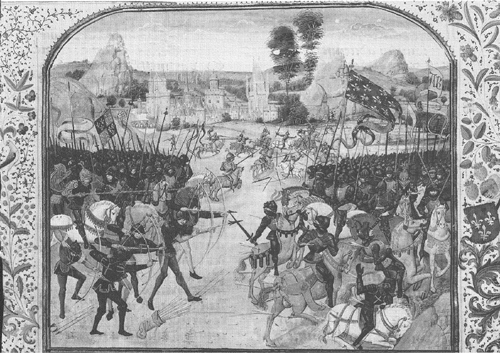
Looking at this detail from a fifteenth-century depiction of the battle of Poitiers, it is easy to see one reason why English armies of the fourteenth century were able to rack up a truly remarkable string of battlefield victories, triumphing over much larger enemies at Dupplin Muir, Halidon Hill, Crécy, Poitiers, Nájera, and elsewhere. A good archer could easily fire five arrows in the time it took a mounted man-at-arms to charge home from out of bow range, and those arrows could wound and madden a horse even at extreme range. At close range, a clothyard shaft could strike down a warhorse or penetrate armour to kill its rider.
This ‘Infantry Revolution’ of the fourteenth century involved far more than just the matter of whether men chose to fight on horseback or on foot: it also led to changes in cultural attitudes towards war, chivalry, social class, and political participation, and alterations in the composition and recruitment of armies. The key fact was that pikemen and archers were usually drawn from the common populace, rather than the aristocracy. Although some of the ‘infantry’ troops of the late middle ages, including the renowned English mounted archers, were provided with horses, they did not ride into battle. Thus, they needed only cheap hackneys to provide them with strategic mobility, rather than trained warhorses which typically cost from five to twenty times as much, or even far more: one destrier purchased by Edward III in 1337 cost the fabulous sum of £168, the equivalent of over eighty years’ income for a prosperous peasant family. The infantrymen also typically made do with much simpler and less expensive armour (in comparison with the ever-more-elaborate plate armour of the men-at-arms), and expected far less luxury while on campaign. Furthermore, infantry armed with pole-arms (halberds, bills, pikes, etc.) did not need to invest anywhere near the ‘human capital’ required to train a knight or esquire to fight effectively on horseback. All this was reflected in the lower wages they received: in England a mounted archer earned only half as much as a man-at-arms, while a Welsh spearman could be hired for just a sixth of an esquire’s pay. So long as money was available for wages at these levels, moreover, a power fighting a popular war could find an almost limitless supply of soldiers, since infantrymen were drawn from the mass of the population rather than the elite 2–4 per cent at the top of the social pyramid who provided the bulk of the heavy cavalry. France was so populous and so wealthy that her monarchs could continue to field armies composed mainly of men-at-arms (who after 1346 typically fought on foot, mounting only for pursuits and occasional skirmishes) despite their cost, and the same was at least partially true for the Italian states, who used their commercial wealth to hire cavalry-heavy mercenary companies (condottieri), but-as at Courtrai—the lower cost, easy availability, and great effectiveness of common infantry now made it possible for smaller powers to stand up to their more powerful neighbours, a fact contributing significantly to the frequent particularistic rebellions of the period, which led to greater independence for the Scots, the Portuguese, the Flemings, the Frisians (whose infantry defeated the men-at-arms of the count of Hainault at Staveren in 1345), and the Swiss, among others.
One side effect of the rising importance of common infantry was that the European battlefield became a much more sanguinary place than it had been. Noble combatants of the high middle ages expected to be taken for ransom rather than killed if defeated in combat, and battles of the twelfth and thirteenth centuries often involved no more than a few dozen deaths. Common troops, however, could not afford to pay ransoms large enough to be worth the bother, even if their inferior armour allowed them to survive long enough to surrender. In addition, the weapons and the close-order tactical systems of the new style of combat made it relatively difficult to take captives. Finally, class antipathy between noble and commoner often led to remarkably blood-thirsty behaviour by both sides. The Swiss, for example, were famous for never giving quarter: such was their ferocity that it was considered necessary, in a regulation of 1444, to forbid them from tearing out the hearts of their dead enemies. The French men-at-arms who (fighting on foot) defeated the Flemings at Westrozebeke, on the other hand, ‘had no mercy on them, no more than if they had been dogs’. In contrast to the five knights who perished during the year-long Flanders war of 1127 (only one of whom was actually killed by the hand of an enemy), the death-toll at Agincourt on St Crispin’s day of 1415 may have approached 10,000 men. (See the illustration from the Holkham Bible in Chapter 9, below p. 204, for an image of battlefield mortality.)
These casualties tended to be suffered almost entirely by the defeated army, especially after its formation had been broken. For infantry fighting hand-to-hand, the key to keeping losses to a minimum, and also the key to gaining the victory, was to maintain a good, solid, tight formation, ‘in such close order that one could hardly throw an apple among them, without its falling on a bascinet or a lance’. In the words of the fourteenth-century chronicler Lopez de Ayala, good order was ‘the most important thing in the world for gaining an advantage over one’s enemy’; on the other hand, wrote another contemporary, ‘those who are not in ordered formation are easy to defeat.’ ‘Two great evils’, explained Christine de Pisan around 1409, ‘. . . can follow from a disordered formation: one is that the enemies can more easily break into it; the other is that the formations may be so compressed that they cannot fight. Thus it is necessary to keep a formation in ranks, and tight and joined together like a wall.’ Of course, it was much easier for soldiers to keep such an array if they were standing still than if they were tramping over difficult ground, jumping irrigation ditches or hedges, all the while holding their heads down to keep arrows away from their ill-protected faces. Thus, there was a great advantage to be gained by holding to the tactical defensive. As Jean de Bueil wrote in the late fifteenth century, ‘a formation on foot should never march forward, but should always hold steady and await its enemies... A force which marches before another force is defeated, unless God grants it grace.’
By the late fourteenth century, when this illumination was painted, men-at-arms normally fought on foot, rather than on horseback. Contemporary artists, however, continued to depict battle scenes as dramatic clashes of mounted knights. Because the combat shown here took place on a bridge, the artist gave us a rare glimpse of how fourteenth-century men-at-arms actually deployed and handled their weapons when fighting as heavy infantry. As usual in medieval infantry battles, the defenders (left), able to maintain better order, ultimately won the fight (near Ivry, July 1358).
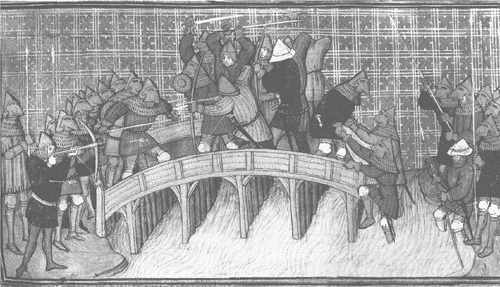
The defensive is inherently the stronger form of warfare, and this was especially true in the late middle ages, when this tactical superiority of the defence was combined with the equally great advantage enjoyed by the defensive in siege warfare (at least until the 1420s, when gunpowder artillery began to reverse the balance). For a belligerent with defensive aims, this made a Fabian strategy of the sort recommended by the late Roman author Vegetius (whose work was the most popular military handbook of the middle ages, frequently translated into the vernacular and borrowed heavily from by ‘popularizers’ like Alfonso the Wise of Castille and Christine de Pisan) potentially very effective. Philip VI of France, for example, took this approach when his kingdom was invaded by an Anglo-Imperial army under Edward III in 1339. The campaign, the first major one of the Hundred Years War, opened with a siege of Cambrai, but this was abandoned after just nineteen days, as the invaders had not made adequate logistical provisions and were running out of supplies, and the city was too strong to be taken by assault. Edward then rode through the Cambrésis, Vermandois, and Thiérache burning and plundering the countryside in an effort to provoke King Philip into giving battle, but despite the destruction of nearly two hundred villages and a few larger towns, the French resisted the temptation to attack his army. Instead, Philip’s troops blocked any supply columns from reaching the Anglo-German army and implemented a virtual scorched-earth policy to hinder the invaders further. After a stand-off in which each side occupied a strong position in the unfulfilled hope that the other would accept the disadvantages inherent in taking the tactical offensive (a quite common occurrence during this period) the campaign simply fizzled out. Philip had suffered a severe blow to his kingly reputation, but Edward had expended a huge fortune and a full campaigning season without making any concrete gains. As Philip’s counsellors dryly remarked, ‘if the King of England wanted to conquer the realm of France, he would need to make a large number of such chevauchées.’
This campaign provides a concrete illustration of the problem sketched out in general terms by Dubois a generation earlier, but with a significant twist: in this case it was the weaker power which was strategically on the offensive, and so eager for battle, while the stronger army, Philip’s, was unwilling to make an attack even though its enemies did not retreat behind stone fortifications. In a development not foreseen by Dubois, the walls formed by steady infantry formations had come to be almost as invulnerable as permanent fortresses. The 1339 campaign also illustrates, however, that relying on the tactical defensive in pursuit of aggressive war aims was likely to lead nowhere unless it was combined with a strategy that somehow persuaded the enemy to cooperate by taking the tactical offensive. Medieval commanders in this situation relied mainly on two techniques to pressure their adversaries into doing just that, both of which were attempted, unsuccessfully, by Edward III in the campaign discussed above. One was to besiege an important city or castle until it was about to fall, so that its owner had to make a move in order to rescue it; the other, as suggested in the Doctrine of Successful Expeditions and Shortened Wars, was to devastate the lands unprotected by city walls, so that the defenders would have to attack to stop the destruction.
Edward III preferred the former of these two approaches. He used it successfully in 1333 (drawing the Scots to attack his position at Halidon Hill by besieging the city of Berwick), and tried it again in 1339, 1340, and 1346–7, with the sieges of Cambrai, Tournai, and Calais, respectively. The biggest problem with this strategy however, was its cost. As noted above, a well-defended and well-fortified city could hold out against a siege for many months, and during that time the besieger had constantly to maintain an army large enough to withstand a relief army’s attack. In some ways the rise of the infantry helped reduce this problem, for foot soldiers were far cheaper than men-at-arms, but this advantage was largely counteracted by the need to have them in large numbers: as Commynes said of archers (though it would be equally applicable to pikemen) ‘in battles they are the most important thing in the world, but only if they are strong and in large numbers, because a few of them are useless.’ The rising importance of the foot troops, thus, brought not only the opportunity but also the need to expand armies substantially. Thus, as early as the late thirteenth century, we can observe Edward I campaigning at the head of armies incorporating tens of thousands of paid archers and spearmen; by the time of his grandson, the English government’s capacity to manage military endeavours had increased to the point where forces of that size could occasionally be maintained for several months, even across the Channel. This represented a major change in approaches to recruitment, organization, and above all pay.
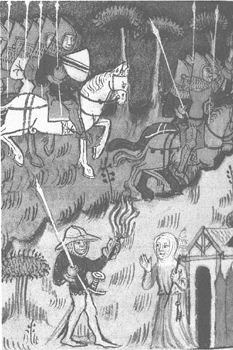
the devastation of the countryside was a normal part of medieval warfare, and fire was the soldiers’ main tool in the work of havoc. A woman might have her house burned as retribution for failure to pay ‘patis’ [protection money] to enemy garrisons, or for failure to pay taxes or levies to support ‘friendly’ garrisons, or by an invading army bent on provoking the defending army into giving battle, or by a defending army trying to create a wasteland in which the invaders could not operate.
The cost of supporting an army which averaged somewhere around 23,000 men for the two-month siege of Tournai in 1340, for example, mounted to roughly £60,000 in soldiers’ wages alone; the total expenditure was several times that large. The annual peacetime revenues of the English crown at the start of Edward Ill’s reign, by contrast, were in the area of £30,000–40,000. It is easy to see why this style of warfare strained the resources of any medieval state, even the best organized (like England) or the richest (like France) to the very breaking point, and sometimes beyond. Over the course of the last century of the medieval period, army size did fall off from the peaks achieved just before the Black Death, partly because of the rise of mounted infantry troops (who were more expensive than regular infantry, though still paid only half as much as heavy cavalrymen) and partly because of the general decline in population. The levels of military expenditure, however, remained very high.
In fact, the rapid increase in the scale and costs of making war which characterized the end of the thirteenth and start of the fourteenth centuries was, in terms of its impact on society at large, perhaps the most important aspect of the period’s military developments. It was only with the greatest possible effort that the monarchs of the time were able to bear the financial burdens of war, but war gave them the greatest possible incentive to make those efforts. The following passage from a contemporary chronicle vividly illustrates the financial difficulties of the French monarchy at the start of the Hundred Years War. The chronicler also, unwittingly, indicates the equal fiscal problems of the English king, for in fact the reason for the inactivity of Edward’s allies was his failure to pay them the subsidies he had promised:
And because the King of England received no help from his German allies—even though he had paid all too dearly for it—he could do nothing, and did not try to accomplish anything further. And the King of France, leaving some men-at-arms on the frontiers, returned to Paris and gave leave for his army to depart. And because of the assembly of that army, he taxed his people very severely, for he made them pay double the subsidy which they had to pay the year before. And the tax collectors said that this was for thearrière-ban [the call-up of the militia] which had been proclaimed at the beginning, but in truth it could not be said to have been a real arrière-ban, because the army never actually went forth. And besides this common tax, everyone was required to take part in musters of arms. Then it was put to the rich men that they were not sufficiently equipped, and that they would therefore have to pay certain fines. In this year [1338], Pope Benedict granted the tithes for two years from the churches to the King of France, on condition that he not demand any other subsidy from the clergy; but the condition was not met, for there were few clerics of whatever estate or condition who didn’t have to make some other aid to the King. He even asked of his own clerks of Parlement, of the chamber of inquests, and of the chamber of accounts, and even of the knights of his household, that they lend him their silver vessels in order to make coins. This they did and so he struck a great deal of money, and then before the year was over he returned to them the silver, according to the measurements which had been taken. And he continually lessened the silver content of his coinage, and so made florins out of pennies.
As expedients and emergency measures became regularized, and as taxpayers grew accustomed to year after year of heavy impositions, the agonizing stretches of the early years of the Hundred Years War became routine. By the end of the fourteenth century, taking taxation into account, the average annual revenues of the crowns of France and England had grown very substantially—a fact all the more remarkable when one considers what it meant in terms of per capita taxation over a period when the population fell by nearly half due mainly to the repeated visitations of the Black Death from 1348 on.
In England, the monarchy’s greatly improved ability to squeeze money out of the community of the realm without engendering radical opposition from the taxpayer was largely the result of King Edward’s superb skill in building a political consensus in favour of his policies, exercised in the rising institution of Parliament, which owed its increasing importance in this period directly to the government’s need for vast sums of money in order to fight the war with France. At various times Edward had tried a number of expedients aimed at extracting money or military service against popular opposition, and had been forcefully reminded of the limited coercive powers provided by a fourteenth-century state apparatus, even one as relatively well developed as England’s. Thus, in general he was careful to secure the co-operation of the Commons in his efforts to raise the huge amounts of cash required by his initial strategy for fighting the Hundred Years War, which involved paying massive subsidies to the Continental allies who provided the great majority of his soldiers in 1339–40.
The story of the three Parliaments called between October 1339 and May 1340 provides the best illustration of the interrelationships between war finances and the rising importance of the Commons. At the first of the three sessions, the royal governmentrequested a large subsidy in order to pay some of the debts arising from the just-finished Cambrésis campaign, and to make possible a renewed effort in the spring. The Commons complained of the heavy taxes they had already paid, and took the highly unusual step of refusing to grant an aid until they had returned to their communities to get popular approval for a new subsidy. When Parliament met again in January of 1340, the Commons agreed to a large subsidy of 30,000 sacks of wool, but only if the King would grant a list of petitions, the most significant of which were an audit of the accounts of all the royal ministers and tax-collectors, and the creation of a committee of Peers, answerable only to Parliament, to oversee future military expenditures. Since Edward was still on the Continent, his representatives could only agree to forward the Commons’ offer to him, and dismiss the Parliament until May. Then the assembly was told of the massive debts the prosecution of the war had created, and
how our lord the King needed to be assisted with a great aid, or he would be dishonoured forever, and his lands on both sides of the sea in great peril; for he would lose his allies, and he would have to return personally to Brussels, and remain imprisoned there until the sums for which he was obligated had been fully paid. But if he were granted an aid, all these difficulties would cease, and the enterprise which he had undertaken would be brought, with the help of God, to a good conclusion, and peace and calm restored for all.
There was some compromising on both sides, and after the King accepted a somewhat reduced list of petitions (which did however include the audit of his officials’ accounts by a parliamentary committee) the community of the realm granted him a tithe of the wheat, wool, and lambs produced in the counties, and a ninth of the goods of the burgesses. This process, notes G. L. Harriss, marked ‘the first emergence of the Commons as an independent political force’. By 1369, thanks to the continuing demands of war finance and recruitment, the MPs elected by the free landholders of the shires had secured all the powers they were to hold for the next two hundred years.
However willing and effective Parliament might be as a tool for raising revenues, however, it simply could not sustain costs like the ones stemming from the Low Countries campaigns of 1339 and 1340. As Dubois had predicted, a siege-based strategy had proved both ineffective and ruinously expensive. Thus, when the war reopened in 1346, the English turned to a new strategic approach. In 1346, 1349, 1355, 1356, and 1359 Plantagenet troops launched major chevauchées into almost every corner of France, laying waste broad bands of territory (typically some fifteen miles wide) along the lines of their passage. Once the armies reached areas away from the heavily defended frontier areas, they were able to destroy sizeable towns and even cities as well as the smaller settlements of the countryside: on the Crécy chevauchée, for example, the towns of Caen, Cherbourg, St-Lô, Lisieux, Barfleur, Carentan, Valonges, Gisors, Vernon, Poissy, St-Germain-en-Laye, St Cloud, Pontoise, Poix, Longueville, Neufchâtel, Le Crotoy, and Étaples, and the suburbs of Beauvais, Montreuil-sur-Mer, and Boulogne, were all more-or-less destroyed, along with nearly a dozen others. In one of the two major chevauchées of 1355, the Black Prince rode from Bordeaux to the Mediterranean and back, destroying some 500 castles, towns, villages, and hamlets, along with Limoux and the suburbs of Toulouse, Carcassonne, and Narbonne, some of the largest cities of France. By 1359–60, when a large English army rode from Calais to Reims to Burgundy to Paris, France was left ‘overwhelmed, and trampled under foot’, ‘on the verge of destruction’, and ‘tormented and war-ravaged’ from one end to the other.
Devastation, as noted above, was an important method of provoking an enemy into giving battle. It was only the need to try to stop the destruction of their realm that led the French to fight (and suffer defeat) at Crécy in 1346 and Poitiers a decade later. Devastation served more purposes than that, however. It also enriched the raiders, demoralized and impoverished their enemies, and gave the people of the raided country (from bottom to top of the social hierarchy) an immediate and direct reason to desire peace, gained by accepting the invaders’ demands if it could not be achieved by defeating them in battle. In explaining why he had accepted the humiliating 1360 Treaty of Brétigny, which called for the surrender of a full third of France to English sovereignty, King Jean II made this clear:
because of the said wars many mortal battles have been fought, people slaughtered, churches pillaged, bodies destroyed and souls lost, maids and virgins deflowered, respectable wives and widows dishonored, towns, manors and buildings burnt, and robberies, oppressions, and ambushes on the roads and highways committed. Justice has failed because of them, the Christian faith has chilled and commerce has perished, and so many other evils and horrible deeds have followed from these wars that they cannot be said, numbered or written...
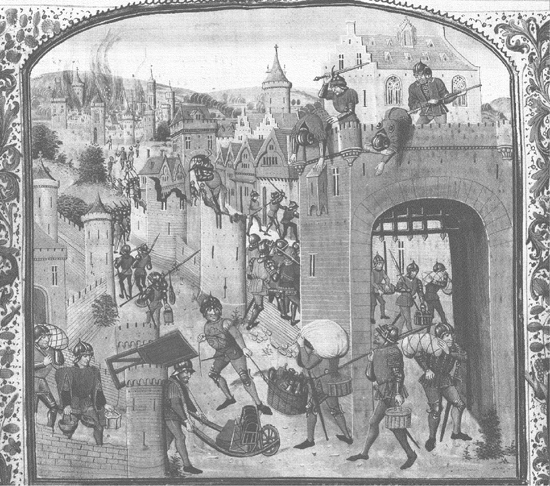
The Norman city of Caen was one of the many sacked and burned during Edward III’s Crécy chevauchée of 1346. ‘The tourn & the subbarbus vnto the bare wallys of al thing that myghte be bore & caryed out, was robbid and despoyled’, observes theBrutchronicle. The destruction of the city served both to enrich the English soldiers and to encourage other towns to negotiate surrenders instead of fighting until they were captured by assault, as Caen was.
Considering all this, ‘and that it seemed in truth that even greater evils could have followed in time to come’ if the war continued, he had been compelled to accept the English demands. The devastation of the North of England in the 1320s, similarly, led directly to the ‘Cowardice Peace’ of 1328, by which the young Edward III surrendered his claim to suzerainty over Scotland.
Thus, the direct inflicting of misery and harm on the enemy population was one of the three main tools in the hands of the medieval commander, along with battle and siege. This may seem surprising given the widespread modern idea of the late middle ages as a time of high chivalry, but the contradiction is a false one, for nothing in the late medieval conception of chivalry forbade direct attacks on the ‘civilian’ population, just as nothing prevented the bombing of Dresden or Nagasaki in the twentieth century: the population at large was seen as the mast of the enemy’s ship of state, and so a legitimate target of attack, for it was only by the support of the commons that a king could wage war. ‘If sometimes the innocent must suffer along with the guilty’ in such attacks, wrote Honoré Bouvet, ‘it cannot be otherwise’ (see further, Chapter 12, pp. 261–3).
One of the reasons, then, that a battlefield victory could yield decisive results was that it enabled the winning side to proceed with what H.J. Hewitt aptly called the ‘work of havoc’, with all its political implications, largely free from interference. Of course, that was no new revelation: the high stakes wagered in a general engagement were the reason for the popularity of Vegetian strategy for armies on the strategic defensive, as already noted. In the midto late-fourteenth century, the Scots and the French in particular refined this old strategic approach in order to trump the English chevauchée strategy which had proven so effective in the period up to 1360. This required two basic changes. First, the strategic defenders had to strengthen their resolve to avoid battle so that they could resist the pull of honour and the push of shame which impelled them towards fighting an invader. The many victories of defensively arrayed infantry armies from 1302 onwards made this increasingly practicable. Second, they had to reduce their physical vulnerability to devastation, lest they find themselves escaping the frying-pan of battlefield defeat only to burn up in the fire of economic and social collapse (like France in 1358–60). The French achieved this by making immense expenditures on two waves of re-fortification inspired by the events of 1346 and 1355–6, which secured the urban centres of the realm, and by improving their ability to ‘shadow’ an invading army, forcing it to keep concentrated and ready for battle (and thus preventing it from spreading out to inflict widespread destruction), which minimized the damage to the countryside. In the 1380s they persuaded King John of Castile to employ similar methods against the Duke of Lancaster’s expeditionary force:
We will make war wisely, by garrisons, for two or three months, or for a whole season, if need be, and allow the English and Portuguese to chevauchée through Galicia and elsewhere, if they can. If they conquer some towns, what of it? We will recapture the towns immediately, once they have left the area. They will only have borrowed them.… So the best way to decimate and defeat them is to decline to fight them, and let them chevauchée wherever they may.
The resolute pursuit of such a strategy by the defender, though it might be painful, left the attacking side little choice but to attempt a gradual conquest based on a series of sieges. If the fortifications dominating a given area could be captured and garrisoned, then control of that area would be effectively secured, and the burden of the initiative would be shifted to the other side to try to get it back. Such a ‘gradualist’ strategy was used for example by Henry V in his conquest of Normandy from 1417.
As Dubois had observed, however, capturing a strong castle or town by force was a ‘lengthy, dangerous, and arduous’ process, and expensive as well. A besieging army might harass the garrison by arcing trebuchet-stones over the walls, could try to overtop the walls with mobile siege towers or to slowly dig a mine under them, but none of these techniques was likely to make a rapid assault possible. Thus, by far the best way to capture such strongholds was simply to persuade the men guarding them to hand them over. This was most often accomplished through bribery, threats, or some combination of the two. It was common for a besieging army to engage in bombardment and assaults simultaneously with negotiations. Usually the attackers would threaten dire consequences if they succeeded in taking the place by storm, while promising favourable treatment for the garrison and inhabitants in case of an agreement to surrender. The longer the resistance, the less favourable the terms would generally become, and the greater would be the chance that the place would be captured by assault, in which case the defenders were usually slaughtered without mercy. If a garrison surrendered reasonably promptly, on the other hand, the soldiers could expect to be allowed to keep their accumulated plunder and take it with them under a safe-conduct escort to the nearest friendly fortification (see further, Chapter 8, pp. 182–3).
These pressures were set in balance with the defenders’ desire to hold out on their lord’s behalf as long as possible; over time the scales tipped more and more in favour of surrender, which was the ultimate outcome far more often than assault. Of course, this calculus was greatly influenced by each side’s assessment of the probability of a relief army coming to break the siege, of the strength of the fortifications, of the relative logistic problems facing the adversaries, etc. If an invading army was sufficiently strong, hope of relief sufficiently remote, and the enthusiasm of the defenders sufficiently low, whole regions could change hands through a series of negotiated surrenders in a single campaigning season. This style of warfare enabled the French, in the early 1370s, to reconquer most of the lands they had lost to the Plantagenets in 1360, and brought Normandy and Maine under English control in the years after Agincourt. When Henry V wanted to capture the castle of the town of Caen, where the garrison was holed up, for example,
he sent worde to the lorde Montayny beyng capitain, that if he would yelde the castle by a daie, he should depart without dammage. And yf he would be foolishe and obstinate, all clemencye and favor should be from hym sequestred. When the capitain and his compaignions had well digested his message, beyng in dispaire of comfort, upon the condicions offred, [they] rendred the Castle and yelded themselves.
The fall of a particularly strong fortress, if the prospect of a relief army remained remote, could trigger a wave of other surrenders. ‘When the renderynge of Roan [Rouen] was blowen throughe Normandy’ in 1419, for example, ‘it is in maner incredible to heare how manye tounes yelded not once desired [to surrender], & how many fortresses gave up wythout contradiccion.’
The two factors which played the greatest role in determining the success of military operations of this sort were probably reputation and the ability to raise or to fight off relief forces. The latter was important because the prospect of assistance was critical in inspiring defenders to hold out: if help was not on the way, or would clearly not be able to overcome the besiegers, then what were they holding out for? If it was inevitable that they would have to surrender, they might as well do it promptly and get generous terms, without enduring the discomforts of the siege or the risk of a catastrophic assault. Thus, in this situation, battlefield victories were neither necessary nor sufficient for conquest, but they were still highly advantageous. Henry V’s victory at Agincourt paved the way for his occupation of Normandy, though the battlefield victory had to be followed up with a determined and skilfully executed campaign of conquest lasting several years; after the English defeat at Formigny in 1450, on the other hand, it took only four months to eliminate the last vestige of Lancastrian control of the duchy. The second factor, reputation, was so important because, as already noted, most sieges ended with a negotiated surrender rather than with toppled walls and a bloody assault; thus, the struggle was as much a psychological as a physical one. The more the defenders saw their eventual surrender as inevitable, the more certain they were that they would be punished severely if they held out too long, and the more confident they were of receiving good terms if they gave up quickly, the shorter the siege would be.
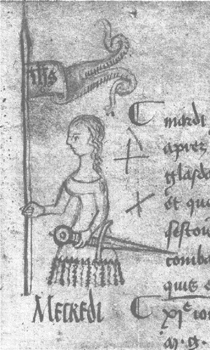
Just nineteen years old when she led a small army to break the siege of Orléans in 1429, Joan of Arc gave the Dauphin and his troops the confidence they needed to stand up to their English adversaries. Charles VII’s coronation at Reims, which she engineered, gave the Valois party a critical advantage over the young Henry VI, and marked a true turning point in the war. This drawing was made in 1429, but the artist was inaccurate in depicting Joan in women’s clothes and with long hair.
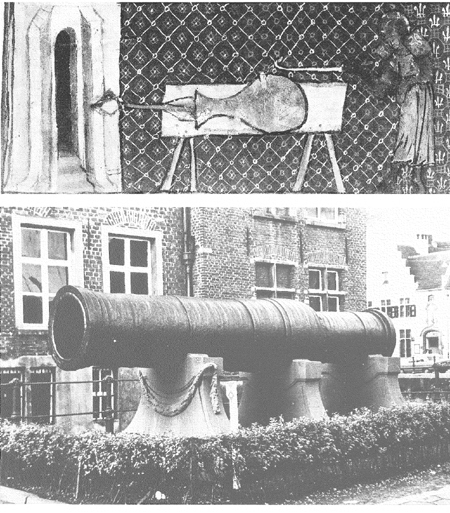
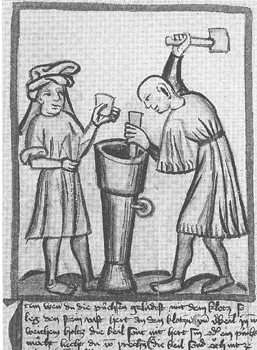
These three plates illustrate a century’s development in gunpowder artillery. The illumination (i) is one of the two earliest depictions of European cannon, dating from 1327. Vase-shaped guns firing bronze bolts quickly gave way to more tubular designs, like the one shown (iii) being loaded in this page from a German Master-Gunner’s Book of 1411. This type of bombard had a long, thin powder chamber behind a short barrel, typically (as here) with only slightly more length than diameter. Because of the short barrel, the gun ‘spat’ out the stone ball it fired, rather than accelerating it more smoothly; to make this practical, the opening of the powder chamber had to be plugged with a soft wooden cylinder (in the left hand of the figure on the left), and then the ball had to be wedged in place with three triangular wedges and covered with wet loam. The firing process was so slow, and the resulting trajectories so inaccurate, that one gunner who managed to hit three different targets in the same day was required to make a pilgrimage because it was thought he had to be in league with the devil. By the 1430s, large guns with much longer barrels were being built up out of wrought-iron hoops and staves. Guns like Dulle Griet (ii), firing stone balls weighing hundreds of pounds at higher velocities (thanks in part to the introduction of superior ‘corned’ gunpowder) had the power and accuracy to bring down castle walls.
In Henry V’s conquest of Normandy, the English developed a reputation for invincibility in battle and unwavering resolution in the prosecution of sieges that served them in very good stead for many years thereafter. The French were in a difficult situation: particularly after their defeats at Cravant in 1423 and Verneuil in 1424, they lacked the confidence to challenge English armies, and therefore left themselves no opportunity to win a victory which could restore to them the aggressiveness and élan without which they could not hope to reverse the tide of the war—even though English over-confidence gave them various opportunities for military success. That is why the appearance of Joan of Arc was so important. The Valois cycle of defeat and dismay had to be broken from outside, and the soldiers’ belief in divine intervention did the trick. Inspired by her to defeat the English siege army at Orléans in 1428, they shook off their sense of inferiority and resumed the war in a new military environment which now, as it happened, favoured them more than ever before.
The art of war had already begun to experience something of a sea-change in the years between Agincourt and the arrival of the Maid; this was largely due to the development of gunpowder artillery capable of knocking down strong castle walls (see further,Chapter 8, pp. 180–2). By this time, cannon had been in use in Europe for just over a century, but the early guns were far too small and weak to demolish fortifications. Instead they were used mainly as harassment weapons, lobbing large stones onto the roofs of houses within a besieged town and so increasing the misery of the defenders and encouraging them to surrender sooner rather than later. Over the years the guns grew slowly but steadily larger, until by around 1420 the largest of them fired stone balls weighing as much as 750 kg. Around the same time, a series of technological innovations (especially the development of more powerful ‘corned’ gunpowder) and design improvements greatly increased the efficiency of the guns. The most important of these was the simple step of lengthening the cannons’ barrels so that the ball was pushed by the force of the explosion for a longer period of time, increasing its muzzle velocity and so its accuracy and hitting power. This also meant that the wet loam seal formerly used to plug the ball in the barrel could be dispensed with, so the guns fired much faster. The net result was a radical increase in the practical usefulness of the heavy artillery. It had taken Henry V seven months to capture Cherbourg and six more to gain Rouen in 1418–19, despite his use of a siege train powerful for its time. In 1450, by contrast, only sixteen days were required to leave almost the entire wall of Bayeux ‘pierced and brought down’, while at Blaye a year later it took only five days until ‘the town walls were completely thrown down in many places’. As Pierre Dubois had observed a hundred and fifty years earlier, the superiority of the strategic defensive had in his day given the weak leverage to resist the strong, and reduced the value of the King of France’s battlefield might. This ‘Artillery Revolution’ of the fifteenth century tended to reverse that situation. Triumph in battle (as Guicciardini remarked when the siege trains developed in the crucible of the Hundred Years War took Italy by storm in 1494) came to be the virtual equivalent of victory in war, for now the value of the Vegetian approach to strategy was severely undermined, and defence had to be defence in the field.
At the same time when cannon were dramatically tipping the strategic balance in favour of the strong over the weak, and in favour of the strategic offensive over the defensive, they also began to alter the determinants of battlefield success. Defensive tactics remained dominant, and indeed the growing prevalence and effectiveness of gunpowder weapons tended to reinforce the advantages of the defence, by allowing nations not blessed with a recruitment pool of strong yeoman archers nonetheless to enjoy some of the tactical advantages which the longbowmen provided to English armies. The Bohemian Hussites in the 1420s and 1430s, for example, used cannon and primitive ‘hand culverins’ (ancestors of the arquebus) to help defend the mobile fortresses which they constructed on the battlefield by chaining together lines of war-wagons. One key difference, however, was introduced by the new weapons: now the side best provided with artillery could often compel its enemy to make an attack (or suffer interminable bombardment), and so secure for itself the advantages of the tactical defensive. By the end of the Hundred Years War, this finally provided the French with an effective counter to the English tactics which had led to Valois defeats from Crécy to Verneuil. The last two battles of the war, Formigny and Castillon, were almost the first full-scale, head-on fights to be won by the French, and in both their artillery played an important part.
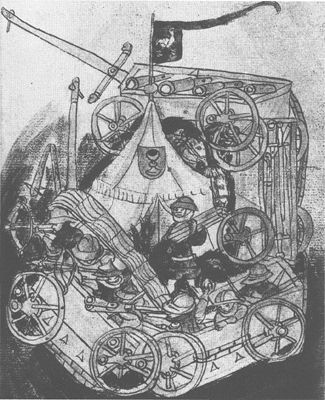
This contemporary drawing shows the essential features of the Hussite Wagenburg. Troops armed with crossbows, primitive handguns, maces and flails shelter behind their war-wagons, which protect them much as the wall of the city would. The barrel of another artillery piece can be seen guarding the opening at the front of the first (bottom left) wagon. Hussite victories made such war-wagons common in eastern and central Europe of the fifteenth century.
Since victory or defeat on the battlefield now had such great consequences (sieges having declined into relative unimportance), Western European rulers placed ever-greater emphasis on fielding larger and more professional armies. This trend is particularly noticeable at the end of our period, with the compagnies d’ordonnance of France and Burgundy, which will be discussed in the concluding chapter of this book. These standing forces were very expensive, as was a good artillery train, and in general only the richest rulers of Christendom could afford them. All of this favoured the central governments of large states who benefited from a ‘coercion-extraction cycle’ whereby a state’s military might enabled it to conquer new lands or impose new taxes on reluctant subjects, thus increasing revenues and funding a new increment of military might, and so on. Philippe de Commynes, the late-fifteenth-century soldier, politician, and historian, illustrated this circular process when he spoke of ‘a prince who is powerful and has a large standing army, by the help of which he can raise money to pay his troops’. This was a new military world, one dominated by what William H. McNeill dubbed the ‘Gunpowder Empires’: states whose powerful armies in combination with wall-toppling cannon enabled them to consolidate their power over particularist provinces and to gobble up their smaller neighbours. Two of the first states to set out on this path were France and the Ottoman Empire. In their respective campaigns of 1453 they employed armies spearheaded by permanent, professional troops and backed by skilled artillerists and large siege trains to effect conquests which were literally epoch-making. The earl of Shrewsbury’s army was wiped out by French gunners at Castillon, leading to the collapse of the pro-English rising in Gas-cony and (in retrospect) the end of the Hundred Years War. Meanwhile Mehmed the Conqueror, assisted by mammoth bombards among the largest ever manufactured, succeeded in the task which had frustrated his forebears for many years: the capture of Constantinople, the strongest-walled city in Europe. Thus did the ‘middle ages’ draw to their close, with thick clouds of black-powder smoke as their final curtain.