
Two battles fought near the start and end of this period provide us with convenient vantage points from which to begin an assessment of its characteristics. At Bouvines, between Lille and Tournai, on 27 July 1214, a French army commanded by King Philip II Augustus engaged a German-Flemish army led by the Emperor Otto IV and the count of Flanders. After a hard struggle involving a great deal of hand-to-hand fighting, Philip was victorious. The Emperor escaped, but the count of Flanders was captured and taken in triumph to be imprisoned in the Louvre. At Courtrai, south of Ghent, on 11 July 1302, an army mainly composed of the Flemish communal militias inflicted a crushing defeat on Robert of Artois’s French army, killing its commander and all the other leaders of the royal host. The French appear to have lost between a third and a half of their knights, and the gilded spurs of 500 of their dead were hung up as trophies in the church of St Mary in Courtrai.
Bouvines and Courtrai present us with both similarities and differences. The two battlefields lie no more than forty miles apart, their proximity serving as a reminder of the strategic importance for France of the Flemish plain and the provinces lying immediately to its south. On both occasions political circumstances overruled the well-known and justifiable reluctance of medieval commanders to risk engaging in battle. In 1214 Philip II confronted an extremely dangerous coalition: KingJohn of England, Otto IV, and Ferrand of Portugal, the count of Flanders. In 1302 French control over Flanders, established just two years previously, was imperilled by insurrection, the ‘Matins of Bruges’ of 18 May. Bouvines proved to be a decisive riposte to the challenge which Philip faced. The king saw off the German threat, confirmed his conquest of Normandy from England, and constructed a firm French hegemony over Flanders. Philip also garnered great personal renown from winning the first pitched battle which a French king had dared fight for a century; it should be added that the encounter almost cost him his life. On the other hand, the defeat at Courtrai proved to be much less important in its long-term consequences. King Philip the Fair reacted with energy to the humiliation and personally gained a victory over the Flemings at Mons-en-Pévèle two years later.

It was well-armed and disciplined foot-soldiers like these who in 1302 defeated Philip the Fair’s horsemen at the battle of Courtrai. This famous triumph of infantry over cavalry was an affront to the age’s sense of social order as well as a massive blow to a monarchy which stood at the height of its prestige and influence.
Both at Bouvines and at Courtrai the French relied primarily, though not exclusively, on their heavy cavalry. This proved disastrous in the latter engagement, but only because Robert of Artois refused to allow his skilled cross-bowmen to inflict enough casualties on the massed Flemish pikemen before launching his series of charges. Courtrai was a triumph over stupidity as much as a revelation of what infantry could achieve. Both battles reveal the essentially eclectic mixture of battle tactics which characterized thirteenth-century warfare, before the devastating impact of the English longbow on Continental war-making (see Chapter 7, p. 142; Chapter 9, pp. 203–5). Nor were there major changes in the way the French royal host was recruited for the two encounters, although the shock of Courtrai did induce Philip the Fair to attempt a revival of universal military service (the arrière-ban) as a means of mobilizing men and money more rapidly and effectively. In terms of tactics and organization, the historian searches in vain for a ‘military revolution’ in this period. Instead we detect developments more fragmented and subtle: the wearing of more plate mail in response to the spreading use of crossbows, the more sophisticated deployment of infantry, more formidable stone fortifications and hence more ingenious siege techniques, especially the widespread employment of the trebuchet from about 1200 onwards (see Chapter 5, p. 109; Chapter 8, p. 174). Above all, behind these changes we see the pervasive impact on warfare of government, as the latter became more centralized, ambitious, and demanding. European war-making in the thirteenth century was arguably more conditioned than ever before by the wide variation in the capabilities of the individuals and states which were resorting to the use of force.
Before addressing these issues, some assessment must be made of the wars which were fought. Following Bouvines there was a period of some eighty years of peace between England and France. Peaceful relations were not unbroken, but the absence of a major conflict between Western Europe’s two most powerful kingdoms was remarkable and the consequences for French society were profound. The problem of the routiers, freelance mercenaries (see Chapter 10, p. 213) who harassed religious houses and civilian communities, was dealt with, largely because so many died at Bouvines and during the Albigensian Crusade. Warfare ceased to be part of the normal pattern of French life. In addition, slowly but surely it was removed from the private domain and became a prerogative of public authority. By c.1284 even Philippe de Beaumanoir, a noted champion of the nobility’s privileges, was ready to accept limitations on their right to go to war if it infringed royal justice. Indeed, Philippe Contamine, France’s leading historian of warfare in the middle ages, has recently written of ‘the great peace of the thirteenth century’. For the French nobility, war became associated above all with two forms of activity and associated loyalties which exerted a powerful appeal on the aristocratic mind: crusading and service to the Capetian dynasty.
The continuing appeal of the crusade was apparent in the Fourth and Fifth Crusades (1202–4, 1217–19), for which recruitment in France was heavy. But more important for our purposes was the Albigensian Crusade of 1209–29. This series of expeditions against the cathar heretics and their noble protectors took the form, for the most part, of gruelling sieges conducted amongst the valleys and hills of Languedoc by armies of knights and sergeants from northern France. The crusaders found their opponents well-entrenched in fortresses, and in sieges like those of Minerve and Termes in 1210, the new type of trebuchet, which derived its power from a counterweight, proved invaluable. But trebuchets were temperamental and required skilful handling by engineers who all too often fell ill, were killed, or deserted because they were unpaid. Local nobles, moreover, were infuriatingly nonchalant about breaking the terms of surrender agreements once their fortresses had been captured. Simon of Montfort, the leader of the Catholic forces, was forced to rely on the services of crusaders whose votive obligation committed them to just forty days of fighting. He therefore faced almost insurmountable problems in holding on to what he gained in the course of each summer’s hard campaigning. In the winter of 1209–10, for example, it was claimed that more than forty strongholds slipped out of Simon’s hands. Crusader frustration and cathar intransigence led to a brutality which was rare by the standards of thirteenth-century warfare. Massacres and burnings became commonplace; after the fall of Bram in 1210 Simon had the entire garrison blinded with the exception of one man who was placed in charge of his mutilated comrades. Nonetheless, it was only in 1226, when Louis VIII led a royal expedition to the south, that substantial progress was made.
The one important battle of the Albigensian Crusade was fought at Muret on 12 September 1213 between Simon of Montfort and the combined forces of the house of Toulouse and the crown of Aragon. Simon secured victory at Muret in a thoroughly orthodoxfashion by launching a shock cavalry charge at the disorderly Catalan lines. His success was scarcely less important for Philip Augustus than the king’s own a year later at Bouvines, for it put paid to an Aragonese attempt to establish a protectorate over Languedoc. Bouvines consolidated this gain by taking England too out of the political equation, clearing the way for the extension of royal authority in the south between 1226 and 1249. Such leaps forward in Capetian power and prestige, and the administrative innovations which accompanied them, enabled Louis IX to plan his crusade to the East, in 1244–8, with a rigour and attention to detail which was unprecedented in French military history. The recruiting of troops, the raising of cash, and the provision of shipping and supplies, all showed what the Capetian monarchy was now capable of achieving, and may well have been repeated for the king’s second crusade in 1267–70. But these were extraordinary efforts, and set standards which Louis’s descendants were unable to match.
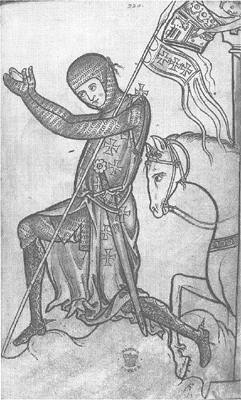
This anonymous crucesignatus represents the monastic ideal of a crusading knight: reverential and committed to Christ’s cause, but possessing the arms, equipment, and support to defeat His enemies. In reality, however, any crucesignatus who sported so many crosses would have been regarded by his comrades as both incongruous and vain.
St Louis’s two crusades met with failure, as did the next major exertion of royal strength, Philip Ill’s invasion of Aragon in 1285. Philip’s army could not take the great stronghold of Gerona and he was cut off from his supplies when most of his fleet was sunk. In military terms, none of the Capetians from Louis IX onwards enjoyed overwhelming success, but it would be a mistake to allow our knowledge of the disasters to come to shape our views of this period. For example, the French more than held their own in fighting against the English in Gascony in 1296–7. They were led on these campaigns by the same commander who was to lose at Courtrai, and who won against the Flemings at Furnes in 1297. Philip VI’s reign, which was to see so much disaster, began with a brilliant victory, again over the Flemings, at Cassel in 1328. In addition, while St Louis’s crusades were not crowned with military glory, the kudos derived from them gave the French monarchy incalculable benefits in terms of its image within the European community, its relations (especially financial) with the French church and the papacy, and its projection of policy to its own subjects. In the thirteenth century, the age of crusading par excellence, military balance sheets have to take such factors heavily into account.
Crusading, which offered its participants a potent blend of combat and penitence, was integral to the experience of warfare for many thousands of European soldiers in the thirteenth century. Apart from the campaigns in the East and within the heartlands of Christendom, there was much crusading in Iberia and the Baltic region. In these two areas the crusaders achieved military successes as striking as any which had occurred in the Latin East. At the battle of Las Navas de Tolosa, on 16 July 1212, Alfonso VIII of Castile inflicted a crushing defeat on the Almohads, the rulers of Muslim al-Andalus. The encounter was the most important Christian victory of the entire Reconquista, leading to a series of Castilian and Aragonese conquests, notably the Balearic islands (1229–35), Córdoba (1236), Valencia (1238), and Seville (1248). Also by 1248, the Portuguese had reached the Algarve coastline in the south. It took decades for these huge territorial gains to be effectively assimilated and colonized. Granted that the Almohads were already disunited at the time of Las Navas, this battle joined Muret and Bouvines as an encounter which had massive consequences. Indeed, it would be hard to find another example in European history of three battles, fought in consecutive years in different theatres of operation, which were so decisive in their impact.
The conquests made at much the same time in Livonia and Prussia were almost as impressive as those in Iberia. Catholic Livonia was created between 1198 and 1263, initially by bands of German crusaders, then by the military order of the Sword-brothers, and finally by the Teutonic Knights. More important for the latter was their work further south, in Prussia. The Knights were invited into northern Poland by Conrad of Masovia to counter destructive raids on his lands by the pagan Prussians. From their initial base in Kulmerland, the Knights drew on their own personnel, and the services of visiting German crusaders, to advance northwards along the Vistula basin. Stone castles were built to consolidate conquests, major examples being Balga (1239), Königsberg (1254), and Ragnit (1275). The subjugation of the natives in the name of Christ proved difficult: there were great revolts against the Order’s rule in 1240 and 1260. Nonetheless, by 1320 the Knights were no longer challenged in Prussia, where they had created, and successfully colonized, the most closely governed ‘order-state’ of the middle ages. They needed this stable base, as well as the continuing support of the German and indeed the European nobility, for they now faced an even greater challenge in the shape of their great war against pagan Lithuania.
Mailed cavalry, stone towers manned by Knight-brethren, giant catapults and trebuchets, crossbows, and cogs added up to an overwhelming superiority in military techniques for the Germans in their war against the indigenous tribes along the Baltic. Perhaps not until the Spaniards encountered the Aztecs was such a dramatic disparity of technology to recur in a major conflict. However, it is notable how rapidly the Prussians learnt how to use at least some of their opponents’ weapons. And any idea that this local imbalance represented a general ascendancy of Catholic Europe over its neighbours is readily shattered when one considers the hammer blows dealt by the Mongol Tatars during their military encounters with the central European powers. In April 1241, within the space of a few days, the Tatars crushed the Poles and Teutonic Knights in one battle (Liegnitz) and the Hungarians in another (Mohi) (see further, Chapter 9, pp. 196–7). In both cases it was the discipline and fury of the Tatars which overwhelmed their Christian opponents. Sheer good fortune, in the form of a Tatar withdrawal shortly afterwards, saved the European powers from the threat of conquest, and from the difficult task of adapting their traditional tactics to deal with Tatar fighting techniques.
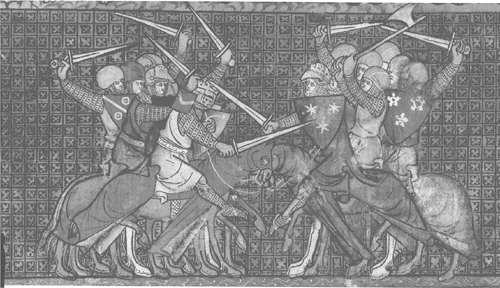
‘To be soaked in one’s own sweat and blood, that I call the true bath of honour’ (Henry of Laon). Fortunes as well as reputations were won and lost in the hack and thrust of close combat like this, for knights who were captured had to pay large sums for their release. It is not hard to imagine the noise, confusion, fear, and exhaustion which accompanied protracted hand-to-hand encounters.
Is there, then, any underlying unity to the dramatic successes achieved in this period in Spain and the Baltic region? It cannot plausibly be argued that they were simply the military expression of population pressure. Settling what they conquered was no easy task for either the Iberian monarchies or the Teutonic Order; and in the case of a third zone of Catholic conquest, the Byzantine lands following the Fourth Crusade, it proved impossible to promote adequate settlement. The active presence in all these areas of crusading ideology and institutions naturally represents a common feature of some importance. In particular, the contribution made by the brethren of the military orders should not be underestimated. While the Knight-brothers of the Iberian orders did not play the central role enjoyed by the Sword-brothers and Teutonic Knights, they did garrison a large number of fortresses. Salvatierra castle, held by Calatrava, was a thorn in the flesh for the Almohads for some years in the early thirteenth century, and its fall in 1211 precipitated the Las Navas campaign. Without the assistance of the orders the southwards sweep of the Iberian monarchies could not have proceeded so fast. However, even in the Baltic region ‘the crusading presence’ does not by itself account for Catholic success. At the end of the day, it was largely coincidence that local factors, of a widely differing nature, worked to the advantage of the crusaders at both extremities of Europe.
It remains to consider warfare in the British Isles and Italy. England in the thirteenth century experienced two periods of intense military activity, the first in the Barons’ Wars of the 1260s and the second during the Welsh and Scottish Wars of Edward I. Civil wars tend to be characterized by pitched battles as both sides seek a speedy resolution of the quarrel, and the Barons’ War produced two major engagements at Lewes (1264) and Evesham (1265). By contrast, it is hard not to see the most important feature of Edward I’s conquest of Wales in 1277–83, and certainly its most fascinating legacy, as the carefully planned network of castles which the king had constructed there (see also Chapter 8, pp. 176–9). The most important were at Rhuddlan, Flint, Conway, Harlech, Beaumaris, and Caernarvon. Michael Prestwich has recently judged them to be ‘the most magnificent series of fortifications to be built in all of medieval Europe’, while at the same time questioning the wisdom of Edward’s strategic approach in terms of the resources required to maintain them later.
Together with Louis IX’s two crusades, Edward I’s Scottish wars form the most instructive of all the thirteenth-century conflicts which have to date profited from the close attention of research historians. This was principally because, like Louis’s overseas ventures, they so clearly reveal the royal government tackling fundamental issues of military organization in a thorough way. The strategy adopted by Edward is less impressive, consisting as it did of sending northwards large armies with the goal of bringing the Scots to battle. This worked at Falkirk in 1298, but on other occasions it failed, either because the Scots avoided battle or because, as at Stirling Bridge in 1297 and Bannockburn in 1314, they won through innovative ways of deploying their foot soldiers. It was not until after 1320, first at Boroughbridge (1322) and more importantly at Halidon Hill (1333), that the English began implementing their own tactical changes, which were shortly to pay such huge dividends in France.
Italy witnessed probably the most constant and widespread warfare of any European country in the thirteenth century, one result being that it attracted bands of mercenaries from virtually everywhere else. The endemic nature of the conflicts there was rooted in two sets of circumstances. First, the self-governing communes of the north and centre were engaged in cut-throat competition for land and markets. Secondly, both the popes and the kings of Sicily, until 1266 the Staufen and thereafter the Angevins, were in a position, either ex officio or for dynastic reasons, to mobilize and bring in military power on a large scale from outside the peninsula. These two dynamics interacted because the complex range of communal enmities and alliances wove intricate patterns of patronage and allegiance with the papal, imperial, and royal authorities. The resulting warfare defies ready analysis, except for the relatively clear divide between the royal south and the communal centre and north. In the kingdom of Sicily, where political authority had long been remarkably centralized, battles could be decisive. Charles of Anjou, the younger brother of Louis IX who was summoned into Italy by the pope to oust the Staufen, effectively won the Regno through his clear-cut victories at Benevento (1266) and Tagliacozzo (1268). On the other hand, in Tuscany and Lombardy the extreme political fragmentation meant that even such a resounding victory as Frederick II’s defeat of the Milanese at Cortenuova (1237) ultimately settled nothing.
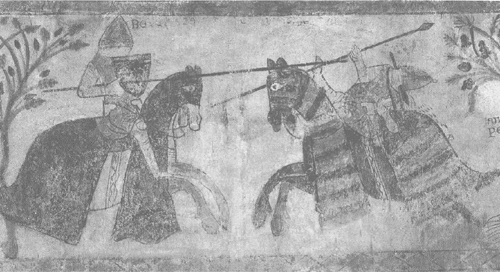
The single combat depicted here between a French knight and Manfred of Staufen is a stylized representation of the rivalry between the Angevins and their German opponents. In 1283 complicated arrangements were made for a real-life duel between Charles I of Anjou and King Peter of Aragon, who was Manfred’s son-in-law. But the encounter never took place.
Because the centre and north was a land of fortified towns and cities, sieges were commonplace. They were, however, notoriously difficult to carry through, and even a town which had been captured might be lost again shortly afterwards through bribery, treachery, or insurrection. The situation was in fact similar to what the Albigensian crusaders encountered in Languedoc. Capturing even such a relatively small town as Faenza took Frederick II six months in 1240–1; and the emperor’s siege of Parma in 1248 ended in failure despite his construction of a siege camp, which he foolishly called ‘Victory’, on such a scale that it was all but a town itself. The virtual impossibility of inflicting a decisive defeat on one’s enemy meant that warfare in Italy in this period attained a frequency which resembles that of the eleventh rather than the thirteenth century. This was viable within a society which depended to such a large degree on commerce, ease of communications, and inter-city cooperation only because of a complex system of restraints. These kept hostilities to a mutually agreed level and helped to exercise a brake on the most brutal behaviour during the conduct of military operations. At times the restraints broke down or were mutually discarded, as during the last ten years or so of Frederick II’s war with the communes. The horrors of this period were graphically depicted by such chroniclers as Salimbene. But for the most part thirteenth-century Italy enables us to view the ‘law of arms’ (the customary conventions governing relations between hostile parties) functioning with a clarity lacking in less well-ordered and legally refined environments.
Even this short tour d’horizon of war-making in the thirteenth century will make it apparent that there were numerous reasons for the age’s belligerence. The pursuit of dynastic rights, the conquest of enemy territory, civil war, and the winning of personal glory or honour, co-existed without apparent tension with more altruistic motives such as the defence of the realm or patria, the reconquest of patrimonial lands which had been seized, and service to the Christian faith through the crusade or wars of conversion. It was of course these latter causes which were pressed on rulers by canon and civil lawyers; by 1300, such men were vociferous in their espousal of the duty of the Christian prince to wage only just wars. But many rulers neither knew of nor much cared about the ideas of lawyers and theologians, and those who were personally susceptible to such arguments found little difficulty in portraying their most cherished goals in acceptable ways. As Maurice Keen put it, ‘in practice a just war and a public war meant the same thing’. Documents issued in the name of men like Frederick II and Philip the Fair showed that they appreciated the desirability of communicating their military goals in a plausible manner, for many reasons. But it would be hard to sustain the argument that they or their contemporaries had an approach towards war which was au fond very different from that of their predecessors in the eleventh and twelfth centuries.
Where change was occurring, albeit in piecemeal fashion, was in the recruiting, paying, and supplying of armies. Recruitment of soldiers is best handled by reference to England, France, and Italy. The English kings raised their armies through a combination of household service, feudal obligations, the imposition of a more general duty to serve, and payment. The royal household provided at least the core of an army and sometimes much more than that. In 1314–15 Edward II had thirty-two bannerets and eighty-nine knights in his household, although these figures contracted sharply immediately afterwards. As for feudal obligations, in the early thirteenth century the English magnates won a major success by getting their quotas (servitium debitum) drastically reduced. From John’s reign onwards the issuing of a feudal summons was rarely enough in itself to secure an army. It was either replaced or supplemented by distraint of knighthood (as for Edward I’s first Welsh campaign of 1277), wages, and, from at least 1270 onwards, contractual service. A multiplicity of military, financial, and political factors shaped the approach which was followed on each occasion that the crown needed to raise an army. In 1282, for example, the earls wanted to serve in Wales without pay, because by responding to a feudal summons they would increase their chances of receiving any lands which the king conquered. More puzzlingly, no feudal summons was issued in the case of the Falkirk campaign of 1298 yet the majority of the cavalry were not paid either. The motive for service appears to have been general fealty to Edward I.
The situation in France was not dissimilar. Philippe Contamine has written of the royal host that fought at Bouvines that it was ‘hardly an army at all, rather an episodic gathering together of small, autonomous units, a reflection of the feudal structure, easily brought together, easily dismissed at the end of the campaign, which came when requested to flesh out the modest group of household knights’. Feudal services continued to be used throughout the century, although the last occasion when the resources of the entire kingdom were called on was in 1272. Towns were usually expected to provide contingents of infantry. It is possible to reconstruct the quotas in the case of the Bouvines campaign, ranging from 1,000 due from Arras to fifty from Crandelain. Many religious houses also had military obligations to the crown: Saint-Germain-des-Près, for example, was supposed to send 150 sergeants whenever the king led his host to war.
Well before the last feudal summons of 1272, the Capetians had begun to make extensive use of wages (vadia), notably for St Louis’s crusades and for the Aragonese crusade of 1285; all three were interesting cases because a large proportion of the combatants had a votive obligation to serve. Salaried service was particularly prominent in the large number of castle garrisons which had to be paid to man France’s more troubled frontiers. Some of these were substantial; for example, in 1299 there were 32 sergeants stationed at Sainte-Livrade, 256 at Moissac, and 50 at Villefranche. When money was paid for service on campaign, on the other hand, the amounts were modest, and the concept of salary is sometimes less appropriate than that of an indemnity to cover expenses and compensate for inconvenience. By 1300 written contracts to serve were also making their appearance, at first in the feudal disguise of fief-rents (i.e. a ‘fief’ granted in the form not of an estate but of payment in return for the promise of service). None of these mechanisms were exclusive. As in England, we can assume that the procedure adopted was what best suited both soldiers and paymaster after a period of haggling. In 1249, for example, Alphonse of Poitiers engaged the services of Hugues le Brun, count of Angoulême, together with eleven knights, for his crusade. Hugues received wages, an annual hereditary fief-rent of 600 livres Poitevin, and a four-year loan of 4,000 livres of Tours.
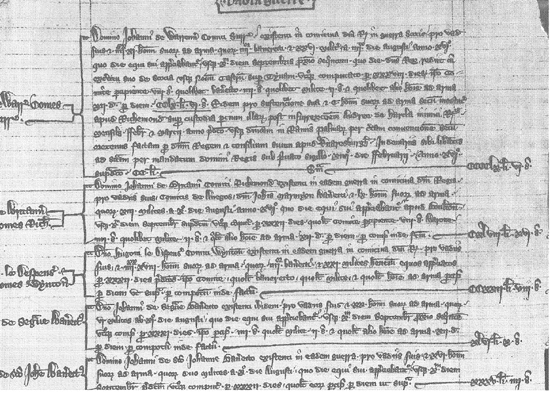
The famous dictum pecunia nervus belli est (money is the sinews of war) certainly applied to European warfare in the 13th century. These accounts of wages paid for cavalry service in Scotland in 1322 were compiled by clerks working for the English royal wardrobe, but their counterparts existed in all the western European states. War needed bureaucrats as well as cash.
In both England and France the movement towards paid service was blurred by the fact that it co-existed for many decades not just with older forms of obligation but also with a strong sense of personal allegiance to the anointed monarch who, on major campaigns, himself led his soldiers into action. The vast majority of these men were after all subjects of the king. In the Italian communes the historical continuity was much less imposing and the element of personal loyalty lacking. Many foreign soldiers were attracted by the wealth and incessant belligerence of the peninsula’s governments; in turn their business-like attitude towards the engagement of their skills and expertise accentuated the appearance that Italy was in the vanguard of a movement towards a more commercial way of organizing war. To a large extent this was true also of the Angevin kings of Naples. Their commitments regularly exceeded the military service they could prise out of the feudal baronage and they hired many French and Provençal knights, sergeants, and crossbowmen. Some of these were subjects of the Angevins, but many were mercenaries pure and simple.
The result has been well analysed, in the case of Florence, by Daniel Waley. The obligation of Florentine citizens to serve in person was taken very seriously throughout our period. However, the service of the citizens was supplemented by the hiring of mercenaries, troops whose service was solely linked to the payment of wages. From about 1270 onwards their role both on campaign and in garrison duty became more significant. Waley has vigorously rebutted the idea that this reflected the demilitarization of Florentine society: ‘There is no evidence that the Florence of 1300 was a city of soft, decadent businessmen who preferred to pay others to fight on their behalf.’ Rather, it was due to the spread of plate mail and the increasingly heavy chargers which it necessitated, the lengthening of Florence’s military agenda, and the growing pool of mercenaries who were available for hire. The contract (condotta; see also Chapter 10, p. 217) was therefore by 1320 a common and sophisticated feature of military life in the peninsula. By this point most cities were appointing officials with the task of negotiating the contracts. The condotta had already proceeded far beyond the obvious stipulations relating to salary and length of service, to include provisions about the armour to be worn, compensation for horses lost (mendum), disposal of booty and prisoners, and jurisdiction in the case of lawbreaking. Moreover, many contracts were by this time agreed between communes and entrepreneurs, Italians or otherwise, who had assembled into a masnada orconestabularia the troops on whose behalf they negotiated terms.
Underpinning all these changes was of course the development across the Continent of a money economy, together with the ability of governments to milk this economy in order to increase their revenues and expand their credit, and so pay for their warfare. War finance is too large and complex a topic to be dealt with here, but one point at least must be made: that in Western Europe at least, population growth, allied to burgeoning governmental receipts and an undiminished bellicosity on the part of rulers, led to considerably larger armies taking the field. Professor Contamine has estimated a threefold or fourfold increase in the military strength available to the French crown between Bouvines and Courtrai. Based on the king’s expenditure, it has been reckoned that Louis IX led as many as 15,000 or even 25,000 combatants on his first crusade: extraordinary figures when it is borne in mind that these men, accompanying non-combatants, and perhaps 8,000 horses, all required shipping. Like Philip the Fair, Edward I could field an army of up to 30,000 men, a figure far beyond what King John could have hoped to achieve. Professor Prestwich has written that the Falkirk campaign of 1297 was fought by ‘probably the largest single army that had been raised up to that time by an English government’. By contrast, William Marshal may well have won his victory at Lincoln in 1217 with fewer than 800 men.
These bigger armies were also more sophisticated in their make-up than their predecessors had been. In the English army the heavy cavalry were divided into three categories: bannerets, knights, and a third group made up of sergeants, squires, and valets. Amongst the French, a greater emphasis on knighthood created two groups: the dubbed, ranging from dukes to bachelor-knights, and the rest, generally termed sergeants at the start of the century and squires by its close. These categories of ‘men-at-arms’ hinged not solely on social status but also on the amount of mail worn and the number of chargers owned. In addition, there were mounted archers and crossbowmen, and in England the lightly armed horsemen called hobelars (see Chapter 9, p. 195). Infantry featured in some capacity in nearly all campaigns and included such specialized troops as archers, spearmen, crossbowmen, and shieldbearers (pavesari), who protected the crossbowmen while they reloaded.
Many units in thirteenth-century armies were remarkably well organized. As in so many spheres of medieval life, lordship was the most important cohesive force. In English and French armies it was exercised through the retinues of the kings and magnates. In 1297 the earl of Norfolk served Edward I with a retinue of five bannerets, nine knights, and seventeen men-at-arms. A few years later, during the Courtrai campaign, the lord of Varannes served Philip IV with a force of five knights, twenty squires, a chaplain, two clerks, six chamberlains, sixty-one servants, and a washerwoman. They had at their disposal eighty-four horses. In other cases knights formed agreements, based on mutual support, known as brotherhood in arms. Infantry were commonly grouped along regional lines, each group of fighters possessing its civilian servants, chaplains, and similar auxiliaries. The militias provided by towns, particularly those of Italy, Flanders, and the frontier regions of Castile, were characterized by a high degree of organization. The men used the same equipment and armour and trained together; indeed, in many instances they worked and worshipped together. Uniforms were common by 1300: the men from Tournai wore red tunics with a silver castle on the chest and back.
Organizational neatness reached its apogee in the citizen militias of the Italian communes, in which each of the town’s quarters would field a separate force fully kitted out with its requirements. Thanks to the ‘Book of Montaperti’ compiled by officials of the Florentine commune we possess a mass of detail about the army which fought (and lost) the eponymous battle in 1260. Here in microcosm is the commune at war. Each sesto (sixth) provided both cavalry and infantry, the cavalry contingents being the responsibility of the aristocratic clans (consorterie). Contingents were led by standard-bearers accompanied by commissioners and councillors. The entire army was commanded by the podestà, the commune’s chief executive official, but what really unified his composite army was the carroccio, the curious battle wagon drawn by oxen and carrying a miscellaneous collection of the commune’s relics and blessed banners. At Montaperti the Florentine carroccio had a guard of fifty knights. The loss of the town carroccioto the enemy was considered a dire humiliation. Following the battle of Cortenuova in 1237 Frederick II had the captured Milanese carroccio dragged by an elephant through the streets of Milan’s leading rival, Cremona. Its banners were lowered in shame and the captured podestàwas shackled to it.
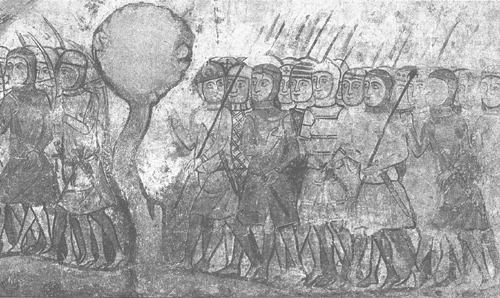
Their crosses show that at least some of these Catalan foot-soldiers were crusaders, probably participants in Jaume I’s campaigns against the Moors of Valencia and Majorca. Their prowess and ferocity became legendary, and enabled Jaume and his successors to establish the crown of Aragon as one of the most dynamic powers in the Mediterranean region.
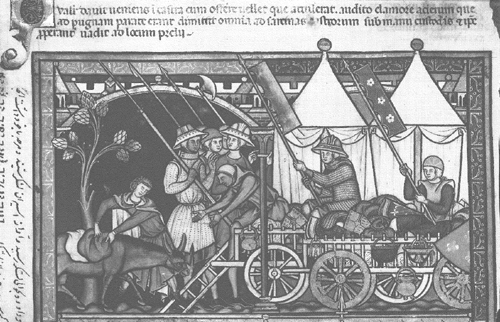
Together with arms, equipment, and money, armies needed food. Their requirements were met in part by direct provisioning, but more frequently by encouraging the efforts of merchants and entrepreneurs to buy up and transport supplies for the fighting men and their animals.
It was surely inevitable that this general movement towards larger numbers of combatants, and better ordered forces, should have its counterpart in the field of supply, in particular that of food for men and animals. Across Europe, strenuous efforts were made by governments to ensure that armies and garrisons would be adequately supplied as well as equipped. The figures available in documentary sources are on a scale simply not approached in earlier periods, so there is a danger of exaggerating the novelty of what was achieved. Nonetheless, it would be foolish not to accept the extent of the effort involved. This was the more striking insofar as it emanated from officials who were already overstretched: few new administrative organs were created. So effective was the redirection of Sicilian grain towards the supply needs of Louis IX’s crusading army in Tunisia in the summer of 1270 that there were shortages not just in the north Italian cities but at Syracuse itself. In England, by the end of Edward I’s wars, the compulsory purchase of foodstuffs for military purposes, known first as prise and later as purveyance, had become one of the crown’s most unpopular prerogatives. In France, at the same time, a stream of safe conducts and toll exemptions were issued by the king for merchants who were busy supplying the royal host. However it was undertaken, provisioning was acknowledged to be crucially important. When it broke down prices went through the roof, morale collapsed, and relations with the local civilians, which were fraught at the best of times, were brutalized.
Shortage of weapons could be as serious as shortage of food, and by 1300 the more advanced European states were also getting used to making purchases of arms and armour in readiness for their conflicts. The records of the English, French, and Neapolitan monarchies are full of references to the buying in and auditing of such stores. In 1295, for example, the French government bought 2,000 crossbows, 1,000 padded doublets, 3,000 bascinets, and 3,000 gorgets, at Toulouse, for the war in Gascony. Trebuchet ammunition was kept in bulk and above all crossbow bolts and arrows were stored. In the Italian communes the usual practice was that hired mercenaries would provide their own armour, but the city would furnish ammunition for crossbows. The counterpart to these preparations was the ban customarily placed on the export of war materials, horses, armour, and even iron, at times of war.
Crusading to the East posed uniquely vexing problems relating to supply, and the efforts which St Louis made to ensure the adequate provisioning of his troops are well known. One of Joinville’s most charming anecdotes is of the hills of wheat and barley which Louis’s officials accumulated in Cyprus in anticipation of the needs of the royal army when it wintered on the island. The corn on the top sprouted in the rain and had to be removed to get at the fresh corn lying underneath. St Louis’s first crusade also provides the most famous thirteenth-century example of civilian building works undertaken in association with a military venture. This was the king’s construction of Aigues-Mortes in Provence, in order that his army could embark at a port located within the lands of the French crown. For Louis, as later for Philip VI, this consideration evidently outweighed such disadvantages as the ineluctable tendency of the harbour to silt up and the lack of fresh water in the vicinity. Aigues-Mortes was a response to what one historian of Louis’s reign has termed ‘the challenge of the crusade’. It is increasingly clear that the main impact which crusading in the East exerted on European warfare lay in the field of novel administrative demands, rather than the application in the West of specifically military lessons which had been learned in Egypt, Palestine, and Syria. There were very few of the latter, and they do not include Edward I’s Welsh castles, which historians used to think were modelled on castles which Edward had observed in the Holy Land during his stay there in 1271–2.
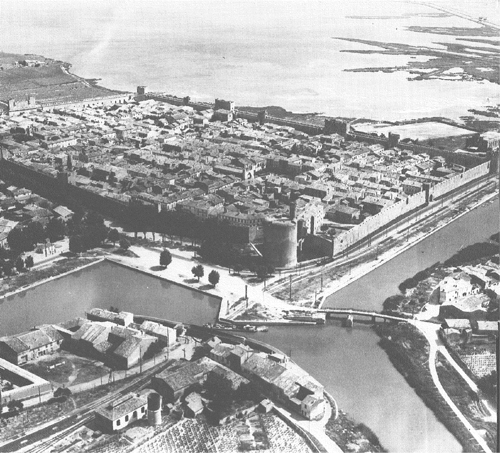
This aerial view of the port at Aigues-Mortes communicates well the astonishing ambition of Louis IX’s military planning. The energy and resources which on this occasion were harnessed for the needs of the king’s planned crusade to the East would later be directed towards objectives nearer at home and yielding more obvious benefits to the French crown.
So far in this chapter we have concentrated on the broad sweep of campaigns and the mobilization and organization of the armies which fought them; let us finally consider the fighting man of the period. Did the growing professionalism of war, and the increasingly dirigiste role of governments, affect his attitude to what he was doing? Was he different in kind from his predecessors? It is notoriously difficult to answer such questions with confidence, but they must at least be addressed. For simple reasons of evidence we can only consider the attitude of the mounted warrior, the knight, or at best the sergeant, regrettable though it is to neglect the views of those who fought on foot.
Military service, as we have seen, was provided out of obligation, voluntarily, or for pay. So much attention has been paid in recent years to the way in which these intertwined that the old view of the thirteenth century as a period of transition, from feudal, or civic, obligation towards paid service, no longer seems wholly satisfactory. Payments were already being made in 1200 while obligations still played a large part in 1320: indeed, Philip IV tried to put the clock back by reviving the old arrière-ban, much to the annoyance of Pierre Dubois. Dubois interpreted this as the king abjectly surrendering to the nobility’s reluctance to perform their vassalic duty, but it could equally well have been an attempt to revive a sense of general obligation for France’s defence, whether expressed through service or payment.
Perhaps of greater importance than what Philip was trying to do was the political and administrative effort involved in this and in similar moves in other countries. Governmental control over the waging of war became tighter in the thirteenth century than it had been in the twelfth or was to be (at least in some areas) in the fourteenth. We have seen that the freelance mercenaries known as routiers, who had acquired a terrible reputation for brutality in the later twelfth century, ceased to be a problem early in the thirteenth century. Their successors, the free companies, had yet to emerge. The exception, the Catalan Grand Company, was certainly extraordinary and pointed the way to the future (See further Chapter 10, p. 217). But its success was largely due to its theatre of operations, first in the Byzantine Empire and then in Frankish Greece. Since the Fourth Crusade the endemic conflict in this area had attracted a lot of Western mercenaries: as early as 1210 the Latin emperor of Constantinople, Henry, was criticized by Pope Innocent III for aggravating his shortage of fighting men by not offering the going rate for such soldiers, who were more attracted by the wages offered by Henry’s Greek enemies. Elsewhere the thirteenth-century warrior was generally anchored to the service of an establishedauthority to which the lawyers ascribed the ius ad bellum (right to wage war): either a secular power or, when he fought as a crusader or as a professed member of a military order, the church. Those who took the cross but accepted financial subventions while doing so, such as many who fought with St Louis in the East, were often in the service of both. The obligations of fighting men were increasingly spelled out in the form of contracts and religious vows, while the nature and limits of their service were defined juridically through the work of canon and civil lawyers.
It is safe to say that warriors had never before been subject to such controls or received such quantities of prescriptive advice; but whether this radically altered the way the fighting man saw himself and his work is another matter. A consensus about what constituted chivalric behaviour had already emerged by 1200, and may be clearly seen in the Life of William Marshal, which was written in the late 1220s. Its author focused on a characteristic blend of military excellence, faithful service to a succession of English kings, good lord-ship, and religious piety. William spent over two years in the Holy Land and entered the order of the Knights Templar on his deathbed in 1219. During the following decades those knights who attracted similar admiration from their contemporaries tended to have a career as crusaders, as well as being loyal vassals and active in military affairs generally. Geoffrey of Sergines, who commanded the French ‘regiment’ left behind at Acre by St Louis when he returned to France in 1254, was acclaimed as a hero by the poet Rutebeuf, and such men as Erard of Valéry, Otto de Grandson, and Giles of Argentine fitted much the same mould.
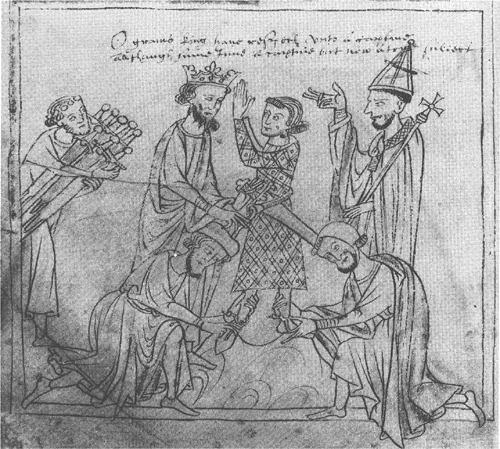
Roland, shown here in a thirteenth-century manuscript being dubbed by his lord Charlemagne, remained an extremely attractive figure for fighting men. His combination of vassalic loyalty, military prowess, and religious devotion made him an enduring chivalric exemplar.
It is tempting to see a gulf in attitudes between such warriors and some of those who took contractual service with the Italian communes, and whose relations with their employers turned sour. One such was the Catalan marshal Diego de Rat, who was an important element in Florence’s military establishment from 1305 to 1313, commanding some 200–300 cavalry and 300–500 infantry. Rat became a familiar enough figure in Florence to feature in the Decameron, and in 1308 the city praised him for his service. But by 1312 ill-feeling had developed between the republic and its employee over his substantial arrears of salary, and in the spring of 1313, when Florence faced a grave threat of attack from Henry VII, Rat was refusing to obey orders. Like the activities of the Catalans in Greece, this was an ominous sign of things to come, and indeed it was just nine years later, in the winter of 1322–3, that the republic first had to take military action against a large force of mercenaries who detached themselves completely from the service of the political authorities and lived by ravaging the countryside.
Appearances can however be deceptive. William Marshal’s career contained its fair share of political wheeler-dealing. His efficiency as a warrior hinged on his willingness to destroy and steal the property of non-combatants, and his renowned expertise on what has been termed ‘the tournament circuit’ was milked for all it was worth in cash terms. William was fortunate in that circumstances enabled him to rise to prosperity while adhering sufficiently to the chivalric ideals of his day to excite the admiration of his contemporaries. In other words, it seems likely that success in thirteenth-century chivalry remained the rather volatile combination of ideals, skills, and sharp practice that it had always been. A degree of brutality in the treatment of civilians was accepted as a natural concomitant of war. Destructive raiding was a key feature of strategy, and booty an essential component of the range of rewards available to fighting men. In these circumstances it is hardly surprising that ius in bello, as opposed to ius ad bellum, received scant attention from the theorists. The attention it did receive tended to be exculpatory, as when the decretalist Raymond of Pennaforte judged that a man who set fire to another’s property ‘at the command of one who has the power to declare war’ was innocent of arson. The behaviour of those fighters whose economic needs or sense of adventure took them far from their native lands, and exposed them to the raw winds of the market place and the temptation to switch allegiances, was probably not so different from that of their contemporaries whose military careers unfolded in more familiar settings and more ‘respectable’ contexts.
This is not to imply that all wars were identical in the perception of the warrior elite. A keener interest in the juridical nature of the conflict being waged led at least some warriors in the thirteenth century to make distinctions between the opponents whom they faced. Michael Prestwich has outlined a difference between the way the English fought in Wales and Scotland, on the one hand, and France, on the other. The Welsh and Scots were regarded as rebels against the crown and prisoners were executed in barbaric ways. Paradoxically, the insistence of the Scots that they were fighting a just (i.e. ‘public’) war compelled them to adhere to chivalric conventions in their treatment of English prisoners. In much the same way, normal chivalric mores were set aside during crusades, although there were substantial differences in practice between behaviour in Iberia, the Baltic, and the East. Warfare against Islamic rulers was often characterized by a courtly behaviour, conditioned by economic as well as cultural factors, which was absent from the vicious fighting in Prussia and Livonia. There can be little doubt that one reason for the horrors perpetrated during the Albigensian Crusade was the view held by some of the crusaders that the cathar heretics and their employees, the hatedroutiers, were ‘beyond the pale’ and that they were waging what would later be termed a guerre mortelle, although the normal chivalric law of arms can be seen intermittently in operation.
If the world-view and behaviour of fighting men remain at times difficult to interpret, the overall characteristics of European warfare in the thirteenth century are clear enough: an ambitious attempt by the public authorities to establish a monopoly on military activity; strenuous efforts by those authorities to mobilize the resources of their subjects more fully and effectively for war; and a growing tendency to view the practice of war through juridical spectacles. To a whiggish frame of mind these trends appear to be progressive. It is not so long since a historian of Philip the Fair’s reign could describe the substitution of taxes for personal service as ‘a major step towards civilization’. This is misguided. Arguably the bigger armies mobilized, albeit less frequently, around 1300, were more destructive than their predecessors. The chevauchée was not total war but it was far from being surgical in its impact on civilian life. The unrelenting bellicosity of Europe’s rulers exerted massive fiscal demands on their subjects; the ‘military state’ and the ‘fiscal state’ were twins. Warfare became more expensive, and more of a drain on the economy. Lawyers placed few constraints on how war was waged, focusing instead on slavishly justifying the demands which their princes made. What had been achieved was ‘bigger and better’ wars. Moreover, there was a danger of their becoming all-consuming should the state falter in its control of the armies which it was creating. The actors were in place and the stage set for the ferocious conflicts of the late middle ages.