
Chapter One
Many SS men who entered the realms of the concentration camp system welcomed the chance of joining this elite organisation because of its strict system of beliefs and values based on the military virtues of obedience and self-discipline. They sought the idea of becoming part of the SS not purely because it was the racial-ideological elite, but for status reasons and the chance to become part of an organisation that could possibly control the course of Germany’s path to recovery. Joining the SS also meant camaraderie and career prospects.
Reichsführer Heinrich Himmler, commander of the SS, had made considerable efforts to recruit members of the old German elite and, through a tactful combination of pressure and adulation, to invite many fighters of the old ‘German Guard’ to give up their daily jobs and become full-time members of what became known as the black order of the new ‘SS Staat’. Within months many of these new recruits had formally joined the SS, and were soon assigned to run the various new concentration camps that had sprung up across Germany.
One of the earliest camps, called Dachau, would be regarded as the foundation of all other camps. SS-Brigadeführer Theodor Eicke had been made commander of Dachau concentration camp in June 1933, and became a major figure in the SS. He was regarded as the architect, builder, and director of the concentration camp system and ruled it with an iron fist. As a man he was stocky in appearance, blatantly brutal and ruthless, and gave off an aura of raw energy.
Dachau was located on the grounds of an abandoned munitions factory near the medieval town of Dachau, ten miles northwest of Munich. It was the first regular concentration camp established by the National Socialist government and was regarded by Himmler as the first camp for political opponents who were seen as an imminent threat to the new German government. Dachau was established on 20 March 1933, and it served as a prototype and model for the other concentration camps that followed. Its basic organisation, camp layout, and construction of buildings were developed and ordered by Theodor Eicke.
Dachau was not like a normal prison. Here, the inmates did not know how long their sentences would run. They led an existence of uncertainty when they would see freedom again. Life for the prisoners inside Dachau was brutal. The SS guards were all ordered to follow Eicke’s demand for blind and absolute obedience and to treat each prisoner with fanatical hatred. By perpetually drilling his SS guards to hate the prisoners, they were able to infuse themselves with anger and mete out severe punishments. The training which the SS guards were given at the camp was relentless. They learned about enemies of the state, and were given an in-depth indoctrination into SS philosophy and racial superiority. These ideological teachings were aimed at producing men who ardently believed in the new Aryan order. Regularly the SS staff had to listen to the commandant lecturing them about anti-Semitism. On the notice boards inside the SS barracks and canteen there were copies of the racist newspaper ‘Der Stürmer’. Propaganda newspapers were deliberately pinned up in order to foment hatred and violence against the prisoners, and to encourage anti-Semitic behaviour among the staff, especially the younger men. In Eicke’s view, once his staff had learnt their trade of brutality without the slightest compunction, the commandant had absolute power over them.
All of the staff at Dachau were indoctrinated into a fanatical determination to serve the SS with blind allegiance. Eicke invested each SS man with life-and-death power over all the inmates of the camp. Rule breaking among the prisoners was classified as a crime. It was looked upon as an incitement to disobedience and each guard was given power to handout stringent punishments.
The Dachau formula for mistreating the inmates sometimes affected the guards, but as members of the SS they were compelled to implement orders to be cruel to the prisoners with horrific efficiency. All SS were given extensive freedom to deal very harshly with any inmates they deemed to have committed a crime ‘behind the wire’. In addition to the general physical abuse meted out to the prisoners the camp commandant introduced other measures of cruelty upon these hapless individuals. Prisoners were deprived of warm food for up to four days, they were subjected to long periods of solitary confinement on a diet of bread and water. To supplement these harsh methods Eicke introduced corporal punishment into the daily routine. A prisoner would receive twenty-five strokes with the lash, carried out in the open square on specific orders of the commandant in the presence of assembled SS guards. In order to ensure every SS officer, non-commissioned officer and SS guard was infused with the same brutal mentality as their commandant, Eicke regularly ensured that each man routinely punished prisoners with the lash without showing the slightest hesitancy, emotion or, most of all, remorse. Only in this way could Eicke guarantee that his concentration camp staff would become hardened to the brutal code that he himself had harshly implemented.
Eicke also infused his staff with hatred against Jews, emigrants, homosexuals and Jehovah Witnesses. Frequently the SS men listened whilst the commandant brazenly delivered lectures about what he considered were the most dangerous enemies of National Socialism.
Predominantly, he instructed his men to be brutal to the Jews and use whatever violence necessary to keep them in check. However, often the Jews were only seen at roll calls. For long periods, sometimes up to four months, they were shut away in sealed barracks only ever being allowed to leave their beds at mealtimes and roll call.
Although some of the staff disliked the brutality of the camp, most were nonetheless inspired by its harsh order and discipline. They were able to bury their emotions and become absorbed by loyalty to the SS. Some would hope that in the future they might run their own concentration camp. In spite of the crude and brutal values of the SS, it offered many of these men a clear example to follow. They saw Dachau as a stepping-stone to success within the realms of the SS order.
Regular beatings and cruel acts of brutality continued to escalate at Dachau. Most SS men became pitiless and callously thoughtless to human suffering, and their thirst for moving through the ranks far outweighed any moral feelings. They became increasingly convinced that the camp was the most effective instrument available for destroying all elements hostile to the banner of National Socialism.
Most of the SS were motivated by Eicke’s success and his firm grip on his own position within the camp. They watched how the commandant strengthened his power in order to make the camp run more efficiently. They saw the camp evolve and watched Eicke organise Dachau into a model detention centre with its various administration departments. There was a medical department, an administration pay office to purchase all supplies, another office to retain all the personal property surrendered by the inmates upon entering the camp, a department for repair and maintenance, and one for the making of the prisoner’s uniforms.
Eicke’s staff also observed how he had organized the inmates to work and expand the camp’s economic enterprises. They saw how the commandant put to work the prisoners to construct buildings, and to expand the camp to include a locksmith’s shop, a saddlery, and a shoemaking and table shop.
Eicke was a great believer that the inmates were able to endure prison with more discipline if they were allowed to work. For him working in slavery was a mystical declaration that self-sacrifice through endless labour would bring about a kind of spiritual freedom. It was this belief that prompted Eicke to display the inscription ‘Arbeit Macht Frei’ (‘Work Brings Freedom’) on the main entrance gate of Dachau. The slogan itself was not new to the National Socialists.
For some of Eicke’s staff their post to Dachau was to mould their future in the ranks of the SS. Not only would it offer them officer status and a regular wage for them and their families, but also it gave them a secure belonging. Eicke weeded out those men he regarded not fit for concentration camp duty and only kept reliable, disciplined SS officers, NCOs, and enlisted men. As he expanded the camp system the commandant’s SS cadre served him with devoted allegiance and fanaticism. Promotions within the SS cadre were a common occurrence, especially among model SS.
His men knew that to progress further through the ranks they would have to strengthen their beliefs that all the prisoners detained inside the concentration camp system were inferior, and that they were implacable enemies of the state, against whom the SS were waging a war. They were aware that the slightest vestige of sympathy towards those in the concentration camps was regarded by the SS as intolerable. They had learnt to conceal any type of lingering feeling or compassion for those incarcerated and followed Eicke’s doctrine of being ‘hard’.
As inspector of concentration camps Eicke soon established a permanent concentration camp system that included notorious camps such as Sachsenhausen and Buchenwald. Eicke based Sachsenhausen on the Dachau model that he had created. The brutal methods of mistreating prisoners were applied in other camps, along with Dachau’s harsh disciplinary and punishment regulations, which included the death penalty and punishment by the whip. As with Dachau, solitary confinement, general physical abuse and forced labour became standard practice.
The commandant of Sachsenhausen, SS-Standartenführer Baranowski was infused by Eicke with fanaticism and elitism. Like all Death Head members of the new SS-Totenkopfbände they were to be unfeeling to any type of human suffering. Baranowski’s personnel looked upon him as a model commandant, whom they admired for being hard and mercilessly strict. Life at the Sachsenhausen camp was very similar to that of other concentration camps at that time, but under Baranowski’s command there was a steady increase of brutality against the inmates and a rise in the death rate. The process of indoctrination of highly disciplined guards made Sachsenhausen a model camp.
By the late 1930s Nazi foreign policy became increasingly aggressive. Eicke made it clear to his men that the threat of war meant that the SS would expand to provide greater internal security, and that as a consequence the concentration camps would fill with new prisoners.
SS Reichsführer Heinrich Himmler had already envisaged an expansion programme, but this would not include Eicke. Eicke was allowed to retain command of the camps and the new SS-Verfügungstruppe(Special Service Troops), but all policy matters concerning the Totenkopferbände would be run at the highest level between Himmler and the Führer, Adolf Hitler.
With new government policies and with prospects of war against Poland looming, a more hostile attitude was instilled across the concentration camp system. There was even less tolerance towards the inmates and new slogans of hatred and discrimination were plastered around the camps for guards to read.

On 1 September 1939 the German Army unleashed its might against Poland. Here in this photograph is a column of armoured vehicles destined for the front lines.
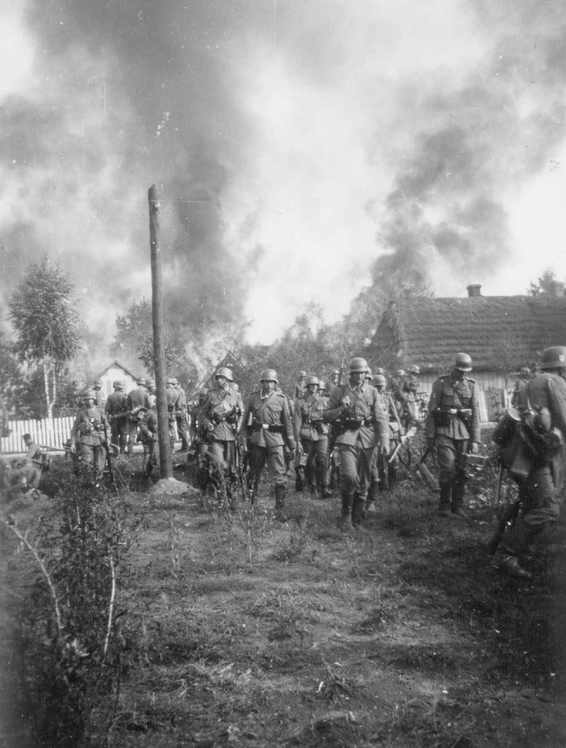

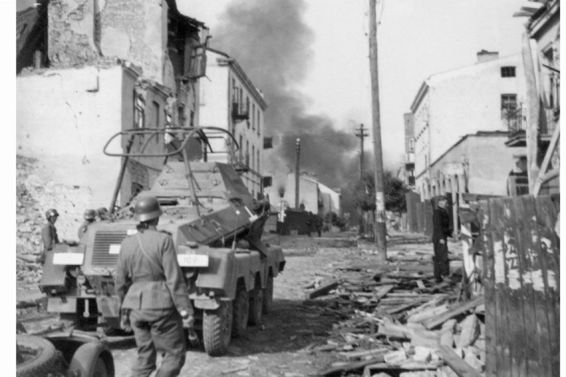
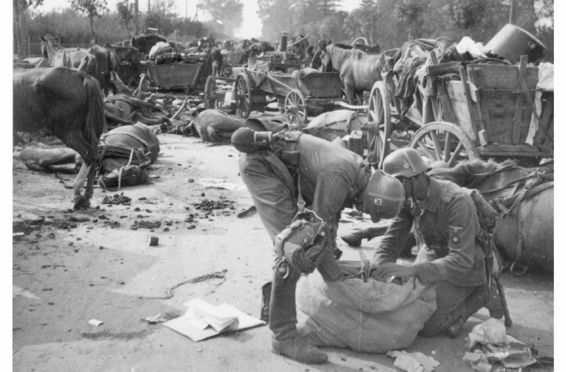
Four photographs showing SS-VT (later Waffen-SS) belonging to the Leibstandarte Adolf Hitler Division probably during action around the town of Sochaczew. Along the Bzura near Sochaczew there was heavy fighting between Hitler’s foremost fighting machine and Polish forces. What followed after the battle were scenes of mass destruction. Columns of dead civilians, troops, cattle and horses had perished during intensive and prolonged attacks by the army and units of the SS-Leibstandarte, and were laid tangled inside ditches and clearings along the road leading to Warsaw.
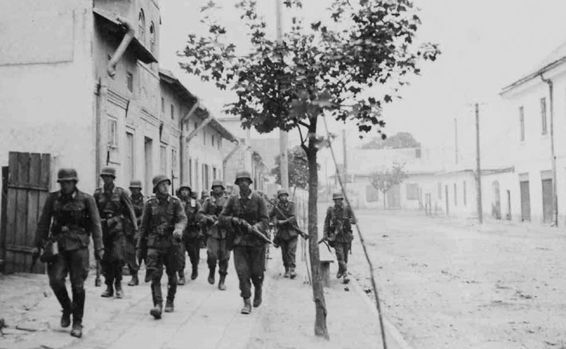
A Wehrmacht unit on patrol inside a newly captured Polish town. Troops were often assigned to weed out resistance fighters and anyone they regarded as a threat to the German invasion. Behind the military arm of the SS-VT and the German Army lurked the SS Death’s-Head groups or Totenkopfverbande under the notorious command of Theodor Eicke. Three regiments had been deployed in Poland: SS Oberbayern, Brandenburg, and Thuringen. Eicke’s men quickly gained a reputation. In a matter of days they began torturing and killing Poles they regarded as being hostile to the Reich.

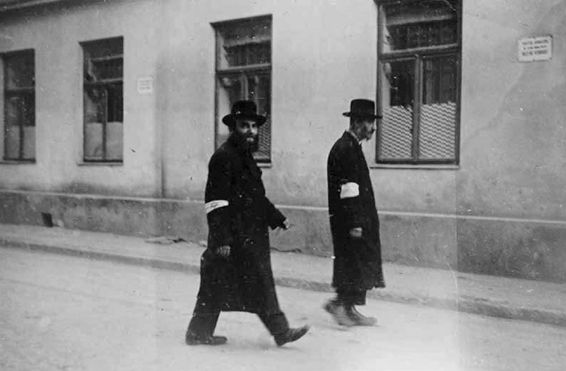
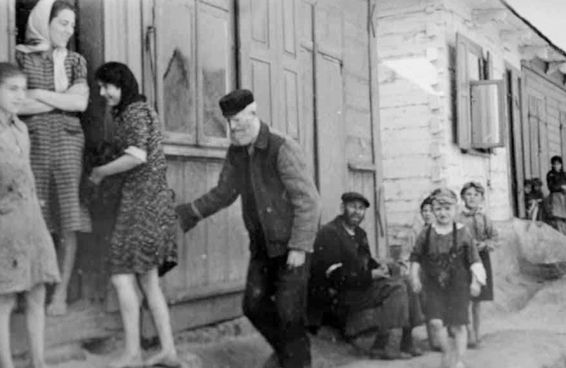
While the German war machine marched its way through Poland, troops came across eastern Jews for the first time. As the soldiers entered these towns, with their dreary buildings and hut-like dwellings, their unhealthy thoughts about the East were reinforced. They now got a firsthand view of the land which Germany was going to ruthlessly conquer. Among those walking along the dusty untended roads and going about their business were men in high-crowned hats and caftans. They had seen these figures in many of the anti-Semitic drawings plastered up on notice boards, walls and lamp-posts throughout Germany. They were the enemy, the Jews. For these German soldiers, protection of the Reich against such enemies was a priority. For some time it had become almost a religious creed to hate all Jews, especially those from the East.
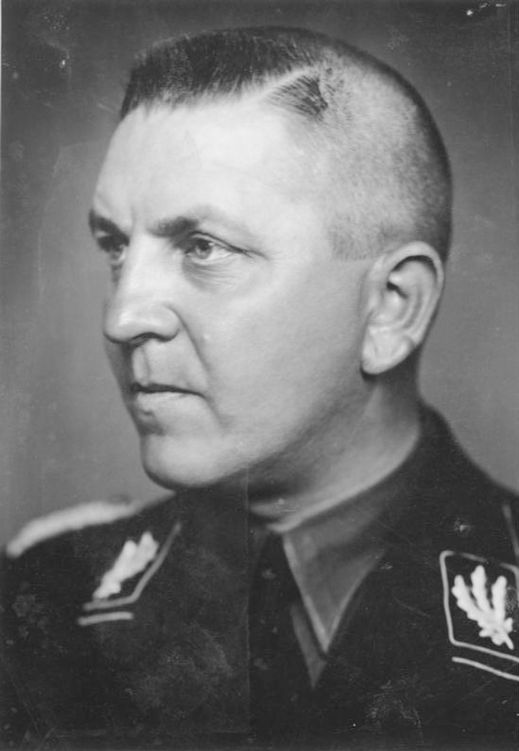

Two portrait photographs of Obergruppenführer Theodor Eicke. Eicke had been made commander of Dachau concentration camp in June 1933 and had become a major figure in the SS. He was regarded as the architect, builder, and director of the concentration camp system and ruled it with an iron fist. As a man he was stocky in appearance, and gave off an aura of raw energy. Once the Germans had conquered Poland, Eicke acquired more freedom and power than ever before. The concentration camp system could now be expanded across Poland, and Eicke could infuse even more hatred against Jews and emigrants. As the Germans rounded up Jews and political prisoners, Eicke instructed his men to be brutal and use whatever violence necessary.

SS training during the early part of the war. SS men who entered the realms of the concentration camp system saw the chance of joining an elite organisation with a strict system of beliefs and values based on military virtues of obedience and self-discipline.

An SS training school. New recruits sought the idea of becoming part of this new order, not only because it was a racial-ideological elite, but for status reasons and also for the chance to become part of an organisation that looked likely to play a major role in Germany’s path to recovery.
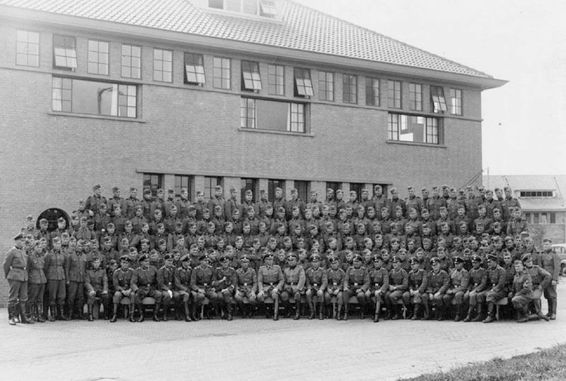
Regimental photograph at an SS training school. Many were attracted by the camaraderie of the SS, and were keen to broaden their career prospects in a military system that would become the major part of their life.
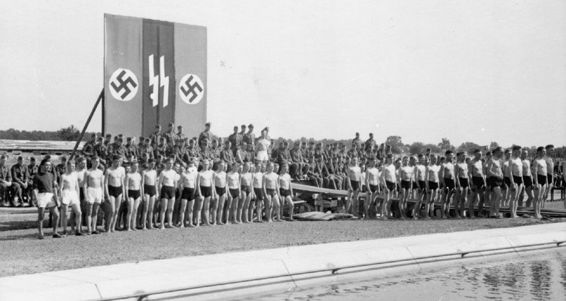
At an SS training school: recruits preparing to show how fit they are during a swimming exercise.
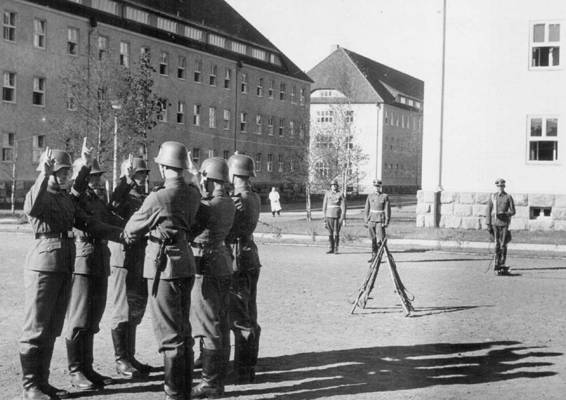
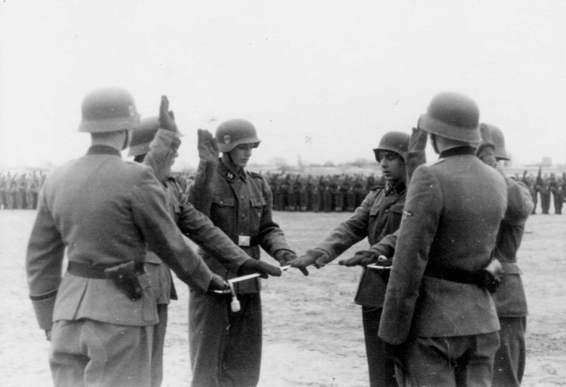
Here are two photographs showing recruits being sworn into the SS. These men had sworn an oath containing the words ‘my loyalty is my honour’. They would have to prove their loyalty by doing any task assigned to them, even if it meant killing innocent men, women and children.
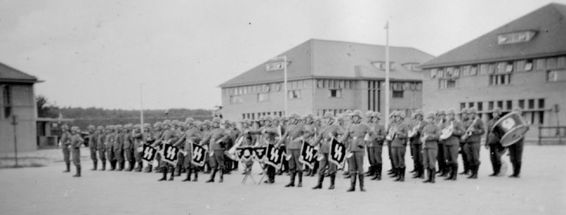
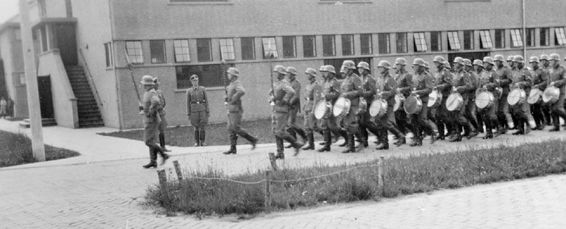


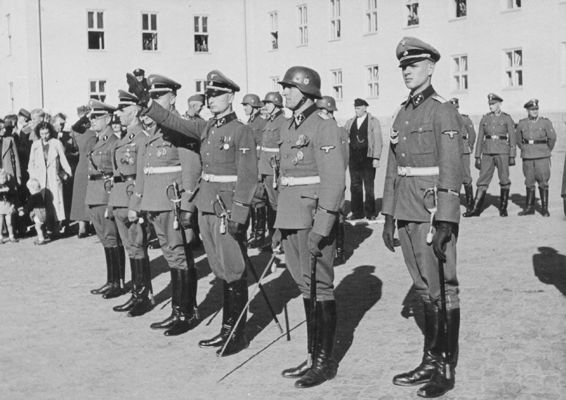
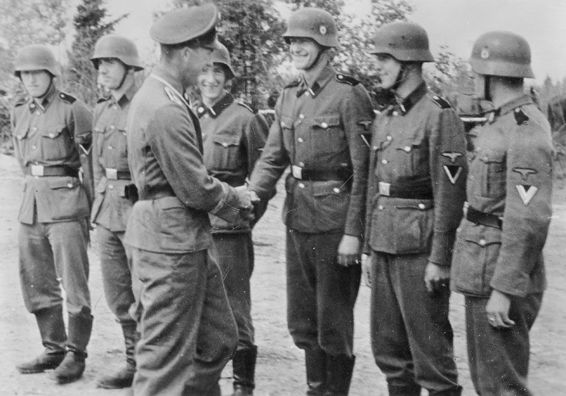

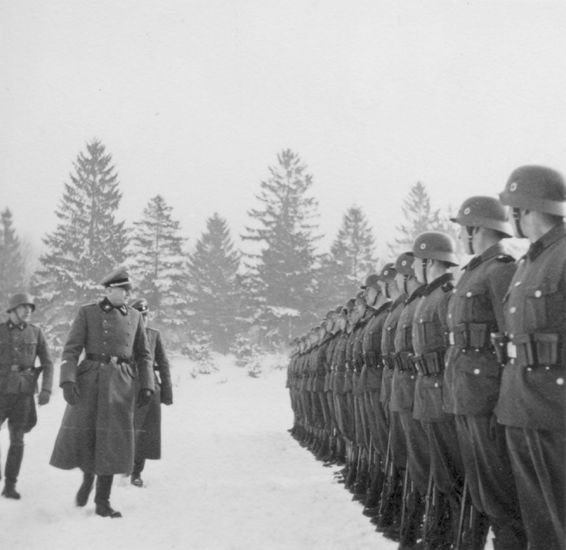
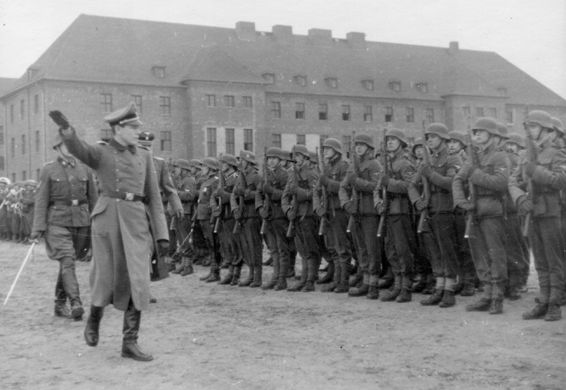
Seven photographs showing an SS training ground with soldiers seen on a parade ground in front of their commanding officers during what appears to be a passing out ceremony. The recruits learned about enemies of the state and were indoctrinated with the SS philosophy of racial superiority. These ideological teachings were aimed at producing men who ardently believed in the new Aryan order.
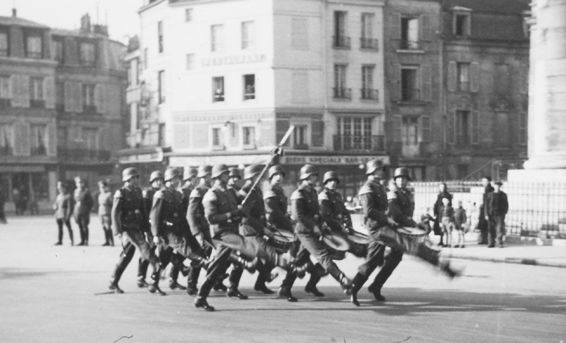
An SS marching band, probably during the fall of Paris in June 1940.

A photograph taken at an SS training ground showing troops on parade in front of their commanding officer.
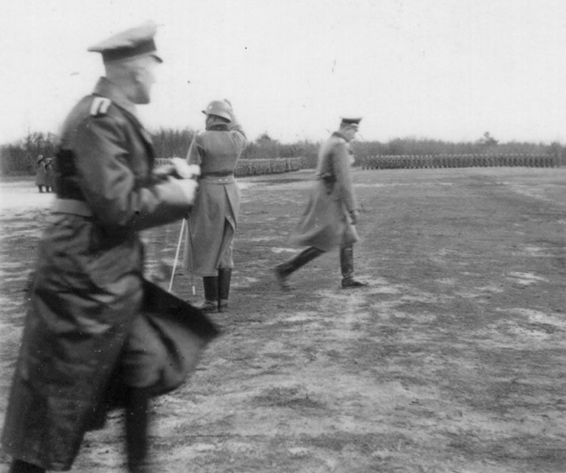
Three more photographs at an SS training ground showing troops on parade in front of their commanding officers. At least three times a week these trainees had to listen to formal lectures covering policies of the Nazi Party, which included in-depth indoctrination into SS philosophy. The lectures covered many topics, and in particular the theories that the Aryan race was superior to those they regarded as sub-human, for example Slavs and Jews.
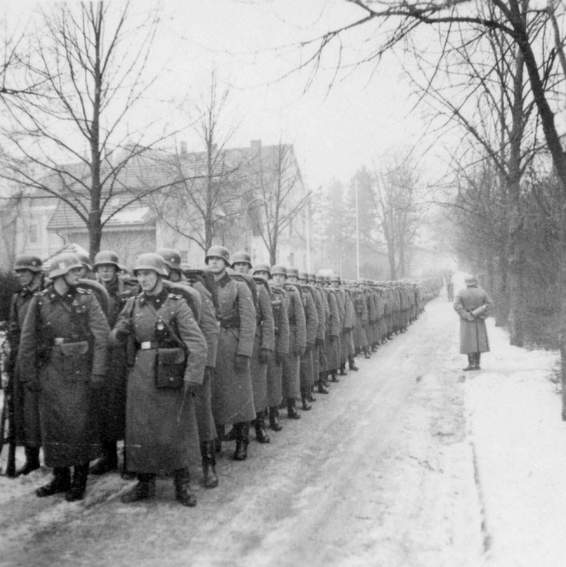
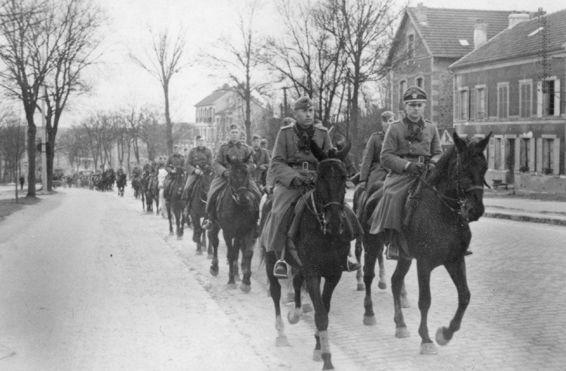
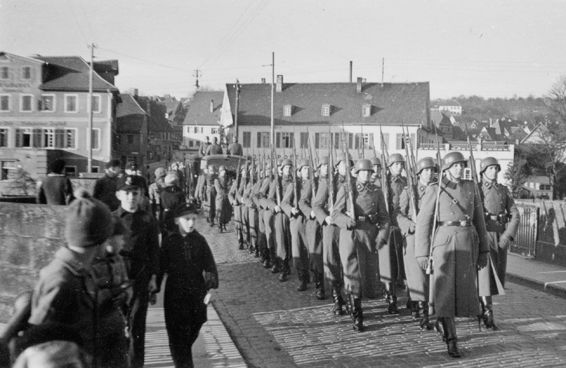
Three photographs showing a column of Totenkopf troops on horseback and on a foot march. At the outbreak of the Second World War, one of the first combat units of the Waffen-SS, the SS Division Totenkopf was formed from SS-TV personnel. It was the SS-Totenkopfverbände (SS-TV), Death’s-Head Units, which were the SS organization responsible for administering the Nazi concentration camps, and were not connected in any way to the Waffen-SS arm of the Totenkopf Division.
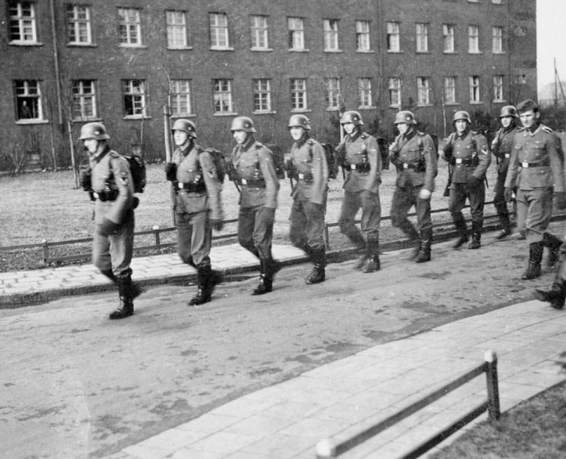
Totenkopf recruits marching during a training exercise in 1939.
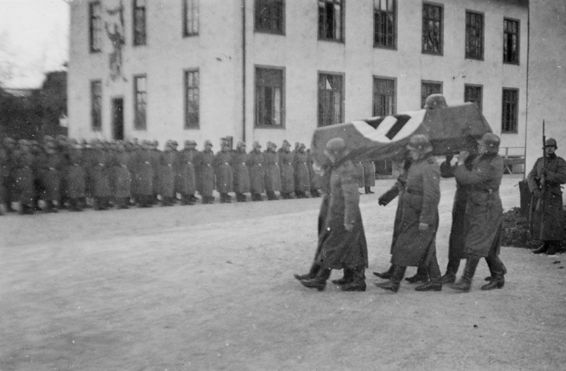


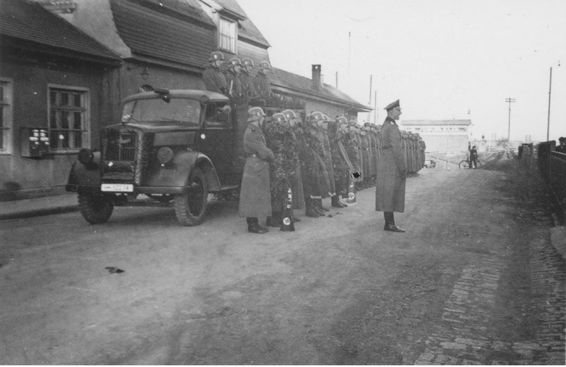


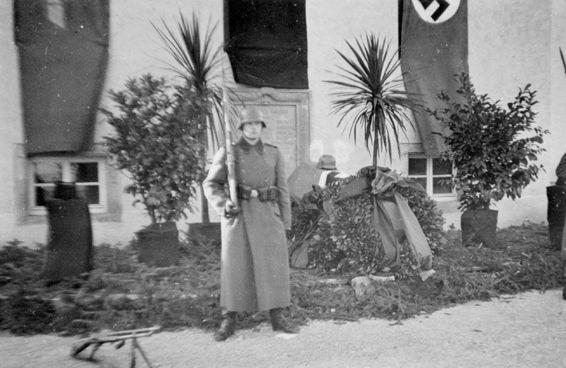
Eight photographs showing men of the SS-Totenkopf during a funeral ceremony. Training in the SS-style was often hazardous, especially when the men were supplied with live ammunition during exercises. Such aggressive training led inevitably to fatalities, but the SS were firm believers in the ‘train hard, fight easy’ school. The training also made the average SS man much more willing to lay down his life in honour of der Führer. Off the battlefield the Totenkopf Division still had close ties to the concentration camp service and its members continued to wear the Death’s-Head as their unit insignia. They were known for brutal tactics, a result of the original doctrine of no mercy which Eicke had instilled in his camp personnel during the thirties.
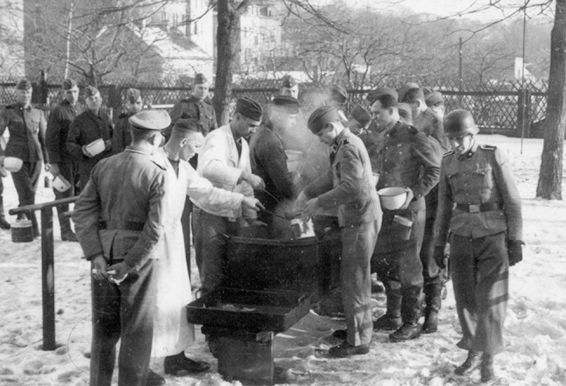
During a break in their training these SS men queue with their mess tins for soup.

SS troops pose for a group photograph during their training. As members of the SS these men were taught by their commandants to implement orders to the prisoners with horrific efficiency, in order to ensure that every officer, non-commissioned officer and SS guard was infused with the same brutal mentality as their commandant.
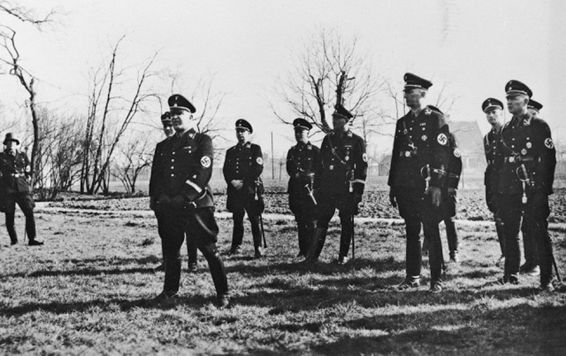
A photograph of Eicke with other commanding officers, in his role as inspector of the concentration camps. Eicke had begun an extensive reorganisation of the camps in 1935, with smaller camps being dismantled. Dachau camp remained, which was the first ever built, then Sachsenhausen opened in summer 1936, and Buchenwald in summer 1937. Dachau became the training centre for the concentration camps service. On 29 March 1936, the concentration camp guards and administration units were officially designated as the SS-Totenkopfverbände (SS-TV). Eicke’s reorganisations and the introduction of forced labour camps were the SS’s most powerful tools in the Third Reich. They earned Eicke a good reputation and total support from his SS-Reichsführer, Heinrich Himmler. (USHMM 51639)

The entrance to the SS compound at the infamous concentration camp, Mauthausen. Built in upper Austria, Mauthausen was greatly expanded over time, and by the summer of 1940 it had become one of the largest labour camp complexes in German-controlled Europe. Between 1939 and 1945 the camp was ruled with an iron fist by Franz Ziereis. By order of Eicke, Ziereis was quickly promoted to the rank of SS-Sturmbannführer, and on 20 April 1944 he received his final promotion to SS-Standartenführer.