
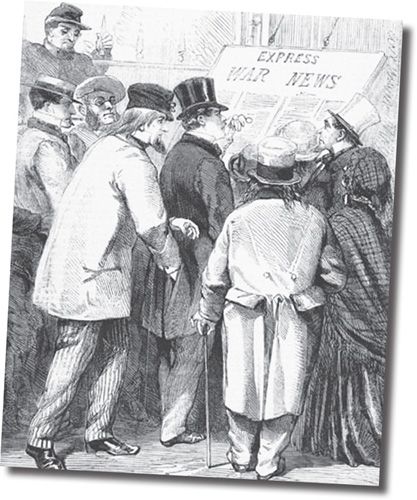
Civilians eagerly reading the latest war news on Broadway in New York City.
THIRTY MILLION AMERICANS lived in the United States during the Civil War. Nearly four million of them began the war as slaves and, by war’s end, were free. More than 3.5 million men, black as well as white, served in uniform and fought on the battlefields of that war from Texas to Pennsylvania. For the remaining millions who did not serve, the war ultimately touched nearly every one of them in countless ways. Many had sons, fathers, brothers, cousins, husbands, or sweethearts fighting in the ranks who sent them occasional letters home; some witnessed battles that raged, in a few cases, in their own backyards; Northerners as well as Southerners lost homes and property as cities and towns became military targets. But the vast majority of Northerners experienced the war day to day by reading the country’s great newspapers. New York, then as now the publishing center of the nation, boasted more than half a dozen dailies (among some 174 newspapers nationwide), among which three morning papers exerted enormous influence and attracted readers beyond the city’s boundaries: James Gordon Bennett’s Herald, Horace Greeley’s Tribune, and Henry J. Raymond’s New York Times.1 Though newspapers offered the country its principal source of news — the only source for most — editors and reporters in mid-19th century America did not aspire to objective journalism as they do (most of the time) in the 21st century. Papers were expected to maintain a clear and decisive political point of view and reflect it consistently in editorials and news coverage alike. Democrats read Democratic papers, and Republicans read Republican papers, and their respective readers expected no diversity of views in either.
Bennett’s Herald was unabashedly Democratic. Bennett himself, who was 61 years old when the war began, was an old Jacksonian who had flirted with the anti-foreigner Know-Nothing movement in the 1850s but returned to “the Democracy” before the war. His p a p e r, with a circulation of 84,000, promoted itself at the time as the most widely read daily in America, a claim The Times once disputed with a rare and savage caricature of Bennett as a horned devil “inflating his well-known, first-class, A-No. 1 Wind-bag Herald.” Bennett used his paper to assail Republicans generally, and the administration of President Abraham Lincoln in particular, at nearly every opportunity, though he might dispatch a correspondent to write friendlier stories if they promised to boost readership.
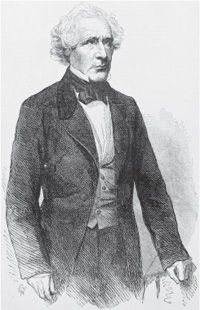
James Gordon Bennett, founder, editor, and publisher of The New York Herald.
Northern Democrats like Bennett were generally supportive of a war to maintain the Union, but suspicious of any attempt to use the conflict to forward a social agenda, especially if it embraced emancipation, or worse, equal rights for blacks. War for the Union was one thing; war for the black race quite another. As Bennett wrote in 1862: “That the negro should be as free as white men, either at the North or at the South, is out of the question.” Bennett was suspicious of Lincoln’s emancipationist tendencies, and he was occasionally as vituperative toward the president as the Richmond Enquirer or other Confederate dailies.2
On the other side of the political spectrum, Horace Greeley’s Tribune had become a liberal Republican paper. That meant that it generally championed the antislavery position, and was often well in advance of Lincoln on the question of emancipation. It was not quite an abolitionist paper like, for example, William Lloyd Garrison’s Liberator or Frederick Douglass’s Monthly, but when Greeley took Lincoln to task for not being aggressive enough in prosecuting the war or ending slavery, he reached a far larger audience. If Bennett’s Herald was the most widely read daily in America, Greeley’s Tribune (which reached 200,000 readers nationwide with its weekly edition) may have been the most influential.
The 50-year-old Greeley himself was something of an eccentric who went about New York in every season garbed in a full-length duster and carrying an umbrella. His cheeks were clean-shaven, but he let the white whiskers on his throat grow long and frizzy, giving him the appearance of an old gobbler. A strong supporter of manifest destiny, Greeley had famously urged young Americans to “go west” in 1835. Politically, he generally supported Lincoln and the Republicans, but he also challenged the president on occasion, and aware of Greeley’s influence, Lincoln paid attention to what he had to say.
Greeley’s politics were somewhat idiosyncratic, however, and occasionally unpredictable. He supported the conservative Edward Bates over the antislavery New York Senator William H. Seward for the 1860 Republican presidential nomination, then tried without success to win Seward’s vacant Senate seat for himself after Lincoln made his onetime rival his secretary of state.
It would not be Greeley’s only political failure. During the war, he persuaded Lincoln to authorize him to undertake a mission to Niagara Falls to negotiate peace with Confederate emissaries. The adventure proved a debacle. Finally, in 1872, Greeley accepted the Democratic nomination for president to run against the enormously popular President Ulysses S. Grant. Greeley not only lost overwhelmingly, but also became the only candidate in presidential history to die before the electoral votes were officially counted.3
In contrast to The Herald and The Tribune (which merged into one paper decades later), The New York Times reflected a centrist position. Its co-owner and editor was Henry Jarvis Raymond (1820–1869), a staunch Republican, who was neither as conservative as Bennett nor as liberal as Greeley. Born on a farm in the upstate town of Lima, New York (a “poor boy from the country,” his obituary stressed), he had graduated from the University of Vermont with high honors at the age of 20 and went to work at once writing for newspapers, including, for a time, Greeley’s Tribune. At the tender age of 31, Raymond and a partner, George Jones, raised $100,000 in pledged capital and formed a new company to establish a third major morning daily in New York. Jones, the largest stockholder, took on the role of publisher and business manager. Raymond, who owned 20 of 89 shares of the paper, became its editor.
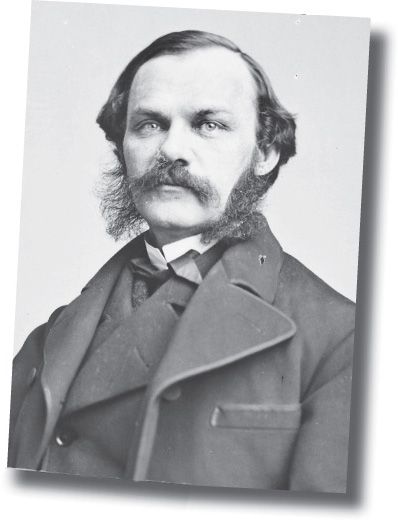
Henry Jarvis Raymond, founder and editor of The New York Times.
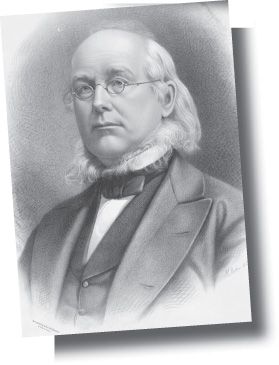
Horace Greeley, founder and editor of The New York Tribune.
Initially the new venture was called The New-York Daily Times, and afterward simply The New-York Times. (“Daily” vanished from the logo in 1857; the hyphen in “New-York” disappeared in 1896.) Founded in 1851 as a pro-Whig paper, but with aspirations to avoid “the advancement of any party, sect, or person,” the broadsheet, priced at a penny per issue, or $4 annually by subscription, promised to feature “tales, poetry, biography, the news of the day, editorials upon all subjects of interest, and a variety of interesting and valuable matter.” It would be “a family newspaper” committed to “needful reform,” yet “conservative.” It would try to “allay, rather than excite, agitation,” but it would also “inculcate devotion to the Union and the Constitution” and “obedience to law.”
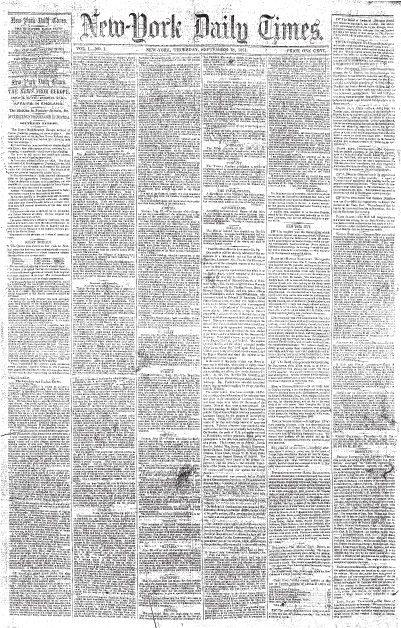
The first edition of The New York Times was printed on September 18, 1851.
The Times’s success, however, was by no means automatic. Immediately after Raymond announced its publication, The Tribune threatened local newsdealers that it would cease doing business with them if they dared to carry the new daily. (They defied him.) During the ensuing circulation war, both Greeley and Bennett dispensed rumors that their younger new rival was a dangerous radical.4
These harsh responses stemmed not only from the threat of business competition, but of political rivalry as well. Along with many of his fellow editors of the period, Raymond was also an active politician with ambitions not only for his party, but also for himself. Originally an “old Whig of the Seward School,” Raymond had served as a New York State Assemblyman — in 1851, the same year he opened The Times, he served as Assembly speaker — and later, from 1855 to 1857, he was New York’s “Anti-Nebraska” lieutenant governor (opposed to the controversial Kansas-Nebraska Act, which gave those territories autonomy and the right to decide whether slavery was allowed). For the last-named post he had defeated Greeley himself, ensuring his competitor’s lifelong enmity.
Like Lincoln, Raymond abandoned the fading Whig organization to become one of the founding members of his state’s new Republican party in the mid-1850s. At the first Republican National Convention in 1856, Raymond was instrumental in writing the new party’s founding principles and offered a widely praised speech from the floor. Within only five years, he had thus earned a reputation as both a “great orator” and a “great journalist” who “never absolutely abdicated his real and invisible authority as a writer when he assumed the insignia of a more palpable but a less genuine influence as a politician.”5
By the dawn of the Civil War, The Times had carved out its own niche in the furiously competitive marketplace for loyal New York readers. Though it still described itself in early 1860 as “the youngest of the daily newspapers of the City,” The Times could credibly boast that it had already “become one of the most widely known and most firmly established daily journals of the United States.” To be sure, some Republican critics assailed the conservative Raymond for his “thundering orthodoxy”; but others preferred his cautious nature to that of his counterpart at The Tribune. Horace Greeley was perhaps the better natural writer, but he was an inferior editor, for as one admirer wrote, Raymond “did not force, but coaxed, public opinion.... He had the soft answer that turned away wrath.” As his associate editor John Swinton recalled, Raymond “was a man of many talents rather than of special genius.” Yet this made him “a model editor, a man of mental equipoise, clear-headed, reasonable, ingenious, and genial.”6
Raymond’s Times proved capable of political independence, too — at least at the beginning of the Civil War. Although Raymond had supported Lincoln for president in 1860, he lost patience with the new administration when it failed to act swiftly against secession or to suppress rebellion at once. Less than two weeks after the Confederate attack on Fort Sumter (which The Times, along with most Northerners, including Lincoln, spelled “Sumpter”), The Times published a scathing editorial that began with the words: “Wanted — a Leader!” Lincoln clipped it along with several similar editorial critiques from the same unsettling period and filed them under the heading “Villainous articles.” The president was not pleased.7
But relations with the White House improved once Raymond better understood the unprecedented challenges facing the new president (and after he experienced some personal time with the commander-in-chief). After one White House meeting, the editor accepted the president’s explanation that he “wished he could get time to attend to the southern question,” as Lincoln put it, but for the fact that “the office-seekers demanded all his time.” Lincoln, Raymond said, was “like a man so busy in letting rooms in one end of the house, that he can’t stop to put out the fire that is burning the other.”8
Not that Raymond himself did anything to reduce such pressures — quite the opposite. From the beginning of the Lincoln administration, the editor sought to use his political influence to gain jobs for friends and allies. One job-seeker was granted an audience by the State Department simply because, as Lincoln put it, “He has a note from Raymond.” Indeed, Raymond asked Lincoln’s intervention to secure appointments large and small, both “on public grounds,” as he put it in one such plea, and “as a personal favor.” Once, when a New York congressman-elect asked Lincoln’s help on “a matter of political importance,” the president perhaps only half-jokingly urged him to see the editor of The New York Times instead. “Raymond,” he said, “is my Lieutenant-General in politics. Whatever he says is right in the premises, shall be done.” Those “premises,” after all, embraced the largest and wealthiest city in the nation, and Raymond grew in stature, in the words of another newspaper, by sitting “in that editorial chair which has so long swayed the minds of so vast a portion of the mighty multitudes of men that belong to, or are tributary to the heart of the Continent — New York City.”9
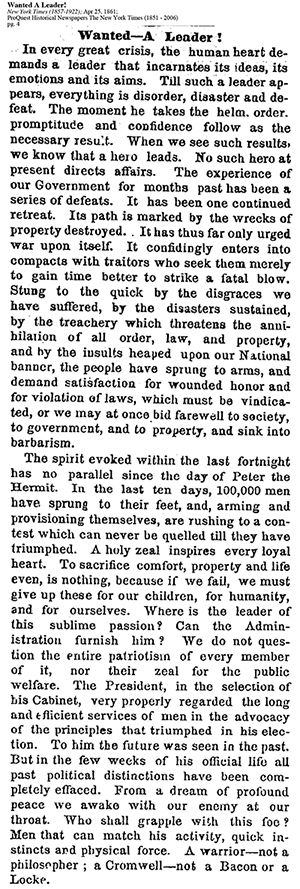
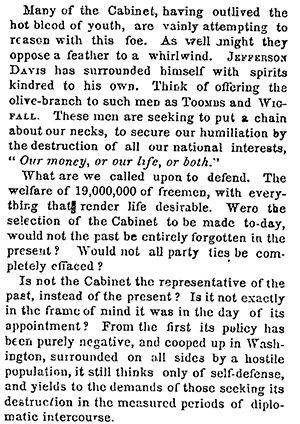
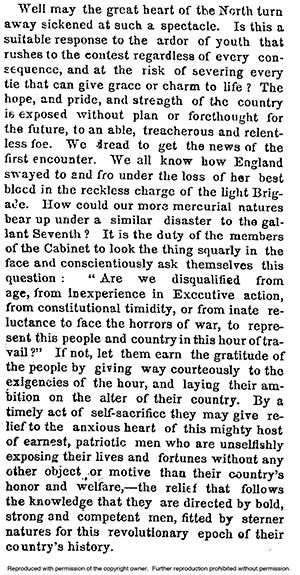
This Times editorial was printed on April 25, 1861.
Notwithstanding their common purpose, disputes between Lincoln and Raymond occasionally flared up. When, for example, The Times criticized Lincoln’s 1862 proposal for compensated emancipation as too costly, a vexed Lincoln shot off a famous letter to Raymond defending his initiative. “Have you noticed the facts,” asked Lincoln, “that less than one half-day’s cost of this war would pay for all the slaves in Delaware, at four hundred dollars per head? — that eighty-seven days’ cost of this war would pay for all in Delaware, Maryland, District of Columbia, Kentucky, and Missouri at the same price… Please look at these things, and consider whether there should not be another article in the Times.”
Raymond, who had not written the offending editorial himself, quickly saw to the publication of several corrective pieces in the paper. In a personal letter to Lincoln, moreover, he called the compensated emancipation proposal “a master-piece of practical wisdom and sound policy” typical of what he called Lincoln’s “plain, self-vindicating, common-sense” approach.” Not only did Raymond praise the idea in print as the president requested, he also introduced a resolution in the State Legislature endorsing the idea. For Raymond had returned to the Assembly — and would soon again become Speaker.10
Raymond offered further wartime advice after the July 1863 New York City Draft Riots, during which Times shareholder Leonard Walter Jerome (future grandfather of Winston Churchill) took to the roof of the newspaper’s headquarters to hold off a mob with a Gatling gun. After order had been restored, and the draft peaceably resumed, Raymond proposed that Lincoln submit the controversial federal conscription law to immediate review by the courts to counter the prevailing impression “that the act is unconstitutional.” The editor may well have influenced the prompt — and favorable — judicial review of the nation’s new draft laws.11
For the most part, Raymond’s newspaper remained a consistent champion of the administration and the war. Republican electoral successes and Union battlefield triumphs were invariably headlined as “Glorious News!” Democratic dissent was usually likened to high treason. The editor reliably defended the president from attacks by Bennett on the right and Greeley on the left. Though Greeley regarded Raymond as a “little villain,” the Tribune editor later conceded — once Raymond’s premature death, just four years after the war, softened the memories of their rivalry — “Abler and stronger men I may have met; a cleverer, readier, more generally efficient journalist, I never saw.”12
Raymond also grew into a peripatetic personal advocate for the Union and the party. As one example, just two weeks before Lincoln delivered his Gettysburg Address in November 1863, Raymond delivered a pro-war speech of his own in Wilmington, Delaware. In early 1864, a presidential election year, Raymond chaired the New York delegation to the national convention of the newly renamed National Union party, and led the Committee on Resolutions that wrote the party platform calling for a constitutional amendment abolishing slavery. He may have played a role in securing the nomination of conservative Tennessee Senator Andrew Johnson as Abraham Lincoln’s vice presidential running mate. Certainly he praised the selection in his editorials. The choice would come back to haunt both the editor and the nation.
By now Raymond had also taken on yet another key political role, the most important of his career: that of chairman of the National Union Executive Committee (the equivalent of today’s Republican National Committee). For the 1864 campaign, he also wrote a highly flattering campaign biography titled History of the Administration of President Lincoln; including His Speeches, Addresses, Letters, Messages and Proclamations; with a Preliminary Sketch of His Life. Its publisher openly described it as “written with a view to aid President Lincoln’s re-nomination,” privately confiding: “It cannot fail to have an excellent influence upon everyone who reads it.” That publisher, interestingly, referred to his author as “Gov. Raymond,” indicating that during the war the editor continued to use the traditional honorific he had earned as the state’s antebellum lieutenant governor.13
Once the convention chose Lincoln as its nominee in June, Raymond devoted himself, and his paper, to providing “the American people the material for forming an intelligent judgment as to the wisdom of continuing Mr. Lincoln, for four years more, in the Presidential Office.” That meant frequent editorials, along with political advice to both his readers and his candidate. When Horace Greeley’s Niagara Falls peace initiative collapsed, for instance, Raymond urged the publication of Greeley’s correspondence with Lincoln to expose Greeley as a liar for blaming Lincoln for the undertaking’s failure. Of course he also no doubt wanted The Times to seize the high ground over The Tribune. Lincoln, however, wanted the letters published only if he could first delete some of Greeley’s more incendiary charges about dwindling Northern morale; Greeley refused to authorize the cuts, so Raymond’s idea was dropped. “I have concluded that it is better for me to submit, for the time, to the consequences of the false position in which I consider he has placed me,” the president explained to Raymond, “than to subject the country to the consequences of publishing these discouraging and injurious parts.” Raymond had lost a battle but won a war: he, not Greeley, emerged with the administration’s entire confidence.14
If Raymond was eager to expose Greeley’s willingness to negotiate with the Southern traitors, by the late summer of 1864, he worried that Northern public opinion was turning against the war, and that a clear-cut Union victory was slipping away. In A ugust 1864, he sent the president a brutally frank and politically ominous assessment lamenting Republican prospects in the fast-approaching presidential election, and proposing a peace initiative of his own. Wrote Raymond:
I am in active correspondence with your staunchest friends in every state and from then all I hear but one report. The tide is turning strongly against us.... Nothing but the most resolute and decided action on the part of the government and its friends, can save the country from falling into hostile hands.... Why would it not be wise, under these circumstances, to appoint a Commissioner, in due form, to make distinct proffers of peace to [Jefferson] Davis, as the head of the rebel armies, on the sole condition of acknowledging the supremacy of the constitution — all other questions to be settled in a convention of the people of all the States?15
What Raymond implied, of course, was that in order to get reelected, Lincoln might have to back away from the promise of emancipation. That Lincoln was unwilling to do. He did draft a reply that would have authorized Raymond to seek an armistice under the terms he proposed, but he did so in the conviction that Jefferson Davis and the Confederacy would reject such an overture, and thereby bolster Northern determination. It never came to that. Instead, the cabinet (led by Raymond’s particular ally, Secretary of State Seward) urged Lincoln not to make the offer — to Davis or to Raymond. Instead, the president met with the entire National Committee at the White House. Arriving “in obvious depression and panic,” the party leaders were treated to a briefing and something of a dressing down. Lincoln bluntly told them that “sending a Commission to Richmond would be worse than losing the Presidential contest — it would be ignominiously surrendering it in advance.” Though Lincoln had adroitly neutralized Raymond in this instance, the editor and party boss apparently left Washington satisfied, and resumed his active campaigning for the administration in print — unleashing a stream of pro-Lincoln editorials that masked Raymond’s apparent personal yearning for a speedy peace.16
The Times’s advantages and influence expanded exponentially during the Civil War — and, arguably, because of it. First of all, the paper maintained the strongest connections with the Lincoln administration, which meant its political coverage was authoritative. But it also nurtured a sober style of reporting by a stable of talented and relentless correspondents, plus enviable contacts throughout the country and the world (The Times far outshone its rivals in foreign news). Adding temperate editorializing to its recipe for success, The Times established a major reputation as a source of news and opinion that only grew as the war continued. To some readers, the writing style in this collection will no doubt seem florid and ornamental; but to Civil War–era patrons, it was perhaps the most measured in the field of journalism.
The Times relied on a vast and growing network of sources, including news services it helped create, staff, and manage. During the war, all three New York newspapers also printed official notices provided by the government and public addresses by government officials, but each paper also boasted its own reporters who filed stories from the front — by telegraph if one were available, or by post if necessary. When reporters had access to the military telegraph, they often filed updates on battles as they were in progress. Here, for example, are the reports filed with The New York Times during the Battle of Bull Run, the first engagement of the war, on July 21, 1861, and which appeared in the paper the next day:
11:40. — The fighting is very heavy, and apparently more on our left wing.
11:50. — There is evidently a battle toward our left in the direction of Bull’s Run, and a little north. The firing is very rapid and heavy.
1:45. — Heavy guns are heard again, and apparently nearer. The musketry is heavy and nearer.
2 P.M. — The musketry is very heavy and drawing much nearer. There is evidently a movement more to our left.
2:45 P.M — The firing is a little farther off, and apparently in the direction of the Junction. Less heavy guns and more light artillery, as near as I can judge.
3 P.M. — The firing has ceased ten minutes since.17
More often, the stories of the fighting at the front reached New York readers in the form of narrative accounts filed by field reporters. Though occasionally it was possible to read these narratives the day after the events took place, a two-day delay often occurred between events at the front in Virginia and the stories that appeared in New York. The delay was greater in the case of events that occurred in the Western Theater — between the Appalachian Mountains and the Mississippi River. The war on the Mississippi was especially remote from New York readers. News about the siege of Vicksburg, for example, had to travel upriver by steamboat to Cairo, Illinois, for several days before it could be sent to New York by telegraph. On one occasion it was further delayed, and rendered almost obsolete, when an assistant of The Times correspondent Franc Wilkie got drunk and allegedly left the reports the correspondent had entrusted to him in a hotel room. Even in the best of circumstances, however, events in “the West” might not be reported in the New York papers for a full week.18
Every paper sent reporters into the field. Early in the war, the eager and dedicated Raymond acted as his own correspondent. He accompanied the Union army to Manassas, Virginia, in July 1861 and reported on the battle from there, filing his first dispatch on the pre-battle skirmish that took place along the banks of Bull Run Creek on July 18, 1861. Like most reporters at the time, Raymond described what he observed personally as an eyewitness. He did not interview sources. Generals who tolerated reporters at all were disinclined to grant them interviews. As a result, Raymond’s reports were written in the first person, and he often attached himself to a New York regiment, since his readers would want to know what their husbands and sons had done in the battle. The following is representative:
I went out with the centre column. At ten minutes before six we halted about a mile this side of the position of the rebels. The Sixty-ninth and Seventy-ninth Regiments of New-York were thrown to the right, in the woods, and the First and Second Ohio and the Second New-York to the left in advance....”19
Like journalists in every era, Raymond and his fellow correspondents worked on tight deadlines. They had to get their stories to the telegraph office in Washington in time to transmit them to the papers in New York for publication early the next morning. As a result, Raymond filed his story on Bull Run early at about 2:15 p.m. on the day of the battle. His dispatch that afternoon read: “I write this at 2 ¼ o’clock, and am compelled to close in order to avail myself of a special messenger to Washington. The fight is still going on with great energy.” At that time, the Union was winning the battle, and that was the news that Raymond wired. Alas, 45 minutes after the courier departed, fresh reinforcements from the Confederate army led by Joseph E. Johnston arrived on the field to turn the tide and force a Union retreat, a retreat that soon tuned into an embarrassing rout. Raymond tried to submit an amended report, but it had to wait until he arrived back in the capital. He showed up at the military telegraph office that night “sun-burned, dusty, and hardly recognizable” to file a new story. But the army telegrapher decided that it was not in the national interest to transmit news of a defeat, and would not let him use the army telegraph. Consequently, it was not until July 26, four days later, that The Times carried a full account of the humiliating loss.20
Raymond was hardly the only journalist caught short by the events along the banks of Bull Run Creek. All the New York dailies initially reported a Union victory, then had to correct the story later. Raymond decided that his days as a field reporter were over. After that, he sent other men to the front to report the news while he stayed in New York to assemble the paper, which was, after all, the editor’s job. But his writers in the field seldom failed him: they wrote quickly, for the most part authoritatively, and almost always evocatively. Their dispatches might offer thrilling accounts of the ebb and flow of distant battles, or features on the everyday life of soldiers: their diets, their frustrations, and their emotional attachment to the Union cause. Raymond supplemented their frontline reporting with editorials that usually ran a day or two after major encounters or political events, assessing each victory or defeat with commentary that not only reflected, but often scripted, the official Republican party line.
The Times could be counted on to reflect administration dissatisfaction with failed commanders, a resolute commitment to the overweening theme of Union and, later, emancipation, hatred of slave owners, the view that Jefferson Davis and other Confederate leaders were traitors, and a deep and abiding hostility to anti-war Democrats. That last category included New York’s own Mayor (and later Congressman) Fernando Wood — whose brother owned the anti-Lincoln New York Daily-News, as well as so-called Copperhead activists in other states. There was no pro-secession, pro-Confederate, pro-slavery, or, indeed, anti-Lincoln sentiment to be found on the pages of The Times during the Civil War. Thus, the stories that appear in this collection are undisguisedly, even proudly, biased — just as they would have seemed to the delight of pro-Republican readers of their day.
Raymond’s instructions to his correspondents were clear enough: “Don’t let anybody croak [lie] in The Times.… Put in as much spice as can be had.” And “Uphold Mr. Lincoln always.”21
Even after he abandoned his brief role as a war correspondent, Raymond did not sequester himself full-time in the paper’s lavish, fresco-filled five-story headquarters on New York’s “Newspaper Row” — the period name for the cluster of major publishing houses just south of City Hall Park. He still journeyed occasionally to the front or took the train to Washington to see administration officials, including Secretary of State Seward, Secretary of the Treasury Chase and the president himself. It was common understanding that the confidences they shared would not be reported in the paper. Once, Raymond even took on the role of industry lobbyist, traveling to the national capital with other editors to urge the government to repeal or reduce a recently imposed tax on printing paper.22
Raymond also traveled to observe the Army of the Potomac on the Virginia Peninsula in mid-1862. And the following January, in response to a sad summons to meet his soldier-brother’s corpse in Belle Plain, Virginia, he journeyed down to the remote village on the Potomac Creek. There, to his joy, he found his brother alive and well: the telegraph had garbled the message — the editor had been summoned to visit not his brother’s corpse, but his corps. Happy as he was at this unexpected news, Raymond was horrified at the “state of gloom and discouragement among the officers and soldiers” of Ambrose Burnside’s army after its recent defeat at Fredericksburg. The troops had lost confidence in their general, the editor observed, because Burnside “had no confidence in himself.” Ever loyal, Raymond confined these observations only to his diary. But he did approach Lincoln at a White House reception a few days later to whisper his concerns about Burnside’s rumored successor, Joseph Hooker — whom Raymond and others suspected of harboring dictatorial ambitions. Lincoln reassured him personally. He “put his hand on my shoulders,” Raymond later recalled, “and said in my ear, ‘Hooker does talk badly; but the trouble is, he is stronger with the country today than any other man.’”23
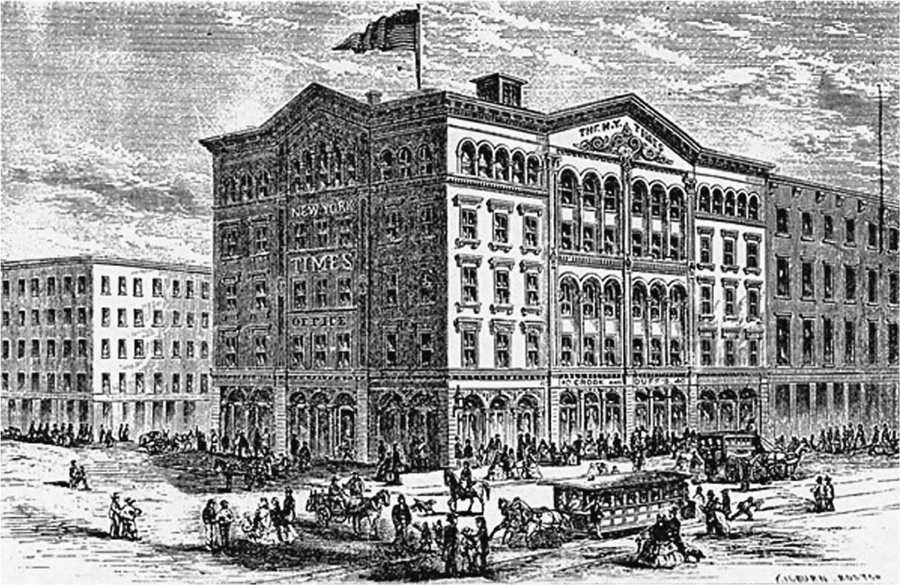
The New York Times building near City Hall was the most elaborate newspaper headquarters in the city.
Not even The Times could be everywhere all the time, so occasionally Raymond’s newspaper reprinted stories and even editorials from other papers, especially from the West — there was no copyright law then to protect such stories from being copied and reprinted, and most dailies of the time did so routinely. The Times also reprinted stories from some Southern journals. These might present a rare pro-Union or defeatist view from the region, but just as often offer a retrograde defense of slavery or secession, which The Times usually accompanied with an incredulous headline or mocking introductory paragraph. Conversely, stories in The Times were also frequently reprinted in other papers all across the country.
Most of its original reports came from field correspondents — men (and they were all men) who were embedded (as we would say today) with the army at the front. Some of them became household names, as familiar to readers of The Times as Walter Cronkite became to a later generation of television viewers. There was Lorenzo Livingston Crounse, who reported on the Battles of Chancellorsville and Gettysburg and reveled in pursuing what he called “the single object of getting the news, and getting it first, too,” explaining: “In no business in existence is the competition so sharp as between the leading newspapers of New York.” There was the “cold-blooded” William Swinton, who once traveled with the army in the company of Raymond, and later covered Gettysburg as well; and George F. Williams, who traveled with Grant’s army through the Wilderness and Spotsylvania to Richmond, as well as many others. Sometimes they signed their articles; sometimes they provided only initials (Raymond himself was only “R” or “H. J. R.”); and sometimes they employed noms de plume: George H. S. Salter signed his pieces “Jasper”; Franc Banks Wilkie was “Galway,” the name of his upstate New York childhood home; and William Conant Church chose the name “Pierrepont.” Often their contributions remained entirely unattributed. There was no such thing as an under-the-headline “byline” during the Civil War.24
It was not always easy for these reporters to gain the necessary credentials to get to the front lines. Lincoln’s personal intervention was required in May 1864 when The Times reporter Edward A. Paul was denied such a pass. “We have had a great deal of difficulty in getting any correspondents into the field for The Times,” Raymond huffed, “while special pains seems to have been taken to give the World [an anti-Administration paper], The Herald &c. all possible facilities.” Raymond was particularly incensed when Secretary of War Edwin Stanton personally held up Paul’s approval (Paul reported that Stanton used “stronger language than is necessary to repeat” to the president), complaining that his “treatment of me in this matter is perfectly inexplicable.... I am not aware of having ever given him cause for the resentment & hostility he seems to feel towards The Times.” Actually, The Times had earlier railed against “the vexatious despotism of the War Department since Mr. Stanton became its chief,” and Stanton no doubt held a grudge. History remains unclear about whether Paul ever got his credentials.25
But the secretary of war was not the only official in authority to impede the uncensored transmittal of news. The mercurial Union Gen. William T. Sherman made life miserable for nearly every reporter covering his army, and reportedly rejoiced when one of them was captured by Confederates. In September 1864, Maj. Gen. Benjamin F. Butler issued an order to all journalists covering the Army of the James that “there shall be no prognostications, no assertions that you could give news if it were not contraband; no predictions that movements are about to be made that will surprise the enemy or anybody else.” Butler perhaps had reason for concern. Earlier that same year, several New York newspapers — though not The Times or The Tribune — had published a bogus presidential proclamation calling for 400,000 fresh Union volunteers. The hoax was designed to enrich Wall Street speculators poised to sell short on the wings of the counterfeit order, but it was quickly exposed. High-speed boats were even successfully sent out from the city’s ports to intercept liners carrying the faked news to Europe. One of the reporters responsible for the forgery turned out to be Joseph Howard of The Brooklyn Eagle. Howard had previously worked for The New York Times.26
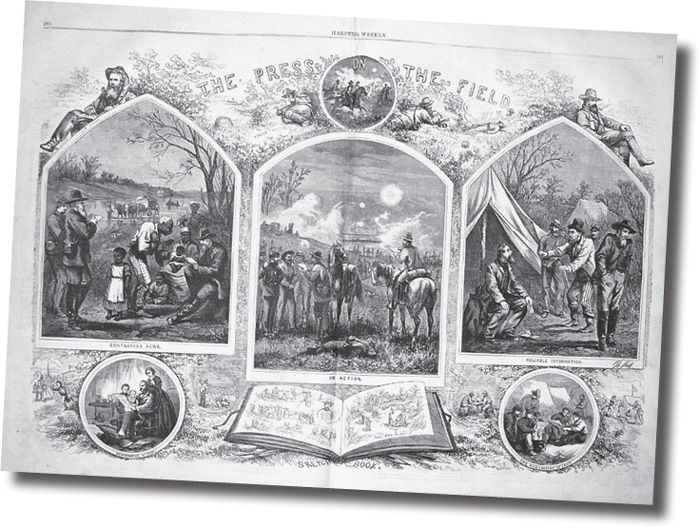
Harper’s Weekly illustration from 1864 showing war correspondents interviewing emancipated slaves (left), soldiers (center), and an unidentified man.
When they could get to the front and do their reporting unobstructed, the lives of wartime correspondents were as adventurous, and occasionally as dangerous, as those of embedded 21st-century reporters in Iraq or Afghanistan. The Tribune reporter Whitelaw Reid recalled an encounter with Crounse of The Times: “A horseman gallops up and hastily dismounts. It is a familiar face — L. L. Crounse, the well-known chief correspondent of the New York Times, with the army of the Potomac. As we exchange hurried salutations, he tells us that he has just returned from a little post-village in Southern Pennsylvania, ten or fifteen miles away; that a fight, of what magnitude he cannot say, is now going on near Gettysburg, between the First corps and some unknown force of the enemy; that Major-General Reynolds is already killed, and that there are rumors of more bad news.” Then Crounse and Reid both mounted up to ride toward Gettysburg. Unsurprisingly, perhaps, Crounse had two horses shot from under him during the war.27
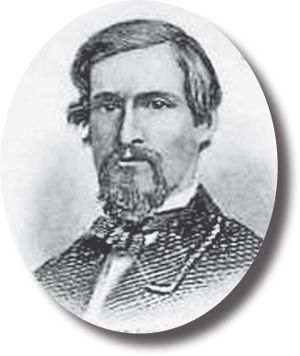
Times correspondent L. L. Crounse.
The “thick-skinned” war correspondent William Swinton (1833–1892) accompanied Grant’s army during the decisive Overland Campaign in 1864. He was an indefatigable journalist who often incurred the anger of Union generals who thought him too eager to discover — and to print — stories about the army’s movements. After Swinton reported on Burnside’s march across the Rappahannock River in January 1863 (“the army was literally stuck in the mud … absolutely helpless”), the general threatened to have him shot. In several of his reports, Swinton kept a running diary recording his impressions hour by hour as the battles in Virginia were being fought, and later relied on that diary to write two acclaimed books: Twelve Decisive Battles of the War (1871) and The History of the Campaigns of the Army of the Potomac (1882). Henry Ward Beecher said of him, “If any one will know the mechanism and anatomy of battle, let him read our American Napier, William Swinton.” It did not hurt that Swinton’s brother John was an influential associate editor of The Times. But William more than earned his own reputation (though Herald reporter Henry Villard, for one, thought him a “habitual liar”). Raymond ultimately assigned his star reporter to interview Lincoln himself on his relationship with General McClellan, and to obtain copies of their unpublished correspondence. The editor described William Swinton as “a gentleman of ability & intelligence and fully worthy of any confidence you may place in him.” But that did not stop him from leaving the paper by 1864 for a job with the rival Tribune.28
The prototypical Western Theater correspondent Franc Bangs Wilkie beautifully described fresh-faced recruits for whom the war seemed at first “a picnic, a pleasure-trip, a triumphal jaunt through Dixie, with flying banners and beating drums.” When Raymond saw one of Wilkie’s well-crafted early freelance pieces, The Times hired him for $7.50 per column of type. But Wilkie widened the communications gap between New York and the West by periodically failing to transmit stories (he did not, for instance, file a timely account of the Battle of Wilson’s Creek). Raymond nevertheless extravagantly hailed a subsequent contribution as “unparalleled in the history of journalism,” and hired him as a full-time correspondent. Wilkie ended up campaigning with Grant for nearly two years. His postwar books included Pen and Powder (1888).29
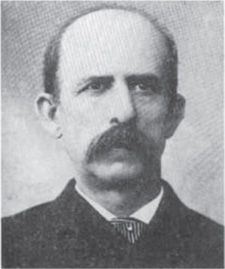
Times correspondent Franc Bangs Wilkie.
George Forrester Williams was another daring and intrepid Times reporter. He was so determined to get to the scene of action that during the Battle of the Wilderness in 1864, though he was denied permission by the army’s provost marshal to approach the battlefield, he borrowed a horse and rode twelve miles to observe and report on the fighting firsthand. The provost marshal subsequently arrested him and hauled him before General Grant. To the frustration of the provost, Grant declared that the reporter had violated no law, he had merely been resourceful. Then he added: “Your description of the battle, Mr. Williams, was a very good one. I read it with a great deal of interest.” After the war Williams wrote Bullet and Shell: War as the Soldier Saw It (1884), though he might have subtitled it: War as a New York Times Reporter Saw It.30
Arguably no Times reporter endured more danger and sorrow — yet maintained a more professional demeanor — than Samuel Wilkeson, who worked for both The Tribune and The Times, but covered the war’s greatest battle, Gettysburg, for the latter paper, knowing that his own son was serving in the ranks of Union forces engaging the Confederate enemy. Once the fighting subsided, he went searching for the boy, only to find him dead. While sitting at his son’s grave, Wilkeson wrote the following justly famous lines:
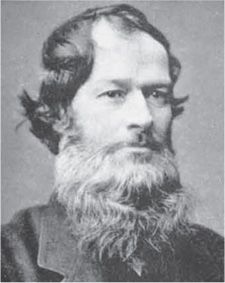
Times correspondent Samuel Wilkeson.
Oh, you dead, who are at Gettysburgh have baptized with your blood the second birth of Freedom in America, how you are to be envied! I rise from a grave whose wet clay I have passionately kissed, and I look up and see Christ spanning this battle-field with his feet and reaching fraternal and lovingly up to heaven. His right hand opens the gates of Paradise — with his left he beckons these mutilated, bloody, swollen forms to ascend.31
The articles by these men, and those of many others, form the bulk of this volume. The idea is to allow modern readers to follow the full story of the war as the original readers of the Civil War–era New York Times did from 1861 to 1865. Twenty-five wartime chapters are preceded by a prologue featuring articles covering the major events that led to secession and war; and they are followed by an epilogue containing accounts that carry the story forward through the important postwar period known as Reconstruction. The articles are all reprinted here in the order in which they appeared. For that reason, accounts of the events in the West sometimes appear four, five, or six days after the events themselves. In a few cases, such as during the 1864 Red River campaign in Louisiana, accounts arrived several weeks after the fact.
The emphasis — just as it was in the original editions of the newspaper — remains firmly focused on the military aspect of the Civil War. But the political battles on the home front were seldom far from the lead position of the paper, and they get ample space in this collection, too. Raymond knew that without Republican majorities in Washington and Albany, public and financial support for the Union would evaporate. Consequently, The Times reported avidly on local and national elections alike, not only New York’s own, but also assailing Democratic candidates in other states, particularly if they advocated for peace at any price. After Raymond assumed his role as Republican chairman in early 1864, his principal job became defeating Democrats at every level.
On August 27, just days after sending his dis-obliging letter on the party’s prospects and then visiting Lincoln to propose a peace conference, Raymond reiterated to his readers that he was now “deeply impressed with the belief that Mr. Lincoln will be re-elected; and regards the political situation as most hopeful and satisfactory....” To help ensure the victory, he demanded a $500 political contribution from each cabinet secretary. And he proposed assessing the employees of their various departments and tithing workers at the New York Custom House, one of the city’s most lucrative patronage mills, to the tune of 3 percent of annual wages. In a letter to government contractors, Raymond blatantly informed them: “I take it for granted you appreciate the necessity of sustaining the government in its contest with rebellion.… Please remit whatever you feel inclined to give in a check, payable to my order as treasurer of the national executive committee. I respectfully ask your immediate attention to this matter, as the need of funds is pressing and the time for using them is short.” The dividing line between journalism and politics, if there ever was one, was now totally erased.32
By now, Raymond was himself a candidate, too — for the House of Representatives — facing a difficult race of his own in New York’s evenly split Eighth Congressional District. Raymond described the candidacies of himself and the president’s as representing the conviction that the war must be prosecuted until the “complete and final overthrow of the rebellion.” Fundraising was the weapon of choice. Raymond called on Lincoln to sanction active campaigning for money among government workers at the city’s post offices and navy yards; Lincoln did nothing to squelch the effort.33
Navy Secretary Gideon Welles, for one, resisted Raymond’s attempts to pressure employees of his department. Labeling the Times editor “an unscrupulous soldier of fortune,” he charged: “He and some of his colleagues are not to be trusted, yet these political vagabonds are the managers of the party.” Welles’s objections to Raymond’s blatant fund-raising were not based entirely on principle. He suspected Raymond at least in part because of the editor’s close ties to Welles’s cabinet rival William H. Seward. The Navy secretary was convinced that The Times would “attack any and every member of the Cabinet, but Seward.” Raymond ultimately journeyed to Washington to plead his case personally to Lincoln at the White House. There, Welles was appalled to find the editor one day speaking “in a low tone of voice” to the president about the lack of party loyalty among the 7,000 employees of the Brooklyn Navy Yard. They should, Raymond brazenly insisted, accept a levy imposed on their wages for the party’s use or be fired. Outmaneuvered, Welles reluctantly agreed that the most “obnoxious” foes of the administration at the Brooklyn yard could be dismissed, and shrank away from the meeting, later confiding to his diary: “I am amazed that Raymond could debase himself so far as to submit such a proposition, and more that he expects me to enforce it.” To Welles, Raymond’s methods represented an “arbitrary and despotic exercise of power.” Eventually, some pro-Democratic workers in Brooklyn were indeed fired — but only some 50 of them.34
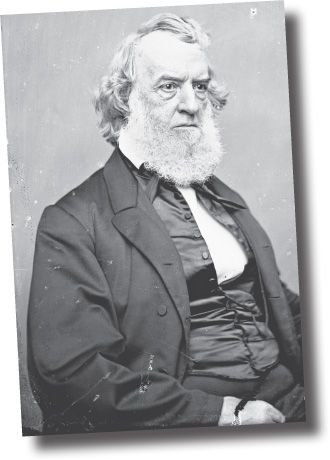
Secretary of the Navy Gideon Welles.
Ultimately, Raymond, like the president, easily won his November election (though Lincoln lost decisively in New York City). Earning 42 percent of the vote in a four-man contest, the editor now became a congressman-elect. Ironically, his victory also hastened his decline; his editorial and political power would never again be so great. By the time Raymond headed to Washington to take his seat in the House in December 1865, his great benefactor Lincoln was dead, and his unpopular successor was splintering the old Republican coalition, while the influential Times languished in the hands of caretaker editors. But then, the great issue of the day — the Civil War — had been settled.
Throughout that war, readers of The New York Times, particularly during election campaigns, were treated to almost daily puff pieces about the Republicans, alongside withering criticisms of the Democrats. But to suggest that The Times featured only war stories and political propaganda would be misleading. Like other broadsheets of the day, it contained reprints of major orations, odd human-interest stories, literary items, business and financial news, reports of public meetings and scientific innovations, crime stories, reviews of art and music, and reports on the comings and goings of the rich and famous — the “early publication of reliable intelligence from both continents,” according to its original prospectus. Most of these, the editors have been unable to include in this volume; but we mention them here to give the readers of this book an appreciation of the scope of coverage the paper provided six days a week throughout the war.35
It might be added that while The Times and most other newspapers of the period were designed for home-front consumption, the paper also offered soldiers in the field a vital link to the communities they had left behind to fight for the nation. Just as the paper brought news of the war to civilians, it brought civilian news to soldiers as well. In 1864, when The Times and other pro-Republican dailies successfully advocated for the soldiers’ right to vote by absentee ballot if they could not return home on Election Day, the newspaper also became a vital sounding board for campaign politics among the military. Speaking for soldiers and civilians alike, Oliver Wendell Holmes observed early in the war: “If we are rich, we can lay down our carriages, stay away from Newport or Saratoga, and adjourn the trip to Europe sine die.... Only bread and the newspaper we must have, whatever else we do without.”36
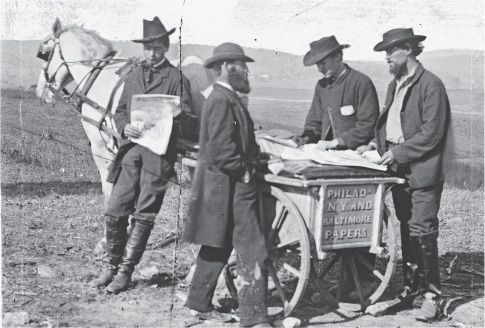
A newspaper vendor near a soldier camp in Meade, Virginia, 1863.
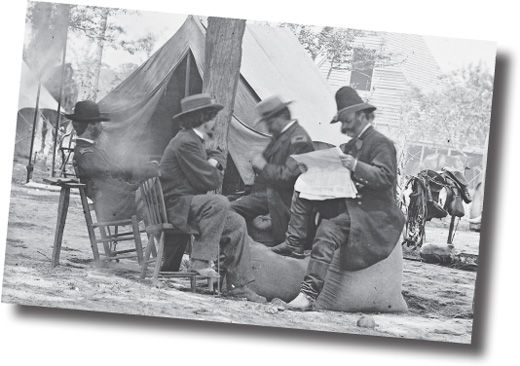
Union General Ambrose E. Burnside reading a newspaper with photographer Mathew B. Brady (nearest tree) at Army of the Potomac headquarters.
The American Civil War was the nation’s greatest and most traumatic event. Its genesis is covered in a Prologue and its consequences in an Epilogue, but it is the war itself — the bitter, sanguinary conflict that lasted almost exactly four years, from April 1861 to April 1865 — that is the centerpiece of this book. To read about it as New Yorkers and other contemporaries did allows a modern reader to gain an entirely new understanding of the complexity of this wrenching conflict. It was not a constant parade of battles, nor was there universal appreciation of the deep channel that the war was carving out for itself. Wars have a tendency to create their own momentum, and the unpredictable and uneven momentum of the Civil War is evident in the pages of The Times.
The national conversation about the relationship of slavery to re-Union, for example, began almost at once and lasted throughout the war and into the Reconstruction era. The understanding of the protocols of war — what today we would call the rules of engagement — changed constantly, too. Lincoln initially declared Confederate privateers to be pirates, and then had to back down from that when Jefferson Davis threatened retaliation. Once Lincoln made the decision to allow black men to serve in the Union Army, Davis asserted that black men under arms would be considered as escaped slaves and would be sold back into slavery, and that their white officers would be treated as guilty of fomenting a slave rebellion and executed on the spot. Other issues, including the treatment of prisoners, the protection of noncombatants, and the legitimacy of targeting factories and farms, emerged as the war progressed. Throughout it all, thoughtful men with various perspectives considered and debated the meaning of these changes in the pages of The New York Times.
The cost of the war, both in dollars and in human lives, astonished everyone. As appalling as the losses in the Battle of First Bull Run in the summer of 1861 seemed at the time, they paled by comparison to the losses at Shiloh in 1862, and those in turn paled in comparison to the killing at Gettysburg. The Overland Campaign in 1864 was a 40-day bloodletting, with no historical antecedent, that foretold the World War I carnage in the trenches of the Western Front from 1915 to 1917. Before the Civil War was over, some 620,000 men lost their lives, and Abraham Lincoln, as The Times reported in detail, became very nearly the last of them.
In editing this volume, the first challenge we faced was selecting from among a truly breathtaking archive — the tens of thousands of stories printed by The Times — those that most accurately revealed the course of events and the shift in attitude provoked by those events. In the end, we chose some 650 articles, editing some of the longer ones down to their central argument. The surgery necessary to do this was painful, but we are convinced that what remains represents the central essence of The Times’s reporting of the Civil War. Still, for those who wish to read all the stories in their unedited format, the accompanying disks contain all the raw material. As lengthy as this book is, it could well have been much longer.
To save space, one of the things we were forced to edit was the character of the 19th-century headlines — and Raymond’s Times is generally credited with introducing the display headline. During the Civil War, it was common for most important articles to be introduced by as many as a dozen headings and subheadings — “banks” or “decks,” as professional journalists call them. In this manner, readers could quickly understand major events as might by glancing at a handbill. As but one daunting example of this tradition, here is the “headline” that led the article printed on July 7, 1863, about the Battle of Gettysburg:
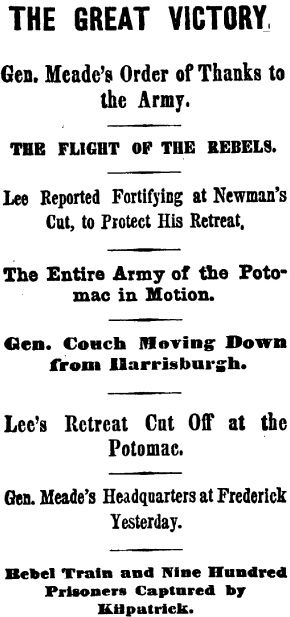
Rather than duplicate all of this, the headline we used in this volume is:
THE GREAT VICTORY.
GEN. MEADE’S ORDER OF THANKS TO THE ARMY.
In the articles themselves, abridged or not, we occasionally indicate the misspelling of a proper name by adding the accurate spelling in brackets. Likewise, the first time an important individual is named in an article, we have had added the first name in brackets. For important historical actors we have provided more detailed information in footnotes at the end of many articles. Otherwise we have retained the original structure and spelling of the articles just as they appeared during the war. The Times spelled Gettysburg and Vicksburg as “Gettysburgh” and “Vicksburgh” and spelled entrenchments as “intrenchments,” and we have allowed these to stand, too. Similarly, the paper used capital letters in printing the name of every person it described in print; that practice long ago vanished, but we have retained it here out of respect for the original journalistic convention.
Aside from these minor concessions to modern sensibilities among readers to whom we introduce this material 150 years after the Civil War began, the editors have gratefully allowed The New York Times to speak again for itself. As the following pages will demonstrate, it did so with extraordinary vitality, breadth, and determination.
After Lincoln’s death, Raymond wrote a laudatory biography called The Life and Public Services of Abraham Lincoln that burnished the martyr’s growing legend for an audience beyond even that of The Times. But in his day, Lincoln had expressed similar sentiments about Raymond’s newspaper. When Secretary of War Edwin M. Stanton once insisted that he could not issue passes to Times correspondents in advance of those issued to others, Lincoln made clear his undisguised favoritism. “The Times,” he wrote, “is always true to the Union, and therefore should be treated at least as well as any other.” (See art below.)37
The editors hope they have done the same.
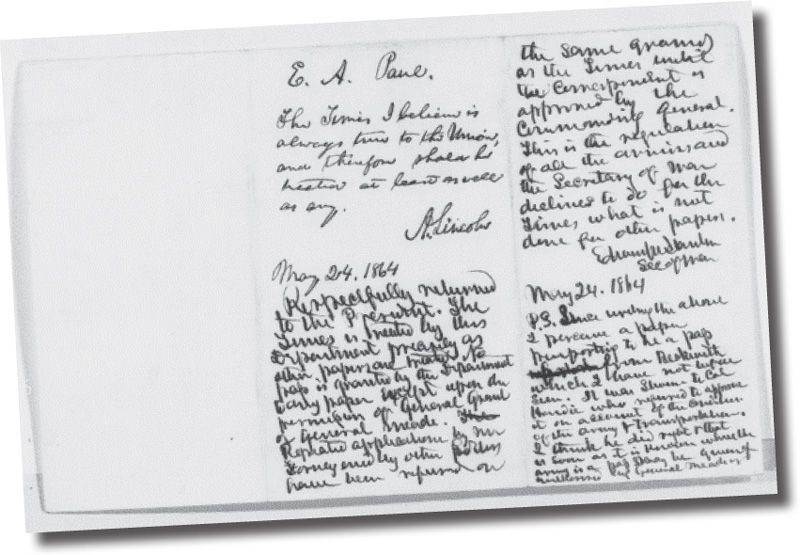
This endorsement from President Lincoln—and the subsequent comments by Secretary of War Edwin M. Stanton— came after Times correspondent E.A. Paul complained that he had been refused a pass from the War Department to cover General Grant’s army in the field. Paul demanded that “The Times be placed on an equal footing with other loyal papers.”
The Times I believe is always true to the Union, and therefore should be treated at least as well as any.
A. Lincoln
May 24. 1864
Respectfully returned to the President. The Times is treated by this Department precisely as other papers are treated. No pass is granted by the Department to any paper except upon the permission of General Grant or General Meade. The Repeated application by Mr Forney and by other Editors have been refused on the same ground as the Times until the correspondent is approved by the Commanding General. This is the regulation of all the armies and the Secretary of War declines to do for the Times what is not done for other papers.
Edwin M. Stanton
May 24. 1864
P. S. Since writing the above I perceive a paper purporting to be a pass from Beckwith which I have not before seen. It was shown to Col Hardie who refused to approve it on account of the condition of the army & transportation. I think he did right & that as soon as it is known where the army is a pass may be given if authorised by General Meade or Grant but not without their express or personal authority.
Edwin M. Stanton
Sec of War
NOTES
1. On the eve of war in 1860, the population of the United States was 31,443,321, which included 3,953,760 slaves. Just under 23 million lived in the Union States, and 9.1 million in what would soon become the Confederate States. Of that latter number, more than three million were slaves.
2. The quotation is from The New York Times, December 11, 1861. For Bennett, see Douglas Fermer, James Gordon Bennett and the New York Herald: A Study of Editorial Opinion in the Civil War Era, 1854–1867 (London: Royal Historical Society, 1986).
3. For Greeley, see Robert C. Williams, Horace Greeley: Champion of American Freedom (New York: New York University Press, 2006). Also worthwhile is Greeley’s autobiography: Horace Greeley, Recollections of a Busy Life (New York: J. B. Ford, 1868).
4. Augustus Maverick, Henry J. Raymond and the New York Press for Thirty Years (Hartford, Conn.: A. S. Hale & Co., 1870), 94–95.
5. Obituary of Henry J. Raymond in The New York Times, June 21, 1869; Alexander K. McClure, Recollections of Half a Century (Salem, Mass.: The Salem Press, 1902).
6. New York Sun, March 2, 1860; New–York Times, June 21, 1869; John Swinton, “The New York Daily Papers and the Editors,” Part 2, The Independent (Jan 25, 1900), 237–238.
7. The full article, dated April 25, 1861, is reproduced in Chapter 3 and a facsimile appears on page 10. Historian David Herbert Donald described Lincoln as “wounded” by this and similar editorial attacks. See Donald, “Sixteenth President Wrote His Own Book on Leadership,” in David Herbert Donald and Harold Holzer, eds., Lincoln in the Times: The Life of Abraham Lincoln as Originally Reported in the New York Times (New York: St. Martin’s Press, 2005), 1.
8. Henry J. Raymond, The Life and Public Services of Abraham Lincoln (New York: Derby & Miller, 1865), 720.
9. On the irony of Raymond’s efforts to influence the patronage, The Times had insisted that the President “owes a higher duty to the country…than to fritter away the priceless opportunities of the Presidency in listening to the appeals of competing office–hunters” (April 4, 1861). For the endorsement of an office seeker, see Lincoln to William H. Seward, June 8, 1861, in Roy P. Basler, ed., The Collected Works of Abraham Lincoln, 8 vols., hereinafter cited as Collected Works (New Brunswick, NJ: Rutgers University Press, 1953), 4:397; Raymond to Lincoln, January 16, 1862, Abraham Lincoln Papers, Library of Congress; Francis B. Carpenter, “Anecdotes and Reminiscences,” quoted in Raymond, Life and Public Services of Lincoln, 758; Washington Intelligencer quoted in The New York Times, June 21, 1869.
10. Lincoln to Raymond, March 9, 1862, in Collected Works, 5:152–3; Raymond to Lincoln, March 15, 1862, Abraham Lincoln Papers, Library of Congress.
11. Raymond to Lincoln, July 19, 1863, Abraham Lincoln Papers, Library of Congress.
12. The New York Times, June 6, 1869; J. Cutler Andrews, The North Reports the Civil War (Pittsburgh: University of Pittsburgh Press, 1985), 11.
13. J. C. Derby to John Nicolay, April 11, May 5, February 24, and March 22, 1864, all in John G. Nicolay Papers, Library of Congress.
14. Raymond, Life and Public Services of Lincoln, 5; Lincoln to Raymond, August 15, 1864, Collected Works, 7:494.
15. Raymond to Lincoln, August 22, 1864, Abraham Lincoln Papers, Library of Congress.
16. Lincoln’s handwritten draft authorization for Raymond’s peace mission, dated August 24, 1864, is in Collected Works, 8:517. See also, John G. Nicolay and John Hay, Abraham Lincoln, A History, 10 vols. (New York: The Century Company, 1890), 9:219
17. See the full entry in chapter 4.
18. Franc Wilkie, Pen and Powder (1888), quoted in Louis M. Starr, The Bohemian Brigade: Civil War Newsmen in Action (Madison: University of Wisconsin Press, 1954), 239.
19. See the full entry in Chapter 4.
20. Raymond’s article, dated July 26, 1861, appears in Chapter 4.
21. Swinton, “The New York Daily Papers, Part II,” 238.
22. Henry W. Raymond, “Extracts from the Journal of Henry J. Raymond (Edited by his Son), II,” Scribner’s Monthly, 18 (March 1880): 708. The delegation of publishers lobbying on the paper levy included William Appleton and Fletcher Harper of Harper’s Weekly.
23. Nicolay and Hay, Lincoln, 6:212; Henry W. Raymond, “Extracts from the Journal of Henry J. Raymond, I,” Scribner’s Monthly, 18 (January 1880): 419–20; Raymond, Life and Public Services of Lincoln, 705.
24. “The Army Correspondent,” Harpers New Monthly Magazine (October, 1863): 627–633; Starr, The Civil War’s Bohemian Brigade, 232. Sylvanus Cadwallader, Three Years with Grant, quoted in James M. Perry, A Bohemian Brigade: The Civil War Correspondents — Mostly Rough, Sometimes Ready (New York: John Wiley & Sons, 2000), 254.
25. Henry J. Raymond to Nicolay, E. A. Paul to Lincoln, May 23, May 25, 1864, Abraham Lincoln Papers and John G. Nicolay Papers, Library of Congress. Lincoln’s endorsement, May 24, 1864, is in Collected Works, 7:360. See also, Starr, Bohemian Brigade, 105.
26. Maverick, Henry J. Raymond, 257.
27. Frank Moore, ed., The Rebellion Record: A Diary of American Events (New York: Putnam, 1864); Andrews, The North Reports the Civil War, 419.
28. Beecher’s remarks were contained in the Swinton obituary that appeared in The New York Times, December 11, 1892; Raymond to Lincoln, April 4, 1864, Abraham Lincoln Papers, Library of Congress; Henry Villard to John G. Nicolay, June 16, 1863, John G. Nicolay Papers, Library of Congress.
29. Wilkie was praised in an editorial on “one of our special correspondents,” in The New York Times, October 3, 1861, reprinted in Andrews, The North Reports the Civil War, 128. Wilkie in turn said Raymond “surely was the most appreciative, kindliest, and most courteous of journalists,” Perry, A Bohemian Brigade, 62.
30. The exchange between Williams and Grant is recorded in Andrews, The North Reports the Civil War, 609–10.
31. Wilkeson’s full report, dated July 6, 1863, is in Chapter 14. He later became The Times’s Washington Bureau chief. See Wilkeson to Nicolay, September 21, 1864, inquiring about President Lincoln’s demeanor when visiting the Antietam battlefield (John G. Nicolay Papers, Library of Congress).
32. Francis Brown, Raymond of the Times (New York: W. W. Norton, 1951), 224; Henry J. Carman and Reinhard H. Luthin, Lincoln and the Patronage (New York: Columbia University Press, 1945), 290–91.
33. Raymond, Life and Public Services of Lincoln, 602.
34. Gideon Welles, The Diary of Gideon Welles, Secretary of the Navy under Lincoln and Johnson, ed. by Howard K. Beale (New York: W. W. Norton, 1960), 2:87–88, 97–99, 104, 136.
35. Maverick, Henry J., Raymond, 93.
36. Oliver Wendell Holmes, “Bread and the Newspaper,” Atlantic Monthly (September 1861), 346.
37. Lincoln to Edwin Stanton, May 24, 1864, Basler, ed., Collected Works, 7:360. Emphasis added.