
PROLOGUE
1850 –1860

Detail from an 1850 editorial cartoon condemning the Fugitive Slave Act.
Every modern American knows — just as every reader of The New York Times understood at the time — that the Civil War began with the first shots fired at Fort Sumter in April 1861. But there was a dramatic backstory, too: the long-simmering dispute between North and South over the toxic issue of chattel slavery. It had been smoldering anew for nearly a decade, beginning with the passage of the Fugitive Slave Act in 1850. An earlier Fugitive Slave law dating from 1793 had made it unlawful for citizens to harbor runaways or abet their escape from slavery. But this new legislation, passed as part of the Compromise of 1850, went further by making it unlawful for any citizen to refuse to assist authorities in recapturing escaped slaves. In effect, it made every Northerner part of the slave-catching apparatus of the government.
Two years later, author Harriet Beecher Stowe published her explosive novel Uncle Tom’s Cabin; or, Life among the Lowly, an exposé of the evils of slavery that caused both a literary and political sensation. The book sold 300,000 copies domestically in 1852 alone, and eventually became the biggest best seller of the century. Abraham Lincoln probably did not, as the legend holds, declare on meeting the author for the first time: “So this is the little lady who made this big war.” But he might as well have said exactly that.
Politically, the dominant issue of the 1850s was not the continued existence of slavery in the South — only a handful of extremists like William Lloyd Garrison advocated outright abolition, and he was excoriated by the vast majority of Americans, North and South alike. Instead, the issue was the extension of slavery into the national territories in the West. Most Americans believed the issue had been settled by two great Congressional compromises: one in 1820 that concerned Missouri, and one in 1850 that concerned the territory that had been gained from Mexico in the Mexican-American War. Then in 1854, Congress passed the Kansas-Nebraska Act. Sponsored by Senator Stephen A. Douglas, an Illinois Democrat, primarily to facilitate the construction of a transcontinental railroad, Southerners refused to support it unless the new territories were opened to slave owners.
To gain Southern support in Congress, Douglas added a codicil declaring that the residents of the new territories could vote on the issue for themselves. This became known as the doctrine of “popular sovereignty.” When Southerners protested that it was a false choice because slavery had been banned north of the latitude of 36°30’ by the Missouri Compromise, Douglas added another codicil repealing that portion of the 1820 act. In effect, the bill thus opened territories to slavery where it previously had been forbidden. Douglas argued that slavery would never take root in these territories anyway, because the cotton culture was incompatible with the climate in Kansas, but antislavery interests reacted to the legislation with fury, arguing that it threatened to nationalize the “peculiar institution.” The legislation hastened the formation of the new Republican Party, which denounced Douglas and mocked his proposal as “squatter sovereignty.”
The Nebraska law set the stage for a bloody outbreak in Kansas’s territory — in a sense, a violent precursor to the convulsive war yet to come. In a protracted, bitter fight over whether to accept a slave or free constitution for the new territory, sustained fighting broke out between pro-slavery “Border Ruffians” and antislavery Free Staters, who had poured into the region. They squared off in a series of bloody guerrilla battles that ultimately claimed more than four dozen lives. After pro-slavery zealots burned a hotel in the town of Lawrence, abolitionist John Brown led a band of antislavery zealots into a pro-slavery settlement and killed five men along the banks of Pottawatomie Creek. A few months later, armies of vigilantes on both sides of the explosive issue fought at the so-called Battle of Osawatomie.
At the outset of the Kansas violence, U.S. Senator Charles Sumner of Massachusetts, a champion of abolition and black rights, delivered a speech denouncing the authors of the Kansas-Nebraska Act, describing one of them, Senator Andrew Butler, as a Don Quixote (to Douglas’ Sancho Panza). Sumner’s three-hour oration featured a devastating impersonation of Butler, who suffered from slurred speech caused by a stroke. The next afternoon, Butler’s enraged nephew, South Carolina Congressman Preston Brooks, avenged his uncle by savagely attacking Sumner at his Senate desk, using a heavy cane to beat him into unconsciousness. Sumner nearly died as a result of the assault and, though he ultimately recovered, did not return to Washington for three years. By the end of 1856, Charles Sumner had become a martyr to the cause of antislavery, and Preston Brooks a hero to the champions of Southern chivalry.
The genie was now fully out of the bottle, and bitter debates on the slavery issue roiled Congress, as well as town halls, lyceums, and newspapers nationwide. Two years later, in 1858, Douglas faced a stiff challenge for a third-term from a former Whig Congressman, all but unknown outside of Illinois. Abraham Lincoln, a recent convert to Republicanism, challenged the incumbent to a series of open-air political debates in Illinois. With newspapers breathlessly reporting the prairies “on fire” with their oratorical dueling, the entire nation focused on this local race as if it would determine the future of popular sovereignty and slavery itself. Douglas won re-election, but Lincoln emerged with a national reputation. Newspaper transcripts of their “joint meetings,” followed by publication of a book-length reprint masterminded by Lincoln, immortalized the encounters as the most famous political debates in American history and set the two principals — and the rest of the increasingly divided nation — on a collision course toward the 1860 election.
Until 1857, however, only the legislative and executive branches had weighed in on the growing sectional crisis — with the new President, James Buchanan, feebly (and unsuccessfully) attempting to impose a pro-slavery constitution on Bleeding Kansas. A few days after Buchanan’s inauguration, however, the judicial branch was heard from — in thunder tones that shook the very foundation of the country. The Supreme Court’s now-infamous Dred Scott decision held that African-Americans could never, in effect, be citizens of the United States, and judged slavery to be permissible anywhere and everywhere. Southerners cheered the ruling as a vindication of their “peculiar institution,” while Northerners like Lincoln insisted that the ruling violated the “all men are created equal” spirit of the nation’s founding documents.
To some Southerners, outright war became likely, if not inevitable, in May 1859, when John Brown of Kansas fame caused another sensation by leading a raid on the federal arsenal at Harpers Ferry, Virginia — a quixotic, doomed plot designed to arouse and arm what he hoped would become a massive slave insurrection. Although many Northerners dismissed Brown as a madman, he became a martyr to abolitionists after his trial and execution in December. Antislavery admirers shaved slivers from his wooden coffin. Composers wrote songs in tribute, and artists romanticized his hanging. Brown’s martyrdom infuriated and frightened slave owners who worried that their black chattels, more numerous in some Southern states than whites, might one day revolt against them and convulse the region in bloodshed. By the dawn of the critical year 1860, many Southerners were loudly warning that the Union of states would be fatally doomed should any Republican capture the White House later that year. Northerners in turn denounced Southerners for a “rule or ruin” mentality, and insisted that the Union could not be fractured.
In February, at the end of a series of well-publicized audition speeches by Western Republicans in New York, the frontier giant who had captured national attention in his earlier debates with Douglas made his local oratorical debut with an address at Cooper Union. Abraham Lincoln’s speech — which ended with the ringing assurance to antislavery men that “right makes might” — set the stage for one of the most rancorous presidential election campaigns in American history. It also triggered the further national convulsions that many Americans, North as well as South, had ample reason to fear would follow.
SOUTHERN SLAVERY.
A GLANCE AT UNCLE TOM’S CABIN.
JUNE 22, 1853
We commence this morning the publication of a somewhat extended notice of “Uncle Tom’s Cabin,” a book which has been more widely read and more generally noticed already than any other ever issued in this country, but which still has a fresh and profound interest for every class of readers, and in every section of the country.1 The review is written by a Southern gentleman, a lawyer of distinction, an accomplished scholar, and who has filled very high and responsible public stations with honor to himself and credit to the country. It presents naturally enough the opinion of the book generally entertained in the Southern States, where the work has been widely read, and where whatever good it is calculated to effect, will be accomplished. Such a book was scarcely needed to demonstrate to the people of the North the odiousness of many of the features of Southern slavery, and still less to stimulate the hostile intermeddling of officious persons of both sexes in Europe, with evils which, however responsible they may be for their existence, they can now do nothing whatever to remedy, and which their ill-judged action cannot fail to aggravate. But there are many things contained in the book which cannot fail to do good in the South, by directing the attention of those who have it in their power to apply a remedy, to many gross and glaring evils which have grown up in connection with Slavery as it exists in the Southern States. The review referred to, will be read, we think, with general interest.
FIRST PAPER. BY A SOUTHERNER.

Harriet Beecher Stowe, author of Uncle Tom’s Cabin, ca. 1880.
The time has come for a calm review of Mrs. HARRIET BEECHER STOWE’s2 book — a book which has attracted so much attention, both at home and abroad. It is quite clear that the review must come from the South.3 The book cannot be fairly judged anywhere else in all the world; in truth, it cannot be comprehended anywhere else. Its style may be admired the world over, its vivid sketches of the lights and shadows of life, its life-like creation — presenting at one moment the loveliest impersonation of virtue, and at the next the most revolting embodiment of course vice — gives powerful interest to the book, independent of the particular class or race whose wrongs it is intended to depict.
The power of the book is not to be questioned. Its fidelity, its fairness, its morality we may venture to discuss; but it would be idle to deny that it is a powerful appeal to humanity; that it moves the soul in its very depths; and that it awakens the intensest interest in the fortunes of the humble hero of the story, and of all the personages in any way connected with him. A writer just beginning to be talked about, undertakes to show us that all popular superstitions are founded on some truth. In his argument, which is historical, he overlooks astrology, one of the most beautiful, fascinating, and commanding forms of speculative faith which the world has ever acknowledged, since the stars first glittered in the firmament....
There lies the secret power of Mrs. STOWE’s sketch of Life among the Lowly. It is not merely that it depicts the scenes in the life of a slave torn from his happy home, his family, his friends, and subjected to cruel treatment upon a Southern plantation; but it is because the glowing pages exhibit the chequered fortunes of a man displaying a character at every step of his eventful history, at once gentle and heroic. Through the darkening shadows of his later years, the beautiful lineaments of the Christian shine out clear, steady and strong; and we do not know whether the soul is most moved by admiration for the lofty courage and sublime faith of the expiring martyr, suffering, bleeding, sinking in the loneliness of a wretched hovel, without an eye to cheer, or a human voice to speak a word of sympathy; or with indignant detestation of the demon-like brutality of a wretch, without a single redeeming quality. Such a picture, drawn anywhere, would move us....
It is quite clear that whatever may be the demerits of the slave system, they are not fairly exhibited in Mrs. STOWE’s Book; a book which we do not misconceive or undervalue.
We have already said that it possesses extraordinary attractions. It has fixed in the eyes of the civilized world on the Slaveholding States. Its “still, sad music” has reached the ear of mankind. It is altogether impossible that it should pass away without working great results; indeed we trust that its results will be seen in all the future fortunes of the African race. It ought to be read by every Slaveholder; it is far more important that he should read it, than the Abolitionist of America, or of Europe, should find in its pages fresh fuel for his passions. All this we freely say. But we say something more than this; and it is — that the sympathy of the civilized world has been roused, not by an exhibition of the true relations between master and slave, but by a splendid picture; — an elaborate and successful performance, in which the imagination prevails to so high a degree, that the scene should have been laid in some Oriental region, rather than amidst the sober and commonplace realities of the Plantation States.
Uncle Tom’s Cabin stands at the head of that entertaining class of books known as “Tales Founded on Facts.” WALPOLE.
1. First published in June 1851 as a serial in the abolitionist journal The National Era, the novel Uncle Tom’s Cabin appeared in book form the following March, creating a national — and ultimately, international — sensation. The book made characters like “Uncle Tom,” “Little Eva,” and “Simon Legree” pillars of American folklore.
2. Harriet Beecher Stowe (1811–1896) was the daughter of the famous minister Lyman Beecher, and the sister of both minister Henry Ward Beecher and educator Catherine Beecher, with whom she wrote another bestselling book about the American woman’s role in the home. It was said that Harriet and her husband, Calvin Stowe, harbored many fugitive slaves in their home as they fled to freedom via the Underground Railroad.
3. This careful and reasoned — but critical — multipart review of the book was anything but typical of Southern reaction to Uncle Tom’s Cabin. Southern writers also produced some 30 rebuttal books, like Mary Henderson Eastman’s Aunt Phillis’s Cabin, which argued that slavery was a benevolent institution that protected blacks.
THE NEBRASKA BILL.
THE CLOSING SCENES — EFFECT OF THE MEASURE.
MAY 7, 1854
WASHINGTON, THURSDAY, MAY 26, 1854.
1½ O’CLOCK A.M.
I have just left the Senate chamber, where the Nebraska iniquity was consummated a few minutes since;1 and, as I write, the roar of cannon from Capitol Hill is speaking the joy of those who have accomplished it. The work is finished. Tomorrow, doubtless, the bill will receive the President’s approval;2 and by Monday-next, the hire-ling crew who have betrayed their constituencies for prices stipulated, may walk up and demand the reward of their ignominy. The work of organizing the Territories, and of rewarding those whose consciences would not let them vote the measure until stiffened by Executive promises of a share in the spoils, will probably progress pari passu; and it will be an interesting study to analyze the appointments for officers of the new Territories, and ascertain who gives a receipt in full for services rendered, as each commission is filled up by the Executive. The fat jobs and contracts which constitute the price of some of those whose votes passed the measure through Congress, will not be available for some time yet; but as they come along in the course of time, I shall hope to have the pleasure of announcing them, and of giving the value of the contract, and the vote which secured it, side by side, as cause and effect.
There is little to be said of tonight’s session of the Senate. It was interesting, but not exciting. Mr. [William H.] SEWARD, Mr. [Salmon P.] CHASE,3 and others, in their speeches distinctly indicated the results which are to flow from the consummation of the Nebraska swindle. Their language was calm, courteous, and forcible. They were replied to by Mr. [Stephen A.] DOUGLAS in a tirade of scurrilous abuse towards themselves, the clergy, and everybody else who does not belong to the Slavery Propaganda, such as he only is capable of; and as he has been practicing this speech and this style before the Senate now for some three or four months, he has become rather perfect in that line, as you may suppose.
The disclosures in the Senate, during the last day or two, in relation to the action of the Southern Whig Senatorial Caucus on the Nebraska bill, presents one fact in a very strong light — to wit: that every man of the Whig party who went for the Nebraska bill, was filled with the conviction that he was going to political death, so far as a national political position is concerned. And the same thing is equally true, of nearly every Senator among those who have heretofore claimed the title of Democracy. A more lamentable exhibition of moral cowardice can scarce be imagined, than has been displayed in connection with this bill, from beginning to end. Nobody hardly, except DOUGLAS, has been for it. The men who have spoken for it, and toiled for it with him, have cursed it and him with it, continually, in secret. But they were in his toils, and dared not refuse to do his bidding, lest they should be suspected of being Abolitionists, or of being disloyal to the “Democratic” party. I know this to be true, as does everybody else here, who is at all familiar with political life behind the scenes. It was clear from the first, that there was no sincere, spontaneous support of the bill, from any quarter. And still I saw it must pass, for it had the earmarks of the Administration, which had adopted it, and brought to bear upon it the whole weight and influence of Executive power and patronage — and that, at this day, is irresistible.
It remains now to be seen whether DOUGLAS and Co. can cheat the people into believing that after all it’s best to be quiet and “acquiesce” in this new triumph of the Slave Power — whether the arch Demagogue who initiated this scheme, and whose untiring energy and industry this scheme, and whose untiring energy and industry has carried it through, is right when he laughs to scorn all threats of resistance to his plans of Slavery aggression.
The events of last month are considered by all thinking men here to have completely broken down all old party lines. Whigs of the North have no longer any responsibility to or sympathy with the Southern Whigs as such. The line of division is complete. On the other hand a large portion of the Democracy of the North feel that they are thrown out of their old party association, because while they are honest, patriotic men, they can never consent to political fellowship with those whose whole end and aim is to strengthen, develop and extend the Slave power, at the sacrifice of all that true Democracy claims to feel and to inculcate. The old issues by which party lines were marked have been suspended. The question of Freedom or Slavery as the ruling principle, the controlling interest in the Republic, is the only issue of any importance now before the people; and it certainly is a far more interesting and vital one than any the country has divided upon since the foundation of the Government. Upon that the country must divide. That is inevitably the issue, although the most strenuous efforts will be made to divert public attention from it. The friends of freedom and the public faith must rally under the banner of Democracy, for that is the name which expresses the sentiment necessarily embodied in the party of Freedom. Let the organization commence without delay. The enemies of Freedom are untiring, remorseless, sleepless. The true Democracy will need to be ceaselessly vigilant, or the chains, ere long, will have been so firmly riveted upon them that escape will be almost hopeless. It is the time for action. That action has already begun in the hearts of the people. Let the leaders in every hamlet, town and city give it immediate direction and permanent form.
S.

An 1856 poster cartoon attributes the violence in Kansas to proslavery elements.
1. The controversial Kansas-Nebraska Act, authored by Senator Stephen A. Douglas (1813–1861), Democrat of Illinois, reignited the sectional crisis by repealing part of the Missouri Compromise, which had limited slavery to territory below the 36°30’ parallel.
2. As predicted, the legislation was signed by Democratic President Franklin Pierce (1804–1869).
3. Northern antislavery Senators from New York and Ohio, respectively, who would later serve as Cabinet officers in the Lincoln administration.
RIGHTS OF MINORITIES — A SOUTHERN VIEW OF THE PASSAGE OF THE NEBRASKA BILL.
MAY 31, 1854
FROM THE CHARLESTON (S.C.) MERCURY, MAY 27.
The recent struggle in the House of Representatives over the Nebraska bill will be memorable not only for the pertinacity with which the minority resisted its passage, but also for the extraordinary measures to which the majority resorted at the last to secure their triumph. The amendment offered by Mr. [Alexander H.] STEPHENS1 in Committee of the Whole, to strike out the enacting clause of the bill, cut off all other amendments, deprived the bill of its vitality, and compelled the Committee to rise and report the bill thus amended to the House. The question then came up in the House upon the adoption of this report. By previous understanding the very majority who had so amended the bill in committee now voted for the rejection of the report.
The effect of this move, then, was to remove the bill from Committee where amendments without limit could impede its passage, and bring it before the House where the call for the previous question to the exclusion of all amendments would force it at once to a direct vote. The tactics were most adroit and as the result showed, entirely successful. Thus after a tedious Parliamentary campaign, which left the question still to be decided by patience and physical endurance, the victory is won by a simple maneuver, as unlooked for as it is unusual. The resort to it is an era in the Parliamentary history of the country. It has closed the door henceforth to the successful resistance on the part of minorities to measure which they deem unconstitutional and oppressive. And the effect of the victory thus won will be to make majorities more intolerant of opposition, and regardless of the claims and arguments of the weaker side. We do not speak of this movement in reference to the Nebraska bill. We look at it as a question deeply affecting the future history of the country and as such it is worthy of note.
As Mr. CALHOUN2 observed, Governments were formed to protect minorities — majorities can take care of themselves. The rules of the House of Representatives constitute a part of the system. The restrictions imposed by them upon hasty or oppressive legislation by placing in the hands of the minority the power to check and defeat it, are among its wisest provisions. They have ever been regarded in England and in this country as necessary to justice and liberty.
We think the late move in the House of Representatives by which the Nebraska bill was carried, subversive of this system and these restrictions. The precedent is established, and majorities in the future need only follow it to perpetrate acts of the grossest injustice. Where now is there any parliamentary protection for minorities. This new system of tactics violates it utterly, and by a single blow deprives them of that power, which, although it may at times be the rallying point of faction, yet in the light of all history is the last strong refuge of justice and freedom. In the annihilation, therefore, of the power of minorities, in the intolerant spirit which hereafter will actuate majorities, and the consequent wrongful legislation to which they may lead in all these aspects, we regard the precedent established as bad and dangerous. It is a fearful stride to that fatal evil which ever impends Democratic institutions when minorities, their protests, appeals and rights, are unheeded in the remorseless tread of majorities.
There are some who now congratulate themselves and the country upon the success of Mr. STEPHENS’ tactics, who will yet regret and decry their application. They will yet feel the value of the rights of minorities, when they belong to the weaker side themselves, and will bitterly remember that they first administered the poisoned chalice which evenhanded justice commends to their own lips. The whole country, and particularly the South, will be made to feel at what cost the passage of the Nebraska bill was bought.
Whatever were the merits of the bill, whatever of wisdom or of justice which may be claimed for it, we place them far below the perpetuity and recognition of those rights which belong to the few against the many....
1. Georgia Congressman Stephens (1812–1883), floor manager of the Kansas-Nebraska bill in the House of Representatives, called the passage of the bill “the greatest glory of my life.”
2. The late Senator John C. Calhoun (1782–1850) of South Carolina was a longtime advocate of the “positive good” of slavery, and ardently believed in the right of a state to secede.
THE NEBRASKA BILL AGAIN.
JUNE 7, 1854
Popular indignation at the passage of the Nebraska bill finds vent in various projects, some wise and some otherwise. We have all sorts of violent propositions, from all quarters. CASSIUS M. CLAY1 proposes that every body who voted for the bill shall be treated to a social as well as a political crucifixion — and seeks to prepare the country for a dissolution of the Union. GARRISON, PHILLIPS & Co.2 are seizing the opportunity to push their project of dissolving the Union and breaking down the Constitution. We hear men a good deal more sensible than any of these, proclaiming their hatred of all compacts which bind us to the Slaveholding interest, and declaring they will keep no faith with those who keep no faith with them. All this effervescence is good so far as it may lead to practical measures. But all measures to be practical, must be rational, judicious and legal. Resisting the law affords no remedy for the wrong we have sustained. Denouncing the Constitution may gratify a temporary indignation, but cooler judgment will not approve it and the great mass of the people will not endorse it. The true remedy is to be sought by the quiet, old-fashioned agency of the ballot-box. All we have to do is to elect Congressmen who will make laws favoring Freedom instead of Slavery — and a President who will not throw the whole power, patronage and influence of that office — as all our Presidents have done hitherto — into the scale of the Slaveholding interest.
The champions of the Nebraska bill know perfectly well that they have acted in direct opposition to the popular will. The originators of the iniquitous measure have for months been as clearly persuaded that the great sense of the country is against this outrageous breach of honor and good faith, as they are of their own existence. Yet they have accomplished it through recreant Northern votes. These Northern traitors prating Democratic cant, have gone deliberately against what they knew to be the mind of the North. The smallest fraction of decent regard to honor and propriety would have led them to put it over, till the sense of the country could be tested by another election. They were chosen to vote on no such question. Its coming up was not dreamed of by the people at large. When it was sprung upon the country, there was but one consentaneous cry of indignation throughout all the Northern land, in which honest and honorable men of all parties joined. Scarcely the slavish officials from Custom-Houses and Post Offices in small packed meetings, dared peep feebly in its behalf. A large portion of the honest and honorable feeling of the South was against it too. The palpable indecency of driving it through under such circumstances, was doubtless as much a matter of distinct consciousness to the majority that perpetrated it, as to the minority that resisted it, as to the country that cried out against it. They did it because it was in their power to do it — they had the Might and that they knew was all the Right they had. They dreaded to let it go over to another Congress. They feared — they knew, it could not then be passed. Sublime devotion to the Public Will!…
1. Clay (1810–1903) was a onetime Kentucky slave owner who became an abolitionist editor, orator, Mexican War veteran, and founder of the Republican Party. Lincoln would appoint him Minister to Russia.
2. William Lloyd Garrison (1805–1879), editor of The Liberator, and Wendell Phillips, Massachusetts orator, were arguably the nation’s best known abolitionists — admired by antislavery Northerners, and reviled in the slaveholding South. It was Garrison who called the Constitutional protection of slavery “a covenant with death and an agreement with hell.”
THE COWARDLY ASSAULT ON MR. SUMNER.
MAY 23, 1856
WASHINGTON, FRIDAY, MAY 22
Immediately after the adjournment of Congress, today, PRESTON S. BROOKS, of South Carolina,1 a member of the Lower House, entered the Senate Chamber, and approaching the seat of Mr. SUMNER,2 struck him a powerful blow with a cane, at the same time accusing him of libeling South Carolina and his great bearded relative, Senator BUTLER.3 Mr. SUMNER fell from the effects of the blow, and BROOKS continued beating him. Mr. SUMNER soon recovered sufficiently to call for help, but no one interposed, and BROOKS repeated the blows until Mr. SUMNER was deprived of the power of speech. Some eyewitnesses state that BROOKS struck him as many as fifteen or twenty times. Mr. SUMNER was sitting in an armchair when the assault was made, and had no opportunity to defend himself. After his assailant desisted, he was carried to his room, but the extent of his injuries are not yet ascertained.
Various opinions on the subject are expressed, many applauding and some denouncing the assault as a cowardly attempt to beat down freedom of speech.
Mr. BROOKS has been complained of by Mr. Wm. [name illegible] on whose oath Justice HOLLINGSHEAD required BROOKS to give bail in the sum of [amount illegible] as security for his appearance tomorrow afternoon.
Messrs. CRITTENDEN, TOOMBS, MURRAY,4 and others interfered as soon as they could, and probably prevented further damage. The greatest excitement prevailed. Mr. SUMNER sank perfectly unconscious to the floor, where he lay bloody and dreadfully bruised, till raised by his friends. Mr. Sumner’s physicians say his wounds are the most severe flesh ones that they ever saw on a man’s head, and deny his friends admission to him.
Mr. SUMNER has several severe but not dangerous wounds on his head. The cane used by BROOKS was shattered to pieces by the blows....

Congressman Preston S. Brooks of South Carolina.

Senator Charles Sumner of Massachusetts, victim of a beating by Rep. Brooks on the Senate floor.
1. Democrat Preston Smith Brooks (1819–1857) was never indicted for attacking Sumner; the House did not even agree on a motion to censure him, but he eventually left Congress on his own. Constituents sent him canes to replace the one he had broken in beating Sumner.
2. A senator since 1851, Charles Sumner (1811–1864) of Massachusetts had declared in his incendiary speech that Senator Butler had a mistress “ugly to others” but “lovely to him...the harlot, slavery.” Sumner did not return to Washington until December 1859, at which time he delivered his first speech on “The Barbarism of Slavery.”
3. Andrew Pickens Butler (1796–1857) died shortly after the Sumner attack.
4. John J. Crittenden (1786–1863) of Kentucky, Robert A. Toombs (1810–1885) of Georgia, and possibly Rep. Ambrose S. Murray (1807–1885), a congressman from New York.
THE RUFFIANLY ASSAULT ON SENATOR SUMNER.
SPECIAL CORRESPONDENCE OF THE N.Y. DAILY TIMES.
MAY 24, 1856
WASHINGTON, THURSDAY, MAY 22
I can add but little of fact, in relation to the ruffianly assault upon Mr. SUMNER, to what I have already telegraphed. A well known personal friend of Mr. BROOKS publicly stated, tonight, before a dozen gentlemen, that the assault was premeditated and arranged for at a private conclave, held last evening, at which the individual who made the statement was present. Mr. BROOKS then agreed to do this ruffian work which today he has consummated. Whether the same chivalric Council agreed that the crime thus settled upon should be carried to the extreme of murder, I know not; but the weapon employed, the ferocity of manner with which it was used long after it was apparent that Mr. SUMNER was unconscious, and therefore unable even to raise an arm to ward off the blows, and the fact that the assailant’s accomplice exerted himself, cane in hand, to prevent interference with the outrage upon the helpless victim, all tend to produce the conviction in my mind that foul murder was the purpose.
The defenders of this outrage (for shame, be it said, it has defenders here in creatures bearing the human form) tell us that there was no such purpose — but only a design to disgrace the Senator from Massachusetts. Paltry subterfuge! If that were the only purpose, the weapon would have been something far less dangerous to life. Look at the facts. Mr. SUMNER was seated at his desk writing in great haste for the afternoon’s mail. Suddenly Mr. BROOKS — who had been sitting in the Chamber during twenty minutes, waiting, apparently, until the object of his malice should be quite alone — suddenly stepped up and addressed him. Mr. S. did not rise from his seat — had not the slightest expectation of being assailed, and had spoken no single word, when he received a blow that deprived him of consciousness. Those who dressed his wounds express their wonder that he was able to move at all after this blow had been inflicted. In the instinct of self-preservation, however, he sprang from his seat, ripping up his desk from the floor in the movement, and overturning it. You will understand that, with his nether limbs under the desk, and his arm chair drawn close up to it, he was, in a manner, pinioned fast. He sprang forward, however, but his strength and consciousness were already lost, and he could do nothing in the way of self-defense....
What will be the end of it all, do you suppose? The proof of the assault without other provocation than words spoken in debate is perfectly conclusive, but a fine of fifty or a hundred dollars will be the extent of the legal punishment visited upon the criminal unless I greatly err; and the chivalric sons of South Carolina who signalize their prowess by first disabling a man whom they take at a disadvantage, and then beating him with perfect safety until taken off, will walk our streets with heads as high as honest men.
I will not trust myself to comment upon the political aspect of this affair. Your readers cannot fail to see in it another exemplification of the arrogance and overbearing insolence by means of which a portion of the champions of the Slave power seek to crush out all liberty of speech or of the Press wherever that privilege is exercised in behalf of Freedom. It is a part of the great plot of fraud and violence and wrong enacting on a larger stage in Kansas. Here it is an Editor or a Senator assassinated in a manner which should make a coward blush; in Kansas it is a freeman murdered, simply for declaring himself a freeman, and another followed by relentless persecutions under the forms of a law which has its basis in fraud, simply because he was a witness of the murder. Where will it end? What is the remedy? One remedy of the people have in their hands — and that is a stern rebuke to the time-serving politicians whose attempts to force Slavery into Kansas — by a stupendous scheme of fraud, to be sustained only while freemen live, in violence and blood — have set the example for these no less disgraceful efforts to stop discussion by blackguardism and crime.

An 1856 cartoon laments the caning of Senator Sumner.
S.
STUPIDITY OF THE SOUTH.
MAY 28, 1856
Happily for the world wisdom and wickedness do not often travel together; in fact they are never found in company, and malignity always overreaches itself and neutralizes its bitterness by its own folly. The assault on Senator SUMNER is a notable proof in point, and the most marvelous circumstance about the affair, after all, is the amazing stupidity of BROOKS, and the fatuous blindness of the Southern Senators in their approbation of his conduct. If that chivalric gentleman in his anxiety to defend his uncle’s reputation, and uphold the honor of his native State could have foreseen, as in any but a maniac must have done, that for every blow inflicted upon the head of Mr. SUMNER, the cause of Slavery must lose at the least ten thousand votes, he probably would have desisted from his foul and cowardly deed. There never was so good an opportunity offered to the South, before, to make capital for itself, as in this case of the ruffian BROOKS; but, true to their instincts, and blinded by the madness that must lead to their utter defeat, they have chosen to defend the outrageous scoundrelism of their self-appointed champion and have thus made themselves responsible for his acts. In consequence of the notoriety given to Mr. SUMNER’s speech it will now have ten readers where it would before have had one; and Mr. BROOKS may congratulate himself upon having done more to add to the Republican Party, and to give vigor and permanency to the Anti-Slavery sentiment of the North, than all the Free Soilers have done in Congress. Some of the Southern papers have the sagacity to see this; and while they express their admiration of Mr. BROOKS’ ruffianism, and pour out their vile abuse upon Mr. SUMNER, they regret the violence of which he was the subject — since it will inevitably strengthen the hands of their opponents. One of the Virginia papers, with unintentional felicity, calls the assault upon Mr. SUMNER a “classical caning.” The epithet was well chosen. The brutal act will become classical as the poisoning of SOCRATES and the ostracism of ARISTIDES are classical; and the speech of the Senator, which might have been forgotten, will become a classic, and be received by future school boys, and be committed to memory and quoted by public orators. We published a supplement, containing this speech, on Saturday, and the call for it has been incessant ever since. It is read more eagerly than a new novel by DICKENS or THACKERAY, and hundreds of thousands will read it now, and treasure up the facts it enumerates, who would never have perused a lie of it but for the stupid brutality of the ruffian BROOKS.
THE SLAVERY QUESTION — THE DECISION OF THE SUPREME COURT.
MARCH 9, 1857
The decision of the Supreme Court in the case of DRED SCOTT completes the nationalization of Slavery. Slavery is no longer a local institution — the creature of local law — dependent for its existence and protection upon State sovereignty and State legislation. It is incorporated into the Constitution of the United States. Its tenure is the tenure of all property, and the Constitution protects and preserves it, to the same extent and upon the same principles, as it protects any other property of any kind whatever. This is the fundamental position which the Supreme Court has just asserted, and upon which all its decisions in this case rest. Congress cannot exclude Slavery from Federal territory, because the right to slaves is the right to property, and cannot be divested. For the same reason the people of the Territory cannot exclude Slavery from their own domain — and when the time for the next step comes, we shall have it in the logical sequence, that no State Government has the right to deprive any citizen of property, which the Constitution of the United States protects him in holding.
It is not too much to say that this decision revolutionizes the Federal Government, and changes entirely the relation which Slavery has hitherto held towards it. Slavery is no longer local: it is national. The Federal Government is no longer held aloof from it, as a thing wholly and exclusively out of its jurisdiction — it is brought directly within its sphere and put immediately under its protection. The doctrine of State Rights, so long its friend, is now its foe.
That this decision is to produce the most profound impression upon the public judgment is certain. Its first effect will be to paralyze and astound the public mind. Familiar as our people have become to the advancement of Slavery towards supremacy in our Government, they have not believed that it could obtain so absolute a seat in the supreme council of the Republic at so early a day. The decision will be accepted and obeyed as law. There will be no wide or loud protest against it. The public peace will not be disturbed — the public ear will not be vexed — by clamorous outcries or noisy denunciations of the court and its decree. But the doctrine it has promulgated will sink deep into the public heart, and germinate there as the seed of discontent and contest and disaster hereafter. They mistake the temper of the men of this Republic, who believe that they will ever accept Slavery as the fixed and permanent law of the American Union. They have trusted to time — to the progress of civilization, to the melioration of legal codes — to climate, to population, to established metes and bounds, to old covenants and compacts and the advancement of Christian principle, for ultimate deliverance. They will strive still to cling to such of these as violence and wrong have left untouched. But this last decision leaves little to hope and everything to fear. And the people will begin to ask why, if Slavery is national, the nation should not assume the custody and control of it — why, if its extension is synonymous with its existence, both should not be ended together.
Apparent peace will follow the action of the Supreme Court. The partisans of its conduct and its doctrine will proclaim it to be the end of controversy upon this subject, and the immediate result will seem to confirm their hopes. But it has laid the only solid foundation which has ever yet existed for an Abolition party; and it will do more to stimulate the growth, to build up the power and consolidate the action of such a party, than has been done by any other event since the Declaration of Independence.

Dred Scott, the most famous slave in America.
POLITICAL CONTEST IN ILLINOIS.
AUGUST 23, 1858
SPECIAL DISPATCH TO THE NEW YORK TIMES
WASHINGTON, SUNDAY, AUG. 22
The city is dull, and there is very little important business transacted by the Cabinet, inasmuch as the Secretary of State, the Attorney-General, and the Secretary of the Navy are all absent in search of a change of air and recruited health.
The engrossing topic of conversation is the fierce contest in Illinois, and how it will end, and the politicians of all sorts are agog to see a report of the encounter between DOUGLAS and LINCOLN, which took place at Ottawa, Ill., yesterday. The friends of the Administration generally seem disposed to occupy a position of armed neutrality between them, taking no especial interest in either, being desirous rather of the election of some reliable Democrat....
DOUGLAS AND LINCOLN AT OTTAWA — PERSONAL REMINISCENCES.
AUGUST 26, 1858
Messers. DOUGLAS and LINCOLN had a grand tilt at Ottawa, Ill., last week.1 Mr. DOUGLAS’ speech contained this amusing passage:
In the remarks which I have made upon this platform, and the position of Mr. LINCOLN upon it, I mean nothing personal, disrespectful or unkind to that gentleman. I have known him for nearly twenty-five years. We had many points of sympathy when I first got acquainted with him. We were both comparatively boys — both struggling with poverty in a strange town for our support. I an humble school teacher in the town of Winchester, and he a flourishing grocery keeper in the town of Salem. [Laughter.] He was more successful in his occupation than I, and hence became more fortunate in this world’s goods. Mr. LINCOLN is one of those peculiar men that has performed with admirable skill in every occupation that he ever attempted. I made as good a school teacher as I could, and when a cabinet-maker I made the best bedsteads and tables, but my old boss said I succeeded better in bureaus and secretaries than in anything else. [Laughter.] But I believe that Mr. LINCOLN was more successful in his business than I, for his business soon carried him directly into the Legislature. There I met him in a little time, and I had a sympathy for him, because of the up-hill struggle we had in life. [Cheers and laughter.] He was then as good at telling an anecdote as now. He could beat any of the boys at wrestling — could out run them at a foot-race — beat them all pitching quoits and tossing a copper, and could win more liquor than all the boys put together; [laughter and cheers] and the dignity and impartiality with which he presided at a horse-race or a fist-fight were the praise of everybody that was present and participated. [Renewed laughter.] Hence I had a sympathy for him, because he was struggling with misfortune and so was I.
Mr. LINCOLN served with me, or I with him, in the Legislature of 1836, when we parted. He subsided or submerged for some years, and I lost sight of him. In 1846, when WILMOT2 raised the Wilmot Proviso tornado, Mr. LINCOLN again turned up as a Member of Congress from Sangamon District. I, being in the Senate of the United States, was called to welcome him, then without friend and companion. He then distinguished himself by his opposition to the Mexican war, taking the side of the common enemy, in time of war, against his own country. [Cheers and groans.] When he returned home from that Congress, he found that the indignation of the people followed him everywhere, until he again retired to private life, and was submerged until he was forgotten again by his friends. He came up again in 1854, in time to make the Abolition Black Republican platform, in company with LOVEJOY, GIDDINGS, CHASE and FRED. DOUGLASS,3 for the Republican Party to stand upon. TRUMBULL,4 too, was one of our own contemporaries. He was one born and raised in old Connecticut. Bred a Federalist, he removed to Georgia, and there turned Nullifier, when Nullification was popular. But as soon as he disposed of his clocks and wound up his business, he emigrated to Illinois. When he got here, having turned politician and lawyer, he made his appearance in 1840–41 as a Member of the Legislature, and became noted as the author of a scheme to repudiate a large portion of the State debt of Illinois, and thus bring infamy and disgrace upon the fair escutcheon of our glorious State. The odium attached to that measure consigned him to oblivion for a time. I walked into the House of Representatives and replied to his repudiation speeches until we carried resolutions over his hear, denouncing repudiation, and asserting the moral and legal obligation of Illinois to pay every dollar of debt she owed — every bond bearing her signature. TRUMBULL’s malignity toward me arises out of the fact that I defeated his infamous scheme to repudiate the State debt and State bonds of Illinois.

Painting by Robert Marshall Root of the fourth Lincoln–Douglas debate at Charleston, Illinois. Abraham Lincoln is standing; seated on his right is Senator Stephen A. Douglas.
1. At the first of seven Lincoln-Douglas debates for the U.S. Senate seat from Illinois. The Times barely covered the duel.
2. David Wilmot (1814–1868) was at the time a Congressman from Pennsylvania. In 1846, he had introduced an amendment barring slavery in all territories acquired in the Mexican War. Though it never passed, the so-called Wilmot Proviso was reintroduced countless times over the next few years; Lincoln, as a Congressman, reckoned he voted for its passage more than 40 times in his single term in the House.
3. Abolitionists Owen Lovejoy (1811–1864) of Illinois, Joshua Giddings (1795–1864) of Ohio, Salmon P. Chase (1808–1873), and the African-American leader Frederick Douglass (1817?–1895).
4. Illinois Senator Lyman Trumbull (1813–1896) had won his seat in 1855, defeating Lincoln in a vote of the state legislature.
WHAT DOUGLAS IS, AND WHAT HE HAS DONE.
SEPTEMBER 20, 1858

Senator Stephen A. Douglas, Democrat of Illinois.
FROM THE WASHINGTON UNION.
Mr. DOUGLAS is a self-nominated candidate for reelection to the Senate by the Legislature of Illinois. He asks the Democracy of the State to sustain him and to indorse his opposition last Winter to the President and the Democratic members of the Senate and House of Representatives. He has made that issue. It is not a party contest; it is whether he shall be sustained in his apostacy. In other words, Mr. DOUGLAS joined the opposition during the last session of Congress, and he now demands that his conduct, while fighting in their ranks, shall be ratified and confirmed, or repudiated, by the people of his State. If the Democracy sustain him, they have a sure thing of it with LINCOLN and DOUGLAS as candidates; for had the former occupied Judge DOUGLAS’ seat in the Senate he would doubtless have voted precisely as DOUGLAS did. Would the Democracy of Illinois indorse TRUMBULL on the issue presented? Why express dissatisfaction with TRUMBULL, who voted uniformly with DOUGLAS, and confidence in DOUGLAS, who voted uniformly with TRUMBULL? It must be remembered that the Lecompton issue in Illinois is one of Judge DOUGLAS’ own making. He asks for a special indorsement purely on the strength of his opposition to that measure. Then, why approve DOUGLAS and condemn TRUMBULL? Why fear LINCOLN, who would certainly have acted as DOUGLAS? We oppose LINCOLN because we know he is a Republican, and, had he been in the Senate, would have voted with TRUMBULL and DOUGLAS. We oppose him because he is an Abolition agitator, assailing the decision of the Supreme Court of the United States in order to keep open the Slavery issue. Judge DOUGLAS is doing the same thing. As a representative of the Democracy of the Union, he has forfeited all confidence in his integrity and virtue. He has broken the commandments, derided the faith, set aside the rituals, and violated the moral sense of the whole congregation. He is no longer worthy to be the expounder of our doctrines, the adviser of our people, or their representative in the councils of the nation. Then let his constituents strip him of the surplice, revoke his commission, disarm him of authority. That is all we can ask; and we appeal to the Register to modify its indignation, so that, by repentance and well-doing, Mr. DOUGLAS hereafter may associate with the Democracy.
THE NEGRO INSURRECTION.
ORIGIN AND OBJECTS OF THE PLOT.
CAPT. BROWN, OF KANSAS, ORIGINATOR OF THE DISTURBANCE.
OCTOBER 19, 1859
ORIGIN OF THE CONSPIRACY
FROM THE BALTIMORE AMERICAN, OCT. 18
The principal originator of this short but bloody insurrection was, undoubtedly, Capt. JOHN BROWN, whose connection with scenes of violence in the Border warfare in Kansas then made his name familiarly notorious throughout the whole country. BROWN made his first appearance in Harper’s Ferry more than a year ago, accompanied by his two sons — all three of them assuming the name of Smith. He inquired about land in the vicinity, and made investigations as to the probability of finding ores there, and for some time boarded at Sandy Point, a mile east of the Ferry. After an absence of some months the elder BROWN reappeared in the vicinity, and rented or leased a farm on the Maryland side, about four miles from the Ferry. They bought a large number of picks and spades, and this confirmed the belief that they intended to mine for ores. They were frequently seen in and about Harper’s Ferry, but no suspicion seems to have existed that “Bill Smith” was Capt. BROWN, or that he intended embarking in any movement so desperate or extraordinary. Yet the development of the plot leaves no doubt that his visit to the Ferry and his lease of the farm were all parts of his preparation for an insurrection which he supposed would be successful in exterminating Slavery in Maryland and western Virginia.
BROWN’s chief aide was JOHN E. COOK, a comparatively young man, who has resided in and near the Ferry some years. He was first employed in tending a lock on the Canal, and afterwards taught school on the Maryland side of the river, and, after a brief residence in Kansas, where, it is supposed, he became acquainted with BROWN, returned to the Ferry, and married there. He was regarded as a man of some intelligence, and known to be Anti-Slavery, but was not so violent in the expression of his opinions as to excite any suspicions.
These two men, with BROWN’s two sons, were the only white men connected with the insurrection that had been seen about the Ferry. All were brought by BROWN from a distance, and nearly all had been with him in Kansas.
The first active movement in the insurrection was made at about 10½ o’clock on Sunday night. WILLIAM WILLIAMSON, the watchman at Harper’s Ferry Bridge, whilst walking toward the Maryland side, was seized by a number of men who said he was their prisoner and must come with them. He recognized BROWN and COOK among the men, and knowing them, treated the matter as a joke; but, enforcing silence, they conducted him to the Armory, which he found already in their possession. He was detained till after daylight, and discharged. The watchman who was to relieve WILLIAMSON at midnight found the bridge lights all out, and was immediately seized. Supposing it an attempt at robbery, he broke away, and his pursuers, stumbling over him, he escaped. The next appearance of the insurrectionists was at the house of Col. LEWIS WASHINGTON, a large farmer and slave-owner living about four miles from the Ferry. A party, headed by COOK, proceeded thither, and rousing Col. WASHINGTON, told him he was their prisoner. They also seized all the slaves near the house, took a carriage horse and a large wagon with two horses. When Col. WASHINGTON saw COOK he immediately recognized him as the man who had called upon him some months previous, and to whom he had exhibited some valuable arms in his possession, including an antique sword, presented by FREDERICK THE GREAT to GEORGE WASHINGTON, and a pair of pistols, presented by LAFAYETTE to WASHINGTON, both being heir-looms in the family. Before leaving, COOK wanted Col. WASHINGTON to engage in a trial of skill at shooting, and exhibited considerable skill as a marks-man. When he made the visit on Sunday night, he alluded to his previous visit and the courtesy with which he had been treated, and regretted the necessity which made it his duty to arrest Col. WASHINGTON. He, however, took advantage of the knowledge he had obtained by his former visit, to carry off all the valuable collection of arms, which he did not re-obtain till after the final defeat of the insurrection.
From Col. WASHINGTON’s he proceeded with him as a prisoner in the carriage, and twelve of his negroes in the wagon, to the house of Mr. ALLSTADT, another large farmer on the same road. Mr. ALLSTADT and his son, a lad of sixteen, were taken prisoners, and all their negroes within reach forced to join the movement. He then returned to the Armory at the Ferry. All these movements seem to have been made without exciting the slightest alarm in town, nor did the detention of Capt. PHELP’s train.
It was not until the town was thoroughly waked up and found the bridge guarded by armed men, and a guard stationed at all the avenues, that the people discovered that they were prisoners. A panic appears to have immediately ensued, and the number of insurrectionists at once increased from fifty (which was probably their greatest force, including the slaves who were forced to join) to from five to six hundred. In the meantime a number of workmen, not knowing anything of what had occurred, entered the Armory, and were successively taken prisoners, until at one time they had not less than sixty men confined in the Armory. Among those thus entrapped were ARMISTEAD BALL, Chief Draughtsman of the Armory; BENJAMIN MILLS, Master of the Armory, and J. E. P. DANGERFIELD, Paymaster’s Clerk. These three gentlemen were imprisoned in the engine-house, which afterwards became the chief fortress of the insurgents, and were not released until after the final assault. The workmen were imprisoned in a large building further down the yard, and were rescued by the brilliant Zouave dash made by the Railroad Company’s men which came down from Martinsburgh.

A period woodcut shows federal troops assaulting John Brown’s insurgents at Harpers Ferry.
THE BATTLE YESTERDAY
BALTIMORE, TUESDAY, OCT. 18 — P.M.
An eyewitness who has returned from Harper’s Ferry, describes the scene there as follows:
“The first attack was made by a detachment of the Charlestown Guards, which crossed the Potomac River above Harper’s Ferry, and reached a building where the insurgents were posted by the canal on the Maryland side. Smart firing occurred, and the rioters were driven from the bridge. One man was killed here, and another was arrested. A man ran out and tried to escape by swimming the river; a dozen shots were fired after him; he partially fell, but rose again, threw his gun away, and then his pistols, but both snapped; he drew his bowie-knife and cut his heavy accoutrements off and plunged into the river; one of the soldiers was about ten feet behind; the man threw up his hands and said, “Don’t shoot;” the soldier fired, and the man fell into the water with his face blown away; his coat-skirts were cut from his person, and in the pockets was found a captain’s commission to Capt. E. H. LEEMAN from the Provisional Government. The commission was dated Oct. 15, 1859, and signed by A. W. BROWN, Commander-in-Chief of the Army of the Provisional Government of the United States.
A party of five of the insurgents, armed with Minié rifles, and posted in the rifle armory were expelled by the Charlestown Guards.
They all ran for the river, and one who was unable to swim was drowned. The other four swam out to the rocks in the middle of the Shenandoah, and fired upon the citizens and troops upon both banks. This drew upon them the muskets of between two hundred and three hundred men, and not less than four hundred shots were fired at them from Harper’s Ferry, about two hundred yards distant. One was finally shot dead, the second, a negro, attempted to jump over the dam, but fell short, and was not seen afterwards; the third was badly wounded, and the remaining one was taken unharmed. The white insurgent, wounded and captured, died in a few moments after in the arms of our informant. He was shot through the breast and stomach. He declared that there were only nineteen whites engaged in the insurrection.
For nearly an hour a running and random firing was kept up by the troops against the rioters. Several were shot down, and many managed to limp away wounded. During the firing the women and children ran shrieking in every direction, but when they learned that the soldiers were their protectors, they took courage and did good service in the way of preparing refreshments and attending the wounded.”
Our informant, who was on the hill when the firing was going on, says: “All the terrible scenes of a battle passed in reality before his eyes. Soldiers could be seen pursuing singly and in couples, and the crack of a musket or rifle was generally followed by one or more of the insurgents biting the dust. The dead lay in the streets where they fell. The wounded were cared for.”...
EXECUTION OF JOHN BROWN.
HIS INTERVIEW WITH HIS WIFE.
SCENES AT THE SCAFFOLD.
DECEMBER 3, 1859
SPECIAL DISPATCH TO THE NEW-YORK TIMES.
CHARLESTOWN, VA., FRIDAY, DEC. 2, HALF-PAST 3 O’CLOCK, P.M.
BROWN was executed to-day at a little after 11 o’clock. There was no attempt at rescue, nor any indications of any disposition to interfere with the course of justice in any way. Indeed, there was very little excitement of any kind.
I visited the field in which the gallows had been erected at an early hour this morning. The day was very fine and the air warm. All strangers were excluded from the town. Indeed, no railroad trains were allowed to enter during the entire day.
The gallows was erected at 7½ o’clock, and all preparations for the execution immediately completed. The reporters who had secured the privilege of being present were allowed to enter soon after.
On being summoned, BROWN appeared perfectly calm and collected. He took formal leave of each of his fellow prisoners, and gave each one a quarter of a dollar as a token of remembrance. He remarked to COOK that he did not tell the truth when he said that he had been induced by him to take up arms, and enter upon this project. COOK replied that he did — that BROWN did invite him to the course he had pursued. BROWN replied, “I did not.”
As he left the jail COOK bowed to acquaintances outside.
He rode to the scaffold in an open wagon, seated upon his coffin.
At the gallows BROWN was still perfectly cool. He made no remarks. As soon as he had mounted the scaffold the cap was put on and drawn over his face.
He was not standing on the drop. The Sheriff told him to get upon it.
BROWN said, “I cannot see — place me on it, and don’t keep me waiting.”
He stood upon the drop nine minutes and a half when it fell. He suffered but little. After three minutes, there were no convulsions, or indications of life. At the end of twenty minutes his body was examined, and he was reported dead.
THE INTERVIEW BETWEEN BROWN AND HIS WIFE — INCIDENTS OF THE EXECUTION.
CHARLESTOWN, FRIDAY, DEC. 2
The interview between BROWN and his wife lasted from 4 o’clock in the afternoon until 8 o’clock in the evening, when Gen. TALIAFERRO1 informed them that the period allowed had elapsed, and that she must prepare for departure to the Ferry. A carriage was again brought to the door, the military took possession of the square, and with an escort of twenty men, the cortegé moved off, Capt. MOORE, of the Montgomery Guard, accompanying her. The interview was, I learn, not a very affecting one — rather of a practical character, with regard to the future of herself and children, and the arrangement and settlement of business affairs. They seemed considerably affected when they first met, and MRS. BROWN was for a few moments quite overcome, but BROWN was as firm as a rock, and she soon recovered her composure. There was an impression that the prisoner might possibly be furnished with a weapon or with strychnine, by his wife, and before the interview her person was searched by the wife of the jailor, and a strict watch kept over them during the time they were together. At the time of separation they both seemed to be fully self-possessed, and the parting, especially on his part, exhibited a composure either feigned or real, that was truly surprising. I learn from Capt. MOORE that she rather repelled all attempt on his part to express sympathy with her under her affliction....
The prisoner said that he contemplated his death with composure and calmness. It would undoubtedly be pleasant to live longer, but as it was the will of God he should close his career, he was content. It was doubtless best that he should be thus legally murdered for the good of the cause, and he was prepared to submit to his fate without a murmur. Mrs. BROWN becoming depressed at these remarks, he bid her cheer up, telling her that his spirit would soon be with her again, and that they would be reunited in heaven.
With regard to his execution, he said, that he desired no religious ceremonies either in the jail or on the scaffold from ministers who consent or approve of the enslavement of their fellow creatures; that he would prefer rather to be accompanied to the scaffold by a dozen slave children and a good old slave mother, with their appeal to God for blessings on his soul than all the eloquence of the whole clergy of the Commonwealth combined.
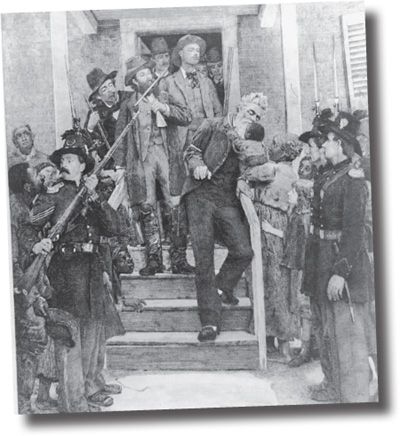
Thomas Hovenden’s ca. 1884 painting sympathetically depicted The Last Moments of John Brown.
1. William Booth Taliaferro (1822–1898) was commander of the Virginia state militia at the time of John Brown’s raid at Harpers Ferry, and later served in the Confederate Army as a brigadier-general.
REPUBLICANS AT COOPER INSTITUTE.
ADDRESS BY HON. ABRAHAM LINCOLN, OF ILLINOIS.
FEBRUARY 28, 1860
The announcement that Hon. ABRAHAM LINCOLN, of Illinois, would deliver an address in Cooper Institute, last evening, drew thither a large and enthusiastic assemblage. Soon after the appointed hour for commencing the proceedings, DAVID DUDLEY FIELD, Esq., arose and nominated as Chairman of the meeting Mr. WILLIAM CULLEN BRYANT.1 The nomination was received with prolonged applause, and was unanimously approved.
Mr. BRYANT, after the applause had subsided, said: It is a grateful office that I perform in introducing to you at this time an eminent citizen of the West, whom you know — whom you have known hitherto — only by fame, and who has consented to address a New-York assemblage this evening. The great West, my friends, is a potent auxiliary in the battle we are fighting, for Freedom against Slavery; in behalf of civilization against barbarism; for the occupation of some of the fairest region of our Continent on which the settlers are now building their cabins. I see a higher and wiser agency than that of man in the causes that have filled with hardy people the vast and fertile regions which form the northern part of the valley of the Mississippi — a race of men who are not ashamed to till their acres with their own hands, and who would be ashamed to subsist on the labor of the slave. [Applause.] These children of the West, my friends, form a living bulwark against the advance of Slavery, and from them is recruited the vanguard of the armies of liberty. [Applause.] One of them will appear before you this evening in person — a gallant soldier of the political campaign of 1856 – [applause] — who then rendered good service to the Republican cause, and who has been since the great champion of that cause in the struggle which took place two years later for the supremacy of the Republicans in the Legislature of Illinois; who took the field against Senator DOUGLAS, and would have won in the conflict but for the unjust provisions of the law of the State, which allowed a minority of the people to elect a majority or the Legislature [Applause.] I have only, my friends, to pronounce the name of ABRAHAM LINCOLN of Illinois – [cheers] — I have only to pronounce his name to secure your profoundest attention. [Prolonged applause, and cheers for LINCOLN.]
Mr. LINCOLN advanced to the desk, and smiling graciously upon his audience, complacently awaited the termination of the cheering and then proceeded with his address as follows:
...Some of you admit that no Republican designedly aided or encouraged the Harper’s Ferry affair; but still insist that our doctrines and deliberations necessarily lead to such results. We do not believe it. We know we hold to no doctrines, and make no declarations, which were not held to and made by our fathers who framed the Government under which we live. You never dealt fairly by us in relation to this affair. When it occurred, some important State elections were near at hand, and you were in evident glee with the belief that, by charging the blame upon us, you could get an advantage of us in those elections. The elections came, and your expectations were not quite fulfilled. Every Republican man knew that, as to himself at least, your charge was a slander, and he was not much inclined by it to cast his vote in your favor. Republican doctrines and declarations are accompanied with a continual protest against any interference whatever with your slaves, or with you about your slaves. Surely, this does not encourage them to revolt. True, we do in common with our fathers, who framed the Government under which we live, declare our belief that Slavery is wrong; but the slaves do not hear us declare even this. For anything we say or do, the slaves would scarcely know there is a Republican Party. I believe they would not, in fact, generally know it but for your misrepresentations of us in their hearing. In your political contests among yourselves, each faction charges the other with sympathy with Black Republicanism; and then, to give point to the charge, defines Black Republicanism to simply be insurrection, blood and thunder among the slaves.
Slave insurrections are no more common now than they were before the Republican Party was organized. What induced the Southampton insurrection, twenty-eight years ago, in which at least three times as many lives were lost as at Harper’s Ferry. You can scarcely stretch your very elastic fancy to the conclusion that Southampton was got up by Black Republicanism. In the present state of things in the United States, I do not think a general, or even a very extensive slave insurrection, is possible. The indispensable concert of action cannot be attained. The slaves have no means of rapid communication; nor can incendiary free men, black or white, supply it. The explosive materials are everywhere in parcels; but there neither are, nor can be supplied, the indispensable connecting trains.
Much is said by Southern people about the affection of slaves for their masters and mistresses; and a part of it, at least, is true. A plot for an Uprising could scarcely be devised and communicated to twenty individuals before some one of them, to save the life of a favorite master or mistress, would divulge it. This is the rule; and the slave-revolution in Hayti was not an exception to it, but a case occurring under peculiar circumstances. The gunpowder plot of British history, though not connected with slaves, was more in point. In that case, only about twenty were admitted to the secret; and yet one of them, in his anxiety to save a friend, betrayed the plot to that friend, and, by consequence, averted the calamity. Occasional poisonings from the kitchen, and open or stealthy assassinations in the field, and local revolts extending to a score or so, will continue to occur as the natural results of Slavery; but no general insurrection of slaves, as I think, can happen in this country for a long time. Whoever much fears, or much hopes, for such an event, will be alike disappointed.
In the language of Mr. JEFFERSON, uttered many years ago, “It is still in our power to direct the process of emancipation, and deportation, peaceably, and in such slow degrees, as that the evil will wear off insensibly; and their places be, pari passu, filled up by free white laborers. If, on the contrary, it is left to force itself on, human nature must shudder at the prospect held up.”
Mr. JEFFERSON did not mean to say, nor do I, that the power of emancipation is in the Federal Government. He spoke of Virginia; and, as to the power of emancipation, I speak of the Slaveholding States only.
The Federal Government, however, as we insist, has the power of restraining the extension of the institution — the power, to insure that a slave insurrection shall never occur on any American soil which is now free from Slavery.
JOHN BROWN’s effort was peculiar. It was not a slave insurrection. It was an attempt by white men to get up a revolt among slaves, in which the slaves refused to participate. In fact, it was so absurd that the slaves, with all their ignorance, saw plainly enough it could succeed. That affair, in its philosophy, corresponds with the many attempts, related in history, at the assassination of kings and emperors. An enthusiast broods over the oppression of a people, till he fancies himself commissioned by Heaven to liberate them. He ventures the attempt, which ends in little else than his own execution. ORSINI’s attempt on LOUIS NAPOLEON, and JOHN BROWN’s attempt at Harper’s Ferry were, in their philosophy, precisely the same. The eagerness to cast blame on old England in the one case, and on New-England in the other, does not disprove the sameness of the two things.
And how much would it avail you, if you could, by the use of JOHN BROWN, HELPER’s book2, and the like, break up the Republican organization? Human action can be modified to some extent, but human nature cannot be changed. There is a judgment and a feeling against Slavery in this nation, which cast at least a million and a half of votes. You cannot destroy that judgment and feeling — that sentiment — by breaking up the political organization which rallies around it. You can scarcely scatter and disperse an army which has been formed into order in the face of your heaviest fire, but if you could, how much would you gain by forcing the sentiment which created it out of the peaceful channel of the ballot-box into some other-channel? What would that other channel probably be? Would the number of John Browns be lessened or enlarged by the operation?
But you will break up the Union, rather than submit to a denial of your Constitutional rights.
That has a somewhat reckless sound; but it would be palliated, if not fully justified, were we proposing, by the mere force of numbers, to deprive you of some right, plainly written down in the Constitution. But we are proposing no such thing.
When you make these declarations, you have a specific and well-understood allusion to an assumed Constitutional right of yours, to take slaves into the Federal Territories, and to hold them there as property. But no such right is specifically written in the Constitution. That instrument is literally silent about any such right. We, on the contrary, deny that such a right has any existence in the Constitution, even by implication.
Your purpose, then, plainly stated, is, that you will destroy the Government, unless you be allowed to construe the Constitution as you please, on all points in dispute between you and us. You will rule or ruin in all events.
This, plainly stated, is your language to us. Perhaps you will say the Supreme Court has decided the disputed Constitutional question in your favor. Not quite so. But, waiving the lawyer’s distinction between dictum and decision, the Court have decided the question for you in a sort of way. The Court have substantially said, it is your Constitutional right to take Slaves into the Federal Territories, and to hold them there as property.
When I say the decision was made in a sort of way, I mean it was made in a divided Court by a bare majority of the Judges, and they not quite agreeing with one another in the reasons for making it; that it is so made as that its avowed supporters disagree with one another about its meaning; and that it was mainly based upon a mistaken statement of fact — the statement in the opinion that “the right of property in a slave is distinctly and expressly affirmed in the Constitution.”
An inspection of the Constitution will show that the right of property in a slave is not distinctly and expressly affirmed in it. Bear in mind the Judges do not pledge their judicial opinion that such right is impliedly affirmed in the Constitution; but they pledge their veracity that it is distinctly and expressly affirmed there — “distinctly” — that is, not mingled with anything else — “expressly” — that is, in words meaning just that, without the aid of any inference, and susceptible of no other meaning.
If they had only pledged their judicial opinion that such right is affirmed in the instrument by implication, it would be open to others to show that neither the word “slave” nor “slavery” is to be found in the Constitution, nor the word “property,” even, in any connection with language alluding to the things slave, or slavery, and that wherever in that instrument the slave is alluded to, he is called a “person;” and wherever his master’s legal right in relation to him is alluded to, it is spoken of as “service or labor due,” as a “debt” payable in service or labor. Also, it would be open to show, by contemporaneous history, that this mode of alluding to slaves and Slavery, instead of speaking of them, was employed on purpose to exclude from the Constitution the idea that there could be property in man.
To show all this is easy and certain.
When this obvious mistake of the Judges shall be brought to their notice, is it not reasonable to expect that they will withdraw the mistaken statement, and reconsider the conclusion based upon it?
And then it is to be remembered that “our fathers, who framed the Government under which we live” — the men who made the Constitution — decided this same constitutional question in our favor, long ago — decided it without a division among themselves, when making the decision; without division among themselves about the meaning of it after it was made, and so far as any evidence is left without basing it upon any mistaken statement of facts.
Under all these circumstances, do you really feel yourselves justified to break up this Government, unless such a Court decision as yours is shall be at once submitted to as a conclusive and final rule of political action?
But you will not abide the election of a Republican President. In that supposed event, you say, you will destroy the Union; and then, you say, the great crime of having destroyed it will be upon us!
That is cool. A highwayman holds a pistol to my ear, and mutters through his teeth, “Stand and deliver, or I shall kill you, and then you will be a murderer!”
To be sure, what the robber demanded of me — my money — was my own; and I had a clear right to keep it; but it was no more my own than my vote is my own; and the threat of death to me, to extort my money, and the threat of destruction to the Union, to extort my vote, can scarcely be distinguished in principle.
A few words now to Republicans. It is exceedingly desirable that all parts of this great Confederacy shall be at peace, and in harmony, one with another. Let us Republicans do our part to have it so. Even though much provoked, let us do nothing through passion and ill temper. Even though the Southern people will not so much as listen to us, let us calmly consider their demands, and yield to them if, in our deliberate view of our duty, we possibly can. Judging by all they say and do, and by the subject and nature of their controversy with us, let us determine, if we can, what will satisfy them.
Will they be satisfied if the Territories be unconditionally surrendered to them? We know they wilt not. In all their present complaints against us, the Territories are scarcely mentioned. Invasions and insurrections are the rage now. Will it satisfy them if, in the future, we have nothing to do with invasions and insurrections? We know it will not. We so know because we know we never had anything to do with invasions and insurrections; and yet this total abstaining does not exempt us from the charge and the denunciation.
The question recurs, what will satisfy them? Simply this: We must not only let them alone, but we must, somehow, convince them that we do let them alone. This, we know by experience, is no easy task. We have been so trying to convince them from the very beginning of our organization, but with no success. In all our platforms and speeches, we have constantly protested our purpose to let them alone; but this has had no tendency to convince them. Alike unavailing to convince them is the fact that they have never detected a man of us in any attempt to disturb them.
These natural and apparently adequate means all failing, what will convince them? This, and this only; cease to call Slavery wrong, and join them in calling it right. All this must be done thoroughly — done in acts as well as in words. Silence will not be tolerated — we must place ourselves avowedly with them DOUGLAS’ new sedition law must be enacted and enforced, suppressing all declarations that Slavery is wrong, whether made in politics, in presses, in pulpits, or in private. We must arrest and return their fugitive slaves with greedy pleasure. We must pull down our Free-State Constitutions. The whole atmosphere must be disinfected from the taint of opposition to Slavery, before they will cease to believe that all their troubles proceed from us.
I am quite aware they do not state their case precisely in this way. Most of them would probably say to us, “Let us alone, do nothing with us, and say what you please about Slavery.” But we do let them alone — have never disturbed them — so that, after all, it is what we say which dissatisfies them. They will continue to accuse us of doing until we cease saying.
I am also aware they have not, as yet, in terms, demanded the overthrow of our Free-State Constitutions. Yet those Constitutions declare the wrong of Slavery, with more solemn emphasis than do all other sayings against it: and when all these other sayings shall have been silenced, the overthrow of these Constitutions will be demanded, and nothing be left to resist the demand. It is nothing to the contrary that they do not demand the whole of this just now. Demanding what they do, and for the reason they do, they can voluntarily stop nowhere short of this consummation. Holding, as they do, that Slavery is morally right, and socially elevating, they cannot cease to demand a full national recognition of it, as a legal right, and a social blessing.
Nor can we justifiably withhold this on any ground save our conviction that Slavery is wrong. If Slavery is right, all words, acts, laws, and Constitutions against it, are themselves wrong, and should be silenced, and swept away. If it is right, we cannot justly object to its nationality — its universality; if it is wrong, they cannot justly insist upon its extension — its enlargement. All they ask, we could readily grant, if we thought Slavery right; all we ask, they could as readily grant, if they thought it wrong. Their thinking it right, and our thinking it wrong, is the precise fact upon which depends the whole controversy. Thinking it right, as they do, they are not to blame for desiring its full recognition, as being right; but thinking it wrong, as we do, can we yield to them? Can we cast our votes with their view, and against our own? In view of our moral, social, and political responsibilities, can we do this?
Wrong as we think Slavery is, we can yet afford to let it alone where it is, because that much is due to the necessity arising from its actual presence in the nation; but can we, while our votes will prevent it, allow it to spread in the National Territories, and to overrun us here in these Free States?
If our sense of duty forbids this, then let us stand by our duty, fearlessly and effectively. Let us be diverted by none of those sophistical contrivances wherewith we are so industriously plied and belabored — contrivances such as groping for some middle ground between the right and the wrong, vain as the search for a man who should be neither a living man nor a dead man — such as a policy of “don’t care” on a question about which all true men do care — such as Union appeals beseeching true Union men to yield to Disunionists, reversing the Divine rule, and calling, not the sinners, but the righteous to repentance — such as invocations of WASHINGTON, imploring men to unsay what WASHINGTON said, and undo what WASHINGTON did.
Neither let us be slandered from our duty by false accusations against us, nor frightened from it by menaces of destruction to the Government, nor of dungeons to ourselves. Let us have faith that right makes might; and in that faith, let us, to the end, dare to do our duty, as we understand it.
When Mr. LINCOLN had concluded his address, during the delivery of which he was frequently applauded, three rousing cheers were given for the orator and the sentiments to which he had given utterance....

Photograph of Abraham Lincoln the day of the Cooper Union speech, New York 1860.

Lincoln’s Cooper Union speech was reprinted and sold thousands of copies.
1. Poet Bryant (1794–1878) was editor of the anti-slavery New York Evening Post.
2. Hinton Rowan Helper (1829–1909), born on a North Carolina plantation, had been denounced in the region as a traitor for writing the 1857 book The Impending Crisis of the South: How to Meet It, in which he argued that slavery doomed the South to an inferior economic position in the growing nation.