
CHAPTER 23
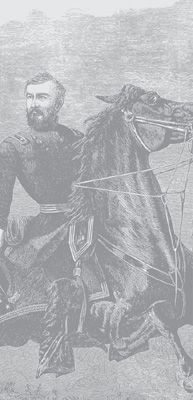
Detail of a print showing Major General Philip Sheridan after the Battle of Fisher’s Hill.
The climactic year of the American Civil War began unfolding in a maelstrom of remarkable events that seemed concurrently to advance the conquest of the South, heighten the quest for an armistice, and widen the embrace of black freedom, all at the price of further bloodshed, devastation, and social upheaval.
In January, William T. Sherman, fresh from his long march from Atlanta to the sea, turned northward toward the Carolinas and resumed his destructive campaign through territory where the rebellion had begun four long years before. Many would observe that Sherman’s army now included regiments of African-American troops, fully engaged in what seemed to be the final chapter of the fight for their own freedom.
In the respective capitals of Washington and Richmond, meanwhile, the Congresses of both the Union and the Confederacy went into session and focused attention on the question of black freedom. In the North, progressives labored to accomplish universally what the Emancipation Proclamation had begun. In the South, legislators considered offering the promise of freedom in exchange for military service, in a rather ironic and desperate attempt to replenish rebel forces. Though generations of Southern leaders had resolutely insisted on the inequality of black men, Confederate leaders now seriously considered conscripting the region’s remaining slaves to fight to preserve the system that kept them in chains. The Confederate Congress did give a belated recognition to Robert E. Lee, making him general-in-chief almost in recognition of his resistance to a defeat that now seemed inevitable. It was a deliberate slight to President Jefferson Davis, who was the constitutional commander-in-chief, but Davis allowed it to stand since it boosted Southern morale at a time when the fortunes of the Southern confederacy were dire. Lee’s great need, however, was not for increased authority but for more men, and there was nowhere else in the shrinking Confederacy to turn for them other than the South’s black population. Indeed, the desperation of the dying Confederacy was nowhere more evident than in the decision by the rebel Congress to accede to Lee’s request that he be allowed to arm some slaves.
Meanwhile, one of the South’s great nemeses, Union general Benjamin F. Butler, lost his command after years of controversial field leadership and military administration. One thing could be said about the Massachusetts-born political general, however: he had consistently advocated for black freedom in all his posts.
When it came, Abraham Lincoln was so jubilant over passage of the Thirteenth Amendment to the Constitution, abolishing slavery everywhere, that he affixed his name to the Congressional resolution that formally sent the proposal to the states for ratification. The law did not require a Presidential signature on such a document, and in an apparent battle for glory and credit, Congress huffily passed an additional resolution criticizing the chief executive for his seeming impertinence. Lincoln hardly noticed the slap. The amendment, he told a throng gathered at the White House to celebrate on February 1, was “a King’s cure for all the evils,” adding: “It winds the whole thing up.”
Not quite. Although Lincoln exulted that the Thirteenth amendment would be “the indispensable adjunct to the consummation of the great game we are playing,” the game had not yet ended. Only a few weeks earlier, in fact, the commander-in-chief had quietly asked General Grant to appoint the President’s 21-year-old son, an officer on his personal staff. Robert had lobbied for years to be allowed to join the Union army, but his mother had opposed it. Now, in the last months of the war, Robert Lincoln got his wish. Like so many fathers in America, the President now had a son in the army.
And the fight did continue, notably under the command of William T. Sherman and his counterparts in the United States Navy. On January 13, with Admiral David Dixon Porter softening the resistance with a mighty fleet of 59 vessels packing more than 600 guns, the Union began an assault on Fort Fisher, which guarded the entrance to the Cape Fear River and access to Wilmington, North Carolina. The strategic Confederate port, the last with direct rail connections to Richmond, fell two days later. The Confederacy’s Vice President, Alexander H. Stephens, called the demoralizing defeat “one of the greatest disasters which had befallen our Cause since the beginning of the war.”
Three weeks afterward, Sherman himself was on the move, and by mid-February he had advanced well into the Carolinas. The relentless Union general captured the South Carolina state capital of Columbia on the 17th, and on the same day Confederate forces abandoned Charleston, the city where the war had begun with the firing on Fort Sumter in 1861. By now the fort, like Confederate dreams of independence, lay pounded into ruins — leveled by a bombardment from Union batteries on Morris Island and by Union vessels offshore.
With a Union victory on the horizon, Lincoln surprised many observers by agreeing to meet a Confederate peace delegation at Fortress Monroe, Virginia, early in February. The conference, also attended by Secretary of State William H. Seward, marked the first, last, and only time Lincoln discussed peace directly with rebel leaders. The conference had been urged and arranged by Francis Preston Blair Sr., who had journeyed to Richmond to ask Jefferson Davis himself to agree to the attempt to end hostilities without further loss of life or property.
Leading the Confederate conferees was Vice President Stephens, Lincoln’s old colleague from their days in the U.S. House of Representatives more than a decade before. Though he harbored few hopes for a negotiated settlement, Lincoln met with Stephens, former Senator Robert T. Hunter, and former Supreme Court Justice John A. Campbell for four hours on February 3 aboard his steamer, the River Queen. The conference went nowhere. The news that Congress had passed the Thirteenth Amendment abolishing slavery put a decisive chill on the discussion. Lincoln insisted that the only way to peace was for the Confederacy to lay down its arms, and Seward made clear that there was no chance of going back on the Emancipation Proclamation. The President did not foreclose the idea of compensating Southerners for lost slaves, but would not yield an inch on restoration of the union. The meetings ended with no resolution.
Once back in Washington, Lincoln acted to settle all lingering questions about whether he was now hoping for an armistice rather than unconditional surrender. At his instruction, Secretary of War Edwin M. Stanton wired Grant in the field: “Nothing transpired, or transpiring with the three gentlemen from Richmond, is to cause any change, hindrance or delay, of our military plans or operations.”
The war would continue awhile longer.
PROGRESS OF THE WAR.
SHERMAN TO GO ON.
JANUARY 9
Events in the Southwest have justified my anticipations (frequently stated in the TIMES) of the important consequences to flow from the advance of our armies from the West. It would have rejoiced the nation to have taken Richmond at any time during the war; but at no time could it have been of half the importance of a continuous march from the West — cutting off the Southwestern States, destroying the lines of communication, practically annihilating the principal resources of the Confederacy, and reducing, not merely Richmond, but what Richmond holds, the rebel Government, to the last extremity. This process has been begun, and partly accomplished, by SHERMAN’s victorious march through Georgia. But it will be far more apparent in what is to follow, if SHERMAN pursues his course, with the military sagacity which has heretofore guided him. His march on the single line of railroad through Branchville, (at any point on it which he may select,) his march on the railroads of North Carolina, and thence on the Roanoke, (at Danville,) utterly destroying all communication between LEE and his supports, are matters of course, unless the rebels can throw an army across his path stronger than that of LEE. How probable that is, we may know by reference to some obvious facts....
Now, in the absence of white men, what is left? Gen. LEE says, arm the slaves. Well, I don’t doubt the slaves will make good soldiers, and with their masters for officers, will remain some time. But there are three things which will end that dream at an early day. First, half the slave country is in our possession, or cut off from the rebel Government; consequently they can get but a comparatively small number of able-bodied men slaves. They will not get as many as we do and it will require several months to discipline them. Secondly, as fast as their slaves are taken prisoners, or can get within our lines, they will never return. Thirdly, the arming of the slaves by the Confederacy will end the last doubt or question upon LINCOLN’s Proclamation of freedom. Slavery is, by the confession and consent of the rebels, ended forever. Then, let them be armed by the South, that the jubilee of freedom may come, and this continent ring with the shouts of universal freedom! Let no man mistake this matter. If the rebels arm slaves, every negro on this continent is free. Nor is this all. We shall sweep the South with the besom of destruction. We shall put such an end to the war that slavery, and Southern rights, and State sovereignty shall be heard of no more in this land. And this was the end to which we were destined from the beginning. Liberty and Union, one and inseparable. A great country cannot be governed and sustained by the miserable dogma of State rights. The country must have a strong Government, founded on the representative principle, centralizing the power of a great nation, and extending its arm of protection to every individual within its vast embrace.
A VETERAN OBSERVER.
SHERMAN AND THOMAS — THE NEW CAMPAIGNS IN THE COTTON STATES.
JANUARY 9
The Richmond Examiner, of Friday last, says it is confirmed that SHERMAN’S troops have crossed the Savannah River and are believed to be marching toward Grahamsville, in the direction of Charleston. The rebels are now as much puzzled in regard to the nature and direction of the next campaign of SHERMAN as they were about his last campaign at the time of its inauguration and during its progress. They know that it must be eastward and northward, as there is no enemy in the whole region west of the Savannah worthy of his attention. But is he going to strike first for Augusta, or for Branchville, or for Charleston? Or, will he adopt his Georgia policy and move his forces so as to appear to be striking for several places in one direction, while his real objective is another place in a different direction? It will be as hard for the rebels to find out as it would be for us to tell; but as the Unionist dispatches from Savannah a few days since announced that “SHERMAN’s army was being rapidly reorganized and reequipped, preparatory to the commencement of a campaign as remarkable as its last,” and, as the rebel dispatches are already beginning to report movements on SHERMAN’s part, of a singularly incomprehensible character, we think it not unlikely that before the close of the present month, they will find out the whole secret of his puzzling plans.
MAJ.-GEN. B.F. BUTLER.
HIS REMOVAL FROM COMMAND.
JANUARY 11
CITY POINT, MONDAY, JAN. 9
SPECIAL DISPATCH TO THE NEW-YORK TIMES.
BUTLER is dethroned — ordered to report at Lowell, and Gen. ORD1 takes his place. R.J.H.
DISPATCH TO THE HERALD.
CITY POINT, SUNDAY, JAN. 8
The news of the President’s Order No. 1, series of 1865, removing Maj.-Gen. BENJAMIN F. BUTLER from the command of the Department of Virginia and North Carolina, is causing much comment, but, so far as I can learn, little or no animadversion.
The ostensible grounds for depriving him of his command are undoubtedly his recent fiascos of Wilmington and Dutch Gap. But a mountain of dissatisfaction has been accumulating against him for months on account of alleged illegal and arbitrary arrests, imprisonments and punishments. It is said that many cases of glaring injustice have come to light, and many others are expected to be developed by his supersedure.
Maj.-Gen. BUTLER is ordered to turn over his command, all moneys and Government properly, and the civil fund in his possession, to the person named by Lieut.-Gen. GRANT as his temporary successor, and to proceed to Lowell. Mass., and to report to the War Department by letter.
Maj.-Gen. EDWARD OTHO CRESSUP ORD, commanding the Twenty-fourth Army Corps, has been named the temporary successor of Gen. BUTLER, and will at once take charge of the department. To the Colored Troops of the Army of the James
In this army you have been treated, not as laborers, but as soldiers. You have shown yourselves worthy of the uniform you wear. The best officers of the Union seek to command you. Your bravery has won the admiration even of those who would be your masters. Your patriotism, fidelity, and courage have illustrated the best qualities of manhood. With the bayonet you have unlocked the iron-barred gates of prejudice, opening new fields of freedom, liberty, and equality of rights to yourselves and your race forever. Comrades of the Army of the James, I bid you farewell, farewell!
BENJAMIN F. BUTLER. MAJ.-GEN.
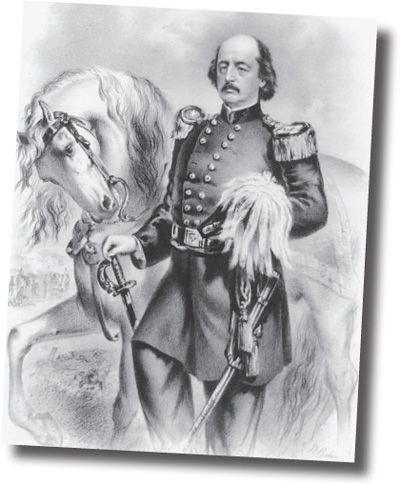
Major General Benjamin Butler, U.S.A.
1. E. O. C. Ord (1818-1883) assumed command this day of the Army of the James and the Department of North Carolina.
LEE AS SOUTHERN DICTATOR — ITS EFFECT ON THE WAR — DRAFTING, VOLUNTEERING AND DODGING AN THE NORTH.
JANUARY 12
IN THE FIELD, BEFORE PETERSBURGH, SUNDAY, JANUARY 1
To the Editor of the New-York Times:
From the straws that have been blown to the North in the blasts of Southern journals, we may infer that JEFFERSON DAVIS, the first President of that sinful conspiracy against human liberty — the Confederacy — may soon voluntarily yield the overwhelming responsibilities of his thankless and dangerous position to ROBERT E. LEE. The failing health of DAVIS, his still more rapidly failing popularity, the constant and increasing dissatisfaction at the unvarying current in the present tide of Southern affairs, may well induce him to pause — even to step aside, and permit his most able and successful General to take his place.
But it cannot be as President that LEE can assume this prominency; it must be by the consenting action of the rebel Congress; and we can well imagine that to some such step as this Mr. FOOTE1 recently alluded in his disaffected speech before the rebel Senate. The South inaugurated this war, not more for separation from the North than to effect an entire change in the nature of its Government. We have often heretofore declared our conviction that republicanism was entirely hateful to the leaders of secession. Their aim was to change existing forms into monarchy, in some shape or other. They have succeeded perfectly in organizing the most complete military despotism the world ever saw. The Southern people are no longer their own masters, or they would long since have overthrown their oppressors; their very slaves are now more free than they. Yet Mr. DAVIS’ despotism has not sufficed for the accomplishment of its avowed end — the procurement of Southern independence. It has not been able even to subdue entirely every expression of dissentient opinion, or to compel to its control every possible element of Southern strength. To effect these, constitutional rights must be put aside, and the fact must be practically enunciated that no dweller within the limits of rebel authority has any longer any rights whatever. This much Mr. FOOTE has foreseen and declared — and he has not been alone in these sentiments.
Hence the possible, if not probable, abandonment of the present form of the Confederate Government, in favor of still greater absolutism.
LEE is by far the most popular man now before the Southern people; he has their perfect respect and confidence; they will look upon him whom their soldiery lovingly style “Uncle ROBERT,” with an affection that will go far toward reconciling them to his extreme supremacy, no matter by what name it may be called.
In such an hypothesis we can see no reason to hope for an earlier peace. It is a measure looking rather to a more energetic prosecution of a game upon which the South has staked its all, and will be played until human passion and human folly shall have been exhausted from the Southern heart. Continually the declaration is reiterated that complete separation is the only and undying aim of the Southern people. Every hope of foreign aid, however slight, has passed away, and they have manfully supported the bitterness of their disappointment. Every prospect of active sympathy from Northern Secessionists has faded from the horizon; yet there is but little practical evidence of despair, and for all material purposes the South is just as resolute, at this moment, as on the day she opened her guns upon Fort Sumter.
There can, indeed, be no peace until the grand design of Providence that underlie all human agencies are fully effected. If this design is not that slavery shall be extirpated, root and branch, we have illy followed the indications of the Almighty will. Slavery is fast perishing from the land, as much by the hands of its own supporters and worshippers as by those of its most bitter enemies. And it would appear that Providence is meeting out to the American nation, North and South, the severest plagues of war as a just punishment for ever having permitted the foul and accursed thing among them. So the war must go on until, in the Divine sight, the great end is attained. And we may safely infer that no such change in the Governmental status of the Confederacy, as is apprehended, can be for the purpose of bringing about a peace. The South is rather girding up her loins for another trial of strength. That strength will be better employed – certainly with the more cordial confidence and cooperation of the people — under LEE than any other leader of whom rebeldom can boast. A soldier is what the South wants. No State craft can do it service. Its best General should be at the head of its affairs, so long as its policy is purely warlike.
1. Confederate Congressman Henry S. Foote (1804–1880) of Virginia, longtime foe of Davis.
WILMINGTON.
FORT FISHER CARRIED BY ASSAULT.
JANUARY 18
WASHINGTON, TUESDAY, JAN. 17 — 10:40 A.M.
Maj.-Gen. J.A. Dix:
The following official dispatches have just been received at this department:
HEADQUARTERS UNITED STATES FORCES ON FEDERAL POINT, N.C., JAN. 15, VIA FORTRESS MONROE, JAN. 17
Brig.-Gen. J.A. Rawlins: GENERAL:
I have the honor to report that Fort Fisher was carried by assault, this afternoon and evening, by Gen. AMES’ division and the Second Brigade of the First Division of the Twenty-fourth Army Corps, gallantly sided by a battalion of marines and seamen from the navy. The assault was preceded by a heavy bombardment from the Federal fleet, and was made at 3:30 P.M., when the First Brigade — CURTISS’, of AMES’ division-effected a lodgment upon the parapet, but full possession of the work was not obtained until 10 P.M. The behavior of both officers and men was most admirable. All the works south of Fort Fisher are now occupied by our troops. We have not less than 1,200 prisoners, including Gen. WHITING and Col. LAMB, the Commandant of the fort. I regret to say that our loss is severe, especially in officers. I am not yet able to form any estimate of the number of casualties.
(SIGNED,) ALFRED H. TERRY,
BREV. MAJ.-GEN., COMMANDING EXPEDITION.

The capture of Fort Fisher.
THE APPOINTMENT OF GENERAL-IN-CHIEF — JEFF. DAVIS VIEWS ON THE MATTER.
JANUARY 28
EXECUTIVE OFFICE, RICHMOND, JAN. 18.
Messrs. James F. Johnson, President pro tem, of Virginia Senate, and Hugh W. Sheffey, Speaker of Virginia House of Delegates.
GENTLEMEN:
I have the honor to acknowledge the receipt of your joint letter of the 17th inst., indorsing a resolution of the General Assembly of Virginia, passed on the 17th inst., and communicated to me in confidence, as directed by the Assembly.
This resolution informs me that, in the opinion of the General Assembly of Virginia, the appointment of Gen. ROBERT E. LEE to the command of all the armies of the Confederate States would promote their efficiency, and operate powerfully to reanimate the spirits of the armies, as well as of the people of the several States, and to inspire increased confidence in the final success of our cause. In your communication you kindly assure me that the General Assembly, with sincere confidence in my patriotic devotion to the welfare of the country, desire in this critical period of our affairs, by such suggestions as occur to them, and by dedication, if need be, of the entire resources of the Commonwealth to common cause, to strengthen my hand and to give success to our struggle for liberty and independence. This assurance is to me the source of the highest gratification, and while conveying to you my thanks for the expression of the confidence of the General Assembly in my sincere devotion to our country and its sacred cause, I must beg permission in return to bear witness to the uncalculating, unhesitating spirit with which Virginia has, from the moment when she first drew the sword, consecrated the blood of her children and all her maternal resources for the achievement of the object of our struggles. The opinion expressed by the General Assembly in regard to Gen. R.E. LEE has my full concurrence. Virginia cannot have higher regard for him, or greater confidence in his character and ability, than is entertained by me. When Gen. LEE took command of the Army of Northern Virginia, he was in command of all the armies of the Confederate States by my order of assignment. He continued in this general command as well as in immediate command of the Army of Northern Virginia as long as I could resist his opinion that it was necessary to him to be relieved from one of these two duties. Ready as he has ever shown himself to be to perform any service that I desired him to render to his country, he left it for me to choose between his withdrawal from command of the army in the field, and relieving him of the general command of all the armies of the Confederate States. It was only when satisfied of the necessity that I came to the conclusion to relieve him from the general command, believing that the safety of the capital and the success of our cause depended in a great measure on their retaining him in command in the field — of the Army of Northern Virginia. On several subsequent occasions the desire on my part to enlarge the sphere of Gen. LEE’s usefulness had led to renewed consideration of the subject, and he has always expressed his inability to assume command of other armies than those now confided to him, unless relieved of the immediate command in the field of that now opposed to Gen. GRANT. In conclusion, I assure the General Assembly that whenever it shall be found practicable by Gen. LEE to assume command of all the armies of the Confederate States without withdrawing him from direct command of the Army of Northern Virginia, I will deem it promotive of the public interests to place him in such command, and will be happy to know that by so doing I am responding to their expressed desires. It will afford me great pleasure to see you, gentlemen, as proposed in your letter, whenever it may be convenient for you to visit me.
I am very respectfully and truly yours.
JEFFERSON DAVIS.

General Robert E. Lee, C.S.A.
GEN. SHERMAN’S ORDER PROVIDING HOMES FOR THE FREED NEGROES.
JANUARY 29
HEADQUARTERS MILITARY DIVISION OF THE
MISSISSIPPI, IN THE FIELD, SAVANNAH, GA.,
JAN. 16
SPECIAL FIELD ORDERS, No. 15.
I. The islands from Charleston south, the abandoned rice fields along the rivers for thirty miles back from the sea and the county bordering the St. John River. Florida, are reserved and set apart for the settlement of the negroes now made free by the acts of war and the proclamation of the President of the Untied States.
II. At Beaufort, Hilton Head, Savannah, Fernandina, St. Augustine and Jacksonville, the blacks may remain in their chosen or accustomed vocations; but on the Islands and in the settlements hereafter to be established, no white person whatever, unless military officers and soldiers detailed for duty, will be permitted to reside; and the sole and exclusive management of affairs will be left to the freed people themselves, subject only to the United States military authority and the acts of Congress. By the laws of war, and orders of the President of the United States, the negro is free, and must be dealt with as such. He cannot be subjected to conscription or forced military service, save by the written orders of the highest military authority of the department, under such regulations as the President or Congress may prescribe. Domestic servants, carpenters, blacksmiths and other mechanics will be free to select their own work and residence; but the young and able-bodied negroes must be encouraged to enlist as soldiers in the service of the United States, to contribute their share toward maintaining their own freedom and securing their rights as citizens of the United States. Negroes so enlisted will be organized into companies, battalions and regiments, under the orders of the United States military authorities, and will be paid, fed and clothed according to law. The bounties paid on enlistment may, with the consent of the recruit, go to assist his family and settlement in procuring agricultural implements, seed, tools, boats, clothing and other articles necessary for their livelihood.
III. Whenever three respectable negroes, heads of families, shall desire to settle on land, and shall have selected for that purpose an island or a locality clearly defined, within the limits above designated, the Inspector of Settlements and Plantations will himself, or by such subordinate officer as he may appoint, give them a license to settle such island or district, and afford them such assistance as he can to enable them to establish a peaceable agricultural settlement, The three parties named will subdivide the land, under the supervision of the inspector, among themselves, and such others as may choose to settle near them, so that each family shall have a plot of not more than forty acres of tillable ground, and when it borders on some water channel, with not more than eight hundred feet front, in the possession of which land the military authorities will afford them protection until such time as they can protect themselves, or until Congress shall regulate their title. The Quartermaster may, on the requisition of the Inspector of Settlements and Plantations, place at the disposal of the Inspector one or more of the captured steamers, to ply between the settlements and one or more of the commercial points heretofore named in orders, to afford the settlers the opportunity to supply their necessary wants, and to sell the products of their land and labor.
IV. Whenever a negro has enlisted in the military service of the United States he may locate his family in any one of the settlements at pleasure, and acquire a homestead and all other rights and privileges of a settler as though present in person. In like manner negroes may settle their families and engage on board the gunboats, or in fishing, or in the navigation of the inland waters, without losing any claim to land or other advantages derived from this system. But no one, unless an actual settler as above defined, or unless absent on Government service, will be entitled to claim any right to land or property in any settlement, by virtue of those orders.
V. In order to carry out this system of settlements a general officer will be detailed as Inspector of Settlements and Plantations, whose duty it shall be to visit the settlements, to regulate their police and general management, and who will furnish personally to each head of a family, subject to the approval of the President of the United States, a possessory title in writing, giving as near as possible the description of boundaries, and who shall adjust all claims or conflicts that may arise under the same, subject to the like approval, treating such titles altogether as possessory. The same general officer will also be charged with the enlistment and organization of the negro recruits, and protecting their interests while so absent from their settlements, and will be governed by the rules and regulations prescribed by the War Department for such purpose....
BY ORDER OF MAJ.-GEN. W.T. SHERMAN.
L.M. DAYTON, MAJOR AND ASSISTANT
ADJT.-GENERAL.
THE ABOLITION OF SLAVERY.
FEBRUARY 1
Congress has decided to submit to the action of the several States an amendment of the Constitution prohibiting slavery forever within the limits or jurisdiction of the United States. The Senate adopted a resolution to this effect at its last session; and the House of Representatives concurred in its passage yesterday, by a vote of 119 ayes to 56 nays. Of those ordinarily and distinctively known as Democrats, there voted for it, Messrs. BAILEY, BALDWIN, COFFROTH, ENGLISH, GANSON, GRISWOLD, HER-RICK, HUTCHINS, KING, MCALLISTER, NELSON, ODELL, RADFORD, ROLLINS, STEELE, WHEELER, YEAMAN. If this amendment is concurred in by the Legislatures in three-fourths of all the States, it will become part of the Constitution. The Union is composed of 36 States; the assent of 27 of these is therefore required for the ratification of this amendment. There is very little doubt that it will receive the prompt assent of the Legislatures of the following States:
Maine, Iowa, New-Hampshire, Wisconsin, Vermont, Minnesota, Massachusetts, Missouri, Connecticut, Kansas, Rhode Island, Nevada, New-York, Oregon, New-Jersey, California, Pennsylvania, Tennessee, Maryland, Arkansas, Ohio, Louisiana, Indiana, Virginia, Illinois, West Virginia, Michigan.
This is the full number required; but it is also probable that Delaware and Kentucky will also vote for the amendment within a year or two at furthest; and as no time is fixed by the Constitution within which the ratification must take place, their votes in its favor will be valid whenever cast.
It has already been objected to this action that it ought not to be taken while the States most directly interested are not in condition to vote upon it. They should have a voice, it is urged, in a measure designed to destroy an enormous interest peculiar to themselves. But it is their own fault that they do not vote, and they have no right to profit by their own wrong. Beside, a still more conclusive answer is found in the fact, that failing to vote is really equivalent to voting against the proposed amendment.
The adoption of this amendment is the most important step ever taken by Congress; and its ratification by the requisite number of States will complete the most important act of internal administration performed by any nation for a hundred years. It perfects the great work of the founders of our Republic. The national feeling was not strong enough to enable them to abolish slavery at the outset of our career; but although slavery has grown in power with gigantic strides since that time, the growth of the sentiment of nationality has outstripped it, and slavery is now abolished, not only without danger to the Union, but as the only means of preserving and making it perpetual. The rebellion, however, is the cause of its abolition. That act of madness and treason touched the very heart of the nation, and aroused to vigorous action the patriotism and national pride of the American people. But for the rebellion slavery would have lasted fifty years — perhaps twice as long — and its destruction, even if it had been achieved by peaceful means, would have cost as much in treasure and in human suffering as the war has involved.
With the passage of this amendment the Republic enters upon a new stage of its great career. It is hereafter to be, what it has never been hitherto, thoroughly democratic — resting on human rights as its basis, and aiming at the greatest good and the highest happiness of all its people.

Celebration on the floor of the House of Representatives following the passage of the Thirteenth Amendment.
THE “SINGLE EYE” ON PRESIDENT LINCOLN.
FEBRUARY 2
The country will be glad to learn that Mr. FERNANDO WOOD, of this city, has introduced a resolution into the House of Representatives to the effect, that it is the duty of the President, under no circumstances, to proffer or accept negotiations which shall admit, by the remotest implication, the existence of any other Federal or Confederate Government within the territory of the United States. The friends of the Union will feel easy, now that they know that Mr. WOOD has his eye on Mr. LINCOLN. The well-known disposition of the President to acknowledge the Confederacy, renders the vigilance of a gentleman like Mr. WOOD, who has been from the outset the uncompromising foe of that institution, and the firm opponent of all attempts to tolerate its existence, peculiarly necessary at this juncture. We are glad to see, also, that Mr. WOOD is of opinion that it is “the duty of the President, in every legal and constitutional manner, to preserve the integrity of the Union.” Should he get this resolution passed, it will then become Mr. LINCOLN’s duty, if he retains a proper respect for Mr. WOOD and for the House, to try the only means of restoring the Union which, we believe, is, in Mr. WOOD’s opinion, either “legal or constitutional,” and that is, asking the revolted States, in a firm and decided manner, whether they are going to come back or not.
The question will probably suggest itself to most people, what will Mr. LINCOLN do, in case they decline to comply with his request. On this point, however, we need not give ourselves any uneasiness, as we believe Mr. WOOD’s resources are not exhausted. He would doubtless, in case of the neglect or refusal of the leaders to heed Mr. LINCOLN’s summons, have a commission appointed to proceed to Richmond and convince them of their mistake by reasoning with them. How long this process might last before it produced any results, it is impossible to say; but it is only the very shallow and flippant who will imagine that this uncertainty about its duration in any way lessens its value. It may last for years, or it may last forever. In the meantime, however, we should have an armistice, and should go on buying and selling, marrying and giving in marriage, as before the war. To the argument that the Confederacy would be all this time virtually independent, the answer is, that this would make no difference as long as we had not acknowledged its independence. If European Powers choose to disgrace themselves eternally by doing so, let them do it. We may rest satisfied that as long as we withhold our recognition, the Confederate leaders would never be able to pluck the rooted sorrow from their brains. DAVIS and STEPHENS are both said to be in delicate health, and there is little doubt that this want of courtesy on our part would kill them. Upon the more robust members of the Confederate Government, the effect of our coolness might not at first be so apparent, but it would surely do its work in the long run on the very healthiest of them. They would pine gradually away, their vitals eaten out by sorrow and disappointment. Neither cotton, nor “niggers,” nor tobacco, would any longer afford them any delight, or change the sorrowful current of their thoughts; and when these things fail to cheer a drooping slaveholder, what is left for him but a premature grave?
THE CONSTITUTIONAL AMENDMENT.
REJOICINGS AND RATIFICATIONS — SERENADE TO THE PRESIDENT.
FEBRUARY 3
WASHINGTON, THURSDAY, FEB. 2
The serenading party, last night, having played several airs before the White House, the President appeared at the centre upper window, under the portico, and was greeted with loud cheers.
The President said he supposed the passage through Congress of the constitutional amendment for the abolishment of slavery throughout the United States, was the occasion to which he was indebted for the honor of this call. [Applause.] The occasion was one of congratulation to the country and to the whole world. But there is a task yet before us — to go forward and consummate by the votes of the States that which Congress so nobly began yesterday. [Applause, and cries, “They will do it,” &c.] He had the honor to inform those present that Illinois had already done the work. [Applause.] Maryland was about half through; but he felt proud that Illinois was a little ahead. He thought this measure was a very fitting, if not an indispensable adjunct to the winding up of the great difficulty. [Applause.] He wished the reunion of all the States perfected and so effected as to remove all causes of disturbance in the future, and to attain this end it was necessary that the original disturbing cause should, if possible, be rooted out....
RATIFICATION BY RHODE ISLAND.
PROVIDENCE, R.I., THURSDAY, FEB. 2
The Rhode Island House of Representatives this morning passed a resolution, approving and adopting the proposed amendment to the United States Constitution. The vote stood 62 yeas against 4 nays.
The House also passed a resolution, requesting the Governor to make an application for the postponement of the draft.
RATIFICATION BY ILLINOIS.
CHICAGO, THURSDAY, FEB. 2
The General Assembly of Illinois yesterday ratified the Constitutional Amendment abolishing slavery. The vote in the Senate stood 18 yeas against 6 nays, and in the House, 48 against 28. Five Democratic Senators voted aye.
REJOICING IN CINCINNATI.
CINCINNATI, THURSDAY, FEB. 2
One hundred guns were fired at Columbus, Ohio, this evening, in honor of the passage of the Constitutional Amendment abolishing slavery.
MASSACHUSETTS REJOICING OVER THE CONSTITUTIONAL AMENDMENT.
BOSTON, THURSDAY, FEB. 2
National salutes were fired to-day in Boston and other cities; and there was also a general ringing of bells throughout the State in honor of the passage of the Constitutional Amendment abolishing slavery throughout the land. A bill was presented in the House this afternoon, ratifying the Constitutional Amendment abolishing slavery, and after a debate it was referred to the Committee on Federal Relations. At the proper time it is presumed the bill will be adopted nearly unanimously.
THE MICHIGAN LEGISLATURE.
DETROIT, MICH., THURSDAY, FEB. 2
The Constitutional Amendment abolishing slavery was ratified by the Legislature this morning.
THE PEACE CONFERENCE.
MOVEMENTS OF THE PRESIDENT.
FEBRUARY 3
SPECIAL DISPATCH TO THE NEW-YORK TIMES.
WASHINGTON, THURSDAY, FEB. 2
Secretary SEWARD, early this morning, telegraphed the President from Fortress Monroe, that his presence was needed immediately. Upon receipt of this dispatch, the President proceeded in a special car to Annapolis, where a Government vessel was awaiting to convey him to Fortress Monroe. Speculation is rife as to the meaning of this departure of the President to confer with the rebel Commissioners. Many infer that it is preliminary to peace; others, again, who are well informed, believe that the entire affair will end, for the present in no adjustment of our national difficulties.
WASHINGTON, THURSDAY, FEB. 2
At 11 o’clock this morning, President LINCOLN left Washington by a special train for Annapolis, at which place he arrived at 2 P.M., and embarked on the steamer Thomas Colyer for Fortress Monroe, which place he will reach at 1 to-morrow morning. Information received from Fortress Monroe to-night states that the Southern Commissioners on Tuesday morning were on board Gen. GRANT’s dispatch-boat, the Mary Martin, awaiting the President’s order as to whether they should proceed to Washington.
THE POPULARITY OF THE CONSTITUTIONAL AMENDMENT.
FEBRUARY 3
The Amendment obtained a majority in the House exceeding expectation. Its popularity, as now manifesting itself through the country, is more surprising yet. It is not only hailed with universal joy by the friends of the Administration, but it receives the willing acceptance, if not the positive favor, of the party which heretofore has stood firmly by every interest of slavery. The “Democracy,” which always before the war rallied with peculiar spirit upon the slavery-protecting sections of the Constitution, and whose great watchword since the war, has been “the Constitution as it is,” now move not a step in earnest, or lift a finger, to save slavery. A certain force of habit causes a portion of them to mouth a phrase or two of dissent, but there is no heart in it. They neither make, nor attempt to make, any serious fight. Whether or not they have the grace to welcome the right, they at least have the sense to recognize the inevitable.
The truth is, that this amendment is merely supplementary work — a form to close up what has already become essentially a finality. It is burying that from which the life has departed, and which stinks in the nostrils. The war had already given slavery its death-wound. What the amendment has to do is only to shovel it under, beyond resurrection.
The Southern people themselves, with all their errors and delusions, do not longer imagine that slavery can be saved. They have gradually come to a full understanding that the institution must come to an end without alternative. They realize that the armies of the “Confederacy” cannot be kept up to the fighting standard without enlisting such numbers of the slaves, and emancipating such numbers of their wives and children, as would make it objectless to try to keep the remainder in bondage. They also are as sensible that slavery could never enjoy peace and security again under a restored Union — that even at best, its existence would be a constant conflict, and an intolerable plague.
The change of feeling here in the North toward slavery since the war commenced is deemed wonderful. All the former charity which so largely prevailed has fallen into unqualified aversion, and all the former aversion has sunk into intensest detestation. All this has been the result of the tremendous attrition of the war — an attrition which has gradually ground to powder every pro-slavery bias here in the North. This effect here is patent to every-body; but we are too apt to make no account of any corresponding change in the South. We easily assume that the Southern people have yet the same intense attachment to slavery that so strongly characterized them at the beginning of the contest. The thing is morally impossible. To suppose it is to suppose the Southern people “stocks and stones,” incapable of all reflection, insensible to all experience. The great fact has been brought home to them, as never before, that the moral sentiment of the world is irreconcilably opposed to slavery. Before the war they had deluded themselves into the belief that the civilized world might be converted to pro-slavery ideas; or, at least, that its interests in the staples produced by slavery would secure a general friendship toward their Government. The matter has been put to a test, and it is found that the European sentiment against slavery is as firmly planted as Gibraltar — that all considerations, whether material or political, in favor of breaking up the American Union, and securing success to the “Confederacy,” are absolutely null before this moral intolerance of what is deemed an outrage upon humanity.
How can it be supposed that a proud people can complacently cling to an institution which thus precludes every helping hand, even in their most trying hour, from those who would fain be their best friends? They may assume very independent tones about it; but it is not in civilized human nature to be insensible to such an alienation from the sympathies of the world. It is not possible for the Southern people to retain their old devotion to slavery, after such a practical realization that slavery puts them under the ban.
It is getting plain to the rebels that their attainment of independence is impossible. The South is daily becoming more and more shut up to the single question, whether to come back to the Union or to consent to foreign connections, which will be equivalent to a foreign protectorate. Slavery has no practical concern in either decision. In all Southern discussions, it is admitted or implied that both alike would involve its abandonment. And what is particularly observable is, that this necessity is nowhere urged as a reason for standing out against either course The great feeling appealed to against returning to the Union, is pride; and the great argument plied is the loss of State rights. The saving of slavery appears to be no longer an object of hope or thought. We have yet to see the first intimation in the Southern press that the prospective passage of the Constitutional amendment destroying slavery forever, is a new motive for remaining out of the Union. It is not recognized as having any bearing upon the question; and its adoption by the loyal States will not retard restoration one instant.
Our State Legislatures, twenty-two of which are now in session, are vieing with each other, in the promptness of their adoption of the Amendment. The ratification of the entire twenty-seven, necessary to give it effect, it is now quite certain, will be secured before the year closes.
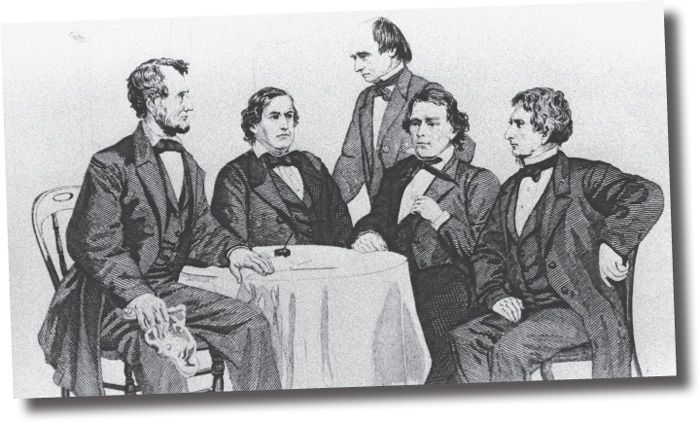
Hampton Roads peace conference members, from left: U.S. President Abraham Lincoln, Confederate Secretary of State Robert Hunter, Confederate Assistant Secretary of War John Campbell, Confederate Vice President Alexander Stephens, U.S. Secretary of State William Seward. This proof edition of a print was never completed and was never issued.
THE PEACE CONFERENCE.
FEBRUARY 4
For the first time since the war commenced we now have what may fairly be called a Peace Conference. Not a word has ever been directly exchanged between our Government and the rebel authorities concerning peace. The little communication which has taken place on the subject has all been the irresponsible work of private parties, officious not official, tolerated rather than sanctioned. It amounted, and in fact could amount, to no more than what was daily uttered by the public press of the two sections — simply restating the issues, and reprotesting a determination to fight it out on those issues to the last extremity. Furnished with no discretion, it could do nothing to adjust. Committing nobody who had any power in the premises, it could elicit nothing upon which official action could be ventured. The most it could do was to stir a little dust. It had no more real effect upon the mighty conflict than the frisking of the field mice in the track of our armies.
But this meeting of President LINCOLN and Secretary SEWARD, with the specially appointed agents of the “Confederate Government,” though informal, and by no means plenipotentiary, has all the essential influence of a veritable Peace Conference. Our Government speaks through its highest embodiment; it is free to give the utmost possible latitude to its inducements in the interests of peace, and to deal directly with all possible apprehensions and objections. Whatever it promises it will make a part of its future policy, and doubtless will be able to carry through successfully, if accepted by the Southern people in good faith. The delegates from the rebel Government, we may take it for granted, are also at liberty to set forth its views without reserve, and to open the way for every practicable movement in the direction of peace. There are no men in the “Confederacy” of greater power, intellectual and moral, than the three who have been charged by JEFF. DAVIS with these responsibilities. There is no reason to believe that anything they recognize, or consent to, will be hereafter dis-avowed, or materially modified, by either the rebel President or the rebel Congress.
Peculiar interest, then, must attach to the conference now going on at Fortress Monroe. But it has been too quickly concluded that a speedy peace is likely to come from it. We have as yet seen nothing to justify any such belief. Certainly our own Government does not go into this conference with any design to concede one iota in respect to the great original requirement of the complete submission of the Southern States and people to the constitutional law of the land. On minor matters it may be prepared to make new advances toward conciliation, but here it must ever stand immovable. It can offer no terms or overtures; can enter into no negotiation, or parleying. Its only language must be that of authoritative demand; its only object unconditional submission. In considering the probabilities of peace, then, the great question is, whether the rebel Government is prepared to yield to this requirement. Will these commissioners assure President LINCOLN that, if he will facilitate, the authorities they represent will open the door for the return of the South, and that the South will use the privilege? Nowhere is there an inkling of any such intention or disposition. Not a syllable in that sense has been uttered, so far as is known, by either the rebel Executive or the rebel Congress, or the leaders of the rebel armies. Though, perhaps, the language in these quarters is not quite so imperious and defiant as it once was, it has not yet disclosed the least purpose, or even admitted the remotest possibility of resuming the old Constitutional relations. If we are to look to the press as an exponent of the spirit which prevails in the rebel capital from which these commissioners make their appearance, the articles which we daily reproduce from the Richmond prints, both friendly and unfriendly to JEFF. DAVIS, sufficiently testify that no purpose of submission is yet entertained. The Sentinel, which is accounted the special organ of DAVIS is as emphatic as the Examiner, his special adversary, in pronouncing all peace impossible which does not involve Confederate independence. It is easy to say that all this vehement language is bluster and buncombe, designed to hide actual wishes and designs. Even were that granted, the existence of a war spirit that must thus be dealt with, would be a fact not very auspicious for the speedy approach of a peace which we could welcome.
If it be asked why JEFF. DAVIS is so ready to send Peace Commissioners to our Government unless he deems peace practicable, it may be answered that this readiness is nothing new, that it is precisely what he has evinced from the beginning. One of the very first acts of the Confederate Government was to send commissioners to Washington to secure peace on the basis of Confederate independence; and again and again it has made attempts, direct and indirect, to accomplish the same thing. Though the rebel ruler must know that such efforts will not and cannot be responded to by our own Government in any way that will suit him, they yet go to silence his opponents, who complain that he trusts everything to arms, and nothing to diplomacy. There is every reason to suppose that this present action is meant by him as a political stroke against his home opponents, and a means of reuniting upon himself the popular favor which he has of late largely lost, rather than a bona fide essay to procure peace on any basis he deems practicable.
We again advise our readers not to be sanguine in anticipating that peace will be hastened by this conference. There is, indeed, a chance that it may be; and in view of the extreme desirableness of the end, President LINCOLN deserves commendation for making the most of that chance. Unquestionably, he will leave nothing unsaid or undone in this business that can contribute to any peace not inconsistent with the principles of the Constitution he has sworn to maintain. But it must not be forgotten that this is the very kind of peace JEFF. DAVIS and all his crew have sworn they will never accept; and that unless he has been converted by the progress of events and the steady advance of the Union armies, to more rational views, we have little to hope from his pacific inclination.
THE CONFERENCE PROBABLY ENDED.
FEBRUARY 4
SPECIAL DISPATCH TO THE NEW-YORK TIMES.
WASHINGTON, FRIDAY, FEB. 3
The extraordinary conference at Fortress Monroe, which for the past two days has fixed the attention of the whole country, has come to a close.
President LINCOLN and Secretary SEWARD are understood to be on their way to Washington, and, doubtless, by this time, Messrs. STEPHENS, HUNTER and CAMPBELL have returned to the rebel capital.
What transpired at this meeting remains, of course, a secret with the participants, and all speculation on the subject is the merest folly. Imagination has in this meeting, its circumstances, and results, ample scope and verge, and conjecture in regard thereto takes here probably much the same diverse directions it does with you. That the conference will result in an immediate cessation of hostilities, is certainly too much to believe; but it would certainly be unwarrantable to predict that it will have proved entirely fruitless.

Abraham Lincoln poses for Alexander Gardner at his final photographic sitting, Washington, February 5, 1865.
PRESIDENT LINCOLN AND THE PEACE CONFERENCE.
FEBRUARY 7
We trust that Senator WADE will sleep better now that the attempt to negotiate a peace has utterly failed. His general temper, never, perhaps, too sweet and gentle, ought to be considerably mollified by the assurance that the war must still go on. In common with a good many other opponents of the Administration, he seems to have been greatly exasperated of late by the efforts of the President to ascertain whether peace was possible without sacrificing the object for which the war is waged — the integrity of the Union. We do not suppose that the result of these endeavors will soften his indignation against Mr. LINCOLN for having made them, but it may do something toward healing the wound which the possibility of peace was likely to make incurable. Mr. WADE, and those who sympathize with him, can rest easy in their minds. There is no immediate danger of peace. It is now quite certain that the rebels are not prepared to surrender. They are preparing to fight with new vigor and to make fresh sacrifices in the attempt to destroy the Union. We shall have more battles, more taxes, more drafts, — quite enough of all, we are sorry to believe, to satisfy the patriotic rapacity even of those who have come to love war for its own sake, because it gratifies certain resentments and hatreds in their natures, which have long since overborne their love of the Union and their regard for the Constitution of our common country.
We saw nothing to approve in the volunteer mission of Mr. BLAIR to Richmond. We objected to that on precisely the grounds which have led us to object to all the volunteer diplomacy which meddlesome busy-bodies have, from time to time, set on foot. All such negotiations, carried on without authority and involving no responsibility, are simply mischievous and discreditable. If there is ever any reason why our Government should make suggestions, invite conferences, or hint at negotiations with the rebel authorities, there is every reason why it should do so through its own agents, acting under its instructions, and saying precisely what it wishes said — nothing less, and nothing more. Any other mode of action subjects the Government to the chances of serious misconstruction, and may lead all parties into very damaging complications.
That we have escaped them in this case, is due far more to the practical good sense of President LINCOLN than to the intervention of Mr. BLAIR, who went to Richmond with full liberty apparently to talk just as he pleased, — to promise, solicit and assert whatever he might deem wise, — it being understood all the time that he could only talk for himself and not at all for the President. But the fact of his being in Richmond carried with it a certain presumption that whatever he might promise, the Government would feel, to a certain extent, bound in honor to fulfill. We had an instance of this at the very outset of the conference. The rebel commissioners insisted on going to Washington, — claiming the fulfillment of Mr. BLAIR’s promise, that they should treat directly with the President. It is clear that one of the leading motives of JEFF. DAVIS in consenting to the appointment of commissioners at all was to secure what was really a tempting opportunity to do a little missionary work at the National Capital. The commissioners selected were precisely the men best fitted to impress favorably the men they counted on meeting. They were men of ability, of large experience, personally acquainted from long residence at Washington with all the prominent politicians of the North, and quite certain to go back thoroughly advised upon all our weak points, and bearing with them renewed assurances of distinguished consideration from the whole brood of sympathizers with the rebel cause. But for Mr. BLAIR’s promise on this point we should probably have had no commissioners from the rebel President, and we are indebted to the sagacity of Mr. LINCOLN for our deliverance from the manifold mischiefs which their appearance in Washington would have involved.
After Mr. BLAIR’s volunteer diplomacy had, to a certain extent, committed the Government to a conference, nothing could be wiser, more patriotic, or more satisfactory, than the course pursued by President LINCOLN. He gave the strongest possible proof of his desire for peace, by meeting personally the rebel commissioners, and by giving the fullest and most liberal consideration to every proposition and suggestion they had to offer. Yet he did not permit them for a single moment to believe, or even suppose, that peace was possible at cost of separation. The integrity of the Union must be preserved, the authority of the Government must be restored. Upon that point he was immovable and inflexible. And that was precisely the point upon which they were not authorized to make any concessions whatever. With them recognition of the independence of the Confederate States was indispensable as a preliminary condition to any negotiation for a close of hostilities.
The conference has had this good result: it has defined anew and made unmistakably clear the exact position of the contending parties. True, it has told us nothing new; but it has told us again, with fresh emphasis and authority, what special efforts at deception were leading many men to doubt, that the South is fighting for independence, and that only by successful war on our part can the Union be maintained. The demonstration thus afforded of this fact ought to unite all men, without distinction of party, in a cordial support of the Government and a vigorous prosecution of the war.
THE PROPOSED FREEDMAN’S BUREAU.
FEBRUARY 7
WASHINGTON D.C., WEDNESDAY, FEB. 1
To the Editor of the New-York Times:
I look with extreme solicitude upon the propositions now being put forward in Congress to place the affairs of the freed-men in Treasury or civil hands.
The reason adduced for such control is startling. It is simply that if the plantations are put in civil control, so the freedman must follow. Was it not just that from which we supposed they were emancipated? They were the subordinates, the appendages of plantations — that was slavery. The interests of the man and of the plantation may be hay, in the nature of the case, are even opposite — just as the interest of buyer and seller are. One wants to buy cheap, the other to sell high. Just so with land and labor. The landed interest would cut off other avenues of labor for its own advantage, and would procure it at the lowest possible rates. Now, can it be safe to put the labor-owning freedmen by legislation into the hands of that landed interest? It does not matter where this interest is vested. Whether in agents of the Government or not, the principle is the same. The two interests ought not, by any means, be put into the same set of hands — much less the men legislated under — into property hands.
Now this principle has full illustration in freed men’s affairs already. For two years the plantation without legislation, has controlled the policy pursued toward the black to his hurt. The wages received by him have seldom done more then support him, while profitable labor was open to him on every hand. But the curse of the plantation system has been that it thrusts the people out of safe places where they could support themselves, and more, to utterly indefensible points along a line of a thousand miles. At these points they have been murdered by scores, captured and resold into slavery by the hundred, while hundreds more have saved themselves by flight and hiding, stripped of all things, and so cast themselves again upon the governmental care.
Aside from this disaster to the blacks, the plantations have furnished thousands of mules and vast supplies of food and clothing and money to the rebel armies. There can be no question of the disaster to the black, and the disgrace to the nation, of the plan hitherto. Beside these points, the plantations became the centre and heart of the whole speculative and trade interest, and of contraband traffic. They lie outside our military lines, are open to the whole rebel country, while free ingress and egress across our lines for persons or supplies must be given. Estimate as best you can, the effect of such an open communication with the rebel territory, and that, too, when, by information of military movements, a man might save his plantation from plunder. There have been several cases of remarkable immunity from harm in most exposed localities.
This plantation reason for putting the blacks into civil hands is remarkable. Wherever the plantations go, there by all means do not let the blacks follow.
The results of such a civil control of the freedmen could not fail to be injurious in this respect. You are aware of the immense pressure of trade and speculative interest through all these regions. It has well nigh overborne military operations. There is to-day danger that we shall be swamped by them. Now these interests on the river make civil control of freedmen their central plan — their pet idea. If they can carry trade interests, control of lands, and control of the race of laborers into civil hands, the military ideas must succumb. You will notice that it is part of every congressional scheme of civil control of freedmen, that the military authorities shall lend their power to the execution of all the plans of the civil agents. When you have set such a scheme afoot, you will no longer have any simple, unadulterated military operation in any quarter. The civil speculative idea has a mortgage on everything — infects, taints — either controls or puts an injunction on every motion of military affairs. I think that these influences have had power enough without the alliance of Congress in this new league. Gentlemen do not appear to perceive it, but to us on the river it is perfectly clear that the question between a military and civil bureau of freedmen’s affairs, as settled by Congress now, is really this: Whether war is our first and supreme work till honorable peace is achieved or not. It is a momentous question, and on it I believe that the fate of armies and campaigns yet depend.
Aside from these considerations which do appear to me weighty, is also this: None but the military arm can protect, control, or see justice done the freedmen while the war lasts. Civil courts either do not exist, or are of the old slave codes, and under them the black is whipped, fined double, convicted without evidence, debarred from the right to testify, has no redress for any wrong. How shall civil agents help them? They are powerless over the old civil process. They are unknown to the military courts. Absolutely there is none but the military power to do anything for or with them. On it the civil agent must depend for the validity and force of every smallest act. What then is the use of such an insertion? If the military officer must do the thing, why not set him at it without putting a shadow between him and his work? Besides, when you have set a civil aged to do the thing, you cannot make the military officer responsible for doing it. You cannot make him do it. Such an attempt will end in conflict, failure, confusion.
Would it not be wiser to take your civil agent and put him in military authority and let him do his own work?
Civil agents, helpless during the war, will only begin to be efficient when the war is over. I suspect after all that this consideration of the hereafter is really the one that recommends to many the scheme. With me it is fatal to it. When the war is over we want no special control of black people. The war power will have to represent the Government until the old codes are rooted out — will have itself to root them out; and when under its supervision the reconstruction is complete and civil affairs in loyal hands, the black man, a free man, with rights, the protection of the courts, and the worth of his labor and his vote, needs no special swaddling. No system of United States officials will need to interpenetrate the State system to take care of him. Indeed, it could not, however much needed. I know of no United States power, outside the courts, which can appear in a State except the military. So long as the freedman needs special protection, the military power will have it to do. The edict of emancipation was a military one, is made effective by military power. The freedmen are gathered in districts under martial law, protected by arms, supplied through army channels. Whatever the Government has done for them has been devised and done by the military authorities, on their own responsibility. Many mistakes have been made, doubtless, but all the experience in actual charge of these people is among military men. All the facts which can guide future operations wisely have been developed under their eyes. No set of men, theorists and lookers-on, are qualified as are they for the work. The most numerous and notable and devoted examples of labor and sacrifice for freedmen are to be found among the officers and men of the army. Witness the work of Gen. SAXTON and his officers, Col. EATON and his, and Gen. THOMAS’ recent order in the Southwest. Is it wise to overset these men, with their practical experience and proven devotion, to put in their places men with theories and no experience, with plans and no power? We have had abundant experience of these theories and plans of lookers-on. Men write letters for information, run through the field, and up and down it for a month or so, and then publish their schemes and notions, get them adopted, and curse the black with them all. It was some such wisdom as that which, against the protest of every practical worker on the Mississippi, put the plantation plan at work last year, and unseated a plan of independent farming by the freed-men, which would have been safe, wise and profitable, and so honorable to the nation. I look with extreme dread upon the projected renewal of the reign of mere theory, especially when the theory is so contrary both to reason and experience as is this of civil control.
F.A.S.
A PEACE POLICY NOW TREASON.
FEBRUARY 7
We have now a right to look for a consolidated support of this war by men of all parties in the North. The peace conference has confirmed beyond all question that there is no alternative to war but disunion. The commissioners of the rebel Government demanded the recognition of its independence as an indispensable preliminary to any negotiation for peace. President LINCOLN in vain exhausted every inducement to bring them to ground where compromise was possible. They would not swerve one hair’s-breadth — in fact could not so move without violating their trust, and at once evoking a repudiation from Richmond. Their directness was honorable. They practiced no reserve or equivocation. They confronted us on their real position at the outset. So far from attempting to deceive, they, from the very beginning, made mistake impossible. No sine qua non was ever more sharply defined, or more positively claimed. It must be met in the same manly spirit. It cannot be yielded to without treason. It cannot be paltered with without imbecility.
From the time this war commenced, we have never for an instant imagined that it could be ended by compromise. The issue was between the life and death of the Union, and between life and death there can be no such thing as compromise. Holding this absolute conviction, we have yet recognized that many good men have believed that the rebellion might be propitiated, and peace promoted, by liberal overtures. It was not difficult to see how such a belief could be honestly entertained. A large portion of our people had been educated to the idea that as the Union was originally created in compromise, and had worked habitually through compromise, the only possible mode of saving it must be by compromise. Within certain limits — as bearing on minor differences — this was all correct enough. Mutual concessions of sentiment and of interest always have been and always will be necessary to the successful working of our federal system. But the mistake of these peace men has lain in not recognizing that, while compromise may be ever so efficacious within its own range, there is an ultimate vital principle in Government to which it cannot apply. A Government, like a man, may give all that it hath for its life; but when the life itself is demanded, and no concession will be taken short of that, it must stop giving. There is no such thing as yielding a part of the life, and reserving a part. The rebellion was an attack upon the life of the Government, and nothing else. From the beginning it has been simply and purely a dis-union movement. Its essential nature, then, precluded the possibility of its being compromised with; and a peace policy, founded on the idea of compromise, could be nothing else than a mockery. But old associations had charmed many with the word compromise, and the delusion clung to them that somehow the rebel spirit could be laid by it. During the Presidential canvass, argument and evidence to the contrary were presented to an extent that should, we think, have convinced them, a hundred times over, of this error. All failed; yet in a vast number of cases, not because the spirit was essentially malignant and factious, but because the power of old association was too strong. But let all that past be forgotten. Whether or not the peace men ought to have been convinced long ago that their object could not be reached by compromise, it is enough that the proof of it now comes to them in a way that permits no doubt.
In the face of this attestation by the rebel Government itself, that it will not negotiate for peace except as an independent Power, every syllable henceforth uttered in favor of negotiation must be taken as a proclamation of sympathy with treason, and its author should suffer the fullest force of public opinion. We hope now to see every peace man of the past, who has preserved one spark of loyalty, come squarely up to the support of the Government, in the most vigorous prosecution of a war, which shall crush what cannot be conciliated. Every loyal sentiment of every shade, throughout the length and breadth of the land, should be consolidated into one overwhelming determination to conquer the peace which baffles all other effort. The fact is patent to everybody that the war has already vastly reduced the strength of the rebellion. This the rebels themselves do not pretend to deny. It requires, then, but a perseverance in the war to exhaust the rebellion altogether. All military authority agrees that a few months, at most, will suffice for this, if the national armies are kept up to their proper standard. In fact, SHERMAN’s last campaign has made it plain to all the world. Let it be honestly accepted, in conjunction with the result of the peace conference, and be resolutely followed up with a universal cooperation in meeting the last call of the Government for more soldiers. Even the most inveterate peace man of the past must admit that if the rebellion must be crushed, the sooner it is done the better.
ARMING SLAVES FOR THE REBEL SERVICE.
FEBRUARY 19
It seems to be more than probable that the rebels will make the experiment of arming at least a small number of their slaves. BENJAMIN1 publicly confesses that the able-bodied white population is used up, and that Richmond must be evacuated unless the negroes be conscripted. Gen. LEE favors the measure the army calls for it, as we may see from the letters from the camps in the Richmond papers; DAVIS has long been an advocate of it. The strong aristocratic slaveholding caste must at length yield, and all its slaves, as well as its children, must be offered a sacrifice to the ambition of DAVIS and the pride of LEE. The so-called Congress, it is true, rejects any comprehensive measures for arming great numbers of slaves; but it allows twenty or thirty thousand to be employed as “pioneers and teamsters.” How long will it take Gen. LEE to make passable soldiers of these pioneers and put them in garrison or on guard at bridges in his rear? Still time flies, and SHERMAN presses steadily on. Whatever regiments are to be drilled for the Spring and Summer campaign, must be drilled now. The area for conscripting the black population diminishes every day; the time for arming and exercising and organizing such a mass of raw troops grows continually shorter. It is not improbable that approaching ruin and the feeling of desperation will finally drive the rebel administration into the forcible conscription of masses of blacks, and the insurgent armies will be reinforced with these unwilling Sepoys.
It will need but this to be the crowning act in the providential drama of retribution on this accursed rebellion, made in the cause of human slavery — that its death-blow should at length be given by its own slaves, madly organized and armed in its defence. Divine justice can have no grander display, than a Slave Confederacy perishing by the hands of its bondmen.

African-American soldiers.
1. Confederate Secretary of State Judah P. Benjamin (1811–1884).
HIGHLY IMPORTANT.
CAPTURE OF COLUMBIA BY GEN. SHERMAN.
FEBRUARY 20
WAR DEPARTMENT, WASHINGTON, D.C.,
FEB. 18.
Major-Gen. Dix:
The announcement of the occupation of Columbia, S.C., by Gen. SHERMAN, and the probable evacuation of Charleston, has been communicated to the department in the following telegram just received from Lieut-Gen. GRANT.
EDWIN M. STANTON, SECRETARY OF WAR.
FIRST DISPATCH FROM GEN. GRANT.
CITY POINT, 4:45 P.M., FEB. 18
Hon. Edwin M. Stanton, War Department: The Richmond Dispatch of this morning says:
SHERMAN entered Columbia yesterday morning and its fall necessitates, it presumes, the fall of Charleston, which it thinks has already been evacuated.
U.S. GRANT, LIEUT-GENERAL.
SECOND DISPATCH FROM GEN. GRANT.
CITY POINT, VA., FEB. 18
Hon. E.M. Stanton, War Department: The following is taken from to-day’s Richmond Dispatch:
THE FALL OF COLUMBIA.
Columbia has fallen. SHERMAN marched into and took possession of the city yesterday morning. The intelligence was communicated yesterday by Gen. BEAUREGARD in an official dispatch. Columbia is situated on the north bank of the Congaree River, just below the confluence of the Saluda and Broad Rivers.
From Gen. BEAUREGARD’s dispatch it appears that on Thursday evening the enemy approached the south bank of the Congaree, and threw a number of shells into the city. During the night they moved up the river, and yesterday morning forded the Saluda and Broad Rivers. Whilst they were crossing these rivers our troops, under Gen. BEAUREGARD, evacuated Columbia. The enemy soon after took possession.
Through private sources we learn that two days ago. when it was decided not to attempt the defence of Columbia, a large quantity of medical stores, which it was thought it was impossible to remove, were destroyed. The female employees of the Treasury Department had been previously sent off to Charlotte, South Carolina, a hundred miles north; of Columbia. We presume the Treasury lithographic establishment was also removed, although as to this we have no positive information.
The fall of Columbia necessitates, we presume, the evacuation of Charleston, which, we think likely, is already on process of evacuation.
It is impossible to say where SHERMAN will next direct his columns. The general opinion is that he will go to Charleston and establish a base there; But we confess that we do not see what need he has of a base. It is to be presumed he is subsisting on the country, and he has had no battle to exhaust his ammunition. Before leaving Savannah he declared his intention to march to Columbia, thence to Augusta, and thence to Charleston. This was uttered as a boast, and to hide his designs. We are disposed to believe that he will next strike at Charlotte, which is a hundred miles north of Columbia, on the Charlotte and Columbia Railroad, or at Florence, S.C., the junction of the Columbia and Wilmington and the Charleston and Wilmington Railroads, some ninety miles east of Columbia.
There was a report yesterday that Augusta had been taken by the enemy. This we do not believe.
We have reason to feel assured that nearly the whole of SHERMAN’s army is at Columbia, and that the report that SCHOFIELD was advancing on Augusta was untrue,
FROM THE RICHMOND WHIG, FEB. 18
The Charleston Mercury, of Saturday, announces a brief suspension of that paper, with a view to its temporary removal to another point. This is rendered necessary by the progress of military events, cutting it off from the mail facilities for distributing its paper to a large portion of its subscribers, while the lack of transportation renders its supply of paper precarious.

General Sherman’s troops watch and celebrate as Columbia, South Carolina, burns.
THE FALL OF WILMINGTON.
FEBRUARY 25
Had any one, at the time of the Presidential election in November last, predicted the military achievements of the three months of Winter, he would have been looked on as a lunatic. The fall of the great rebel strongholds of Wilmington, Charleston and Savannah, the occupation of the Capitals of South Carolina and Georgia, the march of SHERMAN from Chattahoochee to the ocean, and from the ocean to the Great Pedee, the rout and demolition of HOOD’s army, the scatteration of COBB’s forces, the double hegira of HARDEE, the flight of BEAUREGARD, the flight of BRAGG or HOKE, the advance into North Carolina and toward LEE’s rear the possibility of such a speedy achievement of such vast labors — the possibility of such a marvelous and unbroken series of successes, entered into no sane man’s head. But this bold catalogue gives a faint idea of the greatness of the triumphs of the armies of the Union, and the staggering blows and irretrievable damage inflicted upon the rebellious South.
This morning it is Wilmington which we proudly record as being under our flag. Since the fall of Fort Fisher and the subsequent reinforcement of our army, operations have been steadily prosecuted by Gen. SCHOFIELD, looking to the capture of the city. The advance and success of our forces on the 11th, the movement of our troops to the west bank of the Cape Fear River, and the capture of the great earth-work called Fort Anderson on the 19th, rendered the city untenable; and it was almost immediately after the latter event that the rebel garrison decamped, and on Wednesday last — WASHINGTON’s Birthday — our troops entered and took possession of the long-sought prize.
The various and vital bearings of the capture of Wilmington have often been shown. But now, it is of incalculably greater importance than ever it was before, from its relations to the present march and prospective advance of the army of Gen. SHERMAN. The large force of Gen. SCHOFIELD at Wilmington will now be relieved, and the Twenty-third Corps speedily effect a junction with their old comrades under Gen. SHERMAN, with whom they so long campaigned in the Southwest. (On this head, we may note, en passant, that the army of Gen. GILLMORE at Charleston, is now also released to co-operate or combine with SHERMAN.) Whether or not Gen. SHERMAN will now strike in the direction of Wilmington, is a matter about which nothing is known at present; but it is altogether likely that he will concentrate all the forces possible before he makes the grand and final advance, in cooperation with the Army of the Potomac, and under the orders of the Lieutenant-General, upon the rebel capital and LEE’s rebel army.